
Shaker Heights City Zoning Code
TITLE FIVE
Signs, Off-Street Parking, Off-Street Loading, and Landscaping
1250.01 PURPOSE AND SCOPE.
The following sign regulations are established in order to achieve the following purposes:
A. To preserve the non-commercial character of residential neighborhoods, and to provide reasonable yet appropriate conditions for identifying businesses and services rendered in commercial districts by controlling the size, type and design of signs in relation to the type and size of establishment.
B. To reduce traffic hazards by restricting signs and lights which exceed the viewers’ capacity to receive information or which increase the probability of accidents created by distracting attention or obstructing vision.
C. To preserve order and cleanliness, maintain open spaces and avoid the appearance of clutter, protect property values, and prevent nuisances and invitations to vandalism.
D. To protect the public peace, health, safety, welfare, convenience and comfort.
1250.02 HOW SIGNS ARE REGULATED.
Signs shall be constructed and maintained in accordance with the provisions set forth in this Chapter. Signs are regulated by different means, including those enumerated in this section. Each means of regulation has an impact on the design of a sign and the regulations are applied collectively to each sign installation.
A. Other City Codes.
1. All signs shall be constructed, erected and maintained in accordance with the Shaker Heights Building Code.
2. The provisions of this Chapter shall not amend, nor in any way interfere with, other codes, rules or regulations governing traffic signs within the City.
B. Regulations Found Within This Chapter.
1. Classification of Signs. Four classes of signs are regulated by the City: Prohibited, Exempt, Temporary, and those requiring permits. Regulations for each of these are included within this Chapter.
2. Sign Function and Type Regulated by District. Regulations specific to a particular district are included in Section 1250.07, Sign Regulations by District. The zoning districts regulate what sign type may be used in that district. Further limitations to height or sign area may be placed upon signs as part of a particular district’s regulations.
3. Design Characteristics Regulated by Sign Type. Sign Types are regulated in Section 1250. 08, Regulations by Sign Type. Standard requirements for height and sign area are included for each sign type. These regulations may be further altered within districts for specific applications of a particular sign type.
4. Primary and Secondary Signs. Window, projecting and canopy signs, where permitted, may be installed either as primary or secondary signs subject to all the other applicable regulations for such signs. Regulation of the sign and limitations upon other signage are dependent upon whether the sign owner has chosen to install the sign as primary or secondary. Such restrictions are established in Section 1250.08, Regulations by Sign Type.
5. Additional Factors. Certain signs are regulated on the basis of additional factors which are set forth in applicable sections of this Chapter.
1250.03 PROHIBITED AND EXEMPT SIGNAGE.
A. Prohibited Signs. The following signs are prohibited in all districts:
1. Signs painted directly on an exterior wall, fascia, parapet, or chimney of a building or on a fence, except for murals or works of art pursuant to Section 1250.11, Mural or Pictorial Signs, and subject to review by the Architectural Board of Review.
2. Signs which move, or give the appearance of movement. This category includes pennants, banners (except those specifically allowed by Section 1250.04.B.5), streamers, and all other signs which flutter, undulate, swing, rotate, oscillate or otherwise move by natural or artificial means.
3. Signs containing flashing or running lights giving the illusion of movement, including time and temperature devices.
4. Roof signs.
5. Off premises signs.
6. Signs which imitate traffic signs. Signs which use the words “stop”, “look”, “danger”, “go slow”, “caution”, or “warning”, are deemed to be within this category except where such words are part of the name of the business. This category (6) does not include signs which are accessory to parking lots.
7. Portable or wheeled signs.
8. Signs placed on parked vehicles or trailers where the apparent purpose is to advertise a product or to direct people to a business or activity located on the same or nearby property.
9. Motor vehicles whose sole apparent purpose is to advertise business. Motor vehicles engaged in the cartage of goods or the transport of passengers are exempt from this restriction.
10. Signs which contain matter which is untruthful or misleading.
11. Inflatable images such as balloons, beer cans, etc.
12. Pole signs.
13. Signs displayed for pay or other compensation.
(Ord. 04-132. Enacted 11-22-04.)
B. Exempt Signs. The following signs are hereby designated as “exempt signs” and, as such, are subject only to the regulations contained in this Section 1250.03 B.
1. Signs used for safety purposes relative to the repair or maintenance of streets, sidewalks, or utilities in a public right-of-way, provided such signs shall not exceed two (2) square feet in area, unless a greater area is mandated by state law or regulation.
2. Nameplates not to exceed one (1) square foot in area, placed not less than ten (10) feet from any lot line, and pursuant to Section 1315.03 of the Shaker Heights Building Code.
3. Address numbers not to exceed two (2) square feet in area, placed a minimum of ten (10) feet from any lot line, and pursuant to Chapter 1315 of the Shaker Heights Building Code.
4. Paper notices placed on information kiosks maintained by governments.
5. Signs and public notices erected or required by governmental bodies, or authorized for a public purpose by any law, statute or ordinance. Such public signs may be of any type, number, area, height, location, or illumination as authorized by law, statute or ordinance.
6. Public information signs identifying telephones, rest rooms and similar facilities, not to exceed two (2) square feet. Advertising matter is not permitted on such signs. This category (6) does not include parking or driveway signs.
7. “No Parking”, “Will be Towed”, Private Parking”, parking control signs, and fire lane signs, intended to prohibit or impose conditions upon parking pursuant to the Shaker Heights Traffic Code or State Law not to exceed four (4) square feet.
8. Governmental flags. Such flags shall not exceed two (2) in number and twenty-four (24) square feet in area. Additionally, the height of such flags shall not exceed fifteen (15) feet in residential districts and thirty (30) feet in non-residential districts.
9. Memorial plaques and cornerstones not to exceed two (2) square feet in area designed, intended, or used to preserve the memory of a person, place, or event, including landmark plaques and historical plaques which must be constructed of bronze or other incombustible materials and be permanently affixed to the building or premises thereto.
10. Matter appearing on gasoline pumps, newspaper vending boxes and automatic teller machines and other vending machines as purchased or installed.
11. Matter appearing on or adjacent to entry doors including “Push”, “Pull”, “Open” or “Closed” signs, not exceeding one and one half (1 ½) square feet in area per establishment or one per entrance.
12. Matter appearing on display windows or doors to retail or service establishments denoting hours of operation, credit cards accepted, and similar information, not exceeding a cumulative total of one (1) square foot in area per establishment.
13. emporary holiday and festival decorations, with the condition that they do not act as advertisements.
1250.04 TEMPORARY SIGNS.
A temporary sign is a sign which is intended to be displayed for a limited time only. Such signs include real estate availability signs, construction signs, special events signs, holiday decorations, signs and banners announcing grand opening events, and other temporary signs as described herein. Temporary Signs may be permitted in Residential Districts subject only to the provisions contained in Section 1250.04.A, below. Temporary Signs may be permitted in Non-Residential Districts subject only to the provisions contained in Section 1250.04.B, below.
A. Residential Districts. Temporary signs in Residential Districts may be installed as window signs or lawn signs, pursuant to the following:
1. Window Signs. Temporary signs installed as window signs shall be no greater than six (6) square feet in area. The combined total surface area of all temporary window signs shall be no greater than twelve (12) square feet.
2. Lawn Signs.
a. Size. Temporary signs installed as lawn signs shall be no greater than six (6) square feet in area and no greater than four (4) feet in height. The combined total surface area of all temporary lawn signs shall be no greater than twelve (12) square feet.
b. Location. Temporary lawn signs shall be located a minimum of twenty (20) feet from the nearest edge of the sidewalk and shall not be placed within the side-yard setback.
c. Height and Location Exceptions. If, due to the topography, existing foliage, or other similar condition existing as to a particular property, conformance with the size and height regulations set forth herein would impair the visibility of a temporary lawn sign as observed from the street, then the Zoning Administrator may grant exceptions to the size and location regulations above pursuant to the following:
1. The height and area requirements above may be increased by a factor no greater than fifty percent (50%).
2. The lawn sign may be placed within twenty (20) feet of the sidewalk, or within the side-yard setback.
In determining whether to grant an exception, the sole standard to be used by the Zoning Administrator is the visibility of the sign and no sign shall exceed that height, area or distance which is reasonably necessary to render the sign visible when observed from the street.
3. All temporary signs in residential districts shall be displayed no more than forty-five (45) days after placement, after which time they must either be removed or replaced.
B. Commercial Districts.
1. Availability Signs. Availability signs such as “For sale,” “Vacancy,” or “For rent” may be permitted to announce the sale, rental, or lease of the lot where the sign is displayed or to announce the sale, rental or lease of one or more structures or a portion thereof, located on the lot. Such signs may indicate the owner, realty agent, telephone numbers, or “open house” information. Such signs:
a. Shall not exceed twelve (12) square feet in area.
b. Shall be located upon or within any building or portion of building occupied or to be occupied by any single business enterprise.
c. Shall only advertise the rental, lease, or sale of such building or portion thereof.
d. Shall also meet or exceed the front yard setback established within the zoning district, regardless of whether a building is present on the lot.
2. Construction Signs. Construction signs on non-residential property may not exceed thirty-two (32) square feet in area or eight (8) feet in height. Such signs may identify the owner’s name, the architect, the contractors, the financing arrangements, and the purpose for which the project is intended. No products or services may be advertised on construction signs. One (1) construction sign may be placed on each part of the lot or on each face of the building that borders a public street. A minimum setback of ten (10) feet from the property line or the building setback line, whichever is less, is required for any construction sign. A construction sign shall not be erected before construction starts, and it shall be removed within fourteen (14) days after the use commences or construction is completed, whichever occurs first.
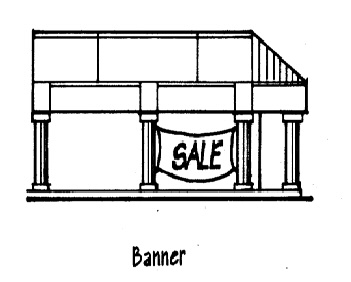
3. Event Signs. Event signs may not exceed a maximum size of six (6) square feet in area, or covering all portions of an existing permitted sign, whichever is greater, and must be located on the premises of the event, excluding any residential use, announcing a campaign, drive or event of a civic, philanthropic, educational or religious organization.
Figure 1250.04.B.3 Banner Sign
 |
4. Holiday Decorations. Holiday decorations displayed in connection with civic, patriotic or religious holidays.
5. Grand Opening Signs. Grand opening signs or banners announce the opening of a business on the premises located in a non-residential zoning district. Such a sign may be displayed for not more than thirty (30) days from the date on which the activity commences, and shall not exceed the requirements applicable for an identification wall sign at the location. Grand opening signs may be installed on the premises only to identify a newly established business which has changed ownership or has newly located on the premises.
6. Temporary Window Signs.
a. Area of Temporary Signs. Except as otherwise provided above, one (1) or more temporary window signs may be displayed on each window of the premises, but the total area of all window signs in any one (1) window shall not exceed ten percent (10%) of the area of that window.
b. Area of all Temporary and Permanent Signs. The combined area of all temporary and permanent window signs in any one (1) window shall not exceed twenty percent (20%) of the area of that window.
c. Time Limit. Temporary window signs in Commercial Districts shall be displayed no more than thirty (30) days after placement, after which time they must either be removed or replaced.
1250.05 SIGNS REQUIRING PERMITS.
Except as otherwise regulated by 1250.03, Prohibited and Exempt Signs, permits are required for the erection of all permanent signs, including identification signs, directory signs, and auxiliary entry signs as permitted by Section 1250.07, Sign Regulations by District. Permits shall be applied for pursuant to all the requirements of this section.
A. Sign Permits Required.
1. From and after the effective date of this Zoning Ordinance, no person may erect, alter or relocate any of the signs listed in Section 1250.07, Sign Regulations by District, except for Temporary Signs, without first obtaining a permit from the Building Commissioner, approval from the Zoning Administrator, and paying the required fee.
2. Routine maintenance or changing parts of a sign shall not be considered an alteration of a sign, provided that the maintenance or change of parts does not alter the type of installation, surface area, height, or otherwise make the sign non-conforming.
B. Electrical Permit Required. In addition to complying with the provisions of this Zoning Ordinance, all signs in which electrical wiring and connections are to be used shall be regulated pursuant to the Shaker Heights Building Code. No illuminated sign may be approved by the Zoning Administrator under this Zoning Ordinance unless and until a permit has been issued by the Building Commissioner and approved by the Zoning Administrator under the procedures provided in the Building Code.
C. Permit Applications. Applications for sign permits shall be made upon forms provided by the Building Commissioner.
D. Issuance of Permits.
1. The applicant shall submit the sign application to the Architectural Board of Review for its review and recommendations pursuant to the procedures and requirements set forth by Chapter 1309 of the Shaker Heights Municipal Code.
2. Upon submission of the application to the Architectural Board of Review, the Zoning Administrator shall review the application and determine if the proposed sign is in full compliance with the conditions of this Zoning Ordinance. If the proposed sign requires a variance or conditional use permit, the Zoning Administrator shall notify the applicant. The applicant shall apply for the necessary approval, and the Zoning Administrator shall process the application according to the requirements established in Chapter 1213, Permit and Administrative Review Procedures, of this Zoning Ordinance.
3. The Building Commissioner, upon receiving notice of the Architectural Board of Review ’s approval, shall review applications for sign permits for completeness. The Building Commissioner shall request any such information considered necessary for the complete and adequate review of a sign permit application.
4. If the proposed sign is in compliance with all the requirements of this Zoning Ordinance and all other applicable ordinances of the City, and has received the signatures of approval from both the Architectural Board of Review and the Zoning Administrator, and upon receipt of the appropriate permit fee, the Building Commissioner shall issue a permit for the proposed sign.
E. Validity of Permit. If the work authorized under a sign permit has not been completed within one (1) year after the date of issuance, the permit shall become null and void.
F. Permit Fee. A fee shall be paid with each application for a sign permit in accord with the current established fee schedule maintained by the Building Commissioner. If an electrical permit is required, an additional fee shall be paid for the cost of the electrical permit according to the established fee schedule maintained by the Building Commissioner.
G. Revocation. All rights and privileges acquired under the provisions of this Zoning Ordinance are mere licenses, revocable at any time by the authority which granted the permit. If the sign permit was granted pursuant to a Conditional Use Permit, then the City Council, on recommendation from the City Planning Commission, may revoke such permit for just cause. If the sign permit was granted pursuant to a Variance, then the Board of Zoning Appeals may revoke such permit for just cause. If just cause for revocation is shown for any other sign permit, the sign permit may be revoked by the Building Commissioner.
Figure 1250.01 Sign Permit Procedure.
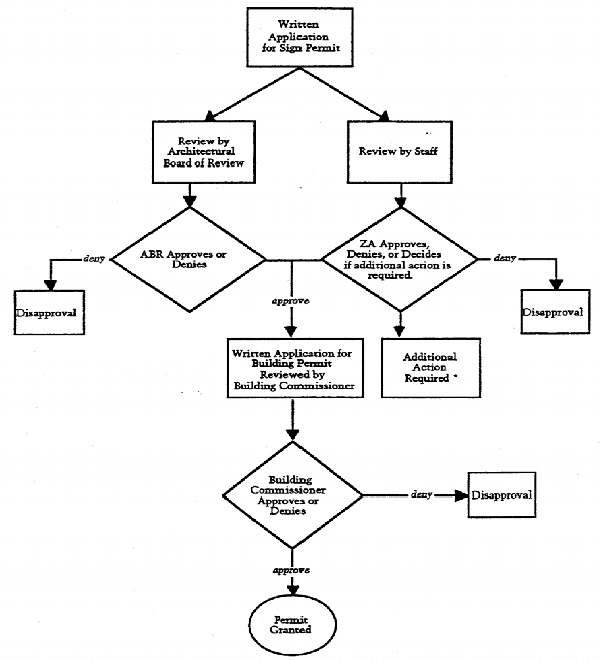 |
*If a Conditional Use Permit is needed, the applicant shall submit an application for such permit to the City Planning Commission. No further action on the sign permit shall be taken until such Conditional Use Permit is approved by the City Planning Commission and City Council. If a Zoning Variance is needed, the applicant shall submit an application for such variance to the Board of Zoning Appeals No further action on the sign permit shall be taken until such variance is approved by the Board of Zoning Appeals.
H. Failure to Obtain Permit. Any person who erects, alters or moves a permanent sign after the effective date of this Zoning Ordinance without obtaining a permit as required by Section 1250.05.A, Sign Permits Required, shall be subject to a penalty and or remedy as provided by Section 1214.05, Penalties and Remedies For Violations.
1250.06 GENERAL SIGN REGULATIONS.
A. Limitations on Location of Signs. All permanent and temporary signs requiring a permit shall be located on the premises they are intended to serve. Such signs shall be located pursuant to the following:
1. No sign shall be located within or shall obstruct the public right-of-way.
2. No sign shall be erected or placed so as to prevent free ingress and egress from any door, window, or fire escape, nor shall such sign be attached to any standpipe or fire escape.
3. No sign shall be erected or placed so as to cover or extend across the architectural elements of the building upon which it is located. Such elements include building cornices, sills, windows, doors, portals, projections or recesses greater than six (6) inches in depth; or piers, pilasters, columns, arches, and fascia. Signs may be placed within the confines of such elements subject to review and approval by the Architectural Board of Review.
B. Calculating Sign Area. Sign area is defined as the area within any perimeter enclosing the limits of lettering, emblems, or other figures on a sign, together with any material or color forming an integral part of the display or used to differentiate the sign from the background on which it is placed. Structural members bearing no sign copy shall not be included in its surface area. In the case of a multifaced sign all sides shall be included in the calculation of surface area.
Figure 1250.06.B Calculating Sign Area
 |
C. Changeable Copy. Changeable copy may be installed pursuant to all the provisions and restrictions set forth below.
1. As Part of a Directory Sign. A directory sign may contain changeable copy, if located within the signable area of the building wall and within six (6) feet of the building entrance door. Letters within the sign shall be no more than four (4) inches in height.
2. As Part of a Multiple-Family Identification Sign. A multiple-family building identification sign may contain changeable copy which is limited to the listing or current rental availability. Such changeable copy shall not exceed three (3) lines of information. Letters within the sign shall be no more than four (4) inches in height.
3. As Part of a Place of Worship Identification Sign. Changeable copy may be permitted as part of a place of worship identification sign whether installed as a monument or wall sign. Letters within the sign shall be no more than four (4) inches in height.
4. As Part of an Automotive Fuel Station Price Sign. Changeable copy may be permitted as part of an Automotive Fuel Station identification sign for the purpose of listing fuel prices. Letters within the sign shall be no more than six (6) inches in height.
D. Illumination of Signs.
1. External Illumination of Signs.
a. Illuminated signs shall be limited to the following:
1. Interior luminous tubes.
2. Enclosed floodlighting using white or daylight gooseneck-type lamps.
3. Backlighting of items of information.
The remaining surface of the sign shall be opaque, and shall not emit light.
b. Whenever external illumination is used for a sign, the source of light shall be located, shielded and directed in such a manner that the light does not shine or cause glare onto any surrounding public street or private residence, pursuant to Section 1260.06, Environmental Performance Standards.
c. Any receptacle or device used to provide external illumination for a wall sign shall not protrude more than twelve (12) inches from the face of the sign.
2. Brightness Limitations
a. In no case shall the lighting intensity of any sign, whether resulting from internal or external illumination, exceed seventy-five (75) foot candles when measured with a standard light meter perpendicular to the face of the sign at a distance equal to the narrowest dimension of the sign.
b. The lighting intensity of all signs is further subject to the provisions regarding glare as set forth in Section 1260.06, Environmental Performance Standards, of this Zoning Ordinance.
3. Hours of Illumination. No sign shall be illuminated between the hours of 2:30 a.m. and 5:00 a.m., unless and to the extent that the activity displaying the sign is open for business during those hours. The Zoning Administrator is authorized to grant an exemption from the provisions of this section to any activity in which illumination of signs during the hours otherwise proscribed is necessary or desirable for the security and safety of the activity or for property in the custody of the activity.
4. Backlit Canopies and Awnings. Backlit canopies or awnings are prohibited.
5. Voltage Plate. All signs in which electrical wiring and connections are to be used shall have affixed thereon a plate showing the voltage of the electrical apparatus used in connection with the sign. This voltage plate shall face away from public view and right-of-way.
E. General Construction and Maintenance Requirements.
1. Construction. All lawn signs shall be designed and constructed to withstand a wind pressure of not less than thirty (30) pounds per square foot of net surface area and to receive dead loads as required in the Shaker Heights Building Code.
2. Fireproof Construction. All permanent signs shall be constructed of non-combustible material.
3. Sharp Projections Restricted. All signs, canopies and awnings which are constructed on, over, or within five (5) feet of a public thoroughfare shall have no nails, tacks, or wires or other hazardous projections protruding therefrom.
4. Use of Glass. Any glass forming a part of any sign shall be safety glass. If any single piece or pane of glass exceeds three (3) square feet, such piece or pane shall be wired glass.
5. Maintenance. All signs, canopies and awnings shall be kept and maintained in a safe, clean and orderly condition and appearance, and shall be repainted or otherwise maintained periodically by the owner to prevent corrosion or deterioration caused by weather, age or any other conditions, and to keep the same in a safe, clean, neat and orderly condition and appearance.
1250.07 SIGN REGULATIONS BY DISTRICT.
A. Sign Regulations in Single- and Two-Family Districts.
1. Purpose. Permitted signs in Single- and Two-Family Residential Districts are intended to provide legible information regarding the location of residences and institutions located within the district, their availability for purchase or lease, to inform the public as to the ownership and access limitations of property, and to describe the activities of institutions and places of worship.
2. Applicability to Zoning Districts. The following regulations pertain to signs located in the SF1, SF2, SF3 and TF Zoning Districts.
3. Primary Signs. Primary signs shall be permitted in Single- and Two-Family Residential Districts pursuant to the following:
a. Permitted. The following primary signs are permitted by right, pursuant to this chapter.
(1) Permanent signs serving residential uses, installed as a window or lawn sign.
(a) Permanent signs serving residential uses, when installed as a window signs, shall be no greater than one (1) square foot in area.
(b) Permanent signs serving residential uses, when installed as a lawn sign, shall be no greater than one (1) square foot in area and no greater than three (3) feet in height.
Such signs shall be located a minimum of fifty (50) feet from the nearest edge of the sidewalk, unless the front yard measured from the building to the edge of the sidewalk is less than fifty (50) feet in which case such signs shall be located within five (5) feet of the front of the building, and such signs shall be positioned within three (3) feet in front of shrubbery of at least equal height as the sign.
No more than two (2) permanent lawn signs are permitted on a property.
(2) Directory signs, used to identify places of worship and schools, and installed as a wall sign. Such signs shall not exceed twenty-four (24) square feet. Directory signs may incorporate changeable copy.
(3) Identification signs used to identify places of worship and schools only, installed as a monument sign, not to exceed twenty-four (24) square feet, and pursuant to 1250.08.B, Regulations Affecting Monument Signs. Such identification signs serving places of worship may incorporate changeable copy.
4. Temporary Signs. Temporary Signs shall be permitted pursuant to Section 1250.04.A, Residential Districts.
5. Signs Approved as Part of a Planned Development. Signs which vary from the regulations of this Chapter may be approved as part of a Planned Unit Development or a Small Lot Infill Development.
B. Sign Regulations In Multiple-Family Residential Districts.
1. Purpose. Permitted signs in Multiple-Family Residential Districts are intended to provide legible information regarding the location of residences and institutions located within the district, their availability for purchase or lease, to inform the public as to the ownership and access limitations of property, and to describe the activities of institutions and places of worship.
2. Applicability to Zoning Districts. The following regulations pertain to signs located in the MF and A zoning districts.
3. Primary Signs. Primary signs shall be permitted in Multiple-Family Residential Districts pursuant to the following:
a. Permitted. The following primary signs are permitted by right, pursuant to this chapter.
(1) Permanent signs serving residential uses, installed as a window or lawn sign.
(a) Permanent signs serving residential uses, when installed as a window signs, shall be no greater than one (1) square foot in area.
(b) Permanent signs serving residential uses, when installed as a lawn sign, shall be no greater than one (1) square foot in area and no greater than three (3) feet in height. Such signs shall be located beyond fifty (50) feet from the nearest edge of the sidewalk, unless the front measured from the building to the edge of the sidewalk is less than fifty (50) feet in which case such signs shall be located within five (5) feet of the front of the building, and such signs shall be positioned within three (3) feet in front of shrubbery of at least equal height as the sign. No more than two (2) permanent lawn signs are permitted on a property.
(2) Identification signs on buildings serving multiple-family or institutional purposes. Identification signs serving places of worship may incorporate changeable copy.
(a) Wall Signs, not to exceed twelve (12) square feet in area, pursuant to 1250.08 A. Regulations Affecting Wall Signs.
(c) Monument sign, not to exceed four (4) feet in height or twenty four (24) square feet, and pursuant to 1250.08 B, Regulations Affecting Monument Signs.
(3) Directory signs, used to identify places of worship and schools.
(a) Wall sign. Such signs shall not exceed twenty four (24) square feet. Directory signs may incorporate changeable copy.
(b) Directory signs used to identify places of worship and schools, installed as a monument sign, not to exceed four (4) feet in height or twenty four (24) square feet, and pursuant to 1250.08 B, Regulations Affecting Monument Signs. Such signs may incorporate changeable copy.
4. Parking Control Signs. Parking Control Signs shall be permitted pursuant to the following:
a. Only one (1) parking control sign is permitted per entry or exit drive serving a parking lot.
b. Such signs shall not exceed a surface area of four (4) square feet and a height of five and one half (5 ½) feet. One sign is required for each ADA parking spot.
c. Such signs shall not contain a business name or logo.
5. Temporary Signs. Temporary Signs shall be permitted pursuant to Section 1250.04.A, Residential Districts.
6. Signs Approved as Part of a Planned Unit Development. Signs which vary from the regulations of this Chapter may be approved as part of a Planned Unit Development.
C. Sign Regulations In Commercial and Office Districts.
1. Purpose. Permitted signs in Commercial Districts are intended to provide legible information regarding the location of businesses, institutions and residences located within the district, their availability for purchase or lease, to inform the public as to the ownership and access limitations of property, and to describe the activities of businesses and institutions.
2. Applicability to Zoning Districts. The following regulations pertain to signs located in the C1, C2, C3, CM, and O Zoning Districts.
3. Primary Signs. Every business establishment shall be permitted one (1) of the following primary sign types for each public right-of-way upon which the property fronts:
a. Permitted. The following primary signs are permitted by right, pursuant to this chapter.
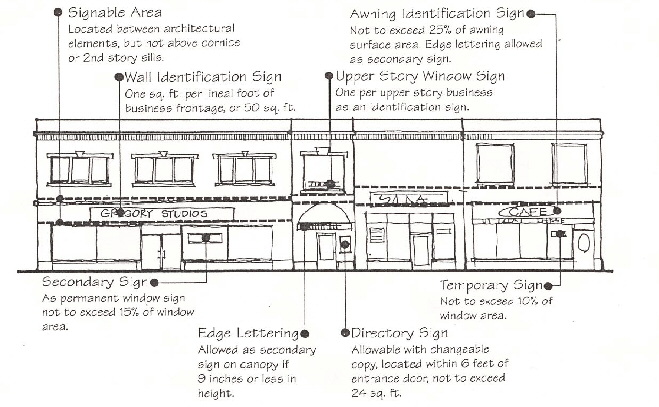
(1) Identification signs, installed as a wall, window, canopy, awning, or monument sign.
(c) Canopy or awning signs are pursuant to 1250.08.D, Regulations Affecting Canopy and Awning Signs.
(2) Directory signs may be used as primary signs to identify upper story business and institutional uses. Such signs shall be installed as a wall sign, not to exceed twenty-four (24) square feet, and located within six (6) feet of the doorway serving such uses. Such signs may incorporate changeable copy.
4. Secondary Signs. Every business establishment shall be permitted one (1) of the following as a Secondary Sign for each public right-of-way upon which the property fronts:
a. Permitted
(1) Window signs, not to exceed six (6) square feet in area or fifteen percent (15%) of the window area, whichever is smaller, and pursuant to 1250.08.C, Regulations Affecting Window Signs.
(2) Canopy or awning signs pursuant to Section 1250.08.D Regulations Affecting Canopy and Awning Signs.
5. Auxiliary Entry Signs. Every business establishment shall be permitted one (1) auxiliary entry sign, installed as a wall sign, no wider than the width of the customer entrance, and not to exceed two (2) feet in height.
Figure 1250.07C Typical Commercial Sign Requirements
 |
6. Parking Control Signs. Parking Control Signs shall be permitted pursuant to the following:
a. Only one (1) parking control sign is permitted per entry or exit drive serving a parking lot.
b. Such signs shall not exceed a surface area of four (4) square feet and a height of five and one half (5 ½) feet. One sign is required for each ADA parking spot.
c. Such signs shall not contain a business name or logo.
8. Signs Approved as Part of a Planned Unit Development. Signs which vary from the regulations of this Chapter may be approved as part of a Planned Unit Development
D. Sign Regulations In Institutional and Park and Recreation Districts.
1. Purpose. Permitted signs in Institutional and Park and Recreation Districts are intended to provide legible information regarding the location of institutions and public facilities located within the district, their availability for purchase or lease, to inform the public as to the ownership and access limitations of property, and to describe the activities thereon.
2. Applicability to Zoning Districts. The following regulations pertain to signs located in the I and PR Zoning Districts.
3. Primary Signs. Every business establishment shall be permitted one (1) of the following as a primary sign for each public right-of-way upon which the property fronts:
a. Permitted. The following primary signs are permitted by right, pursuant to this Chapter.
(1) Identification signs, installed as a wall sign, not to exceed twelve (12) square feet, and pursuant to 1250.08.A, Regulations Affecting Wall Signs.
(2) Directory signs, installed as a wall sign, not to exceed twenty-four (24) square feet, and located within six (6) feet of the doorway serving such uses. Such signs may incorporate changeable copy.
4. Parking Control Signs. Parking Control Signs shall be permitted pursuant to the following:
a. Only one (1) parking control sign is permitted per entry or exit drive serving a parking lot.
b. Such signs shall not exceed a surface area of four (4) square feet and a height of five and one half (5 ½) feet. One sign is required for each ADA parking spot.
c. Such signs shall not contain a business name or logo.
5. Temporary Signs. Temporary signs shall be permitted, pursuant to Section 1250.04, Temporary Signs.
6. Signs Approved as Part of a Planned Unit Development. Signs which vary from the regulations of this Chapter may be approved as part of a Planned Unit Development
(Ord. 18-25. Enacted 4-23-18.)
1250.08 REGULATIONS BY SIGN TYPE.
A. Regulations Affecting Wall Signs.
1. Purpose. The purpose of a wall sign is for identification.
2. Size. The maximum area of wall signs along the frontage of a single business enterprise shall be equal to one (1) square foot of signage for each one (1) lineal foot of building frontage, but shall not exceed fifty (50) square feet nor any greater limitation established in this Chapter. Corner lots may be permitted up to two (2) signs, if each is facing a major street. Each frontage shall be permitted one (1) square foot of signage for each one (1) lineal foot of building frontage, up to a maximum of fifty (50) square feet.
3. Location. Permitted wall signs shall be located and designed subject to the following criteria:
a. Location on Building Facade. A wall sign cannot be located above the cornice line or second floor window line of a building, whichever is lower.
b. Street Frontage Orientation. All wall signs shall be oriented to face the street by being mounted on the building facade generally parallel or perpendicular to the street. Where a property is located on a corner lot, signs may be provided on both streets.
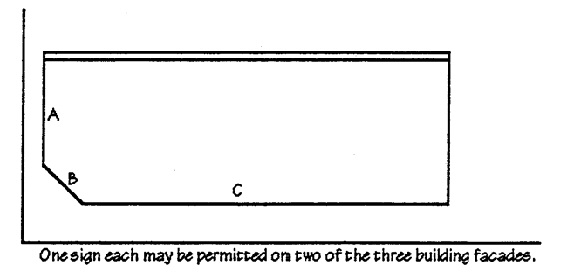
c. Dual Street Frontage Orientation. When a building on a corner lot has a facade which is oriented to the corner, a wall sign may be placed on two (2) of the three (3) façades as illustrated below.
 |
4. Projection. A wall sign shall project no further than twelve (12) inches from the wall on which it is mounted.
B. Regulations Affecting Monument Signs.
1. Purpose. The purpose of a monument sign is identification from a sign on the ground.
Figure 1250.07.B.1 Monument Sign
 |
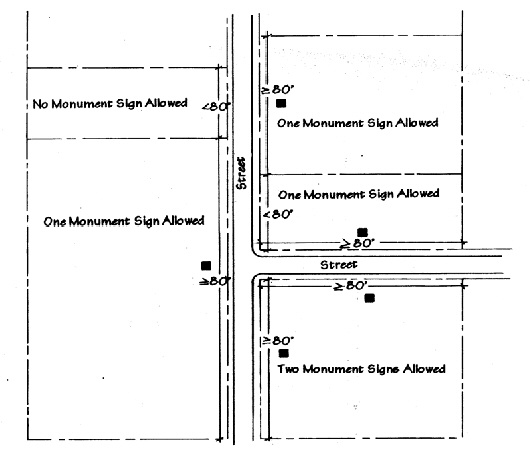
2. Frontage Requirement. No activity may display a monument sign oriented to any street or highway unless the activity has not less than eighty (80) feet of frontage at grade along such street or highway.
Figure 1250.08.B.2 Frontage Requirement for Monument Signs
 |
3. Signable Area.
a. A monument sign may display not more than two (2) signable areas, located on opposite faces of the sign.
b. The maximum permissible area of each single sign face shall not exceed twenty-four (24) square feet.
4. Height. Monument signs shall not exceed five (5) feet in height. Such height includes one (1) foot to be used for the base of the sign.
5. Location.
a. Monument signs shall be located no closer than five (5) feet from the front property line no closer than ten (10) feet to the principal structure and no closer than ten (10) feet to the driveway.
b. The monument sign shall be located outside the visibility triangle established in Section 1260.05, View Obstructions, of this Zoning Ordinance.
c. In determining the appropriate location of a monument sign along the property frontage, a minimum separation of eighty (80) feet from other monument signs shall be maintained.
6. Landscaping. The base of monument signs shall be located in and softened with mostly evergreen landscaping in an amount to be determined by the Zoning Administrator.
7. Special Conditions Affecting Places of Worship. Monument signs for places of worship may incorporate changeable copy. The monument sign must be set back at least twenty-five (25) feet from the adjoining side lot line and front property line or right-of-way.
C. Regulations Affecting Window Signs.
1. Window Signs as a Primary Sign.
a. Upper Story Businesses. Businesses whose only windows are above the first story of a building may display one (1) permanent window sign in one (1) window. The lettering of such sign shall not exceed four (4) inches in height .
b. Ground Floor Businesses. A ground-floor business may display, as its primary sign, one (1) permanent window sign per business, either with or without a separate entry door. Such signs shall be limited in area to one (1) square foot for each lineal foot of building frontage, not to exceed fifty (50) square feet or any greater limitation of this Chapter.
2. Window Signs as a Secondary Sign. Ground floor businesses may also display a window sign as a secondary signs. The placement and design of window signs shall, in addition to all other requirements of this Chapter, be subject to the following:
a. Location of Permanent Window Signs. A permanent window sign must be located on the window and be contained totally within a single window. A sign will also be considered as a window sign if it is located within six (6) feet inside the window.
b. Total Area of Permanent Window Signs. Permanent window signs cannot exceed fifteen percent (15%) of the area of the window through which the sign may be seen or six (6) square feet, whichever is less.
c. Total Area of Temporary Window Signs. A person may display one (1) or more temporary window signs on each window of the premises, but the total area of all window signs in any one (1) window shall not exceed ten percent (10%) of the area of that window. Such temporary window signs shall be displayed for no longer than thirty (30) days, pursuant to Section 1250.04.B.6, Temporary Window Signs.
d. Total Area of All Window Signs. The combined total area of Temporary and Permanent Window Signs shall not exceed twenty percent (20%) of the area of the window through which such signs may be seen.
e. Computation of Coverage. Window panels separated only by mullions shall be considered as one (1) continuous windowpane in the computation of window surface area.
f. Transparency of Sign. Permanent window signs shall be “see-through” with a transparent background.
g. Window Displays. Window displays shall be limited to forty percent (40%) of the window area. No window display located within six (6) feet of the window may be maintained which has the effect of circumventing the intent of this Section 1250.08.C.2, Window Signs as a Secondary Sign. If material purporting to be a window display has such effect, it shall be deemed to be a temporary window sign and not a window display.
D. Regulations Affecting Canopy and Awning Signs.
1. Relationship to Wall Signs. Canopies and awnings may constitute an activity’s primary sign unless an activity displays an identification sign installed as a wall or window sign. However, any activity located in a commercial district may display edge lettering on a canopy or awning as a secondary sign in accordance with the provisions of this section.
2. Coverage Limitations.
a. If canopies and awnings are used to display a primary identification sign, the area of such sign may not exceed twenty-five percent (25%) of the surface of the canopy or awning or six (6) square feet, whichever is less.
b. If canopies and awnings are used as a secondary sign, lettering may be placed on the edge of a canopy or awning hanging perpendicular to the street if the lettering is nine (9) inches or less in height.
3. Location Requirements.
a. No portion of a canopy or awning shall be less than eight and one-half (8 1/2) feet above the level of the sidewalk or other public thoroughfare over which it projects.
b. No portion of a canopy or awning may extend more than five (5) feet from the building facade.
c. No portion of a canopy or awning may be located within the public right-of-way.
4. Additional Review Required. The location, design, and installation of canopies and awnings is subject to the approval of the Architectural Board of Review and the Building Commissioner.
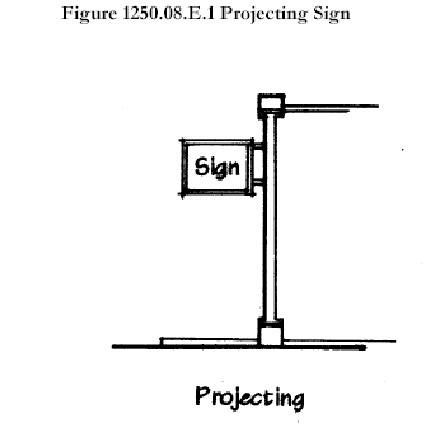
E. Regulations Affecting Projecting Signs.
1. Limited to Use in Local Sign District Regulation. A projecting sign may only be authorized as part of an approved local sign district plan, subject to the procedures and requirements of Section 1250.09, Local Sign District Regulations. A projecting sign may be used only as a secondary sign. Any other use of a projecting sign is prohibited.
 |
2. Cannot Project Above Cornice. No element of an approved projecting sign, including any support structure or cables, shall extend above the cornice line of the building to which it is attached.
3. Location and Spacing of Projecting Signs. The location of a projecting sign and its spacing in relation to any other sign shall be established by the City Planning Commission as part of a Local Sign District plan, and approved as special regulation by the Architectural Board of Review.
4. Maximum Projection of Projecting Signs. Projecting signs shall extend no more than three (3) feet from the facade of the building except as otherwise regulated by the Local Sign District.
5. Maximum Area of Projecting Signs. The maximum area of projecting signs shall be no more than six (6) square feet except as otherwise regulated by the Local Sign District.
1250.09 LOCAL SIGN DISTRICT REGULATIONS.
A. Submission of Local District Regulations to the City Planning Commission. A mixed-use planned development, shopping center or any association of merchants or building owners doing business within a specific area within the City, may establish a set of integrated, project specific regulations for such mixed-use planned development, shopping center or office area. Persons or entities desiring to obtain approval of Local Sign District regulations pursuant to this Section shall submit the regulations to the Department of Planning and Development, together with any additional material requested by the Department.
1. The regulations for the Local Sign District should set forth standards that address permitted sign types, sizes heights, and placement on the site and buildings.
2. A successful set of regulations will integrate all sign types on site in a unified system of materials, colors, shapes, and sizes that are compatible with the architecture and other site elements.
B. Procedure for Approval. The Zoning Administrator shall review the regulations, and applications shall be made to the City Planning Commission for a conditional use permit approval.
C. Conditions for Approval. No local sign regulations will be approved by the City Planning Commission unless the regulations are binding upon all persons or entities in the mixed use planned development, shopping center or office park or the specific area within the City to which the regulations are intended to apply.
(Ord. 18-25. Enacted 4-23-18.)
1250.10 SPECIAL CONDITIONS FOR AUTOMOTIVE FUEL STATIONS.
A. Additional Regulation Necessary. Automotive Fuel Stations are hereby declared to be an activity which requires certain additional regulations regarding signs.
B. Information on Gasoline Pumps. Matter appearing on gasoline pumps as purchased or installed shall not be considered as signs for purposes of this Zoning Ordinance.
C. Price and Service Information at Pump Areas. In addition to all other signs permitted by this Zoning Ordinance, an Automotive Fuel Station may display one (1) sign, not larger than four (4) square feet, above each pump island stating whether the area is a “self service” or “full service” area and the current price per gallon of the gasoline sold at the station. No element of the cost to the customer of the gasoline shall be omitted from statement of the price per gallon.
D. Display of Certain Additional Signs. Automotive Fuel Stations may display the following additional signs without the information contained thereon being treated as items of information: signs showing an affiliation with a motor club signs indicating the acceptance of designated credit cards matters appearing on outdoor vending machines as purchased or installed and price information displayed on monument signs pursuant to Section 1250.06.C Changeable Copy.
1250.11 MURAL OR PICTORIAL SIGNS.
A. Mural or pictorial signs shall not depict any scene or picture containing advertising or commercial aspects.
B. Mural or pictorial signs shall be in proportion with the total area of the structure. Such signs shall complement the building and street where displayed in terms of scale, color, and pattern. No mural or pictorial sign shall be intended, used, or have the effect of shocking the visual coherence of the streetscape.
1250.12 NON-CONFORMING AND UNSAFE SIGNS AND NUISANCES.
A. Non-Conforming Signs Erected With a Permit Are Deemed Conforming. All signs which were installed with a permit prior to the effective date of this Zoning Ordinance shall be deemed conforming with the requirements of this Zoning Ordinance until they become nuisances or unsafe signs as described in subsections E and F below.
B. Special Regulations Regarding Pole Signs. Pole signs in existence on the effective date of this Zoning Ordinance may continue to be displayed for a period of ten (10) years from the effective date of this Zoning Ordinance, or until the sign is damaged or destroyed in excess of twenty percent (20%) of its replacement value.
C. Removal of Signs Erected Without a Permit. Any sign erected without a permit shall be removed within forty-eight (48) hours of receipt of a notice of violation from the Zoning Administrator. If such sign is not removed within such forty-eight (48) hour period, the Zoning Administrator is authorized to cause the sign to be removed. Any expense incident thereto shall be paid by the owner, agent or person having the beneficial use of the building, structure or premises on which the sign is found.
D. Maintenance of Signs Deemed Conforming. Normal maintenance of signs subject to this section, including necessary nonstructural repairs and incidental alterations which do not extend or intensify the non-conforming features of the sign, is permitted. However, no structural alterations, enlargement or extensions shall be made in a sign subject to this Section unless the alteration will result in eliminating the nonconforming features of the sign. If a sign subject to this Section is damaged or destroyed by any means to an extent equal to or exceeding sixty percent (60%) of its replacement value at that time, the sign may not be rebuilt or used thereafter unless it conforms to all of the provisions of this Zoning Ordinance.
E. Signs Deemed Nuisances. Any sign, retractable canopy or awning, whether existing on or erected after the effective date of this Zoning Ordinance, which advertises a business no longer being conducted or a product no longer being sold in or from the premises to which the sign relates, is hereby declared to be a public nuisance and such sign shall be taken down and removed by the owner, agent or person having the beneficial use of the building, structure or premises upon which such sign is found. Removal shall be effected within thirty (30) days after written notice from the Zoning Administrator. If such a sign is not removed after such thirty (30) day period, the Zoning Administrator is authorized to cause the sign to be removed forthwith. Any expense incident thereto shall be paid by the owner, agent or person having the beneficial use of the building, structure or premises on which such sign is found.
F. Unsafe Signs. If the Zoning Administrator or Building Commissioner finds that any sign, retractable canopy or awning is unsafe or insecure, or is a menace to the public, he or she shall give written notice to the person displaying such sign. Correction of the condition which causes the Zoning Administrator to give such notice shall be effected within ten (10) days after receipt of the notice. If such condition is not corrected after such ten (10) day period, the Zoning Administrator is authorized to cause the sign to be removed forthwith at the expense of the person displaying the sign. Notwithstanding the foregoing provisions, the Zoning Administrator is authorized to cause any sign, retractable canopy or awning to be removed summarily and without notice whenever he or she finds that such a sign, canopy or awning is an immediate peril to persons or property.
1251.01 PURPOSE AND SCOPE.
In order to relieve traffic congestion in the streets, to minimize any detrimental effects of off-street parking areas on adjacent properties, and to ensure the proper and uniform development of off-street parking areas throughout the City, off-street parking and loading spaces and driveways for every use shall be provided in accordance with the standards established in this Zoning Ordinance.
1251.02 REQUIRED NUMBER OF OFF-STREET PARKING SPACES.
A. Except as provided elsewhere in this Zoning Ordinance, each principal and accessory use of land shall be provided with the number of off-street parking spaces indicated for that use in Table 1251.02, Schedule of Off-Street Parking Requirements. When the intensity of use of any structure or lot is increased through a change in use or the addition of dwelling units, gross floor area, seating capacity, or other units of measurement used in Table 1251.02, Schedule of Off-Street Parking Requirements, additional parking facilities shall be provided as required for the entire use as increased.
B. Minimum requirements shall be computed per dwelling unit or on the gross square footage of the building or buildings excepting space used exclusively for mechanical equipment necessary for lighting, heating or air conditioning the building.
C. When any calculation results in a fraction of a parking space, any fraction shall be rounded to the nearest whole number.
D. In the event this Zoning Ordinance does not specify the number of parking spaces for a specific use, the Zoning Administrator shall determine the number of spaces required. In making this determination, the Zoning Administrator shall consider the following criteria:
1. The number of off-street parking spaces required for a use listed in Table 1251.02, Schedule of Off-Street Parking Requirements, that is the most similar to the proposed use in terms of the parked vehicles that are anticipated to be generated.
2. The square footage to be occupied by the proposed use.
3. The number of employees and patrons that are anticipated for the proposed use.
1251.03 CREDIT FOR ON-STREET PARKING.
Some or all of the requirements for off-street parking spaces may be met by the provision of onstreet spaces. Such credit shall be calculated by subtracting the number of marked on-street parking spaces abutting the curb of the lot on which the building or use is located. Marked spaces which extend beyond the side property lines of the lot shall not be used in calculating the credit.
1251.04 EXEMPTION FOR PROVISIONS OF REQUIRED OFF-STREET PARKING SPACES.
A. In commercial districts or office districts all business uses in structures erected prior to the date of this Zoning Ordinance shall be exempt from the requirements of Table 1251.02, Schedule of Off-Street Parking Requirements. Notwithstanding the above, no existing off-street parking spaces shall be eliminated from any property in these districts unless the same number of
spaces is provided in accordance with all requirements of this Chapter.
RESIDENTIAL USES | OFF-STREET PARKING SPACES REQUIRED |
Hotel/Motel | One (1) space per guest room plus one (1) space per employee on peak shift. |
Multiple-Family Dwellings and Apartments | One and one-half (1 1/2) spaces per unit, enclosed, and one-half (1/2) space per unit, unenclosed. |
Senior Citizen Apartments | One-half (1/2) of the number required for regular Multiple-Family Dwellings or Apartments. |
Single-Family Attached and Detached Dwellings | Two (2) spaces per unit, enclosed. |
Two-Family Dwellings | Two (2) spaces per unit, of which one and one-half (1 1/2) spaces per unit are enclosed and one-half (½) space per unit is unenclosed. |
Assisted Living Facilities | One (1) space per two (2) beds. |
Banks/Financial/Government offices | One (1) space per two hundred fifty (250) square feet of gross floor area. |
Convalescent, Nursing or Rest Homes | One (1) space per two (2) beds. |
Hospitals | One (1) space per each bed. |
Libraries | One (1) space per three hundred (300) square feet of gross floor area. |
Offices, Business and Professional Services | One (1) space per three hundred (300) square feet of gross floor area. |
Places of worship | One (1) space per four (4) seats in main sanctuary or auditorium plus one (1) space per each three hundred (300) square feet of classrooms and other meeting areas. |
Schools, Specialized Instructional | One (1) space per fifty (50) square feet of classroom area. |
COMMERCIAL/ RETAIL SERVICE USES | OFF-STREET PARKING SPACES REQUIRED |
Assembly and Packaging facilities | One (1) space per five hundred (500) square feet of gross floor area. |
Automotive Fuel Stations | One and one-half (1 1/2) spaces per fuel nozzle and one (1) space per two hundred fifty (250) square feet of retail sales area. |
Automobile Sales | One (1) space per three hundred (300) square feet of indoor display area plus one (1) space per service bay. |
Automobile Repair Facilities | One (1) space per two hundred and fifty (250) square feet of gross floor area. |
Car Washes | Four (4) spaces per bay or stall plus one (1) space per employee plus ten (10) stacking spaces. |
Drive-through Facilities | One (1) space per one hundred (100) square feet of gross floor area plus five (5) stacking spaces for the first drive-through window and two (2) stacking spaces for each additional drive-through window. |
Dry Cleaners and Other Personal Services | One (1) space per two hundred fifty (250) square feet of gross floor area. |
Funeral Homes/Mortuaries | One (1) space per four (4) seats in parlor plus one (1) space per two (2) employees plus one (1) space per vehicle used in connection with the enterprise. |
Furniture/Appliances Stores | One (1) space per five hundred (500) square feet of gross floor area. |
Groceries (Food store) | One (1) space per three hundred (300) square feet of gross floor area. |
Lab or Research Facility | One (1) space per five hundred (500) feet of gross floor area. |
Medical/Dental Clinics | One (1) space per three hundred (300) square feet of gross floor area. |
Restaurants, sit-down | One (1) space per one hundred (100) square feet of gross floor area. |
Restaurants, carry-out | One (1) space per eighty (80) square feet of gross floor area. |
Retail or Service Establishments | One (1) space per two hundred (200) square feet of gross floor area. |
Shopping Centers, Regional | One (1) space per two hundred fifty (250) square feet (more than 100,000 square feet) gross floor area. |
EDUCATIONAL USES | OFF-STREET PARKING SPACES REQUIRED |
Day Care Centers or Homes | One (1) space per two hundred (200) square feet of gross floor area. |
Primary Schools (K-8th grades) | One (1) space per employee plus one (1) visitor’s space per each seventy-five (75) students. |
Secondary Schools (High school) | One (1) space per employee plus one (1) space per eight (8) students. |
Colleges/Universities | One (1) space per two (2) employees plus one (1) space per four (4) students based on maximum capacity. |
CULTURAL/ ENTERTAINMENT USES | OFF-STREET PARKING SPACES REQUIRED |
Amusement Establishments | One (1) space per one hundred (100) square feet of gross floor area. |
Bowling Alleys | Five (5) spaces per lane. |
Clubs/Lodges | One (1) space per two hundred fifty (250) square feet of gross floor area. |
Golf Courses | Five (5) spaces per hole plus one (1) space per two (2) employees. |
Museums/Art Galleries & Artist’s Studios | One (1) space per eight hundred (800) square feet of gross floor area. |
Recreation facilities | One (1) space per two hundred (200) square feet of gross floor area. |
Swimming Pools or Natatorium | One (1) space per one thousand (1,000) square feet of gross floor area. |
Tennis Clubs
|
Four (4) spaces per court.
|
Theaters and Assembly Halls
|
One (1) space per four (4) seats.
|
TRANSPORTATION/ COMMUNICATION | OFF-STREET PARKING SPACES REQUIRED |
Utilities | One (1) space per employee. |
Bus/Rail Facility | One (1) space per four hundred (400) square feet of gross floor area. |
B. When the application of off-street parking regulations results in a requirement of three (3) or fewer spaces on a single zoning lot in a business district, such off-street parking spaces need not be provided. This exemption shall not apply to dwelling units.
1251.05 CALCULATION OF PARKING SPACE REQUIREMENTS FOR MIXED-USE DEVELOPMENT.
In computing required parking spaces, the total number of required spaces shall be based upon the summation of the parking requirements for all the uses on the zoning lot.
1251.06 MIXED USE AND SHARED PARKING.
A. Collective off-street parking facilities for separate uses, except for those in the SF and TF Districts, may be provided if the total number of spaces so provided is not less than the sum of the separate requirements of each such use, and all regulations governing proximity of off-street parking spaces to the use served are adhered to. No parking space or portion thereof shall serve as a required space for more than one (1) use unless approved by the Board of Zoning Appeals.
B. When two (2) or more uses jointly provide off-street parking as provided above, the Board of Zoning Appeals may authorize a reduction in the total number of required off -street
parking spaces, provided their respective hours of operation do not overlap in the manner described in the Schedule of Off-Street Parking Requirements. Reduction of off-street parking shall be subject to the following conditions:
1. A parking plan shall be submitted for approval by the Board of Zoning Appeals which shall show the layout of proposed parking.
2. The property owners involved in the joint use of off-street parking facilities shall submit a legal agreement approved by the Law Director of the City guaranteeing that the off-street parking spaces shall be maintained so long as the use requiring off-street parking is in existence or unless the required parking is provided elsewhere in accordance with the provisions of this Chapter. Such instrument shall be filed with the Zoning Administrator.
1251.07 MOBILITY IMPAIRED ACCESSIBLE SPACES.
The City of Shaker Heights encourages all development within the City which serves the public to provide adequate facilities for accessibility to people with mobility impairments as defined by this Zoning Ordinance and the Americans with Disabilities Act (ADA) of 1990. In accordance with this goal and pursuant to the ADA, accessible parking shall be provided by any building or use initiated after the effective date of this Zoning Ordinance according to the following minimum requirements and any further requirements hereafter adopted by federal, state, or local law. If there are any discrepancies between the provisions of this Zoning Ordinance or any other state or local ordinance and the ADA, then the provisions of the ADA shall apply.
A. Required Spaces. Required mobility impaired accessible and van accessible parking spaces shall be provided in the amount set forth by Tables 1251.07.A, Accessible Parking Space Requirements, and 1251.07.B, Van Accessible Parking Space Requirements. In addition to these requirements, accessible patient parking at outpatient facilities must equal no less than ten percent (10%) of the required parking, and facilities which specialize in treatment or services for persons with mobility impairments must provide accessible parking equaling no less than twenty percent (20%) of the required parking for patient use.
B. Reductions In Accessible Space Requirements Are Prohibited. The required number of mobility impaired accessible parking spaces shall be calculated prior to any applied reduction in parking requirements otherwise approved by the City or provided pursuant to this Zoning Ordinance.
Total Off-Street Parking Spaces Provided | Required Minimum Number of Accessible Parking Spaces |
1 to 25 | 1 |
26 to 50 | 2 |
51 to 75 | 3 |
76 to 100 | 4 |
101 to 150 | 5 |
151 to 200 | 6 |
201 to 300 | 7 |
301 to 400 | 8 |
401 to 500 | 9 |
501 to 1000 | 2% of total number |
over 1000 | 20 plus 1 for each 50 spaces over 1000 spaces |
Accessible Spaces Required | Van Accessible Spaces Required |
1 to 8 | 1 |
9 to 16 | 2 |
17 to 24 | 3 |
25 to 32 | 4 |
33 and over | 1 van accessible space for every 8 accessible spaces |
C. Location Of Accessible Spaces. Each accessible or van accessible parking space shall be located along an accessible route to the building entrance. The minimum width of said accessible route shall be no less than three (3) feet.
D. Access Aisles. All parking lots shall provide access aisles for the mobility impaired within one hundred (100) feet of the entrance to the use served by the parking lot. Such access aisles shall be no less than five (5) feet in width when adjacent to one (1) accessible parking space and no less than eight (8) feet in width when adjacent to van accessible parking spaces. Access aisles may not be obstructed by any curb ramp or wheel stops.
E. Size of Accessible Spaces. Accessible parking spaces shall be a size no less than that required per Section 1251.10, Size of Required Parking Spaces and Aisles. Small car spaces shall not be designated for mobility impaired persons.
F. Maximum Slope. Accessible parking spaces and access aisles shall not exceed a slope of 1:50, and the ramp from the access aisle to the sidewalk or other transition to the principal use shall not exceed a slope of 1:12.
G. Vertical Clearance. Clearance for passenger loading areas and all parking levels which contains weather protected access to the principal use shall maintain an adequate height to permit access to vans used for accessible transit and paratransit. The vertical clearance for accessible parking spaces shall be no less than eight feet two inches (8 ft, 2 in), and the vertical clearance for passenger loading zones shall be no less than nine feet six inches (9 ft, 6 in).
H. Passenger Loading Zones. Passenger loading zones shall provide an access aisle a minimum of twenty (20) feet in length, adjacent and parallel to the vehicle pull up space. If there are curbs between the access aisle and the vehicle pull up space, then a curb ramp shall be provided.
I. Signage And Marking. All accessible spaces shall be designated by the international access symbol. Van accessible spaces will be labeled by both the international access symbol and an additional sign indicating that the space is accessible for vans. Signs shall be placed high enough not to be obscured by parked vehicles. The mobility-impaired symbol shall also be painted on the ground to the rear of the parking space.
1251.08 LOCATION OF PARKING SPACES.
A. No off-street parking is permitted in front of the building setback line.
B. To limit parking in front of single-family and two-family dwellings, parking shall be permitted behind the building setback line. No more than three (3) vehicles may be parked on driveways within front or corner side yards for more than eight (8) continuous hours. In addition, no right-of-way area adjacent to the lot may be used for parking.
C. One (1) outdoor parking space will be permitted in the rear yard of Single- and Two-Family uses of property screened as determined by the Zoning Administrator.
D. Except as provided for below, all required parking spaces shall be located on the same zoning lot as the principal use. In non-residential districts off-site parking may be used to satisfy the parking requirements if such off-site parking facility conforms to the following:
1. Such facility is within three hundred (300) feet walking distance of said structure or use.
2. Such facility is located in a zoning district where such facilities are allowed as a permitted use or conditional use.
3. Such facility is on a lot owned or leased by the same party as the lot on which the structure or use to be served is located.
1251.09 USE OF REQUIRED OFF-STREET PARKING SPACES.
A. Off-street parking spaces required in this Code shall be designed, maintained and used for the exclusive use of the tenants, occupants and customers of the buildings or uses on the site.
B. Off-street parking spaces shall not be offered for use by non-tenants or non-customers of the use, except for the number of spaces which are in excess of the requirement for the use, and where such off-site parking would be permissible in the zone district in which the use is located.
1251.10 SIZE OF REQUIRED PARKING SPACES AND AISLES.
A. The minimum size of off-street parking spaces shall conform to the requirements established on Table 1251.10, Off-Street Parking Dimensions.
B. Any aisle providing access to required parking spaces shall be at least the width designated in Table 1251.10, Off-Street Parking Dimensions, based on the angle of parking provided and whether the aisle serves one (1) or two (2) rows of parking spaces.
C. Enclosed parking spaces shall have a vertical clearance of at least seven (7) feet.
1251.11 DRIVEWAYS AND ACCESS.
A. General. The location, width and number of driveways serving off-street parking, off-street loading, distance from intersections, and garages shall be planned so as to minimize interference with the use of adjacent properties and the public rights-of-way. All curb cuts on a public street for driveway entrances shall have the approval of the Zoning Administrator or the Council Safety Committee.
B. Width.
1. Entrance driveways for Single- and Two-Family residential uses shall be a maximum of twelve (12) feet and a minimum of eight (8) feet in width.
2. Driveways for all uses except for those in the SF and TF Districts shall be limited to the following unless recommended otherwise by the City Planning Commission or the Council Safety Committee:
a. One-way driveways shall be limited to one (1) lane measuring twelve (12) feet at the sidewalk line.
b. Two-way driveways shall be limited to two (2) lanes, measuring a total of twenty-four (24) feet at the sidewalk line.
c. A controlled three (3) lane drive consisting of one (1) left turn exit, one (1) right turn exit, and one (1) entrance lane may be developed if required for safe traffic movement and if the entrance lane and exit lanes are divided by a landscaped curb island no less than five (5) feet in width.
C. Angle of Intersection. Except in SF or TF districts, the angle of intersection between the driveway and the street shall be between sixty (60) and ninety (90) degrees. The radii of the edge of the driveway apron shall be at least twenty-five (25) feet so that a car entering or leaving may not obstruct vehicles in other traffic lanes in the driveway or the curb lane of the street.
Table 1251.10. Off-Street Parking Dimensions (in feet)

Parking Angle | Parking Space Width (W) | Parking Space Length (L) | Aisle Width (A) | Single Loaded Module Width (SL) | Double Loaded Module Width (DL) |
0° | 9.0 | 21.0 | 18.0/22.0* | 26.5/30.5* | 29.0/39.0* |
45° | 9.0 | 18.0 | 18.0 | 31.25 | 48.5 |
60° | 9.0 | 18.0 | 18.0 | 32.25 | 51.25 |
90° | 9.0 | 18.0 | 22.0 | 40.0* | 58.0* |
* Two-Way Traffic Authorized | |||||
Note: Required parking for stall angles other than those contained in the above table may be interpolated from the table.
D. Driveway Parking Prohibited Except in Residential Districts. Except in residential districts, parking in driveways connecting the public right-of-way with a parking area or garage shall not be permitted on or adjacent to the driveway. However, no parking shall be allowed in front of the front building setback line in any district.
E. Design of Circular Driveways. Circular drives may be installed where a lot is at least one hundred (100) feet in width. The driveway lane shall be a maximum of twelve (12) feet in width. The drive shall be landscaped with evergreen plantings pursuant to the approval of the Zoning Administrator.
F. Review of Landscape Plan. Landscape plans pursuant to Chapter 1253, Landscape and Screening Requirements, shall be submitted for site plan review and shall be approved upon the finding that landscaping plans are adequate to properly screen off-street parking areas from neighboring properties so as to reduce nuisances from lights and noise.
G. Emergency Access. Emergency fire lanes shall be provided as required by the Chief of the Fire Department. Where such are required, no less than three (3) sides of all buildings shall be accessible by all fire equipment of the City. Such fire lanes shall be designed with sufficient bearing capacity to withstand the weight of all city fire equipment and shall be designed to allow continuous forward movement of vehicles.
H. Landscape Parking Prohibited. Parking is prohibited on landscaped areas and any area not constructed of a paved, dustless surface.
I. Through Driveways Prohibited. Single and Two-family residential driveways cannot cut across property lines to create a through driveway except for duplex and single-family attached properties.
1251.12 DESIGN AND MAINTENANCE.
A. Non-residential off-street parking facilities may be open to the sky or enclosed in a building.
B. A required off-street parking space shall open directly upon an aisle or driveway. All off-street parking facilities shall be provided with appropriate means of vehicular access to a public street.
C. All open, off-street parking areas, including driveways for residential dwellings, shall be improved with a paved dustless surface, in accordance with the standards established in the Building Code of the City. Gravel is specifically prohibited as a parking or driveway surface.
D. All open, off-street parking areas, excluding single and two-family dwellings, containing more than four (4) parking spaces shall be striped and shall include wheelstops of portland cement concrete curbing not less than six (6) inches in height, and shall be placed two (2) feet into the required length of the space. Wheelstops may be replaced by a curb constructed within the parking aisles. A six (6) inch curb and sidewalk shall be placed at the perimeters of the parking lot rather than the concrete wheelstops.
E. Required off-street parking facilities shall be solely for the parking of automobiles of patrons, occupants or employees. When bus transportation is provided for patrons, occupants or employees of a specific establishment, or when the use is a public assembly use such as in an
auditorium or place of worship, additional open or enclosed off-street parking spaces for each bus to be parked on the premises shall be provided.
F. Cars awaiting repair in Automotive Fuel Stations may be stored on-site no longer than thirty (30) days.
G. No motor vehicle repair work, other than emergency repairs, shall be permitted in unenclosed off-street parking areas.
H. Landscaped areas provided in a parking area shall be provided pursuant to Section 1253.08.C, Interior Parking Lot Landscaping.
I. Parking areas and access driveways shall be so graded and drained as to dispose of all surface water and drainage into proper storm sewer outlets and so that such water and drainage does not flow across a public sidewalk or onto adjacent properties.
J. All parking lots shall be illuminated as needed to accommodate public safety in relation to the use being served. Such lighting shall be composed of ornamental light posts, wired internally and underground.
K. Illumination of an off-street parking area shall be arranged so as not to reflect direct rays of light into adjacent residential districts and streets. In no case shall such lighting cause more than one (1) footcandle of light to fall on adjacent properties as measured horizontally at the lot line. Shields shall be used where necessary to prevent exposure of adjacent properties. Lighting shall conform with Section 1260.06, Environmental Performance Standards.
L. Any wall, fence or landscaping provided shall be adequately protected from damage by vehicles using the parking lot and shall be properly maintained and kept in good repair at all times.
1251.13 BICYCLE PARKING FACILITIES.
New public, hospital, university or college buildings, and shopping centers shall provide bicycle parking facilities. The number and size of such facilities shall be established through site plan review but shall be no less than one (1) bicycle space for every twenty (20) automobile spaces.
1251.14 PARKING LOT LANDSCAPING AND BUFFERING REQUIREMENTS.
Off-street parking areas shall be separated from the street and from abutting properties and landscaped in accordance with the requirements of Chapter 1253, Landscaping and Screening and Requirements.
1252.01 GENERAL REQUIREMENTS.
A. Location and Screening. All required off-street loading berths shall be located on the same zoning lot as the use served. All motor vehicle off-street loading berths in a residential district or the “O” Office district shall be screened by building walls, or by a uniformly finished solid non-combustible fence, wall, or door, or densely planted mature shrubbery or any combination thereof, not less than six (6) feet in height. Loading berths in other districts which abut property in the above mentioned districts or are separated from such district by a public right-of-way, shall likewise be screened from view from such abutting property. In all districts, no loading berths shall be located in a required front, corner side or side yard. Loading berths located in a required rear yard may be open to the sky.
B. Size. This Zoning Ordinance provides for two (2) sizes of loading berths, short berths and long berths. The number of loading berths required, whether short or long berths, is identified in Table 1252.02, Schedule of Off-Street Loading Requirements. The vertical clearance of all berths shall be not less than fifteen (15) feet. The size of short and long loading berths shall
conform to the following:
1. Short Berths. The size of berths, maneuvering aprons, and access aisles shall be as follows:
a. Berth Size. Short berths shall have a minimum width of twelve (12) feet and a minimum length of thirty-five (35) feet.
b. Maneuvering Apron. A maneuvering apron of forty-five (45) feet shall be provided.
c. Access Aisles. A width of at least eighteen (18) feet shall be provided for one-way aisles and twenty-four (24) feet for two-way aisles.
2. Long Berths. The size of berths, maneuvering aprons, and access aisles shall be as follows:
a. Berth Size. Long berths shall have a minimum width of twelve (12) feet and a minimum length of fifty (50) feet.
b. Maneuvering Apron. A maneuvering apron of sixty (60) feet shall be provided.
c. Access Aisles. A width of at least eighteen (18) feet shall be provided for one-way aisles and twenty-four (24) feet for two-way aisles.
C. Access. Each required off-street loading berth shall be designed with appropriate means of vehicular access to a street or alley in a manner which will least interfere with traffic movement, and which will not restrict the access of surrounding uses, and shall be subject to approval by the Zoning Administrator.
D. Surfacing. All open off-street loading berths shall be paved with asphalt, concrete or other dustless allweather material capable of bearing a live load of two hundred (200) pounds per square foot. Gravel is not permitted as a surfacing material.
E. Repair and Service. No motor vehicle repair work or service of any kind shall be permitted accessory to off-street loading facilities provided in any district, except that emergency repair service necessary to start vehicles shall be permitted in all districts.
F. Utilization. Space allocated to any off-street loading use shall not, while so allocated, be used to satisfy the space requirement for any off-street parking facilities or portions thereof.
G. Central Loading. Central loading facilities may be substituted for loading berths on individual zoning lots provided the following conditions are fulfilled:
1. Each zoning lot served shall have direct access to the central loading area without crossing streets or alleys at-grade.
2. No zoning lot served shall be more than five hundred (500) feet removed from the central loading area.
3. Total area of off-street loading berths provided shall meet the minimum requirements herein specified, based on the sum requirements of the several types of uses served.
H. Minimum Facilities. Uses for which off-street loading facilities are required herein, but which are located in buildings of less floor area than the minimum prescribed for such required facilities, shall be provided by the owner with adequate receiving facilities, accessible by motor vehicle off any service drive, street or open space on the same zoning lot.
1252.02 NUMBER AND TYPE OF OFF STREET LOADING BERTHS REQUIRED.
The number and type of off-street loading berths required shall conform to the requirements set forth on Table 1252.02, Schedule of Off-Street Loading Requirements, below.
Use | Gross Floor Area (square feet) | No. of Berths & Size* |
RESIDENTIAL USES | ||
Hotel, Motel, | 12,000 - 120,000 | One Short |
Assisted Living or | ||
Nursing Home | ||
Multiple-Family | 40,000- 120,000 | One Short |
each additional | 200,000 | One Short |
OFFICE AND INSTITUTIONAL USES | ||
Banks, | 12,000 - 120,000 | One Short |
Government Buildings, | each additional 120,000 up to 500,000 | One Short |
Offices, | each additional 500,000 | One Long |
Business Services, | ||
Hospitals | ||
COMMERCIAL USES | ||
Personal Services | Under 12,000 | One Short |
12,000 - 25,000 | Two Short | |
Restaurants | Under 25,000 | One Short |
25,000 - 40,000 | Two Long | |
40,001 - 120,000 | Three Long | |
each additional 200,000 | One Long | |
Retail Sales | 5,000 - 15,000 | One Short |
15,001 - 40,000 | Two Long | |
40,001 - 100,000 | Three Long | |
each additional 50,000 | One Long | |
Assembly and Packaging Facility | 5,000 - 12,000 | One Short |
12,001 - 30,000 | One Long | |
30,001 - 120,000 | Two Long | |
each additional 120,000 | One Long | |
Lab or Research Facilities | 30,000 - 120,000 | Two Long |
each additional 120,000 | One Long | |
EDUCATIONAL/CULTURAL/ENTERTAINMENT USES | ||
Primary or | 12,000 - 120,000 | One Short |
Secondary school, | each additional 120,000 | One Short |
College or University, | ||
Theater or Assembly Hall, | ||
Amusement Establishment | ||
TRANSPORTATION/COMMUNICATION USES** | ||
Bus/Rail facility | 12,000 - 30,000 | One Short |
Utilities | 30,001 - 120,000 | One Long, One Short |
* Berth (Loading Dock) Dimensions: | ||
Short = 12 ft. wide x 35 ft. deep | ||
Long = 12 ft. wide x 50 ft. deep. | ||
** Gross Floor Areas refer to all buildings or structures on premises. | ||
1253.01 PURPOSE.
The landscaping and screening requirements specified in this Chapter are intended to foster aesthetically pleasing development which will protect and preserve the appearance, character, health, safety, and welfare of the community. Specifically, these regulations are intended to increase the compatibility of adjacent uses, and, in doing so, minimize the harmful impact of noise, dust and other debris, motor vehicle headlight glare or other artificial light intrusions, and other objectionable activities or impacts conducted or created by an adjoining or nearby use.
The Tree Preservation regulations are intended to preserve the existing density of trees in the City in order to maintain their positive environmental effects, and their contributions to the street canopies and balance of nature and development that is characteristic of Shaker Heights. The requirements are particularly intended to ensure that developers design and locate projects such that they minimize the removal of existing trees whenever possible and provide for the replacement of any trees that must be removed.
1253.02 ENFORCEMENT OF LANDSCAPE REQUIREMENTS.
Wherever the submission and approval of a Landscape Plan is required by this Zoning Ordinance, no final occupancy permit shall be issued without City approval of the Landscape Plan. Failure to implement and maintain the approved Landscape Plan shall be cause for revocation of the occupancy permit.
1253.03 WHEN LANDSCAPING AND SCREENING ARE REQUIRED.
A. All land areas which are not developed or otherwise improved shall be appropriately
landscaped or shall be left in their natural state.
B. Any portion of a property specified herein shall be landscaped according to these provisions.
1253.04 LANDSCAPE PLAN.
A. Landscape Plan Required. A Landscape Plan is required for all exterior construction including pools, and ornamental structures, but excepting other accessory uses unless otherwise required. Such Landscape Plan shall be drawn in conformance with the requirements specified in this Section. Landscape Plans must be approved by the Zoning Administrator prior to the issuance of a building permit unless the development is being reviewed by the City Planning Commission or Board of Zoning Appeals in which case the Landscape Plan shall be subject to that body’s review and approval.
A Landscape Plan must include a Tree Preservation Plan for all new construction or landscape improvements that propose to remove any existing trees from the property. The property owner is required to replace or relocate any trees larger than three (3) inches DBH that are removed for new construction on the site. Additionally, any trees that are accidentally damaged during construction must be replaced according to the same regulations. The owner is encouraged, but not required, to replace any hazard trees that are dead, diseased, dying, or have a dangerous structural defect.
B. Content of Landscape Plan. All Landscape Plans submitted for approval shall contain or have attached thereto the following information:
1. The location and dimensions of all existing and proposed landscaping, structures, parking lots and drives, roadways and rights-of-way, sidewalks, bicycle paths, lawn signs, storage areas, refuse disposal areas, bicycle parking areas, fences, freestanding electrical equipment, tot lots and other recreational facilities, storage structures and other freestanding structural features as determined necessary by the Zoning Administrator.
2. The location, quantity, size at planting and at maturity, and name, both botanical and common names, of all proposed planting materials, including ground cover.
3. Existing and proposed grading of the site, only if the grading will be altered. This should include proposed berming, indicating contours at one (1) foot intervals.
4. Elevations and materials of all fences proposed for location on the site.
5. Elevations, cross-sections and other details as determined necessary by the Zoning Administrator.
6. A Tree Preservation Plan, which must include:
a. A list of the locations, botanical name, dimension at breast height (DBH), and vertical height of all existing trees on the property, and the intent to preserve, relocate, or replace each tree.
b. When it is not feasible to preserve or relocate an existing tree, the locations, species, and dimensions of each tree to be removed and the replacement trees must be specified. For each removed tree, one replacement tree must be planted in its place within one (1) month or during the next planting season, either in the same location or a new location on the property. In the event that it is determined by the Zoning Administrator that it is not practical to locate the replacement tree on the property, the Zoning Administrator has the authority to modify or waive the requirement, or to require that the replacement tree must be planted on approved public lands or other approved private property. The cost for removal, relocation, and replacement of all trees shall be borne by the property owner.
(1) A removed tree must be replaced with a replacement tree that is of the same species, or of a similar species with comparable potential for shade or screening properties and other characteristics. The Zoning Administrator may authorize an alternate replacement species when an exact species is not available in the required size.
(2) Replacement trees must meet the size requirements set forth in Table 1253.04.
Removed Tree (DBH) | Replacement Tree (caliper) |
Two (2) to six (6) inches
| Two (2) inches
|
Greater than six (6) inches
| Four (4) inches
|
(Ord. 04-132. Enacted 11-22-04.)
1253.05 SELECTION, INSTALLATION, AND MAINTENANCE OF PLANT’ MATERIALS.
A. Selection. Planting materials used in conformance with the provisions of this Section shall be of good quality, of a species normally grown in northeastern Ohio, and capable of withstanding the extremes of individual site microclimates. See Section 1253.04.B.7.b.1. Size and density of plant material, both at the time of planting and at maturity, are additional criteria which must be considered when selecting plant materials.
B. Installation.
1. All landscaping materials shall be installed in accordance with the current planting procedures established by the International Society of Arboriculture in “Principles and Practices of Planting Trees and Shrubs”.
2. No private fence or wall shall be erected or planted within public right-of-way. No fence, wall or hedge shall interfere with, obstruct the view of, or create a safety hazard to any motor vehicle. All improvements made by residents shall be made on that resident’s own property, shall be maintained by the resident, and the City shall have the right to require the removal of any fence or hedge on a public right-of-way at no cost to the City.
C. Maintenance.
1. Responsibility. The owner of the premises shall be responsible for the maintenance, repair, and replacement of all landscaping materials and barriers, including refuse disposal areas, as may be required by the provisions of this Section.
2. Landscaping Materials.
a. All landscaping materials shall be maintained in good condition so as to present a healthy, neat and orderly appearance, and plant material not in this condition shall be replaced when necessary in a timely manner and shall be kept free of refuse and debris.
3. Fences and Walls. Fences, walls, and other barriers shall be maintained in good, structurally sound repair, and in neat, clean and attractive condition.
4. Hedges. All hedges shall be planted and maintained so that the hedge will not overhang or interfere with the use of a public right-of-way such as a sidewalk or street.
1253.06 DESIGN CRITERIA.
Landscape Plans described above shall be prepared based on the following design criteria. The evaluation and approval of Landscape Plans shall also be based on these design criteria.
A. Scale and Nature of Landscaping Material. The scale and nature of landscaping materials should be appropriate to the size of the structures. Large scaled buildings, for example, should generally be complemented by larger scaled plants.
B. Selection of Plant Material. Plant material should be selected for its form, texture, color, and concern for its ultimate growth.
C. Evergreens and Screening. Evergreens and fences should be incorporated into the landscape treatment of a site, particularly in those areas screening parking lots, storage or other similar features from dedicated public rights-of-way or property zoned for residential use.
D. Shade Trees. Required shade trees planted on private property shall have a minimum trunk size of two (2) inches in diameter upon installation, as measured six (6) inches above the established ground level.
E. Softening of Walls and Fences. Plant material should be placed intermittently against long expanses of building walls, fences, and other barriers to create a softening effect.
F. Foundation Planting. Foundation planting is required on all elevations of the main house for new residential construction projects. Such landscaping is intended to screen the building’s foundation. The majority of selected plants must be mostly at least two (2) feet tall, and of an amount and type that are subject to approval by the Zoning Administrator as part of the Landscape Plan.
F. Planting Beds. Planting beds should be mulched with bark chips, feather rocks, mulch, or similar materials.
G. Detention/Retention Basins and Ponds. Detention/retention basins and ponds shall be landscaped. Such landscaping should include shade and ornamental trees, evergreens, shrubbery, hedges, and/or other planting materials.
H. Irrigation. A permanent means of irrigating plant material shall be provided. A hose bib shall be provided within one hundred (100) feet of all landscape areas. Installation of an automatic underground sprinkling system is recommended but not required.
I. Energy Conservation. The following criteria is not required however, the City encourages such consideration.
1. Deciduous trees should be placed on the south and west sides of buildings to provide shade from the summer sun.
2. Evergreens and other plant materials should be concentrated on the north side of buildings to dissipate the effect of winter winds.
J. Preservation of Existing Plant Material and Trees. Existing plant material and trees should, wherever practical as determined by the Zoning Administrator, be incorporated into the landscape treatment of a site.
K. Berming. Earthen berms and existing topography should be, whenever determined practical by the Zoning Administrator, incorporated into the landscape treatment of a site, particularly when combined with plant material to facilitate screening.
1253.07 RIGHT-OF-WAY LANDSCAPING.
A. Purpose. The purpose of regulations for right-of-way landscaping is to provide guidance to those property owners who wish to improve their tree lawn with landscaping.
B. Applicability. Where a parcel abuts a dedicated public right-of-way, landscaping may be provided, but only in accordance with the provisions of this Section.
C. Ground Cover. The unpaved portion of a public right-of-way shall be fine graded and sodded or seeded with grass.
D. Parkway Trees.
1. Quantity. Parkway trees may be provided an average of not more than forty (40) feet apart in the right-of-way adjacent to the parcel.
2. Spacing. Such trees may be clustered or spaced linearly in the right-of-way as determined appropriate by the Director of Public Works.
3. Size. Parkway trees shall have a minimum trunk size of three and one-half (3-1/2) inches in diameter, as measured six (6) inches above the established ground level, pursuant to Shaker Heights ordinance 93-154 and the Director of Public Works’ rules.
4. Species. Parkway trees shall be limited to the following species. However, a variety of compatible species from this list should be included in the planting plan for a specific site or development:
a. Linden.
b. Maple (excluding Silver Maple and other softwood species).
c. Hackberry.
d. Ginkgo.
e. Oak.
f. Ash.
g. Thornless Honeylocust (cultivars).
h. Callery (Bradford) or Flowering Pear.
i. Sweet Gum.
j. Amelanchier.
k. Golden Rain.
l. Elm (disease resistant hybrid).
m. Other species of trees as determined appropriate by the Director of Public Works.
5. Other Landscape Material. No plant material or barriers, except as specified herein, may be located in a dedicated public right-of-way.
1253.08 PARKING LOT LANDSCAPING AND SCREENING.
A. Applicability. All parking lots designed for fifteen (15) or more parking spaces shall devote no less than twenty percent (20%) of their surface area to landscaping. Smaller parking lots shall provide landscaping as deemed appropriate by the Zoning Administrator. Parking Lot landscaping may include both perimeter and interior parking lot landscaping as described herein.
B. Perimeter Parking Lot Landscaping. Where a parking lot is located within twenty (20) feet of a lot line, perimeter landscaping shall be required along the corresponding edge of the parking lot in conformance with Table 1253.08, Perimeter Parking Lot Landscaping Requirements, and the following:
1. The minimum landscape strip shall be measured from the back of curb and shall not include any parking space overhang area.
2. Landscaping for front and corner side yards shall consist of evergreen or dense deciduous shrubs. Landscaping in rear and interior side yards shall consist of dense evergreen landscaping.
3. In determining the number of trees required, the figure shall be rounded to the nearest whole number.
4. All landscaping described herein shall conform to Section 1260.05, View Obstructions.
5. The minimum height of shrubs may be reduced if berming is provided so that the combined height of shrubs and berming is not less than the minimum required height.
6. Plantings in rear and interior side yards shall be concentrated into shrub masses, typically containing seven (7) to nine (9) shrubs per shrub mass.
7. Additional plantings may be provided, subject to the approval of the Zoning Administrator.
Requirements Along Front and Corner Side Yards | Requirements Along Rear and Interior Side Yards | |||
Across From Residential | Across From Non-Residential | Adjacent To Residential | Adjacent To Non-Residential | |
Minimum Landscape Strip | Twenty (20) feet | Five (5) feet | Twenty (20) feet | Five (5) feet |
Percent of Screening Covering Frontage | 100% | 100% | 100% | 50% |
Minimum Height of Shrubs | 100% at three (3) feet | 50% at three (3) feet, 50% at two (2) feet | 100% at six (6) feet | 100% at five (5) feet |
Ornamental or Shade Trees | One (1) tree per fifty (50) feet of frontage | One (1) tree per fifty (50) feet of frontage | Not required | Not required |
Ground Cover | Except where occupied by planting beds, perimeter parking lot landscaping areas shall be sodded, seeded, or planted with a suitable ground cover, as determined by the Zoning Administrator. | |||
Figure 1253.08A.1. Perimeter Parking Lot Landscaping Across from a Residential Use
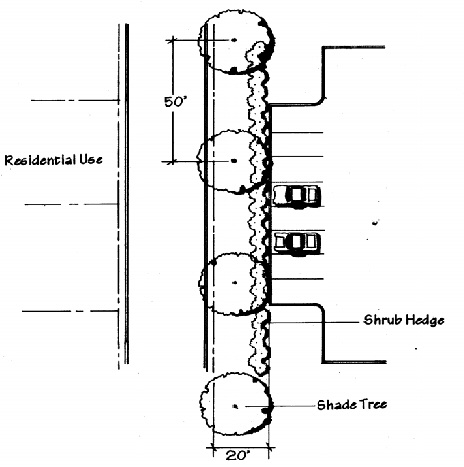 |
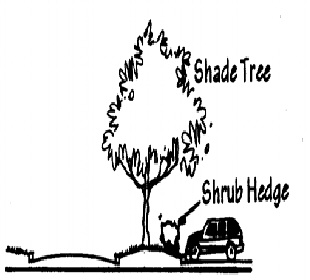 |
Figure 1253.08A.2. Perimeter Parking Lot Landscaping Adjacent to a Residential Use
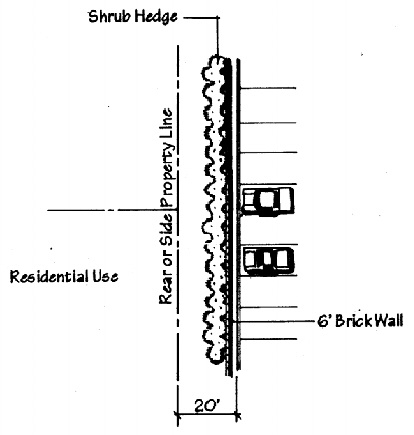 |
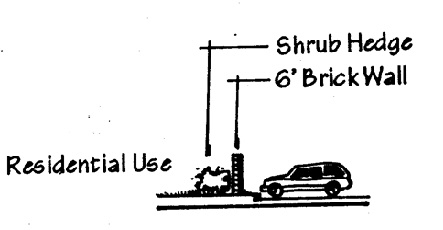 |
Figure 1253.08A.3. Perimeter Parking Lot Landscaping Across from a Non-Residential Use
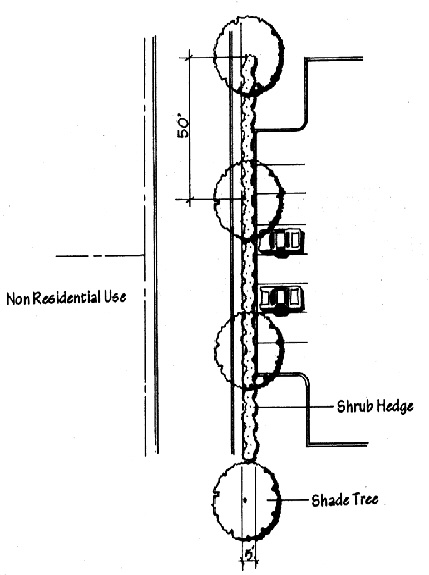 |
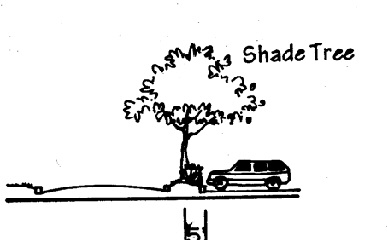 |
Figure 1253.08A.4. Perimeter Parking Lot Landscaping Adjacent to a Non-Residential Use
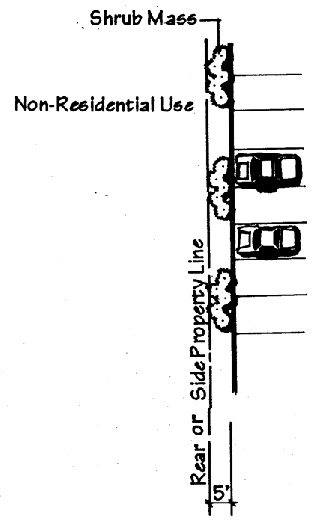 |
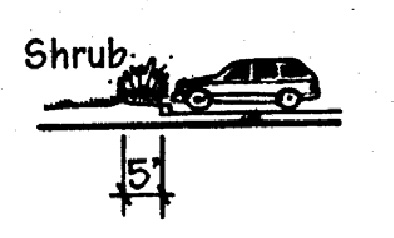 |
C. Interior Parking Lot Landscaping. Interior Parking Lot Landscaping may be provided in addition to Perimeter Parking Lot Landscaping towards meeting the twenty percent (20%) landscaped area requirement. Such areas may be grouped or configured in any combination which meets the width, area, and materials requirements herein.
1. Interior parking lot landscaping areas (planting islands) shall be included within the parking lot in groupings. The area of landscape groupings shall be an average of no less than one hundred twenty (120) square feet per every ten (10) parking spaces.
2. Such planting islands shall be curbed and shall be a minimum of seven (7) feet in width, as measured from back of curb to back of curb.
3. Landscape Material. The plant material used to improve the landscape areas defined above shall conform to the following:
a. Type. The primary plant materials used in parking lots shall be shade tree species in conformance with Section 1253.06, Design Criteria. Ornamental trees, shrubbery, hedges, and other plant materials may be used to supplement the shade tree plantings, but shall not be the sole contribution to such landscaping.
b. Quantity. One (1) shade tree shall be provided for every one hundred twenty (120) square feet of landscaping area.
c. Ground Cover. A minimum of fifty percent (50%) of every interior parking lot landscaping area shall be improved with approved ground cover, as determined appropriate by the Zoning Administrator.
1253.09 LANDSCAPE BUFFERS AND SCREENING.
A. Applicability. Landscape buffers shall be required in the following situations as described in Table 1253.09, Summary Table of Landscape Buffers and Screening Requirements. Where more than one of the following situations applies, or where both landscape buffer or screening and parking lot landscaping are required, the more restrictive shall apply.
1. Transition Yards. Landscape buffers shall be provided in the transition yards where multiple-family and nonresidential rear and side yards abut yards of lesser intensity as described below.
a. MF Multiple-Family and A Apartment Residential Districts Where a yard in a multiple-family development in the MF or A District abuts a Single-Family or Two-Family District or use, a landscape buffer a minimum of five (5) feet in width shall be provided. Such buffer shall adequately screen the development from view, as determined by the zoning Administrator.
b. O Office District
(1) Side Yards. Where a side yard in the O District abuts any residential district, such yard shall have a minimum setback of forty (40) feet. In addition, a landscape buffer a minimum of five (5) feet in width shall be provided. Such buffer shall be subject to the approval of the Zoning Administrator.
(2) Rear Yards. Where a rear yard in the O District abuts any residential district, such yard shall have a minimum setback of forty (40) feet. In addition, a landscape buffer shall be provided which shall be subject to the approval of the Zoning Administrator . If such yard abuts a single-family or two-family district, the landscape buffer shall be a minimum of twenty (20) feet in width.
c. C1 Limited Commercial District
(1) Side Yards. Where a side yard in the C1 District abuts any residential district, such yard shall have a minimum setback of twenty (20) feet. In addition, a landscape buffer a minimum of ten (10) feet in width shall be provided. Such buffer shall be subject to the requirements of 1253.09.B, Buffers for Commercial Uses.
(2) Rear Yards. Where a rear yard in the C1 District abuts any residential district, such yard shall have a minimum setback of forty (40) feet. In addition, a landscape buffer, a minimum of ten (10) feet in width, shall be provided and such buffer shall be subject to the requirements of 1253.09.B, Buffers for Commercial Uses.
d. C2 General Commercial, C3 Business Commercial, and CM Commercial Mixed Use Districts
(1) Side Yards. Where a side yard in the C2, C3, or CM Districts abuts any residential district, such yard shall have a minimum setback of twenty (20) feet. In addition, a landscape buffer a minimum of ten (10) feet in width shall be provided. Such buffer shall be subject to the requirements of 1253.09.B, Buffers for Commercial Uses.
(2) Rear Yards. Where a rear yard in the C2, C3, or CM Districts abuts any residential district, such yard shall have a minimum setback of forty (40) feet. In addition, a landscape buffer a minimum of twenty (20) feet in width shall be provided. Such buffer shall be subject to the requirements of 1253.09.B, Buffers for Commercial Uses.
Figure 1253.09.A Buffers
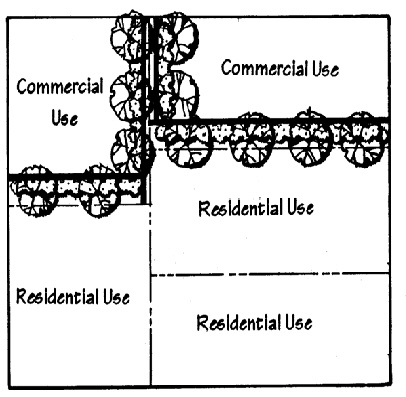 |
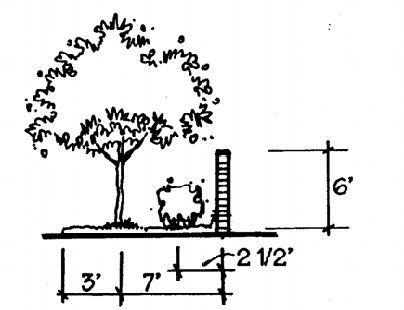 |
e. I Institutional District. All side and rear yards in the I District shall have a minimum twenty-five (25) foot landscape yard. Landscape yards are yards devoted exclusively to landscaping except however, that driveways and sidewalks needed to serve the use and buildings on the lot may be located within a required landscape yard. No specific improvements are required within landscape yards, except that all landscape areas not planted with trees and shrubs shall be maintained in turf or other approved groundcover.
f. PR Park and Recreation District. All side and rear yards in the PR District abutting residential districts shall have a minimum twenty-five (25) foot landscape yard. All side and rear yards in the PR District abutting non-residential districts shall have a minimum ten (10) foot landscape yard. Landscape yards are yards devoted exclusively to landscaping except however, that driveways and sidewalks needed to serve the use and buildings on the lot may be located within a required landscape yard. No specific improvements are required within landscape yards, except that all landscape areas not planted with trees and shrubs shall be maintained in turf or other approved groundcover.
2. Commercial Uses—Rear Yards. Landscape buffers shall be provided in the rear yard of all commercial uses, regardless of district, subject to the requirements of 1253.09.B, Buffers for Commercial Uses.
3. Commercial Uses Abutting Residential Uses—Rear and Side Yards. Where a rear or side yard of any commercial use, regardless of district, abuts any residential use, a landscape buffer shall be provided along such yard. Such buffer shall be subject to the requirements of 1253.09.B, Buffers for Commercial Uses.
4. Screening of Outdoor Storage and Waste Disposal Facilities.
a. General Requirement. Except as otherwise provided below, permitted outdoor storage and waste disposal facilities shall be located in the rear yard only and shall require screening when adjacent to a residential lot or visible from a public street. Such uses shall be completely surrounded by a solid brick wall, with a solid gate, that is a minimum of six (6) feet in height.
b. Exemptions to Outdoor Storage Facilities Requiring Screening. Except as otherwise provided in this Zoning Ordinance, all storage shall be located within enclosed structures. However, firewood, compost piles and the temporary storage of materials for construction on the premises may be located outdoors and shall not require screening. All other outdoor storage which is specifically permitted by this Zoning Ordinance shall be screened pursuant to the requirements of this Section.
c. Additional Screening. Additional landscape buffering around outdoor storage or waste disposal facility may be required by the City Planning Commission in the case of a conditional use.
5. Screening of Outdoor Sales Lots.
a. Outdoor sales lots associated with garden centers and temporary uses shall be subject to screening requirements as deemed appropriate by the Zoning Administrator.
B. Buffers for Commercial Uses. Landscape buffers and screening shall be provided as directed by Section 1253.09.B, Buffers for Commercial Uses Where indicated by that section, the required landscape buffer for commercial uses consist of the following:
1. A solid brick wall not more than six (6) feet nor less than four (4) feet in height shall be located along the inside edge of the required landscape area. This fence shall be installed pursuant to Section 1262.05, Fences and Walls.
2. A continuous evergreen or dense deciduous shrub hedge extending the entire length of the landscape area shall be planted two and one-half (2.5) feet from the fence described in subsection (2) above. This shrub hedge shall be installed at not less than four (4) feet in height.
3. Shade trees not less than three (3) inches in caliper shall be planted not less than fifty (50) feet on center along a line located seven (7) feet from the fence described in subsection (2) above.
4. All surface area not planted with shrubs or trees shall be maintained as a grass lawn or planted in groundcover.
5. Buffers shall be maintained in good repair and in neat, attractive condition.
Situation Requiring Buffer or Screening | Minimum Setback | Minimum Depth of Landscape Buffer | Landscape Requirements | Fence or Wall | |
Shrubs | Shade Trees | ||||
1. Transition Yards | |||||
a. MF, A Districts | |||||
Side and Rear Yard of Multiple- Family Uses Abutting Single- and Two-Family Districts or Uses. | As described in District Regulations. | Five (5) feet. | An appropriate buffer as determined by the Zoning Administrator. | Not required. | |
b. O District | |||||
Side Yard abutting residential district. | Forty (40) feet. | Five (5) feet. | An appropriate buffer as determined by the Zoning Administrator. | Not required. | |
Rear Yard abutting a Multiple- Family or Apartment District | Forty (40) feet. | An appropriate depth as determined by the Zoning Administrator. | An appropriate buffer as determined by the Zoning Administrator. | Not required. | |
Rear Yard abutting Single- or Two-Family District | Forty (40) feet. | Twenty (20) feet. | An appropriate buffer as determined by the Zoning Administrator. | Not required. | |
Situation Requiring Buffering or Screening | Minimum Setback | Minimum Depth of Landscape Buffer | Landscape Requirements | Fence or Wall | |
Shrubs | Shade Trees | ||||
1. Transition Yards (Continued) | |||||
c. C1 District | |||||
Side Yard abutting any residential district | Twenty (20) feet. | Ten (10) feet. | Masses of 7-9 plants measuring a minimum of two and one- half (2.5) feet in depth. | A minimum of one (1) shade tree, a minimum of three (3) inches in trunk width, planted a minimum of every fifty (50) feet. | A solid brick wall of at least six (6) feet in height shall be provided. |
Rear Yard abutting any residential district | Forty (40) feet. | Ten (10) feet. | Masses of 7-9 plants measuring a minimum of two and one- half (2.5) feet in depth. | A minimum of one (1) shade tree, a minimum of three (3) inches in trunk width, planted a minimum of every fifty (50) feet. | A solid brick wall of at least six (6) feet in height shall be provided. |
Side Yard abutting any residential district. | Twenty (20) feet. | Ten (10) feet. | Masses of 7-9 plants measuring a minimum of two and one- half (2.5) feet in depth. | A minimum of one (1) shade tree, a minimum of three (3) inches in trunk width, planted a minimum of every fifty (50) feet. | A solid brick wall of at least six (6) feet in height shall be provided. |
Rear Yard abutting any residential district | Forty (40) feet. | An appropriate depth as determined by the Zoning Administrator. | An appropriate buffer as determined by the Zoning Administrator. | ||
Rear yard abutting single- or two-family residential districts. | Forty (40) feet. | Ten (10) feet. | Masses of 7-9 plants measuring a minimum of two and one- half (2.5) feet in depth. | A minimum of one (1) shade tree, a minimum of three (3) inches in trunk width, planted a minimum of every fifty (50) feet. | A solid brick wall of at least six (6) feet in height shall be provided. |
Situation Requiring Buffering or Screening | Minimum Setback | Minimum Depth of Landscape Buffer | Landscape Requirements | Fence or Wall | |
Shrubs | Shade Trees | ||||
1. Transition Yards (Continued) | |||||
d. C2, C3, CM Districts | |||||
Side Yard abutting any residential district | Twenty (20) feet. | Ten (10) feet. | Masses of 7-9 plants measuring a minimum of two and one- half (2.5) feet in depth. | A minimum of one (1) shade tree, a minimum of three (3) inches in trunk width, planted a minimum of every fifty (50) feet. | A solid brick wall of at least six (6) feet in height shall be provided. |
Rear Yard abutting any residential district | Forty (40) feet. | Twenty (20) feet. | Masses of 7-9 plants measuring a minimum of two and one- half (2.5) feet in depth. | A minimum of one (1) shade tree, a minimum of three (3) inches in trunk width, planted a minimum of every fifty (50) feet. | A solid brick wall of at least six (6) feet in height shall be provided. |
e. I District | |||||
Side or Rear Yard | Twenty-five (25) feet. | An appropriate buffer as determined by the Zoning Administrator. | Not required. | ||
f. RP District | |||||
Side or Rear Yard | Twenty-five (25) feet abutting residential districts, ten (10) feet abutting other districts. | An appropriate buffer as determined by the Zoning Administrator. | Not Required. | ||
Situation Requiring Buffering or Screening | Minimum Setback | Minimum Depth of Landscape Buffer | Landscape Requirements | Fence or Wall | |
Shrubs | Shade Trees | ||||
2. Rear Yard of All Commercial Uses | |||||
As described in District Regulations. | Ten (10) feet. | Masses of 7-9 plants measuring a minimum of two and one- half (2.5) feet in depth. | A minimum of one (1) shade tree, a minimum of three (3) inches in trunk width, planted a minimum of every fifty (50) feet. | A solid brick wall of at least six (6) feet in height shall be provided. | |
3. Side Yards of Commercial Abutting Residential | |||||
As described in District Regulations. | Ten (10) feet. | Masses of 7-9 plants measuring a minimum of two and one- half (2.5) feet in depth. | A minimum of one (1) shade tree, a minimum of three (3) inches in trunk width, planted a minimum of every fifty (50) feet. | A solid brick wall of at least six (6) feet in height shall be provided. | |
4. Outdoor Storage/Waste Disposal Facilities | |||||
n/a | n/a | n/a | n/a | A solid brick wall of at least six (6) feet in height shall be provided. | |
5. Outdoor Sales Lots | |||||
Auto Dealers | As described in District Regulations. | ||||
Garden Centers, Temporary Uses, and other Permitted Outdoor Sales | As described in District Regulations. | ||||
(Ord. 04-132. Enacted 11-22-04.)

