
Shaker Heights City Zoning Code
TITLE FOUR
Special District Regulations
1240.01 PURPOSE.
The I Institutional District establishes locations where existing institutional uses and structures are permitted to be used or adaptively re-used provided that their current character is maintained. This requires avoiding demolition and preserving both the buildings and their grounds. Any changes to an institutional use or structure shall require special review as described within this chapter and shall reflect the historic character of the use or structure. Such changes also shall not negatively affect the overall character of the neighborhood.
1240.02 REUSE OF BUILDINGS.
The reuse of buildings is encouraged through the classification of uses which are divided into those permitted only in existing buildings and those permitted in existing or new buildings. Demolitions, modifications, and alterations of existing buildings in preparation for their reuse or the use of their site shall require review by the City Planning Commission pursuant to 1213.01, Public Hearing Procedures. Standards for such review shall include such factors as the hours of operation and parking needs of the proposed use as well as the architectural character and open space provided.
1240.03 PERMITTED USES.
The following uses are permitted in either new or existing buildings. Demolitions, modifications, and alterations of existing buildings in preparation for their reuse or the reuse of their site shall require review by the City Planning Commission pursuant to Section 1240.02, Reuse of Buildings. Any use other than those listed below which proposes new structures or demolition of existing structures shall not be considered a permitted use.
A. Libraries.
B. Museums.
C. Parks and playgrounds, public.
D. Places of Worship.
E. Publicly owned forest preserves, botanical gardens, arboreta, conservatories, recreational areas, and other open spaces.
F Schools, primary and secondary, private.
G. Schools, primary and secondary, public.
1240.04 CONDITIONAL USES.
Conditional Uses are those uses having some special impact or uniqueness that require a careful review of their location, design, configuration, and special impact to determine the desirability of permitting their establishment on any given site. Permits for Conditional Uses may be granted pursuant to the requirements of Section 1213.05, Conditional Uses. General standards for conditional use permits are found in Section 1213.05.H, Standards for Conditional Use Permits. Standards for specific conditional uses may be found in Chapter 1263, Conditional Uses, or elsewhere as referenced herein.
A. In order to promote preservation and reuse, the following may be permitted only as Conditional Uses in existing buildings in the I Institutional District. Modifications and alterations of existing buildings in preparation for their reuse shall require review by the City Planning Commission pursuant to Section 1240.02, Reuse of Buildings.
1. Assembly Halls.
3. Colleges and universities.
7. Day care centers and schools operated as a part of a Place of Worship, pursuant to Section 1263.09.
8. Dwelling units, multiple-family of three (3) or more.
9. Government buildings, and administrative offices.
11. Offices.
12. Shelters, emergency.
13. Similar uses approved by the City Planning Commission and the City Council, pursuant to Section 1213.05.D.2.
14. Theatres.
B. Recognizing that some uses may not fit into the existing structures or may require additions, alterations or new construction but may be compatible with the surrounding neighborhood, the following uses may be permitted as a conditional use. These uses require stringent review by the City Planning Commission and City Council. Only after thorough review will building adaptations or new construction be considered.
3. Recreational facilities, indoor or outdoor, public or private.
4. Similar uses approved by the City Planning Commission and the City Council, pursuant to Section 1213.05.D.2.
(Ord. 18-25. Passed 4-23-18.)
1240.05 ACCESSORY USES AND STRUCTURES.
A. All general standards for Accessory Uses and Structures and additional standards for specific Accessory Uses and Structures are found in Chapter 1262, Accessory Uses and Structures.
B. The following are permitted Accessory Uses and Structures in the I Institutional District:
1. Antennae, master radio, television and other telecommunications equipment, pursuant to Section 1262.02.
2. Fences and Walls, pursuant to Section 1262.05.
3. Greenhouses, private non-commercial, pursuant to Section 1262.10.
4. Heating, ventilating and air conditioning equipment, motorized, pursuant to Section 1262.08.
5. Landscape features (including gardens, fountains, sidewalks, and lawns, but excluding fences and walls).
6. Loading, off-street, pursuant to Chapter 1252, Off-Street Loading Regulations.
7. Maintenance, Storage, Utility and Waste Disposal Facilities, if enclosed or screened pursuant to Section 1253.09.B, Buffers for Commercial Uses. Utility lines shall be entirely enclosed or buried for all new construction.
8. Ornamental Structures, in rear or side yard only, pursuant to Section 1262.10.
9. Parking, off-street, pursuant to Chapter 1251, Off-Street Parking Regulations.
10. Parking Structures, pursuant to Section 1262.12.
11. Recreational Structures, pursuant to Section 1262.13.
12. Signage, pursuant to Chapter 1250, Sign Regulations.
13. Swimming Pools and Hot Tubs, private non-commercial, pursuant to Section 1262.17.
1240.06 MINIMUM AREA PER DWELLING UNIT.
Minimum area per dwelling unit shall be pursuant to Section 1225.05.B, A Apartment District, Minimum Area Per Dwelling Unit.
1240.07 MINIMUM LOT WIDTH.
The minimum lot width requirement in the I Institutional District shall be one hundred and twenty (120) feet.
1240.08 MINIMUM YARDS.
A front landscaped yard of no less than twenty-five (25) feet or the yard shown on the Building Setback Map, whichever is greater, shall be provided. Additionally, a perimeter landscaped yard, a width of no less than twenty-five (25) feet, shall be provided along the side and rear perimeters for all uses located in the I Institutional District.
The perimeter landscaped yard requirements apply only to structures erected after the effective date of this Code provided, however, no structure existing on such effective date shall be expanded in violation of this regulation.
1240.09 MINIMUM LANDSCAPED AREA.
The minimum landscaped area for the I Institutional District shall be no less then forty percent (40%) of the lot area.
1240.10 MAXIMUM HEIGHT.
A. Building Height.
1. The maximum height of a principal structure in the I Institutional District shall not exceed three (3) stories or forty-five (45) feet, except for steeples or tower elements which may extend to a total height of seventy (70) feet above grade.
2. The general requirement above applies only to structures erected after the effective date of this Code provided, however, no structure existing on such effective date shall be expanded in violation of this regulation.
3. New or modified structures which exceed the general requirement above may be permitted pursuant to a Conditional Use Permit if such height is no higher than that of the adjacent development.
B. Rooftop Mechanical Equipment. Rooftop mechanical housing and equipment may extend up to ten (10) feet above the maximum height limit and shall be designed as an integral part of the principal building or concealed with similar architectural treatment and materials as the exterior of the building.
C. Accessory Uses and Structures. The maximum height of Accessory Uses and Structures shall be pursuant to Chapter 1262, Accessory Uses and Structures.
1240.11 MAXIMUM LOT COVERAGE.
The surface coverage of all above grade structures on a lot shall be no greater than thirty-five percent (35%) of the lot area.
1240.12 LOCATION OF ACCESSORY USES AND STRUCTURES IN REQUIRED YARDS.
The location of Accessory Uses and Structures in required yards shall be pursuant to Chapter 1262, Accessory Uses and Structures.
1240.13 ALLOWABLE ENCROACHMENTS AND DISTANCE.
Allowable encroachments into the yards are listed in Table 1260.04, Allowable Encroachments.
1240.14 SITE PLAN REVIEW.
No building permit may be issued without first adhering to the site plan review standards set forth in Section 1213.06, Site Plan Review. Additionally, the following requirements shall be observed:
A. Building Separation. The principal buildings shall be separated from other site uses according to the following schedule:
1. Accessory Buildings = Ten (10) feet unless attached.
2. Other principal buildings = Twenty (20) feet unless attached.
B. Off-Street Parking Buffers. All parking lots pursuant to Section 1253.08, Parking Lot Landscaping.
C. Site Design. The location, relation and separation of uses and buildings shall be designed and constructed so as to provide compatible utilization and functioning of all uses.
D. New Construction Over 2,500 Square Feet. All building additions or new buildings over 2,500 square feet in gross floor area shall require Site Plan Review by the City Planning Commission per Section 1213.06, Site Plan Review.
1241.01 PURPOSE.
The purpose of this district is to preserve and control the location of park land within the City and to protect residential properties by providing appropriate and compatible park land areas for aesthetic, environmental and recreational benefits to the community.
1241.02 PERMITTED USES.
The following are permitted uses in the PR Park and Recreation District, pursuant to any additional standards set forth herein.
A. Parks and playgrounds, public.
1241.03 CONDITIONAL USES.
Conditional Uses are those uses having some special impact or uniqueness that requires a careful review of their location, design, configuration, and special impact to determine the desirability of permitting their establishment on any given site. Permits for Conditional Uses may be granted pursuant to the requirements of Section 1213.05, Conditional Use Permits. General standards for conditional use permits are found in Section 1213.05.H, Standards for Conditional Use Permits. Standards for specific conditional uses may be found in Chapter 1263, Conditional Uses, or elsewhere as referenced herein.
In order to preserve and control the location of park land within the City and to protect residential properties by providing appropriate and compatible park land areas for aesthetic, environmental and recreational benefits, the following may be permitted only as Conditional Uses in the PR Park and Recreation District:
A. Athletic fields as a primary use.
E. Golf courses, public or private.
F. Government offices.
G. Information centers.
H. Libraries.
I. Museums.
J. Offices.
L. Publicly owned forest preserves, botanical gardens, arboreta, conservatories, recreational areas, and other open spaces.
M. Recreational facilities, indoor or outdoor, public or private.
N. Utilities (including substations, transmission facilities and related facilities).
O. Similar uses approved by the City Planning Commission and City Council pursuant to Section 1213.05.D.2
(Ord. 18-25. Enacted 4-23-18.)
1241.04 ACCESSORY USES AND STRUCTURES.
A. All general standards for Accessory Uses and Structures and additional standards for specific Accessory Uses and Structures are found in Chapter 1262, Accessory Uses and Structures.
B. The following are permitted Accessory Uses and Structures in the PR Park and Recreation District:
1. Antennae, single, roof-mounted or in rear yard only, pursuant to Section 1262.02.
2. Fences and Walls, pursuant to Section 1262.05.
3. Greenhouses, non-commercial, in rear yard only, pursuant to Section 1262.10.
4. Heating, ventilating and air conditioning equipment, motorized, pursuant to Section 1262.08. Air conditioning units are acceptable accessory structures only if totally enclosed or located on the roof.
5. Landscape features (including gardens, fountains, sidewalks, and lawns, but excluding fences and walls).
6. Loading, off-street, in rear yard only, pursuant to Chapter 1252, Off-Street Loading Regulations.
7. Maintenance, Storage, Utility and Waste Disposal Facilities, only if totally enclosed.
8. Ornamental Structures, in rear or side yard only, pursuant to Section 1262.10.
9. Parking, off-street, and Driveways, pursuant to Chapter 1251, Off-Street Parking Regulations.
10. Recreational structures, pursuant to Section 1262.13.
11. Signage, pursuant to Chapter 1250, Sign Regulations.
1241.05 MINIMUM LOT AREA.
The minimum lot area requirement for the PR Park and Recreation District shall be seven
thousand five hundred (7,500) square feet.
1241.06 MINIMUM LOT WIDTH.
The minimum lot width requirement for the PR Park and Recreation District shall be forty (40) feet.
1241.07 YARD REQUIREMENTS.
The following minimum yards shall be provided in the PR Park and Recreation District:
A. Front and Corner Side Yards. A front and corner side yard shall be provided pursuant to the Zoning map. Where the map is silent, a yard no less than seventy five (75) feet in depth shall be provided.
B. All Other Yards. A landscaped buffer of no less than twenty-five (25) feet when abutting a residential district and no less than ten (10) feet when abutting any other district shall be provided.
1241.08 MAXIMUM HEIGHT.
A. Principal Structures. The maximum height of a principal structure in the PR Park and Recreation District shall not exceed thirty-five (35) feet.
B. Accessory Uses and Structures. The maximum height of Accessory Uses and Structures shall be regulated pursuant to Chapter 1262, Accessory Uses and Structures.
1241.09 MAXIMUM LOT COVERAGE.
The surface coverage of all above grade structures on a lot shall be no greater than fifteen percent (15%) of the lot area.
1241.10 LOCATION OF ACCESSORY USES AND STRUCTURES IN REQUIRED YARDS.
The location of Accessory Uses and Structures in required yards shall be regulated pursuant to Chapter 1262, Accessory Uses and Structures.
1241.11 ALLOWABLE ENCROACHMENTS AND DISTANCE.
1242.01 PURPOSE.
The purpose of the Planned Unit Development (PUD) Overlay District is to encourage and accommodate, in a unified project, creative and imaginative infill developments that utilize innovations in land development that are in the best interests of and consistent with the City's development and planning policies and which would not otherwise be permitted in the conventional residential or commercial districts pursuant to this Zoning Ordinance. The regulations for PUDs are intended to achieve the following objectives:
A. To encourage creative approaches to the use of land and related physical facilities that result in better urban design, higher quality construction and the provision of aesthetic amenities.
B. To promote the efficient use of land, so as to promote economies in the provision of utilities, streets, schools, public grounds and buildings, and other facilities.
C. To permit flexibility of design that will create desirable public and private common open spaces while maximizing the development potential of individual sites.
D. To enhance the appearance of neighborhoods by conserving areas of natural beauty and natural green spaces.
E. To provide substantial buffers and transitions between areas of different land use and development densities.
(Ord. 13-16. Passed 5-28-13.)
1242.02 DESIGNATION OF PUD OVERLAY DISTRICT.
An Overlay District is a mapped zone that establishes a development option with a set of design requirements that are in addition to those of the conventional "base" residential or commercial zoning district, so that any parcel of land lying in a PUD Overlay District shall also lie in one or more conventional residential or commercial district. The PUD Overlay District gives property owners the choice of developing according to the conventional "base" district regulations or the PUD regulations.
A. Location Of District.
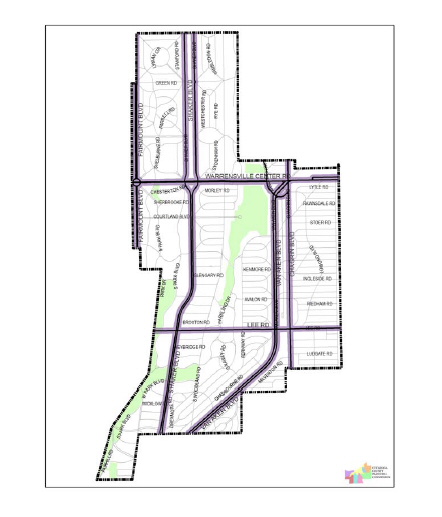
1. The location of the PUD Overlay District is limited to land fronting the following major streets.
a. Chagrin Boulevard.
b. Lee Road.
c. Van Aken Boulevard.
d. Warrensville Center Road.
e. Green Road.
f. Shaker Boulevard.
g. Fairmount Boulevard.
h. Farnsleigh Road from Warrensville Center Road to Chagrin Boulevard.
2. These major streets are highlighted in Figure 1242.02, Allowable Locations for PD Overlay District.
 |
B. PUD as a Conditional Use.
1. PUDs designed according to this Chapter shall be permitted as a conditional use. The availability of the PUD option imposes no obligation on a property owner to select the PUD form of development. The decision to approve a PUD application shall be at the sole discretion of the City.
2. Conditional Uses are those uses having some special impact or uniqueness that requires a careful review of their location, design, configuration, and special impact to determine the desirability of permitting their establishment on any given site. Permits for Conditional Uses may be granted pursuant to the requirements of Section 1213.05, Conditional Uses. General standards for conditional use permits are found in Section 1213.05 H, Standards for Conditional Use Permits. Standards for specific conditional uses may be found in Chapter 1263, Conditional Uses, or elsewhere as referenced herein.
C. Relationship to Base Districts.
1. In the PUD Overlay District, the use and dimensional specifications of the base zoning district are herein replaced by an approval process in which an approved plan becomes the basis for continuing land use controls.
2. The base zoning district shall be used as a guide for development, with any adjustment relative to use, density and building layout reviewed and approved through the PUD review process set forth in Section 1213.09.
3. In the event a proposed PUD is located in more than one base zone, the use limitations of the most intense base zone shall be used as the guide for the entire project.
D. Limitations on Flexibility of PUDs. The City Planning Commission shall only approve PUDs that are consistent with the objectives set forth in Section 1242.01. Therefore, the City Planning Commission may require as a condition of approval any reasonable condition, limitation or design factor which will promote proper development of a PUD.
(Ord. 18-25. Enacted 4-23-18.)
1242.03 PROJECT AREA.
A. The minimum project area for a PUD shall be one contiguous acre with a minimum of 200 feet of frontage on a street listed in Section 1242.02 A., unless specifically permitted otherwise.
B. When the proposed PUD is located adjacent to an existing multi-family, commercial or special district, the City Planning Commission may approve a PUD on less than one contiguous acre when the City Planning Commission determines that:
1. Land ownership cannot be readily consolidated to reach the one acre minimum project size; or
2. The project will not result in isolated development; or
3. The project will not have any unreasonable or adverse impacts on adjacent areas.
C. The proposed project area shall be in one ownership, or if there are two (2) or more owners, the application shall be filed jointly by all owners of the properties included in the proposed PUD boundaries. (Ord. 13-16. Passed 5-28-13.)
1242.04 USES.
A. Principal Uses Permitted in a PUD. In keeping with the desire for flexibility in this district, the following may be permitted as -principal uses in the PUD Overlay District:
1. Uses listed as permitted in the base zoning district. In the case of a lot located in more than one base zoning district, the use limitations of the most intense base zoning district shall prevail.
2. Dwelling units, single-family residence attached.
3. Mixed-use development where the base zoning permits non-residential uses.
4. Uses listed as conditional in the base zoning district. In the case of a lot located in more than one base zoning district, the use limitations of the most intense base zoning district shall prevail.
5. Additional uses may be authorized as part of a PUD, provided that the City Planning Commission finds:
a. That the additional uses are necessary or desirable and are appropriate with respect to the primary purpose and character of the PUD.
b. That the additional uses will not create a detrimental influence on the neighborhoods surrounding the PUD, or upon the internal character of any part of or all of the PUD itself.
B. Accessory Uses and Structures. Uses listed as accessory in the base zoning district shall also be permitted in a proposed PUD. In the case of a proposed PUD located in more than one base zoning district, the accessory use limitations of the most intense base zoning district shall prevail. (Ord. 13-16. Passed 5-28-13.)
1242.05 MAXIMUM DENSITY FOR RESIDENTIAL PUDS
A. The gross residential density of a PUD shall not be greater than that set forth below:
Base Zoning District | Maximum Density |
SF 1 Single-Family Residential |
5 units per acre |
SF 2 Single-Family Residential |
7 units per acre |
SF 3 Single-Family Residential |
10 units per acre |
TF Two-Family Residential |
14 units per acre |
All other base districts |
As specified in the base district regulations |
B. The City Planning Commission may establish a lower maximum density for the proposed development when it finds that the PUD, at the density permitted in subsection 1242.05 A. will adversely impact the character of the immediate residential area when considering any one or more of the following:
1. The unusual size and shape of the PUD parcel.
2. The topography and other natural limitations of the PUD such as streams, ravines, etc.
3. The reduced buildable area within the PUD because of items number 1. and 2. above.
4. The proximity of adjacent buildings and/or structures.
5. The actual lot sizes of the immediate residential area.
C. The City Planning Commission may permit greater density for a PUD under the following specific situations:
1. The PUD is located adjacent to an existing multi-family district, commercial district or special district; and
2. The Planning Commission determines that the increase in density:
a. Is warranted to assure the economically feasible development of the project, for economical development or redevelopment, when non-residential development is contrary to the City's planning policies; and
b. Will have no material adverse impact on the adjacent properties compared to other reasonable uses that might be contemplated for the property. (Ord. 13-16. Passed 5-28-13.)
1242.06 LOT REQUIREMENTS.
A. Dwelling units are not required to be on individual, subdivided lots.
B. There is no minimum lot size or lot width requirement for lots on subdivided lots.
(Ord. 13-16. Passed 5-28-13.)
1242.07 PERIMETER YARD REQUIREMENTS.
A. A landscaped buffer shall be provided along the perimeter of the PUD, pursuant to Section 1253.09, Landscape Buffers and Screening, if either of the following applies as determined by the Zoning Administrator:
1. Topography, installed screening or other barriers do not provide adequate privacy for the PUD and for existing uses adjacent to the development.
2. Nonresidential uses or structures in the PUD abut a residential district.
B. The width of the buffer shall be at least ten (10) feet, unless the Planning Commission finds that a lesser distance, combined with landscaping and/or other screening mechanisms are sufficient to ensure adequate privacy.
(Ord. 13-16. Passed 5-28-13.)
1242.08 DESIGNATION OF PERMANENT OPEN SPACE.
A. A PUD shall provide a minimum of 10% of the area of the PUD as permanent public or private landscaped open space or other common open space.
B. In the case of mixed uses, permanent open space shall be allocated to the property in proportion to the uses assigned to the PUD and shall be located in relation to those uses.
(Ord. 13-16. Passed 5-28-13.)
1242.09 OTHER DEVELOPMENT STANDARDS.
The development standards of the base zoning district that are not specifically addressed in this Chapter shall be used as a guide for determining the appropriate building layout, building height and other development requirements of the PUD. In approving a PUD layout, the City Planning Commission shall find that the proposed site plan is no less beneficial to the tenants or occupants of such development, as well as the neighboring property, than would be obtained under the yard requirements of this Zoning Ordinance for buildings developed on separate zoning lots.
(Ord. 13-16. Passed 5-28-13.)
1242.10 STANDARDS FOR REVIEW OF PUD APPLICATIONS.
A. Conditional Use Permit Standards. No PUD shall be approved pursuant to Section 1213.09, Planned Development Review, unless the applicant shall establish that the proposed development is based on the criteria for conditional uses in Section 1213.05 H. and the following standards specific to PUDs.
B. Additional Standards Specific to PUDs
1. Conformity with City Policies and Ordinances. The proposed development shall not injure the use, value and enjoyment of the surrounding property in accordance with the policies of the City shall be consistent in all respects with the purpose and intent of this Zoning Ordinance and shall advance the general welfare of its immediate vicinity and of the City as a whole.
2. Timely Progression of the Development. The order in which stages of development will likely proceed, and the time estimated to complete the development and its various stages, should be based on a reasonable schedule in which improvements may be substantially completed.
3. Site Design. The location, configuration, construction, manner and time of operation of off-street parking and loading areas, service areas, circulation systems, entrances, exits, open space, amenities, lighting, or other potentially detrimental influences shall be designed to avoid: (a) adverse effects on residential uses within or adjoining the development, (b) traffic congestion, and (c) hazards to vehicular or pedestrian traffic.
4. Utilities. The proposed development shall provide, if possible, for underground installation of utilities (including electricity and telephone) within both public ways and private extensions thereof. Provisions also shall be made for acceptable design and construction of storm water facilities including grading, gutter, piping, and treatment of turf and maintenance of facilities.
5. Maintenance of Common Space. The proposed development shall include provisions for the maintenance of common space, including all improvements thereto, as are reasonably necessary to ensure their continuity, maintenance, and operation in accordance with pre-determined standards and to ensure that remedial measures will be available to the City of Shaker Heights if such common space or other improvements are not maintained in a condition consistent with the best interests of the PUD, its immediate vicinity, or the City as a whole.
(Ord. 18-25. Enacted 4-23-18.)
1243.01 PURPOSE.
These regulations are established to provide for the construction and use of Wireless Telecommunication Facilities in the City. The regulations allow Wireless Telecommunication Facilities as a conditional use, or permitted accessory use depending upon the specific land areas of the City in which, and circumstances under which, they are proposed to be located. The purpose of these regulations is to balance the competing interests created by the federal Telecommunications Act of 1996 (Public Law 104-104, codified at 47 U.S.C. §§ 151 et seq.), the Secretary of the Interior’s Standards for Rehabilitation and Guidelines for Rehabilitating Historic
Buildings, and the interests of the City in regulating Wireless Telecommunication Facilities for the following reasons:
A. To protect property values and provide for orderly development within the City;
B. To insure that adequate telecommunication services are available within the City;
C. To protect the visual character for residents and wireless users of the City, including, but not limited to, its unique residential character, unobstructed open spaces, attractive commercial/office areas, and trees and other vegetation;
D. To maintain the historic character of the City, as recognized by its inclusion on the National Registry of Historic Places, from the potential for visual blight caused by Towers and related facilities,
E. To protect residential properties, parks, open spaces and the nonintensive, mainly low-rise commercial zoning districts which are characteristic of the City from the potential adverse effects of Towers and related Facilities;
F. To promote Co-location of Wireless Telecommunications Facilities in order to minimize the potential adverse effects of additional single-provider Towers in the City;
G. To provide for and protect the health, safety and general welfare of the residents and visitors of the City; and
H. To maintain, where possible, the integrity of the existing zoning regulations contained in the Zoning Ordinance.
The regulations identify acceptable land areas for the location of Wireless Telecommunication Facilities as a conditional use in an overlay zoning district (“Wireless Telecommunication Facilities Overlay District” or “WTFO District”), or as a permitted accessory use when colocating for erection of Antennas only, which determination is dependent upon the location and characteristics of such land areas and the structures involved.
Where applicable, the regulations governing the Wireless Telecommunications Facilities Overlay District shall control and supersede wherever they are inconsistent with other provisions of the Zoning Ordinance. If no inconsistency exists between the provisions of this WTFO District and the provisions of the underlying zoning district, the underlying zoning district regulations and other provisions of this Zoning Ordinance shall remain in full force and effect and shall regulate all land use and development.
1243.02 DEFINITIONS.
As used in this section:
A. “Co-location” means the use of a Wireless Telecommunication Facility by more than one wireless telecommunication provider.
B. “Lattice” means a support structure constructed of vertical metal struts and cross braces forming a triangular or square structure which often tapers from the foundation.
C. “Monopole” means a support structure constructed of a single, self-supporting hollow metal tube securely anchored to a foundation.
D. “Personal Wireless Services” means commercial mobile services, unlicensed wireless services, and common carrier wireless exchange access services as defined by federal law at 47 U.S.C. §332(c)(7).
E. “Technically Suitable” means the location of a Wireless Telecommunication Antenna(e) reasonably serves the purpose for which it is intended within the band width of frequencies for which the owner or operator of the Antenna(e) has been licensed by the Federal Communications Commission (FCC) to operate without a significant loss or lack of communication capability within developed areas of the City.
F. “Telecommunication(s)” means the technology that enables information to be exchanged through the transmission of voice, video or data signals by means of electrical or magnetic systems and includes the term “Personal Wireless Services.”
G. “Wireless Telecommunication Antenna” or “Antenna” means the physical device through which electromagnetic, wireless telecommunication signals authorized by the FCC are transmitted or received. Antennas used by amateur radio operators are excluded from this definition.
H. “Wireless Telecommunication Equipment Shelter” or “Equipment Shelter” means the structure or cabinet in which the electronic receiving and relay equipment for a Wireless Telecommunications Facility is housed.
I. “Wireless Telecommunication Facility” or “Facility” means a facility consisting of the equipment and structures involved in receiving telecommunications or radio signals from a mobile radio communications source and transmitting those signals to a central switching computer which connects the mobile unit with the land-based telephone lines for the provision of Personal Wireless Services. This can include the antenna, tower or support structure, equipment and equipment building and any other materials used at the site.
J. “Wireless Telecommunication Tower” or “Tower” means any structure, other than a building, that elevates the Wireless Telecommunication Antenna and may include accessory transmission and receiving equipment.
1243.03 APPLICABILITY.
No person shall construct, erect, maintain, extend or remove a Wireless Telecommunication Facility in the City unless it is in compliance with the purposes and provisions of this Chapter.
1243.04 DESIGNATION OF WIRELESS TELECOMMUNICATION FACILITIES OVERLAY DISTRICT, (WTFO).
A. Relationship to Base Districts. The Wireless Telecommunication Facilities Overlay District (WTFO) is an overlay zone which may be applied in the manner described in this Chapter, to existing zoning districts in the locations listed in Section 1243.04 (B), Location of District, and illustrated on the zoning map.
B. Location of District. The WTFO is limited to land within the following existing districts, as illustrated on the zoning map:
1. C2- General Commercial
2. C3- Business Commercial
3. O-Office
4. I-Institutional
1243.05 USE REGULATIONS.
A. Conditionally permitted use.
1. Antenna(e). The erection or construction of a Wireless Telecommunication Antenna(e) on an existing Wireless Telecommunication Tower may be permitted as an accessory use as a Co-location on such a Tower provided that all electronic and relay equipment for the Wireless Telecommunication Antenna shall be housed within the existing Equipment Shelter or as such Shelter may be expanded. Such use may be approved by the City Planning Commission upon submission of an application to the Zoning Administrator which meets all applicable regulations of this Chapter related to the placement of the Wireless Telecommunication Equipment and related Facilities associated with such Antenna(e), as well as the regulations in Section 1213.05.
2. Towers. A Wireless Telecommunication Tower may be permitted as a conditional use only in the areas indicated as a WTFO District on the Zoning Map in the following Districts: C2 - General Commercial; C3 - Business Commercial; O - Office, and I - Institutions. Such use may be approved by the City Planning Commission upon submission of an application to the Zoning Administrator, provided the applicant demonstrates compliance with each of the following Co-location requirements in this Section, as well as the standards set forth in Sections 1243.05 and 1213.05 of the Zoning Ordinance:
3. Co-location.
a. There is no Technically Suitable space for the applicant’s Antenna(e) and related Facilities reasonably available on an existing Tower, building or structure within the geographic area to be served. With the application, the applicant shall list the location of every Tower, building or structure within five (5) miles of the proposed site that could support the proposed Antenna(e) or area where it would be Technically Suitable to locate so as to allow it to serve its intended function. The applicant must demonstrate that a Technically Suitable location is not reasonably available or cannot reasonably be modified on an existing Tower, building or structure. If another existing Tower, building or structure is Technically Suitable, the applicant must demonstrate that it has requested to Co-locate on the existing Tower, building or structure and the Co-location request was rejected by the owner of the Tower, building or structure. In all circumstances, owners of existing Towers shall promptly respond in writing to requests for Co-location, but in no event shall they respond more than thirty (30) days from the date of receipt of a written request for Co-location. If another Tower, building or structure is Technically Suitable, the applicant must further show that it has offered to allow the owner of that other Tower, building or structure to Co-locate an Antenna(e) on another Tower, building or structure which is owned or controlled by the applicant, if any, on reasonably reciprocal terms and the offer was not accepted.
b. All applicants for construction or erection of Wireless Telecommunication Towers shall be required to construct on a base Tower structure and structure foundation that is designed to be buildable up to, but not including one hundred and seventy (170) feet above grade. Such structure shall be designed to have sufficient structural loading capacity to accommodate at least three (3) Antenna platforms or Antenna arrays of equal loading capacity for three (3) separate providers of service to be located on the structure when constructed to the maximum allowable height. The Wireless Telecommunication Facility shall also be designed to show that the applicant has enough space on its site plan for an Equipment Shelter large enough to accommodate at least three (3) separate users of the Facility. If an Equipment Shelter is initially constructed to accommodate only one (1) user, space shall be reserved on site for Equipment Shelter expansions to accommodate up to at least three (3) separate users. Agreement to the provisions of this subsection must be included in the applicant’s lease with the landowner, if different from the owner/user of the Tower. Written documentation must be presented to the Zoning Administrator evidencing that the landowner of the property on which the Tower is to be located has agreed to the terms of this subsection. As an additional condition of issuing a conditional use permit, the owner/user shall respond in writing to any inquiries regarding Co-location of another user of the Facility within thirty (30) days after receipt of a written inquiry. Copies of all written requests to Collocate and all written responses shall be sent to the Zoning Administrator.
B. Permitted Accessory Use. The installation of a Wireless Telecommunication Antenna(e) where the construction or erection of a Tower is not proposed by the applicant, shall be permitted as an accessory use on existing buildings or structures in any of the following zoning districts in the City: Office, Commercial, Institutional, Apartment and Multiple-Family. In addition, all Wireless Telecommunication Facilities shall not be located greater than ten (10) feet above the roofline of an existing building or structure to which it is attached. All electronic and relay equipment for the Wireless Telecommunication Antenna shall be housed within the existing building or structure, if possible. Any Equipment Shelter shall be designed as an integral part of the principal building or concealed with similar architectural treatment and materials as the exterior of the building or as may otherwise be required by Sections 1225.09B, 1230.10D, 1231.10B, 1232.10B, 1233.09B, 1234.10C and 1240.11B, as applicable. To the extent the remaining standards of this Chapter are applicable to the situation involving the installation of a Wireless Telecommunication Antenna(e) on an existing building or structure, such standards shall govern the installation.
1243.06 SUBMITTAL REQUIREMENTS.
Applicants for conditionally permitted Wireless Telecommunication Facilities shall submit the following information:
A. Survey of Existing Conditions. A survey for the entire property shall be prepared by a surveyor licensed to practice in the State of Ohio. This survey shall indicate all observable physical features on the site and on property abutting the site, ownership of the property and of all property abutting the site, underground and overhead utilities, easements, deed restrictions, property line bearings and distances. Topography at two foot intervals shall be shown for the entire property or within at least a 150 foot radius of the tower, whichever is less. Spot elevations may be used when contour intervals are impractical.
B. Legal Description. Legal description of the parent tract and leased parcel if applicable.
C. Site Development Proposal. A scaled site plan and specifications clearly indicating the location of all new and existing underground and overhead facilities. This shall include, but not be limited to, the proposed tower, antenna and associated buildings, uses and structures on the same and adjacent properties, underground and overhead utilities, and exterior lighting. Adjacent roadways, proposed means of access, parking and other information deemed necessary by the Zoning Administrator for a review of the application shall also be shown.
D. Setback Dimensions. Setback dimensions shall show the distance between each property line and the closest point on the perimeter of the tower structure.
E. Grading and Landscaping Plan. A proposed site grading and landscape plan showing specific landscape materials, sizes and species proposed. Land contours shall be shown at two foot intervals and the surface drainage concept shall be indicated for the entire property, or within at least a 150 foot radius of the tower, whichever is less. Spot elevations may be substituted where contour elevations are impractical.
F. Antenna and Towers. Plans, elevation drawings and material specifications for all proposed antenna towers and antennae.
G. Buildings. Building plans, elevation drawings and material specifications for all proposed buildings, structures, fences, walls and gates.
H. Fences. Shall include a plan and elevations drawn to scale together with a material specification for all security enclosures.
I. Certification of Compliance. A written certification from a registered professional engineer of compliance with all applicable federal, state, county or local laws including all provisions with this Chapter. Additionally, prior to final inspection by the Building Department documented certification shall be submitted to the FCC, with a copy to the City certifying that the wireless communication facility complies with all current FCC regulations for non-ionizing electromagnetic radiation (NIER).
J. Co-Location Statement. A notarized statement by a registered professional engineer, hired by the applicant, that verifies that construction of the tower will accommodate co-location of additional antennas for future use and also states the ultimate height needed for the co-location capacity required.
K. Lease Agreement. A copy of the proposed antenna tower site lease agreement including all easements and access rights.
L. Inventory.
1. List of Applicant Locations: Each applicant for an antenna and/or tower shall provide to the Zoning Administrator an inventory of its existing towers, antennas, or sites approved for towers or antennas, that are either within the jurisdiction of the City or within one mile of the border thereof, including specific information about the location, height, and design of each tower.
2. Specification of Backhaul Providers: Identification of the entities providing the backhaul network for the tower(s) or antenna(s) described in the application and other cellular sites owned or operated by the applicant in the City.
M. Justification. A description of the suitability of the use of existing towers, other structures or technology not requiring the use of the proposed new tower.
1. Existing facilities not available. A demonstration that a technically suitable location is not reasonably available on an existing tower, building or structure.
2. Co-location rejected. If another tower is technically suitable the applicant must show that the applicant has requested to co-locate and that the request was rejected by the owner of the tower, building or structure.
N. Master Plan of Provider. A description of the feasible locations of future towers or antennas within the City based upon existing physical, engineering, technological or geographical limitations in the event the proposed tower or antenna is erected.
O. Radio Frequency (RF) Engineer Testimony. Testimony shall be made by a radio frequency engineer at all required public hearings and he/she shall attest to the engineering need for the tower height requested.
1243.07 MINIMUM STANDARDS FOR CONSTRUCTION ERECTION, MAINTENANCE AND REMOVAL.
EXCEPT AS OTHERWISE PROVIDED IN THIS CHAPTER, ALL WIRELESS TELECOMMUNICATION FACILITIES SHALL COMPLY WITH THE FOLLOWING STANDARDS:
A. Spacing. There shall be a separation of a minimum of one-quarter (1/4) mile between Wireless Telecommunication Towers, including a separation of at least one-quarter (1/4) mile from any such Tower located outside the City’s corporate limits.
B. Height. All free-standing Wireless Telecommunication Towers, including Antennae and all appurtenances, shall be designed at the minimum functional height and shall generally not exceed the maximum height for buildings in the zoning district where the Tower is located by more than ten (10) feet. This maximum height standard may be modified upon a finding by the Planning & Zoning Commission that additional height is necessary to provide service to the geographical service area of the applicant, but any height modification allowed shall be less than one hundred and seventy (170) feet above grade. The height of any Equipment Shelter shall not exceed fifteen (15) feet from the approved grade. The maximum height of any Wireless Telecommunication Antenna or Equipment Shelter, installed on an existing building or structure pursuant to Section 1243.04B hereof, shall be no greater in height than ten (10) feet above the roof-line of the existing building or structure to which it is attached.
C. Setbacks. All Wireless Telecommunication Towers shall be set back from any rear or side property lines abutting a residentially-zoned or used lot a distance of at least fifty (50) feet, and a distance of at least twenty (20) feet from any rear or side property lines abutting any commercially or institutionally-zoned lot. Otherwise, all Wireless Telecommunication Facilities, other than Towers, shall comply with the required setbacks in the zoning district in which they are located. In no event shall a Wireless Telecommunication Tower or Facility be located in front of the principal building on the lot, if any, or in front of the front yard setback line as shown on the zoning map when no principal building is present on the lot.
D. Design.
1. All Wireless Telecommunication Towers shall be of a Monopole design, as opposed to a Lattice design. No guy wired Towers shall be permitted. All wires and conduit servicing Antennas shall be located inside the Tower.
2. All Wireless Telecommunication Facilities shall be subject to review by the Architectural Board of Review (ABR) for the purpose of enhancing the compatibility of the Facilities with their surroundings. The color of a Wireless Telecommunication Tower and/or Antennas shall be as determined by the ABR for the purpose of minimizing its visibility, unless otherwise required by the FCC or the Federal Aviation Administration (FAA).
3. The Wireless Telecommunication Antennas shall be of a panel design and mounted flush to the Tower, building or structure which elevates the Antennas, unless the applicant can demonstrate that it is not feasible from an engineering standpoint to use such Antennas or to mount them in such a fashion.
E. Landscaping. A landscape buffer area of not less than fifteen (15) feet in depth shall be placed between the Wireless Telecommunication Facilities and the public rights-of-way and any adjacent properties from which there is a direct view of the Facilities, other than the Tower itself. Where the Facility abuts a residentially-zoned or used lot, a landscape buffer area of not less than twenty (20) feet in depth shall be placed between the Facility and the residential lot. The landscape buffer area shall have a tight screen fence of hardy evergreen shrubbery not less than six (6) feet in height. In addition, a minimum of one (1) shade tree, three inches (3") in trunk width when planted, shall be planted a minimum of every fifty (50) feet within the landscape buffer area to screen the Facilities from the public rights-of-way and adjacent properties. The landscaping shall be continuously maintained and promptly restored, if necessary.
F. Engineering Report. A report shall be prepared and submitted by a qualified and licensed professional engineers and shall provide proof of compliance with all applicable federal, state, county, and City regulations. The report shall include a detailed description of the Wireless Telecommunication Tower, Antenna (e), Equipment Shelter, and appurtenances, and shall certify that radio frequency emissions are in compliance with the regulations of the FCC.
G. Prospective Plans. All applicants for construction or erection of Wireless Telecommunication Towers shall be required to submit a five (5) year written plan for use of the proposed telecommunications facility, including plans for additional development of the site and signal coverage within the geographic area.
H. Maintenance.
1. The applicant shall submit a plan documenting how the Wireless Telecommunication Facility will be maintained on the site in an ongoing manner that meets industry standards.
2. On each biennial anniversary of the issuance of the building permit for a Wireless Telecommunication Facility, or not more than ninety (90) days prior thereto, the owner/user shall submit to the City a report prepared by a licensed professional engineer(s) which shall verify continued compliance of the Facility with all governmental requirements including, but not limited to, the structural integrity and stability of any Towers or Antennas, electrical safety standards, and auxiliary power source safety standards.
I. Lighting Prohibited. Except as required by law, a Wireless Telecommunication Antenna or Tower shall not be illuminated and lighting fixtures or signs shall not be attached to the Antenna or Tower. If lighting is required by FAA regulations, the most visually nonobtrusive “state-of-the-art” lighting available shall be used, unless otherwise required by the FAA.
J. Security.
1. Climbing rungs or other apparatus designed to assist a person to climb a Wireless Telecommunication Tower shall be located on the Tower no lower than twenty (20) feet above grade.
2. Other security measures for the Facility shall be determined by the Planning Commission as is appropriate under the circumstances of the particular application.
K. Advertising Prohibited. No advertising sign(s) or devices shall be permitted anywhere on a Wireless Telecommunication Facility site.
L. Outdoor Storage. There shall be no outdoor storage of equipment or other items on the Wireless Telecommunication Facility site except during the Facility construction period and to supply temporary emergency power to the Facility only during a power outage.
M. Access to Facility. The access driveway to the Wireless Telecommunication Facility shall, whenever feasible, be provided along with circulation driveways of the existing use on the lot, if any. Where use of an existing driveway is not feasible, the driveway to the Facility shall be a minimum of twelve (12) feet in width with a minimum overhead clearance of eleven (11) feet and shall be setback a minimum of twenty (20) feet from the nearest side or rear lot line. This driveway shall meet the load limitations for fire equipment. There shall be a maximum of one (1) offstreet parking space on the Facility site.
N. Accessory Equipment Shelter. Only one (1) Equipment Shelter accessory to a Wireless Telecommunication Tower or Antenna, or the configuration of more than one (1) Equipment Shelter constructed to appear that there is only one (1) Equipment Shelter, shall be permitted on a lot. The size of an Equipment Shelter shall depend on the total number of separate entities having Antennas located at the Facility. The maximum total size of an Equipment Shelter for one (1) entity having Antennas at a Facility shall be two hundred fifty (250) square feet. The maximum cumulative size of Equipment Shelter(s) for two (2) entities having Antennas at a Facility shall be five hundred (500) square feet. The maximum cumulative total size of all Equipment Shelters for more than two (2) entities having Antennas at a Facility shall be seven hundred fifty (750) square feet. The maximum height of an Equipment Shelter shall not exceed fifteen (15) feet above the approved grade at the site for an Equipment Shelter with a pitched roof and a maximum height of ten (10) feet above the approved grade at the site for an Equipment Shelter with a flat roof. The roof and facade of the Equipment Shelter shall be compatible as to architectural design and materials with the principal building on the lot, if any, and shall be subject to review by the Architectural Board of Review pursuant to Chapter 1309 of the Building Code. Where it is technically feasible and reasonably practical, an existing building or structure on a lot shall be used to shelter the equipment associated with a Wireless Telecommunication Facility.
Any Equipment Shelter located on the roof of an existing building shall comply with Section 1243.04B of this Chapter.
O. Undergrounding of Utilities. All utility lines from the utility source to the Wireless Telecommunication Facility shall be underground.
P. Time Limit for Commencement and Completion. After issuance of a building permit to construct a Wireless Telecommunication Facility, the applicant shall commence and complete construction as required by Section 1303.08 of the Building Code.
Q. Abandonment and Removal of Facilities.
1. The applicant for the Wireless Telecommunication Facility shall be required as a condition of issuance of a building permit to post a cash or surety bond acceptable to the Director of Law of not less than one hundred dollars ($100.00) per vertical foot from grade of the Wireless Telecommunication Facility. If an access drive which is separate from an existing access drive on the property is required to be constructed for a Wireless Telecommunication Facility, the owner/operator of the Facility shall also be required as a condition of issuance of a building permit to post a cash or surety bond acceptable to the Director of Law of not less than thirty dollars ($30.00) per linear foot of access drive. The bond(s) shall insure that an abandoned, obsolete or destroyed Wireless Telecommunication Facility and/or access drive shall be removed within one hundred eighty (180) days of cessation of use or abandonment. Any successor-in-interest or assignee of the applicant shall be required to additionally execute such bond, as principal, to insure that the bond will be in place during the period of time that the successor-in-interest or assignee occupies the Facility.
2. The owner/user of the Wireless Telecommunication Facility shall, on no less than an annual basis from the date of issuance of the building permit, file a declaration with the Zoning Administrator as to the continuing operation of each of its Facilities within the City.
3. If at any time the use of the Wireless Telecommunication Facility is discontinued for one hundred eighty (180) consecutive days, the Facility shall be deemed abandoned. The Zoning Administrator shall notify the owner/user in writing and advise that the Facility must be reactivated within ninety (90) days or it must be dismantled and removed from the site and the site restored to a landscaped condition within that same ninety (90) day period, all at the cost of the owner/user. The owner/user shall have the right to appeal the Zoning Administrator's decision to require removal of an abandoned Facility to the Board of Zoning Appeals pursuant to Section 1213.02 of the Zoning Ordinance.
1243.08 COSTS.
The applicant for a Wireless Telecommunication Tower and/or Antenna Facility shall be responsible for all expenses incurred by the City for any technical and/or engineering services deemed necessary by the Zoning Administrator, the Commissioner of Buildings, the City Planning Commission, the Board of Zoning Appeals, or the Architectural Board of Review to perform any reviews required by the Codified Ordinances which are not covered by the fees set forth in this Section.
1243.09 EXEMPTION OF CERTAIN CITY PROPERTY.
Regardless of the provisions of this Chapter, a Wireless Telecommunication Facility used for city services may be permitted on any property owned or controlled by the City and shall be constructed, erected, maintained, extended and removed under such conditions, standards and regulations as required by the City Council.
1243.10 VARIANCES.
The Board of Zoning Appeals may grant variances to provisions of this Chapter as applied to any Wireless Telecommunication Facility application pending before the Board of Zoning Appeals. The Board of Zoning Appeals shall make a determination on a proposed variance to any provisions of this Chapter based on Chapter 1213.04 Variances and on the following criteria:
1. The Wireless Telecommunication Facility as proposed will be in keeping with the land use policies established by the City Council.
2. The Facility as proposed will be in harmony with the general and specific purposes for which the Zoning Ordinance and this Chapter were enacted and for which the regulations of the district in question were established.
3. The Facility as proposed will not create any public nuisance.
4. The Facility as proposed will not have a substantial or undue adverse impact upon adjacent property, the character or historic integrity of the neighborhood or area, or the public peace, health, safety and general welfare.
5. The Facility as proposed will be constructed, arranged and operated so as not to excessively interfere with the use and development of neighboring property in accordance with the applicable district regulations.
6. The Facility as proposed will be served adequately by essential public facilities and services such as streets, public utilities, drainage structures, police and fire protection.
7. The Facility as proposed will not result in unnecessary destruction, loss, or damage of any natural, scenic, or historic feature of significant importance.
8. The Facility as proposed complies with all other standards imposed on it by this Chapter.
1244.01 PURPOSE .
The purpose of the Small Lot Infill Development (SLID) Overlay District is to foster creative infill housing in a way that ensures neighborhood compatibility, maintains harmony and character of existing residential areas, and ensures residential infill development occurs in an orderly and desirable manner. Additionally, the regulations are intended to:
A. Promote neighborhood preservation and enhancement through redevelopment of vacant properties.
B. Applies to the planned development and construction of new single family detached and attached units at a similar density to the underlying district and to allow for the subdivision of land to accommodate such units on small lots.
C. Spark innovative design in new housing construction.
D. Allow flexibility in housing type through reduced lot size, setbacks, street frontage, lot coverage, and vehicle access requirements to facilitate infill development.
E. Provide development and design standards and guidelines to promote compatibility between existing and new development and enhance the marketability of the entire block.
F. Establish a review process for small lot infill development as a planned development that considers the subdivision of land into small lots simultaneously with the design of the proposed housing on such lots to ensure neighborhood compatibility of the Small Lot Infill Development.
G. Encourage transit oriented development.
(Ord. 18-25. Enacted 4-23-18.)
1244.02 DESIGNATION OF SLID OVERLAY DISTRICT.
An Overlay District is a mapped zone that establishes a development option with a set of design requirements that are in addition to and in some cases an exception to those of the conventional "base" residential zoning district, so that any parcel of land lying in a SLID Overlay District shall also lie in one or more conventional residential district. The SLID Overlay District gives property owners the choice of developing according to the conventional "base" district regulations or the SLID regulations.
A. Location of SLID Overlay District. The City Planning Commission and City Council may, through the zoning amendment procedures in Section 1213.07, approve a SLID Overlay District for a residential neighborhood where infill housing is to be encouraged. Areas where a SLID Overlay District has been established are described below:
1. The location of the South Moreland SLID Overlay District is limited to the TF District designated on Figure 1244.02.A.1.
2. The location of the North Moreland SLID Overlay District is limited to the TF District designated on Figure 1244.02.A.2.
B. SLID as a Conditional Use. Once a SLID Overlay District is established, Small Lot Infill Development (SLID) shall be regulated as a conditional use.
1. The availability of the SLID option imposes no obligation on a property owner to select the SLID form of development. The decision to approve a SLID application shall be at the sole discretion of the City Planning Commission and City Council.
C. Relationship to Base Districts.
1. In the SLID Overlay District, the use and dimensional specifications of the base zoning district are herein replaced by an approval process in which an approved infill development plan becomes the basis for continuing land use controls.
2. The base zoning district shall be used as a guide for development, with any adjustment relative to use, density and building layout reviewed and approved through application of standards and design guidelines set forth in this Chapter and the review process for planned developments set forth in Section 1213.09.
D. Relationship to Other Development Standards.
1. All of the provisions of the Shaker Heights Zoning Code that are applicable to the underlying district shall apply to SLID projects except as specifically modified in this Chapter.
2. To the extent that these regulations conflict with design standards in the Subdivision Regulations, these regulations shall apply.
E. Limitations on Flexibility of SLID. The City Planning Commission shall only approve a SLID that is consistent with the objectives set forth in Section 1244.01. Therefore, the City Planning Commission may require as a condition of approval any reasonable condition, limitation or design factor that will promote proper development of a SLID.
F. A map of approved Small Lot Infill Developments shall be prepared and maintained by the Shaker Heights Planning Department.
(Ord. 18-25. Enacted 4-23-18.)
1244.03 DEFINITIONS.
As used in this Chapter:
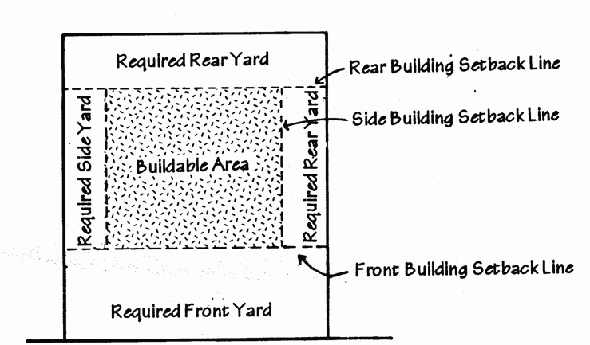
A. "Development influence area" means the parcels within 150 linear feet of the boundary of the SLID site along the same side of an existing public street.
B. "Dwelling, Courtyard Unit" means a rear unit with its entrance oriented toward a shared courtyard on a SLID site with four or more units.
C. "Dwelling, Front Unit" means a dwelling unit located at the front of the Small Lot Infill Development site oriented toward the existing public street.
D. "Dwelling, Rear Unit" means a dwelling unit located behind the front unit and either with a narrow frontage on the existing public street (as in a flag lot) or without direct frontage on the existing public street.
E. "Lot, Flag" means a parcel of land shaped like a flag, with a narrow strip providing access to a public street and the bulk of the property containing no street frontage.
F. "Lot, Small" means a new parcel created as part of a small lot subdivision in accordance with this Chapter.
G. "Lot, Small with no street frontage" means a parcel of land that does not share a lot line with a public street right-of-way.
H. "Small lot infill development (SLID) site" means the entire area included in the lot consolidation and replat infill development project. Also referred to as "SLID site" or "infill development site."
I. "Small lot subdivision" means a lot consolidation and replat of one or more eligible traditional lots into two or more small lots that comply with the requirements of this Chapter.
J. "Street Frontage" means the portion of a lot that abuts a public or private street.
K. "Traditional lot" means a parcel of record that was recorded in the office of the Cuyahoga County Fiscal Office prior to January 1, 2018.
(Ord. 18-25. Enacted 4-23-18.)
1244.04 ELIGIBILITY.
A. A vacant parcel or a combination of vacant parcels may be redeveloped as a Small Lot Infill Development if the proposed SLID site is comprised of:
1. At least one traditional lot, and
2. An area of one acre or less.
B. The proposed SLID site shall be in one ownership, or if there are two (2) or more owners, the application shall be filed jointly by all owners of the properties included in the proposed SLID boundaries.
C. Once a traditional lot has been replatted as a part of a SLID, it shall no longer be considered a traditional lot for the purposes of these regulations.
(Ord. 18-25. Enacted 4-23-18.)
1244.05 USES.
A. Residential uses listed as permitted in the base zoning district. In the case of a proposed SLID site located in more than one base zoning district, the use limitations and density of the most intense base zoning district shall prevail.
B. Accessory Uses and Structures.
1. Accessory uses and structures permitted in the base zoning district.
2. Accessory buildings to accommodate congregate / shared / common facilities such as but not limited to dining, laundry, recreation and storage, which shall be in addition to and not in replacement of such facilities in each dwelling unit.
3. Shared driveways.
4. Garages, attached or detached to one or more dwelling units, pursuant to Section 1262.07, except as otherwise permitted in this Chapter.
C. Additional dwelling types may be authorized as part of a SLID, provided that the City Planning Commission finds:
1. That the additional dwelling types are desirable and appropriate with respect to the primary purpose and character of the SLID.
2. That the additional dwelling types will not create a detrimental influence on the neighborhood, or upon the internal character of any part of or all of the SLID itself. (Ord. 18-25. Enacted 4-23-18.)
1244.06 DENSITY AND LOT REQUIREMENTS.
A. A maximum of two dwelling units shall be permitted for each traditional lot comprising the proposed SLID site when overlaying a TF Two Family District.
B. There is no minimum lot size or minimum lot width for fee-simple lots in a SLID, provided the SLID site as a whole complies with the maximum lot coverage limits and each unit complies with the minimum setbacks set forth in this Chapter.
C. There is no minimum street frontage required for fee-simple lots. Flag lots and lots with no street frontage may be approved in compliance with the requirements of this Chapter, including requirements for access to each unit.
D. Fee-simple lots do not need to be of uniform size and may be irregularly shaped in order to provide private parking and outdoor space within the fee-simple lot.
(Ord. 18-25. Enacted 4-23-18.)
1244.07 SETBACKS FROM SLID SITE BOUNDARY.
A. Setback from Public Street. The neighborhood context shall provide direction for establishing the setback of front unit(s) from the existing public street as follows.
1. The required setback of the front unit(s) in a small lot development shall be the same as the setback of the majority of the existing houses in the development influence area.
2. If the setback of the existing houses in the development influence area varies by more than 10 feet, the front yard setback shall be within 5 feet of the average setback.
3. The front setback of an existing house shall be measured from the street right-of-way to the front wall of the house, or the City Planning Commission may consider the front of the porch when the porch extends more than 50% across the width of the house and is covered by a roof.
B. Setback from Side and Rear Lot Lines of SLID Site. All dwelling units shall be located a minimum of three feet from the side and rear lot lines of the SLID.
C. Garages and other permitted accessory buildings shall be located behind the front unit(s), a minimum of 3 feet from the side and rear lot lines of the SLID site, or may be located at or closer to the property line of the SLID if the wall is fireproofed.
(Ord. 18-25. Enacted 4-23-18.)
1244.08 YARD REQUIREMENTS WITHIN THE SLID SITE.
A. Dwelling units, garages and other permitted accessory buildings shall comply with the setback requirements in 1244.07.B measured from the interior SLID lot lines, or be attached with a common wall along the interior SLID property line.
B. Allowable encroachments into the yards that are permitted in the underlying district as listed in table 1260.04, Allowable Encroachments are permitted.
C. Required Private Open Space. Each dwelling unit shall be provided a minimum of 150 square feet of clearly defined, at grade, private open space with direct access from the interior of the dwelling. (Ord. 18-25. Enacted 4-23-18.)
1244.09 LOT COVERAGE.
The surface coverage of all enclosed buildings and structures on the SLID site shall, taken together, occupy no more than 60% percent of the total SLID site area.
(Ord. 18-25. Enacted 4-23-18.)
1244.10 PARKING AND ACCESS REQUIREMENTS.
A. Off-street parking shall be located behind the front unit(s).
B. Off-street parking spaces shall be provided as required below:
1. Each dwelling unit shall be provided a minimum of one and a maximum of two enclosed parking spaces per unit.
2. An enclosed parking space may be provided, either attached to the dwelling or detached.
C. A detached garage shall be located no closer than 10 feet to a dwelling unit.
D. Each garage structure shall be limited to no more than 4 spaces and a maximum floor area of 800 square feet.
E. Access to all dwelling units and parking areas shall be provided by a driveway with a minimum width of 8 feet and sufficient space in front of the parking spaces to maneuver.
F. Any access that is shared by two or more dwellings shall be governed by a permanent access easement recorded on the subdivision plat, or owned in common by an owners association.
G. Address signs for all units are required on the unit.
(Ord. 18-25. Enacted 4-23-18.)
1244.11 DESIGN REQUIREMENTS.
Constructing infill housing offers a unique set of design challenges not only on the parcel level, but also on the neighborhood level and within the public realm. Therefore, it is important to consider the design elements of each small lot home and how it will enhance the overall neighborhood character and vitality of the larger public realm. This Section articulates design requirements to ensure infill development permitted by this Chapter is compatible with the surrounding neighborhood.
A. The City's adopted Design Guidelines for Multi-Family and Attached Single-Family Infill Housing shall be considered in the design and layout of SLID projects, supplemented with the additional design principles in this section.
B. Public Realm. Each infill project, however small, must contribute to a vital and coherent public realm. To do so, each project should focus on the relationship between the proposed small lot subdivision and the public environment, with emphasis on: building orientation toward the existing public street, articulation of facades and entry ways, landscaping, lighting, building fenestration, pedestrian circulation, type and location of driveways and garages.
C. Building size and massing. Infill development should be compatible with other units within the Development Influence Area in regards to size, bulk, scale, mass, and rhythm. Dwellings shall either be similar in size and height, or if larger, be articulated and subdivided proportionally to the mass and scale of other residential buildings in the development influence area. The City Planning Commission may limit the height of dwellings based on prevailing height of existing dwellings in the Development Influence Area.
D. Orientation and Entrances.
1. Front Unit Orientation. Each front unit shall be oriented toward the existing street, and should have the primary entrance and main windows facing the street with direct access to the public sidewalk.
2. Rear and Courtyard Units. For units that are not adjacent to the public street, pedestrian circulation shall be provided in the form of private walkways or clearly delineated paths of travel from the public sidewalk to their entryway.
E. Screening, Privacy, and Landscape Design.
1. Screening along SLID site boundaries. To protect existing and future dwellings in the areas of the SLID site, side and rear yards of the lots in the new subdivision shall be separated and screened along common lot lines of the adjacent residential area with a solid wooden fence six (6) feet in height or with dense evergreen shrubs.
2. Interior spaces as well as doors and windows should be configured to provide privacy between dwelling units and adjacent property.
3. Shrubs and tree planting are encouraged to define private space and increase privacy between infill houses.
4. Adequate space to accommodate recycling and trash receptacles should be provided and appropriately screened.
5. All screening and fence material shall be attractive, durable and contribute to the quality of the residential landscape design.
6. All fences shall be erected so that the finished side faces the neighboring property.
F. Lighting.
1. Exterior lighting should enhance the overall design and increase safety.
2. All light fixtures should complement the architecture and landscape design.
(Ord. 18-25. Enacted 4-23-18.)
1244.12 OTHER DEVELOPMENT STANDARDS.
The development standards of the base zoning district that are not specifically addressed in this Chapter shall be used as a guide for determining the appropriate building layout, building height and other development requirements of the SLID.
(Ord. 18-25. Enacted 4-23-18.)
1244.13 REVIEW OF SLID APPLICATIONS.
A. Applications for a proposed SLID shall include a site plan, preliminary plat and other items required for planned developments pursuant to Section 1213.09.
B. Conditional Use Permit Standards. No SLID shall be approved unless the applicant shall establish that the proposed development is based on the criteria in this chapter, the criteria for conditional uses in Section 1213.05 H. and the following standards specific to SLID.
C. Additional Standards Specific to SLID.
1. Conformity with City Policies and Ordinances. The proposed development shall not injure the use, value and enjoyment of the surrounding property in accordance with the policies of the City, shall be consistent in all respects with the purpose and intent of this Zoning Ordinance, and shall advance the general welfare of its immediate vicinity and of the City as a whole.
2. Site Design. The location, configuration, construction, manner and time of operation of off-street parking and loading areas, service areas, circulation systems, entrances, exits, open space, amenities, lighting, or other potentially detrimental influences shall be designed to avoid: (a) adverse effects on residential uses within or adjoining the development, (b) traffic congestion, and (c) hazards to vehicular or pedestrian traffic.
3. Utilities. The proposed development shall provide for underground installation of service connections and lines (including electricity and telephone). Provisions also shall be made for acceptable design and construction of storm water facilities including grading, gutter, piping, and treatment of turf and maintenance of facilities.
Maintenance of Shared and Common Space. The proposed development shall include provisions for the maintenance of shared and/or common space, including all improvements thereto, as are reasonably necessary to ensure their continuity, maintenance, and operation in accordance with pre-determined standards and to ensure that remedial measures will be available to the City of Shaker Heights if such shared or common space or other improvements are not maintained in a condition consistent with the best interests of the SLID, its immediate vicinity, or the City as a whole. (Ord. 18-25. Enacted 4-23-18.)

