
Shawnee City Zoning Code
DIVISION 6
PROCEDURES
Sec. 22-223.- General procedures.
A.
Purpose. The purposes of this article are to:
1.
Establish the appropriate workflows associated with each land development process; and
2.
Ensure that processes comply with state law; and
3.
Assign the appropriate approval authority, completeness measures, and deadlines to ensure that the processes are efficient and fair to applicants; and
4.
For discretionary or legislative decisions, provide notice and an opportunity to be heard by persons affected by the application.
B.
General procedural requirements.
1.
Applicability. This section establishes rules and procedures for specific land use decisions under the jurisdiction of the city commission, planning commission, board of adjustment, director, and city staff (where applicable).
2.
Procedures. This section sets up rules for procedures, such as notices and public hearings. It then describes the process for specific land use decisions. The procedures have a common workflow and description per Table VI.1: Procedural Components.
Table VI.1: Procedural Components
3.
Authority table. Table VI.2: Authority Table summarizes the major review procedures for land use applications and development activity in the city's corporate limits and who acts on those applications.
Table VI.2: Authority Table
C.
Pre-application.
1.
Applicability. These requirements apply to any application requiring a pre-application meeting or if the applicant elects to request a pre-application meeting with the city.
2.
Initiation. Before filing an application subject to this section, the applicant shall request a meeting with the development review committee concerning the plans and data as specified in this UDC.
3.
Development review committee. The purpose of the development review committee is to assist an applicant prior to the submittal of an application, to coordinate the technical aspects of development, and to advise the city manager concerning planning and development issues.
a.
The development review committee is composed of the following departments, members, or their representatives:
i.
The director.
ii.
The city engineer.
iii.
The city building official.
iv.
The city fire marshal.
b.
The development review committee may request the assistance of other staff members and agency representatives.
4.
Scheduling. Any applicants wishing to discuss a development proposal with the development review committee shall advise the director at least seven calendar days prior to the meeting.
5.
Pre-application meeting.
a.
The pre-application meeting shall include the following:
i.
A discussion of the general project consistency with this UDC and the comprehensive plan;
ii.
A discussion of technical studies, plans, and other information deemed relevant to the specific application request; and
iii.
Discussion of the anticipated level of citizen interest.
b.
The applicant shall provide a brief overview of the project, including proposed location, uses, densities, project layout, and design features.
c.
The director will provide information and comments at the pre-application meeting but will not take formal action on the application. In addition to the provision of verbal information, the director may provide a pre-application meeting checklist.
d.
The applicant's and development review committee's comments are for informational purposes, and are not binding on either the city or the applicant.
6.
Documentation.
a.
During the meeting, the director may review and complete an informational checklist, based on the scope of the application.
b.
The director will record in writing and provide the applicant with any pertinent information concerning the project scope, as described by the applicant, as well as verbal guidance provided by city staff.
D.
Submitting applications.
1.
General requirements.
a.
Applications filed under this UDC must include the information required in any applicable checklist.
b.
The city commission may establish fees for all applications required in this UDC by resolution.
2.
Completeness.
a.
The director will not process incomplete applications.
b.
An application is not complete until all required items are submitted (see the application's submittal checklist).
c.
When applications are submitted, the director will review them for completeness.
d.
The time period to process an application does not commence until the director determines that the application is properly submitted, and the applicant has corrected any deficiencies in the application.
e.
The review for application completeness is solely to determine whether information required for submission with the application is sufficient to allow further processing.
f.
The director will determine whether the application is complete and will transmit the determination to the applicant. If the director determines that the application is not complete, the director will specify those parts of the application that are incomplete and will indicate how they can be made complete, including a list and description of the information needed to complete the application. The director or the approval authority is not obligated to further review the application until the required information is corrected.
g.
The director or the approval authority may provide submission deadlines for materials required in support of any application provided for in any checklist. Compliance with those deadlines is required to have the application placed on an agenda to be heard by the approval authority.
E.
Noticing.
1.
Generally.
a.
Upon receipt of an application requiring a public hearing, the city clerk shall set dates of the public hearings before the planning commission and city commission.
b.
Interested parties and citizens shall have an opportunity to be heard at all public hearings.
c.
All mailed notices shall provide a list of all owners of real property within the prescribed radius of the exterior boundary of the subject property to be certified by the county assessor, abstract company, or title company.
2.
Noticing for the planning commission and city commission.
a.
Generally. Any application requiring a public hearing and approval from the planning commission or city commission shall follow the requirements established above, as well as the additional requirements specified below.
b.
Rezoning.
i.
Generally.
(A)
At least 15 days' notice of the rezoning requested, date, time, and place, each hearing shall be published in a newspaper of general circulation in the city.
(B)
The notice shall also include a map of the area to be affected, indicating street names or numbers, streams, or other significant landmarks in the area.
ii.
Mail. Notice of a public hearing on any proposed zoning change shall be given 20 days prior to the hearing by mailing written notice by the city clerk to all owners of real property within a 300-foot radius of the exterior boundary of the subject property. The notice shall contain as follows:
(A)
Legal description of the property and the street address or approximate location;
(B)
Present zoning and classification of the property and the classification sought by the applicant; and
(C)
Date, time, and place of the public hearing.
iii.
Signage. Notice of public hearing of any zoning change shall be given by a sign or signs as may be required, placed on the property affected by the proposed zoning reclassification. The sign or signs shall be posted on the affected property at least 20 days before the hearing date. Signs and lettering shall be of sufficient size so as to be clearly visible and legible from the public street or streets which it faces. It shall contain as follows:
(A)
The date, time, and place of the public hearing;
(B)
By whom the public hearing will be conducted;
(C)
Existing and desired zoning classification; and
(D)
Other information as deemed necessary to provide adequate and timely public notice.
3.
Noticing for specific uses.
a.
Generally.
i.
In accordance with state law, if the zoning change requested permits the use of treatment facilities, multiple-family facilities, transitional living facilities, halfway houses and any housing or facility that may be used for medical or nonmedical detoxification as these terms are defined pursuant to 43A O.S. § 3-403, written notice shall be provided at least 30 days before the hearing date to all property owners within one-quarter mile where the area to be affected is located.
ii.
The applicant is responsible for costs associated with the notice and shall provide proof of compliance.
iii.
The content of the notice shall meet the requirements of this article and state law.
iv.
The city will be responsible for posting the property and providing publication in the newspaper in accordance with the other provisions of the UDC and state law.
b.
Group homes.
i.
In accordance with state law (60 O.S. § 863), a group home, although a permitted use, shall only be established after notice is given to all affected real property owners within 300 feet of the exterior boundaries of the property on which the group home is to be located.
ii.
The notice shall contain a legal description of the property and the street address or approximate location of the group home.
iii.
The applicant shall furnish to the city the mailing list prepared by a bonded abstractor.
4.
Noticing for the board of adjustment.
a.
Notice of public hearing before the board of adjustment shall be given by publication in a newspaper of general circulation in the municipality where the property is located and by mailing written notice by the clerk of the board of adjustment hearing to all owners of property within a 300-foot radius of the exterior boundary of the subject property. A copy of the published notice may be mailed in lieu of written notice; however, the notice by publication and written notice shall be published and mailed at least ten days prior to the hearing.
b.
The notice, whether by publication or mail, of a public hearing before the board of adjustment shall contain:
i.
Legal description of the property and the street address or approximate location in the municipality;
ii.
Present zoning classification of the property and the nature of the appeal, variance, or exception requested; and
iii.
Date, time, and place of the hearing.
c.
For hearings involving minor variances or special exceptions, notice shall be given by the clerk of the board of adjustment by mailing written notice to all owners of property adjacent to the subject property. The notice shall be mailed at least ten days prior to the hearing and shall contain finding of facts. The board of adjustment shall have the powers to grant minor variances or special exceptions as set forth in the board of adjustment Resolution No. 1-81, subject to the approval or amendment by the city commission.
F.
Staff review.
1.
Review by other departments and agencies. The staff may forward copies of the application to various local, state and/or federal agencies and departments for their review and comment. The director may ask the reviewers to respond in writing or attend an application review meeting with the staff.
2.
Staff review. The staff shall review the application and supporting information. This may occur in a meeting with the applicant and representatives of other departments or agencies, as described in [subsection] 1. above. After reviewing the information, staff shall prepare a report summarizing the information for the approval authorities and provide a recommendation for action and any proposed conditions. The applicant or other interested parties may obtain a copy of the staff report from the department before the hearing at which the application is scheduled to be heard.
3.
Staff report. If an individual section of this article (and where permitted by state law) delegates to staff the authority to approve, approve with conditions, or deny/disapprove an application, the staff report may include a written decision to that effect.
G.
Decisions and public hearings.
1.
Purpose. The purpose of a public hearing is to allow the applicant and all other interested parties a reasonable and fair opportunity to be heard, to present evidence relevant to the application, and to rebut evidence presented by others.
2.
Rules of procedure. The city commission and planning commission may adopt rules of procedure for public hearings.
3.
Action. Approval authorities shall hold regularly scheduled public hearings to receive and review public input on items required by this UDC. Decisions and recommendations shall be rendered in a timely manner, based on the specific requirements of this UDC and following:
a.
Conformance with these regulations, the comprehensive plan, and other adopted plans, design guidelines, and policies;
b.
Recommendations of staff and approval authorities providing recommendations to the final approval authority;
c.
Input of reviewing agencies and departments;
d.
Public comment and testimony received at the hearing; and
e.
Effects of the proposal on the neighborhood, area, and community-at-large.
4.
Authority to condition development approvals.
a.
After application review, other pertinent information or documents, and any evidence made part of the public record, approval authorities may impose conditions that are necessary to ensure compliance with applicable general or specific standards expressed in this UDC.
b.
The director shall include a copy of the conditions with the record of the decision.
c.
The applicant shall be notified of any conditions imposed on the application.
H.
Tabling.
1.
Purpose. This section allows for the tabling of applications as needed to collect additional information, or to engage in further review.
2.
Applicant request. An applicant may request to table any application in writing for a future meeting date.
3.
Director request. The director may request to table any application for further review and consideration. In that case, the director shall provide notice and explanation to the applicant in writing before the meeting at which the application is scheduled for hearing. Notice of the tabling will be given at the beginning of the scheduled meeting.
I.
Application withdrawal.
1.
Generally. An application may be withdrawn at any time prior to formal consideration by the approval authority.
2.
Fees. Withdrawal of an application after the determination of completeness results in the forfeiture of fees.
3.
No public hearing required. If no public hearing is required, the applicant shall give notice of the withdrawal to the director at the earliest possible time. This allows the director to notify other applicants of an agenda change.
4.
Public hearing required. If a public hearing is required, an applicant may request a withdrawal from the director at any time prior to the opening of the hearing. Once the public hearing is opened, the approval authority shall decide whether to approve the request and may instead act on the application.
J.
Scope of approval.
1.
Generally. The approval authority may take any action on the application that is consistent with the notice given, including approval, conditional approval, or denial/disapproval of the application.
2.
Amendments.
a.
The approval authority may allow amendments to the application if the effect of the amendment is to reduce the density or intensity of the original application, reduce the impact of the development, or reduce the amount of land involved from that indicated in the notices of the hearing.
b.
The approval authority may not permit a greater amount of development, a more intensive use, a larger area of land than indicated in the original application, or a greater variance than was indicated in the notice.
K.
Protest against change.
1.
Generally. Any resident can protest against a proposed change in regulations, restrictions, or district boundaries as provided in 11 O.S. § 43-105. All written protests against proposed changes shall be filed at least three days before the public hearing date. If protests are filed by:
a.
The owners of 20 percent or more of the area of lots included in a proposed change; or
b.
The owners of 50 percent or more of the area of lots within a 300-foot radius of the exterior boundary of the territory included in a proposed change.
Then the proposed change or amendment shall not become effective except by a favorable vote of three-fifths of all the members of the city commission.
2.
Protest exclusions. A resident may not protest or impact approval majorities for plats, conditional use permits, or other applications not approved by the city commission pursuant to 11 O.S. § 43-105.
L.
Post-decision.
1.
Minor revisions.
a.
The director may approve minor revisions to the terms of an approved application. "Minor revisions" are those that are necessary in light of technical considerations discovered after the decision on the application, and that do not substantively change the character of the approval. Minor revisions include, but are not limited to:
i.
An increase in building square footage not exceeding five percent;
ii.
Substitution of landscape materials if the proposed materials are of a similar shape, size, and type;
iii.
Location of trees; and
iv.
Changes to building materials, parking lot design, screening devices, building location, or similar elements of site or building design, that would improve the site or are needed because of circumstances not foreseen at the time of site plan approval.
b.
Minor revisions must be authorized in writing.
c.
Minor revisions are subject to appeal to the board of adjustment. On appeal, no further action will be taken to process the application, and/or issued permits are stayed pending the board of adjustment's determination.
2.
Major revisions.
a.
A major revision is any revision that the director determines is not a minor revision.
b.
A major revision is approved by the original approval authority and is required in accordance with the procedures established for the original consideration of the application.
c.
In making a determination, the director may seek a recommendation from any approval authority involved in the original application process.
M.
Appeals.
1.
Generally. A party with standing may seek judicial review.
2.
Appeals to the board of adjustment.
a.
Appeals may be taken to and before the board of adjustment where it is alleged there is error in any order, requirements, decision or determination made by an administrative official in the enforcement of this UDC.
b.
An appeal shall be made by submitting to the city a notice of appeal and specifying the appeal's grounds.
c.
An appeal shall be taken within 30 days from the date of the decision by filing with the city and filing with the board of adjustment a notice of appeal specifying the grounds therefore, and by paying a filing fee in an amount as described in the city fee schedule at the city at the time the notice is filed. The applicant shall provide at the time of application a certified list of property owners within 300 feet in question prepared by a bonded abstract company. Newspaper publication shall also include a map of the area to be affected that indicates street names or numbers, streams, or other significant landmarks in said area.
d.
The office or department from which the appeal is taken shall transmit to the board of adjustment all of the papers constituting the record from which the action appealed was taken.
e.
An appeal shall stay all proceedings in furtherance of the action appealed from unless the building inspector shall certify to the board of adjustment that, by reason of facts in the certificate, a stay would cause imminent peril to life or property, in which case proceedings shall not be stayed otherwise than by a restraining order which may be granted or by a court of equity, after notice to the office from whom the appeal.
f.
The board of adjustment shall fix a reasonable time for the hearing of the appeal or other matter referred to it, and shall mail notices of that hearing to the petitioner and to the owners of property lying within a 300-foot radius of the exterior boundary of the subject property on which an appeal is desired, and to all other persons deemed by the board of adjustment to be affected by the appeal. These owners and persons shall be determined according to the current tax rolls of the city.
3.
Appeals to district court.
a.
An appeal from any action, decision, ruling, judgment, or order of the board of adjustment or city commission may be taken by any person(s), jointly or severally aggrieved, or any taxpayer or any officer, department, board, or bureau of the municipality to the district court in the county in which the sites of the municipality is located.
b.
The appeal shall be taken by filing a notice of appeal with the city and with the clerk of the board of adjustment within ten days of the decision by the board of adjustment. Day one begins the first day following the board of adjustment's decision. The notice shall specify the grounds for the appeal. No bond or deposit for costs shall be required for such appeal.
c.
Upon filing the notice of appeal, the board of adjustment shall forthwith transmit to the court clerk the original, or certified copies, of all papers constituting the record in the case, together with the order, decision, or filing of the board of adjustment.
d.
The appeal shall be heard and tried without jury in the district court. All issues in any proceedings under this section shall have preference over all other civil actions and proceedings.
e.
An appeal to the district court from the board of adjustment stays all proceedings in furtherance of the action appealed from, unless the chair of the board of adjustment, from which the appeal is taken, certified to the court clerk, after the notice of appeal has been filed, that by reasons of facts stated in the certificate a stay in their opinion cause imminent peril of life or property. In such case, proceedings shall not be stayed otherwise than by a restraining order, which may be granted by district court upon application or notice to the administrative officer in charge of the enforcement of the terms and provisions of the code, and upon notice to the chair of the board of adjustment from which appeal is taken, and upon due cause being shown.
f.
The district court may reverse or affirm, wholly or partly, or modify the decision brought up for review. Costs shall not be allowed against the board of adjustment unless it shall appear to the district court that the board acted with gross negligence or in bad faith or with malice in making the decision appealed from. An appeal shall lie from the action of the district court as in all other civil actions.
(Ord. No. 2806NS, § 1(Exh. A), 8-19-2024)
Sec. 22-224. - UDC text amendment.
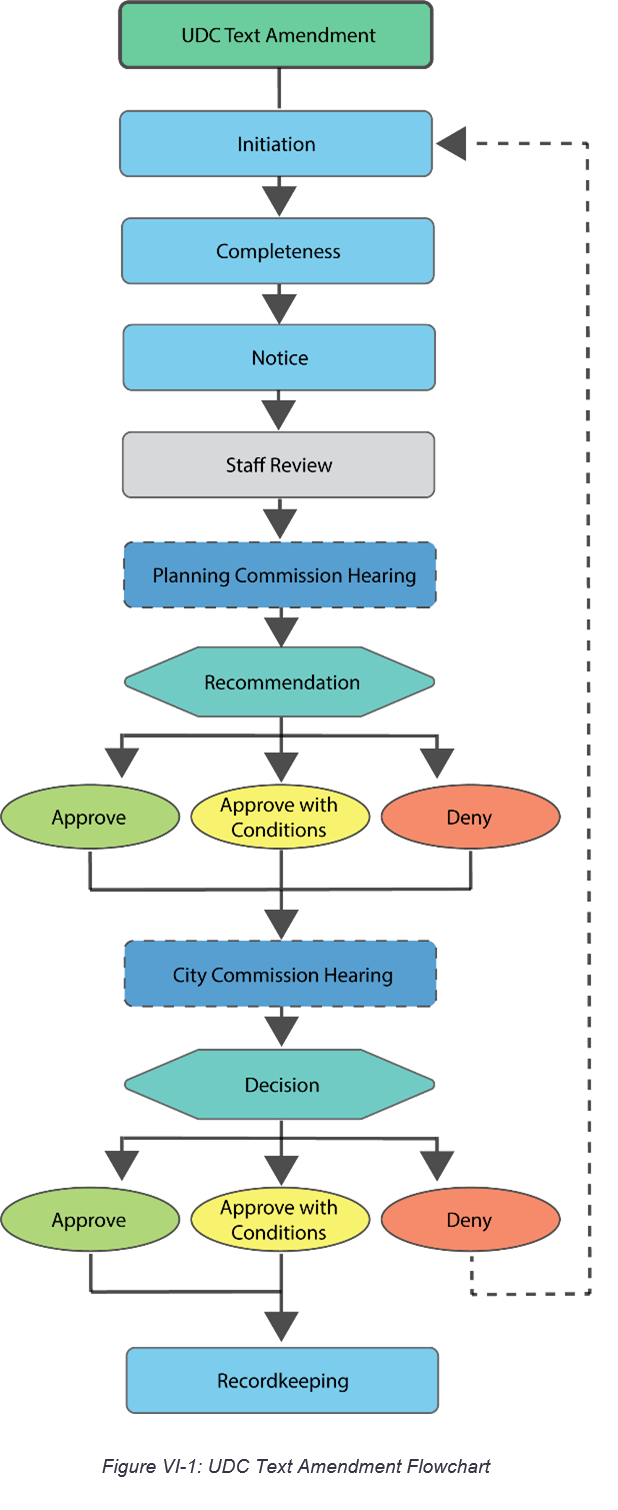
A.
Applicability. This section applies to any action of the city commission to amend or change the regulations of this UDC. This includes the regulations, restrictions, and boundaries or classification of property contained within this UDC or a change to the zoning map initiated by the city commission.
B.
Initiation. A text amendment may be initiated by:
1.
City commission;
2.
The planning commission;
3.
City staff; or
4.
Application of any resident, property owner, or business owner within the city.
C.
Completeness. See section 22-223.D.
D.
Notice and hearings).
1.
Noticing shall comply with section 22-223.E. and state law, as applicable.
2.
Two public hearings are required and shall comply with section 22-223.G.
E.
Decision.
1.
Planning commission hearing and recommendation. The planning commission shall conduct a public hearing on the text amendment. The planning commission shall submit its recommendation to the city commission:
a.
To approve the text amendment;
b.
To deny the text amendment; or
c.
To approve the text amendment with modifications.
2.
City commission hearing and decision. The city commission shall consider the text amendment at a public hearing after a recommendation has been provided by the planning commission. After the hearing is closed, the city commission shall by ordinance:
a.
Adopt the text amendment;
b.
Deny the text amendment;
c.
Approve the text amendment with revisions; or
d.
Remand the text amendment to the planning commission.
F.
Standards. A text amendment is a legislative decision subject to the city commission's discretion. The city commission may approve the text amendment if it:
1.
Is consistent with the comprehensive plan; and
2.
Promotes public health, safety, and general welfare.
G.
Subsequent applications. Not applicable.
H.
Appeals. See section 22-223.M.
I.
Scope of approval. The approval of a text amendment does not authorize the development of land. A text amendment allows property owners to apply for permits or actions consistent with its standards and requirements.
J.
Recordkeeping. The UDC's text amendment shall be codified and published as part of this Code by the city clerk.
(Ord. No. 2806NS, § 1(Exh. A), 8-19-2024)
Sec. 22-225. - Annexation.
A.
Applicability. This section applies to the annexation of territory to the city, consistent with the following state statutes:
1.
11 O.S. § 21-102.
2.
11 O.S. § 21-103.
3.
11 O.S. § 21-105.
4.
11 O.S. § 21-106.
5.
11 O.S. § 21-108.
6.
11 O.S. § 21-109.
7.
11 O.S. § 21-112.
8.
11 O.S. § 21-113.
9.
11 O.S. § 21-114.
10.
11 O.S. § 21-203.
B.
Initiation. Annexations are initiated as provided by state law.
C.
Completeness. All information required by state law is required for any annexation initiated by a property owner.
D.
Notice and hearing(s). Public notice is required as provided by state law.
E.
Decision. Decision-making procedures are provided by state law.
F.
Approval criteria.
1.
The city's annexation policy is to evaluate annexation applications based on their conformance with the goals of the city's comprehensive plan.
2.
The city commission shall hold public hearings at the same time as annexation to establish the zoning district classification for newly annexed property.
G.
Subsequent applications. Any limits on subsequent applications apply to the extent provided by state law.
H.
Appeals. Appeals procedures are provided by state law.
I.
Scope of approval. The city will extend the regulations of this UDC to annexed territory as provided by state law.
J.
Recordkeeping. Annexations are tracked as provided by state law.
(Ord. No. 2806NS, § 1(Exh. A), 8-19-2024)
Sec. 22-226. - Rezoning.
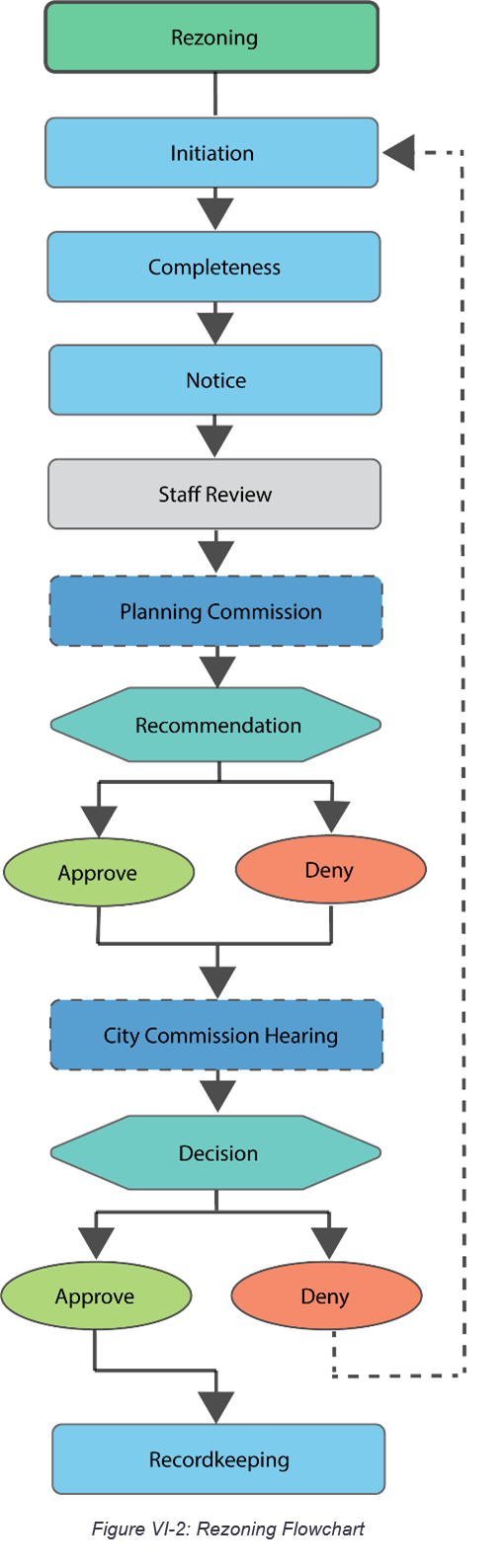
A.
Applicability. This section applies to the change in the zoning classification of individual properties.
B.
Initiation. A rezoning may be initiated by:
1.
City commission;
2.
The planning commission; or
3.
Request by owner or agent of owner of property to be changed.
C.
Completeness. See section 22-223.D.
D.
Notice and hearing(s).
1.
Noticing shall comply with section 22-223.E. and state law, as applicable.
2.
One public hearing is required and shall comply with section 22-223.G.
E.
Decision.
1.
Director review. The director shall review the rezoning and may provide a recommendation to the planning commission to:
a.
Approve the rezoning; or
b.
Deny the rezoning.
2.
Planning commission recommendation. The planning commission shall review the proposed rezoning and submit its recommendation to the city commission:
a.
To approve the rezoning; or
b.
To deny the rezoning.
3.
City commission. The city commission shall conduct a public hearing to consider the rezoning after a recommendation has been provided by the planning commission. After the hearing is closed, the city commission shall, by ordinance:
a.
Approve the rezoning; or
b.
Deny the rezoning; or
c.
Approve the rezoning to a lower intensity classification.
F.
Standards. In its review of an application for rezoning, the city commission shall consider the following standards. No single factor is controlling. Instead, each is weighed in relation to the other standards. If the planning commission finds that a rezoning is inconsistent with the land use element of the comprehensive plan, the application shall not be considered until a recommendation regarding a comprehensive plan amendment for the proposed zoning amendment is forwarded to the city commission, either prior to or concurrently with the proposed zoning amendment.
1.
Consistency. The city commission does not redetermine the city's policy of comprehensive zoning. The city's zoning map shall not be altered for the special benefit of the landowner when the change will cause substantial detriment to the surrounding lands or serve no substantial public purpose.
2.
Adverse impacts on neighboring lands. The city commission shall consider the nature and degree of an adverse impact upon neighboring lands. Lots shall not be rezoned in a way that is substantially inconsistent with the uses of the surrounding area, whether more or less restrictive. Further, the city commission finds and determines that vast acreages of single-use zoning produce uniformity with adverse consequences such as traffic congestion, air pollution, and social alienation. Accordingly, rezonings that promote mixed uses subject to a high degree of design control are not necessarily deemed to be inconsistent with neighboring lands and shall be considered.
3.
Suitability as presently zoned. The city commission shall consider the suitability or unsuitability of the tract for its use as presently zoned. This factor, like the others, must often be weighed in relation to the other standards, and instances can exist in which the use for which land is zoned may be rezoned upon proof of a real public need or substantially changed conditions in the neighborhood.
4.
Health, safety, and welfare. The rezoning must bear a substantial relationship to the public health, safety, morals, or general welfare or protect and preserve historic and cultural places and areas. The rezoning may be justified, however, if a substantial public need exists, and this is so even if the private owner of the tract will also benefit.
5.
Public policy. A strong public policy in favor of rezoning may be considered. Examples include a need for affordable housing, economic development, recreational activity, or mixed-use development, which functionally relates to the surrounding neighborhoods.
6.
Size of tract. The city commission shall consider the size, shape, and characteristics of the tract in relation to the affected neighboring lands. Proof that a small tract is unsuitable for use as zoned or that there have been substantial changes in the immediate area may justify a rezoning.
7.
Other factors. The city commission may consider any other factors relevant to a rezoning application under state law.
G.
Subsequent applications.
1.
This subsection applies if:
a.
The applicant withdraws an application after notice of hearing is published; or
b.
The city commission denies a zoning or rezoning application.
2.
If the above requirements apply, the applicant shall not submit a rezoning application for the same zoning district request on the same property for at least six months. However, a rezoning application for the same property in a different zoning classification may be submitted without limitation.
3.
The above waiting period begins with the date of the city commission's denial of the prior application.
H.
Appeals. See section 22-223.M.
I.
Scope of approval. The approval of a rezoning does not authorize the development of land. A rezoning allows the applicant to apply for a building permit or concept plan, in the case of uses permitted as of right, or a conditional use permit, in the case of uses designated as special uses within the applicable zoning district.
J.
Recordkeeping. If the amendment involves changes to the existing zoning district boundaries, the form of the amending ordinance shall contain a narrative description of the land to be reclassified or reference to an accompanying plat of such land showing the new zoning districts and indicating their boundaries. The director shall refer to the attested ordinance as a record of the current zoning status until the zoning map is changed accordingly.
(Ord. No. 2806NS, § 1(Exh. A), 8-19-2024)
Sec. 22-227. - Conditional use permit.
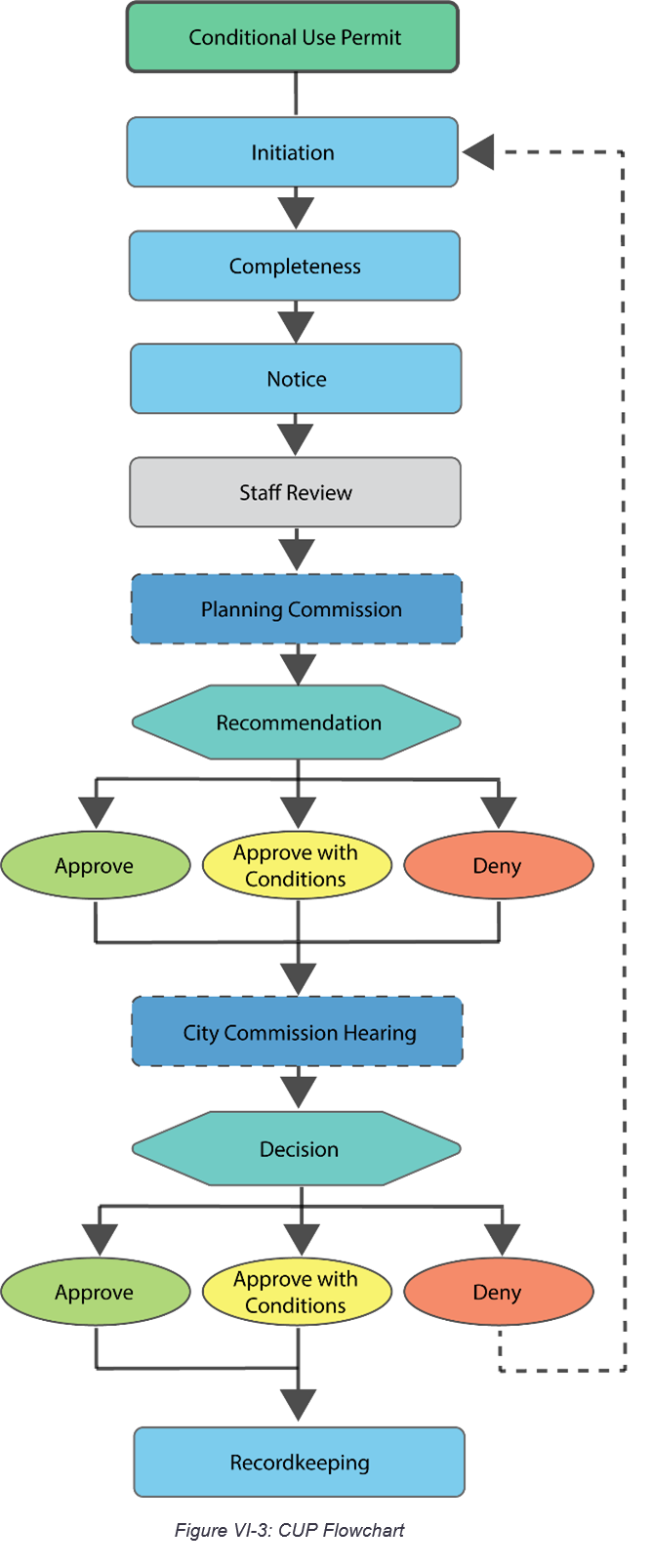
A.
Applicability. This section applies to any application for approval of a use designated as a conditional use in Table III.2: Use Table.
B.
Initiation. The owner or agent of the owner of the property may initiate a conditional use permit.
C.
Completeness.
1.
Generally. See section 22-223.D.
2.
Specific requirements.
a.
An application shall be filed with the director for completeness review.
b.
The application shall show the location and intended use of the site.
c.
The applicant shall provide a certified property ownership list of all property owners within 300 feet as prepared by a bonded abstract company.
d.
The applicant shall provide the existing land uses adjacent to the site and any other material pertinent to the request that the director may require.
e.
A conditional use permit application shall be accompanied by the payment of a fee in an amount as described in the city fee schedule to cover costs of notice and posting and administrative review.
D.
Notice and hearing(s).
1.
Noticing shall comply with section 22-223.E. and state law, as applicable.
2.
One public hearing is required and shall comply with section 22-223.G.
3.
In the event any applicant files an application for an amendment concurrently with an application for a conditional use, the planning commission may, upon its option, consider both applications concurrently upon proper notice having been given.
E.
Decision.
1.
Director review. The director shall review the conditional use permit and shall provide a recommendation to the planning commission to:
a.
Approve the conditional use permit; or
b.
Deny the conditional use permit; or
c.
Approve the conditional use permit with conditions.
2.
Planning commission recommendation. The planning commission shall review the conditional use permit and submit its report and recommendation to the effect of the proposed building or use upon the character of the neighborhood, traffic congestion, public utilities, and other matters pertaining to the general health, safety, and welfare of the public and to the city commission within 45 days of the application date. The planning commission shall recommend to the city commission:
a.
To approve the conditional use permit; or
b.
To deny the conditional use permit; or
c.
To approve the conditional use permit with conditions.
3.
City commission decision. The city commission shall consider the conditional use permit at a public hearing after a recommendation has been provided by the planning commission. After the hearing is closed, the city commission shall by ordinance:
a.
Approve the conditional use permit; or
b.
Deny the conditional use permit; or
c.
Approve the conditional use permit with conditions.
F.
Standards.
1.
Generally. The planning commission and city commission may set conditions on the approval of any conditional use permit, including, but not limited to, conditions on:
a.
Hours of operation;
b.
Use restrictions;
c.
Building design;
d.
Parking;
e.
Setbacks;
f.
Lot sizes;
g.
Density;
h.
Landscaping;
i.
Screening;
j.
Site design elements;
k.
Signs;
l.
Lighting;
m.
Noise; and
n.
Other development standards and operational safeguards that may be deemed important to the welfare and protection of adjacent property and the community as a whole.
2.
Specific conditions required for approval. The city commission shall approve a conditional use permit only if the applicant demonstrates that five of the eight conditions below are met:
a.
The proposed conditional use shall comply with the intent of all regulations of the applicable zoning district, the provisions of division 2, any applicable use regulations of division 3, and any applicable development standards of division 4 of this UDC.
b.
The proposed conditional use permit does not have a probable effect on the adjacent property and the community welfare with appropriate regard to the health, safety, and welfare of the general public.
c.
The proposed conditional use shall conform to the character of the neighborhood within the same zoning district in which it is located. The proposal, as submitted or modified, shall have no more adverse effects on health, safety, or comfort of persons living or working in the neighborhood, or shall be no more injurious to property or improvements in the neighborhood than any other use generally permitted in the same district. In making this determination, the planning commission or city commission shall consider the location, type, and height of buildings or structures, the type and extent of landscaping and screening on the site and whether the proposed use is consistent with any policy of the comprehensive plan which encourages mixed uses or densities.
d.
The proposed use shall not be noxious or offensive by reason of vibration, noise, odor, dust, smoke, or gas.
e.
The proposed use shall not injure the use and enjoyment of the property in the immediate vicinity for the purposes already permitted nor substantially diminish or impair the property values within the neighborhood.
f.
Adequate measures shall be taken to provide ingress and egress designed to minimize traffic hazards and to minimize traffic congestion on public roads.
g.
The establishment, maintenance, or operation of the proposed use shall not be detrimental to or endanger the public health, safety, morals, comfort, or general welfare.
h.
The public interest and welfare supporting the proposed conditional use authorization shall be sufficient to outweigh the individual interests that are adversely affected by the establishment of the proposed use.
G.
Subsequent applications.
1.
This subsection applies if:
a.
The applicant withdraws an application after notice of hearing is published; or
b.
The city commission denies a conditional use permit application.
2.
If the above requirements apply, the applicant shall not submit a conditional use permit application for the same conditional use permit request on the same property for at least six months.
3.
The above waiting period begins with the date of the city commission's denial of the prior application.
H.
Appeals. See section 22-223.M.
I.
Scope of approval.
1.
Generally. The approval of a conditional use permit does not authorize the development of land. A conditional use permit allows the applicant the right to apply for a building permit, plat, or site plan.
2.
Violations. Any conditional use permit violates this UDC and shall be suspended or revoked if:
a.
A court with jurisdiction or a jury finds the holder of the conditional use permit guilty of a violation or if a holder of a conditional use permit pleads guilty of violating.
b.
Any requirement or term or condition of the conditional use permit or has not conformed, at any time, with any or all of the requirements or terms or conditions as set out in the conditional use permit as approved by the city commission.
c.
The activity authorized by the conditional use permit commences prior to the institution of all conditions imposed by the conditional use permit.
d.
The use for which the conditional use permit was authorized does not commence within six months of the effective date of the conditional use permit. The city commission may grant an extension of up to six months for good cause shown, upon petition of the conditional use permit holder.
e.
The use for which the conditional use permit is authorized is discontinued for six consecutive months.
3.
Notification. If the use discontinues or fails to commence as stipulated in this UDC, the director will issue written notification to the property owner. Ten days after issuance of this notice, the director shall issue the permit holder written notification of the conditional use permit's official revocation and removal from the zoning map.
J.
Recordkeeping.
1.
The conditional use permit shall contain a narrative description if the conditional use permit is only associated with a portion of a tract of land to be reclassified or reference to an accompanying plat if the conditional use permit is associated with the entire tract of land.
2.
A certified copy of all ordinances authorizing a conditional use permit pursuant to this section shall be recorded by and at the expense of the applicant with the city clerk.
(Ord. No. 2806NS, § 1(Exh. A), 8-19-2024)
Sec. 22-228. - Preliminary plat.
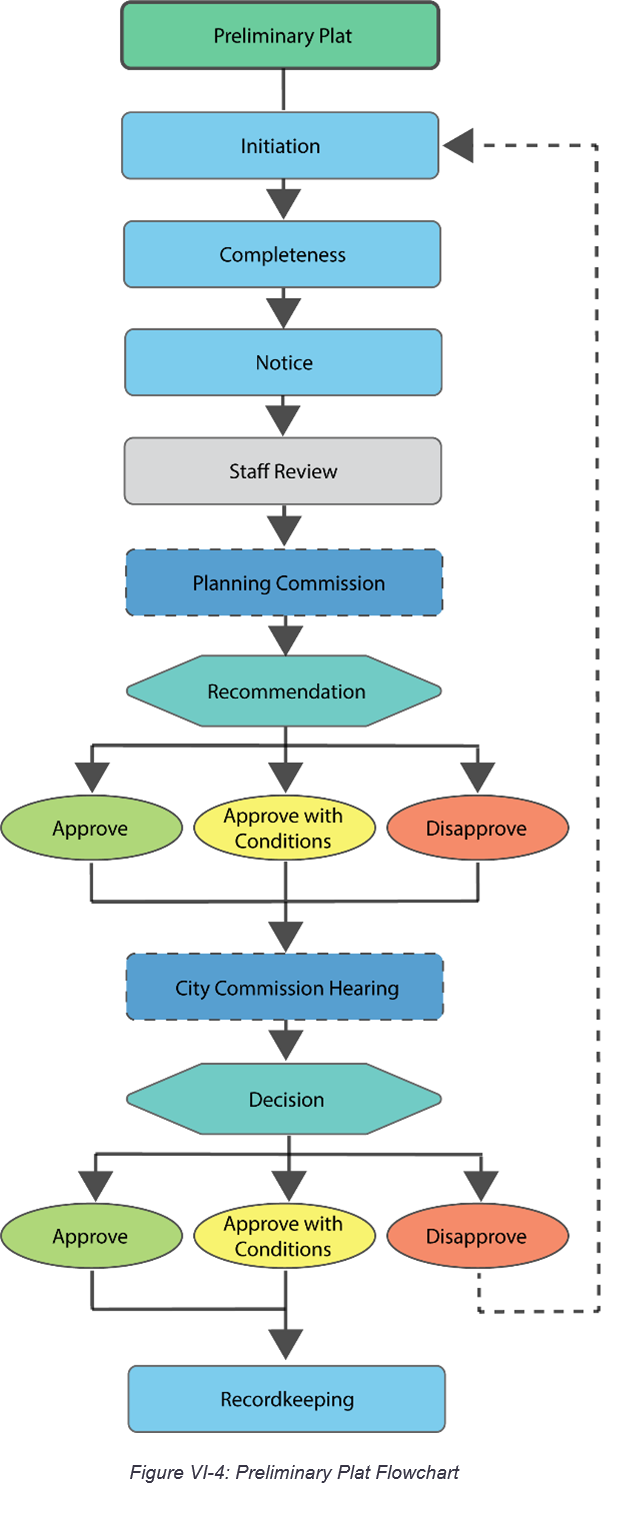
A.
Applicability. This section applies to any application for approval of a preliminary plat of subdivision.
B.
Initiation. The applicant shall submit a complete application to the director.
C.
Completeness. See section 22-223.D.
D.
Notice and hearing(s).
1.
Any noticing shall comply with section 22-223.E. and state law, as applicable.
2.
One public hearing is required and shall comply with section 22-223.G.
E.
Decision.
1.
Director review. The director shall review the preliminary plat application, send the application to other departments and entities for review (i.e., engineering, fire, health, etc.), place the application on the next planning commission agenda, and provide a recommendation to the planning commission to:
a.
Approve the preliminary plat; or
b.
Disapprove the preliminary plat; or
c.
Approve the preliminary plat with conditions.
2.
Planning commission recommendation. The planning commission shall review the preliminary plat and submit its report and recommendation to the effect of the proposed preliminary plat upon the character of the neighborhood, traffic congestion, public utilities, and other matters pertaining to the general health, safety, and welfare of the public and to the city commission within 45 days of the application date. The planning commission shall recommend to the city commission to:
a.
Approve the preliminary plat; or
b.
Disapprove the preliminary plat; or
c.
Approve the preliminary plat with conditions.
3.
City commission decision.
a.
Generally. The city commission shall conduct a public hearing to review and consider each preliminary plat submitted pursuant to this UDC after a recommendation has been provided by the planning commission, and take the following action within 90 days of the submittal date by the applicant, unless additional time is agreed to by the applicant:
i.
If the preliminary plat complies with all provisions of this UDC, the city commission shall approve the plat; or
ii.
Approve the preliminary plat with conditions; or
iii.
Disapprove the preliminary plat if it fails to comply with this UDC.
b.
Approved with conditions or disapproved.
i.
If the preliminary plat is disapproved or approved conditionally, the reasons for that action shall be stated in writing, a copy of which shall be signed by the city commission and shall be attached to one copy of the plat and transmitted to the applicant.
ii.
Reasons for disapproval or conditional approval shall refer specifically to those parts of the comprehensive plan or specific regulations with which the plat does not conform.
iii.
On a conditional plat approval, the city commission may require submission of a revised preliminary plat.
iv.
If the plat conforms to all standards, or after the applicant and city commission agree upon any revision that shall be filed with the city commission on a revised copy, the applicant may proceed with the layout of streets and roads, preparation of utility plans and preparation of the final plat.
F.
Standards. No person shall subdivide any tract of land except in conformity with this UDC. The city commission shall approve a preliminary plat only if it conforms to:
1.
The comprehensive plan and its current and future streets, alleys, parks, playgrounds, and public utility facilities;
2.
The planned extension of major thoroughfares, streets, and public highways within Shawnee, taking into account access to and extension of sewer and water mains and the instrumentalities of public utilities; and
3.
The rules and regulations of division 5 of this UDC.
G.
Subsequent applications. The city commission may reconsider the conditions for granting approval within 12 months following city commission approval upon the applicant's written request. The request shall be submitted on forms approved by the director and shall state the specific requirement or condition of approval to be reconsidered and the reasons for reconsideration. The city commission may:
1.
Affirm its previous action(s);
2.
Rescind its previous action(s) if the merits of the situation warrant; or
3.
Grant a variance as provided under this UDC.
H.
Appeals. See section 22-223.M.
I.
Scope of approval.
1.
Preliminary plat approval is effective for a period of one year, except as provided in section 22-229.B.4.
2.
If a final plat is not submitted for approval within this time, the preliminary plat becomes void unless the city commission agrees to a time extension.
3.
A formal request for extension with the reasons for extension must be submitted before the one-year deadline date.
4.
Time extensions may be granted for one year and may not be granted more than two times.
J.
Recordkeeping. A preliminary plat is not recorded with the county assessor. The director and the applicant shall maintain copies of the preliminary plat for purposes of inspection and final plat approval.
(Ord. No. 2806NS, § 1(Exh. A), 8-19-2024)
Sec. 22-229. - Final plat.
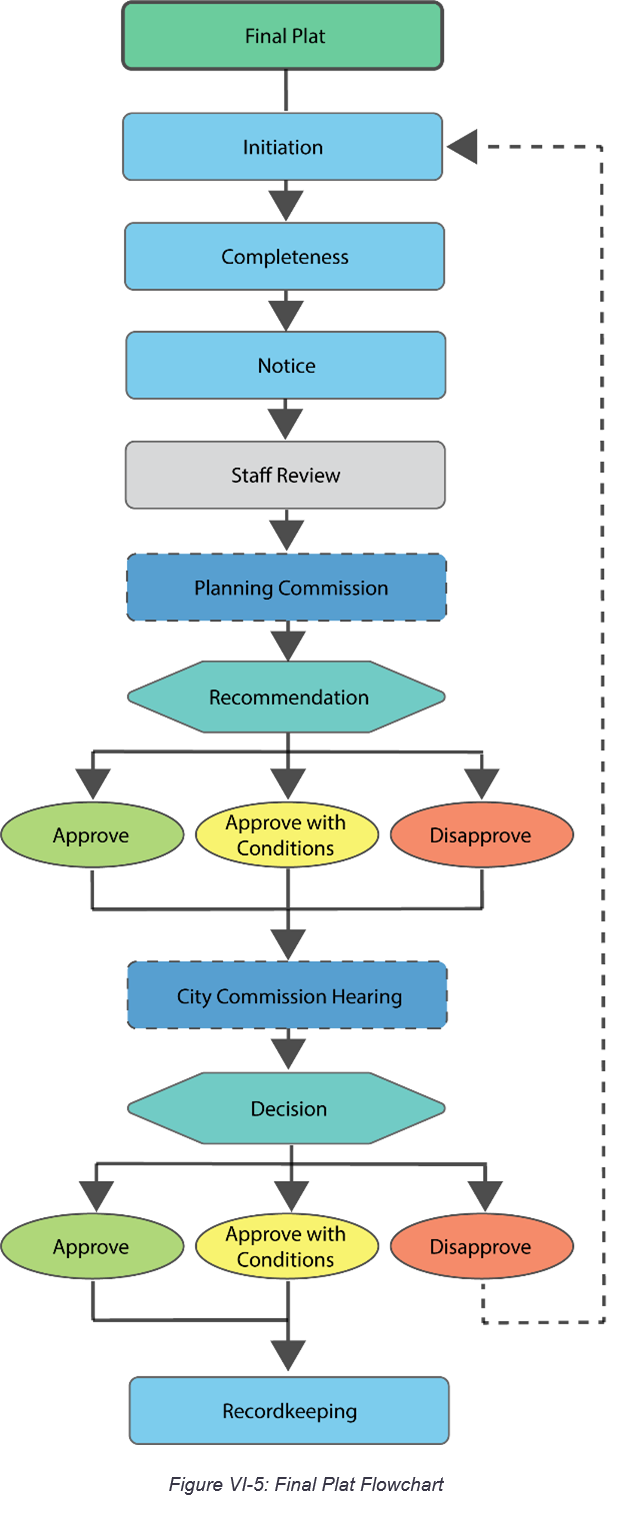
A.
Applicability. This section applies to any application for approval of a final plat of subdivision.
B.
Initiation.
1.
The applicant shall submit a complete application to the director.
2.
The final plat shall be submitted to the city commission for final approval within one year of the preliminary plat approval date.
3.
If not submitted for final plat approval within this time, the preliminary plat is void unless the city commission agrees to a time extension.
4.
Where only a portion of an approved preliminary plat is submitted for final plat approval, a final plat of the remaining area may be submitted at any time within five years of the preliminary plat approval date, if each subsequent final plat conforms substantially to the approved preliminary plat.
C.
Completeness. See section 22-223.D.
D.
Notice and hearing(s). Not applicable.
E.
Decision.
1.
Director review.
a.
Generally. The director shall review the final plat application, send the application to other departments and entities for review (i.e., engineering, fire, health, etc.), place the application on the next planning commission agenda, and provide a recommendation to the planning commission to:
i.
Approve the final plat; or
ii.
Disapprove the final plat.
b.
Substantial compliance required. A final plat shall be in substantial compliance with the approved preliminary plat to be considered by the planning commission and city commission. A revised preliminary plat may be required if changes to the final plat are considered by the director to be substantial. Substantial changes may include the following:
i.
Change in lot dimensions;
ii.
Increase in the number of lots;
iii.
Increased density;
iv.
Change in circulation network;
v.
Change in drainage patterns;
vi.
Change in relationship between uses of land; and
vii.
Change in land use in general.
2.
Planning commission recommendation. The planning commission shall review the proposed final plat and recommend to the city commission to:
a.
Approve the preliminary plat; or
b.
Disapprove the preliminary plat.
3.
City commission decision.
a.
Generally. The city commission shall conduct a public hearing to review and consider each final plat submitted pursuant to this UDC after a recommendation has been provided by the planning commission, and take the following action within 60 days of the submittal date by the applicant, unless additional time is agreed to by the applicant:
i.
If the final plat complies with all provisions of this UDC, the city commission shall approve the plat; or
ii.
Disapprove the final plat if it fails to comply with this UDC.
b.
Disapproved decision.
i.
If the final plat is disapproved, the reasons for that action shall be stated in writing, a copy of which shall be signed by the city commission and shall be attached to one copy of the plat and transmitted to the applicant.
ii.
Reasons for disapproval shall refer specifically to those parts of the comprehensive plan or specific regulations with which the plat does not conform.
c.
Automatic approval. If no action is taken by the city commission at the end of 60-day period, the final plat shall be deemed approved.
F.
Standards.
1.
Final plats shall comply with the conditions of plat approval imposed by the city commission, if any, and the following additional requirements.
2.
No person shall subdivide any tract of land except in conformity with this UDC. The city commission shall approve a final plat only if it conforms to:
a.
The preliminary plat approval substantially;
b.
The comprehensive plan and its current and future streets, alleys, parks, playgrounds, and public utility facilities;
c.
The planned extension of major thoroughfares, streets, and public highways within Shawnee, taking into account access to and extension of sewer and water mains and the instrumentalities of public utilities;
d.
The rules and regulations of division 5 of this UDC.
G.
Subsequent applications. Not applicable.
H.
Appeals. See section 22-223.M.
I.
Scope of approval.
1.
Before recording the final plat, it shall be submitted to the city commission for acceptance of public ways, service and utility easements, and land dedication to public use.
2.
This approval of the plat shall be shown over the signature of the mayor and attested by the city clerk.
3.
The disapproval of any plat by the city commission shall be deemed a refusal of the proposed dedication shown on the plat.
4.
The applicant must meet the requirement of section 22-222 prior to city commission acceptance of any final plat.
J.
Recordkeeping.
1.
Generally.
a.
A final plat is recorded with the county clerk within two years after approval by the city commission or planning commission. If not filed within this time, the final plat approval becomes void.
b.
The recording of a signed final plat may be withheld until all public improvements or performance guarantee and security requirements have been obtained to the city's satisfaction as provided in section 22-222.
2.
Signatures required. Signatures shall be affixed to the final plat under the following conditions:
a.
When a bond or other assurance for completion of improvements is required, endorsement of approval on the plat shall be given after the assurance or security has been approved by the city commission, and all the conditions of the final plat approval pertaining to the plat have been satisfied. When such performance guarantee and security requirements are required, the applicant shall meet the requirements established in section 22-222.
b.
When installation of improvements is required, endorsement of approval on the plat shall be given after all conditions of the final plat approval have been satisfied and all improvements completed and accepted. There shall be written evidence that the required public facilities have been installed in a manner satisfactory to the city as shown by a certificate signed by the director.
3.
Recording with the county. A final plat may be recorded under the following conditions:
a.
After the final plat approval and the affixing of all required signatures, the applicant, accompanied by the city clerk shall file the original tracing, one dark line print on cloth, and one contact reproducible cloth tracing or mylar with the county clerk.
b.
After recording, the applicant shall provide the director with three white background prints and one contact reproducible mylar.
c.
The applicant shall also submit to the director one eight and one-half by 11-inch reproducible copy of the recorded plat.
d.
The applicant shall pay all required county recording fees.
e.
No plat or other land subdivision instrument shall be recorded with the county clerk until approved by the planning commission and by the city commission as required.
(Ord. No. 2806NS, § 1(Exh. A), 8-19-2024)
Sec. 22-230. - Minor subdivision.
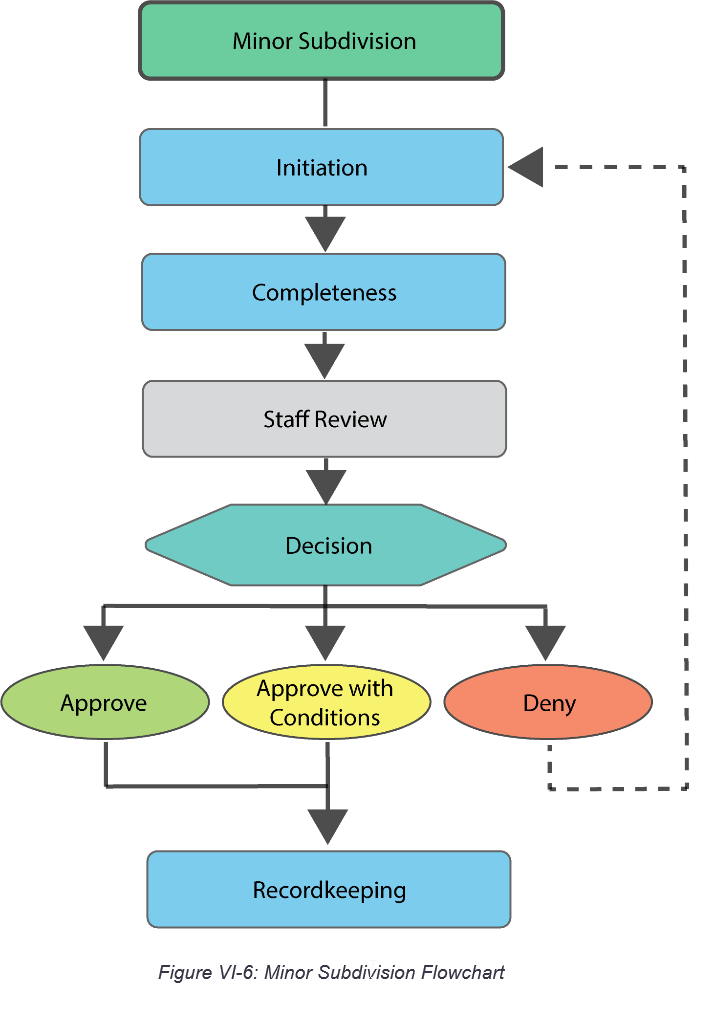
A.
Applicability. This section applies to minor subdivisions, which include any of the following:
1.
A subdivision containing no more than five lots.
2.
Final plats not requiring dedication of public right-of-way or easements. A plat that includes public street right-of-way or public easements to be dedicated to the city is processed under section 22-228 and section 22-229. A minor subdivision may include the dedication of private easements.
3.
An adjustment in boundaries of adjoining platted lots.
4.
A resurvey to combine two or more platted lots or tracts.
5.
A resurvey of platted lots or tracts containing two-family or multi-family residential structures to subdivide the dwelling units for individual ownership (i.e., condominium plats).
6.
A resurvey of platted lots or tracts containing nonresidential structures to subdivide building units for individual ownership (i.e., condominium plats, townhouse plats).
7.
A previously platted lot divided as a minor subdivision by either metes and bounds description or by replatting. A metes and bounds division may only be divided one time and by only one new dividing lot line under the minor subdivision process. Any further division requires replatting.
8.
Lots zoned for nonresidential purposes may be divided into two or more tracts without replatting the lot. However, the lot produced shall conform to all minimum standards of this UDC and other applicable city codes.
B.
Initiation. The applicant shall submit a complete application to the director.
C.
Completeness. See section 22-223.D.
D.
Notice and hearing(s). Not applicable.
E.
Decision.
1.
The director shall act upon a minor subdivision application within 30 days after receipt of a complete application.
2.
If the application is approved, the director shall sign and furnish a certificate of approval to be affixed to the lot split survey.
3.
The applicant may appeal the denial of an application for a minor subdivision to the planning commission. The planning commission shall act on the appeal within 30 days following the filing. All decisions of the planning commission are final.
4.
Director review and decision. The director shall review the minor subdivision and shall act to:
a.
Approve the minor subdivision; or
b.
Deny the minor subdivision; or
c.
Approve the minor subdivision with conditions.
F.
Standards. The director shall approve the minor subdivision if it finds that the following criteria are satisfied:
1.
The proposed minor subdivision conforms to the requirements of division 4 and division 5, the applicable zoning district regulations and any other applicable provisions of this Code, subject only to acceptable rule exceptions.
2.
The proposed minor subdivision represents an overall development pattern that is consistent with the comprehensive plan and other city-adopted studies and plans.
3.
The proposed minor subdivision contains a sound, well-conceived parcel and land subdivision layout which is consistent with good land planning and site engineering design principles.
4.
The spacing and design of proposed curb cuts, driveway approaches, and intersection locations are consistent with the Engineering Design Manual, good traffic engineering design, and public safety considerations.
5.
The proposed minor subdivision conforms to any existing, unexpired, and valid conditions of rezoning, special use permit, or site development plan approval.
6.
All submission requirements are satisfied.
G.
Subsequent applications.
1.
When a minor subdivision application is withdrawn or denied, the same application for the same property shall not be resubmitted for a period of one year from the date of withdrawal or denial.
2.
A new minor subdivision application showing major modifications and/or revisions to the withdrawn or denied application may be submitted at any time.
H.
Appeals. See section 22-223.M.
I.
Scope of approval.
1.
A minor subdivision does not authorize development.
2.
After the minor subdivision is approved, the applicant may apply for any required permits (site plan, building permit, etc.) to develop the property.
J.
Recordkeeping. A minor subdivision is recorded with the county clerk within two years after approval by the director. If not filed within this time, the minor subdivision approval becomes void.
(Ord. No. 2806NS, § 1(Exh. A), 8-19-2024)
Sec. 22-231. - Construction plans.
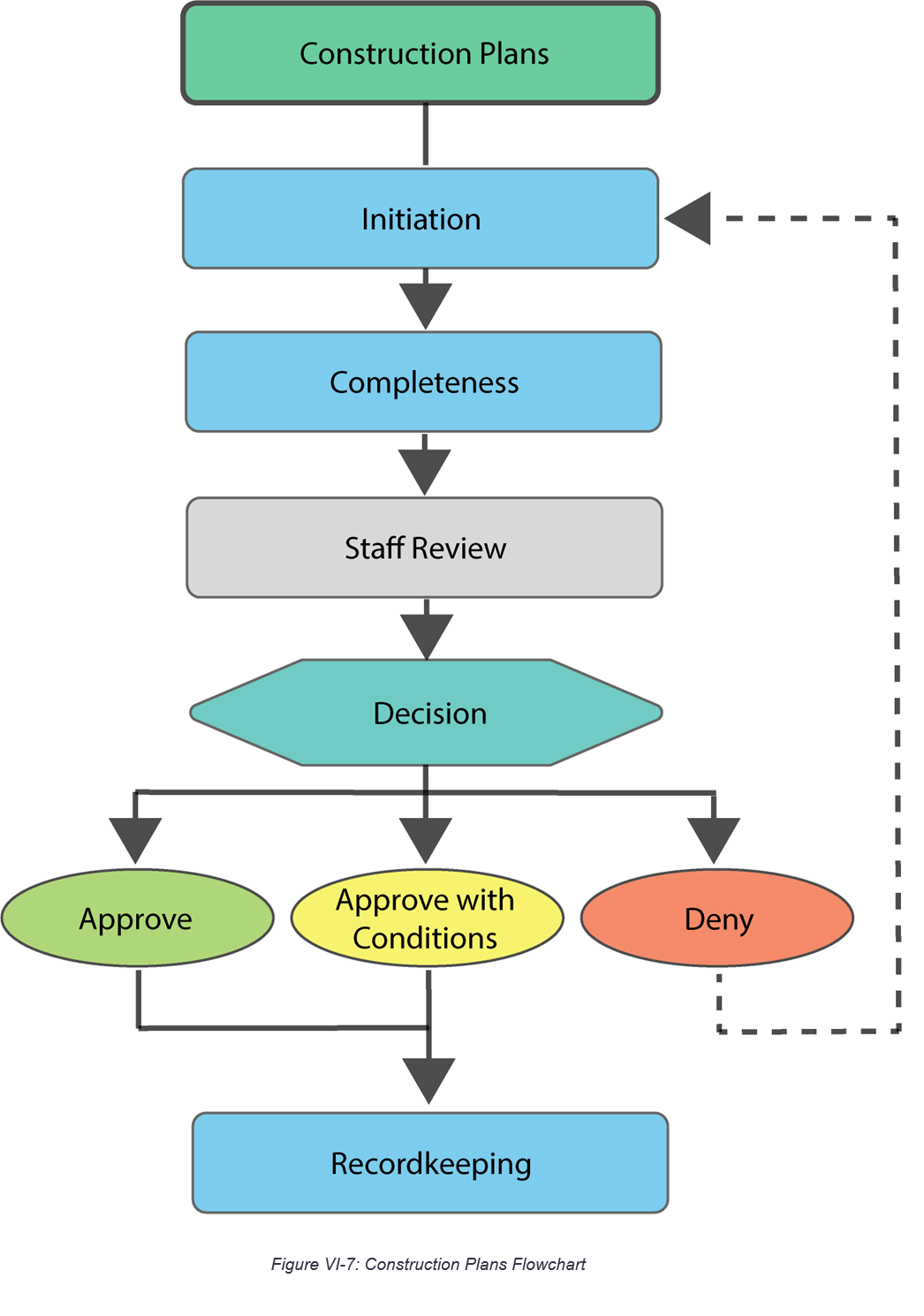
A.
Applicability. Construction plans shall be prepared for all subdivision improvements.
B.
Initiation. Construction plans shall be submitted with the final plat, prepared, signed, and sealed by a professional engineer, licensed to practice in the State of Oklahoma. The professional engineer may submit construction plans on behalf of the applicant.
C.
Completeness. See section 22-223.D.
D.
Notice and hearing(s). Not applicable.
E.
Director review and decision. The director shall review the construction plans and shall act to:
a.
Approve the construction plans; or
b.
Deny the construction plans; or
c.
Approve the construction plans with conditions.
F.
Standards.
1.
Generally.
a.
All improvements shall be designed and installed in accordance with all of the elements of the latest adopted comprehensive plan, and shall meet the minimum requirements and standards established by the ordinances and regulations relating thereto.
b.
All construction plans shall conform to all standards and specifications required by this Code, this UDC, and the city's Engineering Design Manual.
c.
Plans shall be drawn on 24-inch by 36-inch sheets at a horizontal scale of 40 feet to an inch and a vertical scale of four feet to an inch or at a scale approved by the city engineer.
2.
Final construction plans.
a.
Final construction plans for paving and street drainage shall conform to all city standards and specifications including:
i.
The horizontal layout and alignment showing geometric data and other pertinent design details. The horizontal layout shall also show the direction of stormwater flow and the location of maintenance holes, inlets, and special structures;
ii.
Profile showing existing centerline and proposed elevation along the curb tops of all roads;
iii.
Typical paving sections showing design details and type of material.
b.
Final construction plans for water distribution systems shall conform to all city standards and specifications including:
i.
The layout and specific location of the water mains, pump stations, elevated tanks, and other related structures in accordance with all current city standards, specifications, and criteria for construction of water mains;
ii.
The size and location of all mains, existing and proposed;
iii.
The location of fire hydrants and valves;
iv.
Design details showing the connection with the existing city water system;
v.
The specific location and size of all individual lot's water service connections, when applicable.
c.
Final construction plans for sanitary sewers shall conform to all city standards and specifications including:
i.
A complete sewage flow map with flow calculations at outfall points;
ii.
Design details for maintenance holes and special structures. Flow line elevation shall be shown at a minimum of every 100 feet and at every point where the line enters and leaves maintenance holes;
iii.
Detailed design for lift stations, lagoon oxidation ponds, package plants, or other special structures;
iv.
Engineer's report and application for state health department approval.
d.
Final construction plans for stormwater management and control shall conform to all city standards and specifications including:
i.
A complete drainage map with computations as required by these regulations and the Shawnee Code of Ordinances.
ii.
Detailed design of all drainage facilities including typical channel or paving section, storm sewers, and other storm water control facilities.
e.
Final design criteria, reports, basin calculations, and all other related computations shall be submitted with final construction plans, unless previously submitted.
G.
Subsequent applications. Not applicable.
H.
Appeals. A decision may be appealed to the city commission. Section 22-223.M.
I.
Scope of approval.
1.
No construction shall commence until the city engineer has approved the construction plans.
2.
All water and sanitary sewer improvements must be approved by the Oklahoma State Health Department prior to any work commencing.
J.
Recordkeeping. After all improvements have been installed, four sets of "as-builts" plans and specifications certified and signed by a professional engineer registered in the State of Oklahoma, shall be filed with the director prior to the acceptance by the city commission of any improvements installed by the applicant.
(Ord. No. 2806NS, § 1(Exh. A), 8-19-2024)
Sec. 22-232. - Plat vacation.
A.
Applicability.
1.
If the owner of any tract of land platted for municipal purposes, or the owner of any portion of such platted tract, desires to vacate the whole or some part thereof, the owner shall follow the procedures prescribed herein.
2.
Unrecorded and recorded plats may be vacated and shall follow the procedures pertaining to unrecorded and recorded plats prescribed in this section.
B.
Initiation.
1.
Unrecorded plats. The owner of any plat may nullify or void the same by application at any time prior to the recordation of said plat, by a written instrument, a copy of which shall be attached to said plat declaring it to be null or void.
2.
Recorded plats. At the request of the owner, the city commission shall, at its discretion, vacate and nullify a duly approved and recorded plat or any part of any plat in accordance with 11 O.S. § 42-101 et seq. The owner shall apply for nullification and vacation of said plat, by a written instrument, a copy of which shall be attached to said plat declaring it to be null and void.
C.
Completeness. See section 22-223.D.
D.
Notice and hearing(s).
1.
Noticing shall comply with section 22-223.E. and state law, as applicable.
2.
Two public hearings are required and shall comply with section 22-223.G.
E.
Decision.
1.
Director review. The director shall review the plat vacation application, send the application to other departments and entities for review (i.e., engineering, fire, health, etc.), place the application on the next planning commission agenda, and provide a recommendation to the planning commission to:
a.
Approve the plat vacation; or
b.
Deny the plat vacation.
2.
Planning commission review and recommendation. The planning commission shall conduct a public hearing on the plat vacation. The planning commission shall submit its report and recommendation to the effect of the vacation to the city commission within 45 days of the application date. The planning commission shall recommend to the city commission to:
a.
Approve the plat vacation; or
b.
Deny the plat vacation.
3.
City commission decision. The city commission shall consider the plat vacation at a public hearing after a recommendation has been provided by the planning commission. After the hearing is closed, the city commission shall by ordinance:
a.
Approve the plat vacation; or
b.
Deny the plat vacation.
F.
Standards.
1.
Unrecorded plats.
a.
A plat vacation shall be approved in the same manner as platting or subdivision.
b.
All accepted public easements shall be reviewed.
2.
Recorded plats. The plat vacation must meet the following requirements:
a.
None of the lots in the plat vacation have been sold or title transferred.
b.
If any of the lots have been sold, all owners of those lots shall approve, in writing, of the proposed nullification and vacation of the plat vacation. This written approval shall accompany the application for nullification and vacation.
c.
The request for nullification and vacation is in accordance with 11 O.S. § 42-101 et seq., as amended.
3.
Partial plat vacations.
a.
Partial vacations of plats are allowed pursuant to 11 O.S. § 42-106.
b.
All partial plat vacations shall follow the requirements provided in 11 O.S. § 42-106.
G.
Subsequent applications. Not applicable.
H.
Appeals. Generally, refer to section 22-223.M., however, if the applicant desires to vacate a plat that does not meet the provisions of subsection F. above, such vacation requires the approval of a court of competent jurisdiction in the county in which the property is situated. Compliance with 11 O.S. § 42-101 et seq., as amended, and district court procedures are required.
I.
Scope of approval. Plat vacations are valid for two years from the initial approval date.
J.
Recordkeeping. Upon being duly recorded or filed with the county clerk, the instrument shall operate to destroy the force and the effect of the approval of the plat so nullified, and to divest all public rights in the streets, alleys, and public grounds, and all dedications or easements laid out or described in those plats.
(Ord. No. 2806NS, § 1(Exh. A), 8-19-2024)
Sec. 22-233. - Site plan.
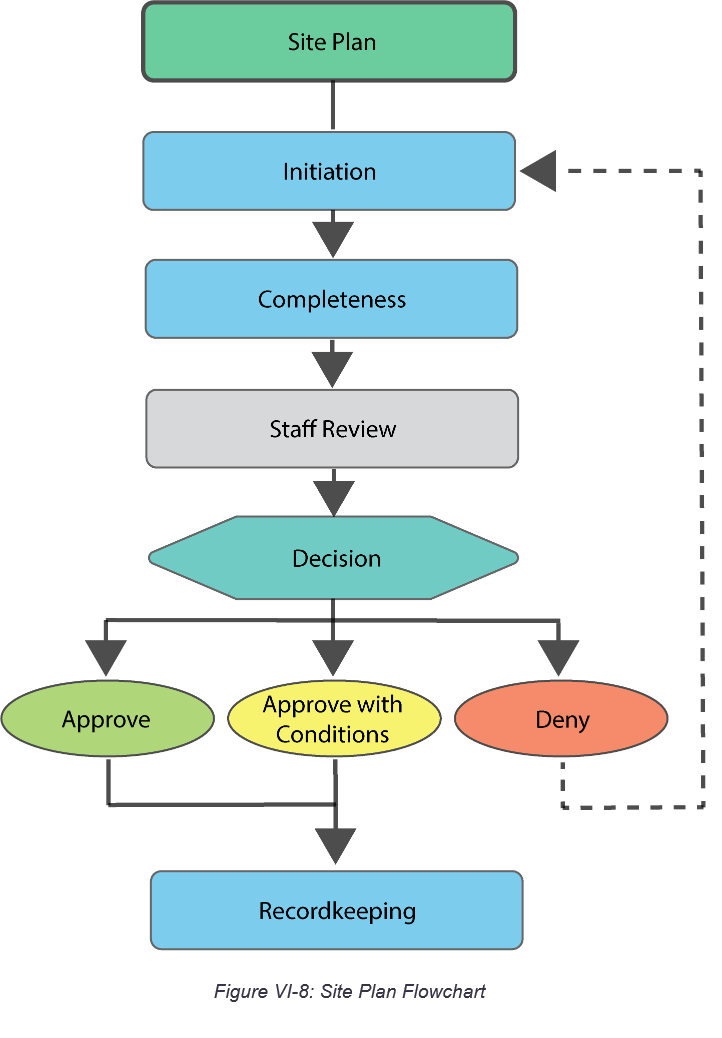
A.
Applicability.
1.
Generally. Site plan approval is required for all development except single-family and two-family (duplex) dwellings, and for all events that meet the following thresholds:
a.
New construction or expansion of an existing building or structure that increases the existing floor area by 25 percent or that adds 1,000 square feet of floor area.
b.
New construction or expansion of parking lots that increase the existing impervious area by 25 percent or that add 1,000 square feet of impervious coverage.
2.
Deviations prohibited. A site plan shall not authorize deviation from any applicable development standards normally required by the existing underlying zoning, including, but not limited to, signs, landscaping, parking, lighting, or dimensional requirements.
B.
Initiation. The applicant shall submit a site plan application to the director. In addition to the information required by section 22-223.D., the director may require the following additional information if needed to address the proposed development's impacts:
1.
Elevations of the proposed new or remodeled structures;
2.
Analysis of the traffic impacts of the proposed use; or
3.
Evaluation of the environmental impacts of the proposed use.
C.
Completeness. See section 22-223.D.
D.
Notice and hearing(s). Not applicable.
E.
Decision.
1.
Director review and decision. The director shall review the site plan and shall act to:
a.
Approve the site plan; or
b.
Deny the site plan; or
c.
Approve the site plan with conditions.
2.
Authorization to impose conditions.
a.
Generally. The director may impose conditions necessary to maintain the integrity of the city's zoning districts, to ensure the proposed use is consistent with the comprehensive plan, conforms with this UDC, is appropriate to its location and compatible with neighboring uses, and does not cause undue traffic congestion or significant deterioration of the environment.
b.
Supplementary conditions. All requirements imposed by a site plan are in addition to and supplement this UDC's requirements.
c.
Authorized conditions. Authorized conditions include, but are not limited to:
i.
Site plan features. Limitations or requirements regarding the area, setbacks, open space, landscaping, lighting, fencing, signage, off-street parking, and similar site plan features of the proposal.
ii.
Operations. Limitations or requirements regarding the proposed use's operating characteristics, duration, or any similar feature of the proposed use.
iii.
Duration. If the director limits the duration of a site plan, a one-year grace period, starting from the final approval date, is afforded to the applicant in addition to the time period stipulated in the site plan conditions.
3.
Automatic approval.
a.
The director shall see that all administration reviews are completed within 15 days.
b.
The director may extend the review by one 15-day period, and thereafter, the site plan shall be automatically approved if administrative review is not completed.
F.
Standards. A site plan application shall comply with the following standards:
1.
Generally. The site of the proposed use or any associated improvements is not in violation of any local, state, or federal law (other than a UDC violation).
a.
The use and site plan for the proposed use conforms, at a minimum, with all applicable provisions of this UDC for the existing underlying zoning designation, including, but not limited to:
i.
Development standards. All parking, landscaping, signage, improvement, and dimensional standards.
ii.
Zoning districts standards. The purpose of the zoning district in which the proposed use is to be located and any standards applicable to the particular proposed use.
b.
Site plans are only authorized for the proposed use.
2.
Suitability. The characteristics of the proposed site are suitable for the proposed use considering the size, shape, location, topography, and location of improvements and natural features.
3.
Timeliness. The proposed use or development is timely, considering the adequacy of transportation systems, public facilities, and services, existing or planned for the area affected by the proposed use.
4.
Compatibility to surrounding area. The proposed use will not alter the character of the surrounding area in a manner that substantially limits, impairs, or precludes the use of surrounding properties for the primary uses listed as allowable by the underlying zoning district.
5.
Comprehensive plan. The proposed use satisfies any applicable goals and policies of the comprehensive plan that apply to the proposed use.
6.
Use appropriate and compatible. The use is appropriate to its proposed location and compatible with the character of neighboring uses, or enhances the mixture of complementary uses and activities in the immediate vicinity.
7.
Traffic. The use shall not cause undue traffic congestion, dangerous traffic conditions or incompatible service delivery, parking, or loading problems. Necessary mitigating measures shall be proposed by the applicant.
8.
Nuisance. The operating characteristics of the use do not create a nuisance and the impacts of the use on surrounding properties are minimized with respect to noise, odors, vibrations, glare, and any other similar conditions.
9.
Environment. The use shall not cause significant deterioration to water resources, wetlands, wildlife habitat, scenic characteristics, or other natural features. As applicable, the proposed use shall mitigate its adverse impacts on the environment.
G.
Subsequent applications. Not applicable.
H.
Appeals. Generally, refer to section 22-223.M. however, if a site plan is appealed to the board of adjustment:
1.
The board of adjustment shall consider the site plan at a public meeting.
2.
After the consideration of the director's decision and any evidence provided by the applicant or an aggrieved party, the board of adjustment shall:
a.
Approve the site plan; or
b.
Deny the site plan; or
c.
Approve the site plan with conditions; or
d.
Remand the site plan to the director for further consideration.
I.
Scope of approval.
1.
Generally. After the site plan is approved, the director may issue a building permit or certificate of occupancy consistent with any conditions of site plan approval. An approved site plan expires one year after the approval date unless a building permit has been obtained and the work commenced.
2.
Changes to site plan.
a.
Generally. Any change to an approved site plan, other than those changes that qualify as insubstantial pursuant to subsection b. below, requires amendment of the existing site plan. Amendment of an approved site plan may only be authorized by the director pursuant to the procedures established in subsection E. above, and subject to appeal to the board of adjustment.
b.
Insubstantial changes to approved site plan.
i.
The director may approve insubstantial changes to a previously approved site plan without notice or a public hearing. An insubstantial change is one that becomes necessary during the use's actual implementation, which could not be reasonably anticipated during its review, and that does not significantly change the original approval granted.
ii.
An insubstantial change includes:
(A)
Minor building revisions/expansions that do not increase the height of a building and are less than an aggregate total of 1,000 square feet;
(B)
Minor changes in the number of parking spaces (adding, removing, or relocating 20 parking spaces or less), provided that minimum parking requirements are met;
(C)
Adjustments to solid waste container location;
(D)
Minor revisions to approved elevations; and
(E)
Substitution of similar materials on an approved landscape plan.
c.
An amendment to any of the following site plan requirements is not considered insubstantial:
i.
Use. Those activities allowed on site by the site plan.
ii.
Operational characteristics. The gross limitations or requirements regarding the proposed use's operating characteristics.
iii.
Site plan features. The gross limitations or requirements regarding the area, setbacks, open spaces, landscaping, buffering, lighting, fencing, signage, or the off-street parking of the proposal.
iv.
Duration. Requirements governing the duration of the permit.
v.
Permit holder. Requirements regarding the person or entity to whom the permit is issued.
3.
Extension. The director may extend an approved site plan for a single one-year period, upon receipt of a written request for an extension not less than 30 days before the expiration of the approved site plan.
4.
Revocation.
a.
Criteria. An approved site plan is considered in violation of this UDC and shall be revoked if a court of law finds the use in violation of any of the following conditions:
i.
The use established on site does not conform, at any time, with any or all approved permit condition(s) and or any local, state, or federal law.
ii.
The activity authorized by the site plan commences prior to the institution of all conditions imposed by the site plan.
iii.
Discontinuance of the approved use for at least six consecutive months.
b.
Revocation procedures. If the director's inspection reveals noncompliance with this UDC, site plan revocation procedures shall commence as follows:
i.
The director shall, upon discovery of site plan noncompliance, issue a written warning, granting a grace period of at least 30 calendar days. During this time, the use may be brought into compliance with the current approved site plan for that location.
ii.
If noncompliance persists after the conclusion of the warning grace period, a director shall issue written citation.
iii.
If the citation results in a guilty verdict, the site plan is considered revoked.
iv.
The director shall issue the permit holder written notification of the site plan's official revocation.
v.
In the event of discontinuance or failure to commence as stipulated above, the director will issue written notification to the applicant. Fourteen calendar days after issuance of director notification of discontinuance or failure to commence, the director shall then issue the permit holder written notification of the site plan's official revocation.
J.
Recordkeeping. The applicant and director shall maintain a copy of the approved site plan.
(Ord. No. 2806NS, § 1(Exh. A), 8-19-2024)
Sec. 22-234. - Sign permit.
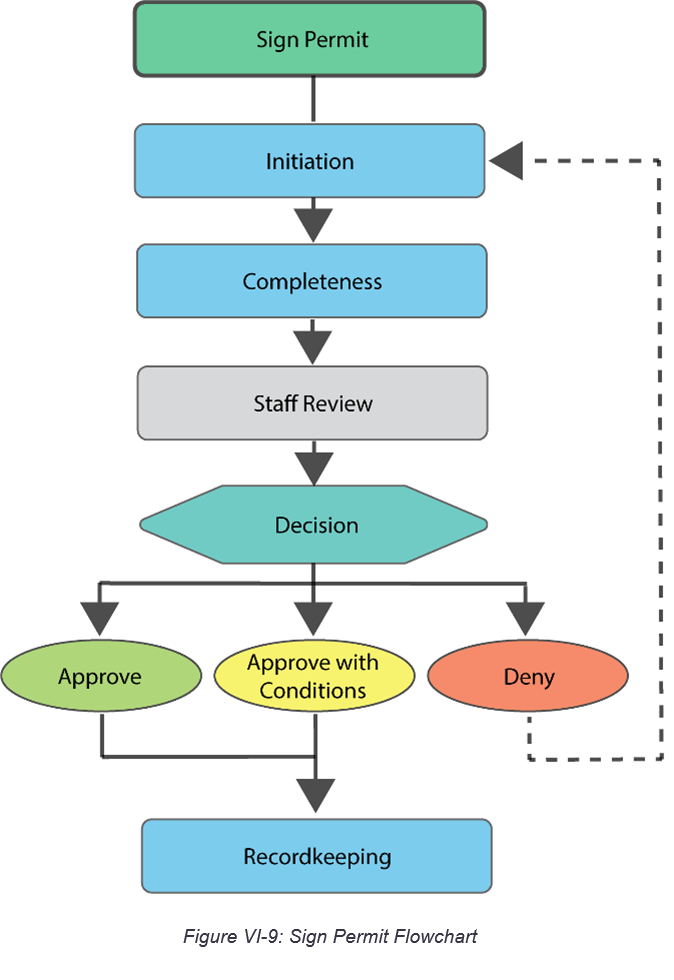
A.
Applicability. A person shall not construct, alter, or relocate any sign within the corporate limits of Shawnee without first obtaining a permit, unless otherwise specified.
B.
Initiation. Each sign permit requires a separate application. The application must be filed on a form furnished by the director and include a non-refundable permit fee.
C.
Completeness. See section 22-223.D.
D.
Notice and hearing(s). Not applicable.
E.
Decision. The director shall:
1.
Approve the sign permit; or
2.
Deny the sign permit; or
3.
Approve the sign permit with conditions.
F.
Standards. A sign permit shall be issued if the proposed sign complies with all applicable provisions of this UDC and any conditions or stipulations of any applicable rezoning, conditional use permit, site plan, or development plan.
G.
Subsequent applications. Not applicable.
H.
Appeals. See section 22-223.M.
I.
Scope of approval.
1.
Generally. The director may issue a sign permit if there is an approved site plan.
2.
Expiration.
a.
A sign permit becomes null and void if installation does not commence within six months from the date of permit approval.
b.
If work authorized by the permit is suspended or abandoned for one year from the date the work commences, a new permit is required to complete the installation work, even if no changes are made to the original sign permit.
3.
Revocation. The director may revoke a sign permit if:
a.
It is issued in error; or
b.
The sign or sign supporting structure is installed contrary to the approved plans or in violation of this UDC.
4.
Repairs and maintenance. The repair, routine maintenance, or repainting of an existing sign deemed conforming or allowed to continue as a nonconforming sign does not require a sign permit.
J.
Recordkeeping. The applicant and director shall maintain a copy of the approved sign permit.
(Ord. No. 2806NS, § 1(Exh. A), 8-19-2024)
Sec. 22-235. - Building permit.
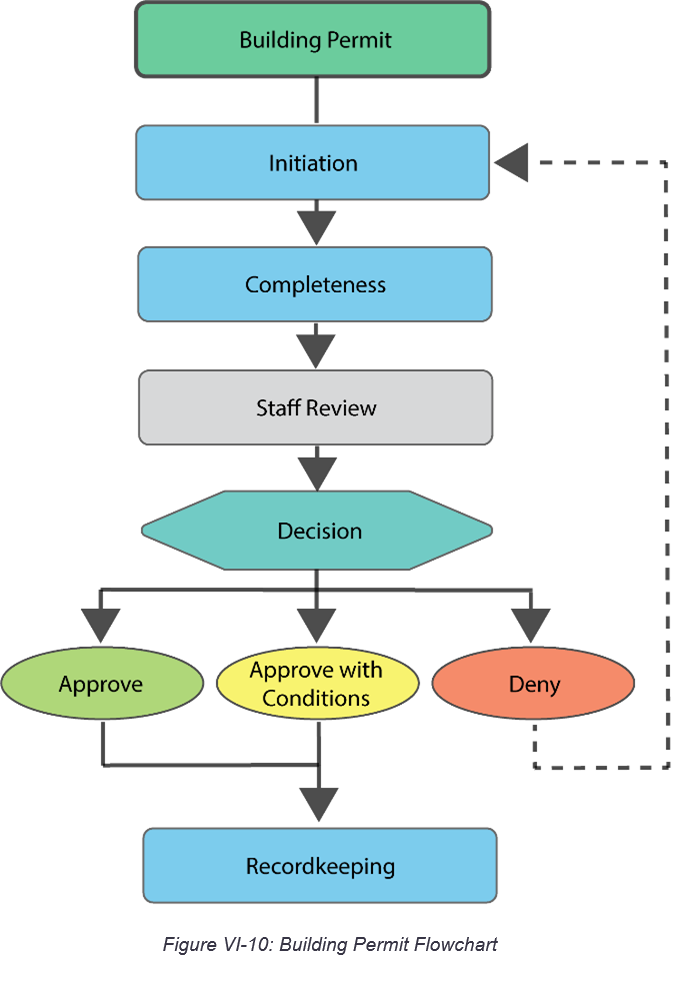
A.
Applicability. The city shall process building permits as provided in the Shawnee building code.
B.
Initiation. The applicant shall not submit a building permit application, and the city shall not issue a building permit, for any application until all required permits or applications are approved.
C.
Completeness. See section 22-223.D.
D.
Notice and hearing(s). Not applicable.
E.
Decision. See Shawnee building code.
F.
Standards. The city may issue the building permit only if the application complies with all applicable provisions of this UDC and any approved rezoning condition, conditional use permit, plat, or site plan.
G.
Subsequent applications. Not applicable.
H.
Appeals. Generally, refer to section 22-223.M.; however, if a building permit is denied for noncompliance with a provision of this UDC, the applicant may appeal that decision.
I.
Scope of approval. See Shawnee building code.
J.
Recordkeeping. The city shall maintain the approved building permit in its files, and the applicant shall maintain an original signed copy of the approved building permit.
(Ord. No. 2806NS, § 1(Exh. A), 8-19-2024)
Sec. 22-236. - Certificate of occupancy.
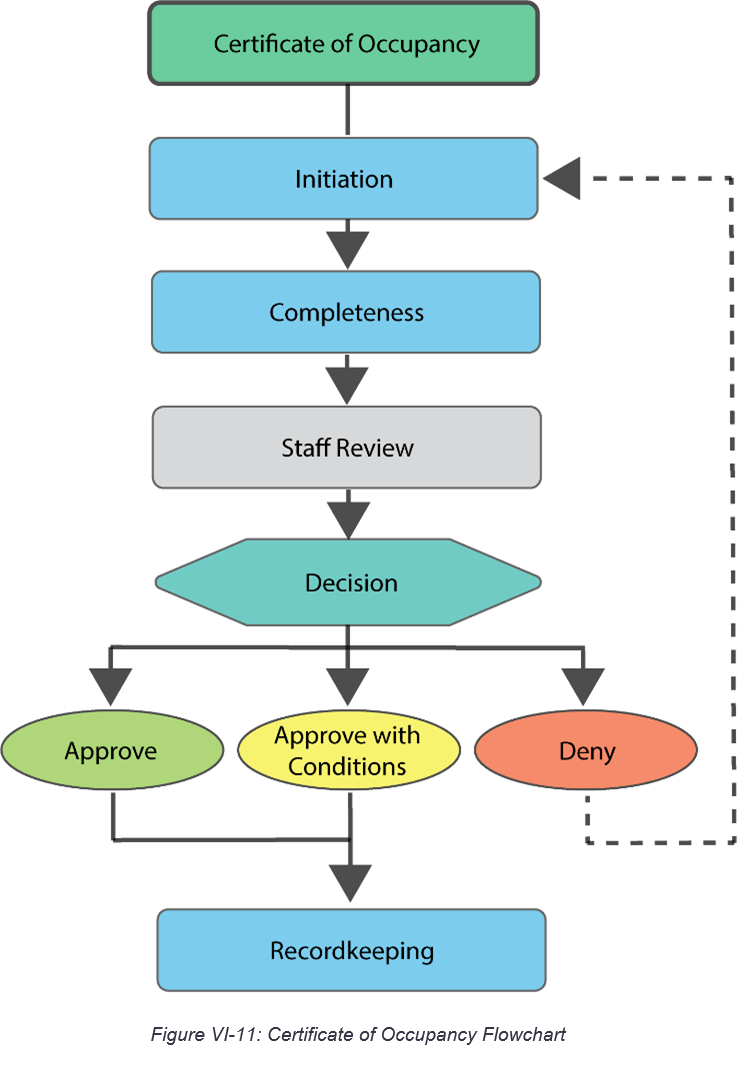
A.
Applicability. The director shall process certificates of occupancy as provided in the Shawnee building code.
B.
Initiation. The applicant shall not submit a certificate of occupancy application, and the director shall not issue a certificate of occupancy, for any application until all required permits or applications are approved.
C.
Completeness. See section 22-223.D.
D.
Notice and hearing(s). Not applicable.
E.
Decision. See Shawnee building code.
F.
Standards. The director may issue the certificate of occupancy only if the application complies with all applicable provisions of this UDC and any approved rezoning condition, conditional use permit, plat, or site plan.
G.
Subsequent applications. Not applicable.
H.
Appeals. Generally, refer to section 22-223.M.; however, if a certificate of occupancy is denied for noncompliance with a provision of this UDC, the applicant may appeal that decision.
I.
Scope of approval. See Shawnee building code.
J.
Recordkeeping. The director shall maintain the approved certificate of occupancy in its files, and the applicant shall maintain an original signed copy of the approved certificate of occupancy.
(Ord. No. 2806NS, § 1(Exh. A), 8-19-2024)
Sec. 22-237. - Interpretation.
A.
Applicability. The director has authority to make written interpretations concerning the text of this UDC and the official zoning map.
B.
Initiation. A request for interpretation shall be submitted to the director on a form established by the director and made available to the public.
C.
Completeness. See section 22-223.D.
D.
Notice and hearing(s). Not applicable.
E.
Decision. The director may take any of the following actions:
1.
Review and evaluate the request;
2.
Consult with other staff or the planning commission;
3.
Render an opinion; and
4.
Provide the interpretation to the applicant in writing by regular mail.
F.
Standards. The director's decision shall consider this UDC, the zoning map, the comprehensive plan, and any other relevant information.
G.
Subsequent applications. Not applicable.
H.
Appeals. See section 22-223.M.
I.
Scope of approval. An interpretation does not authorize the development or use of property. After an issued interpretation, the applicant or any other person may file an application to develop or use property pursuant to this UDC, and the approval authority shall take the interpretation into consideration.
J.
Recordkeeping. The director shall maintain an official record of interpretations available for public viewing.
(Ord. No. 2806NS, § 1(Exh. A), 8-19-2024)
Sec. 22-238. - Administrative adjustments.
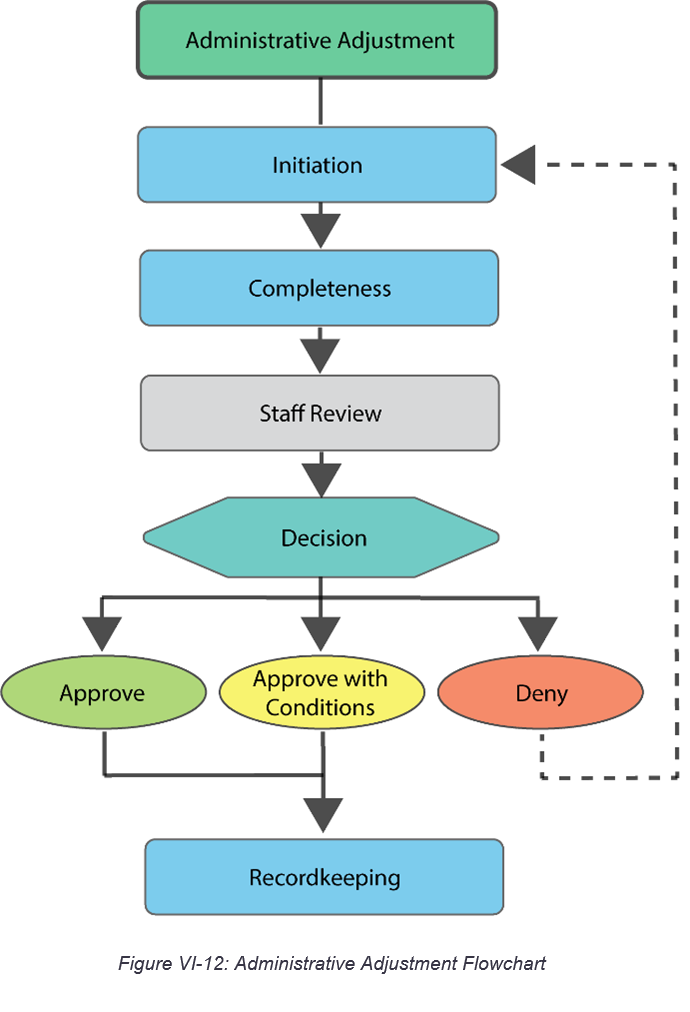
A.
Applicability.
1.
Generally. The director has authority to make administrative adjustments pertaining to the standards in division 4 of this UDC.
2.
Administrative adjustment types. Administrative adjustments may include the following reductions or increases by ten percent:
a.
The number of required parking spaces;
b.
Setbacks;
c.
Building height;
d.
The amount of required loading;
e.
Screening and fencing applicability;
f.
Light fixture height;
g.
Sign size and location;
h.
Nonresidential, mixed use, and downtown design standards;
i.
Required landscaping;
j.
The unobstructed approach path requirement for refuse facilities;
B.
Initiation. A request for an administrative adjustment shall be submitted to the director on a form established by the director and made available to the public.
C.
Completeness. See section 22-223.D.
D.
Notice and hearing(s). Not applicable.
E.
Decision. The director shall review the administrative adjustment and shall act to:
1.
Approve the administrative adjustment; or
2.
Deny the administrative adjustment; or
3.
Approve the administrative adjustment with conditions.
F.
Standards. The director shall not approve an administrative adjustment if the proposed development will:
1.
Adversely affect the safety and convenience of vehicular and pedestrian circulation in the vicinity of the subject tract, including traffic reasonably expected to be generated by the proposed use and other uses in the area given the existing zoning, existing land uses, and proposed land uses in the area;
2.
Create more adverse impacts on existing uses in surrounding areas than that reasonably might result from development of the site in strict compliance with the adjusted standard;
3.
Be incompatible with existing or permitted uses on adjacent properties, in terms of adjusted building height, setbacks, landscaping, screening, or parking features; or
4.
Be detrimental to the public health, safety, or welfare or materially injurious to properties or improvements in the vicinity for reasons specifically articulated by the director.
The applicant shall have the burden of demonstrating that the proposal meets the applicable review criteria.
G.
Subsequent applications. Not applicable.
H.
Appeals. See section 22-223.M.
I.
Scope of approval. After an administrative adjustment is approved, the director may apply the approval to a pending site plan review. Once the administrative adjustment and the site plan is approved, the director may issue a building permit or certificate of occupancy consistent with any conditions of an administrative adjustment and site plan approval.
J.
Recordkeeping. The applicant and director shall maintain a copy of the approved administrative adjustment.
(Ord. No. 2806NS, § 1(Exh. A), 8-19-2024)
Sec. 22-239. - Special exception.
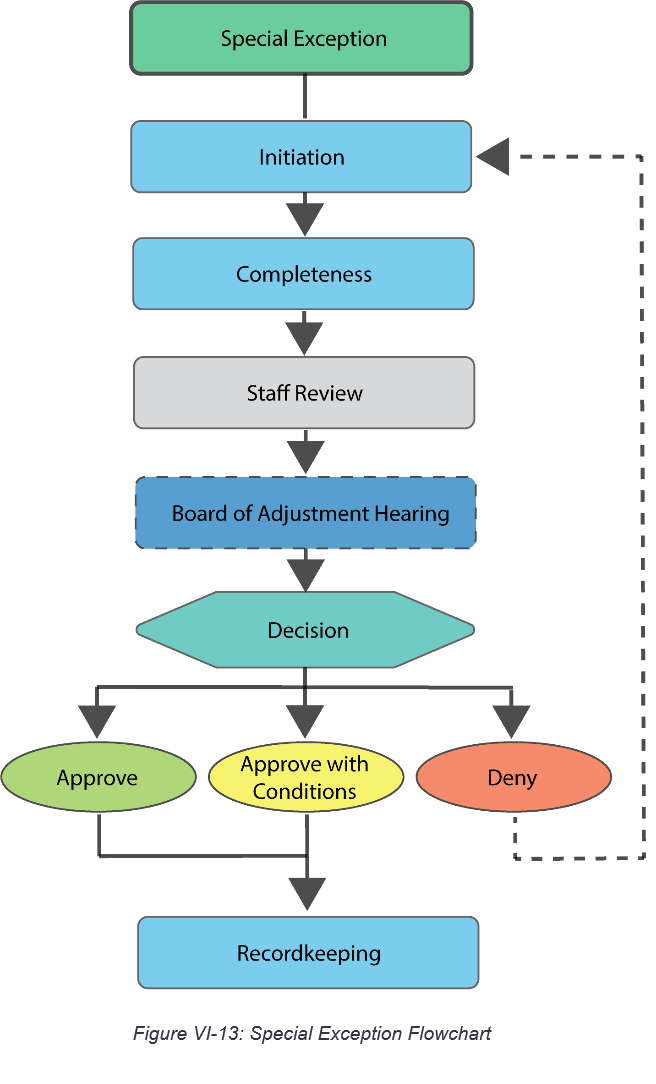
A.
Applicability.
1.
The board of adjustment is authorized to hear and decide a special exception in accordance with this section.
2.
A special exception is an allowed variation from the regulations of this UDC, but is differentiated from a variance in two ways as described below.
a.
No hardship required. A special exception does not require a finding of an unnecessary hardship.
b.
Specifically allowed and pre-determined by the UDC. Approval of a special exception by the board of adjustment is specifically provided for and defined in this UDC.
B.
Initiation. The board of adjustment may grant a special exception upon receiving a written request from the applicant.
C.
Completeness. See section 22-223.D.
D.
Notice and hearing(s). Noticing shall comply with section 22-223.E. and state law, as applicable.
E.
Decision.
1.
The board of adjustment shall conduct a public hearing on the special exception and shall render its decision after the hearing is closed.
2.
The board of adjustment may, in whole or in part:
a.
Approve the special exception; or
b.
Deny the special exception; or
c.
Approve the special exception with conditions.
3.
In granting a special exception, the board of adjustment may impose such conditions as are necessary to protect adjacent property owners and to ensure the public health, safety, and general welfare, including, but not limited to, conditions specifying the period during which a nonconforming use may continue to operate or exist before being brought into conformance with the provisions of this UDC.
F.
Standards. If the board of adjustment finds that the public convenience and welfare will be substantially served and the appropriate use of the neighboring property will not be substantially injured, the board of adjustment may authorize the following special exceptions to the regulations herein established:
1.
Nonconforming uses. Permit the reconstruction, extension, or enlargement of a building occupied by a nonconforming use on the lot or tract occupied by such building provided such reconstruction does not prevent the return of such property to a conforming use and permit the expansion of off-street parking or off-street loading for a nonconforming use.
2.
Setbacks. For existing buildings that were legally constructed prior to the effective date of this UDC, the board of adjustment may authorize a special exception to allow reconstruction of a building over a setback line or allow a building to be set back further than a build-to line established by this UDC.
3.
Landscaping. The board of adjustment may permit landscaping that varies by more than ten percent but less than 20 percent from the requirements of landscaping regulations.
4.
Parking. In a case where the customary mode of transportation of a majority of the patrons, employees, and proprietors of any use, to and from the area in which that use is located, is other than by private automobile, required parking may be reduced up to 50 percent by the board of adjustment.
G.
Subsequent applications. No request for a special exception that has been denied shall be further considered by the board of adjustment under a subsequent request unless:
1.
Six months have elapsed from the denial date; or
2.
Conditions relative to other property in the immediate vicinity, within the six-month period, have been changed or acted on by the board of adjustment so as to alter the facts and conditions on which the previous board of adjustment action was based.
H.
Appeals. See section 22-223.M.
I.
Scope of approval. After a final decision on the special exception is rendered, the applicant and any party in interest may file any further permits or applications, undertake construction, or establish a use consistent with that decision.
J.
Recordkeeping. The director shall maintain a copy of any order of the board of adjustment pursuant to this section.
(Ord. No. 2806NS, § 1(Exh. A), 8-19-2024)
Sec. 22-240. - Variances.
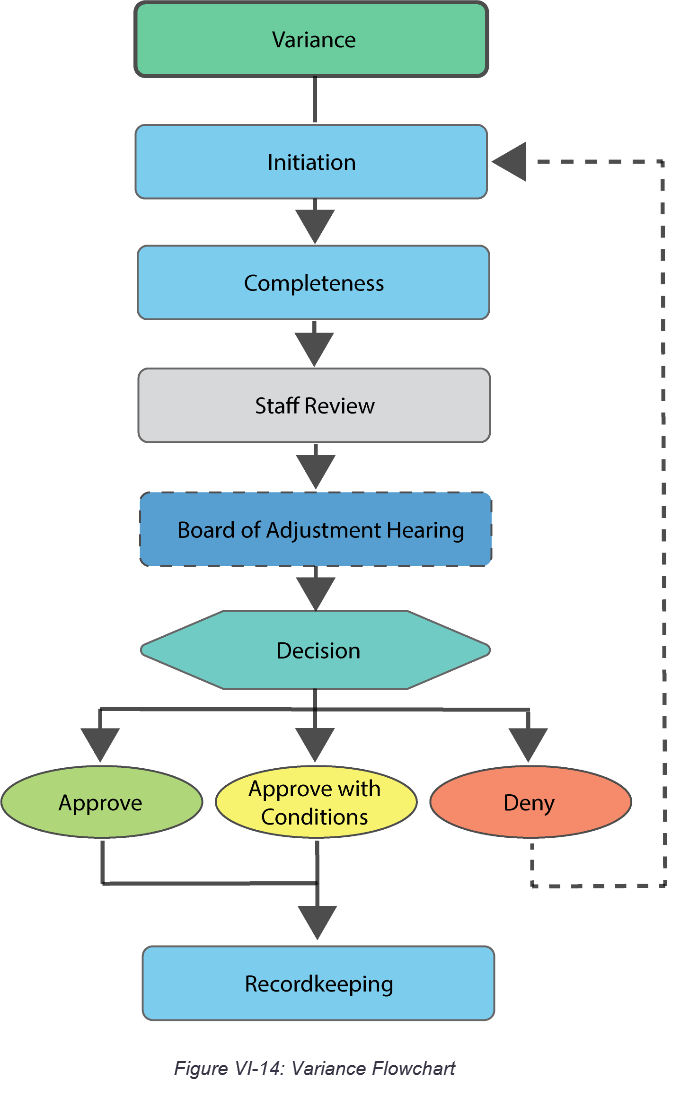
A.
Applicability. The board of adjustment may authorize, in specific cases, a variance from the terms of this UDC.
B.
Initiation. An application for a zoning variance shall be filed with the director.
C.
Completeness. See section 22-223.D.
D.
Notice and hearing(s). Noticing shall comply with section 22-223.E. and state law, as applicable.
E.
Decision.
1.
The board of adjustment shall conduct a public hearing on the variance and shall render its decision after the hearing is closed.
2.
The board of adjustment may, in whole or in part:
a.
Approve the variance; or
b.
Deny the variance; or
c.
Approve the variance with conditions.
3.
A concurring vote must be a majority of the members of the board of adjustment to authorize a variance.
F.
Approval criteria. The board of adjustment shall not approve a variance unless it finds that:
1.
The application of this UDC to the subject property would create an unnecessary hardship;
2.
Such conditions are peculiar to the subject property involved;
3.
If granted, would not cause substantial detriment to the public good, or impair the purposes and intent of the UDC or the comprehensive plan; and
4.
If granted, would be the minimum necessary to alleviate the unnecessary hardship.
G.
Subsequent applications. Not applicable.
H.
Appeals. See section 22-223.M.
I.
Scope of approval. After a final decision on the variance is rendered, the applicant and any party in interest may file any further permits or applications, undertake construction, or establish a use consistent with that decision.
J.
Recordkeeping. The director shall maintain a copy of any order of the board of adjustment pursuant to this section.
(Ord. No. 2806NS, § 1(Exh. A), 8-19-2024)
Sec. 22-241. - Waivers.
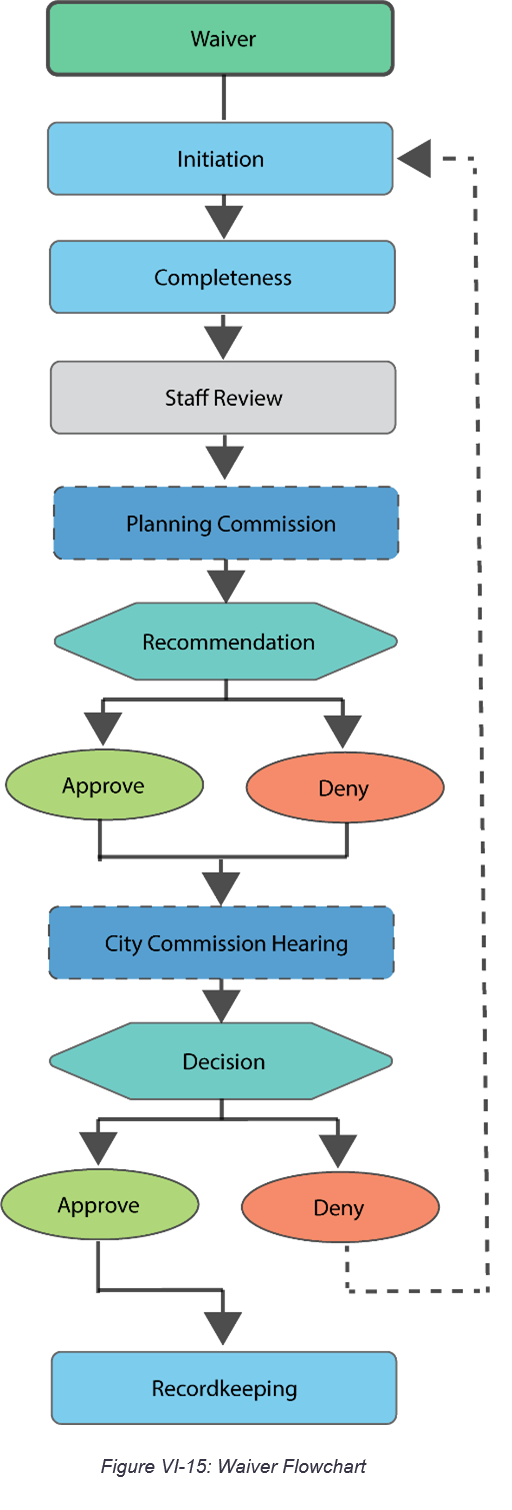
A.
Applicability. The city commission may authorize, in specific cases, a waiver from the subdivision regulations in division 5 of this UDC.
B.
Initiation. A waiver application shall be filed with the director.
C.
Completeness. See section 22-223.D.
D.
Notice and hearing(s). Not applicable.
E.
Decision.
1.
Director review. The director shall review the waiver application, send the application to other departments and entities for review (i.e., engineering, fire, health, etc.), place the application on the next planning commission agenda, and provide a recommendation to the planning commission to:
a.
Approve the waiver; or
b.
Deny the waiver.
2.
Planning commission recommendation. The planning commission shall review the waiver and submit its report and recommendation to the effect of the proposed waiver upon the character of the neighborhood, traffic congestion, public utilities, and other matters pertaining to the general health, safety, and welfare of the public. The planning commission shall recommend to the city commission to:
a.
Approve the waiver; or
b.
Deny the waiver.
3.
City commission decision.
a.
The city commission shall conduct a public hearing on the waiver after recommendation from the planning commission and shall render its decision after the hearing is closed.
b.
The city commission may, in whole or in part:
i.
Approve the waiver; or
ii.
Deny the waiver.
c.
The concurring vote of 75 percent of the members of the city commission is necessary to authorize a waiver.
F.
Approval criteria. The city commission shall not approve a waiver unless it finds that:
1.
The waiver is not contrary to the public interest; and
2.
Due to special conditions, a literal enforcement of the UDC would result in unnecessary hardship; and
3.
The spirit of the varied provision is observed and substantial justice is done.
G.
Subsequent applications. Not applicable.
H.
Appeals. See section 22-223.M.
I.
Scope of approval. After a final decision on the waiver is rendered, the applicant and any party in interest may file any further permits or applications, undertake construction, or establish a use consistent with that decision.
J.
Recordkeeping. The director shall maintain a copy of any order of the city commission pursuant to this section.
(Ord. No. 2806NS, § 1(Exh. A), 8-19-2024)

