
Slidell City Zoning Code
ARTICLE 9
TREE PRESERVATION AND LANDSCAPE REQUIREMENTS
Section 9.1 - Generally.
A.
Purpose. These tree preservation and landscape requirements are intended to:
1.
Beautify the city.
2.
Purify and cool the air by providing shade, absorbing particulates, and producing oxygen.
3.
Reduce flooding by slowing and capturing stormwater runoff and by returning water to the environment through percolation and transpiration.
4.
Improve water quality by filtering out particulates.
5.
Aid in the recharge of groundwater aquifers.
6.
Retain topsoil and reduce soil erosion.
7.
Reduce demand on city drainage infrastructure.
8.
Provide a wildlife habitat where birds and animals can find food, nest, and be protected from predators and the environment.
9.
Provide screening and buffers between low and higher intensity uses by blocking or limiting the adverse impacts of noise, light, and particulates.
B.
Applicability.
1.
All new development or substantial improvements must comply with land clearing, tree preservation, and landscaping requirements in this section.
2.
Trees not approved for removal must comply with tree protective measures in this section.
3.
Stewardship of applicable public areas by the city must be provided in accordance with this section.
4.
All required landscaping installed for conformance with this UDC must be maintained in perpetuity to maintain zoning compliance.
C.
Permits, licenses, and certifications.
1.
Permit application. The department of planning reviews and acts on all tree removal, land clearing, and landscaping permits, with the exception that the department may refer proposed alternative landscape plans to the planning commission for review and approval at the discretion of the director of planning.
2.
License and certification requirements.
a.
Tree removal. A Louisiana State Licensed Arborist must apply for tree removal permits.
b.
Land clearing. A Louisiana State Licensed Arborist or General Contractor must apply for land clearing permits.
c.
Landscape plans. Landscape plans must be prepared and stamped by a Louisiana Licensed Landscape Architect in compliance with this section and applicable Louisiana Revised Statutes.
d.
Landscape installation and planting. A Louisiana Licensed Landscape Architect or Louisiana Licensed Horticulturist must supervise all landscape plantings installed per a required landscape plan. Yard work (cutting lawns, edging, and hand-weeding beds) is not regulated by state licensure.
e.
Planting certification. Upon installation, the Louisiana Licensed Architect or Horticulturist who submitted the plan must certify in writing the installed plantings are in accordance with the approved plan.
D.
Fees. Must be provided in accordance with appendix F of this Code.
E.
Definitions specific to this section.
1.
Branch. An outgrowing shoot, stem, or twig that grows from the main stem or trunk.
2.
Caliper. The diameter measurement of the stem or trunk of plants grown in or obtained from a nursery.
3.
Canopy. The portion of the tree that includes the branches.
4.
Container. A flat, pot, tub, etc., usually made of plastic, wood, ceramic, or metal, used to grow or hold one or more plants and which generally prevents the growth of roots beyond its side walls or bottom.
5.
Critical root zone (CRZ). The equidistant extent of the majority of a tree's root system from the tree trunk around a tree trunk in all directions, determined by multiplying the tree DBH (diameter at breast height) in inches by 12 and measured in linear feet at ground level.
6.
Deciduous. Plants that shed all their leaves at the end of the growing season and remain leafless throughout the winter or dormant period.
7.
Diameter breast height (DBH). On the tree trunk, measure the circumference outside the bark at four and one-half feet above grade on the uphill side of the tree; divide the circumference by π (pi = 3.14) to get the trunk diameter. Diameter may also be measured by use of a caliper tool.
8.
Evergreen. A plant that has foliage that remains green and functional through more than one growing season.
9.
Hardscape. Non-living, human, or machine-made features or structures that are constructed using durable materials such as concrete, brick, stone, or metal; these features are typically immovable and include elements such as driveways, walkways, patios, pools, retaining walls, fences, and similar structures.
10.
Invasive species. A plant species that is not native to Louisiana and may rapidly dominate the beneficial plants that have evolved in local native habitats. These invaders out-compete native species, are very prolific, are not usually affected by native insects or diseases, and grow very rapidly. Introduction may cause economic or environmental harm.
11.
Landscape area.
a.
Buffer landscape area. That vegetated planting area between a more intense and a less intense use that is intended to shield the less intense use from the adverse effects of light, noise, and particulates created by the more intense use.
b.
Open space landscape area. That vegetated planting area reserved for trees, landscaping, or other vegetative ground cover where structures and hardscape are not allowed; this area in calculation is considered separate and not synonymous with buffer, parking, or street landscape areas.
c.
Parking landscape area. That vegetated planting area within and on the immediate perimeter of private parking lots.
d.
Street landscape area. That vegetated planting area along a property frontage at the boundary between any public right-of-way (ROW) and the private property, not inclusive of the public ROW.
12.
Landscape irrigation contractor. A Louisiana licensed contractor specializing in the construction, installation, connection, repair, maintenance, improvement, or alteration of any portion of a landscape irrigation system, including the required wiring for that system.
13.
Licensed arborist. A professional who recommends or executes tree-surgery type work, including tree removal, pruning, trimming, cabling, fertilization, and cavity work, who is licensed by the State of Louisiana in accordance with Louisiana Revised Statutes. A Utility Arborist License is required for a professional who recommends or executes the removal of trees or portions of trees along any utility easement, servitude, or right-of-way (ROW).
14.
Licensed landscape architect. A professional who prepares landscape design plans, landscape grading and drainage plans, landscape irrigation plans, planting plans, and related landscape construction details and specifications for a fee, who is licensed by the State of Louisiana in accordance with Louisiana Revised Statutes.
15.
Licensed horticulturalist. A professional who recommends and executes measures for interior and exterior beautification through the use of nursery stock or sells, leases, and maintains nursery stock, who is licensed by the State of Louisiana in accordance with Louisiana Revised Statutes. Horticulturalists are not authorized to draw landscape plans for a fee.
16.
Perennial. A plant that lives for more than two years; the foliage of herbaceous perennials may die in fall and winter, but the roots and rhizomes persist. The term is also used to distinguish those plants with little or no woody growth from trees and shrubs.
17.
Planting season. The preferred time of year for the installation of trees and shrubs to ensure the plant's successful establishment and root growth is between October and March. Palm species require warm season planting (May to September) for best results.
18.
Shrub. Generally smaller than a tree; a small-to-medium-sized perennial woody plant. Unlike herbaceous plants, shrubs have persistent woody stems above the ground. Shrubs can be either deciduous or evergreen.
19.
Substantial Improvement. Any repair, reconstruction, rehabilitation, alteration, addition or other improvement of a building, structure, or premise, the cost of which equals or exceeds 45 percent of the value of the structure before the improvement or repair is started. If the structure has sustained substantial damage, any repairs are considered substantial improvement regardless of the actual work performed.
20.
Tree. A wood perennial, usually having a single trunk, normally exceeding ten feet in height at maturity; including the following tree types:
a.
Large tree. Any self-supporting woody plant of a species which normally grows to an overall height greater than 40 feet, usually with one main stem or trunk and many branches; it may also appear to have several stems or trunks.
b.
Heritage tree. Any non-invasive tree with a DBH equal to or greater than 24 inches.
c.
Protected tree. Any non-invasive tree where the DBH is equal to or greater than 12 inches.
d.
Small tree. Any self-supporting woody plant of a species which normally grows to an overall height less than 40 feet, usually with one main stem or trunk and many branches; it may also appear to have several stems or trunks.
21.
Trunk. The stem and main woody axis of a tree, as distinct from, branches, limbs, and roots, which is an important feature in tree identification, and which often differs markedly from the bottom of the trunk to the top, depending on the species.
22.
Vegetative cover. Mixed vegetation within that portion of a property upon which living elements such as trees, shrubs, groundcover, grass, and other plants inhabit; it includes natural or cultivated vegetation that provides greenery, contributes to ecological balance, and enhances the visual appeal of the area.
23.
Woody plant. Vegetation, typically trees and shrubs producing hardened stems and trunks that persist above ground from year to year in their environment.
Section 9.2 - Land clearing and tree preservation.
A.
Purpose. To preserve existing trees, protect trees during construction, require planting of new or replacement trees, and provide for the remediation of damaged trees.
B.
Applicability.
1.
A tree removal permit is required prior to the removal of any protected or heritage tree as defined in this section.
2.
A land clearing permit and tree survey are required prior to the removal of five or more trees greater than six inches DBH.
C.
Minimum tree protective measures. Existing trees within the public right-of-way or existing trees to be preserved using the following measures; for development projects, existing trees must be shown on all demolition, grading, and site plans.
1.
High-visibility plastic fencing, wooden fencing, or a chain link barricade of at least 48 inches in height must be installed at the edge of the tree CRZ to avoid damage.
2.
Vehicles and materials are not allowed within the tree protection barricade.
3.
This temporary barricade must be maintained throughout the entire period of construction activity.
4.
Trenching within the CRZ of barricaded trees is not permitted. Only boring or air spading is permitted within the critical root zone. No roots two inches or larger can be cut without prior arborist approval and remediation measures enacted.
5.
Sidewalk bridging should be used where possible in instances of tree root conflicts.
6.
Tree trimming and pruning must not structurally weaken a tree. If a tree is found to be destabilized or fall within one year of trimming or pruning, the department of planning may require a replacement tree to be planted. Tree trimming and pruning is limited to a removal of 25 percent of a tree's canopy within a year.
D.
Criteria for tree removal. Protected or heritage trees may only be removed for one or more of the following reasons and only after approval by the department of planning:
1.
Dead or dying trees, trees weakened by age, storm, fire or other injury, or trees that must be removed to observe good tree management practices as supported by a written opinion from a Licensed Louisiana Landscape Architect or Arborist.
2.
Trees that pose a safety hazard to pedestrians, vehicular traffic, or buildings as supported by a written opinion from a Licensed Louisiana Landscape Architect or Arborist, or appropriate city staff with the department of engineering or public works.
3.
Trees located near an existing or planned building foundation, where the owner/applicant has demonstrated that the project cannot be redesigned to accommodate retention of the tree.
a.
Trees that qualify for removal must be shown on a project site plan, and supported with photographs that establish the relationship of the tree to the existing or proposed structure.
i.
Trees less than 30 feet tall: must be within ten feet from the building foundation or eight feet from a corner of the building foundation.
ii.
Trees between 30 to 60 feet tall: must be within 15 feet from the building foundation or 12 feet from a corner of the building foundation.
iii.
Trees greater than 70 feet tall: must be within 20 feet from the building foundation or 15 feet from a corner of the building foundation.
b.
Height refers to the tree height at maturity as listed by the United States Department of Agriculture (USDA) or other forestry service as determined by the director of planning, not at planting or current height.
E.
Remediation of protected and heritage trees removed in accordance with this section.
1.
Purpose. To retain the city's mature tree canopy, owners/developers must demonstrate their attempt, whenever feasible, to remediate damaged or distressed trees before requesting a permit for their removal. Such evidence must be submitted with the request for removal for consideration by the department of planning.
2.
With permit. Trees removed with a tree removal or land clearing permit will be required to be replaced on a one tree per each 12-inch DBH removed tree or fractional portion thereof or the property owner must pay in lieu of planting or replacement as directed in this section. Example: If a 26-inch DBH tree is removed, three new trees must be planted, because 26 divided by 12 is 2.167.
a.
Replacement trees must meet the minimum new planting standards described in section 9.3(D)(3).
b.
Delay in planting. If approved by the director of planning, the planting of replacement trees can be delayed to the beginning of the next planting season to provide the best opportunity for the planting to take root and survive. In no case will the planting of replacement trees be delayed beyond the next planting season. If replacing more than five trees, the developer must provide a performance bond as a guarantee of the tree(s) replacement.
3.
Without permit or damaged caused by development activity. If it is determined by the department of planning that the damage or distress to the protected or heritage tree was caused by the property owner, developer, or an entity contracted by them, the owner/developer will be required to plant replacement trees and/or be subject to citation(s) with associated fines.
a.
Trees removed, damaged beyond repair, or killed without a permit will be required to be replaced on a one-inch DBH to one-inch caliper ratio.
b.
Trees may be replaced by one or multiple trees whose total caliper inches equals or exceeds the DBH in inches of the removed tree; replacement trees must meet the minimum plant standards described in this section.
c.
Delay in planting. If approved by the director of planning, the planting of replacement trees can be delayed to the beginning of the next planting season to provide the best opportunity for the planting to take root and survive. In no case will the planting of replacement trees be delayed beyond the next planting season. The developer must provide a performance bond as a guarantee of the tree(s) replacement.
d.
Fines. When a protected or heritage tree is killed or removed without a permit, a $500.00 fine will be assessed per day following tree removal and until the subject tree is verified as being replaced, or a mitigation plan is submitted for review and approval. The maximum fine for tree removal without a permit shall be $10,000.00.
4.
Performance bond for delayed planting. A performance bond, as a guarantee for delayed planting, must be equal to the cost to install and maintain the replacement tree(s) for one year after planting. The director of planning shall have the authority to redeem the bond and cause the replacement trees to be planted or to release the bond upon successful completion of the planting based on current bond acceptance and release practices as approved by the city.
5.
Payment in lieu of planting or replacement. When plantings are impractical due to lack of sufficient planting area, presence of utilities or other obstructions, or lack of suitable soil and growth medium to plant a tree, or when a historic or protected tree has been removed illegally, the director of planning can authorize payment in lieu of required plantings to mitigate tree planting requirements.
a.
The amount of the payment is based on the following formula, where Tree Value = COT + COL + COM + COER.
i.
COT = Cost of tree, which includes the cost of purchasing one or more trees such that the caliper inches of the replacement trees equal or exceed the DBH of the tree removed, as affirmed by an estimate or invoice from a nursery showing the cost of the trees.
ii.
COL = Cost of labor, which includes the hourly cost of the licensed arborist or horticulturist and the hourly cost for each laborer times the number of hours to complete the installation. The hourly rate must be based on prevailing wages.
iii.
COM = Cost of material, which includes all materials needed to plant, support, and maintain the tree(s) for one growing season. Materials must be itemized on an estimate, invoice, or sales receipt and be based on prevailing rates.
iv.
COER = Cost of equipment rental, which includes the cost of renting equipment needed for installation and the maintenance of the tree/trees for one growing season. Equipment rental costs must be itemized in a rental contract and be based on prevailing rates.
b.
Such payment will be applied to the city's tree maintenance budget and is separate and distinct from any fine assessed by the director of the department of planning for tree removal without a permit, tree damage beyond repair, or killing of a protected or heritage tree.
6.
Enforcement and penalties for violations. When a protected or heritage tree is killed or removed without a permit, the property owner, developer, and/or an entity contracted by them, will be subject to enforcement procedures and mitigation measures as provided for in this section.
a.
Enforcement. Except as noted otherwise in this section, the director of planning department and city code enforcement officers are authorized to enforce the regulations of this section.
b.
Violations. Any violation of this section shall be subject to the provisions of chapter 1, section 1-12 of the City Code.
Section 9.3 - Landscape requirements.
A.
Purpose. To establish planting requirements for street, parking, open space, buffer landscape areas, and alternative landscape plans.
B.
Applicability. Landscape requirements apply to all new construction and substantial improvements for industrial and commercial developments, including multi-family residential, and for one and two-family dwellings.
C.
Landscape plan.
1.
Applicability. Landscape plans are required for industrial, commercial, and multifamily (three units or more) development in the following situations:
a.
New construction;
b.
Substantial improvements; and
c.
Once a property has lost its legal nonconforming status as per article 5 of this UDC.
2.
Review, approval, and appeal. The department of planning shall review and has the authority to approve, require modifications, or reject landscape plans. Appeals of a rejected landscape plan must be made within ten calendar days of the director's decision to the board of adjustment per chapter 2, article IV of this Code.
3.
Inspection. After the permit holder has notified the department of planning that the landscape installation is complete, the department of planning will inspect the work, and either approve or require planting modification. In the latter case, the department of planning will notify the permit holder of the deficiencies and what is required for final approval.
4.
Alternative landscape plan. To encourage more creative approaches to landscaping and where existing site configurations preclude strict adherence to these regulations, the director of the department of planning may approve alternative landscape plans or refer alternative plan applications to the planning commission for decision-making.
a.
Eligible requests for alternative plans.
i.
Developed lot. When a previously developed lot does not have sufficient space or the configuration of principal and accessory structures improvements preclude strict compliance with landscape regulations.
ii.
Alternative arrangement. An owner/developer of either a developed or undeveloped lot may submit an alternative landscape plan that rearranges or combines required landscape areas to provide a creative or functional landscape.
b.
Ineligible requests for alternative plan approval.
i.
Lack of sufficient space for a new construction project.
ii.
Lack of sufficient space for a developed site when the decision-making of the current property owner created the lack of sufficient space.
iii.
Lack of sufficient space on a developed lot where the existing improvements are to be demolished and the site redeveloped.
D.
Common requirements and exceptions generally applicable to landscape areas.
1.
Planting requirements.
a.
Within all landscape areas unless otherwise specified, trees and shrubs may be planted in clusters with variable spacing.
b.
All landscape areas not planted with trees or shrubs must be planted with a living vegetative covering unless otherwise approved by the director of the department of planning.
c.
When a required landscape area is calculated to be less than 1,000 square feet, the director of the department of planning may approve a proportional percentage reduction of planting requirements consistent with the required landscape area square footage calculations.
d.
No hardscape may be counted towards any landscape area.
e.
No hardscape may be located in any landscaped area other than exceptions provided in this section.
2.
Camellia requirement. All multi-family, commercial, and industrial new construction or substantial improvements must plant and maintain three camellias for the first five acres or portion thereof of property and a minimum of two additional camellias for every additional acre.
a.
Any genus of the camellia is acceptable.
b.
The camellia can be planted in the open space, parking, or street landscape areas provided that each camellia is in a location visible from the public right-of-way or near a building main entrance.
3.
New planting standards. New plantings must comply with the following standards:
a.
Large trees shall have a minimum height of eight feet and be a minimum of two inches in caliper at the time of planting, as determined in the American Standard for Nursery Stock, ANSI Z60.1-2004, as amended.
b.
Small trees shall have a minimum height of six feet and be a minimum of one and one-quarter inches in caliper at time of planting, as determined in the American Standard for Nursery Stock, ANSI Z60.1-2004, as amended.
c.
Multi-stem trees, whether canopy or understory, shall have at least three stalks and be a minimum of eight feet in height above ground level at the time of planting.
d.
Large shrubs shall have a container size of at least three gallons, and shall be at least three feet in height at the time of planting, and shall reach the required minimum performance height within four years of installation.
e.
Small shrubs shall have a container size of at least two gallons and shall be at least two feet in height at the time of planting and shall reach the required minimum performance height within five years of installation.
f.
Herbaceous perennials shall not be considered a shrub for the purpose of meeting the requirements of this UDC.
4.
Measurement. When the required landscaping area calculation results in a fraction, the final calculation shall be rounded up to the nearest whole number once all calculations are complete. Required planting areas do not include curbing; accessory structures, such as light poles; or hardscape such as paving stones, gravel, asphalt, or concrete.
5.
Exceptions and credits.
a.
For developments in zoning districts with zero lot lines, the requirement for landscape areas may be waived by the department of planning.
b.
Sidewalks, bicycle pathways, subsurface utility lines, and overhead utility lines may cross any required landscape area, provided:
i.
Sidewalks and bicycle pathways connect to existing trails, sidewalks, and paths.
ii.
The alignment of underground utility lines does not cross through the critical root zone (or CRZ) of any large or small trees, and the area above the utility line is planted with a living vegetative covering.
iii.
Large trees are not planted underneath overhead utility lines, and the selection of any small trees planted underneath utility lines typically grow no higher than 20 feet at maturity.
iv.
Large trees must not be planted over underground utility lines. If the public utility line runs parallel to the required landscape area, thereby precluding the planting of large trees, the width of the area shall be extended to ensure the landscape area meets the intent of standards established in this section.
c.
Protected trees, as defined in this Code retained on site, including those retained through the action of a tree removal or land clearing permit, will be credited toward the total required trees at a ratio of one tree per each 12 inches DBH of preserved and retained tree.
E.
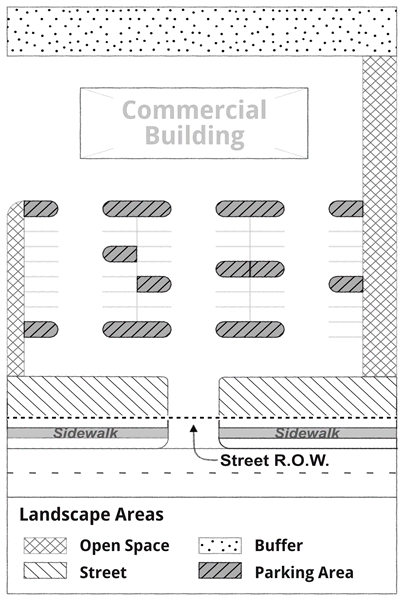
Landscape areas. Four landscape areas shall be required in accordance with this section, including buffer, open space, parking and street landscape areas (see Figure 9.2.1).
F.
Buffer landscape area.
1.
Applicability. A buffer includes both a landscape area and an opaque fence or wall.
a.
A required buffer and the entity responsible for the buffer occurs in the following conditions, whenever the conditions for permitting require a landscape plan:
i.
Between a multifamily development and any existing single-family use.
Figure 9.2.1. Typical Required Landscape Areas
ii.
Between a commercial or mixed-use development and any existing single-family or multi-family use.
iii.
Between an industrial development and any existing single-family, multi-family, mixed use, or commercial use.
2.
Planting requirement.
a.
Must consist of a minimum of four large trees, four small trees, and 20 shrubs for every 1,000 square feet of landscape area.
b.
All trees and shrubs must be evergreen and dispersed evenly along the shared property boundary to provide continuous screening.
3.
Fence requirement.
a.
The site must include an opaque fence at least six feet tall to block noise, light, and particulates.
b.
The department of planning may require a taller fence and sound abatement materials to increase the buffer effect when light, noise, or particulates from the more intense land use are likely to pass over a six-foot fence without hindrance.
c.
In the event that there exists on the property in either zone a fence meeting these requirements, said fence being within 12 inches of the abutting property lines, no additional fence will be required to be built.
4.
Location and dimensions.
a.
The buffer landscape area must extend along the shared property line boundary with the less intense use(s) as identified in this section.
b.
The width of the buffer landscape area shall be a minimum of ten feet and maximum of 25 feet from the property boundary toward the interior of the property.
G.
Open space landscape area—Industrial, commercial, and multi-family sites.
1.
Planting requirement.
a.
For every 1,000 square feet of landscape area there shall be a minimum of four large trees, five small trees, and 15 shrubs.
2.
Location and dimensions. Open space landscape areas may be:
a.
The project site must retain or provide ten percent of the overall site square footage as open space, in addition to required buffer, parking, and street landscape areas;
b.
Established by creating planting areas along a building façade, between a building and a parking area, or alongside non-buffered property lines; or
c.
Made a part of other required landscape areas, but in no case shall the planting space be counted as both open space landscaping and another required landscape areas.
d.
Elsewhere on the site.
e.
The minimum size of any planting area shall be 25 square feet.
3.
Exceptions.
a.
The department of planning can approve retention of existing vegetation in lieu of removing and replanting areas, provided that the existing vegetation consists of a mix of non-invasive trees and shrubs and may require additional planting of trees and shrubs to meet the minimum planting requirements.
b.
Stormwater drainage improvements may be counted as open space provided improvements consist of a live vegetative covering and include large or small trees and/or shrubs.
H.
Open space landscape area—One- or two-family sites.
1.
Planting requirement. One large tree per each dwelling unit, including for an accessory dwelling unit, is required to be installed in the front or side yard visible from the public right-of-way; however, if an existing protected or heritage tree is retained it will satisfy this requirement. This requirement applies to the new construction of single-family or two-family unit structures, or accessory dwelling units.
2.
Location and dimensions. Every residentially zoned lot, parcel, or tract must maintain a total of 20 percent of the lot, parcel, or tract as open space landscape area.
3.
Maximum surface coverage. Every residentially zoned lot, parcel, or tract must maintain a total of 50 percent of the defined front yard of the lot, parcel, or tract with vegetative or organic groundcover. No front yard may be covered with more than 50 percent impervious materials.
I.
Parking landscape area.
1.
Applicability. Required for new construction and substantial improvement of industrial, commercial, and multifamily properties with ten or more parking spaces. Parking lots shall consist of both endcap planting areas at the end of each parking row and interior island planting areas disbursed throughout the parking lot for maximum shade potential.
2.
Planting requirement. Both endcaps and interior island planting areas shall consist of at least one large tree and five shrubs. Areas not planted with trees or shrubs must be planted with a living vegetative covering.
3.
Location and dimensions.
a.
End cap. The endcap planting area shall consist of a 100 square foot planting area at the end of each row of parking. When two rows of parking abut each other, the 100 square foot endcaps shall be combined into one endcap with a minimum planting area of 200 square feet.
b.
Interior island. The interior island planting area must include a minimum of 200 square feet of planting area for every 12 parking spaces and be dispersed evenly throughout the parking area to provide a consistent shade canopy.
c.
Placement. Trees shall be planted where trunks are a minimum of 30 inches from all curbs, bollards, rear guards, or other permanent parking lot traffic control elements.
4.
Exceptions. The department of planning may approve alternative layouts of the endcap and interior island planting areas to:
a.
Preserve a heritage or protected tree;
b.
Retain a cluster of large and small trees and shrubs;
c.
Accommodate best management practices for stormwater management; or
d.
Achieve a holistic, integrated landscape plan for the site.
J.
Street landscape area.
1.
Planting requirement — depth up to 15 feet. For every 40 linear feet of street frontage (or fraction thereof) a minimum of one large tree and one small tree must be provided. For every ten linear feet of street frontage (or fraction thereof), one shrub must be provided.
2.
Planting requirement — depth more than 15 feet. For every 40 linear feet of street frontage (or fraction thereof) a minimum of two large trees and two small trees must be provided. For every ten linear feet of street frontage (or fraction thereof), two shrubs must be provided.
3.
Location and dimensions.
a.
Must span the entire property frontage along a property frontage at the boundary between any public right-of-way (ROW) and the private property, not inclusive of the public ROW.
b.
The depth of the street landscape area shall be a minimum of ten feet and maximum of 25 feet from the property boundary toward the interior of the property.
Section 9.4 - Public tree management.
A.
Purpose. The strategic planting and maintenance of trees, shrubs, and plants on public property is beneficial to the city, its residents, and businesses. Regulations in this section assign responsibility for public tree planting and management and clarify private property owner's limited ability to plant on public property.
B.
Responsibility. The director of the department of parks and recreation is responsible for tree and landscape planting on public property, including:
1.
Cultivation, placement, maintenance, and removal of trees, shrubs, flowers, and other plants.
2.
Protection of trees during city construction projects.
3.
Review and decision-making on private tree planting requests.
4.
Maintenance of tree planting and removal records.
C.
Limited activity permitted on public property. No private entity or person shall take the following actions in a public right-of-way, park, or any other city property without first submitting an application and receiving approval from the Director of Parks and Recreation or Louisiana Department of Transportation and Development (LADOTD), as applicable:
1.
Plant, cut, prune, break, climb, injure, or remove any tree or landscape material.
2.
Cut, disturb, or interfere in any way with the roots of any tree.
3.
Spray with any chemicals, insecticides, or other oils; or whitewash any tree.
4.
Place any wire, rope, sign, poster, barricade, lights, decorations, electric wire, or other fixtures on a tree or within the public right-of-way.
5.
Injure, misuse, or remove any device placed to protect any tree.
6.
Place shells, gravel, or other such material within 24 inches of any tree or impede the free passage of water and air to any tree, shrub, or plant.
7.
Place, construct, or maintain any roadside memorial or similar encroachment, including the planting of memorial trees or shrubs.
D.
Removal. The city retains the authority to remove or cut back an existing tree or vegetation planted in the city right-of-way or park without permission of the adjacent property owner(s), where the city is not liable for compensation for the removal or loss of any tree, shrub, or plant removed.
E.
Enforcement. The department of parks and recreation employees and city code enforcement officers are authorized to enforce the regulations of this section. enforcement procedures must be in conformance with applicable City Code of Ordinances regulations.

