
Smyrna City Zoning Code
ARTICLE V
- GENERAL PROVISIONS
Sec. 501.- Accessory uses and structures.
Accessory uses and structures shall be permitted in all zoning districts subject to conformance with the following conditions:
(501.1) Such structures and uses shall be located on the same lot as the principal building to which they are accessory.
(501.2) Such structures and uses shall not be permitted in a required front or side yard.
501.3 Residential accessory uses and structures such as garages, greenhouses or workshops shall not be rented or occupied for gain; except as permitted in article IX of chapter 22, businesses, of this Code as it pertains to the operation of short-term rental units.
(501.4) No accessory building shall be constructed upon a lot until construction of the principal building has commenced.
(501.5) When an accessory building is attached to the principal building by breezeway, passageway or similar means, it shall comply with the yard requirements of the principal building to which it is accessory.
(501.6) No garage or other accessory building shall be located closer than five feet to a rear lot line in a residential district. Where any nonresidential lot adjoins the rear of a residential lot, no accessory building on a nonresidential lot shall be located closer than 25 feet to the property line of the residential lot.
(501.7) No nonresidential accessory building shall be used by other than employees of the owner, lessee, or tenant of the premises.
(501.8) Accessory uses in an apartment development may include, but shall not be limited to, laundry facilities for the convenience of residents, which must be housed in a structure whose primary use is not for laundry purposes.
(501.9) Accessory use swimming pools having a minimum depth of two feet shall be permitted only upon written approval of the county health department to indicate compliance with applicable health department swimming pool regulations. Also, a woven wire (chainlink) fence or similar structure at least four feet in height shall be placed around the pool and any gate opening to the exterior of the property shall be equipped with a bolt latch operated from the inside of the fence. If the rear yard in which the pool is located is already fenced, such fence shall be deemed adequate if the height and gate locking features are in conformance with the above provisions. These regulations shall apply only to a permanent type pool attached to or within the ground.
(501.10) Reserved.
(501.11) Accessory structures will be limited to one per lot. The size of the accessory structure will not exceed one-fourth the total square footage of the principal building. The accessory structure will be built with materials and style similar to the principal building or any material and style commonly associated with an accessory structure. The height shall not exceed 15 feet. Structures or buildings commonly transported, with or without axles and/or wheels, and/or built upon a metal frame for transport, including but not limited to a receiver tongue for transporting, shall not be used as an accessory use or structure.
(501.12) Individual parcels five acres or larger shall not be subject to the aforementioned accessory use restrictions. A maximum of five accessory structures may be built, provided that a minimum distance of 20 feet from any other structure is maintained and that they shall not be closer than 100 feet from any property line. Accessory structures shall not exceed height limitations established for the zoning district in which they are built.
(501.13) A satellite antenna, including any structural supports, is permitted as a conditional use, provided the following requirements are complied with:
1.
A satellite antenna is only permitted as an accessory use on a lot that contains a principal structure.
2.
A satellite antenna is only permitted in a rear yard.
3.
A satellite antenna is only permitted as a freestanding structure.
4.
Every satellite antenna shall be effectively screened by a special planting screen or fence as approved by the planning board, which shall be maintained in good condition so that said antenna shall not be visible from any adjacent property or public street.
5.
A satellite antenna shall not be closer to the rear property line than the height of said antenna nor closer to any side property line than the height of said antenna or the side yard setback requirement for the principal structure on the lot, whichever results in the greatest setback.
6.
Any permitted satellite antenna shall not have a surface receiving area greater than 80 square feet.
7.
No lot may contain more than one satellite antenna as heretofore regulated.
8.
No satellite antenna shall exceed a height of 15 feet.
9.
Every satellite antenna shall be of black mesh metal construction.
(501.14) A direct satellite system, DSS, including any structural supports is permitted as a conditional use, provided the following requirements are complied with:
1.
A DSS antenna is only permitted as an accessory use on a lot that contains a principal structure.
2.
A DSS antenna is only permitted in the rear yard or attached to the rear wall or rear roof of a principal structure.
a.
A rear roof of a structure is defined as any portion of a roof from the peak or ridge point sloped toward the rear building setback line and which plane cannot be seen from the street adjacent to the front yard setback line or side yard setback line in the case of a corner lot.
b.
A rear wall of a structure is defined as the plane of a structure facing the rear building setback line and to the front yard setback line or side yard setback line in the case of a corner lot.
3.
A DSS antenna shall not have a radius larger than 18 inches in a residential district and 36 inches in a commercial district.
4.
There shall be only one DSS antenna per building or one DSS per tenant of a multiple tenant building.
5.
The DSS antenna shall not exceed four feet vertically or horizontally from its mounting point for residential applications and shall not exceed seven feet vertically or horizontally from its mounting point for commercial applications.
6.
The DSS antenna shall be of a color that will blend into its surroundings.
(501.15) Reserved.
(501.16) Special land use permit for television, land mobile, communication, microwave, and radio transmission antennae and towers.
1.
General.
(a)
Height limitations: The height limitations set forth in this ordinance applicable to buildings and structures shall not apply to towers and antennae which shall be governed by the special use permit procedure set forth herein.
(b)
Tower height threshold: These standards shall only be applicable to antennae and towers in excess of 25 feet in height.
(c)
The city council may consider for approval a site plan specific request which is in substantial conformance with the requirements listed herein.
2.
Special Use Permit.
Special land use permit shall be required for all television, land mobile, communication, microwave, and radio transmission antennae and towers.
3.
Requirements.
(a)
All towers and antennae in excess of 70 feet must be set back a distance of at least the height of the tower from any adjoining off-site structure.
(b)
At the time of filing the application for a tower, the applicant shall provide a site plan and information regarding topography, coverage zone, and tower height requirements.
(c)
Shared usage of towers/antennae is encouraged, and towers should be designed to accommodate such uses.
(d)
Shared usage of towers/antennae facilities are also encouraged, and facilities should be designed to accommodate such uses.
(e)
Accessory structures shall be limited to usages associated with operation of the antennae or towers and shall be appropriate in scale and intensity.
(f)
All towers and antennae shall be equipped with an anti-climbing devise such as a six-foot barbed strand fence or other appropriate devices to prevent unauthorized access.
(g)
All towers and antennae must meet or exceed current standards and regulations of the Federal Aviation Administration, the Federal Communications Commission or such governing agency guidelines as may be established from time to time. All towers and antennae must be updated and brought into conformity with such standards and regulations within six months of their adoption. The failure to comply with this provision shall be grounds for the City of Smyrna to require removal or repermitting of the antenna or tower at the owner's expense.
(h)
At the time application for building permit, the plans for tower or antenna construction shall be certified by an independent registered structural engineer as meeting all current safety and design standards of all applicable codes.
(i)
Applicants are required to explore and fully utilize existing tower and antenna space.
(j)
No residentially used properties are permitted for tower locations.
(k)
Towers and antennae are encouraged to be located at a height above the tree line no greater than necessary to reasonably accommodate the facilities.
(l)
In addition, all such towers and antennae shall be designed to minimize visual scenic impact when located on a hill.
(m)
A tower may not be located closer than 1500 feet from an existing tower.
(n)
In addition to other regulations, tower/antennae and associated facilities must comply with section 1510(5), subsections (a) thru (k).
4.
Grandfather Clause.
Any existing tower or location existing on the date of adoption of this ordinance shall be grandfathered and nonconforming and not required to meet the above requirements, but shall be subject to the other provisions of this ordinance.
5.
Landscape Buffer/Screening Requirement.
Unless otherwise noted within this section's requirements, or otherwise approved by the city council, the special land use permit hearing, any structure associated with any commercial tower or antenna which abuts residentially zoned property shall have a minimum 50-foot setback from the residential property, 15 feet of which should be a landscaped, screening buffer between the tower and the residentially zoned property which will be subject to approval.
Note: Required buffers may be included within required setbacks; however, in such case that the required buffer is greater than the required setback, the required buffer shall be adhered to.
Additionally, necessary private utilities and/or access drives may be allowed through, over, or across a landscaped buffer. Any such uses which are proposed through, over, or across a designated, undisturbed buffer must be approved pursuant to an original site plan modification.
(a)
Objectives: The above-required landscape screening buffer shall be implemented in connection with a permitted project and shall address the following objectives:
i.
Screening to enhance aesthetic appeal;
ii.
Control or direct vehicular and pedestrian movement;
iii.
Reduce glare;
iv.
Buffer noise;
v.
Establish privacy; and
vi.
Public health and safety.
(b)
Standards: The above-required landscape screening buffer is subject to review and approval by the City of Smyrna in accordance with the following standards:
i.
Plantings are to be a mix of rows of evergreen trees and shrubs, deciduous trees and taller evergreen trees;
ii.
Species are to be ecologically compatible to site and appropriate for design situation;
iii.
Unless public safety concerns dictate otherwise, buffers should provide maximum visual barrier;
iv.
Minimum height of plant materials at installation is to be five feet for trees;
v.
Fencing or walls are to be a minimum of six feet in height as approved by the City of Smyrna;
vi.
Trees included in buffer plantings may be counted toward site density calculations as required by the City of Smyrna Tree Preservation and Replacement Ordinance, subject to review and approval of the City of Smyrna;
vii.
Buffers shall be regularly maintained by the property owner(s) to ensure that the above objectives and standards are met;
viii.
When topography and existing conditions allow, the required landscaped buffer should be an undisturbed buffer; provided, however, the buffer may be crossed by an access drive as shown on the site plan and/or necessary utilities;
ix.
An appeals from determination by the City of Smyrna staff regarding the landscape buffer shall be to the mayor and city council.
(Ord. of 7-20-87 (87-20); Ord. of 2-5-90 (90-2), § 1; Ord. of 10-15-90 (90-36); Ord. No. 94-04, 3-28-94; Ord. No. 95-01, 2-6-95; Ord. No. 96-01, 1-16-96; Ord. No. 97-12, 11-3-97; Ord. No. 2005-39, 10-17-05; Ord. No. 2018-13, 10-1-18; Ord. No. 2019-22, 10-21-19; Ord. No. 2022-05, 6-6-22)
Sec. 502. - Building under construction.
Nothing in this ordinance shall require any change in the construction or intended use of a building which is legally under construction or for which a building permit has been issued prior to the effective date of the ordinance and the construction of which shall be diligently pursued until its completion.
Sec. 503. - Buffer strip required.
Where any parcel which is zoned and used for commercial, industrial, utility, public or similar purposes abuts a residential district or any other zoning classification as herein stipulated, a buffer strip or area shall be required on the common boundary line or lines between such differing classifications within two months of start of construction as follows:
Such buffer strip shall consist of a planted earthen berm or planted strip, including trees, shrubs, stone, rocks, and other appropriate landscaping materials, and shall be at least ten feet in width for developments of five acres or less; and at least 50 feet in width for developments of five acres or greater, 40 feet of which may be a "natural" buffer area.
Such plantings shall be composed of evergreen trees and shrubs not less than six feet in height or trees and shrubs which will, in normal growing conditions, attain a height of six feet within three years; earthen berms shall be not less than six feet in height. In order to provide and form a hardy screen of sufficient density and height to both interrupt vision and diffuse the transmission of sound, all plants used must be first submitted to and approved by the building inspector, including but not limited to the following acceptable plants:
Slash or Loblolly Pines
Prunus Caroliniana (Cherry Laurel)
Red Tip Photinia
Ilex Burfordi (Buford Holly)
Elaeagnus Pungens (Elaegnus)
Said strip shall be planted and maintained in a healthy, growing condition by the property owner. No such buffer strip shall, however, extend nearer to a street right-of-way line than 12 feet.
Where the conditions described in the preceding paragraph cannot be met, with respect to the required ten-foot buffer strip, the owner of said buffer area may erect a permanent or opaque fence not less than six feet in height.
Except as provided above, the natural topography of the land shall be preserved and natural growth shall not be disturbed beyond that which is necessary to prevent a nuisance, or to thin such natural growth where too dense for normal growth, or to remove diseased, misshapen, or dangerous and decayed timbers. However, a slope easement may be cleared and graded where required to prevent soil erosion; provided such easement shall be immediately replanted upon completion of easement improvements.
Such buffer strip shall not be used for parking or a structure other than a fence, wall or drainage improvements required by the city. However, a buffer area may be used for utility easements (only if such uses are provided approximately perpendicular to the greater distance of the buffer area) and for drainage improvements required by the city based upon competent engineering studies which show improvements to be necessary, to the satisfaction of the mayor and council.
(Ord. of 12-29-77; Ord. No. 92-07, 6-1-92; Ord. No. 96-14, 11-18-96)
Sec. 503-A. - Fencing.
(503-A.1) No fence shall be more than eight feet in height or be constructed in a public right-of-way.
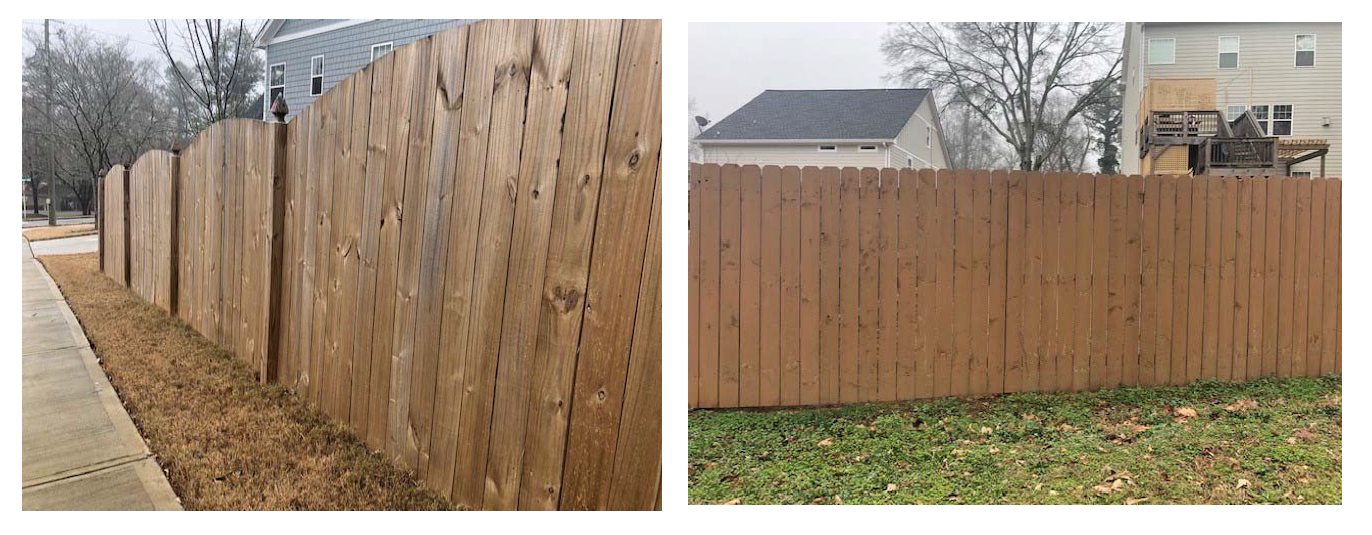
(503-A.2) In all cases, the finished side of a fence shall face adjoining properties and/or public rights-of-way. For purposes of this section, the finished side shall be defined as the side of the fence that contains no visible support structures, unless approved by the community development director.
Examples of the finished side of a fence:
Examples of the unfinished side of a fence:
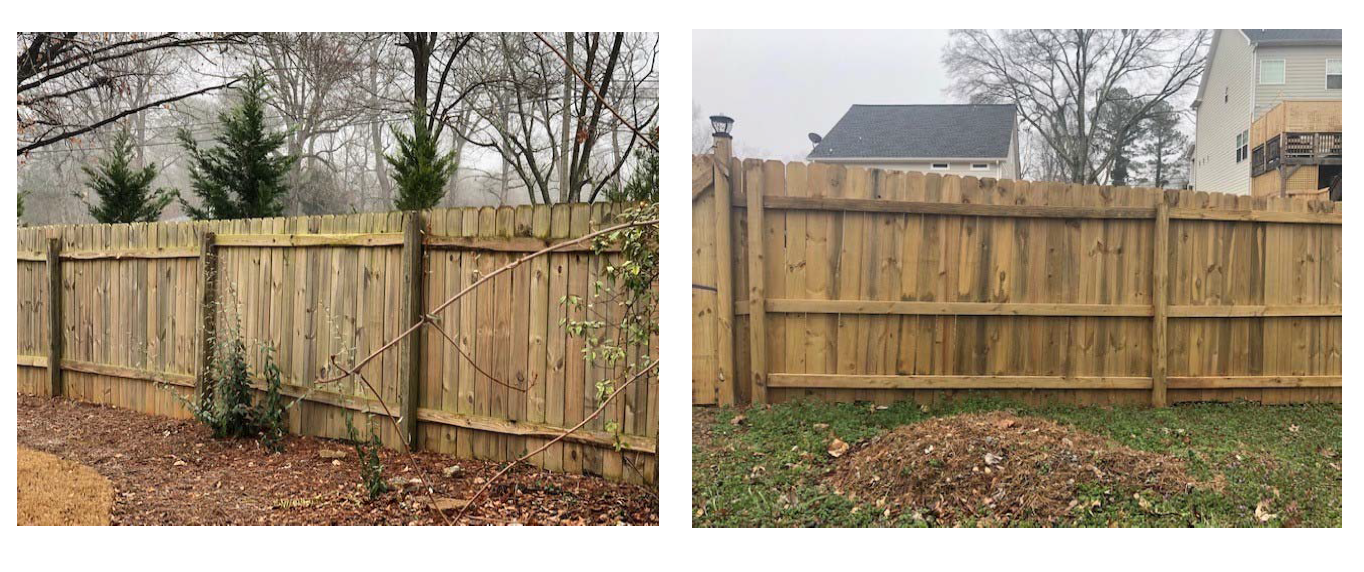
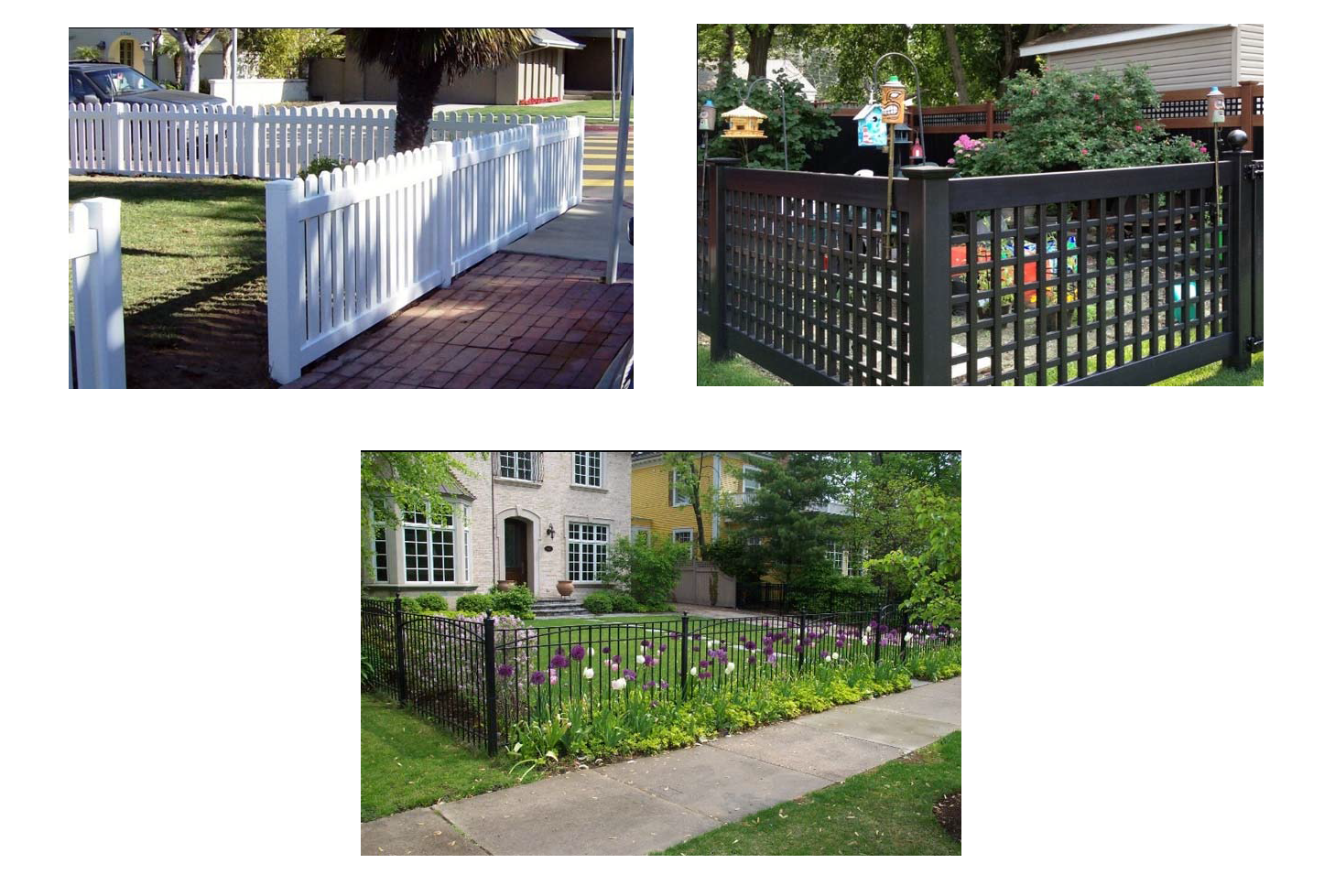
(503-A.3) Within any front yard (front yard shall also include a corner lot in which both yards abutting a street shall be deemed a front yard), in all zoning districts, no chain link or similar woven wire fence shall be permitted. However, within a front yard in the aforementioned districts, a decorative or ornamental rail, split rail, picket, opaque, basket weave or similar fence constructed of wooden materials may be permitted provided that said fence does not exceed four feet in height. Any wire backing on a split rail fence in the front yard must have a black vinyl coating. The use of uncoated wire backing and woven wire backing on split rail between fence sections in the front yard but still cannot exceed four feet in height. Decorative wrought iron or black aluminum fencing shall also be permitted provided that said fence does not exceed four feet in height.
Examples of decorative fences:
(Ord. No. 2019-22, 10-21-19; Ord. No. 2021-11, 6-7-21)
Sec. 504. - Height and density.
No building or structure shall hereafter be erected, constructed, reconstructed, or altered to:
(a)
Exceed the height limits;
(b)
Contain a greater number of dwelling units;
(c)
Occupy a greater percentage of lot area; or
(d)
Have narrower or smaller rear yards, front yards, side yards, courtyards, or other open spaces, than herein required; or in any other manner contrary to the provisions of this ordinance.
Sec. 505. - Home occupation.
Home occupations, as defined in subsection (402.30), may be established in a dwelling unit in any residential district subject to the following conditions and requirements:
(505.1) There shall be no exterior evidence of the home occupation.
(505.2) No accessory buildings or outside storage of materials and equipment shall be used in connection with the home occupation.
(505.3) No internal or external alterations inconsistent with the residential use of the building shall be permitted.
(505.4) No more than 25 percent of the total floor area of the dwelling unit shall be used for such home occupation.
(505.5) Only vehicles used primarily as passenger vehicles shall be permitted in connection with the conduct of the home occupation and no parking of customer vehicles shall be permitted.
(505.6) No use shall involve general public contact on the property other than by telephone or internet.
(505.7) No chemical, electrical or mechanical equipment shall be installed or used, except that which is normally used for household or hobby purposes.
(505.8) No equipment that interferes with radio and/or television reception shall be allowed.
(505.9) No commodity shall be stocked or sold on the premises.
(505.10) Such use shall be conducted entirely within the dwelling unit and only persons living in the dwelling unit shall be employed in such occupation.
(505.11) There shall be no group instruction, assembly or activity.
(505.12) Reserved.
(505.13) A home occupation certificate is merely a privilege to be granted only under circumstances meeting the requirements herein stated in section 505 and there is no vested right to such certificate.
(505.14) Home occupation certificates shall be granted on a calendar year basis for one year.
(505.15) The following events shall be cause for revocation of a home occupation tax certificate, in the manner of other privileged certificates:
(a)
Conducting such activity as creates a nuisance or is illegal.
(b)
Violation of any law or ordinance (except for minor traffic offenses) of the city, county, State of Georgia or United States of America.
(c)
Making a false statement in connection with the application or any document or hearing in connection with such certificate.
(d)
Failure to pay the certificate fee or any tax or other fee to the city, Cobb County, or State of Georgia.
(505.16) The amount of the fee for a home occupation tax certificate shall be approved by the mayor and council and kept on file in the office of the city clerk.
(505.17) Upon conviction of any violation of any section or subsection of section 505 et seq., home occupation, the violator shall be fined.
(505.18) Home occupation certificate may be issued from the occupation tax certificate office without requiring the applicant to appear before the mayor and council, restricted to the following classes: computer work, internet sales, typing, bookkeeping, small arts and crafts, and telephone use. Before the issuance of a home occupation certificate, the following conditions will have to be met by the applicant:
(1)
To operate a business from an apartment, the city will need a letter of approval from the owner, not the management.
(2)
If rental property, a letter of approval will also be required from the property owner allowing the business.
(3)
Certification that there will not be any on-site retail sales of any kind at this location.
(4)
Certificate holder will be the only person to work from this location.
(5)
There shall not be any inventory maintained on the premises.
(6)
Certification that there will not be any outside storage of business related items of any kind at this location.
(7)
Certification that there will not be any traffic generated by the business of any kind (e.g., vehicles or people).
(8)
Certification that there will not be any signs or advertisement of any kind at this location.
(9)
Occupation tax certificate will be granted on a calendar year basis for one year only, subject to renewal by the occupation tax certificate office, providing there has not been any violation of the home occupation ordinances of any kind.
(10)
Applicant agrees that any violation of the conditions stated above will render the certificate null and void.
(Mo. of 11-1-76; Ord. of 7-15-85 (85-14), § 1; Ord. of 1-19-87 (87-1), § 1; Ord. of 1-19-87 (87-2); Ord. of 12-2-91 (91-44); Ord. No. 94-18, § 3, 12-5-94; Ord. No. 2004-6, 2-2-04; Ord. No. 2021-05, 4-19-21)
Sec. 506. - Lot size.
No lot, even though it may consist of one or more adjacent lots of record, shall be reduced in size so that the lot width or depth, front, side or rear yards, lot area per dwelling unit or other requirements of this ordinance are not maintained. This section shall not apply when a portion of a lot is acquired for a public purpose.
Sec. 507. - Principal building.
Only one building and its customary accessory buildings may hereafter be erected on any lot; provided, however, that within a planned unit development more than one principal building used for residential, institutional, commercial or industrial purposes may be located upon a lot or tract, but such buildings shall not encroach upon the front, side and rear yards required by this ordinance and the open space between buildings measured at the closest point shall not be less than 20 feet for one-story buildings, 30 feet where one or both are two-story buildings, and 40 feet where one or both are three- or more story buildings, except as otherwise provided herein.
Sec. 508. - Removal of soil.
No soil, mineral, or similar material may be removed from any lot except that which is purely incidental to construction of a building or structure. No excavation on any lot exceeding one foot in depth, except for the purpose of locating poles, or underground service connections of public utilities shall be permitted unless a building permit is first secured.
Sec. 509. - State highways.
For all developments fronting on a state highway, no building permit shall be issued until the approval of the state department of transportation has been obtained by the applicant on entrances and exits, curb radii, drainage and other matters that are the appropriate concern of the department.
Sec. 510. - Unsafe buildings.
Nothing in this ordinance shall prevent the strengthening or restoring to a safe condition of any part of any building or structure declared unsafe by proper authority.
Sec. 511. - Use.
No building, structure or land shall hereafter be used or occupied and no building or structure or part thereof shall be erected, constructed, reconstructed, moved or structurally altered except in conformity with the regulations of this ordinance or amendments thereto, for the district in which it is located.
Sec. 512. - Utilities location.
Electrical transformer stations, telephone exchanges and gas regulator stations may be located in any zoning district subject to compliance with the following conditions and requirements and approval by the mayor and council:
(512.1) Such facilities shall be essential for service to the area in which located or for the proper functioning of the total utility system of which the same is a part.
(512.2) Any building or structure, except an enclosing fence, shall be set back not less than 50 feet from any property line, and shall meet all other applicable yard requirements of the district in which it is located.
(512.3) Such facility shall be enclosed by a woven wire fence or similar structure not less than eight feet high.
(512.4) Open spaces on the premises shall be suitably landscaped and maintained, and a planted buffer strip at least ten feet wide shall be located along the side and rear property lines.
(512.5) When such facilities are located within any residential district, the storage of vehicles and equipment on the premises shall be prohibited.
(512.6) The area surrounding such a facility shall not be adversely affected by, and shall be protected from noise, odor, glare, dust, fumes, gas, smoke, vibration, or any other obnoxious characteristics.
Sec. 513. - Vision clearance at intersections.
In all zoning districts, no fence, wall, structure, shrubbery or other obstruction to vision between the heights of three feet and 15 feet, except utility poles, light or street sign standards or tree trunks, shall be permitted within 20 feet of the intersection of right-of-way lines of streets, highways and railroads.
Sec. 514. - Yards and other spaces.
Except as hereinafter provided, no yard or other open space or portion thereof provided about any building for the purpose of complying with the provisions of this ordinance shall be included as a part of the yard or other open space required about or for another building.
Sec. 515. - Townhome design standards.
(515.1)
Applicability. These regulations shall apply to all townhome uses, unless specifically exempted herein. Where provisions in this section conflict with the remainder of the city's zoning ordinance, the provisions provided herein shall govern.
(515.2)
Purpose and intent. These requirements are intended to regulate the siting and design of townhome projects in pursuit of cohesive design and walkable development patterns. The regulations are intended to define elements of the development that supports both horizontal and vertical articulations and variations among units that provide architectural interest and reinforce high quality design and responsible site development practices to meet the goals and policies of the city's comprehensive plan.
(515.3)
Minimum architectural design requirements.
(1)
The front façades of townhouse units shall have architectural modulation and detail that includes features such as varied materials and wall planes, varied roof forms and roof lines, balconies, porches, bay windows, varied window sizes and shapes, shutters, entrance doors, sidelights, pilasters, varied garage door designs, and other features to provide visual interest.
(2)
Façade materials for each unit may be combined on each façade only horizontally, with the lighter materials above the more substantial materials.
(3)
The exterior façade shall be comprised of brick and/or stone materials for a minimum of two stories for any building elevation visible from a public or private right-of-way. Where architectural projections are structurally limited from masonry cladding, those projections are permitted to be faced with cementitious lap and shake siding or other similar cementitious products. Molding, windows and doors, and other accents are exempt from this requirement.
(4)
The side elevations adjacent to a public or private right-of-way shall be consistent with the front façade in terms of articulation, fenestration, wall openings, proportions, architectural details, materials, and window styles.
(5)
Buildings that terminate a view or are located at public or private street intersections should provide distinct and prominent architectural features or otherwise create a distinctive visual landmark.
(6)
Any elevation visible from the public right-of-way may not use cementitious lap siding.
(7)
Any building containing more than three units with common walls must have the front façade and the roof of each attached unit distinct from the other through separation, staggering, or offsets in design.
(8)
Pitched roofs shall be symmetrically sloped no less than 6:12, except those roofs for porches and attached sheds may be no less than 2:12.
(9)
Low pitch or flat roofs shall be enclosed by a parapet that is a minimum of 42 feet in height, or a greater height as necessary to conceal mechanical equipment.
(10)
Dormers shall be roofed with a symmetrical gable or a shed configuration. There shall be no more than two windows wide and placed no less than two feet from an end gable or party wall.
(11)
Each home shall have a two-car garage enclosed with architectural doors. Interior clear space a minimum of 18 feet wide by 22 feet deep is required. Standard panel doors are not permitted. A one-car garage may be allowed if approved by the city council.
(12)
All main entrances to the units should have a porch or stoop facing the street that is at least six feet in depth and 30 square feet in area.
(13)
All townhome units must provide a functional rear patio or deck with a minimum of 50 square feet in area.
(14)
The window systems for the townhome units shall be recessed from the façade of the building a minimum of one and three-quarters inches. This reveal shall be accomplished through the design of the window casing reveals and frames.
(15)
All mechanical components for the townhome unit shall be located or screened in a manner not to be visible from the public or private right-of-way.
(515.4)
Design elements catalogue. Each townhome unit shall provide a minimum of one feature from each of the following categories:
(1)
Private outdoor space.
(a)
Front porch (minimum 60 square feet in area).
(b)
Front-facing balcony (minimum 60 square feet in area).
(c)
Rear patio or deck (minimum 150 square feet in area).
(d)
Rooftop terrace (minimum 150 square feet in area).
(2)
Architectural projection.
(a)
Projection window (bay or bow).
(b)
Turret.
(c)
Covered balcony or porch.
(d)
Alternative approved by the community development director.
(3)
Roof element.
(a)
Dormers.
(b)
Front gable or pediment.
(c)
Rooftop terrace.
(d)
Varied gable system.
(e)
Cornice detailing.
(f)
Alternative approved by the community development director.
(4)
Unit or façade variation (required when more than five units front on a single block face).
(a)
Change in brick/stone color or a change in masonry material.
(b)
Change in window composition.
(c)
Projection or recess of an architectural feature that is a minimum of five feet deep or 15 feet tall (used to distinguish and separate façades vertically because of the significance of the projection).
(515.5)
Bulk standards.
(1)
Setbacks. Setback are based on the residential townhome zoning district under section 801. Setbacks shall be measured for the development as whole as well as the from the interior public or private streets.
(a)
Minimum overall development setbacks:
(i)
Front: 50 feet.
(ii)
Side: 25 feet.
(iii)
Rear: 30 feet.
(b)
Minimum interior setbacks:
(i)
Front:
a.
Front-entry townhome: 20 feet from back of sidewalk or the outside edge of the landscape zone if no sidewalk is present.
b.
Rear-entry townhome: ten feet from back of sidewalk or the outside edge of the landscape zone if no sidewalk is present.
(ii)
Street side: 15 feet from back of sidewalk or the outside edge of the landscape zone if no sidewalk is present.
(c)
Setback exceptions:
(i)
If the townhomes are designed to front on an existing public right-of-way, the front setback for the overall development may be reduced to 25 feet.
(2)
Building separations. Townhome buildings shall maintain the following building separations:
(a)
Front to front: 50 feet.
(b)
Side to side: 20 feet.
(c)
Side to rear: 40 feet.
(d)
Rear to rear: 40 feet.
(3)
Maximum building height: 45 feet (or three stories).
(4)
Minimum floor area per unit: 1,000 square feet.
(5)
Minimum unit width: 24 feet.
(6)
Lots:
(a)
Unit lots shall be rectilinear in form.
(b)
Irregular shaped lots are prohibited. The creation and establishment of spite strips, flag lots or other shape that is not rectilinear in configuration shall be prohibited.
(c)
Common improvements. Common improvements shall be located on a stand-alone lot or as part of a lot held in common ownership by the required homeowner's association. Common improvements include but are not limited to stormwater ponds, open spaces, amenities and private roads or alleys.
(515.6)
Live-work units.
(1)
Live-work units shall only be allowed in acceptable zoning districts, such as the mixed-use and central business district zoning districts.
(2)
Live-work units shall be owner-occupied mixed-use dwellings that are fire separated from adjacent units as attached dwellings.
(3)
If any, the minimum number of live-work units in a building is two.
(4)
Each live-work unit shall contain a minimum of 2,400 gross square feet of which the non-residential component shall be no less than 500 square feet and shall be on the ground floor oriented to the public or private right-of-way.
(5)
The owner-proprietor of the business shall be the occupant of the residential portion of the unit.
(6)
An occupational tax certificate shall be required for operation of a business. The business shall not be considered a home occupation.
(7)
The business use or activity shall not employ more than two persons other than the owner-proprietor.
(8)
Permitted business uses in a live-work unit shall be one of the following types:
(9)
Professional office, workshop, or design studio (art, architecture, engineering, jewelry design, real estate, marketing, counseling, etc.).
(10)
Professional services (travel agent, hairdresser, nail salon, tanning salon, music sales or instruction, tutoring, etc.).
(11)
Specialty retail sales (newsstand, books, jewelry, clothing, shoes, antiques, confections, coffee/tea, ice cream).
(12)
Other similar uses subject to approval of the community development director.
(13)
The façade of the live-work unit shall meet the requirements of section 515.3.
(515.7)
Site development standards. Townhome developments shall comply with the following site standards:
(1)
Use.
(a)
A townhome unit shall contain one single-family attached dwelling unit.
(b)
Where the applicable zoning district allows a mix of uses, live-work units are permitted and encouraged. These units shall be planned with the overall development and approved by the city council.
(2)
Buildings.
(a)
There shall be a maximum of six units per building.
(b)
Rear loaded garages:
(i)
A minimum of 25 percent of units shall be rear loaded.
(ii)
Where the proposed project site is not readily situated to accommodate the percentage of rear-loaded units, the community development director or their designee may consider the following in applying this requirement:
a.
Topographical conditions which would require significant adjustments to the natural grade that would result in substantial cut and fill and/or large, expansive retaining walls that would not otherwise be required.
b.
Proposed designs for alternative site layout.
(c)
Relationship external to the development:
(i)
All units fronting on an external public or private street shall face the subject street with the front/primary façade and shall provide access from the interior of the development.
(ii)
Driveways for individual units are not permitted to be accessed from streets external to the development.
(3)
Driveways.
(a)
Driveway length must meet the minimum lengths:
(i)
Townhomes with front-entry garages shall provide a minimum driveway length of 22 feet from garage door to back of sidewalk or the outside edge of the landscape zone if no sidewalk is present.
(ii)
Townhomes with rear-entry garages shall provide a minimum driveway length of 20 feet from garage door to back of curb.
(b)
Reductions in driveway length or the elimination of driveways may be provided if the following conditions exists:
(i)
There is adequate on-street parking within the development;
(ii)
On-street parking must exceed the minimum requirements for guest parking with the development;
(iii)
The covenants for the homeowner's association require the use of the two-car garage for parking and preclude the use of the garage for the storage of personal items; and
(iv)
The city council must approve all reductions in driveway length.
(c)
Driveways for adjoining front-entry units shall be paired together to create larger landscape areas in front of townhome buildings.
(d)
End units may utilize side loaded garages and driveways to provide more space for grouped landscaping at each end of the building.
(4)
Streets.
(a)
All streets within townhome developments shall be accessed through an interconnected network. Cul-de-sac and other dead-end streets terminating interior to the development are prohibited.
(b)
Sidewalks and streetscape elements are required on all streets internal to the development and along all exterior road frontages.
(i)
All streets within the development shall provide a five-foot sidewalk with an eight-foot landscape zone between the back of curb and the sidewalk on one side of the street. The side of the street opposite of the sidewalk shall provide an eight-foot landscape zone measured from back of curb.
(ii)
Street trees shall be planted on both sides of all streets within the development within the required landscape zones.
(iii)
Street trees shall be planted every 40 to 50 feet on center along all public and private streets within the development.
(c)
Streets within a development shall provide the following street widths, as measured from back of curb to back of curb:
(i)
Streets shall maintain a minimum width of 26 feet if the vertical distance between the grade plane and the eaves of the highest roof structure of the building along the street exceeds 30 feet.
(ii)
Streets shall maintain a minimum width of 22 feet if the vertical distance between the grade plane and the eaves of the highest roof structure of the building along the street is less than or equal to 30 feet.
(d)
All streets are required to be developed to public street standards and publicly dedicated, unless developments are proposed to be gated. Streets in gated developments shall be private but are to be developed to public street standards. The developer shall install and maintain Knox boxes or other public safety equipment required by first responder agencies.
(e)
Where the proposed project site is not readily situated to accommodate an interconnected street network, the community development director or their designee may consider the following in applying this requirement:
(i)
Presence of extreme topographical conditions that prevent the feasibility of a crossing based on floodways or other environmental constraints.
(ii)
Availability of adjacent properties to be incorporated into the development to provide interconnected access based on the age of the structures and/or ripeness for redevelopment.
(iii)
Proposed designs for alternative pedestrian connections.
(5)
Open space.
(a)
Each development shall set aside and program a minimum of five percent of the site as functional open space. In no case shall the open space area be less than 2,000 square feet in area.
(b)
Open space may include common amenities, setbacks, planted buffers, parks, and other hardscaped elements and similar features which are located on private property and owned by the homeowner's association and operated as common space.
(c)
A recreation area shall be provided at a ratio of one acre per 50 units (or a proportional percentage thereof) with a minimum of 10,000 square feet provided. Such area shall be developed with at least one passive recreational feature, such as a walking trail, pavilion, gazebo or picnic area, and at least one active recreational feature, such as a swimming pool, playground or tennis courts. Active recreational areas must be outside of any floodplain area and located in such a manner that at least 75 percent of the townhouses are within 300 feet, as measured from the building footprints. Any recreation area, whether passive or active, must be located in an area with a slope of less than 15 percent, however, all recreation areas must meet ADA requirements for accessibility. Active recreational areas must be improved through the use of terracing or other techniques to provide a usable area, such that at least 25 percent of the entire recreational area shall have a slope of no greater than three percent.
(d)
Areas counted toward open space shall be specifically programmed as active or passive recreation.
(e)
Required sidewalks, parking lot landscaping, and other unprogrammed pervious areas shall not be counted toward the open space requirements of this section.
(6)
Utilities.
(a)
Individual systems for water, electric, fuel/gas, fire suppression and HVAC shall be required for each unit.
(b)
Individual metering shall be provided for water, electric, and fuel/gas.
(c)
Individual utility service lines shall not be located under the driveway of the unit.
(d)
Easements for all utility lines shall be provided in the common ownership area where lateral service connections shall take place.
(7)
Parking.
(a)
The development shall provide a minimum of two parking spaces per dwelling unit.
(b)
In addition to the minimum parking requirements for the district/use, a minimum of 0.33 spaces per unit is required to accommodate guest parking within the townhome development. Guest parking count may either be accommodated as common spaces or dedicated to each individual unit.
(8)
Mail kiosk.
(a)
A centrally located mail kiosk shall be provided within the townhome development with appropriate ADA access and parking facilities.
(9)
Fire protection and accessibility.
(a)
Rear access for fire protection. Townhouse developments shall be designed to provide proper access to all dwelling units for firefighting purposes, as may be determined by applicable codes. Rear access, if required for firefighting purposes may and is encouraged to be accomplished by alleys or access easements.
(10)
Common property.
(a)
For all developments containing eight units or more, a mandatory homeowners association shall be created and recorded with the county superior court that shall establish ownership and maintenance obligations for all front yards, common areas and private community infrastructure including, but not limited to: fencing, landscaping, amenities, stormwater management facilities and buffers, and shall include architectural control oversights for the development.
(b)
The development shall be constructed and governed in conformity with the requirements of the Georgia Condominium Act (O.C.G.A. § 44-3-70 et seq.). A declaration of condominium shall be submitted and recorded in compliance of this Act.
(515.8)
Zoning application requirements. Any application for a townhome project shall include the following information so a clear and accurate understanding of the proposed project elements can be evaluated during the legislative review process under article XV of the zoning ordinance:
(1)
Concept site plan illustrating proposed improvements, facilities, structures, amenities, lots, and applicable dimensions to demonstrate compliance with zoning regulations.
(2)
Conceptual landscape plan to show proposed landscaping along project boundaries, in buffer areas, in the streetscape zone, and landscape as a component of any amenity requirements, at a minimum.
(3)
Area calculations and description of proposed amenities articulated on concept and/or landscape plan.
(4)
Concept building elevations that articulate the following:
(a)
General architectural style.
(b)
Proposed materials, colors, and other details to demonstrate compliance with minimum design requirements.
(c)
Architectural elements proposed to meet the minimum design elements.
(d)
Proposed variation between units.
(5)
All variances shall be identified and explicitly requested through the process outlined in article XIV.
(Ord. No. 2022-21, 9-9-22)

