
South Beloit City Zoning Code
Sec. 118-14
Accessory uses and structures.
(a)
General requirements.
(1)
Any accessory use or structure shall conform to the applicable regulations of the district in which it is located except as specifically otherwise provided.
(2)
No accessory use or structure shall be permitted that by reason of noise, dust, odor, appearance, or other objectionable factor creates a nuisance or substantial adverse effect on the property value or reasonable enjoyment of the surrounding properties.
(3)
No accessory use or structure shall be permitted without a principal use on a property except as specifically otherwise provided.
(4)
In any case where the principal use is permitted as a special use, or is permitted only after approval of building, site and operational plans, the requirements of (1) and (2) above shall apply also to any use or structure accessory thereto, except that where such accessory use is added subsequent to the original approval, the PZC may grant approval of any such accessory use without necessity for public hearing if in their opinion it is compatible to the original grant and is not of sufficient scope or different character to necessitate further public hearings.
(b)
Accessory uses and structures definitions.
(1)
An accessory structure/building means one which:
a.
Is subordinate to and serves a principal building or principal use and is not temporary in nature;
b.
Is subordinate in area, extent or purpose to the principal building or principal building or principal use served;
c.
Contributes to the comfort, convenience or necessity of occupants of the principal building or principal use served; and
d.
Is located on the same zoning lot as the principal building or principal use served with the single exception of such accessory off-street parking facilities as are permitted to locate elsewhere than on the same zoning lot with the building or use served.
(2)
An accessory use means one which is incidental to the main use of the premises, is not temporary in nature, and is limited to the following:
a.
A playhouse, garden house and private greenhouse;
b.
A garage, carport, shed or building for domestic storage;
c.
Storage of merchandise normally carried in stock on the same lot with any retail service or business use, unless such storage is excluded by the district regulations;
d.
Storage of goods used in or produced by manufacturing activities, unless such storage is excluded by the district regulations;
e.
A nonpaying guesthouse or rooms for guests within an accessory building, provided that such facilities are used for the occasional housing of guests by the occupant of the principal building and not for permanent occupancy;
f.
Swimming pool, bathhouse, cabana, for use by the occupant and guest;
g.
Off-street motor car parking area and loading and unloading facilities;
h.
Signs (other than advertising signs) as permitted and regulated in each district incorporated in this chapter; and
i.
Public utilities facilities; telephone, electric, gas, water and sewer lines, their supports and incidental equipment.
(c)
Accessory structure permits.
(1)
Any property owner or person erecting an accessory structure or building shall, before beginning such work, apply with the zoning administrator for an accessory structure review permit. Such application shall include, but not be limited to, the following:
a.
The address of the property where the accessory structure or building will be erected; and
b.
A scaled site plan indicating the following minimum requirements: property lines and dimensions of the lot, applicable setbacks, location of the accessory structure/building, the dimensions and square footage of the accessory structure/building, dimensions and setbacks for all existing structures/buildings, and distance between the accessory structure/building and any other structure on the property.
c.
Accessory structures or buildings with a floor area greater than 199 square feet will require a building permit in addition to the accessory structure review permit.
d.
Fees: Permit fees, in an amount established by the council from time to time, will be required.
(d)
Other accessory structure regulations.
(1)
Location. When a side or rear yard is required, no part of an accessory building or structure shall be located closer than two and one-half feet to the lot line for structures less than 500 square feet and five feet to the lot line for structures 500 square feet or greater. along such side yard. In a residential district, no detached accessory building or structure shall be closer than ten feet to the principal building. Overhanging eaves and gutters may not project more than eight inches into any required side or rear yard.
(2)
Time of construction. No accessory building or structure shall be constructed on any lot prior to the start of construction of the principal building to which it is accessory.
(3)
Percentage of required rear yard occupied. Subject to any additional limitations which may be imposed in this Code on accessory buildings/structures, no accessory buildings/structures shall occupy more than 40 percent of the area of a required rear yard.
(4)
Number allowed. Any number of accessory structures may be allowed on one property if under the 40 percent of the area of a required rear yard. However, no more than two sheds are allowed on one property.
(5)
Height of accessory buildings or structures in required rear yards. No accessory building or structure or portion of an accessory building or structure located in a required side or rear yard shall exceed 15 feet in height.
(6)
On reversed corner lots. On a reversed corner lot in a residential district, no accessory building or structure or portion of an accessory building or structure shall be located in any yard closer to the street than a distance of one-half the adjacent public right-of-way not to exceed 60 feet nor less than 30 feet. For purposes of this section, if a property is a corner lot with two front yards, the city will designate one of the front yards as the primary front yard and the other as the secondary front yard. Secondary front yards shall be treated as a side or rear yard for purposes of this section.
(e)
Other accessory use regulations.
(1)
Pre-fabricated swimming pools. Pre-fabricated swimming pools installed above ground that are greater than two feet deep will require a building permit in addition to the accessory structure review permit. Inflatable pools and plastic "kiddie pools" do not require an accessory structure review permit.
(2)
Home occupations. Home occupations in the residential districts shall comply with the following regulations:
a.
There shall be no stock-in-trade other than products manufactured on the premises unless otherwise approved by the PZC by special use permit as provided for by this chapter.
b.
A home occupation shall be conducted within a dwelling or in an accessory building not to exceed 500 square feet of area.
c.
There shall be no outdoor storage of supplies or equipment outside the building.
d.
There shall be no external alteration of the dwelling or accessory building in which a home occupation is conducted, and the existence of a home occupation shall not be apparent beyond the boundaries of the site, except for a nameplate in accord with the provisions of this chapter.
e.
No other than a resident of the dwelling shall be employed in the conduct of a home occupation.
f.
No motor power other than electrically operated motors nor electrical disturbances shall be used in connection with a home occupation.
g.
No unreasonable odor, liquid, noise, glare or solid waste shall be emitted.
h.
Not more than one truck of not more than three-fourths ton capacity and no semitrailers incidental to a home occupation shall be kept on the site.
i.
A home occupation shall not create pedestrian, automobile or truck traffic significantly in excess of the normal amount in the district.
(3)
Fences. This subsection (e)(3) shall not have any application to automobile wrecking establishments or mobile home parks. The requirements of this section apply to all fencing, landscape walls and decorative posts equal to or exceeding 30 inches in height, for all land uses and activities. Fencing excluded from the requirements are: public utilities and local, state, or federal government uses.
a.
Permit required.
1.
No fence shall be erected unless the property owner or their authorized agent has first obtained a permit therefore from the zoning administrator.
2.
A detailed fence plan, including construction and elevation details drawn to scale, must be submitted with the fence permit application form to the city clerk.
3.
If any fence is erected prior to obtaining a fence permit, the fence shall be removed if it is in violation of this article [section]; or, if the fence meets all the restrictions of this article [section], it may remain only if a fence permit is obtained within 30 days after notice from the city at double the regular fee.
4.
All fence permits shall be valid for 120 days from the date of approval by the city clerk. If any fence permit expires prior to the completion of construction of the fence, then another fence permit must be obtained and another fee paid. It shall be unlawful for any person to erect or maintain a fence of any type not in full compliance with the applicable provisions of this article [section].
5.
Notwithstanding the foregoing, no fence permit shall be required to be obtained for repairs to a fence that do not exceed eight feet in total length (e.g. replacement of fence boards or section of fencing). Any repairs in excess of eight feet in total length shall be required to obtain a fence permit prior to commencing repairs.
b.
Standards.
1.
Materials:
i.
Residential districts. Acceptable materials for constructing fencing, landscape walls, and decorative posts include wood, stone, brick, wrought iron, PVC/ABS and chain link/wire mesh (11 gauge or larger). Alternate materials may be used if the zoning administrator determines they are safe and attractive. Fences located in the primary front yard setback shall only be constructed of decorative materials. All finished exteriors of fence shall be colored in a uniform manner with the exception of fluorescent colored paint which is prohibited.
ii.
Nonresidential districts. Acceptable materials for constructing fencing, landscape walls, and decorative posts include wood, stone, brick, wrought iron, PVC/ABS and chain link. Barbed wire fencing shall not be permitted (unless in the PL district as allowed by PZC).
iii.
Temporary fencing. Temporary fencing (including the use of wood or plastic snow fences for the purposes of limiting snow drifting between November 1 and April 1), protection of excavation and construction sites, and the protection of plants during grading and construction is permitted for up to 365 consecutive days.
iv.
Snow fences. Snow fences constructed of wood and wire, and/or plastic shall be permitted only as temporary fences.
2.
Location:
i.
On residential property the following exceptions may be permitted to the location of fences:
ii.
Ornamental fences not exceeding six feet in length in any direction nor more than four feet in height may be erected at the corner of each lot.
iii.
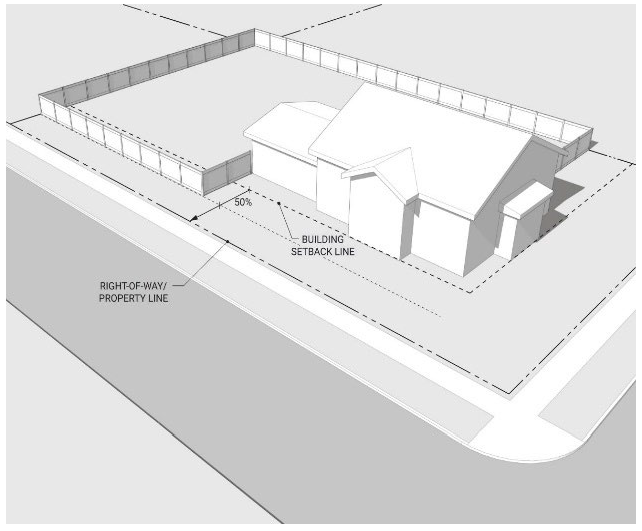
Fences along the secondary front yard, as determined by the zoning administrator, of a corner lot, may extend beyond the building setback line at a distance of 50 percent of the distance between the building setback line and the property line.
iv.
No fence, structure or planting shall be maintained in such a manner that is visibility obstructing of persons using the streets, sidewalks or driveways on or adjacent to such a yard. No such fence, structure or planting shall be located within the sight triangle, the sides of which are formed by the right-of-way lines of two intersecting streets, or a street and a driveway, or a street and an alley. The length of the sides of said triangle shall be 25 feet along the street right-of-way that intersect and ten feet along the right-of-way and the driveway or an alley when a street intersects with an alley or a driveway.
3.
Maximum height:
i.
No fence shall be constructed or erected in any residential, commercial or industrial district to a height exceeding six feet, except where otherwise specified in this Code.
ii.
Fences that are permitted in the primary front yard per shall not exceed four feet in height.
iii.
Fences which enclose public schools, public property, public utilities, athletic fields, tennis courts or similar facilities, but not including parks within only playground equipment may be constructed or erected to a height not to exceed ten feet.
iv.
Where business or industrial property is located adjacent to residentially zoned property and where screening is required by applicable codes or otherwise such screening shall be a total of six feet in height.
4.
Orientation. Any and all fences, landscape walls, or decorative posts shall be erected so as to locate visible supports and other structural components toward the subject property. All finished sides of a fence shall face out from the interior of the lot on which the fence is located and shall not include any signage that is not integral to the construction elements of the fence.
5.
Maintenance. Any and all fences, landscape walls, or decorative posts shall be maintained in a structurally sound and attractive manner. Wood fencing shall be treated with a wood preservative and/or painted.
c.
Prohibited fencing. It is unlawful to erect or maintain anywhere in the city a fence equipped with or having barbed wire spikes or any similar device or any electric fence charged sufficiently to cause shock within seven feet of the ground level. Notwithstanding the foregoing, governmental agencies shall be allowed to utilize barbed wire.
d.
Existing fences. Any fence in existence as of the effective date of this chapter shall be exempt from the provisions of this chapter with the exception of barbed wire fences, electrified fences and swimming pool enclosures.
e.
Damage or destruction. Upon the substantial damage or destruction or voluntarily removal of an existing fence, any repaired, reconstructed, or new fence shall be subject to the provisions of this chapter.
(4)
Reserved.
(5)
Dumpster enclosures. All dumpsters used to service multi-unit residential buildings (exceeding three units), commercial uses and industrial uses, must be enclosed by a site obscuring fence as set forth herein. Any property/business which is required to have a dumpster enclosure, shall apply with the zoning administrator for a zoning clearance prior to installing the dumpster enclosure.
a.
Enclosure requirements—New construction.
1.
Enclosure must create a permanent sight obscuring fence with a maximum height requirement of six feet.
2.
Dumpster enclosures for new construction must provide for the dumpster to be screened on all sides and such enclosure shall be constructed of materials that are consistent with the materials used in the principal structure or alternative material approved by the zoning administrator including, but not limited to, finished masonry block, trex board, or steel deck with frame.
3.
Wood fences and chain link fences with slats or screens are prohibited.
4.
One side of the storage area may be furnished with an opaque, lockable gate.
5.
No fencing enclosure is required when the applicant can demonstrate to the zoning administrator that all dumpsters will be enclosed within a principal building or within an accessory structure such as a garage.
6.
Where feasible, all dumpsters must be located behind a building and setback so that refuse trucks are completely off the public right-of-way when emptying the dumpsters.
7.
All dumpster enclosures constructed in new developments are required to have the dumpster placed on a minimum four-inch concrete slab over eight inches of stone.
8.
All dumpster enclosures shall be setback a minimum of five feet from any side yard setback and shall not be located within a primary front yard.
b.
Enclosure requirements—Existing construction.
1.
A maximum height of six feet is required.
2.
Dumpster enclosures for existing construction may be constructed of wood or vinyl fencing, or material similar to the principal structure after review and approval of permit application.
3.
Chain link fences with slats or screens are prohibited.
4.
One side of the storage area may be furnished with an opaque, lockable gate.
5.
No fencing is required when the applicant can demonstrate to the zoning administrator that all dumpsters will be enclosed within a principal building or within an accessory structure such as a garage.
6.
Where feasible, all dumpsters must be located behind a building and setback so that refuse trucks are completely off the public right-of-way when servicing the facility.
7.
All dumpster enclosures shall be setback a minimum of five feet from any side yard setback and shall not be located within a primary front yard.
c.
Enclosure requirements—Floodway/floodplain.
1.
For properties within the floodway, any property/business required to have a dumpster enclosure shall apply to the Illinois Department of Natural Resources (IDNR) for approval of the dumpster enclosure. If the IDNR denies the dumpster enclosure, the applicant shall request that landscaping be allowed by the IDNR to screen the dumpster.
2.
If neither a dumpster enclosure or landscaping is permitted by the IDNR, the applicant may apply for a waiver of enclosure with the zoning administrator. In these instances, the city recommends storing the dumpster within a principal building or accessory structure.
d.
Enclosure requirements—General.
1.
Dumpster enclosures shall not be placed in, upon, over or across any easement save and except to the extent only that the placement of such dumpster enclosure is approved in advance and in writing by the zoning administrator.
2.
All dumpster enclosures shall not be located within five horizontal feet of combustible walls, openings, or combustible roof eave lines.
3.
If a gated enclosure, the gates shall have the ability to be fixed, or pinned, in a 180-degree open position. A three-foot clearance shall be maintained between the dumpster and any sidewalls of the enclosure.
4.
It shall be the responsibility of the property owner/business to keep the enclosure in good repair and in a sanitary condition including the area around the enclosure. Violations shall be deemed a nuisance.
(6)
Temporary mobile sales and uses.
a.
Background: The city recognizes that the sale of food items is no longer limited to traditional brick and mortar locations and that the sale of these items through mobile means, such as food trucks, fruit/vegetable stands, etc. are becoming more and more popular. The purpose of the regulations, standards, and criteria contained in this article [section] is to set forth the zoning classifications in which temporary mobile sales and uses shall be permitted within the city, establish regulations applicable to temporary mobile sales and uses and to define the term temporary mobile sales and uses.
b.
Districts allowed: Temporary mobile sales and uses shall be allowed by permit on private property that is commercially or industrially zoned. Temporary mobile sales and uses shall be allowed by special use permit on residentially zoned private property but only if the use on the residentially zoned property is an institutional use and is consecutive in nature, as determined by staff (e.g., school or church).
c.
Regulations. Temporary mobile sales and uses shall, at a minimum, conform with the following:
1.
No permanent structures shall be allowed to be erected on any property in association with any temporary mobile sales and uses.
2.
Temporary mobile sales and uses shall be located on a paved surface, conform with applicable setbacks and be located outside of any site triangles.
3.
There shall be no more than one temporary mobile sales and uses on a property or site at one time, unless otherwise authorized by staff.
4.
The application for a permit or a special use permit to allow for temporary mobile sales and uses (depending on whether commercial/industrial or residential zoning) shall include a detailed site plan, business narrative, time frame for and hours of operation and any other information which may be requested by city staff in order to make a full and comprehensive evaluation of the application.
5.
Temporary mobiles sales and uses shall be subject to conformance with any and all other applicable laws, codes, ordinances, regulations, licenses, registrations and permitting.
(7)
Solar energy.
a.
Purpose and applicability: It is the intent and purpose of this article [section] to provide regulations regarding the installation, construction and operation of solar energy, including, but not limited to, solar farms and building mounted solar reflectors, cells, collectors, and panels within the city.
b.
Permitted use:
1.
All building-mounted solar energy reflectors, cells, collectors and panels shall be permitted uses in the urban transitional (UT), rural residential (RR), one-family residential (R1), two-family residential (R2), multi-family residential (RM), commercial retail (CR), commercial general (CG), commercial traffic (CT), light industrial (IL), and heavy industrial (IH) zoning districts subject to the provisions of section 118-14(e)(7)c.
2.
Non-building mounted solar collectors for export of energy for use by an electrical utility (i.e. solar farms) shall be permitted by special use permit only in the urban transitional (UT) and heavy industrial (IH) zoning district and subject to the provisions of section 118-13.
c.
Requirements.
1.
Any solar collectors shall be installed either on the roof of the principal structure or accessory structure or shall be otherwise incorporated into and made an integral part of the main building itself. The maximum height and set-back regulations of the zoning district in which it is proposed shall be observed.
2.
No solar collector, solar engine or accessories, pipes or ducts for any solar collector or shall be installed on any roof having a slope of less than one percent (one-eighth of an inch per foot or one centimeter per meter).
3.
Installations on low sloped roofs shall comply with the following requirements:
i.
Clearances: All collectors, reflectors, engines, pipes ducts or other components shall have sufficient clearance between the roof and the installation to permit roof repairs to be made and to permit circulation of air to avoid constant dampness, considering the configuration and location of the solar components and the roof. A space of two feet or 61 centimeters shall be adequate clearance in all instances, provided that a smaller space shall be permitted if it can be demonstrated that all normal repairs and resurfacings of the roof may be made under the proposed clearances. The clearances required herein shall not apply to vertical pipes installed through the roof surface or installed outside of the outside walls to provide access to solar components.
ii.
Load capacity: No solar component shall be installed on any roof unless the roof has sufficient capacity to hold the weight of the roof, the weight of the solar components and the anticipated snow load. Load requirements must meet the city's adopted building codes with amendments. The weight of fluid to be used in any panels, pipes or other components will be included in the calculations of load. In determining the anticipated snow load, the effect of the solar components on causing drifting shall be considered. If the rated capacity of the roof structure is at least one and one-half times the weight of the roof components, the solar components and the anticipated snow load, the roof structure shall be deemed to have sufficient load capacity.
iii.
Protection from drifting or sliding snow: On any installation where solar collectors, solar engines and reflectors may cause snow drift on a roof, provisions shall be made by snow fences, chutes or other barriers to prevent snowdrifts from accumulating on the roof. Wherever a solar collector, or other solar component may cause snow to slide, the part of the roof where the snow may accumulate as a result of sliding shall have sufficient capacity to hold the weight of the snow anticipated to accumulate because of sliding. Wherever the location and slope of a solar collector or other solar component may cause snow to slide onto any doorway, sidewalk or other place used by pedestrian traffic, protection in the form of chutes, awnings or other devices shall be provided to prevent any snow from sliding onto any such doorway, sidewalk or other place.
iv.
Roof penetration: Whenever any pipe, duct or other solar component penetrates the surface of a roof, the roof shall be protected from leaks in the manner provided for any stack, pipe, or conduit penetrating the roof surface.
v.
Roof preparation: Before any solar component is installed, the roof shall be inspected for any repairs and maintenance work needed shall be done to put the roof in leak proof condition.
4.
All of the requirements for installations on low sloped roofs shall apply to installations on roofs other than low sloped roofs, except that in lieu of clearance from the roof, a solar panel may be attached flush to the roof. Such solar panel may be an integral part of the roof, providing a waterproof cover, with a waterproof seal between the panel and the rest of the roof. If such panel is not made an integral part of the roof but is attached flush with the roof, the top and sides of the panel shall be sealed where they meet the roof surface or shingles, to prevent water from getting under the panel.
5.
Any roof over three stories above the ground shall be provided with a means of access other than an outside ladder against an outside wall. No solar components shall be installed in a location so as to interfere with walkways on the roof.
6.
Each solar component which may contain any liquid or gas shall be designed and constructed to prevent the leakage of any liquid or gas under any combination of temperature and pressure possible either during use or when the system is not in use.
7.
Each solar collector, solar panel and solar engine shall be securely anchored to withstand the maximum wind pressure anticipated, considering the effects, if any, of the solar components in channeling wind, and without considering the weight of any liquid in the components.
8.
Each solar collector, reflector, solar engine and all solar components shall be inspected at least once every two years. Such inspections shall be at the owner's expense, and may be made by any qualified person selected by the owner. The inspection shall include looking for any evidence of dampness on the roof due to shading, lack of air circulation or leaks, and shall include examining the structural parts securing all components. The zoning administrator may request a certified report of such inspection to be provided by the owner/applicant. If such request is required by the zoning administrator shall be in writing and provided by the owner/applicant within 30 days.
9.
Nothing in this article [section] shall be interpreted as prohibiting any innovative design. Any design not specifically permitted by this article [section] may be installed, upon a showing that the proposed system of solar components will achieve the safety objectives and structural objectives of the previsions of this article [section].
10.
Nothing herein contained nor any permit issued hereunder, shall be constructed to restrict or limit the use and development of any adjoining or other premises.
(8)
Mini wind energy convection systems (WECS).
a.
The following information is required in all applications for mini WECS projects:
1.
Mini WECS shall be considered an accessory use permitted by special use in the CG, CT, IL, and IH districts.
2.
Tower height shall be less than 35 feet when freestanding and no more than 25 feet above building roof in commercial and industrial districts.
3.
All parts of the mini WECS structure shall be setback a distance equal to one and one-tenth times the system height from the property lines. Mini WECS shall not be permitted in the front yard. When located on an existing building there shall be no setback.
4.
Noise levels shall not exceed standards set by the Illinois Pollution Control Board.
5.
All mini WECS shall conform to applicable industry standards of the American National Standards Institute (ANSI) and be approved by a small wind certification program recognized by the American Wind Energy Association.
6.
The mini WECS surface shall be a non-reflective, unobtrusive color (usually white or gray). No advertising signs or graphic designs shall be permitted on the mini WECS. The manufacturer's identification with ratings is allowed.
7.
All mini WECS shall be un-climbable for 15 feet above ground level. A visible "High Voltage" warning sign shall be placed on the mini WECS.
8.
The mini WECS shall not be lighted except as required by the Federal Aviation Administration or other state or federal laws.
9.
The mini WECS shall provide electricity for on-site use only; however, the Mini WECS may be connected to the commercial grid.
10.
Evidence that the local electric utility has been informed of the customer's intent to install an interconnected customer-owned generator, if applicable.
11.
All freestanding mini WECS shall be located in the side or rear yards.
12.
All mini WECS not in operation for a period of 12 months shall be removed.
(9)
Amateur radio/citizens radio antennas.
a.
All amateur radio/citizen radio antennas shall be permitted uses in the urban transitional (UT), rural residential (RR), one-family residential (R1 and R1a), two-family residential (R2 and R2a), multi-family residential (RM), central business (CBD), commercial retail (CR), commercial general (CG), commercial traffic (CT), light industrial (IL), and heavy industrial (IH) zoning districts subject to the provisions of this chapter 118. Only duly FCC licensed amateur radio/citizen radio operators are permitted to install, or have installed, and operate licensed amateur communication facilities under the provisions of this chapter.
b.
Permit required: It shall be unlawful for any person to install, construct or increase the height of any antenna support structure without first obtaining a building permit, except that no permit shall be required if the height of the antenna support structure (excluding the height of any building to which the antenna support structure is attached) is less than 12 feet.
c.
Applications: Applications for a building permit shall be made upon such forms required by the city and shall have attached thereto the following items:
1.
A location plan for the antenna support structure.
2.
Manufacturer's specifications for the antenna support structure and details of footings, guys and braces.
3.
A plan showing all dimensions, size and kind of footings and guy wires, if any, locations, depth and type of guy anchors and footings, if any, and showing the type and weight of antenna, apparatus or structure to be attached or supported by the structure.
4.
A copy of the applicant's homeowner or renter's insurance policy.
5.
A permit fee.
6.
Such other information as may be requested by the city to properly evaluate the application.
d.
Height limitation.
1.
No antenna support structure shall be installed, constructed, or increased to exceed 65 feet above grade in one family, two family, multifamily, rural residential, and urban transitional zoning districts or 80 feet above grade if located in a light industrial, commercial general and commercial retail zoning districts. Heavy industrial and light industrial zoning districts shall have no height restriction. This includes antennas attached to towers capable of telescoping or otherwise being extended by mechanical device to a height greater than 65 feet or 80 feet, in the applicable zoning district, so long as the amateur radio facility is capable of being lowered to 65 feet or 80 feet or less, in the applicable zoning district.
e.
Construction requirements.
1.
Materials: Antenna support structures must be constructed from one of the following materials: Aluminum, galvanized steel, or equally weather-resistant steel. All ground-mounted antenna support structures exceeding 35 feet in height shall be mounted in concrete, and erected in such a manner so as to be able to withstand a minimum wind velocity of 80 miles per hour (impact pressure of 25 pounds per square foot).
2.
The thickness of steel used in such antenna support structures, shall not be less than one-eighth inch when galvanized. If not galvanized, steel shall be not less than one-fourth inch in thickness when used structurally. When antenna support structures are constructed of aluminum tubing, the minimum wall thickness of the tubing shall not be less than one-sixteenth-inch and such tubing, if steel, shall be galvanized on the exterior.
3.
Electrical requirements: All antenna supporting structures, whether ground-or roof-mounted, shall be grounded. Grounding shall be in accordance with the provisions of the National Electrical Code (2002), or any later edition adopted by the city, and for ground-mounted towers, shall consist of a minimum of one ground rod a minimum of five-eighths inch in diameter and eight feet in length. The ground conductor shall be a minimum of number ten GA copper; however, in all instances, construction shall follow the manufacturer's requirements for grounding.
4.
Location: All such poles, masts and towers shall be placed no closer than five feet to an official right-of-way line or to property under different ownership, or closer than one foot to an easement. If beam (array) type of antenna is installed, no element or part of such beam type array antenna shall extend closer than five feet to an official right-of-way line and/or the property under different ownership or closer than one foot to an easement.
f.
Restrictions.
1.
No antenna shall protrude in any manner upon the adjoining property without the written permission of the adjoining property owner; and no antenna shall protrude upon the public way.
2.
Ground-mounted antenna support structures may be erected only in a rear or side yard; except that no antenna support structure may be erected in a required side yard setback.
3.
No more than two antenna support structures for licensed amateur communications are allowed per lot of record in a residential district. Upon a showing of a compelling communications need, the city may administratively approve additional antenna support structures.
g.
Maintenance.
1.
Antennas and antenna support structures that have, due to damage, lack of repair, or other circumstances, become unstable, lean significantly out-of-plumb, or pose a danger of collapse must be removed or brought into repair within 90 days following notice by the city, or their designee, however, the city, or their designee, may order immediate action to prevent an imminent threat to public safety or property.
h.
Exemptions.
1.
This article [section] shall not affect any existing antenna support structure, utilized by federally licensed amateur radio or federally authorized citizens radio service stations, which has been constructed and which is in place prior to the date of the passage of this article [section]; provided, however, that such antenna support structure must comply with the grounding requirements of this chapter; and further provided that owners of existing antenna support structures submit to the city, within 90 days of the date of this section, the documentation required this chapter, less the required fee.
i.
Discontinuance.
1.
Within 180 days of the date of discontinuance, the owner of property on which an antenna structure is located must remove the structure from the property in the event license amateur communications will be discontinued at the property due to change in ownership from a licensed amateur radio/citizen radio operator to a person not licensed to engage in licensed amateur communications, the death of the licensee, or the loss or surrender of the FCC license authorizing those communications.
(10)
Car canopies prohibited.
a.
As of the effective date of the ordinance from which this section is derived, no new car canopies, as defined in this chapter, shall be permitted within the city. Violators will be sent a notice of violation and will be required to remove the car canopy.
b.
Car canopies, with a metal top, existing prior to the effective date of the ordinance from which this section is derived shall be deemed to be a legal non-conforming use. Notwithstanding the foregoing, any such structurally unsound car canopy shall be removed; any such car canopy that is damaged more than 50 percent shall be removed and cannot be replaced; and where replacement of such car canopy is needed or desired, such car canopy shall be removed by the owner. All car canopies with a metal top which is existing prior to the effective date of the ordinance from which this section is derived must be securely anchored to the ground.
c.
Car canopies, with a cloth/vinyl/flexible top, are prohibited and any such existing car canopies as of the effective date of the ordinance from which this section is derived shall be sent a notice of violation stating the car canopy must be removed within the timeframe prescribed in the notice.
d.
This section shall not apply to any car canopy on a mobile home lot or within a mobile home park.
(11)
Beekeeping.
a.
Definitions.
1.
Apiary: A place where one or more hives or colonies of bees are kept.
2.
Bee: Any stage of the common domestic honey bee.
3.
Colony: A hive and its equipment and appurtenances, including bees, comb, honey, pollen and brood.
4.
Hive: A structure intended for the housing of a bee colony.
5.
Beekeeper: The person who owns or has charge of one or more colonies of bees.
6.
Number of hives permitted. There shall be no more than one apiary with a maximum of two hives located on lots at least a quarter of an acre. There shall be no more than one apiary with a maximum of four hives located on lots greater than half an acre. There shall be no apiaries located on lots less than a quarter of an acre.
7.
Water source requirements. Beekeeper shall ensure that a convenient and adequate source of fresh water is maintained within ten feet of the hive at all times to prevent bees from straying from the property in search of water. Examples of sources of water beekeepers can provide include:
i.
A tub of water with wood floats to prevent the bees from drowning,
ii.
A faucet in the apiary that is left to drip steadily, or
iii.
Entrance feeders (quart jars with holes in the lids) filled with water and placed on the colony(ies).
iv.
If using tubs of water, beekeepers shall change the water periodically to avoid stagnation and mosquito breeding.
8.
Location restrictions. Hives shall not be permitted on a lot with a multi-family dwelling. Hives shall be located on a rooftop, or in a rear yard, maintained at least 25 feet from any occupied residential structure other than that of the owner, setback at least ten feet from all property lines of an adjacent property.
9.
Fencing/screening requirements. For hives within 20 feet of a property line, a flyway barrier or screen shall be provided. A flyway barrier can be a solid fence or dense vegetation/landscaping that is a minimum of six feet in height. The flyway barrier can be close to the hive or at the lot line. All fencing shall be installed in conformance with regulations of this Code.
10.
Proof of state registration. All bee colonies shall be registered annually with the state department of agriculture by the beekeeper as required in the Bees and Apiaries Act (510 ILCS 20/1 et seq.). Beekeepers must provide the city with their registration number and comply with all laws and regulations provided by the state department of agriculture.
b.
Miscellaneous.
1.
A sign to announce "bees on premises" shall be posted by beekeepers at walkway or gate area entrances to the rear of the premises to warn visitors to the property of the presence of bees on site. The sign shall not exceed two square feet and shall otherwise conform with the city's sign ordinance.
2.
Beekeeping by any person in the city not in compliance with this chapter is prohibited.
3.
Any bee colony not residing in a hive structure intended for beekeeping, or any colony residing in a standard or homemade hive, which, by virtue of its condition, has obviously been abandoned, neglected, or mismanaged by the beekeeper, is unlawful.
4.
All bees, colonies, or items of bee equipment, where bee diseases, bee parasites or exotic strains of bees exist; or hives that cannot be readily inspected, or colonies that are not registered with the state are declared to be nuisances and shall be unlawful for any person to allow such nuisance to exist.
c.
Permit. No person shall keep bees within the city without first obtaining a permit therefore issued from the city. A site plan must be submitted with the permit application depicting, at a minimum, the location of lot lines, location of residential structures on adjacent properties, the potential location of the hives, flyway barrier/fencing, distance measurements from the hives to lot lines and residential structures on adjacent properties, and water source on applicant's property. A new permit application shall be submitted if the location of the hives changes. The permit shall not be transferable or run with the land and shall terminate and become invalid upon the permit holder no longer keeping bees or occupying the property for which the permit was issued.
d.
Removal of hives. Hives and apiary accessories shall be removed upon a beekeeper no longer keeping honeybees, upon a beekeeper no longer occupying the property or upon a beekeeper failing to renew registration with the department of agriculture. All removal procedures shall be followed as prescribed in the Bees and Apiaries Act (510 ILCS 20/1 et seq.).
(Ord. of 5-6-2024; Ord. No. 2809, §§ 6, 7, 8-5-2024)

