
South Beloit City Zoning Code
Sec. 118-15
Signs.
(a)
Purpose. The sign regulations are established in this article [section] in order to protect and promote the public health, safety, convenience, comfort, morale, prosperity and welfare of the public in the city. In order to achieve this purpose, it is necessary to regulate the location, size and illumination of signs.
(b)
Exempt signs.
(1)
Official signs: Signs of a duly constituted governmental body, including, but not limited to, any traffic, fire, and police signs, signals, devices, legal notices, and railroad crossings of the state, county, or city.
(2)
Public signs: Including historic, civic, political or memorial signs authorized by a valid and applicable federal, state, or local law, regulation or ordinance.
(3)
Building marker: Any sign indicating the name of a building, date and incidental information about its construction which sign is cut into a masonry surface or made of bronze or other permanent material. The sign shall not exceed six square feet and shall be attached to the building.
(4)
Interior building signs: Any sign inside a building that is not attached to a window or door, and is not intended to be viewed from the exterior.
(5)
Manufacturer's labels: Labels on farm structures and buildings standard to the assembly of the product.
(6)
Directional sign (on site): Signs of three square feet or less intended to facilitate the movement of vehicles and pedestrians on private property. A directional sign marking a vehicular entrance or exit may include a commercial message or logo of one square foot or less pertaining to an establishment located on the site, but is limited in number to one per entrance and one per exit. A "drive-through" sign of three square feet or less and placed adjacent to or directly over the drive-through lane shall be treated as a directional sign; otherwise they will count as a freestanding or building sign, whichever is applicable.
(7)
Traffic control signs on private property: The face of which meet department of transportation standards and which contain no commercial message. Signs shall be in accordance with the American Association of State Highway and Transportation Officials.
(8)
Religious symbols: Religious symbols attached to religious buildings or located on private church property.
(9)
Holiday lights and decorations: Holiday lights and decorations with no commercial message, but only 30 days prior to and 30 days after a traditionally accepted civic, patriotic, or religious holiday in the commercial and industrial districts.
(10)
Descriptive signs: Descriptive signs on merchandise/inventory for sale in the commercial and industrial districts.
(11)
Flags: Flags, emblems, or insignia of governmental, or other noncommercial organizations having a size of less than 60 square feet in area, and mounted on poles not to exceed 40 feet in height. Residential zones are limited to one pole and three flags per zoned lot. All other zones are limited to three poles and three flags per zoned lot.
(12)
Identification signs: A sign containing only a name and/or an address and limited to two square feet in area. Name may be personal, or identify an organization.
(13)
Incidental sign: A sign, generally informational, that has a purpose secondary to the use of the zone lot on which it is located, such as "no parking," "loading only," "telephone," menu boards, and other similar directives. No sign with a commercial message or logo legible to a normal person of average height on any property line of the zone lot on which the sign is located shall be considered incidental.
(14)
Signs on private property not subject to view from other properties or from public property.
(15)
Works of art approved by the city council.
(c)
Prohibited signs.
(1)
Obstructing signs. Signs which obstruct the vision of drivers or pedestrians or detract from the visibility of any traffic control device.
(2)
Beacons.
(3)
Pennants.
(4)
Left intentionally blank.
(5)
Vehicle signs. Signs attached to or painted on vehicles visible from the public right-of-way unless vehicle is used for normal day-to-day transportation operations of the business.
(6)
Inflatable signs. Inflatable signs and tethered balloons, except when used as temporary sign as regulated in section 118-15(k).
(7)
Portable signs. Other portable signs, except when used as a temporary sign as regulated in section 118-15(k).
(8)
Right-of-way signs. Signs attached to trees, poles, or fences within the public right-of-way.
(d)
General provisions.
(1)
Signs shall be classified in accordance with the regulations under each zoning district as set forth in this article [section].
(2)
In those districts where limitations are imposed by this article [section] on the projection of signs from the face of any building or structure, such limitations shall not apply to identification marquee or canopy signs indicating only the name of the building or the principle project or service available therein, provided that any identification sign located on a marquee or canopy shall be affixed flat to the surface or suspended within and below the outer marquee or canopy limit, except that no such suspended sign shall be lower than ten feet above the ground or surface over which the marquee or canopy is constructed. Further, no other sign shall extend beyond the limits of such marquee or canopy.
(3)
Signs on awnings shall be exempt from the limitations imposed by this article [section] on the projection of signs from the face of the wall of any building or structure, provided that any sign located on an awning shall be affixed flat to the surface, and shall be non-illuminated and shall indicate only the name, address, and/or the type of business of the establishment. Further, no such sign shall extend vertically or horizontally beyond the limits of such awning.
(4)
Within 300 feet of any freeway, expressway or tollway designated as such by the county or the state, no freestanding advertising sign structure designed to be viewed from such road shall be permitted to be erected within 1,000 feet of any other such sign structure on the same side of the road, unless separated by a building or other obstruction that prohibits the motorist's view in their direction of travel. No advertising sign shall be permitted to be erected within 300 feet of any public park of more than five acres in area if facing such park and visible therefrom.
(5)
No off-site advertising sign shall be permitted to be erected within 75 feet of any adjoining residential district boundary line if such sign is to face the residential district.
(6)
No sign shall be painted, pasted or similarly posted directly on the surface of any wall, nor shall any sign be permitted to be placed on any wall, fence or standard facing the side of any adjoining lot located in any residential district.
(7)
All signs shall be erected within the property lines of the premises upon which they are located, except that signs attached to building facades in commercial and industrial districts may project up to one foot of the inner curb line, and no projecting sign, marquee or canopy extended over the public way shall be no less than ten feet above grade.
(8)
Signs which may be in conflict with public traffic signals shall not be permitted. No person shall place, maintain or display any unauthorized sign, signal, marking or device which is an imitation of or resembles an official traffic control device, emergency light or railroad sign or signal, or which attempts to disrupt the movement of traffic. No person shall place, maintain or display any sign which hides from view or interferes with the movement of traffic or the effectiveness of any traffic control device or any railroad sign or signal.
(9)
Signs and sign structures attached to the wall of any building shall not extend more than six feet above the roofline.
(10)
Individual directional signs designating entrance, exits and conditions of use of parking facilities accessory to the main use of the premises may be maintained, provided that they are located within the property lines of the zoning lot and do not exceed 12 square feet.
(11)
Accessory structure for identification of an entrance to a residential or industrial development, provided that the copy area contains the name of such development only.
(12)
No sign shall be allowed to be kept or maintained: in a structurally unsound or unsafe condition; in a state of disrepair or dilapidation; in a worn, tattered, or faded condition; and/or with substantial amounts of chipped/peeling paint or rust.
(13)
Except where otherwise specifically authorized under this article [section], all permanent signs, of whatever category, shall be constructed with appropriate long-lasting, durable materials. Durable materials exclude lightweight fabric, vinyl, or similar pliable materials.
(e)
Allowed signs by district.
(1)
Signs shall be allowed on private property in the city in accordance with the tables and text contained in this section, and all other applicable provision of this section.
(2)
Freestanding signs. The following restrictions apply to the number, area, height and setback requirements for freestanding signs on private property in each district including animated signs, except for holiday lights, may be allowed by special use permit, but excluding building markers, flags, directional signs, incidental signs, identification signs, community signs, subdivision or development identification signs, temporary signs, and other signs exempt per this section.
Notes:
* In no case shall the sign height exceed the height of the front wall of the principle building, and in no case shall the height of the sign exceed the actual sign setback from any adjacent lot that is zoned residential.
** Residential signs in the UT/RR, R1/R1a, R2/R2a, and RM districts may either be freestanding or building signs, but not both, and are limited to one residential sign per lot. Residential signs shall only contain noncommercial messages except advertising for goods or services legally offered on the premises where the sign is located, if offering such services at such location conforms with all requirements of the zoning ordinance. The use of changeable copy on residential signs is prohibited. Notwithstanding the foregoing, residential signs for non-residential uses which are allowed by special use permit in the UT/RR, R1, R2 and RM districts (e.g. schools, churches, golf courses and hospitals) shall be permitted by special use permit. Such special use permit may allow for a deviation from the standards set forth in table.
*** Setback for freestanding signs is from the sign support. In no case shall any portion of the sign project into the right-of-way. Maximum height and area restrictions.
**** In all non-residential districts, lots fronting on two or more streets are allowed the permitted signage for each street frontage, but signage cannot be accumulated and used on one street in excess of that allowed for lots with only one street frontage.
-Developments including shopping centers, industrial parks, and office parks, that include two or more establishments, having 400 or more feet per street frontage, and that do not display any other freestanding sign used by an individual tenant, may substitute a single sign designating the entire development. Such sign may be 25 percent larger in area than the area restrictions found in the table, but must contain only the name and/or logo of the entire development and such sign must be of a monument style.
(3)
Building signs. The following restrictions apply to the number, area, height and setback requirements for building signs in each district except for building markers, window signs, flags, directional signs, incidental signs, identification signs, community signs, temporary signs, and other signs exempted per this section.
Note:
* Length of wall will be calculated using only portions of the wall of the principal building parallel or most nearly parallel to the adjacent property line or street frontage. In multi- establishment buildings with separate entrances, the sign area allocated to each establishment will be apportioned by length of wall that each establishment occupies, unless otherwise allocated by the legal owner or manager of the principle building. In multi-establishment buildings with separate entrances, maximum total area per wall applies to each establishment.
(4)
Permitted building signs by type and zoning district. All signs contained in this section count against the strike (number) and area limits found in the table above, except as noted below.
Note: Low profile signs are encouraged.
P = Permit required
SU* = Only allowed for institutional uses by special use permit
N = Not allowed
(f)
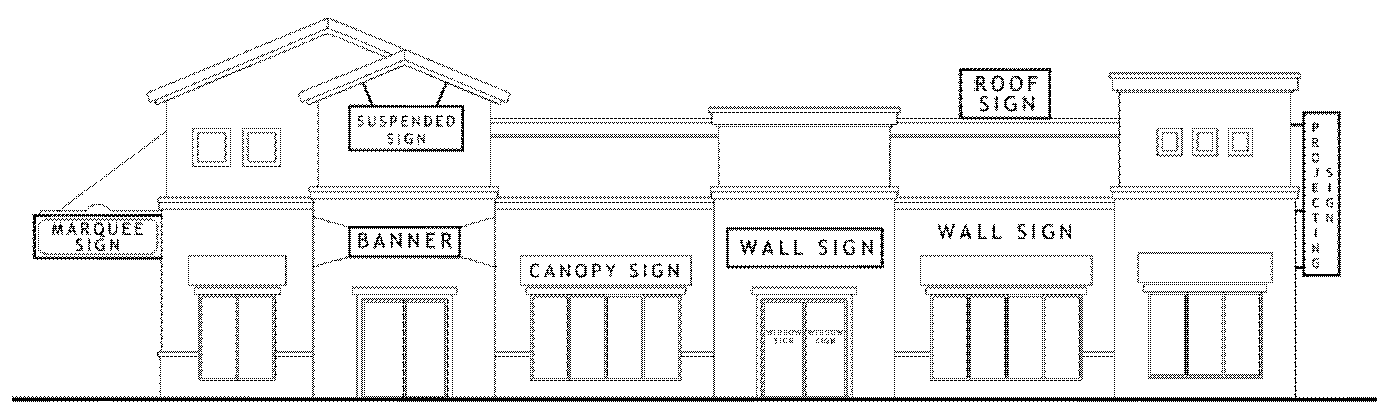
Building sign types and characteristics.
(1)
Banner (temporary): Any sign of lightweight fabric, vinyl or similar material that is attached and hung on a building via ropes or cords. National flags, state or municipal flags, or the official flag of any public institution conforming to subsection 118-15(b)(11) shall not be considered temporary banners. Temporary banners shall be subject to the temporary sign requirements set forth in this section below.
(2)
Banner (permanent): Any sign of lightweight fabric, vinyl, or similar pliable material that is affixed on at least two sides to a frame or bracket which is then attached to a building. For purposes of determine the maximum numbers of sign allowable for a building, permanent banners shall be treated as a type of building sign under section 118-15(e). Permanent banners are subject to yearly inspection by the city to ensure the permanent banner is in good condition and repair.
(3)
Canopy sign. Any sign that is part of or attached to an awning, canopy, or other fabric, plastic, or structural protective cover over a door, entrance, window, or outdoor service area. Includes both fixed and movable awning signs. Content shall be limited to name and/or logo of the establishment utilizing the canopy. Letters and logos shall be permanently mounted and flush with the surface of the canopy, and shall not protrude above, below, or beyond the sides of the canopy. Canopy signs five inches or less in height s hall not be counted against total permitted area (or number).
(4)
Marquee sign. A sign attached to or part of a permanent, projecting structure sheltering the entrance of a theater or other use, which advertises present or scheduled events. Marquee signs must have a vertical clearance of seven percent feet above the adjacent sidewalk, and extend no higher than 36 inches above the marquee.
(5)
Projecting sign. Any sign affixed to a building or wall in such manner that its leading edge extends more than six inches (to a maximum of 48 inches) beyond the surface of such building or wall. Projecting signs are only permitted it a freestanding sign is not or cannot be located on the subject property, and only one projecting sign per building is permitted. Projecting signs must be mounted perpendicular to the wall whose total sign allotment the sign shall count against. Projecting signs must provide a minimum overhead clearance of seven and a half feet measured from the sidewalk; nine feet from vehicular rights-of-way.
(6)
Residential sign. A sign located in a residential district and used for single-family residential uses that contains a noncommercial message except advertising for goods or services legally offered on the premises where the sign is located, if offering such services at such location conforms with all requirements of the zoning ordinance. Residential signs shall be a maximum of six square feet in area and may either be freestanding or wall mounted, not both, and only one residential sign is permitted per residence. The use of changeable copy on a residential sign is prohibited.
(7)
Roof sign. Any sign erected and constructed wholly on and over the roof of a building, and supported by the roof structure. Below-peak roof signs require a special use permit and shall only be granted in cases where the architecture of the building prevents a wall sign. signable area for below-peak roof signs is limited to 20 feet above base of building unless mounted flush with vertical roof surfaces below roof peak that is integral to the roof itself. Above-peak roof signs require a special use permit and shall extend no more than ten feet above roof peak, and shall only be granted in cases where architecture of building prevents wall sign or below-peak roof sign. Roof signs must be constructed of long-lasting durable materials. Roof signs shall not be constructed of vinyl or temporary materials.
(8)
Suspended sign. A sign that is suspended from the underside of a horizontal surface such as a canopy and is supported by such surface. The number of suspended signs shall be limited to one per entrance, and must provide a minimum overhead clearance of seven and one-half feet measured from the sidewalk. A single suspended sign of two square feet or less and containing only the name and/or address of an establishment shall not count against the total number or area of permitted building signs, unless an identification sign is located elsewhere on that building face.
(9)
Wall sign. Any sign attached parallel to, but within six inches of a wall, or erected and confined within the limits of an outside wall of any building or structure, which is supported by such wall or building, and which displays only one sign surface. Wall signs shall not cover any part of windows, doorways, or architectural detail.
(g)
Changeable copy signs.
(1)
Changeable copy signs are permitted in all districts, except for lots in residential use. The changeable copy portion of a freestanding sign, including background materials, shall be not greater than 50 percent of the total freestanding sign area.
(2)
Changeable copy signs with information that changes more than three times a day shall be treated as electronic signs.
(h)
Freeway signs. Freeway signs may be erected in those areas within 150 feet of Interstate 90 right-of-way with a permit. Freeway signs shall not be erected in any other part of the city. Freeway signs designed, intended or located in such a manner as to be visible to the traveling public on a freeway or expressway shall be limited to a height between 30 and 35 feet. Such height shall be measured from the centerline street grade of such freeway adjacent to where the freeway sign is oriented or ground level at the freeway sign location, whichever is higher. All freeway signs shall have a masonry base with a minimum overall height of three feet and a maximum of six feet. No primary sign area is to exceed 196 square feet on one side and 392 square feet on all sides. No secondary sign area is to exceed 84 square feet on one side and 168 square feet on all sides. All lettering shall be a maximum of 28 inches in height. The road side edge of such sign should be located as close to the interstate right-of-way as feasible, but shall maintain a minimum of five feet from the public right-of-way. Illuminated freeway signs shall be erected or maintained so that the beams or rays of light are effectively shielded so as not to cause glare or impair the vision of the driver of any motor vehicle and shall contain no flashing, intermittent or moving lights. Freeway signs which are not designed, intended or located in a manner so as to be visible to the traveling public on freeways and expressways are prohibited. The owner of any freeway sign shall keep it in sound condition, well-maintained, and in good appearance and repair which includes restoring, repainting, or replacement of a worn or damaged legally existing freeway sign to its original condition, and shall maintain the premises on which the freeway sign is erected in a clean, sanitary, and inoffensive condition, free and clear of all obnoxious substances, rubbish, refuse, debris and weeds. To the extent possible, signage for businesses within a business campus shall consolidate signage to the freeway sign.
(i)
Electronic signs and string lighting.
(1)
Electronic signs. Any free-standing electronic graphic display business, institutional use and/or electronic graphic display advertising signage as defined in this section shall be subject to obtaining a special use permit as well as limited to monument style signage with a height not to exceed eight feet total and the electronic display not to exceed a total of 36 square feet in size. Any building sign which is electronic graphic display business, institutional use and/or electronic graphic display advertising signage shall be subject to obtaining a special use permit and shall be in accordance with the table in this section.
(2)
String lighting. String lighting (which for purposes of this article [section] shall be considered to be a form of signage) shall be allowed subject to the meeting the following conditions within all zoning districts excepting UT, RR, RI/R1a, R2/R2a and RM:
(3)
First obtaining a permit pursuant to this Code.
(4)
All string lighting must be securely fastened to a permanent structure so as to avoid any section of lighting to hang or droop or be loose from the permanent structure.
(5)
String lighting shall not be permitted to flash, change colors, blink, or create any effect of moving lights.
(6)
String lighting shall be maintained in good repair and condition at all times.
(7)
With the exception of holiday lights specified in this section, string lighting shall not be allowed in any residential zoning classification.
(j)
Off-site advertising signs.
(1)
With the exception of oversized off-premises commercial signs which are regulated pursuant to this chapter, signs advertising services, products for sale, or organizations not located or provided on the zone lot shall only be permitted by special use only in the CG commercial general district and the CT commercial traffic district, shall be limited to one per zone lot, and shall comply with the restrictions for area, height, and setbacks for freestanding signs located in the table in this section.
(k)
Temporary signs. A temporary sign permit may be required as per this section below.
(1)
Development site signs: No permit is required if the proposed sign does not exceed the following limitations:
a.
Commercial or industrial development site: One non-illuminated, unchanging development site sign, not exceeding 200 square feet, is permitted for a period of one year on a construction site in a commercial or industrial zoning district. Only one sign is allowed per zoning lot, and the size of the sign shall be limited to 0.5 times the lineal front footage of the zoning lot up to the 200 square feet maximum. The sign is permissible for an additional year, provided construction is diligently pursued. The development site sign must be removed prior to the final inspection of the permanent sign.
b.
Residential development site: One non-illuminated development site sign, not exceeding 32 square feet, is permitted for a period of one year on a construction site. The sign is permissible for an additional year provided construction is diligently pursued.
c.
Subdivision development site: One temporary non-illuminated subdivision sign, not exceeding 32 square feet, located not less than 15 feet from any side lot line, is permitted for a period of two years.
d.
New business sign: Subject to obtaining a permit from the city, one temporary sign for a new business not exceeding 32 square feet is permitted for a period of 30 days.
(2)
Real-estate signs (including real estate and estate auctions): No permits are required for real-estate signs that meet the criteria/restrictions set forth in subparagraphs (a) and (b) below.
a.
In residential districts: "For sale", "for rent", or "open house" signs are permitted up to five square feet (24 inches × 30 inches) in size for residential zoning districts. Such signs are limited to one per zoning lot, except corner lots may display one sign visible from each street frontage, and may be displayed as long as the property is for sale or rent. Property directional signs are not larger than two square feet (12 inches × 24 inches) may be installed at the head of a cul-de-sac or an arterial street leading to the property during sale or lease period, but must be private property (e.g., not within the parkway between sidewalk and curb) and have that land owner's permission. Real-estate signs in residential districts which do not meet the criteria/restrictions set forth in this subparagraph (a) shall require a temporary sign permit. In no event shall such sign exceed 32 square feet.
b.
In commercial and industrial districts: Signs up to 32 square feet on property up to five acres in size and up to 64 square feet on property of five acres or more such signs are limited to one per zoning lot, except corner lots may display one sign visible from each street frontage. Signs must be located in minimum of five feet from property line, located outside of the sight triangle and not distract the view of traffic. Signs must be removed within 14 days of sale or lease. The use of banners or inflatable signs must be in compliance with section 118-15(c) below, banners or inflatable signs and advertising devices.
(3)
Temporary banners or inflatable signs and other forms of advertisement. A permit is required and applications must be consistent with the following standards:
a.
Temporary banners or inflatable signs and other forms of advertisement are permitted in commercial and industrial districts for not more than seven calendar days in any one-month period. Temporary banners shall be attached to the principal structure only.
b.
Maximum square footage of each sign is 50 square feet; maximum number of signs/advertising devices at one time is two. They must not exceed ten feet in height. A temporary sign permit is required.
(4)
Flags, commercial: An annual license is required and applications must be consistent with the following standards:
a.
Flags, commercial are permitted in commercial and industrial districts. Flags, commercial shall be placed within the front yard subject to applicable setbacks.
b.
Flags, commercial shall be displayed during business hours and may advertise the business name or services/products provided on the site. Such signs must not exceed ten feet in height and must be maintained in good condition.
c.
One flag, commercial is permitted per business, subject to license and fee.
(5)
Sandwich board: An annual license is required and applications must be consistent with the following standards.
a.
Sandwich boards may be placed on a sidewalk directly in front of the associated establishment. The sign shall be placed on that part of the sidewalk closest to the associated use and the nearest part of the sign structure shall not be separated by more than two feet from the wall of the building. The sign must be placed so as not to interfere with or obstruct pedestrian or vehicular traffic and shall be in compliance with this Code; however in any event, a minimum of five feet of passage must be maintained on the sidewalk between the street and the sign. Signs may not be anchored to the sidewalk, or attached or chained to poles, newspaper vending boxes, or other structures or appurtenances.
b.
Any sandwich board sign shall not exceed two linear feet in width, with a maximum height of 42 inches. Within these specified maximum dimensions, creative shapes that reflect the theme of the business are encouraged (i.e., ice cream shops may display a sign in the shape of an ice cream cone).
c.
The sign must be constructed of materials that present a finished appearance. Rough-cut plywood is not acceptable. The sign frame shall be painted or stained wood or anodized aluminum or metal. Stenciled or spray painted signs are prohibited. The sign lettering should be professionally painted or applied; a "yard sales" or "graffiti" look with hand painted or paint stenciled letters is not acceptable, however, chalkboard signs shall be permitted.
d.
Sandwich boards shall be displayed during business hours only and must be maintained in good condition.
e.
One sandwich board is permitted per business, subject to license and fee.
(6)
Inside signs: No permit is required if the proposed sign does not exceed the following limitations:
a.
Signs inside a business but intended to be viewed from a public right-of-way. Inside signs whether permanent or temporary are permitted in the CR, CG, CT districts subject to the following restriction: no more than 30 percent of the window surface of the business may be obscured by signage or other obstructions.
(7)
Garage, yard or rummage sale signs: No permit is required if the proposed sign does not exceed the following limitations:
a.
Garage, yard or rummage sale signs not larger than two feet by two feet, four square feet to be displayed only on private property for no more than four days in any six month period are permitted. Such signs shall be removed the day following the sale.
b.
Garage, yard or rummage sale signs are limited to one per zoning lot in residential districts. Such signs are not permitted on property not used for residential purposes.
(8)
Small board metal stake yard/lawn signs: Allowed in all zoning districts but must be consistent with the following standards.
a.
One sign is allowed per zoning lot.
b.
Each sign (with the same message) is allowed for no more than two consecutive weeks.
c.
Signage shall be placed within the required front yard.
(9)
Portable signs:
a.
Portable signs are permitted in commercial, industrial, and urban transitional districts for not more than 14 calendar days in any one-month period.
b.
Maximum number of portable signs at one time is one. A temporary sign permit is required.
(l)
Oversize off-premises commercial signs.
(1)
Oversize off-premises commercial signs represent a special privilege granted by the city to advertisers to enable them to use the environment for marketing purposes. Such signs derive their profitability solely from use of the public investment embodied in public roads, and offer no additional public benefit such as identification of premises. Therefore, certain additional considerations arise in their regulation. Such signs by definition do not conform to the restrictions otherwise placed upon freestanding signs of this article [section], and are therefore:
a.
Detrimental to property values, the character and quality of neighborhoods, and highway safety;
b.
Out-of-scale with pedestrian areas and most buildings;
c.
Potential hazards to life and property and potential harbors for criminal activity;
d.
Accumulators of junk;
e.
Obstructers of light, air and sun;
f.
Incompatible with quality building rehabilitation, and with historic architecture, revitalization of existing commercial areas, economic development, and the attraction of image-conscious, high-quality commercial and industrial firms, which attraction is a stated policy of the city;
g.
Otherwise in contravention to the stated purposes of this article [section]; and
h.
Detrimental to aesthetic values and to the public health, safety and welfare otherwise.
i.
To the extent that such signs vary from the freestanding sign standards hereinabove provided by the table in this section hereof, there are imposed the following restrictions. For all oversize off-premises commercial signs to the extent permitted under this section:
j.
A permit shall be required for each such sign.
k.
A sign structure shall have no more than one sign face oriented to a public right-of-way facing the same direction, nor a total of more than two sign faces total.
l.
Any direct lighting of such signs shall be screened from the eyes of passing motorists and from any residential district.
m.
No such sign shall be permitted as a wall sign.
n.
No such sign shall be permitted as a roof sign.
o.
No such sign shall be permitted as a projecting sign.
p.
Such signs in residential areas particularly reduce property values and the quality of neighborhoods. Therefore, such signs are prohibited in residential districts.
q.
Such signs shall be subject to minimum set back requirements.
r.
In addition to the information required in this section hereof, permit applications for such signs shall include:
1.
A site plan, drawn to scale, showing all setbacks, abutting roadways, abutting zoning, landscape materials, and the proposed sign and its orientation and lighting;
2.
An elevation drawing of each proposed sign face, drawn to scale, showing the sign face height, face length, and total height;
3.
An area plan, drawn to scale, showing all lots, their zoning and all existing off-premises signs, within 660 feet of the proposed sign; and
4.
A legal description of the lot upon which the sign will be constructed.
(2)
Where state law does not prevail and in addition to the provisions of subsection b of this section:
a.
Such signs which are up to 72 square feet in area and up to 16 feet high, shall be regulated as follows:
1.
Such signs shall be prohibited if not located along primary highways or arterial streets.
2.
No such sign shall be located within 300 feet along the way of any other such sign, provided that no more than three such signs shall be permitted within 1,200 feet along the way of each other.
3.
There shall be living ground cover installed and maintained surrounding the base of each such sign, unless the sign base is set in pavement.
4.
There shall be no more than an amount of 72 square feet of such sign faces permitted in the city for every 25 acres zoned CT not including planned development districts.
5.
Such signs in existing high-density commercial areas are particularly discouraging of pedestrian uses, detrimental to property values, out of scale with most buildings, potential hazards to life and property, wrongfully disadvantageous to nearby businesses, and incompatible with revitalization of such areas. Therefore, such signs are prohibited from residentially zoned properties, the downtown and areas zoned CR, CG, IL and IH. Accordingly, the only zoning district in which such signs may be located is the CT zoning district and only upon compliance with all other applicable provisions of this article [section].
6.
Since such signs are particularly detrimental to property values, potential traffic hazards, in direct opposition to economic development and the attraction of high quality, image-conscious commercial and industrial firms, which attraction is a stated policy of the city, and are the primary areas of the city where such high quality development is encouraged, such signs are prohibited from areas zoned CR and CG, as well as IL and IH.
7.
No such sign whose face is oriented to and visible from a residential district shall be located less than 200 feet from such district.
(3)
Such signs which are over 72 square feet in area or over 16 feet high, or both, shall be regulated as follows:
a.
Such signs shall be prohibited if not located along primary highways or arterial streets.
b.
No such sign shall be located within 300 feet along the way of any other such sign, provided that no more than three such signs shall be permitted within 1,200 feet along the way of each other.
c.
Such signs shall be landscaped as follows:
1.
Such signs which are double-faced shall have evergreen shrubs planted at their bases in such a manner that no portion of the sign or sign structure visibly appears to be touching the ground after a period of two years;
2.
In the rear of such signs which are single-faced, evergreen trees or shrubs shall be planted of such species and at such location that, at maturity, they totally screen the view of the rear of the sign, such plantings having a minimum planting height of ten feet; and
3.
Any tree or shrub thereon that dies shall be replaced by the end of the next planting season.
d.
The new construction of such signs on arterial streets shall be prohibited except that:
1.
Upon the effective date of this article [section], the total existing number of such sign faces in the city, other than those along primary highways, shall be verified and that total number shall represent the maximum allowable number of such sign faces on arterial streets hereunder; and
2.
Upon removal of any such existing sign faces, the owner thereof shall have 60 days to apply for and receive a permit to replace such sign faces on one or more structures. If application is not made within said 60 days, a permit shall be granted to the first applicant who files for a new permit and meets the requirements applicable to such application.
e.
Such signs in existing high-density commercial areas are particularly discouraging of pedestrian uses, detrimental to property values, out of scale with most buildings, potential hazards to life and property, wrongfully disadvantageous to nearby businesses, and incompatible with revitalization of such areas. Therefore, such signs are prohibited from the downtown core, and areas zoned residential, CR and CG, IL and IH.
f.
Since such signs are particularly detrimental to property values, potential traffic hazards, in direct opposition to economic development and the attraction of high-quality, image-conscious commercial and industrial firms, which attraction is a stated policy of the city, and are the primary areas of the city where such high-quality development is encouraged, such signs are prohibited from areas zoned CR and CG, IL and IH.
g.
Such signs are permitted only in areas zoned CT.
h.
No such sign whose face is oriented to and visible from a residential district shall be located less than 300 feet from such district.
(4)
Such signs which are over 300 square feet in area or over 35 feet high, or both, shall be prohibited.
(5)
Where state law prevails and in addition to the provisions of subsection b of this section:
a.
Such signs which are up to 72 square feet in area and up to 16 feet high, shall be regulated as follows:
1.
No such sign shall be permitted to be erected without a permit from the state department of transportation.
2.
Permit applications for such signs shall include a detailed drawing of the lot upon which the sign will be constructed.
3.
There shall be living ground cover installed and maintained surrounding the base of each such sign, unless the sign base is set in pavement.
4.
No such sign whose face is oriented to and visible from a residential district shall be located less than 200 feet from such district.
(6)
Such signs which are over 72 square feet in area or over 16 feet high, or both, shall be regulated as follows:
a.
Such signs shall be no more than 35 feet high.
b.
Such signs shall be prohibited if not oriented to a primary highway.
c.
Such signs shall be landscaped as follows:
1.
Such signs which are double-faced shall have evergreen shrubs planted at their bases in such a manner that no portion of the sign or sign structure visibly appears to be touching the ground after a period of two years;
2.
In the rear of such signs which are single-faced, evergreen trees or shrubs shall be planted of such species and at such location that, at maturity, they totally screen the view of the rear of the sign, such plantings having a minimum planting height of ten feet; and
3.
Any tree or shrub thereon that dies shall be replaced by the end of the next planting season.
d.
No such sign shall be permitted to be erected without a permit from the state department of transportation.
e.
Permit applications for such signs shall include a detailed drawing of the lot upon which the sign will be constructed.
f.
No such sign whose face is oriented to and visible from a residential district shall be located less than 300 feet from such district.
(m)
Illumination of signs.
(1)
External: Light sources for externally illuminated signs shall be located, shielded and directed in such a manner that the source is not directly visible from the surrounding property. The use of exposed lighting mounted directly on a sign face is prohibited.
(2)
Neon: Signs may be illuminated through the use of tubular lighting (such as neon signs) internal to the sign and filtered by translucent material.
(3)
Animated: Except for portions of a sign showing only time or temperature, the use of flashing lights or lights used in messages that change more than eight times per day shall be treated as animated signs and are prohibited.
(4)
Prohibited: Off-site and temporary signs shall not be illuminated.
(n)
Removal of signs.
(1)
Notice. The zoning administrator may order the repair and/or removal of any signed erected or maintained in violation of this chapter. The officer shall prepare a notice which shall describe the sign and specify the violation involved, and which shall state that if the sign is not repaired, removed or the violation corrected within 30 days, the sign shall be removed by the city. With the exception of chipped/peeling paint or rust, to the extent more than 50 percent of a sign is in disrepair or dilapidated, any repair or replacement of the sign shall be accordance with then current regulations. Such notice may be mailed by certified mail, or hand delivered, with a return receipt required. Any time period provided in this section shall commence on the date of receipt of the notice, as attested by the date of the return receipt. All costs incurred by the city in removing such sign shall be paid by the sign owner.
(2)
Signs not requiring a permit: Garage sale signs, real estate signs, political and public issue signs and any other signs not requiring a permit, erected in a public right of way, in violation of this article [section] shall be considered public property and shall be summarily removed and disposed of. Signs erected or maintained on private property in violation of this article [section] shall be subject to a three day notice to remove, under the procedure described in subsection (a) of this section.
(3)
Emergency: The zoning administrator may remove a sign immediately and without notice when, in the opinion of the officer, the condition of the sign or structure is defective or dangerous or the placement of the sign is dangerous so as to present an immediate threat to the safety of the public. Any sign removed shall be at the expense of the owner of the sign or owner of the property and shall become the property of the city. The sign may be disposed of in any manner deemed appropriate and authorized by state statute.
(4)
Abandoned signs: Abandoned signs shall be removed by the owner or lessee of the premises upon which the sign is located within ten days from the date on which it becomes abandoned as defined by this chapter. If the owner or lessee fails to remove the sign, the designated city official shall proceed as set forth in this section. Failure to remove the sign after service of the written notice as described in this section shall be just cause for the zoning administrator to act as provided in this section.
(5)
Non-conforming abandoned sign: A non-conforming abandoned sign is a sign which no longer correctly directs or exhorts any person, advertises a bona fide business, lessor, owner, product or activity conducted, or product available on the premises where the sign is displayed. Such sign shall be removed in its entirety within six months of discontinuance within ten days from the date on which it becomes abandoned as defined by this chapter. If the owner or lessee fails to remove the sign, the designated city official shall proceed as set forth in this section. Failure to remove the sign after service of the written notice as described in this section shall be just cause for the zoning administrator to act as provided in this section.
(o)
Permitting.
(1)
Any sign located within the city limits shall obtain a permit prior to erection unless it is specifically exempted under this section 118-15.
(2)
Only those permanent or temporary signs which have been granted a permit by the zoning administrator in accordance with the provisions of this section may be erected, installed, constructed or maintained, unless specifically exempted or allowed without permit in the previous sections.
(3)
All applications for permanent sign permits and special use permits must include:
a.
Name and address of the applicant.
b.
Site plan and sign plan, drawn to scale, showing the location, dimensions, design of the signs(s) requested, as well as the site, building and landscaping and all other signs requiring a permit.
c.
Applicable sign permit fee.
(4)
All applications for temporary sign permits must include:
a.
Name and address of applicant;
b.
A description and/or drawing of the proposed sign and its location;
c.
Applicable temporary sign deposit, to be refunded upon retirement of the sign.
(p)
Penalties.
(1)
Violation of the provisions of this article [section] or failure to comply with any of its provisions shall constitute a petty offense with a fine of not less than $250.00 and no more than $750.00. Any person who violates this article [section] or fails to comply with any of its requirements shall, upon conviction thereof, be fined not less than $250.00 and no more than $750.00 plus costs. Each day the violation continues shall be a separate offense.
(2)
The following principles shall control the computations of sign number, sign area and sign height.
(3)
Computation of area of individual building sign: The area of a sign face shall be computed by means of the smallest rectangle, triangle, circle, or combination thereof that will encompass the extreme limits of the writing, emblem, or other representation, together with any material or color forming an integral background to the display or used to differentiate the sign from the backdrop. Area does not include any supporting framework, bracing, or decorative wall or fence when such wall or fence is clearly incidental to the display itself.
(4)
Computation of number and area for freestanding signs: All writing, emblems, decorative framework, or other representations mounted on a single sign support structure shall be regarded as one sign. All writing, emblems, decorative framework, or other representations facing the same direction shall be counted as one sign face. Area of a sign face and total freestanding sign area shall be computed by means of the smallest single rectangle that will encompass all elements, including intervening support elements.
(5)
Computation of area of multi-faced signs: The sign area for signs with surfaces facing more than one direction shall be computed by adding the area of all sign faces visible from any one point. When two identical sign faces are placed back to back so that both faces cannot be viewed from any one point at the same time, and when such sign faces are part of the same structure, and are not more than 42 inches apart, the sign area shall be computed by the measurement of one of the faces.
(6)
Computation of height: The height of a sign shall be computed as the distance from the base of the sign at normal grade to the top of the highest component of the sign. Normal grade shall be construed as the grade after construction, exclusive of any earth altering activity solely for the purpose of locating or elevating the sign.
(7)
Computation of maximum total sign area for a zone lot: The permitted number and area of all individual signs on a zone lot shall be determined by applying the formulas contained in this section. Lots fronting on two or more streets are allowed the permitted sign area for each frontage; however, the total sign area that is oriented toward a particular street may not exceed the portion of the lot's total sign allocation derived from the street or wall area frontage on that street.

