
South Beloit City Zoning Code
Sec. 118-7
General provisions.
(a)
Uses restricted: No structure or land shall be used and no structure shall be hereafter erected, structurally altered, or relocated except for a use as permitted and in compliance with the regulations hereinafter established for the district in which it is located.
(b)
Uses classified: For the purpose of this chapter all uses shall be classified according to the following categories:
(1)
Permitted uses by right: Principal uses the permissibility of which is a predetermined right anywhere in the district which located subject only to the regulations established governing such use.
(2)
Permitted accessory uses: Uses incidental, customary to, and commonly associated with a permitted principal use.
(3)
Permitted uses by special use: Uses, the nature, character, or circumstances of which are so unique, or so dependent upon the specific contemporary conditions, that predetermination of permissibility by right, or the detailing the ordinance of the specific standards, regulations, or conditions necessary or appropriate to such permissibility are not practical; but which may be permitted in the districts where listed subject to certain conditions and requirements as hereinafter specified.
(c)
Unclassified uses.
(1)
In order to ensure that the zoning chapter will permit all similar uses in each district, the PZC, upon its own initiative or upon written request, shall determine whether a use not specifically listed as a permitted use or a special use in residential or commercial districts shall be deemed a permitted use or a special use in one or more districts on the basis of similarity to uses specifically listed. The zoning administrator shall submit such request to the PZC as necessary.
(2)
Appeal to the city council. Within ten days following the date of a decision of the PZC on a request for a determination as to a use not listed, the decision may be appealed to the city council by the applicant or by any other person. The appeal shall state specifically wherein it is claimed there was an error or abuse of discretion by the PZC or wherein its decision is not supported by the evidence on record.
(3)
Determination by city council. The determination of the city council shall be rendered in writing within 60 days unless the applicant consents to an extension of the time period and shall include findings supporting the conclusion.
(d)
Uses on annexed/unzoned territory.
(1)
All territory which is annexed to the city or which is unzoned or becomes unzoned through abandonment of a public street or railroad right-of-way shall be classified in the R1 one-family district. Within 60 days the PZC shall make a study of the territory to determine in which zoning district it should be classified.
(2)
If the PZC finds that a change of district is required, it shall initiate the change as prescribed in this chapter. The owner of the annexed property or the authorized agent of the owner may file an application for a change in district as prescribed in this chapter.
(e)
Additional use requirements. No use shall be permitted and no process, equipment or material shall be employed which is found by the city council to be objectionable to persons residing or working in the vicinity by reason of odor, insect nuisance, fumes, dust, smoke, cinders, dirt, refuse, water-carried wastes, noise, vibration, illumination, glare, unsightliness or traffic, or to involve any hazard of fire or explosion.
(f)
Building location.
(1)
Location restricted. No building shall be hereafter erected, structurally altered or relocated on a lot except in conformity with the following locational regulations as hereinafter specified for the district in which it is located.
(2)
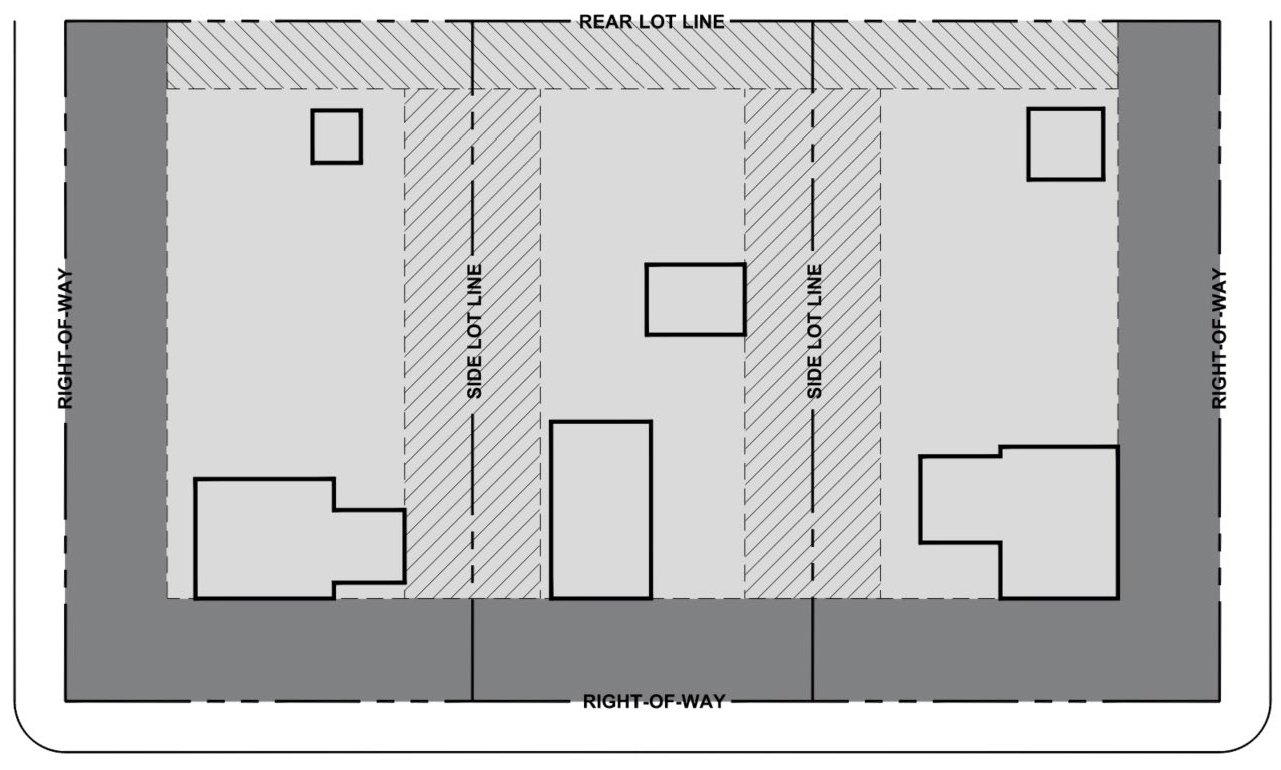
Setbacks and offsets. The proximity of a building to a public street or way or side/reads lot lines are regulated by the provisions as follows:
a.
On a reversed corner lot the minimum rear yard may be not less than the side yard prescribed in the zoning schedule provided that the side yard adjoining the street shall be not less than the required front yard on the adjoining key lot.
b.
Where the side or rear lot line of the site of a use other than a residential use adjoins or is across a street from a residential district, the minimum side or rear yard adjoining or opposite the residential district shall be ten feet greater than the minimum yard prescribed in the zoning schedule.
c.
No building shall hereafter be erected, structurally altered, or relocated so that it is closer to the building setback line than the setback distance hereinafter specified by the regulations of the district in which it is located with the following exceptions:
1.
Where the nearest existing principal on one side of said building is within 100 feet and has less than the required setback, the average between such existing setbacks and the required setback shall apply.
d.
The only structure permitted within a setback area shall be necessary highway and traffic signs, public utility lines and poles, walls and fences, as regulated by this Code, mailboxes, signs as permitted under the individual district regulations, or other items as approved by the PZC.
(g)
Exemptions-nonconforming sites: A site having an area, frontage, width or depth less than the minimum prescribed for the district in which the site is located, which is shown on a duly approved and recorded subdivision map, or for which a deed or valid contract of sale was of record prior to the adoption of this chapter or amendment thereto, and which has a legal area, frontage, width and depth at the time that the subdivision map, deed or contract of sale was recorded, may be used for any permitted use, but shall be subject to all other regulations for the district in which the site is located.
(h)
Vision clearances.
(1)
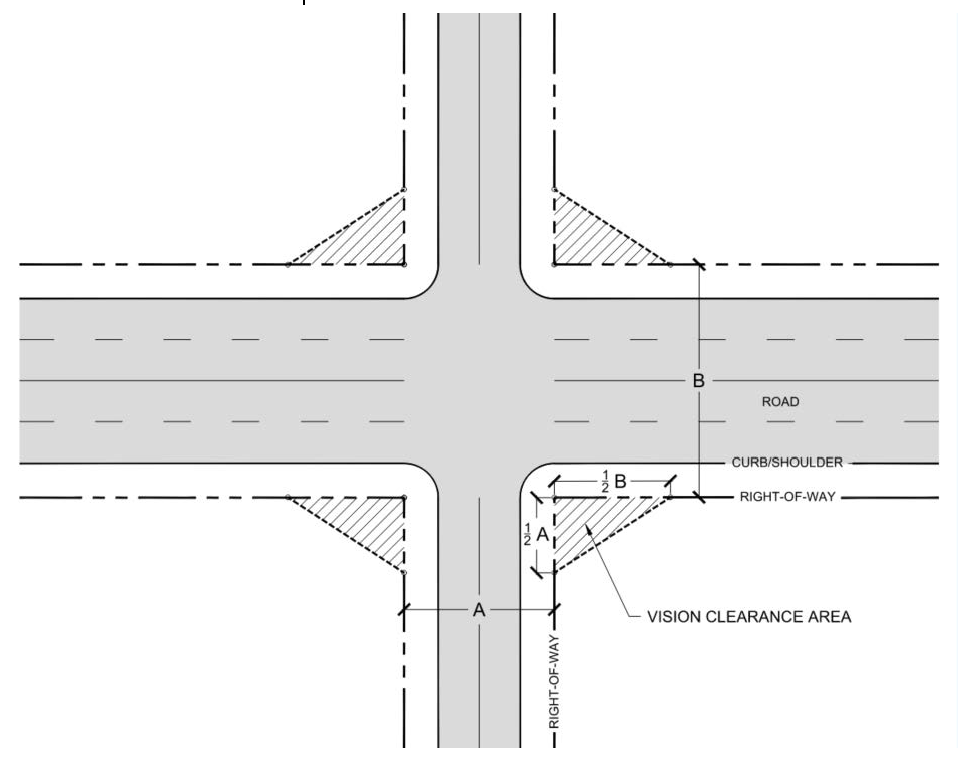
On a corner lot no fence, wall, hedge or other obstruction, except the natural grade of a site, within a triangular area formed by the street property lines and a line connecting points on the street property lines equal to one-half the right-of-way width, measured from the street intersection, shall exceed a height of three feet above the established grade at the edge of the existing or proposed pavement, provided that trees pruned up to eight feet above the street grade shall be permitted.
(2)
Vision setback area variations may be allowed if found by the zoning administrator that a proposed development does not impede safety at both the present and future time.
(i)
Other structures.
(1)
Architectural features including the projecting balconies, sills and chimneys, cornices and eaves may extend into a required side yard or a space between structures not more than 18 inches and may extend into a required front or rear yard not more than four feet, provided that no projection shall extend into a public utility easement.
(2)
Open, unenclosed, uncovered balconies, landings, platforms, porches, stairways, and terraces, no part of which is more than four feet above the grade of the ground, and unenclosed, uncovered porches with floors not higher than eight inches above the grade, may extend into a required rear, front or side yard or space between buildings not more than four feet, provided that pedestrian ways or walks at ground level shall not be reduced below three feet in unobstructed width.
(3)
Open, unenclosed, uncovered metal fire escapes may project into any required yard or space between buildings not more than three feet, provided that no projection shall extend into a public utility easement.
(j)
Lot size.
(1)
Width/depth.
a.
Width of lots shall follow the zoning schedule for the district a property is within. The minimum width shall be found at the frontage of the lot.
b.
Width for corner lots. The minimum width of corner lots in a residential district shall be ten percent greater than the minimum width for the district given in the zoning schedule provided that no corner lot in a residential district shall have a width of less than 80 feet.
c.
Depth adjoining freeway or railroads. No site rearing on a freeway or railroad right-of-way shall have a depth of less than 130 feet.
(k)
Building height.
(1)
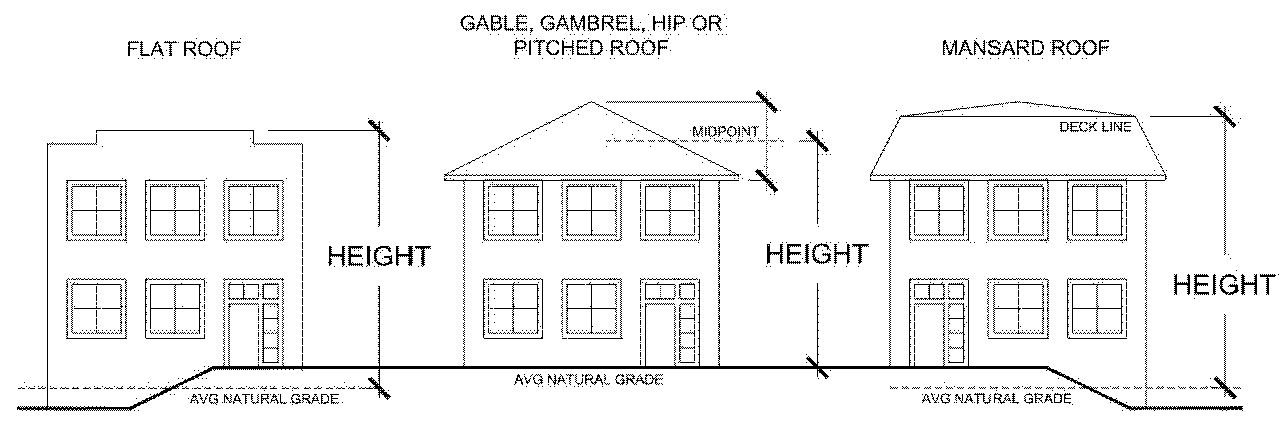
Measurement. The height of a structure shall be measured vertically from the average elevation of the natural grade of the ground covered by the structure to the highest point of the structure (the coping of a flat roof; the deck line of a mansard roof, or the mean height between eaves and ridges for a hip, gable or gambrel roof).
(2)
Exceptions. Towers, spires, cupolas, chimneys, penthouses, water tanks, flagpoles, monuments, scenery lofts, radio and television aerials and antennas, transmission towers, fire towers, and similar structures and necessary mechanical appurtenances covering not more than ten percent of the roof area covered by the structure may be erected to a height of not more than 25 feet above the height limit prescribed by the regulations for the district in which the site is located.
(l)
Basic locational requirements.
(1)
Building must be on a lot: Every building hereafter erected, structurally altered, or relocated shall be placed on a platted lot as herein defined.
(2)
Only one principal residence building on a lot. Except as specifically otherwise provided herein for attached single family dwellings, accessory guesthouses, apartment, farms, or planned development projects only one principal residence building shall be permitted on a lot.
(m)
Engineering regulations.
(1)
Establishment of grades: Every building hereafter erected, structurally altered or relocated shall be at a grade approved by the engineer as being in satisfactory relationship with the established street grades or with the existing street grade where none is established, with particular consideration for proper drainage and safe vehicular access.

