
South Fulton City Zoning Code
ARTICLE 9
- GLOSSARY
Sec. 901.- Purpose of Article 9.
This Article describes how figures, words and phrases used in this Zoning Ordinance are to be interpreted and provides a glossary of all definitions specifically used in the text of this Ordinance.
Sec. 903. - Meaning of Words and Phrases.
(a)
All words and phrases are to be interpreted within the context of the sentence, paragraph, subsection, section, and Article in which they occur.
(b)
Words and phrases specifically relating to a category of use of land or a structure that are defined in this Zoning Ordinance shall be interpreted as defined herein without regard to other meanings in common or ordinary use, unless the context of the word or phrase indicates otherwise.
(c)
Other words and phrases specifically defined in this Zoning Ordinance shall be interpreted as defined herein without regard to other meanings in common or ordinary use, unless the context of the word or phrase indicates otherwise.
(d)
Words and phrases not defined in this Zoning Ordinance shall be construed to have the meaning given by common and ordinary use, the meaning of which may be further clarified by definition of the word or phrase in the Merriam-Webster's Collegiate Dictionary and the North American Industrial Classification System (NAICS) published by the U.S. Department of Commerce (latest edition). See also Article 2.
Sec. 902.01. - Responsibility for interpretation.
The Community Development and Regulatory Affairs Director shall be responsible for the interpretation of the terms and definitions of this Zoning Ordinance in accordance with the authority described in Article 1 of this Ordinance.
Sec. 902.02. - Use of figures and examples for illustration.
Figures or examples associated with defined terms or regulatory paragraphs in this Zoning Ordinance are provided only for illustration and do not limit or change the meaning of the term as defined or the requirements of the regulation as written.
Sec. 902.03. - Use of words and phrases.
(a)
Words not defined herein shall be construed to have the meaning given by Merriam-Webster's Collegiate Dictionary, eleventh edition or later edition.
(b)
For the purposes of this Zoning Ordinance, certain words or terms used herein shall be defined as follows:
(1)
Words used in the present tense shall include the future tense.
(2)
Words used in the singular shall include the plural and vice versa.
(3)
The words "shall", "will", "is to" and "must" all always mandatory and never discretionary.
(4)
The words "may" and "should" are permissive.
(5)
The nouns "zone", "zoning district", "district", "zoning classification" and "classification" have the same meaning and refer to the zoning districts established under this Zoning Ordinance.
(6)
The verbs "zone" and "rezone" have the same meaning and refer to the act of amending the Official Zoning Map through the process established by this Zoning Ordinance.
(7)
The word "structure" includes the word "building;" a "building" is a type of structure.
(8)
The word "erected" includes the words "constructed," "moved," "located," or "relocated."
(9)
The word "lot" includes the words "plot" or "parcel."
(10)
The word "zoning map" means the Official Zoning Map of the City of South Fulton, Georgia.
(11)
The words "road", "street", "highway" and "thoroughfare" have the same meaning with regard to the requirements and restrictions of this Ordinance.
(12)
The word "person" includes the words "individuals", "firms", "partnerships", "corporations", "associations", "governmental bodies" and all other legal entities.
(13)
The word "and" indicates that all of the conditions, requirements, or factors so connected must be met or fulfilled, while the word "or" indicates that at least one condition, requirement or factor so connected must be met.
(14)
The term "such as" is intended to introduce one or more examples in illustration of a requirement or point, and is intended to mean "including, but not limited, to the following."
(15)
The terms "include" or "including," when used to introduce a list of items, is not intended to be exclusive only to the items on the list, but is intended to mean "including, but not limited to, the following."
(16)
The term "used for" shall include the terms "arranged for", "designed for", "intended for," "maintained for" and "occupied for."
(17)
The word "day" means a calendar day unless otherwise specified as a "work" day or "business" day, which means Monday through Friday exclusive of City-recognized holidays.
(18)
References to the "City" and to the City Council and any public officials or appointed bodies of the City not otherwise named by political jurisdiction or defined in this Zoning Ordinance shall always mean the City of South Fulton, Georgia, and its governing body, appointed or employed officials, and appointed bodies as named. These include:
a.
The Planning Commission, created as such and appointed as such by the South Fulton City Council.
b.
The Zoning Board of Appeals, created as such and appointed as such by the South Fulton City Council.
c.
The City Manager, appointed as such by the South Fulton City Council, or the City Manager's designee.
d.
The City Attorney, appointed as such by the South Fulton City Council, or the City Attorney's designee.
e.
The Community Development and Regulatory Affairs Director, the City official appointed as such, or the Community Development and Regulatory Affairs Director's designee.
f.
The Public Works Director, the City official appointed as such, or the Public Works Director's designee.
g.
The Fire Marshal, the City official appointed as such, or the Fire Marshal's designee.
h.
Other City officials or employees, such as a "building inspector" shall mean the City official or employee appointed as such by their respective department director.
(19)
References to an administrative department or committee of the City of South Fulton shall always mean the department or committee created by the City Council as such. These include:
a.
Department of Community Development and Regulatory Affairs: References to action by the "Community Development and Regulatory Affairs Department" shall mean action by the Community Development and Regulatory Affairs Director or by that administrative official to whom responsibility for that action has been assigned by the Community Development and Regulatory Affairs Director.
b.
Public Works Department: A reference to action by the "Public Works Department" shall mean action by the Public Works Director or by that administrative official to whom responsibility for that action has been assigned by the Public Works Director.
c.
Fire and Rescue Department. A reference to action by the "Fire and Rescue Department" shall mean action by the Fire Marshal or by that administrative official to whom responsibility for that action has been assigned by the Public Works Director.
d.
City Engineer: A reference to action by the "City Engineer" shall mean action by that administrative official to whom responsibility for that action has been assigned by the Community Development and Regulatory Affairs Director.
e.
Building Official: A reference to action by the "Building Official" shall mean action by that administrative official to whom responsibility for that action has been assigned by the Community Development and Regulatory Affairs Director.
f.
City Arborist: A reference to action by the "City Arborist" shall mean action by that administrative official to whom responsibility for that action has been assigned by the Community Development and Regulatory Affairs Director.
Sec. 904.01. - A.
Accessory Site Feature. Mechanical, electrical and ancillary equipment, cooling towers, mechanical penthouses, heating and air conditioning units and/or pads, exterior ladders, storage tanks, processing equipment, service yards, storage yards, exterior work areas, loading docks, maintenance areas, dumpsters, recycling bins, and any other equipment, structure or storage area located on a roof, ground or building.
Adjoin. To have a common border with. Adjoin may also mean coterminous, contiguous, abutting and adjacent.
Adult Day Center. A facility licensed by the Georgia Department of Community Health that provides for compensation adult day care or adult day health services for three or more adults 60 years of age or older or mature adults below the age of 60 whose needs and interests are substantially similar to persons 60 years of age or older who have physical or mental limitations that restrict their abilities that perform the normal activities of daily living and impede independent living. Services that are provided include basic social and recreational activities and, as required, limited personal care assistance, supervision, or assistance essential for sustaining the activities of daily living. Services shall not include day habilitation and treatment services exclusively for individuals with developmental disabilities. This term shall not include a respite care services program.
Alternative Telecommunication Support Structure. Clock telecommunication support structures, bell telecommunication support structures, church steeples, light/power poles, electric transmission telecommunication support structures, man-made trees and similar natural or man-made alternative design mounting structures that camouflage or conceal the presence of Antennas or telecommunication support structures. An Alternative Telecommunication Support Structure may include a pre-existing building.
Amateur Radio Antenna. Radio communication facility that is an accessory structure to a single-family residential dwelling operated for non-commercial purposes by a Federal Communication Commission licensed amateur radio operator. The term antenna shall include both the electronic system and any structures it is affixed to for primary support.
Antenna. Any equipment designed for wireless telecommunication, radio, or television communications through the sending and/or receiving of electromagnetic waves or beams of visible or invisible light and radio signals used in the provision of all types of telecommunication services, including standalone equipment and equipment affixed to or proposed to be affixed to existing telecommunication support structures and/or authorized alternative telecommunication support structures.
Apartment. A building which contains three or more dwelling units either attached to the side, above or below another unit. (See also "Dwelling, Multi-Family.")
Apartment, Efficiency. A dwelling unit consisting of not more than one habitable room, together with kitchen or kitchenette and sanitary facilities. Also known as a "studio apartment."
Appeal. A request for relief from a decision made by the Director of Community Development and Regulatory Affairs, other department directors, the Board of Zoning Appeals, and/or the City Council.
Applicable Wall Area. The wall on which a wall sign is attached including all walls and windows that have the same street or pedestrian orientation. All open-air spaces shall be excluded from the applicable wall area.
Assisted Living Facility. A personal care home serving 25 residents or more that is licensed by the Georgia Department of Community Health to provide assisted living care. "Assisted living care" means the specialized care and services provided by an assisted living community which includes the provision of personal services, the administration of medications by a certified medication aide and the provision of assisted self-preservation. This use shall not include hospitals, convalescent centers, nursing homes, hospices, clinics, or similar institutions devoted primarily to the diagnosis and treatment of the sick or injured.
Attic. An unheated storage area located immediately below the roof.
Authorized Agent. Person with legal authority to act on behalf of an applicant.
Sec. 904.02. - B.
Banner. Any sign of lightweight fabric or similar material that is either with frame or without frame and hung or mounted to a pole, building or other background by one or more edges. Flags are not considered banners.
Bar. A commercial establishment used primarily for the sale or dispensing of alcoholic beverages for on-site consumption; where food may be available for consumption on the premises as accessory to the primary use; where entertainment opportunities are not the primary use and occupy no more than 10 percent of the total gross square footage of the business. A bar shall not be considered a Nightclub, Private Club or Club.
Basement. A level below a floor of a building with a minimum of one-half (½) of the total wall area below grade. A basement is not a story. The term basement is synonymous with cellar.
Beacon. Any light with one or more beams directed into the atmosphere or directed at one or more points not on the same lot as the light source; also any light with one or more beams that rotate or move.
Bed and Breakfast Inn. A residence in which the frequency and volume of visitors are incidental to the primary use as a private residence and where guest rooms are made available for visitors for fewer than 30 consecutive days. Breakfast is the only meal served and is included in the charge for the room.
Berm. A planted earthen mound.
Billboard. A free-standing sign with an area of more than 72 square feet but not more than 672 square feet.
Boarding House. A residential use other than a hotel or motel in which lodging may be provided to non-household members and which includes the provision of meals.
Brewery. Any establishment where malt beverages are manufactured.
Brewpub. Any eating establishment in which malt beverages are manufactured, subject to the barrel production limitation prescribed in O.C.G.A. § 3-5-36. As used in this paragraph, the term "eating establishment" means an establishment which is licensed to sell distilled spirits, malt beverages, or wines and which derives at least 50 percent of its total annual gross food and beverage sales from the sale of prepared meals or food; provided, however, that when determining the total annual gross food and beverage sales, barrels of malt beverages sold to licensed wholesale dealers, as authorized pursuant to subparagraph (D) of paragraph (2) of O.C.G.A. § 3-5-36, or to the public for consumption off the premises, as authorized pursuant to subparagraph (D) of paragraph (2) and paragraph (4) of O.C.G.A. § 3-5-36, shall not be used.
Buffer, State Waters. An area along the course of any State waters to be maintained in an undisturbed and natural condition.
Buffer, Tributary. A protection area adjoining the tributaries of the Chattahoochee River. Tributary buffer specifications are contained in Part D of each prospective land use section of the Tree Ordinance.
Buffer, Zoning. A natural undisturbed portion of a lot, except for approved access and utility crossings and approved project entrance signs, which is set aside to achieve a visual barrier between the use on the lot and adjacent lots and/or uses.
Buildable Area. The portion of a parcel of land where a building may be located, and which shall contain enough square footage to meet the minimum required by the zoning district. That portion which is not located in the minimum setbacks, utility corridors, driveways, slopes to build streets, tree save areas, landscape strips, specimen tree areas, state water buffers, tributary buffers, zoning buffers, wetlands, storm water and sanitary sewer easements.
Building. Any structure with a roof, designed or built for the support, enclosure, shelter, or protection of persons, animals, chattels, or property of any kind.
Building Line. A building line is one which is no closer to a property line than the minimum yard (setback) requirements.
Business. A use involving retailing, wholesaling, warehousing, outside storage, manufacturing or the delivery of services regardless of whether payment is involved. The term Business does not include uses which are customarily incidental (accessory) to another use.
Business Incubator: A workspace created to offer startups and new ventures a variety of business support resources and services that could include physical space, capital, coaching, common services, and networking connections.
Sec. 904.03. - C.
Canopy. A roof-like cover, excluding carports, that either projects from the wall of a building or is freestanding.
CDRA. Community Development and Regulatory Affairs.
Cellar. See "Basement."
Check Cashing Establishment. Any establishment licensed by the State of Georgia pursuant to O.C.G.A. §§ 7-1-700 et seq.
Church, Temple or Place of Worship. A facility in which persons regularly assemble for religious ceremonies.
Clear Cutting. The removal of all vegetation from a property, whether by cutting or other means, excluding stream buffer requirements.
Clinic. A use where medical examination and treatment is administered to persons on an outpatient basis. No patient shall be lodged on an overnight basis.
Club, Nonprofit. A nonprofit entity organized for a social, educational or recreational use normally involving community centers, public swimming pools and/or public recreational courts, civic clubhouses, lodge halls, fraternal organizations, country clubs and similar facilities. A club shall not be considered a nightclub, private club or bar.
Commercial Amusement/Indoor. A use where recreational activity such as movie theaters, arcades, billiards, game rooms, sporting activities and other recreational amusements are conducted within a building.
Commercial Amusement/Outdoor. A use where recreational activity such as skating rinks, batting cages, miniature golf, drive-in theaters and other recreational activities or amusements that are conducted outside a building.
Commercial Parking Lot. An uncovered or unsheltered structure of one or more stories designed, constructed and used for the parking of motor vehicles for profit.
Commercial Truck Parking Lot. An uncovered or unsheltered surface lot designed, constructed and used for the parking of motor trucks with a minimum of five axles. Commercial truck parking may be paid or free, can be for short or long durations, depending on the site, and, has no amenities (no showers, food, or refueling), just parking spots, a security fence, security cameras, and occasionally security guards.
Comprehensive Plan. The City of South Fulton Comprehensive Plan.
Composting. A processing operation for the treatment of vegetative matter into humus-like material that can be recycled as a soil fertilizer amendment such as trees, leaves and plant material. Organic animal waste, food, municipal sludge, solid waste, and other non-farm or vegetative type wastes are not included.
Condominium. A form of ownership as defined by State law in which common elements are jointly owned. A condominium is not a building type.
Conservation Subdivision. A single-family detached residential subdivision in which a minimum of 40 percent of the total land area is set aside as permanently protected open space as defined by the South Fulton Subdivision Regulations.
Construction Material. Building materials and rubble resulting from construction, remodeling, repair, and/or demolition operations on pavements, houses, commercial buildings and other structures. Such materials include, but are not limited to, asbestos containing waste, wood, bricks, metal, concrete, wall board, paper, cardboard, inert waste landfill material, and other nonputrescible wastes which have a low potential for groundwater contamination.
Convenient Location and Time. Suitable time and easily accessible place for applicants to meet with interested parties to discuss rezoning and/or special use applications.
Continuing Care Retirement Community. A type of senior housing, as defined by this Zoning Ordinance, that allows residents to age in place by providing health services including assisted living, memory care and skilled nursing, in addition to independent living.
Country Club. A recreational facility, restricted to members and their guests, which generally includes a club house, dining and eating establishments, personal services for members, and recreational facilities such as golf course(s), tennis courts, and swimming pools.
Country Inn. A facility, with the owner or innkeepers residing on the premises, where guest rooms are made available for visitors for fewer than 30 consecutive days. A Country Inn is distinguished from a Bed and Breakfast category in that it serves both breakfast and lunch or dinner.
Courtyard. An open-air area, other than a yard, that is bounded by the walls of a building. Courtyards are used primarily for supplying pedestrian access, light, and air to the abutting building(s). Site furniture, lighting and landscaping are appropriate for courtyards. Vehicular access allowed for unloading and loading only. No vehicular parking or vehicular storage is allowed.
Coworking space. A facilitated environment which may contain desks or other workspaces and facilities and is used by a recognized membership who share the site in order to interact and collaborate with each other as part of a community. Rules for membership and participation in the coworking space are explicit, transparent and are available to by the public. Coworking spaces may host classes or networking events which are open either to the public or to current and prospective members. Equipment is limited to that which does not generate noise or pollutants in excess of what is customary within a typical office environment.
Cul-de-sac. A street having only one connection to another street and is terminated by a vehicular turn-around.
Curb Cut. A connection between a roadway and a property for vehicular access. Curb cut applies to access regardless of the existence of curbing.
Cutoff. A luminaire light distribution where the emission does not exceed 2.5 percent of the lamp lumens at an angle of 90 degrees above nadir and does not exceed ten percent at a vertical angle of 80 degrees above nadir.
Cutoff Fixture. A luminaire light distribution where the candela per 1,000 lamp lumens does not numerically exceed 25 (2.5 percent) at or above a vertical angle of 90 degrees above nadir, and 100 (ten percent) at or above a vertical angle of 80 degrees above nadir. This applies to all lateral angles around the luminaire.
(Ord. No. 2024-038, § 2, 10-22-2024)
Sec. 904.04. - D.
Data Center (Data Processing, Hosting and Related Services or Computer Facilities Management for Data Centers). An establishment engaging in the storage, management, processing, and/or transmission of digital data, and housing computer and/or network equipment, systems, servers, appliances and other associated components related to digital data operations.
Day Care Facility. A facility licensed by the Georgia Department of Early Care and Learning as a "child care learning center" in which shelter, care, and supervision for seven or more children under 13 years of age is provided on a regular basis away from their residence for less than 24 hours a day, without transfer of legal custody. A Day Care Facility may provide basic educational instruction. The term shall include nursery school, kindergarten, early learning center, play school, and pre-school.
Day Care Home, Family. See "Family Day Care Home."
Day-Night Average Sound Level (DNL). The day-night average sound level (DNL) is the 24-hour average sound level, in decibels, obtained from the accumulation of all events with the addition of ten decibels to sound levels in the night from 10:00 p.m. to 7:00 a.m. The weighing of nighttime events accounts for the usual increased interfering effects of noise during the night, when ambient levels are lower and people are trying to sleep. DNL is a weighted average measured in decibels (db).
Deck. A structure abutting a dwelling with no roof or walls except for visual partitions and railings not to exceed 42 inches above finished floor which is constructed on piers or a foundation above-grade for use as an outdoor living area.
Department. Department of Community Development and Regulatory Affairs or future name as adopted by the Mayor and Council of South Fulton.
Development, Duplex. A development of duplexes.
Development, Multifamily. A development of multifamily dwelling units on a single lot of record.
Development Permit Standards. Requirements established for each administrative permit such as setbacks, access, landscape and buffer areas, hours of operation etc.
Development of Regional Impact or DRI. A large-scale and/or specific type of development proposed to be located in the city that is likely to generate impacts beyond the city boundaries.
Development of Regional Impact (DRI) Study. A review by the Atlanta Regional Commission and the Georgia Regional Transportation Authority of large-scale projects that are of sufficient size that they are likely to create impacts beyond the jurisdiction in which each project will be located.
Development, Single-Family. A development of single-family dwelling units, with each dwelling unit including accessory structures, on a separate lot of record.
Development Standards. Dimensional measurements as specified in zoning districts relating to such standards as yard setbacks, lot area, lot frontage, lot width, height and floor area.
Development, Townhouse. A development of townhouse dwelling units.
Director. Director of Community Development and Regulatory Affairs.
Distribution Line. A pipeline other than a gathering or transmission line.
District, Nonresidential. A term used to identify all districts except single-family dwelling districts, all apartment districts, R-6, TR, MHP and residential portions of a CUP — Includes AG-1.
District, Residential. A term which applies to all single-family dwelling districts, all apartment districts, R-6, TR, MHP, NUP and residential portions of a CUP and CUP-CGA — Excludes AG-1.
Drainage Facility. A facility which provides for the collection, removal and detention of surface water or groundwater from land by drains, water course or other means.
Dwelling. Any building or portion thereof which is designed for or used for residential purposes for periods of more than 30 consecutive days. A dwelling shall not include Temporary Storage Units, as defined in this Article.
Dwelling, Duplex. A structure that contains two dwelling units.
Dwelling, Multifamily. A structure containing three or more dwelling units not including townhouses, triplexes or quadruplexes.
Dwelling, Patio Home. A single-family dwelling unit on a separate lot with setbacks on only three sides due to one of the building's sides resting on a lot line.
Dwelling, Quadruplex. Four attached dwellings in one building in which each unit shares one or two walls with an adjoining unit or units.
Dwelling, Triplex. A building containing three dwelling units, each of which has direct access to the outside or to a common hall.
Dwelling Unit. One or more rooms constructed with cooking, sleeping and sanitary facilities designed for and limited to use as living quarters for one family.
Dwelling Unit, Single-Family. One dwelling unit that is not attached to any other dwelling unit by any means.
Dwelling Unit, Townhouse. A dwelling unit in a row of at least three such units in which each unit has its own front and rear access to the outside, no unit is located over another unit, and each unit is separated from any other unit by one or more vertical common walls.
(Ord. No. 2024-034, § 3, 9-24-2024)
Sec. 904.05. - E.
Electric Vehicle Supply Equipment (EVSE). The conductors, including the ungrounded, grounded, and equipment grounding conductors and the electric vehicle connectors, attachment plugs, and all other fittings, devices, power outlets, or apparatus installed specifically for the purpose of transferring energy between the premises wiring and the electric vehicle.
Environmentally Adverse Use. Any use or activity which poses a potential or immediate threat to the environment and/or is physically harmful or destructive to living beings. Without limiting the generality of the foregoing, the following uses are specifically declared to be environmentally adverse:
(a)
All environmentally adverse uses listed in Article 3 of this Zoning Ordinance, in addition to quarries, surface mines, landfills, and waste transfer stations;
(b)
All uses that will result in the discharge of any chemical listed in any of the following publications:
(1)
The Environmental Protection Agency's List of Hazardous Air Pollutants as included in the Clean Air Act Amendments of 1990, including any modifications or amendments thereto;
(2)
The Environmental Protection Agency's List of Toxic Pollutants prepared in accordance with the Clean Water Act as codified at 40 C.F.R. 401.15 of the Code of Federal Regulations, including any modifications or amendments thereto; or
(3)
The Environmental Protection Agency's List of Priority Pollutants prepared in accordance with the Clean Water Act as codified at 40 C.F.R. 423, Appendix A, of the Code of Federal Regulations, including any modifications or amendments thereto.
(c)
All uses that will require the issuance of a permit by or will be otherwise subject to regulations promulgated by either the Environmental Protection Agency or the State of Georgia Environmental Protection Division.
Environmentally Stressed Community. Any existing residential development (single-family dwelling, duplex dwelling, triplex dwelling, quadruplex dwelling, townhouse dwelling or multifamily dwelling), any portion of which is located within ½ mile of an existing Environmentally Adverse Use. Environ.
Explosive. A chemical compound, mixture or device, the primary or common purpose of which is to function by explosion. The term includes, but is not limited to, dynamite, black powder, pellet powder, initiating explosives, detonators, safety fuses, squibs, detonating cord, igniter cord, igniters, display fireworks, and gun powder.
Sec. 904.06. - F.
Family. One or more persons related by blood, marriage, adoption, guardianship or other duly authorized custodial relationship, or up to four unrelated persons, occupying a dwelling unit and living as a single housekeeping unit, as distinguished from persons occupying a rooming, boarding or lodging house, a hotel.
Family Day Care Home. A Home Occupation in which shelter, care, and supervision are provided fewer than 24 hours per day for six or fewer children under 13 years, without transfer of legal custody. A Family Day Care Home shall be licensed by the Georgia Department of Early Care and Learning as a "family child care learning home" and may provide basic educational instruction.
Family Qualified Group Residence. A group residence which otherwise falls under the definition of a "Family" and therefore does not require approval as a Special Use.
Farm. A parcel of land which is used for the raising of animals (including fish) on a commercial basis, such as ranching, dairy farming, piggeries, poultry farming and fish farming; a facility for the business of boarding or renting horses to the public; or a site used for the raising or harvesting of agricultural crops such as wheat, field forage and other plant crops intended for food or fiber.
Farm Winery. A parcel zoned as an agricultural use where: (1) fruit is grown in a producing vineyard, orchard or similar growing area on the premises and with facilities for fermenting and bottling wine on the premises where the owner or lessee manufactures wine or fortified wine that contains not more than 24 percent alcohol by volume; or (2) purchased from producing vineyard, orchard or similar growing area in the City of South Fulton and with facilities for fermenting and bottling wine on the premises where the owner or lessee manufactures wine or fortified wine that contains not more than 24 percent alcohol by volume.
Flag Lot. A lot where frontage to a public street is provided via a narrow strip of land forming a pole or stem to the buildable portion of the lot.
Fleet Storage shall mean a parking area for the parking and storage of five or more operable vehicles that are used in the operations of an existing nonresidential principal use that is not located adjacent to or abutting the lot containing the parking area. This does not include parking and storage of farm vehicles, construction equipment, or motorized vehicles not licensed to operate on state roads. This definition does not include or allow commercial parking lots. May include security features like fencing, cameras, or guards. Fleet storage may have maintenance facilities or allow for vehicle servicing on-site. Feet storage is typically used by logistics, delivery, or transportation companies. Fleet storage is usually located near company headquarters or distribution centers. Fleet storage does not offer short or medium parking. Fleet storage is usually, quarterly or yearly storage
Flex Office/Warehouse Space. Industrial space that is a combination of non-airconditioned warehouse space with airconditioned office space and or showroom space attached.
Flood Lamp. A form of lighting designed to direct its output in a specific direction with a reflector formed from the glass envelope of the lamp itself. Such lamps are so designated by the manufacturers and are typically used in residential outdoor area lighting.
Flood Light. A form of lighting designed to direct its output in a diffuse, more or less specific direction, with reflecting or refracting elements located external to the lamp.
Floor Area, Gross. The sum of all floors of a structure as measured to the outside surfaces of exterior walls or the center of connected or common walls, including common public areas, such as lobbies, rest rooms and hallways, spaces devoted exclusively to permanent mechanical systems, permanent storage areas, stairwells, elevator shafts, but excluding internal parking and loading areas, attics, porches, balconies and other areas outside of the exterior walls of the building. Gross floor area is used to determine the building sizes for all but single-family dwellings and to determine required parking when floor area is the designated measure for a use. Commonly referred to as Floor Area.
Floor Area, Ground. The heated floor area of the first story of a building above a basement or, if no basement, the lowest story.
Floor Area, Heated. The sum of all heated area of a dwelling or dwelling unit, as appropriate, measured to the inside surfaces of exterior walls, excluding porches, balconies, attics, basements (finished or unfinished), garages, patios and decks.
Floor Area, Net. The sum of all floors of a structure as measured to the outside surfaces of exterior walls, excluding halls, stairways, elevator shafts, attached and detached garages, porches, balconies, attics with less than seven feet of headroom, basements, patios and decks are excluded.
Floor Area, Net Leasable. Gross floor area less the common public areas.
Food Truck. A mobile kitchen, mobile canteen or catering truck which serves as a mobile venue that transports, assembles and sells food and beverages (non-alcoholic). Food trucks include ice cream trucks, pushcarts, and or canteen trucks. It is a mobile, fully self-contained unit with valid State of Georgia registration that utilizes no outside cooking area. Mobile food vendors which stop for less than or equal to 30 minutes at a single location shall not be considered Food Trucks.
Food Truck Festival. Coordinated and advertised gathering of three or more Food Trucks in one location on a date certain with the intent to serve the public.
Foot-candle. A unit of measure for illuminance on a surface that is everywhere one foot from a point source of light of one candle, and equal to one lumen per square foot of area.
Full Cutoff. A luminaire light distribution where zero candela intensity occurs at or above an angle of 90 degrees above nadir. Additionally, the candela per 1,000 lamp lumens does not numerically exceed 100 (ten percent) at or above a vertical angle of 80 degrees above nadir. This applies to all lateral angles around the luminaire.
Full Cutoff Fixture. An outdoor light fixture shielded or constructed in such a manner that it emits no light above the horizontal plane of the fixture.
(Ord. No. 2024-038, § 3, 10-22-2024)
Sec. 904.07. - G.
Garage, Truck and Heavy Equipment Repair. A use which may provide a full range of repairs and services including major overhauls on trucks and heavy equipment. Includes paint and body shops.
Garden Center. A business whose primary operation is the sale of seeds and organic and inorganic materials, which include but are not limited to trees, shrubs, flowers, and other plants for sale or transplanting, mulch, pine straw, and other organic products for landscaping purposes.
Gas Station. An establishment where motor vehicle fuel is sold to retail customers. A gas station may be part of a parcel containing a combination of convenience store and/or fast-food restaurant located inside one structure on the parcel.
Glare. The sensation produced within the visual field by luminance that is sufficiently greater than the luminance to which the eyes are adapted, causing annoyance, discomfort, or loss in visual performance and visibility.
Golf Course. A use of land for playing the game of golf. The term shall not include miniature golf, but may include a Country Club, pro shop, and a driving range as an accessory use.
Governmental Facility. A building or institution provided by the government to care for a specified need, such as a courthouse or jail.
Grade. The average elevation of the finished surface of the ground adjacent to all sides of any structure.
Green space. Green space means permanently protected land and water, including agricultural and forestry land, that is in its undeveloped, natural state or that has been developed only to the extent consistent with, or is restored to be consistent with, one or more of the following goals:
(a)
Water quality protection for rivers, streams, and lakes;
(b)
Flood protection;
(c)
Wetlands protection;
(d)
(Reduction of erosion through protection of steep slopes, areas with erodible soils, and stream banks;
(e)
Protection of riparian buffers and other areas that serve as natural habitat and corridors for native plant and animal species;
(f)
Scenic protection;
(g)
Protection of archaeological and historic resources;
(h)
Provision of recreation in the form of boating, hiking, camping, fishing, hunting, running, jogging, biking, walking, and similar outdoor activities; and
(i)
Connection of existing or planned areas contributing to the goals set out in this paragraph.
Group Residence for Adults. A state licensed 24-hour residential facility functioning as a single housekeeping unit for the sheltered care of five or more adults over the age of 18 with special needs which, in addition to providing food and shelter, may also provide some combination of personal care, social or counseling services and transportation. Bedroom suites shall not include kitchen facilities. This use does not include Rooming Houses and uses licensed by the state as Child Caring Institutions, Personal Care Homes, or Assisted Living Facilities. This use does include Second Chance Homes as licensed by the state.
Group Residence for Children. A facility licensed by the Georgia Department of Human Resources as a "child caring institution" in which full time care is provided for six or more children through the age of 18 years of age outside of their own homes. Full-time care is referred to as room, board and watchful oversight. A group residence may not serve the purpose of, or as an alternative to, incarceration.
Guest House. A detached accessory dwelling unit located on the same lot with a single-family dwelling unit and used by relatives, guest or employees that work on the property without payment for rent.
Sec. 904.08. - H.
Hardship. The existence of extraordinary and exceptional conditions pertaining to the size, shape, or topography of a particular property, because of which the property cannot be developed in strict conformity with the provisions of the Zoning Ordinance.
Height. The vertical distance measured from the finished grade along all walls of a structure to the highest point of the coping or parapet of a flat roof or to the average height between eaves and ridge for gable, hip and gambrel roofs.
Height, Sign. The elevation measured from grade level adjoining a sign to the highest point on the sign; except that when measuring a free-standing sign, any part of which is located below the centerline of an adjoining street, said sign shall be measured from the elevation of the centerline of the road to the highest point on the sign.
Historic Period Lighting. Commercial lighting with an architectural design from the late 19th and early 20th centuries.
Home Occupation. An accessory use of a dwelling unit for business, operated by members of the resident family only.
Hospice, Inpatient Facility. A state-licensed facility that provides inpatient palliative and supportive care for five or more chronically or terminally patients and is not a part of a licensed skilled nursing facility or a licensed hospital.
Hotel. A facility with guest rooms or suites that are directly accessed from an enclosed interior lobby and are rented to the general public for transient lodging for fewer than 30 days. A hotel may include additional facilities and services, such as restaurants, meeting spaces, and recreational facilities.
Hotel, Extended Stay. Any hotel with six or more guest rooms, and where more than five percent of the guest rooms located therein contain a fixed cooking appliance.
Sec. 904.09. - I.
IESNA. The Illuminating Engineering Society of North America, a non-profit professional organization of lighting specialists that has established recommended design standards for various lighting applications.
Illuminance. The quantity of light arriving at a surface divided by the area of the illuminated surface, measured in foot-candles. Horizontal illuminance applies to a horizontal surface, vertical illuminance applies to a vertical surface. Average illuminance is the level of illuminance over an entire illuminated target area. Maximum illuminance is the highest level of illuminance on any point within the entire area; minimum illuminance is the lowest level of illuminance on any point within the entire area.
Illuminance Levels. Illuminance levels and foot candles noted in this ordinance mean the maintained illuminance levels; the illuminance levels occurring just prior to lamp replacement and luminaire cleaning. The average illuminance level applies to an entire illuminated target area. Minimum and maximum illuminance levels apply to small areas within the entire illuminated target area. Unless otherwise noted, illuminance levels refer to horizontal illuminance levels.
Illumination. Direct illumination is illumination which is projected from within a sign, building, etc. Indirect illumination is illumination which is projected onto a sign, building, etc.
Improvement Setback. An area adjacent to a zoning buffer in which no improvements and/or structures shall be constructed.
Industrialized Building. Any structure or component thereof which is designed and constructed in compliance with the state minimum standards codes and is wholly or in substantial part made, fabricated, formed, or assembled in manufacturing facilities for installation or assembly and installation on a building site and has been manufactured in such a manner that all parts or processes cannot be inspected at the installation site without disassembly, damage to, or destruction thereof.
Sec. 904.10. - J.
Junk Facility. See "Salvage/Storage/Junk Facility."
Sec. 904.11. - K.
Kennel. A use for the shelter of domestic animals where the shelter of these animals involves an exchange of revenue in which a business license is required. If the kennel is a non-business operation, its use may be certified by the South Fulton Animal Control Office.
Sec. 904.12. - L.
Lamp. The component of an outdoor luminaire that produces light.
Land Disturbance Permit. A permit issued by the Department of Community Development and Regulatory Affairs that authorizes the commencement of alteration or development of a given tract of land or the commencement of any land disturbing activity.
Land Disturbing Activity. Any alteration of land which may result in soil erosion from water or wind and the movement of sediment into water or onto lands, including, but not limited to, clearing, dredging, grading, excavating, transporting and filling.
Landfill, Inert Waste Disposal. A disposal facility accepting only waste that will not or is not likely to cause production of leachate of environmental concern by placing an earth cover thereon. Such waste is limited to earth and earth-like products, concrete, cured asphalt, rocks, bricks, yard trash, stumps, limbs and leaves. This definition excludes other types of industrial and demolition waste not specifically listed above. Refer to the rules concerning Solid Waste Management of the Georgia Department of Natural Resources, Environmental Protection Division, as amended, for further definition.
Landfill, Solid Waste Disposal. A disposal facility accepting solid waste excluding hazardous waste disposed of by placing an earth cover thereon. Solid waste includes waste from domestic, agricultural, commercial and industrial sources. Refer to the rules concerning Solid Waste Management of the Georgia Department of Natural Resources, Environmental Protection Division, as amended, for further definition.
Landscape Strip. An area required by this Ordinance or by conditions of zoning which is reserved for the installation and/or maintenance of plant materials.
Landscaping Business. A business whose primary operation is the sale and/or storage of organic and inorganic materials, plants, mulch, pine straw, and other limited related accessory products for the landscape industry and the storage and use of associated landscape vehicles.
Large-Scale Retail/Service Commercial Establishment. An individual retail/service establishment that is 75,000 square feet or greater. This size threshold refers to an individual establishment and its associated outdoor areas used for display and storage.
Large-Scale Retail/Service Commercial Development. A retail/service commercial development having between one and four large-scale retail/service commercial establishments whether freestanding or combined.
Lawful Use. Any use of lots or structure which is not in violation of any existing federal, state or local law, statute, regulation or ordinance.
Light, Direct. Light emitted directly from the lamp, off of the reflector or reflector diffuser, or through the refractor or diffuser lens, of luminaire.
Light, Fully-shielded. Outdoor light fixtures shielded or constructed so that no light rays are emitted by the installed fixture at angles above the horizontal plane as certified by a photometric test report.
Light, Indirect. Direct light that has been reflected or has scattered off of other surfaces.
Loading Space. An area within the main building or on the same lot, which provides for the loading, or unloading of goods and equipment from delivery vehicles.
Lodge and/or Retreat/Campground. A facility which provides space, food and/or lodging facilities for social, educational or recreational purposes.
Lot. The basic lawful unit of land, identifiable by a single deed. A group of two or more contiguous lots owned by the same entity and used for a single use shall be considered a single lot. Lot, tract and parcel are synonymous.
Lot, Corner. A Multiple Frontage Lot adjoining two streets at their intersection.
Lot Coverage. The computed ground area occupied by all impervious surface within a lot.
Lot Frontage. The shortest property line adjoining a street or, for lots requiring no street frontage, oriented toward a street. A property line adjoining a stub street shall not be considered as frontage unless it is proposed for access or is the only street frontage. Front yard requirements shall be measured from this property line.
Lot Line, Front. A lot line which extends the entire length of an abutting street from intersecting property line to intersecting property line. The front lot line of a corner lot abuts the street which adjoins the lot for the shortest distance.
Lot Line, Rear. The lot line opposite and most distant from the front lot line. For a pointed or irregular lot, the rear lot line shall be an imaginary line, parallel to and the most distant from the front lot line, not less than twenty feet long, and wholly within the lot. True triangular lots do not have rear lot lines. Lots with more than one front lot line do not have rear lot lines.
Lot Line, Side. A lot line which is not a rear or front lot line.
Lot Line/Property Line. A line established through recordation of an approved plat, or a deed in the absence of a platting requirement, which separates a lot from other lots, or a lot from rights-of-way.
Lot, Multiple Frontage. Lots adjoining more than one street.
Lot, Nonconforming. See "Nonconforming Lot, Use or Structure."
Lot-of-Record. A lot, whether lawful or unlawful, which appears on a deed and/or plat recorded in the official records of the Clerk of Superior Court.
Lot, Unlawful. Any lot-of-record which, at the time of recordation in the official records of the Clerk of Superior Court, was not in compliance with zoning and subdivision laws in effect at that time.
Lot Width, Minimum. The least dimension required along the building line specified for each district, parallel to the lot frontage and measured between side lot lines.
Luminaire. This is a complete lighting system and includes a lamp or lamps and a fixture.
Luminaire Height. The height of a luminaire shall be the vertical distance from the ground directly below the centerline of the luminaire to the lowest direct-light-emitting part of the luminaire.
Sec. 904.13. - M.
Maintenance, Normal. The upkeep of a sign for the purpose of maintaining safety and appearance which may include painting, bulb replacement, panel replacement, letter replacement, repair of electrical components, and structural reinforcements to its original condition.
Maker Space: A Coworking Space, as defined in this Article, which allows members access to fabrication tools similar to those in machine shops or other light industrial facilities.
Manufactured Home. A new or used structure, transportable in one or more sections, which, in the traveling mode, is eight body feet or more in width or 40 body feet or more in length or, when erected on site, is 320 or more square feet and which is built on a permanent chassis and designed to be used as a dwelling with or without a permanent foundation when connected to the required utilities and includes the plumbing, heating, air-conditioning, and electrical systems contained therein; except that such term shall include any structure which meets all the requirements of this paragraph except the size requirements and with respect to which the manufacturer voluntarily files a certification required by the secretary of housing and urban development and complies with the standards established under the National Manufactured Housing Construction and Safety Standards Act of 1974, 42 U.S.C. Section 5401, et seq. A manufactured home is not a modular home or a mobile home. A manufactured home does not include recreational vehicles.
Manufactured Home Park. Use of property for two or more manufactured homes for living purposes, and spaces or lots set aside and offered for use for manufactured homes. Does not include manufactured home sales lot.
Massage Therapy. A business where the practice of or engagement in massage therapy, as defined by the Georgia Massage Therapy Practice Act, is performed by massage therapists that are licensed by the Georgia Board of Massage Therapy.
Massing. Varying the massing of a building may be achieved by varying the surface planes of the building with porches, balconies, bay windows, and/or overhangs, and/or stepping-back the buildings from the second floor and above, and/or breaking up the roofline with different elements to create smaller compositions.
Marquee. Any permanent roof-like structure projecting beyond a building or extending along and projecting beyond the wall of the building used for advertising or identification.
Medical Related Lodging. A use which provides temporary lodging for family members of a hospitalized patient.
Microbrewery. Collectively refers to breweries and brewpubs.
Mineral Extraction. Severance and/or removal of sand, stone, gravel, topsoil, and other mineral resources whenever such severance and/or removal is not conducted in conjunction with a permitted development activity.
Mini-warehouse. A structure or group of structures containing separate spaces/stalls which are leased or rented on an individual basis for the storage of goods.
Mobile Home. A new or used structure, transportable in one or more sections, which, in the traveling mode, is eight body feet or more in width or 40 body feet or more in length or, when erected on site, is 320 or more square feet and which is built on a permanent chassis and designed to be used as a dwelling with or without a permanent foundation when connected to the required utilities and includes the plumbing, heating, air-conditioning, and electrical systems contained therein and manufactured prior to June 15, 1976. A mobile home is not a modular home or a manufactured home. A mobile home does not include recreational vehicles.
Model Home. A dwelling unit used for conducting business related to the sale of a development.
Modification. An application requesting change to an approved condition of zoning or special use approval, except for conditions that pertain to a change in use, increase in density, and/or increase in height.
Modular Home. An industrialized building that is a dwelling unit designed and constructed in compliance with the Georgia State Minimum Standard One and Two Family Dwelling Code which is wholly or in substantial part, made, fabricated, formed, or assembled in a manufacturing facility and cannot be inspected at the installation site without disassembly, damage to, or destruction thereof. Any such structure shall not contain a permanent metal chassis and shall be affixed to permanent load-bearing foundation. The term shall not include manufactured homes as defined by the National Manufactured Housing Construction and Safety Standards Act of 1974, 42 U.S.C. Section 5401, et seq.
Motel. A facility with guest rooms or suites that are directly accessed from an exterior walkway and are rented to the general public for transient lodging for fewer than 30 days. A motel may include additional facilities and services, such as restaurant, meeting spaces, and recreational facilities.
Multi-tenant. Two or more businesses that provide goods and/or services within separate structures located on the same site or within the same structure that provides wall separation and private access for each business.
Sec. 904.14. - N.
NADIR. The point directly below the luminaire defined as zero degrees vertical angle.
Nightclub. A commercial establishment having a capacity of at least 100 persons per the City of South Fulton Fire Code, with all booths and tables unobstructed and open to view, dispensing alcoholic beverages and in which music, dancing or entertainment is conducted. All such establishments shall be equipped with air conditioning. The principal business of a nightclub shall be entertaining, and the serving of alcoholic beverages shall be incidental thereto. A nightclub shall not be considered a Bar, Private Club or Non-Profit Club.
Nonconforming (Grandfathered) Lot, Use or Structure. A use, lot, structure or sign that lawfully existed prior to the adoption of the South Fulton Zoning Ordinance, or subsequent amendments thereto, and does not now meet the minimum requirements of the district in which it is located as a result of such adoption or amendment.
Nursing Home. A state-licensed facility which admits five or more patients on medical referral only and for whom arrangements have been made for continuous medical supervision; it maintains the services and facilities for skilled nursing care, rehabilitative nursing care, and has a satisfactory agreement with a physician and dentist who will be available for any medical and/or dental emergency and who will be responsible for the general medical and dental supervision of the home.
Sec. 904.15. - O.
Off-Premise. A location outside of the subject lot for a designated use.
Off-Site/Premise. The location of a structure or use outside the lot-of-record of the subject development including the adjoining street or other right-of-way.
On-Premise. The individual lot-of-record on which the use is located.
On-Site/Premise. The location of a structure or use within the confines of a property delineated by property lines or, if referenced in a zoning or special use approval case, within the confines of the boundaries of the legal description filed with the petition.
Office, Temporary. A mobile, manufactured or other structure which is used as an office for real estate sales, on-site construction management and related functions.
Opaque. As used to regulate fences and walls, the term "Opaque" shall mean a fence or wall has no openings, other than gates, or contains shiplap, tongue and groove or similar overlapping design if made of wood. Apart from any regulation of this Zoning Ordinance that requires a fence or wall to be 100 percent opaque, fences or walls that are less than 25 percent open as viewed on a horizontal plane shall be considered opaque. See also "Open" and "Semi-Opaque."
Figure 9-1 Examples of Opaque Fence Styles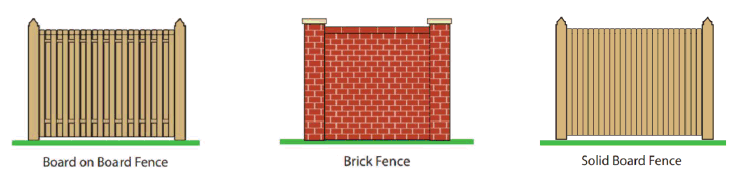
Open. As used to regulate fences and walls, the term "Open" shall mean a fence or wall that consists of more than 75 percent open voids, as viewed on a horizontal plane. See also "Opaque" and "Semi-Opaque."
Figure 9-2 Examples of Open Fence Styles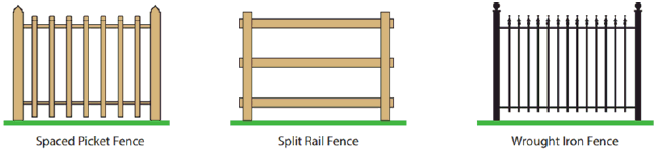
Open Space. A portion of a site which is permanently set aside for public or private use and will not be developed. The space may be used for passive or active recreation or may be reserved to protect or buffer natural areas. Open space may include wooded areas other than required landscape strips and buffers, pathways/walkways, fields, and sensitive environmental areas such as wetlands, etc. Detention facilities and platted residential lots shall not be included in open space calculations.
Outparcel (spin-site). A portion of a larger parcel of land generally designed as a site for a separate structure and business from the larger tract. An outparcel may or may not be a subdivision of a larger parcel. To be recognized as an outparcel, the portion must be identified on a Site Plan approved for the larger parcel.
Sec. 904.16. - P.
Parcel. See "Lot."
Parking Lot. An area which is used for the parking of vehicle.
Parking Space. An area designated for the parking of one vehicle on an all-weather surface.
Path. A cleared way for pedestrians and/or bicycles that may or may not be paved or otherwise improved.
Patio Home. See "Dwelling, Patio Home."
Personal Care Home. A state-licensed dwelling or facility which undertakes through its ownership or management to provide or arrange for the provision of housing, food service, and one or more personal services for five to 24 adults. "Personal Services" includes, but is not limited to, individual assistance with or supervision of self-administered medication, assistance with ambulation and transfer, and essential activities of daily living such as eating, bathing, grooming, dressing, and toileting. This use shall not include hospitals, convalescent centers, nursing homes, hospices, clinics, or similar institutions devoted primarily to the diagnosis and treatment of the sick or injured.
Plans Review. The act of reviewing plans and specifications to ensure that proposed undertakings comply with various governing laws, ordinances and resolutions. Compliance is subsequently utilized to determine that work and materials are in accordance with approved plans and specifications.
Plant Nursery. Any land used to raise trees, shrubs, flowers and other plants for sale or transplanting, but not including the retail sale of any related garden supplies such as chemical fertilizer, tools and other similar goods and/or equipment, or the retail sale of plants not grown on the property except in accordance with this Ordinance.
Plat, Final. A finished drawing of a subdivision which provides a complete and accurate depiction of all legal and engineering information required by the Subdivision Regulations. Certification is necessary for recording.
Plat, Preliminary. A drawing which shows the proposed layout of a subdivision in sufficient detail to clearly indicate its feasibility but is not in final form for recordation pursuant to the Subdivision Regulations.
Pollution Point. The location of an air pollution source (AFS report*), CERCLA site (CERCLIS report*), HSI site (RCRA report*), NPDES site (PCS/ICIS report*), landfill, RCRA site (RCRA report*), solid waste landfill, TRI site (TRI report*), or known reported environmental violation. (*Found at Envirofacts website: www.epa.gov/enviro/)
PODS. Portable on demand storage containers. See also "Temporary Storage Units."
Porch. A roofed open structure projecting from the exterior wall of a building and having at least 70 percent of the total area of the vertical planes forming its perimeter unobstructed in any manner except by insect-screening between floor and ceiling.
Primary Variance. An application requesting relief from the standards of the Zoning Ordinance, except relief from use, minimum lot area, or minimum lot frontage.
Private Club. A corporation chartered, organized and existing under the laws of the state, exempt from federal income taxes pursuant to Section 501(c) of the Internal Revenue Code, as amended, actively in operation within the City, having at least 300 members regularly paying monthly, quarterly, or semiannual dues or user fees, organized and operated exclusively for pleasure, recreation and other nonprofitable purposes, no part of the net earnings of which inures to the benefit of any shareholder or member, and owning, hiring or leasing a building or space therein for the reasonable use of its members with suitable kitchen and dining room space and equipment and maintaining and using a sufficient number of employees for cooking, preparing and serving meals for its members and guests; provided, that no member or officer, agent or employee of the club is paid, or directly or indirectly receives, in the form of salary or other compensation, any profits from the sale of alcoholic beverages to the club or its members or guests beyond a fixed salary. In no event shall dues or user fees be paid on a daily basis. Activities defined by this Zoning Ordinance as Adult Entertainment or facilities defined as an Adult Entertainment Establishment shall be prohibited within a Private Club establishment. A Private Club shall not be considered a Nightclub, Non-Profit Club or Bar.
Property. When used in conjunction with an application for rezoning, an area of land composed of less than one lot, or of accumulations of one or more lots, or parts thereof.
Protected Zone. All lands that fall outside the buildable area of a parcel, all areas of a parcel required to remain in open space, all areas required as landscape strips and/or buffers (including zoning buffers, state water buffers and tributary buffers) and all tree save areas according to the provisions of this Zoning Ordinance, conditions of zoning, special use approval, variance approval, and/or the Tree Preservation Ordinance.
Sec. 904.17. - Q.
Reserved.
Sec. 904.18. - R.
Recreational Court, Private. An improved area designed and intended for the playing of a game or event such as basketball or tennis, and which serves a single family dwelling(s), duplex dwellings and/or multi-family dwellings, or combinations of dwelling types, including such improved areas which are owned and/or controlled by a neighborhood club or similar organization. A basketball goal adjoining a driveway of typical residential driveway dimensions shall not constitute a recreational court.
Recreational Court, Public. An improved area designed and intended for the playing of a game or event such as basketball or tennis, and is operated as a business or as a club unless such club is a neighborhood club or similar organization identified under Recreational Court, Private.
Recreational Facilities. Includes parks, recreation areas, golf courses, playgrounds, recreation counters (indoor & outdoor), playing fields, and other similar uses or facilities.
Recreation Fields. An outside area designed and equipped for the conduct of sports and leisure time activities including but not limited to softball, soccer, football, and field hockey.
Recreational Vehicle. A vehicular-type portable structure without permanent foundation that can be towed, hauled, or driven and is primarily designed as a temporary living accommodation for recreational and camping purposes. Examples include a camper, a motor home and a travel trailer. As distinguished from a mobile home, dimensions shall not exceed a width of 8.5 feet and a length of 45 feet.
Recycling Center, Collecting. Any facility utilized for the purpose of collecting materials to be recycled including, but not limited to, plastics, glass, paper and aluminum materials. A drop off point for temporary storage of recyclables, no processing or reprocessing of materials is allowed.
Recycling Center, Reprocessing. A facility, in which recyclables, such as newspapers, magazines, cardboard, books and other paper products; glass; metal cans; and other products, are recycled, reprocessed and treated to return such products to a condition in which they may again be used in new products. The reprocessing or storage, bailing or otherwise dealing in scrap irons or other metals, used cloth, plumbing fixtures, appliances, brick, wood or other building materials; and the storage or accumulation outside of a storage building of used vehicle tires or tire carcasses is prohibited. A recycling center is not to be considered a landfill.
Relocated Residential Structure. A dwelling which has been removed from one location for relocation to another lot.
Reprocessing. Waste materials are subjected to a special process or treatment to return such products to a condition in which they may again be used in new products.
Restaurant. An establishment where meals are prepared and served to seated patrons. The serving of those meals shall be the principal business conducted, with the serving of alcoholic beverages to be consumed on the premises as only incidental thereto.
Retail Use. A business whose primary purpose is the sale of merchandise to consumers.
Retreat. See "Lodge."
Right-of-Way. A portion of land over which a local or state government has designated a right of use.
Roadside Produce Stand. A use offering either farm-grown, prepared food products such as fruits, vegetables, canned foods, or prepared packaged meats for sale from a vehicle or a temporary structure. The consumption of food on-site is prohibited.
Roadside Vending. The sale of merchandise such as clothing, crafts, household item, firewood, etc., from a temporary table or cart.
Rooming House. A residential use other than a hotel or motel in which lodging may be provided to non-household members for periods of 30 days or longer, and which does not include the provision of meals.
Sec. 904.19. - S.
Salvage/Storage/Junk Facility. Any use involving the storage or disassembly of wrecked or junked automobiles, trucks or other vehicles; vehicular impound lots; storage, bailing or otherwise dealing in scrap irons or other metals, used paper, used cloth, plumbing fixtures, appliances, brick, wood or other building materials; and the storage or accumulation outside of a storage building of used vehicle tires or tire carcasses which cannot be reclaimed for their original use. Such uses are storage and/or salvage facilities whether or not all or part of such operation is conducted inside or outside a building or as principal or accessory uses.
Scale. Scale refers to the relationship of the size of a building to neighboring buildings and of a building to a site. In general, the scale of new construction should relate to the majority of surrounding buildings.
School, Private. An educational use having a curriculum at least equal to a public school, but not operated by the Fulton County Board of Education.
School, Special. An educational use devoted to special education including the training of gifted, learning disabled, mentally and/or physically handicapped persons, but not operated by the Fulton County Board of Education.
Screen. A fence, wall, hedge, landscaping, earthen berm, buffer area or any combination of these that is designed to provide a visual and/or physical barrier.
Seasonal Business Use. A primary use involving the sale of items related to calendar holidays, such as Christmas trees, Halloween pumpkins, etc., which may be conducted outside.
Second Chance Home. A maternity home licensed by the Georgia Department of Human Services that provides full-time residential care, support and supervision to pregnant and parenting youth through 21 years of age and their child(ren) that is expected to last for more than an eight-week period following delivery. Program services include parenting skills, such as child development, education, job training, transitioning to independent living, family budgeting, health and nutrition, and other skills to promote residents' long-term independence and the well-being of their child(ren).
Self-Storage/Mini. A single-level structure or group of structures containing separate spaces/stalls and which are leased or rented to individuals for the storage of goods.
Self-Storage/Multi. A multi-level structure containing separate storage rooms/stalls under a single roof that are leased or rented.
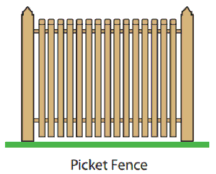
Semi-Opaque. As used to regulate fences and walls, "Semi-Opaque" shall mean a fence or wall that consists of between 25 percent and 75 percent open voids, as viewed on a horizontal plane. See also "Opaque" and "Open."
Figure 9-3 Example of Semi-Opaque Fence Style
Senior Housing. A single family or multi-family development intended for, operated for and designed to accommodate residents 62 years of age and older. Senior housing communities are designed for seniors to live on their own, but with the security and conveniences of community living. Some provide communal dining rooms and planned recreational activities (congregate living or retirement communities), while others provide housing with only minimal amenities or services.
Setback. A space between a property line and a building or specified structure.
Setback, Minimum. The minimum yards as specified in the various use districts. A minimum required space between a property line and a structure. An area identified by a building line.
Short-Term Rental. An accommodation for transient guests where, in exchange for compensation, a residential dwelling unit is provided for lodging for a period of time not to exceed 30 consecutive days. Such use may or may not include an on-site manager. For the purposes of this definition, a residential dwelling shall include all housing types and shall exclude hotels/motels with the capacity to provide separately enclosed sleeping accommodations for more than 30 separate renters at a time, group residences and guest houses, as such terms are defined in this Article.
Sign. Any structure, device, object, design or display that is used or intended to be used to attract the attention of or to convey information to the public, and that is placed in such a way, whether out of doors or inside or near a window, as to be in the view of the general public from the exterior of any building on the property.
(a)
Abandoned sign. Any sign that is located on property which becomes vacant and /or unoccupied or a sign that contains or exhibits broken panels, visible rust, visible rot, damaged support structures, or missing letters or which is otherwise dilapidated, unsightly, or unkempt, and for which no person accepts maintenance responsibility.
(b)
Animated sign. Any sign that has moving parts or includes action, motion, or color changes, or the optical illusion of action, motion, or color changes, including signs using electronic ink, signs set in motion by movement of the atmosphere, or made up of a series of sections that turn, including any type of screen using animated or scrolling displays such as an LED (Light Emitting Diode) screen or any other type of video display, even if the message is stationary.
(c)
Audible sign. Any sign which emits a sound which is audible or emits a signal which can be converted into audible sounds, whether by radio or other means.
(d)
Awning/canopy sign. Any sign that is a part of, or attached to, an awning, canopy or other fabric, plastic or structural protective cover over a door, entrance, window, or outdoor service area. A marquee is not a canopy.
(e)
Banner. A sign other than a flag with or without characters, letters, illustrations or ornamentation applied to cloth, paper, vinyl, plastic or fabric that is intended to be hung either with a frame or without a frame. Neither flags nor canopy signs are considered banners.
(f)
Beacon. Any light with one or more beams directed into the atmosphere or directed at one or more points not on the same lot as the light source; also, any light with one or more beams that rotate or move.
(g)
Billboard. A sign with an area of more than 72 square feet but not more than 672 square feet.
(h)
Changeable copy sign. An animated sign that incorporates changing lettering or images to form a message or messages, whether such changes are accomplished electronically or manually.
(1)
Manual changeable copy sign. Any sign that has a reader board format serving as background for letters/messages that are manually changeable.
(2)
Electronic changeable copy sign. Any sign that uses changing lights or other methods to form a sign message or messages wherein the sequence of messages and the rate of change is electronically programmed and can be modified by electronic processes.
(i)
Fall zone. An area equal to 133 percent of the height of the structure in every direction.
(j)
Flag. Any fabric or bunting containing colors, patterns, or symbols used as a symbol of a government or other entity or organization.
(k)
Feather Flag Sign. A free-standing temporary sign typically constructed of a single plastic or metal shaft driven in the ground with an attached pennant that is vertically elongated and attached to the shaft. A feather flag sign is a type of animated sign.
(l)
Flashing sign. An animated sign, the illumination of which is not kept constant in intensity at all times when in use and which exhibits marked changes in lighting effects.
(m)
Freestanding sign. A permanently affixed sign supported by structures or supports that are placed on, or anchored in, the ground and that are independent from any building or other structure.
(n)
Illuminated sign, external. A sign illuminated by an external light source. Such source cannot be a device that changes color, flashes or alternates.
(o)
Illuminated sign, internal. A sign illuminated by an internal light source. Such source cannot be a device that changes color, flashes, or alternates.
(p)
Incidental door sign. A small sign, emblem or decal no larger than one square foot in area that is located on a door and is generally not readily visible or legible from public rights-of-way.
(q)
Internal development signs. Free-standing signs not visible from a public right-of-way and located adjacent to internal road(s) serving a development.
(r)
LED sign. Any sign or portion thereof that uses light emitting diode technology or other similar semiconductor technology to produce an illuminated image, picture, or message of any kind whether the image, picture, or message is moving or stationary. This type of sign includes any sign that uses LED technology of any kind, whether conventional (using discrete LEDs), surface mounted (otherwise known as individually mounted LEDs), transmissive, organic light emitting diodes (OLED), light emitting polymer (LEP), organic electro polymer (OEL), or any other similar technology. An LED sign is considered to be a form of electronic changeable copy sign.
(s)
Marquee. Any permanent roof-like structure projecting beyond a building or extending along and projecting beyond the wall of the building, generally designed and constructed to provide protection from the weather.
(t)
Marquee sign. Any sign attached flat against or upon a permanent marquee of a building.
(u)
Pennant, streamer. Any lightweight plastic, fabric, or other material, whether or not containing a message of any kind, suspended from a rope, wire, or string, usually in a series, designed to move in the wind.
(v)
Permanent sign. Any sign which, when installed, is intended for permanent use. A permanent freestanding sign shall be of a type and construction as not to be easily or readily removed from the lot on which it has been erected.
(w)
Portable sign. Any sign not permanently attached to the ground or other permanent structure, or a sign designed to be transported, including, but not limited to, signs mounted upon a trailer, bench, wheeled carrier or other non-motorized mobile structure with or without wheels; signs converted T- frames; sandwich board, A-frame, and sidewalk signs; balloons; umbrellas; and signs attached to or painted on vehicles parked and visible from the public right-of-way, unless said vehicle is used in the normal day-to-day operations of the business.
(x)
Project entrance sign. A permanent freestanding sign located at an entrance designed and permitted for vehicular access into a multi-family development, or into a development containing multiple lots, such as but not limited to a particular single-family residential subdivision, a townhouse subdivision, or a commercial subdivision such as an office park or industrial park.
(y)
Projecting sign. Any sign which is suspended or projected from the wall, eave, or soffit of the building in such a manner that its leading edge extends more than six inches beyond the surface of such building or wall.
(z)
Public sign. Any sign erected by a governmental entity.
(aa)
Principal sign. The main, most prominent or largest freestanding or building sign on a property's street frontage or principal building, other than a project entrance sign as defined in this Article. Such signs are of permanent construction and not placed as temporary signage.
(bb)
Roof sign. Any sign erected and constructed wholly on and over the roof of a building, supported by the roof structure, and extending vertically above the highest portion of the roof.
(cc)
Sandwich board, sidewalk and A-frame signs. A portable sign the support structure of which is not imbedded in the ground. Such signs are constructed in such a manner that they stand on their own but are not permanently installed. This includes a sign displayed on an easel.
(dd)
Sign face. That part of a sign that is or can be used for advertising purposes.
(ee)
Sign. Any structure, device, object, design or display that is used or intended to be used to attract the attention of or to convey information to the public, and that is placed in such a way, whether out of doors or inside or near a window, as to be in the view of the general public from the exterior of any building on the property.
(ff)
Small temporary sign. A sign with an area of not greater than four square feet, with a sign face made for short-term use (90 days or less), containing no reflecting elements, flags, or projections and which, when erect, stands at a height not greater than three feet and is mounted on a stake or metal frame with a thickness or diameter not greater than 1½ inches.
(gg)
Temporary sign. Any sign that is not permanently mounted.
(hh)
Wall sign. Any sign attached parallel to a wall, painted on the wall surface or erected and confined within the limits of an outside wall of any building or structure, which is supported by such wall or building and which displays only one sign surface.
(ii)
Window sign. Any sign that is applied, painted or placed on, behind or inside a window or upon the windowpanes or glass, and intended to be viewed from outside the building.
Single-Family Development. A development of more than two single-family dwelling units, with each unit on a separate lot of record.
Site Plan. A detailed plan, drawn to scale, based on a certified boundary survey, and reflecting conditions of zoning approval, various requirements of State law, and City Ordinances and Resolutions.
Site Plan, Preliminary. A detailed plan, normally associated with rezoning and Special Use requests, which is drawn to scale and reflects the various requirements of State law and of City Ordinances and Resolutions.
Skywalk. An elevated, grade separated pedestrian walkway or bridge located over a public right-of-way.
Special Event. An event or happening organized by any person or organization which will generate or invite considerable public participation and/or spectators for a particular and limited purpose of time, including, but not limited to, special sales and service promotions, car shows, arts and crafts shows, horse shows, carnivals, festivals, exhibitions, circuses, fairs, show houses and tours of homes for charity. Special events are not limited to those events conducted on the public streets but may occur entirely on private property. Special events may be for profit or nonprofit.
Small box discount store. A store of 10,000 square feet or less which sells at retail an assortment of physical goods, products, or merchandise directly to the consumer; and continuously offer a majority of the items in its inventory for sale at a price less than $5.00 per item.
Spill Light. The light that illuminates surfaces beyond the intended area of illumination caused by the uncontrolled direct light component from the luminaires.
Stealth Tower. See "Alternative Telecommunication Support Structure."
Story. A portion of a building between the surface of any floor and the floor or space above it, excluding basements and attics.
Story, Half. A heated and finished area below a roof, one or more of the vertical walls of which are less than normal ceiling height for the building.
Street. A roadway/right-of-way located and intended for vehicular traffic. Streets may be public or they may be private if specifically approved by the Department of Community Development and Regulatory Affairs as part of a subdivision plat.
(a)
Public streets. Rights-of-way used for access owned and maintained by the federal, state, or local government.
(b)
Private streets. Roadways constructed to South Fulton standards but owned and maintained by a private entity. Necessary easements for ingress and egress for police, fire, emergency vehicles and all operating utilities shall be provided. Should South Fulton ever be petitioned to assume ownership and maintenance of the private streets prior to dedication of the streets, they must be brought to acceptable South Fulton standards subject to the approval of the Director of Public Works.
(c)
Stub streets. Rights-of-way that dead ends into an interior property line.
(d)
Freeway. Any multi-lane roadway having full access control and separation of directional traffic. A freeway accommodates large volumes of high-speed traffic and provides efficient movement of vehicular traffic for interstate and major through travel.
(e)
Principal Arterial. Any roadway that has partial or no access control and is primarily used for fast or heavy traffic. Emphasis is placed on mobility rather than access to adjacent land.
(f)
Minor Arterial. Any roadway that has partial or no access control and is primarily used for interconnectivity of major arterials and places more emphasis on access to adjacent land over mobility than principal arterials.
(g)
Collector Road. Any roadway that has partial or no access control and has more emphasis on access to adjacent land over mobility than arterials. The primary purpose is to distribute trips to and from the arterial system to their destination points and allow access to the local roads.
(h)
Local Road. Any roadway that has no access control and places strong emphasis on access to adjacent land over mobility while service to through traffic is discouraged.
(i)
Full Access Control. Preference is given to through traffic by providing access connections only with selected public roads and by prohibiting crossing at grade and direct private connections.
(j)
Partial Access Control. Preference is given to through traffic to a degree that in addition to connection with selected public roads, there may be some crossing at grade and some private connections.
(k)
No Access Control. Preference is generally given to access to adjacent land rather than mobility.
Structure. Anything built or constructed which occupies a location on, or is attached, to the ground. Driveways, surface parking lots, patios, and similar paved surfaces are not considered structures.
Structure, Accessory. A subordinate structure, customarily incidental to a principal structure or use and located on the same lot. Examples of accessory structures in single-family dwelling districts include outbuildings, such as, tool sheds, woodsheds, workshops, outdoor kitchens, pool houses, gazebos, guest houses, storage sheds, detached garages and detached carports, etc. Fences and retaining walls are not considered accessory structures. Driveways, surface parking lots, patios, and similar paved surfaces are not considered accessory structures.
Structure, Principal. A structure in which the principal use or purpose on a property occurs, and to which all other structures on the property are subordinate. Principal shall be synonymous with main and primary.
Subdivision. The division of land into two or more lots. A development consisting of subdivided lots.
Surface, All-weather. Any surface treatment, including gravel, which is applied to and maintained so as to prevent erosion, and to prevent vehicle wheels from making direct contact with soil, sod or mud; and which effectively prevents the depositing of soil, sod or mud onto streets from areas required to be so treated.
Swimming Pool, Private. A recreation facility designed and intended for water contact activities which serves a single family dwelling(s), duplex dwellings and/or multi-family dwellings, or combinations of dwelling types, including pools which are owned and/or controlled by a neighborhood club or similar organization.
Swimming Pool, Public. A recreation facility designed and intended water contact activities which is operated as a business or as a club unless such club is associated with a neighborhood club or similar organization.
Sec. 904.20. - T.
Temporary Storage Units. Cargo or storage containers, shipping containers, cargo crates, portable storage containers, PODS containers, box trailers, box or utility vans or trucks, van bodies or boxes removed from trailers or other similar vehicles.
Tenant Panels. An on-premise sign panel(s) that list the name of tenants within a shopping center or development which the primary sign identifies.
Thoroughfare, Major. Any street which is classified in the Transportation Element of the Comprehensive Plan as either a freeway, an arterial or a major collector.
Thoroughfare, Minor. Any street which is classified in the Transportation Element of the Comprehensive Plan as a minor collector or local street.
Tiny House. A site-built or modular (industrialized building) detached single-family dwelling that does not exceed 400 square feet in total area of habitable floor space, excluding loft spaces, and that is affixed to a permanent load-bearing foundation and does not contain a permanent metal chassis. Habitable spaces are for living, sleeping, eating or cooking. Bathrooms, toilet rooms, closets, halls, storage or utility spaces and similar areas are not considered habitable spaces.
Transfer Station. A facility used to transfer solid waste from one transportation vehicle to another for transportation to a disposal facility or processing operation.
Trespass Light. The off-site spill light that illuminates beyond the property boundaries in which the light fixture is installed, where it is neither wanted nor needed.
Truck Stop. Any business, premises, or land in which or upon which a business, service or industry involving the maintenance, servicing, or repair of commercial vehicles is conducted or rendered, including the dispensing of motor fuel or other petroleum products directly into motor vehicles and the sale of accessories or equipment for trucks and similar commercial vehicles, but excluding the storage of trailers, trucks and similar commercial vehicles. A truck stop also may include overnight accommodations and restaurant facilities primarily for the use of truck crews. Trucks/trailers shall have current registration and license plates with decal.
Truck Terminal. A primary use of property where trucks/trailers are temporarily stored maintained or based and where trucks load and unload cargo and freight and where the cargo and freight may be broken down or aggregated into smaller or larger loads for transfer to other vehicles or modes of transportation. Truck terminals may include uses incidental to the principal use such as facilities for servicing of trucks and warehouse storage facilities. Trucks/trailers shall have current registration and license plates with decal.
Sec. 904.21. - U.
Use. The purpose or function arranged or intended for a structure or property.
Use, Accessory. A subordinate use which is customarily incidental to the principal use of a lot, and which is located on the same lot as a principal use.
Use, Principal. The primary or main purpose or function of a lot or structure. Synonymous with Main and Primary.
Use Permit. A permit approved by the City Council, pursuant to a public hearing, which authorizes a use which must meet certain standards which exceed the requirements of the district as-a-whole.
Use, Special. A use approved by the City Council subject to meeting certain standards or conditions that are established by this Zoning Ordinance.
Sec. 904.22. - V.
Vape Shop. A business whose principal product line for retail sale is alternative nicotine products or vape juice, or both. For the purposes of this paragraph, "alternative nicotine products" refer to any products or devices that employ an electronic heating element, power source, electronic circuit, battery, or other electronic, chemical, or mechanical means to produce a vapor that delivers nicotine to the person inhaling from the device, including electronic cigarettes, electronic cigars, electronic hookahs, electronic bongs and electronic pipes, whether manufactured, distributed, marketed, or sold as an electronic cigarette, electronic cigar, or electronic pipe. For the purposes of this paragraph, "vape juice" refers to any liquid that contains compounds containing pharmaceutical grade vegetable glycerin, propylene glycol, nicotine, foodgrade flavoring, and water, and can be used for vaping by means of an alternative nicotine product. For purposes of this paragraph, "principal" shall mean that alternative nicotine products, vape juice, or both constitute at least 25 percent of the business's aggregate retail sales.
Variance. An application requesting relief from the standards of this Zoning Ordinance, except relief from use, minimum lot area, or minimum lot frontage.
Vegetative Screen. An evergreen planting which, within three years of planting, provides a 100 percent visual barrier between a lot and adjacent lots and uses with a minimum height of six feet. A vegetative screen is composed of plant materials.
Vehicle, Junk or Salvage. Any automobile, truck or other vehicle which is missing one of the following: 1) current registration, 2) license plate with current decal, 3) proof of liability insurance, 4) drive train component for more than 30 days.
Veterinary Clinic/Hospital. A place where animals are given medical care and the boarding of animals is limited to short-term care incidental to the hospital use.
Sec. 904.23. - W.
Waste. Materials that are discarded, disposed of or no longer usable.
Waste Disposal Boundary. The limit of all waste disposal areas, appurtenances, and ancillary activities (including but not limited to internal access roads and drainage control devices).
Waste, Hazardous. See Georgia Department of Natural Resources definition.
Waste, Solid. See Georgia Department of Natural Resources definition.
Sec. 904.24. - X.
Reserved.
Sec. 904.25. - Y.
Yard. A land area extending between a structure and a lot line.
Yard, Front. A yard abutting any street except the side street on a corner lot. Front yards extend the entire length of an abutting street from intersecting lot line to intersecting lot line. The front yard of corner lots shall be applied to the street which abuts the lot for the shortest distance.
Yard, Minimum. The minimum distance between a building or specified structure and a lot line as specified in the district regulations.
Yard, Rear. The rear yard is the minimum required distance between the rear lot line and a structure. True triangular lots do not have rear yards. Lots with more than one front lot line do not have rear yards. The Director of Community Development and Regulatory Affairs or his/her designee shall make the final determination of rear yards when in dispute or undefined by this definition.
Yard, Side. A yard which is not a front or rear yard.
Yard Sale. The sale or offering for sale of more than one article of tangible personal property at any one residential premises at any one time. All sales entitled: garage sale; tag sale; porch sale; lawn sale; attic sale; basement sale; rummage sale; flea market sale or any similar casual sale of tangible personal property are included.
Sec. 904.26. - Z.
Zoning Change. An amendment to the Zoning Map (rezoning), approval of a Special Use, or approval of a change in the conditions of approval associated with a rezoning or Special Use.
Zoning Conditions. Requirements placed on property by the City Council at the time of approval of a rezoning and/or special use. Also called "conditions of approval."
Zoning Modification. An application to change approved zoning conditions on rezonings and Special Use approvals where it has been determined by the Director of Community Development and Regulatory Affairs that the requested change involves a matter of significant public interest.

