
South Fulton City Zoning Code
ARTICLE 5
- OVERLAY DISTRICTS
Sec. 502.- Definitions.
The words "shall" and "must" are mandatory, and the words "may" and "should" are permissive. As used in this Article, the following terms shall be defined as follows:
(a)
Appearance. The outward aspect that is visible to the public.
(b)
Appropriate. Fitting to the context of a site, neighborhood or community.
(c)
Architectural concept. The basic aesthetic idea of a structure, or group of structures, including the site, signs, buildings and landscape development that produces the architectural character.
(d)
Architectural feature. A significant element of a structure or site.
(e)
Attractive. Having qualities that arouse satisfaction and pleasure in numerous, but not necessarily all, observers.
(f)
Building. A building is a structure created to shelter any form of human activity, including but not limited to, a house, store, barn, church, hotel.
(g)
Certificate of endorsement (COE). A document evidencing support of a material change in the appearance of a property located within an overlay district by the person or board designated within an overlay district.
(h)
Cohesiveness. Unity of composition among elements of a structure or among structures, and their landscape development.
(i)
Compatibility. Harmony in appearance of architectural features in the same vicinity.
(j)
Design review board (DRB). A panel which, when appointed by the City Council, consists of eight members appointed to consider applications within a specific overlay district.
(k)
Designation or designated. A decision by the City Council of South Fulton, Georgia, wherein a property or district is declared an overlay district.
(l)
External design feature. The general arrangement of any portion of structures or landscaping, including the type, and texture of the materials, the type of roof, windows, doors, lights, signs, and fixtures of portions which are open to the public view.
(m)
Exterior architectural features. The architectural style, general design and general arrangement of the exterior of a structure and site, including but not limited to the kind or texture of the building material and the type and style of all windows, doors, signs, facade, landscaping and other architectural fixtures, features, details, or elements relative thereto.
(n)
Geographic area. Land area subject to overlay district regulations.
(o)
Harmony. A quality that represents an attractive arrangement of parts, as in an arrangement of various architectural elements.
(p)
Landscape. Plant materials, topography and other physical elements combined in relation to one another and to structures including pavement.
(q)
Logic of design. Widely accepted principles and criteria in the solution of design problems.
(r)
Material change in appearance. A change in a structure or a parking lot within an overlay district that exceeds ordinary maintenance or repair (defined below), and requires either a sign permit, building permit or land disturbance permit such as, but not limited to:
(1)
The erection, alteration, restoration, addition or removal of any structure (including signs) or parking lot;
(2)
Relocation of a sign or building;
(3)
Commencement of excavation; or
(4)
A change in the location of signage visible from the public right-of-way.
(s)
Ordinary maintenance or repair. Exempt from inclusion in "Material Change in Appearance" defined above. Ordinary maintenance or repair of any exterior of any structure, parking lot or sign in or on an overlay district property to correct deterioration, decay or damage, or to sustain the existing form, and that does not involve a material change in outer design, material, or appearance thereof. Painting, reroofing, resurfacing, replacement of a broken sign face and other similar types of ordinary maintenance shall be deemed ordinary maintenance and repair.
(t)
Overlay district. A geographically definable area, possessing a significant concentration or linkage of sites, buildings, structures, objects or landscapes, including the adjacent area necessary for the proper treatment thereof, united by plan and/or physical development. An overlay district shall further mean an area designated by the South Fulton City Council as such.
(u)
Overlay property. An individual site, structure, object or landscape, including the adjacent area necessary for the proper continuity thereof, contained within an overlay district.
(v)
Proportion. Balanced relationship of parts of a building, signs and other structures, and landscape to each other and to the whole.
(w)
Scale. Proportional relationships of the size of parts to one another and to humans.
(x)
Street hardware. Objects other than buildings that are part of the streetscape. Examples are: street light fixtures, utility poles, traffic lights and their fixtures, benches, litter containers, planting containers, fire hydrants, etc.
(y)
Streetscape. The appearance and organization along a street of buildings, paving, plantings, street hardware and miscellaneous structures.
Sec. 501.01.- Declaration of purpose, scope, intent and public policy.
(a)
The South Fulton City Council finds that as a matter of public policy that the aesthetic, economic and functional qualities of the City of South Fulton are worthy of enhancement and preservation and are essential to the promotion of the health, prosperity, safety and general welfare of the existing and future residents of South Fulton. Therefore, the City Council authorizes each planning area to propose overlay districts and regulations, and, if desired, to request that City Council appoint a design review board. The purpose of the overlay district regulations shall be:
(1)
To foster civic pride,
(2)
To promote attention to accepted design principles in areas of new development and redevelopment,
(3)
To raise the level of community understanding and expectation for quality in the built environment,
(4)
To implement the City of South Fulton Comprehensive Plan,
(5)
To provide for the designation, protection, rehabilitation and redevelopment of properties within overlay districts and to participate in federal and state programs designed to do the same,
(6)
To protect and enhance local aesthetic and functional qualities and to stimulate business, and
(7)
To enhance the opportunities for federal, state and local tax benefits under relevant federal, state and local laws.
(b)
The City Council further finds that the timely exercise of judgement in the public interest by a public body of proposed new development or redevelopment is desirable. Accordingly, the public policy objectives of this Article are to guide certain aspects of development, such as:
(1)
The spatial relationships of structures and open spaces to each other, and
(2)
The appearance of buildings and open spaces as they contribute to the attractiveness, function, economy and character of an area.
(c)
Planning area design standards are intended to be uniformly applied to evaluate the appropriateness of proposed changes to an overlay district in order to:
(1)
Protect and enhance the visual qualities and character of the district,
(2)
Provide guidance to design professionals, property and business owners undertaking construction in the district,
(3)
Recommend appropriate design approaches, and
(4)
Provide an objective basis for review, assuring consistency and fairness.
Sec. 503.01.- Approval of alterations or new construction.
Applicants for a South Fulton land disturbance permit, sign permit or building permit shall obtain a certificate of endorsement (COE) for applicable properties.
Sec. 503.02. - Issuance of a certificate of endorsement.
(a)
A COE may be issued when the proposed material change(s) in the appearance or arrangement of the elements of the project is consistent with the overlay district provisions.
(b)
A copy of each final COE shall be maintained in the Department of Community Development.
Sec. 503.03. - Submission of plans.
An application for a COE shall be accompanied by such drawings, photographs, material samples or plans as may be required pursuant to the overlay district provisions.
Sec. 503.04. - Interior alterations.
Review of applications for endorsement shall not consider interiors or exterior features which are not visible from a public street.
Sec. 503.05. - Exceptions.
(a)
When, by reason of unusual circumstances, the strict application of any provision of this Article would result in the exceptional practical difficulty or undue hardship due to the circumstances unique to the particular property in question, the Zoning Board of Appeals, shall consider a variance from said provisions so as to relieve such difficulty or hardship provided such variances shall remain in harmony with the general purpose and intent of said provisions, so that the integrity or character of the property, shall be conserved and substantial justice done. A hardship shall not qualify as an undue hardship if it is of a person's own making.
(b)
The process for considering a variance request shall follow the requirements for a hardship variance in Article 8 of this Ordinance.
(c)
In granting such variances, the Zoning Board of Appeals may impose such reasonable and additional stipulations and conditions as will, in its judgement, best fulfill the purpose of this Article.
Sec. 503.06. - Deadline for consideration of application for COE.
The DRB shall consider a completed application for a COE within 15 days after the filing thereof by the owner or occupant of an overlay district property. If the application has not been acted upon within 15 days, then the application shall be considered to be approved as submitted.
Sec. 504.01.- Designation on official zoning map(s).
Designation of a zoning overlay district provides additional requirements or restrictions on the portions of zoning districts over which they are established. Adopted overlay districts shall be shown as such on the official zoning maps of South Fulton, Georgia.
Sec. 504.02. - Affirmation of zoning ordinance and other regulations.
(a)
Nothing in this Article shall be construed to exempt property and business owners from complying with other provisions in this Zoning Ordinance and with other existing City regulations whenever this Article does not apply.
(b)
Within each overlay zoning district, land and structures shall be used in accordance with the standards of the underlying zoning district.
Sec. 504.03. - Conflicts.
All other provisions of the Zoning Ordinance shall remain in effect unless provisions in the overlay district conflict with other provisions of this Ordinance, in which case, the stricter provisions of the overlay district shall apply.
Sec. 505.01.- Ordinary maintenance or repair.
Ordinary maintenance or repair of any exterior feature visible from a public street in or on an overlay district property to correct deterioration, decay or damage, or to sustain the existing form, and that does not involve a material change in design, material, or outer appearance thereof, does not require a building, sign, or land disturbance permit.
Sec. 505.02. - Failure to provide ordinary maintenance or repair.
The owner or owners, or the owner's agent, of each designated overlay district property or site, shall keep in good repair all of the exterior portions of such property and site and all interior portions thereof which, if not maintained, may cause or tend to cause the exterior portion of such property or site to deteriorate, decay or become damaged or otherwise to fall into a state of disrepair. The Director of Community Development and Regulatory Affairs shall be responsible for the enforcement of the ordinary maintenance or repair provisions contained within this Article.
Sec. 505.03. - Affirmation of existing building codes.
Nothing in this Article shall be construed to exempt property and business owners from complying with Georgia State Minimum Standard Codes and locally adopted building codes.
Sec. 506.02. - Purpose and intent.
(a)
The City Council of South Fulton, Georgia hereby declares it to be the purpose and intent of this Cascade Corridor Overlay District (District) to establish a uniform procedure for providing for the protection, enhancement, preservation, unity of design, and use of places, sites, buildings, structures, streets, neighborhoods, and landscape features in the Cascade Corridor District in accordance with the provisions herein.
(b)
The Cascade Corridor Overlay District is adopted as part of a strategy designed to promote the health, safety, order, prosperity, and general welfare of the citizens of South Fulton through the regulation of design, aesthetics, location, bulk, size of buildings and structures, and the density and distribution of population.
(c)
This District also seeks to reduce congestion on the streets; to provide safety from fire, flood and other dangers; provide adequate light and open space; protect the natural environment and address other public requirements, in order to provide sustainable development that involves the simultaneous pursuit of economic prosperity, environmental protection and social quality.
(d)
This District also seeks, among other things, to promote accepted design principles in areas of new development and redevelopment, to raise the level of community understanding and expectation for quality in the built environment, to protect and enhance local aesthetic and functional qualities, and to stimulate business and promote economic development.
(e)
In consideration of the character of the Cascade Corridor Overlay District, the regulations in this Section 506 are intended to monitor the suitability for certain uses, construction and design, prevent functional and visual disunity, promote desirable conditions for community and commerce and protect property against blight and depreciation.
Sec. 506.03. - Applicability.
(a)
The Cascade Corridor Overlay District and the regulations of this Section 506 apply to all properties zoned or developed for nonresidential and residential uses (except as indicated in Section 506.03(b) below) within 3,500 feet of the center line of Cascade Road in South Fulton between the Atlanta City limits and Danforth Road (see attached map under Section 506.01 above).
(b)
Single-family detached dwellings are exempt from the District requirements, with the exception that the exterior finish prohibitions in Section 506.10(c) shall apply.
Sec. 506.04. - Architectural review process.
(a)
Prior to the issuance of a building permit, the applicant shall submit plans which include details of exterior materials, colors, design and architectural elements of proposed building(s) as specified by this Section 506.
(b)
South Fulton staff will review all requests for land disturbance, building (excluding interior renovations), and sign permits for compliance with this Section. Upon determination of compliance, a Certificate of Endorsement (COE) will be provided in the form of signing the formally submitted plans and drawings.
(c)
Prior to the issuance of a building permit, the community will be allowed ten working days to review and comment. In no event shall a proposal which otherwise conforms to applicable codes and regulations be delayed issuance of a building permit for more than ten working days due to this review and comment process.
Sec. 506.05. - Landscaping requirements.
A 15-foot wide landscape strip along any public street shall be required when Article 4 of the Zoning Ordinance otherwise specifies a smaller landscape strip, in accordance with the following requirements:
(a)
The landscape strip may be as specified by the South Fulton Tree Preservation Ordinance, or may be a combination of hardscape elements (plazas, planters, benches, fountains and tables, etc.), ground cover, shrubs, and the required number of hardwood trees as specified by the Tree Preservation Ordinance.
(b)
Shrubs shall be a minimum height of three feet at time of planting.
(c)
A minimum of one two-inch caliper diameter at breast height (DBH) hardwood shade tree is required for every 30 linear feet of landscape strip.
(d)
A ten-foot wide landscape strip shall be provided along any interior property line adjacent to a nonresidential zoning and/or use.
Sec. 506.06. - Accessory site features; placement and screening.
(a)
Accessory site features are prohibited in the front yard of any property.
(b)
Accessory site features located on the ground shall be screened from view from any public right-of-way, any residential use, or any residential or AG-1 zoning category by one of the following: placement behind the building, 100 percent opaque fencing, berm or vegetative screen planted to buffer standards.
(c)
Accessory site features on a roof shall be screened by a parapet or other architectural feature or as approved by the Director Community Development and Regulatory Affairs.
(d)
Roof-mounted equipment and flat roofs shall be screened from the view of public and private streets by a parapet. No parapet shall be required to be greater than four feet above roof.
(e)
Refuse areas and receptacles.
(1)
Refuse areas and receptacles shall be placed in the least visible location from public streets and shall be enclosed on three sides with opaque walls. The fourth side shall be a self-closing gate made from noncombustible materials. Opaque walls shall be a minimum of 12 inches higher than the receptacle. Wall materials shall be noncombustible brick.
(2)
Refuse receptacles shall not be placed within 50 feet of an existing residential or AG-1 (Agricultural) zoning district.
Sec. 506.07. - Fencing and wall requirements.
(a)
Chain link fencing is only allowed along golf courses, play fields, and other recreational areas. All chain link fencing shall be black or hunter green vinyl coated. Fences should not be visible from the street.
(b)
When required, fencing material around detention/retention facilities shall be black or hunter green vinyl coated chain link fence.
(c)
Retaining walls shall be faced with or constructed of stone, brick, or decorative concrete modular block only.
(d)
Screening walls shall be screened with a hedge of evergreen shrubbery, a minimum of two feet in height at planting.
(e)
Fencing materials along public streets and side yards are restricted to brick, stone, iron, decorative wrought iron, and treated wood.
Sec. 506.08. - Pedestrian paths.
(a)
Sidewalks are required along all public and private road frontages.
(b)
Internal walkways (paths) are required from the public sidewalk to the main entrance of the principal use of the property and shall meet applicable Americans with Disabilities Act (ADA) standards for slope, width, texture, level differences, and ramps.
(c)
Pedestrian paths may be constructed of either colored/textured materials or conventional sidewalk materials and shall be clearly identified.
(d)
Pedestrian paths shall be illustrated on the site plan submitted at the time of application for a land disturbance permit.
(e)
Paths shall be designed to minimize direct auto-pedestrian interaction.
(f)
Paths shall be connected to signalized crosswalks where applicable.
(g)
Paths shall be direct and convenient routes between points of origin (such as a bus stop) and destination (such as a shop, bank, etc.).
(h)
Street furniture shall be located outside the specified width of any pedestrian path.
(i)
If a business is open after dark, the path shall be well-lit by a minimum of 0.9 foot-candles with an average to minimum uniformity ratio of 4:1. The lighting plan for pedestrian paths shall be included on the site plan submitted at the time of application for a land disturbance permit.
Sec. 506.09. - Building design.
(a)
Developments shall include architecture elements, including:
(1)
Trim to include eaves, corner boards, gable and eave boards, pediments, friezes, lintels, sills, quoins, belt courses, balustrades;
(2)
Gables, dormers, pillars, posts, porches, recessed windows and doors, cupolas, bay windows;
(3)
Half-rounded or quarter-rounded roof gutters and down spouts integrated with trim;
(4)
Glass storefronts, transom windows, building wall offsets, projections, recesses, floor level changes, roof-line offsets.
(b)
Architectural treatments of front facades shall continue major features around all visibly exposed sides of a building.
(c)
The principal entry area of a building shall be articulated and express greater architectural detail than other portions of the building.
(d)
To the extent any rear or side of any building is visible from any public street or single-family residence, architectural treatment shall continue through the rear or side.
(e)
Flat roofs are prohibited unless screened by a parapet in accordance with Section 506.06(d) above.
(f)
Neon lights outlining and/or detailing building features are prohibited.
(g)
Restaurants with outdoor seating should allow for ease of pedestrian circulation, adequate shade through the use of extended awnings, canopies, or large umbrellas, provide outdoor trash receptacles, and maintain clean and litter-free premises.
Sec. 506.10. - Building materials.
(a)
The exterior finish of all principal buildings shall be at least 51 percent brick per vertical wall plane.
(b)
Accent building materials on principal buildings shall be nonreflective glass, natural stone, precast concrete, stucco, stucco-like material, glass block, Hardi-plank and/or tile (or an equivalent alternative treatment approved by the Director Community Development and Regulatory Affairs) and shall not exceed 49 percent per vertical wall plane.
(c)
Exposed concrete masonry unit (CMU) block, corrugated steel, aluminum siding, vinyl siding, wood siding, synthetic stucco, prefabricated metal, exposed plywood, reflective glass, and exposed pressboard are prohibited as exterior finishes, with the exception that wood siding is allowed on single-family detached dwellings.
(d)
Exterior finishes for accessory structures shall be consistent with the principal structure.
Sec. 506.11. - Building colors.
(a)
Roof colors shall be black, gray, brown, or green. Reflective and metallic colors are prohibited.
(b)
Colors for exterior walls, building components, sign structures, accent and decorative elements must be chosen from the tones and shades specified in the color chart below (from the Pantone Formula Color Guide) or as approved by the Director of Community Development and Regulatory Affairs if a proposed color is not listed in the color chart but approximates one of the approved colors.
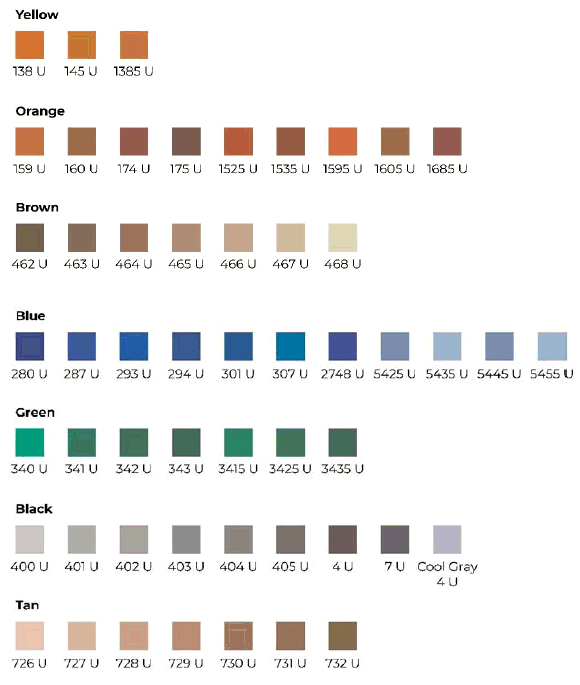
The code number under each color refers to the Pantone Matching System, an International Color Matching System. An online color search tool can be accessed here: https://www.pantone.com/color-finder?from=topNav. To search for a color, type the code number code into the search box. Include a space between the number and letters.
Sec. 506.12. - Security devices.
(a)
Burglar bars.
(1)
Burglar bars, steel gates, metal awnings and steel-roll down curtains are prohibited on the exterior of a structure except at the structure's rear.
(2)
Burglar bars are prohibited on the rear of a structure if visible from a public street.
(3)
Burglar bars are also prohibited on the rear of an outparcel building if visible from the main structure.
(b)
Roll-down security devices.
(1)
Roll-down security devices that allow visibility into the store when they are deployed, such as security shutters, are allowed if installed interior to the structure.
(2)
Said interior security devices shall give the overall appearance of a uniform horizontal pattern and shall be placed so that the pattern is at a uniform height across the entire business front and shall match or compliment the color of the surrounding window frame.
(3)
The interior security device shall be rolled up (out of sight) during business operating hours and if business has vacated.
(4)
Extraneous items shall not be attached to the security device.
(5)
The preferred security device is QMI, Vision Profile Security Shutters, Style 51.
(c)
Letter of Appropriateness required.
(1)
Prior to the installation of all security devices the owner/leasee shall obtain a Letter of Appropriateness from the Director of Community Development and Regulatory Affairs.
(2)
In order to obtain the Letter of Appropriateness, the owner/leasee shall provide a signed and notarized letter with attachments describing:
a.
Building address where devices are to be installed.
b.
Detailed information including site plan and elevation drawing showing location of security device in relation to building façade, windows, doors, etc.
c.
Name of security product (provide manufacturer information).
d.
Detailed information on the security product (color, material etc.).
e.
Other information as may be requested to assure compliance with the security device standard.
f.
Notarized letter from installer certifying that product shall be installed to manufacturer's specifications.
(3)
CDRA Staff will review the information for compliance with the security device standard and upon determination of compliance will provide a Letter of Appropriateness.
Sec. 506.13. - Outdoor vending and storage.
(a)
Vending machines, paper stands, and other similar devices must be located interior to the building structure.
(b)
Except as provided for in Article 3, the storage and/or sale of goods is prohibited in parking lots and other areas outside of the interior or permanently sheltered portions of a building.
(c)
Storage of shopping carts is allowed without a permit, but is subject to the requirements of Title 6, Chapter 5 Abandoned Shopping Carts of the City Codes of Ordinances.
Sec. 506.14. - Sign standards.
(a)
The base and framework of monument signs shall be made of the same brick as the principal structure.
(b)
The architecture color standards of the overlay district apply only to the sign structure, not to the sign face.
(c)
Window signs along the corridor are prohibited.
(d)
Wall signs shall be internally illuminated.
Sec. 506.15. - Utility placement.
All utilities shall be located underground.
Sec. 506.16. - Stormwater management facilities.
All required detention/retention facilities shall be designed to meet the South Fulton alternative design standards that have the intent of making such facilities an attractive amenity or focal point for the subdivision per current South Fulton Subdivision Regulations.
Sec. 507.02. - Purpose and intent.
(a)
The City Council of South Fulton, Georgia hereby declares it to be the purpose and intent of the Cedar Grove Overlay District (District) to establish a uniform procedure for providing for the protection, enhancement, preservation, unity of design, and use of places, sites, buildings, structures, streets, neighborhoods, and landscape features in the Cedar Grove Overlay District in accordance with the provisions herein.
(b)
The Cedar Grove Overlay District is adopted as part of a strategy designed to promote the health, safety, order, prosperity, and general welfare of the citizens of South Fulton through the regulation of design, aesthetics, location, bulk, size of buildings and structures, and the density and distribution of population.
(c)
This District also seeks to reduce congestion on the streets; to provide safety from fire, flood and other dangers; provide adequate light and open space; protect the natural environment and address other public requirements, in order to provide sustainable development that involves the simultaneous pursuit of economic prosperity, environmental protection and social quality.
(d)
This District also seeks, among other things, to promote accepted design principles in areas of new development and redevelopment, to raise the level of community understanding and expectation for quality in the built environment, to protect and enhance local aesthetic and functional qualities, and to stimulate business and promote economic development.
(e)
In consideration of the rural character of the Cedar Grove Overlay District, the regulations in this Section 507 are intended to define and monitor the suitability for certain uses, construction and design, prevent functional and visual disunity, promote desirable conditions for community and commerce and protect property against blight and depreciation.
Sec. 507.03. - Applicability.
(a)
The Cedar Grove Overlay District and the regulations of this Section 507 apply to all properties zoned or developed for nonresidential and residential uses (except as indicated in Section 507.03(b) below), within the area illustrated on the attached map (excluding the South Fulton Parkway Overlay District) under Section 507.01 above.
(b)
Single-family detached dwellings are exempt from the Cedar Grove Overlay District requirements, with the exception that the exterior finish prohibitions in Section 507.12(b) shall apply.
(c)
The District also recognizes the Cedar Grove Crossroads as designated in the South Fulton Comprehensive Plan.
Sec. 507.04. - Architectural review process.
(a)
Prior to issuance of a land disturbance permit (LDP) or a building permit, the applicant shall submit details of exterior materials, colors, landscape strips, buffers, signage, lighting, parking, streets and paths, entrances design and architectural features of the proposed site and building which demonstrate compliance with the design standards set forth herein.
(b)
All building plans submitted as an application for a building permit shall clearly indicate all of the proposed building materials and colors for each facade in accordance with Section 507.12 and Section 507.13. The plans should clearly show the location and calculate the amount/percentage of all building materials per facade.
(c)
Prior to the issuance of an LDP or building permit, the community will be allowed ten working days to review the application. An application which otherwise conforms to applicable codes and regulations shall not be delayed issuance of an LDP or building permit for more than ten working days due to this review and comment process.
(d)
South Fulton staff will review all applications for land disturbance permits, building permits and sign permits for compliance with the standards of this Overlay District and upon determination of compliance will provide a Certificate of Endorsement (COE) in the form of signing the formally submitted plans and drawings.
Sec. 507.05. - Buffers and landscaping requirements.
(a)
All AG-1 and residentially zoned developments shall provide a minimum 50-foot wide natural, undisturbed buffer with a ten-foot improvement setback along all public streets.
(b)
All non-residentially (except AG-1) zoned developments shall provide a minimum 50-foot wide landscape strip along all public streets.
(c)
A minimum 15-foot wide landscape strip shall be provided along any interior property line adjacent to a nonresidential zoning and/or use.
(d)
Large, overstory trees shall be planted 40 to 60 feet on center and shall be located along both sides of all public streets (except residential streets).
(e)
Small, understory trees shall be planted ten to 30 feet on center and shall be located along both sides of residential streets.
(f)
Street trees shall be a minimum two-inch caliper diameter at breast height (DBH).
(g)
Street trees shall be selected from Appendix E of the South Fulton Tree Preservation Ordinance and Administrative Guidelines or as may be approved by the South Fulton Arborist.
Sec. 507.06. - Accessory site features; placement and screening.
(a)
Accessory site features are prohibited in the front yard of any property.
(b)
Accessory site features located on the ground shall be screened from view from any public right-of-way, any residential use, or any residential or AG-1 zoning district by one of the following: placement behind the building, 100 percent opaque fencing, berm or vegetative screen planted to buffer standards.
(c)
Accessory site features on a roof shall be screened by a parapet or other architectural feature or as approved by the CDRA Director.
(d)
Refuse areas and receptacles.
(1)
Refuse areas and receptacles shall be placed in the least visible location from public streets and shall be enclosed on three sides with opaque walls. The fourth side shall be a self-closing gate made from noncombustible materials. Opaque walls shall be a minimum of 12 inches higher than the receptacle. Wall materials shall be noncombustible brick, stone, or split-faced concrete masonry block.
(2)
Refuse receptacles shall not be placed within 100 feet of an existing residential or AG-1 zoning district.
Sec. 507.07. - Fencing and wall requirements.
(a)
Screening walls shall be screened with a hedge of evergreen shrubbery, a minimum of two feet in height at planting.
(b)
Fencing materials along public streets and side yards are restricted to brick, stone, iron, decorative wrought iron, and treated wood.
(c)
Chain link fencing may be used only along golf courses, play fields, and other recreational areas. All chain link fencing shall be black or hunter green vinyl coated.
(d)
When required, fencing material around detention/retention facilities shall be black or hunter green vinyl coated chain link fence.
(e)
Retaining walls shall be faced with or constructed of stone, brick, or decorative concrete modular block only.
Sec. 507.08. - Sidewalks/pedestrian paths.
(a)
Sidewalks are required along all public and private road frontages (except alleys) and shall meet all applicable Americans with Disabilities Act (ADA) standards.
(b)
Sidewalks and other paths (multi-purpose or pedestrian) shall be illustrated on the site plan submitted at the time of application for a land disturbance permit.
(c)
Sidewalks shall be a minimum width of five feet.
(d)
Pedestrian paths may be constructed of either colored/textured materials or conventional sidewalk materials and shall be clearly identified.
(e)
Multi-use paths for bicycles and pedestrians may be substituted for the required sidewalks as approved by the CDRA Director and the Public Works Director when the path is part of an approved transportation plan.
(f)
Multi-use paths designed for use by bicyclists and pedestrians shall be 12 feet wide.
(g)
Multi-use paths designed with separate paths for bicyclists and pedestrians shall be 15 feet wide, ten feet for bicycles and five feet for pedestrians.
(h)
Street furniture shall be located outside the specified width of any path.
(i)
Sidewalks and paths shall be connected to signalized crosswalks where applicable.
(j)
Sidewalks and paths shall be designed to minimize direct auto-pedestrian interaction.
(k)
Sidewalks and paths should be direct and convenient routes between points of origin (such as a bus stop) and destination (such as a shop, bank, etc.).
(l)
Pedestrian access should be provided to all entrances including access from rear parking areas.
(m)
Inter-parcel connectivity shall be required for multiuse, pedestrian paths and sidewalks.
Sec. 507.09. - Lighting.
(a)
A lighting plan for open parking lots and pedestrian paths shall be submitted for approval prior to the issuance of a land disturbance permit.
(b)
Street lights shall be installed on all interior streets within community crossroads, as identified in the South Fulton Comprehensive Plan.
(c)
Open parking lots and walkways providing access thereto shall be lighted at a minimum of two-foot candles measured at grade level.
(d)
The maximum to minimum foot candle level shall not exceed a 12:1 ratio.
(e)
Non-LED shoebox fixtures, cobra lighting fixtures, and neon lighting are prohibited.
(f)
Any luminaire with a lamp or lamps rated at a total of more than 1,800 lumens, and all flood or spot luminaires with a lamp or lamps rated at a total of more than 900 lumens, shall not emit any direct light above a horizontal plane through the lowest direct-light-emitting part of the luminaire.
(g)
Any luminaire with a lamp or lamps rated at a total of more than 1,800 lumens, and all flood or spot luminaires with a lamp or lamps rated at a total of more than 900 lumens, shall be mounted at a height equal to or less than the value 3 + (D/3), where D is the distance in feet to the nearest property boundary. The maximum height of the luminaire may not exceed 20 feet.
(h)
Any luminaire with a lamp or lamps rated at a total of 1,800 lumens or less, and all flood or spot luminaires with a lamp or lamps rated at 900 lumens or less, may be used without restriction to light distribution or mounting height, except that if any spot of flood luminaire rated 900 lumens or less is aimed, directed, or focused such as to cause direct light from the luminaire to be directed toward residential buildings on adjacent or nearby land, or to create glare perceptible to persons operating motor vehicles on public ways, the luminaire shall be redirected or its light output controlled as necessary to eliminate such conditions.
(i)
Luminaires used for public-roadway illumination may be installed at a maximum height of 25 feet and may be positioned at that height up to the edge of any bordering property.
(j)
All temporary emergency lighting needed by police, fire or other emergency services, as well as all emergency vehicular luminaires, shall be exempt from the requirements of this Section.
(k)
All hazard warning luminaires required by federal regulatory agencies are exempt from the requirements of this Section, except that all luminaries used must be red and must be shown to be as close as possible to the federally required minimum lumen output requirement for the specific task.
(l)
Luminaires used primarily for sign illumination may be mounted at any height to a maximum of 25 feet, regardless of lumen rating.
(m)
Lighting fixtures used to illuminate a billboard shall be mounted on the top of the sign structure. All such fixtures shall use a type of shielding to direct lighting downward. Bottom-mounted sign lighting is prohibited.
(n)
The use of laser source light or any similar high intensity light used outdoors is prohibited.
(o)
The operation of searchlights is prohibited.
(p)
Permanent mounted exterior neon lights are prohibited.
(q)
Back-lit awnings and roof mounted lights are prohibited.
Sec. 507.10. - Building design.
(a)
Developments shall include architectural elements such as columns, arcades, covered entry-walkways, arches, facade offsets, windows, balconies, offset walls, clock towers, cupolas and/or courtyards.
(b)
The principal entry area of a building shall be articulated and express greater architectural detail than other portions of the building.
(c)
Shopfront buildings shall utilize a parapet at all street frontages.
(d)
For large commercial/retail buildings variations in facade, roofline and depth shall be provided to lend the appearance of multi-tenant occupancy.
(e)
Buildings are limited to 35 feet in height.
(f)
Permissible roofs are gable, pyramidal, hip or decorative parapets. No parapet shall be required to be greater than four feet above the roof line. Shed roofs are permitted over porches, additions, and accessory structures.
Sec. 507.11. - Building orientation.
(a)
All buildings shall be oriented to face a street or a courtyard.
(b)
All primary entrances shall face the street or courtyard.
(c)
All primary entrances which face a street shall be at street level.
(d)
Fuel pumps, canopies and associated gasoline station service areas shall be located at the rear of the structure, not between the building and the street, to allow the building to be the spatial edge of the streetscape.
Sec. 507.12. - Building materials.
(a)
The exterior wall materials of nonresidential buildings shall consist of a minimum of 60 percent (per vertical wall plane) of the following: brick, stone or clapboard (or an equivalent alternative treatment approved by the Director of Community Development and Regulatory Affairs). Reflective glass is prohibited.
(b)
The exterior wall materials of residential buildings shall consist of a minimum of 60 percent (per vertical wall plane) of the following: brick, stone, cement stucco, split-faced block natural treated wood and/or cement based artificial wood siding, solid plank, cementitious plank, or horizontal clapboard siding (or an equivalent alternative treatment approved by the Director of Community Development and Regulatory Affairs). Synthetic stucco, vinyl siding and aluminum siding are prohibited.
(c)
Any nonresidential building facade shall have a minimum of 25 percent fenestration or as may be approved by the CDRA Director. Black glass, tinted glass and/or reflective glass is prohibited.
(d)
Accent wall materials on residential and nonresidential buildings shall consist of non-reflective or non-tinted glass, architecturally treated concrete masonry, precast stone, or stucco (or an equivalent alternative treatment approved by the Director of Community Development and Regulatory Affairs) and shall not exceed 40 percent per vertical wall plane.
(e)
To the extent any rear or side of any building is visible from any public street or single-family residence, architectural treatment shall continue through the rear or side.
(f)
Exterior finishes for accessory structures shall be consistent with the principal structure.
(g)
Allowable roof materials for pitched roofs are asphalt shingles, composition shingles, natural wood shingles, wood shake, slate, terra cotta, or as may be approved by the CDRA Director.
Sec. 507.13. - Building colors.
(a)
Roof colors shall be gray, brown, terra-cotta or green. Reflective and metallic colors are allowed only when not visible from a street.
(b)
Colors for exterior walls, building components, sign structures, accent and decorative elements must be chosen from the tones and shades specified in the color chart below (from the Pantone Formula Color Guide) or as approved by the CDRA Director.
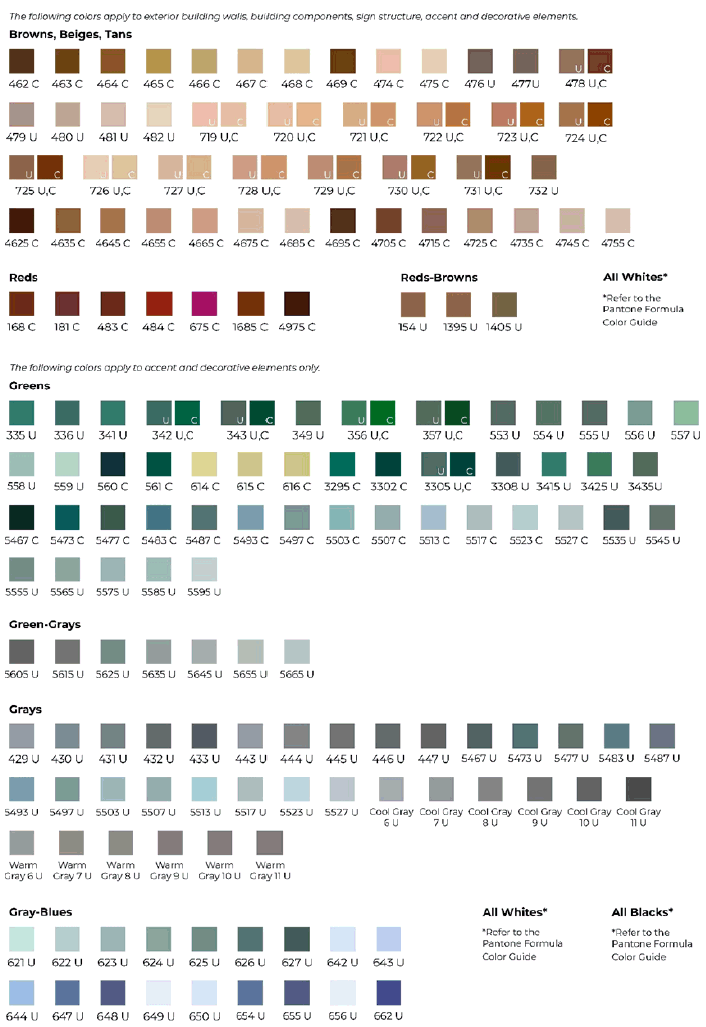
The code number under each color refers to the Pantone Matching System, an International Color Matching System. An online color search tool can be accessed here: https://www.pantone.com/color-finder?from=topNav. To search for a color, type the code number code into the search box. Include a space between the number and letters.
Sec. 507.14. - Parking.
(a)
All off-street parking for townhouses and multi-family buildings shall be located to the side, rear or enclosed.
(b)
A minimum of 50 percent of the required surface parking for out-parcels shall be located at the rear of the building.
(c)
On-street parking is allowed subject to the approval of the CDRA Director.
(d)
No parking or loading area shall be used for the sale, repair, dismantling or servicing or storing of any vehicle, equipment, materials or supplies.
(e)
All developments must provide space for parking bicycles. This area may be within the parking lot or courtyard. A bike rack shall be permanently attached to the ground accommodating a bicycle lock or chain.
(f)
All parking and loading areas shall be screened from public streets by either a minimum four-foot high berm and/or a continuous hedge of evergreen shrubs.
Sec. 507.15. - Utility placement.
All utilities shall be located underground.
Sec. 507.16. - Signs.
(a)
The architectural color standards of the overlay district apply to the sign structure and not the sign face.
(b)
Sign structures and faces constructed of wood or canvas materials are prohibited.
(c)
Window signs are prohibited.
(d)
Roof mounted flagpoles are prohibited.
Sec. 507.17. - Stormwater management facilities.
All required detention/retention facilities shall be designed to meet the South Fulton alternative design standards that have the intent of making such facilities an attractive amenity or focal point for the subdivision per current South Fulton Subdivision Regulations.
Sec. 507.18. - Design guidelines for the Cedar Grove community.
The purpose of these design guidelines is to help preserve the rural nature of the Cedar Grove Community, the night sky, green space, vistas, the "country" feel, and open space. These guidelines are encouraged but are not standards. Therefore, noncompliance does not necessitate variances.
(a)
Site design.
(1)
All design strategies shall minimize changes to the existing topography and loss of mature vegetation and water features.
(2)
Minimize level grading. New developments should step with landforms and maximize preservation of existing vegetation and trees. Level grading of entire lots is to be avoided.
(3)
Transitions at property lines should seem natural for the surrounding terrain. Where the existing terrain is generally level, avoid newly graded slopes greater than 1:3 at property lines.
(4)
Cut and fill slopes should be rounded where they meet natural grade to blend with natural slope.
(5)
Natural contouring and re-vegetation are encouraged. Retaining walls should be faced with indigenous rock, brick and/or constructed to blend with adjacent surroundings.
(6)
Storm water retention for multiple sites should be combined into a lake as opposed to individual drainage ponds.
(7)
Permanent conservation easements should be established to protect water sheds, view sheds, and rare habitats.
(b)
Buildings and courtyards.
(1)
Buildings should be oriented to avoid summer overheating.
(2)
Locate courtyards for optimum southern exposure in winter and provide for shading in the summer.
(3)
Locate buildings so that solar heat is naturally reduced on hot summer days by landscape strips and trees.
(4)
Coordinate corner buildings with adjacent developments. Generally, the primary mass of a building on a corner should not be placed at an angle to the corner. Angled or sculpted building corners and open plazas should not be precluded from corners. Vertical focal points to visually anchor corners are encouraged.
(5)
Courtyards should include such features as sculptures or fountains as focal points, moveable seating and tables, sunny and shaded areas, several entrances into courtyards, variety of textures and colors for visual interest, landscaping, covered and uncovered outdoor passageways.
(c)
Street standards.
(1)
Culs-de-sac are prohibited unless approved by the CDRA Director.
(2)
The following street standards shall also apply:
(d)
Parking.
(1)
On-street parking (parallel, diagonal, and head-in) is encouraged.
(2)
All developments shall provide connectivity to adjacent developments to link buildings and open spaces together to minimize vehicular traffic and other impacts.
(e)
Architectural features/enhancements are as follows:
(1)
Trim to include eaves, corner boards, gable and eave boards, pediments, friezes, lintels, sills, quoins, belt courses, balustrades;
(2)
Gables, dormers, pillars, posts, porches, recessed windows and doors, cupolas, bay windows;
(3)
Half-rounded or quarter-rounded roof gutters and down spouts integrated with trim;
(4)
Glass storefronts, transom windows, building wall offsets, projections, recesses, floor level changes, roof-line offsets;
(5)
Architectural treatments of front facades shall continue major features around all visibly exposed sides of a building.
(6)
Restaurants with outdoor seating should allow for ease of pedestrian circulation, adequate shade through the use of extended awnings, canopies, or large umbrellas, provide outdoor trash receptacles, and maintain clean and litter-free premises.
(f)
Viewsheds.
(1)
All development proposals should arrange buildings to preserve views from adjacent properties and streets.
(2)
Locate courtyards, surface parking, and open spaces to align with view sheds from adjacent properties.
(3)
Locate drives, parking, and open spaces on high points. Avoid placing buildings except churches or public buildings of high architectural quality on ridge lines.
(4)
All new developments will be reviewed with respect to topography and existing landforms, existing vegetation and trees, soil properties and bed rock depth, existing watercourses, floodway and flood plain areas, drainage patterns, climatic factors and view sheds.
(5)
All new developments will be reviewed for land use and site organization in relation to building form, character, and scale of existing and proposed development, sensitivity and nature of adjoining land uses, location of adjacent roads, rights-of-way, driveways, off-street vehicular connections, pedestrian ways, access points, easements, existing structures and other built improvements, prehistoric and historic sites, structures and routes, and any other features that may be impacted or impact the proposed new development.
Sec. 508.02. - Purpose and intent.
(a)
The purpose and intent of the Cedar Grove Agricultural Overlay District (District) is to protect the natural areas and ensure responsibly planned economic and social growth.
(b)
Within the Cedar Grove Agricultural Overlay District, the Mixed Use - Cedar Grove Agricultural zoning district (MIX-CGA) and the Community Unit Plan - Cedar Grove Agricultural zoning district (CUP-CGA) allow for developments with a mix of uses for residents to live, work and relax.
(c)
To further protect the rural land and natural resources of the area, standards have been established to provide for green space and open space throughout the District.
(d)
Agriculturally zoned properties and rural services will remain prevalent throughout the area.
(e)
The Cedar Grove Agricultural District will ensure that mixed-use future growth occurs and that many types of housing for all incomes and ages will be provided. The developments will provide connectivity for pedestrians, bicyclists and motorists.
Sec. 508.03. - Applicability.
The Cedar Grove Agricultural Overlay District and the regulations of this Section 508 apply to all properties located in that portion of South Fulton bordered to the west by the Chattahoochee River, to the south by Coweta County, and to the east by Cascade-Palmetto Highway (SR 154) that are not within the municipal limits of the City of Chattahoochee Hill Country except as noted in Section 508.06 below. See Section 508.01 above for a boundary map.
Sec. 508.04. - Architectural review process.
(a)
Prior to issuance of a land disturbance permit (LDP) or a building permit, the applicant shall submit details of exterior materials, colors, landscape strips, buffers, signage, lighting, parking, streets and paths, entrances, design and architectural features of the proposed site and building which demonstrate compliance with the design standards set forth herein.
(b)
Prior to the issuance of an LDP or building permit, the community will be allowed ten working days to review the application. An application which otherwise conforms to applicable codes and regulations shall not be delayed issuance of an LDP or building permit for more than ten working days due to this review and comment process.
(c)
South Fulton staff will review all applications for land disturbance permits, building permits and sign permits for compliance with the standards of this overlay district and upon determination of compliance will provide a certificate of endorsement (COE) in the form of signing the formally submitted plans and drawings.
Sec. 508.05. - MIX-CGA and CUP-CGA districts; requirements.
See Article 4 for allowed uses and development standards.
Sec. 508.06. - Area wide development standards.
(a)
The area wide development standards apply to all properties zoned or developed for nonresidential and residential uses including all single-family platted subdivisions but excluding all properties zoned for MIX-CGA and CUP-CGA as well as the scenarios described in Section 508.06(b) below.
(b)
Stand-alone single-family detached dwelling units and minor subdivisions are excluded from these area wide standards with the exception of the South Fulton Parkway buffer and setback requirements, and the building materials standards in Section 508.06 (f) below.
(c)
See Article 4 for requirements that pertain to buildings and lots in the MIX-CGA and CUP-CGA zoning districts.
(d)
Streetscape features. Lighting, signage, benches, recycling bins, trash receptacles, drinking fountains, and other street furniture shall be compatible in material, color, finish and architectural style of the surrounding area.
(e)
Lighting.
(1)
Cobra light fixtures, non-LED shoebox light fixtures, and neon lighting are prohibited.
(2)
Light fixtures shall be designed and located to minimize spillage onto adjoining properties.
(3)
Lighting shall use a type of shielding to direct lighting downward.
(f)
Building materials.
(1)
Vinyl siding, aluminum siding and synthetic stucco are prohibited materials on all dwelling types.
(2)
Reflective and mirrored glass is prohibited on non-residential buildings.
(g)
Wireless telecommunications.
(1)
Telecommunications switchboards, power generators, and other telecommunication relay equipment rooms or floors housing such uses are limited to the following areas of a building:
a.
Subterranean levels;
b.
First and second floors which are set back a minimum of 50 feet from the street; or
c.
Third and fourth floors.
(2)
Cellular towers.
a.
Alternative antenna support structures are required for all cell towers. Man-made trees are allowable.
b.
Height of towers shall not exceed 199 feet.
c.
The wireless communications facility shall be disassembled and removed from the site within 90 days of the date its use for wireless telecommunications is discontinued.
(h)
Water towers.
(1)
Towers shall be constructed of natural materials or if metal painted to blend with the landscape.
(2)
Except for safety purposes, water tower lighting shall be allowed only during maintenance periods. Each outdoor light that is not required for safety shall be fully shielded. The safety lighting shall use a type of shielding to provide lighting downward.
(i)
Signage.
(1)
General provisions for all signs.
a.
Internal illumination is not allowed. If illumination is used, the sign shall be externally illuminated. External lighting is limited to either top mounted fixtures where the fixture is mounted on the top of the sign structure and the light directed downward or ground mounted fixtures where the light fixture is screened from view with landscaping.
b.
Freestanding and walls signs including both the sign structure and the sign face shall be made out of wood, material designed to have the appearance of natural wood, or metal. Plastic inserts are not allowed.
c.
Project entrance pillar sign standards.
1.
Pillar signs shall be designed to have the appearance of a four-sided column and shall be constructed of natural stone, wood or materials designed to have the appearance of natural wood. Brick is a prohibited material.
2.
Pillar sign faces shall be constructed of natural stone, metal, wood or materials designed to have the appearance of natural wood. Plastic inserts are not allowed. Brick is a prohibited material.
(2)
Non-residential uses.
a.
All freestanding signs shall be of shingle design.
b.
The maximum size of the sign face shall be nine square feet. Sign copy is allowed on both sides of the sign face.
c.
Wall signs shall be a maximum of three percent of the applicable wall area.
d.
Window signs are prohibited.
(3)
Residential uses.
a.
One identification pillar sign or one freestanding sign is allowed per entrance.
b.
The maximum size of an identification pillar sign structure is eight feet in height and three feet in width per side.
c.
The maximum size of the sign face on identification pillar signs is nine square feet for each side.
d.
The sign face shall be directly mounted on or in the identification pillar sign structure or can be mounted to hang perpendicular to the identification pillar sign structure in the manner of a shingle sign.
e.
Freestanding signs shall not exceed ten feet in height.
f.
The maximum size of the sign face on freestanding signs shall be nine square feet. Sign copy is allowed on both sides of the sign face.
(j)
Landscaping, buffers and setbacks.
(1)
Acceptable evergreen plant material and deciduous trees for undisturbed buffers within the bounds of the CGA Overlay District are limited to the following: Cherry Laurel, Eastern Red Cedar, Canadian Hemlock, Deodar Cedar, American Holly, Nellie R. Stevens Holly (cross between Chinese & English Hollies), Southern Magnolia, Virginia Pine, Red Maple, River Birch, American Hornbeam, Hickories, Sugar Hackherry, American Beech, Sweet Gum, Poplar, Black Gum, Oaks and Linden/Basswood.
(2)
Along the entire frontage of the South Fulton Parkway, a 100-foot natural, undisturbed buffer is required along the right-of-way with an additional ten-foot setback interior to the buffer (except for approved access and utility crossings, improvements and replantings where sparsely vegetated subject to the approval of the South Fulton Arborist). Only existing AG-1 (Agricultural) uses and pedestrian and bicycle paths are permitted in the setback. This standard applies to all properties with frontage on the South Fulton Parkway and along the rights-of-way of public roads which intersect the parkway for a distance of 300 feet measured from the intersection with the parkway, including stand-alone single family-detached dwelling units and minor subdivisions. When the undisturbed buffer is grassed or pasture, the applicant shall plant to City buffer standards or as approved by the Director Community Development and Regulatory Affairs using materials listed in Section 508.06(j)(1) above.
(3)
Along the entire frontage of the South Fulton Scenic Byways, a 100-foot natural, undisturbed buffer is required along the right-of-way with an additional ten-foot setback interior to the buffer (except for approved access and utility crossings, improvements and replantings where sparsely vegetated subject to the approval of the South Fulton Arborist). Only existing AG-1 (Agricultural) uses and pedestrian and bicycle paths are permitted in the setback. This standard applies to all properties with frontage on a South Fulton Scenic Byway and along the rights-of-way of public roads which intersect a South Fulton Scenic Byway for a distance of 300 feet measured from the intersection with the South Fulton Scenic Byway. When the undisturbed buffer is grassed or pasture, the applicant shall plant to City buffer standards or as approved by the Director of Community Development and Regulatory Affairs using materials listed in Section 508.06(j)(1) above.
(4)
All residential uses except stand-alone single family detached dwelling units and minor subdivisions shall provide a minimum 100-foot wide natural undisturbed buffer along all property lines with an additional ten-foot setback interior to the buffer (except for approved access and utility crossings and replantings where sparsely vegetated). When the undisturbed buffer is grassed or pasture, the applicant shall plant to City buffer standards or as approved by the CDRA Director using plant materials listed in Section 508.06(j)(1) above.
(k)
Fences and walls.
(1)
Fence standards.
a.
Opaque fences along any road right-of-way are prohibited.
b.
Chain link fences along any road right-of-way are prohibited except when constructed as part of recreational courts or recreational fields.
c.
Allowable fence materials: wood, wire or materials designed to have the appearance of natural wood.
d.
Allowable fencing types: split rail, 3-4 horizontal rail, crossbuck and horse wire or combination thereof.
(2)
Wall standards.
a.
Walls are limited to two feet in height.
b.
Allowable wall materials: wood, stone or materials designed to have the appearance of natural wood.
(l)
Street standards.
(1)
All newly created lots shall derive access from internal subdivision streets.
(2)
All streets should follow existing contour with a minimum of cut and fill and shall be designed for interparcel pedestrian and vehicular access.
(m)
Amenity areas. Amenity areas and recreational facilities shall be located interior to the subdivision.
(n)
Stormwater management facilities. All required detention/retention facilities shall be designed to meet the South Fulton alternative design standards that have the intent of making such facilities an attractive amenity or focal point for the subdivision per current South Fulton Subdivision Regulations.
(o)
Accessory site features. Loading areas, dumpster areas, service yards, mechanical and electrical equipment and other utilities, including roof top equipment, shall be screened with evergreen plant material, opaque fences, or structural screens of materials matching the exterior building facade.
(p)
Utility Placement. All utilities shall be located underground.
Sec. 509.02. - Purpose and intent.
(a)
The City Council of South Fulton, Georgia hereby declares it to be the purpose and intent of this Section 509.
(b)
Cliftondale Overlay District (District) to establish a uniform procedure for providing for the protection, enhancement, preservation, unity of design, and use of sites, buildings, structures, streets, neighborhoods, and landscape features in the District in accordance with the provisions herein.
(c)
This Cliftondale Overlay District is adopted as part of a strategy designed to promote the health, safety, order, prosperity, and general welfare of the citizens of South Fulton through the regulation of design, aesthetics, location, bulk, size of buildings and structures, and the density and distribution of population.
(d)
This District seeks to reduce congestion on the streets; to provide safety from fire, flood and other dangers; provide adequate light and open space; protect the natural environment and address other public requirements, in order to provide sustainable development that involves the simultaneous pursuit of economic prosperity, environmental protection and social quality.
(e)
This District also seeks to promote accepted design principles in areas of new development and redevelopment, to raise the level of community understanding and expectation for quality in the built environment, to protect and enhance local aesthetic and functional qualities, to stimulate business and promote economic development.
(f)
In consideration of the character of the District, the regulations in this Section 509 are intended to monitor the suitability for certain uses, construction and design, prevent functional and visual disunity, promote desirable conditions for community and commerce and protect property against blight and depreciation.
Sec. 509.03. - Applicability.
(a)
The District and the regulations of this Section 509 apply to all properties zoned or developed for nonresidential and residential uses (except as indicated in Section 509.03(b) below) and structures within the area illustrated on the map in Section 509.01.
(b)
Single-family detached dwellings are exempt from the District requirements, with the exception that the building material prohibitions in Sec 507.12(b)509.12(b) shall apply.
(c)
If any portion of a parcel and/or development is located in the defined boundary area, the entire parcel and/or development shall comply with the standards herein.
(d)
The District also recognizes the Cliftondale Crossroads as designated in the South Fulton Comprehensive Plan.
Sec. 509.04. - Architectural review process.
(a)
Prior to issuance of a building permit, the applicant shall submit details of exterior materials, colors, design and architectural features of the proposed building which demonstrate compliance with the design standards set forth in this ordinance.
(b)
South Fulton staff will review all applications for land disturbance permits, building permits and sign permits for compliance with the standards of this overlay district and upon determination of compliance will provide a Certificate of Endorsement (COE) in the form of signing the formally submitted plans and drawings.
(c)
Prior to the issuance of a building permit, the community will be allowed ten working days to review and comment. An application which otherwise conforms to applicable codes and regulations shall not be delayed issuance of a building permit for more than ten working days due to this review and comment process.
(d)
All building plans submitted as an application for a building permit should clearly indicate all of the proposed building materials and colors for each facade in accordance with Section 509.12 and Section 509.13. The plans should clearly show the location and calculate the amount/percentages of all building materials per facade.
Sec. 509.05. - Landscaping, buffers and street tree requirements.
(a)
All AG-1 and residentially zoned developments shall provide a minimum 50-foot wide natural, undisturbed buffer with a ten-foot improvement setback along all public streets.
(b)
All non-residentially (except AG-1) zoned developments shall provide a minimum 50-foot wide landscape strip along all public streets.
(c)
A minimum 50-foot wide natural, undisturbed buffer with a ten-foot improvement setback shall be provided along any interior property line adjacent to a residential zoning and/or use.
(d)
A minimum 15-foot wide landscape strip shall be provided along any interior property line adjacent to a nonresidential zoning and/or use.
(e)
Large, overstory trees shall be planted 40 to 60 feet on center and are allowed along residential and commercial streets.
(f)
Small, understory trees shall be planted ten to 30 feet on center along residential streets.
(g)
Street trees shall be a minimum of two-inch caliper diameter at breast height (DBH).
(h)
Street trees shall be selected from Appendix E of the South Fulton Tree Preservation Ordinance and Administrative Guidelines or as may be approved by the South Fulton Arborist.
Sec. 509.06. - Accessory site features.
(a)
Accessory site features are prohibited in the front yard of any property.
(b)
Accessory site features located on the ground shall be screened from view from any public right-of-way, any residential use, or any residential or AG-1 zoning district by one of the following: placement behind the building, 100 percent opaque fencing, berm or vegetative screen planted to buffer standards.
(c)
Accessory site features on a roof shall be screened by a parapet or other architectural feature or as approved by the director.
Sec. 509.07. - Refuse areas and receptacles.
(a)
Refuse areas and receptacles shall be placed in the least visible location from public streets and shall be enclosed on three sides with opaque walls. The fourth side shall be a self-closing gate made from noncombustible materials.
(b)
Required opaque walls shall be a minimum of 12 inches higher than the receptacle. Wall materials shall be noncombustible brick, stone, or split-faced concrete masonry block.
(c)
Refuse receptacles shall not be placed within 50 feet of an existing residential or AG-1 zoning district.
Sec. 509.08. - Fencing and walls.
(a)
Fencing materials along public streets and side yards, golf courses, play fields and other recreational areas are restricted to decorative stone, iron, wrought iron, treated wood, white picket, and/or minimum three-rail horse fencing with posts.
(b)
Opaque fences are prohibited adjacent to public streets.
(c)
When required, fencing material around detention/retention facilities shall be constructed in accordance with the South Fulton Subdivision Regulations or as approved by the CDRA Director. Vegetation shall be planted in accordance with Article 4 of this Ordinance.
(d)
Retaining walls shall be faced with or constructed of stone, brick, or decorative concrete modular block only.
Sec. 509.09. - Sidewalks/pedestrian paths.
(a)
Sidewalks are required along all public and private road frontages (except alleys) and shall meet all applicable Americans with Disabilities Act (ADA) standards.
(b)
Sidewalks and other paths (multi-purpose or pedestrian) shall be illustrated on the site plan submitted at the time of application for a Land Disturbance Permit.
(c)
Meandering sidewalks are permissible upon approval by the CDRA Director.
(d)
Pedestrian paths shall be a minimum width of five feet.
(e)
Pedestrian paths may be constructed of either colored/textured materials or conventional sidewalk materials and shall be clearly identified.
(f)
Multi-use paths for bicycles and pedestrians may be substituted for the required sidewalks as approved by the director when the path is part of the South Fulton Bicycle and Pedestrian Plan.
(g)
Multi-use paths designed for use by bicyclists and pedestrians shall be a minimum of 15 feet wide; five feet for the pedestrian sidewalk and ten feet for the bicyclists.
(h)
Street furniture shall be located outside the specified width of any path.
(i)
Paths shall be connected to signalized crosswalks where applicable.
(j)
Paths shall be designed to minimize direct auto-pedestrian interaction.
(k)
Paths should be direct and convenient routes between points of origin (such as a bus stop) and destination (such as a shop, bank, etc.).
(l)
Pedestrian access should be provided to all entrances including access from rear parking areas.
Sec. 509.10. - Lighting.
(a)
A lighting plan for open parking lots and pedestrian paths shall be submitted for approval prior to the issuance of a land disturbance permit.
(b)
Open parking lots and walkways providing access thereto shall be provided with a maintained minimum two-foot candles (a measure of illumination) of light measured at grade level.
(c)
The maximum to minimum foot candle level shall not exceed a 12:1 ratio.
(d)
Non-LED shoebox lighting fixtures, cobra lighting fixtures, and neon lighting are prohibited.
(e)
Any luminaire with a lamp or lamps rated at a total of MORE than 1,800 lumens, and all flood or spot luminaires with a lamp or lamps rated at a total of MORE than 900 lumens, shall not emit any direct light above a horizontal plane through the lowest direct-light-emitting part of the luminaire.
(f)
Any luminaire with a lamp or lamps rate at a total of MORE than 1,800 lumens, and all flood or spot luminaires with a lamp or lamps rated at a total of MORE than 900 lumens, shall be mounted at a height equal to or less than the value 3 + (D/3), where D is the distance in feet to the nearest property boundary. The maximum height of the luminaire may not exceed 25 feet.
(g)
Any luminaire with a lamp or lamps rated at a total of 1800 lumens or LESS, and all flood or spot luminaires with a lamp or lamps rated at 900 lumens or LESS, may be used without restriction to light distribution or mounting height, except that if any spot of flood luminaire rated 900 lumens or LESS is aimed, directed, or focused such as to cause direct light from the luminaire to be directed toward residential buildings on adjacent or nearby land, or to create glare perceptible to persons operating motor vehicles on public ways, the luminaire shall be redirected or its light output controlled as necessary to eliminate such conditions.
(h)
Luminaires used for public-roadway illumination may be installed at a maximum height of 25 feet and may be positioned at that height up to the edge of any bordering property.
(i)
All temporary emergency lighting needed by the police or fire departments or other emergency services, as well as all vehicular luminaires, shall be exempt from the requirements of this article.
(j)
All hazard warning luminaires required by Federal regulatory agencies are exempt from the requirements of this article, except that all luminaries used must be red and must be shown to be as close as possible to the Federally required minimum lumen output requirement for the specific task.
(k)
Luminaires used primarily for sign illumination may be mounted at any height to a maximum of 25 feet, regardless of lumen rating.
(l)
Lighting fixtures used to illuminate a billboard shall be mounted on the top of the sign structure. All such fixtures shall use a type of shielding to direct lighting downward. Bottom-mounted sign lighting shall not be used.
(m)
The use of laser source light or any similar high intensity light, searchlights, permanent mounted exterior neon lights, back-lit awnings, and roof mounted lights are prohibited.
Sec. 509.11. - Building design.
(a)
Buildings shall include architecture elements such as columns, arcades, covered entry-walkways, arches, facade offsets, windows, balconies, offset walls, clock towers, cupolas and/or courtyards.
(b)
All buildings shall be oriented to face a street or a courtyard.
(c)
The principal entry area of a building shall be articulated and express greater architectural detail than other portions of the building.
(d)
All primary entrances which face a street shall be at street level.
(e)
Buildings are limited to 35 feet in height.
(f)
To the extent any rear or side of any building is visible from any public street or single-family residence, architectural treatment shall continue through the rear or side.
(g)
For large commercial/retail buildings, variations in facade, roofline and depth should be provided to lend the appearance of multi-tenant occupancy.
(h)
Fuel pumps, canopies and associated gasoline station service areas should be located at the rear of the structure, not between the building and the street, to allow the building to be the spatial edge of the streetscape.
(i)
Permissible roofs are gable, pyramidal, and hip. Shed roofs are permitted over porches, additions, and accessory structures. Roof pitches shall be 5/12 to 12/12.
(j)
Roof mounted flagpoles are prohibited.
Sec. 509.12. - Building materials.
(a)
The exterior wall materials of all nonresidential buildings shall consist of a minimum of 60 percent (per vertical wall plane) of the following: brick, stone, or clapboard (or an equivalent alternative treatment approved by the Director of Community Development and Regulatory Affairs). Reflective glass is prohibited.
(b)
The exterior wall materials of all residential buildings shall consist of a minimum of 60 percent (per vertical wall plane) of the following: brick, stone, stucco, solid plank, cementitious plank, or horizontal clapboard siding (or an equivalent alternative treatment approved by the Director of Community Development and Regulatory Affairs). Vinyl siding, aluminum siding and synthetic stucco is prohibited.
(c)
Any nonresidential building facade shall have a minimum of 25 percent fenestration or as may be approved by the CDRA Director. Black glass, tinted glass, and/or mirrored glass is prohibited.
(d)
Accent wall materials on residential and nonresidential buildings shall consist of glass, architecturally treated concrete masonry, precast stone, or traditional stucco (or an equivalent alternative treatment approved by the Director of Community Development and Regulatory Affairs) and shall not exceed 40 percent per vertical wall plane.
(e)
Exterior finishes for accessory structures shall be consistent with the principal structure.
(f)
Allowable roof materials for pitched roofs are asphalt shingles, composition shingles, wood shingles, wood shake, slate, terra cotta or as may be approved by the CDRA Director.
Sec. 509.13. - Building colors.
(a)
Roof colors shall be black, gray, brown, or green. Reflective and metallic colors are prohibited.
(b)
Colors for exterior walls, building components, sign structures, accent and decorative elements must be chosen from the tones and shades specified in the color chart below (from the Pantone Formula Color Guide) or as approved by the CDRA Director.
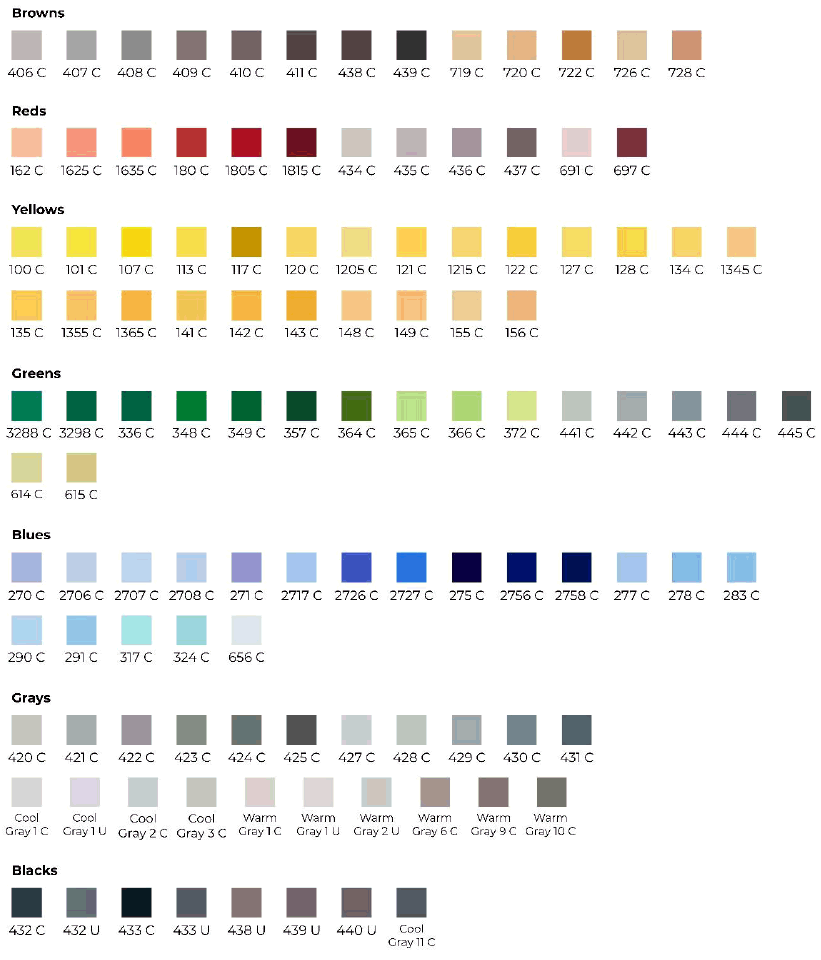
The code number under each color refers to the Pantone Matching System, an International Color Matching System. An online color search tool can be accessed here: https://www.pantone.com/color-finder?from=topNav. To search for a color, type the code number code into the search box. Include a space between the number and letters.
Sec. 509.14. - Parking.
(a)
Off-street parking shall be located to the rear or side of the building.
(b)
Parallel and angle-in on-street parking is allowed subject to the approval of the CDRA Director.
(c)
For commercial and multi-family uses only, no more than 50 percent of the required parking spaces shall be located in the front and side of a building.
(d)
Shared parking within a multi-tenant development is required and shall be in accordance with the provisions of Article 6 of the Zoning Ordinance.
(e)
No parking or loading area shall be used for the sale, repair, dismantling or servicing or storing of any vehicle, equipment, materials or supplies.
(f)
Bicycle parking areas shall be provided for each nonresidential development.
(g)
All parking and loading areas shall be screened from public streets by either a minimum four-foot high berm and/or a continuous hedge of evergreen shrubs.
Sec. 509.15. - Wireless telecommunications.
(a)
Stealth design is required for all cell towers.
(b)
Height of cell towers shall not exceed 199 feet.
(c)
Wireless communications facilities shall be disassembled and removed from the site within 90 days of the date its use for wireless telecommunications is discontinued.
(d)
Vending machines, paper stands, and other similar devices must be located inside a building.
Sec. 509.16. - Utility placement.
Utilities shall be installed underground.
Sec. 509.17. - Stormwater management facilities.
Retention/detention shall comply with the requirements of the South Fulton Subdivision Regulations.
Sec. 509.18. - Signs.
(a)
Building color standards shall apply to the sign structure and not the sign face.
(b)
Sign structures and faces constructed of wood or canvas materials are prohibited.
(c)
Door signs are allowed up to a maximum of 25 percent of the door area.
(d)
Window signs. Up to three window signs, each no greater than four square feet, are allowed on a principal building. The window sign(s) shall not cover more than ten percent of the area of each window in which the sign is placed.
Sec. 510.01.- Boundary map.
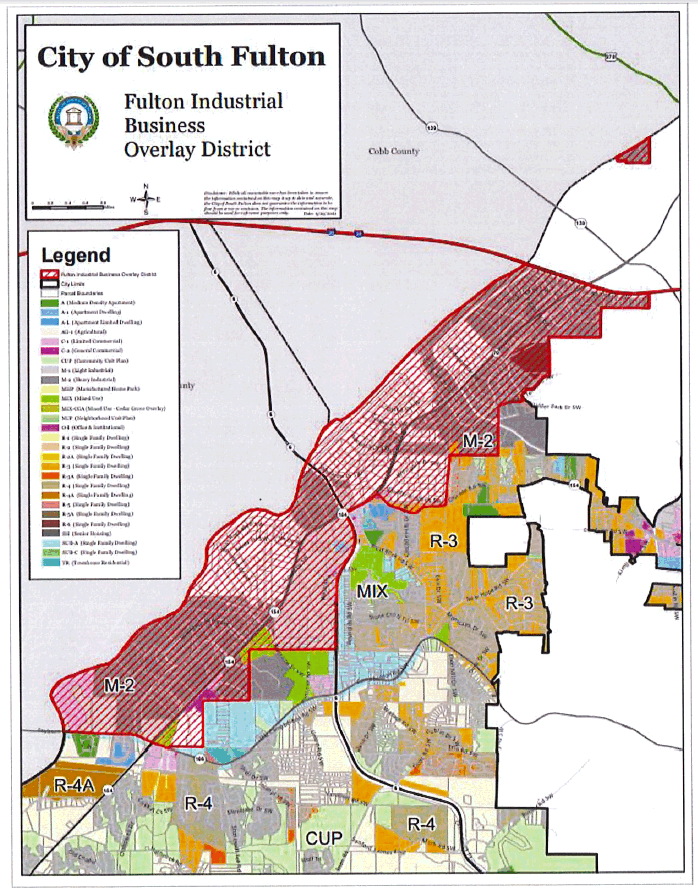
(Ord. No. 2021-039, § 1(Exh. A), 12-21-2021)
Sec. 510.02. - Purpose and intent.
(a)
The City Council of South Fulton Georgia hereby declares it to be the purpose and intent of this Section 510 Fulton Industrial Business District Overlay District (District) to establish a uniform procedure for providing for the protection, enhancement, preservation, unity of design, and use of places, sites, buildings, structures, streets, and landscape features in the Fulton Industrial Business District in accordance with the provisions herein.
(b)
This District is adopted as part of a strategy designed to promote the health, safety, order, prosperity, and general welfare of the citizens of South Fulton through the regulation of design, aesthetics, location, bulk, size of buildings and structure.
(c)
This District also seeks to reduce congestion on the streets; to provide safety from fire, flood and other dangers; provide adequate light and open space; protect the natural environment and address other public requirements, in order to provide sustainable development that involves the simultaneous pursuit of economic prosperity, environmental protection and social quality.
(d)
This District also seeks, among other things, to promote accepted design principles in areas of new development and redevelopment, to raise the level of community understanding and expectation for quality in the built environment, to protect and enhance local aesthetic and functional qualities, and to stimulate business and promote economic development.
(e)
In consideration of the character of the Fulton Industrial Business District, the regulations in this Section 510 are intended to monitor the suitability for certain uses, construction and design, prevent functional and visual disunity, promote desirable conditions for community and commerce and protect property against blight and depreciation.
Sec. 510.03. - Applicability.
(a)
The Fulton Industrial Business District Overlay District and the regulations of this Section 510 apply to all properties zoned or developed for nonresidential uses and residential uses except as indicated in Section 510.03(b) below. See map in Sec 510.01 above for boundaries of the District.
(b)
Single-family detached dwelling units are exempt from the District requirements, with the exception that the building material prohibitions in Section 510.05(d)(6) shall apply.
(c)
For any parcel in which there is a question as to applicability of the overlay district standards, a final determination will be made by the Director of Community Development and Regulatory Affairs.
Sec. 510.04. - Architectural review process.
(a)
Prior to the issuance of a land disturbance permit (LDP) or a building permit, the applicant shall submit details of exterior materials, colors, landscape strips, buffers, signage, lighting, parking, streets and paths, entrances, design and architectural features of the proposed site and building which demonstrate compliance with the design standards set forth herein.
(b)
Prior to the issuance of an LDP or building permit, the community will be allowed ten working days to review the application. An application which otherwise conforms to applicable codes and regulations shall not be delayed issuance of an LDP or building permit for more than ten working days due to this review and comment process.
(c)
CDRA staff will review all applications for land disturbance permits, building permits and sign permits for compliance with the standards of this Overlay District and upon determination of compliance will provide a Certificate of Endorsement (COE) in the form of signing the formally submitted plans and drawings.
Sec. 510.05. - Development standards that apply to all properties within the Fulton Industrial Business District.
(a)
Refuse areas and receptacles.
(1)
Refuse areas and receptacles shall be identified on site plans.
(2)
Refuse areas and receptacles shall be placed in the least visible location from the public right-of-way.
(3)
Refuse areas and receptacles shall not be placed within 50 feet of existing residential zoning or use.
(4)
Refuse areas shall be enclosed on three sides with opaque walls. The fourth side shall be a self-closing gate made of non-combustible materials.
(5)
Opaque walls shall be 12 inches higher than the receptacles.
(6)
Opaque walls shall be constructed of same materials and colors as that of the primary building. If primary building material is not a masonry material, the opaque walls shall be constructed of non-combustible brick, stone, split concrete masonry block or other similar material as approved by the Director of Community Development and Regulatory Affairs.
(b)
Retaining walls. Retaining walls, when visible from a public right-of-way, are to be faced with or constructed of stone, brick, decorative concrete modular block or other similar material as approved by the Director of Community Development and Regulatory Affairs.
(c)
Sidewalks.
(1)
Sidewalks shall be connected to signalized crosswalks and bus stops where applicable.
(2)
Street furniture shall be located outside the specified width of any sidewalk.
(d)
Building materials and architectural treatments.
(1)
Variations shall be incorporated into all facades visible from the public right-of-way and shall include architecture elements such as columns, arcades, covered entry-walkways, arches, façade offsets, windows, balconies, offset walls, clock towers, cupolas and/or courtyards.
(2)
The principal entry area of a building shall be articulated and express greater architectural detail than other portions of the building.
(3)
The office portion of industrial buildings shall be located in the front portion of buildings, facing the public right-of-way.
(4)
The office portion of industrial buildings shall be designed with a minimum of 40 percent of their exterior facade as windows.
(5)
Accessory structures/buildings, when visible from a public right-of-way, shall have architectural features consistent with the principal buildings.
(6)
Vinyl siding and synthetic stucco are prohibited on residential uses.
(e)
Sign materials. Sign structures and faces constructed of wood or canvas materials are prohibited on all permanent signs.
(f)
Utility Placement. All utilities shall be located underground.
(g)
Stormwater Management Facilities. All required detention/retention facilities shall be designed to meet the South Fulton alternative design standards that have the intent of making such facilities an attractive amenity or focal point for the subdivision per current South Fulton Subdivision Regulations.
Sec. 510.06. - Additional standards for all properties designated as industrial on the future development map with frontage on Fulton Industrial Boulevard.
(a)
Buffers and landscaping. A minimum 15-foot wide landscape strip is required along all frontages on Fulton Industrial Boulevard.
(b)
Outside storage and display.
(1)
All outside storage is to be screened when visible from Fulton Industrial Boulevard.
(2)
Screening shall be accomplished by a wall or fence of at least 50 percent opacity in the same colors of the primary building or by a ten-foot landscape strip planted to buffer standards. Lattice style screening and fences and walls constructed out of wood are prohibited.
(c)
Nonresidential building materials. All exterior walls visible from Fulton Industrial Boulevard shall meet the following standards.
(1)
No wood siding or reflective glass shall be permitted.
(2)
Exposed exterior walls visible from a street shall be composed of the following maximum and minimum percentages of materials in each classification. The percentages apply to the siding on each exposed exterior wall of each building.
(3)
Type A materials consist of brick; stone with weathered, polished or fluted face; marble aggregate masonry block with fluted, split-face, or broken-face finish; tilt-up, poured-in-place or precast concrete either fluted or with exposed aggregate finish; insulated window wall panels of stainless steel, porcelain treated steel, anodized or other permanently finished aluminum, and stucco or synthetic stucco.
(4)
Type B materials consist of metal panels with baked-on enamel or acrylic finish.
(5)
Type C materials consist of plain reinforced concrete slabs.
(6)
Type D materials consist of corrugated steel and aluminum, wood, and composite board.
(7)
Materials not listed above may be presented to the Director of Community Development and Regulatory Affairs and the Director of Public Works for classification.
(8)
Buildings having walls over 25 feet high may be given special material percentages by the Director of Community Development and Regulatory Affairs and the Director of Public Works.
(d)
Fence materials. Wood fencing is prohibited.
(e)
Sign materials.
(1)
Free-standing sign structures shall be constructed of brick, granite, stone, marble or other material used in the primary building and be in the same colors as the primary building.
(2)
If primary building materials are non-conforming, the free standing signs shall be constructed of materials prescribed by Section 510.06(c) above or other material as approved by the Director of Community Development and Regulatory Affairs.
Sec. 510.07. - All properties designated as industrial marketplace on the future development map within the Fulton Industrial Business District.
(a)
Accessory site features: other (See Section 510.05(a) for refuse areas and receptacles).
(1)
Accessory site features are prohibited in the front yard.
(2)
Accessory site features located on the ground shall be screened from view from any street, and any residential zoning or use by one of the following: placement behind the building, 100 percent opaque fence or wall, berm or vegetative screen planted to buffer standards.
(3)
Accessory site features on a roof shall be screened by a parapet or other architectural feature or as approved by the Director of Planning and Community Services.
(4)
Except for provided for in Article 3, the storage and/or sale of goods is prohibited in parking lots and other outside areas outside of the interior or permanently sheltered portions of a building. This standard does not apply to fuel pumps and ATMs.
(b)
Nonresidential building materials.
(1)
Industrially zoned buildings: All exterior walls visible from the public right-of-way shall consist of the following: stucco, stone, brick, or other similar alternative building material approved by the Director of Community Development and Regulatory Affairs.
(2)
Commercially zoned and/or commercially used buildings: All exterior walls shall consist of a minimum of 60 percent (per vertical plane) of the following: stucco, brick, or stone. Accent wall materials shall consist of non-reflective glass, architecturally treated concrete masonry or precast stone. Alternative treatments and building materials may be approved by the Director of Community Development and Regulatory Affairs.
(c)
Security devices.
(1)
Burglar bars, steel gates, and steel roll down curtains are prohibited on the exterior and interior of the structure except at the structures rear.
(2)
Security grilles are allowed if installed interior to the place of business.
(3)
Grilles should be of a grid or brick pattern and placed so that the grid is at a uniform height across the business front.
(d)
Fence materials. Wood privacy fencing is prohibited.
(e)
Sign standards.
(1)
Window signs are prohibited.
(2)
Free-standing sign structures shall be constructed of brick, granite, stone, marble or other material used in the primary building and be in the same colors as the primary building. If primary building materials are non-conforming, the free-standing signs shall be constructed of materials prescribed by Section 510.06(c) above or other material as approved by the Director of Planning and Community Services.
(f)
Sidewalks and pedestrian paths.
(1)
Sidewalks.
a.
All sidewalks are to be a minimum eight feet wide, of which two feet shall be a stamped brick pattern adjacent to the back of the curb.
b.
All handicap ramps shall be constructed per GDOT and South Fulton standards.
(2)
Pedestrian paths. Pedestrian paths shall be designed to minimize direct auto-pedestrian interaction by such means as striping, elevated walkways and signs.
Sec. 510.08. - Landscaping requirements.
A 15-foot-wide landscape strip along any public street shall be required when Article 4 of the Zoning Ordinance otherwise specifies a smaller landscape strip, in accordance with the following requirements:
(a)
The landscape strip may be as specified by the South Fulton Tree Preservation Ordinance or may be a combination of hardscape elements (plazas, planters, benches, fountains, and tables, etc.), ground cover, shrubs, and the required number of hardwood trees as specified by the Tree Preservation Ordinance.
(b)
Shrubs shall be a minimum height of three feet at time of planting.
(c)
A minimum of one two-inch caliper diameter at breast height (DBH)
hardwood
shade tree is required for every 30 linear feet of landscape strip.
(d)
A ten-foot-wide landscape strip shall be provided along any interior property line adjacent to a nonresidential zoning and/or use.
(Ord. No. 2021-040, § 1, 12-21-2021)
Sec. 511.02. - Purpose and intent.
(a)
The City Council of South Fulton, Georgia hereby declares it to be the purpose and intent of the Old National Highway Overlay District (District) to establish a uniform procedure for providing for the protection, enhancement, preservation, unity of design, and use of places, sites, buildings, structures, streets, neighborhoods, and landscape features in the Old National Highway District in accordance with the provisions herein.
(b)
The Old National Highway Overlay District is adopted as part of a strategy designed to promote the health, safety, order, prosperity, and general welfare of the citizens of South Fulton through the regulation of design, aesthetics, location, bulk, size of buildings and structures, and the density and distribution of population.
(c)
This District also seeks to reduce congestion on the streets; to provide safety from fire, flood and other dangers; provide adequate light and open space; protect the natural environment and address other public requirements, in order to provide sustainable development that involves the simultaneous pursuit of economic prosperity, environmental protection and social quality.
(d)
This District also seeks, among other things, to promote accepted design principles in areas of new development and redevelopment, to raise the level of community understanding and expectation for quality in the built environment, to protect and enhance local aesthetic and functional qualities, and to stimulate business and promote economic development.
(e)
In consideration of the character of the Old National Highway District, the regulations in this Section 511 are intended to monitor the suitability for certain uses, construction and design, prevent functional and visual disunity, promote desirable conditions for community and commerce and protect property against blight and depreciation.
Sec. 511.03. - Applicability.
(a)
The Old National Highway Overlay District and the regulations of this Section 511 apply to all properties zoned or developed for nonresidential and residential uses (except as indicated in Section 511.03(b) below) which have frontage on Old National Highway or have direct access to Old National Highway, or are located on streets that intersect Old National Highway in South Fulton between the City of College Park limits, Union City limits, and Fayette County (see map in Section 511.01 above).
(b)
Single-family detached dwellings are exempt from the District requirements, with the exception that the prohibitions on certain exterior finishes in Sections 507.12(b), 511.10(e) and 511.10(f) shall apply.
Sec. 511.04. - Architectural review process.
(a)
At the time of application for rezoning and/or use permit, a land disturbance permit or a building permit, the applicant will be directed to the community for a review of Old National Overlay Design Standards. The community will be allowed ten working days to review and comment. An application which otherwise conforms to applicable codes and regulations shall not be delayed issuance of a permit for more than ten working days due to this review and comment period.
(b)
Prior to the issuance of a building permit, the applicant shall submit samples of exterior materials, colors, design and architectural details of proposed building(s) and demonstrate compliance with the architectural design standards set forth in this Section 511.
(c)
CDRA staff will review land disturbance, exterior building and sign permit applications for compliance with the Old National Highway Overlay District. Upon determination of compliance, a Certificate of Endorsement (COE) will be provided in the form of signing the formally submitted plans and drawings.
Sec. 511.05. - Landscaping requirements.
(a)
A 15-foot wide landscape strip shall be required along any property line adjacent to a public street when Article 4 of this Ordinance otherwise specifies a smaller landscape strip.
(1)
The landscape strip may be as specified by the South Fulton Tree Preservation Ordinance, or may be a combination of hardscape elements (plazas, planters, benches, fountains and tables, etc.), ground cover, shrubs, and the required number of hardwood trees as specified by the Tree Preservation Ordinance.
(2)
Shrubs shall be a minimum height of three feet at time of planting.
(3)
A minimum of one two-inch caliper diameter at breast height (DBH) hardwood shade tree is required for every 30 linear feet of landscape strip.
(b)
A ten-foot wide landscape strip shall be provided along any interior property line adjacent to a nonresidential zoning and/or use.
(c)
All landscaped areas shall be maintained by the property owner(s).
(d)
Landscape treatments shall not obscure street addresses.
Sec. 511.06. - Accessory site features.
(a)
Accessory site features are prohibited in the front yard of any property.
(b)
Accessory site features located on the ground shall be screened from view from any public right-of-way, any residential use, or any residential or AG-1 zoning category by one of the following: placement behind the building, 100 percent opaque fencing, berm or vegetative screen planted to buffer standards.
(c)
Accessory site features on a roof shall be screened by a parapet or other architectural feature or as approved by the Director of Community Development and Regulatory Affairs.
(d)
Except as provided for in Article 3, the storage and/or sale of goods is prohibited in parking lots and other areas outside of the interior or permanently sheltered portions of a building.
(e)
Vending machines, paper stands, and other similar devices must be located inside a building.
(f)
Shopping carts shall be stored inside the structure or in parking lot receptacles and shall be subject to the requirements of Title 6, Chapter 5 Abandoned Shopping Carts of the City Codes of Ordinances.
Sec. 511.07. - Screening requirements and materials.
(a)
Refuse areas shall be enclosed on four sides with opaque fencing, 12 inches higher than the receptacle, and constructed of the same material as the building structure. One side shall be a self-closing gate. Refuse receptacles shall not be placed within 50 feet of an existing residential or AG-1 zoning district.
(b)
When required, fencing material around detention/retention facilities shall be black or hunter green vinyl coated chain link fence.
(c)
Retaining walls shall be faced with or constructed of stone, brick, or decorative concrete modular block only.
(d)
Loading docks shall be screened by a continuous hedge of evergreen shrubs. Shrubbery shall be a minimum height of five feet at time of planting. Shrubbery must be cared for under a continuous maintenance program.
(e)
Chain link fencing is prohibited except in retention/detention areas. All chain link fencing must be black or green vinyl clad.
Sec. 511.08. - Pedestrian paths.
(a)
Sidewalks are required along all public and private road frontages.
(b)
Internal walkways (paths) are required from the public sidewalk to the main entrance of the principal use of the property and shall meet applicable Americans with Disabilities Act (ADA) standards for slope, width, texture, level differences, and ramps.
(c)
Pedestrian paths may be constructed of either colored/textured materials or conventional sidewalk materials and shall be clearly identified.
(d)
Pedestrian paths shall be illustrated on the site plan submitted at the time of application for a land disturbance permit.
(e)
Paths shall be designed to minimize direct auto-pedestrian interaction.
(f)
Paths shall be connected to signalized crosswalks where applicable.
(g)
Paths shall be direct and convenient routes between points of origin (such as a bus stop) and destination (such as a shop, bank, etc.).
(h)
Street furniture shall be located outside the specified width of any pedestrian path.
Sec. 511.09. - Building design.
(a)
Developments shall include architecture elements such as columns, arcades, covered entry-walkways, arches, facade offsets, windows, balconies, offset walls, clock towers, cupolas and/or courtyards.
(b)
The principal entry area of a building shall be articulated and express greater architectural detail than other portions of the building.
(c)
Neon lights outlining and/or detailing building features are prohibited.
(d)
Flat roofs and roof-mounted equipment shall be screened from the view of public and private streets by a parapet. No parapet shall be required to be greater than four feet above the roof.
(e)
Burglar bars, steel gates, metal awnings and steel-roll down curtains are prohibited on the exterior and interior of the structure except at the structure's rear.
Sec. 511.10. - Building materials.
(a)
All buildings shall be brick, precast concrete, natural stone, cementitious stucco, tinted glass or horizontal clapboard siding (or an equivalent alternative treatment approved by the Director of Community Development and Regulatory Affairs). Exterior metal siding is allowed in industrially zoned districts but only on non-street-facing façades.
(b)
The exterior wall materials of all structures except industrial buildings shall consist of a minimum of 60 percent (per vertical wall plane) of the following: horizontal clapboard siding, brick or stone (or an equivalent alternative treatment approved by the Director of Community Development and Regulatory Affairs).
(c)
Accent wall materials of non-reflective glass, architecturally treated concrete masonry, precast stone, or stucco (or an equivalent alternative treatment approved by the Director of Community Development and Regulatory Affairs) shall not exceed 40 percent per vertical wall plane.
(d)
Exterior finishes for accessory structures shall be consistent with the principal structure.
(e)
Cinder block, corrugated steel, wood siding, reflective glass, exposed plywood and exposed pressboard are prohibited as exterior finishes.
(f)
In addition to the prohibited materials listed in Section 511.10(e) above, synthetic stucco, vinyl siding and aluminum siding shall be prohibited as exterior finishes on residential uses.
Sec. 511.11. - Building colors.
(a)
Roof colors shall be black, gray, brown, or green. Reflective and metallic colors are prohibited.
(b)
Colors for exterior walls, building components, sign structures, accent and decorative elements must be chosen from the tones and shades specified by the color chart below (from the Pantone Formula Color Guide) or as approved by the Director of Community Development and Regulatory Affairs.
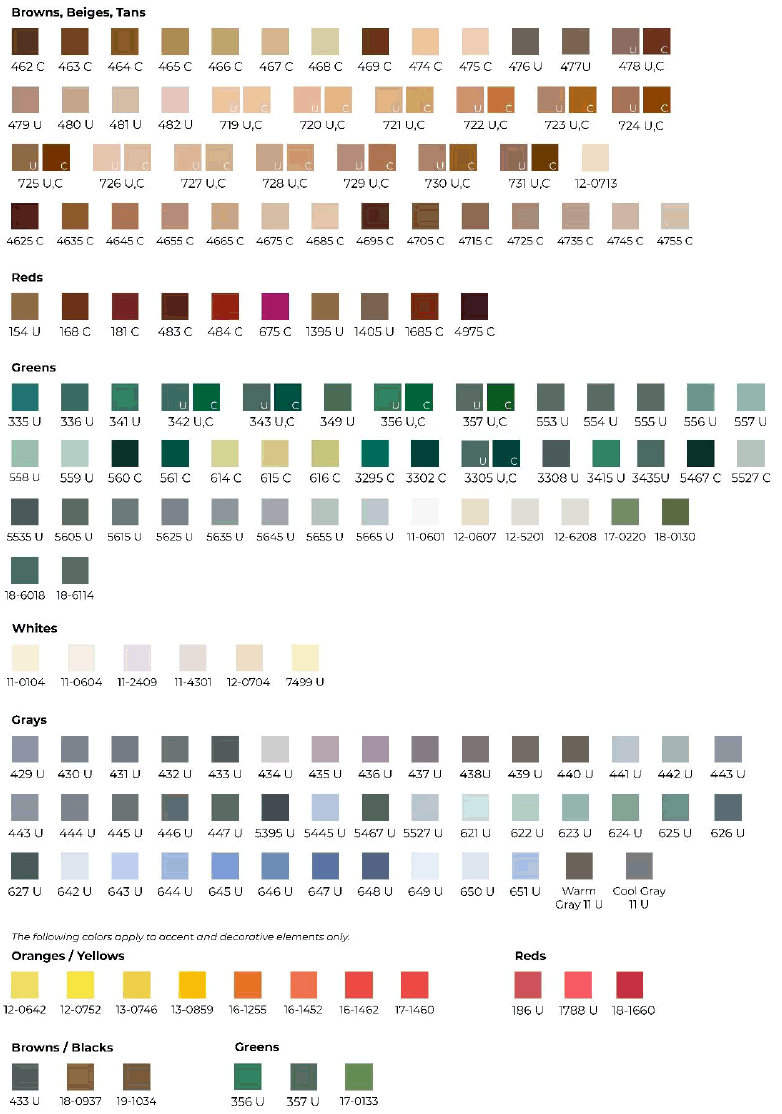
The code number under each color refers to the Pantone Matching System, an International Color Matching System. An online color search tool can be accessed here: https://www.pantone.com/color-finder?from=topNav. To search for a color, type the code number code into the search box. Include a space between the number and letters.
Sec. 511.12. - Vacant lots and abandoned structures.
(a)
Previously disturbed vacant lots shall not be paved unless it is a pre-existing condition.
(b)
Vacant lots shall not be overgrown (vegetative cover exceeding six inches in height) and must be maintained. The lot must remain free of trash and debris.
(c)
All openings of abandoned structures shall be secured from unauthorized entry.
(d)
All fabricated boards used to board up all openings of abandoned structures shall be painted on the exterior surface the same color as the building.
(e)
All garbage, trash, and other debris shall be removed from the interior and exterior of vacant premises.
(f)
A deadbolt shall be installed on the front exterior door above the existing lock of an abandoned structure.
Sec. 511.13. - Signs.
(a)
The architectural color standards of the overlay district apply to the sign structure and not the sign face.
(b)
Sign structures and faces constructed of wood or canvas materials are prohibited.
(c)
Window signs along the Old National Highway Corridor are prohibited.
Sec. 511.14. - Streetscape standards.
(a)
Lighting.
(1)
A single decorative style light fixture and pole shall be used along the entire length of Old National highway and for a distance of 500 feet along the north and south sides of Flat Shoals Road where it intersects with Old National Highway.
(2)
The preferred light fixture is Cooper Lighting "Traditionaire" Post Top Fixture. Lighting source shall be LED or the most energy efficient approved light source at the time of installation.
(3)
Preferred streetlight pole is the Hapco manufacturing "Grand Series/Granville" decorative pole. This pole is FHWA approved as a 'breakaway' pole.
(4)
Pole shall include banner arms as well as GFCI outlets as required.
(5)
Lighting shall be installed behind the sidewalk at 80- to 100-foot intervals.
(b)
Sidewalks.
(1)
All sidewalks along Old National Highway shall be a minimum of eight feet wide. The sidewalk shall include two feet of brick pavers laid in a running bond course pattern adjacent to the back of the curb.
(2)
All handicapped ramps shall be constructed per GDOT and South Fulton standards with a brick paver band installed.
Sec. 511.15. - Utility placement.
All utilities shall be located underground.
Sec. 511.16. - Stormwater management facilities.
All required detention/retention facilities shall be designed to meet the South Fulton alternative design standards that have the intent of making such facilities an attractive amenity or focal point for the subdivision per current South Fulton Subdivision Regulations.
Sec. 512.02. - Purpose and intent.
(a)
The City Council of South Fulton, Georgia hereby declares it to be the purpose and intent of the Sandtown Overlay District (District) to establish a uniform procedure for providing for the protection, enhancement, preservation, unity of design, and use of places, sites, buildings, structures, streets, neighborhoods, and landscape features in the Sandtown District in accordance with the provisions herein.
(b)
The Sandtown Overlay District is adopted as part of a strategy designed to promote the health, safety, order, prosperity, and general welfare of the citizens of South Fulton through the regulation of design, aesthetics, location, bulk, size of buildings and structures, and the density and distribution of population.
(c)
This District also seeks to reduce congestion on the streets; to provide safety from fire, flood and other dangers; provide adequate light and open space; protect the natural environment and address other public requirements, in order to provide sustainable development that involves the simultaneous pursuit of economic prosperity, environmental protection and social quality.
(d)
This District also seeks, among other things, to promote accepted design principles in areas of new development and redevelopment, to raise the level of community understanding and expectation for quality in the built environment, to protect and enhance local aesthetic and functional qualities, and to stimulate business and promote economic development.
(e)
In consideration of the character of the Sandtown District, the regulations in this Section 512 are intended to monitor the suitability for certain uses, construction and design, prevent functional and visual disunity, promote desirable conditions for community and commerce and protect property against blight and depreciation.
Sec. 512.03. - Applicability.
(a)
The Sandtown Overlay District and the regulations of this Section 512 apply to all properties zoned or developed for nonresidential and residential uses as illustrated on the map in Section 512.01 above. Single-family developments are exempted except for compliance with Section 512.05 (Buffers and Landscaping) and the exterior finish prohibitions in Section 512.11(f).
(b)
Single-family dwelling units not part of a subdivision are exempt from the requirements of this District, with the exception that compliance with Section 512.11(f) is required.
Sec. 512.04. - Architectural review process.
(a)
Prior to the issuance of a land disturbance permit (LDP) or a building permit, the applicant shall submit details of exterior materials, colors, landscape strips, buffers, signage, lighting, parking, streets and paths, entrances, design and architectural features of the proposed site and building which demonstrate compliance with the design standards set forth herein.
(b)
Prior to the issuance of an LDP or building permit, the community will be allowed ten working days to review the application. An application which otherwise conforms to applicable codes and regulations shall not be delayed issuance of an LDP or building permit for more than ten working days due to this review and comment process.
(c)
CDRA staff will review all applications for land disturbance permits, building permits and sign permits for compliance with the standards of this Overlay District and upon determination of compliance will provide a Certificate of Endorsement (COE) in the form of signing the formally submitted plans and drawings.
Sec. 512.05. - Buffers and landscaping requirements.
(a)
A 40-foot wide natural, undisturbed buffer (except for approved access and utility crossings, improvements, and replantings where sparsely vegetated subject to the approval of the South Fulton Arborist), with a ten-foot improvement setback or as may be approved by the Director of Community Development and Regulatory Affairs shall be provided along Camp Creek Parkway.
(b)
All AG-1 zoning district and residential zoning districts or uses shall provide a minimum 25-foot wide natural undisturbed buffer with a ten-foot improvement setback or provide a minimum six-foot high earthen berm planted to landscape strip standards, with a maximum slope of three to one or combination thereof along all public streets.
(c)
All nonresidential (except AG-1) zoning districts or uses shall provide a minimum 25-foot wide landscape strip along all public streets.
(d)
A 15-foot wide landscape strip shall be provided along any interior property line adjacent to a nonresidential zoning and/or use.
Sec. 512.06. - Accessory site features.
(a)
Accessory site features are prohibited in the front yard of any property.
(b)
Accessory site features located on the ground shall be screened from view from any public right-of-way, any residential use, or any residential or AG-1 zoning district by one of the following: placement behind the building, 100 percent opaque fencing, berm or vegetative screen planted to buffer standards.
(c)
Accessory site features on a roof shall be screened by a parapet or other architectural feature or as approved by the Director Community Development and Regulatory Affairs.
(d)
Except as provided for in Article 3, the storage and/or sale of goods is prohibited in parking lots and other areas outside of the interior or permanently sheltered portions of a building.
(e)
Vending machines, paper stands, and other similar devices must be located inside a building.
(f)
Storage of shopping carts is allowed without a permit, but is subject to the requirements of Title 6, Chapter 5 Abandoned Shopping Carts of the City Codes of Ordinances.
Sec. 512.07. - Screening.
(a)
Refuse areas and receptacles.
(1)
Refuse areas and receptacles shall be placed in the least visible location from public streets and shall be enclosed on three sides with opaque walls. The fourth side shall be a self-closing gate made from noncombustible materials.
(2)
Required opaque walls shall be a minimum of 12 inches higher than the receptacle.
(3)
Wall materials shall be noncombustible brick, stone, or split-faced concrete masonry block. Refuse receptacles shall not be placed within 50 feet of an existing residential or AG-1 zoning district.
(b)
Fencing and walls; placement and materials.
(1)
Opaque fences are prohibited adjacent to public streets.
(2)
Fencing materials along public streets and side yards are restricted to stone, wrought iron, material designed to have the appearance of wrought iron, treated wood, or material designed to have the appearance of natural wood.
(3)
Chain link fencing may be used along golf courses, play fields, and other recreational areas. All chain link fencing shall be black or hunter green vinyl coated.
(4)
When required, fencing material around detention/retention facilities shall be black or hunter green vinyl coated chain link fence.
(5)
Retaining walls shall be faced with or constructed of stone, brick, or decorative concrete modular block only.
(c)
Parking and loading areas. All parking and loading areas shall be screened from public streets by either a minimum four-foot high berm and/or a continuous hedge of evergreen shrubs.
Sec. 512.08. - Pedestrian paths.
(a)
Sidewalks are required along all public and private road frontages, on both sides.
(b)
Except in truck loading and parking areas of industrial and warehouse-distribution uses, internal walkways (paths) are required from the public sidewalk to the main entrance of the principal use of the property and shall meet applicable Americans with Disabilities Act (ADA) standards for slope, width, texture, level differences, and ramps.
(c)
Pedestrian paths may be constructed of either colored/textured materials or conventional sidewalk materials and shall be clearly identified.
(d)
Pedestrian paths shall be illustrated on the site plan submitted at the time of application for a land disturbance permit.
(e)
Paths shall be designed to minimize direct auto-pedestrian interaction.
(f)
Paths shall be connected to signalized crosswalks where applicable.
(g)
Paths shall be direct and convenient routes between points of origin (such as a bus stop) and destination (such as a shop, bank, etc.).
(h)
Street furniture shall be located outside the specified width of any pedestrian path.
Sec. 512.09. - Lighting.
(a)
A lighting plan for open parking lots and pedestrian paths shall be submitted for approval prior to the issuance of a land disturbance permit.
(b)
Any lighting fixture shall be a cutoff luminary whose source is completely concealed with an opaque housing. Fixtures shall be recessed in the opaque housing. Drop dish refractors are prohibited. The wattage shall not exceed 420 watts/480 V per light fixture. This provision includes lights on mounted poles as well as architectural display and decorative lighting visible from a street or highway. Wall pack lighting shall be cut-off down directional a maximum of 250 watts. Canopy lighting shall be cut-off down directional a maximum of 250 watts. Canopy lighting shall be cut-off luminaries with a maximum lamp wattage of 400 watts.
(c)
Light sources (lamps) shall be incandescent, fluorescent, LED lighting, metal halide, mercury vapor, natural gas, or color corrected high-pressure sodium (CRI of 60 or better). The same type must be used for the same or similar type of lighting on any one site.
(d)
Mounting fixtures must be modified in such a manner that the cone of the light is not directed at any property line. The minimum mounting height for a pole is 12 feet. The maximum mounting for a pole is 35 feet. Any fixture and pole located within 20 feet of a residential zoning shall be a type four or forward throw distribution.
(e)
Lights shall be architecturally decorative with a historic style (includes shepherds crook, pole top, and bollard) or a style that complements the architecture of the principal building. The same type of design must be used along pedestrian pathways and/or common areas.
(f)
Non-LED shoebox lighting fixtures, cobra lighting fixtures, and neon lighting are prohibited.
(g)
All site lighting shall be designed so that the illumination as measured in foot-candles at any one point meets the following standards: Minimum and maximum levels are measured at any one point. Average level is not to exceed the calculated value and is derived using only the area of the site included to receive illumination. Points of measure shall not include the area of the building or areas which do not lend themselves to pedestrian traffic. Also, if the major portion of the lighting design is to be in the front of a building, the average level should not be affected by adding a light or two in the back of the same building, which would raise the average of the intended area for lighting.
(h)
Future renovations, upgrades, or additions to existing facilities prior to the effective date of this Ordinance shall not exceed existing illumination levels below. The entire site must be bought into conformance with this Section 512 should a renovation, upgrade, or addition occur that would require a land disturbance permit.
Sec. 512.10. - Building design.
(a)
Nonresidential buildings are limited to 35 feet in height. Residential buildings and mixed-use buildings that contain a residential component are limited to three stories.
(b)
Developments shall include architecture elements such as columns, arcades, covered entry-walkways, arches, facade offsets, windows, balconies, offset walls, clock towers, cupolas and/or courtyards.
(c)
Any nonresidential building facade shall have a minimum of 25 percent fenestration or as may be approved by the CDRA Director.
(d)
The principal entry area of a building shall be articulated and express greater architectural detail than other portions of the building.
(e)
To the extent any rear or side of any building is visible from any public street or single-family residence, architectural treatment shall continue through the rear or side.
(f)
Permissible roofs are gable, pyramidal, and hip. Shed roofs are permitted over porches, additions, and accessory structures. Roof pitches shall be 5/12 to 12/12.
(g)
Flat roofs and roof-mounted equipment shall be screened from the view of public and private streets by a parapet. No parapet shall be required to be greater than four feet above roof.
(h)
Burglar bars, steel gates, and steel-roll down curtains are prohibited on the exterior and interior of the structure except at the structure's rear. Security grilles are allowed if installed interior to the place of business. Grilles shall be of a grid or brick pattern and placed so that the grid or brick pattern is at a uniform height across the entire business front.
(i)
Neon lights outlining and/or detailing building features are prohibited.
Sec. 512.11. - Building materials.
(a)
The exterior of all industrial building facades shall be provided with an architectural treatment such as stucco, stone, brick, wood or an alternative treatment approved by the Director Community Development and Regulatory Affairs.
(b)
The exterior wall materials of all nonresidential buildings except industrial buildings shall consist of a minimum of 60 percent (per vertical wall plane) of the following: solid wood siding, cementations siding, stucco, brick, stone or an alternative treatment approved by the Director Community Development and Regulatory Affairs.
(c)
The exterior wall materials of all residential buildings, excluding single-family detached dwellings and developments, shall consist of a minimum of 60 percent (per vertical wall plane) of the following: traditional stucco, cementitious siding, solid wood siding, brick, stone or an alternative treatment approved by the Director Community Development and Regulatory Affairs.
(d)
Accent wall materials on residential (excluding single-family detached dwellings and developments) and nonresidential buildings shall consist of glass, architecturally treated concrete masonry, precast stone, stucco, material designed to have the appearance of stucco if installed a minimum of four feet above grade or combination thereof and shall not exceed 40 percent per vertical wall plane.
(e)
Exterior finishes for accessory structures shall be consistent with the principal structure.
(f)
Prohibited building materials for exterior walls and accents on all residential and nonresidential buildings: metal panel systems, vinyl siding, site-cast smooth concrete masonry or plain reinforced concrete slabs, aluminum siding, pressed-wood panels, plywood panels, mirrored glass, and corrugated steel (exceptions: mechanical penthouse and roof screens). In addition, synthetic stucco and aluminum siding is prohibited on all residential buildings.
(g)
Allowable roof materials for pitched roofs are asphalt shingles, composition shingles, wood shingles, wood shake, slate, terra cotta or as may be approved by the Director of Community Development and Regulatory Affairs.
Sec. 512.12. - Building colors.
(a)
Roof colors shall be black, gray, brown, or green. Reflective and metallic colors are prohibited.
(b)
Colors for exterior walls, building components, sign structures, accent and decorative elements must be chosen from the tones and shades specified in the color chart below (from the Pantone Formula Color Guide) or as approved by the Director of Community Development and Regulatory Affairs.
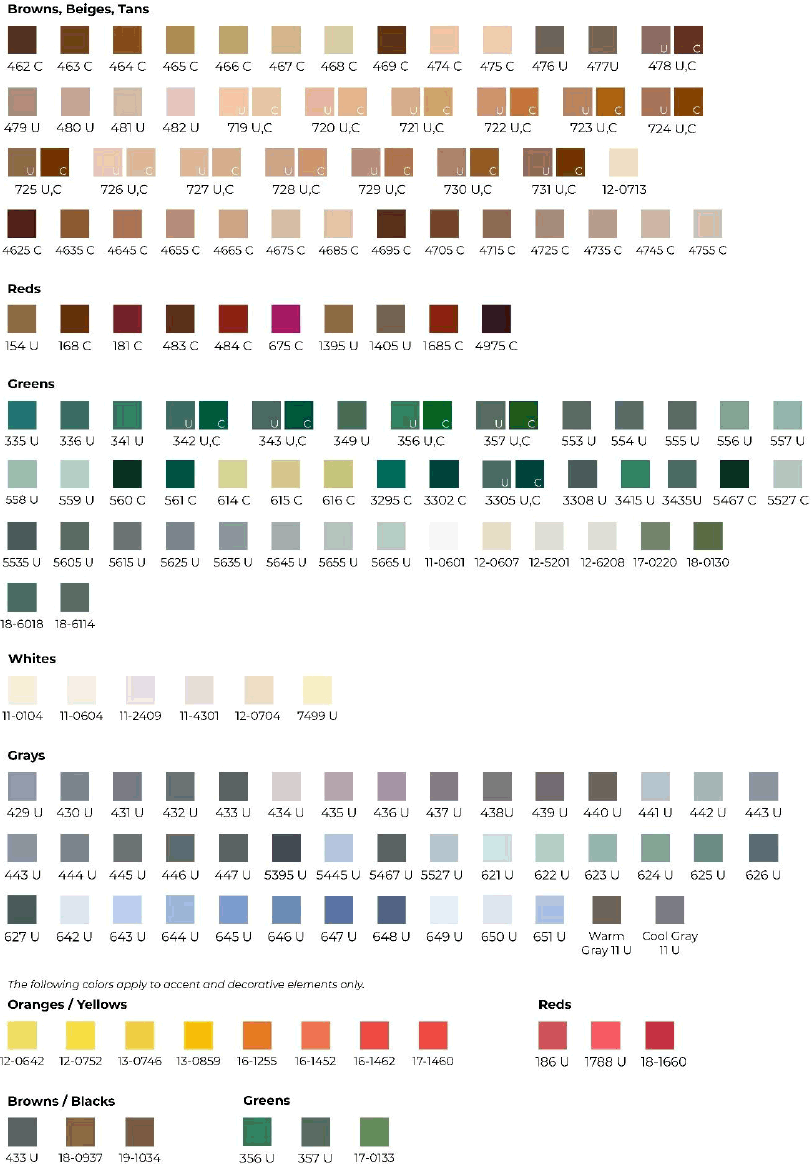
The code number under each color refers to the Pantone Matching System, an International Color Matching System. An online color search tool can be accessed here: https://www.pantone.com/color-finder?from=topNav. To search for a color, type the code number code into the search box. Include a space between the number and letters.
Sec. 512.13. - Sign requirements.
(a)
Monument signs (except for the sign face) shall be constructed of brick, granite, stone, marble or other material used in the principal building(s) on site.
(b)
Monument signs (except for the sign face and/or logo or trade name) shall be earth tones not primary colors.
(c)
Changeable copy and reader board configurations are prohibited unless approved as a marquee sign.
(d)
Wall signs shall be internally illuminated only.
(e)
Door signs are allowed up to a maximum of 25 percent of the door area.
(f)
Window signs. Up to three window signs, each no greater than four square feet, are allowed on a principal building. The window sign(s) shall not cover more than ten percent of the area of each window in which the sign is placed.
Sec. 512.14. - Utility placement.
All utilities shall be located underground.
Sec. 512.15. - Stormwater management facilities.
All required detention/retention facilities shall be designed to meet the South Fulton alternative design standards that have the intent of making such facilities an attractive amenity or focal point for the subdivision per current South Fulton Subdivision Regulations.
Sec. 513.02. - Purpose and intent.
(a)
The City Council of South Fulton, Georgia hereby declares it to be the purpose and intent of the South Fulton Parkway Overlay District (District) to establish a uniform procedure for providing for the protection, enhancement, preservation, unity of design, and use of places, sites, buildings, structures, streets, neighborhoods, and landscape features in the South Fulton Parkway District in accordance with the provisions herein.
(b)
This District is adopted as part of a strategy designed to promote the health, safety, order, prosperity, and general welfare of the citizens of South Fulton through the regulation of design, aesthetics, location, bulk, size of buildings and structures, and the density and distribution of population.
(c)
This District also seeks to reduce congestion on the streets; to provide safety from fire, flood and other dangers; provide adequate light and open space; protect the natural environment and address other public requirements, in order to provide sustainable development that involves the simultaneous pursuit of economic prosperity, environmental protection and social quality.
(d)
This District also seeks, among other things, to promote accepted design principles in areas of new development and redevelopment, to raise the level of community understanding and expectation for quality in the built environment, to protect and enhance local aesthetic and functional qualities, and to stimulate business and promote economic development.
(e)
In consideration of the character of the South Fulton Parkway District, the regulations in this Section 513 are intended to monitor the suitability for certain uses, construction and design, prevent functional and visual disunity, promote desirable conditions for community and commerce and protect property against blight and depreciation.
Sec. 513.03. - Applicability.
(a)
Except as noted in Section 513.03(b) below, the South Fulton Parkway Overlay District and the regulations of this Section 513 apply to all properties zoned or developed for nonresidential and residential uses, within 2,640 feet of the centerline of the South Fulton Parkway from its easterly origin beginning at Wolf Creek to Cascade-Palmetto Highway (SR 154). These boundaries are depicted in the map in 513.01 above.
(b)
Single-family detached dwelling units in the boundaries of this District are exempt from the regulations herein, with the exception that Section 513.05(a) and Section 513.09(d) shall apply.
(c)
If any portion of a parcel and/or development is located in the defined boundary area, the entire parcel and/or development shall comply with the standards herein.
Sec. 513.04. - Architectural review process.
(a)
Prior to the issuance of a land disturbance permit (LDP) or a building permit, the applicant shall submit details of exterior materials, colors, landscape strips, buffers, signage, lighting, parking, streets and paths, entrances, design and architectural features of the proposed site and building which demonstrate compliance with the design standards set forth herein.
(b)
Prior to the issuance of an LDP or building permit, the community will be allowed ten working days to review the application. An application which otherwise conforms to applicable codes and regulations shall not be delayed issuance of an LDP or building permit for more than ten working days due to this review and comment process.
(c)
CDRA staff will review all applications for land disturbance permits, building permits and sign permits for compliance with the standards of this Overlay District and upon determination of compliance will provide a Certificate of Endorsement (COE) in the form of signing the formally submitted plans and drawings.
Sec. 513.05. - Buffers and landscaping.
(a)
All developments to include single-family detached residential subdivisions shall provide a minimum 100-foot wide natural, undisturbed buffer (except for approved access and utility crossings, improvements, and replantings where sparsely vegetated subject to the approval of the South Fulton Arborist), with an additional ten-foot setback interior to the buffer, along the South Fulton Parkway and along the rights-of-way of public roads which intersect the Parkway for a distance of 300 feet measured from the intersection with the South Fulton Parkway.
(b)
A minimum 15-foot wide landscape strip along all public and private streets, except as noted in Section 513.05(a) above, when Article 4 of the Zoning Ordinance otherwise specifies a smaller landscape strip.
(c)
Subject to the approval of the CDRA Director, street trees may be placed in public rights-of-way.
(d)
A minimum ten-foot wide landscape strip along any interior property line adjacent to a nonresidential zoning and/or use.
(e)
Hardwood shade trees, e.g., maples and oaks, a minimum of two-inch caliper diameter at breast height (DBH), shall be planted in all landscape strips and minimally spaced as specified by the Tree Preservation Ordinance.
Sec. 513.06. - Accessory site features.
(a)
Accessory site features located on the ground shall be screened from view from any public right-of-way and/or any residence, residential zoning category, or AG-1 zoning category by one of the following: placement behind the building, 100 percent opaque fencing, berm or vegetative screen planted to buffer standards.
(b)
Accessory structures on a roof shall be located to the rear of the roof and shall be screened by a parapet or other architectural feature as approved by the CDRA Director.
(c)
Loading docks and bay doors fronting the South Fulton Parkway are prohibited.
(d)
Loading docks shall be screened by a continuous hedge of evergreen shrubs. Shrubbery shall be a minimum height of five feet at time of planting.
(e)
Vending machines, paper stands, and other similar devices shall be located inside a building or screened from the view of all public streets and residentially or AG-1 zoned or developed properties.
(f)
Except as provided for in Article 3, the storage and/or sale of goods is prohibited in parking lots and other areas outside of the interior or permanently sheltered portions of a building.
(g)
Storage of shopping carts is allowed without a permit, but is subject to the requirements of Title 6, Chapter 5 Abandoned Shopping Carts of the City Codes of Ordinances.
(h)
Refuse areas and receptacles.
(1)
Refuse areas and receptacles shall be placed in the least visible location from public streets and shall be enclosed on three sides with opaque walls.
(2)
The fourth side shall be a self-closing gate made from non-combustible materials.
(3)
Required opaque walls shall be a minimum of 12 inches higher than the receptacle.
(4)
Wall materials shall be non-combustible brick, stone, or split concrete masonry block. Refuse receptacles shall not be placed within 50 feet of an existing residential or AG-1 zoning district.
Sec. 513.07. - Retaining walls.
Retaining walls shall be faced with or constructed of stone, brick, or decorative concrete modular block only.
Sec. 513.08. - Building design.
(a)
Developments shall include architecture elements such as columns, arcades, covered entry-walkways, arches, facade offsets, windows, balconies, offset walls, clock towers, cupolas and/or courtyards.
(b)
To the extent the rear and/or side of a building is visible from a public street or an adjacent agriculturally or residentially zoned or developed property, architectural treatments shall continue through the rear and sides of the building.
(c)
The principal entry area of a building shall be articulated and express greater architectural detail than other portions of the building.
(d)
Outparcel buildings shall have architectural features consistent with the principal buildings.
(e)
Flat roofs and roof-mounted equipment shall be screened by a parapet or other architectural feature as approved by the CDRA Director from the view of public and private streets and adjacent agriculturally and residentially zoned and/or developed properties.
(f)
Sloped roofs shall be standing seam, metal, slate and concrete roof tiles and composition shingles.
(g)
Building components such as burglar bars, steel gates, metal awnings and steel roll-down curtains are prohibited if visible from a public street.
Sec. 513.09. - Building materials.
(a)
The exterior wall materials of all nonresidential buildings shall consist of a minimum of 60 percent (per vertical wall plane) of the following: brick, precast concrete, natural or precast stone, or tinted, non-reflective glass (or an equivalent alternative treatment approved by the Director of Community Development and Regulatory Affairs).
(b)
The exterior wall materials of all residential buildings (excluding single-family detached dwellings) shall consist of a minimum of 60 percent (per vertical wall plane) of the following: brick, stone, traditional stucco, Hardi-plank siding, solid plank, or cementitious plank (or an equivalent alternative treatment approved by the Director of Community Development and Regulatory Affairs).
(c)
Accent wall materials on residential and nonresidential buildings shall not exceed 40 percent per vertical wall plane.
(d)
Prohibited exterior finishes on all buildings (except on mechanical penthouses and roof screens) are highly reflective, shiny, or mirror-like materials, exposed unfinished foundations, exposed plywood or particle board, unplastered, corrugated steel, exposed standard concrete masonry block, vinyl and aluminum siding. In addition, prohibited exterior finishes on residential buildings are synthetic stucco, vinyl siding and aluminum siding.
Sec. 513.10. - Building colors.
Colors for exterior walls, building components, sign structures, accent and decorative elements must be chosen from the tones and shades indicated in the color chart below (from the Pantone Formula Color Guide) or as approved by the CDRA Director.
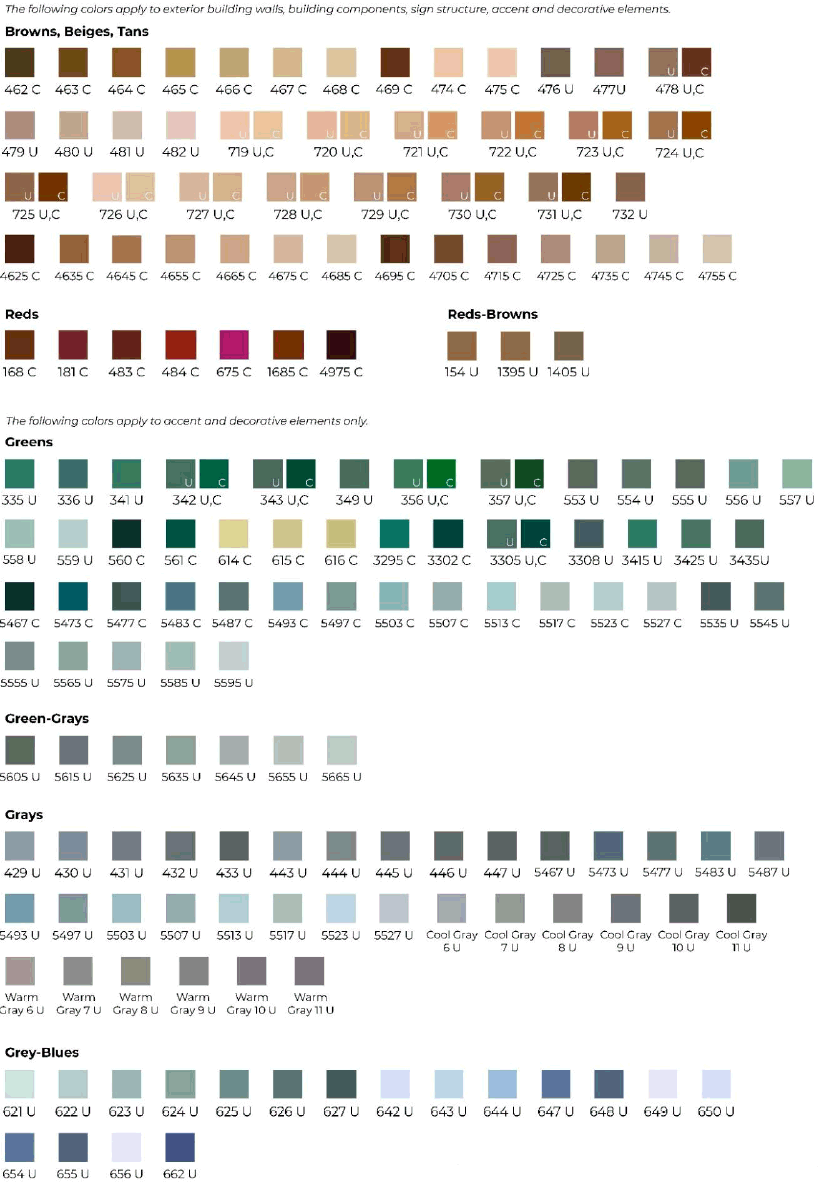
The code number under each color refers to the Pantone Matching System, an International Color Matching System. An online color search tool can be accessed here: https://www.pantone.com/color-finder?from=topNav. To search for a color, type the code number code into the search box. Include a space between the number and letters.
Sec. 513.11. - Pedestrian paths.
(a)
Sidewalks are required along all public and private road frontages.
(b)
Pedestrian paths shall be illustrated on the site plan submitted at the time of application for a land disturbance permit.
(c)
Except in truck loading and parking areas of industrial and warehouse-distribution uses, internal walkways (paths) are required from the public sidewalk to the main entrance of the principal use of the property and to adjacent buildings within the same development.
(d)
All sidewalks and pedestrian walkways (paths) shall meet applicable Americans with Disabilities Act (ADA) standards.
(e)
Pedestrian paths may be constructed of either colored/textured materials or conventional sidewalk materials and shall be clearly identified.
(f)
Paths shall be designed to minimize direct auto-pedestrian interaction by such means as sidewalks, striping, and signs.
(g)
Paths shall be connected to crosswalks at intersections where applicable.
(h)
Street furniture shall be located outside the specified width of any pedestrian path.
(i)
Paths and sidewalks shall be connected to green space and open space and connectivity shall be illustrated on the site plan submitted at the time of application for a land disturbance permit.
(j)
Pedestrian paths shall be a minimum width of five feet.
(k)
Multi-use paths for bicycles and pedestrians may be substituted for the required sidewalks as approved by the CDRA Director and the Public Works Director when the path is part of the South Fulton Bicycle and Pedestrian Plan or other approved transportation plan.
(l)
Multi-use paths designed for use by bicyclists and pedestrians shall be 12 feet wide.
(m)
Multi-use paths designed with separate paths for bicyclists and pedestrians shall be 15 feet wide, ten feet for bicycles and five feet for pedestrians.
(n)
Paths should be direct and convenient routes between points of origin (such as a bus stop) and destination (such as a shop, bank, etc.).
(o)
Paths not visible from a public street shall be illuminated.
Sec. 513.12. - Lighting.
(a)
A photometric plan for open parking lots and paths shall be submitted at the time of application for a land disturbance permit.
(b)
Any lighting fixture shall be a cutoff luminary whose source is completely concealed with an opaque housing. Fixtures shall be recessed in the opaque housing. Drop dish refractors are prohibited. The wattage shall not exceed 420 watts/480 V per light fixture. This provision includes lights on mounted poles as well as architectural display and decorative lighting visible from a street or highway. Wall pack lighting shall be cut-off down directional a maximum of 250 watts. Canopy lighting shall be cut-off down directional a maximum of 250 watts. Canopy lighting shall be cut-off luminaries with a maximum lamp wattage of 400 watts.
(c)
Light sources (lamps) shall be incandescent, fluorescent, LED lighting, metal halide, mercury vapor, natural gas, or color corrected high-pressure sodium (CRI of 60 or better). The same type must be used for the same or similar type of lighting on any one site.
(d)
Blue-white colors of florescent, mercury vapor lamps, metal halide, high-pressure sodium with CRI of less than 60 are prohibited.
(e)
Ground level, low wattage/voltage up-lights to accent features in landscape strips are permitted.
(f)
Low intensity, downward shielded lighting along pedestrian paths and in parking lots is required.
(g)
All site lighting shall be architecturally compatible with the buildings on a site. Lights shall be architecturally decorative with a historical style (includes shepherds crooks, pole top, and bollard).
(h)
Exterior wall-mounted lights shall be directed downward fully shielded to prevent spillage. The bottom of wall-mounted light fixtures shall be no higher than seven feet above grade.
(i)
Soffit mounted light fixtures shall be recessed into the soffit or otherwise fully shielded.
(j)
Ground mounted or other upward directional lighting is allowed to accent architectural features.
(k)
Unshielded floodlights, wall packs, NEMA head style fixtures, sag/convex lens mounted on non-LED shoebox fixtures, cobra, neon and dome lights are prohibited.
(l)
Mounting fixtures must be modified in such a manner that the cone of the light is not directed at any property line. The minimum mounting height for a pole is 12 feet. The maximum mounting for a pole is 35 feet. Any fixture and pole located within 20 feet of a residential zoning shall be a type four or forward throw distribution.
(m)
All site lighting shall be designed so that the illumination as measured in foot-candles at any one point meets the following standards: Minimum and maximum levels are measured at any one point. Average level is not to exceed the calculated value and is derived using only the area of the site included to receive illumination. Points of measure shall not include the area of the building or areas which do not lend themselves to pedestrian traffic. Also, if the major portion of the lighting design is to be in the front of a building, the average level should not be affected by adding a light or two in the back of the same building, which would raise the average of the intended area for lighting.
(n)
Future renovations, upgrades, or additions to existing facilities prior to the effective date of this Ordinance shall not exceed existing illumination levels below. The entire site must be bought into conformance with this Section 513 should a renovation, upgrade, or addition occur that would require a land disturbance permit.
Sec. 513.13. - Streetscape features.
(a)
Benches, trash receptacles, drinking fountains, and other street furniture shall be compatible in material, color, finish and architectural style of the development.
(b)
The use of streetscape features as signage prohibited.
Sec. 513.14. - Parking.
(a)
All off-street parking for townhouses and multi-family buildings shall be located to the side, rear or enclosed.
(b)
A minimum of 50 percent of the required surface parking for out-parcels shall be located at the rear of the building.
(c)
The required number of off-street parking spaces may be reduced as approved by the director.
(d)
Shared parking shall be permitted as approved by the CDRA Director.
(e)
Non-residential developments shall provide parking for bicycles.
(f)
Loading areas shall be located in the rear or side yards.
Sec. 513.15. - Signs.
See Article 7.
Sec. 513.16. - Wireless telecommunications and water towers.
(a)
Telecommunications switchboards, power generators, and other telecommunication relay equipment rooms or floors housing such uses are limited to the following areas of a building:
(1)
Subterranean levels,
(2)
First and second floors which are set back a minimum of 50 feet from the street, or
(3)
Third and fourth floors.
(b)
Stealth design is required for all cell towers.
(c)
Height of towers shall not exceed 199 feet.
(d)
A wireless communications facility shall be disassembled and removed from the site within 90 days of the date its use for wireless telecommunications is discontinued.
(e)
Water towers shall be painted to blend with the landscape.
(f)
Except for safety purposes, water tower lighting shall be allowed only during maintenance periods. Each outdoor light that is not required for safety shall be fully shielded. The safety lighting shall use a type of shielding with a ten degree cut-off to provide lighting downward.
Sec. 513.17. - Utility placement.
All utilities shall be underground.
Sec. 513.18. - Stormwater management facilities.
All required detention/retention facilities shall be designed to meet the South Fulton alternative design standards that have the intent of making such facilities an attractive amenity or focal point for the subdivision per current South Fulton Subdivision Regulations.
Sec. 513.19. - Design guidelines for the South Fulton Parkway.
The purpose of these design guidelines is to help preserve the buffers along the South Fulton Parkway, the night sky, green space, vistas, the "Parkway" feel, and open space. These guidelines are encouraged but are not standards. Therefore, noncompliance does not necessitate variances.
(a)
Site design.
(1)
All design strategies shall minimize changes to the existing topography and loss of mature vegetation and water features.
(2)
Minimize level grading. New developments should step with landforms and maximize preservation of existing vegetation and trees. Level grading of entire lots is to be avoided.
(3)
Transitions at property lines should seem natural for the surrounding terrain. Where the existing terrain is generally level, avoid newly graded slopes greater than 1:3 at property lines.
(4)
Cut and fill slopes should be rounded where they meet natural grade to blend with natural slope.
(5)
Natural contouring and re-vegetation are encouraged. Retaining walls should be faced with indigenous rock, brick and/or constructed to blend with adjacent surroundings.
(6)
Storm water retention for multiple sites should be combined into a lake as opposed to individual drainage ponds.
(7)
Permanent conservation easements should be established to protect water sheds, view sheds, and rare habitats.
(b)
Buildings, courtyards.
(1)
Buildings should be oriented to avoid summer overheating.
(2)
Locate courtyards for optimum southern exposure in winter and provide for shading in the summer.
(3)
Locate buildings such that solar heat is naturally reduced on hot summer days by landscape strips and trees.
(4)
Coordinate corner buildings with adjacent developments. Generally, the primary mass of a building on a corner should not be placed at an angle to the corner. Angled or sculpted building corners and open plazas should not be precluded from corners.
(5)
Vertical focal points to visually anchor corners are encouraged.
(c)
Street standards.
(d)
Parking.
(1)
On-street parking (parallel, diagonal, and head-in) is encouraged.
(2)
All developments shall provide connectivity to adjacent developments to link buildings and open spaces together to minimize vehicular traffic and other impacts.
(3)
Courtyards should include such features as sculptures or fountains as focal points, moveable seating and tables, sunny and shaded areas, several entrances into courtyards, variety of textures and colors for visual interest, landscaping, covered and uncovered outdoor passageways.
(e)
Architectural features/enhancements.
(1)
Trim to include eaves, corner boards, gable and eave boards, pediments, friezes, lintels, sills, quoins, belt courses, balustrades;
(2)
Gables, dormers, pillars, posts, porches, recessed windows and doors, cupolas, bay windows;
(3)
Half-rounded or quarter-rounded roof gutters and down spouts integrated with trim;
(4)
Glass storefronts, transom windows, building wall offsets, projections, recesses, floor level changes, roof-line offsets;
(5)
Architectural treatments of front facades shall continue major features around all visibly exposed sides of a building.
(6)
Restaurants with outdoor seating should allow for ease of pedestrian circulation, adequate shade through the use of extended awnings, canopies, or large umbrellas, provide outdoor trash receptacles, and maintain clean and litter-free premises.
(f)
View sheds.
(1)
All development proposals should arrange buildings to preserve views from adjacent properties and streets.
(2)
Locate courtyards, surface parking, and open spaces to align with view sheds from adjacent properties.
(3)
Locate drives, parking, and open spaces on high points. Avoid placing buildings except churches or public buildings of high architectural quality on ridge lines.
(4)
All new developments will be reviewed with respect to topography and existing landforms, existing vegetation and trees, soil properties and bed rock depth, existing watercourses, floodway and flood plain areas, drainage patterns, climatic factors, view sheds.
(5)
All new developments will be reviewed for land use and site organization in relation to building form, character, and scale of existing and proposed development, sensitivity and nature of adjoining land uses, location of adjacent roads, rights-of-way, driveways, off-street vehicular connections, pedestrian ways, access points, and easements, existing structures and other built improvements, prehistoric and historic sites, structures and routes, and any other features that may be impacted or impact the proposed new development.
Sec. 514.01.- Boundary map.
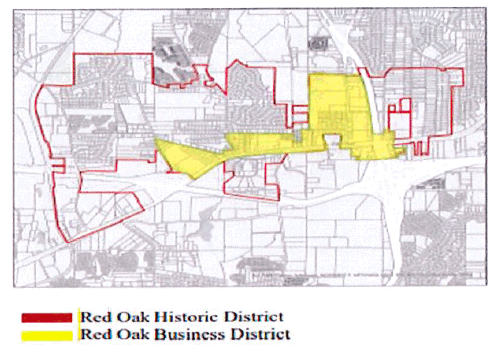
(Ord. No. 2021-034, § 1(Exh. A), 12-21-2021)
Sec. 514.02. - Purpose and intent.
The City Council of South Fulton, Georgia hereby declares it to be the purpose and intent of this Section 514. - Red Oak Overlay District (District), to establish a uniform procedure for providing for the protection, enhancement, preservation, unity of design, and use of sites, buildings, structures, streets, neighborhoods, and landscape features in the District.
(a)
This District encourages increased pedestrian activity, opportunities for diversifying land uses, and vehicular access to the district. The District is tied together by urban design features, such as lighting, coordinated signage, landscaping, as well as architectural compatibility requirements.
(b)
This Red Oak Overlay District is adopted as part of a strategy designed to promote the health, safety, order, prosperity, and general welfare of the citizens of South Fulton through the regulation of design, aesthetics, location, bulk, size of buildings and structures, and the density and distribution of population.
(c)
This District also seeks to promote design principles in areas of new development and redevelopment, to raise the level of community understanding and expectation for quality in the built environment, to protect and enhance local aesthetic and functional qualities, to stimulate business and promote economic development.
(d)
In consideration of the character of the District, the regulations in this Section 514 are intended to monitor the suitability for certain uses, construction and design, prevent functional and visual disunity, promote desirable conditions for community and commerce and protect property against blight and depreciation.
(Ord. No. 2021-034, § 1(Exh. A), 12-21-2021)
Sec. 514.03. - Applicability.
(a)
This division applies to each application for a land-disturbance permit, building permit or sign permit which involves the development, use, alteration, or modification of any structure where the subject property is located in whole, or in part, within the boundaries of the Red Oak Overlay District. The procedures, standards, and criteria herein apply only to that portion of the subject property within the boundaries of the District.
(b)
The District and the regulations of this Section 514 apply to all properties zoned or developed for nonresidential and residential uses (except as indicated in Section 514.03(c) below) and structures within the area illustrated on the map in Sec. 514.
(c)
Single-family detached dwellings are exempt from the District requirements, with the exception that the building material prohibitions in Section 514.12(b) shall apply.
(d)
If any portion of a parcel and/or development is located in the defined boundary area, the entire parcel and/or development shall comply with the standards herein.
(e)
The District also recognizes the Red Oak as designated in the South Fulton Comprehensive Plan.
(Ord. No. 2021-034, § 1(Exh. A), 12-21-2021)
Sec. 514.04. - Architectural review process.
(a)
Prior to issuance of a building permit, the applicant shall submit details of exterior materials, colors, design and architectural features of the proposed building which demonstrate compliance with the design standards set forth in this ordinance.
(b)
South Fulton staff will review all applications for land disturbance permits, building permits and sign permits for compliance with the standards of this overlay district and upon determination of compliance will provide a Certificate of Endorsement (COE) in the form of signing the formally submitted plans and drawings.
(c)
Prior to the issuance of a building permit, the community will be allowed ten working days to review and comment. An application which otherwise conforms to applicable codes and regulations shall not be delayed issuance of a building permit for more than ten working days due to this review and comment process.
(d)
All building plans submitted as an application for a building permit should clearly indicate all of the proposed building materials and colors for each facade in accordance with Section 514.12 and Section 514.13. The plans should clearly show the location and calculate the amount/percentages of all building materials per facade.
(Ord. No. 2021-034, § 1(Exh. A), 12-21-2021)
Sec. 514.05. - Landscaping, buffers and street tree requirements.
(a)
All AG-1 and residentially zoned developments shall provide a minimum 50-foot wide natural, undisturbed buffer with a 10-foot improvement setback along all public streets.
(b)
All non-residentially (except AG-1) zoned developments shall provide a minimum 25-foot-wide landscape strip along all public streets.
(c)
A minimum 25-foot wide natural, undisturbed buffer with a 10-foot improvement setback shall be provided along any interior property line adjacent to a residential zoning and/or use.
(d)
A minimum 15-foot-wide landscape strip shall be provided along any interior property line adjacent to a nonresidential zoning and/or use.
(e)
Large, overstory trees shall be planted 40 to 60 feet on center and are allowed along residential and commercial streets.
(f)
Small, understory trees shall be planted ten to 30 feet on center along residential streets.
(g)
Street trees shall be a minimum of two-inch caliper diameter at breast height (DBH).
(h)
Street trees shall be selected from Appendix E of the South Fulton Tree Preservation Ordinance and Administrative Guidelines or as may be approved by the South Fulton Arborist.
(Ord. No. 2021-034, § 1(Exh. A), 12-21-2021)
Sec. 514.06. - Accessory site features.
(a)
Accessory site features are prohibited in the front yard of any property.
(b)
Accessory site features located on the ground shall be screened from view from any public right-of-way, any residential use, or any residential or AG-1 zoning district by one of the following: placement behind the building, 100 percent opaque fencing, berm or vegetative screen planted to buffer standards.
(c)
Accessory site features on a roof shall be screened by a parapet or other architectural feature or as approved by the director.
(Ord. No. 2021-034, § 1(Exh. A), 12-21-2021)
Sec. 514.07. - Refuse areas and receptacles.
(a)
Refuse areas and receptacles shall be placed in the least visible location from public streets and shall be enclosed on three sides with opaque walls. The fourth side shall be a self-closing gate made from noncombustible materials.
(b)
Required opaque walls shall be a minimum of 12 inches higher than the receptacle. Wall materials shall be noncombustible brick, stone, or split-faced concrete masonry block.
(c)
Refuse receptacles shall not be placed within 50 feet of an existing residential or AG-1 zoning district.
(Ord. No. 2021-034, § 1(Exh. A), 12-21-2021)
Sec. 514.08. - Fencing and walls.
(a)
Fencing materials along public streets and side yards, golf courses, play fields and other recreational areas are restricted to decorative stone, iron, wrought iron, treated wood, white picket, and/or minimum three-rail horse fencing with posts.
(b)
Opaque fences are prohibited adjacent to public streets.
(c)
When required, fencing material around detention/retention facilities shall be constructed in accordance with the South Fulton Subdivision Regulations or as approved by the CORA Director. Vegetation shall be planted in accordance with Article 4 of this Ordinance.
(d)
Retaining walls shall be faced with or constructed of stone, brick, or decorative concrete modular block only.
(Ord. No. 2021-034, § 1(Exh. A), 12-21-2021)
Sec. 514.09. - Sidewalks/pedestrian paths.
(a)
Sidewalks are required along all public and private road frontages (except alleys) and shall meet all applicable Americans with Disabilities Act (ADA) standards.
(b)
Sidewalks and other paths (multi-purpose or pedestrian) shall be illustrated on the site plan submitted at the time of application for a Land Disturbance Permit.
(c)
Meandering sidewalks are permissible upon approval by the CORA Director.
(d)
Pedestrian paths shall be a minimum width of five feet.
(e)
Pedestrian paths may be constructed of either colored/textured materials or conventional sidewalk materials and shall be clearly identified.
(f)
Multi-use paths for bicycles and pedestrians may be substituted for the required sidewalks as approved by the director when the path is part of the South Fulton Bicycle and Pedestrian Plan.
(g)
Multi-use paths designed for use by bicyclists and pedestrians shall be a minimum of 15 feet wide; five feet for the pedestrian sidewalk and ten feet for the bicyclists.
(h)
Street furniture shall be located outside the specified width of any path.
(i)
Paths shall be connected to signalized crosswalks where applicable.
(i)
Paths shall be designed to minimize direct auto-pedestrian interaction.
(k)
Paths should be direct and convenient routes between points of origin (such as a bus stop) and destination (such as a shop, bank, etc.).
(l)
Pedestrian access should be provided to all entrances including access from rear parking areas.
(Ord. No. 2021-034, § 1(Exh. A), 12-21-2021)
Sec. 514.10. - Lighting.
(a)
A lighting plan for open parking lots and pedestrian paths shall be submitted for approval prior to the issuance of a land disturbance permit.
(b)
Open parking lots and walkways providing access thereto shall be provided with a maintained minimum two-foot candles (a measure of illumination) of light measured at grade level.
(c)
The maximum to minimum foot candle level shall not exceed a 12:1 ratio.
(d)
Non-LED shoebox lighting fixtures, cobra lighting fixtures, and neon lighting are prohibited.
(e)
Any luminaire with a lamp or lamps rated at a total of MORE than 1,800 lumens, and all flood or spot luminaires with a lamp or lamps rated at a total of MORE than 900 lumens, shall not emit any direct light above a horizontal plane through the lowest direct- light-emitting part of the luminaire.
(f)
Any luminaire with a lamp or lamps rate at a total of MORE than 1,800 lumens, and all flood or spot luminaires with a lamp or lamps rated at a total of MORE than 900 lumens, shall be mounted at a height equal to or less than the value 3 + (D/3), where D is the distance in feet to the nearest property boundary. The maximum height of the luminaire may not exceed 25 feet.
(g)
Any luminaire with a lamp or lamps rated at a total of 1800 lumens or LESS, and all flood or spot luminaires with a lamp or lamps rated at 900 lumens or LESS, may be used without restriction to light distribution or mounting height, except that if any spot of flood luminaire rated 900 lumens or LESS is aimed, directed, or focused such as to cause direct light from the luminaire to be directed toward residential buildings on adjacent or nearby land, or to create glare perceptible to persons operating motor vehicles on public ways, the luminaire shall be redirected or its light output controlled as necessary to eliminate such conditions.
(h)
Luminaires used for public-roadway illumination may be installed at a maximum height of 25 feet and may be positioned at that height up to the edge of any bordering property.
(i)
All temporary emergency lighting needed by the police or fire departments or other emergency services, as well as all vehicular luminaires, shall be exempt from the requirements of this article.
(j)
All hazard warning luminaires required by Federal regulatory agencies are exempt from the requirements of this article, except that all luminaries used must be red and must be shown to be as close as possible to the Federally required minimum lumen output requirement for the specific task.
(k)
Luminaires used primarily for sign illumination may be mounted at any height to a maximum of 25 feet, regardless of lumen rating.
(l)
Lighting fixtures used to illuminate a billboard shall be mounted on the top of the sign structure. All such fixtures shall use a type of shielding to direct lighting downward. Bottom-mounted sign lighting shall not be used.
(m)The
use of laser source light or any similar high intensity light, searchlights, permanent mounted exterior neon lights, back-lit awnings, and roof mounted lights are prohibited.
(Ord. No. 2021-034, § 1(Exh. A), 12-21-2021)
Sec. 514.11. - Building design.
(a)
Buildings shall include architecture elements such as columns, arcades, covered entry-walkways, arches, facade offsets, windows, balconies, offset walls, clock towers, cupolas and/or courtyards.
(b)
All buildings shall be oriented to face a street or a courtyard.
(c)
The principal entry area of a building shall be articulated and express greater architectural detail than other portions of the building.
(d)
All primary entrances which face a street shall be at street level.
(e)
Buildings are limited to 35 feet in height.
(f)
To the extent any rear or side of any building is visible from any public street or single-family residence, architectural treatment shall continue through the rear or side.
(g)
For large commercial/retail buildings, variations in facade, roofline and depth should be provided to lend the appearance of multi-tenant occupancy.
(h)
Fuel pumps, canopies and associated gasoline station service areas should be located at the rear of the structure, not between the building and the street, to allow the building to be the spatial edge of the streetscape.
(i)
Permissible roofs are gable, pyramidal, and hip. Shed roofs are permitted over porches, additions, and accessory structures. Roof pitches shall be 5/12 to 12/12.
(j)
Roof mounted flagpoles are prohibited.
(Ord. No. 2021-034, § 1(Exh. A), 12-21-2021)
Sec. 514.12. - Building materials.
(a)
The exterior wall materials of all nonresidential buildings shall consist of a minimum of 60 percent (per vertical wall plane) of the following : brick, stone, or clapboard (or an equivalent alternative treatment approved by the Director of Community Development and Regulatory Affairs). Reflective glass is prohibited.
(b)
The exterior wall materials of all residential buildings shall consist of a minimum of 60 percent (per vertical wall plane) of the following : brick, stone, stucco, solid plank, cementitious plank, or horizontal clapboard siding (or an equivalent alternative treatment approved by the Director of Community Development and Regulatory Affairs). Vinyl siding, aluminum siding and synthetic stucco is prohibited.
(c)
Any nonresidential building facade shall have a minimum of 25 percent fenestration or as may be approved by the CORA Director. Black glass, tinted glass, and/or mirrored glass is prohibited.
(d)
Accent wall materials on residential and nonresidential buildings shall consist of glass, architecturally treated concrete masonry, precast stone, or traditional stucco (or an equivalent alternative treatment approved by the Director of Community Development and Regulatory Affairs) and shall not exceed 40percent per vertical wall plane.
(e)
Exterior finishes for accessory structures shall be consistent with the principal structure.
(f)
Allowable roof materials for pitched roofs are asphalt shingles, composition shingles, wood shingles, wood shake, slate, terra cotta or as may be approved by the CORA Director.
(Ord. No. 2021-034, § 1(Exh. A), 12-21-2021)
Sec. 514.13. - Building colors.
(a)
Roof colors shall be black, gray, brown, or green. Reflective and metallic colors are prohibited.
(b)
Colors for exterior walls, building components, sign structures, accent and decorative elements must be chosen from the tones and shades specified in the color chart below (from the Pantone Formula Color Guide) or as approved by the CORA Director.
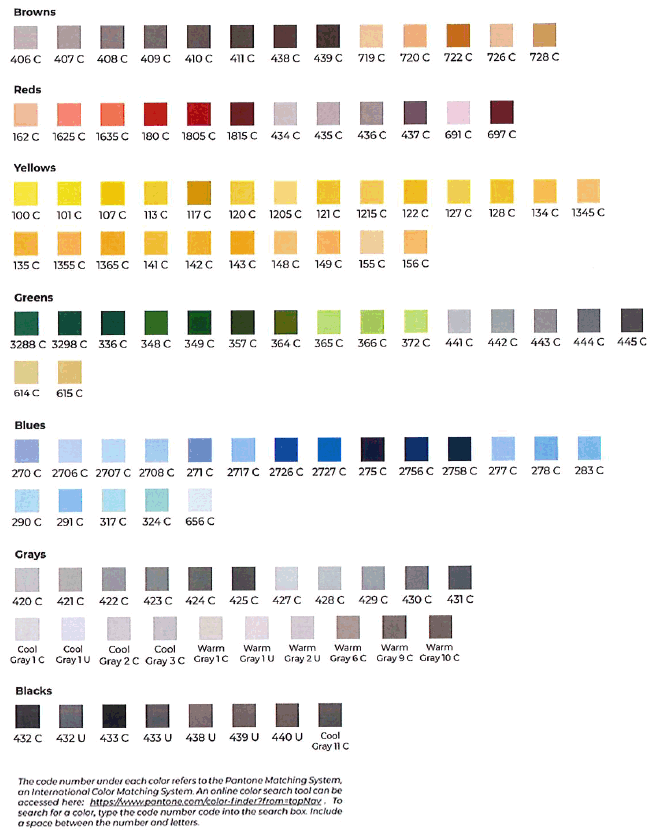
(Ord. No. 2021-034, § 1(Exh. A), 12-21-2021)

