
South Fulton City Zoning Code
ARTICLE 4
- LOT AND BUILDING STANDARDS
Sec. 401.- Purpose of Article 4.
This Article sets out the standards that control the size of lots, the placement of buildings and structures on a lot, and the bulk and intensity of development on a lot in each district. In addition, this Article identifies special standards that apply to the design of certain structures and developments.
Sec. 404. - Requirements Specific to Certain Zoning Districts.
In addition to the requirements in this Article, including those contained in Table 4-1 and other applicable regulations in this Ordinance, the following shall apply to certain zoning districts as described herein.
Sec. 410. - Encroachment on Public Rights-of-Way.
(a)
No privately owned structures other than driveways, access walkways, and mailboxes shall be allowed within a publicly owned right-of-way.
(b)
Mailbox support structures shall be allowed within the City owned right-of-way provided that the mailbox support structure or appurtenance conforms to the following conditions.
(1)
Mailbox support structures or appurtenances shall not be constructed of masonry, concrete or stone unless the support design has been shown to be safe by crash tests and is approved by the Director of Community Development and Regulatory Affairs.
(2)
With the exceptions noted in subsection 1. above, the mailbox support structure shall be a single four-inch x four-inch or four-inch circumference wooden or metal post with strength no greater than a two-inch diameter standard steel hollow pipe and embedded not more than 24 inches into the ground.
(3)
A mailbox support structure containing a metal post shall not be fitted with an anchor plate, but it may have an anti-twist device that extends no more than ten inches below the ground surface.
(c)
Mailbox structures along roadways with posted speed limits of 35 miles per hour or less within platted subdivisions of the City shall be exempt from this provision.
(d)
Landscaping shall be allowed within the public right-of-way with permission of the Georgia Department of Transportation or the Director of Community Development and Regulatory Affairs, or as specified in the Tree Preservation Ordinance, as applicable.
Signs and other structures belonging to the City, the State of Georgia, or a railroad or utility are exempt from this Section.
Sec. 402.01. - Conformance with regulations.
(a)
Structures shall be erected and uses shall be established only upon a single lot which meets or exceeds the requirements of this Zoning Ordinance or conditions of zoning, whichever is more restrictive.
(b)
Structures shall be erected, and sites shall be developed in accordance with other applicable local regulations, including Title 14. Environment in the City Code of Ordinances.
Sec. 402.02. - Minimum buildable area required.
Regardless of the minimum requirements of individual zoning districts, a plat shall not be approved until the buildable area (including the buildable area(s) that must be outside a floodplain in accordance with local floodplain management regulations) of every lot is determined to be sufficient to accommodate a square configured from the minimum building area required by the zoning district.
Sec. 402.03. - Division of conditionally zoned parcels.
All lots of a proposed subdivision must be in keeping with unit and density allocations, and other conditions of zoning as well as this Zoning Ordinance and the Subdivision Regulations. If each proposed parcel does not conform to such conditions, the proposed division shall require a zoning modification in accordance with the requirements in Article 8 to accomplish the desired modification of conditions.
Sec. 402.04. - Outparcel development.
Outparcel development permitted as a condition of zoning approval and identified on a site plan shall comply with the following standards.
(a)
The total floor area for outparcels shall be included in the total floor area allowed for the larger parcel.
(b)
Access for outparcels shall be from internal drives with no direct access to public roads.
(c)
Each outparcel abutting a public right-of-way shall have a minimum of 200 feet of frontage on that public right-of-way.
(d)
Internal entrance drives shall be located at least 100 feet from any publicly dedicated right-of-way.
Sec. 402.05. - Number of principal buildings.
Only one principal building and its customary accessory buildings may hereinafter be erected on any lot of record.
Sec. 402.06. - Accessory structure construction relative to principal building.
Accessory structures shall be constructed concurrently with or subsequent to a principal building.
Sec. 403.01. - Area regulations for lots and principal buildings.
Provisions relating to the minimum area, width and frontage, the maximum height of a building, minimum setbacks for front, side and rear yards, and other dimensional requirements as they relate to a principal building are included in Table 4-1 Area Regulations for Lots and Principal Buildings and in this Section 403. Setback provisions for accessory structures are contained in Section 403.03(f).
Sec. 403.02. - Lots.
(a)
Minimum lot size requirements.
(1)
See Table 4-1 for minimum lot size requirements by zoning district.
(2)
Lots created within a development project to accommodate detention and retention facilities which are incidental, related, appropriate, and clearly subordinate to the main use in the project are exempt from the minimum lot size requirements in all zoning districts. No other construction/building shall be permitted on such lots. An access easement is required in accordance with the Subdivision Regulations.
(3)
When a lot or property is reduced in size, all resulting divisions and all structures shall meet the minimum requirements of the applicable provisions of this Ordinance; except that if a lot or property is reduced in area to less than the zoning district minimum lot size as a result of government action, the lot shall be deemed nonconforming.
(4)
Lots utilizing both a well and a septic tank shall be not less than one acre in size unless a larger size is required by the Fulton County Board of Health.
(5)
Any lot proposed to be served by either a well or a septic tank/drain field shall comply with the larger of the minimum lot area required by the Fulton County Board of Health or the minimum required for the district in which the lot is located.
(b)
Multiple frontage lots. Lots adjoining more than one public street shall provide a minimum front yard along each right-of-way except corner lots. The setbacks for the street-adjoining side yards of corner lots shall be as specified in the district regulations. In situations where a multiple frontage lot has equal distance on street frontages, the Director of Community Development and Regulatory Affairs shall determine the legal lot frontage.
(c)
Flag lots. Minimum yards shall not be identified within the stem portion of a flag lot unless such portion, independent of the flag portion, can meet the requirements of Sections 4.2.2. Measurements for a front yard setback shall begin at the point of intersection of the stem and the flag portion of a flag lot running along the property line the most perpendicular to the stem. A flag lot stem shall not be less than 15 feet in width.
(d)
Interpretation by Community Development and Regulatory Affairs Director. The Director of Community Development and Regulatory Affairs shall make the final determination of front, side, and rear lot lines when in dispute or undefined by the definitions in Article 9 of this Zoning Ordinance.
Sec. 403.03. - Setbacks.
(a)
See Table 4-1 for minimum setback requirements for principal buildings by zoning district.
(b)
When there is more than one building on a lot, minimum interior setbacks (building separations) shall be as specified by the International Building Code and International Residential Code.
(c)
Staggered setbacks. Staggered front setbacks of five feet (minimum) for detached single-family dwellings are required in certain single-family residential zoning districts as indicated on Table 4-1, with the exception that reductions in this requirements may apply on cul-de-sacs and curved streets at the discretion of the City Engineer.
(d)
Uses and structures allowed in required setbacks (yards).
(1)
Yards may be used for driveways, signs, at-grade parking, loading areas, fountains, flag poles, yard ornaments not to exceed two feet in height, walls, fences, walkways, lawns, buffers, landscape areas, underground utilities, well houses, stormwater management facilities, tree preservation areas, and recreation amenities such as swing sets and private swimming pools. No part of any yard or use made thereof shall serve the requirements for any other lot or structure.
(2)
See Article 3 for limitations on the location of outside storage and accessory displays.
(e)
Allowed encroachments into yards. The following encroachments shall be allowed to the extent specified below:
(1)
All zoning districts. Architectural features such as cornices, eaves, steps, gutters, fire chases, chimneys which are a part of an exterior wall of the primary structure, and fire escapes may not encroach or project over more than 36 inches into any minimum yard.
(2)
Non-residential.
a.
Canopies shall be allowed over walkways or driveways to within 12 feet of the street right-of-way or the right-of-way based on the street's functional classification, whichever is farther from the street's centerline.
b.
Fuel pumps and pump islands shall be set back as stated above for canopies.
(3)
Single-family residential and townhouses on individual lots of record.
a.
Porches, decks or patios attached to the main dwelling may extend no more than ten feet into a minimum front or rear yard.
b.
Outdoor fireplaces and outdoor uncovered kitchens, whether stand-alone or constructed as a part of a patio, retaining wall or other structure, may only be located in the rear yard and may extend no more than ten feet into the minimum rear yard. In no case shall an outdoor fireplace be located closer than ten feet to a property line.
c.
Awnings may project to within five feet of a side lot line.
(4)
Adjoining railroads. For those uses which utilize a rail siding for loading and unloading, there shall be no minimum rear yard requirement adjoining the siding.
(f)
Placement of accessory structures. In addition to requirements in Articles 2 and 3 regarding types of allowed accessory uses by zoning district and associated restrictions, the following shall also apply.
(1)
In agricultural and residential zoning districts, except as noted in this Section, accessory structures may be located in rear or side yards but shall not be located within a minimum yard.
(2)
On AG-1 zoned properties that are a minimum of ten acres in sizes, structures that are accessory to a principal agricultural use may be located in any yard, but shall not be located within a minimum yard.
(3)
In the R-5A and NUP zoning districts, accessory structures may be located in rear or side yards, but shall not be located within a minimum rear yard except that detached garages may locate along a rear lot line at between zero and seven feet with an encroachment and maintenance easement allowing a minimum of seven feet of access to the garage.
(4)
In the TR zoning district, accessory structures may be located in the rear and side yards only but shall not be located within a minimum yard. Townhouse accessory structures may be located within the side or rear yards only, but not within minimum perimeter setbacks or minimum yards.
(5)
In the A zoning district, accessory structures may be located in the rear yard only but shall not be located within a minimum yard.
(6)
In the A-L zoning district, accessory structures shall not be located in the minimum front yard.
(7)
In the MIX zoning district, single-family, duplex and townhouse accessory structures may be located in the rear or side yards only but shall not be located within a minimum yard. Multi-family accessory structures shall not be located in the minimum front yard.
(8)
In the C-1, C-2, M-1, and M-2 zoning districts, accessory structures shall not be located in the minimum front yard.
(9)
In the CUP and SH zoning districts, accessory structures to single-family and two-family uses shall be located within the side or rear yards but shall not be located within a minimum yard and are subject to perimeter and minimum yard setback requirements. Multi-family accessory structures may be located in the rear yard only but shall not be located within a minimum yard.
Sec. 403.04. - Height limits.
(a)
See Table 4-1 for maximum building height by zoning district.
(b)
The zoning districts' maximum height limitations for structures shall not apply to the following:
(1)
Spires, belfries, cupolas and domes.
(2)
Water storage tanks.
(3)
Cooling towers.
(4)
Chimneys.
(5)
Mechanical penthouses located on roofs.
(6)
Smokestacks.
(7)
Flag poles.
(8)
Silos and grain elevators.
(9)
Fire towers.
(10)
Private and special schools, which may be erected to 60 feet in height.
(11)
Churches, temples, and other places of worship may be erected to 75 feet in height.
(c)
For each foot that schools and places of worship exceed the height regulations of the zoning district in which they are located, as allowed in Sections 403.04(b)(10) and 403.04(b)(11) above, an additional foot of side and rear yard setbacks shall be required.
Table 4-1 Area Regulations for Lots and Principal Buildings
1 Distance from the principal building to the lot line, unless otherwise noted in the table. Staggered front yard setbacks only apply to single-family residential districts as indicated in this table; see Section 403.03(c).
2 To place a building in the R-5A zoning district along an interior side lot line at between 0 and 7 feet shall require an encroachment and maintenance easement allowing a minimum of 7 feet of access to such buildings. A minimum building separation of 14 feet shall be maintained.
3 For the TR setback requirements, the standards in the top line are the minimum perimeter setbacks for the entire development, and the standards in the bottom line are the minimum interior setbacks when there is one building on a lot.
4 For townhouse developments, this minimum distance requirement shall apply to each dwelling unit. In addition, for all developments, up to 35 feet in frontage may be required whenever the Director of Public Works requires the extra width to protect catch basins.
5 When access to a lot is not from a public right-of-way, the setback shall be 25 feet measured from back of curb if the driveway and garage are in the front; if vehicular access is to the rear of the townhome unit, the distance from the back of curb shall be 12.5 feet.
6 Zero setback if units are attached (for example, townhomes on separate lots of record); and, 7 feet when units are not attached, except that a 7-foot encroachment and maintenance easement may be provided on adjacent parcels, in combination with or in lieu of a side yard, such that a minimum building separation of 14 feet is maintained.
7 This minimum width is required throughout the lot depth, from the front to rear lot line.
8 No single-family residential dwellings or accessory structures shall exceed 40 feet in height. The height of all other structures is as approved per the approved CUP development plan/conditions of zoning.
9
To place a building along an interior side lot line at between 0 and 7 feet shall
require an encroachment and maintenance easement allowing a minimum of 7 feet of access
to such buildings. A minimum building separation of 14 feet shall be maintained.
10 Unless a minimum lot width is specified in the approved development plan.
11 The maximum allowed size for a NUP development is 12 acres.
12
See Section 404.08(c) for density bonuses (and see Section 404.08(d) additional requirements for individual dwelling unit dimensions that are not addressed
in the table)
13 A 50' principal perimeter building setback shall be provided for the entire development when adjacent to single-family residential and/or AG-1 zoning districts. In addition, see Section 404.07(d) for minimum interior setback requirements when there is one building per lot.
14 Up to 35 feet may be required whenever the Director of Public Works requires the extra width to protect catch basins.
15 See also Section 404.05 for additional requirements.
16 Requirement applies to each dwelling unit.
17 See Section 405 for landscape strip and buffer requirements.
18 See Section 405 for landscape strip and buffer requirements.
19 Exception: Structures shall be set back at least 12 additional feet for each foot of building height in excess of 50 feet when adjacent to a residential district.
(Ord. No. 2021-036, § 1, 12-21-2021)
Sec. 404.01. - R-5 single-family district.
R-5A zoned developments shall have a minimum perimeter setback of 40 feet.
Sec. 404.02. - TR townhouse residential district.
(a)
Townhouse developments shall contain no more than eight dwellings per single building.
(b)
Townhouse developments shall vary setbacks and roof lines by a least two feet so that no more than three adjoining dwellings within a single building shall have the same front setback or roof line.
Sec. 404.03. - CUP community unit plan district.
(a)
Development plan.
(1)
The development plan shall be the zoning control document for features depicted graphically.
(2)
The site plan requirement applicable to rezoning requests, as outlined in Article 8, shall be adhered to for CUP rezoning requests. Administrative guidelines for preparing site plans are available from the Director of Community Development and Regulatory Affairs.
(3)
A site plan shall become the development plan if the request to rezone is approved without changes or additions. If the approval by the City Council differs, in any way, from what is depicted on the site plan submitted for the purpose of seeking rezoning, a revised plan must be certified by the Department of Community Development and Regulatory Affairs before development related permits may be issued.
(4)
A site plan or development plan shall not substitute for plans which are required as a prerequisite for applying for development related permits.
(5)
The location of all use areas shall be shown on the development plan, and location on the ground shall be as shown on the development plan.
(b)
Other minimum standards.
(1)
Setbacks and roof lines shall be varied by at least two feet so that no more than three adjoining dwelling units within a single building shall have the same front setback or roof line.
(2)
Common outdoor area consisting of not less than 550 square feet per unit shall be provided for recreation in all developments of 20 or more acres.
(3)
Land area proposed for open space or recreation shall be allocated among the use areas in proportion to the ratio of a neighborhood population to the total CUP population so that acreage devoted to open space is reasonably accessible to all residents.
(4)
Multi-family uses shall not be located along the perimeter except adjacent to or across a street from an existing multifamily or more intense use.
(5)
Agreements, covenants, declarations and other contracts which govern the use, maintenance, and protection of a CUP development among its owners' areas shall be part of the official zoning file.
(6)
Multi-family units shall not exceed 25 percent of the total number of dwelling units in a CUP.
Sec. 404.04. - NUP neighborhood unit plan district.
The requirements for a development plan in Section 404.03(a) above shall apply to the NUP zoning district.
Sec. 404.05. - MIX mixed use district.
(a)
A minimum of 20 percent of the total site area shall be common outdoor area and shall be maintained by the property owner(s).
(b)
All components are required to be interconnected with pedestrian paths constructed of either colored/textured materials or conventional sidewalk materials and clearly identified.
(c)
Off-street parking as required by Article 6 may be reduced, and shared parking among uses may be allowed upon approval by City Council in the conditions of zoning.
(d)
No more than 25 percent of the total floor area of a building may be devoted to storage.
Sec. 404.06. - A-L apartment limited dwelling district.
An outdoor area consisting of not less than ten percent of the gross land area shall be provided for recreation.
Sec. 404.07. - SH senior housing district.
(a)
Development plan. The requirements for a development plan in Section 404.03(a) above shall apply to the SH zoning district.
(b)
Maximum density. See table below for requirements.
Table 4-2 SH Maximum Allowed Densities
(c)
Minimum heated floor area. See table below for requirements.
Table 4-3 SH Minimum Heated Floor Area Requirements
(d)
Minimum interior setbacks when one building per lot.
(1)
Minimum front yard: 20 feet from right-of-way.
(2)
Minimum side yard:
a.
Seven feet adjacent to interior lot line, except that up to a seven-foot encroachment and maintenance easement may be provided on adjacent parcels, in combination with or in lieu of a side yard, such that a minimum building separation of 14 feet is maintained.
b.
Zero feet if units are attached, for example, townhouses on separate lots of record.
c.
Fifteen feet adjacent to street.
(3)
Minimum rear yard: 25 feet.
(e)
Other minimum standards.
(1)
Setbacks and roof lines shall be varied by at least two feet so that no more than three adjoining dwelling units within a single building shall have the same front setback or roof line.
(2)
Common outdoor area consisting of not less than 150 square feet per unit shall be provided for recreation in all developments.
(3)
Land area proposed for open space or recreation shall be allocated among the use areas in proportion to the ratio of a neighborhood's population to the total SH population so that acreage devoted to open space is reasonably accessible to all residents.
(4)
A minimum 600 square foot heated and cooled community center with kitchen and media center facilities shall be provided. If there is a management office associated with the development, the community center may be located within the confines of that office.
(5)
Senior housing shall be 100 percent occupied by persons who are 62 years of age or older which shall be verified per Housing and Urban Development (HUD) regulations regarding verification of occupancy.
(6)
Agreements, covenants, declarations and other contracts which govern the use, maintenance, and protection of a SH development among its owners' areas shall be part of the official zoning file, and changes thereto shall have no force and effect until a copy has been provided to the Director of Community Development and Regulatory Affairs. All SH developments shall have a mandatory agreement, covenant or contractual requirement that all sales or transfers of the property to subsequent owners shall be subject to the 100 percent occupancy requirement by residents aged 62 or older.
(7)
Parking spaces shall be calculated as 1.4 spaces per dwelling unit.
(8)
No parking shall be allowed in the minimum front yard setback.
(9)
SH developments must be served by public water and sewer.
(10)
All SH developments shall provide a minimum 25-foot wide natural, undisturbed buffer with a 10-foot improvement setback or a minimum six-foot high earthen berm planted to landscape strip standards, with a maximum slope of three to one or combination thereof around the perimeter of the property. Said buffer and improvement setback or berm shall not be part of any residentially platted lot.
(11)
All areas which are not part of an individual lot and are held in common shall be accessible via dedicated roadways, easements, sidewalks, etc. and shall be maintained by a mandatory homeowners association, whose proposed documents of incorporation shall be submitted to the Director of Community Development and Regulatory Affairs for review and approval prior to the recording of the first final plat.
(12)
Facility shall comply with all applicable local, state, and federal regulations and copies of any applicable permits shall be provided to the Department of Community Development and Regulatory Affairs prior to the issuance of a certificate of occupancy.
(13)
Projects are required to incorporate Easy Living and applicable accessibility standards (as administered and copyrighted by a coalition of Georgia citizens including AARP of Georgia, Atlanta Regional Commission, Concrete Change, Georgia Department of Community Affairs, Governor's Council on Developmental Disabilities, Home Builders Association of Georgia, Shepherd Center and the Statewide Independent Living Council of Georgia).
Sec. 404.08. - MHP manufactured home park district.
(a)
Application. Applications for rezoning to MHP shall, in addition to the required submittal routinely required by the Community Development and Regulatory Affairs Department, be supported by:
(1)
A copy of the rules and regulations of the proposed manufactured home park.
(2)
A copy of any proposed covenants.
(3)
A proposed maintenance plan for lawns, shrubbery, trees, recreation areas, and other natural areas.
(b)
Development plan.
(1)
The development plan shall be the zoning control document for features depicted graphically.
(2)
The site plan requirement applicable to rezoning requests shall be adhered to for MHP rezoning requests. Administrative guidelines for preparing site plans are available from the Director of Community Development.
(3)
A site plan shall become the development plan if the request to rezone is approved without changes or additions. If the approval by City Council differs, in any way, from what is depicted on the site plan submitted for the purpose of seeking rezoning, a revised plan must be certified by the Department of Community Development and Regulatory Affairs before development related permits may be issued.
(4)
A site plan or development plan shall not substitute for plans which are required as a prerequisite for applying for development related permits.
(5)
The location of all proposed structures (excluding manufactured homes) shall be as shown on the development plan, adopted at the time of zoning approval, and actual location on the ground shall be as shown on the development plan.
(c)
Maximum density. The maximum density shall be 5.5 units per gross acre plus an additional 0.2 units per acre for each of the following features: day care center, community building and/or tornado shelter, and unit carports or garages.
(d)
Requirements for individual unit locations. Each manufactured home shall be located on a separate site which shall be identified by a marker at each corner. It is not required that individual sites be surveyed. Minimum requirements for individual sites, in addition to those listed in Table 4-1, are as follows:
(1)
Minimum all-weather patio: 300 square feet.
(2)
Minimum enclosed storage: 125 cubic feet.
(3)
Minimum interior street setback: 15 feet from pavement.
(4)
Minimum unit separation: 20 feet.
(e)
Minimum improvements required.
(1)
Within 30 days of being located in a manufactured home park, the undercarriage shall be screened from view.
(2)
Each manufactured home park shall have a minimum of two primary access streets which shall be paved to a minimum width of 30 feet. Other streets within a manufactured home park shall be paved to a minimum width of 24 feet.
(3)
Streets and drainage structures shall be constructed in accordance with the minimum standards available from the South Fulton Department of Public Works.
(4)
All-weather pedestrian walks shall be provided throughout a manufactured home park to the South Fulton Subdivision Regulations specifications.
(5)
Streets and walkways shall be lighted.
(6)
All utilities shall be placed underground. A central television antenna system shall be provided.
(7)
Each unit shall be served by public water and sanitary sewer.
(8)
At a minimum, ten percent of the gross acreage of a manufactured home park shall be provided for common open space and recreation for the residents of the manufactured home park.
(9)
At least 400 square feet of common storage area shall be provided per unit for the storage of boats, travel trailers and other vehicles. This common storage area shall be enclosed by a fence and screened from view from all units and streets.
(10)
Each manufactured home site shall be provided with water-tight and rodent proof refuse container(s) having a capacity of at least 50 gallons.
(11)
Dumpsters or similar common refuse collection devices shall be provided for every 30 units or fraction thereof in excess of 15. Such central collection facilities shall be screened from view and shall not be located more than 400 feet from any manufactured home served.
(12)
Central laundry facilities shall be provided at the rate of one standard-size washing machine and dryer for each 25 units or fraction in excess of 11 units. Laundry facilities shall be located not more than 800 feet from the units served.
(13)
Fire hydrants shall be located throughout the park in accordance with standards of the Fire Marshal. Each unit shall be equipped with a fire extinguisher type approved by the Fire Marshal of South Fulton.
(14)
Each manufactured home park shall be landscaped with shade trees, shrubs and grass. Landscaping shall be in accordance with a landscaping plan which has been approved by the Department of Community Development and Regulatory Affairs.
(f)
MHP district subdivision. Individually divided lots are not allowed in the MHP District. All other divisions shall comply with the Subdivision Regulations of South Fulton.
Sec. 404.09. - C-1 limited commercial district.
Not more than 45 percent of the floor area of a building or land may be devoted to storage incidental to primary uses.
Sec. 404.10. - M-1 light industrial zoning district.
(a)
Exterior building walls.
(1)
No wood siding shall be allowed.
(2)
Exposed exterior walls visible from a street shall be composed of the following maximum and minimum percentages of materials in each classification. The percentages apply to the siding on each exposed exterior wall of each building.
(b)
Types of materials.
(1)
Type A materials consist of brick; stone with weathered, polished or fluted face; marble aggregate masonry block with fluted, split-face, or broken-face finish; tilt-up, poured-in-place or precast concrete either fluted or with exposed aggregate finish; insulated window wall panels of stainless steel, porcelain treated steel, anodized or other permanently finished aluminum, and stucco or synthetic stucco.
(2)
Type B materials consist of metal panels with baked-on enamel or acrylic finish.
(3)
Type C materials consist of plain reinforced concrete slabs.
(4)
Type D materials consist of corrugated steel and aluminum, wood, and composite board.
(c)
Materials not listed in this Section may be presented to the Director of Community Development and Regulatory Affairs for classification.
(d)
Buildings having walls over 25 feet high may be given special material percentages by the Director of Community Development and Regulatory Affairs.
[Sec. 405.01. - Landscape strip and zoning buffer requirements.]
(a)
Landscape strips.
(1)
Landscape strips shall be provided along all lot lines, as specified in Table 4-4 Minimum Landscape Strip and Buffer Requirements, except when zoning buffers are required.
(2)
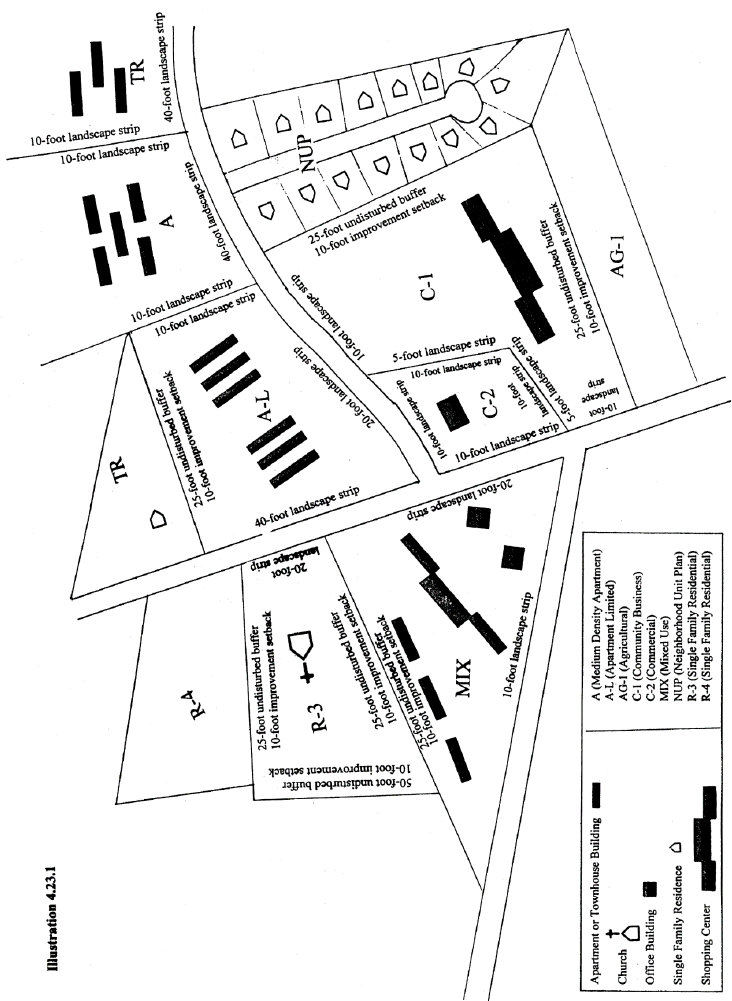
TR, A and A-L zoned districts shall provide landscape strips adjacent to TR, A, and A-L zoned districts, as specified in Table 4-5, unless adjacent properties are developed with single-family residential uses. If adjacent properties are developed with single-family residential uses, zoning buffers are required as specified in Table 4-5. (See Illustration 4.23.1.)
(b)
Zoning buffers.
(1)
Zoning buffers shall be provided along all lot lines, as specified in Table 4-4, adjacent to differently zoned properties, including those zoned AG-1, R-1, R-2, R-2A, R-3, R-3A, R-4, R-4A, R-5, R-5A, R-6, TR, A, A-L, NUP, CUP and MIX with residential components, and adjacent to all existing single- family residential uses in all zoning districts. (See Illustration 4.23.1.)
(2)
A 100-foot zoning buffer shall be provided for all new residential developments along property boundaries adjacent to or within a municipal jurisdiction adjacent to the City of South Fulton. To the extent possible, the zoning buffer from an adjacent jurisdiction shall remain undisturbed. If it is determined by the City Engineer that preservation of a completely undisturbed zoning buffer is not feasible in a location due to topography, drainage or other factors, a landscape buffer plan (in accordance with the buffer design standards in this Zoning Ordinance) shall be provided and executed following review and approval by the City Engineer and Director of Community Development and Regulatory Affairs.
(3)
A zoning buffer is achieved with natural vegetation and must be replanted subject to the approval of the City Arborist or the Director of Community Development and Regulatory Affairs or his/her designated agent(s) when sparsely vegetated.
(4)
Zoning buffers shall be undisturbed except for approved access and utility crossings, approved project entrance signs, and replantings as required by the City Arborist or the Director of Community Development and Regulatory Affairs or his/her designated agent(s).
(5)
Clearing of undergrowth from a buffer is prohibited except when accomplished under the supervision of the City Arborist or the Director of Community Development and Regulatory Affairs or his/her designated agent(s).
(6)
See also Article 3 for separation distance requirements between industrial uses and Environmentally Adverse Uses.
(c)
Improvement setbacks.
(1)
An additional setback of ten feet shall be interior to all zoning buffers as specified in Table 4-4.
(2)
No improvements and/or structures shall be constructed in the improvement setback.
(3)
No reduction of the ten-foot improvement setback is allowed nor shall any grading, land disturbance, tree clearing, stump removal or grinding, or other development activity be allowed within this improvement setback unless permission is obtained from the Director of Community Development and Regulatory Affairs through an Administrative Variance pursuant to Article 8. Said approval shall include a site visit report and recommendation by the City Arborist.
(d)
Fence and wall placement. Fences and/or walls shall be located interior to any required buffers and/or improvement setbacks except that when zoning buffers are required between properties zoned for single-family residences or developed with single-family residences, fences may be constructed along side and rear lot lines.
(e)
Additional requirements.
(1)
Unless otherwise specified, lots developed with single-family detached dwelling units that are not in a single-family development, as defined in this Ordinance, are not required to provide landscape areas strips or zoning buffers. Individual lots created for single-family detached dwellings within a new single-family development are required to provide landscape strips or zoning buffers only to the extent such requirements are applied to the entire parcel being developed and subdivided.
(2)
When minimum landscape strips or zoning buffers for uses in existing structures do not meet the requirements herein, conditions of zoning shall apply when approval is sough for substantial modifications to existing structures.
(3)
Whenever deemed necessary to protect adjoining or nearby properties or to otherwise promote the public health, safety or welfare, the City Council may specify conditions which require increased landscape strips and/or buffers, setbacks, berms, or other treatments to protect surrounding and nearby properties.
(4)
Landscape areas or strips required pursuant to this section shall be maintained in accordance with the requirements of the Tree Preservation Ordinance.
Table 4-4 Minimum Landscape Strip and Buffer Requirements
* Nonresidential uses only.
** The second number applies when a lot line adjoins a less intense non-residential (except AG-1) district.
Sec. 405.02. - Parking lot landscaping.
(a)
At-grade, non-single-family parking lots shall provide landscaped islands with a minimum of 200 square feet of contiguous soil space.
(b)
Required landscaped islands shall be located at both ends of a parking bay, and also after every five parking spaces. A parking bay is a module consisting of one row of parking spaces and the aisle from which motor vehicles enter and leave the spaces.
(c)
Such landscaped islands shall include minimum two-inch caliper diameter at breast height (DBH) shade trees from the list of recommended shade trees for parking lots in Appendix K of the South Fulton Tree Preservation Ordinance.
(d)
No parking space shall be more than 40 feet from a tree
(e)
Landscaping in these islands should preserve and maintain adequate sight lines from the minor lane to the major lane. Alternate methods of landscaping parking lots may be approved whenever the Director of Community Development and Regulatory Affairs determines that the alternate method equals or exceeds this standard.
(f)
See also the South Fulton Tree Preservation Ordinance, Appendix J.
Sec. 405.03. - Tree preservation ordinance and administrative guidelines.
Standards for tree preservation are as set forth by the South Fulton Tree Preservation Ordinance and Administrative Guidelines.
Sec. 406.01. - Exterior finishes on principal buildings.
(a)
Residential Buildings. Vinyl siding, aluminum siding and synthetic stucco are prohibited materials on all residential buildings and mixed-use buildings with residential uses.
(b)
Non-Residential Buildings.
(1)
Reflective and mirrored glass is prohibited on non-residential buildings.
(2)
Whenever visible from a public street in all except the AG-1 and industrial districts, and whenever adjoining a residential zoning district in all districts, the exterior of all common aggregate blocks shall be provided with an architectural treatment such as stucco, stone, brick, wood or an alternate treatment approved by the Director of Community Development. Split rib and marble aggregate block shall not be deemed to be common aggregate block.
Sec. 406.02. - Fences and walls.
Fences and walls which conform to the provisions stated herein shall be permitted by the Department of Community Development and Regulatory Affairs. Fences erected for agricultural purposes in the AG-1 District shall be exempt from permit requirements.
(a)
Visibility triangle. Fences, walls and vegetative materials used in association therewith must not obstruct the minimum sight distance requirements which are specified in South Fulton Subdivision Regulations.
(b)
Gates. No part of a gate shall be located within 20 feet of a public right-of-way, nor shall any gate or vehicle in any way obstruct a public right-of-way or the minimum sight distance specified in the Subdivision Regulations regardless of whether open, closed or in an intermediate position.
(c)
Fence and wall materials. Where the Zoning Ordinance or zoning conditions require fences and walls to be solid/opaque, the visual density of the fence shall be such that it cannot be seen through. The following standards shall apply to fences and walls:
(1)
Adjoining right-of-way.
a.
In all zoning districts except AG-1, M-1, and M-2, wire and plastic fencing materials, including chain-link fencing with plastic or wooden inserts shall not be used adjoining a street right-of-way.
b.
The architectural treatment of poured concrete, common aggregate block or concrete block walls shall be approved by the Director of Community Development and Regulatory Affairs.
c.
The requirements of this section shall not preclude the use of chain link fencing as a security fence around stormwater facilities.
(2)
Fences along all property lines. Walls and fences constructed along all property lines shall be constructed with a finished side toward the neighboring property.
(3)
Barbed wire—Agricultural. Barbed wire may be used in the AG-1 District as long as its use is associated with a legitimate agricultural pursuit. Barbed wire use shall meet the following:
a.
Barbed wire shall not be allowed on any single-family dwelling lots including such lots which are located in the AG-1 zoning district;
b.
Barbed wire use adjacent to the public right-of-way shall be installed in a straight strand manner, coiled/concertina style installation shall be prohibited; and
c.
Razor wire is prohibited.
(4)
Barbed wire, razor wire, chain link—Commercial and Industrial. Barbed wire/razor wire/chain link may be used in all Commercial and Industrial Districts as follows:
a.
All chain link fence shall be green or black vinyl coated;
b.
All chain link fences shall be constructed with a top rail to ensure fence stability; and
c.
Barbed wire/razor wire use adjacent to the public right-of-way shall be installed in a straight strand manner (coiled/concertina style installation shall be prohibited).
(5)
Use of fabric as fence or screen. The use of fabric as a fence or screen is prohibited except as a windscreen around recreational courts.
(6)
Minimum landscape requirements. A minimum three-foot landscape strip shall be provided between a fence or wall and a public right-of-way.
(7)
Height.
a.
Fences and walls shall not exceed a height of eight feet from grade in residential districts, except as regulated under section b) below.
b.
Fences and walls placed in the front yard in residential districts shall not exceed a height of four feet from grade.
(8)
Setback. Fences and walls shall be set back a minimum of three feet from a public right-of-way.
(9)
Retaining Walls.
a.
Permit not required. Retaining walls that are monolithically placed and structurally tied to a house or building foundation wall do not require a separate wall permit if said walls are shown on the plans for which a building permit was issued.
b.
Permit required.
1.
All other retaining walls over four feet high require a permit if they were not shown and permitted on a Land Disturbance Permit.
2.
Walls four feet to six feet high can be permitted upon execution of an Owner Certification/Indemnification form for retaining walls four feet to six feet high.
3.
All walls over six feet high and any walls four feet to six feet high for which an owner is not prepared to execute the Owner Certification/Indemnification form shall require execution of an Engineer Certification/Indemnification form for Retaining Walls permit. Please note that the latter form requires both an engineer's certification and an Owner's Certification/Indemnification.
4.
A Checklist for Retaining Wall Permit Drawing shall be completed by the applicant to verify the adequacy of the submittal for issuance of the permit. A separate permit form and fee is required for each wall.
Sec. 406.03. - Skywalks.
The following requirements shall apply to proposed skywalks in non-residential zoning districts.
(a)
A minimum vertical clearance of 16 feet above all streets, and a minimum vertical clearance of 16 feet above the walkway shall be provided.
(b)
Ample space for the free flow of pedestrians with a 12-foot minimum walkway width shall be provided.
(c)
Prior to issuance of a building permit, a bridge agreement shall be filed with the Community Development and Regulatory Affairs Department as a condition of approval. The CDRA Department shall be responsible for the interpretation and application of the conditions set forth above and no building permit shall be issued by the Department except upon written approval of the Department of Public Works.
Sec. 406.04. - Accessory site features.
Refuse areas shall be identified on site plans for lots improved with structures other than single family dwellings, and such areas shall be screened to 100 percent opacity with fences or walls, or a vegetative screen which complies with the screening requirements of the Tree Protection Ordinance. The refuse containers located therein shall not be visible from streets or adjoining properties. Vegetative screens must comply with the provisions of Section 405. Refuse areas shall not be located in required landscape areas, required buffers, required parking areas, or required loading areas.
Sec. 406.05. - Streetscape features.
When not otherwise regulated by overlay district requirements (see Article 5), streetscape features including lighting, signage, benches, recycling bins, trash receptacles, drinking fountains, and other street furniture shall be compatible in material, color, finish and architectural style of the surrounding area.
Sec. 407.01. - Purpose and intent.
(a)
"Large-scale retail" refers to any retail/service establishment that is 75,000 square feet or greater. This size threshold refers to an individual establishment and its associated areas used for display and storage. A "large-scale retail development" has no more than four such establishments whether freestanding or combined.
(b)
The purpose of establishing requirements for large-scale retail structures and developments is to apply design standards and additional conditions to large developments proposed in the city in order to ensure the development of appropriate, functional, well-planned, aesthetically pleasing retail/service commercial developments that stimulate economic and social growth, are integrated with surrounding areas, positively contribute to the changing community character, with facilities that have functional reuse potential in the future.
(c)
As such, these regulations intend to promote high quality materials and design, promote pedestrian-friendly environments, encourage infrastructure concurrency, encourage responsible storm-water management practices, and promote environmental planning policies.
(d)
The regulations are to be used in conjunction with the development criteria of this Ordinance, including overlay district standards, and all other adopted development standards and criteria.
Sec. 407.02. - Number, size and location criteria.
(a)
No more than four large-scale retail establishments are allowed in a single development.
(b)
Developments may include additional smaller retail structures as part of the overall development; however, the number of retail establishments 75,000 square feet or larger is limited to four, and such developments are subject to the regulations outlined in this Section.
(c)
Large-scale retail establishments or developments cannot be accessed solely via collector or local roads, as defined by South Fulton guidelines and depicted on the Georgia DOT Road Functional Classification maps. They are solely permitted on sites with at least one frontage on an arterial road. However, the CDRA Director may waive the road classification criteria if the developer can demonstrate that the proposed road improvements, with identified funding sources, will accommodate projected traffic volume to be generated by the proposed development to the degree that the current level of service (LOS) or better is maintained for the affected road segment.
(d)
Developments are encouraged to create a cluster effect in order to achieve a village and/or town center effect. These regulations promote an appropriate mix of large- and small-scale retail with smaller retail buildings located closer to streets in order to reduce the visual scale of the development, encourage pedestrian traffic, and promote the use of architectural details.
(e)
This Section 407 also recognizes the varied types of developments in the city and promotes the use of screening and buffers in areas with a more rural aesthetic.
(f)
As used in Section 407, "suburban development" means any large-scale retail establishment or development in a predominantly residential area zoned for single-family and/or agricultural uses. "Infill/urban development" means any large-scale retail establishment or development in a predominantly commercial and higher density residential area. The Community Development and Regulatory Affairs Director shall assign either classification to a proposed large-scale retail establishment or development upon review of surrounding land uses, zoning and densities, as well as the Comprehensive Plan.
Sec. 407.03. - Site design guidelines and requirements.
(a)
General site guidelines.
(1)
To the extent feasible, on site creeks should be integrated into the site as amenities.
(2)
New construction shall conform to the existing topography as much as possible subject to approval by the Director of Community Development.
(3)
Buildings shall be discouraged on sites with existing slopes greater than 33 percent. This condition may be amended as approved by the Director of Community Development.
(4)
Where retaining walls are required, they must be faced with stone, brick or decorative concrete modular block. Use of landscape timber as exterior treatment in retaining walls is prohibited. Retaining walls above five feet shall have evergreen plantings in front or as approved by the Director of Community Development.
(5)
Detention facilities are encouraged to be designed pursuant to the Alternative Design Standards described in the South Fulton Subdivision Regulations.
(6)
To the greatest extent practicable, design of a traditional detention facility shall follow the natural landforms around the perimeter of the basin.
(b)
Open space.
(1)
A minimum of ten percent of the site shall be landscaped open space.
(2)
Each retail development shall contribute to the establishment or enhancement of the community and public spaces by providing at least two community amenities such as patio/seating area, water feature, clock tower, and pedestrian plazas or benches. Such features shall be constructed of materials that are the same or similar to those used for the principal buildings and landscape.
(3)
Square footage of community areas can be counted towards the minimum open space requirement.
(c)
Screening and fencing.
(1)
Landscaping and fencing materials should be used to minimize visual and noise impact of parking, loading areas and accessory site features.
(2)
All loading areas shall be located to the rear or side of the building. Location should be restricted, however, to whichever location does not abut a residentially zoned property, if applicable. Loading areas shall be screened from view of any public street by a five-foot berm, a continuous row of evergreen hedges five-foot in height at the time of planting, or architectural treatment.
(3)
Refuse areas and receptacles shall be placed in the least visible location from public streets and shall be enclosed on three sides with opaque walls. The fourth side shall be a self-closing gate with an architectural finish. Opaque walls shall be a minimum of 12 inches higher than the receptacle. Wall materials shall be noncombustible brick, stone, or split-faced concrete masonry.
(4)
Accessory site features, as defined in this Ordinance, shall be placed in the least visible location from public streets, and shall be screened from view of any right-of-way and/or any property zoned, used, or developed for residential uses, including the AG-1 zoning district, by one of the following means:
a.
Placement behind the building;
b.
One hundred percent opaque fencing which must be constructed of the same type of exterior material used for the building; or
c.
By a berm or vegetative screening. The screening shall consist of evergreen shrubs, be 3½ to four feet at time of planting, and reach a height of six feet within two years or planting.
(5)
Fencing materials along public streets and side yards are restricted to brick, stone, iron, decorative wrought iron, and treated wood, and or combinations of the above not resulting in an opaque fence.
(6)
Fences adjacent to a public street shall not exceed 55 inches from finished grade.
(7)
Chain link fencing, except as required along detention/retention ponds, is prohibited from public view. All chain link fencing shall be black vinyl clad.
(8)
Suburban Developments: All parking areas shall be screened from view of any public street by:
a.
A 25-foot wide landscape strip planted to buffer standards; or
b.
A berm planted with a continuous hedge or evergreen shrubs. Plants shall be a minimum height of 3½ to four feet at time of planting, and such plants (or in the case of the landscape strip option above, the berm and the planting combined) shall be capable of reaching a height of six feet within two years of planting.
(d)
Outdoor storage and display.
(1)
Display or sale of goods outside the permanent portions of a building is prohibited. Garden centers, and other similar areas, with permanent walls/fencing on the outside are considered permanent structures. Exceptions: seasonal holiday trees, pumpkins, and open-air fairs, provided an Administrative Permit is obtained, pursuant to Article 3.
(2)
Vending machines, paper stands, and other similar devices must be located interior to the building structure.
(e)
Buffer standards.
(1)
Suburban developments.
a.
All developments shall provide a minimum 25-foot wide landscape strip along all public streets, if buildings within the development do not front the street.
b.
A minimum 100-foot wide natural, undisturbed buffer with a ten-foot improvement setback shall be provided along any interior property line adjacent to a residential zoning and/or use. This buffer shall be augmented with plantings if it does not achieve the intended visual screening.
c.
To ensure that a visual buffer is achieved (for developments adjacent to a residential zoning and/or use), the City may require the installation of a four-foot high earthen berm with plantings per Section 405. The City Arborist will make the determination of a berm requirement based upon a review of the Landscape Plan and existing topography and vegetation.
d.
A minimum 15-foot wide landscape strip shall be provided along any interior property line adjacent to a nonresidential zoning and/or use.
(2)
Infill/urban developments.
a.
Developments are encouraged to place small retail storefronts on the public street.
b.
If buildings do not front a public street, all properties shall provide a minimum 15-foot wide landscape strip along all public streets. This landscape strip shall be planted with minimum two-inch caliper diameter at breast height (DBH) hardwood over-story trees every 30 feet.
c.
A minimum ten-foot wide landscape strip shall be provided along any interior property line adjacent to a nonresidential zoning and/or use. This provision does not apply to individual lots within an overall development.
d.
A minimum 25-foot wide natural, undisturbed buffer with a ten-foot improvement setback shall be provided along any interior property line adjacent to a residential zoning and/or use. This buffer shall be augmented with plantings if it does not achieve the intended visual screening.
(f)
Landscaping.
(1)
Specimen trees should be preserved to the extent possible.
(2)
Large overstory street trees in the landscape strips shall be planted in asymmetrical groupings at a minimum density of one tree per 30 feet of street frontage.
(3)
Street trees shall be a minimum of two-inch caliper diameter at breast height (DBH).
(4)
Street trees shall be selected from the list provided in Appendix E of the South Fulton Tree Preservation Ordinance and Administrative Guidelines or as may be approved by the South Fulton Arborist.
(5)
Street trees may be counted towards the required tree density for a site as approved by the South Fulton Arborist.
(g)
Parking lot landscaping islands. Parking lot landscaping shall follow the standards in Section 405.02.
(h)
Landscape installation and maintenance.
(1)
Landscaping must be installed, or a landscape installation guaranty must be provided prior to the release of Certificate of Occupancy (CO), unless appropriate provisions are made to guarantee the installation of landscaping after such certificate is issued, such as approval by the CDRA Department of a bond for landscaping. The guaranty shall be stamped and signed by a registered landscape architect certifying that landscaping meets the standards of the Tree Preservation Ordinance.
(2)
Landscape plantings must be replaced if damaged or dead.
(i)
Sidewalks and pedestrian circulation.
(1)
Sidewalks or pedestrian paths are required along all public and private road frontages and may meander around existing trees subject to the approval of the City Arborist.
(2)
Pedestrian paths may be installed instead of sidewalks as approved by the CDRA Director.
(3)
Sidewalks shall be a minimum width of five feet.
(4)
Pedestrian paths shall be a minimum of five feet wide. They shall be made out of a hard surface material such as concrete, brick or pavers. Paths may be gravel or gravel dust as approved by the CDRA Director.
(5)
Sidewalks for all new projects should connect with existing walks, where applicable.
(6)
Pedestrian access should be provided to all entrances including access from rear parking areas.
(7)
Inter-parcel connectivity shall be required for multiuse, pedestrian paths and sidewalks.
(8)
All internal pedestrian walkways shall be distinguished from driving surfaces through the use of color and durable, low maintenance surface materials such as pavers, bricks, or scored concrete to enhance pedestrian safety and comfort, as well as the attractiveness of the walkways.
(j)
Parking.
(1)
Parking lots should be distributed around large buildings along not less than two facades (front, rear or sides) in order to shorten the distance to other buildings and public sidewalks.
(2)
A minimum of 50 percent of the required surface parking for out-parcels shall be located at the rear of the out-parcel building, interior to the overall development or facing the large retail parking lot.
(3)
No parking or loading area shall be used for the sale, repair, dismantling or servicing or storing of any vehicle, equipment, materials or supplies.
(4)
All developments must provide space for parking bicycles. This area may be within the parking lot or courtyard. A bike rack, permanently attached to the ground accommodating a bicycle lock or chain
(5)
Suburban Developments: Where feasible, no more than 50 percent of the off-street parking area for the lot, tract or area of land devoted to the large retail establishment should be located along the property fronting a public road and between the front facade and the road.
(6)
Urban/Infill Developments: On-street parking is allowed subject to the approval of the CDRA Director and the City Engineer.
(k)
Architectural standards.
(1)
The design and lay-out of a development should build upon and complement the design of the surrounding community. The size, orientation, setback and scale of buildings are integral elements of communities. A building's orientation and placement should complement and relate to adjacent buildings, structures and properties.
(2)
The location of a building should take into consideration its surrounding and take advantage of opportunities to maintain open views and spaces. Buildings should be in proportion, in scale and characteristic to their natural setting. The building design and material should contribute to the style and surrounding areas. Building design that is based on a standardized formula associated with a business or franchise shall be modified to meet the provisions of this section.
(3)
Buildings shall include architecture elements such as columns, arcades, covered entry-walkways, arches, facade offsets, windows, balconies, recesses/projections, clock towers, cupolas and/or courtyards.
(l)
Orientation.
(1)
All buildings shall be oriented to a public street. An entrance to a building should be located on the side of the building facing a public street.
(2)
Small retail stores as part of an overall development should be oriented to a public street, with the larger retail buildings in the rear.
(3)
Principal buildings should have articulated building entryways with greater architectural details, to include a minimum of two of the following seven elements: Decorative columns or posts, pediments, arches, brackets, transoms over doorways, sidelights, and porticos.
(m)
Height.
(1)
There shall be a maximum height limit of two stories with the maximum height 35 feet from average-finished grade to the bottom of the roof eave.
(2)
Urban/Infill Developments: three-story buildings with a height limit of 50 feet from average-finished grade to the bottom of the roof eave are allowed.
(n)
Scale. For every 100 feet of building length on a single face, visible from the public street, there shall be variation in the exterior. This exterior variation shall be accomplished through the following means:
(1)
For each 100 feet of building exterior wall, the building exterior and roof shall be offset.
(2)
For each 100 feet of building exterior wall, there shall be a change in details, or patterns or materials.
(o)
Building material.
(1)
The exterior wall materials of all buildings shall consist of a minimum of 60 percent (per vertical wall plane) of the following: brick, stone, stucco, EIFS, solid plank, cementitious plank, or horizontal clapboard siding.
(2)
Accent wall materials on buildings shall consist of glass, architecturally treated concrete masonry, stone, EIFS, or stucco and shall not exceed 40 percent per vertical wall plane.
(3)
Prohibited exterior building facade materials are: metal panel systems, precast, smooth concrete masonry or plain, reinforced concrete slabs, aluminum or vinyl siding, plywood, mirrored glass, press-wood or corrugated steel (exceptions: mechanical penthouses & roof screens).
(4)
To the extent any rear or side of any building is adjacent to a public street or single-family residence, architectural treatment shall continue through the rear or side.
(p)
Colors.
(1)
Permitted colors for exterior walls, building components, sign structures, accent and decorative elements shall be a specified by the appropriate overlay district.
(2)
If a large-scale retail establishment or development is not located in an overlay district, all aspects of a development should use colors common in the area and in nature. Earth-toned, subtle and muted colors provide for a development that incorporates sensitivity to its natural surroundings. High intensity colors shall be avoided.
(q)
Roof.
(1)
Permissible roofs types are flat, gable, pyramidal, and hip. Shed roofs are permitted over porches, additions, and accessory structures.
(2)
Roof pitches shall be in the range of four over 12 to 12 over 12.
(3)
Roof pitch material shall be made out of the following materials: asphalt shingle, wood shingle, wood shake, standing seam metal, or materials designed to give the appearance of the above-mentioned materials.
(4)
A decorative parapet or cornice shall be constructed along all roof lines with a lower pitch than specified in above.
(5)
Flat roofs and roof-mounted equipment shall be screened from the view of public and private streets by a parapet. No parapet shall be required to be greater than four feet above roof.
(r)
Additional requirements.
(1)
Burglar bars, steel gates, metal awnings and steel roll-down curtains are prohibited on the exterior and interior of the structure except at the structure's rear. Steel roll down curtains may be located in other areas if not visible from the front of a building or from a public street.
(2)
Neon lights outlining and/or detailing building features are prohibited.
(3)
Where additional stores will be located in a large retail establishment, each such store that is 5,000 square feet and greater shall have at least one exterior customer entrance, which shall conform to the above requirements.
Sec. 407.04. - Adaptive reuse of properties and store closure.
If an establishment remains empty for a period of 12 consecutive months the owner and/or lessee must work with South Fulton Economic Development Department to create a plan for the removal or adaptive reuse of the principal structure.
Sec. 407.05. - Vacancy maintenance requirements.
(a)
Owner shall provide security patrols on the site to deter vandalism or other illegal activities on the property.
(b)
Retail establishments that have been closed should be maintained at the standard of the occupied store, prior to store closure, this includes all parking lot surfaces and landscaping.
(c)
Building fenestration, including doors and windows cannot be boarded.
Sec. 408.01. - Purpose and intent.
The purpose and intent of this Section is to provide a regulatory strategy for outdoor lighting that will allow reasonable uses of outdoor lighting for nighttime safety, utility, security, productivity, enjoyment and commerce; curtail and reverse the degradation of the nighttime visual environment and the night sky; preserve the dark night sky for astronomy; minimize glare, obtrusive light and artificial sky glow by limiting outdoor lighting that is misdirected, excessive or unnecessary; conserve energy and resources to the greatest extent possible; and help to protect the natural environment from the damaging effects of night lighting from man-made sources.
Sec. 408.02. - Conformance with applicable codes.
All outdoor illuminating devices shall be installed in conformance with the provisions of this ordinance, the International Building Code and the National Electrical Code as applicable and under appropriate permit and inspection. Where there is conflict between the provisions of this ordinance and other regulations, the most restrictive provision shall prevail.
Sec. 408.03. - Applicability.
(a)
For all land uses, developments and buildings that require a permit, all outdoor lighting fixtures shall meet the requirements of this Section 408, with the exception that outdoor lighting fixtures in the City's overlay districts shall meet the requirements in Article 5 where there are conflicts with this Section.
(b)
All building additions or modifications of 25 percent or more in terms of additional dwelling units, gross floor area, or parking spaces, either with a single addition or with cumulative additions subsequent to the effective date of this Zoning Ordinance, shall invoke the requirements of this Section 408 for the entire property, including previously installed and any new outdoor lighting.
(c)
Cumulative modification or replacement of outdoor lighting constituting 60 percent or more of the permitted lumens for the parcel, no matter the actual amount of lighting already on a non-conforming site, shall constitute a major addition for purposes of this section.
(d)
Minor additions. Additions or modifications of less than 25 percent to existing uses, as described in Section 408.03(b), and that require a permit, shall require the submission of a complete inventory and site plan detailing all existing and any proposed new outdoor lighting. Any new lighting on the site shall meet the requirements of this ordinance with regard to shielding and lamp type.
Sec. 408.04. - Exempt lighting.
The following luminaries and lighting systems are exempt from requirements of Section 408:
(a)
Lighting for pools used at night.
(b)
Underwater lighting used for the illumination of swimming pools and fountains.
(c)
Temporary holiday lighting.
(d)
Lighting required and regulated by the Federal Aviation Administration, or other federal, state or local agency.
(e)
Emergency lighting used by police, fire, or medical personnel, or at their direction.
(f)
All outdoor light fixtures producing light directly from the combustion of fossil fuels, such as kerosene and gasoline.
(g)
Security lighting controlled and activated by a motion sensor device for a duration of ten minutes or less.
Sec. 408.05. - Prohibited outdoor lighting.
(a)
Aerial lasers.
(b)
Searchlight style lights.
(c)
Other very intense lighting, defined as having a light source exceeding 200,000 lumens or intensity in any direction of two million candelas or more.
(d)
Mercury vapor lamps.
(e)
Neon lighting.
Sec. 408.06. - Outdoor lighting standards.
All nonexempt outdoor lighting fixtures shall meet the following criteria:
(a)
Shall be full cutoff placed so as to allow no light above the horizontal as measured at the luminaire, except as herein noted in this ordinance (as in the case of period fixtures, cutoff fixtures may be used).
(b)
Shall be located, aimed or shielded so as to minimize glare and stray light trespassing across property boundaries and into the public right-of-way in accordance with the following standards:
(c)
Flood or spot lamps must be positioned no higher than 45 degrees above straight down (half-way between the vertical and the horizontal) when the source is visible from any off-site residential property or public roadway.
(d)
All light fixtures that are required to be shielded shall be installed and maintained in such a manner that the shielding is effective as described herein for fully shielded fixtures.
(e)
Multi use development lighting must conform to the standards of its respective use.
(f)
Illumination levels are measured from any height and orientation of the measuring device at any location along the property line, except the lighting of parking lots shall be measured at grade with the meter sensor held horizontally on the surface.
Sec. 408.07. - Standards for designated uses or lighting types.
All lighting not directly associated with the uses or lighting types designated below shall conform to the lighting standards described in this Ordinance, with the exception that this Section 408.07 shall not be construed to overrule any standards established in any Overlay District or as established in Article 3.
(a)
Outdoor sports, recreation fields, or performance areas. Lighting of outdoor recreational facilities (public or private), such as, but not limited to, outdoor athletic fields, courts, tracks, special event or show areas shall meet the requirements of this Section.
(1)
Facilities designed for municipal leagues, elementary to high school levels of play and training fields for recreational or social levels of play, college play, semi-professional, professional or national levels of play shall utilize luminaries with minimal uplight consistent with the illumination constraints of the design. Where fully shielded fixtures are not utilized, acceptable luminaries shall include those which:
a.
Are provided with internal and/or external glare control louvers or lenses, and are installed so as to minimize uplight and offsite light trespass and glare; and
b.
Are installed and maintained so as to avoid aiming no more than 2.5 times the mounting height.
(2)
Illuminance. All lighting installations shall be designed to achieve the illuminance levels for the activity as recommended by the Illuminating Engineering Society of North America (IESNA RP-6).
(3)
Off-site spill. The installation shall also limit off-site spill (off the parcel containing the sports facility) to the maximum extent possible consistent with the illumination constraints of the design. For all recreational or social levels of play and training fields, as well as, performance areas, illumination levels shall not exceed 1.5 foot-candles at any location along any non-residential property line, and 0.5 foot-candles at any location along any residential property line.
(4)
Curfew. All events shall be scheduled so as to complete all activity no later than 10:30 p.m. Illumination of the playing field, court or track shall be permitted after the curfew only to conclude a scheduled event that was unable to conclude before the curfew due to unusual circumstances. Field lighting for these facilities shall be turned off within 30 minutes after the last event of the night.
(5)
Setback. All light poles shall be set back the greater of 50 feet or one foot for every foot in height from any residential property line or right-of-way.
(b)
Service station canopies and parking structures.
(1)
All luminaries mounted on or recessed into the lower surface of service station canopies and parking structures shall be fully shielded and utilize flat lenses.
(2)
The total light output of luminaries mounted on the lower surface, or recessed into the lower surface of the canopy, and any lighting within signage or illuminated panels over the pumps, shall not exceed 50 foot-candles.
(3)
The total light output of illuminated areas of a service station other than as detailed in Section 408.07(b)(2) above shall not exceed 15 foot-candles.
(4)
Illuminance levels for the interior of parking structures, where interior lighting is visible from outside the structure, shall conform to the IESNA recommendation (RP-20).
(5)
Lights shall not be mounted on the top or sides of a canopy and the sides of a canopy shall not be illuminated.
(c)
Security lighting.
(1)
Security lighting shall be directed toward the targeted area.
(2)
Sensor activated lighting must be located in such a manner as to prevent direct glare and lighting into properties of others or into a public right-of-way, and the light shall not be triggered by activity off the property.
(d)
Pedestrian path lighting. Lighting post shall not exceed 16 feet from the finished grade.
(e)
Architectural accent lighting.
(1)
Fixtures used to accent architectural features, materials, colors, style of buildings, landscaping, or art shall be located, aimed and shielded so that light is directed only on those features. Such fixtures shall be aimed or shielded to minimize light spill into the dark night sky in conformance with the luminaire standards.
(2)
Lighting fixtures shall not generate glare, or direct light beyond the facade onto a neighboring property, streets or into the night sky.
(f)
Temporary lighting permits.
(1)
Permits for temporary lighting will be granted by the CDRA Department if the total output from the luminaries does not exceed 50 foot-candles and the following conditions apply:
a.
The purpose for which the lighting is proposed can be completed within 30 days, except that the permit for a major construction project may extend to completion.
b.
The proposed lighting is designed in such a manner as to minimize light trespass and glare.
c.
Permits issued for temporary recreational lighting shall be extinguished by 10:30 p.m.
(2)
The application for the Temporary Lighting Permit shall include, but not be limited to, the following information:
a.
Name and address of applicant and property owner;
b.
Location of proposed luminaire(s);
c.
Date and times for the lighting;
d.
Type, wattage and lumen output of lamp(s);
e.
Type and shielding of proposed luminaires;
f.
Intended use of the lighting;
g.
Duration of time for requested exemption;
h.
The nature of the exemption; and
i.
The means to minimize light trespass and glare.
(g)
Commercial parking areas.
(1)
All lighting fixtures servicing parking lots, except floodlights, shall be cutoff fixtures, directed downward and not toward buildings or other areas.
(2)
The minimum illumination level for a parking lot shall be 0.4 foot-candles at grade level and the ratio of the average illumination to the minimum illumination shall not exceed 4:1.
(3)
Floodlights should be aimed or shielded to minimize uplight.
(4)
Light poles used in parking lots shall not exceed 35 feet in height.
(h)
Streetlights. All streetlight fixtures new, repaired (outside of normal maintenance) or replaced fixtures shall be cutoff.
Sec. 408.08. - Variances.
(a)
Any person may submit an application to the Department of Community Affairs and Regulatory Affairs for a variance from the provisions of this Section 408, in accordance with the Appeals section in Article 8 and the requirements in this Section.
(b)
The application should include, but not be limited to, evidence about the following:
(1)
How the proposed design and appearance of the luminaire are superior;
(2)
How light trespass and glare will be limited;
(3)
How the proposed solution will provide a benefit without negative impact on the health, safety, or welfare of the community.
(c)
The application may include the recommended practices of the Illuminating Engineering Society of North America, a professional engineer, or other authority on outdoor lighting.
Sec. 408.09. - Submission of plans and evidence of compliance.
(a)
The applicant for any permit required by any provision of the laws of the City of South Fulton in connection with proposed work involving outdoor lighting fixtures shall submit, as part of the application for permit, evidence that the proposed work will comply with the Outdoor Lighting Standards requirements in this Article.
(b)
Even should no permit be required, the installation or modification, except for routine servicing and same-type lamp replacement of any exterior lighting, shall require submission of the information described below.
(c)
Said submission shall contain but shall not necessarily be limited to the following, all or part of which may be part or in addition to the information required elsewhere in the laws of the City of South Fulton upon application for the required permit:
(1)
Plans indicating the location on the premises of each illuminating device, both proposed and any already existing on the site.
(2)
Description of all illuminating devices, fixtures, lamps, supports, reflectors, both proposed and existing. The description may include, but is not limited to, catalog cuts and illustrations by manufacturers.
(3)
Photometric data, such as that furnished by manufacturers or similar, showing the angle of cutoff of light emissions.
(d)
Additional submission.
(1)
The above required plans, descriptions and data shall be sufficiently complete to enable the CDRA Department to readily determine whether compliance with the applicable requirements of this Article will be secured.
(2)
If such plans, descriptions and data cannot enable this ready determination, the applicant shall additionally submit as evidence of compliance to enable such determination such certified reports of tests as will do so provided that these tests shall have been performed and certified by a recognized testing laboratory.
(e)
Subdivision plats. All new subdivided properties shall submit information as described herein for installed streetlights and other common or public area outdoor lighting.
(f)
Certification. For all projects, certification that the lighting as installed, conforms to the approved plans shall be provided by an illumination engineer/professional before the Certificate of Occupancy is issued. Until this certification is submitted, approval for use by the issuance of the Certificate of Occupancy shall not be issued.
Sec. 409.01. - Requirements.
(a)
New residential development proposed within five miles of the Hartsfield-Jackson International Airport boundary shall be in compliance with the requirements of the Site Acceptability Noise Standards table below.
(b)
No residential dwelling shall be occupied if the interior day-night average sound level is 50 dBA or higher.
(c)
Any existing legal residential lot of record that does not change use or zoning classification is exempt from the requirements of this Section.
(d)
The requirements in the Site Acceptability Noise Standards table shall apply to all new proposed residential uses.
Table 4-5 South Fulton Site Acceptability Noise Standards
Reference: Title 24, Housing & Urban Development, Part 51 — Environmental Criteria and Standards, Subpart B — Noise Abatement and Control, Section 51.103 Criteria and Standards (c) Exterior standards.

