South Fulton City Zoning Code
ARTICLE 10
- INACTIVE ZONING DISTRICTS
Sec. 1001.- Purpose of Article 10.
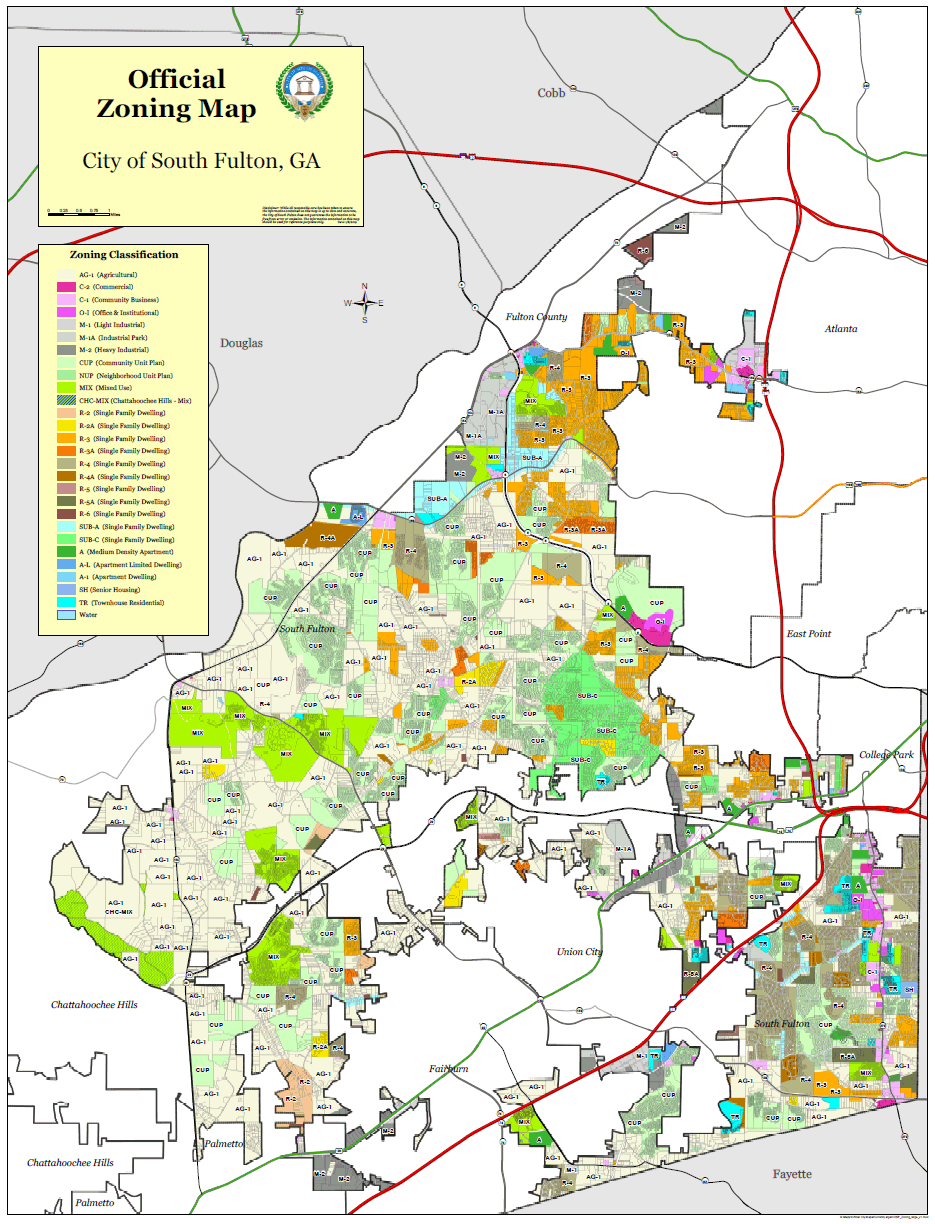
The purpose of this Article is to identify use and development standards that apply to individual zoning districts which are no longer active but which continue to apply to properties zoned in those classifications. No additional parcels will be rezoned to any inactive district classification.
Sec. 1002. - Other Regulations That Apply.
The headings below contain other provisions applicable to uses allowed in the inactive zoning districts, unless the type of regulation shown below is specifically addressed in this Article.
Sec. 1003. - SUB-A Suburban A Single-Family Dwelling District.
Regulations set forth in this Section 1003 are the SUB-A District regulations.
Sec. 1004. - SUB-C Suburban C Single-Family Dwelling District.
Regulations set forth in this Section 1004 are the SUB-C District regulations.
Sec. 1005. - TR Townhouse Residential District (Old)
The regulations set forth in Section 1005 are the regulations of the TR Townhouse Residential District (Old).
Sec. 1006. - A-1 apartment dwelling district regulations.
The regulations set forth in this Section 1006, are the regulations in the A-1 District.
Sec. 1002.01. - Zoning ordinance.
(a)
Nonconformities, see Article 1.
(b)
Off-street parking and loading, see Article 6.
(c)
Outside storage, see Article 3.
(d)
Landscape area and buffer regulations, see Article 4.
(e)
Signs, see Article 7.
(f)
Overlay districts, see Article 5.
(g)
Restrictions on particular uses, see Article 3.
(h)
Outdoor lighting standards, see Article 4.
Sec. 1002.02. - Other local regulations.
(a)
South Fulton Development Regulations.
(b)
South Fulton Floodplain Management Ordinance.
(c)
South Fulton Subdivision Ordinance.
Sec. 1003.01. - SUB-A district intent.
The SUB-A zoning district encompasses lands devoted to residential use areas of one or fewer dwellings per acre.
Sec. 1003.02. - SUB-A use regulations.
(a)
Allowed uses.
(b)
A principal building may be used for only a single-family dwelling.
(c)
For allowed accessory and temporary uses, see Article 2's Accessory and Temporary Use Table requirements for single-family residential zoning districts, with the exception that "party houses" are prohibited in the SUB-A zoning district.
Sec. 1003.03. - SUB-A development regulations.
(a)
Height regulations. Buildings shall be no higher than 35 feet or 2½ stories, whichever is higher.
(b)
Area regulations.
(1)
Minimum front yard: 60 feet.
(2)
Minimum side yard:
a.
15 feet adjacent to interior lines.
b.
30 feet adjacent to streets.
(3)
Minimum rear yard: 40 feet
(4)
Minimum lot area: 1 acre
(5)
Minimum lot width: 150 feet
(6)
Minimum lot frontage: 35 feet
(7)
Minimum heated floor area:
a.
1,200 square feet for less than two stories.
b.
1,320 square feet for two stories or more than two stories with 900 square feet on the ground floor.
(8)
Minimum accessory structure requirements. Accessory structures may be located in rear or side yards, but shall not be located within a minimum yard.
Sec. 1004.01. - SUB-C district intent.
The SUB-C zoning district encompasses lands devoted to residential use areas of two or fewer dwellings per acre.
Sec. 1004.02. - SUB-C use regulations.
(a)
Allowed uses.
(b)
A principal building may be used for only a single-family dwelling.
(c)
For allowed accessory and temporary uses, see Article 2's Accessory and Temporary Use Table requirements for single-family residential zoning districts, with the exception that "party houses" are prohibited in the SUB-C zoning district.
Sec. 1004.03. - SUB-C development regulations.
(a)
Height regulations. Buildings shall be no higher than 35 feet or 2½ stories, whichever is higher.
(b)
Area regulations.
(1)
Minimum front yard: 50 feet.
(2)
Minimum side yard:
a.
10 feet adjacent to interior lines.
b.
20 feet adjacent to streets.
(3)
Minimum rear yard: 35 feet
(4)
Minimum lot area: 18,000 square feet
(5)
Minimum lot width: 100 feet
(6)
Minimum lot frontage: 35 feet
(7)
Minimum heated floor area:
a.
1,000 square feet for less than two stories.
b.
1,100 square feet for two stories or more than two stories with 850 square feet on the ground floor.
(8)
Minimum accessory structure requirements. Accessory structures may be located in rear or side yards, but shall not be located within a minimum yard.
Sec. 1005.01. - TR district intent.
This district encompasses lands devoted to residential uses having both single and multi-family characteristics. The intent of this district is to provide standards for low-density dwellings which will:
(a)
Encourage the provisions of usable open and recreation areas and desirable living environments;
(b)
Be located primarily in areas near or adjacent to single-family use areas;
(c)
Be located so as to provide transition between single-family use areas and higher density dwelling areas and/or commercial areas; and
(d)
Be located near such services as retail shopping and major thoroughfares and collector streets.
Sec. 1005.02. - TR use regulations.
(a)
A principal building shall be used only for the following purposes:
(1)
Single-family dwelling.
(2)
Two-family dwelling.
(3)
Townhouses.
(b)
Accessory uses or buildings customarily incidental to any of the above uses are allowed as follows:
(1)
Single-family and two-family dwellings: Accessory uses and buildings that are not a part of the main structure shall be located in the rear yard or in the side yard, and shall not be less than 10 feet from any side or rear lot line.
(2)
Townhouses:
a.
All accessory buildings shall be located not nearer to any perimeter lot line than the distance prescribed for side and rear yards.
b.
Unenclosed recreational facilities, except swimming pools, may be placed within any required side or rear yard, provided that any such use shall not be permitted nearer to any perimeter lot line than 30 feet.
c.
Swimming pools are allowed provided that no swimming pool may be placed nearer than 30 feet to any rear or side lot line, nor nearer than 50 feet to any public street line. Provided further that when located adjacent to a single-family residential district, such pools shall not be located within 150 feet thereof, except in cases when located so as to be screened from single-family dwelling district by a townhouse dwelling, or an accessory structure greater in length by a minimum of 20 feet on each side of such pool(s), the distance of 150 feet shall not be required. A fence of minimum height of five feet shall be provided around the perimeter of all swimming pools.
Sec. 1005.03. - TR building regulations.
(a)
Single-family, two-family and townhouse dwellings: No building or structure shall exceed 35 feet in height.
(b)
Townhouse residential development:
(1)
No more than 20 townhouse dwelling units shall be permitted to form a single building.
(2)
No more than three contiguous townhouse dwellings which form a part of a single building shall have the same front setback or roof line. Said setback and roof line shall be varied by a minimum of two feet.
(3)
Sidewalks shall be provided for each townhouse pedestrian access throughout the entire development.
(4)
Driveways serving more than six units shall be paved to a minimum width of 30 feet.
Sec. 1005.04. - TR Area Regulations.
(a)
Single-family and two-family dwellings:
(1)
Front yard: There shall be a front yard having a depth of not less than 40 feet.
(2)
Side yard: There shall be two side yards, one on each side of the building of not less than ten feet. where a lot is located at the intersection of two or more streets, the width of the yard along the side street shall not be less than 20 feet. No accessory building or portion thereof shall be located within the required yard area along any street.
(3)
Rear yard: There shall be a rear yard having a depth of 25 feet.
(4)
Lot area per family: Every dwelling shall be located on a lot having a frontage of 90 feet at the building setback line and containing the following areas:
a.
11,000 square feet for a single-family dwelling (90' x 122').
b.
5,500 square feet per family for a two-family dwelling (99' x 112').
(b)
Townhouse residential developments:
(1)
Density: A townhouse residential development shall not exceed nine dwelling units per gross acre (4,480 square feet per family unit).
(2)
Size of development site: The minimum size of the site to be developed for townhouse residential use shall be two acres, with 100 feet of frontage.
(3)
Yard requirements:
a.
Front yard: There shall be a front yard of not less than 40 feet.
b.
Side yard: There shall be two side yards of not less than 30 feet on each side provided, however, where a side yard abuts a single-family dwelling district, the side yard shall not be less than 40 feet.
c.
Corner setback: Where a lot, tract, or parcel of land is located at the intersection of two streets, the width of the yard along the side street side shall not be less than 40 feet provided, however, that when such property lies adjacent to a single family dwelling district, the yard requirement along the side street shall be the same as prescribed or established for the front yard of the adjacent single family dwelling district. In no case shall such yard be less than 40 feet.
d.
Rear yard: There shall be a rear yard along the rear lot line of not less than 35 feet.
(c)
Buffers.
(1)
In addition to the above setback requirements, a buffer zone may be required along any perimeter lot line, or portion thereof, in order to provide privacy and separation between adjoining properties.
(2)
Property with such buffer areas may be included within the lot area for density and lot coverage purposes.
Sec. 1005.05. - TR residential floor area regulations.
(a)
Each single-family dwelling shall have a minimum ground floor area of 1,200 square feet if less than two stories.
(b)
Each single-family dwelling of two stories in height shall have a minimum ground floor area of 900 square feet, and a total minimum floor area of 1,320 square feet.
(c)
Each two-family dwelling shall have a minimum floor area of 900 square feet and a minimum ground floor area of 900 square feet if two stories in height.
(d)
Each townhouse dwelling unit shall have a minimum floor area of not less than 1,100 square feet.
(e)
Each townhouse unit shall have a minimum width of 20 feet.
(f)
Screening garbage and storage areas. All exterior garbage, incinerators, or other outside storage areas shall be screened by a solid enclosure of not less than four feet in height, unless a more restrictive standard is prescribed by Article 3.
Sec. 1005.06. - TR open space requirements.
Open space requirements for townhouse residential buildings shall be as follows:
(a)
The minimum distances between buildings, when so arranged shall be as follows:
(1)
Front to front: 50 feet
(2)
Front to rear: 60 feet
(3)
Rear to rear: 50 feet
(4)
Front or rear to side: 40 feet
(5)
Side to side: 40 feet
(b)
Where unusual and uncommon conditions of topography or configuration of the property exist, the Community Development and Regulatory Affairs Director may approve a requested departure from the above prescribed distances between buildings, provided such departure shall not diminish the required distances by more than 50 percent.
(c)
Private, usable open space, such as balconies, sundecks, patios, etc. shall be provided contiguous to each dwelling unit. The area of such open space provided for each unit shall not be less than ten percent of the floor area of the unit served. The location and number of square feet shall be clearly indicated on the site plan.
Sec. 1005.07. - Other requirements.
(a)
Approval of plans for drainage, sewerage, driveways, and parking areas by the Community Development and Regulatory Affairs Department shall be required prior to the issuance of building permits.
(b)
Construction shall conform to the overall site plan that was approved with the property's rezoning and detailed engineering plans as approved by Community Development and Regulatory Affairs Department.
Sec. 1006.01. - A-1 use regulations.
A building or premises shall be used only for the following purposes:
(a)
Principal uses.
(1)
Apartments.
(2)
Rooming house and boardinghouse. Both uses require Special Use approval.
(3)
Schools and places of worship in accordance with the requirements in Article 3. Both uses require Special Use Approval.
(4)
Non-profit clubs, excepting those the chief activity of which is a service customarily carried on as a business, in accordance with the requirements in Article 3.
(b)
Accessory uses.
(1)
Accessory uses for the A-L zoning district shall be allowed in the A-1 zoning district. See the Accessory and Temporary Use Table in Article 2.
(2)
Accessory buildings shall be located in the rear yard and not nearer to any lot line than the distance prescribed for side and rear yards.
(3)
Swimming pools may be located within the buildable area of any tract or parcel of land used for multiple family dwelling purposes, provided that when located on property adjacent to single-family or two-family dwelling districts, such pools, including their enclosed areas, shall not be located within 150 feet thereof. Provided, however, when swimming pools are located so as to be screened from such districts by a multiple family dwelling greater in length by a minimum of 20 feet on each end of the enclosed area of such pools, said distance of 150 feet shall not be required.
Sec. 1006.02. - A-1 height regulations.
No building shall exceed three stories or 45 feet.
Sec. 1006.03. - A-1 area regulations.
(a)
Front yard: There shall be front yard having a depth of not less than 40 feet.
(b)
Side yard:
(1)
Where an A-1 zoning district abuts single-family and two-family zoning districts, there shall be two side yards, one on each side of the building each having a width of not less than 25 feet.
(2)
Where an A-1 zoning district does not abut single-family and two-family zoning districts, there shall be two side yards, one on each side of the building, having a combined width of not less than 25 feet provided, however, that no side yard shall be less than ten feet in width.
(3)
Where a lot is located at the intersection of two or more streets, the width of the yard along the side street shall be not less than 25 feet.
(c)
Rear yard: There shall be a rear yard having a depth of not less than 25 feet, provided, that when a rear yard abuts a single-family district and is used for multiple dwelling purposes, the rear yard shall be not less than 75 feet.
(d)
Lot area per dwelling unit: Apartments shall be located upon a lot having a frontage of not less than 100 feet and an area of not less than 2,250 square feet per dwelling unit.
Sec. 1006.04. - A-1 residential floor area.
(a)
Each efficiency or studio apartment shall have a floor area of not less than 450 square feet.
(b)
Each dwelling unit other than efficiency or studio apartments shall have a floor area of not less than 600 square feet per dwelling unit.
Sec. 1006.05. - A-1 lot coverage.
Maximum coverage of the lot by buildings, including accessory buildings, shall be 30 percent of the gross lot area.
Sec. 1006.06. - A-1 buffer requirements.
(a)
The developer shall provide a buffer screen beginning at the building line and extending along any side or rear property line which abuts a single-family or two-family district. A buffer screen is defined as permanent fence, wall, or evergreen planting screen which will interrupt vision between adjacent properties.
(b)
A buffer screen shall be at least six feet high except that initially an evergreen planting screen may be less than six feet if plants are provided which will ultimately attain a height of six feet or more. (Note: If grouped in proximity, such plants as Pinus Strobus (White Pine); Prunus Caroliniana (Cherry Laurel); ligustrum Licidum (Ligustrum); Elaeagnus Pungens (Elaeagnus); Ilex Crenta Burfordi (Burfordi Holly); or species as approved by the City Arborist will grow to form a hardy screen thick enough and high enough to interrupt vision and to effectively reduce the transmission of sound.)
(c)
Where the requirements in this section conflict with those in Article 4, the more restrictive shall apply.
Sec. 1007.01. - Intent.
The intent of the CUP-CGA District is to provide opportunities for planned communities that meet the intent of the CUP District and that of the Cedar Grove Agricultural Overlay District (see Article 5).
Sec. 1007.02. - Allowed uses.
Principal and accessory uses not approved by City Council with an application for rezoning, including a master plan, are prohibited unless the approved master plan is amended in accordance with the "Modification of Conditions of Approval" procedures in Article 8 of this Zoning Ordinance.
Sec. 1007.03. - Development standards and other requirements.
See Section 1008.03 below.
Sec. 1008.01. - Intent.
The intent of the MIX-CGA District is to provide opportunities for planned communities that meet the intent of the MIX District and that of the Cedar Grove Agricultural Overlay District (see Article 5).
Sec. 1008.02. - Allowed uses.
Principal and accessory uses not approved by City Council with an application for rezoning, including a master plan, are prohibited unless the approved master plan is amended in accordance with the "Modification of Conditions of Approval" procedures in Article 8 of this Zoning Ordinance.
Sec. 1008.03. - Development standards and other requirements.
(a)
Master plan approval required. Within the MIX-CGA and CUP-CGA districts, land and structures may be used in accordance with the standards herein and in consideration of the purpose and intent of the Cedar Grove Agricultural Overlay District (see Article 5) and the Comprehensive Plan.
(1)
The master plan shall be the zoning control document for uses and features depicted graphically. Proposed principal and accessory uses shall be identified on the master plan with the application for rezoning to MIX-CGA or CUP-CGA. All uses not specifically included in the application, either in a general land use category or detailed for individual areas, and approved by City Council, are prohibited unless the master plan is subsequently amended in accordance with procedures for zoning modifications, as described in Article 8.
(2)
Additional master plan requirements are as follows:
a.
MIX-CGA: The master plan shall depict open space, nonresidential, residential, and civic and/or institutional uses, in accordance with Table 10-1.
b.
CUP-CGA: The master plan shall depict open space, residential, and non-residential uses, and may include civic and/or institutional uses, all in accordance with Table 10-1.
c.
The location of all use areas shall be shown on the master plan, and location on the ground shall be as shown on the master plan.
(b)
Development standards table. The following requirements apply to the MIX-CGA and CUP-CGA zoning districts.
Table 10-1 Development Standards for MIX-CGA and CUP-CGA Zoning Districts
(c)
Additional development standards for MIX-CGA and CUP-CGA districts.
(1)
Buildings.
a.
All buildings shall be oriented to face the street and or courtyard.
b.
Display windows shall be oriented to face the street and or courtyard and shall be at street level.
c.
All primary entrances be oriented to face the street and or courtyard and shall be at street level.
d.
Any nonresidential building facade shall have a minimum of 25 percent fenestration or as may be approved by the Community Development and Regulatory Affairs Director.
(2)
Residential uses.
a.
All residential structures be oriented to face the street and or courtyard.
b.
A street-facing door (excluding garage door) for each unit is required.
c.
No front-loaded, attached garage shall protrude beyond the front facade of a building.
d.
Fence height shall not exceed three feet in the front yard and six feet in the rear and side yards.
e.
Front yard fences shall be non-opaque. Opaque fences are permitted in side and rear yards. Chain link fences (black or green vinyl-coated only) are permitted in rear yards only.
f.
Gated communities are prohibited.
(3)
Gasoline service stations. Fuel pumps, canopies and associated gasoline station service areas shall be located at the rear of the lot and not between the building and the street.
(4)
Parking.
a.
All off-street parking for non-residential buildings, townhouses, and multi-family buildings shall be located to the side or rear.
b.
A minimum of 75 percent of the required surface parking shall be oriented to the rear of building.
c.
No surface parking area shall be larger than 65,340 square feet unless separated by a street, lane, alley or building.
d.
On-street surface parking spaces located adjacent to the front property line shall be counted toward the minimum number of parking spaces required for that lot.
e.
The required number of off-street parking spaces may be reduced as approved by the Community Development and Regulatory Affairs Director.
f.
Shared parking shall be permitted as approved by the Community Development and Regulatory Affairs Director.
g.
When surface parking located to the rear is along a (side) street right-of-way, the parking may occur along such frontage for a maximum of 120 linear feet.
h.
When surface parking abuts a street right-of-way, a minimum four-foot wide landscape area shall screen the parking. Within the landscape area, a continuous planting of evergreen shrubs is to be installed at a minimum height of two feet and maintained to a maximum height of three feet. Walls of the same height are also permitted with appropriate pedestrian access to the primary entrance.
i.
Access lanes and additional curb cuts (other than the primary access drive) shall be located to the side or rear of the property. The maximum width of the access lane and/or driveway is 18 feet.
j.
Parking decks must include a minimum of 25 percent occupied space (non-residential) at ground level and the occupied space must be a minimum depth of 50 feet.
k.
Parking decks shall be constructed to conceal vehicles and to include architectural detailing and finish compatible with surrounding buildings.
l.
Non-residential developments shall provide parking for bicycles.
m.
Loading areas shall be located in the rear or side yards.
(5)
Street Standards. Per South Fulton Subdivision Regulations.
(6)
Block Standards.
a.
The maximum length for a block is 600 linear feet with the total perimeter length not to exceed 1,680 linear feet.
b.
The total area of a block shall not exceed 3.30 acres.
c.
Any block exceeding 400 feet in length shall include a dedicated alley or lane providing through access.
(7)
Bridges.
a.
Bridges shall provide pedestrian and bicycle access.
b.
Bridges shall contain architectural elements compatible with the surrounding area.
(8)
Sidewalks. Sidewalks shall be constructed on both sides of the road.
(9)
Landscaping.
a.
Street trees shall be planted on both sides of all roadways except alleys and lanes.
b.
Except along greenways, alleys, and lanes a minimum four-foot wide landscape area shall be provided along all roadways, except alleys and lanes, subject to review by the Community Development and Regulatory Affairs Director and approval by City Council in the master plan.