
South Holland City Zoning Code
SPECIFICATION F
OFFSTREET PARKING AND LOADING REQUIREMENTS
A.
Purpose.
1.
In order to reduce the visual impact of large residential and nonresidential parking areas, to minimize the adverse effects of off-street parking on adjacent properties, and to ensure the proper development of parking areas throughout the village, off-street parking and loading spaces for every use shall be provided in accordance with the standards established in this section.
2.
For any off-street parking area required under this section, and for any public parking lot, garage, and storage area operated on a commercial based, an off-street parking management plan shall be submitted as part of site plan review.
B.
Scope of regulations.
1.
When the intensity of use of any building, structure, or premises shall be increased through the addition of dwelling units, gross floor area, seating capacity, or, other units of measurement specified herein for required parking or loading facilities, parking and loading facilities as required herein shall be provided for such increase in intensity of use and for one hundred (100) percent of any existing deficiency in parking or loading facilities.
2.
Whenever the existing use of a building or structure shall hereafter be changed to a new use, parking or loading facilities shall be provided as required for such new use.
3.
Uses not specified shall conform on the same basis as the most similar use as determined by the plan commission.
4.
Existing parking and loading facilities. Accessory off-street parking and loading facilities in existence on the effective date of this section and located on the same lot as the building or use served shall not hereafter be reduced below, or if already less than, shall not be further reduced below, the requirements for a similar new building or use under the provisions of this section.
5.
Submission of plot plan. Any application for a building permit, or for an occupancy certificate where no building permit is required, shall include therewith a plot plan drawn to scale fully dimensioned showing any off-street parking or loading facilities to be provided in compliance with this section.
C.
Required number of off-street parking spaces.
1.
Except as otherwise provided in subsection 2. below, each principal use on a parcel shall be provided with the number of off-street parking spaces indicated for that use in Table A.
2.
In the event that the number of parking spaces listed on Table A cannot be placed on the parcel in accordance with these regulations without the demolition of an existing structure to accommodate a parking area the director of planning, development and code enforcement may authorize up to a twenty (20) percent reduction in the total number of parking spaces required on the lot. The director of planning, development and code enforcement may issue such an authorization only upon the request of the applicant and only upon determining that the reduction in the number of required parking spaces will not unreasonably increase parking congestion along public streets or in parking areas located on nearby lots. After such authorization is granted, the applicant shall not demolish or remove the existing structure without the approval of the director of planning, development and code enforcement.
3.
In the event that an applicant demonstrates that a new commercial use will require more parking spaces than the number allocated under Table A, the director of planning, development and code enforcement may authorize up to a twenty (20) percent increase in the total number of parking spaces permitted on the lot. The director of planning, development and code enforcement may issue such authorization only upon the request of the applicant and only upon determining that the new use will attract more vehicles than the parking lot could otherwise accommodate.
4.
In the event that an applicant demonstrates that fewer parking spaces are needed to serve the use at the time of permit application, the director of planning, development and code enforcement may authorize a reduction in the amount of parking spaces and reserve additional land for potential use as parking spaces at a future time.
5.
When the required number of off-street parking spaces computed according to Table A results in a fractional number, the number of required parking spaces shall be determined as follows: Any fraction up to and including one-half (½) shall be disregarded and fractions over one-half (½) shall require one (1) parking space.
6.
If a use is not listed in Table A, the director of planning, development and code enforcement shall determine the number of off-street parking spaces that shall be required.
TABLE A
*Requirements based on square feet mean square feet of gross floor area, except as otherwise indicated.
Requirements based on the number of seats or students mean the number that is the design capacity of the building.
Requirements based on the number of staff or employees mean the maximum number of staff or employees on one shift, as certified by the applicant.
**If no on-street parking is allowed, every dwelling unit must provide 2.5 spaces, or a parking agreement must be provided with a parking lot within 500 feet of the dwelling units.
D.
Size of required parking spaces and aisles.
1.
Each required parking space shall cover a rectangle at least nine (9) feet wide and eighteen and one-half (18½) feet long, as illustrated in Figure B. The minimum required eighteen and one-half (18½) foot length shall be greater where there is a wall, fence or other obstruction or where parallel parking is required at the end of the parking space. The minimum required length may be up to two (2) feet less if a strip of ground at least two (2) feet wide exists at the end of the space and a wheelblock or curb prevents a vehicle from driving onto the strip or hitting any fence or wall at the edge of the parking area.
2.
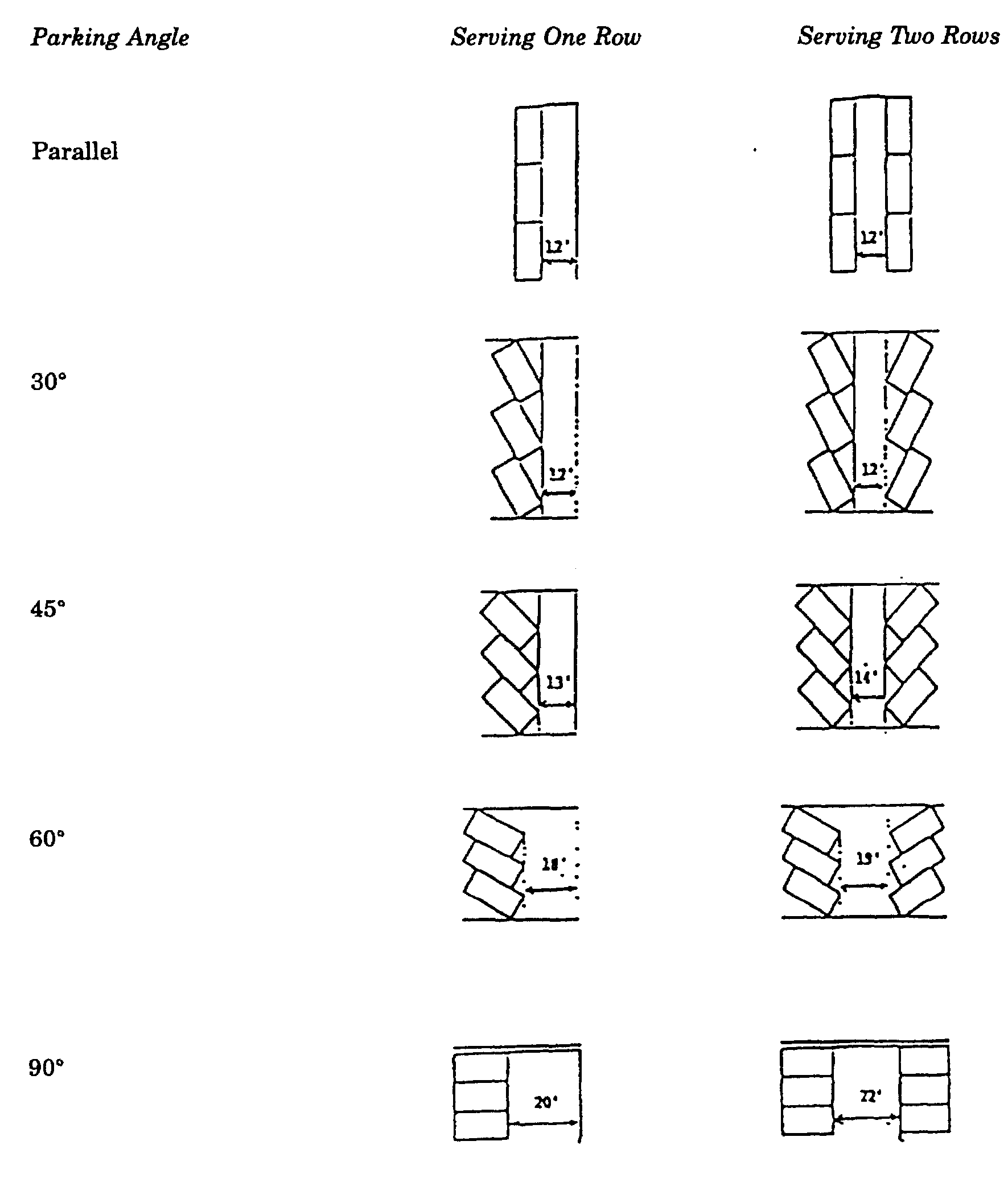
Each required parking space shall have direct and unrestricted access to an aisle. The minimum width of said aisle is set out in Figure B. See Figure B hereinbelow.
3.
The vertical clearance of each enclosed off-street parking space shall be a minimum of seven (7) feet.
FIGURE B
Required Parking Aisle Widths
E.
Spaces for the handicapped.
1.
Except for single family dwellings, the number of spaces required under the provisions of subsection C. above shall include the following requirements for parking spaces for handicapped persons:
2.
Off-street parking spaces for the handicapped shall be designed as follows:
a.
All spaces for the handicapped shall have access to a curb-ramp or curb-cut when necessary to allow access to the building served, shall be located so that users will not be compelled to wheel behind parked vehicles, and shall be located the shortest possible distance between the parking area and the entrance to the principal building it serves.
b.
The total number of accessible parking spaces may be distributed among parking lots, if greater accessibility is achieved in consideration of such factors as anticipated usage, number and location of entrances and level of parking areas.
c.
Each parking space for the handicapped shall be at least sixteen (16) feet wide including an eight (8) foot wide access aisle, and adjacent parking spaces shall not share a common access aisle. All access aisles shall blend to a common level with an accessible route and shall be diagonally striped.
d.
Parallel parking spaces for the handicapped shall be located either at the beginning or end of a block, or adjacent to alley entrances. Curbs adjacent to such spaces shall be of a height which will not interfere with the opening and closing of motor vehicle doors.
e.
No accessible parking spaces shall be required if only attendant or valet parking is provided and is available at all times that the facility is open for public use. If accessible at-grade parking is available, at least one (1) space for self parking of a vehicle with sensitive specialized control devices shall be provided.
f.
Each parking space for the handicapped shall be equipped with a sign which complies with Ill. Rev. Stat. Ch. (95½), par. 11-301 et seq., as amended, and shall meet the requirements of Sign R7-8, U.S. Department of Transportation Standard and the Illinois Department of Transportation. Signs shall bear the internationally accepted wheelchair symbol and shall be vertically mounted on a post or a wall at the front center of the parking space, no more than five (5) feet horizontally from the front of the parking space, and set a minimum of four (4) feet from finished grade to the bottom of the sign.
F.
Location of required parking.
1.
Required off-street parking spaces accessory to residential dwellings shall be located on the same lots as the use served.
2.
Required off-street parking spaces accessory to nonresidential districts shall be located within one thousand (1,000) feet of the use served, except for spaces accessory to overnight accommodations, which shall be within three hundred (300) feet of the use served.
3.
Where these regulations allow shared parking between uses on different lots, all such off-street parking areas shall be located no more than five hundred (500) feet from the use they are intended to serve.
G.
Maintenance. All parking areas shall be kept in a dust-free condition at all times.
H.
Restriction on use of off-street parking and loading spaces.
1.
Ingress and egress to and from off-street parking and loading spaces shall be provided by means of clearly limited and defined entrance and exit drives which lead from public rights-of-way to clearly limited and defined maneuvering lanes which in turn provide access to individual off-street parking or loading spaces.
2.
Layout configurations which require backing directly onto a street or a parking or loading space are prohibited.
3.
On arterial roadways, the number of access points shall be limited to one (1), unless a competent traffic engineering study determines that site access would be improved by additional access points. The minimum space between access drives shall be based on roadway speed and not on speed type and shall be determined by the director of the planning, development and code enforcement.
4.
Wherever practicable, access drives shall be shared by several uses. Such uses shall be jointly responsible for the maintenance and landscaping of the drive.
I.
Shared parking.
1.
In order to reduce the total number of parking spaces which would otherwise be required according to subsection C. above, joint use of up to fifty (50) percent of required parking spaces may be permitted for two (2) or more uses located on the same or adjacent parcels. In order to qualify for a joint use reduction, the owner of the parking lot and the owner(s) of adjacent uses must demonstrate that the shared parking will not create a parking shortage during peak hours.
2.
Any sharing of required parking spaces by uses located on different parcels shall be guaranteed by a legally binding written agreement between the owner of the parking area and the owner of any use located on a different parcel and served by the parking area that is approved by the village attorney.
3.
In the event that joint use of parking spaces becomes inappropriate, in the opinion of the director of the department of community development, after a shared parking program has been implemented, the agreement in subsection I.2. above shall be set aside. The required number of off-street parking spaces shall be computed and provided according to the provisions of subsection C. above.
J.
Design and maintenance.
1.
Accessory parking spaces may be open to the sky or enclosed in a building.
2.
In yards (residential zoning districts). Off-street parking spaces, open to the sky may be located in any yard except a front yard adjoining a street. Enclosed buildings and carports containing off-street parking spaces shall be subject to applicable yard requirements.
3.
Surfacing. All new residential and nonresidential open off-street parking and access drives shall be surfaced within one (1) year from the date of occupancy. Open off-street parking spaces and access drives shall be surfaced according to the following schedule for all existing nonresidential and residential property which is presently being used for commercial purposes as a legal nonconforming use:
a.
One (1) acre or under: The front one hundred (100) feet from the right-of-way or entrance shall be surfaced within twelve (12) months. Fifty (50) percent of the balance of the property requiring surfacing shall be completed within twenty-four (24) months. The balance of the area to be surfaced shall be completed within thirty-six (36) months.
b.
Areas in excess of one (1) acre: The front one hundred (100) feet from the right-of-way or entrance shall be surfaced within twelve (12) months.
1)
Twenty-five (25) percent of the remaining portion to be surfaced within twenty-four (24) months.
2)
An additional twenty-five (25) percent of the initial total area to be surfaced within thirty-six (36) months.
3)
An additional twenty-five (25) percent of the initial total area to be surfaced within forty-eight (48) months.
4)
The balance of the initial total area to be surfaced within sixty (60) months.
The surfacing referred to shall be constructed to provide adequate draining. The surfacing material for areas zoned commercial (GB and LB) are required to have bituminous asphalt or concrete upon the entire area required. Any area not surfaced shall have landscaping.
Areas zoned industrial (LI) shall be required to have bituminous asphalt or concrete at the entrance of the property. Areas used for parking and loading shall also be required to have bituminous asphalt or concrete. In areas zoned LI, where there are areas of granulated mineral matter in excess of the required parking, loading or access, said areas may be used only for the storage of materials and/or equipment provided the same has been treated adequately with an Environmental Protection Agency approved asphaltic emulsion. Property used by the village for park purposes, including access drives and parking, may also be treated adequately with an environmental protection agency approved asphalt emulsion. (which are in the Illinois Department of Transportation, Division of Highways, Bureau of Design Minimum Standards Manual.)
4.
Lighting. Any lighting used to illuminate off-street parking areas shall be directed away from residential properties in such a way as not to create a nuisance and in a parking area containing four (4) or more parking spaces such lighting shall be extinguished one-half (½) hour after the close of business except as may otherwise be permitted or required by the planning and development commission for maintaining illumination after the time specified above.
5.
Repair and service. No motor vehicle repair work or service of any kind shall be permitted in conjunction with any parking facilities. No gasoline or motor oil shall be sold in conjunction with any accessory parking facilities.
6.
All sidewalks within or adjoining off-street parking spaces shall be kept free from dirt, ice, sleet, and snow and maintained in a safe condition for pedestrian travel.
7.
Identification and marking. Required off-street parking areas for three (3) or more automobiles shall have individual spaces marked, in accordance with the regulations of the Illinois Accessibility Code, 71 Illinois Administrative Code, Chapter 1, Section 400 et seq., as amended which relates to parking lots and shall be designed, maintained and regulated so that no parking or maneuvering incidental to parking shall be on any public street or walk.
(Ord. No. 97-9, § 1, 4-21-97; Ord. No. 97-14, § 1, 6-16-97; Ord. No. 97-15, § 1, 7-7-97; Ord. No. 98-5, § 1, 1-20-98; Ord. No. 2023-6, § 1, 1-17-23)

