
South Salt Lake City
City Zoning Code
City Zoning Code
CHAPTER 17
03 - LAND-USE DISTRICTS AND MATRIX
17.03.010 - Land Use Matrix.
A.
Any Use not specifically permitted or conditionally permitted in this Land Use Matrix is prohibited. Only the following Uses are allowed:
1.
Uses indicated by the letter "P" below are Permitted Uses only where designated.
2.
Uses indicated by the letter "C" are Conditional Uses only where designated.
B.
All Permitted Uses are subject to the general and specific standards, as applicable, contained in Section 17.04, as well as the regulations of each particular zoning district where permitted.
C.
All Conditional Uses are subject to the general and specific standards, as applicable, contained in Section 17.05, as well as the regulations of each particular zoning district.
(Ord. No. 2021-06, § II, 5-26-2021)
(Ord. No. 2020-02, § IV(Exh. C), 1-8-2020; Ord. No. 2020-09, § I, 8-12-2020; Ord. No. 2021-01, § I, 1-13-2021; Ord. No. 2021-06, § II, 5-26-2021; Ord. No. 2022-08, § I(Exh. A), 4-13-2022; Ord. No. 2022-12, § I(Exh. A), 5-25-2022; Ord. No. 2022-16, § 1(Exh. A), 9-14-2022; Ord. No. 2024-01, § I(Exh. A), 2-7-2024; Ord. No. 2024-28, § II (Exh. B, § II), 12-11-2024; Ord. No. 2025-05, § 1(Exh. A), 3-12-2025; Ord. No. 2025-10, § 1(Exh. A), 4-23-2025; Ord. No. 2025-32, § 2(Exh. A), 7-9-2025; Ord. No. 2025-38, § 1(Exh. A), 7-23-2025; Ord. No. 2024-47, § I(Exh. A), 10-15-2025; Ord. No. 2026-02, § 1(Exh. A), 1-28-2026)
17.03.020 - R1 District.
A.
Purpose. The purpose of the R1 district is to provide for low Density Single-Family, residential housing neighborhoods on Lots not less than six thousand (6,000) square feet in size.
B.
Uses. No Building, Structure, Site or land shall be used or Developed except in accordance with the adopted Land Use Matrix as found in Section 17.03.010. Uses shall be Compatible with the existing Scale and intensity and shall preserve the existing character of the neighborhood.
C.
Standards.
1.
Area. The minimum area of any new Lot in this district is (6,000) square feet.
2.
Minimum Width. Width regulations are as follows:
a.
The minimum width of any Lot shall be fifty (50) feet at all points along the length of the property from the Front Property Line to the Rear Property Line.
b.
The Land Use Authority may decrease the minimum Lot width along the Frontage for residential Parcels accessed from a Cul-de-Sac or turnaround area.
3.
Maximum Height. The maximum Height for any Structure is thirty-five (35) feet.
4.
Required Setbacks. See Chapter 17.07.
(Ord. No. 2020-02, § IV(Exh. C), 1-8-2020; Ord. No. 2024-01, § I(Exh. A), 2-7-2024)
17.03.030 - Residential Multiple (RM) district.
A.
Purpose. The purpose of the Residential Multiple (RM) district is to provide a district where Multi-Family housing may be Developed with varying residential densities.
B.
Uses. No Building, Structure, Site, or land shall be used or Developed except in accordance with the adopted Land Use Matrix as found in Section 17.03.010.
C.
Standards.
1.
Minimum Area.
a.
The minimum area of any Lot for Multi-Family Development in this district is two (2) acres.
b.
The minimum area of any Lot for detached Single-Family residential Development in this district is 6,000 square feet.
2.
Minimum Width. Width regulations are as follows:
a.
The minimum width of any Lot or Parcel used for a Multi-Family Development shall be 250 feet at all points along the length of the property from the Front Property Line to the Rear Property Line.
b.
The minimum width of any new Lot used for Single-Family detached homes is 50 feet at all points along the length of the property from the Front Property Line to the Rear Property Line.
c.
The land use authority may decrease the minimum Lot width along the Frontage of Single-Family residential Parcels that will be accessed from a Cul-de-Sac.
3.
Maximum Building Height. The maximum Building Height for a Multi-Family Structure is 65 feet.
4.
Required Setbacks. See Chapter 17.07.
5.
Minimum Number of Units. The minimum number of units for any Multi-Family Development shall be 50 units.
6.
Residential Density. The maximum Density for any Multi-Family residential Development in the RM district shall be 25 units per acre.
(Ord. No. 2020-02, § IV(Exh. C), 1-8-2020; Ord. No. 2021-06, § III, 5-26-2021; Ord. No. 2022-08, § I(Exh. A), 4-13-2022)
17.03.040 - Jordan River (JR) district.
A.
Purpose. The purpose of the Jordan River district is to provide and preserve areas in the City of South Salt Lake for low Density residential Development, together with limited agricultural Accessory Uses associated with a primary Single-Family Use.
B.
Uses. No Building, Structure, Site, or land shall be used or Developed except in accordance with the adopted Land Use Matrix as found in Section 17.03.010.
C.
Standards.
1.
Minimum Area. Area regulations are as follows:
a.
The minimum Lot Area shall be one-half acre.
b.
The minimum area required for the raising of animals and fowl for Family food production shall be one-half acre.
c.
The minimum area for raising or boarding of horses, cattle, sheep, goats or other similar large animals is one acre.
d.
Requirements for Urban Poultry or an Apiary are detailed in Chapter 6.08.
2.
Minimum Width. The minimum width of any Lot one-half acre or larger shall be one hundred (100) feet at all points along the length of the property from the Front Property Line to the Rear Property Line.
3.
Maximum Height. The maximum Height for any Structure depends on the Building Form and adjacent Structures, as more completely detailed in Chapter 17.07.
4.
Required Setbacks. See Chapter 17.07.
(Ord. No. 2020-02, § IV(Exh. C), 1-8-2020)
17.03.050 - Commercial Corridor (CC) district.
A.
Uses. No Building, Structure, Site, or land shall be used or Developed except in accordance with the adopted Land Use Matrix as found in Section 17.03.010.
B.
Standards. Regulations for a corridor commercial district are as follows:
1.
Minimum Area.
a.
The minimum area for a new non-residential Lot in the district is one (1) acre.
b.
The minimum area for any new Multi-Family residential Lot in the district is two (2) acres with a minimum width of 250 feet along any point.
2.
Maximum Height. The maximum Height for any Structure depends on the Building Form as more completely detailed in Chapter 17.07.
3.
Required Setbacks/Build-To Standard. See Chapter 17.07.
4.
Minimum Number of Units. The minimum number of units for any Multi-Family Development shall be fifty (50) units.
5.
Residential Density. The maximum Density for any Multi-Family residential Development in the CC district shall be twenty-five (25) units per acre.
6.
All Multi-Family residential Developments in the district shall have a minimum area of 4,000 square-feet of commercial or Retail space on the ground-floor of the Primary Façade.
(Ord. No. 2020-02, § IV(Exh. C), 1-8-2020)
17.03.060 - Commercial General (CG) district.
A.
Purpose. The purpose of the Commercial General (CG) district is to allow more intense business activity in order to improve the economic base of the City without detriment to the environmental character and quality of the district. Provide space for the many highly diverse types of commercial activity needed to serve people and industry and to maintain and strengthen the economic base of the City
B.
Uses. No Building, Structure, Site, or land shall be used or Developed except in accordance with the adopted Land Use Matrix as found in Section 17.03.010.
C.
Standards.
1.
Minimum Area. The minimum area for a new Lot in the district is one-half (0.5) acre.
2.
Maximum Height. The maximum Height for any Structure is based on the Building Form as more completely detailed in Chapter 17.07.
3.
Required Setbacks/Build-To Standard. See Chapter 17.07.
(Ord. No. 2020-02, § IV(Exh. C), 1-8-2020; Ord. No. 2022-16, § 1(Exh. A), 9-14-2022)
17.03.070 - Commercial Neighborhood (CN) district.
A.
Purpose. The purpose of the Commercial Neighborhood (CN) district is to provide an area for neighborhood-oriented businesses that support the residential areas surrounding the district. The district may serve as a Buffer between residential and business/commercial districts. The Commercial Neighborhood district designation is intended for commercial Developments that will not generate high vehicle traffic. It is intended that businesses in this district will both enhance and be Compatible with the surrounding residential neighborhoods through architecture, Development, access, and site design.
B.
Uses. No Building, Structure, Site, or land shall be used or Developed except in accordance with the adopted Land Use Matrix as found in Section 17.03.010.
C.
Standards.
1.
Minimum Area. The minimum area for any Lot for Development in this district shall be one-quarter (0.25) acre.
2.
Maximum Building Height. The maximum Building Height for any Structure is based on the Building Form as more completely detailed in Chapter 17.07.
3.
Required Setbacks/Build-To Standard. See Chapter 17.07.
D.
Regulations. Regulations for a Commercial Neighborhood district are as follows:
1.
Time Restrictions. Business activities shall not normally be conducted by any of the Permitted or Conditional Uses allowed in this district before six (6) a.m. or after ten (10) p.m.
2.
Parking. Parking shall only be allowed for passenger-type vehicles or light, vans and trucks that do not exceed one ton in capacity, except for the temporary parking of larger vehicles involved in delivering goods in the area while the goods are being loaded and unloaded.
3.
Changes of Use. The conversion of a Single Family Dwelling Unit into a commercial use is a Change Of Use, subject to the following standards:
a.
The residential character of the Building exterior shall be maintained.
b.
The Front Building Elevation shall contain no more than fifty (50) percent glass.
c.
Additions and remodels are subject to the City's General Residential Design Standards in section 17.07.060.
d.
All front and corner side yards shall be fully landscaped subject to the City's Landscape Standards.
e.
Parking.
i.
Off-Street parking is only permitted in the rear yard area.
ii.
The proposed use must provide 2 (two) stalls per every 1,000 square feet on-site.
iii.
Existing single family driveways may be used to service rear yard parking areas. All driveways must be a minimum of 12 feet wide.
f.
On-site waste container enclosures and management is required in the rear yard.
(Ord. No. 2020-02, § IV(Exh. C), 1-8-2020; Ord. No. 2021-06, § IV, 5-26-2021; Ord. No. 2022-16, § 1(Exh. A), 9-14-2022; Ord. No. 2025-40, § 1(Exh. A), 7-23-2025)
17.03.080 - Business Park (BP) district.
A.
Purpose. The purpose of the Business Park (BP) district is to provide for specific Uses in a business park setting. The Business Park (BP) district will emphasize a high level of architectural and landscape excellence in a park-like atmosphere. The intent is to create an attractive business park that will complement the surrounding land uses.
B.
Uses. No Building, structure, Site or land shall be used or Developed except in accordance with the adopted Land Use Matrix as found in this Chapter.
C.
Standards.
1.
Minimum Area. The minimum area for a new Lot in the district is one (1) acre.
2.
Maximum Height. The maximum Height for any Structure is based on the Building Form as more completely detailed in Chapter 17.07.
3.
Required Setbacks/Build-To Standards are detailed in Chapter 17.07.
D.
Regulations. Time Restrictions. Business shall not normally be conducted before six (6) a.m. or after ten (10) p.m.
(Ord. No. 2020-02, § IV(Exh. C), 1-8-2020; Ord. No. 2022-16, § 1(Exh. A), 9-14-2022)
Editor's note— Ord. No 2022-16, § 1(Exh. A), adopted September 14, 2022, repealed former § 17.03.080, which pertained to professional office (PO) district and derived from Ord. No. 2020-02, § IV(Exh. C), adopted January 8, 2020. Subsequently, §§ 17.03.090—17.03.220 were renumbered as §§ 17.03.080—17.03.210.
17.03.090 - Flex district.
A.
Purpose. The purpose of the Flex district is to designate appropriate locations where warehousing and industrial Uses with minimal objectionable characteristics may be established, maintained and protected. The regulations of this district are designed to promote a high level of environmental quality by Uses which do not contribute to the deterioration of environmental quality.
B.
Uses. No Building, Structure, Site or land shall be used or Developed except in accordance with the adopted Land Use Matrix as found in this Chapter.
C.
Standards.
1.
Minimum Area. The minimum area for a new Lot in the district is one (1) acre.
2.
Maximum Height. The maximum Height for any Structure is based on the Building Form as more completely detailed in Chapter 17.07.
3.
Required Setbacks/Build-To Standards are detailed in Chapter 17.07
D.
Regulations. Regulations for the Flex district are as follows: Noise and Odor. Uses in the Flex district shall not produce noxious, foul or offensive odors, nor produce smoke or fumes that are injurious or detrimental to the health of the general population or business community. No Use is this district shall produce a noise in violation of adopted noise regulations of the Salt Lake County Health Department or in any other manner constitute or contribute to a public or a private nuisance.
(Ord. No. 2020-02, § IV(Exh. C), 1-8-2020; Ord. No. 2022-16, § 1(Exh. A), 9-14-2022)
Note— See editor's note at § 17.03.080.
17.03.100 - Transit Oriented Development (TOD) district.
A.
Purpose. The purpose of the Transit-Oriented Development (TOD) district is to encourage property Owners to Develop their property using transit-oriented design principles.
B.
The TOD district is established:
1.
To promote new, well-integrated residential, commercial, office, institutional and other employment center Development close to TRAX and transit stations;
2.
To ensure that new Development takes advantage of Compatible, higher Density, transit friendly, design opportunities in close proximity to transit systems in order to provide options for economic development and diversity;
3.
To encourage pedestrian orientation and human Scale in new Development and promote public infrastructure that supports transit Use and Mixed-Use Development;
4.
To manage parking and vehicular access utilizing Shared Parking and driveway access to avoid pedestrian conflicts;
5.
To promote residential Development that is Compatible with surrounding Uses and that is of sufficient Scale to create functional Mixed-Use neighborhoods near transit; and
6.
To encourage, through design, configuration, and mix of Buildings and activities, a pedestrian-oriented environment that provides settings for social interaction and active community life.
C.
Uses. No Building, Structure, Site, or land shall be used or Developed except in accordance with the adopted Land Use Matrix as found in this Chapter.
D.
Applicability. A property Owner shall follow the provisions of the Transit-Oriented Development district when Developing or changing the Use of property.
E.
Regulations. Regulations for the Transit-Oriented Development district are as follows
1.
Minimum Area.
a.
The minimum area of any Lot for Multi-Family Development shall be two (2) acres.
2.
Minimum Width. Width regulations are as follows:
a.
The minimum width of any Lot for a Multi-Family Development shall be 250 feet at all points along the length of the property.
b.
The land use authority may decrease the minimum Lot width requirement along the Frontage for residential Lots accessed from a Cul-de-Sac.
3.
Maximum Building Height. The maximum Building Height for any Structure is based on the Building Form as more completely detailed in Chapter 17.07.
4.
Required Setbacks/Build-To Standards are described in Chapter 17.07.
5.
Minimum Number of Units. The minimum number of units for any Multi-Family Development shall be 50 units.
6.
Residential Density. The maximum Density for any Multi-Family residential Development in the TOD district shall be 25 units per acre.
7.
All Multi-Family residential Developments in the district shall have a minimum area of 4,000 square-feet of commercial or Retail space on the ground-floor of the Primary Façade.
(Ord. No. 2020-02, § IV(Exh. C), 1-8-2020; Ord. No. 2021-06, § V, 5-26-2021; Ord. No. 2022-16, § 1(Exh. A), 9-14-2022)
Note— See editor's note at § 17.03.080.
17.03.110 - Transit Oriented Development Core (TOD-C) district.
A.
Purpose. The purpose of the Transit-Oriented Development-Core (TOD-C) district is to encourage property Owners adjacent to or near existing transit stations to Develop their property using transit-oriented design principles.
B.
The TOD-C district is established:
1.
To promote new, well-integrated high-Density residential, commercial, office, institutional and other employment center Development close to TRAX and transit stations;
2.
To ensure that new Development takes advantage of Compatible, higher Density, transit friendly, design opportunities in close proximity to transit systems in order to provide options for economic development and diversity;
3.
To encourage pedestrian orientation and human Scale in new Development and promote public infrastructure that supports transit Use and Mixed-Use Development;
4.
To manage parking and vehicular access utilizing Shared Parking and driveway access, and quality design of drive-through areas, to avoid pedestrian conflicts;
5.
To promote residential Development that is Compatible with surrounding Uses and that is of sufficient Scale to create functional Mixed-Use neighborhoods near transit; and
6.
To encourage, through design, configuration, and mix of Buildings and activities, a pedestrian-oriented environment that provides settings for social interaction and active community life.
C.
Uses. No Building, Structure, Site, or land shall be used or Developed except in accordance with the adopted Land Use Matrix as found in this Chapter.
D.
Applicability. A property Owner shall follow the provisions of the TOD-C district when Developing or changing the Use of property.
E.
Regulations. Regulations for the district are as follows:
1.
Minimum Area.
a.
The minimum area of any Lot for Multi-Family Development shall be two (2) acres.
2.
Minimum Width. Width regulations are as follows:
a.
The minimum width of any Lot for a Multi-Family Development shall be 250 feet at all points along the length of the property.
b.
The land use authority may decrease the minimum Lot width requirement along the Frontage for residential Lots accessed from a Cul-de-Sac.
3.
Minimum Number of Units. The minimum number of units for any Multi-Family Development shall be 50 units.
4.
Maximum Building Height. The maximum Building Height for any Structure is based on the Building Form as more completely detailed in Chapter 17.07.
5.
Required Setbacks/Build-To Standards are detailed in Chapter 17.07.
6.
All Multi-Family residential Developments in the district shall have a minimum area of 4,000 square-feet of commercial or Retail space on the ground-floor of the Primary Façade.
(Ord. No. 2020-02, § IV(Exh. C), 1-8-2020; Ord. No. 2021-06, § VI, 5-26-2021; Ord. No. 2022-08, § I(Exh. A), 4-13-2022; Ord. No. 2022-16, § 1(Exh. A), 9-14-2022)
Note— See editor's note at § 17.03.080.
17.03.120 - Mixed-Use district.
A.
Purpose. The purpose of the Mixed-Use district is to encourage a mixture of Compatible Uses and Structures that will enhance the vitality and diversity of the area. Development should accommodate and respect surrounding land Uses by providing a gradual transition from more intensive Uses to lower Density Residential Uses that are adjacent to a potential Mixed-Use site.
B.
Uses. No Building, Structure, Site, or land shall be used or Developed except in accordance with the adopted Land Use Matrix as found in this Chapter.
C.
Standards. Standards for the district are as follows:
1.
Minimum Area. The minimum area of any Lot for Multi-Family Development is two (2) acres.
2.
Minimum Width. Width regulations are as follows:
a.
The minimum width of any Lot for a Multi-Family Development shall be 250 feet at all points along the length of the property.
b.
The land use authority may decrease the minimum Lot width along the Frontage for residential Parcels when accessed from a Cul-de-Sac.
3.
Maximum Building Height. The maximum Building Height for any Structure is based on the Building Form as more completely detailed in Chapter 17.07.
4.
Required Setbacks/Build-To Standards are detailed in Chapter 17.07.
5.
Minimum Number of Units. The minimum number of units for any Multi-Family Development shall be 50 units.
6.
Residential Density. The maximum Density for any Multi-Family Development in the district shall be 25 units per acre.
7.
All Multi-Family residential Developments in the district shall have a minimum area of 4,000 square-feet of commercial or Retail space on the ground-floor of the Primary Façade.
(Ord. No. 2020-02, § IV(Exh. C), 1-8-2020; Ord. No. 2021-06, § VII, 5-26-2021; Ord. No. 2022-08, § I(Exh. A), 4-13-2022; Ord. No. 2022-16, § 1(Exh. A), 9-14-2022)
Note— See editor's note at § 17.03.080.
17.03.130 - City Facility (CF) and City Facility (CF) Overlay district.
A.
Purpose. The purpose of the City Facility (CF) and City Facility (CF) Overlay district is to provide for locations and appropriate standards for a range of public uses conducted by governmental and specified agencies. These uses are operated for the benefit of the community and provide basic services and essential support services for the community.
B.
Uses. No Structure, Lot, or Parcel shall be used or Developed except in accordance with the adopted Land Use Matrix as found in this Chapter.
C.
Scope. The City Facility and CF Overlay district includes all property designated as CF on the official zoning map, as well as all dedicated public streets and Rights-of-Way. The CF Overlay reverts to the underlying zoning district immediately preceding the zoning map amendment for the CF Overlay upon the termination of the City Use.
D.
Regulations. The Development Standards, Design Standards and Building Forms in Title 17 do not apply to City Facilities. The Community Development Director or designee shall determine, in writing, that the project has demonstrated the following:
1.
There is a demonstrated need for the City Facility within the community at large and it is not contrary to the public interest.
2.
The City Facility is consistent with the goals and policies of the general plan, and applicable ordinances of the city where feasible.
3.
The City Facility is located, planned, and developed in a manner that is not inconsistent with the health, safety, or general welfare of persons residing or working in the city. Including, but not limited to, the following:
a.
The generation of noise, noxious or offensive emissions, or other nuisances which may be injurious or detrimental to the surrounding area.
b.
The availability of public services to support the City Facility, including utilities, vehicular, pedestrian and public transit systems, police, fire, education, and social and health services.
c.
The adequacy of landscaping, screening and buffering, building setbacks, parking, open space, or other development characteristics necessary to mitigate the impact of the City Facility on neighboring properties.
E.
Standards.
1.
Outdoor Storage. Outdoor Storage regulations are as follows:
a.
Screening. Outdoor storage and storage yards must be screened from public view. Solid fencing shall be installed to screen outdoor storage areas. All fencing must be at least six feet in height and may not exceed the maximum height of 8 feet. Chain link and vinyl fences are prohibited.
b.
All fences shall meet the Clear View Area requirements.
c.
Barbed Wire. Fences containing strands of barbed wire, including all forms of security wire, shall be prohibited.
d.
Electrified Fences. Electrified fences shall be prohibited. This provision does not prohibit an "invisible" fence (wired or wireless) to contain canines with a collar receiver.
(Ord. No. 2020-02, § IV(Exh. C), 1-8-2020; Ord. No. 2021-06, § VIII, 5-26-2021; Ord. No. 2022-16, § 1(Exh. A), 9-14-2022; Ord. No. 2025-10, § 1(Exh. A), 4-23-2025; Ord. No. 2025-38, § 1(Exh. A), 7-23-2025)
Note— See editor's note at § 17.03.080.
17.03.140 - Open Space (OS) district.
A.
Purpose. The Open Space district is to encourage the preservation of open space.
B.
Uses. No Building, Structure, Site, or land shall be used or Developed except in accordance with the adopted Land Use Matrix as found in this Chapter.
C.
Development Review. The Planning Commission shall review requests for Development in the district. During the review process, the Planning Commission shall set appropriate Building Height, size, and Setback requirements for each specific Development proposal.
(Ord. No. 2020-02, § IV(Exh. C), 1-8-2020; Ord. No. 2022-16, § 1(Exh. A), 9-14-2022)
Note— See editor's note at § 17.03.080.
17.03.150 - Historic and Landmark (HL) district.
A.
Purpose. This Section is enacted and intended to:
1.
Encourage protection, restoration, and reuse of Structures, Sites, and areas of historic and architectural significance, these being among the City's most important cultural, educational, and economic assets;
2.
Protect the character of the historic and landmark Structures, Sites, and areas from being lost through expansion or change of commercial, residential, or other activity in the City;
3.
Preserve historic and landmark Structures, Sites, and areas for the Use, observation, study, education, enjoyment, and general welfare of the present and future inhabitants of South Salt Lake;
4.
Stabilize and revitalize neighborhoods by creating an environment conducive to reinvestment and continued maintenance;
5.
Educate citizens about the City's history;
6.
Protect key elements of the City's history;
7.
Protect and enhance historic elements that attract residents, tourists, and visitors, and serving as a support and stimulus to business and industry;
8.
This Section does not prohibit the razing of Structures that pose an immediate hazard to human health and safety, nor preclude ordinary maintenance and repair not otherwise subject to City regulation.
9.
Preserve structures from deliberate acts of demolition or destruction and deliberate or inadvertent neglect of historic and landmark Structures and Sites within historic districts.
10.
Serve as a support and stimulus to business and industry.
B.
Uses. No Building, Structure, Site, or land shall be used or Developed except in accordance with the adopted Land Use Matrix as found in this Chapter.
C.
Regulations. Regulations for the district are as follows:
1.
An area, Parcel, or Lot may be designated as within this district if it contains a natural feature, Structure, or Building with historical significance, valued character, interest, or importance as part of the Development, heritage, or cultural characteristics of the community, as measured by falling into one or more of the following categories:
a.
Historical Significance.
i.
It is the location of, or is associated in a significant way with, an historic event that had a significant effect upon the City, state, or nation.
ii.
It is associated in a significant way with the life of a person important in the history of the City, state, or nation.
iii.
It is associated in a significant way with an important aspect of the cultural, political, or economic heritage of the City, state, or nation.
b.
Architectural, Landscape Architecture, and Engineering Significance.
i.
It embodies the distinctive visible characteristics of an architectural style, period, or a method of construction.
ii.
It is an outstanding work of a designer or builder.
iii.
It contains elements of extraordinary or unusual architectural or structural design, detail, use of materials, or craftsmanship.
iv.
It portrays the environment of a group of people in an era of history characterized by a distinctive architectural style.
v.
It has retained historic integrity, in that there have not been any major alterations or additions that have obscured or destroyed the significant historic features.
D.
Powers and Duties.
1.
The Historic and Landmark Commission shall have the following duties:
a.
Survey and inventory the community's Historic Buildings and landmarks along with contributory and Non-Contributory Structures upon a site. The Commission shall conduct or cause to be conducted a survey of the historic, architectural, and archaeological resources within the community. Survey and inventory documents shall be maintained and open to the public.
b.
Recommend the designation of areas, Parcels, or Lots as within the district to the City Council in accordance with the procedures adopted in this Title.
c.
Review and make recommendations related to Applications for a permit for the demolition or relocation of a Building or Structure which is within the district.
2.
For the purpose of this Section, "Structure" includes all Buildings, exterior walls, fences, signs, utility fixtures, steps, or appurtenant elements.
E.
Procedures for Land Use Designations and Design Review Certificates.
1.
Official nominations of properties to be designated within the district must originate with the property Owner, City administration, the Historic and Landmark Commission, or the City Council. Applications shall be filed with the Community Development Department.
2.
The Historic and Landmark Commission shall review all Applications submitted to the Community Development Director. Approvals shall be consistent with established guidelines. The Historic and Landmark Commission may call upon historic preservation consultants, through the Community Development Director, for professional expertise.
F.
Design Review Certificate Standards.
1.
A design review certificate shall be required in any of the following instances involving a Structure within the district:
a.
All additions, renovation, alterations, exterior remodeling, or major changes in color, material, texture, roofing materials, to the exterior of any improvement which do not constitute demolition;
b.
Alterations or Development affecting natural features, or site improvements; and
c.
Any signs placed on any Structure or property.
2.
Routine maintenance and upkeep, repainting or replacing roofing, shutters, trim, or similar decorative items with similar materials shall not require a design review certificate.
3.
If the Structure is contributory or non-contributory and the changes involve additions, renovation, exterior remodeling, or major changes in color, material, texture, or size, the project shall be presented to the historic and landmark commission for a design review certificate prior to the issuance of a Building Permit or commencement of work, if no permit is required.
4.
Establishment of Standards and Guidelines. South Salt Lake standards and guidelines for exterior and site design criteria may be adopted by the Historic and Landmark Commission to aid Applicants in formulating plans for Development relating to sites and Structures within the district.
5.
Application of Standards and Guidelines. In approving an Application for a design review certificate, the Historic and Landmark Commission shall find that a project substantially complies with the Secretary of the Interior's Standards and Guidelines for Rehabilitating Historic Buildings. The following standards and guidelines shall be applied during reviews by the Historic and Landmark Commission:
a.
A property will be used as it was historically or be given a new Use that requires minimal change to its distinctive materials, features, spaces, and spatial relationships.
b.
The historic character of a property will be retained and preserved. The removal of distinctive materials or alteration of features, spaces, and spatial relationships that characterize a property will be avoided.
c.
Each property will be recognized as a physical record of its time, place, and Use. Changes that create a false sense of historical Development, such as adding conjectural features or elements from other historic properties, will not be undertaken.
d.
Changes to a property that have acquired historic significance in their own right will be retained and preserved.
e.
Distinctive materials, features, finishes, and construction techniques or examples of craftsmanship that characterize a property will be preserved.
f.
Deteriorated historic features will be repaired rather than replaced. Where the severity of deterioration requires replacement of a distinctive feature, the new feature will match the old in design, color, texture, and, where possible, materials. Replacement of missing features will be substantiated by documentary and physical evidence.
g.
Chemical or physical treatments, if appropriate, will be undertaken using the gentlest means possible. Treatments that cause damage to historic materials will not be used.
h.
Archeological resources will be protected and preserved in place. If such resources must be disturbed, mitigation measures will be undertaken.
i.
New additions, exterior alterations, or related new construction will not destroy historic materials, features, and spatial relationships that characterize the property. The new work shall be differentiated from the old and will be Compatible with the historic materials, features, size, Scale and proportion, and massing to protect the integrity of the property and its environment.
j.
New additions and adjacent or related new construction will be undertaken in such a manner that, if removed in the future, the essential form and integrity of the historic property and its environment would be unimpaired.
G.
Demolition Permit Processing Requirements.
1.
When any Application is made for a demolition permit for a Structure within the district, the Community Development Director may delay approval of the demolition permit for a period of up to thirty (30) days in order to do the following:
a.
Make a historical record, both written (history, floor plans and elevations) and photographic, of the Structure and Site.
b.
Review the condition of the Structure to determine the impact of the demolition upon the neighborhood and the technical feasibility of preservation to the Structure.
c.
Allow the Historic and Landmark Commission to consider and make recommendations regarding the Application.
d.
Make the Owner aware of incentives available to rehabilitate historic resources.
e.
Encourage the property Owner not to demolish the Structure until an attempt can be made to locate either a suitable Use or occupancy to make the preservation of the Structure economically viable or to find a purchaser who is willing to acquire and preserve the Structure.
2.
Denial. Upon findings of fact by the Historic and Landmark Commission that preservation of the Structure is warranted, leaves the Owner with reasonably beneficial Use of the Property, and is in the best interest of the City, the permit may be denied.
H.
Appealing Decisions of the Historic and Landmark Commission. Decisions of the Historic and Landmark Commission may be appealed as provided in Chapter 17.12.
(Ord. No. 2020-02, § IV(Exh. C), 1-8-2020; Ord. No. 2022-16, § 1(Exh. A), 9-14-2022)
Note— See editor's note at § 17.03.080.
17.03.160 - Crossing MPMU district.
A.
Intent and Administration. The Crossing Development is designed as the catalyst for redevelopment of the Central Point Project Area. Since every successful downtown redevelopment area has a grocery component, the Crossing Development includes a regional grocery store to anchor the project's other Retail, commercial, and Multi-Family Uses.
1.
This Code is adopted in accordance with the provisions of Section 17.03.130 of this Code, regulating the establishment of Mixed-Use districts. This Section, in conjunction with the broader Code regulates Uses, Building forms, architecture, open space, Site Development standards, and parking and access requirements for the Crossing Development.
2.
The Crossing Master Plan Book of Exhibits (CMPBE), attached hereto and incorporated by reference, is a compilation of exhibits meant to be conceptual in nature unless expressly referenced as regulatory herein.
3.
Unless stated otherwise in this document, all requirements of this Code apply.
4.
For the purposes of the Crossing Master Plan, the City Council is the land use authority for Multi-Family Development established as a Conditional Use in this MPMU district. Final approval of Conditional Uses and designs for Multi-Family Development must be preceded by a recommendation from the Planning Commission.
B.
Subdistrict Designations. Subdistrict boundaries are depicted in the subdistrict designation map of the CMPBE and are incorporated herein as regulatory.
1.
Anchor Tenant. The Anchor Tenant subdistrict accommodates a large format Retail establishment to anchor the entire Crossing Development. The proposed establishment and associated parking and access must be contained entirely within this subdistrict.
2.
2100 South Street Frontage. The 2100 South Street Frontage subdistrict allows a variety of Retail, office, and Residential Uses that complement the principal Retail and Residential Uses in the Crossing Development.
3.
Transit. The Transit subdistrict allows a Multi-Family Development as further conditioned herein.
4.
State Street Frontage. The State Street Frontage subdistrict allows for Retail Uses within in-line or single-tenant Retail Buildings that are oriented toward State Street. These Buildings will complement the principal Retail and Residential Uses in the Crossing Development, while addressing and activating the State Street corridor.
C.
Circulation. The Crossing Development shall provide an interior network of pedestrian and vehicular connections to facilitate access among subdistricts and between Uses.
D.
Open Space and Outdoor Gathering Areas. At a minimum, every Parcel will include open space that is appropriate for the Use, required by the South Salt Lake Municipal Code and integrated into a network of functional open spaces throughout the site.
E.
Building Types and Design Standards. The Crossing Development is a Mixed-Use district with Building types and design standards required to produce a harmonious mix of commercial Retail/Restaurant and Residential Uses tied to the urban Street network and embracing pedestrian and bike connections to the City and the streetcar. The area shall be organized around Compatible yet eclectic architectural Building statements in terms of character, materials, texture, and color of Buildings. Themed Restaurants, Retail chains, and other franchise-style Structures, signage and designs are prohibited. Themed business Uses must adjust their standard architectural prototype, signage, and designs to be consistent with the district's architectural character. Only the following Building forms and corresponding design standards are allowed within the Crossing Development.
1.
Anchor Retail. The anchor Retail Building is allowed solely in the Anchor Retail subdistrict and is regulated by the concept plan and elevations described in "Winco Foods Proposed Exterior Design" exhibits of the CMPBE.
2.
Multi-Family.
a.
Urban-style Multi-Family Building. The urban-style Multi-Family Building form is allowed in the transit and 2100 South subdistricts. Urban-style Multi-Family Building forms, amenities, and Site Plans shall comply with each provision of the urban-style Multi-Family Building requirements of Chapter 17.07, except:
i.
No Building shall exceed seventy-five (75) feet in height, as measured from natural grade.
ii.
In the Transit subdistrict, from former Major Street to State Street, no Building shall not exceed twenty-eight (28) feet in height measured from natural Grade.
iii.
First level floor-to-floor dimension shall be no less than ten feet.
iv.
At least seventy-five (75) percent of the units must have either Porches or balconies.
a)
The average depth of each Porch/balcony must be at least five (5) feet.
b)
The area of each Porch/balcony must be at least forty (40) square feet.
v.
Fifty (50) percent of the Street level perimeter of any above-Grade parking garage must be Retail or office Uses permitted in the subdistrict within habitable space that is at least twenty-five (25) deep.
vi.
For Urban-Style Multi-Family Buildings, the required amenities can be found in Section 17.07.110.
b.
Townhome Building shall comply with the standards found in Section 17.07.080.
c.
Common Requirements. Regardless of Multi-Family Building form, the following Site-specific requirements and adjustments shall be made for Multi-Family Development:
i.
Setback requirements for each Multi-Family Development are set forth in Street cross-sections of the CMPBE.
ii.
Architectural design characteristics and trim treatments are to be consistent with a contemporary form of Building design and details that are expressed in high quality durable materials including wood siding, cementitious fiberboard, brick masonry, split-faced masonry, architecturally finished concrete. Glass, architectural metal panels, or corrugated metal may be used as accent materials and shall not be the dominant materials on any elevation. Stucco, EIFS to be limited to a maximum of ten (10) percent of any Building Elevation.
iii.
Each elevation of a proposed Building shall provide patios, balconies, windows and doors for minimum of twenty (20) percent of the wall area. Windows must be trimmed with finished edges Compatible to the contemporary form of the rest of the elevation.
iv.
The location of utility metering, electrical cabinets, transformers and other equipment (some of which is existing) must be screened from public view.
3.
Commercial Retail Buildings. The commercial Retail Building type is allowed in the 2100 South Street and State Street Frontage subdistricts and is designed for small and moderate scale commercial, Retail, and Restaurant Uses that typically accompany large format Retail, housing, and other Uses typically found in Mixed-Use centers. The required Site Plan and Building type provides convenient automobile access from the thoroughfare, while minimizing the negative impacts of Parking Lots upon the pedestrian. Commercial Retail Buildings may be freestanding Structures intended for Use by a single tenant or may be multi-tenant Buildings. Except as modified below and as depicted in the Building Elevation exhibit of the CMPBE, the provisions of this Code, the layout, orientation, Setbacks, and materials intended for Use for commercial Retail Buildings apply:
a.
Orientation. New commercial Retail Buildings must be oriented to create quality Streetscapes and connected pedestrian pathways within the Development. The anticipated orientation of commercial Retail Buildings is indicated in the "Building Elevation" exhibit of the CMPBE.
b.
Materials. Primary Materials must consist of glass, integral color CMU, metal panel, tile, metal or cementitious fiber board. EIFS may be used up to seventy-five (75) percent of non-glass areas. An approved palette of materials is referenced in the "Building Elevation" exhibit of the MPBE.
c.
Primary Facades. Primary Facades on structures using the commercial Retail Building form must incorporate a Building canopy, awning, or similar weather protection along the Building's principal public entrance, projecting at least four (4) feet from the Façade. In addition, Primary Façades incorporate visually prominent Building entrances through the use of at least one (1) of the following features:
i.
Secondary roof Structures, or a parapet roof with transitions, used to accent the principal public entrance.
ii.
Outdoor pedestrian features such as seat walls and Landscaping, or permanent landscaped planters with integrated benches.
iii.
Architectural detailing such as tile, metal, stone, precast or cement board work and moldings integrated into the Building structure.
d.
Secondary Façades.
i.
All secondary Façades that face State Street shall include a similar level of architectural detail and treatment consistent with the Primary Façade. Secondary Façade walls must include a window, a functional doorway, or another architectural detail to match the architectural articulation of the Primary Facade.
ii.
All secondary Façades facing other access roads may include a reduced level of architectural detail and treatment consistent with the Primary Façade.
e.
Windows. Commercial Retail Buildings shall comply with the following window requirements:
i.
All Street level windows within twenty (20) feet of the principal pedestrian entrance of a multi-tenant Building shall be visually permeable.
ii.
Front Façade walls shall include a window or functional general access doorway per the following standard:
a)
Every twenty-four (24) feet for Structures of forty thousand (40,000) square feet or less in size; and
b)
Every forty (40) feet for Structures larger than forty thousand (40,000) square feet in size.
f.
Roofs. Commercial Retail Buildings shall have a flat roof with parapet walls. Parapet walls must feature transitions and articulation to match the architectural articulation of the primary Facade. All rooftop equipment must be screened from view from all Streets, Parking Areas, and drive approaches.
g.
Side and Rear Loading and Service Areas. Loading, service, and equipment areas must be located in a manner that minimizes their visibility from drive approaches and Streets. Loading, service, and equipment areas must be screened through the use of Architectural Elements and materials that reduce their visibility.
h.
Drive-through Facilities. Drive through facilities, where permitted as Accessory Uses associated with commercial Retail Buildings, must include a canopy or roof that is architecturally integrated with the Building and that mirrors the roof form of the Primary Structure. Drive-through access is prohibited on Façades that face State Street.
F.
Crossing Development Sign Standards. Sign locations and details are found in Site Signage exhibit of the MPBE. Signage shall comply with the requirements of the South Salt Lake Municipal Code, except as provided for in this Section and in the exhibits. Signage must be consistent with the theme and unity provisions in the Building design standards. Internally illuminated cabinet Wall Signs are prohibited, except to display a logo or individual alphanumeric characters.
G.
Crossing Development Landscaping Standards.
1.
A concept Landscape Plan for the Crossing Development is included in Landscape Area Exhibit of the CMPBE. The Landscape Plan is illustrative in nature. Tree and plant spacing may vary depending on the location of existing utilities and other site conditions. The 2100 South Street Frontage subdistrict shall comply with the landscape standards in Section 17.06.300 and shall have a minimum ten (10) foot landscape setback measuring from back of right-of-way along Main Street and 2100 South.
2.
Transit District Landscape Standards. All Multi-Family open space areas are to be landscaped with a combination of trees (two (2)-inch minimum caliper), shrubbery, lawn, groundcover, plaza paving, and mulching. Street trees are to be spaced at thirty (30) feet on center on average. Ornamental open space trees are to be planted at a rate of not less than fifteen (15) trees per open space acre. The tree species are to be selected from the following pallet:
a.
Street trees:
i.
Green Ash;
ii.
Linden;
iii.
Honey Locust;
iv.
Zelkova;
v.
Tatarian Maple.
b.
Ornamental Open Space Trees:
i.
Red Bud;
ii.
Crab Apple;
iii.
Flowering Pear;
iv.
Columnar Spruce.
H.
Crossing Development Parking and Access Standards. Parking and access requirements established in Chapter 17.06 apply, unless otherwise provided in specific terms as follows. Pedestrian access to each subdistrict within the Development is required and must include lighted and paved pedestrian pathways connecting Parking Lots, public Rights-of-Way, principal public entrances of each Building, and adjacent public trails and transit.
1.
Parking for Retail Uses. Parking for Retail Uses must be provided at a standard ratio of four (4) Parking Stalls per one thousand (1,000) square feet of gross Floor Area.
2.
Parking for All Multi-Family Uses. Parking for Multi-Family Uses must be provided in the form of individual garages and on-site Parking Stalls for urban-style Multi-Family Buildings an access-controlled multi-level parking garage incorporated in the overall residential apartment Building.
a.
Multi-Family Uses require 1.2 Parking Stalls per Dwelling Unit.
b.
The maximum number of Parking Stalls allowed adjacent to Central Pointe Boulevard shall be twelve (12). These Parking Stalls may be oriented diagonally but must be located on the Multi-Family Development Site.
3.
Bicycle Amenities. One (1) exterior bicycle parking space is required for each ten (10) residential units.
4.
Streetcar Orientation. The Crossing Development must provide Building entrances with direct access to the streetcar station or with direct connectivity to the streetcar station via sidewalks. These areas must be landscaped with paving and planting materials and are to include Site furnishings designed for comfortable use. Benches compliant with the Downtown Furnishings Handbook will be provided on the perimeter of the Crossing Development for public use. Along the perimeter of the Crossing Development landscape areas must be installed and maintained to improve and enhance the Streetscape. The corner of Central Pointe Place and Main Street must be enhanced with a landscaped plaza area and public amenities.
5.
Pedestrian/Bicycle Rider Connectivity. The following Street improvements are required: wide sidewalks; Street furnishings, Landscaping, a dedicated bike lane located along Central Pointe Place, and all public Rights-of-Way to provide connectivity to community and neighborhood nodes.
(Ord. No. 2020-02, § IV(Exh. C), 1-8-2020; Ord. No. 2022-08, § I(Exh. A), 4-13-2022; Ord. No. 2022-16, § 1(Exh. A), 9-14-2022; Ord. No. 2023-31, § I(Exh. A), 10-25-2023)
Note— See editor's note at § 17.03.080.
17.03.170 - East Streetcar Neighborhood (ESN) MPMU district.
A.
Purpose. The purpose of the East Streetcar Neighborhood district is to facilitate the redevelopment of the East Streetcar Corridor in a manner compatible with the South Salt Lake City General Plan and the East Streetcar Master Plan. Redevelopment in this corridor will be transit-oriented and will preserve the land values and integrity of surrounding Single-Family neighborhoods.
Specifically, the East Streetcar Neighborhood district will promote Development that will:
1.
Protect neighboring homes and property values;
2.
Be context sensitive through height transitions and Compatible design;
3.
Improve neighborhood safety and appeal;
4.
Revitalize or replace neglected properties;
5.
Increase homeownership of existing homes;
6.
Build high-quality new housing for a wide spectrum of residents;
7.
Create a quality urban neighborhood that appeals to new residents;
8.
Maximize the opportunity to locate housing and jobs adjacent to transit, bike, and pedestrian ways; and
9.
Complement the City's redevelopment strategy supporting the Development of an urban core in South Salt Lake.
B.
Regulations. Regulations for Buildings and Site Development in the East Streetcar Neighborhood district are established in the East Streetcar Neighborhood Form Based Code. Unless the East Streetcar Neighborhood Form Based Code specifies otherwise, all other City ordinances apply.
(Ord. No. 2020-02, § IV(Exh. C), 1-8-2020; Ord. No. 2021-01, § II, 1-13-2021; Ord. No. 2022-08, § I(Exh. A), 4-13-2022; Ord. No. 2022-16, § 1(Exh. A), 9-14-2022)
Note— See editor's note at § 17.03.080.
17.03.180 - Downtown South Salt Lake MPMU district.
A.
Purpose. The purpose of the Downtown South Salt Lake district is to facilitate the redevelopment of Downtown South Salt Lake as a regional Mixed-Use center in a manner Compatible with the South Salt Lake City General Plan and the Downtown South Salt Lake Master Plan. Redevelopment in this district is intended to transform the existing Streetscape into a walkable, urban place to serve as a City center of the community. Specifically, the Downtown South Salt Lake district will promote Development that will:
1.
Act as an icon for South Salt Lake's identity as a City and a destination;
2.
Function as a destination for urban living;
3.
Establish a legacy of beautiful civic and public places;
4.
Provide unmatched access and mobility for all travelers;
5.
Enable unprecedented and sustained economic growth;
6.
Support business and job creation;
7.
Embrace cultural, social, and economic diversity;
8.
Reduce and eliminate Nonconforming Uses; and
9.
Complement the City's redevelopment strategy supporting the Development of an urban core in South Salt Lake.
B.
Regulations. Regulations for Buildings and site Development in the Downtown South Salt Lake district are established in the Downtown South Salt Lake Form Based Code and Design Standards. Unless the Downtown South Salt Lake Form Based Code and Design Standards specifies otherwise, all other City ordinances apply.
(Ord. No. 2020-02, § IV(Exh. C), 1-8-2020; Ord. No. 2021-01, § III, 1-13-2021; Ord. No. 2022-08, § I(Exh. A), 4-13-2022; Ord. No. 2022-16, § 1(Exh. A), 9-14-2022)
Note— See editor's note at § 17.03.080.
17.03.185 - Housing and Transit Overlay district.
A.
Purpose. The purpose of the Housing and Transit Overlay district is to facilitate the redevelopment of the Downtown area in a manner compatible with the South Salt Lake City General Plan. Redevelopment in this area will be transit-oriented and will energize the commercial core of the City by reintroducing a vibrant population base.
Specifically, the Housing and Transit Overlay district will promote Development that will:
1.
Encourage mixed-use development, emphasizing first floor, pedestrian and transit oriented commercial activity;
2.
Utilize high-value transit opportunities by aggregating density near transit hubs;
3.
Improve neighborhood safety and appeal through excellent design;
4.
Revitalize or replace neglected properties;
5.
Build high-quality new housing for a wide spectrum of residents;
6.
Create a quality urban neighborhood that appeals to new residents;
7.
Create a variety of Building Heights within each Development;
8.
Create opportunities for publicly accessible parking and publicly accessible gathering spaces;
9.
Foster public art and iconic structures;
10.
Maximize the opportunity to locate housing and jobs adjacent to transit, bike, and pedestrian ways; and
11.
Complement the City's redevelopment strategy supporting the Development of an urban core in South Salt Lake City.
B.
Uses. No Building, Structure, Site, or land shall be used or Developed except in accordance with the adopted Land Use Matrix as found in Section 17.03.010 and the standards adopted throughout Title 17 and herein.
C.
Standards.
1.
Minimum Development Area.
a.
The minimum area of any Multi-Family Development in this district is five (5) acres.
2.
Minimum Average Building Height. The average Building Height for each Development proposal in this district must exceed 50 feet.
3.
Required Setbacks. See Chapter 17.07.
4.
Minimum Number of Units. The minimum number of units for any Multi-Family Development shall be 50 units per acre.
5.
Prior to rezoning to the HT Overlay district, the petitioner, owner, and the City shall negotiate and execute a mutually acceptable Development Agreement that fully describes the attributes of the proposed Development concept and design, and that binds the petitioner, the property owner, and the property owner's successors and assigns to a specific Development proposal and to its commitments to fulfill the purposes of the HT Overlay district.
(Ord. No. 2025-32, § 1(Exh. A), 7-9-2025)
17.03.190 - Riverfront MPMU district.
Riverfront MPMU Design Guidelines and Regulations subject the Riverfront MPMU to this Title, except as specifically provided herein. The Riverfront MPMU Design Guidelines and Regulations modify City standards, as follows:
A.
Subdistricts. The Riverfront MPMU consists of the following subdistricts.
1.
Flex Industrial (R-F/I).
2.
Multi-Family Garden-Style Building Forms (R-RM1).
3.
Single-Family Detached Residential (R-R1).
4.
Elementary School (R-S).
Figure 1: Subdistricts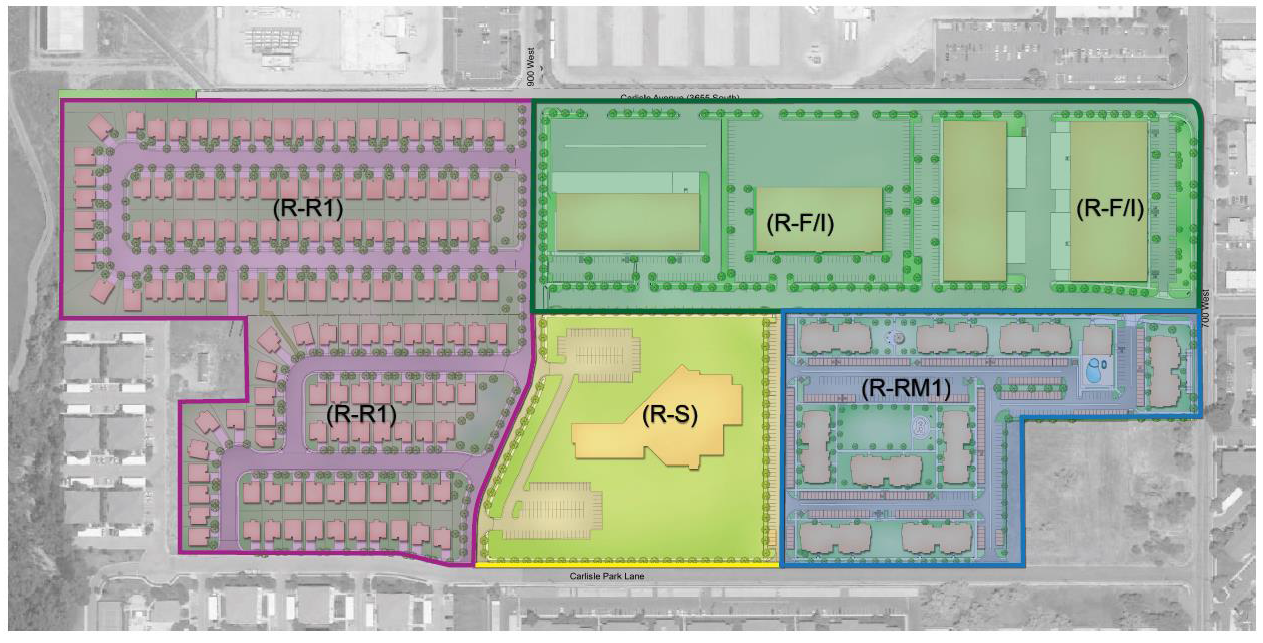
B.
Uses. Uses within each subdistrict are restricted to only those allowed as specifically designated in this Chapter, 17.03.
C.
Site Plan and Development Configuration. The Riverfront MPMU Site Plan and Development configuration shall substantially conform to the following:
Figure 2: Site Plan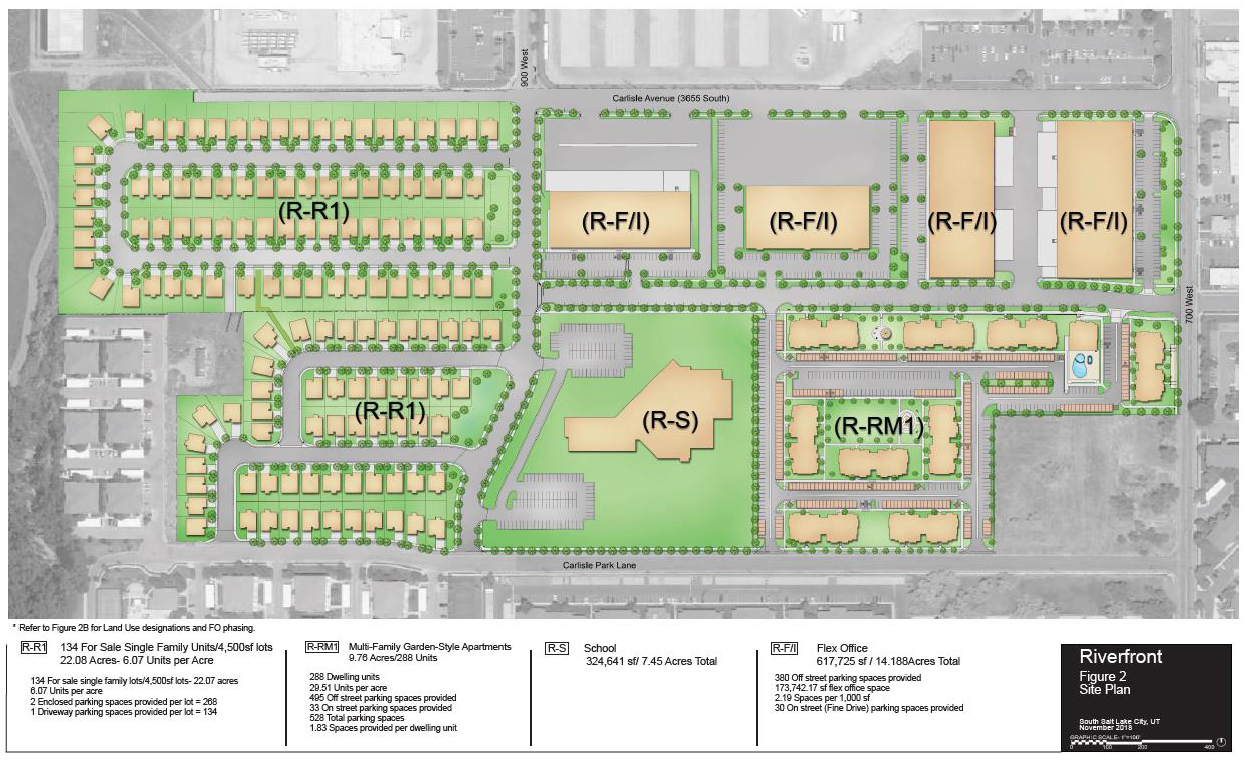
D.
Street, Pedestrian and Circulation Plan.
1.
Connection of Blocks, and pedestrian and bicycle paths, Street connectivity and traffic circulation must be Developed and maintained as illustrated in Figure 3.
2.
Pedestrian and bicycle paths must be Developed and maintained as illustrated in Figure 4.
Figure 3: Street Blocks, Connectivity and Vehicle Circulation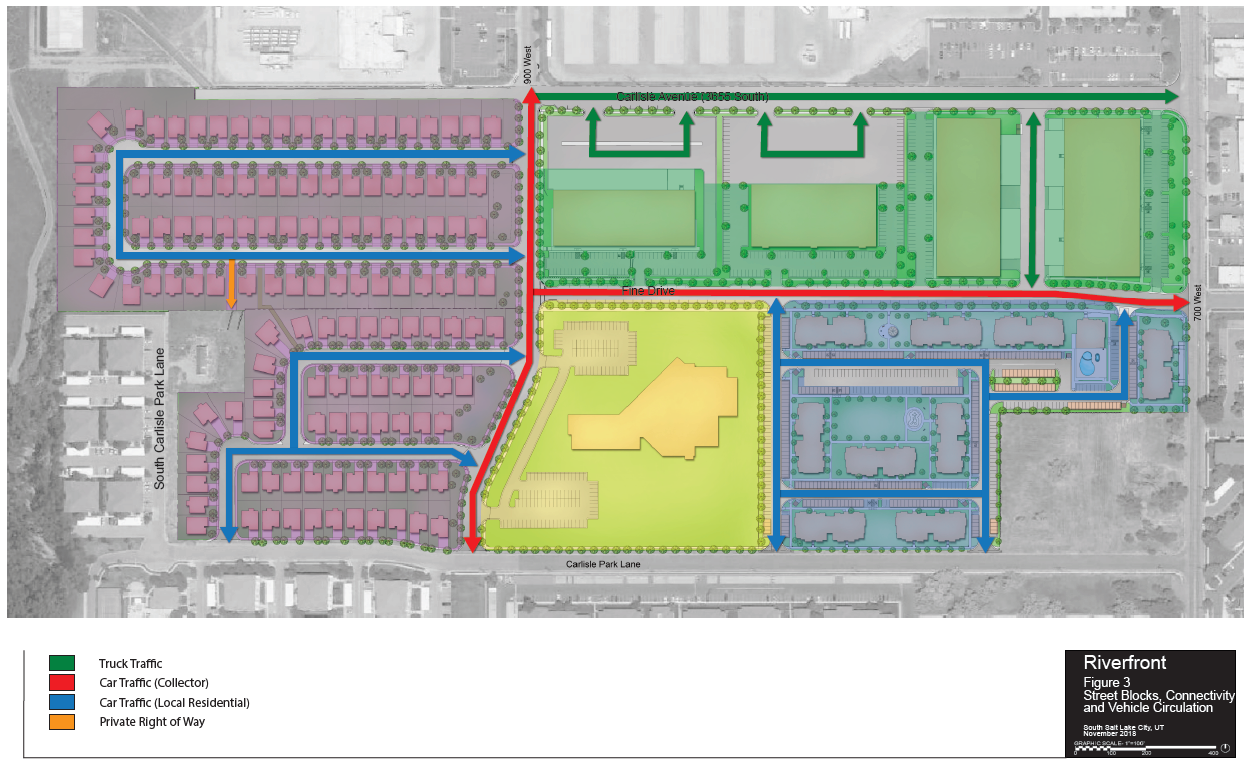
Figure 4: Pedestrian and Bicycle Paths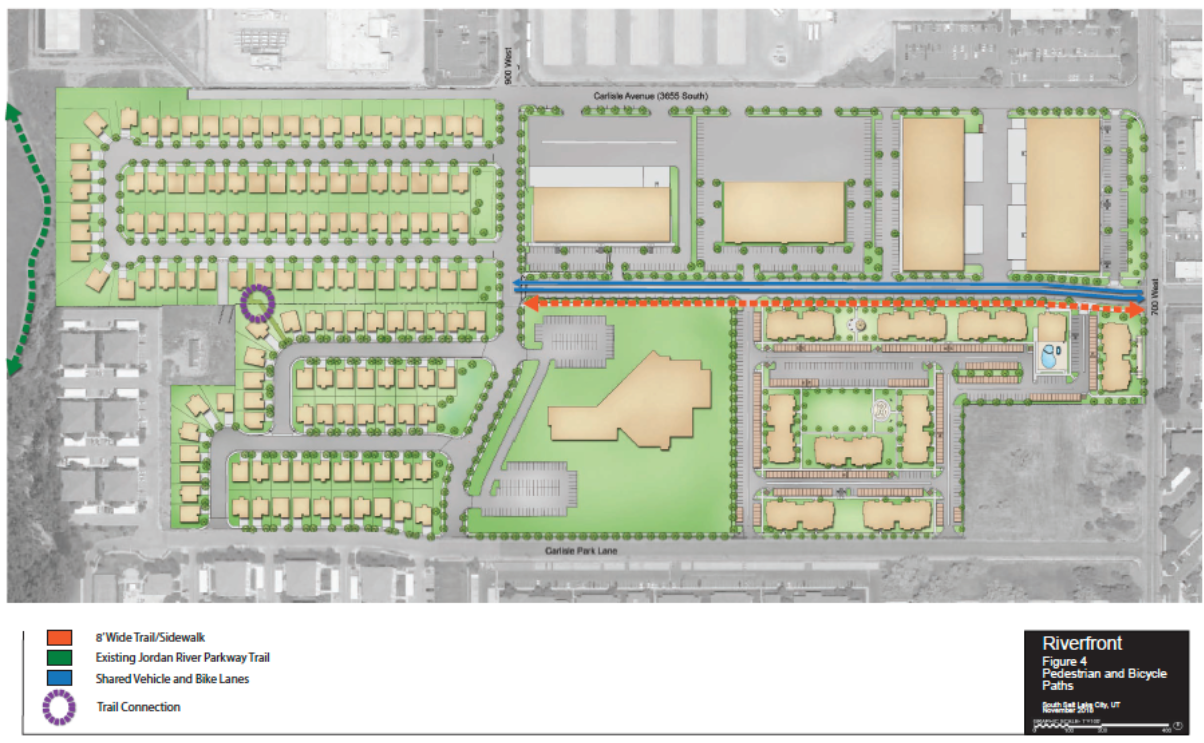
3.
Fine Drive must be Developed and maintained with shared bike and car lanes (shared lane marking or share row) on each side of the Street from 700 West to 900 West.
4.
An 8-foot wide concrete sidewalk must be provided and maintained along the south side of Fine Drive as the pedestrian component, providing connectivity from 700 West to 900 West.
5.
Roadway Widths and Design Standard.
a.
Developer shall install Streets consistent with the Street cross sections described in Figures 5A, 5B, 5C, 5D, 5E, 5F.
Figure 5A: Roadway Widths and Design Standards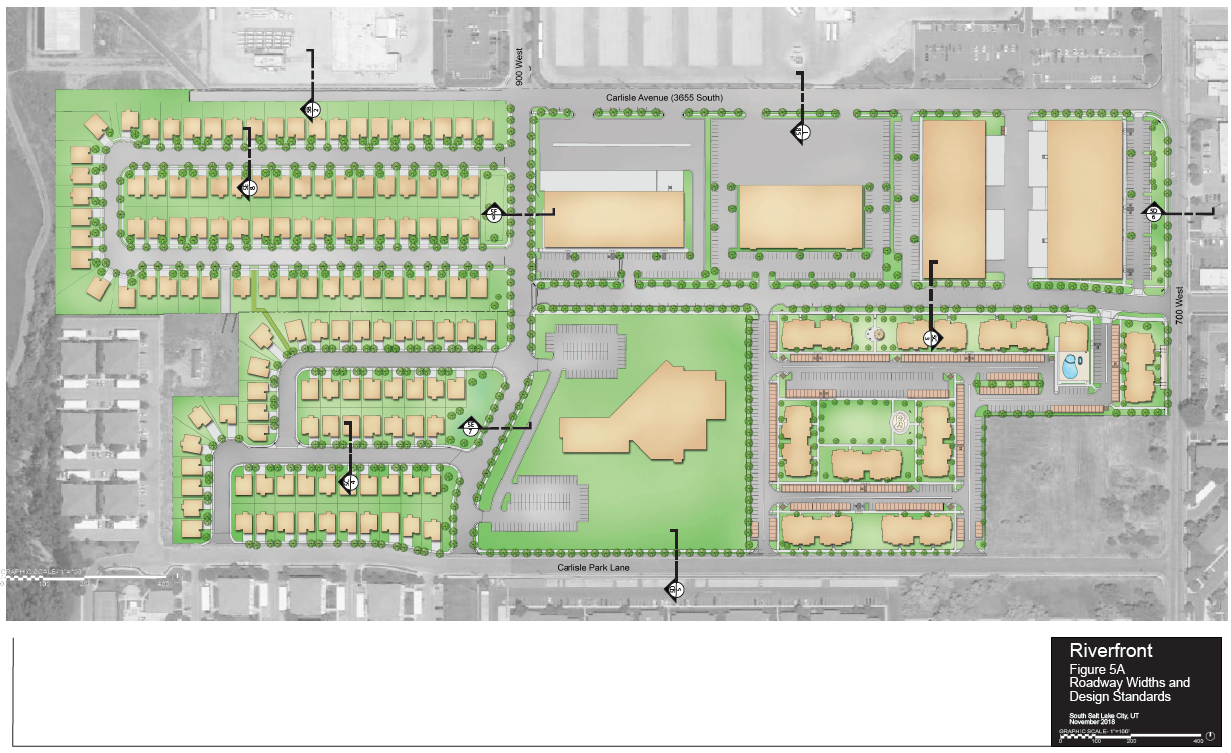
Figure 5B: Roadway Widths and Design Standards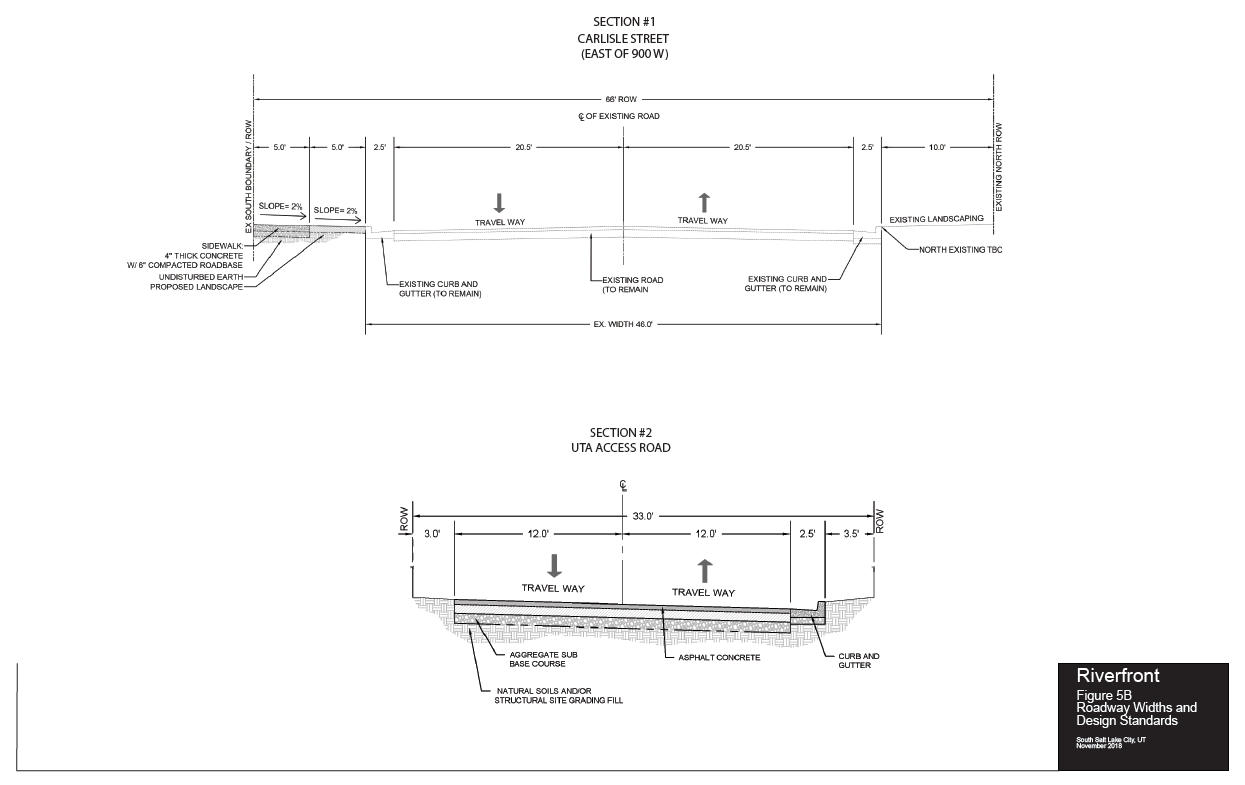
Figure 5C: Roadway Widths and Design Standards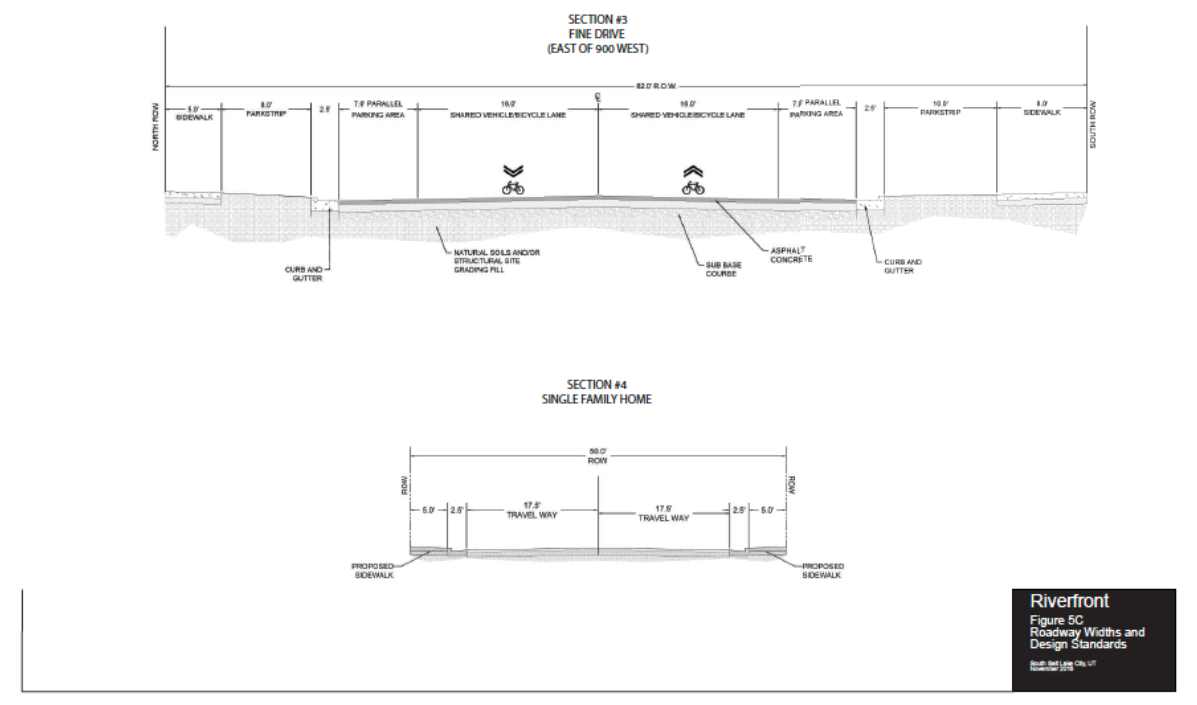
Figure 5D: Roadway Widths and Design Standards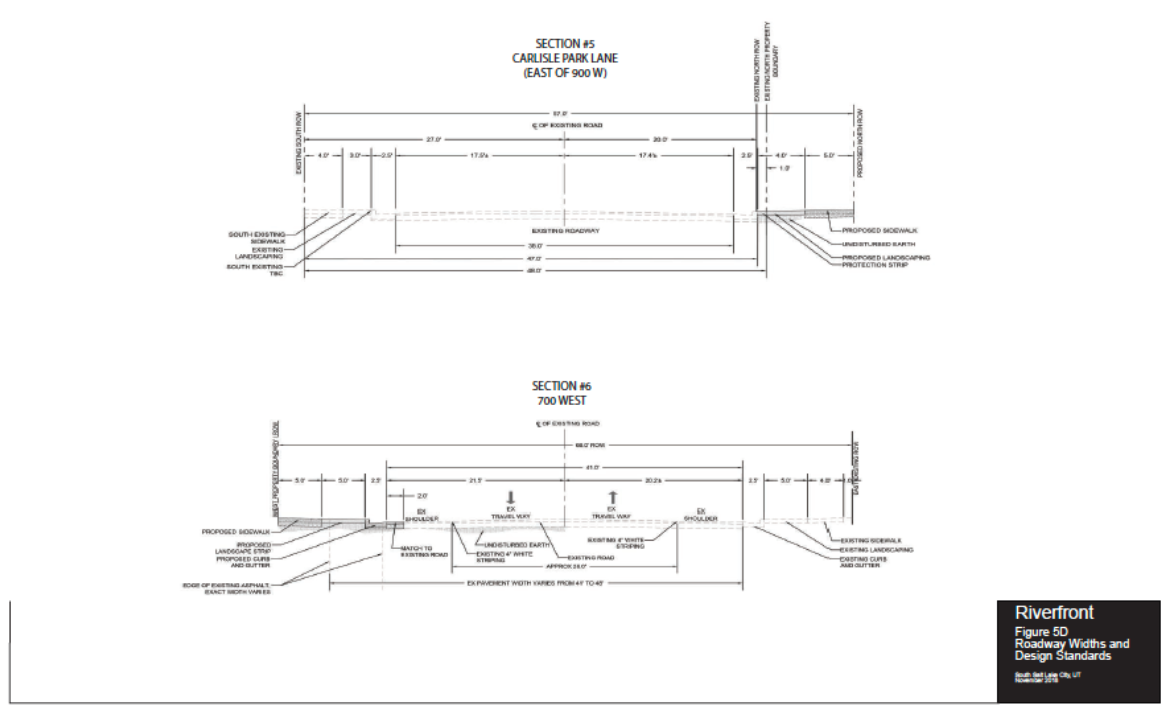
Figure 5E: Roadway Widths and Design Standards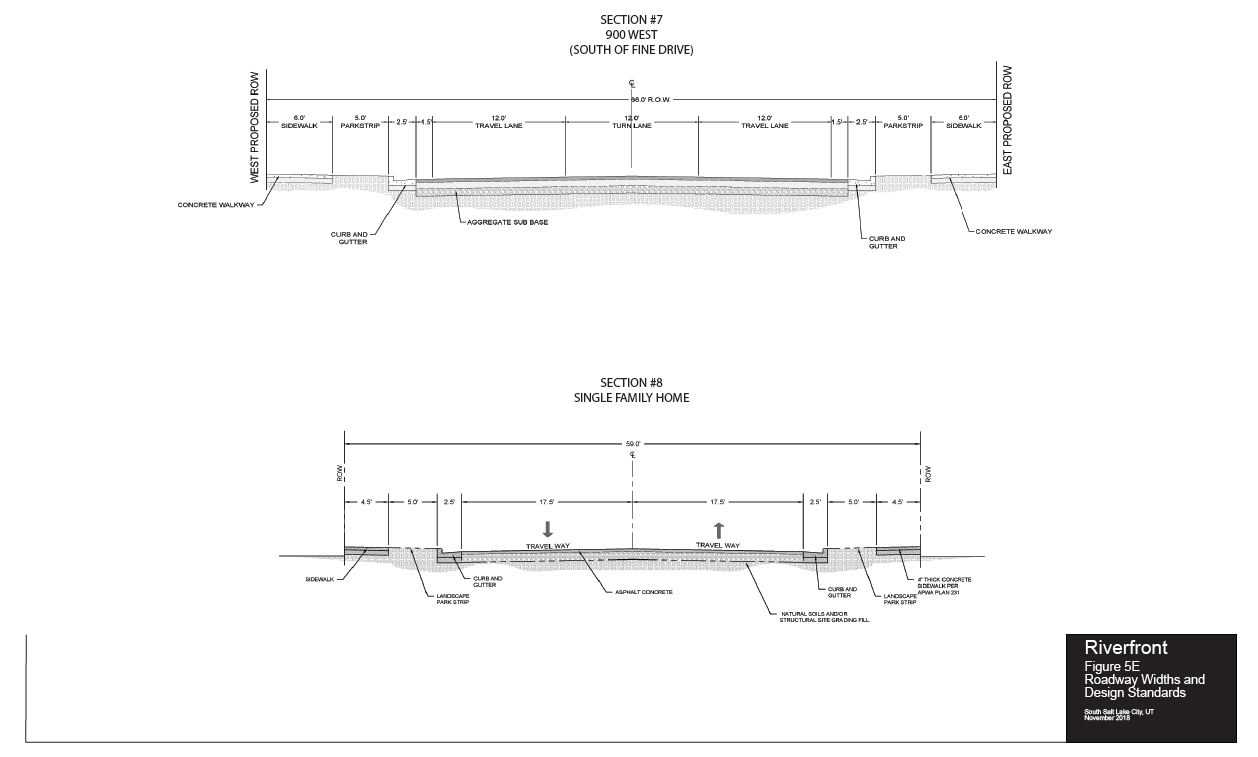
Figure 5F: Roadway Widths and Design Standards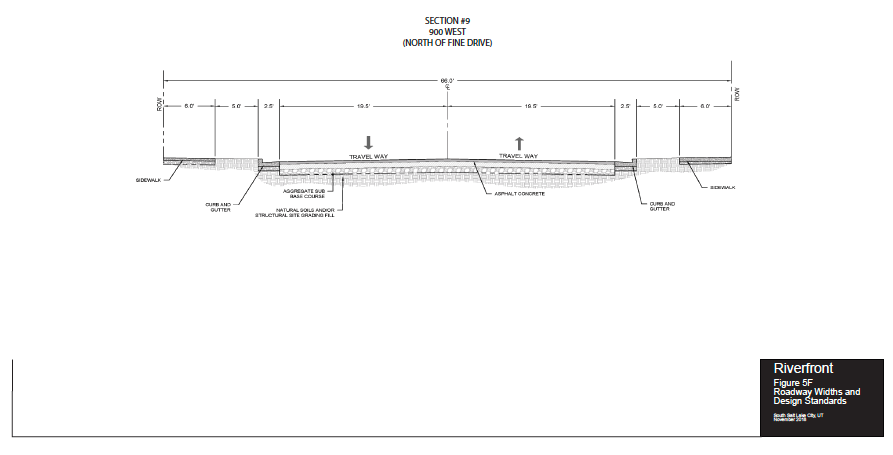
b.
Required Streets, pedestrian and bicycle path ownership shall be as depicted in Figure 5G.
Figure 5G: Roadway Ownership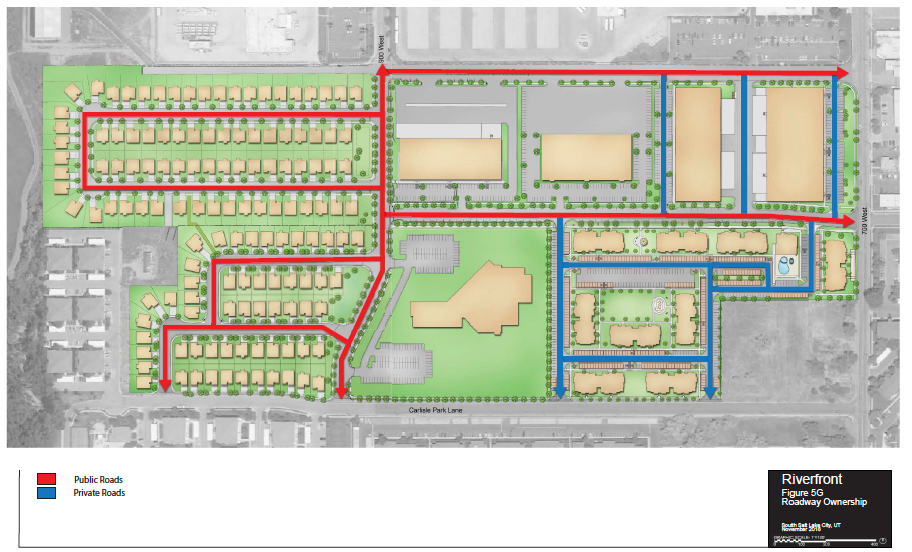
E.
Minimum Parking Requirements.
F.
Open Space.
1.
Developer and Owners shall comply with the open space and fencing plan as provided in Figure 6A. The figure provides a summary of required open spaces for each subdistrict, together with the percentages of open space relative to the overall acreages within the MPMU.
Figure 6A: Open Space/Fencing Plan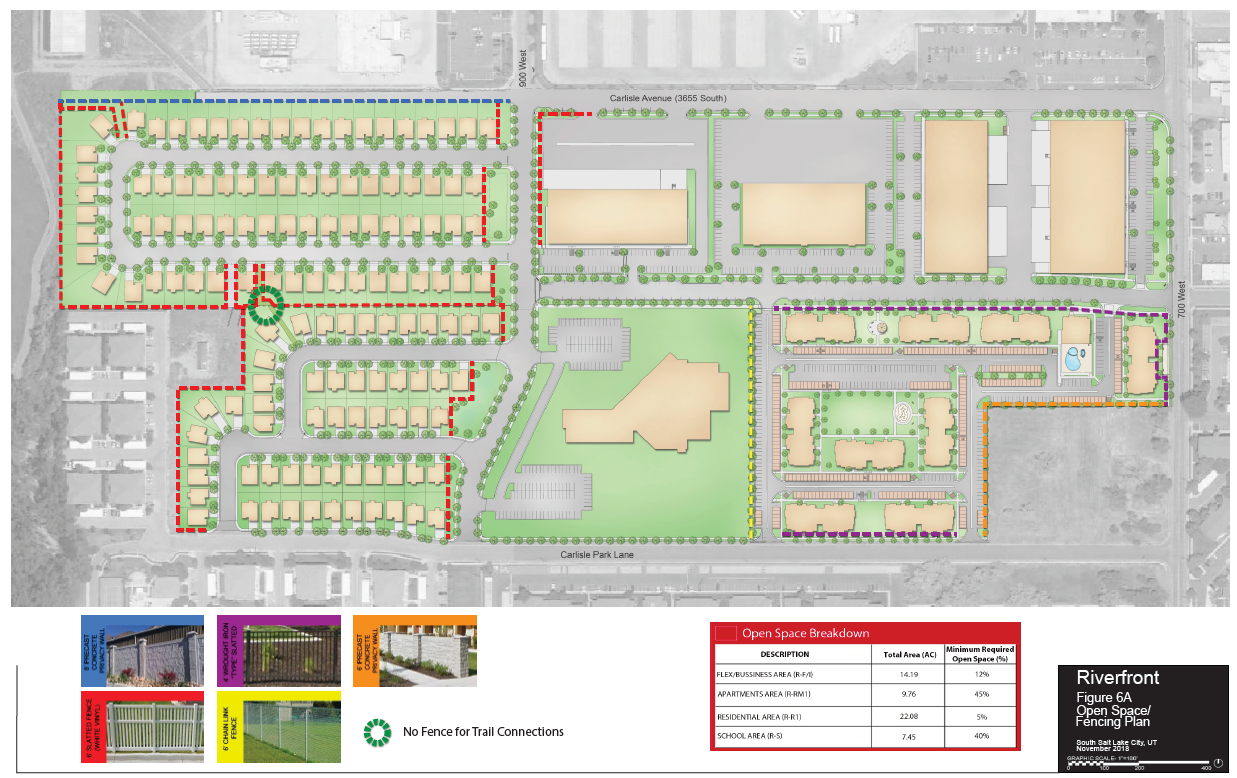
2.
Developer shall provide, and Owners shall maintain, Dedicated trails, open space and open areas within the R-RM1 subdistrict to provide useable gathering and recreational spaces, such as linear parkways and playground areas.
3.
Developer shall provide, and Owners shall maintain, open spaces along 900 West to provide a greenbelt along the roadway.
4.
Required ownership of each open space area is designated on Figure 6A. All open space outside of the public Rights-of-Way will be held in private ownership (HOA). All open space within the Right-of-Way shall be Dedicated to public ownership. All open space, both public and private, will be maintained by the governing Owner's association.
5.
Required Right-of-Way widths are shown on figures 5A, 5B, 5C, 5D, 5E.
6.
Developer shall install, and the Owners shall maintain, all storm water detention systems required on private property within the Riverfront MPMU.
G.
Fencing.
1.
Project perimeter fencing is required as shown in Figure 6A.
2.
Developer shall construct, and Owners shall maintain, an eight-foot high perimeter fence to Buffer the Single-Family residential subdistrict (R-R1) from other adjacent land uses and sub-districts. The developer will work with and the City shall determine the suitable material and fencing type in order to accomplish two objectives:
a.
The fencing will be constructed to provide an element of Screening/privacy.
b.
Fencing type, height and materials shall be as indicated in Figure 6A.
3.
The second type of fencing shall be a four-foot high picket or semi-transparent style. A depiction of this fencing type is illustrated in Figures 6A. Developer shall install, and Owners shall maintain, uniform fencing within each subdistrict.
4.
Fencing is not allowed within the front set back in the R-R1 subdistrict.
5.
Chain link fencing is not allowed as a private fencing material within the R-R1 subdistrict.
H.
Tree Master Plan. Developer shall install, and Owners shall maintain, Landscaping consistent with the Tree Master Plan Figure 6B and the following guidelines.
Figure 6B: Tree Master Plan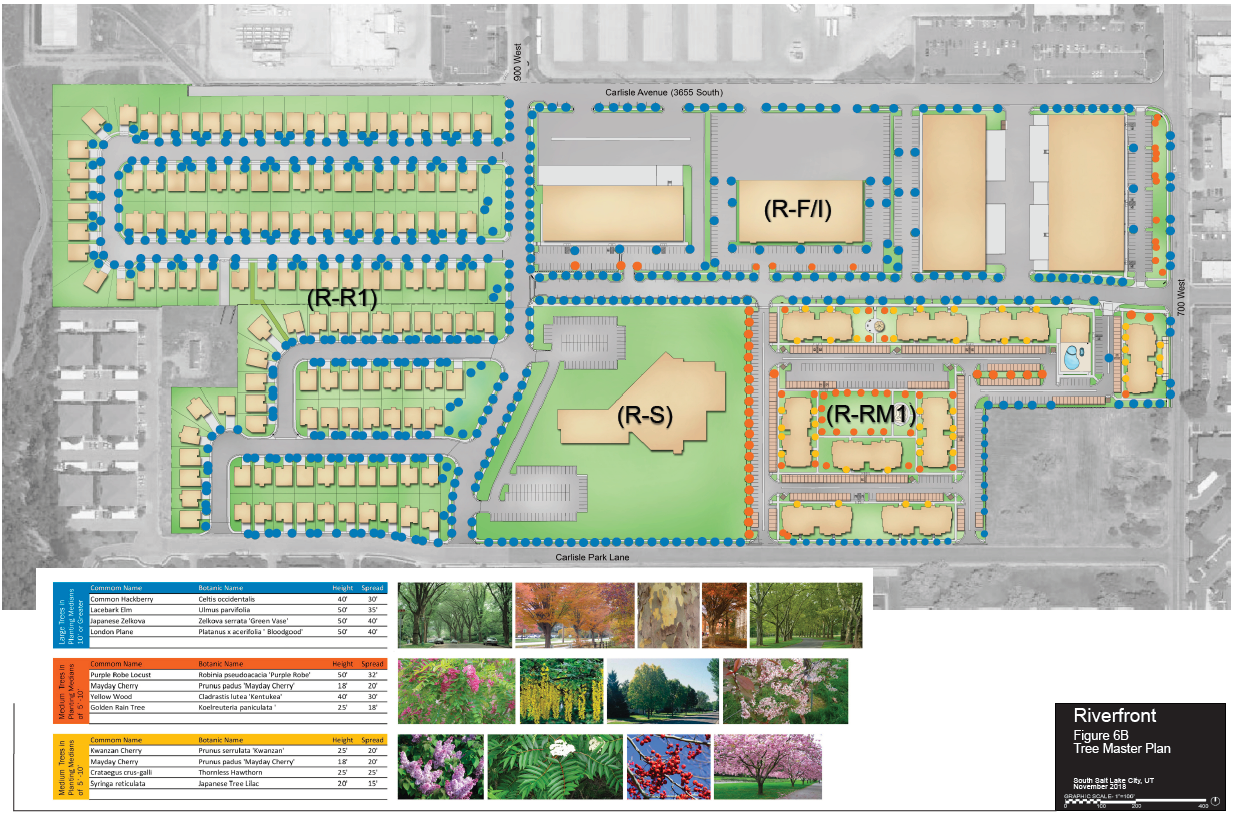
1.
Deciduous shade trees shall be a minimum of two-inch caliper.
2.
Evergreen trees shall be a minimum of eight feet in height.
3.
Planting will create seasonal interest and species variety, with a mix of deciduous and evergreen trees used where appropriate.
4.
Provide a proportional and appealing aesthetic. Designed shrub and groundcover plantings will be furnished containing appropriate combinations of woody plants at five-gallon size, and perennials/groundcovers at one-gallon size.
5.
Where appropriate, (i.e. trail edges or large public spaces, medians, etc.), native grasses/meadow seeding shall be utilized to create a natural, low maintenance appearance.
6.
Ornamental planting areas may be Developed to provide year-round foliage and seasonal interest.
I.
District Sign Standards. Only monument style signs are allowed as Detached Signs within the Development as illustrated in Figure 7A.
Figure 7: Project Signage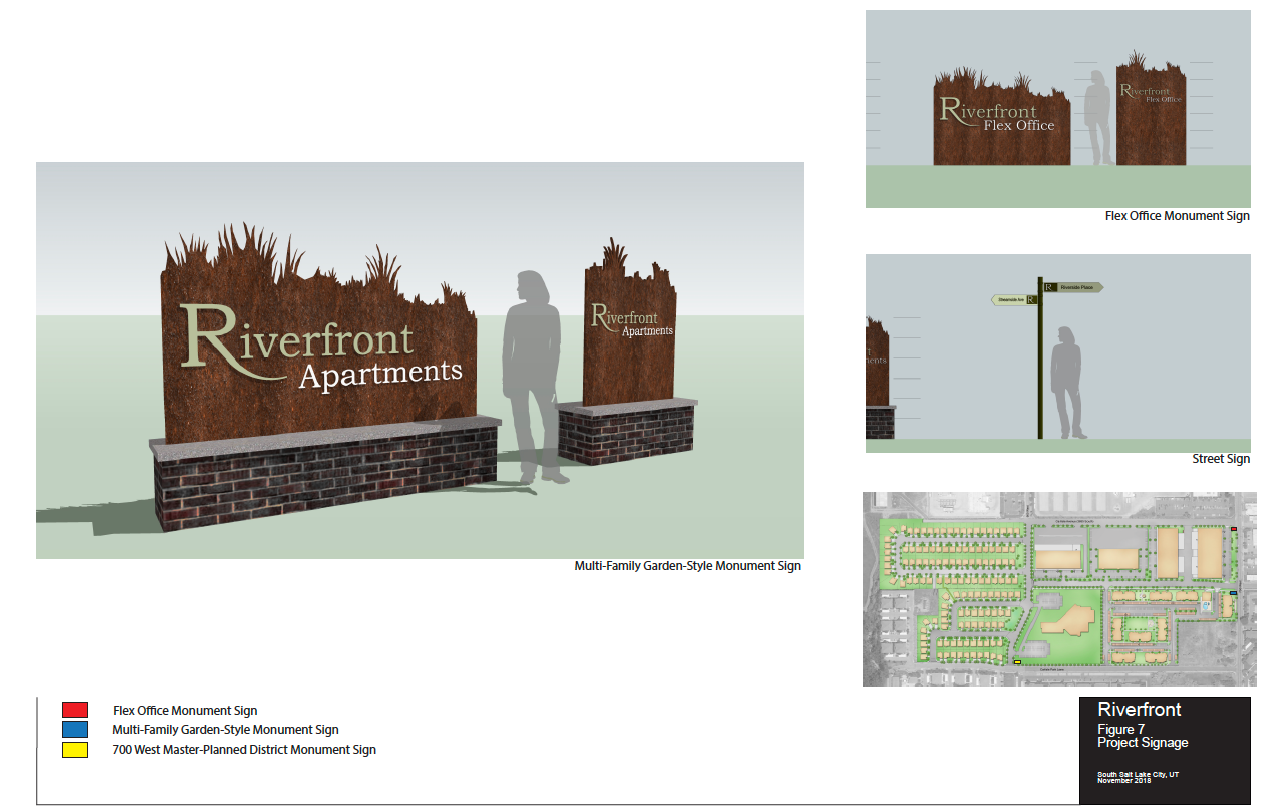
J.
Attached Building signs shall meet the requirements of Chapter 17.08 of this Code.
K.
Project Lighting. Figures 8A and 8B provides two section perspectives of required project site lighting, typical Street lighting and typical pedestrian lighting. The sections represent the style of poles and luminaries that are required throughout the entire master-planned Development, creating uniformity throughout.
Figure 8A: Street Lighting Plan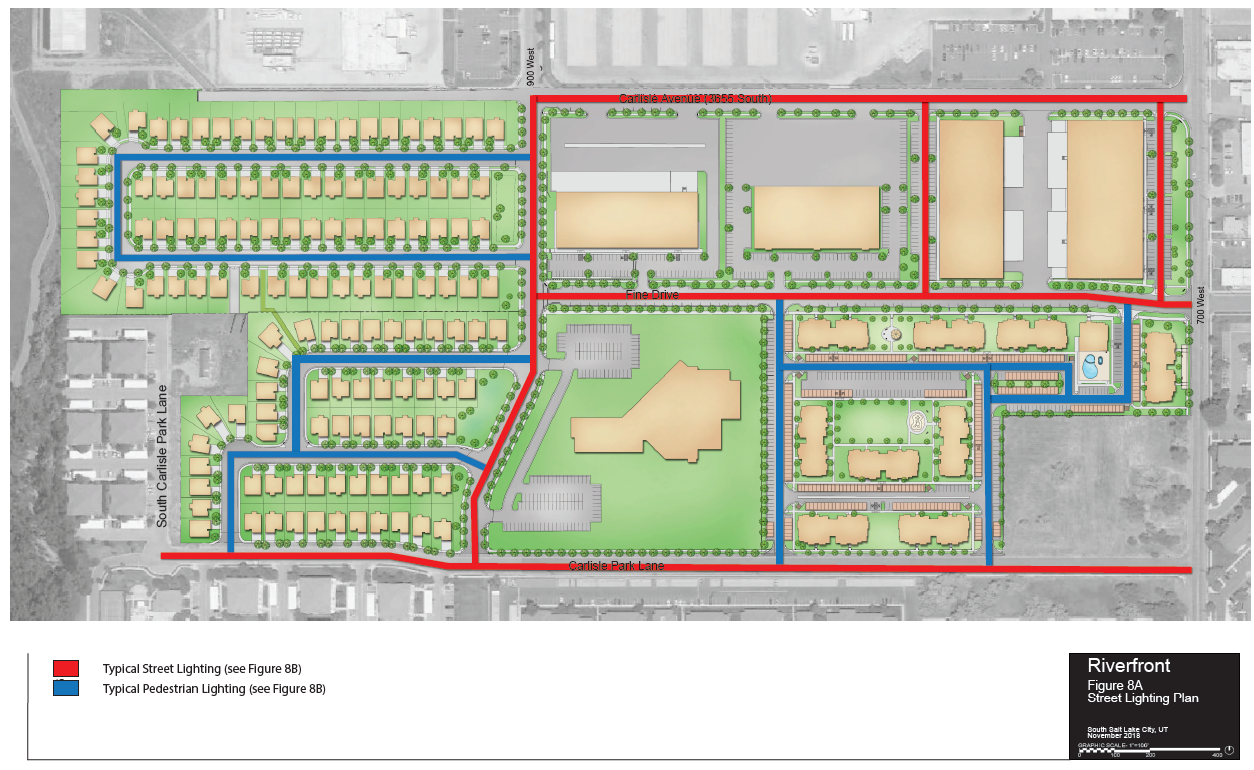
Figure 8B: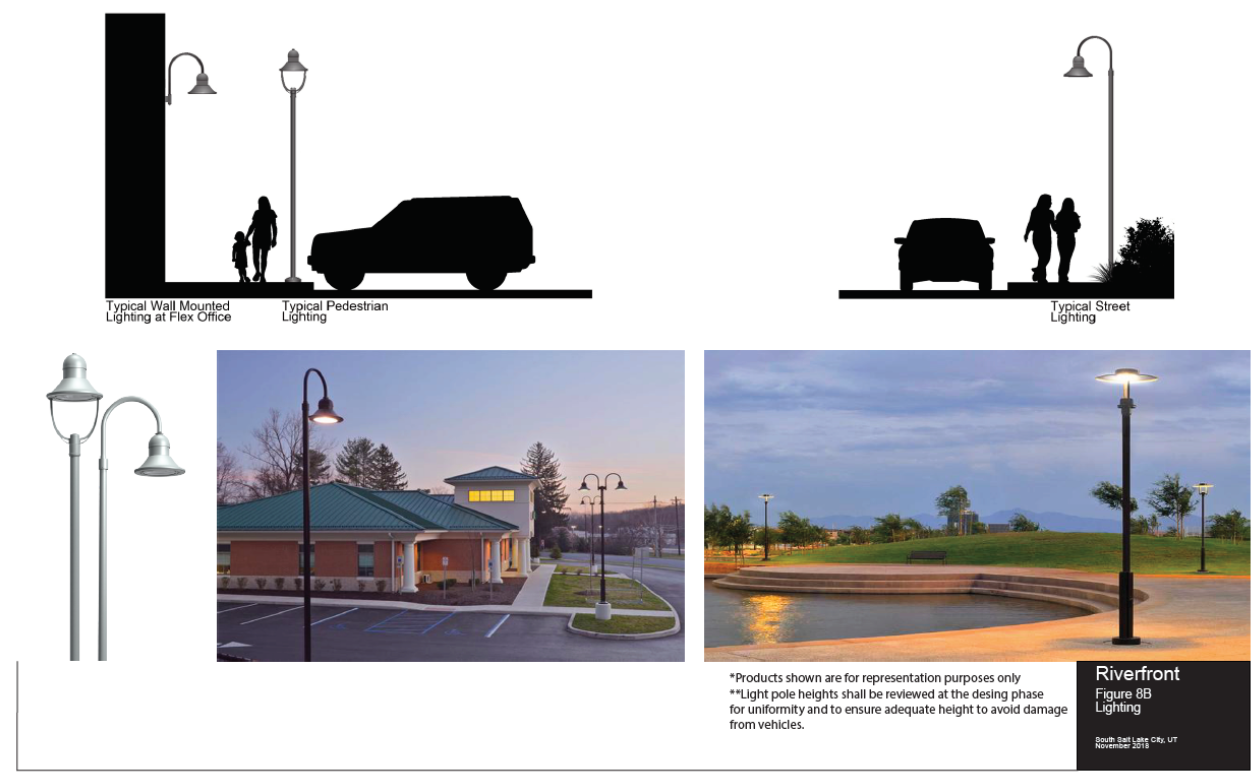
L.
Pedestrian and Street Lights.
1.
Lighting fixtures shall be spaced to create continuous and uniform lighting levels.
2.
Street light poles will not exceed twenty (20) feet in height.
3.
Street lighting shall be shielded from casting light higher than in a line fifteen (15) degrees below the horizontal plane, as measured from the light sources.
4.
Lighting shall not be directly cast into adjacent residential windows.
5.
Lighting color shall be as close to incandescent as possible, including minimum wattage metal halide or color corrected sodium light sources.
6.
Street light styles and materials must complement the architectural character of the Development.
M.
Building Lighting.
1.
Lighting shall be integrated into the architectural design to creatively illuminate pedestrian areas and highlight Building elements.
2.
Full cutoff or fully shielded light fixtures shall be used in order to avoid light being directed upwards.
3.
Lighting shall integrate with Retail signage, storefront windows, covered Parking Structures, and other Building elements to enhance visual interest.
4.
Lighting shall limit glare and minimizing spill light beyond the property boundary.
5.
Lighting within Parking Lots (particularly within the R-RM1 subdistrict) shall consist of one, or a combination of both, pedestrian lighting and surface mounted lighting. Where Parking Lots are narrow (one hundred twenty (120) to one hundred fifty (150) feet wide) lighting must be directed toward the interior of the Parking Lot from the perimeter to minimize light trespass on adjacent Uses.
N.
Street Furniture.
1.
Developer shall install, and Owners shall maintain Street furniture consistent with the style and materials depicted in Figure 9.
2.
All Street furniture benches shall contain an intermediate arm rest to discourage individuals from sleeping on them.
Figure 9: Street Furniture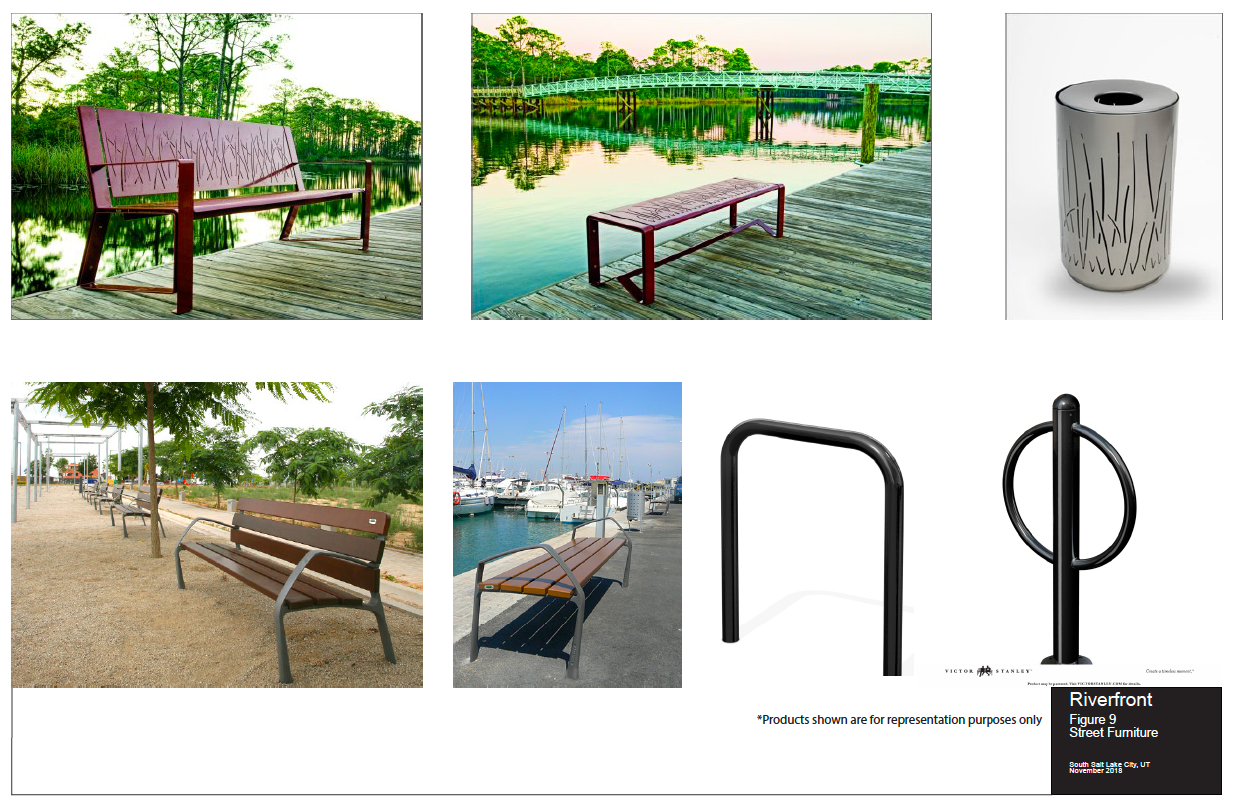
O.
Covered Parking (R-RM1). Covered parking is required within the RM1 subdistrict. Two Structure types as shown on Figure 9 (single column covered Parking Structures and double column covered Parking Structures) are permitted within this subdistrict.
Figure 10: Covered Parking Structures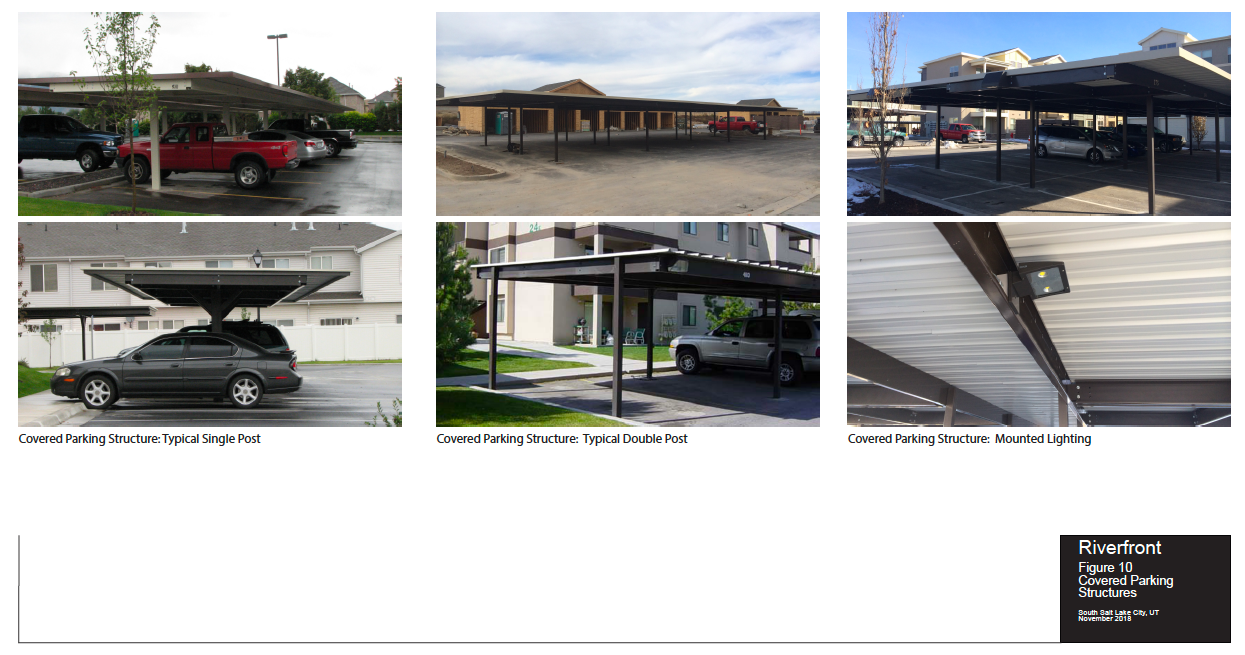
P.
Design Approval Process. Unless otherwise specified in the City Code, the Community Development Department will review and approve Site Plans and Building Elevations in accordance with enacted land-use regulations. In the event that the developer and the Community Development Department dispute the design standards in this plan, the Community Development Director may certify Site Plans and Building Elevations for design review by the Planning Commission.
Q.
Design Standards Modifications. The following provisions modify conflicting Design Standards in Chapter 17.07 within the Riverfront MPMU:
1.
Compatibility. Building forms, within the same land use subdistrict, that front across the Street from one another shall be similar in Scale, form, or massing, to the maximum extent possible.
a.
For Single Family Buildings:
i.
Structures on Corner Lots shall maintain consistent average front Setbacks with Buildings on either side, to the maximum extent possible.
ii.
Infill Development (for subsequent Development) shall utilize the same Building form as Development on either side, to the maximum extent. possible.
iii.
Each roof pitch shall be no less than 4:12.
iv.
Exterior materials:
a)
Homes shall use Hardie Board on all sides.
b)
Homes shall not include stucco.
c)
The first floor of each road-facing surface shall include two materials.
v.
Buildings using this form shall be no more than two stories and no higher than thirty-five (35) feet measured from the Grade to the peak of the roof, or flat roofed structures, the top of the parapet.
b.
For Garden-style Multi-Family Buildings: The garden-style Multi-Family Building includes residential Dwelling Units arranged in a Building in a stacked configuration where units are located side-by-side and one atop another and are served by one or more stairways. The R-RM1 Building design and color scheme shall substantially conform with Figure 11:
Figure 11: Multi-Family Garden Style Apartments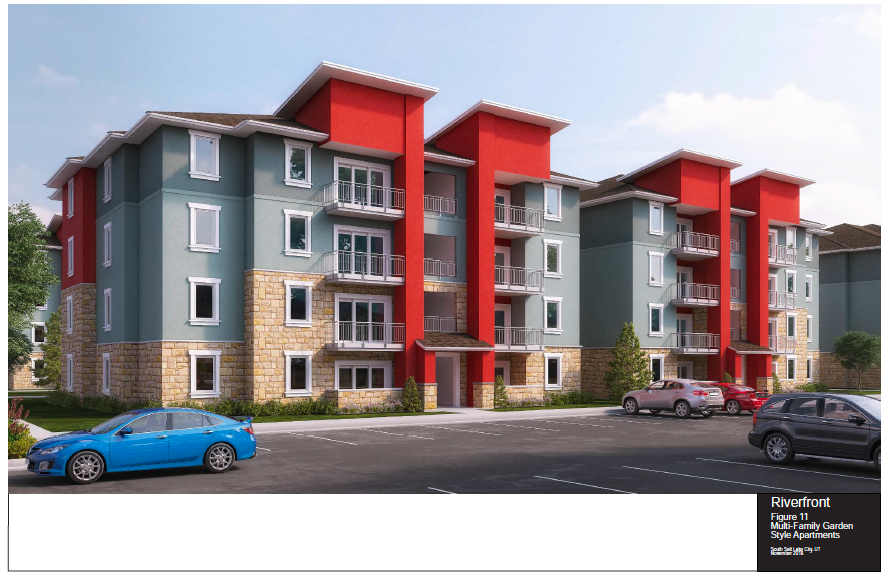
i.
Materials.
a)
Exterior Building walls of structures using the garden-style Multi-Family Building form shall be composed of one or more of the following Primary Materials: wood clapboard, cementitious fiber board, wood board and batten, wood siding, brick, stone, split-faced masonry bock, one-coat stucco system, architectural metal panels, or similar material. EIFS, glass, smooth-faced masonry block, or wavy corrugated metal may be used as accent materials only and shall not be the Primary Material used on any exterior.
b)
When stucco is used as a primary exterior Building material, EIFS may not also be used as an accent material. Likewise, if EIFS is used as a primary exterior Building material, stucco may not be used as an accent material.
ii.
Exterior Staircases and Entry Features. Up to one exterior staircase per seventy (70) feet of Façade is allowed to service the units in each garden-style Multi-Family Building. Exterior staircases shall be incorporated into an exterior entry that is a prominent, architectural focal point directing pedestrians into the Building. The feature shall relate to the architecture of the structure. Exterior entries shall feature a secondary roof structure that is consistent or complementary with the primary roof form. Staircases shall be incorporated according to the following standards:
a)
Staircases may extend from the Primary Structure. Projected staircases require a minimum three-foot Façade projection.
b)
Staircases may be recessed from the Primary Façade. Staircases shall be recessed at least three (3) feet from the Primary Façade.
c)
All exterior entries shall be designed to allow for natural light penetration.
iii.
Porches, Balconies, and Private Patios.
a)
Every Dwelling Unit in a garden-style Multi-Family Building that faces a Public Street, a perimeter Street, primary internal Street, park, or Common Open Space shall have one of the following: a Porch, balcony, or private patio. Porches, balconies, and patios shall be a minimum of fifty-eight (58) square feet in area and a minimum of five (5) feet in depth.
b)
Porches, balconies, and private patios will have railings that consist of materials other than vinyl, such as powder coated steel, or other upgraded material(s).
iv.
Roofs. All roof vents, pipes, Antennae, satellite dishes, and other roof penetrations and equipment (except chimneys) shall configured to have a minimum visual impact as seen from an adjacent Street, to the extent possible.
v.
Façades.
a)
All elevations of structures using the garden-style Multi-Family Building form visible from the Street shall provide doors, Porches, balconies, common staircase entries, or windows in the following amounts:
I.
A minimum of forty (40) percent of front elevations; and
II.
A minimum of twenty-three (23) percent of side and rear Building Elevations.
b)
Façades of Structures using the garden-style Multi-Family Building form facing Streets or containing the Primary Façade(s) to Dwellings shall provide the following design features for each residential unit fronting onto a Street;
I.
Projections or recesses in the Façade lane every forty-five (45) feet.
II.
Projections or recesses must have a minimum depth of two feet;
vi.
Architectural Variability. Architectural Variability Standards must be used from the columns of the following table as indicated. Up to one of the items in the left column may be substituted for one of the items in the right column.
* Materials for the same or similar elevation shall be combined in different configurations and shall differ in style (such as horizontal siding, shingles, flat panels, and board and batten) and/or differ in locations (horizontal siding at the second floor over stucco at the first floor, or board and batten siding over horizontal siding).
vii.
Meter and Equipment Placement. Wall-mounted and ground-based meters, HVAC, and utility equipment serving a garden-style Multi-Family Building shall be:
a)
Screened from view, and
b)
Placed in close proximity to one another.
viii.
Required Amenities for Multi-Family Residential Buildings. Buildings using the Townhome-style or garden-style Multi-Family form shall include the following amenities.
a)
A common social gathering area of at least four hundred (400) square feet for each fifty (50) units, or portion thereof, with the Building or Development.
b)
Items from the unit features section, general amenities section, recreation amenities section, energy efficiency enhancements section described in the table below and according to the number of items identified for each Building form.
c)
Table of Required Amenities:
c.
For Flex/Industrial Buildings. The design and color scheme of all Buildings in the Flex/Industrial subdistrict shall substantially conform with Figure 12A and 12B:
Figure 12A Flex Industrial: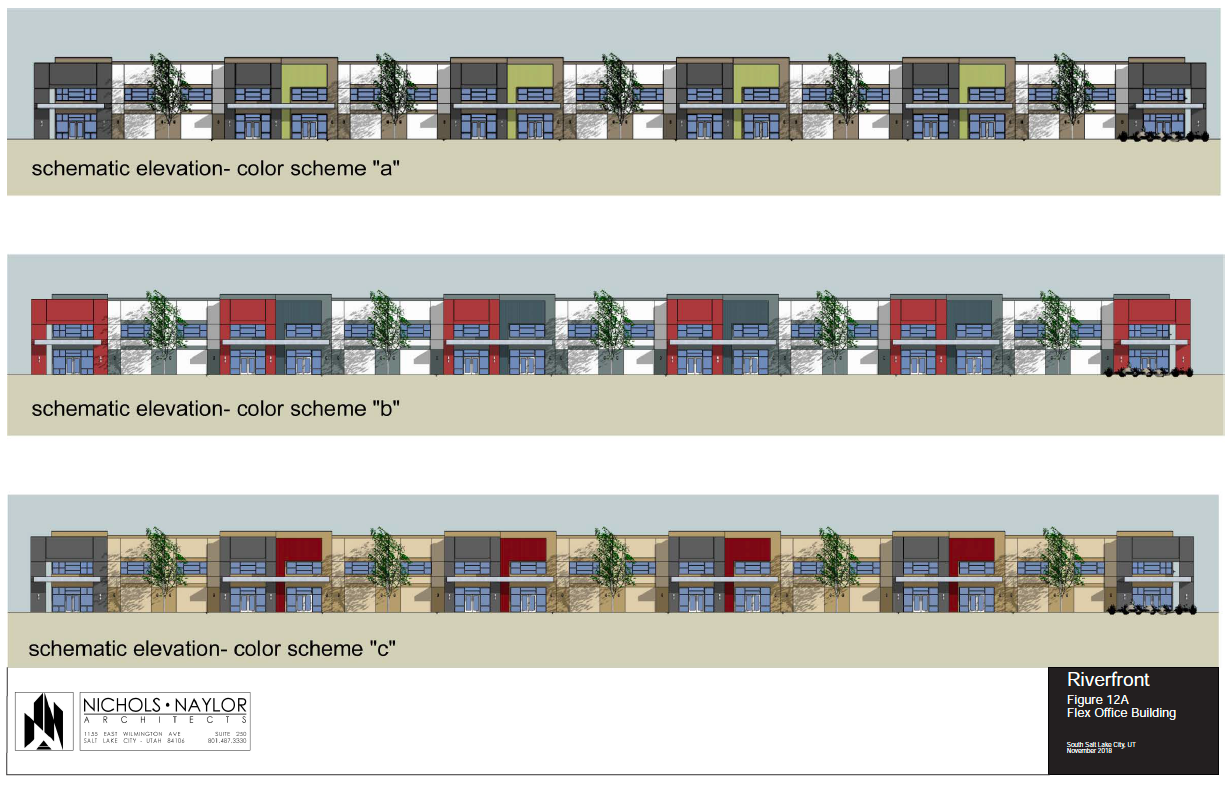
Figure 12B: Flex Industrial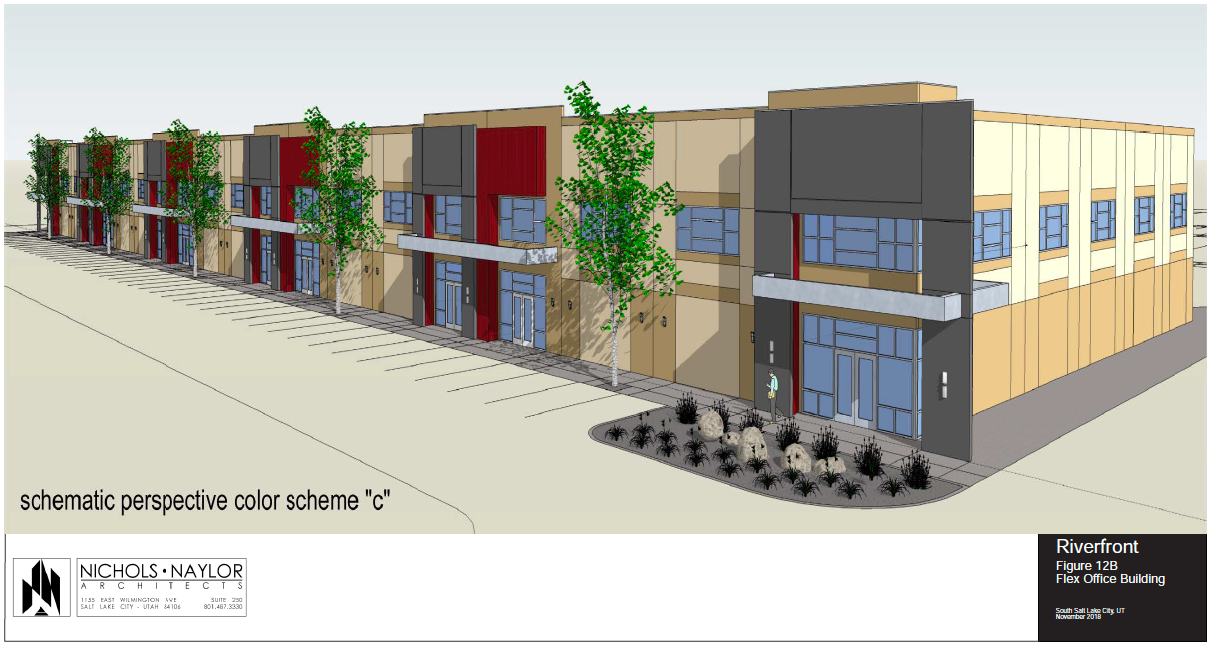
i.
Orientation.
a)
Developments composed of a single Structure using the Flex/Industrial Building form shall be oriented such that the Primary Façade faces the Street from which the Building derives its Street address. However, in order to create functional truck loading areas within the limits of the sub-district, Primary Façades may also face customer/Public Parking Lots that have convenient and direct access to the primary Street.
b)
Development with multiple structures using the Flex/Industrial Building form shall be configured to conceal operations from off-site views directly adjacent to residential Dwellings.
c)
Accessory Structures or Uses shall be in the rear yard.
d)
Buildings that have end sections fronting along Fine Drive and 3655 South must have a "store front wrap around" to project the look and feel of a store front appearance.
e)
Buildings that have end sections fronting along Fine Drive must also incorporate wing walls that extend from the Building to edge of the drive entrance. This will provide Screening of the truck loading docks from the Street. The wing walls must be at least six (6) feet in Height and consist of a material other than wood, vinyl, stucco, or other material that is prone to graffiti vandalism. Wing wall materials shall be composed of concrete, or other material(s) that are complementary to and/or have similar architectural appearance to the Buildings. Wings walls must also be supplemented and maintained with appropriate Landscaping.
ii.
Architectural Fronts.
a)
Architectural fronts shall be clearly demarcated through signage, Architectural Elements, or other features, and Building Façades containing customer entrances should be oriented towards the Street from which the Structure derives its Street address when possible.
b)
Any office portion of a Structure using the Flex/Industrial Building form shall utilize human-Scale design along with a variety of architectural detail to break up large walls or enhance visual quality.
iii.
Materials.
a)
Exterior Building materials shall be continued to the Grade on any elevation.
b)
All exterior wall of a Structure using the Flex/Industrial Building form shall be clad with materials that are durable, economically-maintained, and of a quality that will retain their appearance over time, including, but not limited to:
I.
Natural or synthetic stone;
II.
Brick;
III.
Stucco;
IV.
Painted, textured, or glazed concrete masonry units;
V.
High-quality pre-stressed concert systems;
VI.
Float finish EIFS;
VII.
Glass; or
VIII.
Painted metal siding as an accent material.
iv.
Roofs. Roof-based mechanical equipment shall be screened from Streets and off-site views.
v.
Compatibility with Single-Family Development:
a)
Restrict all access to residential Streets.
b)
Locate service and loading areas as far from Single-Family residential subdistricts as possible.
(Ord. No. 2020-02, § IV(Exh. C), 1-8-2020; Ord. No. 2022-08, § I(Exh. A), 4-13-2022; Ord. No. 2022-16, § 1(Exh. A), 9-14-2022)
Note— See editor's note at § 17.03.080.
17.03.200 - Granite MPMU district—Townhome subdistrict.
A.
Purpose. The purpose of the Townhome subdistrict of the Granite MPMU district is to receive Residential Density from the entire historic Granite High School site within the Granite Master Planned Mixed-Use Development and then concentrate and supplement the existing Residential Density to form a well-planned, condominiumized Townhome community and facilitate the construction and operation of a 29,500 square-foot Library within the companion Library subdistrict.
Figure 1 — Granite MPMU: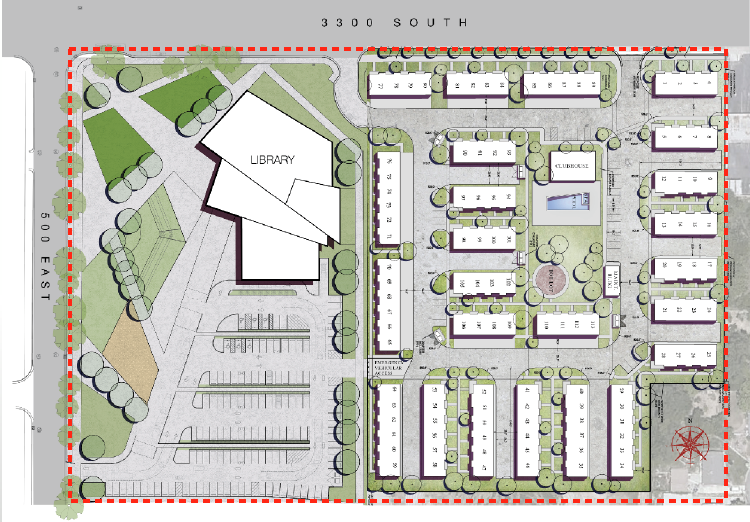
B.
Uses. In the Townhome subdistrict, the Buildings, Structures and land shall not be occupied, Used, or Developed except in accordance with the Uses allowed in the Townhome subdistrict found in this Chapter.
C.
Building and Site Development. In addition to the design standards and review requirements established for this District in Chapter 17.07 of this Code, all Development within the Townhome subdistrict must meet the following minimum standards:
1.
Minimum Development area: six (6) contiguous acres;
2.
Minimum Lot width at Street Frontage: 400 feet;
3.
No Townhome unit or occupied Structure shall be less than 20 feet in width;
4.
Maximum Building Height: 42 feet;
5.
Maximum Density: up to 113 Townhome Condominium units, plus common area amenities;
6.
The proposed Development must include an eight (8) foot Park Strip and a ten (10) foot sidewalk along the 3300 South Right-of-Way:
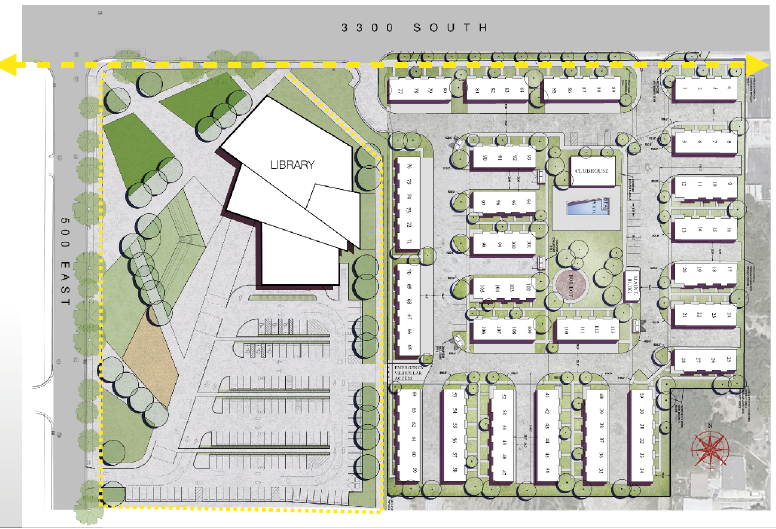
7.
The project Site Plan and Development must connect each separate Building with internal concrete walkways to provide safe and convenient pedestrian access to common areas and amenities. The width of internal walkways that are adjacent to Parking Stalls shall be no less than five (5) feet. The width of internal walkways that are not adjacent to Parking Stalls shall be no less than four (4) feet.
8.
Minimum Required Open Space: 20%. Open Space includes hardscape such as sidewalk, plazas, Courtyards, landscaped detention pond, pools, spa, pool deck, and interior spaces available to residents as common area such as a clubhouse;
9.
Each unit must include enhanced sound attenuation and sound mitigation construction;
10.
Nine (9) foot ceilings are required throughout the interiors of each unit;
11.
Upgraded cabinets, stone or quartz countertops, and upgraded cabinet, window, and door hardware are required throughout each unit. At a minimum, such upgrades shall persist within each unit, through the first year of occupancy of each unit;
12.
A tot lot, common area pool and spa, BBQ area, clubhouse and exercise facility are required common project amenities;
13.
Elevations. The Townhomes will be constructed in general conformity with the concept designs, front door entrances, and identifiable transitions, depicted below:
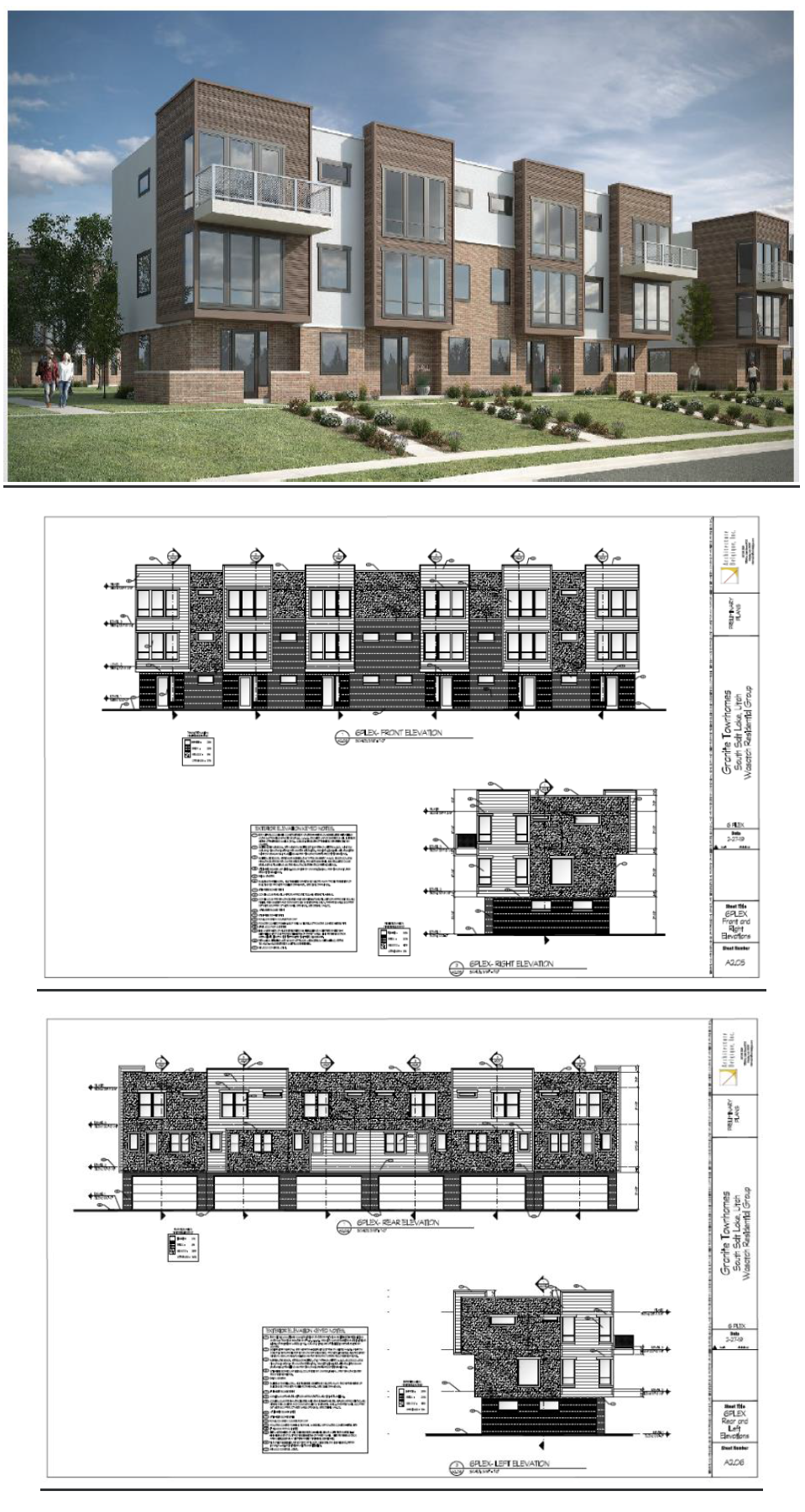
a.
Each corner unit on Buildings facing 3300 South and the Library must have at least 4' x 12' of deck space;
b.
Each designated end unit must have at least 4' x 15' of patio space that wraps around the corner of the unit and includes a pony wall for privacy;
c.
In addition to the exceptions to Setbacks located in Chapter 17.07.030(C), upper floor balconies may encroach into the Front Yard Setback a maximum of five feet, if each encroaching balcony is at least 10 feet above finished grade;
d.
Designated end units are depicted in red below:
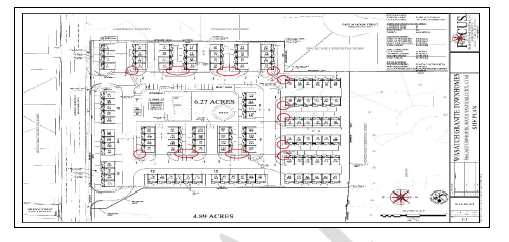
14.
To implement the Granite MPMU Development, Development within both subdistricts must include cross-access easements. As planned, the Townhome subdistrict shall provide two points of ingress/egress from 3300 South. The westernmost point of ingress/egress shall include of a minimum paved public safety vehicle "pull out" from 3300 South that is at least 26 feet wide and at least 60 feet long. If two points of ingress/egress from 3300 South are provided for the Townhome subdistrict, the Townhome subdistrict shall provide paved emergency egress, at least 26 feet in width, from the Library subdistrict through the Townhome subdistrict. The emergency access may be gated in coordination with South Salt Lake City. If the Townhome subdistrict is unable to gain UDOT approval for two points of ingress/egress into the Development from 3300 South, it shall Develop a second point of ingress/egress through the Library subdistrict to 500 East. The second point of ingress/egress may not be gated;
15.
Each Building within the Townhome subdistrict shall share the same architectural theme, including, but not limited to colors, materials, rooflines, and entries;
16.
At a minimum, the first floor of each Townhome shall be brick or stone. No vinyl or aluminum siding is allowed on any exterior portion of any Townhome;
17.
Stucco may be allowed on structures so long as the stucco meets the following maximum percentages: Front elevation (20%); Side elevation (45%); Rear elevation (36%); and
18.
Townhome Buildings and required amenities may be configured substantially as depicted below:
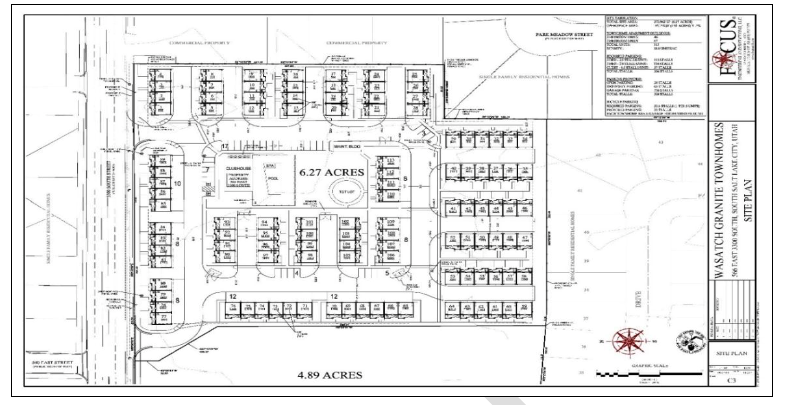
19.
All Townhomes shall be subdivided into individual Condominium units prior to issue of a certificate of occupancy.
20.
Front Yard Park Strip Landscaping is required for a minimum depth of 8 feet.
D.
Road and Public Access Easements Cross Sections:
1.
The required cross section of 3300 South UDOT Right-of-Way and SSLC public access easement and improvements is depicted below:
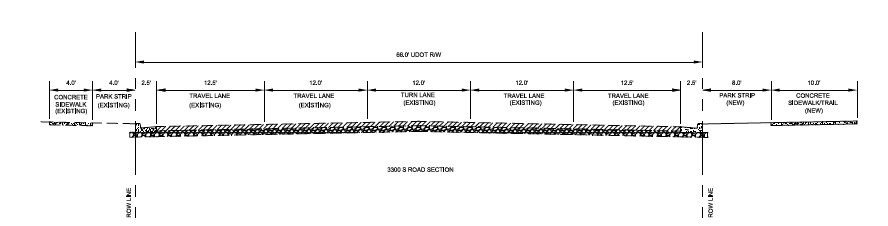
a.
UDOT has sole authority to regulate the specifications for travel lanes within the UDOT right-of-way; and
b.
The foregoing cross-section notwithstanding, at any time prior to the issuance of the first Certificate of Occupancy within any subdistrict, the owners or its designees within the Granite MPMU Development may elect to:
i.
Improve the 2.5' gap between the edge of pavement and the southern edge of the 3300 South UDOT ROW, from 500 East to the easternmost edge of the Granite MPMU Development, to the reasonable satisfaction of the City Engineer; and
ii.
Realign and improve:
(A)
The 10' wide concrete sidewalk from the southern edge of the SSLC public access and Landscaping easement to the southern edge of the 3300 South UDOT ROW, along the entire length of the UDOT ROW in the Granite MPMU Development; and
(B)
The 8' wide landscaped Park Strip from the northern edge of the SSLC public access and Landscaping easement to the southern edge of the 10' wide concrete sidewalk, along the entire length of the UDOT ROW in the Granite MPMU Development.
c.
The owners' election to realign the public sidewalk and Landscaping within the City's public access and Landscaping easement shall not compromise the City's right to align public improvements within the easement as the City may later determine is appropriate.
2.
Private Roads: The required cross section of private roads within the subdistrict is depicted below:
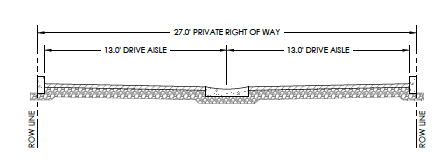
E.
Storm water management. Site Development must include comprehensive storm water management, including the public Dedication and improvement of public storm water facilities within the subdistrict.
F.
Parking. The Townhome subdistrict shall meet the following parking requirements:
1.
For each three (3) bedroom unit—two and one half (2.5) stalls
2.
For each two (2) bedroom unit—two (2.0) stalls
3.
Guest parking for each unit—one half (0.5) stalls
4.
Driveways and garages shall count towards total parking requirements.
G.
Signage. A monument Sign of up to five (5) feet in height and ten (10) feet in width shall be permitted at each public entrance into the project.
(Ord. No. 2020-02, § IV(Exh. C), 1-8-2020; Ord. No. 2022-16, § 1(Exh. A), 9-14-2022)
Note— See editor's note at § 17.03.080.
17.03.210 - Granite MPMU district—Library subdistrict.
A.
Purpose. The sole purpose of the Library subdistrict of the Granite MPMU district is to effect the redevelopment of a portion of the historic Granite High School site within the Granite Master Planned Mixed-Use Development into a Library at the corner of 3300 South and 500 East.
Figure 1: Granite MPMU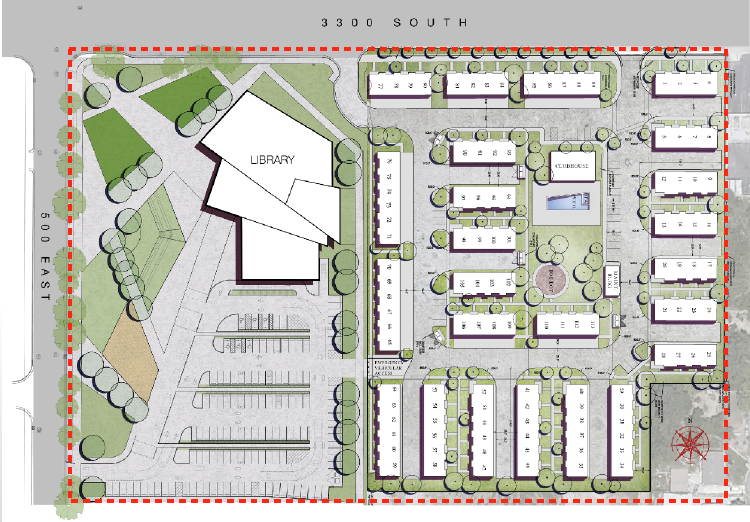
B.
Uses. In the Library subdistrict, the Buildings, Structures or land shall not be occupied, Used, or Developed except in accordance with the adopted Uses permitted for the subdistrict found in this Chapter. The Library shall be the Primary Use. All other allowed Uses within the district are accessory to the Primary Use.
C.
Buildings and site Development regulations. In addition to the design standards and review requirements established for this district in Chapter 17.07, all Development within the subdistrict must meet the following minimum standards:
1.
Minimum contiguous Development area: 4.0 acres;
2.
Minimum open space required: 30%. Open space includes hardscape such as sidewalk, plazas, and Courtyards;
3.
A gateway emphasis is required at the corner of 3300 South and 500 East and must include a combination of Landscaping, public art, pedestrian lighting, plaza space, and signage;
4.
Minimum Floor Area: 29,500 square feet;
5.
Minimum Lot width at Street Frontage: 300 feet;
6.
Maximum Building Height: 42 feet;
7.
Minimum Building Height: 20 feet;
8.
Architectural design must address the historic character of the site and incorporate familiar design features of the Granite High School architecture and shall display Granite High School Memorabilia that the Granite High School Alumni Association entrusted to the City of South Salt Lake;
9.
The Building corner facing 3300 South 500 East shall include an architecturally prominent feature;
10.
Exterior Materials: Primary Materials shall be brick, integral color CMU, stone or marble, EIFS, metal, or composites. Stucco may be used on the Façades as a Secondary Material but may not exceed 20% of any Façade;
11.
Windows and Doorways:
a.
At least 40 percent of each Façade along 3300 South and 500 East shall be occupied by windows and glass doorways; and
b.
All Street-level windows shall have a minimum transparency of 70 percent, measured between two (2) feet and eight (8) feet above Grade. Upper Story windows shall be at least 25 percent transparent.
i.
All windows along 3300 South and 500 East shall incorporate mullions and/or transoms and at least two of the following standards:
(a)
Trim or molding at least four (4) inches in width;
(b)
Canopies or overhangs, proportional to the size of the window;
(c)
Recessed inset from the Primary Façade by at least two (2) inches;
12.
Primary Façades. Primary Façades shall incorporate the following design elements:
a.
Variations in roof form and parapet heights;
b.
Wall recesses or projections of a minimum depth of two (2) feet at least every 40 feet;
c.
Distinct changes in texture and color of wall surfaces;
d.
Vertical accents or focal points;
e.
All Primary Façades shall incorporate a significant Building arcade or vestibule. In addition, Primary Façades must incorporate visually prominent Building entrances through the use of the following features:
i.
Outdoor pedestrian features such as seat walls and Landscaping, or permanent landscaped planters with integrated benches;
ii.
Architectural details such as tile, stone, and moldings shall be integrated into the Building structure with wall plane variation to enhance the Building Façade and to clearly identify each entry location;
13.
Drive-through drop-off facilities are prohibited along any side with Public Street Frontage;
14.
Pedestrian Amenities:
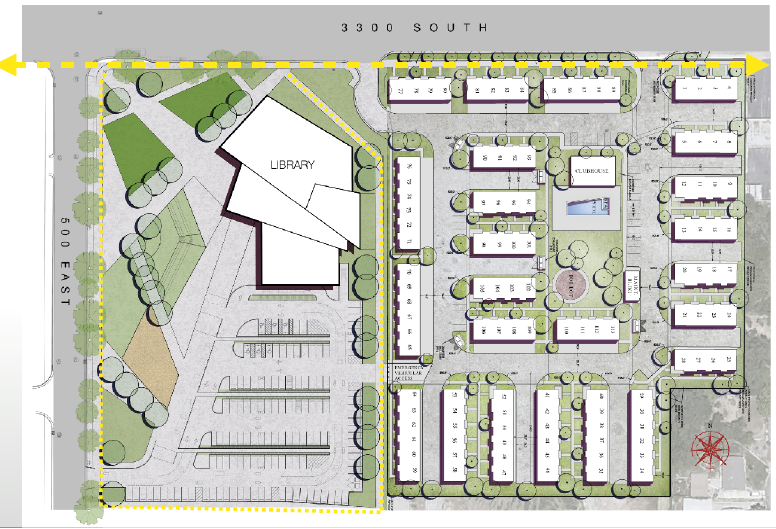
a.
At a minimum, the Development must include an 8-foot Park Strip along 3300 South and along 500 East;
b.
The Development must include 10-foot sidewalks along 3300 South and 500 East;
c.
The Library must connect to Parking Areas with concrete walkways of no less than five (5) feet in width;
d.
To the maximum extent possible, all Development activity shall protect existing mature trees on 3300 South and 500 East. If, during construction, the City determines that any trees must be removed, the Applicant shall remove and replace any missing Street trees with trees of a minimum 4" caliper. Tree spacing and species shall meet City requirements;
e.
Parking and loading are prohibited between the Building and 3300 South and between the Building and 500 East;
f.
Development shall include an improved, 10-foot wide concrete or asphalt fitness trail around the perimeter of the property;
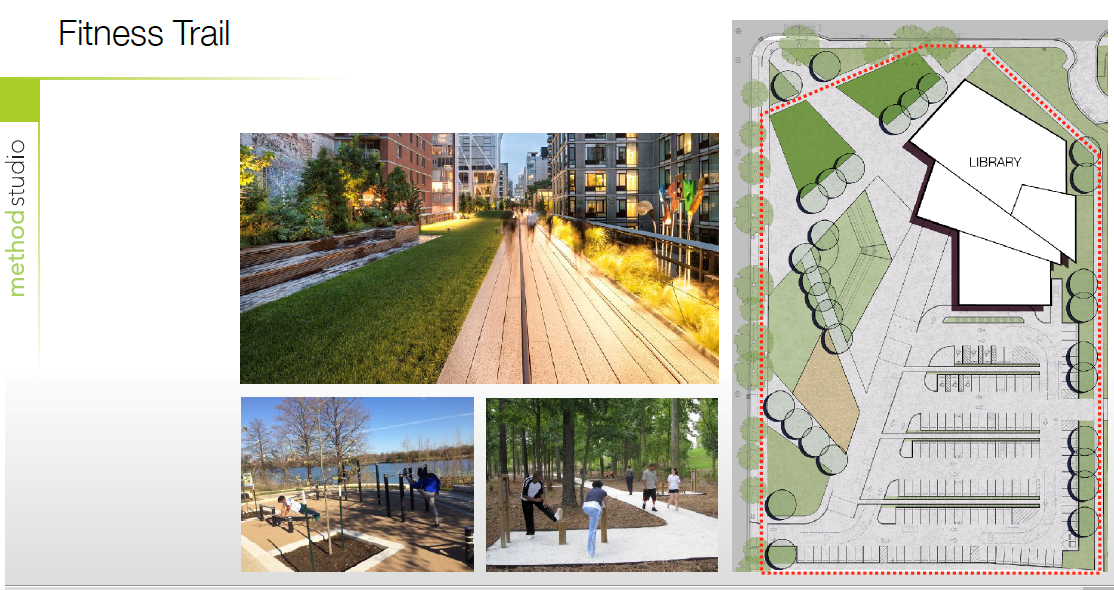
g.
All Development shall include improved pedestrian access paths and cross-access easements between the Townhome and Library subdistricts:
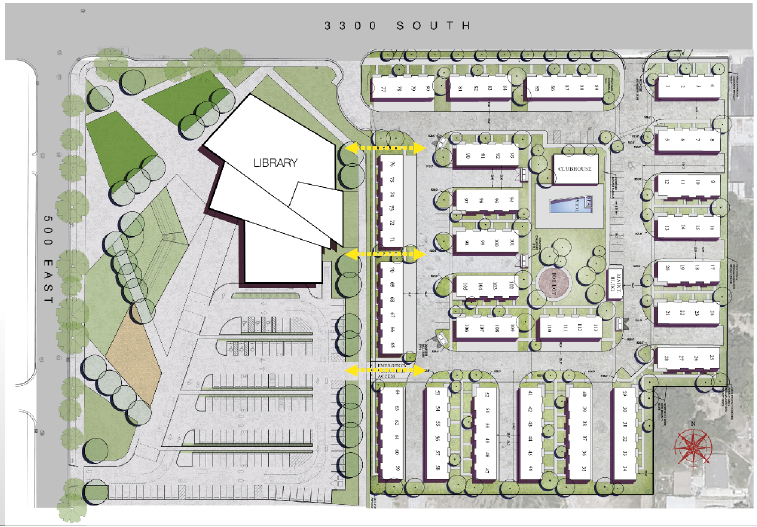
h.
Pedestrian and overhead lighting that meets the character district standards of the South Salt Lake Lighting Master Plan shall be installed along 500 East and 3300 South; and
i.
The South Property Line shall include a tree-lined, landscaped Buffer of at least five (5) feet in width and a paved sidewalk width of at least ten (10) feet.
15.
The design must achieve a nationally adopted standard for sustainable Building construction.
16.
Access from 500 East shall be located no less than 300 feet from the 3300 South Right-of-Way.
D.
Road and Public Access Easement Cross Sections:
1.
3300 South UDOT Right-of-Way and required cross section of SSLC public access easement and improvements:
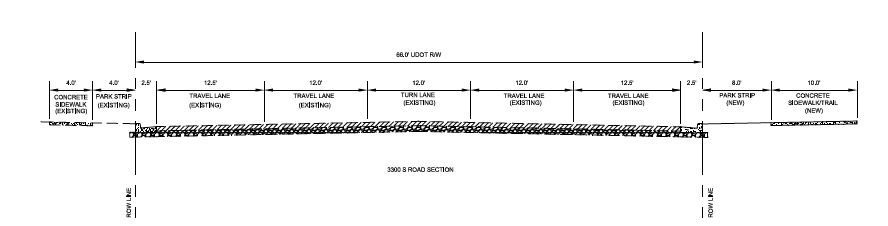
a.
UDOT has sole authority to regulate the specifications for travel lanes within the UDOT right-of-way; and
b.
The foregoing cross-section notwithstanding, at any time prior to the issuance of the first Certificate of Occupancy within any subdistrict, the owners or its designees within the Granite MPMU Development may elect to:
i.
Improve the 2.5' gap between the edge of pavement and the southern edge of the 3300 South UDOT ROW, from 500 East to the easternmost edge of the Granite MPMU Development, to the reasonable satisfaction of the City Engineer; and
ii.
Realign and improve:
(A)
The 10' wide concrete sidewalk from the southern edge of the SSLC public access and Landscaping easement to the southern edge of the 3300 South UDOT ROW, along the entire length of the UDOT ROW in the Granite MPMU Development; and
(B)
The 8' wide landscaped park strip from the northern edge of the SSLC public access and Landscaping easement to the southern edge of the 10' wide concrete sidewalk, along the entire length of the UDOT ROW in the Granite MPMU Development.
c.
The owners' election to realign the public sidewalk and Landscaping within the City's public access and Landscaping easement shall not compromise the City's right to align public improvements within the easement as the City may later determine is appropriate.
2.
500 East Right-of-Way and required SSLC public access easement and improvement
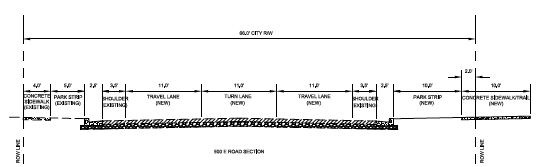
* UDOT has sole authority to regulate the specifications for travel lanes within the UDOT right-of-way.
E.
Storm water management. Site Development must include comprehensive storm water management, including the public Dedication and improvement of public storm water facilities within the district.
F.
Parking. The following parking requirements apply:
1.
The base parking requirement shall be 1 stall for every 150 gross square feet of Building.
2.
A reduction of the parking footprint up to 40% is allowed if measures are provided to encourage carpooling, bike, and pedestrian use. These include providing secure bike racks, pedestrian connections from adjacent properties through the site, and preferred parking for carpools for 5% of the total Parking Stalls after reductions are made from the base ratios.
(Ord. No. 2020-02, § IV(Exh. C), 1-8-2020; Ord. No. 2022-16, § 1(Exh. A), 9-14-2022)
Note— See editor's note at § 17.03.080.
17.03.220 - Granite Lofts Multi-Family Townhome (GLT) district.
A.
Uses. Uses within this district are described in this Chapter.
B.
Density. Project Density is limited to residential Development at up to seventeen (17) units per acre in the configuration designated in Subsection C, Site Plan and Unit Configuration.
C.
Site Plan and Unit Configuration. Upon Subdivision, the project Site Plan and unit configuration shall be:
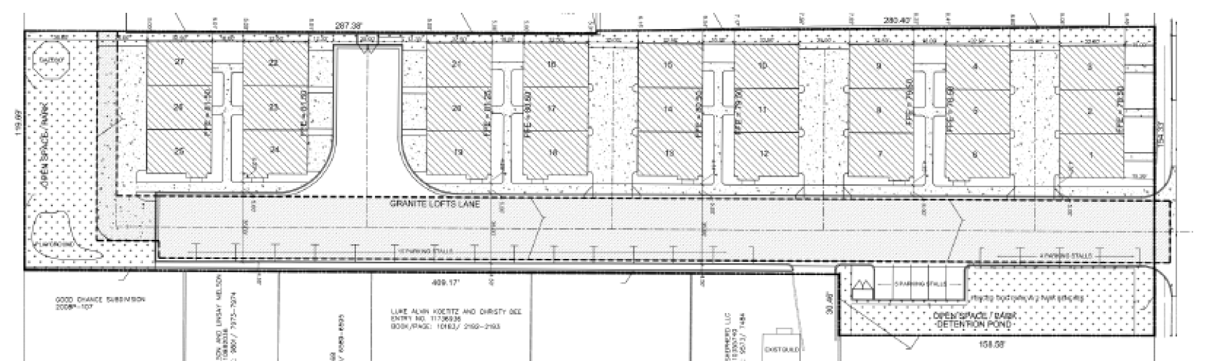
D.
Development Design Regulations. In addition to Chapter 17.07, the following regulations apply:
1.
Minimum project area is 1.6 acres;
2.
The project may not include more than nine Townhome Buildings;
3.
Only units one through twelve (12) as depicted above may include rooftop access or use;
4.
Offsite noise projected from rooftop access or use is prohibited from 10:00 p.m. to 8:00 a.m.; and
5.
All units must have enhanced sound attenuation from Street noise and from noise between units.
(Ord. No. 2020-02, § IV(Exh. C), 1-8-2020)
17.03.230 - Tracy Aviary's Jordan River Nature Center (JRNC) District.
A.
Purpose. The Tracy Aviary's Jordan River Nature Center (JRNC) District provides Development standards for a Nature Center within the City.
B.
Establishment. The JRNC District is established to:
1.
Provide a tailored Development, design, and Use framework appropriate for a new Nature Center proposed within the City;
2.
Specifically support and increase the Use, awareness, understanding, appreciation, and stewardship of the natural environment within the City; and
3.
Facilitate the investment of future legislative appropriations in a manner consistent with state-level directives.
C.
Applicability. The development of the JRNC shall comply with the provisions of this Code.
D.
Uses. A single Nature Center shall be the only Primary Use allowed.
1.
The JRNC Nature Center may include the following:
a.
A visitor education center shall be the Primary Structure at the JRNC Nature Center and shall be located at the corner of 3300 South and 1000 West. The visitor education center shall include the following accessory uses:
i.
Guest services;
ii.
Admissions and memberships;
iii.
Rental equipment including camping gear, boats, bikes;
iv.
Retail spaces/a nature store;
v.
Food service;
vi.
Educational spaces/ animal displays;
vii.
Office spaces/conference rooms;
viii.
Employee Housing Dwelling Units;
ix.
Event space;
x.
Secured gates;
b.
A secured clientele parking lot with access from 1000 West;
c.
A secured staff parking lot with access from 3300 South;
d.
Landscaping featuring native and/or xeric plantings;
e.
Secured internal restroom facilities;
2.
The JRNC Nature Center may include any of the following accessory uses interior to the Nature Center:
a.
Additional educational spaces;
b.
Wildlife viewing Structures;
c.
Amphitheater;
d.
Shade pavilions
e.
Plazas;
f.
Photovoltaic Solar Energy Systems;
g.
Electric vehicle charging stations;
h.
A variety of gardens including edible and pollinator gardens;
i.
Children play areas;
j.
Live animal enclosures/displays - no venomous animals permitted;
k.
Secured outdoor recreational equipment storage;
l.
Other Nature Center programming.
E.
Standards.
1.
Operator/manager. The JRNC Nature Center shall be operated and managed by a single operating/managing entity - Friends of Tracy Aviary, a Utah non-profit corporation. No entity other than the Applicant may be substituted for the operator/manager of the Nature Center.
2.
The Nature Center site plan:
a.
The JRNC Nature Center shall generally be configured as depicted below:
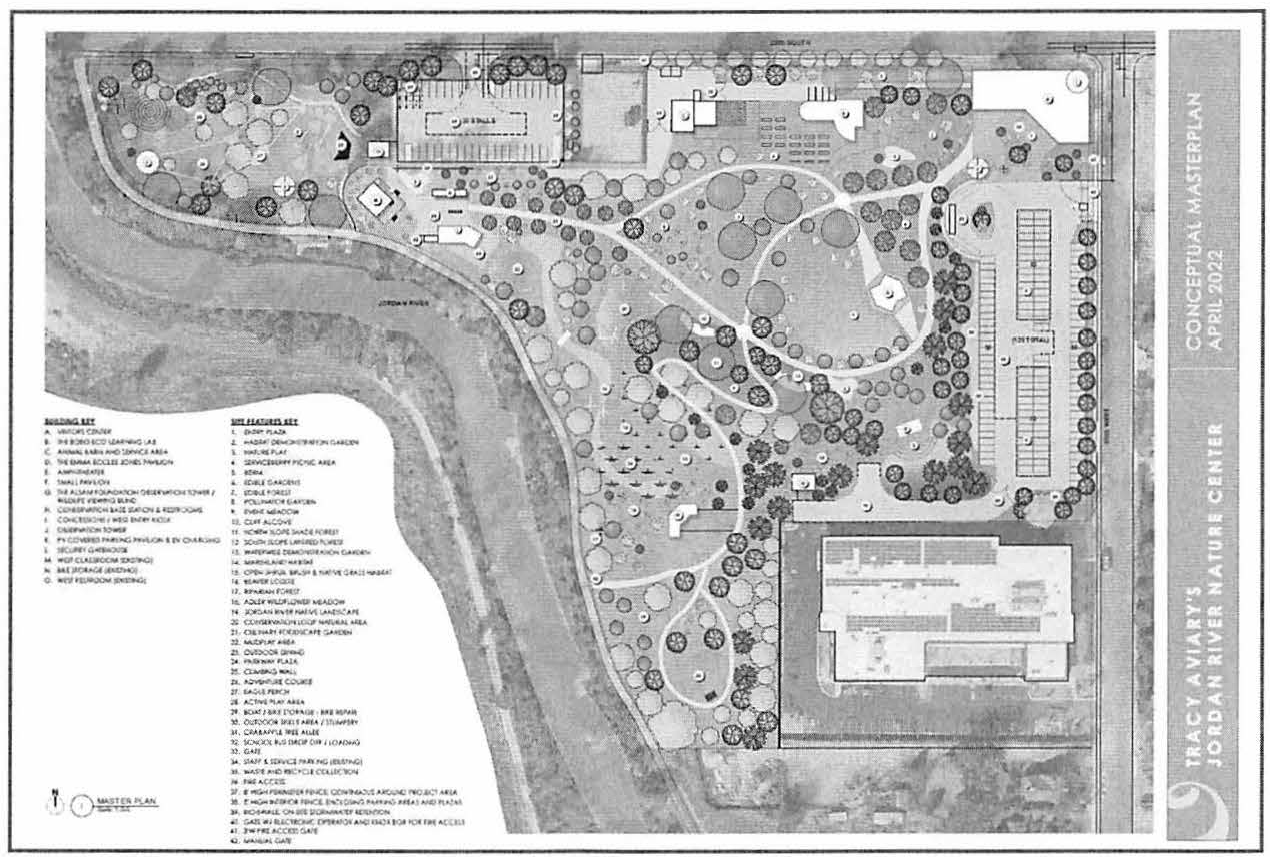
_____
F.
Operations:
a.
The JRNC Nature Center may operate for a maximum of twenty (20) hours per day, seven (7) days per week.
b.
The JRNC Nature Center may hold special events with additional evening hours but in no case later than 12:00 a.m.
G.
Programming.
a.
The Nature Center shall provide staff-directed experiences and staff-hosted group events for up to a maximum of 2,000 individuals at a time.
b.
Specialty Recreational Installations shall be operated and staffed during all regular open hours and shall exclusively be operated and managed by the Nature Center's staff, which may be supplemented by trained volunteers.
H.
Security and management. In addition to complying with Crime Prevention through Environmental Design (CPTED) principles, any Use shall incorporate plenary operation and management practices to prevent and mitigate adverse onsite behavioral issues, including:
1.
The operator/manager shall employ private security personnel to ensure that the Nature Center offers the general public welcoming and engaging spaces and that it is not occupied during off-hours.
2.
Staff. The JRNC Nature Center operator/manager shall have at least five of its staff member's onsite during operating hours.
3.
Lighting. The JRNC Nature Center shall submit a photometric study for the City's review and evaluation. The installation of lighting at the JRNC Nature Center shall feature strategically located internal light fixtures across the site to maximize dark-sky compliant night-time visibility and illuminated exterior surfaces.
4.
Cameras. The JRNC Nature Center shall direct appropriate video camera surveillance onto each Building within the site. The operator/manager shall continuously record activity in the vicinity of each Building and its immediate surrounding area to deter vandalism and ensure the protection of the Nature Center property and shall preserve such recordings for a minimum of 30 days.
5.
Electrical outlets. All power outlets shall be located inside a Structure, to the maximum extent possible; any power outlets located outside shall employ locking covers and shall remain locked or turned off when not in use by Nature Center staff or volunteers. No electrical outlets shall be accessible from the exterior of the JRNC Nature Center fence line.
6.
Fencing and foliage. The JRNC Nature Center site shall install and enclose its perimeter with an eight-foot (8') climb-deterrent, black, PVC-coated, welded-wire mesh fencing. The fence shall incorporate six (6) exterior gated entry points: one (1) primary access-controlled pedestrian gate located near the Visitor's Center entrance off 1000 West; two (2) access-controlled pedestrian gates located off the Jordan River Trail; one (1) access-controlled vehicular gate securing the clientele parking lot along 1000 West; one (1) access- controlled vehicular gate securing the staff parking lot along 3300 South; one (1) access-controlled pedestrian gate for public safety access along 3300 South. These gated entry points shall match the height of the fence and style of the fence. All gates shall comply with standards of the South Salt Lake Fire Marshal.
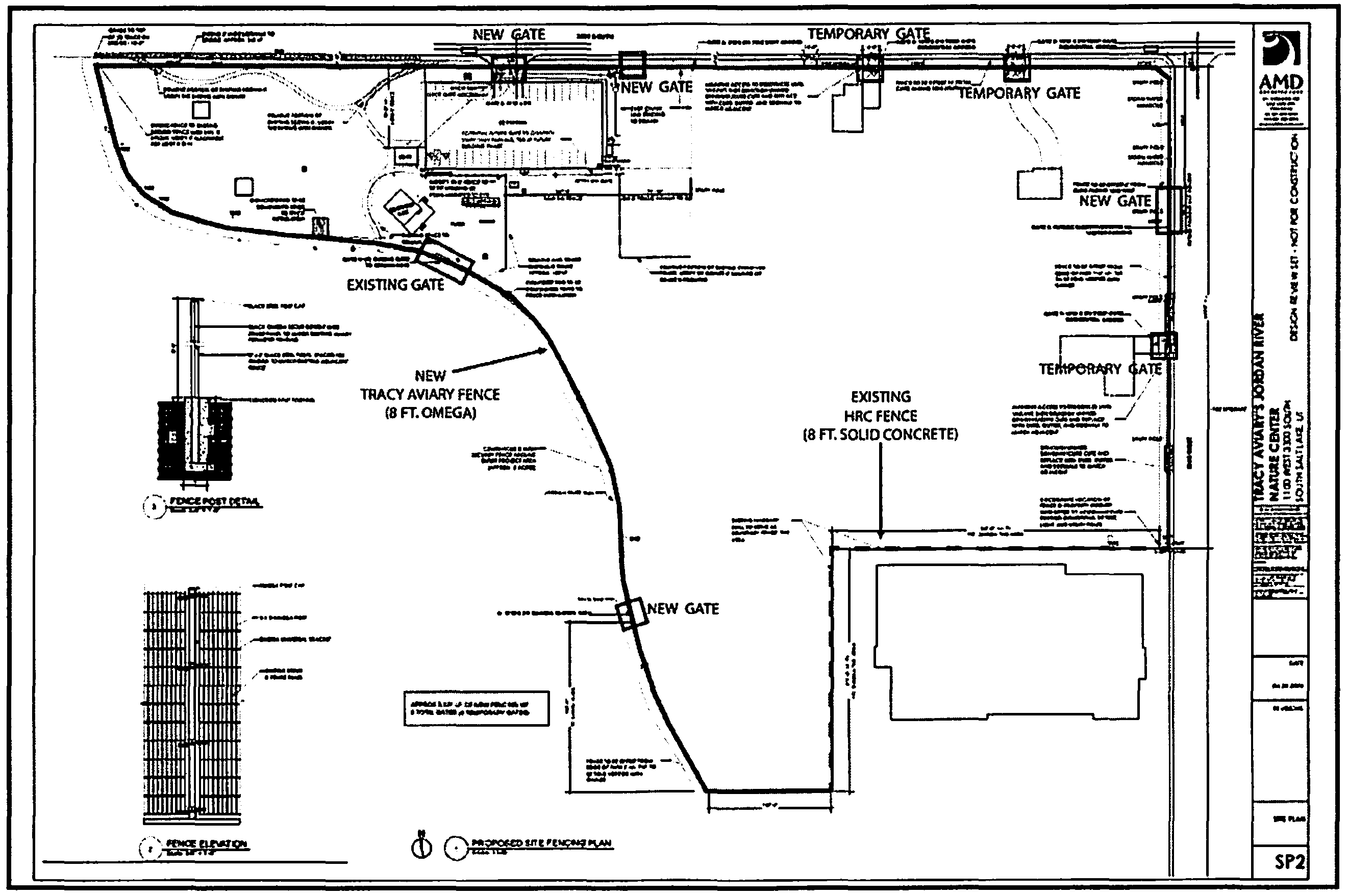
7.
Landscape maintenance. The Nature Center shall install and maintain exterior landscaping along the fence and abutting public right-of-ways by trimming, pruning, and maintaining plants as required.
8.
Restroom facilities. Only Nature Center staff and guests shall have access to restrooms. All restrooms shall be internal to the JRNC project area. There shall be no public access to restrooms.
9.
Anti-graffiti. The Applicant shall apply an anti-graffiti coating on all vertical, exterior surfaces within five (5) feet of the perimeter fence. The Applicant shall promptly remove any graffiti within the JRNC District.
10.
Site management. The Nature Center operator/manager shall contract with a licensed and bonded private security company to conduct at least two (2) site visits to the Nature Center per night, at random hours. The operator/manager shall contract with a licensed and bonded private security company, as needed, to provide security for large events and other identified security needs. The operator/manager shall ensure all Structures are reasonably secured against unauthorized access.
11.
Waste management. All waste container enclosures shall be secured and located interior to the JRNC Nature Center fence line. All waste containers shall be emptied regularly into aggregate collection containers to prevent onsite litter and unsightly collection of discarded items.
I.
Design and Construction. The following Design Guidelines and construction requirements shall apply to the JRNC Nature Center:
1.
Civil improvements.
a.
The JRNC Nature Center shall comply with all South Salt Lake Engineering standards found in Title 17.10.
b.
Site Development shall be designed and graded to meet MS4 permit standards, all to the City's Engineering standards.
c.
Berms. Berms are permitted in the JRNC Nature Center subject to South Salt Lake Engineering approval. All berms shall be located interior to the development and shall be no higher than the perimeter fence.
d.
Interior Pathways. All Interior pathways shall comply with the minimum widths and weight requirements as required by the South Salt Lake Fire Marshal.
a.
Primary pathways. Primary pathways shall be constructed of concrete or asphalt.
b.
Secondary pathways. Secondary pathways shall be constructed of compacted gravel or another similar material.
c.
Tertiary pathways. Tertiary pathways are constructed of dirt or other natural materials.
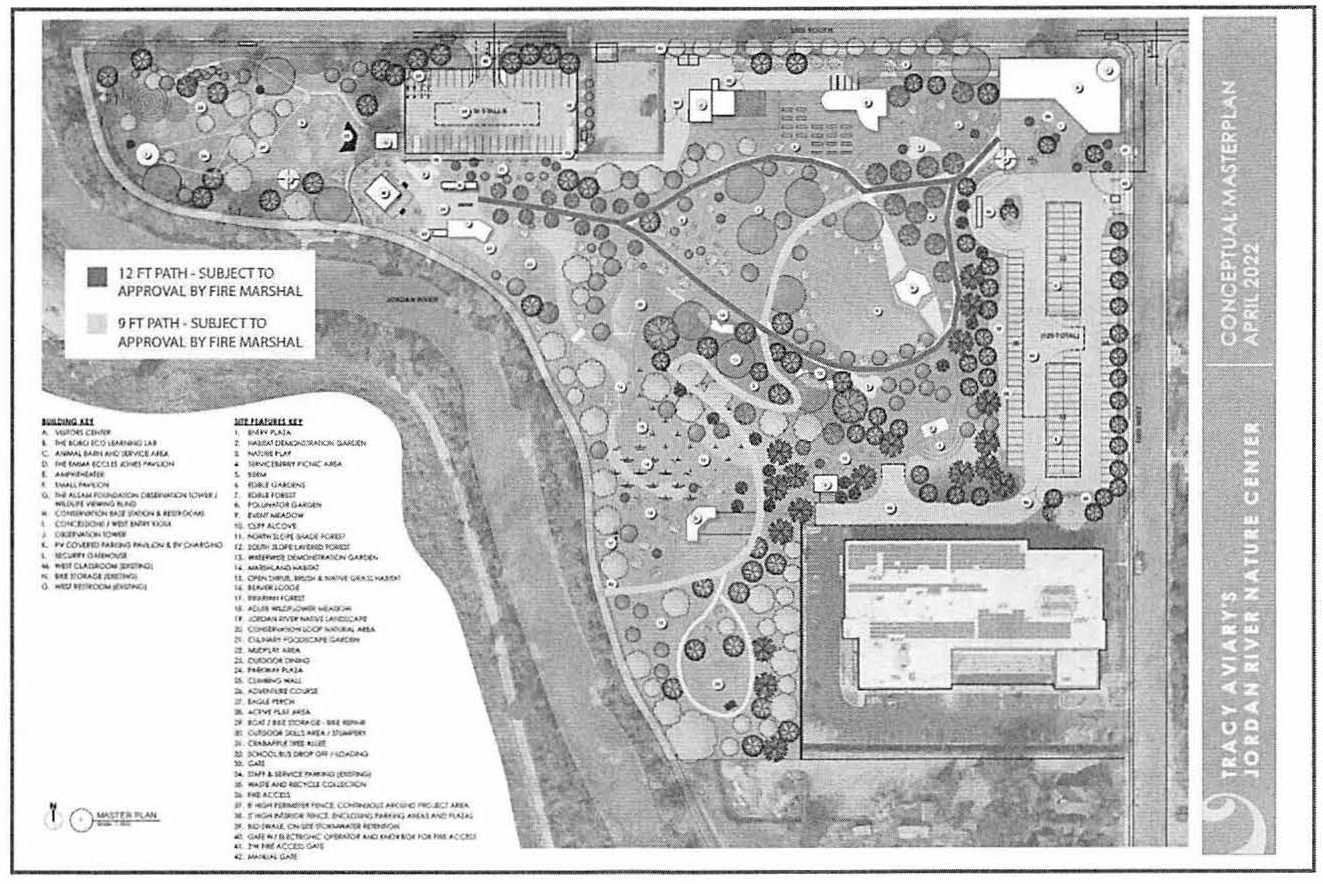
_____
e.
Parking, Access and Circulation Requirements. Refer to Title 17.06.
f.
Flood plain/Jordan River Diversion. Any changes impacting the flood plain or alteration to the flow of location of the Jordan River shall be reviewed and approved by South Salt Lake Engineering, the Salt Lake County Flood Control, the Army Corps of Engineers and any other applicable County, State or Federal agency.
g.
Curb cuts. As part of the development of the JRNC Nature Center, all unused curb cuts located along 3300 South and 1000 West shall be removed and replaced with the appropriate infrastructure including curb, gutter, and sidewalk.
h.
Public Right-of-Way Sidewalk. 3300 South and 1000 West shall have a five (5) foot sidewalk abutting back of curb along the entirety of the 3300 South and 1000 West frontage. No parkstrips are permitted.
2.
Architectural standards. All Structures shall have a similar architectural design and style throughout the JRNC Nature Center.
a.
Visitor Education Center.
i.
Area. The visitor education center may have a maximum Gross Floor Area of 18,000 square feet.
ii.
Maximum Height. The maximum Height shall be 55 feet.
iii.
Required Setbacks. The visitor education center shall have a 15 feet maximum setback from both 3300 South and 1000 West.
iv.
Residential Density. The maximum Density for any Employee Housing Dwelling Unit located within the visitor education center Structure shall be one dwelling unit per acre. The Employee Housing Dwelling Units are restricted to occupancy by JRNC staff only.
a.
Location. Employee Housing Dwelling Units shall be located within the upper floors of the visitor education center Structure. Employee Housing Dwelling Units shall be internally accessed, and access controlled.
b.
Layout. Employee Housing Dwelling Units shall be dorm style with living quarters containing a number of private or semiprivate rooms for residents with shared kitchen/dining area and shared restroom/shower facilities.
c.
Amenities. The following amenities shall be provided for the Employee Housing Dwelling Unit:
i.
Secured on-site parking
ii.
On-site laundry
d.
Short-term rentals are prohibited.
v.
Design Standard Regulations.
a.
The visitor education center shall be a permanent Structure.
b.
Frontage/Orientation. The visitor education center shall be located at the corner of 3300 South and 1000 West.
c.
Primary Entrance. The Primary Entrance of the visitor education center shall be located internal to the access-controlled clientele parking lot located on 1000 West.
d.
Façade. Each Façade of the visitor education center shall display the same level of architectural detail and transparency.
e.
Materials. The visitor education center shall consist of the following exterior Primary Materials: painted steel, plaster, stone, and architectural metal.
f.
Roofs. The visitor education center shall have a roof clad in standing seam metal or a low-slope membrane or a material of similar quality and durability.
g.
Loading and Service Areas. Any loading or service area shall be located internal to the access-controlled clientele parking lot located on 1000 West.
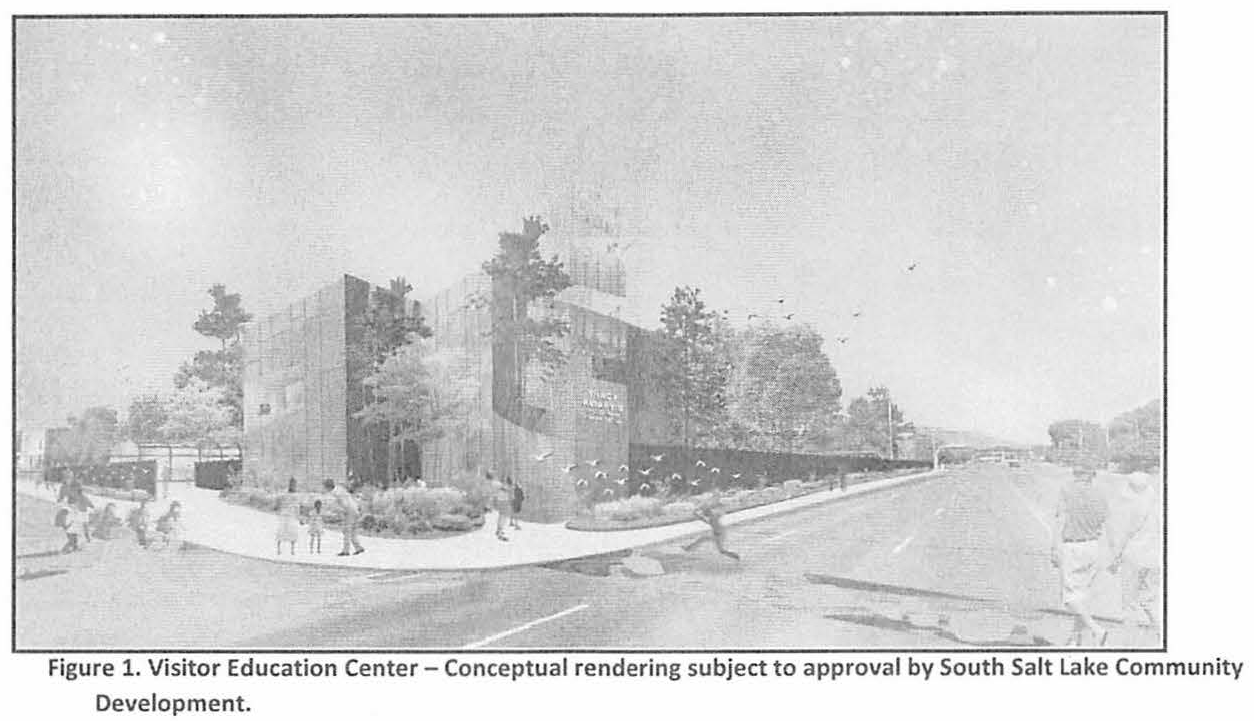
b.
Specialty Recreational Installation - pavilions.
i.
Area. Pavilions may have a maximum Gross Floor Area of 2,000 square feet.
ii.
Maximum Height. The maximum Height shall be 18 feet.
iii.
Location. All pavilions shall be interior to the JRNC Nature Center fencing.
iv.
Design Standard Regulations.
a.
Pavilions shall be a permanent Structures.
b.
Materials. All pavilion Structures shall consist of the following exterior Primary Materials: painted steel and wood.
c.
Roofs. All pavilions shall have a roof clad in standing seam metal or a low-slope membrane or a material of similar quality and durability.
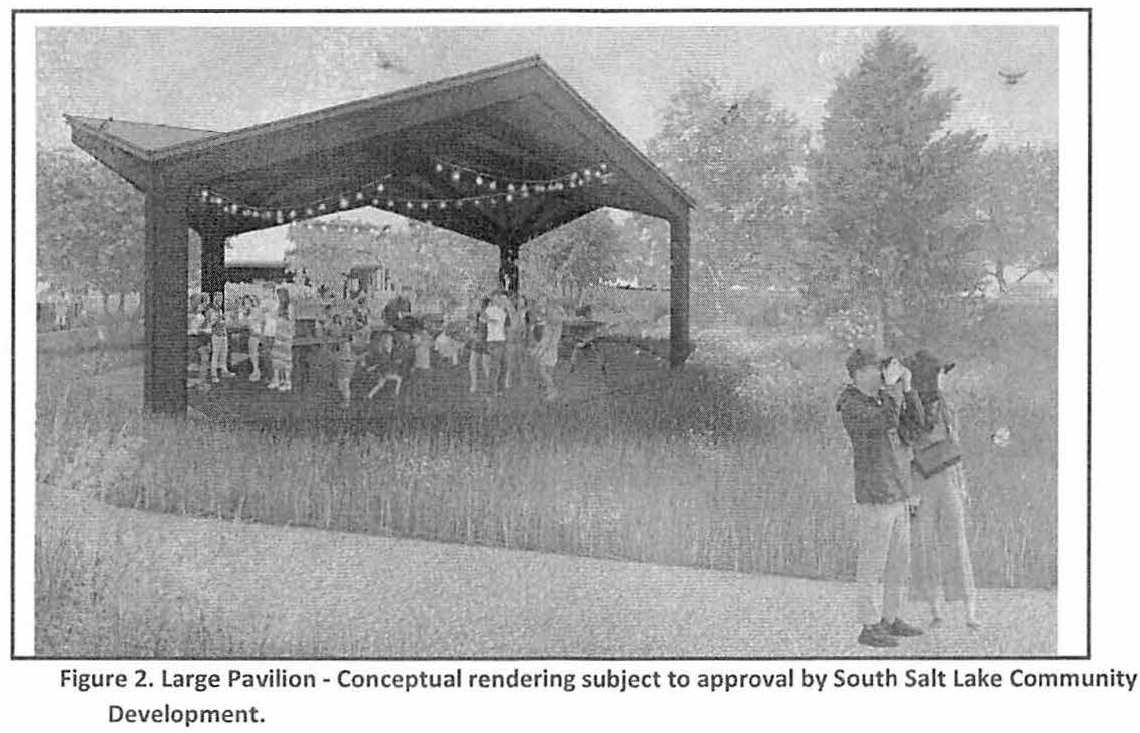
c.
Specialty Recreational Installation - eco learning lab.
i.
Area. Eco learning labs may have a maximum Gross Floor Area of 2,000 square feet.
ii.
Maximum Height. The maximum Height shall be 22 feet.
iii.
Location. All eco learning labs shall be interior to the JRNC Nature Center fencing.
iv.
Design Standard Regulations.
a.
Eco learning labs shall be permanent Structures.
b.
Materials. Eco learning lab Structures shall consist of the following exterior Primary Materials: painted steel, plaster, stone, wood, and glass.
c.
Roofs. Eco learning labs shall have a roof clad in glass and standing seam metal or a low-slope membrane or a material of similar quality and durability.
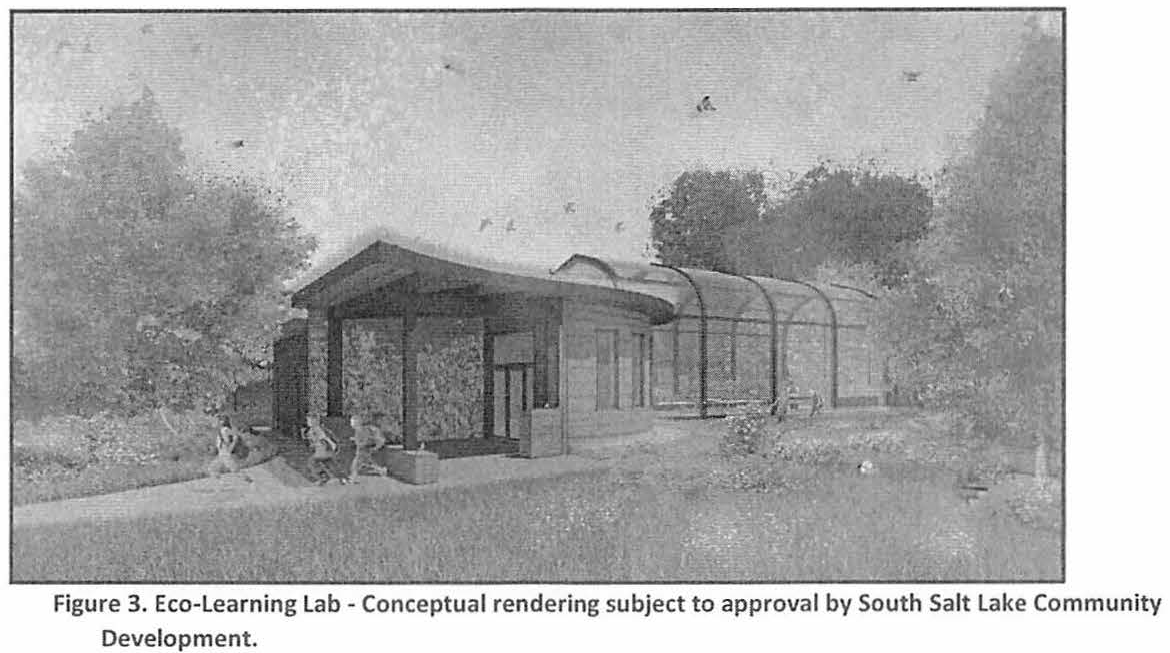
d.
Specialty Recreational Installation - animal barn and service area.
i.
Area. Animal barns and service areas may have a maximum Gross Floor Area of 2,000 square feet.
ii.
Maximum Height. The maximum Height shall be 20 feet.
iii.
Location. All animal barns and service areas shall be interior to the JRNC Nature Center fencing.
iv.
Design Standard Regulations.
a.
Animal barns and service areas shall be a permanent Structures.
b.
Materials. Animal barns and service area Structures shall consist of the following exterior Primary Materials: timber, wood, plaster, and architectural metal.
c.
Roofs. Eco learning labs shall have a roof clad in standing seam metal or a low-slope membrane or a material of similar quality and durability.
d.
All animal enclosures shall comply with Title 6 and shall be approved by South Salt Lake Animal Services.
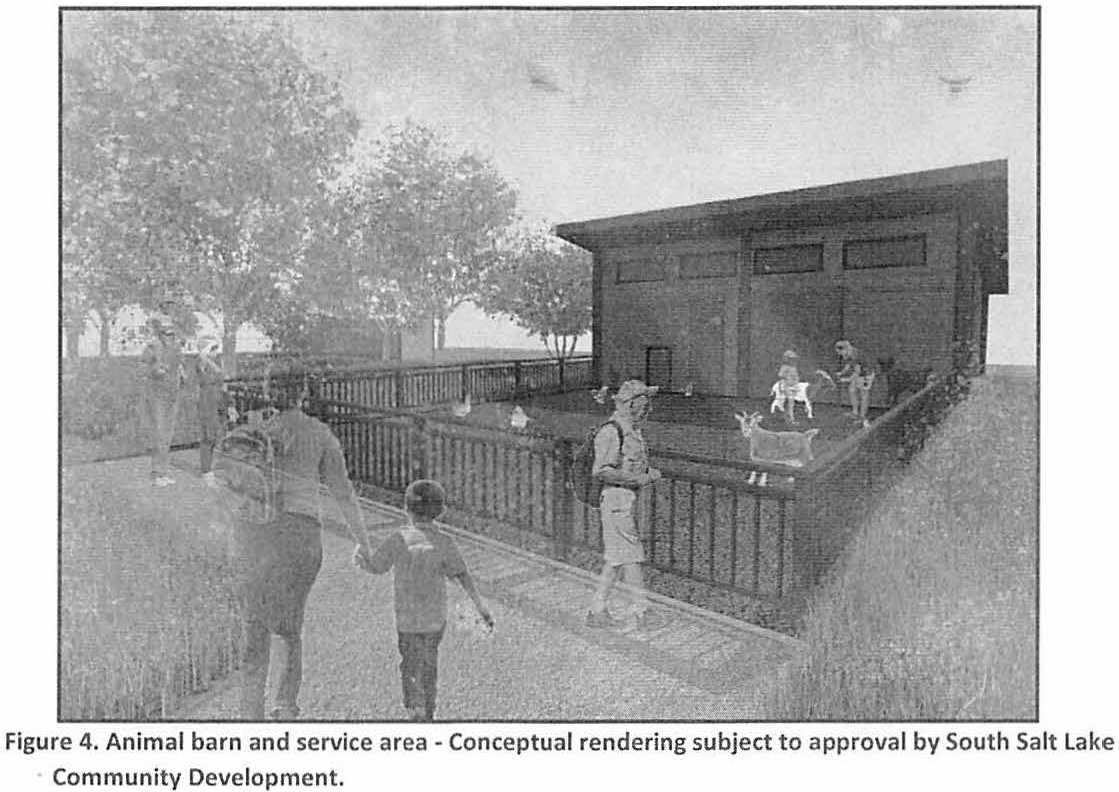
e.
Specialty Recreational Installation - observation tower/wildlife viewing blind.
i.
Area. Observation towers/wildlife viewing blinds may have a maximum Gross Floor Area of 1,000 square feet.
ii.
Maximum Height. The maximum Height shall be 35 feet.
iii.
Location. All observations towers/wildlife viewing blinds shall be interior to the JRNC Nature Center fencing.
iv.
Design Standard Regulations.
a.
Observation towers/wildlife viewing blinds shall be permanent Structures.
b.
Materials. The observation tower and wildlife viewing blind Structure shall consist of the following exterior Primary Materials: painted steel, painted composite siding, metal, and wood.
c.
Roofs. The observation tower and wildlife viewing blind shall have a roof clad in standing seam metal or a low-slope membrane or a material of similar quality and durability.
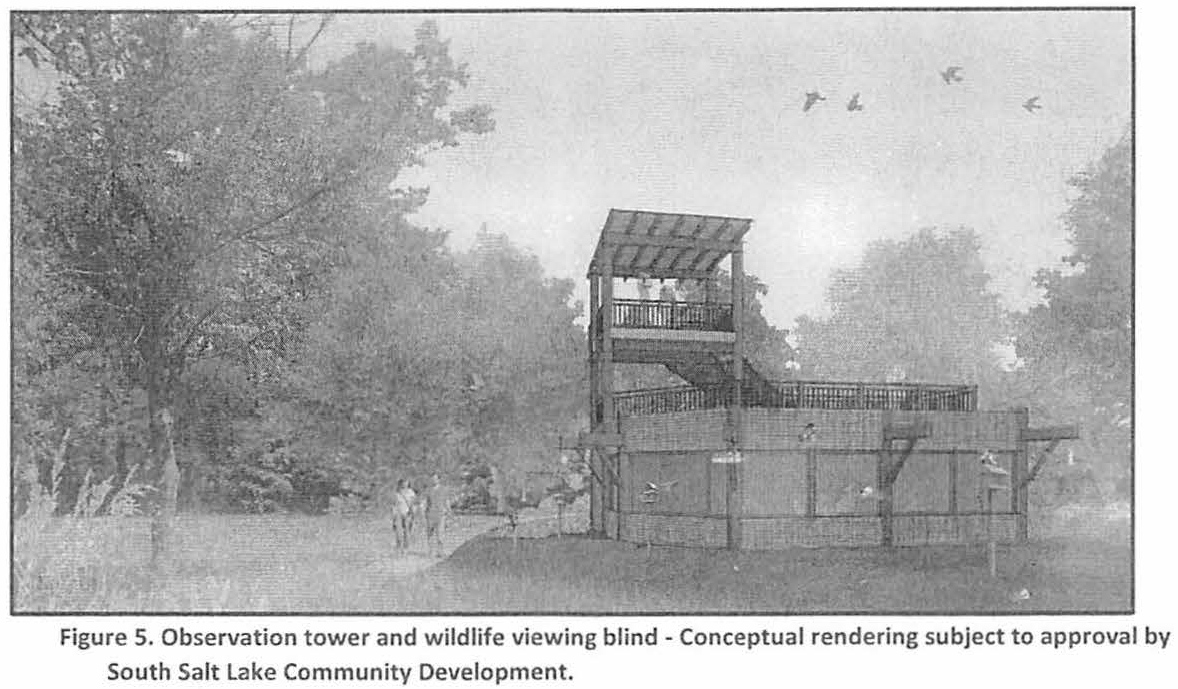
f.
Specialty Recreational Installation - conservation base station.
i.
Area. Conservation base stations may have a maximum Gross Floor Area of 1,000 square feet.
ii.
Maximum Height. The maximum Height shall be 20 feet.
iii.
Location. All conservation base station Structures shall be interior to the JRNC Nature Center fencing.
iv.
Design Standard Regulations.
a.
Conservation base stations shall be permanent Structures.
b.
Materials. The conservation base station Structure shall consist of the following exterior Primary Materials: plaster, wood, and metal.
c.
Roofs. The conservation base station shall have a roof clad in standing seam metal or a low-slope membrane or a material of similar quality and durability.
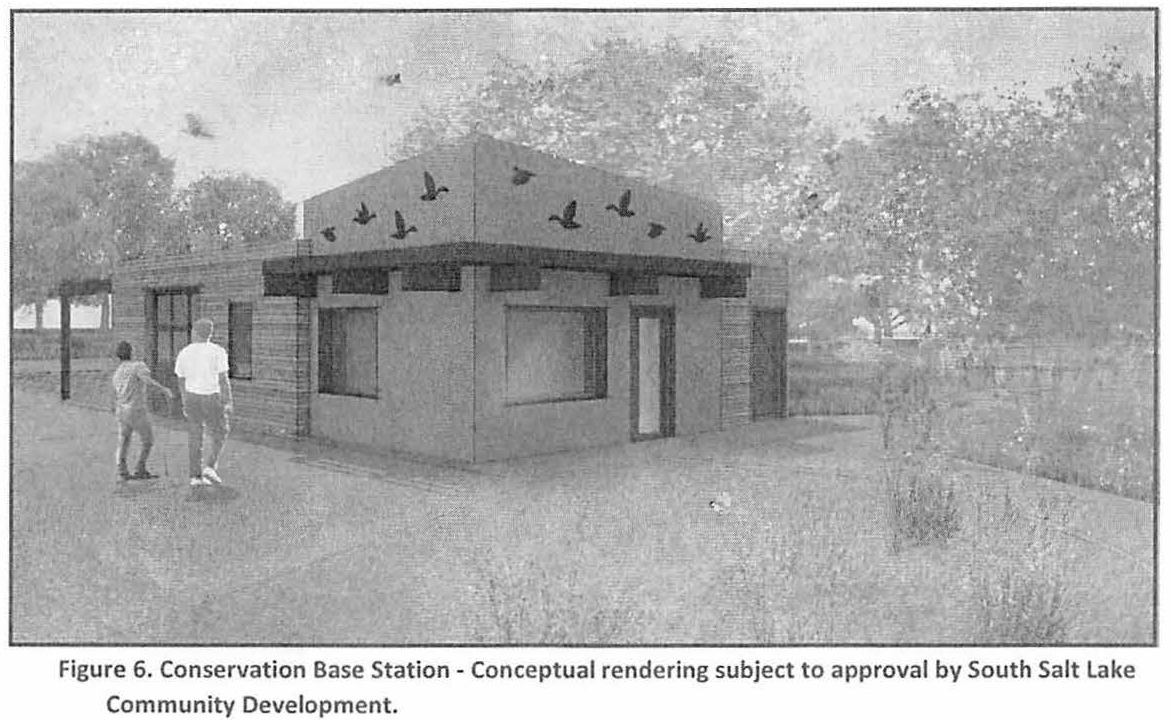
g.
Specialty Recreational Installation - amphitheater.
i.
Maximum Height. The maximum Height shall be 20 feet.
ii.
Location. All amphitheater Structures shall be interior to the JRNC Nature Center fencing.
iii.
Design Standard Regulations.
a.
The amphitheater shall be a permanent Structure.
b.
Materials. The amphitheater Structure shall be consistent with other exterior materials found in the JRNC Nature Center.
c.
Roofs. The amphitheater shall have a roof clad in standing seam metal or a low-slope membrane or a material of similar quality and durability.
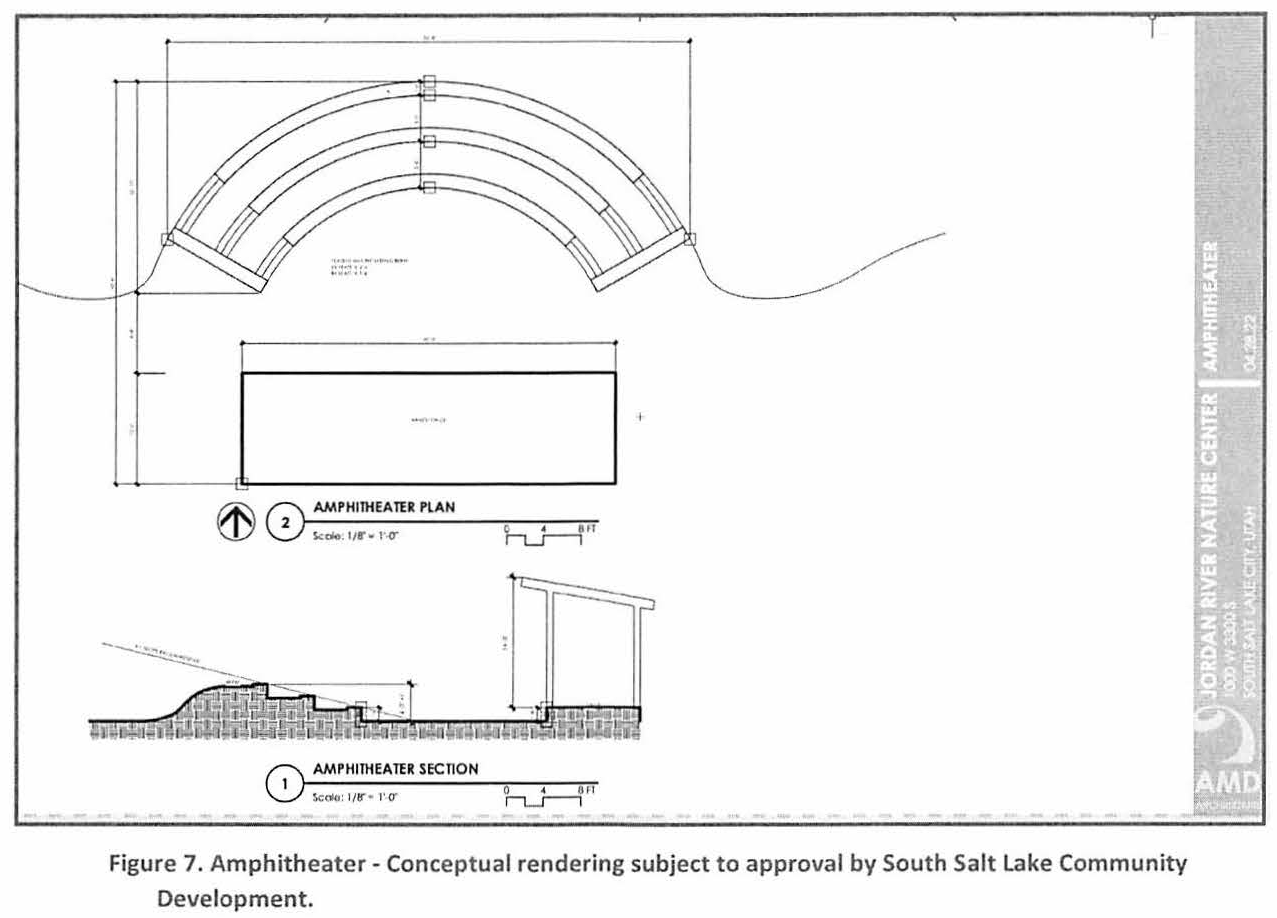
h.
Accessory Structures. Structures serving as an appropriate Accessory Use may be prefabricated, including up to ten (10) container structures onsite.
i.
Area. Accessory Structures may have a maximum Gross Floor Area of 1000 square feet.
ii.
Maximum Height. The maximum Height shall be 20 feet.
iii.
Location. All Accessory Structures shall be interior to the JRNC Nature Center fencing.
iv.
Design Standard Regulations.
a.
All Accessory Structures shall be permanent Structures and affixed to a foundation.
b.
Materials. Accessory Structures shall be consistent with other exterior materials found in the JRNC Nature Center. Metal shipping containers may be used as architectural elements in Accessory Structures. Nature themed murals are permitted.
c.
Roofs. Accessory Structures shall have a roof clad in standing seam metal or a low-slope membrane or a material of similar quality and durability.
3.
Parking, Access and Circulation Requirements. Refer to Title 17.06.
4.
Landscaping. The JRNC Nature Center shall comply with all provisions of Title 17.06.300, with the following exceptions:
a.
Exterior Perimeter Landscape Standards.
i.
Turf grass is prohibited between the JRNC Nature Center fence and the public right of way. The JRNC Nature Center shall install a rock mulch base in all landscaped areas and shall include live plant material that covers 75% of the area at maturity. Live plant material shall be selected and installed to discourage camping and loitering along the perimeter of the development.
ii.
Benches and other public furnishing installations are prohibited between the JRNC Nature Center fence and any public right of way.
5.
Signage.
a.
The JRNC Nature Center may feature two (2) Monument Signs, with a maximum height of four (4) feet and a maximum area of 50 square feet.
b.
The JRNC Nature Center may feature two (2) Wall Signs that are limited to 15% of the front façade area of the Visitor Center, with alphanumeric character height up to four (4) feet in height. Walls signs may be placed on any façade of the Visitor Center.
c.
The JRNC Nature Center may have an unlimited number of Directional Signs and informational signs within the interior of the development.
d.
Pole Signs are prohibited.
(Ord. No. 2022-12, § I(Exh. A), 5-25-2022)
Editor's note— Ord. No. 2022-12, § I(Exh. A), adopted May 25, 2022, repealed and reenacted section 17.03.230 in its entirety to read as herein set out. Formerly, section 17.03.230 pertained to the Nature Center Pilot Project (NCPP) Overlay District, and derived from Ord. No. 2020-02, § IV(Exh. C), adopted January 8, 2020.
17.03.240 - South Salt Lake City Police Department (SSLC-PD) Overlay District.
A.
Purpose. The South Salt Lake City Police Department (SSLC-PD) Overlay District provides Development standards for specific Accessory Structures necessary for safe City Police Department operations.
B.
Establishment. The SSLC-PD Overlay District is established to:
1.
To support appropriate addition of Accessory Structures to City Police Department sites to make additions Compatible with the SSLC Police Department Primary Use and Structures surrounding the site;
2.
To minimize human interface with hazardous, contaminant, or otherwise unsafe conditions or materials; and
3.
To facilitate daily SSLC Police Department operations.
C.
Applicability. A property Owner shall follow the provisions of this Section when Developing or changing the Use of property within the district.
D.
Uses. In the SSLC-PD Overlay District, Uses, Buildings, Structures or land shall only be used or Developed in a nature accessory to the Primary Use of the subject property.
E.
Standards. Specific standards for the SSLC-PD Overlay District are as follows:
1.
Permissible Accessory Structure: One Accessory Structure is allowed in the district to support an Accessory Use to (a) minimize SSLC Police Department personnel interface with hazardous, contaminant, or otherwise unsafe conditions or materials; and (b) facilitate daily SSLC Police Department operations. An Accessory Structure serving an appropriate Accessory Use under this Section may be prefabricated—including a container structure—or constructed on-site. All Accessory Structures shall be permanently affixed to a foundation. An Accessory Structure shall only be used for temporary indoor storage and shall not be used for human occupancy other than for and during incidental processing of custodial property.
2.
Grading and Drainage: An Accessory Structure shall only be constructed on a site graded and designed to meet MS4 permit standards, all to the City's Engineering standards.
3.
Maximum Height: Accessory Structure height shall not exceed 11 feet.
4.
Size and Siting: Accessory Structure Gross Floor Area shall not exceed 420 square feet per Accessory Structure. An Accessory Structure must be located within three (3) feet of a Side Property Line and within three (3) feet of the Rear Property Line, but shall not obstruct a Right-of-Way sight-distance triangle or Drive Aisle, including the Accessory Structure's door-swing paths.
5.
Construction: An Accessory Structure shall match the exterior color of the primary SSLC Police Department Structure within the district and shall employ an anti-graffiti coating on all vertical, exterior surfaces. An Accessory Structure may incorporate electrical service for lighting, HVAC, and as necessary to support incidental processing of custodial property within the Accessory Structure. All exterior lighting shall be directed downward and away from any adjacent Residential Uses. HVAC equipment shall not emit noise levels in excess of 55dBa at the Property Line.
6.
Security: Appropriate video camera surveillance shall be directed onto any Accessory Structure. The SSLC Police Department shall continuously record activity in the vicinity of the Accessory Structure and its immediate surrounding area to deter vandalism and ensure the protection of City and custodial property. The Accessory Structure shall be appropriately secured from unauthorized access.
(Ord. No. 2020-02, § IV(Exh. C), 1-8-2020)
17.03.250 - School (S) district.
A.
Purpose. The purpose of this zoning district is to allow for schools to operate within the district.
B.
Uses. No Building, Structure, Site, or land shall be used or Developed except in accordance with the adopted Land Use Matrix as found in this Chapter.
C.
Standards. Standards for the district are as follows:
1.
The minimum area of any Lot for Development is two (2) acres.
2.
The maximum Height for any Structure is sixty-five (65) feet.
3.
Required Setbacks are detailed in Chapter 17.07.
D.
Development Review. The Planning Commission shall review requests for Development in the district.
(Ord. No. 2020-02, § IV(Exh. C), 1-8-2020; Ord. No. 2022-16, § 1(Exh. A), 9-14-2022)
17.03.260 - Townhome Overlay District.
A.
Purpose. The Townhome Overlay District provides Development standards to facilitate the Development of well-designed Townhome communities.
B.
Uses. No Building, Structure, Site, or land shall be used or Developed except in accordance with the adopted Land Use Matrix as found in this Chapter.
C.
Standards. Standards for Townhome Development within the district are as follows:
1.
Minimum Area. The minimum area for Townhome Project Development is one (1) contiguous acre.
2.
Minimum Width. The minimum width of any Lot or Parcel for a Townhome Project Development is 128 feet along one Public Street. If a Townhome Project Development has access from a second Public Street, the width of the frontage on that Street shall be sufficient to meet all applicable South Salt Lake road profile requirements.
3.
Maximum Building Height. The maximum Building Height for any Structure is based on the Traditional 2 Story Townhome Building Form, Traditional 3 Story Townhome Building Form, Live/Work Townhome Building Form, and Urban Style Townhome Building Form, as applicable, and more completely detailed in Chapter 17.07.
4.
Required Setbacks/Build-To Standards are detailed in Chapter 17.07.
5.
The minimum width of each Dwelling Unit and each commercial storefront, as applicable, within the District is 22 feet.
6.
Each Townhome Development shall be subdivided into individual lots for each Dwelling Unit or into individual condominium units for each Dwelling Unit, Commercial Unit, Common Area, and Limited Common Area.
7.
Each rezone to the Townhome Overlay District shall be preceded by an executed Development Agreement among the Applicant, Property Owner, Developer, and the City detailing the specific Applicant, Property Owner, and Developer commitments to the City including project design, community management that respects important attributes of home ownership, and Development.
(Ord. No. 2021-06, § XI, 5-26-2021; Ord. No. 2022-16, § 1(Exh. A), 9-14-2022; Ord. No. 2023-28, § 1(Exh. A), 7-26-2023)
Editor's note— Ord. No 2022-16, § 1(Exh. A), adopted September 14, 2022, repealed former § 17.03.260, which pertianed to temporary transitional beneficial use (TTBU) overlay district and derived from Ord. No. 2020-09, § II, adopted August 12, 2020. Subsequently, § 17.03.270 was rebumbered as § 17.03.060.
17.03.270 - Family Interim Non-congregate Children Housing (FINCH) Zone.
A.
Purpose. The Family Interim Non-congregate Children Housing (FINCH) zone provides minimum development and re-development standards for a Family Interim Non-congregate Children Housing Facility, as a Conditional Use, within the City.
B.
Establishment. The FINCH zone is established to:
1.
Provide a tailored re-development, design, and Use framework appropriate to facilitate a new Family Interim Non-congregate Children Housing Facility as a conditional Use within existing structures as of June 1, 2024, that housed a prior Motel Use within the City;
2.
Allow for the waiver of certain subdivision, design, parking, and development standards, which are applicable to development within the City; and
3.
Facilitate and coordinate future legislative appropriations to the City that are designed to alleviate regional homelessness of child-centered families in a manner consistent with state-level directives.
C.
Primary Use. A Family Interim Non-congregate Children Housing Facility is the only Primary Use within the FINCH zone and is subject to all applicable Conditional Use criteria found in Title 17.05.040.M. The Use is further limited as follows:
1.
Limited to occupancy within Structures existing in the zone as of June 1, 2024 (no more than 52,795 square feet);
2.
No overnight occupancy outside of 85 approved bedrooms existing as of June 1, 2024; and
3.
Intensity of all Uses on the Site is limited to:
i.
Overnight occupancy of properly registered guests;
ii.
The total overnight occupancy within the zone is limited to no more than 400 individuals in any 24-hour period;
iii.
No more than a total of 45 employees, volunteers, non-residents, or contract laborers at any time; and
iv.
The average duration of family occupancy shall not exceed one year.
D.
Accessory Uses. A Family Interim Non-congregate Children Housing Facility is limited to the following Accessory Uses:
1.
Within Structures located on site and existing as of June 1, 2024:
i.
Sanitation to maintain a clean and sightly condition interior to each room and throughout the zone;
ii.
Laundry services to accommodate the permitted Use;
iii.
Office spaces, conference rooms, and one intake area to allow the approved operator to function consistent with all conditions of approval and provide life skills and child- centered services for approved residents;
2.
Within the zone:
i.
Access controlled perimeter fencing/gates;
ii.
Secured parking lot for emergency services providers, staff, and properly registered guests; and
iii.
Fenced dog/animal exercise area;
E.
Standards. Structures existing within the zone as of June 1, 2024, with associated surface parking are legal, Non-complying Structures, and are legal, Non-complying parking, within the FINCH Zone. Any modification of the exterior of the existing Structures must comply with the following:
1.
Minimum Area. The minimum Lot Area is 1.88 acres.
2.
Minimum Frontage. The minimum Frontage for any Lot is 250 feet.
3.
Minimum Depth. The minimum depth of any Lot is 300 feet along the length of the of the property from the Front Property Line to the Rear Property Line.
4.
Maximum Height. The maximum Height for any new or remodeled Structure must comply with Chapter 17.07.090.
5.
Required Setbacks. All Structures existing on the Site as of June 1, 2024 are valid, Non- complying Structures. Any new or expanded Structure must comply with the Setback provisions of Chapter 17.07.030.
6.
Subdivision Infrastructure. Any subdivision within the zone must comply with the provisions of Chapter 17.06, except all requirements to meet minimum sidewalk width, underground utilities, landscaping, parking demand, and parking stall configuration (except those parking stall counts, requirements and configurations detailed in a Conditional Use Permit signed by the City and the Applicant), are provisionally deferred until such time as the Applicant chooses to request a further zone text or map change, develop a new Structure, or substantially remodel a Structure existing on Site as of June 1, 2024 in a manner that is not approved in the original Conditional Use Permit.
7.
Fencing. A site perimeter fence, of adequate strength and aesthetic appeal is required, to provide a safe and welcoming environment for children housed within the facility and to substantially mitigate the potential for adverse effects of the facility on the neighboring community.
(Ord. No. 2024-28, § II (Exh. B, § III), 12-11-2024)

