
Southaven City Zoning Code
CHAPTER 10
- LANDSCAPING
Sec. 13-10(a).- General development requirements.
Landscaping will be provided and maintained for any new development within the city. For all new development, excluding single-family residential, a landscape plan, drawn to scale, is required for review and approval by the design review board and planning staff. This plan should include:
(1)
Scale and north arrow;
(2)
Any existing or proposed buildings, parking areas and walkways;
(3)
A plant legend showing size (caliper, height, or pot size), spacing, quantity and type of proposed landscape materials;
(4)
Appropriate landscape planting details as needed or requested;
(5)
Percentage of pervious versus impervious surface;
(6)
Location, type and size of any existing landscape to be saved;
(7)
Identification of irrigation systems if proposed;
(8)
Existing land uses adjacent to the site.
Sec. 13-10(b). - Streetscapes.
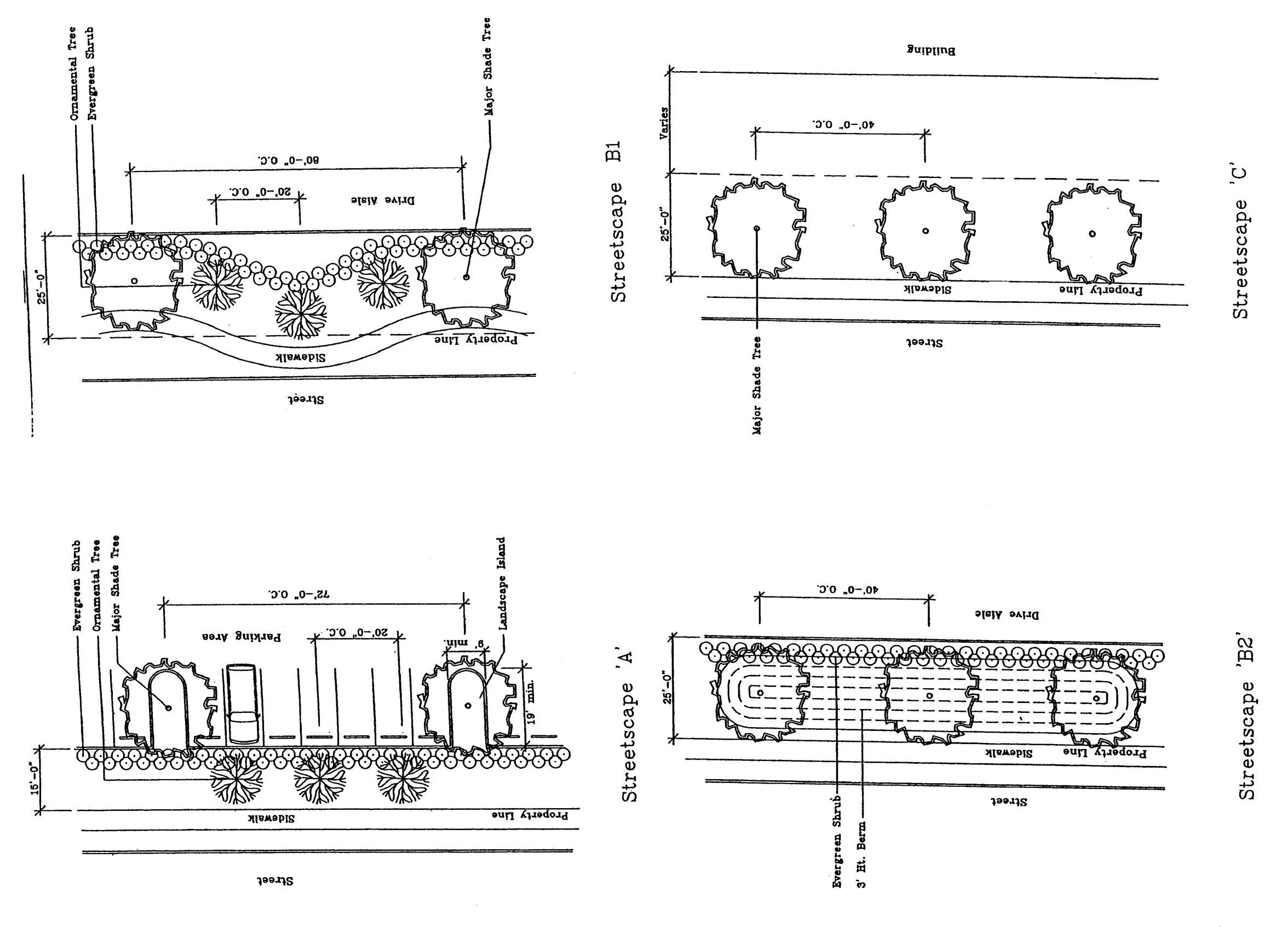
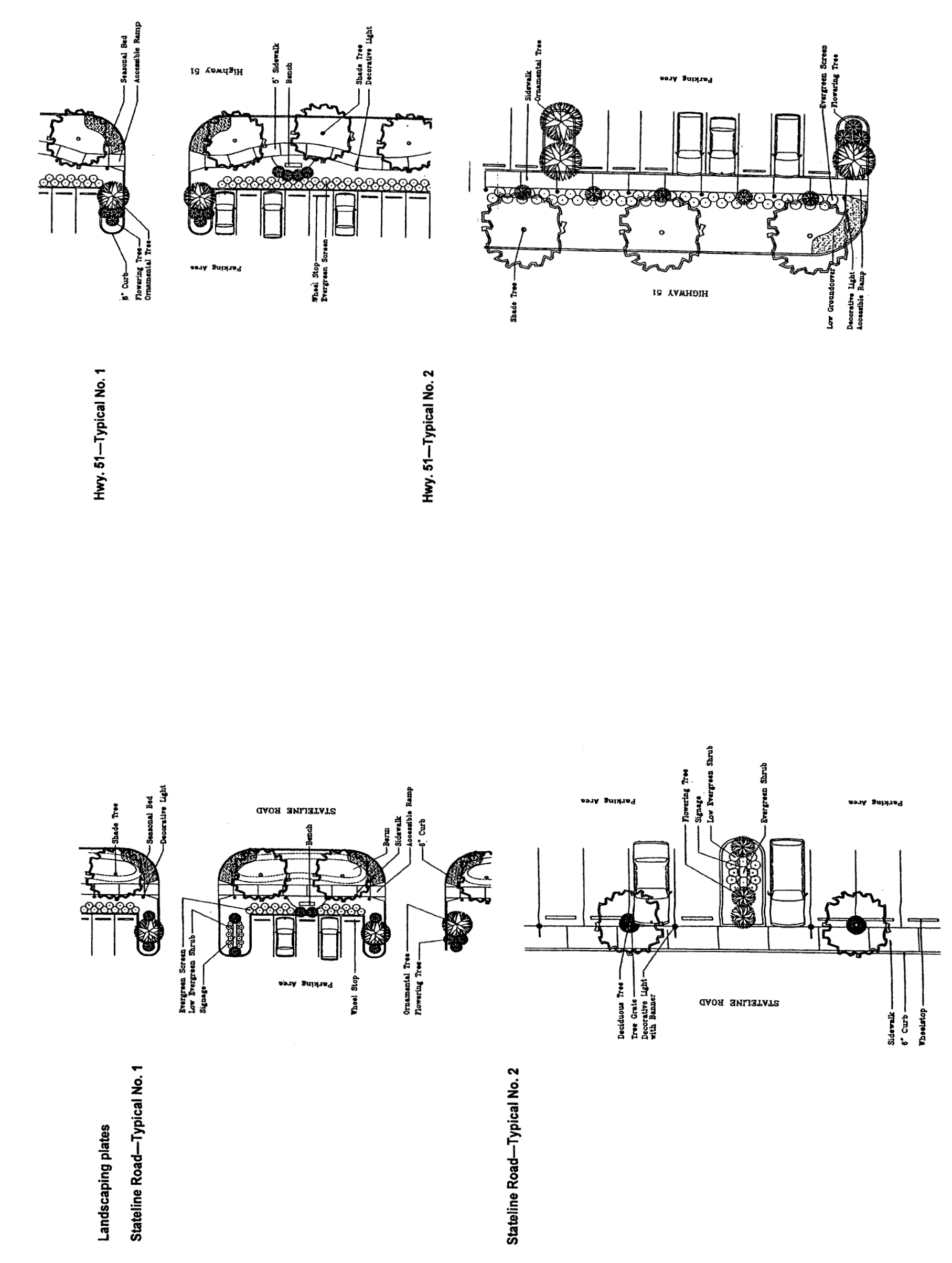
Landscaped areas shall be provided along all public road rights-of-way. The streetscape type to be used shall be dependent upon either the presence of parking or a vehicular drive aisle adjacent to the streetscape area.
(1)
Streetscape Type A shall be required where parking is located adjacent to the streetscape and facing the public right-of-way and shall consist of a twenty-foot wide area supplemented by a landscape island (ten (10) feet by twenty (20) feet minimum) in the parking area located every eight (8) spaces.
Planting shall consist of one (1) major shade tree planted in each of the islands accompanied by a single, staggered row of evergreen shrubs supplemented by three (3) ornamental trees, planted twenty (20) feet on center, between each pair of shade trees.
(2)
Streetscape Type B shall be required where parking is not present but a vehicle drive aisle is located on the lot, adjacent to the streetscape and shall consist of a twenty-five-foot wide area. Planting shall consist of either B1 or B2.
B1 consists of one (1) major shade tree planted every eighty (80) feet accompanied by a single, staggered row of evergreen shrubs supplemented by three (3) ornamental trees, planted twenty (20) feet on center, between each pair of shade trees. This type should be used to maintain continuity of landscape within a unified development.
B2 consists of one (1) major shade tree planted every forty (40) feet accompanied by a single, staggered row of evergreen shrubs and a berm three (3) feet in height.
(3)
Streetscape Type C shall be required where the green space or lawn between a building and the public right-of-way is unbroken by parking or vehicular travel surface and shall consist of a twenty-five-foot wide area. Planting shall consist of one (1) major shade tree planted every forty (40) feet.
Sec. 13-10(c). - Parking lot landscaping.
(a)
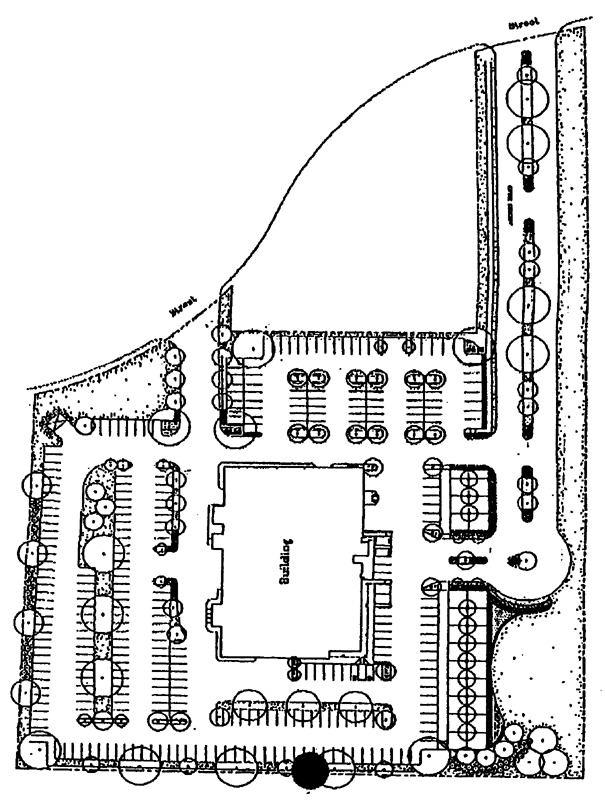
Parking lot landscaping shall be provided at a ratio of three hundred (300) square feet of green space including one (1) shade tree for every ten (10) parking spaces or increment thereof. No parking space should be located farther than fifty (50) feet from a landscaped area.
(b)
Parking lot landscape shall be provided within curbed island planted.
(c)
Parking lot landscaping shall be located to delineate driving lanes, define rows of parking, and generally to mitigate the visual impact of parking lots.
Sec. 13-10(d). - Interior lot landscaping.
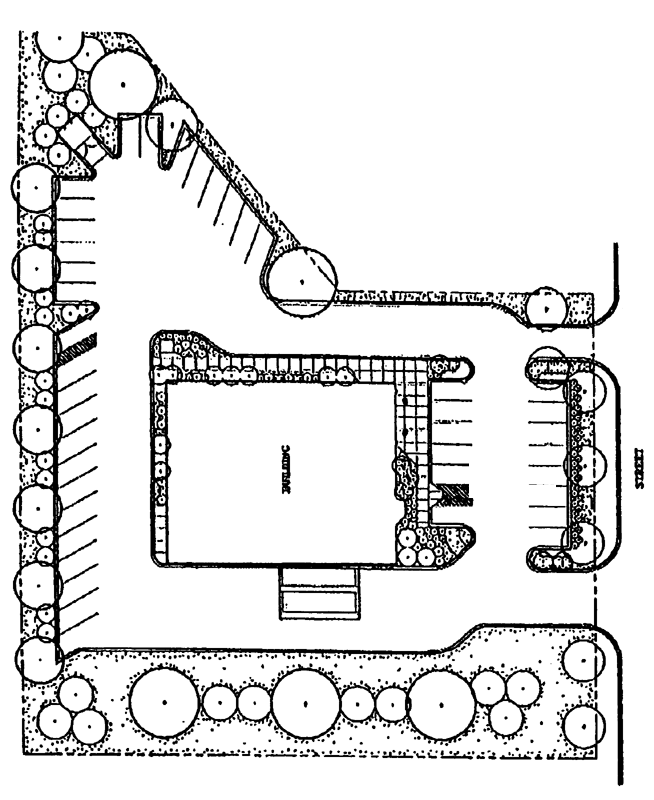
Interior lot landscaping shall be provided in an amount equivalent to twenty (20)
percent of the total area of the lot. Interior lot landscaping shall be considered
the total, cumulative area devoted to greenspace (i.e. lawns, ground covers, shrubs,
and trees). This may include streetscapes, bufferyards, required screening and any
other landscaped areas surrounding the building or contained within the boundary of
the lot or site.
Sec. 13-10(e). - Screening.
(a)
Purpose: The purpose of regulations contained in this subsection is to provide for the gradual transition between incompatible uses so that such incompatibility may be minimized.
(b)
Screening required: Screening shall consist of trees, shrubs and/or earthen berm, in conjunction with opaque masonry or wood fencing as necessary per this title:
(1)
Yard screening: Front, rear and side yard screening will be provided and maintained for all property when said property is located on a public or private right-of-way.
(2)
Screening-corner lots: On corner lots, screening shall be provided as required above except that no screening of more than two (2) feet in height shall be located or maintained in the sight triangle.
(3)
Garbage facilities, loading docks and utility service areas: Shall be screened from view from all public or private rights-of-way with an opaque masonry or wood fence and landscaping to be determined by planning staff. Said materials of fencing shall be of similar material to match the building.
Sec. 13-10(f). - Transitional bufferyards.
(a)
Purpose. The bufferyard provisions are included in this chapter to improve the physical appearance of the community; to improve the environmental performance of new development by contributing to the abatement of heat, glare, or noise and by promoting natural percolation of stormwater and improvement of air quality; to buffer potentially incompatible land uses from one another; and to conserve the value of property and neighborhoods within the city.
(b)
Conflicts. Any conflict between this section and another section of this chapter shall be resolved in favor of the more restrictive provision.
(c)
Definitions. The following definitions shall be used for terms contained within this title:
(1)
Bufferyard means a landscaped area provided to separate and partially obstruct the view of two (2) adjacent land uses or properties from one another.
(2)
Tree means a woody plant having at least one (1) well-defined trunk or stem and a more or less definitely formed crown, usually attaining a mature height of at least eight (8) feet.
(d)
General standards.
(1)
Location and design. Bufferyards shall be located on the outer perimeter of a lot or parcel, extending to the lot or parcel boundary line. Buffers shall not be located on any portion of an existing, dedicated or reserved public or private street or right-of-way.
Where a required drainage, utility, or other easement is partially or wholly within a required bufferyard, the developer shall design the buffer to minimize plantings within the required easement. The planning commission or the governing authority may require additional bufferyard area or additional plantings of the developer in such instances to ensure that the screening purpose of the bufferyard is maintained.
(2)
Use of bufferyards. A bufferyard may be used for some forms of passive recreation. It may contain pedestrian, bike, or equestrian trails, provided that:
a.
No required plant material is eliminated.
b.
The total depth/width of the bufferyard is maintained.
c.
All other regulations of this title are met.
d.
In no event, however, shall the following uses be allowed in bufferyards: accessory buildings, sheds, garages, playfields, stables, swimming pools, tennis courts, or similar active recreation uses.
(3)
Ownership of buffers. Bufferyards may remain in the ownership of the original owner/developer (and assigns) of a developing property. Bufferyards may be subjected to deed restrictions and subsequently be freely conveyed. They may be transferred to any consenting grantees, such as owners associations, adjoining landowners, a park district, the city, or any conservation group, provided that any such conveyance adequately guarantees the protection of the bufferyard for the purposes of this title.
(4)
Determination of bufferyard requirements. To determine the type of bufferyard required between two (2) adjacent parcels, the following procedure shall be followed:
a.
Identify the zoning classification of the proposed development by referring to the chart entitled "bufferyard requirements" located at the end of this section. Appropriate classification for land uses within planned unit developments shall be made according to the type and densities of land uses which most nearly correspond with the table designation.
b.
Identify the zoning classification and status of development (undeveloped versus platted and/or developed) of each adjoining property, including properties located across an intervening street, by referring to the chart.
c.
Determine the bufferyard requirements for those side, rear, and front lines or portion thereof on the subject development parcel by referring to Chart 2 in section 13-10(f) and the additional requirements of this section. Existing plant material may be counted as contributing to the total bufferyard requirement. The bufferyards specified are to be provided on each lot or parcel independent of adjoining uses or adjoining bufferyards.
d.
When a development parcel is proposed adjacent to vacant unplatted/unsubdivided land, the following provisions shall apply:
1.
The owners of the affected properties may submit a contractual agreement (which becomes a deed restriction on both properties) whereby the bufferyard for the development parcel is reduced or waived, provided that the owner of the development parcel agrees to develop, at no greater intensity than as shown on his approved site/subdivision plan; and if any additional bufferyard is required by this chapter at a future date, it will be provided on the vacant land; or
2.
The required bufferyard for the development parcel, derived by using the existing zoning of the undeveloped tract, shall be equal to one-half (½) of the minimum width prescribed in the chart entitle "bufferyard requirements" located at the end of this section, or ten (10) feet in width, whichever is the greater. However, any development parcel proposed for nonresidential use, which lies contiguous to a tract of undeveloped/subdivided land zoned for residential use or is designated as "residential low density", "residential medium density," or "residential high density" on the approved Land Use Map of Southaven shall be required to fulfill the bufferyard requirements of this title utilizing the existing zoning on the undeveloped tract as the determinant of the bufferyard requirement.
3.
Should a developed parcel increase in intensity or zoning classification from a given zoning district to a more intense zoning district (e.g. from R-20 to R-12, from C-1 to C-3), the planning commission shall, during the site plan or subdivision review process, determine if additional bufferyard is needed and, if so, to what extent and type.
(5)
Additional bufferyard provisions. In addition to the requirements provided in this section, the following bufferyard provisions shall apply to the proposed development parcels. In general, the owner, developer, or operator of a proposed use within a development parcel shall install and maintain a landscaped bufferyard on his/her lot, site, or common development, as set forth in this section.
a.
Parcels with intervening major street. When an arterial or collector street (as identified on the transportation plan for Southaven) separates adjacent development parcels requiring a bufferyard, the required bufferyard shall be the greater of one-half (½) of the required bufferyard set forth in Chart 2 of this title or fifteen (15) feet.
b.
Parcels with intervening local street. When a local street (as identified on the transportation plan for Southaven) or any other public right-of-way separates adjacent development parcels requiring a bufferyard, the required bufferyard shall be the greater of two-thirds (⅔) of the required bufferyard set forth in the chart on bufferyards of this title, or twelve (12) feet.
c.
Railroad right-of-way. Any lot or site which is adjacent to an active railroad right-of-way shall be exempt from any bufferyard requirement along the common property line with such right-of-way.
(6)
Table of bufferyard requirements. The following table, located at the end of this section, shall be used to determine the bufferyard requirements of a development parcel which is adjacent to a developed and/or platted property, site or common development.
(7)
Transitional bufferyard landscaped area and minimum width regulations.
a.
General design standards. The following general provisions shall apply to the design and construction of transitional bufferyards as defined herein:
1.
The layout, design, and arrangement of the prescribed numbers and types of landscape.
2.
In those bufferyards which require the construction of a wall, the following provisions shall apply: An opaque barrier at the height prescribed in the specific bufferyard design type standards in this section, shall be provided which visually screens the potentially offensive development parcel uses from the adjacent properties as follows:
i.
A masonry wall, a minimum of four (4) feet in height, of a design approved by the planning commission.
(e)
Transitional bufferyard design types. Transitional bufferyards of the following types shall be provided in the situations as identified by the entries in Chart 2 of this section:
(1)
Bufferyard type 10. Transitional bufferyard type 10 shall consist of a strip of landscaped area, a minimum of ten (10) feet wide, landscaped as follows:
a.
Residential bufferyards: One (1) medium evergreen tree (ultimate height twenty (20) feet to forty (40) feet) for every fifteen (15) feet planted on triangular staggered spacing, plus one (1) large deciduous tree (ultimate height fifty (50) feet or more) for every sixty (60) linear feet measured along the common property line.
b.
Commercial bufferyard: One (1) large deciduous tree (ultimate height fifty (50) plus feet) for every sixty (60) feet, plus a group of two (2) small deciduous or ornamental trees (spaced at thirty (30) feet on centers) for every sixty (60) linear feet (planted) between the large deciduous trees.
(2)
Bufferyard type 15. Transitional type 15. Transitional bufferyard type 15 shall consist of strip of landscaped area, a minimum of fifteen (15) feet wide, landscaped as follows:
a.
Residential bufferyards: One (1) medium evergreen tree (ultimate height twenty (20) feet to (40) feet) for every fifteen (15) feet planted on triangular staggered spacing, plus one (1) large deciduous tree (ultimate height fifty (50) or more feet) for every sixty (60) linear feet measured along the common property line.
b.
Commercial bufferyard: One (1) large deciduous tree (ultimate height deciduous tree (ultimate height fifty (50) feet or more) for every sixty (60) linear feet, plus a group of two (2) small deciduous or ornamental trees (spaced at thirty (30) feet on centers) for every sixty (60) linear feet (planted) between the large deciduous trees.
(3)
Bufferyard type 20: Transitional bufferyard type 20 shall consist of a strip of landscaped area, a minimum of twenty (20) feet wide, landscaped as follows: one (1) large deciduous tree (ultimate height fifty (50) feet or more) for every seventy-five (75) linear feet, plus a group of three (3) medium evergreen trees (planted on fifteen-foot triangular staggered spacing) and one (1) small deciduous or ornamental tree (planted fifteen (15) feet from evergreens) for every seventy-five (75) linear feet.
(4)
Bufferyard type 25: Transitional bufferyard type 25 shall consist of a strip of landscaped area, a minimum of twenty-five (25) feet wide, landscaped as follows: an opaque barrier shall be installed within the bufferyard in accordance with the above requirements to a minimum height of six (6) feet, plus one (1) large deciduous tree (ultimate height fifty (50) feet or more) for every sixty (60) linear feet, plus a group of two (2) small deciduous or ornamental trees (spaced thirty (30) feet on center ) for every sixty (60) linear feet measured along the opaque barrier. The landscape materials shall be planted on the side of the opaque barrier which abuts the more intense zoning district or development.
(5)
Bufferyard type 30: Transitional bufferyard type 30 shall consist of a strip of landscaped area, a minimum of thirty (30) feet wide, landscaped as follows: an opaque barrier shall be installed within the bufferyard, in accordance with the above requirements to a minimum height of six (6) feet, plus one (1) medium evergreen tree (ultimate height twenty (20) feet to forty (40) feet) for every fifteen (15) feet planted on triangular staggered spacing, plus one (1) large deciduous tree (ultimate height fifty (50) feet or more) for every sixty (60) linear feet measured along the opaque barrier. The landscape materials shall be planted on the side of the opaque barrier which abuts the more intense zoning district or development.
(6)
Bufferyard type 35: Transitional bufferyard type 35 shall consist of a strip of landscaped area, a minimum of thirty-five (35) feet wide, landscaped as follows: an opaque barrier shall be installed within the bufferyard, in accordance with the above requirements to a minimum height of six (6) feet, plus one (1) medium evergreen tree (ultimate height twenty (20) feet to forty (40) feet) for every fifteen (15) feet planted on triangular staggered spacing, plus one (1) small deciduous or ornamental tree for every eighty (80) linear feet, plus one (1) large deciduous tree (ultimate height fifty (50) feet or more) for every eighty (80) linear feet measured along the opaque barrier. The landscape materials shall be planted on the side of the opaque barrier which abuts the more intense zoning district or development.
(7)
Bufferyard type 40: Transitional bufferyard type 40 shall consist of a strip of landscaped area, a minimum of forty (40) feet wide, landscaped as follows: an opaque barrier shall be installed within the bufferyard, in accordance with the above requirements, to a minimum height of ten (10) feet, plus one (1) medium evergreen tree (ultimate height twenty (20) feet to forty (40) feet) for every fifteen (15) feet planted on triangular staggered spacing, plus one (1) small deciduous or ornamental tree for every eighty (80) linear feet, plus one (1) large deciduous tree (ultimate height fifty (50) feet or more) for every eighty (80) linear feet measured along the opaque barrier. The landscape materials shall be planted on the side of the opaque barrier which abuts the more intense zoning district or development.
(8)
Bufferyard type 50. Transitional bufferyard type 50 shall consist of a strip of landscaped area, a minimum of fifty (50) feet wide, landscaped as follows: an opaque barrier shall be installed within the bufferyard, in accordance with the above requirements, to a minimum height of ten (10) feet, plus one (1) medium evergreen tree (ultimate height twenty (20) feet to (40) feet) for every ten (10) feet planted on triangular staggered spacing, plus one (1) small deciduous or ornamental tree for every eighty (80) linear feet, plus one (1) large deciduous tree (ultimate height fifty (50) feet or more) for every eighty (80) linear feet measured along the opaque barrier. The landscape materials shall be planted on the side of the opaque barrier which abuts the more intense zoning district or development.
(f)
Additional bufferyard provisions. The following additional provisions shall apply to the design standards for required bufferyard landscaping:
(1)
Preservation of healthy existing tree vegetation within a required bufferyard is strongly encouraged. Preservation of each healthy existing tree, of species and size (at least four and one-half (4½) inches caliper) approved by the office of planning and development, shall count as one (1) tree toward the fulfillment of the landscape requirements of this section.
(2)
A development parcel may continue to comply with the bufferyard and screening requirements in effect at the time of issuance of its initial building permit, regardless of whether an adjacent lot, site, or common development is rezoned to a less intense district which requires additional bufferyards or screening.
(g)
Performance bonding.
(1)
If, at the time of an application for a certificate of occupancy, any required landscaping has not been installed, the city planner has the option to hold the certificate of occupancy until such landscaping has been installed or require the developer to submit a bond or letter of credit to ensure proper landscaping is installed.
(2)
The developer or owner shall grant the city permission to enter upon the land to install required landscaping, at the cost of the developer, if this has not been done within twelve (12) months of the effective date of the certificate of occupancy.
(3)
The city shall release any bond or other arrangement immediately when the permits and inspections division verifies that required landscaping has been installed.
(h)
The owner/developer shall be responsible for all maintenance of bufferyards, unless an identified property owners association can be held responsible. Failure to maintain bufferyards will result in a fine by the City of Southaven.
_____Sec. 13-10(g). - Bufferyard table.
CHART 2. TRANSITIONAL BUFFERYARD REQUIREMENTS TABLE
*No bufferyard required.
Note: Bufferyard requirements stated above are in terms of the average width of the bufferyard along a common boundary of an adjacent development and/or platted property. Consult all other paragraphs of this section for additional bufferyard provisions and landscape screening requirements of the bufferyard. _____
Sec. 13-10(h). - Fences, walls and hedges.
(a)
For all residential districts, including residential uses in PUDs and office districts, no fence shall be erected between the front of a building and the street other than a decorative fence such as a picket fence, wrought iron fence or split rail fence. Such fences shall be set back, at a minimum, ten (10) feet from the right-of-way. Fences erected by the local, state or federal government are not prohibited in any of the stated areas. Wire fences such as chain link are prohibited in the front yard as defined by this ordinance. No fence exceeding four (4) feet in height shall be allowed in the front yard and no fence exceeding six (6) feet shall be allowed in the rear yard.
(b)
For all residential corner lots with two (2) front yards, a maximum of a six-foot sight proof fence may be erected in the front yard which is not designated for the entrance. The entrance front yard must conform to the requirements stated in 13-10(h)(a) concerning decorative fences.
(c)
Walls, hedges, or other similar structures will also be restricted to the same guidelines as fences.
(d)
For existing developments within commercial and industrial districts, including PBP, new fences and fence materials shall be subject to administrative review by the office of planning and development. For new developments, fences and fence materials shall be subject to design review committee review and approval.
(e)
None of the above is to be erected in the sight triangle as defined by this title.
(f)
Barbed wire fencing is prohibited except in agricultural zoned properties.
Sec. 13-10(i). - Landscape material design criteria.
All buffer yards, transitional areas, streetscapes and landscape isles/islands shall conform to the minimal requirements set forth below for all proposed designs including new development, replacement on an existing development site, or replacement design for a tree removal site:
(1)
Trees must be selected from the acceptable trees listed in Table B-1, Sec. 13-11 or approved administratively by the office of planning and development. Proposed trees must have a minimum three and one-half-inch caliper at the time of planting. Proposed landscaping trees which exceed six (6) inches in diameter at the time of planting may constitute a decrease in the total amount of landscaping needed on-site.
(2)
Shrubs or bushes must be approved in the overall design package submitted to the office of planning and development. Shrubs and bushes must have a minimum of three (3) gallons at the time of planting. Proposed landscaping shrubs which exceed five (5) gallons in size at the time of planting may constitute a decrease in the total amount of landscaping needed on-site.
(Res. of 6-3-08(2))

