
Southaven City Zoning Code
CHAPTER 7
- REQUIRED OFF-STREET PARKING AND LOADING
Sec. 13-7(a).- Parking design and maintenance.
(a)
Dimensions of off-street parking and queuing spaces:
(1)
Off-street parking shall be a minimum of ten (10) feet in width and twenty (20) feet in depth with a maximum of five (5) feet overhang.
(2)
Off-street queuing spaces shall be at least eleven (11) feet in width and at least twenty-two (22) feet in length.
(3)
Drive isles located within parking areas shall be a minimum of twenty-four (24) feet in width.
(4)
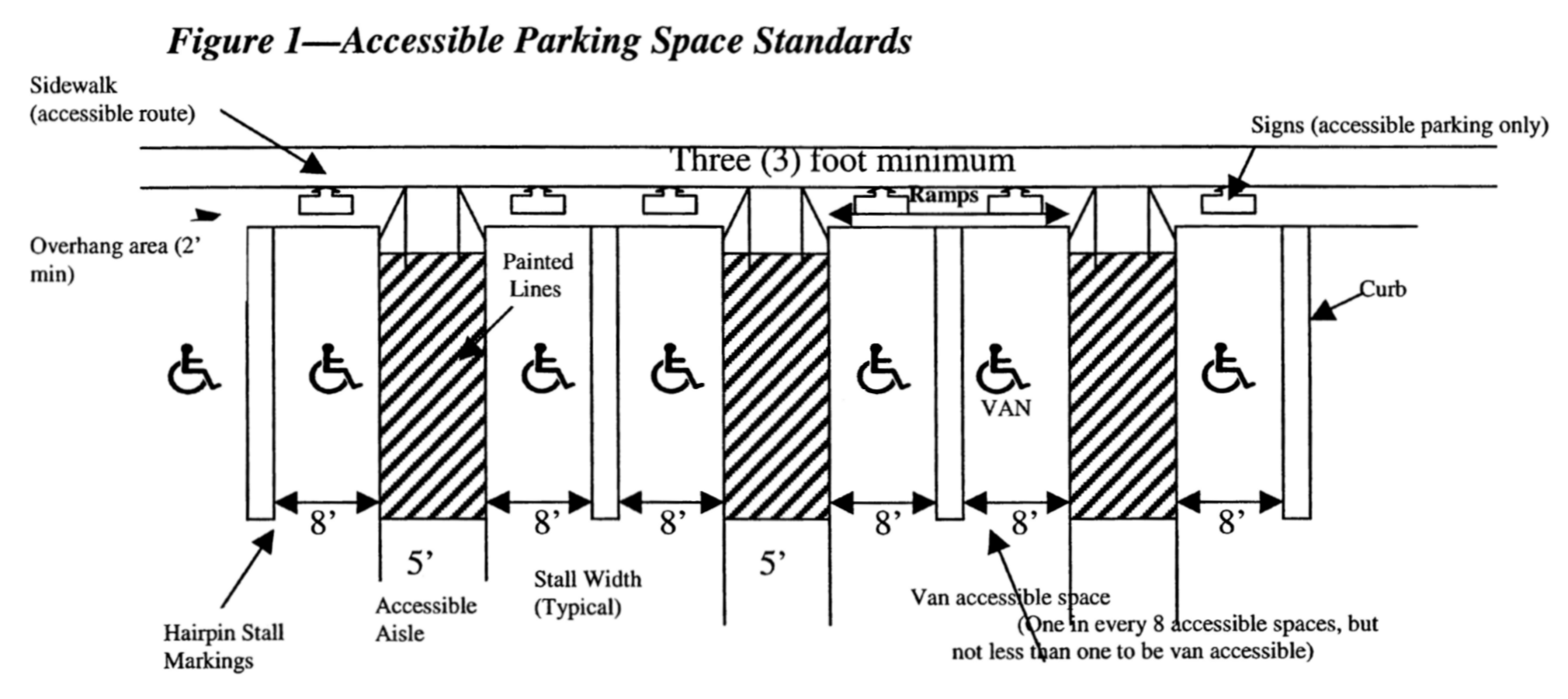
Handicapped parking shall be required for all nonresidential uses in any zone of the city. New and renovated parking areas must fully comply with the handicapped parking requirements of MCA 1972, § 27-19-56(6). The number of handicapped spaces required shall be computed according to the requirements of the current building code adopted and used by the city. In no case shall there be less than one (1) handicapped parking space within the parking lot. Handicapped spaces shall be at least thirteen (13) feet in width and twenty (20) feet in length. (See Figure 1, "Accessible Parking Space Standards".)
(5)
Compact spaces may be constructed for a maximum of twenty-five (25) percent of the total required parking when the development project is subject to site plan review by the planning commission. Such spaces shall be at least eight (8) feet in width and sixteen and one-half (16½) feet in length.
(b)
Design standards: Parking lots shall be designed, constructed, and maintained in accordance with the following minimum standards and requirements:
(1)
Parking lots shall be surfaced with asphalt, concrete, or other hard surface dustless material and be so constructed to provide for adequate drainage to prevent the release of dust. All parking areas shall be properly marked and designed with adequate circulation area.
(2)
Landscape screening within a buffer yard of at least ten (10) feet in depth, shall be provided along each lot line of a parking lot which abuts or is adjacent to a lot used or zoned for residential purposes, or the residential portion of an approved planned unit development. Such screening shall consist of deciduous or evergreen trees and/or evergreen shrubs and grass areas and/or earth berm according to specifications published by the office of planning and development and approved by the governing authority. Such screening shall be maintained in good condition at all times and shall not be placed within fifteen (15) feet of an entrance to or exit from such parking lot. On corner lots, screening shall be provided as required by this subsection except that no screening of more than three (3) feet in height shall be located in the sight triangle.
(3)
If a parking lot abuts a street right-of-way or any screening required by this section, continuous curbing or individual wheel stops shall be provided along the perimeter of that portion of the parking lot, which abuts such street right-of-way or screening.
(4)
Any lighting used to illuminate off-street parking lots shall be so arranged to prevent direct glare onto any public or private property or streets.
Sec. 13-7(b). - Parking space requirements.
When any building or structure is hereafter erected, structurally altered, or converted for any of the uses listed below, the following off-street parking spaces shall be provided:
(1)
For single-family dwellings, two (2) spaces per dwelling unit; for multifamily dwellings, two (2) spaces per dwelling unit.
(2)
For cabins and camps, one (1) space for each two (2) beds but not less than one (1) space for each cabin or other habitable facility.
(3)
For places of public assembly, including auditoriums, theaters and main auditoriums of churches, one (1) space for each four (4) seats provided.
(4)
For schools, two (2) spaces for each classroom, plus one (1) for each ten (10) seats in the auditoriums and gymnasiums.
(5)
For commercial uses:
a.
Retail sales and services: One (1) space per three hundred (300) square feet of gross floor area.
b.
Office buildings, banks, business and professional services: One (1) space per three hundred (300) square feet of gross floor area.
Banks, drug stores, and other nonrestaurant uses with drive-in windows: One (1) space per three hundred (300) square feet of gross floor area, plus four (4) queue spaces for each drive-in teller or station, which queue spaces shall be provided in an exclusive queue lane with only one-way circulation which shall be separated from driveways leading to off-street parking spaces.
c.
Commercial recreation facilities and restaurants: One (1) space per two hundred (200) square feet of gross floor area.
Restaurants with drive-in windows: One (1) space per two hundred (200) square feet of gross floor area, plus ten (10) queue spaces for each drive-in window, which queue space shall be provided between the street right-of-way and the point of placing orders in an exclusive queue lane with only one-way circulation which shall be separated from driveways leading to off-street parking spaces.
d.
Hotels and motels: One (1) space per unit.
e.
Warehouses space within commercial establishments: One (1) space per one thousand (1,000) square feet of gross floor area and storage space within retail establishments.
(6)
For commercial and office uses located within a residential office (R-O) district, one (1) space per six hundred (600) square feet of gross floor area and located, if possible, in the rear or side of the building as to provide a residential appearance.
(7)
For industrial and warehouse uses, one (1) space for each one and one-half (1.5) employees of the maximum number employed on the premises at any one (1) time.
Sec. 13-7(c). - General rules and exceptions.
The requirements in section 13-7(b) are subject to the following general rules and exceptions:
(1)
In the residential (R) districts, no parking of motor vehicles shall be allowed in any yard with the following exceptions:
a.
Vehicles may be parked on a paved or concrete driveway.
b.
Vehicles may be parked between the driveway and the side property line nearest the driveway and on an impervious surface, which surface is comprised of the same materials of the driveway, so long as they do not encroach on neighboring properties and the vehicle(s) is operable and has current motor registration.
(2)
No major recreational equipment such as boats and boat trailers, travel trailers, campers, and similar items, or trailers of any kind, except for utility trailers that do not exceed ten (10) feet and are empty of all debris and equipment, shall be parked or stored on any street or on any yard in any residential district with the following exceptions:
a.
They may be parked on a paved or concrete driveway provided they are at least twenty (20) feet from the street. However, utility trailers that do not exceed ten (10) feet and are empty of all debris and equipment may be parked on paved or concrete driveway provided that such trailer is ten (10) feet from the street.
b.
They may be parked between the driveway and the side property line nearest the driveway on a hard surface (no grassed areas), provided they are at least twenty (20) feet from the street and the grass and surrounding property is properly maintained, and provided they do not encroach on neighboring properties and the vehicle is operable and has current motor registration.
c.
They may be parked in the front yard of a corner lot on a hard surface (no grassed areas), which is to the side of or at the end of the house, provided they area at least thirty (30) feet from the street, provided they do not extend beyond the front of the house and the grass and surrounding property is properly maintained, and provided they do no encroach on neighboring properties and the vehicle is operable and has current motor registration.
(3)
Noncompliant vehicles shall not be parked or stored in any residential zone other than in a completely enclosed garage.
(4)
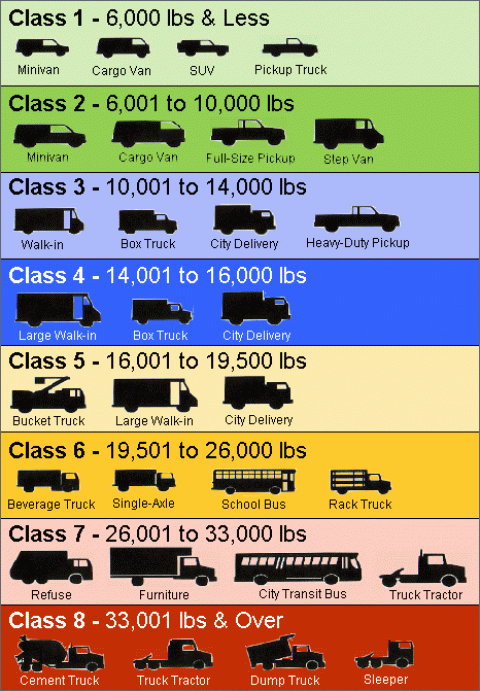
No commercial vehicle classified as a Class 3 or greater, except for a heavy duty pickup which has neither a bed nor any equipment, excluding an antenna, extending more than twenty-four (24) inches above the roof of the cab; or any trailer that exceeds sixteen (16) feet in length shall be parked or stored at any residence or on any street in residential zones, except for immediate service and delivery purposes. The chart, which is incorporated as part of this section, is included for clarity and illustration purposes.
a.
Subsection (4) of this section shall not apply to utility trucks of entities, which are regulated by the Mississippi Public Service Commission, and such truck is designated as the on-call emergency vehicle of the entity provided that the truck is parked on the residential property in the driveway on a hard surface at all times.
b.
Towing or wrecker companies, which are currently included on the Southaven Police Department wrecker rotation as approved the Southaven Board of Alderman and in current compliance with all criteria set forth by the Southaven Police Department for the wrecker rotation may be granted an exception to allow one (1) on call wrecker per company to be parked in residential zones, subject to the following conditions:
(1)
The towing vehicle/wrecker is classified as a class A light duty wrecker, which is used for towing vehicles weighing seven thousand (7,000) pounds or less (i.e. passenger cars, pickup trucks, motorcycles, small trailers, and similar vehicles); or
(2)
The towing vehicle/wrecker is classified as a conventional wrecker and meets one (1) of the following criteria:
(i)
Minimum gross vehicle weight rating (GVWR) of not less than ten thousand (10,000) pounds; or
(ii)
Individual boom capacity of not less than eight thousand (8,000) pounds as rated by the manufacturer; or
(iii)
Individual PTO or hydraulic power winch capacity of not less than eight thousand (8,000) pounds as rated by the manufacturer; or
(iv)
Manufactured wheel-lift with a retracting, lifting capacity of not less than three thousand five hundred (3,500) pounds as rated by the manufacturer; or
(3)
The towing vehicle/wrecker is classified as a rollback wrecker and meets one (1) of the following criteria:
(i)
Minimum gross vehicle weight rating (GVWR) of not less than eleven thousand (11,000) pounds; or
(ii)
Must have at least an eight thousand (8,000) pound winch as rated by the manufacturer.
c.
The on-call wrecker shall be parked on the residential property in the driveway on a hard surface at all times. At no point shall the wrecker be permitted to park on the street or yard.
d.
The on-call wrecker shall have the Southaven Police Department issued on call permit in clear view at all times while parked in a residential zone.
e.
The City of Southaven Police Department reserves the right to revoke the exception granted under this section and/or the on-call permit issued by the Southaven Police Department if the wrecker service fails to comply with any requirement or policy of the Southaven Police Department or any provision set forth in the City of Southaven Ordinances. In addition, if the on-call vehicle is deemed a nuisance by the City of Southaven and/or three (3) or more contiguous or adjacent land owners where the on-call wrecker is parked sign and file a petition with the city planning department requesting that the on-call wrecker be removed, the on-call wrecker shall be removed by the owner within twenty-four (24) hours. In the event the owner does not remove the on-call wrecker within twenty-four (24) hours, the owner shall be issued a citation in an amount not to exceed five hundred dollars ($500.00) and the city shall have the right to tow the on -call wrecker.
(5)
If the existing use of a building or structure shall be increased by the addition of dwelling units, gross floor area, seating capacity or any other measure to increase intensity of use, the provisions of this chapter shall only apply to the extent of such increase in use.
(6)
In computing the number of parking spaces required, the following rules shall govern:
a.
Where fractional spaces result, the parking spaces required shall be the next larges whole number.
b.
In the case of mixed use, the parking spaces required shall equal the sum of the requirements of the various uses computed separately.
(7)
Required parking lots shall be of a hard surface, asphalt or concrete, properly marked and with adequate circulation area.
(Amd. of 12-7-10(2), §§ 1, 2; Res. of 12-5-17; Res. of 10-6-20(7); Res. of 2-2-21(2); Res. of 2-2-21(3); Res. of 2-16-21(1); Res. of 1-3-24(1); Res. of 5-21-24(1); Res. of 2-4-25(1))
Sec. 13-7(d). - Off-street loading.
(a)
Off-street loading space will be provided for all commercial and industrial uses and any other use requiring bulk pickup or delivery and shall be designed according to the criteria listed in subsection (c) below. In no instance will loading or unloading of vehicles be allowed in a public right-of-way or in space provided to meet off-street parking requirements.
(b)
No building or part thereof heretofore erected, which is used for any of the purposes specified above, shall hereafter be enlarged or extended unless off-street loading space is provided in accordance with the provisions of this chapter.
(c)
Design and maintenance:
(1)
Dimensions: Required off-street loading spaces shall not be less than ten (10) feet in width and shall have an obstructed vertical clearance of not less than fourteen (14) feet. The minimum length of loading spaces shall be fifty (50) feet.
(2)
Screening: If a loading space or maneuvering area related thereto abuts or is located within fifty (50) feet of a property zoned or used for residential purposes, or the residential portion of an approved planned unit development, such loading space or maneuvering area shall be screened from the view of such residential uses by a solid wall, barrier or fence of at least six (6) feet in height or a densely planted landscape screen consisting of evergreen shrubs or trees which shall be at least four (4) feet in height when planted and which can be expected to reach at least six (6) feet in height within three (3) years thereafter. Such screening shall be located along the lot line of the property where such loading space is located, and shall be maintained in good condition at all times.
(3)
Surfacing and drainage: Loading spaces and maneuvering areas related thereto shall be surfaced with asphalt, concrete or other hard surface dustless material and be so constructed to provide for adequate drainage and prevent the release of dust.
(4)
Required number of loading spaces:
a.
Retail, service wholesale or institutional establishments in any zoning district shall provide a minimum of one (1) loading space for any such use with ten thousand (10,000) square feet or more of floor area plus one (1) additional space for each additional ten thousand (10,000) square feet of floor are or fraction thereof.
b.
Manufacturing, processing, storage and distribution establishments located in the M-1 or M-2 industrial zoning districts shall provide a minimum of one (1) loading space for any such use with twenty thousand (20,000) square feet or more of floor area plus one (1) additional space for each additional twenty thousand (20,000) square feet of floor area or fraction thereof.

