
Sparks City Zoning Code
CHAPTER 20
05 - ADMINISTRATION
Section 20.05.001 - Generally.
A.
Applicability.
1.
This chapter applies to any application of land development approval in the City.
2.
This chapter establishes procedures for land development decisions made under this chapter. These include:
a.
Legislative decisions, including rezoning and changes to this Zoning Code and the Master Plan. These involve a new policy or rule, or a change in land development policy.
b.
Quasi-judicial decisions, including conditional use permits and variances. These proceedings require a weighing of the evidence, a balancing of the equities, an application of rules, regulations and ordinances to facts and a resolution of specific issues. These also involve a public hearing and the exercise of discretion by the decision-making body.
c.
Administrative decisions, such as building permits and certificates of occupancy. These apply this code or conditions of a quasi-judicial decision to a specific project that is either clearly defined in this code, or that has already obtained all necessary legislative and quasi-judicial approvals. Because these involve the application of non-discretionary rules to specific projects, these decisions are made by City staff without a public hearing.
B.
Process Elements. This chapter sets up rules for procedures, such as pre-application, neighborhood notification, notices and public hearings. It then describes the process for specific land use decisions. The procedures all have a common workflow and description, as follows:
Table 20.05-1 Process Elements
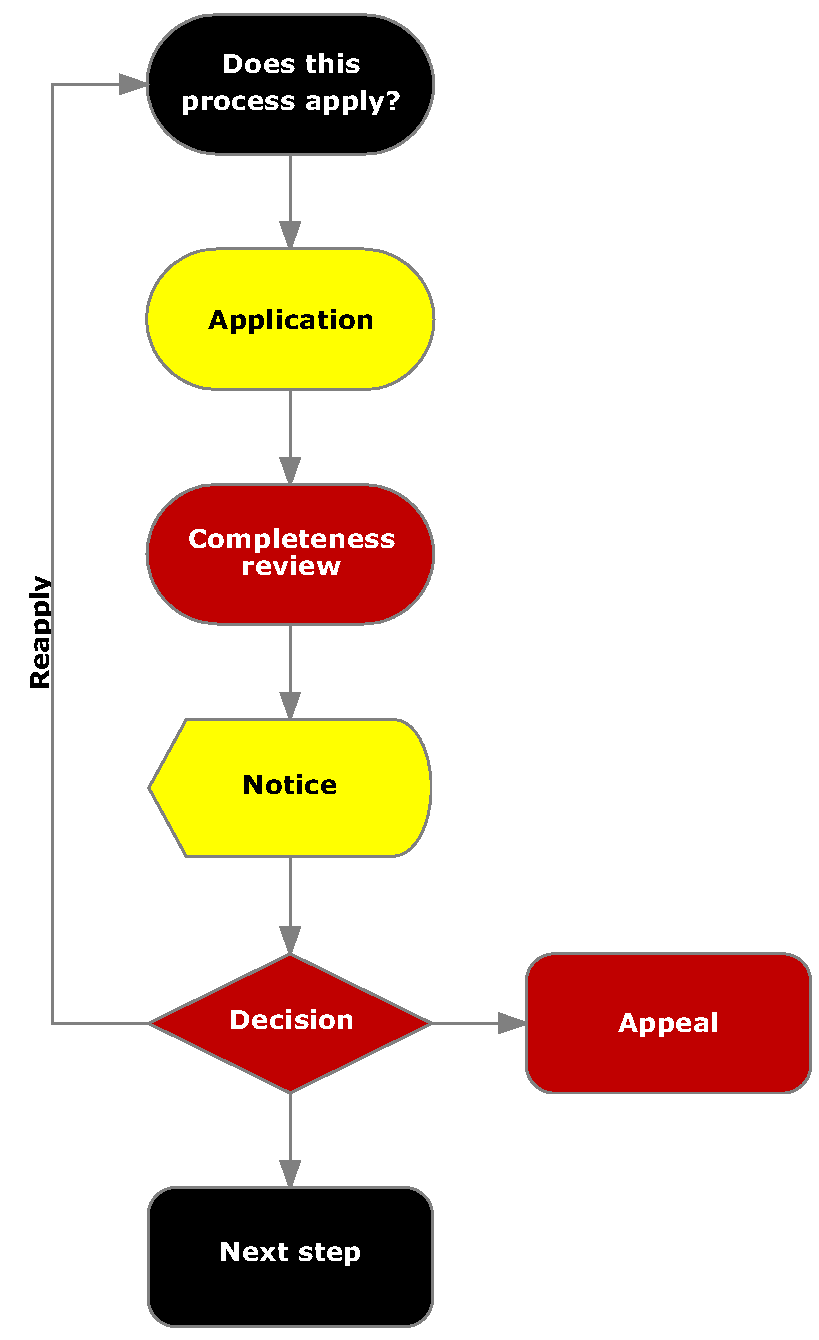
The processes established in this Code are summarized below.
Table 20.05-2 Process Summary
Note: This table is a general summary. Refer to the referenced sections for the specific procedure. If there is any conflict between the text section referenced here and Table 20.05-2, the text section controls.
(Ord. 2564, § 1, Amended, 10/22/2018; Ord. 2512, § 1(Exh. A), Add. 08/24/2015)
Section 20.05.002 - Applications.
A.
What are the general requirements?
1.
Applications filed under this chapter must include the information required by Appendix A-4 (Submittal Requirements). All applications shall be made on forms prepared by the City and available in the Planning Division.
2.
The Council may establish fees for all applications required in this Chapter by resolution.
B.
How are applications reviewed for completeness?
1.
An application is not complete until all required items are submitted (see Appendix A-4).
2.
The City will not process incomplete applications. Review for completeness of application forms is solely to determine whether preliminary information required for submission with the application is sufficient to allow further processing. It does not constitute a decision as to whether an application complies with this chapter.
3.
Within 15 working days after an application is received, the Administrator shall determine whether the application is complete and send a written notice of the determination to the applicant. The Administrator shall specify those parts of the application that are incomplete and will indicate how they can be made complete. The Administrator and the decision making agency are not obligated to further review the application until the required information is provided.
a.
If the Administrator determines that the application is still not complete, the applicant may appeal that determination to the City Council by filing a written notice of appeal with the Administrator. The notice of appeal shall be filed within 10 days after the Administrator's determination. The City Council shall issue a written determination on the appeal within 60 days after receipt of the notice of appeal.
4.
Nothing in this section precludes an applicant and the City from mutually agreeing to an extension of any time limit provided by this section.
C.
Concurrent Processing.
1.
In order to facilitate the development process, the following applications may be submitted and processed concurrently:
a.
Rezonings;
b.
Annexations;
c.
Conditional use permits;
d.
Tentative maps;
e.
Parcel maps;
f.
Variances; and
g.
Major deviations.
2.
Multiple applications submitted for a single development project may be processed concurrently to allow for an expedited review and processing schedule for a project. The time frame and approval process for a consolidated application shall follow the longest time frame and approval process required from among the multiple applications. For example, multiple applications for zoning map amendment and Conditional Use Permit may be processed concurrently, in which case both applications would be considered based on the more extensive zoning map amendment procedure, and the City Council would be the final decision body on both applications unless otherwise provided by law.
(Ord. 2512, § 1(Exh. A), Add. 08/24/2015)
Section 20.05.003 - Notice.
A.
What are the general procedures for notice? State law establishes various requirements for public notice. Unless otherwise provided, the notice established in this chapter is as follows:
Table 20.05-3 Notice
B.
Notice shall include the following information, unless the process includes a different requirement.
1.
Time, date and place of the public hearing or meeting;
2.
The type of land use or development decision that is being considered;
3.
A telephone point of contact within the Planning Division;
C.
Additional Notice. The City may provide additional notice not required by this Chapter or state law at its discretion.
(Ord. 2512, § 1(Exh. A), Add. 08/24/2015)
Section 20.05.004 - Public Hearing.
A.
Generally.
1.
A public hearing gives interested parties an opportunity to be heard. The specific processes for providing testimony and conducting the hearing are established by the agency that conducts the hearing.
2.
Where a public hearing is required for legislative action, the hearing may be called:
a.
By the Planning Commission upon its own initiative; or
b.
At the direction of the Sparks City Council.
B.
Whenever this title requires a public hearing, the following procedures apply (unless otherwise provided):
1.
At least ten days notice of the time, place and purpose of such public hearing shall be:
a.
Published in an official newspaper or newspaper of general circulation in the city, county or region; and
b.
Given by mail to the owner, applicant or appellant, as the case may be.
2.
Parties in interest and citizens shall have an opportunity to be heard and the written communications relative to the hearing may be considered.
Section 20.05.005 - Annexation.
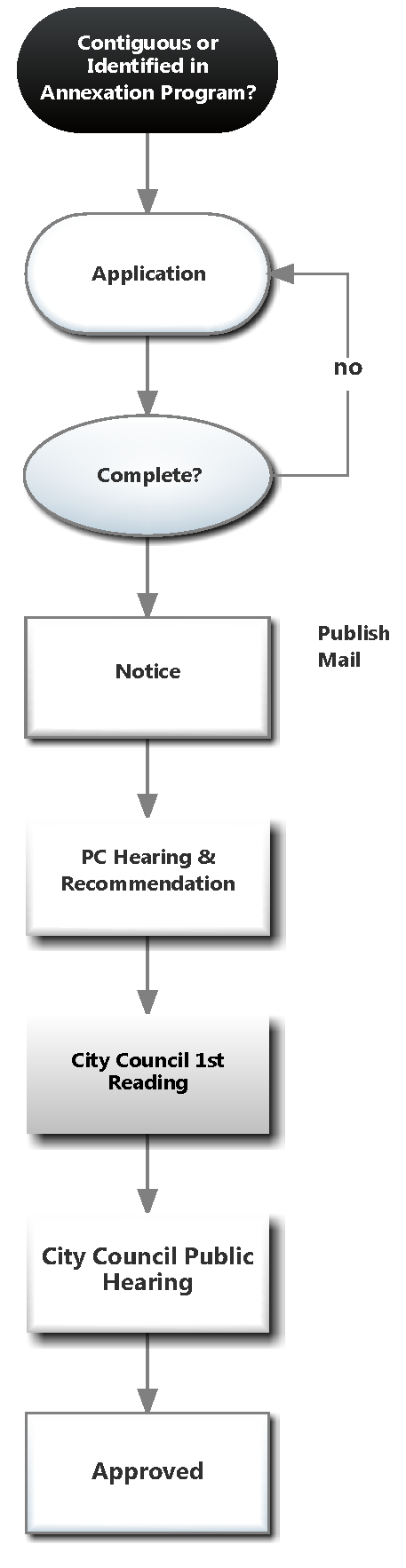
A.
Applicability. This section delineates the process and criteria by which the City of Sparks processes Annexation applications pursuant to NRS 268.670.
B.
Initiation.
1.
The applicant files an application for Annexation with the Administrator.
2.
If the area proposed for annexation is within a Cooperative Planning Area designated by the City, the applicant must also submit a "Cooperative Planning Area" application.
C.
Completeness. See Section 20.05.02.
D.
Notice.
1.
Before adopting any annexation, a public hearing will be conducted after at least ten days notice is given by mail to owners of property 750 feet of the exterior limits of the property or area proposed for Annexation, as shown by the assessor's latest ownership maps.
2.
Notice is provided by publication and mail as provided by NRS 268 and Section 20.05.03 of this title.
E.
Decision.
1.
The Planning Commission will conduct a hearing and will continue, table, recommend approval, or recommend denial of the Annexation.
2.
The City Council will approve deny with or without prejudice, table or continue the Annexation.
F.
Findings for Approval. When considering an application for Annexation submitted under the procedures set forth in NRS 268.670, the City shall consider the following factors in rendering a decision on the application:
1.
The request conforms to the requirements of NRS 268
2.
The request conforms to the findings established for annexation:
a.
Location of the property to be considered for annexation;
b.
The logical extension of City limits;
c.
The need for the expansion to accommodate planned regional growth;
d.
The location of existing and planned water and sewer service;
e.
Community goals that would be met by the proposed annexation;
f.
The efficient and cost effective provision of service areas and capital facilities;
g.
Fiscal analysis regarding the proposed annexation;
h.
Whether Washoe County has adopted a Community Management Plan for the proposed annexation area;
i.
Whether the annexation creates any islands; and
j.
Any other factors concerning the proposed annexation deemed appropriate for consideration by the City Council.
3.
The property requested to be annexed conforms to the Master Plan as it is within the City's Sphere of Influence and Seven Year Annexation Plan.
4.
Public notice was given and a public hearing held per the requirements of the Sparks Municipal Code.
G.
Subsequent Applications. If the annexation of territory to a city is not approved, an application to annex the same or substantially the same territory will not be accepted for at least one year after the date of disapproval.
H.
Appeals. Not applicable.
I.
Scope of Approval.
1.
Generally. After the area is annexed, it becomes subject to all ordinances and regulations of the City of Sparks.
2.
Classification of annexed territory. Territory annexed to the City is classified for purposes of this chapter as follows:
Table 20.05-4 Zoning Classification of Annexed Territory
J.
Recordkeeping. The City Clerk will maintain a record of the Annexation ordinance in accordance with its normal ordinance tracking procedures.
(Ord. 2547, § 1(Exh. A), Amended, 12/11/2017; Ord. 2512, § 1(Exh. A), Add. 08/24/2015)
Section 20.05.006 - Amendments and rezoning.
A.
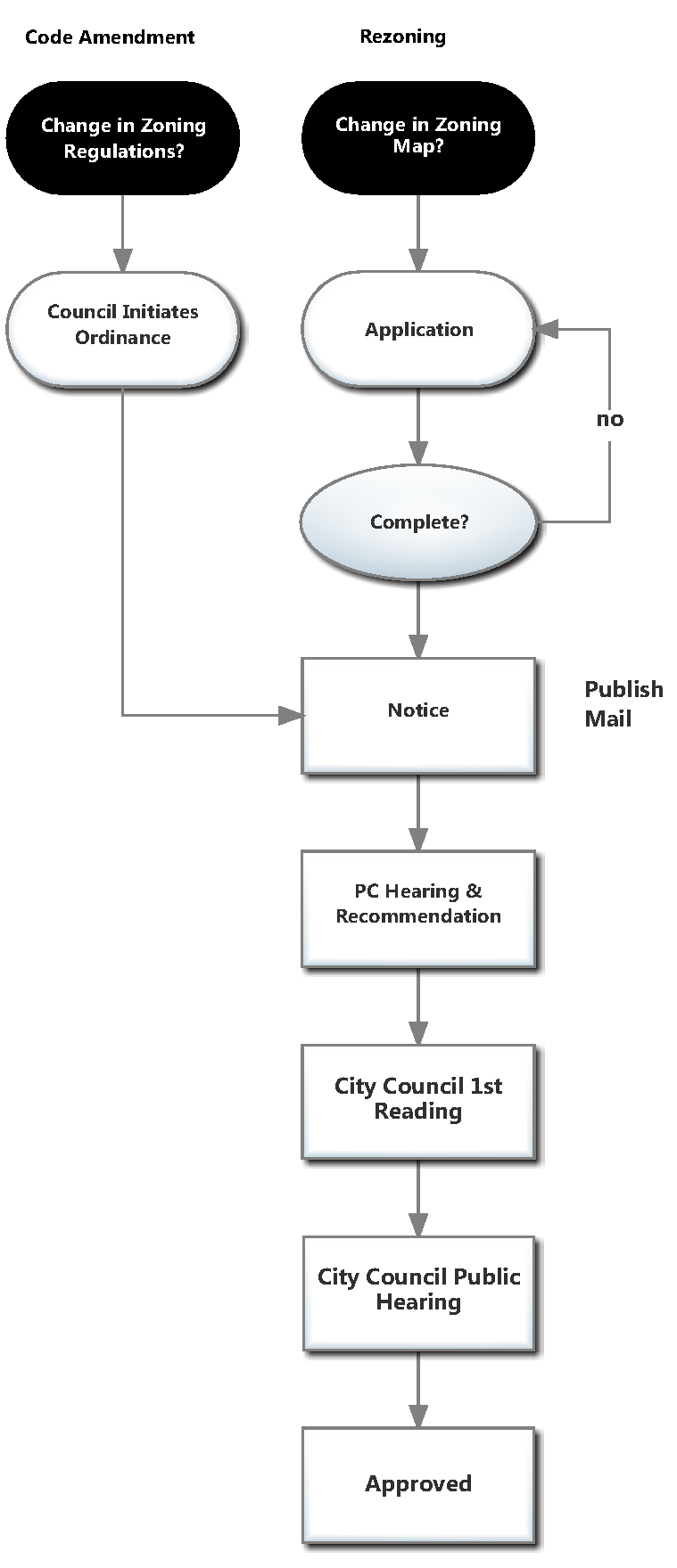
This applies to the amendment or repeal of this Title. This includes any amendment to the zoning map (a "rezoning").
B.
Initiation
1.
Amendments to the zoning map may be initiated by:
a.
The City Council;
b.
For a rezoning, the City Council or the owner of a lot or parcel within the area sought for amendments.
2.
The applicant files an application for Rezoning with the Administrator.
C.
Completeness. See Section 20.05.02.
D.
Notice. Notice is provided by publication and mail as provided by NRS 278.260 and Section 20.05.03 of this title.
E.
Decision. The following procedures apply to Code Amendments and rezonings, as indicated in the table below:
Table 20.05-5 Decision Process for Code Amendments and Rezonings
F.
Findings for Approval. A rezoning or code amendment is committed to the City Council's legislative discretion. The rezoning or Code Amendment may be approved if it is:
1.
Consistent with the City's Master Plan and Truckee Meadows Regional Plan and otherwise consistent with Nevada or federal law.
2.
Consistent with the surrounding land uses.
3.
Public notice was given and a public hearing held per the requirements of the Sparks Municipal Code and Nevada Revised Statutes.
G.
Appeals. Not applicable.
H.
Scope of Approval.
1.
A Code Amendment applies to all situations, uses or development within the scope of the adopted ordinance.
2.
After a Rezoning is approved, all new development within the area subject to the approved rezoning is subject to the uses and development standards in the zoning districts applied by the rezoning ordinance.
I.
Recordkeeping.
1.
The City Clerk will maintain a record of all Code Amendments as provided by the City Charter and Nevada law.
2.
The Administrator will revise the Zoning Map to reflect the approved Rezoning.
Section 20.05.007 - Administrative review.
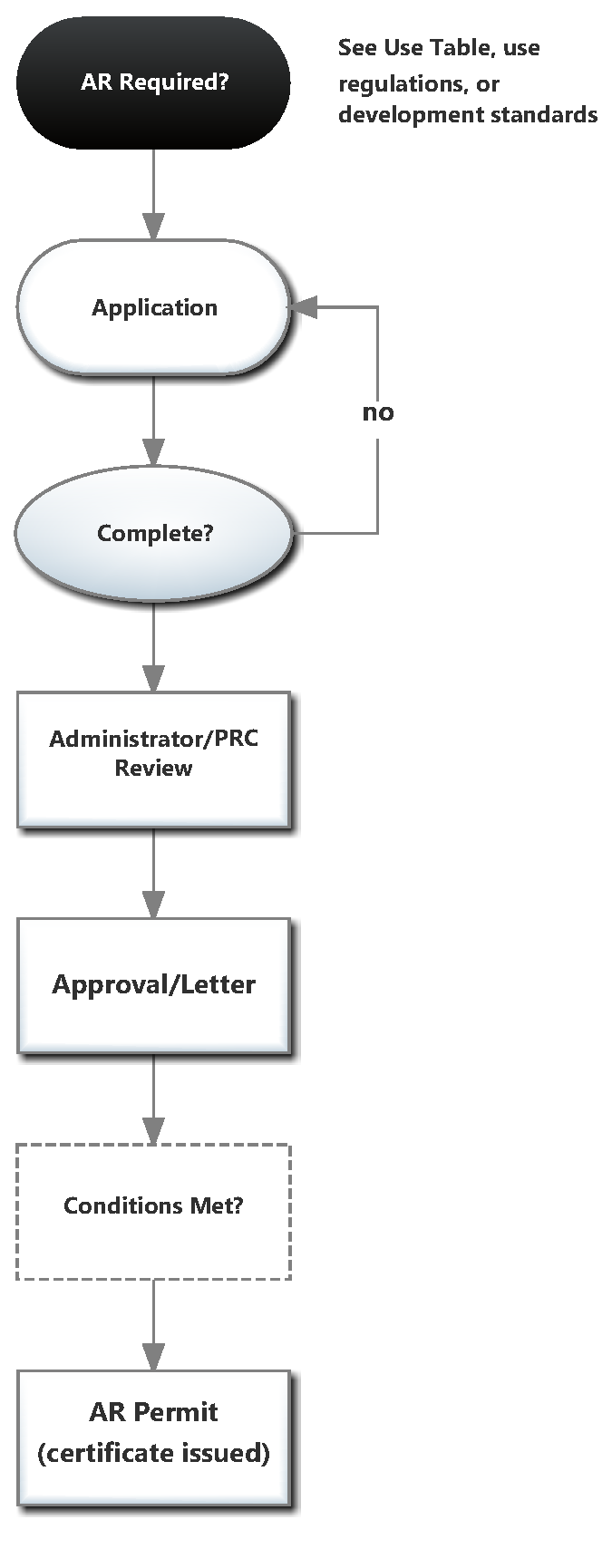
Purpose: Administrative Review determines whether the proposed use, building, structure addition or change to any building, structure or use will conform to the City's Zoning Code, building and fire codes and other applicable ordinances and requirements. Administrative Review insures the development of an aesthetically acceptable and well-ordered community serving the interests of public health, safety and general welfare.
A.
Applicability. Administrative Review is required:
1.
Where indicated in the Use Table (20.02.013),
2.
For any public facility, commercial, industrial or multifamily (two units or more) construction or addition when a conditional use permit is not required; or
3.
Where specifically required in this title.
B.
Initiation. The applicant files an application for administrative review with the Administrator.
C.
Completeness. See Section 20.05.02.
D.
Notice. Not required.
E.
Decision.
1.
Within 30 days from the date the administrative review application is deemed complete:
a.
The Administrator shall review the application for compliance with this title; and
b.
The Administrator shall approve, conditionally approve or deny the administrative review application; and
c.
If the application is approved or conditionally approved, the Administrator shall submit to the applicant a letter and conditions of approval relative to the administrative review.
2.
Issuance of the administrative review does not occur until all the conditions of approval are satisfied.
3.
If the conditions of approval are not satisfied within two years of the date of the letter from the Administrator, or within another specified time limit stated as a condition of approval, the approval is automatically rescinded.
F.
Approval Criteria. The Administrative Review application shall comply with all applicable requirements of this Title, including the following:
1.
The proposed development shall not create unsafe traffic conditions or cause a reduction in the level of service on surrounding streets, taking into consideration:
a.
Any change in traffic conditions on abutting streets created by additional trips generated by the proposed development;
b.
The layout of the site with respect to locations and dimensions of vehicular and pedestrian entrances, exits, drives, walkways and fire-department access lanes;
c.
The arrangement and adequacy of off-street parking facilities to prevent traffic congestion;
d.
The location, arrangement and dimensions of truck loading and unloading facilities;
e.
The surfacing and lighting of off-street parking;
f.
Design of proposed building; and
g.
Location of refuse storage and disposal facilities.
G.
Subsequent Applications.
1.
An administrative review permit may be amended if:
a.
A condition of approval cannot be met;
b.
There are substantial changes in the project; or
c.
The Administrator determines that proposed changes to an approved project will impact surrounding properties.
2.
Amendments to administrative reviews must follow the same procedure as a new application, including the application fee and information required by the Appendices to this code.
H.
Appeals. See Section 20.05.13.
I.
Scope of Approval.
1.
Administrative review certificate. After the applicant satisfies the conditions of approval, the Administrator will issue a certificate indicating that the conditions are satisfied.
2.
Responsibility. The property owner shall comply with and maintain the conditions of approval of an administrative review permit. An administrative review runs with the land, subject to termination in accordance with the procedures in this Section.
3.
Modifications. In issuing building permits, the Administrator may approve minor adjustments of the location and/or dimensions of buildings, parking areas and roadways if they do not change any points of ingress or egress to the site or reduce the parking or landscaping requirements to less than the minimum required by this title. No modification of an approved application can be approved unless specifically provided in writing.
4.
Expiration of administrative review.
a.
An applicant has two years to establish the permitted use after the administrative review is approved.
b.
If the permitted use is not established or construction to accommodate that use begun and diligently pursued during this time, the Administrative review or administrative review permit becomes null and void. If the use is established during this time, the administrative review permit is valid until revoked unless there is a specific expiration date.
c.
The Administrator may extend the expiration date for up to one year if:
(1)
The applicant files a written request, which includes the current status of the project, with the Administrator before the approval expires.
J.
Revocation.
1.
The Administrator may revoke an administrative review if:
a.
The permit holder violates any condition of the permit;
b.
The permitted use becomes a public nuisance; or
c.
The permit was granted on the basis of false statements or fraudulent application.
2.
If the Administrator has reason to believe that an administrative review permit is subject to revocation, the Administrator may institute proceedings to revoke the permit.
K.
Recordkeeping. The Administrator and the applicant shall maintain a record of the administrative review and administrative review permit.
(Ord. 2547, § 1(Exh. A), Amended, 12/11/2017; Ord. 2512, § 1(Exh. A), Add. 08/24/2015)
Section 20.05.008 - Conditional use permits.
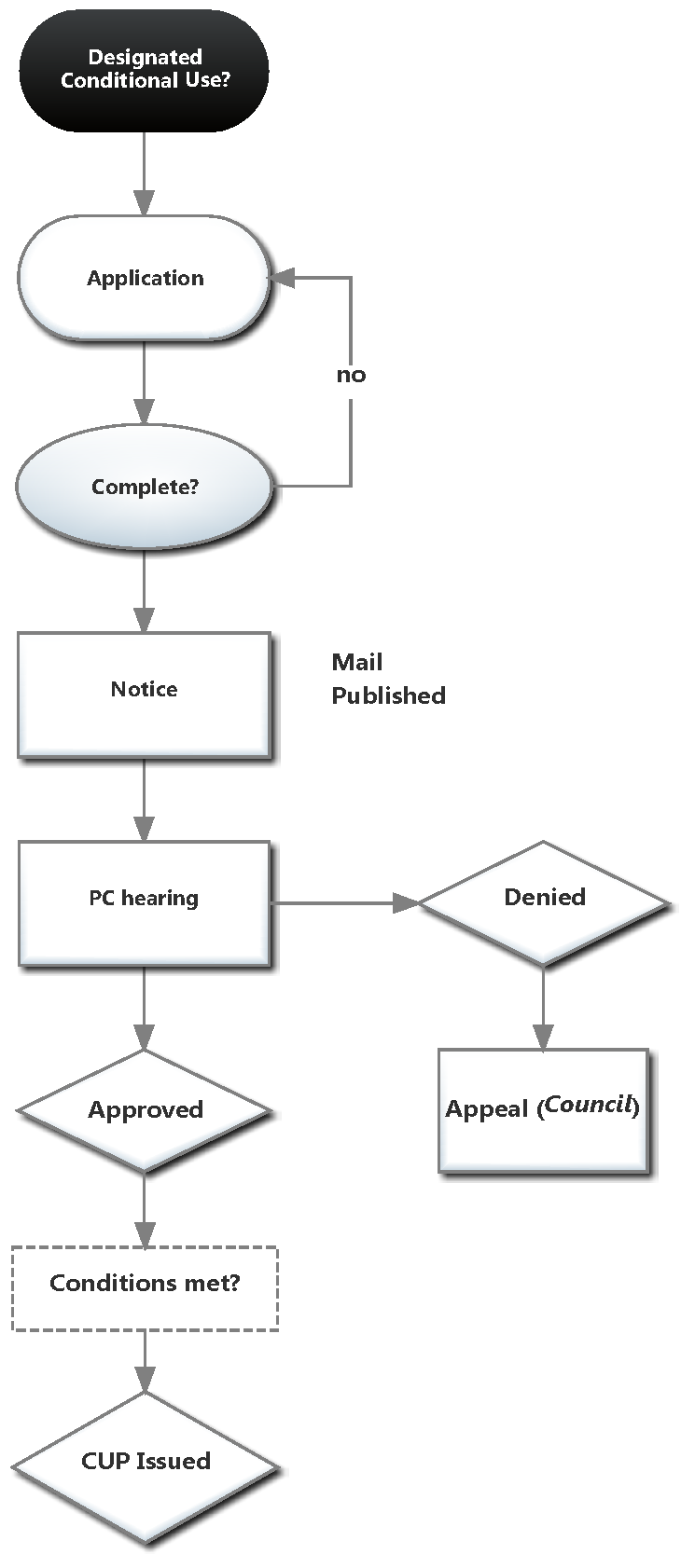
Purpose: This section promotes the public health, safety and general welfare by providing for special safeguards in the location and design of certain uses in certain zoning districts, and by allowing for minor adjustments in the impact of some regulations as specifically provided elsewhere in this title.
State Law reference— See NRS 278.315.
A.
Applicability.
1.
This section applies to:
a.
Any use designated as a conditional use in the Use Table (§ 20.02.013); or
b.
Any other situation where this Title requires conditional use approval.
2.
This section does not authorize a use variance or a deviation based on hardship or difficulty. However, an applicant may combine a request for a variance with a conditional use permit, and the City may process both applications concurrently.
3.
A conditional use permit application may be processed concurrent with a Rezoning application.
4.
Multiple applications submitted for a single development project may be processed concurrently to allow for an expedited review and processing schedule for a project. The time frame and approval process for a consolidated application shall follow the longest time frame and approval process required from among the multiple applications. For example, multiple applications for zoning map amendment and conditional use permit may be processed concurrently, in which case both applications would be considered based on the more extensive zoning map amendment procedure, and the City Council would be the final decision body on both applications unless otherwise provided by law.
B.
Initiation. The applicant files an application for a Conditional Use Permit with the Administrator.
C.
Notice. See NRS 278.315.
D.
Decision.
1.
For purposes of this section, the approving agency for a conditional use permit is:
a.
The Planning Commission; or
b.
The City Council if the Planning Commission's decision is appealed.
2.
The Planning Commission will hold a public hearing within 65 days after the application is filed, unless a longer time or a different process of review is provided in a development agreement (see NRS 278.0201).
3.
The Planning Commission shall:
a.
Approve the conditional use permit;
b.
Approve the conditional use permit with conditions;
c.
Deny the conditional use permit, with or without prejudice;
4.
The approving agency may impose conditions on the conditional use permit to safeguard the public health, safety, morals and general welfare. The conditions may address, but are not limited to, compatibility, site design, architecture, landscaping, building materials, access, internal circulation, lighting, signage, parking, operation of the use, the mitigation of potential impacts, and any other criteria permitted by state law.
5.
An application may be tabled or continued so long as a new public hearing is held within 65 days after the application is heard, unless a longer time or a different process of review is provided in a development agreement (see NRS 278.0201)
State Law reference— NRS 278.315.2.
6.
Within ten days after final action and at the conclusion of any appeal period, the Planning Commission's administrative secretary or the city clerk will notify the applicant in writing of that action, including any conditions imposed by the Planning Commission or City Council. The Planning Commission's administrative secretary must also notify the City Clerk's Office if the Planning Commission takes final action.
7.
After a conditional use is approved, the Administrator shall issue the permit when all conditions of approval, except for continuing conditions, are satisfied.
E.
Findings for approval.
1.
The approving agency must make findings that the proposed conditional use will be in compliance with the Comprehensive Plan;
2.
The conditional use will be compatible with the existing or permitted uses of adjacent properties;
3.
The potential impairment of natural resources and the total population which the available natural resources will support without unreasonable impairment;
4.
The Conditional Use Permits impacts have been conditioned to address identified impacts; and
5.
Public notice has been given and a public hearing held per the requirements of the Sparks Municipal Code and the Nevada Revised Statutes.
F.
Amendments.
1.
A Conditional Use Permit must be amended by the property owner if:
a.
One or more of the conditions of approval cannot be met;
b.
There are substantial material changes in the project; or
c.
The Administrator determines that proposed changes to an approved project will materially impact surrounding properties.
2.
Amendments to Conditional Use Permits must follow the same procedure as for a new application.
G.
Appeals. See Section 20.05.014.
H.
Scope of Approval.
1.
Compliance certificate. After the applicant satisfies the conditions of approval, the Administrator will issue a certificate indicating that the conditions are satisfied.
2.
Responsibility. The property owner is responsible for compliance with and maintenance of the conditions of approval of a conditional use permit for a particular use on a particular piece of property.
3.
Duration.
a.
A conditional use permit runs with the land, subject to termination in accordance with the procedures set forth in this chapter.
b.
Upon cessation of an established use for which a conditional use permit has been issued, the approved conditional use permit and any conditions thereto shall run with the land for a period not to exceed one year from the date the business license associated with the use expires.
c.
A conditional use permit issued by the Administrator is valid until revoked, unless it contains a specified expiration date.
d.
If a final subdivision map is recorded on any portion of a project while a conditional use permit for the project is in effect, the use of that portion of the project is considered established, even if construction has not taken place, unless the subdivision map is amended or reverted to acreage.
4.
Recission. If any conditions of approval (other than continuing conditions) are not satisfied within two years after final action is taken, or within another time limit specified in the permit, the approval is automatically rescinded.
5.
Expiration of an approved conditional use permit.
a.
An applicant has two years to establish the permitted use after the conditional use permit is approved.
b.
If the permitted use is not established or construction to accommodate that use begun and diligently pursued during this time, the conditional use permit becomes null and void. If the use is established during this time, the conditional use permit is valid until revoked unless there is a specific expiration date.
c.
The approving agency may extend the expiration date for up to one year if;
(1)
If a permit holder is unable to establish the permitted use or begin construction to accommodate it within two years or the time specified in the conditional use permit, the approving agency may extend the expiration date. The extension may not exceed 1 year beyond the original expiration date. To obtain an extension, the applicant must submit a written request to the approving agency before the permit expires.
6.
If the Administrator has reason to believe that a Conditional Use Permit is subject to revocation, the Administrator may institute proceedings to revoke the permit. Before revoking any conditional use permit, the body which approved it must hold a public hearing as provided in Section 20.05.004.
a.
The administrator may revoke a conditional use permit if:
(1)
The permit holder violates any condition of the permit;
(2)
The permitted use becomes a public nuisance; or
(3)
The permit was granted on the basis of false statements or fraudulent application.
I.
Recordkeeping.The Administrator and the applicant shall maintain a record of the conditional use permit.
(Ord. 2547, § 1(Exh. A), Amended, 12/11/2017; Ord. 2512, § 1(Exh. A), Add. 08/24/2015)
Section 20.05.009 - Development agreements.
State Law reference— NRS 278.0201 to 278.0207.
A.
Applicability.
1.
This section provides for development agreements to regulate the development of land within the city.
2.
The Administrator has authority to apply, administer and enforce this Section, including the negotiation and enforcement of development agreements.
B.
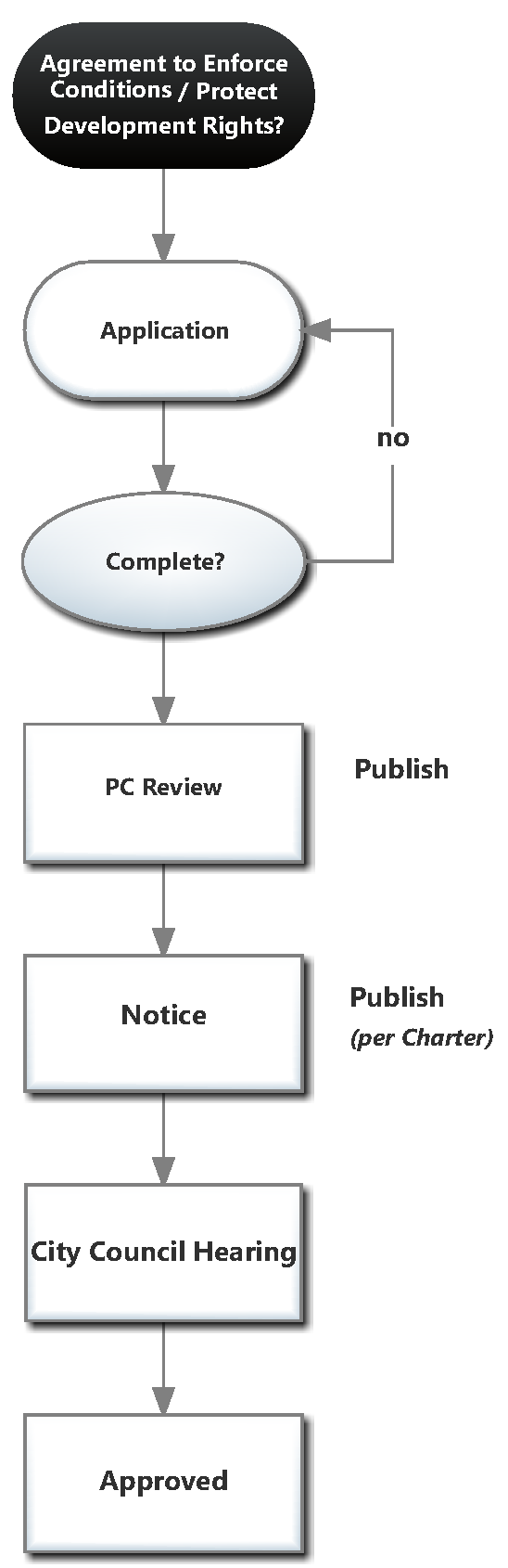
Initiation. The applicant files an application for a development agreement, along with the proposed development agreement, with the Administrator.
C.
Completeness. See Section 20.05.002.
D.
Notice.
1.
See City Charter, § 2.080 (notice required for ordinances). This does not supersede any additional notice required for any development approval required by this section.
2.
Publication is required to amend or cancel any part of the agreement (see NRS 278.0205, City Charter, § 2.080).
E.
Decision.
1.
Before the City Council enters into a development agreement, the Planning Commission shall review the agreement for consistency with the city's Master Plan.
2.
If the sole purpose of the development agreement is to allow an alternate time period for review of an entitlement application, the agreement is processed directly by the City Council and subsection 1 does not apply.
3.
The City Council shall review and approve, approve with modifications, or deny the development agreement by ordinance.
F.
Approval Criteria. A development agreement is committed to the City Council's legislative discretion. The City Council may approve the Development Agreement if it is;
1.
Consistent with the City's Master Plan (NRS 278.0284); and
2.
Otherwise consistent with Nevada or federal law.
G.
Subsequent applications. Not applicable.
H.
Appeals. Not applicable.
I.
Scope of approval. Except as otherwise provided in NRS 278.0201 to 278.0207, or in a development agreement entered into pursuant to this Section, all the procedures and requirements of Title 20 of this code apply to the development of property that is the subject of a development agreement.
J.
Recordkeeping.
1.
The City Clerk will record with the County Recorder;
a.
The original development agreement or any amendments to the agreement; and
b.
A certified copy of the ordinance adopting the development agreement and any amendments to the ordinance.
2.
The original of the amendment must be filed for recording with the County Recorder.
(Ord. 2512, § 1(Exh. A), Add. 08/24/2015)
Section 20.05.010 - Minor deviations.
State Law reference— NRS 278.319.
A.
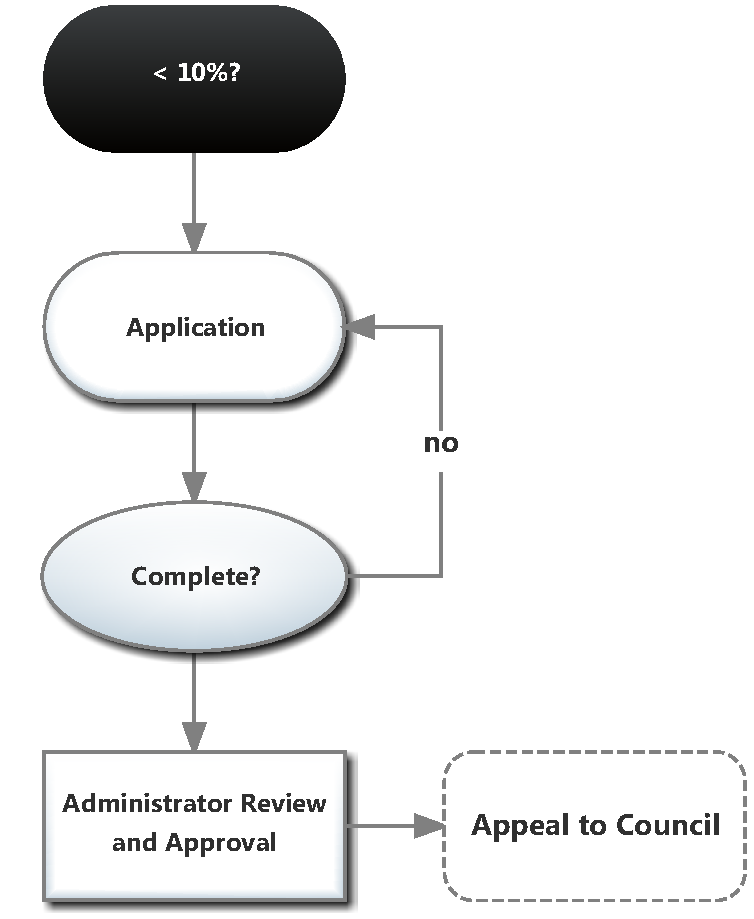
Applicability. This section allows deviations of less than ten percent from requirements for land use in this title. This section does not apply to the sign regulations of this title.
B.
Initiation.
1.
The applicant files an application for a minor deviation with the Administrator. The minor deviation request may be combined with the underlying application for which the minor deviation is requested.
C.
Notice.
1.
The applicant for a minor deviation must provide the written consent of the owner of any real property that would be affected by the deviation.
D.
Decision.
1.
The Administrator will approve, approve with conditions or deny the deviation. No public hearing is required.
2.
The applicant must obtain the written consent of the owner of any real property be affected by the minor deviation. This includes any abutting property, unless the Administrator determines that existing natural or man-made barriers or other factors resolve any potential impacts resulting from the deviation.
E.
Approval criteria.
1.
The deviation shall not change any points of ingress or egress to the site, or exceed the density.
2.
The deviation shall not impair the purpose of the zoning district or any district regulations.
3.
Any changes that might be affected by fire, building or health regulations must be reviewed and approved by the responsible agencies before any deviation is granted.
4.
The Administrator may require mitigation measures to address potential impacts arising from the deviation.
F.
Subsequent Applications. No restriction.
G.
Appeals. See Section 20.05.013.
H.
Scope of Approval. After a minor deviation is approved, the applicant may apply for a building permit or certificate of occupancy.
I.
Recordkeeping. The Administrator and the applicant shall maintain a record of the minor deviation.
(Ord. 2512, § 1(Exh. A), Add. 08/24/2015)
Section 20.05.011 - Major deviations.
Editor's note— NRS 278.315.
A.
Applicability.
1.
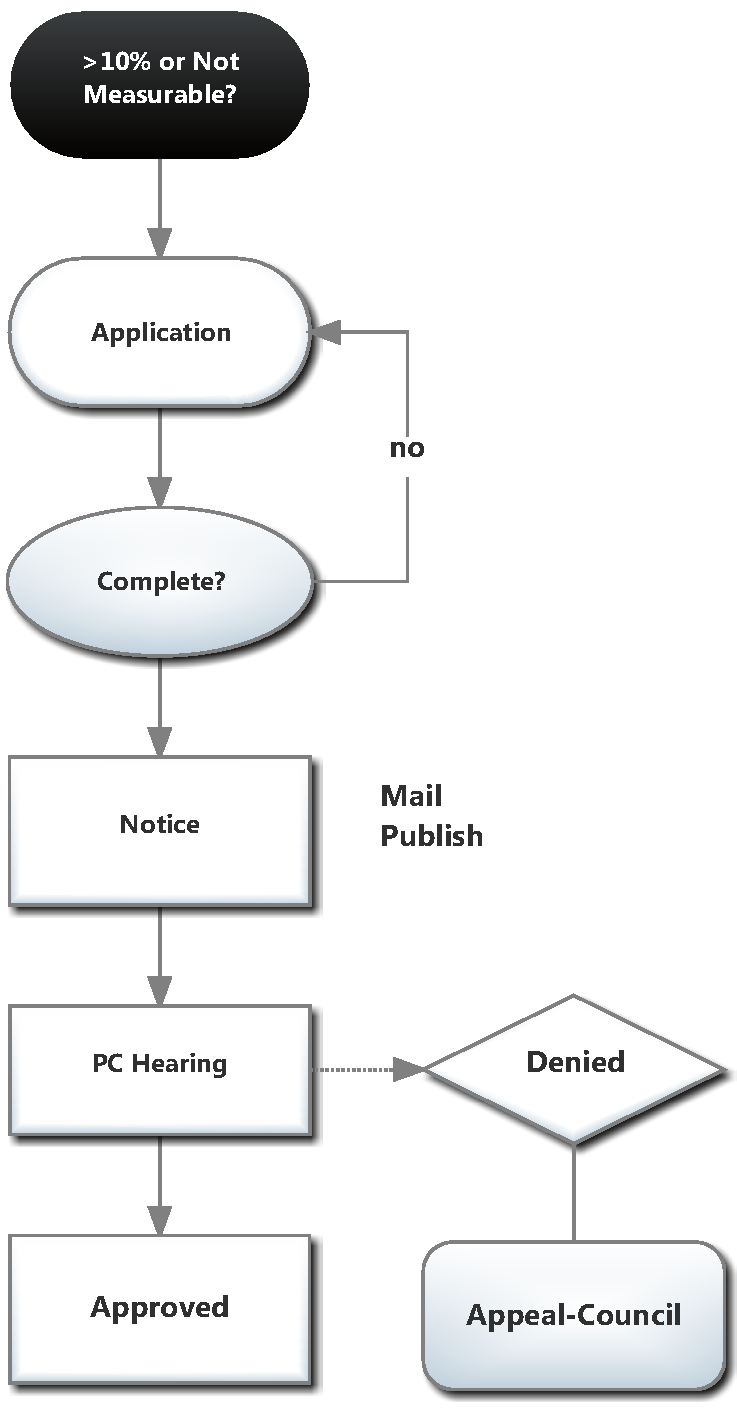
This section authorizes the Planning Commission to approve:
a.
Special exceptions greater than ten percent and less than 50 percent from requirements for land use in this title; or
b.
Special exceptions from development standards that can be quantified.
2.
This section does not authorize a use variance or a deviation based on hardship or difficulty. However, an applicant may combine a request for a variance with a major deviation, and the City may process both applications concurrently. The section does not apply to parking or sign regulations of this title.
B.
Initiation. The applicant files an application for a Major Deviation with the Administrator. The major deviation request may be combined with the underlying application for which it is requested. However, the underlying application will not be approved until the Major Deviation is approved, unless it is possible to comply with the standards associated with the underlying application without the major deviation.
C.
Completeness. See Section 20.05.02.
D.
Notice. A notice setting forth the time, place and purpose of the hearing must be sent at least ten days before the hearing to:
1.
The applicant; and each owner, as listed on the County Assessor's records, of real property located within 500 feet of the property in question;
2.
Notify minimum of the thirty (30) separately owned parcels nearest the property in question as listed on the County Assessor's records; and
3.
Notify each tenant of a mobile home park located within 500 feet of the property in question.
E.
Decision.
1.
The Planning Commission will review the major deviation at a hearing. The hearing is held within 65 days after the filing of the application, unless a longer time or a different process of review is provided in a development agreement (see Section 20.05.09).
2.
The Planning Commission may:
a.
Grant the major deviation, which may be subject to conditions as provided in subsection 4;
b.
Deny the major deviation, with or without prejudice; or
c.
Continue or table the application.
3.
If an application is tabled or continued, the Planning Commission shall hold a new public hearing within 65 days after the application was filed with the Planning Commission, unless a longer time or a different process of review is provided in an agreement entered into pursuant to NRS 278.0201.
4.
The Planning Commission may impose conditions on a major deviation to safeguard the public health, safety, morals and general welfare and to protect the interests of the persons residing or working in the surrounding areas.
F.
Findings for Approval. If granting the approval of the major deviation, the Planning Commission must make findings that the proposed major deviation will be compatible with the existing or permitted uses of adjacent properties and is consistent with the City of Sparks' Master Plan. The Planning Commission must conclude that:
1.
The request is consistent with the stated purposes of Title 20, Zoning and Land Use Controls;
2.
Granting the major deviation will not be materially detrimental to the public health, safety or welfare, or injurious to property or improvements in the vicinity;
3.
Granting the major deviation is necessary for the preservation and enjoyment of a property right possessed by other property owners in the same vicinity and land use district and is denied to the property for which the major deviation is sought; and
4.
Granting of the major deviation does not constitute a special privilege inconsistent with the limitations upon other properties in the vicinity and land use district in which the property is located.
G.
Subsequent Applications. If the Planning Commission denies a Major Deviation, unless the denial is specifically stated to be without prejudice, a new application for a substantially similar major deviation may not be submitted for at least six months following the denial.
H.
Appeals. See Section 20.05.13.
I.
Scope of Approval.
1.
Lapse of major deviation.
a.
A major deviation automatically lapses and becomes void one year following the date on which the major deviation became effective, unless during this time a building permit is issued and construction is commenced and diligently pursued toward completion on the site which was subject to the major deviation application.
b.
The Administrator may renew the major deviation for an additional year if an application to renew the Major Deviation is filed with the Administrator before the original expiration date.
2.
Revocation of major deviation. A major deviation may be revoked by the Planning Commission for any of the following reasons:
a.
The recipient or his successor in interest violates any condition of the approval.
b.
The approval was granted on the basis of false statements or a fraudulent application.
c.
The development as modified becomes a public nuisance.
J.
Recordkeeping. Within ten days after the Planning Commission's final action, the administrative secretary to the Planning Commission must notify the applicant and the City Clerk in writing of that action, including any conditions the Planning Commission imposed.
(Ord. 2512, § 1(Exh. A), Add. 08/24/2015)
Section 20.05.012 - Variance.
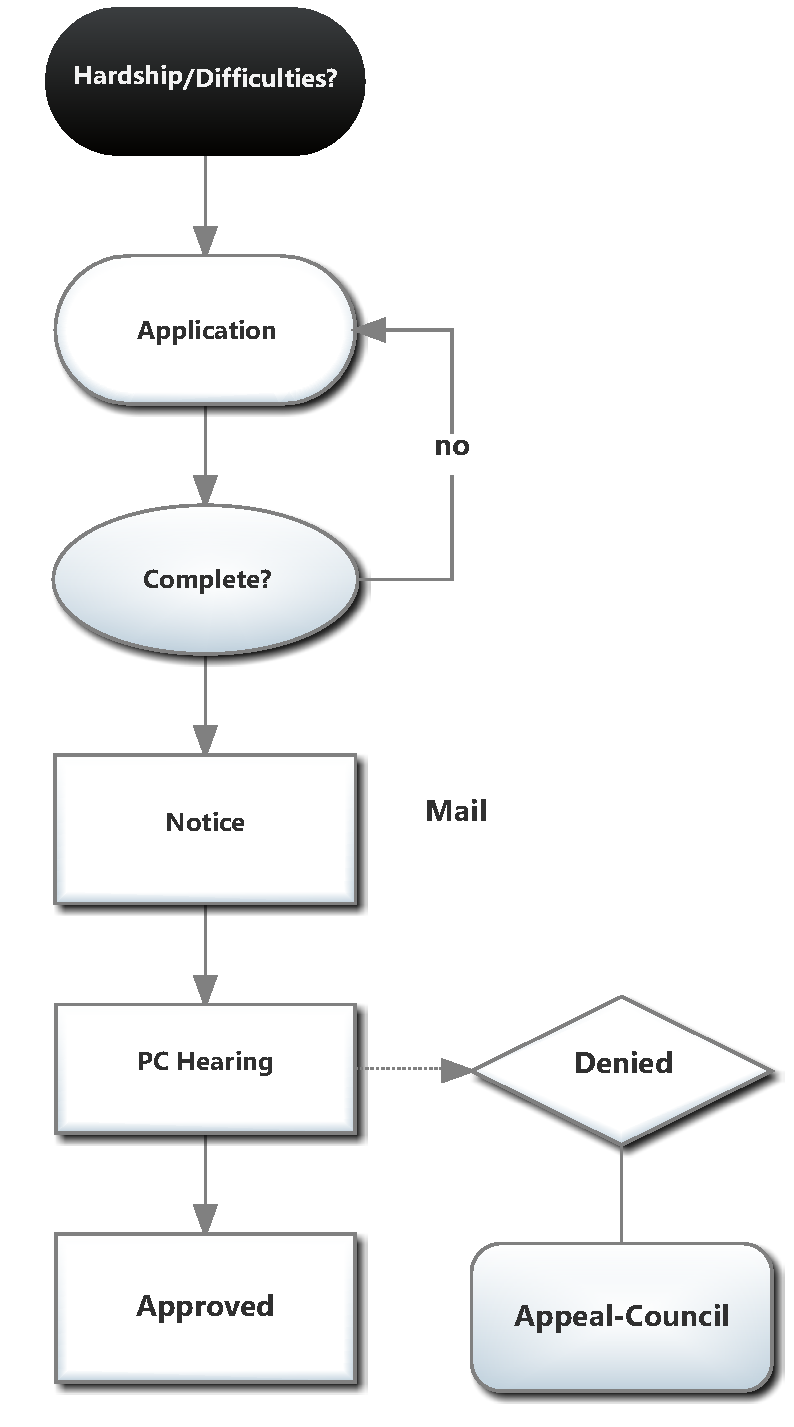
State Law reference— NRS 278.315.
A.
Applicability.
1.
This section authorizes the Planning Commission to grant a variance for the development of property if the variance is necessary to:
a.
Prevent or to lessen any peculiar and exceptional practical difficulties, or exceptional and undue hardships; and
b.
The difficulties or hardships would result from a strict application and enforcement of any provision of this title except the sign standards (see Chapter 20.04).
2.
A peculiar and exceptional practical difficulty or exceptional and undue hardship may result from the size, shape or dimensions of a site or the location of existing structures, or from geographic, topographic or other physical conditions on the site.
3.
Cost to the applicant of strict compliance shall not be the sole reason for granting a Variance.
4.
Use variances are not allowed.
B.
Initiation. The applicant files an application for a variance with the Administrator. The variance request may be combined with the underlying application for which the variance is requested. However, the underlying application will not be approved until the variance is approved, unless it is possible to comply with the standards associated with the underlying application without the variance.
C.
Completeness. See Section 20.05.002.
D.
Notice. A notice setting forth the time, place and purpose of the hearing must be sent at least ten days before the hearing to:
1.
The applicant;
2.
Each owner as listed on the county's assessor's records, of real property located within 500 feet of the property in question;
a.
The owner, as listed on the county assessor's records, of each of the 30 separately owned parcels nearest the property in question, to the extend this noticed does not duplicate the notice given.
3.
Each tenant of a mobile home park located within 100 feet of the property in question.
E.
Decision.
1.
The Planning Commission will review the variance application at a public hearing.
2.
The Planning Commission may:
a.
Grant the variance, which may be subject to conditions as provided in subsection 4 below; or
b.
Deny the variance, with or without prejudice; or
c.
Continue or table the application.
3.
If an application is tabled or continued, the Planning Commission shall hold a new public hearing within 65 days after the application was filed with the Planning Commission, unless a longer time or a different process of review is provided in an agreement entered into pursuant to NRS 278.0201.
4.
The Planning Commission may impose conditions on a variance to safeguard the public health, safety, morals and general welfare and to protect the interests of the persons residing or working in the surrounding areas.
F.
Findings for Approval. To approve or conditionally approve a Variance, the Planning Commission must make findings of fact that:
1.
There are exceptional or extraordinary circumstances or conditions applicable to the property involved that do not generally apply to other properties classified in the same zoning district;
2.
Strict interpretation and enforcement of the specified provisions would deprive the applicant of privileges enjoyed by the owners of other properties classified in the same zoning district;
3.
The variance will not constitute or grant a special privilege inconsistent with limitations on other properties classified in the same zoning district.
4.
The variance will not substantially impair the public health, safety or welfare or materially injure properties or improvements in the vicinity.
5.
The potential impairment of natural resources and the total population which available natural resources will support without unreasonable impairment has been considered.
6.
The affect the availability of and need for affordable housing in the community, including affordable housing that is accessible to persons with disabilities has been considered.
7.
Public notice was given and a public hearing held per the requirements of the Sparks Municipal Code and the Nevada Revised Statutes.
G.
Subsequent Applications. If the Planning Commission denies a variance, unless the denial is specifically stated to be without prejudice, a new application for a substantially similar variance may not be submitted for at least six months following the denial.
H.
Appeals. See Section 20.05.13.
I.
Scope of Approval.
1.
Lapse of variance.
a.
A variance automatically lapses and becomes void two years following the date on which the variance became effective, unless during this time a building permit is issued and construction is commenced and diligently pursued toward completion on the site which was subject to the variance application.
b.
The Administrator may renew the variance for an additional year if an application to renew the variance is filed with the Administrator before the original expiration date.
2.
Revocation of variance. A variance may be revoked by the Planning Commission for any of the following reasons:
a.
The recipient or his successor in interest violates any condition of the variance.
b.
The variance was granted on the basis of false statements or a fraudulent application.
c.
The variance becomes a public nuisance.
J.
Recordkeeping. Within ten days after the Planning Commission's final action, the administrative secretary to the Planning Commission must notify the applicant and the City Clerk in writing of that action, including any conditions the Planning Commission imposed.
(Ord. 2512, § 1(Exh. A), Add. 08/24/2015)
Section 20.05.013 - Appeals.
State Law reference— NRS 278.3195.
A.
Applicability.
1.
This Section applies to any decision of the Planning Commission, Administrator, or any other person appointed or employed by the City Council who is authorized to make administrative decisions regarding the use of land under this title.
2.
An applicant or any aggrieved person may appeal a decision subject to subsection 1 if the person claims:
a.
The intent of a standard in this Title was incorrectly interpreted;
b.
This title does not apply;
c.
A better form of design is proposed that does not require a waiver of the requirements of this title; or
d.
The decision violates state or federal law.
3.
An aggrieved person is one whose personal right or right of property is adversely and substantially affected by the action of the decisionmaker.
4.
This Section does not apply to a recommendation or other action or decision routinely reviewed by the City Council.
5.
The right to appeal to the City Council is waived upon failure to comply with the procedures set forth in this section.
B.
Initiation.
1.
The appeal is initiated by filing a written notice of appeal with the City Clerk which identifies all pertinent issues within 11 calendar days after the action or decision.
2.
The Mayor or any member of the City Council may request review of a Planning Commission action or decision with a written notice to the city clerk or orally at a meeting of the City Council. Any such notice must be made within 11 calendar days after the action or decision.
C.
Completeness. See Section 20.05.02.
D.
Notice. Appeals shall be noticed in the same manner as the original public hearing for the decision being appealed.
1.
The City will provide notice by mail or email to the applicants or aggrieved parties who request personal notice.
2.
Appeals of an Administrative decision do not require noticing.
E.
Decision.
1.
The City Clerk shall set the matter for public hearing at a regular meeting of the City Council.
2.
The City Council shall review the matter de novo.
3.
The City Council may affirm, modify, remand for further consideration or reverse the action or decision.
4.
The City Council shall render its decision within 60 days after a complete appeal is filed.
F.
Approval Criteria. In deciding an appeal, the Sparks City Council will consider:
1.
The statement of purpose underlying the regulation of the improvement of land expressed in Nevada state law;
2.
The plain language of the regulation and principles of interpretation in this Chapter and Nevada law; and
3.
Any applicable requirements of state or federal law.
G.
Subsequent Applications. After the City Council renders a final decision, the City will not consider an appeal involving:
1.
The same property and issues, including the same regulations of this title involved in the subject of the appeal; or
2.
Any issues that could have been raised during the original appeal.
H.
Appeals.
1.
The decision of the Sparks City Council is a final decision for the purpose of judicial review.
2.
Any person who has appealed a decision to the governing body in accordance with this section and is aggrieved by the decision of the Sparks City Council may appeal the decision to Washoe County District Court by filing a petition for judicial review within 25 days after the date of filing of notice of the decision with the clerk of the Sparks City Council.
I.
Scope of Approval. Any permit or decision rendered under this Chapter shall comply with any order of the City Council, as modified or reversed by a final decision on judicial review.
J.
Recordkeeping. The City Clerk will maintain a record of all appeals as provided by the City Charter and Nevada law.
(Ord. 2563, § 1, Amended, 10/22/2018; Ord. 2547, § 1(Exh. A), Amended, 12/11/2017; Ord. 2512, § 1(Exh. A), Add. 08/24/2015)

