
Sparta City Zoning Code
ARTICLE II
DEFINITIONS
Sec. 82-41.- Intent and purpose.
The purpose of this article is to establish rules for the interpretation of the text of this chapter, to define certain words and terms, and to provide for the interpretation of this chapter by adoption of a technical dictionary. Certain words and terms which may not appear in this article, but which have special application may be defined in other articles in which they apply.
(Ord. No. 04-07, § 1(2.01), 7-12-2004)
Sec. 82-42. - Use of words and terms.
(a)
If the meaning of this chapter is unclear in a particular circumstance, then the board of zoning appeals shall construe the provision to carry out the intent of the chapter if it can be discerned from other provisions of the chapter or law.
(b)
All words and phrases shall be construed and understood according to the common preferred use of the language; but technical words and phrases as may have acquired a peculiar and appropriate meaning in the law shall be construed and understood according to that peculiar and appropriate meaning.
(c)
Words used in the present tense shall include the future tense, words used in the singular shall include the plural, and words in the plural number shall include the singular, unless the context clearly indicates and stipulates the contrary.
(d)
The words "person," "proprietor," "property owner," and "operator" shall include any recognized form of legal entity.
(e)
The words "property," "lot," "parcel," "real estate," "premises," "plot" and "land" shall be interpreted to mean real property as delineated and described by legal documents and instruments.
(f)
The word "road" shall also mean "highway," "street," "alley," "drive," "cul-de-sac," "land" or other public thoroughfare.
(g)
The word "building" shall include the word "structure."
(h)
The words "used" or "occupied" when applied to any land or building shall be construed to include the words "intended," "arranged," or "designed to be used or occupied."
(i)
The words "shall" and "required" are always interpreted as mandatory and never as permissive or discretionary.
(j)
The word "may" shall be interpreted as permissive or discretionary.
(k)
Unless the context clearly indicates the contrary, the conjunctions noted below shall be interpreted as follows.
(1)
"And" indicates that all connected items, conditions, provisions, or events shall apply.
(2)
"Or," indicates that the connected items, conditions, provisions or events may apply singularly or in any combination.
(3)
"Either/or" indicates that the connected items, conditions, provisions or events shall apply singularly but not in combination.
(l)
Gender terms in masculine, feminine, and neuter gender shall be interchangeable. Use of genders shall not affect the intent of any provision.
(m)
In computing the number of days, the first day is excluded and the last day is included. If the last day of any period during which an application, filing, or request is required to be made to the village or other governmental agency is a Saturday, Sunday, or legal holiday, the period is extended to include the next day which is not a Saturday, Sunday, or legal holiday.
(Ord. No. 04-07, § 1(2.02), 7-12-2004)
Sec. 82-43. - Definitions "A."
Accessory:
(1)
Structure: A building or structure located on the same lot as the main building or structure, the use of which is incidental or secondary to the main building or principal use.
(2)
Use: A use of land or of a building or portion thereof which is customarily and naturally incidental to, subordinate to, and devoted exclusively to the principal use of the land or main building and located on the same lot with the principal use.
Accessory dwelling unit (ADU): An ADU is a small or secondary residential living unit on the same parcel as a single-family dwelling or a multifamily structure in a residential zoning district. As an independent living space, an ADU is self-contained, with its own kitchen or kitchenette, bathroom and sleeping area. The ADU may take various forms: a detached unit; a unit that is part of an accessory structure, such as a detached garage; or a unit that is part of an expanded, new or remodeled single-family unit or a unit in a multifamily dwelling.
Addition: A structure added to the existing structure after the completion of the existing structure that extends or increases the floor area, or height of a building or structure.
Adult uses: The term shall include adult bookstore, adult motion picture theater, adult motel, adult nightclub, and massage parlor. These terms and terms related to these definitions, as noted, shall have the following indicated meanings:
(1)
Adult bookstore: An establishment having as a significant portion of its stock in trade books, films, magazines and other periodicals which are distinguished or characterized by an emphasis on depicting or describing sexual sonduct or specified anatomical areas.
(2)
Adult motion picture theater: An enclosed building used for presenting material distinguished or characterized by an emphasis on depicting or describing sexual conduct or specified anatomical areas.
(3)
Adult motel: A motel wherein material is presented which is distinguished or characterized by an emphasis on depicting or describing sexual conduct or specified anatomical areas.
(4)
Adult nightclub: A theater or other establishment, which features live performances by topless and/or bottomless dancers, go-go dancers, exotic dancers, strippers or similar entertainers, where these performances are distinguished or characterized by an emphasis on sexual conduct or specified anatomical areas.
(5)
Massage parlor: Any establishment having a fixed place of business where massages are administered for pay, including but not limited to massage parlors, sauna baths, and steam baths.
a.
This definition shall not be construed to include a hospital, nursing home, medical clinic, or the office of a physician, surgeon, chiropractor, osteopath, or physical therapist duly licensed by the state, nor barber shops or beauty salons in which massages are administered only to the scalp, the face, the neck or the shoulder.
b.
This definition shall not be construed to include a nonprofit organization operating a community center, swimming pool, tennis court, or other educational, cultural, recreational, and athletic facilities for the welfare of the residents of the area, nor practices of licensed massage therapists
(6)
Sexual conduct: Considered to be characterized by, but not limited to, the following acts:
a.
Human genitals in a state of sexual stimulation or arousal;
b.
Acts of human masturbation, sexual intercourse or sodomy; and
c.
Fondling or other erotic touching of human genitals, pubic region, buttock, or female breast.
(7)
Specified anatomical areas: Considered to be defined by, but not limited to, the following areas:
a.
Less than completely and opaquely covered: human genitals, pubic region, buttock, and female breast below a point immediately above the top of the areola; and
b.
Human male genitals in a discernibly turgid state, even if completely and opaquely covered.
Alteration: Any modification, remodeling, change or rearrangement in the structural or supporting members such as bearing walls, columns, or girders, as well as any change in the doors or windows which affect the means of egress which is undertaken without adding to the floor area, height, or physical size of the building or structure.
(Ord. No. 04-07, § 1(2.03), 7-12-2004; Ord. No. 05-08, § 1, 7-11-2005; Ord. No. 24-02, § 1, 6-10-2024)
Sec. 82-44. - Definitions "B."
Base flood level: The highest elevation of a flood having a one percent chance of being equaled or exceeded in any given year.
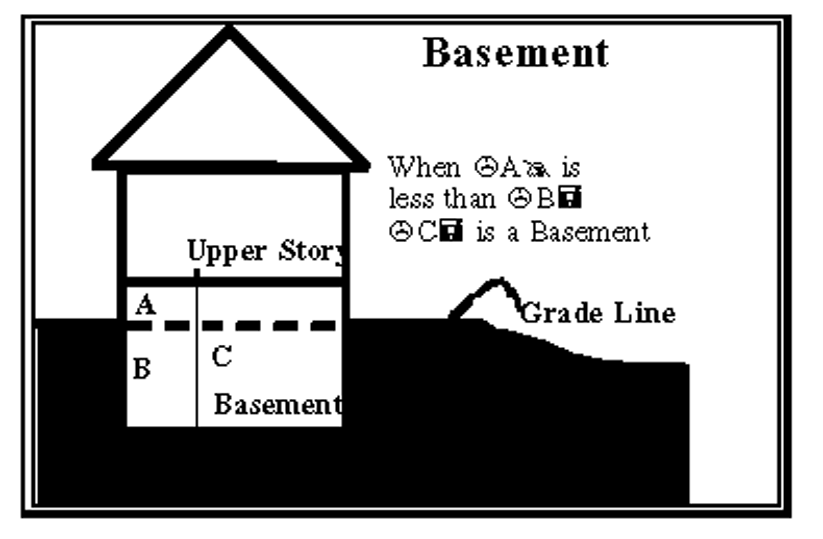
Basement
Basement or cellar: That portion of a building which is partly below and partly above grade, and having at least one-half its height below grade.
Bed and breakfast: A use within a detached single family dwelling in which transient guests are provided a sleeping room, breakfast and access to bathing and lavatory facilities in return for payment.
Building: A combination of material, whether portable or fixed forming a structure having a roof supported by columns or by walls affording a facility or shelter for use or occupancy by person, animals, or property. This includes an existing building, or a building for which a building permit has been issued by the village as of the effective date of this section.
Buildable area: The space remaining within a lot after the minimum setback, including landscaped areas, and open space requirements of this chapter have been met.
Building official: The officer or other designated authority charged with the administration and enforcement of the village building code, or a duly authorized representative.
Build-to-line: The line, parallel to the street line, which passes through the point of the principal building nearest the front lot line.
(Ord. No. 04-07, § 1(2.04), 7-12-2004)
Sec. 82-45. - Definitions "C."
Caliper: The measurement of the diameter of a tree trunk.
Campground: Shall be as defined in Public Act 368 of 1978, as amended, MCLA 333-12501 et seq.
Car wash: Any commercial place or premises open to the public and used for cleaning or washing of the interior or exterior of an automobile, for a charge or fee, using either a mechanized or manual process, including self-serve. A "car wash" does not include a facility used for washing or cleaning vehicles larger than a regularly manufactured pickup or panel truck of one and one-half ton capacity.
Change of use: A use of a building, structure or parcel of land, or portion thereof which is different from the previous use in the way it is classified in this chapter.
Collector street: As defined by the master plan.
Commercial recreation facility: An outdoor recreational facility located near a major travel corridor or a natural feature including, but not limited to, swimming beaches, boat rentals and athletic fields.
Commercial use: An activity carried out as a use of property for financial gain including, but not limited to, retail sales, repair service or salvage operators, business offices, food service, entertainment, and brokerages, related to purchase, sale, barter, display, or exchange of goods, wares, merchandise or personal services, or the maintenance of service offices, or recreation, or amusement enterprise, or garage/basement sales, operating more than 12 days during any one 12-month period.
Commercial wireless telecommunication services: Licensed telecommunication services including cellular, personal communication services (PCS), specialized mobilized radio (SMR), enhanced specialized mobilized radio (ESMR), paging, and similar services that are marketed to the general public.
Condominium: The ownership of a dwelling unit and the space enclosed by the description thereof as contained in the master deed for the complex or project, which has been recorded with the Kent County Register of Deeds in accordance with the provisions of the Condominium Act 59 of 1978, as amended, MCLA 559.101 et seq. This definition includes a condominium unit, or a portion of a condominium project located within a site condominium development.
Construction: The erection, alteration, repair, renovation, demolition or removal of any building or structure; and the excavation, filling, and grading of a lot.
Construction contractors establishment: A parcel of land, building or structure, or a portion thereof used to store trucks, excavation equipment, supplies, tools or materials utilized by construction contractor, subcontractors, and builders.
(Ord. No. 04-07, § 1(2.05), 7-12-2004; Ord. No. 25-04, § 1, 12-15-2025)
Sec. 82-46. - Definitions "D."
Data warehousing facility/data center: An industrial facility that processes, transfers, stores, and/or communicates digital information. A data center may comprise a corporate or enterprise facility, colocation, retail, wholesale, telecommunication, hyperscale facility, or a combination thereof. A data center facility may include but is not limited to, data halls, offices, security centers, soundwalls, screening, security fencing, signage, water and waste water utility systems, transmission lines, switchgears, transformers, inverters, generators and other redundancy equipment, mechanical yards, air-cooled, liquid-cooled, or evaporative-cooling chiller systems, electrical distribution equipment, batteries, uninterruptible power supply (UPS) systems, power distributions systems (PDS), and other similar equipment or accessory structures.
Day care:
(1)
Commercial: A facility, other than a private residence, receiving minor children for care for periods of less than 24 hours in a day, for more than two weeks in any calendar year. Child care and supervision provided as an accessory use, while parents are engaged or involved in the principal use of the property, such as a nursery operated during church services or public meetings, or by a fitness center or similar operation, shall not be considered commercial day care.
(2)
Family: An occupied single-family residence in which care is provided for more than one but fewer than seven minor children or adults for periods of less than 24 hours per day, unattended by a parent or legal guardian. Care for persons related by blood, marriage or adoption to a member of the family occupying the dwelling is excluded from this definition.
(3)
Group: An occupied single-family residence in which care is provided for at least seven but not more than 12 minor children or adults for periods of less than 24 hours per day, unattended by a parent or legal guardian. Care for persons related by blood, marriage, or adoption to a member of the family occupying the dwelling is excluded from this definition.
Demolition: The purposeful razing or destruction, or disassembly of a building or structure.
Density: The number of dwelling units per unit of lot area (see lot area).
(1)
Gross: A figure equaling the total number of dwelling units on a lot divided by the total number of acres included in the lot.
(2)
Net: A figure which equaling the total number of dwelling units on a lot divided by the total number of acres included in the lot, excluding any lot area owned by a governmental entity, used as a private street or occupied by a nonresidential use.
Development: The construction, reconstruction, conversion, structural alteration, relocation, or enlargement of any structure; and mining, excavation, landfilling or land disturbance, and any extension of an existing use of land.
Development permit: A permit issued to a person proposing a development that is regulated by this chapter, which indicates compliance with the chapter.
Disturbed land: A parcel of land that is graded, filled, excavated or mined or stripped of its natural vegetative cover or grass for a purpose other than agriculture land use.
Drive-through service: A business establishment with driveways and approaches developed and designed to serve patrons while in the motor vehicle, or to permit patron self-service within motor vehicles, even though the establishment may have some indoor services. Establishments where food or beverages are consumed on the premises but not within a building are construed as having drive-through service. An automated teller machine (ATM) shall also be considered as a drive-through facility whether as a principal or accessory use.
Driveway: A private path of travel over which a vehicle may be driven which provides access from one or two parcels of land to a public or private road.
District:
(1)
Nonresidential: The B-D business district and the CBD central business district.
(2)
Residential: The R-M medium-density residential district and the R-H high-density residential district.
(3)
Zoning: An area of land for which there are uniform regulations governing the use of buildings and premises, density of development, yard requirements and height regulations, and other appropriate regulations. Also referred to as "district."
Dwelling: A detached building or portion thereof designed or used exclusively as the primary residence or sleeping place of one or more persons, not including accessory buildings or structures, either attached or detached. In the case of a mixed occupancy where a building is occupied in part as a dwelling, the part so occupied shall be deemed a dwelling for purposes of this chapter and shall comply with the provisions herein relative to dwellings.
(1)
Multiple family. A single building with abutting walls containing more than three residential dwelling units.
(2)
Single-family. A detached building designed for or occupied exclusively by one family.
(3)
Two-family. A detached building designed for or occupied by two families living independently of each other.
(4)
Three-family. A detached building designed for or occupied by three families living independently of each other.
Dwelling unit: A building, or portion thereof, designed exclusively for human occupancy providing complete independent living facilities for one or more persons including permanent provisions for living, sleeping, eating, cooking and sanitation. This includes an existing dwelling unit, or a unit for which a building permit has been issued by the village as of the effective date of this section.
(Ord. No. 04-07, § 1(2.06), 7-12-2004; Ord. No. 24-02, § 2, 6-10-2024; Ord. No. 25-04, § 2, 12-15-2025)
Sec. 82-47. - Definitions "E."
Educational institution: A private accredited kindergarten through twelfth grade school, college, trade, or business school, nursery school, pre-school, and/or related administrative offices, excluding maintenance garage.
Essential services: The erection, construction, alteration, or maintenance by public utilities or municipal departments or commissions of underground, surface, or overhead gas, electrical, steam, or water transmission or distribution systems, collection, communication supply or disposal systems. These may include, but are not necessarily limited to, mains, drains, sewers, pipes, conduits, wires, cables, fire alarm boxes, traffic signals, hydrants, towers, poles, and other similar equipment, and accessories in connection therewith reasonably necessary for the furnishing of adequate service by public utilities or municipal departments or commissions or for the public health or general welfare. Essential services shall not include buildings other than those buildings as are primarily enclosures or shelters of the above essential service equipment. Cellular telephone or communications towers as defined by this chapter shall not be considered essential services.
Excavation: Removal or recovery by any means whatsoever of soil, rock, sand, gravel, peat, muck, marrow, shale, limestone, clay or other mineral or organic substances, other than vegetation, from water or land, whether exposed or submerged.
Existing use: The use of a parcel of land or a structure at the time of the enactment of this chapter.
(Ord. No. 04-07, § 1(2.07), 7-12-2004)
Sec. 82-48. - Definitions "F."
Family:
(1)
An individual or group of two or more persons related by blood, marriage, or adoption, together with foster children and servants of the principal occupants who are domiciled together as a single housekeeping unit in a dwelling unit; or
(2)
A collective number of individuals domiciled together in one dwelling unit whose relationship is of a continuing, nontransient domestic character and who are cooking and living as a single nonprofit housekeeping unit. This definition shall not include any society, club, fraternity, sorority, association, half-way house, lodge, coterie, organization, group of students, or other individual whose domestic relationship is of a transitory or seasonal nature, is for an anticipated limited duration of school term or during a period of rehabilitation or treatment, or is otherwise not intended to be of a permanent nature.
Flood or flooding: A general and temporary condition of partial or complete inundation of normally dry land areas from the overflow of waters; or the unusual and rapid accumulation of runoff of surface waters from any source.
Floor area: The sum of all horizontal areas of the several floors of a building or dwelling unit,
measured from the exterior faces of exterior walls, or from the centerline of walls
separating dwelling units. Unenclosed porches, courtyards, patios and cellars shall
not be considered as part of floor area, except when utilized for commercial or industrial
purposes.
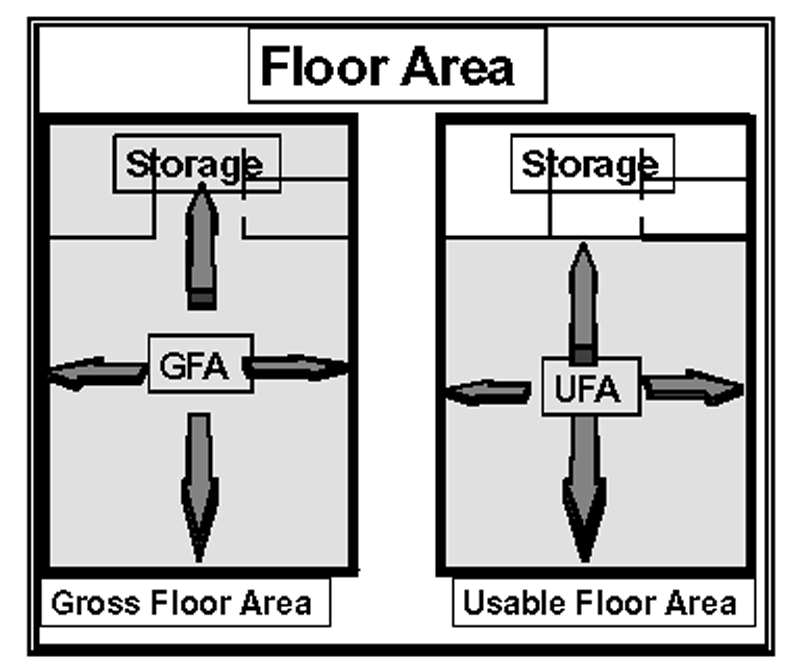
Floor Area
(1)
Gross (GFA): The area within the perimeter of the outside walls of the building under consideration, without deduction for hallways, stairs, closets/ storage rooms, thickness of walls, columns, or other features.
(2)
Usable (UFA): The area used for or intended to be used for the sale of merchandise or services, or for use to serve patrons, clients or customers.
a.
Floor area that is used or intended to be used for hallways, stairways, elevator shafts, utility or sanitary facilities or the storage or processing of merchandise, including areas less than six feet in height, shall be excluded from this computation of usable floor area.
b.
Measurement of usable floor area shall be the sum of the horizontal areas of each story of a structure measured from the internal faces of the exterior walls.
Frontage: The total length of the front lot line being the horizontal distance between the side lot lines, as measured at the front lot line.
(Ord. No. 04-07, § 1(2.08), 7-12-2004)
Sec. 82-49. - Definitions "G."
GFA: See floor area, gross.
General Rules of the Michigan Department of Community Health: General Rules of the Michigan Department of Community Health, Michigan Admin Code, R 333.101 through R 333.133, issued in connection with the Michigan Medical Marihuana Act, as amended.
Government and community service facility: A facility under the operational control of a governmental unit, specifically a village, county, state, the United States Government, or some combination of governmental units, including, but not limited to, offices, libraries, museums, town halls, post offices, courts, and civic centers; excluding vehicle and equipment maintenance, garages and correctional institutions.
Grade: The average elevation of the finished surface of ground after the development, filling, or excavation of a parcel of land.
Greenhouse: A building whose roof and sides are made largely of glass or other transparent or translucent material and in which the temperature and humidity can be regulated for the cultivation of delicate or out-of-season plants for subsequent sale or for personal enjoyment. (See nursery)
Groundcover: Grasses or other plants grown to keep soil from being blown or washed away.
Ground floor: The floor of a building that is at or nearest to the level of the ground around the building.
(Ord. No. 04-07, § 1(2.09), 7-12-2004; Ord. No. 11-06, § 1, 7-11-2011)
Sec. 82-50. - Definitions "H."
Hazardous substance: A chemical or other material that is or may be injurious to the public health, safety, or welfare.
Heavy equipment: Commercial vehicles with a gross vehicle weight in excess of 10,000 pounds, and excavating, grading, road building, earth moving, demolition, loading and similar equipment.
Height: The vertical distance of a structure measured from the average elevation of the finished grade within 20 feet of the structure to the highest point of the structure, or as otherwise provided in this chapter.
Height, building: The building height is the vertical distance measured from the established grade
to the highest point of the roof surface if a flat roof; to the deck of mansard roofs;
and to the mean height level between eaves and ridge of gable, hip and gambrel roofs.
When the terrain is sloping, the ground level is measured at the wall line.
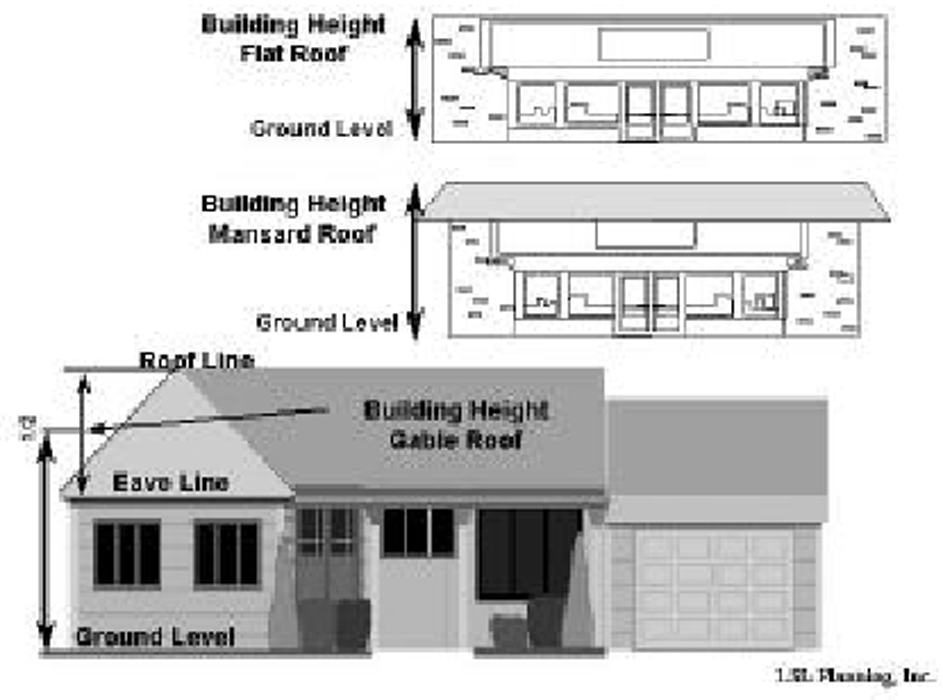
Building Height
Home occupation: An occupation customarily conducted in a dwelling unit that is clearly an incidental and secondary use of the dwelling. Without limiting the foregoing, a single-family residence used by an occupant of that residence to give instruction in a craft or fine art within the residence shall be considered a home occupation. A home occupation shall not be construed to include day care or state licensed residential care facilities.
Human occupancy: A building or portion thereof primarily used or intended to be used for individuals to congregate for any purpose and which is equipped with means of egress, light, and ventilation facilities in accordance with the Michigan Construction Code, excluding a building or portion thereof incidental to the use for agricultural purposes of the land on which the building is located, or a building used exclusively for the purpose of storage in which there are no employees or occupants.
(Ord. No. 04-07, § 1(2.10), 7-12-2004)
Sec. 82-51. - Definitions "I."
Indoor kennel: Any lot or premises on which six or more animals, four months of age or older are kept temporarily or permanently for the purpose of breeding, boarding or sale.
Industrial use: A structure, building, or parcel of land, or portion thereof utilized or inherently designed to be utilized for the purpose of production, manufacturing, processing, cleaning, testing, rebuilding, assembly, distribution, finishing, constructing, or printing of goods or products, and related research and development facilities.
(Ord. No. 04-07, § 1(2.11), 7-12-2004)
Sec. 82-52. - Definitions "L."
Land use: A description of how land is occupied or utilized.
Living area: The interior habitable area of a dwelling unit, including basements and attics, but does not include a garage or any accessory structure.
Loading space: An off-street space on the same lot with a building, or group of buildings, for the temporary parking of a commercial vehicle while loading or unloading merchandise or materials.
Lot: A parcel of land, or contiguous parcels of land under one ownership described within fixed boundaries, of sufficient size and configuration to meet the site development requirements of this chapter and having access to a public road. The word "lot" shall include plot or parcel. A lot need not be a lot of record. A lot may also mean a portion of a condominium project, as regulated by Public Act 59 of 1978, as amended, designed and intended for separate or limited ownership and/or use.
(1)
Area: The total area within the described lot lines of a parcel of land, excluding road right-of-way.
(2)
Corner: A parcel of land abutting upon two or more streets at their intersection, or upon parts of the same street forming an interior angle of less than 135 degrees.
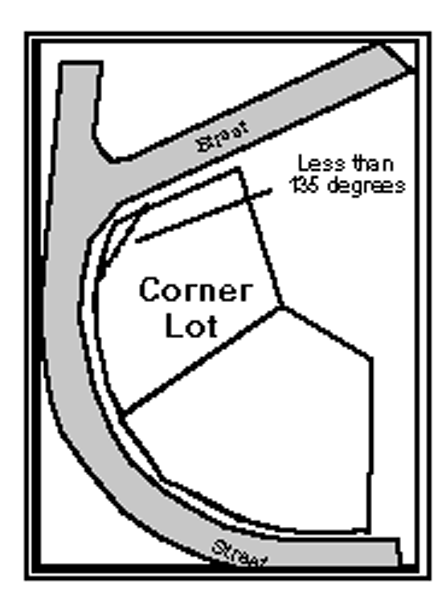
Corner Lot
(3)
Coverage: That portion of the area of lot that contains buildings and structures measured as a percent of the entire lot area.
(4)
Depth: The distance from the front lot line to the rear lot line measured in the general direction of the side lot lines of the lot.
(5)
Interior: A lot other than a corner lot.
(6)
Width: The horizontal distance between the side lot lines, as measured at the front yard setback line.
Lot line: The boundaries of a lot which divide one lot from another lot or from a public or
existing private road or any other publicly owned parcel of land.
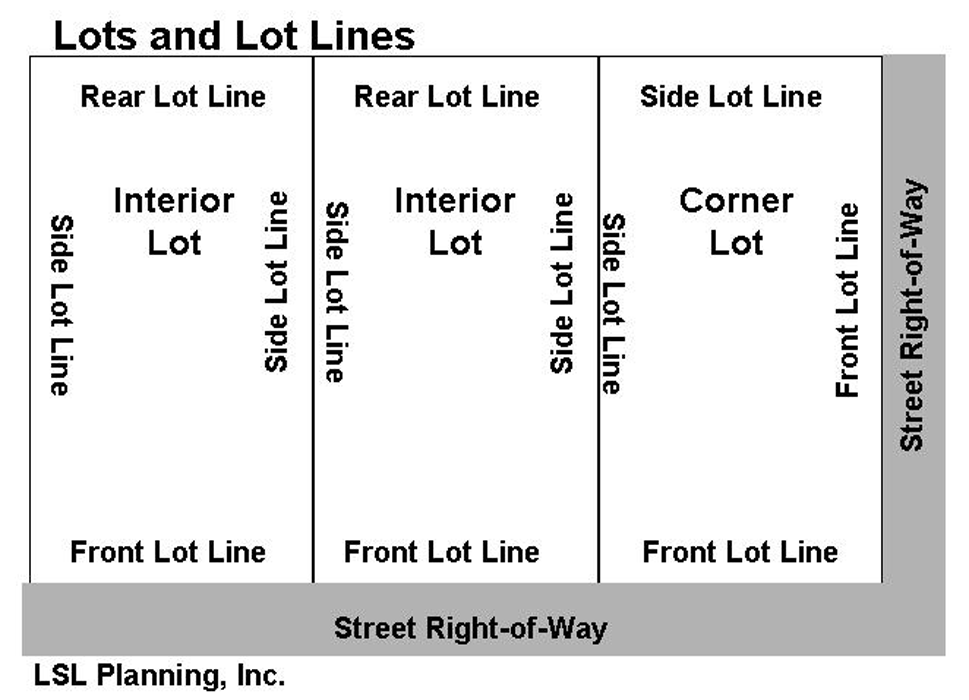
Lots and Lot Lines
(1)
Front: A lot line of a length equal to or greater than the minimum lot width as required in this chapter; the road right-of-way line on interior lots which fronts a public or private road; one of the right-of-way lines on corner lots which is the lot line most parallel to the closest public or private road on all other lots.
(2)
Rear: The lot line opposite and most distant from the front lot line; or in the case of a triangular or otherwise irregularly shaped lot, a line 20 feet entirely within the lot parallel to and at a maximum distance from the front lot line.
(3)
Side: Any lot line other than a front or rear lot line.
(Ord. No. 04-07, § 1(2.12), 7-12-2004; Ord. No. 24-02, § 3, 6-10-2024)
Sec. 82-53. - Definitions "M."
Main building: The primary building in which the principal use of a parcel is conducted.
Major thoroughfare: Major street as defined by the Village Act 51 Map. In addition, streets carrying relatively high traffic volumes in serving one or more of the following may be considered for addition to the major street system:
(1)
Streets that provide extensions to state trunk lines or county primary roads in facilitating through traffic.
(2)
Streets that provide an integral network to service the traffic demands created by industrial, commercial, educational, or other traffic-generating centers.
(3)
Streets that provide for the circulation of traffic in and around the central business district.
(4)
Streets that are designated as truck routes.
(5)
Streets that collect traffic from an area served by an extensive network of local streets.
Manufactured home: A manufactured home is a structure transportable in one or more sections, eight body feet or more in width and 32 body feet or more in length, and which is built on a permanent chassis and designed to be used as a dwelling, with or without permanent foundation, when connected to required utilities and including plumbing, heating and electrical stems contained therein.
Manufactured home development or manufactured home park: A parcel of land owned by a person upon which are located two or more manufactured homes whether attached or detached from each other or adjacent buildings which are occupied for residential purposes or are connected to a water supply or wastewater disposal system either on a temporary or permanent basis, regardless of whether or not the development offers rental lots or manufactured homes to the public.
Massage: A method of treating the external parts of the body for remedial or hygienic purposes by rubbing, stroking, kneading, adjusting or tapping with the hand or an instrument. "Massage" does not include therapy that is a means employed in the cure of disease, the management of disease or of diseased parts.
Massage (licensed): Any individuals who are licensed through the State of Michigan having a fixed place of business where massages are administered for pay who meet one or more of the following criteria:
(1)
Proof of graduation from a school of massage licensed by the state;
(2)
Official transcripts verifying completion of at least 300 hours of massage training from an American community college or university; plus three references from massage therapists who are professional members of a massage association referred to in this section;
(3)
Certificate of professional membership in the American Massage Therapy Association, International Myomassethics Federation, or any other recognized massage association with equivalent professional membership standards; or
(4)
A current occupational license from another state.
Master plan: The statement of policy adopted by the planning commission. It is the officially adopted guidelines for future community development. The plan shall consist of a series of maps, charts and written material.
Medical marihuana facility: A marihuana facility as defined in the Medical Marihuana Facilities Licensing Act, PA 281 of 2016 (MCL 333.27101 et seq.), as amended.
Multiple family development: Two or more buildings containing multiple-family dwellings on a single lot.
Municipal water supply: A water supply system owned by a municipality, county, the State of Michigan, or an authority or commission comprised of these governmental units.
(Ord. No. 04-07, § 1(2.13), 7-12-2004; Ord. No. 05-07, § 1, 7-11-2005; Ord. No. 11-06, § 1, 7-11-2011; Ord. No. 23-07, § 1, 8-14-2023)
Sec. 82-54. - Definitions "N."
Nonconforming:
(1)
Building: A building or portion thereof lawfully existing at the effective date of this chapter or amendments thereto, and which does not conform to the provisions of the chapter in the zoning district in which it is located.
(2)
Lot of record: A platted lot that conformed with all village zoning requirements at the time of recording of the plat, which no longer conforms to the zoning regulations and requirements for lot area, lot width, or both; or a lot outside a recorded plat that conformed with all village zoning requirements at one time, and which has not been subdivided or reduced in size subsequent to the time it did conform to the zoning chapter, which no longer conforms with the zoning requirements for lot area, lot width, or both.
(3)
Use: A use which lawfully occupied a building or land at the effective date of this chapter or amendments thereof, and that does not conform to the use regulations of the zoning district in which it is located.
Nursery: A parcel of land utilized for the purpose of growing ornamental trees, shrubbery, houseplants, flowers, or perennial ground covers from seed or seedlings for the purpose of retail or wholesale trade.
(Ord. No. 04-07, § 1(2.14), 7-12-2004)
Sec. 82-55. - Definitions "O."
Occupancy certificate: A written document received from the building inspector stating that the village building code, as amended, and this chapter have been complied with as they apply to the construction of a building or structure and the use of a lot and that the building may now be occupied for its previously declared purpose.
Occupy: The residing of an individual or individuals overnight in a dwelling unit, or the installation, storage, or use of equipment, merchandise or machinery in any institutional, commercial, agricultural, or industrial building.
Open space, common: Open space which is held for the collective use and enjoyment of the owners, tenants, or occupants of a development that may or may not be available for the use of the public.
Owner: The owner of the freehold of the premises or lesser estate in the premises, a mortgagee or vendee in possession, an assignee of rents, receiver, executor, trustee, leasee, or any other person, sole proprietorship, partnership, association, or corporation directly or indirectly in control of a building, structure, or real property or his or her duly authorized agent.
(Ord. No. 04-07, § 1(2.15), 7-12-2004)
Sec. 82-56. - Definitions "P."
Park: A parcel of land, building or structure used for recreational purposes including but not limited to playgrounds, sport fields, game courts, trails, picnicking areas, and leisure time activities.
Permit: An official document or certificate issued by an authorized official, empowering the holder thereof to perform a specified activity which is not prohibited by law, but not allowed without authorization.
Personal service establishments: Uses performing services on the premises, such as, but not limited to, tailors, beauty and barber shops, interior decorators, photographers, dry cleaners, physical therapy, or professional medical/mental counseling services.
Planned unit development: The use of a parcel of land which is planned and developed as a single entity containing the various uses, structures, open spaces, and other elements and which is designated and developed under one owner or organized group.
Porch:
(1)
Enclosed: A covered entrance to a building or structure that is totally enclosed, and projects out from the main wall the building or structure and has a separate roof or an integrated roof with the main building or structure to which it is attached.
(2)
Open: A covered entrance to a building or structure that is unenclosed except for columns supporting the porch roof, and projects out from the main wall of the building or structure to which it is attached.
Principal use: The primary or predominant purpose to which a parcel of land is devoted as distinguished from an accessory use.
Public and private sanitary sewer, storm sewer, and water:
(1)
Private sanitary sewage disposal system: An individual on-site sewage disposal system as defined in the Kent County Health Department Sanitary Code.
(2)
Private water supply: A well or other water supply system approved by the Kent County Health Department pursuant to Part 127 of Act 368 of the Public Acts of 1978, as amended, MCL 333.12701 et seq.
(3)
Public sanitary sewer: A system of pipe owned and maintained by a governmental unit used to carry human, organic and industrial waste from the point of origin to a point of treatment or discharge.
(4)
Public storm sewer: A system of pipe owned and maintained by a governmental unit, used to carry storm water collected from multiple sources including streets, downspouts, and parking lots to a discharge point. Discharge points include, but are not limited to, a lake, river or tributary, and retention or detention ponds.
(5)
Public water supply: A water works system which provides water for drinking or household purposes to persons other than the supplier of water, except those water works systems which supply water to only one living unit, or as further defined in Public Act 399 of 1976, as amended, MCLA 325.1001 et seq.
(Ord. No. 04-07, § 1(2.16), 7-12-2004)
Sec. 82-57. - Definitions "R."
Recreational marihuana establishment: A marihuana establishment as defined in the Michigan Regulation and Taxation of Marihuana Act, IL 1 of 2018 (MCL 333.27951 et seq.), as amended. This also term includes designated consumption establishments, temporary marihuana events, and any other specialty license type authorized by the state cannabis regulatory agency or its successor agency.
Recreational marihuana retailer: A marihuana retailer as defined in the Michigan Regulation and Taxation of Marihuana Act, IL 1 of 2018 (MCL 333.27951 et seq.), as amended.
Recreational marihuana safety compliance facility: A marihuana safety compliance facility as defined in the Michigan Regulation and Taxation of Marihuana Act, IL 1 of 2018 (MCL 333.27951 et seq.), as amended.
Recreational marihuana secure transporter: A marihuana secure transporter as defined in the Michigan Regulation and Taxation of Marihuana Act, IL 1 of 2018 (MCL 333.27951 et seq.), as amended.
Recreational vehicle: A vehicle or equipment intended for temporary or periodic use for recreational or leisure pursuits. These vehicles shall include boats, airplanes, special purpose automobiles, floats, rafts, trailers, snowmobiles, camping or travel trailers, motorized homes, detachable travel equipment of the type adaptable to light trucks, and other equipment or vehicles of a similar nature.
Rehabilitation: The upgrading of an existing building or part thereof that is in a dilapidated or substandard condition.
Repair: The reconstruction or renewal of any part of an existing building for the purpose of maintenance.
Research and development facility: Any facility that is involved in the inquiry, examination, investigation or experimentation aimed at the discovery and/or interpretation of facts, revision of accepted theories or laws in the light of new facts, or practical application of such new or revised theories of laws and the development thereof. Development may include a limited number of test units of a given product resulting from such research and shall include limited production while a product is being test-marketed, which is the interim step between full research and development and ultimate full-scale production.
Restoration: The reconstruction or replication of an existing building's original architectural features.
Right-of-way: A public or private strip of land acquired or utilized by reservation, dedication, easement, prescription, purchase or condemnation and permanently established for the passage of persons, vehicles, railroads, water, utility lines, and similar uses.
Rooftop solar system: A device or devices connected in a system that is structurally mounted to the roof of a building or structure containing one or more solar panels with receptive cells the purpose of which is to convert solar energy into usable electrical energy.
(Ord. No. 04-07, § 1(2.17), 7-12-2004; Ord. No. 23-07, § 2, 8-14-2023; Ord. No. 25-04, § 3, 12-15-2025)
Sec. 82-58. - Definitions "S."
Satellite dish antenna, or dish antenna: An apparatus capable of receiving communications from a transmitter or a transmitter relay located in planetary orbit.
Setback: The minimum required horizontal distance measured from the front, side, or rear lot
line, as the case may be, which describes an area termed the building setback on a
lot or parcel required by this chapter for the district in which it is located.
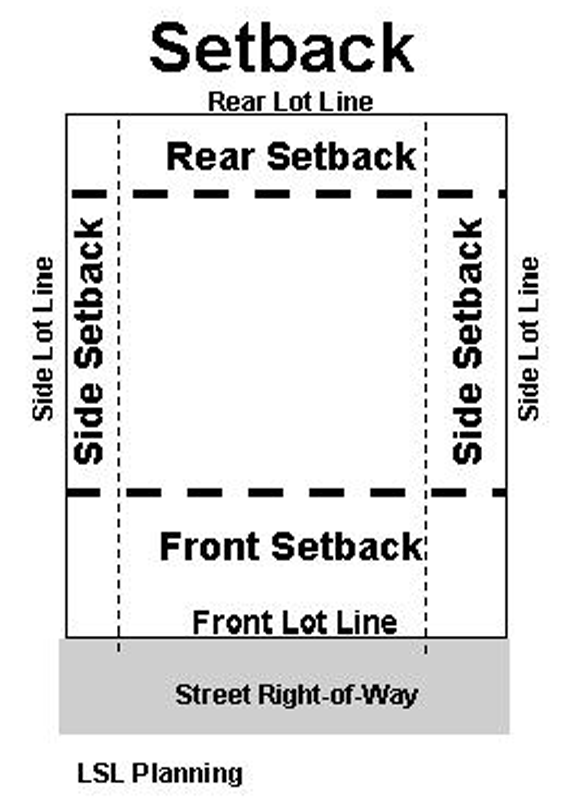
Setback
(1)
Setback, front: The minimum required horizontal distance measured from the front lot line which describes an area termed the front building setback on a lot or parcel required by this chapter for the district in which it is located.
(2)
Setback, rear: The minimum required horizontal distance measured from the rear lot line which describes an area termed the rear building setback on a lot or parcel required by this chapter for the district in which it is located.
(3)
Setback, side: The minimum required horizontal distance measured from the side lot lines which describes an area termed the side building setback on a lot or parcel required by this chapter for the district in which it is located.
Sign: Any device designed to inform or attract the attention of persons not on the premises on which the sign is located, and conforming to the Village of Sparta's sign chapter.
Solar panel—Rooftop: A solar energy collection device attached to or supported by the roof of a building or structure. See also rooftop solar system.
State licensed residential facility: A residential care family or group facility licensed by the State of Michigan under Act 287 of 1972 of the Public Acts of Michigan, as amended, or Act 116 of 1973 of the Public Acts of Michigan, as amended, which provides resident care services under 24-hour supervision or care for persons in need of that supervision or care. This term does not include facilities licensed by the State of Michigan for care and treatment of persons released from or assigned to adult correctional institutions.
(1)
Family: A state licensed residential facility providing resident services to six or fewer persons.
(2)
Group: A state licensed residential facility providing resident services to more than six persons.
Stop work order: An administrative order which is either posted on the property or mailed to the property owner which directs a person not to continue, or not to allow the continuation of an activity which is in violation of this chapter.
Street:
(1)
Private: A privately owned thoroughfare including any rights-of-way and traveled surfaces which afford traffic circulation and principal means of access to abutting property, including avenue, place, way, drive, lane, boulevard, highway, road, path, trail and other thoroughfare. A private road shall include a way open to provide the primary means of ingress and egress established as a separate tract for the benefit of two or more parcels or two or more principal buildings, dwelling units, or other structures. An existing private road is a private road of a private road system which is used to provide access to existing lots, building or dwelling units as of the effective date of this section. This definition shall not apply to driveways.
(2)
Public: A public thoroughfare including any rights-of-way and traveled surfaces that afford traffic circulation and principal means of access to an abutting property, including avenue, place, way, drive, lane, boulevard, highway, road, and other thoroughfare, except an alley.
Structural alterations: Any change in the supporting members of a building such as bearing walls, columns, beams or girders, or in the dimensions or configurations, or of the roof and exterior walls or means of egress.
Structure: A combination of materials whether fixed or portable, anything constructed, erected, or artificially built-up which requires a location on or below the surface of land or water, including a part or parts thereof and all equipment within the structure.
Subdivision: Subdivision means the partitioning or splitting of a parcel or tract of land by the proprietor thereof or by his or her heirs, executors, administrators, legal representatives, successors, or assigns for the purpose of sale, or lease of more than one year, or of building development that results in one or more parcels of less than 40 acres or the equivalent, and that is not exempted from the platting requirements of the Land Division Act, Act 288 of 1967 of the Public Acts of Michigan, as amended. "Subdivide" or "subdivision" does not include a property transfer between two or more adjacent parcels, if the property taken from one parcel is added to an adjacent parcel; and any resulting parcel shall not be considered a building site unless the parcel conforms to the requirements of this act or the requirements of the Village of Sparta Land Division chapter.
Subdivision plat: A map or chart depicting the subdivision of land as regulated by the Land Division Act of 1967, Act 288 of the Public Acts of 1967, as amended.
Substantial improvement: Any repair, reconstruction or improvement of a structure, the cost of which equals or exceeds 50 percent of the market value of the structure either before the improvement or repair is started, or if the structure has been damaged and is being restored, before the damage occurred.
(1)
For the purposes of this definition, substantial improvement is considered to occur when the first alteration of any wall, ceiling, floor, or other structural part of the building commences, whether or not that alteration affects the external dimensions of the structure.
(2)
The term does not, however, include either any project for improvement of a structure to comply with existing state or local health, sanitary or safety code specifications which are solely necessary to assure safe living conditions or any compatible alteration of a structure listed on the National Register of Historic Places or a state inventory of historic places.
Swimming or bathing pool: A nonporous container containing water having a depth of greater than 24 inches or having a surface area of greater than 250 square feet, or a pool permanently equipped with a water recirculating system or constructed of structural materials, excepting retention or detention ponds.
(Ord. No. 04-07, § 1(2.1)8, 7-12-2004; Ord. No. 25-04, § 4, 12-15-2025)
Sec. 82-59. - Definitions "T."
Tower, communication: Towers erected for the purpose of providing commercial wireless telecommunication services or other radio wave communications.
Travel trailer: A vehicular portable structure built on a chassis which is less than 32 feet in length and is of a width and weight that does not require special highway movement permits when drawn by a vehicle.
(Ord. No. 04-07, § 1(2.19), 7-12-2004)
Sec. 82-60. - Definitions "U."
Use: The purpose or activity for which land or structures are designed, arranged, or intended, or for which land or structures are occupied or maintained.
Useable floor area (UFA): See Floor area, useable.
(Ord. No. 04-07, § 1(2.20), 7-12-2004)
Sec. 82-61. - Definitions "V."
Variance:
(1)
Nonuse: Permission given by the zoning board of appeals to a property owner to depart from the literal requirements of this chapter which may occur when conditions related to the property create a practical difficulty on the property owner.
(2)
Use: Permission given by the zoning board of appeals to a property owner to use the property for a use not otherwise permitted in the district in which the lot is located when conditions related to the property create an unnecessary hardship on the property owner.
Vehicle: Every device in, upon, or by which any person or property is or may be transported or drawn upon a highway, or road, excepting devices moved by human power or used exclusively upon stationary rails or tracks.
Vehicle repair (major): Any major activity involving the general repair, rebuilding or reconditioning of motor vehicles, engines, or trailers; collision services, such as body, frame, or fender straightening and repair; overall painting and vehicle rust-proofing; lot refinishing or steam cleaning.
Vehicle repair (minor): A place with or without the sale of petroleum products (excluding gasoline and diesel fuel for motor vehicles), where the following services may be carried out such as minor repairs, incidental replacement of parts, or motor service to passenger automobiles and trucks not exceeding three tons gross vehicle weight; provided, however, there is excluded any repair or work included in the definition of Vehicle repair (major).
Vehicle service station: A building and lot or parcel designed or used for the retail sale of fuel, lubricants, air, water or other operating commodities for motor vehicles (including trucks, aircraft and boats) and including the customary space and facilities for the installation of these commodities on or in vehicles and including space for storage, hand washing, minor repair, and servicing, but not including vehicle repair as defined in this chapter.
Vehicle wash establishment: A building, or portion thereof, the primary purpose of which is that of washing motor vehicles.
Veterinary hospital, clinic, and indoor kennel: Any activity involving the permanent or temporary keeping or treatment of animals operated as a business.
Village: Means the Village of Sparta, Michigan.
Village building code: The duly adopted building code of the Village of Sparta.
Village council, or council: The legislative body of the Village of Sparta, Michigan.
(Ord. No. 04-07, § 1(2.21), 7-12-2004)
Sec. 82-62. - Definitions "W."
Wall: The vertical exterior surface of a building and the vertical interior surfaces which divide a building's space into rooms.
Watercourse: An open trench either naturally or artificially created which periodically or continuously contains moving water draining an area of at least two acres which has definite banks, a bed and visible evidence of a continued flow or occurrence of water.
Wetland: An area that is inundated or saturated by surface water or groundwater at a frequency and duration sufficient to support, and that, under normal circumstances, does support, a prevalence of vegetation typically adapted for life in saturated soil conditions, commonly known as hydrophytic vegetation.
Wind energy turbine: Definitions pertaining to wind energy turbines are located within article X of this chapter.
(Ord. No. 04-07, § 1(2.22), 7-12-2004; Ord. No. 12-07, § 1, 4-9-2012)
Sec. 82-63. - Definitions "Y."
Yard: A yard is an open space on the same land with a building or group of buildings, which open space lies between the building or group of buildings and the nearest lot line and is unoccupied and unobstructed from the ground upward, except as otherwise provided herein. Figures 1 & 2 below shows the visual depiction of yard definitions.
(1)
Front: The open space extending the full width of the lot, the uniform depth of which is measured at right angles to the front lot line. On a corner lot the front yard shall be the yard separating the narrowest street frontage from the street.
(2)
Secondary front: On a corner lot, the secondary front yard faces the lot's secondary street. The secondary front yard includes the area from the lot line abutting the secondary street to the face of the building and from the front line of the building (boundary of the front yard) to the rear lot line. If the property access is on the secondary side yard and the architectural elements of the home indicate a different intended front yard orientation the zoning administrator may designate the secondary front yard as the front yard and the front yard as the secondary front yard on the lot.
(3)
Rear: The open area extending across the full width of the lot, the uniform depth of which is measured at right angles to the rear lot line.
(4)
Side: The open unoccupied area between a main building and the side lot lines, extending from the front yard area to the rear yard area. The width of the side yard shall be measured horizontally from and at right angles to the nearest point of the side lot line.
Figure 1 (Corner Lot)
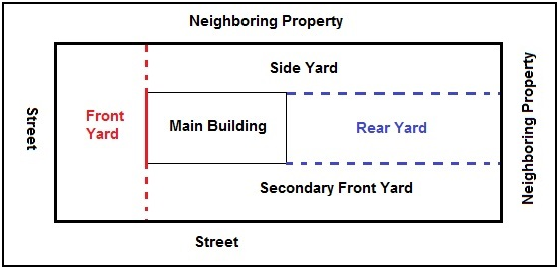
Figure 2 (Regular Lot)
Figure 2 (Regular Lot>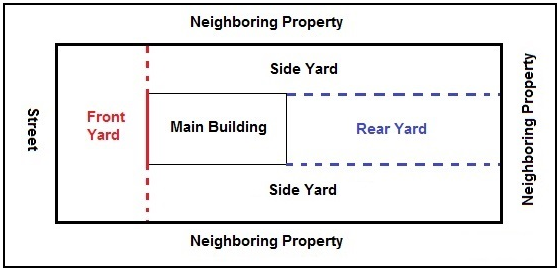
(Ord. No. 04-07, § 1(2.23), 7-12-2004; Ord. No. 17-03, § 1, 10-9-2017)
Sec. 82-64. - Definitions "Z."
Zoning: The dividing of the village into districts of a number and shape considered best suited to carry out the purposes of the Zoning Act and the creation of uniform regulations throughout each individual district.
Zoning act: The Michigan Zoning Enabling Act, Public Act 110 of 2006, of the State of Michigan, as amended.
Zoning administrator: The public official whose duty is to administer and enforce this chapter.
Zoning board of appeals or board: The zoning board of appeals for the Village of Sparta as provided in the Zoning Act.
Zoning chapter: The Village of Sparta Zoning chapter or this chapter.
(Ord. No. 04-07, § 1(2.24), 7-12-2004; Ord. No. 06-02, § 1, 8-14-2006)

