
Sparta City Zoning Code
ARTICLE VII
SIGNS9
Editor's note— Ord. No. 07-03 § 1, adopted May 14, 2007, amended art. VII in its entirety and enacted similar provisions as set out herein. The former art. VII derived from Ord. No. 04-11 § 3(Att. C), adopted Oct 11, 2004.
Sec. 82-501.- Purpose and intent.
(a)
The purpose of this article is to promote traffic safety, public safety, and the conservation of property values through the application of reasonable controls over the use, size, placement, and general appearance of signs.
(b)
The regulations contained in this article involve recognition that the individual user's right to convey a message must be balanced against the public's right to be free of signs which unreasonably compete, distract drivers and pedestrians, and produce confusion. In balancing the individual user's desire to attract attention with the citizens' right to be free of unreasonable distractions, it is recognized that sign regulations provide business with equal opportunity to attract the public. However, oversized, projecting or crowded signs can lead to pedestrian and driver confusion and distraction, and endanger the public health, safety and welfare.
(c)
It is further recognized that:
(1)
Signs should be able to reasonably convey their message;
(2)
Users of property should have reasonable freedom to determine the placement, construction, size, and design of signs as well as the location of buildings; and
(3)
Sign needs may vary based on particular circumstances.
(d)
It is further recognized that regulations for signs, especially number, size and placement, are desirable in order to:
(1)
Prevent or limit traffic or pedestrian accidents, injuries, deaths, and property damages resulting from obstructed vision, distraction or confusion to the public or to emergency safety personnel;
(2)
Minimize the risk of damage and injuries from signs that are dilapidated, windblown, electric shock hazards, etc.;
(3)
Achieve some uniformity in the size, number and placement of signs;
(4)
Enhance the aesthetics of the village;
(5)
Prevent blight;
(6)
Encourage equality among business and property, and;
(7)
Otherwise protect the public health, safety, peace and general welfare.
(8)
The purpose of this ordinance does not include the regulation of the content or any information included on the sign, expect that information such as a street address which may be required for the purposes of public safety.
(Ord. No. 07-03, § 1, 5-14-2007; Ord. No. 18-05, § 1, 2-12-2018)
Sec. 82-502. - Definitions.
The following definitions refer to this article and are placed here for convenience. Section 82-42 shall be used for the purpose of interpreting the following definitions.
(1)
Sign. Every individual announcement, declaration, demonstration, display, illustration, insignia, surface or space when erected or maintained in view of the general public for identification, advertisement or promotion of the interests or idea of any person or group of persons.
(2)
Sign types.
a.
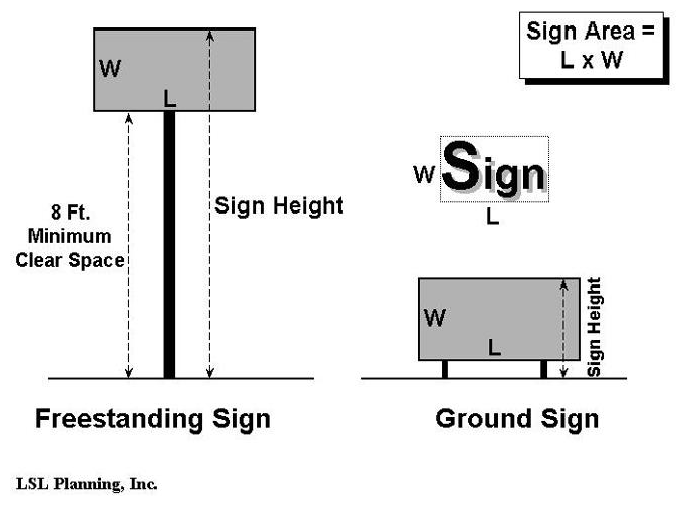
Freestanding. A sign which is supported by a structure, poles, or braces which are less than 50 percent of the width of the sign, with all parts of the display surface of the sign eight feet or more above the grade at the base of the sign.
b.
Ground. A sign supported by a base which rests directly on the ground. The width of the base shall be at least 50 percent of the width of the sign in order to be a ground sign.
c.
Marquee. A sign attached to or hung from the underside of a marquee, awning, canopy, or other covered structure projecting from and supported by a building and does not project horizontally beyond or vertically above said marquee, awning, canopy, or covered structure.
d.
Portable. A type of temporary sign that is not permanent, and not affixed to a building, structure or the ground, including signs supported on mobile chassis other than motor vehicles.
e.
Projecting. A sign attached directly to the building wall, extending more than 15 inches but not more than five feet from the face of the wall.
f.
Roof. A sign erected, constructed and maintained upon or above the roof of a building, or parapet wall and which is wholly or partially supported by the building.
g.
Wall. A sign that is attached directly to a wall, mansard roof, roof overhang, parapet wall, or above a marquee of a building with the exposed face of the sign in a place parallel to the building wall or to the surface on which it is mounted, and which projects not more than 12 inches from the building or structure wall, and which does not have any part of such sign or sign supports extending above the roof lines.
h.
Vehicle and pedestrian safety. Signs that do not exceed four square feet in area of three feet in height, essential to the safe movement of vehicles and pedestrians.
i.
Awning. Letters, numerals or other drawings painted on, printed on, or attached flat against the surface of an awning or canopy.
j.
Balloon and inflatable. Any three-dimensional object, including a tethered balloon, capable of being filled with air or gas depicting a container, figure, product or product trademark, whether or not such object contains a message or lettering.
k.
Banner, flag, flutter flag, and feather flag. A portable sign of fabric, nylon, plastic, or other non-rigid material without an enclosing structural framework, attached to or hung from a pole or rope, or to a building or structure.
l.
Pennant. A flag or cloth that tapers to a point.
m.
Festoons. A string of ribbons, tinsel, flags, pennants, or pinwheels.
n.
Streamer. A long, narrow strip of material used a decoration or symbol.
o.
Permanent. A sign installed on a support structure which is not intended or designed to be moved or removed, but to remain for an indefinite period of time.
p.
Wire frame. A temporary sign made of corrugated plastic, vinyl, cardboard, poster board or similar material which is supported by or attached to a metal frame.
q.
Reader board. A portion of a sign on which copy is changed manually.
r.
Electronic message display. A sign that uses changing lights or other electronic media to form a sign message wherein the sequence of messages and the rate of change is electronically programmed and can be modified by an electronic process.
s.
Government. A sign erected or required to be erected by the Village of Sparta, Kent County, the State of Michigan, or the federal government.
t.
Temporary sign. A display, informational sign, or other message device with or without a structural frame and intended for a limited period of display, as specified herein.
u.
Sidewalk and A-frame. A portable sign designed to be placed on the sidewalk in front of the use to which it relates. This sign is also called a sandwich board sign.
v.
Window. A sign installed on the interior or exterior of a window and intended to be viewed from the outside.
(23)
Vehicle. A sign painted on, incorporated in, or attached directly to any mode of transportation, including but not limited to automobiles, trucks, boats, trailers, semi-trailers, or airplanes.
w.
Video display. A sign which changes its message or background in a manner characterized by moving images of a television quality, and may include a progression of frames which give the illusion of motion, including the illusion of moving objects, moving patterns or bands of light, or expanding or contracting shapes. Video display signs include projected images or messages with these characteristics onto buildings or other objects.
(3)
Display area. The entire area enclosing the extreme limits or writing, lighting, representation, emblem or any figure of similar character, together with any frame or other material forming an integral part of the display or used to differentiate the sign from the background against which it is placed; excluding the necessary supports or uprights on which such sign is placed (see subsection 82-503(b)).
(4)
Roof line. The uppermost line of the roof of a building or, in the case of an extended facade, the uppermost height of that facade.
(5)
Sign setback. The minimum linear distance measured from the street right-of-way line to the nearest part of the sign or message structure.
(6)
Nit means a unit of luminance (brightness) equal to one candela (12.5 lumens or 1.16 foot candles) per square meter, measured perpendicular to the rays of the source.
(Ord. No. 07-03, § 1, 5-14-2007; Ord. No. 18-05, § 1, 2-12-2018)
Sec. 82-503. - General provisions related to signs.
(a)
Permits.
(1)
No sign shall be erected, replaced, structurally altered, enlarged, illuminated, changed in purpose, or relocated without first obtaining a sign permit pursuant to this article, except those signs specifically exempted by subsection (d).
(2)
An application for a sign permit shall be made to the village clerk, by the owner of the property on which the sign is proposed to be located or by his or her agent, or lessee.
(3)
The zoning administrator shall review all properly filled out applications for sign permits and issue permits on for those applicants fully meeting the criteria established in this article and the village building code. The zoning administrator shall approve or reject the application within a reasonable time after receipt of a completed application submittal.
(4)
A schedule of permit fees shall be established and may be amended from time to time by resolution of the village council.
(b)
Determination of display area and height.
(1)
Except as noted in subsections (3) and (4) below, the display area permitted for any sign shall be determined as the entire area within a square, rectangle, circle, triangle or parallelogram enclosing the extreme limits or writing, lighting, representation, emblem or any figure of similar character, together with any frame or other material forming an integral part of the display or used to differentiate the sign from the background against which it is placed; excluding the necessary supports or uprights on which such sign is placed.
(2)
Where a sign has two or more faces, the area of all faces shall be included in determining the area of the sign; except that where two such faces are placed back to back and are at no point more than three feet from one another, the area of the sign shall be taken as the area of one face if the two faces are of equal area, or as the area of the larger face if the two faces are of unequal area.
(3)
The display area of signs painted directly on building wall surfaces shall be limited to that area within a circle, square, rectangle, triangle, or parallelogram enclosing the extreme limits of writing, letters or numbers.
(4)
The height of a sign shall be measured to the maximum vertical distance from the uppermost extremity of a sign or sign support to the average ground level at the base of the sign. Berms or other supporting measures for any sign shall be included in the computation for height.
(5)
Buildings with multiple tenants.
a.
The sign areas for wall signs, marquee signs, projecting signs, and awning signs shall be determined by taking that portion of the front wall of the building, applicable to each tenant space, and computing sign requirements for that portion of the total wall.
b.
For a building located on a corner lot, the wall area of the tenant space along the side portion of the building shall be used to calculate the sign area for a second wall sign, awning sign, or projecting sign.
c.
Each sign shall be attached to the same wall which is used to determine its size.
(c)
Prohibited signs.
(1)
Any sign not expressly permitted is prohibited, including all signs noted in this subsection.
(2)
Roof signs. For the purpose of this article, a sign that is mounted on a mansard roof, roof overhang, parapet wall, above a marquee, or on a wall with a roof below shall not be considered as a roof sign, but shall instead be considered as a wall sign for that side of the building, provided that no part of such sign extends above the uppermost building line not including chimneys, flag poles, electrical, mechanical equipment, TV antennas and other similar equipment and extensions.
(3)
Flashing, moving, oscillating, blinking, or variable-intensity light or intermittent lights resembling the flashing lights customarily used in traffic signals, or police, fire, ambulance, or rescue vehicles, or lights so bright as to be blinding or distracting to a vehicle driver.
(4)
A sign having any moving or animated parts or that have the appearance of moving or animated parts. This shall not be construed to prohibit signs with manually changed letters, such as those used for reader boards or other similar signs. Video signs as defined herein are prohibited.
(5)
A sign using words, phrases, symbols, or characters, in such a manner as to interfere with, mislead, or confuse a vehicle driver.
(6)
Any sign which obstructs the ingress or egress from a required door, window, or other required exit.
(7)
Signs located in the right-of-way of public streets or highways, except as may otherwise be permitted by this chapter.
(8)
Any sign displaying obscene material.
(d)
Signs exempt from the requirements of this chapter. The following signs are permitted with permission of the landowner without a written sign permit and, are not subject to the requirements of this chapter:
(1)
Government signs five square feet or less erected on government property or in the public right-of-way.
(2)
Any sign two square feet or less in size and no more than four feet in height, except electronic message displays. No more than three such signs shall be permitted on one parcel, and shall not be erected in the public or private right-of-way.
(3)
Flags of any nation, state, city, township, government, or government authorized agency. Such flags shall only be displayed on a flag pole and shall not be erected in the public or private road right-of-way. If any flag shares the same pole as the United States flag, the United States flag shall be the largest flag, and any other flag shall be placed below the United States flag.
(4)
Balloon and inflatable signs which are 12 inches or less in diameter.
(5)
In no case shall a sign exempt under this section be permitted on public property without permission from the appropriate government agency.
(e)
Signs exempt from sign permits. The following signs and activities are permitted with permission of the landowner without a written sign permit, subject to the applicable requirements of section 82-506.
(1)
Temporary signs of six square feet or less.
(2)
Ordinary maintenance of signs such as painting and cleaning.
(3)
Changing of sign message. Any non-commercial speech may be substituted for commercial speech on a sign, and any commercial speech may be substituted for non-commercial speech on a sign, subject to the regulations for signs contained herein.
(4)
Traffic-control, directional, warning, or informational signs when authorized by a public agency having appropriate jurisdiction that conforms to the requirements of the Michigan Manual of Uniform Traffic Control Devices.
(f)
Responsibility and removal.
(1)
All signs located in the village shall be erected, altered, and maintained at the risk of the owner thereof, who shall assume full responsibility for consequences of damage caused thereby.
(2)
Any sign erected, altered or maintained shall, upon a determination by the building inspector that such sign is unsafe or not properly maintained, be removed by the owner of the building, structure, or property upon which such sign is located, within 30 days of receipt of written notice by the zoning administrator.
(Ord. No. 07-03, § 1, 5-14-2007; Ord. No. 18-05, § 1, 2-12-2018)
Sec. 82-504. - Signs permitted in any zoning district.
(a)
Temporary signs subject to the following:
(1)
A temporary sign may be installed concurrent with the event to which the sign relates, and shall be removed upon the conclusion of the event. The zoning administrator shall have the discretion to determine the beginning and the conclusion of the event.
(2)
The zoning administrator shall have the discretion to determine when a temporary sign is a permanent sign, subject to the regulations for permanent signs in each zoning district.
(3)
Signs held by a person, and the person holding the sign, shall be located outside the public or private road right-of-way, and shall not hamper the visibility of a driver on or off the parcel.
(4)
Temporary banner, flag, feather and flutter flags not to exceed one such sign per parcel are allowed in the R-4 single-, two-family, and multiple family districts, O-office district, GC-general commercial, CBD-central business district, LI-light industrial district, and in mixed use, commercial, and industrial-PUD zoning districts, subject to the following:
a.
Each banner, flag, feather or flutter flag sign shall not exceed 20 square feet in size and eight feet in height. The sign may be displayed in conjunction with other temporary and permanent signs as allowed within each zoning district. A permit shall be required for the display of a temporary banner, flag, feather or flutter flag.
b.
A temporary banner, flag, feather or flutter flag sign shall be displayed for a maximum of ten days per calendar month for a maximum of 120 days in a calendar year. An application provided by the village and signed by the applicant shall list the specific days, or the span of consecutive days, during which the sign will be displayed, and also the date or dates on which the sign shall be removed during the calendar year. An application shall be effective within one calendar year only, regardless of when the first application for sign display is approved.
c.
If a banner, flag, feather or flutter flag sign is displayed on days outside of the approved permit the zoning administrator shall reduce the number of days the sign is permitted to be displayed during the next requested period of display by the same number of days by which the sign exceeded the number of days listed on the approved application. Example: If a sign is displayed three days longer than the number of days listed on the approved application the zoning administrator shall reduce the next requested period of display by three days. The zoning administrator shall provide notice of such reduction in writing to the holder of the temporary sign permit.
d.
All temporary banner, flag, feather or flutter flag signs shall be properly maintained but shall be removed if they become torn, faded, unreadable, or otherwise unsightly at the discretion of the zoning administrator.
(5)
Portable temporary signs supported on mobile chassis other than motor vehicles.
a.
One portable sign without illumination not larger than 32 square feet in size, upon obtaining a permit, is permitted on a parcel within the O-office district, GC-general commercial, CBD-central business district, LI-light industrial district, and in mixed use, commercial, and industrial-PUD zoning districts, provided that, the sign is located on the parcel that it serves for not more than 30 consecutive days and not more than four times in any calendar year.
b.
The setbacks required for portable signs supported on mobile chassis other than motor vehicles shall be as required for temporary signs as required by section 82-506.
c.
A permit shall be required for the display of a portable sign supported on mobile chassis other than motor vehicles.
(6)
Pennants, festoons and streamers are allowed in the R-4 single-, two-family, and multiple family districts, O-office district, GC-general commercial, CBD-central business district, LI-light industrial district, and in mixed use, commercial, and industrial-PUD zoning districts provided they are properly maintained but shall be removed if they become torn, faded, unreadable, or otherwise unsightly at the discretion of the zoning administrator. They may be displayed in conjunction with other temporary and permanent signs. A permit shall be required for the display of these items.
(7)
A sidewalk or A-frame sign is permitted only on property zoned GC-general commercial and the CBD-central business district, subject to the following:
a.
The sign shall not obstruct sidewalks, driveways, rights-of-way, or site visibility areas. The sign may be placed in the right-of-way of streets in the CBD-central business district at the discretion of the zoning administrator.
b.
One sign is permitted for each public entrance to an establishment, not to exceed the number or temporary signs permitted by this chapter.
c.
Signs shall be placed directly in front of the business using the sign, and no closer than one foot and no further than three feet from the street curb. A minimum of five feet of sidewalk width shall remain to permit the free flow of pedestrian traffic.
d.
The sign shall be a maximum of four feet in height, and shall be no wider than two feet between each sign face. The sign shall be a maximum of eight square feet per side.
e.
Operation of the temporary sign is limited to normal hours of operation for the use.
(7)
Only two temporary signs shall be permitted on a lot or parcel or as otherwise permitted by this chapter.
(8)
No temporary sign shall be closer than five feet from the right-of-way of any public or private street, except for sidewalk or A-frame signs as regulated by section 82-504(a)(7) and temporary signs as regulated by section 82-506.
(9)
All temporary signs requiring a sign permit shall be designed and constructed to withstand a wind pressure of not less than 30 pounds per square foot of area.
(b)
Vehicle and pedestrian safety. Signs essential to the safe movement of vehicles and pedestrians are permitted for each parcel provided the size of each sign does not exceed four square feet and three feet in height, and provided each sign is located at least five feet from any lot line.
(Ord. No. 07-03, § 1, 5-14-2007; Ord. No. 18-05, § 1, 2-12-2018)
Sec. 82-505. - Nonconforming signs.
(a)
Every permanent sign that does not conform to the height, size, area, or location requirements of this article as of the date of the adoption of this article is hereby deemed to be nonconforming.
(b)
Excepted as noted in subsection (c), below, nonconforming signs may not be altered, expanded, enlarged, or extended; however, nonconforming signs may be maintained and repaired so as to continue the useful life of the sign.
(c)
For purposes of this article, a sign that is nonconforming by area or height may alter its structure by diminishing its size or height, provided the alteration reduces the nonconforming size or height by a minimum of 50 percent without jeopardizing the privilege of nonconforming size. This section shall not apply to signs with nonconforming setbacks.
(d)
Any nonconforming sign destroyed by fire or other casualty loss shall not be restored or rebuilt if the cost of reconstruction will constitute more than 50 percent of the value of the sign on the date of loss.
(e)
Any nonconforming sign, upon a determination by the building inspector that such sign is unsafe or not property maintained, shall be removed by the owner of the building, structure, or property upon which such sign is located, within 30 days of receipt of written notice by the zoning administrator.
(f)
A sign accessory to a nonconforming use may be erected in the village in accordance with the sign regulations for the applicable zoning district.
(Ord. No. 07-03, § 1, 5-14-2007; Ord. No. 18-05, § 1, 2-12-2018)
Sec. 82-506. - Sign requirements for individual zoning districts.
(Ord. No. 07-03, § 1, 5-14-2007; Ord. No. 12-03, § 2, 2-13-2012; Ord. No. 18-05, § 1, 2-12-2018; Ord. No. 24-02, § 20, 6-10-2024)
Sec. 82-507. - Electronic message display signs.
Electronic message display signs are subject to the following:
(1)
All sites and uses of EMDs within 150 feet of and facing or visible to a residential use or residential district. Such displays shall contain static messages only, and shall not have movement, or the appearance or optical illusion of movement, of any part of the sign structure, design, or pictorial segment of the sign, including the movement or appearance of movement of any illumination or the flashing, scintillating, or varying of light intensity. Each message on the sign must be displayed for a minimum of 30 seconds. Background graphics are also subject to this restriction.
(2)
All other sites and use of EMDs. The displays shall be limited to static display messages that appear or disappear from the display through dissolve, fade, travel or scroll modes, or similar transitions and frame effects that have text, graphics, or images that are revealed or appear sequentially rather than all at once. Unless further restricted under the sign provisions applicable to a specific zoning district, each message on the sign must be displayed for a minimum of 30 seconds.
(3)
An electronic message display shall not exceed a maximum illumination of 5,000 nits (candelas per square meter) during daylight hours and a maximum illumination of 150 nits between dusk to dawn as measured at the sign's face at maximum brightness.
However, if such signs comply with the illumination requirements required herein, such signs shall not, in the opinion of the zoning administrator, be of such intensity or brilliance as to impair the vision of or be distraction to a motor vehicle driver with average eye sight, or to otherwise interfere with the driver's operation of a motor vehicle, or be of such intensity or brilliance that it interferes with the effectiveness of an official traffic sign, device, or signal.
(4)
Prior to the issuance of a sign permit for an electronic message display, the applicant shall provide to the zoning administrator certification from the manufacturer of the sign that the illumination settings for the sign comply with the maximum illumination requirements of this section.
(5)
An electronic message display shall be equipped with a brightness control sensor that allows for the brightness to be adjusted either manually or automatically.
(6)
An electronic message display shall not consist of more that 50 percent of the allowable sign area for that sign.
(7)
Electronic message displays which are used for drive-through restaurants, gas stations, and similar establishments serving motorists are exempt from the requirements of section 82-507 herein provided the electronic message display area is eight inches or less in height, and the sign is not visible to adjacent residential uses.
(8)
Video display signs are prohibited.
(9)
Electronic message display signs are only permitted in the general commercial (GC), central business district (CBD), O-office district, mixed use PUD district, traditional neighborhood development PUD district, commercial PUD district, industrial PUD district, and light industrial (LI) zoning districts. Electronic message display signs are only permitted in the R-1, R-2, R-3, R-4 and residential PUD district when such sign is approved as part of an application for an approval of special land use.
(Ord. No. 18-05, § 1, 2-12-2018)
Sec. 82-508. - Window signs.
Premitted window signs are subject to the following:
(1)
Message shall be affixed to the internal portions of the window and may only include decals or paintings. No direct illumination is permitted.
(2)
Window signs shall not obscure more than 50 percent of the window area. If the building has more than one window on a wall, and no wall sign on the same wall, the calculation shall be done based on the window area of the cumulative total area of the windows on the entire wall, not the individual window. If the business has a wall sign located on the same wall with multiple windows, this multiple window calculation shall not be allowed, and each individual window sign shall not obscure more than 50 percent of the window area.
(3)
Window signage located in the CBD shall be subject to the requirements of section 82-508(b), but in no case shall any individual window be obscured by more than 25 percent of the window area. Only windows located on the ground floor of the structure will be used for CBD calculations. Windows located in the CBD are also subject to section 82-295, general building design accent standards subsection (c), Windows.
(4)
In addition to the window signs and sign area permitted in section 85-508 (b) and (c), one electronic message display sign is permitted for each windowed building front facing a street or alley. The sign may be positioned within any window located on the ground floor of a building. Electronic window signs may not exceed 2.5 square feet in area. Neon lights and light emitting diodes (LED) are permitted. The regulations of section 82-507 shall apply.
(5)
Window signs are only permitted in the general commercial (GC), central business district (CBD), O-office district, mixed use PUD district, traditional neighborhood development PUD district, commercial PUD district, industrial PUD district, and light industrial (LI) zoning districts. Window signs are only permitted in the R-1, R-2, R-3, R-4, and residential PUD district when such sign is approved as part of an application for an approval of a special land use.
(Ord. No. 18-05, § 1, 2-12-2018)

