
Sparta City Zoning Code
ARTICLE VI
OFF-STREET PARKING AND LOADING
Sec. 82-461.- Intent and purpose.
(a)
It is the intent of this article that off-street parking and loading spaces be provided and adequately maintained by each property owner in every district for the parking of motor vehicles for the use of occupants, employees, vendors, and patrons of each building and premise constructed, altered, or enlarged under the provisions of this chapter.
(b)
At the time any building or structure is erected, enlarged, or increased in capacity, or new uses established, off-street parking spaces shall be provided in all districts according to the requirements specified in this article.
(Ord. No. 04-07, § 1(16.0), 7-12-2004)
Sec. 82-463. - Parking and loading plan review.
(a)
Whenever five or more vehicle parking spaces are required for a given use of land, plans and specifications for the construction or alteration of an off-street parking area shall be submitted for approval by the building inspector and zoning administrator before an occupancy permit is issued.
(b)
Parking lot plans and specifications shall indicate the location, precise use of buildings by square footage, size, site, design, surfacing, marking, lighting, drainage, curb cuts, entrances, exits, landscaping, and any other detailed features essential to the complete design and construction of the parking area.
(c)
Parking lots with a capacity of 15 or more vehicle parking spaces shall have plans and specifications for the construction or alteration of off-street parking areas submitted by a registered professional engineer.
(Ord. No. 04-07, § 1(16.03), 7-12-2004)
Sec. 82-464. - Location of parking areas.
(a)
For residential uses all off-street parking and loading areas shall be located on the same lot as the buildings they are intended to serve.
(b)
For nonresidential uses all off-street parking and zoning district, the nearest part which is located a maximum 300 linear feet from the main entrance to the buildings intended to be served.
(c)
In the central business district, on-street public parking may be considered available to meet all or any portion of the needs of a nonresidential use, provided that the zoning administrator finds parking spaces are reasonably available at the time of day needed and provided that off-street parking meeting the requirements of this section is not feasible.
(d)
Residential off-street parking spaces for single-family and two-family dwellings shall consist of a parking strip, driveway, garage or combination thereof and be located on the premises they are intended to serve.
(Ord. No. 04-07, § 1(16.04), 7-12-2004; Ord. No. 22-11, § 1, 7-11-2022; Ord. No. 25-04, § 5, 12-15-2025)
Sec. 82-465. - Nonconforming parking areas.
(a)
A parking area, parking space, or loading area which exists at the time this chapter becomes effective, or which subsequent thereto is provided for the purpose of complying with the provisions of this chapter shall not thereafter be relinquished or reduced in any manner below the requirements established by this chapter.
(b)
If the intensity of use of any building, structure, or lot is increased through the addition of dwelling units, increase in floor area, increase in seating capacity, or through other means, additional off-street parking shall be provided for the increase in intensity of use.
(Ord. No. 04-07, § 1(16.05), 7-12-2004)
Sec. 82-466. - Uses of parking areas.
(a)
Parking spaces and loading areas shall be used exclusively for the parking of vehicles associated with a building, structure or land use for which whose employees and patrons it is designed to serve. No commercial activity, special events, repair work, advertising, servicing, or selling of any kind shall be conducted within required parking areas without permission being granted by the zoning administrator. No portable structures, buildings, or equipment shall be permitted within required parking areas, except as may otherwise be permitted by this chapter.
(b)
No signs shall be erected in parking areas except the following: vehicle and pedestrian safety signs as defined herein, essential to the safe movement of vehicles and pedestrians and Americans With Disabilities Act accessibility compliance parking space signs, as provided by the Michigan Construction Code Act, Public Act 230 of 1977, as amended, MCL 125.1501 et seq. These signs shall not project beyond the property line of the premises.
(c)
The storage or parking in parking lots of vehicles for sale, travel trailers, motor homes, mobile homes, camper trailers, or parking other trailers or recreational vehicles or any combination of any such vehicles in required parking spaces must comply with the provisions set forth in section 82-130, Storage of Recreational Vehicles and Equipment.
(Ord. No. 04-07, § 1(16.06), 7-12-2004; Ord. No. 18-05, § 2, 2-12-2018)
Sec. 82-467. - Parking requirements.
(a)
Deferred parking area.
(1)
Where an applicant demonstrates that the parking requirements for a particular proposed use would be excessive, an approved site plan may include designated portions of the site for future required parking spaces. A parking deferment may also be imposed upon a finding that the standard parking requirements would be initially excessive.
(2)
Areas reserved for future parking shall be maintained in a landscaped appearance and not used for building area, storage, or other accessory use.
(3)
Alterations to the deferred parking area to add parking spaces may be initiated by the owner or required by the building inspector or zoning administrator, based on parking needs or observation.
(b)
Maximum parking requirement.
(1)
To minimize excessive areas of pavement which detract from the aesthetics of an area and contribute to high rates of storm water runoff, no surface parking lot shall have parking spaces totaling more than an amount equal to ten percent greater than the minimum parking space requirements, as determined by the Table of Off-Street Parking Requirements of this section, except as may be approved by the planning commission.
(2)
In granting any additional space, the planning commission shall determine that the parking is necessary, based on documented evidence of actual use and demand provided by the applicant. The commission shall also consider potential effects on the site and on surrounding properties, including, but not limited to, surface water drainage, natural features, lighting, or other effects.
(3)
This subsection shall apply only to those parking lots that require a minimum of 50 parking spaces as required in the Table of Off-Street Parking Requirements.
(c)
Common parking area.
(1)
The zoning administrator may approve a shared parking arrangement for two or more uses to utilize the same off-street parking facility where the operating hours of the uses do not significantly overlap.
(2)
Required parking shall be calculated from the use that requires the greatest number of spaces.
(3)
A common parking area shall be located within 300 feet of the buildings it is intended to serve, measured from the nearest point of the building to the nearest point of the off-street parking lot.
(4)
Should any use involved in the shared parking arrangement change to another use, the zoning administrator may revoke this approval and require separate parking facilities as required by this chapter.
(5)
A copy of an agreement between the joint users of a parking area shall be recorded with the Kent County Register of Deeds. Such agreement shall guarantee the long-term use and maintenance of the parking facility by each party.
(d)
Measurement and interpretation.
(1)
In the case of a use not specifically mentioned, the zoning administrator shall determine the requirements for off-street parking using the requirements for a use that is mentioned and is most similar to the use not listed.
(2)
When benches, pews, or other similar seating is used, each 18 inches of seating shall be counted as one seat.
(3)
Requirements for parking stated in terms of employees shall be based upon the maximum number of employees likely to be on the premises during the largest shift.
(4)
Floor area, unless otherwise noted, shall include gross floor area (GFA).
(5)
Where usable floor area (UFA) is used for measurement, and the use is not specified, a 15 percent reduction in GFA shall be used to calculate UFA. The zoning administrator, with documentation, may use other percent reductions where the 15 percent figure appears unreasonable.
(6)
Where units or measurement determining the number of required parking spaces result in a fraction equal to or greater than one-half an additional space shall be required.
(e)
[Requirements for specific uses and activities.] The following table contains the parking requirements for individual uses and activities within the Village of Sparta:
Table of Off-Street Parking Requirements
(Ord. No. 04-07, § 1(16.07), 7-12-2004)
Sec. 82-468. - Construction and layout of off-street parking areas.
(a)
Construction requirements.
(1)
The village engineer shall determine compliance with the requirements of this section.
(2)
With the exception of one-family dwellings, the entire parking area, including parking spaces and maneuvering lanes required under this article, shall be provided with asphalt or concrete surfacing in accordance with approved specifications. The village engineer may permit gravel or other similar surface for one-family dwellings.
(3)
In order to reduce the amount of impervious surface and the corresponding storm water runoff and heat given off by paved surfaces, the planning commission may approve alternate parking lot surfaces for storage of materials or equipment including service vehicles related to the business or use, but in no case shall alternate parking lot surfaces be permitted for customer, attendee, resident or employee parking. Such surface may include but not be limited to porous paving (asphalt, concrete, brick), cold-placed asphalt millings, and open graded crushed aggregate. This section is not intended to allow for required parking areas to be constructed in violation of section 82-468(a)(2).
(4)
Surfacing of the parking area shall be completed within one year of the date the permit for the parking area is issued.
(5)
Off-street parking areas shall be drained so as to dispose of all surface water accumulated in the parking area in such a way as to preclude drainage of water onto adjacent property or toward buildings.
(6)
All parking spaces shall be striped with paint, which shall be at least four inches in width. The striping shall be maintained and clearly visible at all times.
(7)
A raised curb of six inches in height shall be constructed along the perimeter of all paved and landscaped areas.
(8)
Bumper stops, sufficient to keep vehicles from encroaching on property lines or sidewalks shall be provided at least four feet from the edge of the property line. Bumper stops shall be secured to prevent their movement.
(9)
Fire hydrants accessed from parking areas shall not be located closer than five feet from the back of the curb adjacent to any parking space, loading area, fire lane or maneuvering aisle.
(b)
Snow storage.
(1)
For parking lots having more than 100 spaces, where snow removal and storage may pose a problem to traffic circulation or reduce the amount of required parking, the site plan shall designate snow storage areas.
(2)
Storage areas may be provided within any yard, except a front yard, and shall not be permitted to hinder the vision of drivers or pedestrians within the parking area.
(3)
The snow storage area shall be equal to at least 20 percent of the size of the planned parking lot. The area used for calculation of snow storage shall not include deferred parking areas, until such time as the deferred parking area is converted to parking.
(4)
Snow shall be removed as necessary to maintain the required number of parking spaces.
(c)
Each parking space shall be clearly identifiable. Parking spaces and maneuvering lanes shall be sufficient in width to allow ease in turning movements in and out of parking spaces. The minimum required dimensions of parking spaces and maneuvering lanes shall be as indicated on the accompanying table.
(d)
Ingress and egress to parking areas shall be provided by means of clearly limited and defined drives as provided for below:
(1)
All parking areas providing more than five parking spaces shall be provided with a drive for ingress and egress of not less than 24 feet in width. When one-way drives or boulevards are utilized, the minimum width of a lane shall be 12 feet.
(2)
All parking areas providing five or more parking spaces shall be designed so as to not permit vehicles to back directly onto a street.
(3)
Off-street parking facilities for trucks, buses, and recreational vehicles at restaurants, motels, hotels, vehicular service stations, commercial garages, and similar establishments shall be sufficient in size to adequately serve large vehicles and trucks without interfering with other vehicles and must be in accordance with section 82-130, Storage of recreational vehicles and equipment.
(4)
Spaces for these vehicles shall not be less than 12 feet in width and 40 feet in length.
(5)
Access drives for these vehicles shall be designed with adequate turning radius and designs accommodating slow entry onto public streets and highways.
(6)
Commercial vehicles:
a.
The owner, tenant, or lessee of any lot, parcel, or tract of land in a residential district or on a lot used for residential purposes shall not permit or allow the storage or parking, at any time thereon, of trucks, semi-trucks and tractor trailers, manufactured homes, tractors, bulldozers, earth carriers, drag lines, cranes, steam shovels and/or any other heavy equipment or machinery.
b.
It is provided, however, that the owner, tenant, or lessee of a farm may openly store the machinery and equipment used on the farm; and it is further provided that equipment necessary to be parked on a lot or parcel during the construction work thereon shall be accepted from this restriction.
c.
This restriction shall not apply to pickup or panel trucks.
(e)
Parking lots shall be adequately lit to ensure security and safety and shall meet the following requirements:
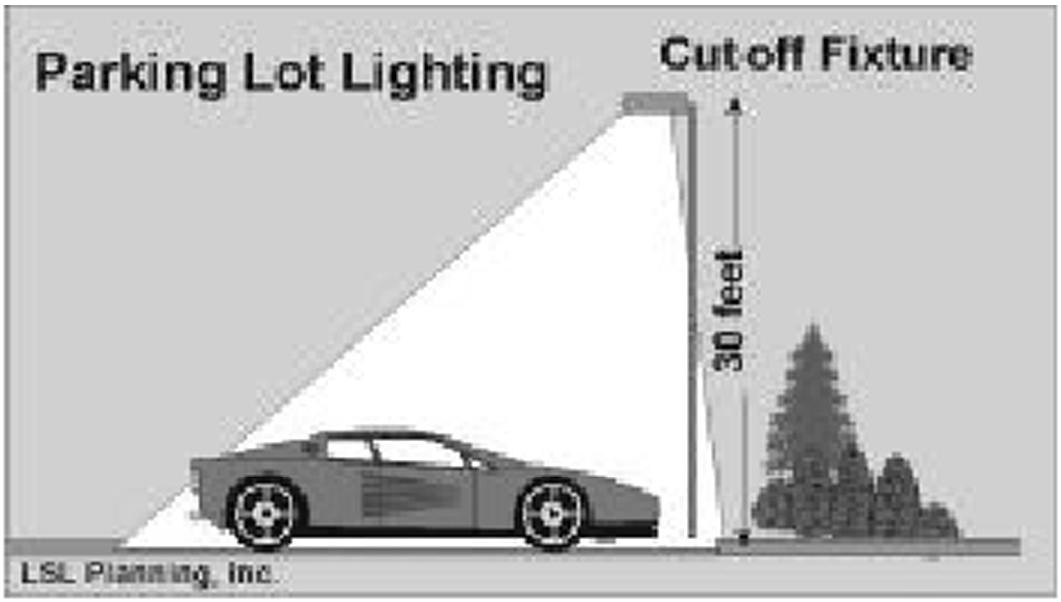
Parking Lot Lighting
(1)
Light fixtures shall be no higher than 30 feet and shall be provided with light cut-off fixtures that direct light downward.
(2)
For parking lots serving a single building or groups of related commercial, industrial, or office buildings in excess of 500 spaces, the village council, as part of the site plan approval, may permit a higher light fixture in selected locations within the parking lot where existing or planned residential areas will not be affected.
(3)
Lighting shall not be attached to buildings or other structures that permit light to be directed horizontally.
(f)
Parking lot landscaping. This subsection is applicable to parking lots serving any nonresidential or multiple family use in any district. A parking lot landscape plan shall be submitted with any application for a building permit or when otherwise required by this chapter.
(1)
Existing parking areas:
a.
The requirements of subsection (f) shall be met for any existing parking lot that is expanded by more than 25 percent of its original existing area, or when any parking area is substantially altered (e.g., removal and replacement of more than 25 percent of existing pavement).
b.
Any landscaping existing within or bordering any existing parking area shall not be removed unless replaced with landscaping meeting the requirements of this subsection.
(2)
Landscaping shall be planned and installed so that at planting or maturity it does not obscure traffic signs, fire hydrants, or lighting, or alter drainage patterns on the site or on adjacent properties; obstruct vision for reasons of safety, ingress or egress; or cause damage to utility lines (above and below ground) and public roadways.
(3)
Any landscaped area required by this section shall be constructed outside any public street right-of-way.
(4)
All landscaped areas, including perimeter areas, shall be protected by a raised or rolled concrete curb.
(5)
Frontage landscaping:
a.
Parking areas directly abutting or facing a public street shall be required to provide screening between the parking area and the road right-of-way. Screening shall consist of, at a minimum, one of the following:
1.
A strip of land at least five feet in width and a solid screen comprised of a hedge or decorative wall, or any combination thereof, which measures at least three feet in height; or
2.
A strip of land at least ten feet in width containing landscaping except that the obscuring screen need not be provided.
b.
The required strip of land shall also be covered with grass or other approved ground cover.
(6)
Interior landscaping:
a.
Interior landscaping shall be provided for any parking area containing 12 or more parking spaces.
b.
The interior of the parking lot shall begin at the outside boundary of the parking area.
c.
The interior area of any parking lot shall incorporate one planting island per each 12 parking spaces, or part thereof.
d.
Each planting island shall be at least 90 square feet in area with a minimum single dimension of nine feet.
e.
Landscaped islands shall be dispersed evenly throughout the parking lot and may be used to separate pedestrian areas, maneuvering areas, and drives.
(Ord. No. 04-07, § 1(16.08), 7-12-2004; Ord. No. 18-04, § 1, 2-12-2018)
Sec. 82-469. - Loading and unloading space requirements.
(a)
In order to prevent undue interference with the public use of streets, every manufacturing, storage, warehouse, department store, wholesale store, retail store, hotel, hospital, laundry, dairy, mortuary, and other uses similarly and customarily receiving or distributing goods by motor vehicle shall provide loading and unloading space on the premises for the number of vehicles that will be at the premises at a particular time on an average day of full use.
(b)
Plans and specifications showing required loading and unloading spaces including the means of ingress and egress and interior circulation shall be submitted pursuant to article V, Site Plan Review.
(c)
Loading spaces required under this section shall be provided as area additional to off-street parking spaces required in this chapter, and shall not be considered as supplying off-street parking space.
(d)
All off-street loading and unloading facilities that make it necessary to back directly into a public road shall be prohibited. All maneuvering of trucks and other vehicles shall take place on the site and not within a public right-of-way.
(e)
There shall be provided adequate space for standing, loading, and unloading services not less than 12 feet in width, 40 feet in length, and 15 feet in height, open or enclosed, for uses listed in the following table:
(f)
Design requirements.
(1)
Off-street loading spaces and access drives shall be drained, and shall have appropriate bumper or wheel guards where needed.
(2)
Any light used for illumination shall be arranged to reflect light away from adjoining premises and streets.
(3)
Where any off-street loading space adjoins or abuts a lot or premises used for residential or educational purposes, or abuts the residential district, a masonry wall or solid fence not less than four feet in height shall be provided between the off-street loading and unloading space and said uses or district.
(Ord. No. 04-07, § 1(16.09), 7-12-2004)
Sec. 82-470. - Disabled parking requirements.
Off-street parking areas shall include spaces for the disabled in accordance with the provisions of Act 230 of the Public Acts of the State of Michigan, 1972, as amended and shall be included in the count of required spaces.
(Ord. No. 04-07, § 1(16.10), 7-12-2004)

