
Sparta City Zoning Code
ARTICLE III
DISTRICT REGULATIONS
DIVISION 3. - R-M MEDIUM DENSITY RESIDENTIAL DISTRICT[2]
Editor's note— Ord. No. 24-02, § 10, adopted June 10, 2024, in effect repealed div. 3, §§ 82-171—82-174, and enacted a new div. 3 as set out herein and as may later be amended. Former div. 3 pertained to the R-1 single-family residential district and derived from Ord. No. 04-07, adopted July 12, 2004; Ord. No. 12-05, adopted April 9, 2012; Ord. No. 15-02, adopted November 9, 2015; and Ord. No. 19-07, adopted October 14, 2019.
DIVISION 4. - R-H HIGH DENSITY RESIDENTIAL DISTRICT[3]
Editor's note— Ord. No. 24-02, § 11, adopted June 10, 2024, in effect repealed div. 4, §§ 82-191—82-194, and enacted a new div. 4 as set out herein and as may later be amended. Former div. 4 pertained to the R-2 single-family residential district and derived from Ord. No. 04-07, adopted July 12, 2004 and Ord. No. 15-02, adopted November 9, 2015.
DIVISION 5. - RESERVED[4]
Editor's note— Ord. No. 24-02, § 12, adopted June 10, 2024, repealed div. 5, §§ 82-211—82-214, which pertained to the R-3 single- and two-family residential district and derived from Ord. No. 04-07, adopted July 12, 2004 and Ord. No. 15-02, adopted November 9, 2015.
DIVISION 6. - RESERVED[5]
Editor's note— Ord. No. 24-02, § 13, adopted June 10, 2024, repealed div. 6, §§ 82-231—82-234, which pertained to the R-4 single-, two-family, and multiple family residential district and derived from Ord. No. 04-07, adopted July 12, 2004; Ord. No. 15-02, adopted November 9, 2015; Ord. No. 22-01, adopted January 10, 2022; and Ord. No. 22-04, adopted March 14, 2022.
DIVISION 7. - B-BUSINESS DISTRICT[6]
Editor's note— Ord. No. 24-02, § 14, adopted June 10, 2024, in effect repealed div. 7, §§ 82-251—82-254, and enacted a new div. 7 as set out herein and as may later be amended. Former div. 7 pertained to the O-office district and derived from Ord. No. 12-02, adopted February 13, 2012.
DIVISION 8. - RESERVED[7]
Editor's note— Ord. No. 24-02, § 15, adopted June 10, 2024, repealed div. 8, §§ 82-271—82-274, which pertained to the GC general commercial district and derived from Ord. No. 12-03, adopted February 13, 2012 and Ord. No. 23-07, adopted August 14, 2023.
DIVISION 10. - RESERVED[8]
Editor's note— Ord. No. 24-02, § 15, adopted June 10, 2024, repealed div. 10, §§ 82-311—82-314, which pertained to the LI light industrial district and derived from Ord. No. 04-07, adopted 7-12-2004; Ord. No. 15-04, adopted November 9, 2015; Ord. No. 18-03, adopted May 14, 2018; and Ord. No. 23-07, adopted August 14, 2023.
Sec. 82-101. - Intent and purpose.
(a)
It is the purpose of this article to establish regulations and conditions that are generally applicable to all districts of this chapter unless otherwise indicated. The purpose of this article is to provide uniform regulations applicable within the Village of Sparta that supplement the specific requirements for each district, and each permitted use.
(b)
The regulations of this article shall apply to all districts of this chapter, unless specifically excepted elsewhere in this chapter.
(Ord. No. 04-07, § 1(3.01), 7-12-2004)
Sec. 82-102. - Essential public services.
The erection, construction, alteration or maintenance of essential public services shall be permitted in any zoning district; it being the intention thereof to exempt government and service facilities from the application of this chapter.
(Ord. No. 04-07, § 1(3.02), 7-12-2004)
Sec. 82-103. - Accessory buildings and structures.
(a)
General requirements.
(1)
Accessory buildings and structures located on the same lot and not otherwise regulated by this chapter, shall be permitted subject to the regulations of this section.
(2)
Attached accessory buildings and structures shall be made structurally a part of the main building and shall conform to the site development requirements of the district in which the building or structure is located.
(3)
Detached accessory buildings and structures shall be no closer than ten feet from the main building or structure.
(4)
Accessory buildings and structures in excess of 100 square feet must be designed, constructed, and finished such that the exterior appearance is compatible in terms of materials, color and general construction with that of the principal structure.
(5)
Accessory buildings and structures shall not be occupied for dwelling purposes, unless otherwise provided in this section.
(6)
Height for accessory buildings and structures shall not exceed the accessory structure height requirement of the district it is located in or the primary structure height.
(7)
Raised garden beds shall not be considered an accessory structure and shall not require an accessory use permit provided that the structure is not located within the public right-of-way, does not otherwise obstruct the view of traffic, does not exceed the height of a permissible fence in the applicable zoning district, and otherwise complies with all other applicable provisions of the village code.
(b)
Detached accessory buildings and structures, residential districts or uses.
(1)
Detached accessory buildings and structures shall be located only in the rear yard or side yard. In no case shall a detached accessory building be closer than five feet from any lot line, as measured from the closest point of the building.
(2)
One detached accessory building shall be permitted on a property for a residential district or use as provided in the site development requirements of the district in which the principal use is located.
(3)
One additional detached storage shed shall be permitted for a residential district or use not to exceed 200 square feet in area. A swimming pool and cover structure shall also be permitted on a lot, subject to the requirements of section 82-116 and any other applicable chapter.
(4)
Properties over two acres in size may split the maximum square footage allowed between two detached accessory structures if they meet all other requirements of their zoning district.
(c)
Detached accessory buildings, nonresidential districts or uses.
(1)
No more than two detached accessory buildings shall be permitted on any lot.
(2)
The total area of all accessory buildings shall not exceed 25 percent of the floor area of the main building(s).
(3)
Detached accessory buildings shall not be located in the front yard, and in no case shall be closer than five feet from any lot side or rear line.
(4)
No detached accessory building shall exceed the permitted height for main buildings in the district in which it is located.
(5)
Shipping containers may be used for outside storage in the B district provided that, to the greatest extent practicable, such containers shall be obscured from the public view, and meet all of the other requirements for outside storage in the B district.
(d)
Wind energy turbines.
(1)
Wind energy turbines located on the same lot as the main building or structure are a permitted accessory use in all zoning districts subject to the requirements of article X of this chapter.
(e)
Rooftop solar energy systems.
(1)
Rooftop solar energy systems, also referred to as solar panels, located on the same lot as the main building or structure are a permitted accessory use in all zoning districts subject to the requirements in this section.
(2)
An accessory use permit shall be required for installation of roof-mounted systems.
(3)
Roof-mounted solar energy systems may include integrated solar panels as the surface layer of the roof structure with no additional apparent change in relief or projection, or separate flus mounted solar panels attached to the roof. Such design shall comply with all building code requirements.
(4)
Mounting and projection.
a.
Sloped roofs.
1.
Solar panels shall be mounted flush (within six inches of the roof surface), shall not project above the peak of the roof, and if integrated solar panels that also serve as the surface layer of the roof structure with no additional apparent change in relief or projection, then not beyond any roof edge.
2.
Solar panels shall not be mounted on any roof that is steeper than 11/12 pitch or on the face of any building.
3.
Solar panels that are separate flush mounted solar panels attached to the roof shall be set back a minimum of two feet from any roof edge.
b.
Flat roofs.
1.
Solar panels shall not project more than two feet above the roof plane at its highest point on the back edge of any panel. Front edge of the panel shall be no greater than six inches from the roof plane.
2.
Solar panels shall be set back a minimum of two feet from any roof edge.
3.
Framework and/or hardware used to affix the solar panels that is visible from the edge of the structure must be the same color as the roof underneath so as to minimize the visual impact of the system.
c.
Height. A roof mounted solar energy system shall not be installed in a manner that would exceed the maximum height restrictions applicable for the property.
d.
Glare and screening.
1.
Glare. Glare shall not be generated that would project onto adjacent property; therefore, non-reflectiveness through design, material, or a combination of both, must be demonstrated in the permit application.
2.
Screening. Vegetative or architectural screening may be required if, in the determination of the building official, the roof mounted solar energy system is proposed in a location or manner that is reasonably expected to be negatively impactful in terms of glare, noise, or visual impact to adjacent property owners and the effects can be mitigated by such means.
e.
Removal. If a roof-mounted solar energy system ceases to be capable of performing its intended function (generating electricity) for more than six consecutive months, the operator must remove the collectors, mounts, and associated equipment and facilities no later than 90 days after the end of the six-month period. Where the removal has not been lawfully completed as required above, and after at least 30 days' written notice, the village may remove or secure the removal of the solar energy system or portion thereof, with the village's actual cost of administrative and legal charges to be placed as a lien on the property.
(f)
Accessory dwelling units. Accessory dwelling units are permitted by right in all residential zoning districts subject to the requirements of section 82-132.
(Ord. No. 04-07, § 1(3.03), 7-12-2004; Ord. No. 12-07, § 1, 4-9-2012; Ord. No. 15-02, § 1, 11-9-2015; Ord. No. 16-02, § 1, 7-11-2016; Ord. No. 19-07, § 1, 10-14-2019; Ord. No. 24-02, § 4, 6-10-2024)
Sec. 82-104. - Access to streets.
All lots created after the effective date of this chapter shall have the required minimum lot width, as measured at the front setback line, and direct access from the lot to a public or private street, or a private drive created in accordance with the requirements of this chapter.
(Ord. No. 04-07, § 1(3.04), 7-12-2004)
Sec. 82-105. - Main building or principal use.
Each parcel shall contain only one main building or principal use, except for groups of related commercial, industrial, and office buildings, and multiple family dwellings, determined by the zoning administrator to constitute a collective main use. Collective main uses shall be contained within a single, integrated complex, sharing parking, signs, access, and other similar features which, in the opinion of the zoning administrator, form a unified function and appearance.
(Ord. No. 04-07, § 1(3.05), 7-12-2004)
Sec. 82-106. - Keeping of animals.
The keeping, housing, raising, use or care of animals is subject to the following limitations and conditions:
(1)
Definitions. For purposes of this section 82-106, the following words, terms, and phrases shall have the following meanings unless the context clearly indicates otherwise:
Customary household pets means such animals used for human companionship including but not limited to dogs, cats, rabbits, birds, small reptiles, amphibians and similar animals.
Dangerous animals means the same as defined in MCL 287.321(a) of the Dangerous Animals Act, Act 426 of 1988.
Large carnivore means the same as defined in MCL 287.1102 of the Large Carnivore Act, Act 274 of 2000.
Livestock means animals used for farming activities including but not limited to: horses, roosters, ducks, geese, goats, sheep, pigs, and any other farm livestock used for commercial purposes.
Owner. Any animal that remains about any premises for a period of five days is deemed to be in possession of the owners or occupants of such property for the purposes of this section. Owner under this chapter does not necessarily describe title holder to said animal.
Wolf-dog cross means the same as defined in MCL 287.1002(p) of the Wolf-Dog Cross Act, Act 246 of 2000.
(2)
No person owning, possessing, or having charge of any dog four months of age or over shall permit such dog to be:
a.
At-large, unless in the custody of some person.
b.
Unleashed and unmuzzled if the dog is a dangerous animal.
c.
At-large at any time, unless vaccinated against rabies within the past year and unless such dog shall have a tag on its collar showing such current vaccination; provided, this subsection shall apply only to dogs four months of age or older.
d.
If a female dog, at-large when such dog is in heat.
e.
Unreasonably disturb those in the vicinity where kept because of loud or frequent or habitual barking, yelping, or howling, or by reason of damaging or trespassing on the property of others.
(3)
Large carnivores, wolf-dog cross, and other exotic animals are expressly prohibited within the village.
(4)
Chickens may be kept in the village subject to the following conditions:
a.
Chickens may be kept in the village with a valid chicken permit subject to all of the following conditions:
1.
Eligible properties. Chickens may only be kept on a lot on which is located a single-family dwelling. Chickens may not be kept on a lot containing a multi-family dwelling.
2.
Minimum lot size and number permitted. Chickens may be kept only on a lot having a minimum area of 5,500 square feet, subject to the following limits:
(i)
Lots 5,500 to 7,999 square feet. Up to six chickens may be kept.
(ii)
Lots 8,000 square feet or greater. A property owner may keep up to six chickens initially. After one year of demonstrated compliance with all applicable regulations while maintaining six chickens, the property owner may apply for a permit to keep up to 12 chickens.
3.
Chickens may only be kept by an occupant of a dwelling unit located on the real property on which the chickens are kept.
4.
Chicken feed must be kept in rodent resistant and weatherproof containers.
5.
The person keeping the chickens shall abide by all health and safety standards of the village's International Property Maintenance Code (IMPC).
6.
Odors from chickens, and chicken manure shall not be perceptible at the property boundaries, in conformance with the village's nuisance ordinance. Perceptible odor shall be abated within 48 hours of notification of the violation by the village.
7.
Perceptible noise from chickens shall not be loud enough at the property boundaries to unreasonably disturb neighboring property owners in conformance with the village's nuisance ordinance. Perceptible noise shall be abated within 48 hours of notification of the violation by the village.
8.
Roosters are expressly prohibited, regardless of the age or maturity of the bird.
9.
Chickens may be slaughtered on site if it is done in an enclosed building and out of public view. Chickens may also be taken off site to be slaughtered. No slaughtering of chickens shall be permitted for commercial purposes.
b.
Enclosures shall be provided and shall be designed to provide safe and healthy living conditions for the chickens while minimizing adverse impacts to other residents and the neighborhood.
1.
Chickens must be kept in an enclosed henhouse or fenced in chicken pen at all times. Chickens must be secured within the henhouse during non-daylight hours.
2.
Henhouses must be clean, dry and odor free, kept in a neat and sanitary condition at all times, in a manner that will not unreasonably disturb the use or enjoyment of neighboring lots due to noise, odor or other adverse impacts. No exterior lighting shall spill onto adjacent properties.
3.
The henhouse and chicken pen must provide adequate ventilation and adequate sun and shade and must be impenetrable to rodents, wild birds, and predators, including dogs and cats.
4.
The henhouse structure shall be enclosed and secured on all sides and shall have a roof, floor and doors. Access doors must be able to be shut and locked at night. Opening windows and vents must be covered with predator and bird proof wire of less than one-inch openings.
5.
The materials used in making the structure shall be uniform for each element of the structure such that the walls are made of the same materials, the roof has the same shingles or other covering, and any windows or openings are constructed using the same materials. The use of scrap, waste board, sheet metal, or similar materials is prohibited. The henhouse shall be well maintained and kept in a clean and sanitary manner at all times.
6.
The structure shall be painted; the color shall be uniform around the structure and shall be in harmony with the surrounding area.
7.
The maximum size of the henhouse may not exceed 50 square feet in overall size and may not exceed five feet in height.
8.
The henhouse shall only be located in the rear yards. In no case, may a henhouse be placed in the side or front yards.
9.
The henhouse must be located no less than 20 feet from the owner's dwelling and no less than 35 feet from any neighbors dwelling and ten feet from any property line. Henhouses may be moveable, only if the dimensional restrictions contained in this article are held in compliance.
10.
An enclosed chicken pen must be provided attached to the henhouse consisting of sturdy wire and fencing or may include a floor made of the same material as the pen secured on all sides. The chicken pen must be covered with wire, aviary netting, or solid roofing. The use of chicken wire is not permitted. The chicken pen must also include a self-latching door. The first 18 inches of the chicken pen must be made of sight obscuring material or screening with sight obscuring landscaping around all sides. The chicken pen must meet the same setback requirements as the henhouse.
11.
The chicken pen is limited to no more than 80 square feet in area.
c.
Any person wanting to keep chickens within the village shall first apply for and obtain a permit from the village manager or his/her designee, before that person may legally keep chickens within the village. Regulations pertaining to permits shall be as follows:
1.
Any person applying for a permit to keep chickens within the village shall submit a permit application on a form promulgated by the village manager or his/her designee and shall pay an application fee established by resolution of the village council.
2.
If the applicant is not the owner of the real property on which he or she wants to keep chickens, the applicant must provide the written consent of the owner of the real property. Without such written consent, the permit application may not be granted.
3.
If the village manager or his/her designee grants the request for the permit, he/she shall do so in writing, which writing shall state the property address at which chickens may be kept, as well as the number of chickens allowed to be kept, and any other conditions of the permit to keep chickens.
4.
If the village manager or his/her designee denies the request for the permit, he/she shall do so in writing, which writing shall state the reasons for such denial.
5.
If the village manager or his/her designee denies the request for the permit, the applicant may file an appeal to the village council subject to the following conditions:
(i)
The applicant must file a written appeal stating why the applicant feels that the permit should be approved with the village clerk within ten days of the permit denial; and
(ii)
The village council will review the appeal at a regularly scheduled village council meeting and may grant the appeal, grant the appeal with conditions, or deny the appeal based on its review of the standards and provisions contained herein.
Any final decision shall be communicated to the appellant in writing stating the basis for the same.
6.
An initial permit shall be valid for a period of one year. If, in the judgment of the village manager or his/her designee, the permittee has abided by all article provisions and permit conditions and has not created a nuisance to the owners or occupants of adjacent properties or the neighborhood, the permit may be renewed for an additional one-year period. However, no permit issued pursuant to this article shall remain valid past the date on which this article either expires or is repealed, whichever is earlier.
7.
Any permit may be suspended or revoked by the village manager or his/her designee, by written notice to the permit holder, upon a finding that the permittee has violated applicable village ordinance provisions or permit conditions.
8.
If the village manager or his/her designee suspends or revokes a permit, the provisions of section 22-45 of this Code regarding suspension and revocation of permits and licenses shall apply.
9.
A permit as described above is personal to the applicant. Such a permit may not be transferred to another individual. If ownership of the underlying real property on which the chickens are kept is transferred, the permit does not run with the land, and a person desiring to keep chickens on the property must apply for a new permit.
10.
Permit fees for the keeping of chickens will be established by village council through resolution.
11.
No person shall keep a chicken or allow a chicken to be kept on real property under his or her control, unless a permit to keep chickens is first obtained from the village in the manner provided for herein.
12.
In addition to the other penalties set forth herein, a violation of this subsection (4) will result in the revocation of the permit allowing the keeping of chickens. All henhouses and chicken coops shall be removed within 30 days following the revocation of a permit hereunder.
(5)
Customary household pets may be kept on a noncommercial basis provided that the number of these animals does not exceed four. It shall be unlawful for any person to keep livestock on any premises within the village except in slaughterhouses or yards adjacent thereto.
(6)
Animals other than household pets and not specified elsewhere in this section may be kept subject to the following requirements:
a.
Minimum lot size of three acres for the first two animals.
b.
An additional one-half acre for each additional animal, provided that no more than a total of 20 acres shall be counted toward the allowance to accommodate animals under this limitation.
c.
When animals are kept or permitted to roam outdoors, an adequate fence shall be provided and maintained to confine the animals from adjoining properties and roads.
(7)
It shall be unlawful for any person having control of any domestic animal on a leash to allow such animal to defecate on or upon any premises other than his own, unless the person shall promptly clean up any feces deposited by the animal.
a.
No person shall allow any animal under his ownership or control to leave excrement on any private or public property, unless that excrement is promptly and thoroughly removed from the property; provided, however, a person may fail to remove excrement from private property which that person owns or in which he has a lawful possessory interest. Nothing in this subsection shall be deemed to permit an accumulation of feces on a person's own property which may be detrimental to the public health.
b.
It shall be unlawful for any person to appear with any animal on a private or public property, unless that person has in his possession an appropriate device for the immediate and thorough removal of any animal excrement; provided, however, the owner or lawful occupant of a vacant parcel of real property or a parcel of real property on which there is located a single-family residence may appear on his own property with an animal without possession of such device.
(8)
A violation of this section shall be a municipal civil infraction, punishable by a fine as established in section 82-589 of this Code. The property owners and the occupants of the property cited under this section are jointly and severally liable.
(Ord. No. 04-07, § 1(3.06), 7-12-2004; Ord. No. 20-01, § 2, 9-14-2020; Ord. No. 23-03, § 1, 4-10-2023; Ord. No. 2026-01, § 1, 3-16-2026)
Sec. 82-107. - Required area or space.
No lot, yard, court, parking area or other space shall be so reduced in area or dimension as to make the area or dimension less than the minimum required under this chapter. If already less than the minimum required under this chapter, the area or dimension shall not be further reduced.
(Ord. No. 04-07, § 1(3.07), 7-12-2004)
Sec. 82-108. - Change of use or alteration.
(a)
No building or structure erected or moved upon a lot that does not meet the requirements of this chapter shall be used or occupied as a dwelling.
(b)
Except as may otherwise be permitted in this chapter, any change in the use of lot or structure, or any alteration of an existing lot or structure shall require the issuance of a development permit in accordance with section 82-585, Development permits, and the compliance with all provisions of this chapter.
(Ord. No. 04-07, § 1(3.08), 7-12-2004)
Sec. 82-109. - Earth removal, grading and filling.
(a)
The following requirements shall apply to all construction activities requiring a development permit pursuant to section 82-585, Development permits, in order to protect adjacent properties, public roads and watercourses, and to provide for adequate drainage of surface water.
(b)
Filling of property to an elevation above the established grade of adjacent developed property shall not be permitted without the expressed written approval of the village engineer.
(c)
The final grade surface of ground areas surrounding a building or structure shall be designed and landscaped such that surface water flows away from the building or structure and is managed to avoid increased flow onto adjacent properties or public roads, erosion or earthen filling of a roadside ditch, the blockage of any watercourse, or creation of standing water over a private sewage disposal drainage field.
(d)
Any land development which disturbs the existing grade of more than one acre of land or lies within 500 feet of a river, stream, lake or open drain, shall require a soil erosion and sedimentation control permit pursuant to Part 91, Public Act 451 of 1994, as amended, prior to issuance of a development permit.
(e)
Any land development, dredging, filling, or other activity requiring a permit pursuant to Part 301, Inland Lakes and Streams Act 1972, amended 1994 Public Act 451, shall be required to obtain the permit prior to the issuance of a development permit.
(Ord. No. 04-07, § 1(3.09), 7-12-2004)
Sec. 82-110. - Cul-de-sac (irregular shaped) lots.
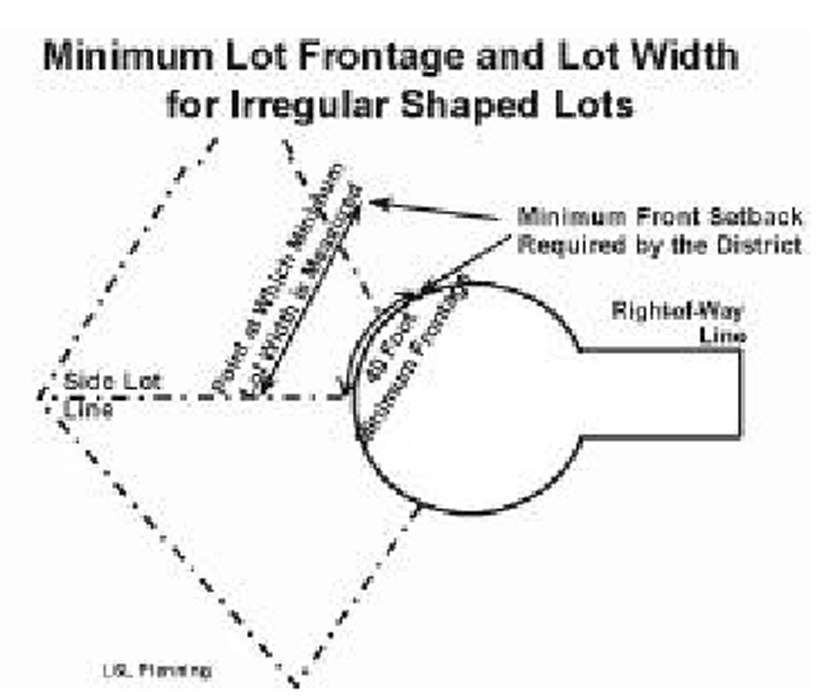
(a)
A cul-de-sac shall be determined to commence at the intersection of the radius of the cul-de-sac with the street right-of-way line.
(b)
The minimum lot width for a lot on a cul-de-sac shall be measured at a line drawn between the two points located at the intersection of a line extending along the side lot lines equal to the distance of the required front setback. If the minimum lot width is not met at this point, the front setback for the lot shall be increased to a point where the minimum lot width is achieved.
(c)
A lot on a cul-de-sac shall have not less than 40 feet of lot frontage as measured along the front lot line.
(Ord. No. 04-07, § 1(3.10), 7-12-2004)
Sec. 82-111. - Projections into yards.
(a)
Architectural elements attached to and necessary to the integrity of the building, or the health or safety of the occupants, such as ramps for the disabled, cornices, eaves, gutters, chimneys, pilasters, unenclosed steps, fire escapes, and similar features shall be permitted to encroach upon the minimum setback requirements of this chapter, provided such projection into a required front or rear yard area is no closer than ten feet from a street right-of-way line or rear lot line. No encroachment shall be permitted into the side setback of the lot.
(b)
Unenclosed terraces, patios, porches, and decks shall be permitted to encroach upon the minimum yard area and setback requirements of this chapter provided they are:
(1)
Attached to the main building;
(2)
Elevated no more than 30 inches above the average surrounding final grade;
(3)
Not fully enclosed by a wall or fence over 5½ feet in height;
(4)
Located no closer than ten feet from a street right-of-way line or rear lot line; and
(5)
Does not encroach into the side setback of the lot.
(c)
Terraces, patios, porches, and decks that are enclosed (covered with a roof), not including steps leading to such structures, shall be attached to and considered part of the main building and comply with all regulations applicable to main buildings.
(d)
Those structures covered in subsections (a) and (b) above are considered conforming structures, and therefore, shall be permitted to be rebuilt if destroyed or removed by any means.
(Ord. No. 04-07, § 1(3.11), 7-12-2004)
Sec. 82-112. - Fences and walls.
(a)
Fences in front yard. Fences and walls in front yards of all districts shall not exceed four feet in height, and shall be of non-solid construction, such as cyclone fencing, which have openings of at least 75 percent in each square foot of fencing, or wall. Fences or walls located in the front yard must be one foot from the inside edge of the sidewalk or right-of-way line.
(b)
Fences on corner lot. On a corner lot which has two front lot lines, fences and walls shall comply with subsection 82-112(a) unless the secondary front yard meets the requirements of section 82-113. If so the fence shall be allowed to be of solid construction and up to six feet in height. Fences or walls located in the front yard or secondary front yard must be one foot from the inside edge of the sidewalk or right-of-way line.
(c)
Fences in side yard and rear yard. Solid walls and fences, and those of open construction, not exceeding eight feet in height are permitted in side and rear yards of all districts, except that unless otherwise permitted, the requirements of section 82-113 shall be met.
(d)
All fences shall be of uniform design, construction and appearance. The method of construction and type of materials and design shall be of a kind normally and customarily associated with the uses permitted in the zoning district in which it is located. All fences shall be sturdily constructed to withstand normal weather conditions and properly maintained so as not to become a visual nuisance, or pose a safety hazard to nearby residents, passerby, or the general public.
(e)
The interior posts of fence shall face property owner and finished side shall face outward toward adjacent property or right-of-way.
(f)
Prohibited fences. The following fences are prohibited:
(1)
A fence consisting in whole or part of coils of barbed wire, concertina wire or razor wire;
(2)
A fence with razored edges, broken glass, affixed spikes, projecting nails or other pointed instruments of any kind or description attached; fence gates shall not be constructed so as to create a hazard to the public by the projection of any pointed instrument or member when open or partially open;
(3)
A fence charged or connected with an electrical current, provided however, this provision shall not be construed to apply to electrical fences installed below ground as elements of an animal control or security system;
(4)
A standard barbed wire fence except upon essential service sites or industrial properties which do not abut property zoned or used for residential purposes; in such locations standard barbed wire may be installed on the top of a fence on arms or cradles extending inward over the owner's property provided that the fence has a minimum height of six feet above the adjacent grade and the combined height of the fence and barbed wire and arms does not exceed eight feet above the adjacent grade;
(5)
A fence which consists in whole or part of woven plastic or other similar materials utilized within a chain link fence; and
(6)
A fence with all metal (i.e. barn siding, roof material, etc.), opaque paneling.
(g)
Fences in business districts.
(1)
On a lot occupied by a principal structure, no fence may be located within the required front yard.
(2)
No fence may exceed eight feet in height.
(3)
All fences should attempt to be decorative in nature and should be wrought iron, wood, brick, stone and similar replications of these materials. However, when abutting residentially zoned and/or used property, and when used to screen parking or outdoor storage areas, the fence shall be constructed of an opaque material.
(4)
Chain link or similar fencing is permitted everywhere except within the front yard and when abutting residentially zoned and/or used property.
(5)
No fencing shall be permitted within the clear vision area (see section 82-113).
(h)
Permit requirements.
(1)
Prior to the construction of any fence or wall, an application for a permit to construct the fence shall be filed with the village. No fence shall be constructed without first obtaining approval from the zoning administrator.
(2)
The fee for the permit shall be established by village council.
(Ord. No. 04-07, § 1(3.12), 7-12-2004; Ord. No. 04-11, § 1(Att. A), 10-11-2004; Ord. No. 16-03, § 1, 7-11-2016; Ord. No. 17-02, § 1, 10-9-2017; Ord. No. 24-02, § 5, 6-10-2024)
Sec. 82-113. - Intersection visibility.
(a)
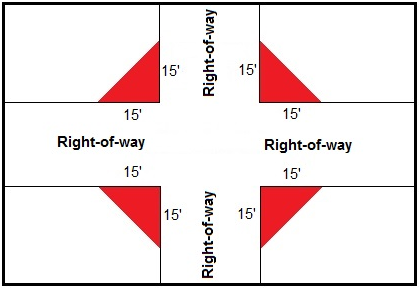
Intersection visibility. No fence, wall, sign, hedge, screen or any planting shall be erected or maintained to obstruct vision between a height of three feet and eight feet within the triangular area formed by the intersection of the street right-of-way lines and a line connecting two points which are located on those intersecting right-of-way lines 15 feet from the point of intersection of the right-of-way lines. See figure 1 for visual reference.
Figure 1 (Intersection Visibility)
(b)
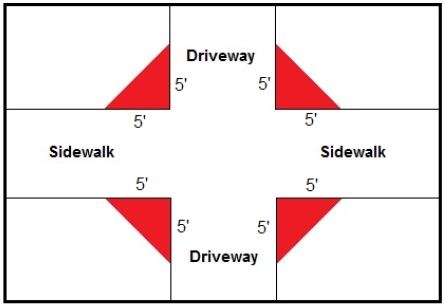
Driveway/sidewalk visibility. When a driveway intersects with a sidewalk or path, no fence, wall, sign, hedge, screen or any planting shall be erected or maintained to obstruct vision between a height of three feet within the triangular area formed at the intersection of a driveway with a sidewalk or path. A straight line shall be drawn between the outside edge of the driveway and the outside edge of the sidewalk or path, at a distance of five feet from their point of intersection to form each triangle. See figure 2 for visual reference.
Figure 2 (Driveway/Sidewalk Visibility)
(c)
This section shall only apply to intersections of driveways with sidewalks or paths which are created after the effective date of this ordinance. Any encroachment on this area permitted and approved by the village prior to the effective date of this ordnance is not subject to this section.
(Ord. No. 04-07, § 1(3.13), 7-12-2004; Ord. No. 17-04, § 1, 10-9-2017)
Sec. 82-114. - Lot width/depth ratio.
Lots created after the effective date of this chapter having a lot area of less than
ten acres shall have a lot width that is equal to, or greater than, one-fourth the
depth of the lot.
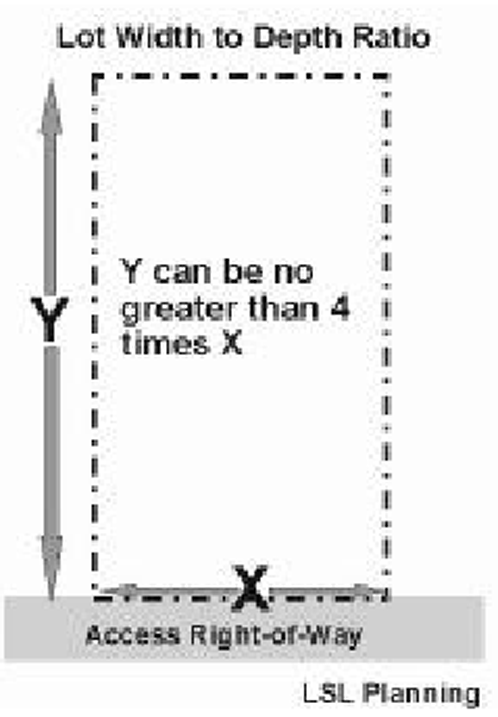
Lot Width to Depth Ratio
(Ord. No. 04-07, § 1(3.14), 7-12-2004)
Sec. 82-115. - Required water supply and sanitary sewage facilities.
No structure for human occupancy shall be erected, altered, or moved upon any premises and used in whole or in part for residential, assembly, business, industrial, institutional, mercantile or storage purposes unless the water supply and waste water disposal system conforms with the requirements of the Michigan Department of Public Health, Kent County Health Department, and/or any village ordinance applicable to public sanitary sewer and public water supply.
(Ord. No. 04-07, § 1(3.15), 7-12-2004)
Sec. 82-116. - Swimming pools.
(a)
Installations, etc.; permit required; application. No person shall erect, install, locate or maintain a swimming pool (hereinafter referred to as a "pool"), unless a permit therefor has first been obtained from the building inspector. The application for the permit shall include the size of the pool, the type of construction and its location on the lot, and such application shall be on forms provided by the village.
(1)
Swimming pools with a depth less than 24 shall not require zoning or building permits.
(b)
Location. Pools used for swimming or bathing shall be constructed in conformance with the village building code and shall conform to the setback requirements for accessory uses pursuant to section 82-103, accessory buildings and structures.
(c)
Water supply. Cross-connections between the village water supply and any other source or sources of water supply for pools are prohibited. The line from the public water supply to the pool shall be protected against backflow of polluted water by means of an air gap and shall discharge at six inches above the maximum high-water level of the pool make-up tank or the pool itself.
(d)
Fences.
(1)
A fence approved by the zoning administrator shall be erected on any lot on which there is located a commercially manufactured swimming pool, hot tub, or other similar structure which contains 24 inches of water or more in depth at any point. The approved fence shall be erected and maintained either surrounding the property or pool area in a manner sufficient to make the swimming pool inaccessible to small children. The fence will not be required if a motorized pool cover is installed in accordance with the current state residential building code.
(2)
The wall or fence shall be permanent and substantial fence or wall that is at least four feet in height above the ground level or with such other barrier as meets the requirements of the state construction code and is approved by the building official. All gates and doors which permit access to the pool area shall be capable of being locked and shall be locked at all times when no person is present upon the lot or parcel of land upon which the pool is located.
(3)
All gates and doors shall be of the self-closing and latching type, with the latch on the inside of the gate positioned in such a manner that it is not readily available for children to open.
(4)
Notwithstanding the provisions of subsections (a) through (c) hereof, if the entire lot or parcel of land upon which the pool is located is enclosed, then the foregoing requirements for the maintenance of a fence or wall may be waived by the building inspector if he or she determines that all the requirements for the pool fence or wall specified herein are complied with.
(5)
If a pool has a top which is four or more feet above grade, which does not have a deck with readily climbable supports and which is, itself, constructed in such a manner that it is not readily climbable, the building inspector may, at his or her discretion, waive the requirements contained in subsections (a) through (c) hereof for a pool fence or wall, if the access to the pool and the gate and door arrangements are as provided for herein or with such other barrier as meets the requirements of the state construction code and is approved by the building official.
(e)
Discharge. Discharge of swimming pools must be in accordance with sections 74-355 and 74-356.
(Ord. No. 04-07, § 1(3.16), 7-12-2004; Ord. No. 21-05, § 1, 6-14-2021)
Sec. 82-117. - Satellite dish antennas.
(a)
Placement.
(1)
In residential districts a satellite dish antenna shall be permitted only in a rear yard, or mounted or attached to a building.
(2)
A satellite dish antenna shall comply with the side and rear yard setback requirements applicable to main buildings in the district in which it is located.
(3)
In nonresidential districts a satellite dish antenna shall be located only in the side or rear yard or mounted on top of a building.
(4)
No more than two satellite dish antennas shall be located on the same lot as a main building.
(5)
Satellite dish antennas are permitted only in connection with, incidental to and on the same lot as a principal use or main building.
(b)
Height.
(1)
In residential districts, a ground mounted satellite dish antenna, including any platform or structure upon which the antenna is mounted, shall not exceed 14 feet in height, or ten feet in diameter.
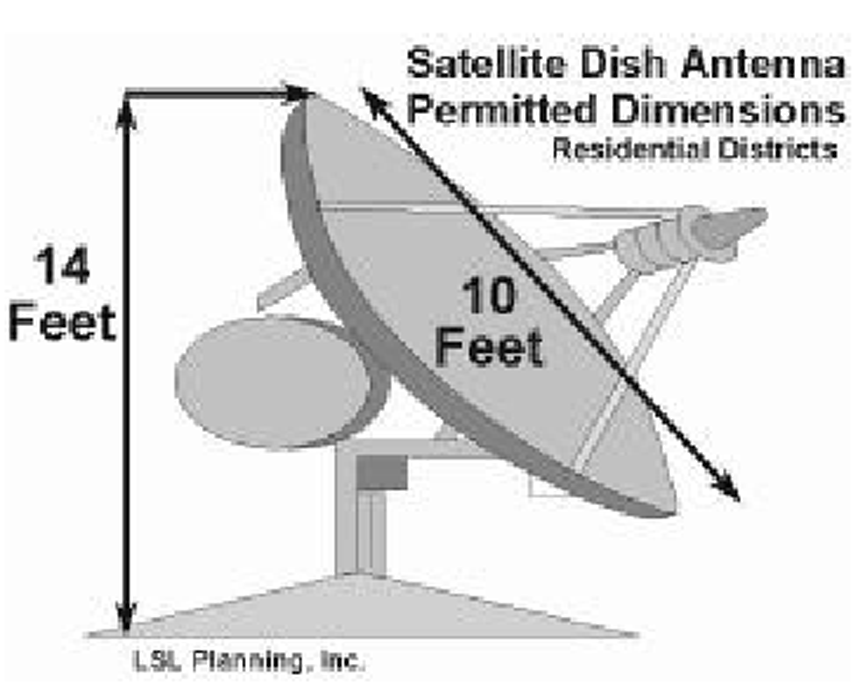
Satellite Dish Antennas
(2)
In the nonresidential districts, a satellite dish antenna, including any platform or structure upon which the antenna is mounted, shall not exceed the maximum height permitted for main buildings in the district in which it is located.
(c)
General provisions.
(1)
These regulations shall not apply to dish antennas that are one meter (39.37 inches) or less in diameter in residential districts or two meters (78.74 inches) or less in diameter in nonresidential districts.
(2)
The building inspector may waive any provision of this section if its enforcement inhibits or prevents the proper operation of the satellite dish antenna.
(3)
No portion of a satellite dish antenna, shall contain any name, message, symbol, or other graphic representation visible from adjoining properties, except as required by the manufacturer or federal regulations for safety purposes.
(4)
The antenna shall be anchored in a manner approved by the building inspector as being adequate to secure the satellite dish antenna during high winds.
(5)
An antenna, shall not be erected, constructed, or installed until a building permit has been obtained from the building inspector.
(6)
These regulations are formulated to ensure that adequate protection measures are provided in this chapter for ensuring that sight distance is not impaired, that dish antennas are located and constructed in a manner that will not afford the potential for injury, and to ensure that the intent and purposes of this chapter are met.
(Ord. No. 04-07, § 1(3.17), 7-12-2004)
Sec. 82-118. - Regulations applicable to single-family dwellings outside manufactured home parks.
(a)
Any single-family dwelling, whether constructed and erected on a lot, or a manufactured home, shall be permitted outside a manufactured home park only if it complies with all of the requirements of this section.
(b)
The dwelling shall meet the minimum square footage requirements for the district in which it is located.
(c)
Design features:
(1)
The minimum width of exterior wall across any front, side, or rear architectural elevation shall be at least 20 continuous feet. Any dwelling existing prior to the date of this chapter shall not be considered a nonconforming building.
(2)
All dwellings shall have either a roof overhang of not less than six inches on all sides, or alternatively with window sills and roof drainage systems concentrating roof drainage at collection points along the sides of the dwelling.
(3)
The dwelling shall contain permanently attached steps connected to exterior door areas or to porches connected to the door areas where a difference in elevation requires it.
(4)
The dwelling shall not contain additions or rooms or other areas which are not constructed with similar quality work as the original structure, including permanent attachment to the main structure and construction of a foundation as required herein.
(5)
The dwelling shall contain an interior storage area in a habitable basement or cellar located under the dwelling, or in a defined storage room space separate from closet areas, garage, and utility or furnace rooms. The minimum storage area shall be equal to ten percent of the floor area of the dwelling or 100 square feet, whichever is less.
(d)
The dwelling shall conform to the village building code and all other pertinent construction and fire codes. Where a dwelling is required by law to comply with any federal or state standards or regulations for construction and where such standards or regulations allow standards of construction that are less stringent than those imposed by the building code in effect in the village, then in that event, the less stringent federal or state standard or regulation shall apply. Additionally, all dwellings shall meet or exceed all applicable roof snow load and strength requirements.
(e)
In the case of a manufactured home, all construction and all plumbing, electrical apparatus and insulation within and connected to the manufactured home shall be of a type and quality conforming to the "Mobile Home Construction and Safety Standards" as promulgated by the United States Department of Housing and Urban Development, being 24 CFR 3280, and as from time to time such standards may be amended.
(f)
The dwelling shall be placed upon and secured to a permanent foundation in accordance with the village building code. The area between the grade elevation of the lot and the structure shall have a wall of the same perimeter dimensions of the dwelling and constructed of such materials and type as required in the applicable code for single-family dwellings. In the event that the dwelling shall be installed pursuant to the manufacturer's set-up instructions, the dwelling shall be secured to the premises by an anchoring system or device complying with the rules and regulations of the Michigan Manufactured Home Commission.
(g)
If the dwelling has wheels, towing mechanisms or undercarriages, they shall be removed.
(h)
The dwelling shall be connected to a public sanitary sewer and public water systems, if available, or private systems approved by the Kent County Health Department.
(i)
The dwelling shall be aesthetically compatible in design and appearance with other residences in the vicinity.
(1)
The compatibility of design and appearance shall be determined in the first instance by the zoning administrator upon review of the plans (which may include elevation sketches or photographs) submitted for a particular dwelling, subject to appeal by an aggrieved party to the zoning board of appeals in accordance with the provisions of subsection 82-544(b), Administrative appeals.
(2)
Any determination of compatibility shall be based upon the standards set forth in this subsection regarding dwellings as well as the character, design and appearance of one or more residential dwellings located outside of manufactured home parks within 300 feet of the subject dwelling where such area is developed with dwellings to the extent of not less than 20 percent of the lots situated within that area; or where the area is not so developed, by the character, design and appearance of one or more residential dwellings located outside of manufactured home parks throughout the village.
(j)
The requirements of this section shall not be construed to prohibit innovative design concepts involving such matters as solar energy, view, unique land contour, or relief from the common or standard designed home.
(k)
The foregoing standards shall not apply to manufactured homes located in a state licensed manufactured home park except as required by state or federal law or otherwise specifically required in any village ordinance pertaining to these parks.
(Ord. No. 04-07, § 1(3.18), 7-12-2004)
Sec. 82-119. - Temporary buildings.
Mobile offices, tool sheds, storage trailers, shall be permitted during the time of actual construction provided they are located pursuant to section 82-103, Accessory buildings and structures, and are in compliance with village chapters and the Kent County Health Department requirements, if applicable. These structures shall be removed within 12 working days after the completion or abandonment of construction work on the property.
(Ord. No. 04-07, § 1(3.19), 7-12-2004)
Sec. 82-120. - Temporary occupancy in vehicular dwelling.
The owner or renter of any premises upon which a dwelling is situated may permit the parking of an occupied recreational vehicle (RV), motor home, or travel trailer, of a guest or visitor on the premises for a period not exceeding a total of 15 days in any period of 365 consecutive days, provided that a permit is applied for by the owner of the property and issued by the zoning administrator. The application for this permit shall include the serial number and license number of the unit, the name and permanent address of the owner thereof, and a statement warranting that the occupants of the unit shall have unrestricted use of the sewer and water supply facilities of the dwelling.
(Ord. No. 04-07, § 1(3.20), 7-12-2004)
Sec. 82-121. - Determination of lot measurements.
(a)
A corner lot shall have two front lot lines, two side lot lines, and no rear lot line.
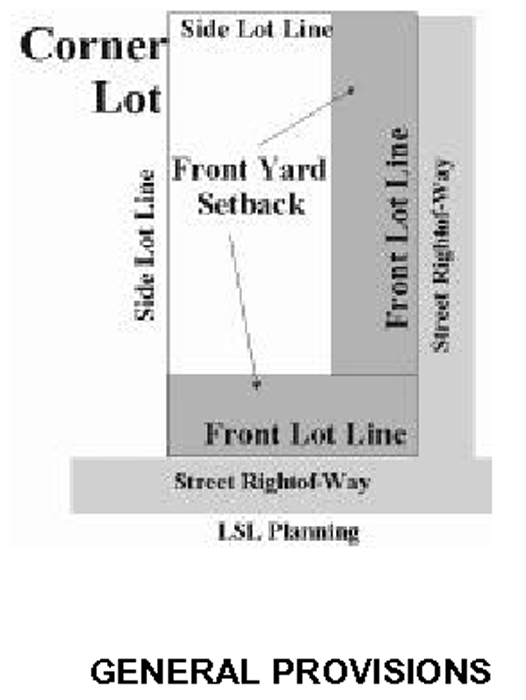
Corner Lot
(b)
Required front yard setbacks shall be measured from both front lot lines.
(c)
For a lot with three front lot lines, the remaining lot line shall be a rear lot line.
(d)
The minimum lot width of a corner lot shall be determined at the shorter of the two front lot lines.
(e)
The front building line on any lot with an outside simple curve will be the straight-line chord that intersects the side lot lines at the point of intersection with the required front setback line.
(f)
The front building line on any lot with an inside simple curve will be the straight-line tangent perpendicular to the arc radius at the midpoint of the curve.
(g)
Front building lines on lots with compound, broken-back or reverse curves will be determined using the tangent or chord which provides the greatest setback toward the interior of the lot from the required setback line and front lot line.
(h)
Average setbacks.
(1)
Where the front setbacks for 50 percent or more of the existing main buildings entirely or partially within 200 feet of the side lot lines, on the same side of the street and in the same zoning district of the subject lot are less than the required front setbacks for the zoning district of the subject lot, the required front setback for the subject lot shall be the average of the front setbacks of those existing main buildings within the 200-foot distance.
(2)
The permitted front setback reduction shall only be permitted if there are two or more lots occupied by main buildings within the two hundred-foot distance.
(3)
In no case shall the required front setback resulting from the application of this subsection be less than 20 feet.
(Ord. No. 04-07, § 1(3.21), 7-12-2004)
Sec. 82-122. - Exterior lighting requirements.
(a)
Parking lot lighting shall be as required in subsection 82-468(e).
(b)
Lighting provided for security or visibility on any site shall be shielded to reduce glare and shall be arranged and maintained to direct the light away from any residential district or use.
(c)
Lighting shall not be attached to buildings or other structures that permit light to be directed horizontally.
(Ord. No. 04-07, § 1(3.22), 7-12-2004)
Sec. 82-123. - Home occupations.
(a)
Home occupations shall be approved by the zoning administrator, who may issue a permit upon receipt of a letter from the applicant stating his or her intent to comply with the requirements of this section and the specific measures by which compliance will be maintained.
(b)
A home occupation shall be conducted only within the premises of a single-family detached dwelling unit. Home occupations are not permitted within two-family or multiple-family dwellings.
(c)
There shall be no outdoor, on-site storage of materials, equipment, or accessory items and/or display of materials, goods or supplies used in the conduct of the home occupation. The on-site storage of commercial vehicles used incidentally for or used in the home occupation business shall not be permitted.
(d)
Only members of the immediate family who reside on the premises and not more than one nonresident employee shall be employed in any part of the operation of the home occupation.
(e)
Home occupations are permitted only in the main structure or building. All activities related to the home occupation shall be carried on entirely within the dwelling unit and are limited to one home occupation business per family member. In no case shall more than 25 percent or 300 square feet, whichever is smaller, of the gross floor area of the main building be utilized for a home occupation. The use of the dwelling unit for the home occupation shall be clearly incidental and subordinate to its use for residential purposes by its occupants.
(f)
A home occupation shall not generate a traffic burden through excessive traffic or create an adverse effect for the general area in which it is located. The following factors shall be considered by the zoning administrator to determine whether the traffic effects on a neighborhood may be excessive:
(1)
Whether the subject parcel is located at the entrance or the interior of a subdivision where increased traffic volumes may be otherwise anticipated.
(2)
Whether the nature of the proposed home occupation requires scheduled appointments or whether traffic volumes may be higher at certain times of the day.
(3)
Whether traffic volumes may vary on a seasonal basis.
(4)
Whether the home occupation could be conducted in such a manner as to reduce traffic generated in the area.
(g)
No more than two customers, clients, students or patients shall be on the premises in which a home occupation is located at any one time.
(h)
Any parking for vehicles associated with the home occupation shall be provided off the street. The home occupation shall not require any additional parking.
(i)
No retail or other sales of merchandise or products shall be conducted upon the premises except for incidental products directly related to or necessary for the home occupation.
(j)
The establishment of a home occupation shall not necessitate exterior modification to any building on the property, except as may be required by the zoning administrator to comply with adopted building codes and requirements.
(k)
No equipment or process shall be used in a home occupation which creates fumes, odors, dust, vibration, noise, smoke or electrical interference detectable to the normal senses outside the dwelling unit, or creates a fire hazard or other conditions which might pose a nuisance to adjacent properties. In the case of electrical interference, no equipment or process shall be used which creates visual or audible interference in any radio or television receivers off the premises or causes fluctuations in line voltage off the premises.
(l)
Visits by customers, clients, students or patients to a dwelling unit in which a home occupation is located shall be limited to between the hours of 8:00 a.m. to 8:00 p.m., local time.
(m)
Signs shall be as allowed as permitted in article VII.
(n)
All building, housing, fire and other local or state codes and ordinances shall be adhered to for home occupations.
(o)
A registered primary caregiver, as defined by and in compliance with the General Rules of the Michigan Department of Community Health (the "General Rules"), the Michigan Medical Marihuana Act (the "Act"), and the requirements of this section, shall be allowed as a home occupation. Nothing in this section, or in any companion regulatory section adopted in any other provision of this chapter, is intended to grant, nor shall they be construed as granting immunity from prosecution for growing, sale, consumption, use, distribution or possession of marihuana not in strict compliance with the Act and the General Rules. Also, since federal law is not affected by the Act or the General Rules, nothing in this section, or in any companion regulatory section adopted in any other provision of this ordinance, is intended to grant, nor shall they be construed as granting immunity from criminal prosecution under federal law. The Act does not protect users, caregivers or the owners of properties on which medical use of marihuana is occurring from federal prosecution, or from having their property seized by federal authorities under the Federal Controlled Substances Act. The following requirements for a registered primary caregiver shall apply:
(1)
The medical use of marihuana shall comply at all times and in all circumstances with the Michigan Medical Marihuana Act and the General Rules of the Michigan Department of Community Health, as they may be amended from time to time.
(2)
A registered primary caregiver must be located outside of a 1,000-foot radius from any school or library, as defined by the Michigan Public Health Code, 1978 PA 368, as amended, MCL 333.7410, to insure community compliance with federal "drug-free school zone" requirements.
(3)
Not more than one primary caregiver shall be permitted to service qualifying patients on a parcel.
(4)
Not more than five qualifying patients shall be assisted with the medical use of marihuana within any given calendar week.
(5)
All medical marihuana shall be contained within the main building in an enclosed, locked facility inaccessible on all sides and equipped with locks or other security devices that permit access only by the registered primary caregiver or qualifying patient, as reviewed and approved by the village building official and the village police department.
(6)
All necessary building, electrical, plumbing and mechanical permits shall be obtained for any portion of the residential structure in which electrical wiring, lighting or watering devices that support the cultivation, growing or harvesting of marihuana are located.
(7)
If a room with windows is utilized as a growing location, any lighting methods that exceed usual residential periods between the hours of 11:00 p.m. to 7:00 a.m., local time, shall employ shielding methods, without alteration to the exterior of the residence, to prevent ambient light spillage that may create a distraction for adjacent residential properties.
(8)
That portion of the residential structure where energy usage and heat exceeds typical residential use, such as a grow room, or where the storage of any chemicals such as herbicides, pesticides and fertilizers occurs, shall be subject to inspection and approval by the village fire department to ensure compliance with applicable provisions of the fire code.
(Ord. No. 04-07, § 1(3.23), 7-12-2004; Ord. No. 04-11, § 2(Att. B), 10-11-2004; Ord. No. 11-06, § 1, 7-11-2011)
Sec. 82-124. - Nonconforming uses, structures, and lots.
(a)
General provisions.
(1)
Any lot, use of land, or structure which has been established in violation of the provisions of a previous zoning ordinance having jurisdiction at the time the use of land or structure was established, and any lot, use of land, or structure which has been lawfully established under a previous zoning ordinance and subsequently violates the terms of the permit under which it was established, shall be in violation of this chapter, except when the lot, use of land, or structure is in full compliance with the provisions of this chapter.
(2)
An existing lot, use of land, or structure which does not fully comply with the provisions of this chapter, as amended, and either was lawfully established under a previous zoning ordinance, created, or commenced during a period of time when no valid zoning ordinance was in effect, or was lawfully established under the jurisdiction of this chapter (before amendment), and remains in compliance with the terms of a permit issued at that time, shall be permitted to continue provided there is compliance with this section.
(3)
A lawful use of land or structure which is under construction in furtherance of the establishment of a building or structure before the enactment of this chapter shall be permitted to continue as a nonconformity.
(b)
Nonconforming uses.
(1)
No part of any nonconforming use shall be moved unless the movement eliminates the nonconformity.
(2)
If a nonconforming use is abandoned for any reason for a period of more than one year, any subsequent use shall conform to the requirements of this chapter.
(3)
A nonconforming use shall be determined to be abandoned if one or more of the following conditions exists, and shall be deemed to constitute an intent on the part of the property owner to abandon the nonconforming use:
a.
Utilities, such as water, gas and electricity to the property, have been disconnected;
b.
The property, buildings, and grounds, have fallen into disrepair;
c.
Signs or other indications of the existence of the nonconforming use have been removed;
d.
Removal of equipment or fixtures that is necessary for the operation of the nonconforming use;
e.
Other actions, which in the opinion of the zoning administrator constitute an intention of the part of the property owner or lessee to abandon the nonconforming use.
(4)
A nonconforming use shall not be changed to any other nonconforming use. A nonconforming use that is succeeded by a conforming use shall lose its nonconformity and shall thereafter be continued in compliance with the provisions of this chapter.
(5)
No nonconforming use shall be permitted to expand or enlarge the size of any building or structure, or extend the land area occupied by the nonconforming use, unless approved by the zoning board of appeals, after a finding that the expansion, enlargement, or extension of the nonconforming use:
a.
Shall not have a substantial detrimental effect on the use and enjoyment of adjacent uses or lots;
b.
Shall comply with all parking, sign, or other applicable regulations applicable to the area affected by the proposed enlargement, increase, or greater area;
c.
Shall comply with any reasonable conditions imposed by the zoning board of appeals that are necessary to ensure that the proposed enlargement, increase, or greater area will not prove detrimental to adjacent properties, the neighborhood, or the community.
d.
Shall not be larger than 25 percent or the original nonconforming area.
(c)
Nonconforming structures.
(1)
The expansion of a nonconforming structure shall be permitted provided that the addition is in compliance with this chapter.
(2)
No nonconforming building shall undertake a structural change requiring a building permit, pursuant to the village building code, as amended, provided, however, that mechanical, electrical, and plumbing permits shall be issued when no structural alteration or modification is involved.
(3)
Nothing in this section shall be construed to prevent the strengthening or restoring to safe condition of any building, structure, or part thereof declared to be unsafe by any public official charged with protecting the public health or safety. These structures may be altered to the extent necessary to comply with the order of that public official.
(4)
A nonconforming residential structure damaged by fire, collapse, explosion, high winds, vandalism, or other means beyond the owner's control may be repaired or replaced to its former condition and location.
(5)
A nonconforming, nonresidential structure destroyed to an extent of more than 50 percent of its replacement value, exclusive of the foundation, shall be reconstructed only in conformance with the provisions of this chapter. Should a nonresidential nonconforming building or structure be destroyed to an amount equal to or less than 50 percent of its replacement value, exclusive of the foundation, it may be reconstructed in its previously nonconforming location.
(6)
A nonconforming structure shall not be moved in whole or in part except when such moving results in full compliance with the provisions of this chapter.
(7)
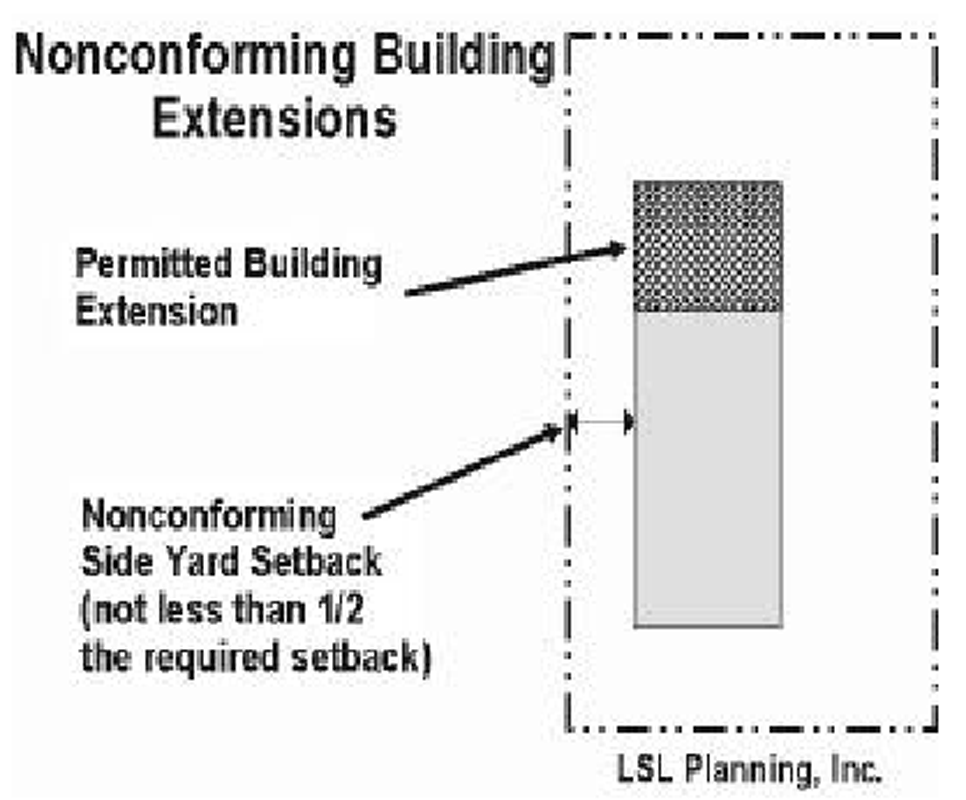
Extensions: Where a nonconforming setback of a structure is equal to or less than one-half of the distance required by this chapter a nonconforming setback may be extended along the same plane as the existing nonconforming setback, provided that in so doing, the setback itself is not further reduced and all other required setbacks are met.
(d)
Nonconforming lots of record.
(1)
A nonconforming lot may be used for the purposes for which it is zoned and shall be issued a development permit, provided that:
a.
If already less than the minimum requirements of this chapter, a required lot area or lot width shall not be divided or reduced in dimensions or area so as to increase its noncompliance with the minimum requirements of this chapter.
b.
The lot area and lot width shall be at least two-thirds of the required lot area and lot width for the district in which the lot is located.
c.
Any main building shall meet the setback requirements of the district in which the lot is located, or obtain a variance from the zoning board of appeals.
(2)
Contiguous nonconforming lots in common ownership.
a.
For any two or more nonconforming lots of record or combination of lots and portions of lots of record, in existence at the time of the passage of this chapter, or an amendment to it, the lands involved shall be considered to be an undivided parcel for the purposes of this chapter if they:
1.
Are in common ownership;
2.
Are adjacent to each other or have continuous frontage, and;
3.
Individually do not meet the lot width or lot area requirements of this chapter.
b.
These parcels shall be combined into lot or lots complying as nearly as possible with the lot width and lot size requirements of this chapter. No portion of that parcel shall be used or divided in a manner that diminishes compliance with lot width and area requirements of this chapter.
(Ord. No. 04-07, § 1(3.24), 7-12-2004)
Sec. 82-125. - Site condominiums.
(a)
A site condominium unit shall be a unit created by the division of land on the basis of condominium ownership that is not subject to the provisions of the Land Division Act, Public Act 288 of 1967, as amended.
(b)
A site condominium unit shall be treated as a separate lot or parcel and may have such buildings constructed thereon and such uses conducted thereon as allowed in its zoning district provided the unit meets the district regulations for the zoning district in which it is located.
(c)
A site plan, including all the condominium documents required for the establishment of a condominium, shall be reviewed and approved by the village council in accordance with article V.
(d)
Monuments shall be set at all boundary corners and deflection points and at all road right-of-way intersection corner and deflection points. Lot irons shall be set at all condominium site corners and deflection points of condominium site lines.
(1)
The zoning administrator and the village engineer may grant a delay in the setting of required monuments or irons for a reasonable time, but not to exceed one year from the date of approval by the village council, on condition that the developer deposit with the village clerk cash, a certified check, or an irrevocable bank letter of credit running to the Village of Sparta, whichever the developer selects, in an amount as determined from time to time by resolution of the village council.
(2)
Such deposit shall be returned to the developer upon receipt of a certificate by a surveyor registered in the State of Michigan that the monuments and irons have been set as required, within the time specified.
(3)
If the developer defaults, the village council shall promptly engage a registered surveyor to set the monuments and irons in the ground as shown on the condominium site plan, at the developer's expense.
(e)
All rights-of-way and utility easements shall be described separately from individual condominium sites and shall be accurately delineated by bearings and distances on the condominium subdivision plan and the final site plan.
(1)
The rights-of-way and utility easements shall be separately designed for their individual purpose, such as access, roadway, location, installation, maintenance and replacing of public utilities.
(2)
The developer shall dedicate to the Village of Sparta all easements for utilities. Water, sewer and electrical easements may be placed within streets, subject to the approval of the village engineer and the standards of the Village of Sparta.
(3)
All streets and roads proposed for any site condominium shall be developed within the minimum design, construction, inspection, approval, and maintenance requirements of this chapter, other applicable village chapters, and the comparable requirements of the Kent County Road Commission, if applicable.
(Ord. No. 04-07, § 1(3.25), 7-12-2004)
Sec. 82-126. - Surface water protection.
(a)
No uses nor the construction or location of any structures shall be allowed within any area designated by the master plan as environmentally sensitive or where there are drainage courses and watercourses, except as may be allowed according to the requirements and provisions of any chapters, standards and regulations of the village.
(b)
No cutting, trimming or otherwise clearing of trees and other natural vegetation shall be allowed within 100 feet of rivers and free-flowing streams, or within floodplains and wetlands, as defined by the master plan, without the express written approval of the village manager.
(c)
Native protective strip.
(1)
A minimum strip of 25 feet bordering each bank of any watercourse or water body, as measured from the bank or high water line, shall be maintained in its natural vegetative state, except for the permitted clearing of dead or noxious plants.
(2)
Within this strip, a space of no greater than ten feet in width may be selectively trimmed and pruned to allow for the placement of walkways, and/or for a view of the waterway, with the approval of the building department.
(3)
Any walkway constructed inside the strip shall be on the land side and may be oriented perpendicular to the water line. Because the intent of the native protective strip is water quality protection, impervious materials such as asphalt or concrete shall not be used.
(4)
The building department may allow limited clearing of the vegetative strip when required for construction of a permitted building or structure outside the vegetative strip, provided that the land cleared is returned to a vegetative state which is approximately the same quality or greater and extent as that which existed prior to the clearing.
(5)
Individual trees within the native protective strip may be removed which are in danger of falling, causing damage to dwellings or other structures, or causing blockage of the watercourse or water body.
(6)
The native protective strip shall not be used for any motorized vehicular traffic, parking, or for storage of any kind, including junk, waste, or garbage, or for any other use not otherwise authorized by this chapter.
(Ord. No. 04-07, § 1(3.26), 7-12-2004)
Sec. 82-127. - Natural feature setback.
(a)
It is the intent of this section to require a minimum setback from natural features and to regulate the use of property within the setback in order to prevent physical harm, impairment and/or destruction of or to natural features and environmentally sensitive areas. It has been determined that, in the absence of a minimum setback, intrusions in or onto natural features would occur, resulting in harm, impairment and/or destruction of natural features contrary to the public health, safety and general welfare.
(b)
This section shall not apply to property for which a site plan has been approved or for which a preliminary subdivision plat has received tentative approval or any subsequent approvals prior to the adoption of this chapter, provided the site plan or plat remains in effect and in good standing.
(c)
Except as may be permitted pursuant to subsection (d) of this section, a minimum setback of 25 feet from a natural feature shall be observed and any filling, land balancing, dredging, construction or any deposit, installation or removal of any material, including structures, soils, minerals, and/or vegetation, within a natural feature setback is prohibited.
(d)
Reduction of setback.
(1)
The minimum setback may be reduced upon application by the property owner and determination by the official or body responsible for review and approval of the proposed construction, activity or operation that the construction, activity or operation is not likely to endanger or materially and adversely affect the natural feature.
(2)
Incidental to the consideration of an application to reduce a natural feature setback, the village may require, at the applicant's expense, an investigation to determine the nature, location and boundaries of the natural feature.
(3)
In determining whether to authorize a reduction of the minimum setback, the official or body responsible for review and approval of the proposed construction, activity or operation shall consider the following criteria:
a.
The nature, environmental sensitivity and size of the natural feature.
b.
The nature, necessity and economic value of the proposed construction, activity or operation.
c.
The feasibility of alternatives.
d.
The probable impact of the proposed construction, activity or operation on the natural feature and the cumulative effect of other existing and anticipated activities on the natural feature.
e.
The probable impact on fish and wildlife and their habitats.
f.
The maintenance of historic, scenic, ecological and recreational values, and the character of the area.
(e)
Exemptions.
(1)
The following activities shall be exempt from regulation under this section, although other sections of this chapter may apply:
a.
Lawn maintenance.
b.
Grading and filling required by the village.
(2)
Exemptions are also made from regulation under this section (although other sections of this chapter may apply) for the construction, maintenance, cleaning and improvements of the following:
a.
Public streets, highways, roads or pedestrian-bicycle pathways within an existing right-of-way or a public easement;
b.
Sanitary sewer, storm drainage systems and facilities; electric, gas, telephone and cable television lines;
c.
Maintenance, repair, cleaning and upgrading of any natural and manmade drainage course, watercourse, drain, pipe, ditch, stream, creek, swale, detention and retention basin and pond which serves to transport or hold stormwater runoff.
d.
Activities that are authorized on state regulated wetlands without a state permit under section 30305 of Public Act No. 59 of 1995 (MCL 324.30305).
(3)
Except for emergencies, exemptions may only be granted with prior written notice and consent from the village engineer is obtained prior to commencement of work. Granting of exemptions shall be based on the following:
a.
Prior written notice is given to the village engineer and written consent is obtained from the village manager prior to commencement of work;
b.
The work is conducted using best management practices to ensure that flow and circulation patterns, and chemical and biological characteristics of wetlands are not impaired; and
c.
Any adverse effect on the aquatic environment will be minimized.
(f)
The village may require that a suitable protective barrier be erected and maintained to prevent construction or development activity from encroaching into the natural feature setback.
(Ord. No. 04-07, § 1(3.27), 7-12-2004)
Sec. 82-128. - Outdoor dining/seating.
(a)
Outdoor dining/seating must be accessory to an approved use.
(b)
Outdoor dining/seating area may not encroach into a public right-of-way. Permission of the zoning administrator may allow outdoor dining in the right-of-way if said dining is not a nuisance or obstructs traffic. Permission to do so may be revoked if dining within the right-of-way becomes a nuisance, obstructs movement of foot or vehicle traffic, or for other reasons relating to the public wellbeing.
(c)
The site plan shall indicate maintenance of eight feet of clear space from tree canopies.
(d)
All alcoholic beverages shall be sold to patrons seated at tables and only for consumption on the premises. No outdoor bars, patron dancing, or live entertainment shall be permitted in the outdoor dining/seating.
(e)
The area designated for outdoor dining/seating must be enclosed with a decorative metal fence consistent with the fencing requirements of the village and no more than 25 percent opaque. This requirement may be waived by the zoning administrator if no alcohol is served on the premises and the zoning administrator determines that fencing is not needed to separate the area from an adjacent public right-of-way or to protect pedestrians utilizing adjacent sidewalks or walkways.
(f)
Outdoor dining/seating shall not extend between the hours of 12:00 a.m. and 7:00 a.m.
(g)
Lighting visible from the public right-of-way should be unobtrusive and in keeping (night and day) with the architectural character of the district. Indirect lighting and accent lighting for public entrances are encouraged.
(Ord. No. 04-07, § 1(3.28), 7-12-2004; Ord. No. 12-04, § 1, 4-9-2012)
Sec. 82-129. - Roads—Privately constructed.
(a)
Public road required. A private driveway may provide principal access for no more than two uses or structures. Service for more than two structures or uses shall require direct access to a public street.
(b)
Village standards and dedication. All privately constructed roads shall be constructed to village standards and dedicated to the public. An applicant proposing a road for dedication shall submit an application including a written description of the proposed development to be served, the names and addresses of the applicant and the contractor and detailed site plans and construction plans as set forth in subsection (c). The application shall also include escrow deposits as required per section 58-172 of the Code of Ordinances, and proof that the applicant is the owner of record of the property underlying the proposed road.
(c)
Site plans and construction plans. The applicant shall file a site plan and construction plans and specifications, showing the proposed location, adjacent properties, proposed street grades, drainage, utilities, lighting, hydrants and proposed improvements prepared by a registered engineer for review and approval of the village engineer.
(d)
Construction. Upon approval by the village engineer construction of the road may be undertaken by a contractor reasonably acceptable to the village manager. All construction shall comply with the plans and specifications approved by the village engineer. The applicant or its contractor shall arrange with the village engineer for inspection of the road construction.
(e)
Dedication and acceptance of road. The applicant shall correct any deficiencies identified by the village or its engineer during either an interim or final review. Upon the village engineer's final review and approval of the completed road improvements, the submission of "as-built" plans acceptable to the village engineer and the submission of a document in a form acceptable to the village manager that either conveys or dedicates the road and needed right-of-way, the village council shall consider acceptance of the road as a village road. Permits for occupancy of properties served by the road shall not be issued until the road has been dedicated and accepted.
(f)
Applicability. These regulations apply to all privately constructed roads constructed after the date of their adoption. Furthermore, these regulations will also apply to existing private roads when any of the following occurs:
(1)
A private road serving fewer than three parcels is subsequently intended to serve three or more parcels.
(2)
A private road serving fewer than three dwellings or commercial uses is subsequently intended to serve a total of three or more dwellings or commercial uses.
(3)
Extensions or additions are added to an existing private road.
(4)
The village determines that an existing private road is unsafe or will not permit reasonable year-round access to firefighting and emergency vehicles to all portions of the private road.
These regulations will apply not only to the new portion of a privately constructed road, but the entire length of the road.
(Ord. No. 04-07, § 1(3.29), 7-12-2004; Ord. No. 05-02, § 1, 2-14-2005)
Sec. 82-130. - Storage of recreational vehicles, boats, equipment and other motorized vehicles.
(a)
Recreational vehicles, boats, equipment, and other motorized vehicles may be located outside of an enclosed building in the driveway of any lot within a residential district provided that the following requirements are met:
(1)
Recreational vehicles, boats, equipment and other motorized vehicles shall be currently licensed with up-to-date registered plates as required by the Michigan Secretary of State. Boats shall have an up-to-date license with the Secretary of State and boat trailers shall have a permanent license per state requirements. Recreational vehicles, offroad vehicles, boats, trailers and other trailered camper vehicles shall be operational and maintained in good working order.
(2)
Notwithstanding the provisions of this section, recreational vehicles and equipment, and other motorized vehicles may be parked within any yard for cleaning, loading, or unloading purposes for not more than 48 hours within any seven-day period.
(3)
Recreational vehicles and equipment may be used for living or housekeeping purposes for a period not exceeding 14 days in any calendar year, provided that running water or indoor sewage facilities within the equipment is not utilized.
(4)
No vehicular display for purpose of sale shall be carried on or permitted upon such premises, except in licensed and approved vehicle sales establishments.
(5)
Outside parking or storage of recreational vehicles, boats, equipment, and other motorized vehicles, or commercial vehicles or automobiles which are not used in the operation of the business is prohibited; provided, however, that such provision shall not apply to any equipment or vehicle which is temporarily on the premises for repair or service and which is stored or parked in a designated parking place. No more than one tow truck may be parked in the front or side yards or in the street at an automobile service station location. Outdoor storage of disabled, abandoned, junk, wrecked and/or unlicensed vehicles is prohibited in all districts in accord with chapter 26, article III of this Code except for properly licensed junk/scrap yards in the business district with special land use approval. Unless otherwise permitted in this section, outdoor storage of rubbish and junked equipment or parts is prohibited unless such rubbish, junked equipment or parts are stored adjacent and to the rear of the principal building and are in a fully screened area approved by the village planning commission, and provided, further, that such rubbish and junked equipment or parts shall be removed from the property at least once every week.
(b)
Where physical features of a property, such as, but not limited to, immovable structures or a tree with a diameter of four inches or greater, prohibit recreational vehicles and equipment from being parked in compliance with this section, the owner may apply to the zoning administrator for permission to park the recreational equipment on the lot. This permission shall be granted, provided that the following requirements are met:
(1)
A 20-foot setback shall be maintained from the recreational equipment to the edge of the street pavement or curb; or, if a sidewalk exists, the 20-foot setback shall be measured from the inside edge of the sidewalk.
(2)
Parking approval, if granted by the zoning administrator, shall be effective for five years following the date of issuance. The zoning administrator may grant additional approvals in accordance with this section.
(Ord. No. 04-07, § 1(3.30), 7-12-2004; Ord. No. 22-09, § 1, 6-13-2022; Ord. No. 24-02, § 6, 6-10-2024)
Sec. 82-131. - Height exceptions for buildings and structures.
(a)
The height requirements in all districts may be exceeded by the following exceptions: parapet walls not over four feet in height, chimneys, silos, farm barns and buildings accessory to active farming operations, cupolas, domes, spires, or other ornamental projections and public water towers provided they are located a minimum of the same distance as their height from any adjoining property line.
(1)
The height of antennas, whether attached to a support structure or a building in residential zoning districts, serving dwelling units, is limited to 35 feet.
(2)
Amateur radio antennas in residential zoning districts operating under a license issued by the Federal Communications Commission may exceed a height of 35 feet, and are subject to the requirements of section 82-387 (hh).
(b)
In industrial zones, height requirements may be exceeded by: stack chimneys, cooling towers, fire towers, elevator buildings and bulkheads, storage tanks, grain elevators, and other necessary appurtenances provided they are located a minimum of the same distance as their height from any adjoining property line.
(c)
The height for wind energy turbines shall be as required by article X.
(d)
The height for wireless communication towers and antennas shall be as required by sections 82-387 (c) and (hh).
(e)
In no case shall the height of any building or structure exceed 80 feet, except as provided by the procedures and requirements of article IV, and by the specific requirements of section 82-388.
(Ord. No. 16-02, § 2, 7-11-2016)
Sec. 82-132. - Marihuana businesses.
(a)
Recreational marihuana establishments are prohibited unless specifically authorized by and operated in compliance with this chapter and chapter 7 of this Code.
(b)
Medical marihuana facilities are prohibited.
(Ord. No. 23-07, § 3, 8-14-2023)
Sec. 82-133. - Accessory dwelling units.
(a)
General provisions.
(1)
Accessory dwelling units (ADU) are a permitted use in all residential zoning districts, subject to issuance of a land use permit issued by the zoning administrator and subject to the requirements of this section.
(2)
A maximum of one accessory dwelling unit is allowed on conforming lots and parcels with a principal single-family, two-family (duplex), or three-family (tri-plex) residential dwelling unit.
(3)
An accessory dwelling unit may be erected on a lot or parcel with either an existing dwelling or a new dwelling unit.
(b)
Standards.
(1)
An accessory dwelling unit may be erected on any lot that meets the minimum lot size required for single-family, two-family (duplex), and three family (tri-plex) dwelling units in the residential zoning districts.
(2)
An accessory dwelling unit shall be integrated within or attached to the principal dwelling as an attached accessory dwelling unit or as a separate building as a detached accessory dwelling unit. Mobile homes, shipping containers, and RV/camping units are prohibited from serving as accessory dwelling units.
(3)
No more than two occupants may reside within an accessory dwelling unit.
(4)
An accessory dwelling unit may not be rented or leased for less than 30 days at a time.
(5)
The setback requirements and lot coverage limitations of this section shall be met. The creation or conversion of an accessory building that does not comply with principal building setbacks is prohibited.
(6)
Attached and detached accessory dwelling units shall retain a residential appearance consistent with the architectural design and building materials of the principal dwelling, including but not limited to roof material, roof type, siding material, and window type and placement.
(7)
Unless otherwise provided in this section, the maximum square footage of an accessory dwelling unit shall not exceed 49 percent of the above-grade gross floor area of the principal dwelling or 900 square feet, whichever is greater. Accessory dwelling units located over a garage may be equal to the same square footage as the ground level of the garage.
(8)
If there are no public water and/or sewer connections available, well and septic approval by the county health department is required. Systems may be shared with the principal system or be separate, contingent upon the approval of the health department. Written verification of approval from the health department shall be submitted to the village.
(9)
Specific requirements for attached accessory dwelling units.
a.
An attached accessory dwelling unit located over an attached garage may be served by a single access point, separate from the rest of the principal dwelling.
(10)
Specific requirements for detached accessory dwelling units.
a.
A parcel or lot shall not be divided in a manner that separates a detached accessory dwelling unit and the principal dwelling unit onto separate parcels or lots.
b.
A detached accessory dwelling unit shall not be located closer to a front lot line than the principal dwelling. All other side and rear yard setbacks applicable to the primary dwelling unit shall apply to the detached accessory dwelling unit.
c.
In the case of a detached accessory dwelling unit over garage space, such as a carriage house, the first-floor garage space shall not count against the maximum square footage applicable to the accessory dwelling unit.
d.
The minimum square footage shall be the minimum necessary to comply with applicable building codes.
e.
The height of a detached accessory dwelling unit shall not exceed the height of the principal dwelling. However, the height of a detached accessory dwelling unit over garage space may exceed the height of a single-story principal dwelling by ten feet. The maximum height shall be calculated based on the highest point of the roof compared with the lowest point of ground level at the foundation.
(11)
Accessory dwelling units shall not have a separate meter for public utilities, such as electric and gas service, or a separate mailing address. The owner of the principal dwelling shall be responsible for all utility service costs.
(12)
An accessory dwelling unit must be properly maintained at all times and may not at any time fall into disrepair such that it detracts from the appearance of the subject property or nearby properties or become a blighted structure.
(13)
The lot coverage limits applicable in the residential zoning districts shall apply to the combined lot coverage of both the principal unit and the accessory unit.
(14)
No additional off-street parking is required for construction of an accessory dwelling unit. If the construction of the ADU necessitates the removal of an existing off-street parking space, it must be replaced on-site if required by the underlying zoning district.
(Ord. No. 24-02, § 7, 6-10-2024; Ord. No. 24-08, § 1, 12-9-2024)
Editor's note— Ord. No. 24-02, § 7, adopted June 10, 2024, set out provisions intended for use as § 82-132. Inasmuch as § 82-132 already exists, these provisions have been included above as § 82-133 at the editor's discretion.
Sec. 82-151. - Establishment of districts.
For the purposes of this chapter, the village is divided into the following zoning districts:
(Ord. No. 04-07, § 1(4.01), 7-12-2004; Ord. No. 24-02, § 8, 6-10-2024)
Sec. 82-152. - Official zoning districts map.
The boundaries of the zoning districts enumerated in section 82-151 are hereby established as shown on the "Official Zoning Map, Village of Sparta," which accompanies this text; this map with all notations, references and other information shown thereon is hereby adopted by reference as a part of this chapter. One copy of the official zoning map shall be maintained and kept up to date by the village clerk, accessible to the public, and the final authority as to the current zoning status of all property in the village.
(Ord. No. 04-07, § 1(4.02), 7-12-2004)
Sec. 82-153. - Interpretation of district boundaries.
(a)
If because of the scale, lack of details, or illegibility of the official zoning map, there is any uncertainty, contradiction, or conflict regarding the intended location of any district boundaries shown on the map, interpretation concerning the exact location of district boundary lines shall be determined by the zoning administrator, using the following standards:
(1)
The boundaries of zoning districts are intended to follow centerlines of alleys, streets, other rights-of-way, or lot lines, or to be parallel or perpendicular thereto, unless the district boundary lines are otherwise clearly indicated on the official zoning map.
(2)
Where district boundaries are indicated to approximately follow lot of record lines, those lines shall be construed to be boundaries.
(3)
Unless shown by dimension on the official zoning map, where a district boundary divides a lot of record the location of the boundary shall be determined by use of the scale shown on the map.
(4)
Where district boundaries are indicated as approximately following village limits, they shall be construed as following the village limits.
(5)
A boundary indicated as following the centerline of a stream, river, canal, lake or other body of water shall be construed as following that centerline.
(6)
If a district boundary is indicated as being parallel to, or an extension of a feature described in this section it shall be so construed.
(b)
Where physical or natural features existing on the ground are at variance with those shown on the official zoning map or in other circumstances not covered in this section the zoning administrator shall determine the district boundaries. Any person who disagrees with the interpretation of the zoning administrator may file an appeal in accordance with the provisions of section 82-544(b)(1), Powers and duties, zoning board of appeals.
Sec. 82-154. - Zoning of vacated areas.
If a street, alley or other public right-of-way within the village is vacated by official governmental action and if the lands within the boundaries thereof attach to and become part of lands adjoining the street, alley or public right-of-way, such lands shall automatically acquire and be subject to the same zoning regulations applicable to adjoining lands as regulated by this chapter.
(Ord. No. 04-07, § 1(4.04), 7-12-2004)
Sec. 82-155. - Zoning of filled land; use of waters.
If earthen fill is placed in any lake or stream, the created land shall automatically and without further governmental action acquire and be subject to the same zoning regulations applicable for lands to which the land attaches or is adjacent; and the created land shall be used for those purposes as are permitted under this chapter for the adjoining lands.
(Ord. No. 04-07, § 1(4.05), 7-12-2004)
Sec. 82-156. - Zoning of annexed areas.
When property is annexed into the village, the planning commission shall consider the appropriate district classification and shall propose an amendment to this chapter concerning the annexed land to the village council within one year of the effective date of the annexation. In the interim period, the property shall be considered to be in the R-M district.
(Ord. No. 04-07, § 1(4.06), 7-12-2004; Ord. No. 24-02, § 9, 6-10-2024)
Sec. 82-171. - Intent and purpose.
The R-M district is intended to provide for stable, moderate density residential areas by ensuring compatible residential density, encouraging a safe environment for family life, and protecting these areas from undesirable land uses. The purpose of this district is to preserve the character, amenities and property values associated with moderate-density residential development. This district allows for primarily single-family homes, two-family homes, and three-family homes but may allow, in a limited number of cases, other uses compatible with single, two, and three-family residential and supportive of cohesive residential neighborhoods such as parks and public service facilities/buildings.
(Ord. No. 24-02, § 10, 6-10-2024)
Sec. 82-172. - Permitted uses.
In the R-M district no building or land shall be used and no building shall be erected except for one or more of the following specified uses, unless otherwise provided in this division:
(1)
Parks and playgrounds.
(2)
Single-family detached dwellings, including home occupations, meeting the requirements of section 82-123, home occupations.
(3)
Two-family dwellings, including home occupations, meeting the requirements of section 82-123, home occupations.
(4)
Three family dwellings, including home occupations, meeting the requirements of section 82-123, home occupations.
(5)
State licensed residential care family facilities.
(6)
Family day care facilities.
(7)
Accessory buildings, structures, and uses, meeting the requirements of section 82-103, accessory buildings and structures.
(8)
Accessory dwelling units, meeting the requirements of section 82-132, accessory dwelling units.
(9)
Private educational institutions.
(10)
Golf courses and country clubs, including related uses, such as snack bars, small retail shows selling goods directly related to the primary use, and other similar uses integral to the main use.
(11)
Religious institutions.
(12)
Bed and breakfast accommodations.
(13)
Rooftop solar panels with an accessory use permit in accordance with section 82-103.
(Ord. No. 24-02, § 10, 6-10-2024)
Sec. 82-173. - Special land uses.
Land and/or buildings in the R-M district may be used for the following purposes when approved by the village council in accordance with the requirements of article IV, special land uses:
(1)
Campgrounds.
(2)
Private cemeteries.
(3)
Public utility structures.
(4)
State-licensed residential care group facilities.
(5)
State-licensed group day care facilities.
(Ord. No. 24-02, § 10, 6-10-2024)
Sec. 82-174. - Site development requirements.
All permitted uses and special land uses are subject to the following site development requirements:
(1)
Site plan review is required in accordance with article V, site plan review.
(2)
Parking is required in accordance with article VI, off-street parking and loading.
(3)
Signs are permitted in accordance with the requirements of article VII, signs.
(4)
Setbacks, height, area, and lot dimensions are required as noted below:
(Ord. No. 24-02, § 10, 6-10-2024)
Sec. 82-191. - Intent and purpose.
The R-H district provides opportunities for more affordable housing, and a wider variety of housing types. Lands within this classification will contain the most intensive residential development, including single-family dwellings on smaller lots, two-family, three family, and multiple family dwellings, as well as other residential related development.
(Ord. No. 24-02, § 11, 6-10-2024)
Sec. 82-192. - Permitted uses.
In the R-H district no building or land shall be used and no building shall be erected except for one or more of the following specified uses, unless otherwise provided in this division:
(1)
Parks and playgrounds.
(2)
Single-family detached dwellings, including home occupations, meeting the requirements of section 82-123, home occupations.
(3)
State licensed residential care family facilities.
(4)
State licensed family day care facilities.
(5)
Two-family dwellings, including home occupations, meeting the requirements of section 82-132, home occupations.
(6)
Three-family dwellings, including home occupations, meeting the requirements of section 82-132, home occupations.
(7)
Accessory buildings and uses, meeting the requirements of section 82-103, accessory buildings and structures.
(8)
Accessory dwelling units, meeting the requirements of section 82-132.
(9)
Bed and breakfast establishments.
(10)
Private educational institutions.
(11)
Golf courses and country clubs, including related uses, such as snack bars, small retail shops selling goods directly related to the primary use, and other similar uses integral to the main use.
(12)
Government service facilities, and community centers.
(13)
Multiple family dwellings.
(14)
Religious institutions.
(15)
Rooftop solar panels with an accessory use permit as required by section 82-103.
(Ord. No. 24-02, § 11, 6-10-2024)
Sec. 82-193. - Special land uses.
Land and/or buildings in the R-H district may be used for the following purposes when approved by the village council in accordance with the requirements of article IV, special land uses:
(1)
Campgrounds.
(2)
Private cemeteries.
(3)
Manufactured home parks.
(4)
Public utility structures.
(5)
State licensed residential care group facilities.
(6)
State licensed group day care facilities.
(Ord. No. 24-02, § 11, 6-10-2024)
Sec. 82-194. - Site development requirements.
Unless otherwise provided in this section, all permitted uses and special land uses are subject to the following site development requirements:
(1)
Site plan review is required in accordance with article V, site plan review.
(2)
Parking is required in accordance with article VI, off-street parking and loading.
(3)
Signs are permitted in accordance with the requirements of article VII, signs.
(4)
Setbacks, height, area, and lot dimensions are required as noted below:
(Ord. No. 24-02, § 11, 6-10-2024; Ord. No. 24-08, § 1, 12-9-2024)
Sec. 82-251. - Intent and purpose.
(a)
The business (B) district is intended primarily for a variety of business, professional office, and retail uses and to accommodate wholesale activities, warehouses, and light industrial operations. Managing access to individual properties will receive strong consideration during the review of individual sites. The use of combined drives, service drives, and well-planned access points will be stressed. Efforts will be made to discourage the placement of loading areas, outside storage and other unattractive features in areas clearly visible from the roadway. This district is further intended to provide for uses, which, due to either size or nature, are not well suited for locations within the central business district. This district is structured to permit, along with any other specified uses, the manufacturing, compounding, processing, packaging, assembly, and/or treatment of finished or semi-finished products from previously prepared material, it being the intent of the district that the processing of raw material for shipment in bulk form, to be used in an industrial operation at another location, not be permitted.
(b)
The business (B) district is also intended to:
(1)
Provide sufficient space, in appropriate locations, to meet the needs of the village's expected future economy for selected types of businesses, manufacturing and related uses.
(2)
Protect abutting residential districts from objectionable influences by separating them from business and manufacturing activities, and by prohibiting the use of industrial areas for new residential development.
(3)
Promote manufacturing development which is free from danger of fire, explosions, toxic and noxious matter, radiation, and other hazards and from offensive noise, vibration, smoke, odor and other objectionable influences.
(4)
Promote the most desirable use of land in accordance with a well-considered plan.
(5)
Protect the character and established pattern of adjacent development, and in each area conserve the value of land and buildings and other structures and protect the village's tax base.
(Ord. No. 24-02, § 14, 6-10-2024)
Sec. 82-252. - Permitted uses.
In the B district no building or land shall be used and no building shall be erected except for one or more of the following specified uses, unless otherwise provided in this division:
(1)
Office buildings for any of the following occupations:
a.
Executive, governmental, administrative, legal, professional, designers, real estate, accounting, financial, drafting, service organizations, travel agencies, and other similar professional activities.
b.
Medical, optical, dental, and veterinary offices and clinics.
(2)
Banks, credit unions, savings and loan associations, and other similar uses, with or without drive-through service.
(3)
Radio and television stations.
(4)
Research, development and testing laboratories and offices without manufacturing.
(5)
Religious institutions.
(6)
Utility and public service buildings, without storage yards, but not including essential public service structures such as poles, wires, and underground utility systems.
(7)
Buildings, structures, and uses accessory to the permitted uses pursuant to section 82-103, accessory buildings and structures.
(8)
Bars or taverns. Outdoor seating areas may be permitted, pursuant to section 82-128, outdoor dining/seating.
(9)
Funeral homes and mortuaries.
(10)
Personal service establishments.
(11)
Private educational institutions.
(12)
Public service establishments and governmental buildings.
(13)
Restaurants, not including drive through service. Outdoor seating areas may be permitted where patrons are served, pursuant to section 82-128, outdoor dining/seating.
(14)
Enclosed theaters, assembly halls or concert hall.
(15)
Offices and showrooms of contractors, decorators or similar trades in connection with whom not more than 25 percent of the usable floor area of the building or part of the building occupied by the establishment is used for making, assembling, repairing, remodeling, altering, finishing or refinishing the products or merchandise of the trade. All storage of materials shall be within the confines of the building or part thereof occupied by the establishment.
(16)
Private clubs, lodges, fraternal organizations, and other similar uses.
(17)
Retail stores selling commodities within an entirely enclosed building.
(18)
Wholesale establishments.
(19)
Outdoor display of merchandise as a use accessory to the principal use of the parcel subject to the following requirements:
a.
The merchandise displayed outdoors is the same as or is related to that which is offered inside the building which is the principal use of the parcel.
b.
The area where merchandise is displayed outdoors shall not create unsafe conditions for vehicles, pedestrians or those on a bicycle.
c.
The area devoted to the outdoor display of merchandise shall at all times be kept neat and orderly.
d.
The outdoor display of merchandise shall not be located within on-street or off-street parking spaces.
(20)
Commercial day care facilities.
(21)
Commercial recreation facilities.
(22)
Residential uses meeting the lot area requirements of the R-H district.
(23)
Nonresidential uses as permitted in this section that are located in converted residential buildings.
(24)
Nurseries and greenhouses.
(25)
Hotels and motels.
(26)
New and used vehicle, boat or farm implement sales including incidental servicing and minor repair.
(27)
Massage (licensed).
(28)
Open air businesses.
(29)
Restaurants, including drive through service. Outdoor seating may be permitted where patrons are served pursuant to section 82-128, outdoor dining/seating.
(30)
Shopping center or shopping mall.
(31)
Vehicle-wash establishments, either self-service or automatic.
(32)
Veterinary hospital, clinic or indoor kennel.
(33)
Vehicle service stations and repair facilities, major and minor.
(34)
Building material suppliers.
(35)
Contractor or builder's office, including an accessory storage equipment yard.
(36)
Dry cleaning plants.
(37)
Laboratories: experimental, film, or testing.
(38)
Manufacture and repair of electric or neon signs, light sheet metal products, including heating and ventilating equipment, cornices, eaves and the like.
(39)
Manufacture of musical instruments, toys, novelties, and metal or rubber stamps or other small molded rubber products.
(40)
Manufacture or assembly of electrical appliances, electronic instruments and devices, radios and phonographs.
(41)
Offices and showrooms of contractors, decorators or similar trades in connection with whom not more than 25 percent of the UFA of the building or part of the building occupied by the establishment is used.
(42)
Offices when accessory to any permitted use or special land use, provided that they do not exceed 50 percent of the GFA of the principal use.
(43)
Public and private utility uses, including electric and gas service buildings and yards; water supply and sewage disposal plants; water and gas tank holders; heating and electric power generating plants, and all accessory uses.
(44)
Storage yards for construction and contractor's equipment, provided all property lines abut the B district.
(45)
The manufacture of pottery and figurines or other similar ceramic products using only previously pulverized clay, and kilns fired only by electricity or gas.
(46)
The manufacture, compounding, assembling, or treatment of articles or merchandise from previously prepared materials such as but not limited to bone; canvas; cellophane; cloth; cork; feathers; felt; fiber; fur; glass; hair; horn; leather; paper; plastics; precious or semiprecious metals or stones; sheet metal, excluding large stampings such as automobile fenders or bodies; shell; textiles; yarns; tobacco; wax; wire; or wood.
(47)
The manufacture, compounding, processing, packaging or treatment of such products as but not limited to bakery goods, candy, cosmetics, pharmaceuticals, toiletries, food products, hardware, and cutlery; tool, die, gauge and machine shops.
(48)
Warehouse, storage, including commercial storage warehouses; and transfer facilities, including truck and railroad related facilities accessory to warehousing.
(49)
Rental space for storage of vehicles such as travel trailers, motor homes, recreational vehicles, campers, snowmobiles, boats, etc.
(50)
Utility trailer rental facilities.
(51)
Lumber and planing mills.
(52)
Wireless telecommunication facilities.
(53)
Rooftop solar panels with an accessory use permit in accord with section 82-103.
(54)
Data warehousing facility/data center.
(Ord. No. 24-02, § 14, 6-10-2024; Ord. No. 25-04, § 5, 12-15-2025)
Sec. 82-253. - Special land uses.
Land and/or buildings in the B district may be used for the following purposes when approved by the village council in accordance with the requirements of article IV, special land uses:
(1)
Buildings, structures, and uses accessory to the approved special land use.
(2)
Adult uses.
(3)
Commercial communication towers, including commercial television, radio, and public utility transmitting and/or receiving towers and receiving microwave antennas, and their attendant facilities.
(4)
Freight yards and terminals.
(5)
Incineration of garbage or refuse when conducted within an approved and enclosed incinerator plant.
(6)
Junkyards.
(7)
Metal plating, buffing and polishing, subject to appropriate measures to control the types of process to prevent noxious results and/or nuisances.
(8)
Recreational marihuana retailers.
(9)
Recreational marihuana safety compliance facilities.
(10)
Recreational marihuana secure transporters.
(11)
Tractor trailer and trucking facilities, including storage and repair.
(12)
Waste lagoon ponds, industrially oriented and permanent in character.
(Ord. No. 24-02, § 14, 6-10-2024)
Sec. 82-254. - Site development requirements.
All permitted uses and special land uses are subject to the following site development requirements:
(1)
Site plan review is required in accordance with article V, site plan review. Site plan review is required in the case of newly established uses as permitted in the B-business district; additions or renovations of buildings and structures for a use permitted in the B-business district or for a legally existing non-conforming use subject to the requirements of section 82-124; and for conversions from any use to a use permitted in the B-business district.
(2)
Parking is required in accordance with article VI, off-street parking and loading
(3)
Signs are permitted in accordance with the requirements of article VII, signs.
(4)
Setbacks, height, area, and lot dimensions are required as noted below:
(5)
Driveways within the business district shall be provided as follows, provided that the planning commission may modify the requirements for driveways if traffic or pedestrian safety, traffic circulation, or unique site conditions warrant the modification. When modifying the requirements for driveways, the planning commission may require traffic studies or the opinion of qualified professionals.
a.
Each lot may be permitted one driveway, provided the spacing requirements of this subsection can be achieved.
b.
One additional driveway may be permitted on parcels with lot widths exceeding 500 feet.
c.
The planning commission may permit two one-way driveways rather than a single dual movement driveway for particular uses where safer, more efficient circulation and function of the drives can be demonstrated. The planning commission may also permit additional driveways for any site, providing the spacing and alignment criteria listed in subparagraph (h) are met, and a traffic impact study is completed that justifies an additional driveway.
d.
The applicant shall submit evidence indicating that the sight distance requirements of the Michigan Department of Transportation (MDOT) or Kent County Road Commission, as appropriate, are met.
e.
Driveways shall be spaced from existing signalized intersections adequately to minimize conflicts with signal operations. If the site has access to a traffic signal or if the driveway has potential to be signalized, the site shall be designed and directional signs provided to direct traffic flow to use the signal.
f.
Interior drives shall provide circulation between uses through the use of shared driveways and internal access connections rather than separate, individual driveways. Site plan or other zoning approvals shall be conditioned on the submission of easement agreements that clearly describe future access conditions and restrictions.
g.
Stacking or queuing depth at driveways shall be sufficient to accommodate expected peak hour volumes without conflict to inbound or internal circulation.
h.
Driveway spacing:
1.
Driveways shall be spaced a minimum of 185 feet from driveways on the same side of the street, centerline to centerline.
2.
Driveways shall be aligned with driveways on the opposite side of the street or offset spaced a minimum of 150 feet, centerline to centerline.
3.
Driveways shall be spaced at least 150 feet from an intersection of a private or public street measured from near pavement edge of the street to near pavement edge of the driveway throat.
4.
The planning commission may modify the spacing if traffic or pedestrian safety, traffic, circulation, or site conditions warrant the modification, based on the unique characteristics of the site, traffic studies or other qualified professional opinion.
(6)
Frontage roads and service drives.
a.
The planning commission may require the construction of frontage roads or rear service drives along parcels to connect future or existing developments.
b.
The planning commission shall require development of service drives where service drives can provide access to signalized locations, where service drives may minimize the number of driveways onto an abutting roadway, and as a means to ensure that traffic is able to safely ingress and egress the site.
c.
Where service drives and frontage roads are constructed they shall be set back as far as reasonably possible from the intersection of the access driveway with the street.
d.
A minimum of 25 feet shall be maintained between the public street right-of-way and the pavement of the service drive.
(7)
Setbacks and landscaping.
a.
Parking is permitted in the required front yard but in no case shall parking be permitted within the public or private road right-of-way.
b.
The planning commission shall consider a landscape plan submitted in conjunction with any site plan in the business district.
c.
No outside storage shall be permitted in any yard adjacent to the street unless otherwise provided in this section.
(8)
Site lighting shall comply with the provisions of section 82-122, exterior lighting requirements, in addition to the following provisions:
a.
Off-street parking areas for uses in the business district shall be adequately lit to ensure security and safety.
b.
Light fixtures shall be provided with light cut-off fixtures that direct light downward. Lighting shall not be attached to buildings or other structures that permit light to be directed horizontally.
c.
Lighting shall illuminate only the parking lot or other areas approved for illumination by the planning commission.
(9)
Site design requirements.
a.
Buildings shall be sited to protected natural features. To the extent possible, natural features such as natural grade, trees, vegetation, water bodies, and others shall be incorporated into the site plan. Mechanical equipment and service areas shall be visually screened from adjacent properties, public roadways, or other public areas. Architectural designs for buildings shall include design features to contain and conceal all heating, ventilation, air conditioning units, trash enclosures, dumpsters, loading docks, telecommunications equipment, and service yards. The method of screening shall be as approved by the planning commission or as otherwise required by the village zoning ordinance.
b.
Architectural features, landscaping, building color, materials, finishes, and forms shall be substantially compatible with the character of the surrounding area. The planning commission may permit the use of architectural features, landscaping, and building materials if, in the judgment of the planning commission, the features, landscaping, and materials are compatible with the surrounding properties, and that such materials comply with the architectural, safety, and other requirements of the village building code, fire code, and other applicable village ordinances.
c.
A minimum of 25 percent of that portion of the building which faces a public or private street, or a residential zoning district or residential use, shall be finished with brick, architectural masonry block, cement board, glass stone or a combination of these materials.
d.
In order to reduce wall massing, buildings with exterior walls greater than 50 feet in horizontal length shall be constructed with a combination of the following.
1.
A combination of architectural features such as recesses, projections, and offsets.
2.
A variety of building materials.
3.
Landscaping near the walls as approved by the planning commission.
e.
Exterior colors shall be of low reflectance, subtle, neutral or earth tone colors. High-intensity colors such as black, neon, metallic or fluorescent for the facade and/or roof of the building are prohibited except as approved for building trim.
f.
Conversions from any use to uses as permitted in the B-business district, and additions and renovations of buildings and structures existing as of the date of the adoption of this section shall be subject to the requirements of this section. The planning commission, the village council, or zoning administrator as the case may be, shall have the authority to modify or waive these requirements or to extend them to the entire existing building and site.
In determining whether to apply these requirements to conversions, additions and renovations of existing buildings, the following criteria shall be considered:
1.
Whether compliance with this section will result in architectural consistency with the existing building and buildings on adjacent properties, and whether compliance will improve the overall aesthetics of the building.
2.
The practicality of requiring compliance with this section based on the design and structural integrity of the existing building.
3.
The practicality of requiring compliance with this section based on the unique characteristics of the site.
(10)
Canopies:
a.
Canopies, such as over drop-off areas, shall be designed to be consistent with the approved building materials and colors. Support columns shall be brick or materials compatible with the main building. The planning commission may require a peaked roof to complement the main building.
b.
Canopy lighting shall be mounted flush with the canopy surface.
(11)
Outdoor storage.
a.
Any outdoor storage or activity areas abutting or adjacent to a residential district or use shall be enclosed on all sides with a six-foot fence or solid wall that is completely obscuring on those sides facing the residential district, which meets the design requirements listed in section 82-112, fences and walls. In no case shall the outdoor storage of materials abutting or adjacent to a residential district or use be stacked higher than the height of the visual screen unless the planning commission or other approving authority determines that the material is stored in a manner that it is not visible from off-site, or that the material is located such a substantial distance from adjacent properties that it is not a visual nuisance.
b.
For any outdoor storage, materials shall be stored only in the side or rear yards, except that materials shall not be stored on the street side of a corner lot or in any required yard.
c.
One non-gated opening, no greater than 12 feet in width, shall be permitted in the visual screen for each 200 feet of frontage on a street.
(Ord. No. 24-02, § 14, 6-10-2024)
Sec. 82-291. - Intent and purpose.
The central business commercial district (CBD) is intended to promote the consolidation of commercial activities in the existing town center by providing for a variety of retail, office, restaurant and entertainment activities within the district. The purpose of this district is to encourage and promote the business use of existing residential buildings within the district and the development and expansion of the town center to serve the needs of the surrounding area. The central business area of the Village of Sparta is viewed as the older, traditional center of the village, and is characterized by smaller lot sizes, more intense land uses, mixed land uses and higher percentages of lot coverage. This area permits the integration of business activity, governmental functions, services and residential land uses.
(Ord. No. 04-07, § 1(11.01), 7-12-2004)
Sec. 82-292. - Permitted uses.
In the CBD no building or land shall be used and no building shall be erected except for one or more of the following specified uses, unless otherwise provided in this division:
(1)
Comparison retail stores selling commodities including but not limited to food, drugs, liquor, furniture, clothing, dry goods notions, gifts or hardware and using no more than 20 percent of the usable floor area for repair facilities.
(2)
Financial institutions with or without drive-through service.
(3)
Enclosed theaters, assembly halls or concert hall.
(4)
Executive, administrative and professional offices.
(5)
Personal service establishments.
(6)
Restaurants, bars or taverns, not including drive through service. Outdoor seating areas incidental to the primary restaurant, bar or tavern business may be permitted where patrons are served, pursuant to section 82-128, outdoor dining/seating.
(7)
Hotels and motels.
(8)
Bed and breakfast accommodations.
(9)
Off-street parking facilities.
(10)
Offices and showrooms of contractors, decorators or similar trades in connection with whom not more than 25 percent of the usable floor area of the building or part of the building occupied by such establishment is used for making, assembling, repairing, remodeling, altering, finishing or refinishing the products or merchandise of the trade. All storage of materials shall be within the confines of the building or part thereof occupied by such establishment.
(11)
Accessory buildings and uses pursuant to section 82-103, accessory buildings and structures.
(12)
Residential uses when combined with commercial businesses permitted in section 82-292.
(Ord. No. 04-07, § 1(11.02), 7-12-2004; Ord. No. 12-06, § 1, 4-9-2012)
Sec. 82-293. - Special land uses.
Land and/or buildings in the CBD may be used for the following purposes when approved by the village council in accordance with the requirements of article IV, special land uses:
(1)
Residential uses meeting the lot area requirements of the R-4 district.
(2)
Commercial day care facilities.
(3)
Building material suppliers.
(4)
Private educational institutions.
(5)
Religious institutions.
(6)
Shopping center or shopping mall.
(7)
Open air business.
(8)
Vehicle service station and incidental repair and servicing.
(9)
Veterinary hospital, clinic or indoor kennel.
(10)
Nurseries and greenhouses.
(11)
Commercial recreation facilities.
(12)
Nonresidential uses as permitted in this section located in converted residential buildings.
(13)
Wireless telecommunication facilities.
(Ord. No. 04-07, § 1(11.03), 7-12-2004; Ord. No. 12-06, § 1, 4-9-2012)
Sec. 82-294. - Site development requirements.
All permitted uses and special land uses are subject to the following site development requirements:
(1)
Site plan review is required in accordance with article V, Site Plan Review.
(2)
Parking is required in accordance with article VI, Off-Street Parking and Loading.
(3)
Signs are permitted in accordance with the requirements of article VII, Signs.
(4)
Setbacks, height, area, and lot dimensions are required as noted below:
a.
Front setback. The required building setback for lots with frontage on the following street segments shall be a minimum of zero feet and a maximum of ten feet from each right-of-way line abutting the lot. This required building setback is also called a build-to line. A minimum of 80 percent of that portion of the building fronting on the right-of-way line must be within the above required setback.
Street segments:
East Division Street within the limits of the CBD zone.
North State Street and South State Street within the limits of the CBD zone.
North Union Street and South Union Street within the limits of the CBD zone.
South Washington Street within the limits of the CBD zone.
Maple Street within the limits of the CBD zone.
b.
Side setback. None required except a minimum setback of 15 feet abutting a residential district.
c.
Any building which does not meet the front setback requirements of this section but which existed before the effective date of this section 82-294 shall be allowed to expand provided the expansion will result in the building being within or closer to the setback or build-to line required for the street on which the building fronts. Approval from the zoning board of appeals is not required for this type of expansion; however, all other requirements of this zoning ordinance shall apply.
d.
Rear setback. None required except a minimum setback of 15 feet abutting a residential district.
(Ord. No. 04-07, § 1(11.04), 7-12-2004; Ord. No. 11-04, §§ 1, 2, 7-11-2011)
Sec. 82-295. - General building design accent standards.
(a)
Building walls and materials.
(1)
When building walls are 100 feet or greater in length, design variations must be applied to assure that the building is not monotonous in appearance. Variations include but are not limited to the following:
a.
Recess and projections along the building facade. Variations in depth should be a minimum of ten feet.
b.
Architectural details or features.
c.
Enhanced ornamentation around building entryways.
d.
Landscaping.
e.
Streetscape elements, such as benches or planters.
f.
Variations in building height.
(2)
The use of exterior wall materials on walls that are visible from a public road or a parking lot shall be in compliance with the maximum percentages permitted in the following chart. The following materials are not permitted on any wall visible from a public road or parking lot: precast concrete, concrete formed in place, metal, reflective glass, wood siding, vinyl siding, fiberglass, reinforced concrete, polymer plastic (fypon), exterior insulation and finishing systems (EIFS), plaster, stucco and similar materials.
(b)
Front facades.
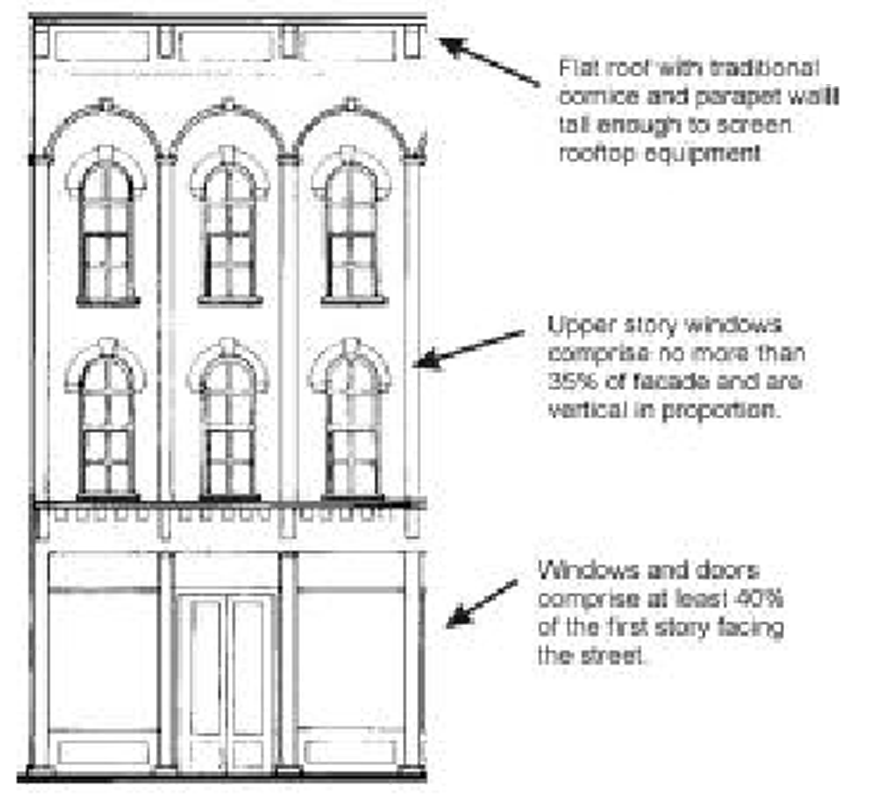
Front Facades
(1)
Blank walls shall not face a public street.
(2)
Walls facing a public street shall include windows and architectural features customarily found on the front facade of a building, such as awnings, cornice work, edge detailing or other decorative finish materials.
(3)
A prominent and usable public building entrance shall be provided at the front of the building.
(4)
Wall massing shall be broken up with vertical pilasters or other architectural elements to reduce scale.
(5)
Windows and doors shall comprise at least 40 percent of the first floor front facade of a building.
(6)
The window area of a facade above the first floor shall not exceed 35 percent of the total facade area of that floor.
(c)
Windows.
(1)
Windows above the first floor shall be vertical in proportion. Large window widths shall be broken up to maintain a vertical proportion.
(2)
Window areas shall be nonreflective glass and clear or lightly tinted in color.
(3)
Window areas shall not be permanently blocked in a manner that obstructs views into the buildings, such as shelving, unless it is used as a display case (intended for exterior display) for products sold on-site.
(d)
Pedestrian orientation.
(1)
Buildings shall be designed at a pedestrian scale with relationship to the street and sidewalk.
(2)
Convenient and safe pedestrian access shall be provided between the public sidewalk and the building entrance.
(e)
Awnings and canopies.
(1)
Awnings with straight sheds may supplement facades. Awnings shall not be cubed or curved except over doorways. Awnings shall be of an opaque material. Translucent or internally lit awnings shall not be permitted.
(2)
Canopies, such as over drive-through structures, shall be designed to be consistent with the approved building materials and colors. Support columns shall be brick or materials compatible with the main building. The planning commission or village manager may require a peaked roof to complement the main building.
(3)
Lighting fixtures mounted under canopies used for vehicular shelter shall be aimed downward and installed such that the bottom of the light fixture or its lens, whichever is lower, is recessed or mounted flush with the bottom surface of the canopy. No lighting, except that is permitted by the sign chapter, shall be permitted on the top or sides of a canopy.
(Ord. No. 04-07, § 1(11.05), 7-12-2004)
Sec. 82-331. - Description and intent.
(a)
The intent of the planned unit development (PUD) districts are to permit the coordinated development on larger sites in order to achieve the following:
(1)
Permit flexibility in the regulation of land development allowing for higher quality of design through innovation in land use, variety in design, layout, and type of structures.
(2)
Provide the opportunity to mix compatible uses or residential types.
(3)
Protect significant natural features which the property owner and village wish to preserve.
(4)
Allow clustering of residential units to preserve common open space and natural features.
(5)
Ensure compatibility of design and function between neighboring properties.
(6)
Protect and preserve historical or significant architectural features.
(7)
Promote efficient provision of public services, utilities and transportation facilities.
(8)
Provide convenient vehicular access throughout the development and minimizing adverse traffic impacts.
(9)
Provide complete non-motorized circulation to, from and within developments.
(10)
Provide adequate housing and employment.
(11)
Encourage development of convenient recreational facilities as an integral part of residential developments.
(12)
Ensure various land uses and building bulk will relate to each other and to adjoining existing and planned uses in such a way that they will be compatible, with no material adverse impact of one use on another.
(13)
Encourage development that is consistent with the goals stated within the Village of Sparta Master Plan.
(14)
Eliminate or reduce the degree of nonconforming uses or structures.
(b)
These PUD regulations are not intended to be used for circumventing the more specific standards and requirements of this chapter, or the planning upon which they are based. Rather, these provisions are intended to result in development that is substantially consistent with the zoning requirements as generally applied to the proposed uses, but with specific modifications that, in the judgment of the village, assure superior quality. If this improved quality is not clearly apparent upon village review, a site shall not qualify for the modifications allowable under this division.
(Ord. No. 04-07, § 1(13.01), 7-12-2004)
Sec. 82-332. - Eligibility criteria.
To be eligible for planned unit development approval, the applicant must demonstrate that each of the following criteria will be met:
(1)
Demonstrated benefit: The PUD shall provide one or more of the following benefits not possible under the requirements of another zoning district:
a.
Preservation of significant natural or historic features.
b.
A complementary mixture of uses or a variety of housing types.
c.
Common open space for passive or active recreational use.
d.
Redevelopment of a nonconforming site where creative design can address unique site constraints.
(2)
Unified control of property: The proposed development shall be under single ownership or control such that there is a single entity having responsibility for completing the project in conformity with the planned unit development regulations.
(3)
Minimum size: The PUD site shall be a minimum of five acres, except as otherwise stated in this division for a particular PUD type. The village council, upon recommendation of the planning commission, may approve a development on fewer acres provided that the proposal substantially achieves the intent of the PUD, as noted in section 82-333, and otherwise meets the eligibility criteria of this section.
(Ord. No. 04-07, § 1(13.02), 7-12-2004)
Sec. 82-333. - Types of puds.
(a)
A property meeting the eligibility criteria may be rezoned to a PUD district, based on the requirements shown in the following table and appropriate requirements contained elsewhere in this chapter. The rezoning shall be concurrent with the approval of a sketch PUD plan. The PUD designation shall be noted in the application and on the official zoning map upon approval of the sketch PUD plan.
(b)
The village council, after recommendation from the planning commission, shall establish a list of permitted uses as part of the PUD agreement, based upon the provisions of the following table and this division.
(Ord. No. 04-07, § 1(13.03), 7-12-2004)
Sec. 82-334. - Residential PUD (RPUD).
(a)
Where the prePUD zoning is R-4, multiple family dwelling units shall be permitted meeting the density and design standards of the R-4 district.
(b)
Where the prePUD zoning is R-1, R-2 or R-3, up to 30 percent of the dwelling units may be multiple-family housing, provided the remaining dwelling units (at least 70 percent shall be single-family detached units.
(c)
The PUD may also include the nonresidential uses provided for in the residential districts, provided that the special land uses provided for in those districts shall be required to follow the review process required for special land uses in article IV of this chapter.
(d)
To encourage flexibility and creativity consistent with the intent of the PUD, specific departures may be permitted from the requirements of the this chapter as a part of the approval process. Any regulatory modification shall be approved through a finding that the deviation shall result in a higher quality of development than would be possible using standard zoning requirements.
(Ord. No. 04-07, § 1(13.04), 7-12-2004)
Sec. 82-335. - Mixed use PUD (MPUD).
(a)
Uses: A mixed use PUD shall include a mixture of uses that are considered to be consistent with the master plan. A minimum of 40 percent of the PUD land area shall be occupied by residential or recreational uses. The list of permitted uses shall be established in the PUD approval.
(b)
Dimensional requirements: Except as may otherwise be permitted by this division, all area and bulk dimensional standards shall comply with those of the respective zoning district. To encourage flexibility and creativity consistent with the intent of the PUD, specific departures may be permitted from the requirements of the this chapter as a part of the approval process. Any regulatory modification shall be approved through a finding that the deviation shall result in a higher quality of development than would be possible using standard zoning requirements.
(c)
Parking: To encourage a true integration of mixed uses and improved efficiency in land use, an overlap in parking requirements may be permitted between uses that have alternating peak-parking demands or where the mixture of uses on a site would result in multipurpose trips.
(d)
Open space: A minimum of 20 percent of the site shall be common open space. The open space shall be dispersed throughout the site and linked through greenway or pedestrian corridors or located along road frontages.
(e)
Pedestrians: Pedestrian gathering and seating plazas, greenways and tree lined drives shall be within parking lots and throughout the site to provide an inviting pedestrian environment, protect pedestrians from vehicular circulation, and to improve traffic operations and views. Other site amenities to create a pedestrian scale environment shall be provided such as bike racks, benches, information kiosks, art, planters, or streetscape elements to separate main buildings from the parking lots.
(Ord. No. 04-07, § 1(13.05), 7-12-2004)
Sec. 82-336. - Commercial PUD (CPUD).
(a)
Uses: No more than 60 percent of the area of the site, exclusive of public rights-of-way, shall contain commercial retail uses, including areas required for setbacks, storm water facilities, and parking associated with those uses. The remainder of the site shall include open space, office, research, and development, lodging, restaurants or entertainment related uses. The list of permitted uses shall be established in the PUD agreement.
(b)
Open space: At least 20 percent of the site shall be open space. Required open space shall be dispersed throughout the site and linked through pedestrian corridors.
(c)
Driveway access and circulation:
(1)
Access to the commercial uses shall be limited to one major entrance along any arterial road, excluding an entrance designed solely for truck traffic. Additional access points shall only be considered if spaced at least 500 feet apart and a traffic impact study demonstrates overall traffic operations and safety will be improved.
(2)
Main access points shall be spaced from existing signalized intersections to ensure proper spacing and efficient flow of traffic if the main access point is signalized in the future.
(3)
The site design shall direct traffic flow to use the main access points. Stacking or queuing depth at site access points shall be sufficient to accommodate expected peak hour volumes without conflict to inbound or internal circulation. Interior drives shall provide circulation between uses.
(4)
Additional right-of-way shall be provided to accommodate improvements to the existing arterial roadway system that are planned or required to mitigate traffic associated with the PUD.
(d)
Pedestrians. Pedestrian gathering and seating plazas, greenways and tree lined drives shall be within parking lots and throughout the site to provide an inviting pedestrian environment, protect pedestrians from vehicular circulation, and to improve traffic operations and views. Other site amenities to create a pedestrian scale environment shall be provided such as bike racks, benches, information kiosks, art, planters, or streetscape elements to separate main buildings from the parking lots.
(Ord. No. 04-07, § 1(13.06), 7-12-2004)
Sec. 82-337. - Industrial PUD (IPUD).
(a)
Uses: The LI district's permitted uses and special land uses shall be allowed in an industrial PUD.
(b)
Dimensional standards: All buildings, structures, accessory structures and parking areas shall meet the minimum setback standards of the LI district shall be met for the perimeter of the PUD. On interior lots, dimensional standards, setbacks and building height shall be approved by the village council, upon recommendation by the planning commission, through the PUD approval. There shall be a one hundred-foot deep open space greenbelt along the exterior public roads and any adjoining residential district, either landscaped or preserved in a natural wooded condition.
(c)
Design standards. Buildings shall utilize high quality architecture and landscaping that create a research and office-park environment with primary use of masonry material, such as brick, stone or split face block, and glass on buildings and landscaping along internal roadways and around the perimeter of the PUD. Metal paneling and plain concrete masonry units shall constitute no more than 25 percent of the facades of buildings visible from the internal roadway or any adjoining public roadway.
(Ord. No. 04-07, § 1(13.07), 7-12-2004)
Sec. 82-338. - Traditional neighborhood development PUD (TND PUD).
(a)
Description and intent.
(1)
The traditional neighborhood planned unit development (TND PUD) is planned in order to permit for the development of fully integrated, mixed-use, pedestrian oriented neighborhoods. The intent is to create neighborhoods through design that foster increased interaction between residents; and to minimize traffic congestion, suburban sprawl, infrastructure costs, and environmental degradation within the village.
(2)
The TND provisions adapt urban conventions, normal in the United States from colonial times until the post-World War II era, that were historically based on the following design principles:
a.
Neighborhoods have identifiable centers and edges.
b.
Edge lots are readily accessible to retail and public spaces by nonvehicular means (a distance not greater than one-quarter mile).
c.
Uses and housing types are mixed and in close proximity to one another.
d.
Street networks are interconnected and blocks are small.
e.
Public spaces are given prominent sites throughout the neighborhood.
(b)
Development provisions. The following requirements apply to TND PUD projects:
(1)
The minimum development size shall be 15 acres. The council, upon recommendation of the planning commission, may permit an application for a development on fewer acres provided that the proposal substantially achieves the description and intent of the TND PUD.
(2)
Maximum permitted densities and total number of dwelling units shall be established during the site plan review process but shall be generally consistent with the master plan.
(3)
Other development provisions are intentionally left unspecified in order to encourage innovation and quality in the design and construction of these developments. Generally, the TND PUD should be consistent with the description and intent of this section.
(c)
General use and design standards and requirements.
(1)
Mixed use arrangements:
a.
The entire land area of the TND shall be divided into blocks, streets, and lots and optional natural or greenbelt areas.
b.
Similar land use categories shall generally front across streets. Dissimilar categories shall abut at rear lot lines. Corner lots which front on streets of dissimilar use with different setbacks shall be set back the same as the use with the lesser setback.
c.
Large-scale, single use (conference spaces, theaters, athletic facilities, etc.) buildings or areas shall occur behind or above habitable street front space.
(2)
Uses permitted within the TND PUD include those permitted in the mixed use PUD, except for the following specific uses:
a.
Any establishment with drive through facilities, with the exception of banks.
b.
Vehicle repair garages.
c.
Vehicle service centers.
(3)
All uses shall be conducted within completely enclosed buildings unless otherwise specified.
(4)
Lots and buildings.
Lots and Buildings
a.
All lots shall have frontage on a street or square.
b.
All buildings, except accessory structures, shall have their main entrance opening onto a street or square.
c.
All lots shall be served by a sidewalk. The width and character (including materials), shall be determined by the village council.
d.
Stoops, open colonnades, and open porches may extend into the front yard setback, provided that at least five feet of clear space is provided between the porch and the sidewalk. (See picture.)
(5)
Streets and alleys.
a.
Streets shall provide access to all tracts and lots.
b.
All streets and alleys shall terminate at other streets within the development and connect to existing and projected through streets outside the development.
c.
There shall generally be a continuous network of alleys to the rear of lots within the TND.
d.
The average perimeter of all blocks within the TND shall not exceed 1,350) feet. No block face shall have a length greater than 500 feet without a dedicated alley or pathway providing through access.
e.
Utilities shall run along alleys wherever possible.
f.
Street lamps shall be installed on both sides of the street no less than 100 feet apart. The village council may approve a decorative street lamp design to enhance the overall character of the TND PUD.
g.
Rights-of-way and streets are encouraged to differ in dimension and each street shall be separately detailed according to its function, number of lots served, length and other factors. The private street standards of the village (section 82-129 shall be used as a general guideline, but may be modified by the village council.
h.
Build-to lines (a minimum and maximum setback) shall be established along all streets and public space frontages, determining the width desired for each street or public space.
i.
The long axis of the street shall have appropriate termination with either a public monument, public square or park, a specifically designed building facade, or similar feature to provide a terminal vista.
Example of Terminal Vista
(6)
Parking.
a.
Parking lots shall generally be located at the rear or at the side of buildings and shall be screened from the sidewalk by low walls, fences or hedges.
b.
Parking lots and commercial parking garages shall not abut street intersections or civic buildings, be adjacent to squares or parks, or occupy lots which terminate a vista.
c.
Adjacent parking lots shall have vehicular connections via an alley or internal drive.
d.
On street parking directly fronting the lot shall count toward fulfilling the parking requirement of that lot. One parking space credit shall be given for every space in front of the lot that is over 50 percent of the length of the parking space.
(7)
Landscaping.
a.
Trees shall be planted within rights-of-way parallel to the street along all streets, but not in alleys.
b.
Tree spacing, plant materials, planting specifications, and maintenance provisions shall be submitted as part of the final site plan.
c.
Plantings in immediate proximity to buildings in front and side yards shall respect architectural lines (should be seen as extension of architectural walls).
d.
Plantings toward the street shall respect the integrity of the street by not obscuring important buildings and respecting views to and from streets, porches, walks, and public open spaces.
e.
Existing trees may be used towards all tree requirements.
(8)
Architectural standards.
a.
With the exception of unique buildings with specific uses, such as religious institutions, the mixed-use nature of the TND PUD requires architectural compatibility in order to visually integrate development and allow for the close proximity of varied uses.
b.
All walls visible from public streets shall be clad in brick, cast concrete, stone, approved metal paneling (no more than 20 percent of a building wall), or material similar in appearance or texture.
c.
Two wall materials may be combined (horizontally) on one facade. The heavier material must be below (concrete below paneling, etc.).
d.
Maximum screening wall height shall be six feet.
e.
Screening walls shall be made of materials matching the main building (if a structure consists of more than one material, the heavier material shall be used).
f.
Building materials that match or are visually compatible with the structure shall be used to screen all rooftop equipment.
(d)
Public space design standards and requirements.
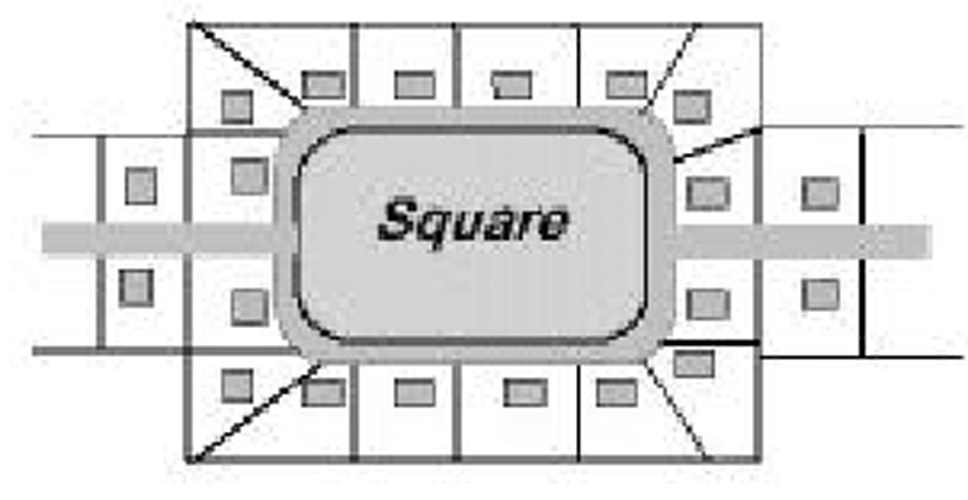
Square
(1)
Land designated for public use within the TND PUD shall consist of squares, greenbelts, parks, recreational areas, streets and alleys.
(2)
Squares and parks.
a.
A minimum of ten percent of the gross area of the neighborhood, or not less than 1½ acres, whichever is greater, shall be permanently allocated to squares or parks.
b.
The TND PUD shall contain as a central focus, at least one square or park no smaller than one acre. This square shall be within 500 feet of the geographic center of the neighborhood.
c.
The remaining public use area shall be divided at least into thirds and distributed such that no portion of the TND is farther than 750 feet from a park or square.
d.
Squares, parks, and other natural amenities and open spaces shall have at least 75 percent of their perimeter abutting street rights-of-way.
(3)
Large scale recreational areas such as golf courses and multiple game fields shall be located on the perimeter of the PUD. Golf courses shall have at least 30 percent of their perimeter abutting street rights-of-way.
(4)
Alleys shall not form the boundary of a park, square, or greenbelt unless a wall with a minimum height of six feet is used for separation.
(5)
Parking: The applicant shall demonstrate the provision of adequate parking for public use areas. Shared parking shall be encouraged. Parking areas related only to public use areas shall be graded, compacted, and landscaped, but may be left unpaved.
(6)
Landscaping: Streets fronting squares and parks shall at a minimum have trees planted on the developed side of the street. Landscaping plans for the square or park shall be included as part of the TND PUD application.
(e)
Commercial/office use design standards and requirements.
(1)
Use:
a.
Lots and buildings designated as commercial/office uses shall have at least 50 percent of the building area dedicated to residential uses. The remainder shall be commercial/office uses.
b.
Residential uses are not permitted on the ground floors of commercial/office buildings. All buildings shall have at least two stories.
c.
A minimum of two percent and a maximum of 30 percent of the gross area of a TND PUD shall be designated for commercial/office use.
(2)
Lots and buildings:
a.
Buildings on commercial/office lots shall have a build-to line of five feet with a sidewalk having a minimum width of seven feet.
b.
Buildings on commercial/office lots shall have the facade built directly on the build-to line along at least 70 percent of its length. The unbuilt portion of the build-to line shall have a street wall directly upon it, unless occupied by a pedestrian walkway to rear parking areas.
c.
Buildings on commercial/office lots shall not require setbacks from front or side lot lines.
d.
Buildings on commercial/office lots shall cover no more than 75 percent of the lot area.
e.
The maximum height shall be the lesser of 35 feet or three stories. The minimum height shall be 26 feet, or two stories.
f.
Lots containing commercial/office buildings shall be separated from any residential uses not within the TND PUD at the side and rear lot lines by a continuous masonry wall no less than six feet in height.
g.
Pedestrian gathering and seating plazas, greenways and tree lined drives shall be within parking lots and throughout the site to provide an inviting pedestrian environment, protect pedestrians from vehicular circulation, and to improve traffic operations and views. Other site amenities to create a pedestrian scale environment shall be provided such as bike racks, benches, information kiosks, art, planters, or streetscape elements to separate main buildings from the parking lots.
(3)
Streets and alleys.
a.
Commercial/office lots shall have their rear lot lines coinciding with an alley at least 24 feet containing a vehicular pavement width of at least ten feet.
b.
Commercial/office lots shall front on streets with a maximum right-of-way of 66 feet consisting of at least two 12-foot travel lanes, eight-foot parallel parking on both sides, and seven-foot sidewalks.
c.
Curb radius shall not exceed 15 feet.
(4)
Parking and loading.
a.
All streets fronting commercial/office uses shall have on-street parking.
b.
There shall be one parking space per 500 square feet of building space for the commercial uses, one space per 300 square feet for office and service uses, and one space per residential unit.
c.
Off-street parking places may be located to one side or to the rear of the building. Shared parking arrangements are encouraged. Where formal shared parking arrangements are made, the individual calculation of the required spaces may be reduced by up to 25 percent with the approval of the village council.
d.
No less than 75 percent of the parking spaces shall be to the rear of the building. Access to rear or side parking areas may be through the frontage only if an alley entrance providing access is not within 200 feet of any part of the lot.
e.
For commercial/office uses, on-street parking directly fronting a lot shall count toward fulfilling the parking requirement.
f.
The parking requirements may be waived for retail uses of 2,000 square feet or less, that portion of restaurant seating which is outdoors and adjacent to the street, day care uses, and other uses generally considered as accessory to other principal uses.
g.
Loading areas shall conform to article VI, Off-Street Parking and Loading.
(f)
Residential design standards and requirements.
(1)
General.
a.
A minimum of 15 percent and a maximum of 30 percent of the gross land area of the PUD shall be designated for multiple-family dwellings and small lot (lot width of 50 feet or less) one-family detached dwellings.
b.
A maximum of 30 percent of the gross land area of the PUD shall be designated for large lot (50 feet or more in width) one-family detached homes.
c.
One accessory building is permitted on each lot.
d.
Lot coverage for all residential lots shall not exceed 50 percent.
e.
No residential building shall exceed a height of 35 feet.
(2)
Multiple-family residential.
a.
The entire building area above the ground floor shall be used for residential purposes.
b.
Land designated for multiple-family residential use may contain limited commercial uses, such as a coffee house, home occupation, or bed and breakfast, small gift shops, and other less intensive commercial or services uses, as approved by the village council.
c.
Buildings on multiple-family lots shall be setback no more than 15 feet from the front lot line, and setbacks shall be constant for a street block.
d.
Buildings on contiguous multiple-family lots shall have no required setbacks from side lot lines. A 15-foot setback shall be maintained for side lot lines abutting nonresidential use lots.
e.
Buildings on multiple-family lots shall have a masonry wall, wood fence, or hedge between three and five feet high built along the unbuilt portion of the frontage line.
(3)
One-family detached homes.
a.
One-family detached homes shall be set back not more than 25 feet from the front lot line and set back from the side lot lines a distance equivalent to not less than 20 percent of the width of the lot. The entire side yard setback may be allocated to one side of the lot.
b.
Main buildings on detached home lots shall be set back no less than 30 feet from the rear lot line.
c.
Main buildings on detached home lots shall have a masonry wall, wood fence, or hedge between three and five feet high along the unbuilt portion of the front lot line.
(4)
Streets and alleys.
a.
All residential lots shall have their rear lot lines coincide with an alley 24 feet wide containing a vehicular pavement width of at least ten feet.
b.
All residential lots shall front on streets with a maximum right-of-way of 50 feet consisting of at least two twelve-foot travel lanes, eight-foot parallel parking on both sides and a five-foot wide sidewalk.
c.
Curb radius shall not exceed 25 feet.
d.
Garages and other accessory buildings shall be set back a minimum of ten feet from the travel lane of the alley. No parking shall be permitted in the travel lane of the alley.
(5)
Parking.
a.
All off-street parking places shall be to the rear of the building. Access shall be by an alley only.
b.
Parking space requirements:
1.
One space per 300 square feet of UFA for nonresidential uses;
2.
One space per room of lodging for permitted lodging uses;
3.
One space per two bedrooms of residential use.
c.
For multiple family uses all off-street parking places shall be to the side or the rear of the building. Where access is through the frontage, garages or carports shall be located a minimum of 20 feet behind the front facade of the building.
(Ord. No. 04-07, § 1(13.08), 7-12-2004)
Sec. 82-339. - Pud design requirements.
In addition to the above requirements for specific types of PUDs, all PUDs shall meet the following requirements, unless other, more restrictive requirements are noted in the individual PUD district, in which case the more restrictive requirement shall apply:
(1)
Open space requirements.
a.
Common open space. All land within a development that is not devoted to a residential unit or road right-of-way shall be set aside as common land for neighborhood use, recreation, conservation or agriculture.
b.
Areas not considered open space. The following land areas are not included as dedicated open space for the purposes of meeting minimum open space requirements:
1.
Area proposed as one-family residential or site condominium lots.
2.
Area proposed to be occupied by multiple family dwellings, including the minimum required setbacks around buildings.
3.
Any area proposed for an office, commercial or industrial land use.
4.
The area of any road right-of-way or private road easement.
5.
Any submerged land area of a pond, lake or stream, provided protected wetlands and storm water ponds designed to appear, and function similar to a natural wetland may be counted for up to 50 percent of the minimum required open space.
6.
Golf courses.
7.
Parking and loading areas, except those exclusively associated with a recreation facility or common open space area.
8.
Any other undeveloped areas not specifically addressed in this section, but determined by the village council to be inadequate to meet the intent and standards for open space.
c.
Open space location: Common open space shall be planned in locations visible and accessible to all in the development. The common open space may either be centrally located, located to preserve natural features, located to buffer adjacent farmland, or located to connect open spaces throughout the development, provided the following areas shall be included within the open space area:
1.
Open space shall be situated to maximize the preservation of any existing site woodlands.
2.
A minimum one hundred-foot wide undisturbed open space setback shall be maintained from the edge of any stream or wetland; provided that the village council may permit trails, boardwalks, observation platforms, or other similar structures that enhance passive enjoyment of the site's natural amenities within the setback.
3.
Where adjacent land includes open space, public land or existing or planned bike paths, open space connections shall be provided between the site and adjacent open space. Trails between adjoining open space development shall be constructed to allow future interconnection between neighborhoods.
d.
Open space protection: The dedicated open space shall be set aside in perpetuity by the developer through a conservation easement or other legal instrument that is found acceptable to the village attorney. The conservation easement or other legal instrument shall assure that the open space will be protected from all forms of development, except as shown on an approved site plan, and shall never be changed to another use.
e.
Allowable use(s) of the dedicated open space shall be indicated in the conservation easement or other legal instrument indicating that the dedicated open space shall be maintained by parties who have an ownership interest in the open space. The village council may require open space restrictions that prohibit the following:
1.
Dumping or storing of any material or refuse.
2.
Activity that may cause risk of soil erosion or threaten any living plant material.
3.
Cutting or removal of live plant material except for removal of dying or diseased vegetation.
4.
Use of motorized off road vehicles.
5.
Cutting, filling or removal of vegetation from wetland areas.
6.
Use of pesticides, herbicides, or fertilizers within or adjacent to wetlands.
f.
The dedicated open space shall forever remain open space, subject only to uses on the approved site plan. Further subdivision of open space land or its use for other than recreation or conservation purposes, except for easements for utilities, shall be strictly prohibited. Any change in use of the open space from what is shown on the approved site plan shall require village council approval, and shall not diminish compliance with the requirements of this chapter.
g.
Nothing herein shall prevent the conveyance of open space to a public agency or other nonprofit entity for recreational or conservation use.
h.
Requirements for maintenance of the open space shall be provided. In the event that the open space is not adequately maintained, or is determined by the zoning administrator to be a public nuisance, the costs for maintenance shall be assessed upon the owners of the open space.
(2)
Natural features.
a.
Limits of tree clearing: The PUD shall be designed so as to preserve natural resources. The limits of tree clearing and grading shall be clearly shown on the preliminary site plan or plat.
b.
Animal or plant habitats: If animal or plant habitats that are characteristic of pre-settlement habitat exist on the site, the village council, as a condition of approval, may require that the site plan preserve these areas in a natural state and adequately protect them as nature preserves or limited access areas.
c.
The requirements of section 82-127, Natural feature setback, shall be observed.
(3)
Landscaping. The following landscaping requirements shall be met in addition to other landscaping requirements contained in this chapter:
a.
Street trees. Both sides of all internal roads shall be landscaped with street trees. One canopy tree shall be provided on each side for every 40 feet of road. Existing trees preserved within ten feet of the road right-of-way or easement may be credited towards meeting this requirement.
b.
Stormwater detention ponds. All ponds and stormwater management facilities shall be designed in accordance with the following:
1.
The design of the pond shall fit into the natural landscape and provide a natural appearance.
2.
Landscaping shall be provided around the perimeter of the pond to create the appearance of a natural pond or wetland.
3.
Landscaping shall include a combination of canopy trees, shrubs, and grasses that are adapted to saturated soil conditions.
4.
Canopy trees may be dispersed around the perimeter, but should provide greater clusters in locations that will provide shade and minimize the heating effect of the sun on the stormwater detention pond.
5.
Stormwater detention ponds shall be designed with shallow side slopes that do not require security fencing.
6.
The development agreement shall provide for long-term maintenance of the stormwater detention pond by the homeowners association.
c.
Parking lots: Site design and landscaping shall diminish the prominence of parking lots as viewed from public streets.
(4)
General design standards. Signs, lighting, landscaping, building architecture and materials, and other features of the project, shall be designed to achieve an integrated and controlled development, consistent with the character of the community, surrounding development or developments, and natural features of the area. The village council may require a consistent type of pedestrian scale ornamental lighting along all streets and sidewalks and within any off street parking lots.
(5)
Residential entrance signs and commercial signs shall be approved as part of the final plan.
(Ord. No. 04-07, § 1(13.09), 7-12-2004)
Sec. 82-340. - PUD approval process.
(a)
Preapplication meeting.
(1)
An applicant desiring to submit an application for a PUD shall attend a pre-application meeting with, at a minimum, representatives of the departments of planning, building, engineering, and any other staff members the planning director deems advisory.
(2)
The purpose of the preapplication meeting is to determine general compliance with PUD eligibility and design requirements, or to identify issues of significance regarding the proposed application.
(3)
If the applicant proceeds with the PUD application, a report on the findings of the preapplication meeting shall be forwarded to the planning commission.
(b)
Application: The applicant shall prepare and submit to the village a request for rezoning to the appropriate PUD designation, including 12 copies of a sketch PUD site plan meeting the requirements of subsection 82-423(d). Materials shall be submitted at least 45 days prior to the meeting at which the planning commission shall first review the request.
(c)
Workshop: In addition to the preapplication meeting, a workshop may be required by the planning commission, or, if not required, the workshop may be requested by the applicant to discuss the appropriateness of a PUD concept, solicit feedback and receive requests for additional materials supporting the proposal.
(d)
Planning commission public hearing: The planning commission shall review the rezoning request, the sketch PUD site plan and PUD agreement, and conduct a public hearing in accordance with the requirements of the Zoning Act.
(e)
Planning commission recommendation: The planning commission shall review the sketch PUD site plan in consideration of public hearing comments, technical reviews from village staff, and other comments from consultants and applicable review agencies, and compliance with the standards and requirements of this division and other applicable standards and requirements of this chapter. The planning commission shall make a recommendation to the village council to approve, approve with conditions or deny the request. The recommendation to the village council shall be based on the following standards:
(1)
The PUD shall satisfy the description and intent of section 82-331 and the eligibility criteria of section 82-332.
(2)
The PUD shall comply with the requirements of this division, other applicable sections of this chapter, and the village's subdivision control regulations or the site condominium provisions of section 82-125.
(3)
The PUD shall be designed and constructed in a manner harmonious with the character of adjacent property and the surrounding area.
(4)
The PUD shall be adequately served by essential public facilities and services, such as roads, pedestrian or bicycle facilities, police and fire protection, drainage systems, water supply and sewage facilities.
(5)
The design of the PUD shall minimize the negative impact on the street system in consideration of items such as vehicle trip generation, access location and design, circulation, roadway capacity, traffic operations at proposed access points and nearby intersections.
(6)
The proposed PUD shall not have an unacceptable significant adverse effect on the quality of the natural environment in comparison to the impacts associated with a conventional development.
(7)
Availability and capacity of public services: The proposed type and density of use shall not result in an unreasonable increase in the use of public services, public facilities, and utility capacities.
(8)
Compatibility with the master plan: The proposed development shall not have an adverse impact on future development as proposed in the master plan of the village.
(9)
Development impact: The proposed development shall not impede the continued use or development of surrounding properties for uses that are permitted in the this chapter.
(f)
Village council decision: Following receipt of the planning commission's recommendation, the sketch PUD site plan shall be considered by the village council. The council may elect to have additional public hearings, noticed as required by the Zoning Act. The village council shall take one of the following actions on the request:
(1)
Table: If the application is determined to be insufficient, does not fully respond to planning commission issues or more information is required, then the request may be tabled. The village council shall direct the applicant to prepare additional information, revise the PUD plan or direct the village staff to conduct additional analysis. The application shall not be removed from the table until the conditions causing its tabling have been satisfied.
(2)
Reconsideration: If the council believes there is new information that might modify the recommendation of the planning commission, the application may be returned to the commission with the new information for its reconsideration. The planning commission shall provide a recommendation within 30 days.
(3)
Approval: Upon determination that a PUD site plan is in compliance with the standards and requirements of this chapter and other applicable chapters and laws, the village council shall approve the sketch PUD site plan. The village council may impose reasonable conditions with the approval of a PUD. Conditions of any approval are attached to the land and will remain through subsequent owners. The applicant shall submit a revised PUD site plan that demonstrates compliance with the conditions.
(4)
Denial: Upon determination that a PUD site plan does not comply with standards and regulations set forth in this chapter, or requires extensive revision in order to comply with the standards and regulations, the village council shall deny the application. Resubmittal of a denied application shall be considered a new application.
(g)
Special land uses: Special land uses provided for in the PUD districts shall be required to follow the review process as required in article IV, Special Land Uses.
(Ord. No. 04-07, § 1(13.10), 7-12-2004)
Sec. 82-341. - Development agreement.
The applicant shall submit an agreement stating the conditions upon which approval is based, for review and approval by the village council. The agreement, after review by the planning commission and approval by the village council, shall be entered into between the village and the applicant and be recorded with the county register of deeds. Approval shall be effective upon recording. At a minimum, the agreement shall provide:
(1)
A certified boundary survey of the acreage comprising the proposed development.
(2)
The manner of ownership of the developed land and the manner of the ownership and of dedication or mechanism to protect any areas designated as common areas or open space.
(3)
Provision assuring that those open space areas shown on the plan for use by the public or residents of the development will be or have been irrevocably committed for that purpose. The village council may require conveyances or other documents to accomplish this.
(4)
Satisfactory provisions to provide for the future financing of any improvements shown on the plan for site improvements, open space areas and common areas which are to be included within the development and that maintenance of such improvements is assured by a means satisfactory to the village council. The council may require a performance guarantee to accomplish this in accordance with the provisions of section 82-590, Performance guarantees.
(5)
Provisions to ensure adequate protection of natural features.
(6)
A copy of the approved sketch PUD site plan signed by the applicant and the mayor.
(Ord. No. 04-07, § 1(13.11), 7-12-2004)
Sec. 82-342. - Final approval.
(a)
Final site plans shall be submitted for review and approval in accordance with the site plan review provisions of article V of this chapter. If final site plans for at least the first phase of the project are not submitted and approved within a two-year period for the approval of the development agreement, the right to develop under the approved PUD sketch site plan shall terminate and a new application must then be filed and processed.
(b)
In reviewing final site plans, the following standards and requirements shall apply in addition to those of article V:
(1)
Final site plans shall be in substantial conformance with the approved sketch PUD site plan;
(2)
Each final site plan shall either individually or in combination with previously approved contiguous project areas, meet the standards of this division and the approved PUD sketch plan regarding layout, density, open space and land use;
(3)
Each final site plan submission shall include a map illustrating the site or phase in relation to previously approved plans and the overall PUD; and
(4)
Any amendment requested to the agreement approved by the village council shall be submitted for review by the village attorney and approved by the village council.
(Ord. No. 04-07, § 1(13.12), 7-12-2004)
Sec. 82-343. - Extensions.
The two-year period for preliminary PUD approval may be extended for one year, if applied for in writing by the petitioner prior to the expiration of the PUD sketch plan approval, and granted by the village council, provided that the reasons for the delay are beyond the general control of the applicant.
(Ord. No. 04-07, § 1(13.13), 7-12-2004)
Sec. 82-344. - Revisions to approved pud plans.
(a)
Approval. Approval of the final site plans confers upon the zoning administrator the authority to approve certain minor deviations when an applicant or land owner who was granted site plan approval notifies the zoning administrator of the proposed amendment to the approved site plan in writing, accompanied by a site plan illustrating the proposed change. The request shall be received prior to initiation of any construction in conflict with the approved plan.
(b)
Procedure. Within 14 days of receipt of a request to amend the site plan, the zoning administrator shall determine whether the change is major, warranting review by the planning commission, or minor, allowing administrative approval, as noted below.
(c)
Minor changes. The zoning administrator may approve the proposed revision upon finding the change would not alter the approved design or provisions of the agreement, would not reduce the area devoted to open space, and all applicable regulations of this chapter will be met. The zoning administrator shall inform the planning commission and village council of the approval in writing.
(d)
Considerations. The zoning administrator shall consider the following when determining a change to be minor:
(1)
For residential buildings, the square footage of structures may be reduced or increased by three percent; provided the overall density of units does not increase, the minimum square footage and parking requirements are met, and the building(s) do not extend into any required open space or required setback;
(2)
Gross floor area of nonresidential buildings may be decreased or increased by up to three percent or 2,000 square feet, whichever is smaller, provided parking requirements are met and the building does not extend into any required open space or required setback;
(3)
Floor plans may be changed if consistent with the character of the use;
(4)
Relocation of a building by up to five feet, if consistent with required setbacks, open space and other requirements;
(5)
Maximum height of buildings may be lowered;
(6)
Designated woodlands or areas not to be disturbed may be increased;
(7)
Plantings on the approved landscape plan may be replaced by similar types of landscaping on an equal or greater basis; any regulated trees lost during construction shall be replaced on a caliper-per-caliper basis on the site;
(8)
Improvements or slight relocation of site access or circulation, such as inclusion of deceleration lanes, boulevards, curbing or pedestrian/bicycle paths, where appropriate;
(9)
Changes of building materials to another of higher quality, or a slight change in the color of the exterior material, as determined by the building official;
(10)
Grade change of up to one foot, after review by the village engineer;
(11)
Modification of entry design, sign placement or reduction in size of signs, which is consistent with the intent of the approved sketch PUD plan;
(12)
Internal rearrangement of parking lots which does not affect the number of parking spaces or alter access locations or design;
(13)
Changes to the location of accessory buildings and structures, when the new location will be consistent with the building envelope identified on the approved plan; and
(14)
Changes required or requested by the village, county or state for safety reasons.
(e)
Major changes. Where the zoning administrator determines that a requested amendment to the approved site plan is major, resubmittal to the planning commission shall be required. Should the planning commission determine that the modifications are inconsistent with the approved sketch PUD site plan, a revised sketch PUD plan shall be submitted according to the procedures outlined in this chapter. In all cases, a change in use to a more intensive use than approved in the sketch PUD plan shall be considered major and require resubmission of a new sketch PUD plan.
(f)
Limitations on variances from zoning board of appeals. The decision to grant PUD approval or any regulatory modifications are not subject to variance approval of the zoning board of appeals. No part of a PUD may be appealed to the zoning board of appeals nor shall an application for variance be accepted. This provision shall not preclude an individual lot owner from seeking a variance following final approval of the PUD, provided the variance does not involve alterations to open space areas as shown on the approved PUD site plan and otherwise meets the applicable review standards applicable to variances in this chapter.
(Ord. No. 04-07, § 1(13.14), 7-12-2004)

