
St Charles Parish City Zoning Code
SECTION VI
- Zoning district criteria and regulations.
A.
Open Land District: The regulations in the Open Land District are as follows:
[I.] O-L. Open Land District:
Policy statement: This district is composed mainly of large open unsubdivided land that is vacant or in agricultural, forestry or residential use. The regulations are designed to protect the open character of the district, and to allow residents to retain their traditional ways of living, by prohibiting the establishment of scattered business, industrial and other uses that are unrelated to any general plan of development and that might inhibit the best future utilization of the land. It is intended that land in these districts will be reclassified to its appropriate residential, commercial or industrial category in accordance with the amendment procedure set forth in the St. Charles Parish Code.
1.
Use Regulations:
a.
A building or land shall be used only for the following purposes:
(1)
Farming.
(2)
Animal husbandry.
(3)
Farm family dwellings.
(4)
Tenant dwellings.
(5)
Site-built, single-family detached dwellings.
(6)
Additional dwellings for family and relatives on unsubdivided property on a non-rental basis, and which meet the criteria outlined in Special Provisions [subsection 3].
(7)
Manufactured housing.
(8)
Mobile homes.
(9)
Accessory buildings and uses. (Ord. No. 23-3-1, § II, 3-13-23)
(10)
Family subdivisions, provided that they conform to the St. Charles Parish Subdivision Regulations [appendix C].
(11)
Farmer's market, provided that the criteria outlined in Special Provisions [subsection 3] is met.
(12)
Any permitted uses under subsection 1.a. items (1) through (9) on a lot or property without frontage provided that a permanent right of passage to access the structure exist or is provided for, is recorded into the deed of the property, and is filed with the Clerk of Court. (Ord. No. 95-9-11, § I, 9-18-95; Ord. No. 97-9-12, § II, 9-22-97; Ord. No. 08-5-8, § I, 5-19-08)
(13)
Lawn Care Service subject to the requirements of Section VII.(Ord. No. 19-2-13, § II, 2-18-19)
(14)
Historic Home Site Bed and Breakfast.(Ord. No. 20-10-5 § II, 10-5-20)
b.
Special exception uses and structures include the following:
(1)
Religious institutions.
(2)
Golf courses and golf practice ranges.
(3)
Public parks and recreational areas.
c.
Special permit uses and structures include the following:
(1)
Child care centers.
(2)
Public and private academic institutions (trade, business and industrial schools shall be located in the appropriate commercial or industrial zoning district).
(3)
Cemeteries and mausoleums, provided that they meet the criteria outlined in Special Provisions [subsection 3].
(4)
Extraction of oil and gas, minerals and other natural resources provided that criteria set forth by the St. Charles Parish Coastal Zone Management Section of the Planning and Zoning Department are met.
(5)
Public stables and kennels.
(6)
Cellular installations and PCS (personal communication service) installations. (Ord. No. 97-7-4, § III, 7-7-97)
(7)
Green markets upon review and approval by the Planning Commission and supporting resolution of the Council. Such sites must possess frontage on a hard-surfaced public collector or arterial street. (Ord. No. 03-1-12, § II, 1-21-03)
(8)
Reserved. (Ord. No. 07-1-6, § III, 1-8-07; Ord. No. 08-5-8, § I, 5-19-08)
(9)
Fire stations with or without firefighter training facilities. (Ord. No. 08-7-8, I, 7-21-08)
(10)
Nonresidential accessory buildings.
(11)
Accessory dwelling units upon approval by the Planning Commission and supporting resolution of the Council.
(12)
Transmission towers.
(13)
Solar Energy System, Large (LSES), in accordance with Section VII, Supplemental Use and Performance Regulations and supporting resolution of the Council. (Ord. No. 23-3-1, § III, 3-13-23)
(Ord. No. 12-7-4, § II, 7-2-12; Ord. No. 15-7-5, § III, 7-6-15; Ord. No. 21-11-6, § I, 11-15-21)
2.
Spatial Requirements:
a.
Minimum lot size shall be twenty thousand (20,000) square feet; minimum width fifty (50) feet. (Ord. No. 07-1-6, § II, 1-8-07)
b.
Minimum yard sizes:
(1)
Front—Thirty-five (35) feet.
(2)
Side—Ten (10) feet.
(3)
Rear—Twenty (20) feet.
(4)
Whenever property abuts a major drainage canal as defined by the Subdivision regulations the required setback for all structures shall be ten (10) feet measured from the inner boundary of such servitude or right-of-way, notwithstanding any other more restrictive setbacks, this provision shall not apply to any lot of record created and existing prior to the effective date of Ordinance No. 99-12-8, December 15, 1999. (Ord. No. 08-8-9, § II, 8-18-08)
c.
Accessory buildings: Minimum rear and side setbacks shall be ten (10) feet.
d.
Permitted encroachments:
(1)
Overhangs projecting not more than twenty-four (24) inches excluding gutter.
(2)
Stairs and landings not more than three (3) feet in height, projecting no more than four (4) feet into the required front or rear yard.
3.
Special Provisions:
a.
Additional dwellings on unsubdivided property:
(1)
Additional dwellings on unsubdivided property referred to in 1, a(11) above, will be permitted at the rate of one (1) dwelling unit for each ten thousand (10,000) square feet of lot area.
(2)
The applicant for any additional dwellings on unsubdivided property shall submit a copy of all subdivision restrictions (covenants) which govern the property in order to protect the integrity of the neighborhood.
(3)
Under no circumstances will the total number of dwellings per unsubdivided lot permitted under these provisions exceed four (4).
(4)
Permits issued under this provision will be issued for a two-year period. At the expiration of this time, an investigation will be conducted by the Planning and Zoning Department to determine if this Code is complied with. Non-compliance will result in the revocation of the permit.
b.
All manufactured housing and mobile homes shall be secured according to the Federal Emergency Management Agency's Sept. 1985 publication Manufactured Housing Installation in Flood Hazard Areas.
c.
All dwelling units shall be connected to utility systems which provide for health and safety under all conditions of normal use. Home utility services shall only be connected to the supply source by means of approved materials, and shall be inspected by the appropriate agency.
d.
Farmer's market:
(1)
All products must be sold on the premises on which they were grown or produced, from either a truck, stand, display table, or other means of display which has been inspected and approved by the Parish Health Unit. (Ord. No. 92-9-20, § II, 9-21-92)
(2)
No structure, vehicles or signs may be located closer to any property line than the general setback requirements of the O-L District with the exception of one (1) on-premises sign which contains the name of the market. This sign shall be located approximate to the entrance drive directing attention to the market. The sign shall conform with acceptable commercial standards regarding quality and aesthetics. No temporary signs will be allowed. If the sign is to be illuminated, lighting shall be arranged as not to interfere with traffic safety or cause a nuisance to abutting properties.
e.
Cemeteries and mausoleums:
(1)
All cemetery or mausoleum sites must have a minimum street frontage of one hundred (100) feet. (Ord. No. 08-3-4, § 1, 3-24-08)
(2)
All cemetery or mausoleum sites must have a fence or screen planting six (6) feet high along all property lines adjoining all districts. (Ord. No. 08-5-7. § 1, 5-19-08)
4.
Prohibited Use: Medical waste storage, treatment or disposal facilities. (Ord. No. 90-9-4, § II, 9-4-90)
(Ord. No. 82-3-3, § II, 3-1-82; Ord. No. 83-11-10, 11-21-83; Ord. No. 86-4-2, § 2, 4-7-86; Ord. No. 87-1-21, 1-19-87)
B.
Residential districts—The regulations in the Residential Districts are as follows:
[I.] R-1A. Single family residential detached conventional homes—Medium density.
Policy statement: This district is composed of areas containing one-family dwellings constructed on a permanent foundation, connected to public utilities and which meet the architectural standards of a permanent residence. The district regulations are designed to protect the residential character of the areas by prohibiting all commercial activities; to encourage a suitable neighborhood environment for family life by including among the permitted uses such facilities as schools and churches; and to preserve the openness of the areas by requiring certain minimum yard and area standards to be met.
1.
Use Regulations:
a.
A building or land shall be used only for the following purposes:
(1)
Site-built single-family detached dwellings
(2)
Accessory uses
(3)
Private recreational uses
b.
Special exception uses and structures include the following:
(1)
Parks, public libraries, fire stations, police or sheriff's stations or substations, and sewer pumping stations.
(2)
Showing the operation of historic buildings and/or sites and their related activities, provided a certificate from the United States Department of Interior is furnished by the owner verifying that the building and/or site is on the National Register of Historic Places.
(Ord. No. 06-12-6, § II, 12-4-06)
(3)
Accessory uses to golf courses and country clubs limited to the following:
•
art studios
•
churches and religious institutions
•
commercial recreation facilities
•
commercial schools
•
personal service businesses, examples include but are not limited to beauty shops and barber shops, acupuncture, and massage services
•
professional offices, examples include but are not limited to doctors, dentists, engineers, architects, landscape architects, plan services, realtors, insurance
•
restaurants and cafeterias
(Ord. No. 16-6-2, § II, 6-16-16)
c.
Special permit uses and structures include the following:
(1)
Child care centers.
(2)
Public and private schools (except trade, business, and industrial).
(3)
Golf courses (but not miniature courses or driving ranges), country clubs, and accessory commercial uses on such properties. (Ord. No. 15-1-10, § I, 1-26-15; Ord. No. 16-6-2, § I, 6-6-16)
(4)
Educational, religious and philanthropic institutions. These buildings must be set back from all yard lines a distance of at least one (1) foot for each foot of building height.
(5)
Modular, panelized and precut homes, provided that they are placed on a permanent foundation.
(6)
Reserved. (Ord. No. 88-5-6, 5-16-88; Ord. No. 95-4-8, § II, 4-3-95)
(7)
Private commercial access roads, upon review by the Planning Commission and supporting resolution of the Council. (Ord. No. 92-10-9, § I, 10-5-92; Ord. No. 92-12-9, §§ I, II, 12-7-92)
Editor's note—Section I of Ord. No. 92-10-9, adopted Oct. 5, 1992, added § VI.B[I]1.b(7). The editor has interpreted the intent of the section to add § VI.B[I]1.c(7). This action was ratified by §§ I, II of Ord. No. 92-12-9, adopted Dec. 7, 1992.
(8)
Accessory dwelling units upon approval by the Planning Commission and supporting resolution of the Council. (Ord. No. 15-7-5, § III, 7-6-15)
(9)
Garden Home Developments in accordance with Section VII Supplemental Regulations upon review and recommendation of the Planning Commission and supporting resolution of the St. Charles Parish Council.(Ord. No. 17-2-10, § I, 2-20-2017)
(10)
Transmission towers when accessory to a permitted use.
(Ord. No. 83-11-10, 11-21-83; Ord. No. 85-7-17; 7-22-85; Ord. No. 87-1-16, 1-5-87; Ord. No. 21-8-11, § I, 8-9-21)
2.
Spatial Requirements:
a.
Minimum lot size: Six thousand (6,000) square feet per family; minimum width—sixty (60) feet.
(Ord. No. 84-6-8, 6-4-84)
b.
Minimum yard sizes:
(1)
Front—Twenty (20) feet.
(2)
Side—Five (5) feet.
(3)
Rear—Twenty (20) feet.
(4)
For lots with less than one hundred (100) feet depth, front setback and rear setback shall be twenty (20) percent of lot depth respectively with a minimum of ten (10) feet to the front lot line and five (5) feet to the rear lot line. (Ord. No. 97-9-3; 9-8-97)
(5)
Whenever property abuts a major drainage canal as defined by the Subdivision regulations the required setback for all structures shall be ten (10) feet measured from the inner boundary of such servitude or right-of-way, notwithstanding any other more restrictive setbacks, this provision shall not apply to any lot of record created and existing prior to the effective date of Ordinance No. 99-12-8, December 15, 1999. (Ord. No. 08-8-9, § III, 8-18-08)
c.
Accessory buildings:
(1)
An accessory building may occupy no more than twenty-five (25) percent of the required rear yard.
(2)
The accessory building shall not exceed two-story construction.
(3)
Minimum setback of accessory buildings, including overhangs, shall be five (5) feet. (Ord. No. 82-2-3, § II, 3-1-82; Ord. No. 25-10-7, § I, 10-6-25)
(4)
Nonresidential accessory buildings shall not be permitted. (Ord. No. 12-7-4, § III, 7-2-12)
d.
Permitted encroachments:
(1)
Overhangs projecting not more than twenty-four (24) inches, excluding gutter. For accessory buildings, overhangs shall not be closer than five (5) feet to any property line. (Ord. No. 25-10-7, § I, 10-6-25)
(2)
Stairs and landings not more than three (3) feet in height, projecting no more than four (4) feet into required front or rear yard.
(Ord. No. 82-3-3, § II, 3-1-82; Ord. No. 87-1-16, 1-5-87)
[II.] R-1A(M). Single Family Residential Detached Conventional Homes, Manufactured Homes, and Mobile Homes—Medium density.
Policy statement: This district is composed of areas containing one-family dwellings constructed on a permanent foundation, connected to public utilities, and which meet the architectural and aesthetic standards of a permanent residence. Additionally, mobile homes which meet the special provisions below are allowed.
1.
Use Regulations:
a.
A building or land shall be used only for the following purposes:
(1)
Site-built, single-family detached dwellings.
(2)
Manufactured homes.
(3)
Mobile homes.
(4)
Accessory uses.
(5)
Private recreational uses.
(6)
Farming on lots of three (3) acres or more and at least one hundred fifty (150) feet frontage.
b.
Special exception uses and structures include the following:
(1)
Additional residences for family and relatives on unsubdivided property on a non-rental basis, and which meet the criteria outlined in Special Provisions [subsection 3].
(2)
Parks, public libraries, fire stations, police or sheriff's stations or substations, and sewer pumping stations.
(3)
Showing and operation of historic buildings and/or sites and their related activities, provided a certificate from the United States Department of Interior is furnished by the owner verifying that the building and/or site is on the National Register of Historic Places.
(Ord. No. 06-12-6, § II, 12-4-06)
(4)
Accessory uses to golf courses and country clubs limited to the following:
•
Art studios
•
Churches and Religious Institutions
•
Commercial recreation facilities
•
Commercial schools
•
Personal service businesses, examples include but are not limited to beauty shops and barber shops, acupuncture, and massage services
•
Professional offices, examples include but are not limited to doctors, dentists, engineers, architects, landscape architects, plan services, realtors, insurance
•
Restaurants and cafeterias
(Ord. No. 16-6-2, § IV, 6-6-16)
c.
Special permit uses and structures include the following:
(1)
Child care centers.
(2)
Public and private schools (except trade, business and industrial).
(3)
Golf courses (but not miniature courses or driving ranges), country clubs, and accessory commercial uses on such properties. (Ord. No. 15-1-10, § II, 1-26-15; Ord. No. 16-6-2, § III, 6-6-16)
(4)
Educational, religious and philanthropic institutions. These buildings must be set back from all property lines a distance of at least one (1) foot for each foot of building height.
(5)
Private commercial access roads, upon review by the Planning Commission and supporting resolution of the Council. (Ord. No. 92-10-9, § II, 10-5-92)
(6)
Accessory dwelling units upon approval by the Planning Commission and supporting resolution of the Council. (Ord. No. 15-7-5, § III, 7-6-15)
(7)
Garden Home Developments in accordance with Section VII Supplemental Regulations upon review and recommendation of the Planning Commission and supporting resolution of the St. Charles Parish Council. (Ord. No. 17-2-10, § II, 2-20-2017)
(8)
Transmission towers when accessory to a permitted use. (Ord. No. 21-8-11, § II, 8-9-21)
2.
Spatial Requirements.
a.
Minimum lot size: Five thousand (5,000) square feet per family; minimum width-fifty (50) feet.
b.
Minimum yard sizes:
(1)
Front—Fifteen (15) feet.
(2)
Side—Five (5) feet.
(3)
Rear—Five (5) feet.
(4)
For lots with less than one hundred (100) feet depth, front setback shall be fifteen (15) percent of lot depth with a minimum of ten (10) feet to the front lot line and five (5) feet to the rear lot line. (Ord. No. 99-8-6, 8-2-99)
(5)
Whenever property abuts a major drainage canal as defined by the Subdivision regulations the required setback for all structures shall be ten (10) feet measured from the inner boundary of such servitude or right-of-way, notwithstanding any other more restrictive setbacks, this provision shall not apply to any lot of record created and existing prior to the effective date of Ordinance No. 99-12-8, December 15, 1999. (Ord. No. 08-8-9, § IV, 8-18-08)
c.
Accessory buildings:
(1)
The accessory building shall not exceed two-story construction.
(2)
Minimum setback of accessory buildings, including overhangs, shall be five (5) feet.
(3)
Nonresidential accessory buildings shall not be permitted. (Ord. No. 12-7-4, § IV, 7-2-12; Ord. No. 25-10-7, § II, 10-6-25)
d.
Permitted encroachments:
(1)
Overhangs projecting not more than twenty-four (24) inches, excluding gutter. For accessory buildings, overhangs shall not be closer than five (5) feet to any property line. (Ord. No. 25-10-7, § II, 10-6-25)
(2)
Stairs and landings not more than three (3) feet in height, projecting no more than four (4) feet into required front yard.
3.
Special Provisions:
a.
Additional dwellings on unsubdivided property:
(1)
Additional dwellings on unsubdivided property referred to in 1.b(1) above will be permitted at the rate of one (1) dwelling unit for each seven thousand (7,000) square feet of lot area.
(2)
The applicant for any additional dwellings on unsubdivided property shall submit a copy of all subdivision restrictions (covenants) which govern the property in order to protect the integrity of the neighborhood.
(3)
Under no circumstances will the total number of dwellings per unsubdivided lot permitted under these provisions exceed four (4).
(4)
Permits issued under this provision will be issued for a two-year period. At the expiration of this time, an investigation will be conducted by the Planning and Zoning Department to determine if this Code is complied with. Non-compliance will result in the revocation of the permit.
b.
All manufactured housing and mobile homes shall be secured according to the Federal Emergency Management Agency's Sept. 1985 publication Manufactured Home Installation in Flood Hazard Areas.
c.
Reserved. (Ord. No. 15-7-5, § III, 7-6-15; Ord. No. 16-6-4, § I, 6-6-16)
d.
All dwelling units shall be connected to utility systems which provide for health and safety under all conditions of normal use. Home utility services shall only be connected to the supply source by means of approved materials, and shall be inspected by the appropriate agency.
(Ord. No. 82-3-3, § II, 3-1-82; Ord. No. 83-11-10, 11-21-83; Ord. No. 85-7-17, 7-22-85; Ord. No. 87-1-15, 1-5-87)
[III.]
R-1B. Single family residential detached conventional homes—Light to medium density.
1.
Use Regulations:
a.
A building or land shall be used only for the following purposes:
(1)
Single family detached dwellings.
(2)
Accessory uses.
(3)
Gardening.
(4)
Private recreational uses.
b.
Special exception uses and structures include the following:
(1)
Parks, public libraries, fire stations, police or sheriff's stations or substations, and sewer pumping stations.
(2)
Showing and operation of historic buildings and/or sites and their related activities, provided a certificate from the United States Department of Interior is furnished by the owner verifying that the building and/or site is on the National Register of Historic Places.
(3)
Accessory uses to golf courses and country clubs limited to the following:
•
Art studios
•
Churches and Religious Institutions
•
Commercial recreation facilities
•
Commercial schools
•
Personal service businesses, examples include but are not limited to beauty shops and barber shops, acupuncture, and massage services
•
Professional offices, examples include but are not limited to doctors, dentists, engineers, architects, landscape architects, plan services, realtors, insurance
•
Restaurants and cafeterias
(Ord. No. 16-6-2, § VI, 6-6-16)
c.
Special permit uses and structures include the following:
(1)
Child care centers (minimum lot size—twenty thousand (20,000) square feet).
(2)
Public and private schools (except trade, business, and industrial).
(3)
Religious institutions.
(4)
Golf courses (but not miniature courses or driving ranges), country clubs, and accessory commercial uses on such properties. (Ord. No. 15-1-10, § III, 1-26-15; Ord. No. 16-6-2, § V, 6-16-16)
(5)
Educational, religious and philanthropic institutions, provided, however, that such uses shall be located on sites of ten (10) acres or more, that buildings shall not occupy more than ten (10) percent of the site area, and that buildings be set back from all yard lines a distance of at least one (1) foot for each foot of building height.
(6)
Reserved. (Ord. No. 06-12-6, § II, 12-4-06)
(7)
Reserved.
(8)
Private commercial access roads, upon review by the Planning Commission and supporting resolution of the Council. (Ord. No. 92-10-9, § III, 10-5-92)
(9)
Accessory dwelling units upon approval by the Planning Commission and supporting resolution of the Council. (Ord. No. 15-7-5, § III, 7-6-15)
(10)
Garden Home Developments in accordance with Section VII Supplemental Regulations upon review and recommendation of the Planning Commission and supporting resolution of the St. Charles Parish Council. (Ord. No. 17-2-10, § III, 2-20-2017)
(11)
Transmission towers when accessory to a permitted use. (Ord. No. 21-8-11, § III, 8-9-21)
(Ord. No. 83-11-10, 11-21-83; Ord. No. 85-7-17; 7-22-85)
2.
Spatial Requirements:
a.
Minimum lot size: Ten thousand (10,000) square feet per family; minimum width—eighty (80) feet.
b.
Minimum yard sizes:
(1)
Front—Twenty-five (25) feet.
(2)
Side—Eight (8) feet.
(3)
Rear—Twenty-five (25) feet.
(4)
Whenever property abuts a major drainage canal as defined by the Subdivision regulations the required setback for all structures shall be ten (10) feet measured from the inner boundary of such servitude or right-of-way, notwithstanding any other more restrictive setbacks, this provision shall not apply to any lot of record created and existing prior to the effective date of Ordinance No. 99-12-8, December 15, 1999. (Ord. No. 08-8-9, § V, 8-18-08)
c.
Accessory buildings:
(1)
An accessory building may occupy no more than twenty-five (25) percent of the required rear yard.
(2)
The accessory building shall not exceed two-story construction.
(3)
Minimum rear and side setbacks of a detached accessory building shall be five (5) feet. (Ord. No. 86-11-7, 11-17-86)
(4)
Accessory buildings shall be located on the same parcel of land as the main structure.
(5)
Nonresidential accessory buildings shall not be permitted. (Ord. No. 12-7-4, § V, 7-2-12)
(Ord. No. 82-3-3, § II, 3-1-82)
d.
Permitted encroachments:
(1)
Overhangs projecting not more than twenty-four (24) inches, excluding gutter.
(2)
Stairs and landings not more than three (3) feet in height, projecting no more than four (4) feet into required front or rear yard.
(Ord. No. 82-3-3, § II, 3-1-82)
3.
Transportation System: Local and collector streets only.
[IV.]
R-1M. Manufactured home/recreational vehicle (RV) park:
Policy statement: This district is established to allow single-family residential usage of manufactured housing and recreational vehicles (RV) in a specially designed community or park with public and private amenities provided by the park developer as opposed to the park tenants. This district will allow a greater density of single-family residences to locate in an aesthetically pleasing environment by requiring certain spatial and buffer requirements.
1.
Use Regulations:
a.
A building or land shall be used only for manufactured home and RV parks and accessory uses.
b.
Special exception uses and structures include clubhouses, laundry facilities, rental offices, managers' homes, and/or accessory recreational facilities for park residents only.
2.
Special permit uses:
a.
Include RV parks of one-half acre provided 1) the Special Provisions for RV Parks [subsection 4 below], other than the minimum site requirement, are met, and 2) the request receives review and approval by the Planning Commission and a supporting resolution of the Council. (Ord. No. 14-8-7, § I, 8-4-14)
b.
Private commercial access roads, upon review by the Planning Commission and supporting resolution of the Council. (Ord. No. 92-10-9, § IV, 10-5-92)
c.
Transmission towers when accessory to a permitted use. (Ord. No. 21-8-11, § IV, 8-9-21)
3.
Spatial Requirements: Shall conform to the Manufactured Home Park or RV Park regulations and design standards outlined as Special Provisions [subsection 4] below.
a.
Whenever property abuts a major drainage canal as defined by the Subdivision regulations the required setback for all structures shall be ten (10) feet measured from the inner boundary of such servitude or right-of-way, notwithstanding any other more restrictive setbacks, this provision shall not apply to any lot of record created and existing prior to the effective date of Ordinance No. 99-12-8, December 15, 1999.(Ord. No. 08-8-9, § VI, 8-18-08)
4.
Special Provisions: Shall conform to either the Manufactured Home Park of [or] RV Park regulations and design standards noted below as they pertain to the total park use.
Manufactured home park:
a.
Location, space and general layout:
(1)
The manufactured home park shall be located on a well-drained site [and] shall be so located such that its drainage will not endanger adjacent property and water supply.
(2)
Any lot or portion of ground proposed to be used for a manufactured home park shall have sufficient frontage for construction of entrances and exits properly designed for safe movement of park traffic.
(3)
Each manufactured home space shall contain a minimum of three thousand one hundred fifty (3,150) square feet, shall be at least thirty-five (35) feet wide and eighty (80) feet long, and shall have its boundaries clearly defined. The space shall abut on an access drive which shall have unobstructed access to a public street or highway.
(4)
A patio slab of at least one hundred eighty (180) square feet shall be provided on each manufactured home lot and conveniently located at the entrance of each manufactured home.
(5)
A minimum site of two (2) acres is required for a manufactured home park.
(6)
Manufactured homes shall be parked on each space to conform to the following minimums:
(a)
Twenty-five (25) feet clearance between coaches. (Ord. No. 06-2-9, § I, 1-20-06)
(b)
Five (5) feet clearance between each coach and its respective site line.
(c)
Ten (10) feet between coaches and any adjoining property lines.
(d)
Twenty (20) feet between coaches and any public street right-of-way.
(e)
Twenty-five (25) feet between coaches and any building or structure not used for accessory purposes.
(f)
Accessory buildings must be a minimum of ten (10) feet from any manufactured home.
(g)
Nonresidential accessory buildings shall not be permitted. (Ord. No. 12-7-4, § VI, 7-2-12)
[b.
Reserved.]
c.
Parking: Sufficient paved parking shall be provided for the parking of at least one (1) motor vehicle for each manufactured home space plus an additional paved parking space for each three (3) lots to provide for guest parking for two (2) car tenants and for delivery and service vehicles.
d.
Recreation: Not less than ten (10) percent of the gross area of the manufactured home park is to be set aside, designed, constructed and equipped as a recreational area. Recreation area design and equipment shall be approved by the St. Charles Parish Recreation Department Director.
e.
Transportation system: All streets and access drives within the manufactured home park shall be constructed to required parish specifications as outlined in Subdivision Regulations [appendix C].
f.
Sewage Disposal: Each manufactured home site shall be provided with a sanitary sewer connection, and each manufactured home park shall be provided with a collection and treatment system and public water supply in compliance with the standards of the Parish Health Unit and the State Health Department.
g.
Garbage: If garbage hoppers are to be provided, then two (2) shall be provided for each twenty (20) manufactured home sites, and each hopper shall be screened from view by wood or masonry fencing.
h.
Screen fences, walls and buffer screening: Fences should be installed where necessary for screening purposes such as around outdoor areas, laundry yards, refuse collection points and playgrounds. A six (6) feet opaque fence or masonry wall shall border the park, and there shall be a buffer strip ten (10) feet wide designated and maintained on the site planted with plant materials acceptable for buffer zones.
i.
General: Individual manufactured home sites may be leased or rented but not subdivided or sold.
j.
All improvements required in this section must be completed prior to the placement of any manufactured home on the site.
RV Park:
a.
Location, space and general layout:
(1)
The RV park shall be located on a well-drained site [and] shall be so located such that is [its] drainage will not endanger adjacent property and water supply.
(2)
Any lot or portion of ground proposed to be used for an RV park shall have sufficient frontage for construction of entrances and exits properly designed for the safe movement of park traffic.
(3)
Each RV space shall contain a minimum of fourteen hundred (1,400) square feet, shall be at least thirty-five (35) feet wide, and shall have its boundaries clearly defined. The space shall abut on a driveway.
(4)
A minimum site of one (1) acre is required for an RV park.
(5)
RV's shall be parked on each space to conform to the following minimums:
(a)
Twenty-five (25) feet clearance between RV's. (Ord. No. 06-2-9, § I, 2-20-06)
(b)
Five (5) feet clearance between each RV and its respective site line.
(c)
Ten (10) feet between RV's and any adjoining property lines.
(d)
Twenty (20) feet between RV's and any public street right-of-way.
(e)
Twenty-five (25) feet between RV's and any building or structure not used for accessory purposes.
(f)
Accessory buildings must be a minimum of ten (10) feet from any RV.
(g)
Nonresidential accessory buildings shall not be permitted. (Ord. No. 12-7-4, § VII, 7-2-12)
b.
Parking: Sufficient area shall be provided for the parking of at least one (1) motor vehicle for each RV space plus an additional car space for each three (3) lots to provide for guest parking, two (2) car tenants and for delivery and service vehicles.
c.
Transportation system:
(1)
Streets and access drives: All streets and access drives within the RV park shall be constructed to required parish specifications as outlined in subdivision regulations [appendix C].
(2)
Driveway: All driveways within the RV park shall be designed and surfaced with appropriate materials which will provide adequate and safe means of transit for park residents.
d.
Recreation: Not less than ten (10) percent of the gross area of the RV park is to be set aside, designed, constructed and equipped as a recreational area. Recreation area design and equipment shall be approved by the St. Charles Parish Recreation Department Director.
e.
Utilities: Each RV site shall be provided with a sanitary sewer connection, and each RV shall be provided with a collection and treatment system and public water supply in compliance with the standards of the Parish Health Unit and the State Health Department.
f.
Garbage: If garbage hoppers are to [be] provided, then two (2) shall be provided for each twenty (20) RV sites, and each hopper shall be screened from view by wood or masonry fencing.
g.
Screen fences, walls and buffer screening: Fences should be installed where necessary for screening purposes such as around outdoor areas, laundry yards, refuse collection points and playgrounds. A six (6) feet opaque fence or buffer strip ten (10) feet wide designated and maintained on the site planted with plant materials acceptable for buffer zones.
h.
General: Individual RV sites may be leased or rented but not subdivided or sold.
i.
All improvements required in this section must be completed prior to the placement of any RV on the site.
(Ord. No. 82-6-9, § 1, 6-7-82; Ord. No. 87-1-14, 1-5-87)
[V.] R-1T. Single family residential attached homes—Townhouses. (Ord. No. 82-6-9, § II, 6-7-82; repealed by Ord. No. 88-3-9, 3-7-88; see § VI.B[VIII]4.b)
[VI.] R-1Z. Single family residential detached homes—"Zero Lot Line." (Ord. No. 82-6-9, § II, 6-7-82; repealed by Ord. No. 88-3-9, 3-7-88; see § VI.B[VIII]4.b)
[VII.] R-2. Two-family residential:
1.
Use Regulations:
a.
A building or land shall be used only for the following purposes:
(1)
See uses allowed in the R-1A district
(2)
Two-family dwellings
(3)
Single family dwellings
(4)
Accessory uses.
(5)
Nonresidential accessory buildings shall not be permitted.
(Ord. No. 88-5-5, 5-16-88; Ord. No. 12-7-4, § VIII, 7-2-12)
b.
Special exception uses and structures include the following:
(1)
Club houses and/or accessory recreational facilities for resident use only
(2)
Professional, non-retail offices
c.
Special permit uses and structures include the following:
(1)
Child care centers
(2)
Schools (public, private, and commercial)
(3)
Religious institutions
(4)
Reserved. (Ord. No. 06-12-6, § II, 12-4-06)
(5)
Reserved. (Ord. No. 88-5-6, 5-16-88; Ord. No. 95-4-8, § III, 4-3-95)
(6)
Private commercial access roads, upon review by the Planning Commission and supporting resolution of the Council. (Ord. No. 92-10-9, § V, 10-5-92)
(7)
Transmission towers when accessory to a permitted use. (Ord. No. 21-8-11, § IV, 8-9-21)
Editor's note—Section V of Ord. No. 92-10-9, adopted Oct. 5, 1992, added § VII.1.c(6). The editor has interpreted the intent of the section to add § VI.B[VII]1.c(6).
d.
Transportation system required: Local or collector street.
2.
Spatial Requirements:
a.
Minimum lot size: Six thousand (6,000) square feet (3,000 per family); minimum width - sixty (60) feet.
b.
Minimum yard sizes:
(1)
Front - twenty (20) feet
(2)
Side - five (5) feet each side
(3)
Rear - twenty (20) feet.
(4)
Whenever property abuts a major drainage canal as defined by the Subdivision regulations the required setback for all structures shall be ten (10) feet measured from the inner boundary of such servitude or right-of-way, notwithstanding any other more restrictive setbacks, this provision shall not apply to any lot of record created and existing prior to the effective date of Ordinance No. 99-12-8, December 15, 1999. (Ord. No. 08-8-9, § VII, 8-18-08)
c.
Accessory buildings:
1)
An accessory building may occupy no more than twenty-five (25) percent of the required rear yard.
2)
The accessory building shall not exceed two-story construction.
3)
Minimum rear setback of accessory building shall be the same as side yard requirement of the district in which it is located.
4)
Accessory buildings shall be located on the same parcel of land as the main structure.
(Ord. No. 82-3-3, § II, 3-1-82)
d.
Permitted encroachments:
1)
Overhangs projecting not more than twenty-four (24) inches, excluding gutter.
2)
Stairs and landings not more than three (3) feet in height, projecting no more than four (4) feet into required front or rear yard.
(Ord. No. 82-3-3, § II, 3-1-82)
3.
Transportation System Requirement: Front on local or collector street only.
4.
Special Provisions:
a.
Where any two-family residential district (R-2) abuts any residential zoning district or use, a six-foot high solid wood fence or masonry wall shall be erected.
(Ord. No. 82-6-9, § III, 6-7-82)
[VIII.] R-3. Multi-family residential:
1.
Use Regulations:
a.
A building or land shall be used only for the following purposes:
(1)
All uses allowed in the R-2 district. (Ord. No. 88-5-5, 5-16-88)
(2)
Multi-family dwellings. (Ord. No. 19-3-13, § II, 3-25-19)
(3)
Boarding and lodging houses.
(4)
Townhouses (see Section VII for Supplemental Use and Performance regulations).Ord. No. 19-3-13, § II, 3-25-19)
b.
Special exception uses and structures: As approved by the Planning and Zoning Commission only:
c.
Special permit uses and structures:
(1)
Supplemental C-1 and C-2 uses. (Ord. No. 88-5-6, 5-16-88)
(2)
Reserved. (Ord. No. 88-5-6, 5-16-88; Ord. No. 95-4-8, § IV, 4-3-95)
(3)
Private commercial access roads, upon review by the Planning Commission and supporting resolution of the Council. (Ord. No. 92-10-9, § VI, 10-5-92)
Editor's note—Section VI of Ord. No. 92-10-9, adopted Oct. 5, 1992, added § VIII.1(c)(3). The editor has interpreted the intent of the section to add § VI.B[VIII]1.c(3).
2.
Spatial Requirements:
a.
Minimum lot size: Ten thousand (10,000) square feet; minimum width - sixty (60) feet; two thousand five hundred (2,500) square feet per family.
b.
Minimum yard requirements:
(1)
Front - twenty (20) feet
(2)
Side - ten (10) feet
(3)
Rear - twenty (20) feet.
(4)
Whenever property abuts a major drainage canal as defined by the Subdivision regulations the required setback for all structures shall be ten (10) feet measured from the inner boundary of such servitude or right-of-way, notwithstanding any other more restrictive setbacks, this provision shall not apply to any lot of record created and existing prior to the effective date of Ordinance No. 99-12-8, December 15, 1999 (Ord. No. 08-8-9, § VIII, 8-18-08).
c.
Maximum land coverage: Eighty (80) percent (twenty (20) percent green space).
d.
Accessory buildings:
(1)
Accessory buildings shall be of one story construction not to exceed sixteen (16) feet in height.
(2)
Accessory buildings shall be located on the same parcel of land as the main structure.
(3)
Nonresidential accessory buildings shall not be permitted.
(Ord. No. 82-3-3, § II, 3-1-82; Ord. No. 12-7-4, § IX, 7-2-12)
e.
Permitted encroachments:
(1)
Overhangs projecting not more than twenty-four (24) inches, excluding gutter.
(2)
Stairs and landings not more than three (3) feet in height, projecting no more than four (4) feet into required front or rear yard.
(Ord. No. 82-3-3, § II, 3-1-82)
3.
Transportation System: Servitude of access, local, or collector street.
4.
Special Provisions:
a.
Where any multi-family residential district (R-3) abuts any residential zoning district or use, a six-foot-high solid wood fence or masonry wall shall border the same and there shall be a buffer strip ten (10) feet wide designated and maintained on the site planted with plant materials acceptable for buffer zones.
(Ord. No. 82-6-9, § III, 6-7-82)
[IX.]
R-3T. Multi-family residential and townhousing. (Ord. No. 83-8-10, § II, 8-15-83; Ord. No. 83-12-4, §§ I, II, 12-5-83; repealed by Ord. No. 88-3-9, 3-7-88; see § VI.B[VIII]4.b)
[X.]
Prohibited use: Medical waste storage, treatment or disposal facilities. (Ord. No. 90-9-4, § II, 9-4-90)
C.
Commercial districts: The regulations in the Commercial district are as follows:
[I.]
CR-1 Residential/commercial transitional (Commercial in Residential Neighborhood):
1.
Use Regulations:
a.
A building or land shall be used only for the following purposes:
(1)
Office buildings, provided that no goods, wares or merchandise shall be prepared or sold on the premises. Office buildings in this district cannot service gambling operations. (Ord. No. 94-1-9, § I, 1-10-94)
(2)
Branch banks and branch savings and loan associations.
(3)
Personal service shops such as beauty shops and barber shops, small schools or studios such as arts and craft schools, conducted by resident members of families provided that no goods or merchandise, except those needed for instruction purposes, or offered for purchase by students only; and, provided that such use shall not occupy more than five hundred (500) square feet of floor area.
(4)
Studios of artists and photographers.
(5)
Antique shops not to exceed five hundred (500) square feet of floor area with no goods or merchandise to be stored or displayed outside the building.
(6)
Parking lots, provided that the parking area shall be used for passenger vehicles only and in no case for sales, repair work, storage, dismantling, or servicing of any vehicles, equipment, materials, or supplies; no signs or advertising of any character except traffic directional signs painted on pavement shall be allowed; the parking area and connecting driveways shall be surfaced with concrete, asphaltic concrete asphalt, or any other type of permanent, dust-free paving and the parking area and connecting driveways shall be maintained in good condition and free of all weeds, dust, trash, and other debris. If lighting facilities are provided, they shall be so arranged as to reflect or direct light away from the adjacent residential district. Required front yards shall be landscaped and maintained in good condition.
(7)
Professional and sub-professional offices, including doctors, dentists, engineers, architects, landscape architects, plan services, realtors, insurance, and other similar uses not involving the sale of merchandise.
b.
Special exception uses and structures: As approved by the Planning Commission.
c.
Special permit uses and structures:
(1)
All uses allowed in an R-1A Zoning District, upon review by the Planning Commission.
(2)
Multifamily dwellings, including duplexes, apartments, apartment houses, townhouses, condominiums, boarding, and lodging houses, upon review by the Planning Commission and supporting resolution of the Council.
(3)
Nonresidential accessory buildings.
(Ord. No. 92-9-14, 9-8-92; Ord. No. 12-7-4, § X, 7-2-12)
(4)
Mobile homes in accordance with the provisions set forth in the R-IA(M) zoning district upon review and approval by the Planning and Zoning Commission and supporting resolution of the Parish Council.
(Ord. No. 13-10-5, § I, 10-7-13)
2.
Spatial Requirements: See respective uses under C-1a.
a.
Minimum lot sizes: Six thousand (6,000) square feet; minimum width - sixty (60) feet. (Ord. No. 86-9-25, 9-22-86)
b.
Minimum yard sizes:
(1)
Front - twenty (20) feet
(2)
Side - five (5) feet
(3)
Rear - ten (10) feet
(4)
Whenever property abuts a major drainage canal as defined by the Subdivision regulations the required setback for all structures shall be ten (10) feet measured from the inner boundary of such servitude or right-of-way, notwithstanding any other more restrictive setbacks, this provision shall not apply to any lot of record created and existing prior to the effective date of Ordinance No. 99-12-8, December 15, 1999.(Ord. No. 08-8-9, § IX, 8-18-08)
3.
Transportation System Requirement: None.
4.
Special Provisions:
a.
Where any commercial us in a CR-1 zoning district (CR-1) abuts any residential zoning district or use, a six-foot high solid wood fence or masonry wall shall border the same and there shall be a buffer strip ten (10) feet wide designated and maintained on the site planted with plant materials acceptable for buffer zones.
(Ord. No. 82-6-9, § III, 6-7-82; Ord. No. 98-1-3 § I, 1-5-98)
[II.] C-1. General commercial district- Commercial offices:
1.
Use Regulations:
a.
A building or land shall be used for the following purposes:
(1)
All uses allowed in the CR-1 district. (Ord. No. 88-5-5, 5-16-88)
(2)
Any type of commercial office or retail sales, excepting those offices serving gambling operations. (Ord. No. 88-5-5, 5-16-88; Ord. No. 94-1-9, § II, 1-10-94)
(3)
(Repealed by Ord. No. 88-8-5, 8-1-88)
b.
Special exception uses and structures include any use related to the principal use.
c.
Special permit uses and structure include the following:
(1)
Child care centers.
(2)
All uses allowed in an R-1A Zoning District, upon review by the Planning Commission. (Ord. No. 92-9-14, 9-8-92)
(3)
Multifamily dwellings, including duplexes, apartments, apartment houses, townhouses, condominiums, boarding, and lodging houses, upon review by the Planning Commission and supporting resolution of the Council. (Ord. No. 92-9-14, 9-8-92)
2.
Spatial Requirements:
a.
Minimum lot size: Six thousand (6,000) square feet, minimum width - sixty (60) feet.
b.
Minimum yard sizes:
(1)
Front - twenty (20) feet
(2)
Side - five (5) feet
(3)
Rear - ten (10) feet.
(4)
Whenever property abuts a major drainage canal as defined by the Subdivision regulations the required setback for all structures shall be ten (10) feet measured from the inner boundary of such servitude or right-of-way, notwithstanding any other more restrictive setbacks, this provision shall not apply to any lot of record created and existing prior to the effective date of Ordinance No. 99-12-8, December 15, 1999. (Ord. No. 08-8-9, § X, 8-18-08)
(Ord. No. 82-6-6, § 1, 6-7-82)
3.
Transportation System: Collector or arterial preferred. Permitted on local if serving similar uses.
4.
Special Provisions:
a.
Where any commercial use in a C-1 zoning district abuts any residential district or use, a six-foot high solid wood fence or masonry wall shall border the same and there shall be a buffer strip ten (10) feet wide designated and maintained on the site planted with plant materials acceptable for buffer zones.
(Ord. No. 82-6-9, § III, 6-7-82; Ord. No. 98-1-3, § II, 1-5-98)
[III.] C-2 General commercial district— Retail sales:
1.
Use Regulations:
a.
A building or land shall be used for the following purposes:
(1)
All uses allowed in C-1 District. (Ord. No. 88-5-5, 5-16-88)
(2)
Retail sales (except auto and mobile home sales), usage, and storage
(3)
Hotels, motels and apartment hotels
(4)
[Repealed by Ord. No. 92-9-14, 9-8-92.]
(5)
Restaurants (including drive-in restaurants) and cafeterias. Specific land use requirements for restaurants serving alcoholic beverages are contained in subsection III.59. of these regulations, with further details contained within Chapter 3 of the St. Charles Parish Code of Ordinances. (Ord. No. 94-11-2, § V, 11-7-94)
(6)
Animal hospitals where all animals are kept inside the building
(7)
Service station
(8)
Commercial recreation facilities
(9)
Commercial greenhouses and nurseries
(10)
Commercial schools
(11)
Shops not to exceed two thousand five hundred (2,500) square feet of floor area for
the repair and servicing of the following:
bicycles
radios
televisions
stereos and recorders
household appliances
locksmith
typewriters
other similar uses
(12)
Shops not to exceed two thousand five hundred (2,500) square feet of floor area may
also include the following uses:
dressmakers
millinery
tailors
baking goods sales
laundry and dry cleaners
theatres (but not the drive-in type)
(13)
Laboratories
(14)
Customary accessory uses incidental to the above uses when located on the same lot
(15)
Funeral homes (provided that a petition of no objection signed by a majority of property owners within a three hundred foot radius of the site and one hundred (100) percent of the property owners on the same street within the same block be filed with the Planning Zoning Department
(16)
Cemeteries and mausoleums, provided however that such uses shall be located on sites of at least twenty (20) acres, all graves shall be set back at least fifty (50) feet from all property lines, shall have a minimum street frontage of one hundred (100) feet and a fence or screen planting six (6) feet high shall be provided along all property lines adjoining all districts.
(17)
Other uses of similar intensity.
(18)
Mini-storage facilities (limited to one-story construction in C-2 district). (Ord. No. 98-3-17, § II, 3-23-98).
(19)
Historic home site bed and breakfast. (Ord. No. 13-7-6, § II, 7-1-13)
b.
Special exception uses and structures include the following:
(1)
Dwelling units contained within the office building
(2)
Reserved
(3)
Reserved
(4)
Churches
(5)
Movie theaters
(6)
Temporary on-site construction buildings for a period of one (1) year upon approval of the Planning Director. (Ord. No. 85-7-17, 7-22-85; Ord. No. 88-9-9, 9-6-88)
c.
Special permit uses and structures include the following:
(1)
R-1A and R-1B uses upon review and approval by the Planning Commission.
(2)
R-3 uses upon review and approval by the Planning Commission and supporting resolution of the Council.
(3)
Office buildings for gaming operations, excluding all gaming activities, upon review and approval by the Planning Commission and supporting resolution of the Council.
(4)
Automobile sales and minor automotive repair. Automobile sales and service on designated federal and state highways; body repair activities being strictly prohibited in the C-2 zoning district. (Ord. No. 21-11-7, § I, 11-15-21)
(5)
Heating and air conditioning service.
(6)
Sheet metal shops
(7)
Plumbing shops.
(8)
Green markets upon review and approval by the Planning Commission and supporting resolution of the Council. Such sites must possess frontage on a hard-surfaced public collector or arterial street.
(9)
Bingo halls, video bingo parlors, and off-track betting establishments upon review of the planning commission and ordinance of the St. Charles Parish Council.
(Ord. No. 92-9-14, 9-8-92; Ord. No. 94-1-9, § III, 1-10-94; Ord. No. 94-6-6, § I, 6-6-94; Ord. No. 98-7-6, 7-6-98; Ord. No. 02-5-21, 5-20-02; Ord. No. 03-1-12, § III, 1-21-03; Ord. No. 07-10-10, § I, 10-15-07; Ord. No. 09-4-19, § 1, 4-20-09)
2.
Spatial Requirements:
a.
Minimum lot size: Six thousand (6,000) square feet, minimum width - sixty (60) feet.
b.
Minimum yard sizes:
(1)
Front - twenty (20) feet
(2)
Side - five (5) feet
(3)
Rear - ten (10) feet. (Ord. No. 82-6-6, § 1, 6-7-82)
(4)
Whenever property abuts a major drainage canal as defined by the Subdivision regulations the required setback for all structures shall be ten (10) feet measured from the inner boundary of such servitude or right-of-way, notwithstanding any other more restrictive setbacks, this provision shall not apply to any lot of record created and existing prior to the effective date of Ordinance No. 99-12-8, December 15, 1999. (Ord. No. 08-8-9, § XI, 8-18-08)
3.
Transportation Requirements: Arterial
4.
Special Provisions:
a.
Where any commercial use in a C-2 zoning district abuts any residential district or use, a six-foot high solid wood fence or masonry wall shall border the same and there shall be a buffer strip ten (10) feet wide designated and maintained on the site planted with plant materials acceptable for buffer zones.
(Ord. No. 82-6-9, § III, 6-7-82; Ord. No. 98-1-3, § III, 1-5-98)
[IV.] C-3. Highway commercial district—Wholesale and retail sales:
1.
Use Regulations:
a.
A building or land shall be used for the following purposes.
(1)
All uses allowed in the C-2 District. (Ord. No. 88-5-5, 5-16-88)
(2)
Commercial auditoriums, coliseums or convention halls
(3)
Retail manufacturing
(4)
Automobile sales and service (Ord. No. 21-11-7, § II, 11-15-21)
(5)
Wholesale uses
(6)
Warehouses (less than 10,000 sq. ft.)
(7)
Bus, railroad, passenger and truck terminals (without video poker gaming facilities) (Ord. No. 98-4-17, § II, 4-20-98)
(8)
Bottling works
(9)
Dog pound
(10)
Building supply
(11)
Heating and air conditioning service
(12)
Plumbing shops
(13)
Automotive repair, minor and major (Ord. No. 21-11-7, § II, 11-15-21)
(14)
Glass installation
(15)
Fabrication of gaskets and packing of soft metal material
(16)
Creameries
(17)
Parcel delivery service
(18)
Reserved. (Ord. No. 97-7-4, § VIII, 7-7-97)
(19)
Frozen food lockers
(20)
Public stables
(21)
Bulk dairy products (retail)
(22)
Animal hospitals
(23)
Gymnasiums
(24)
Sheet metal shops.
(25)
Upholstery
(26)
Other uses of similar intensity
(27)
Customary accessory uses incidental to the above uses when located on the same lot.
b.
Special exception uses and structures:
(1)
Temporary construction facilities for a period of one (1) year upon approval of the Planning Director. (Ord. No. 88-9-9, 9-6-88)
c.
Special permit uses and structures include the following:
(1)
Barrooms, night clubs, lounges, and dancehalls upon review and approval by the Planning Commission and supporting resolution of the Council. (Ord. No. 14-8-6, § I, 8-4-14)
(2)
R-1A and R-1B uses upon review and approval by the Planning Commission.
(3)
R-3 uses upon review and approval by the Planning Commission and supporting resolution of the Council.
(4)
Reserved. (Ord. No. 01-5-18, § II, 5-21-01)
(5)
Cellular installations and PCS (personal communication service) installations.
(6)
Reserved. (Ord. No. 01-5-18, § III, 5-21-01)
(7)
Warehouses (non-hazardous materials) over ten thousand (10,000) square feet.
(8)
Green markets upon review and approval by the Planning Commission and supporting resolution of the Council. Such sites must possess frontage on a hard-surfaced public collector or arterial street.
(9)
Bingo Halls, Video Bingo Parlors, and Off-Track Betting Establishments upon review of the Planning Commission and Ordinance of the Parish Council.
(10)
Outdoor storage, when accessory to an otherwise permitted use in the district.
(11)
Automobile Fleet Services: Examples include rental car facilities, overnight truck parking, dispatch locations, and any use related to the temporary or periodical parking of operative motor vehicles. (Ord. No. 21-11-7, § III, 11-15-21)
(Ord. No. 92-9-14, 9-8-92; Ord. No. 94-1-9, § IV, 1-10-94; Ord. No. 94-6-6, § II, 6-6-94; Ord. No. 97-7-4, § IV, 7-7-97; Ord. No. 98-4-17, § III, 4-20-98; Ord. No. 99-12-24, § I, 12-20-99; Ord. No. 03-1-12, § IV, 1-21-03; Ord. No. 07-10-10, § II, 10-15-07; Ord. No. 09-2-6, § 1, 2-16-09)
2.
Spatial Requirements:
a.
Minimum lot size: Seven thousand (7,000) square feet, minimum width - seventy (70) feet.
b.
Minimum yard sizes:
(1)
Front - twenty (20) feet
(2)
Side - five (5) feet
(3)
Rear - ten (10) feet
(4)
Whenever property abuts a major drainage canal as defined by the Subdivision regulations the required setback for all structures shall be ten (10) feet measured from the inner boundary of such servitude or right-of-way, notwithstanding any other more restrictive setbacks, this provision shall not apply to any lot of record created and existing prior to the effective date of Ordinance No. 99-12-8, December 15, 1999. (Ord. No. 82-6-6, § 1, 6-7-82; Ord. No. 08-8-9, § XII, 8-18-08)
3.
Transportation System: Arterial, local industrial, rail, water.
4.
Special Provisions:
a.
Where any commercial use in a C-3 zoning district abuts any residential district or use, a six-foot high solid wood fence or masonry wall shall border the same and there shall be a buffer strip ten (10) feet wide designated and maintained on the site planted with plant materials acceptable for buffer zones unless the Planning and Zoning Department shall require a greater or lesser buffer strip.
(Ord. No. 82-6-9, § III, 6-7-82; Ord. No. 98-1-3, § IV, 1-5-98)
[V.]
Prohibited use: Medical waste storage, treatment or disposal facilities. (Ord. No. 90-9-4, § II, 9-4-90)
D.
Manufacturing and industry districts—The regulations in these districts are as follows.
[I.] M-1 Light manufacturing and industry district:
1.
Use Regulations: A building or land may be used for the following purposes if in accordance with the special provisions outlined below.
a.
A building or land shall be used only for the following purposes:
(1)
Those uses identified as items 2 through 27 as listed in the C-3 District.
(2)
Office parks which shall include groups or clusters of administrative, professional, and other business offices as well as individual banks and restaurants.
(3)
Agriculture and other general farming uses.
(4)
Warehousing and storage of nonhazardous material.
(5)
Assembly plants.
(6)
Bottled gas sales and/or service.
(7)
Food processing plants.
(8)
Cellophane products manufacturing.
(9)
Cold storage or refrigerating plants.
(10)
Electrical parts manufacturing and assembly.
(11)
Fiber products manufacturing (previously prepared fiber).
(12)
Garment manufacturing.
(13)
Glass products manufacturing.
(14)
Ironwork (no foundry, drop hammer, and no punch presses over twenty (20) tons capacity).
(15)
[Repealed by Ord. No. 92-1-1, § I, 1-21-92.]
(16)
Leather products manufacturing (previously prepared leather).
(17)
Commercial vehicle and heavy equipment sales and service. (Ord. No. 21-11-7, § IV, 11-15-21)
(18)
Millwork.
(19)
Paint mixing and treatment (not employing a boiling process).
(20)
Paper products manufacturing (previously prepared material).
(21)
Plastic products manufacturing (previously prepared material).
(22)
Sheet metal products manufacturing (light).
(23)
Sign manufacture.
(24)
Open storage of building material, lumber, machinery and pipe, provided the material is enclosed within a solid fence at least six feet high within required building lines when the storage area is adjacent to or across the street from an A, R, or C District.
(25)
Railroad freight terminals, switching and classification yards, repair shops, roundhouse, power houses and fueling, sanding and watering stations.
(26)
Television and radio broadcasting transmitters.
(27)
Textile products manufacturing.
(28)
Toy manufacturing.
(29)
Well drilling services.
(30)
Wood products manufacturing (assembling work and finishing).
(31)
Automobile Fleet Services: Examples include rental car facilities, overnight truck parking, dispatch locations, and any use related to the temporary or periodical parking of operative motor vehicles. (Ord. No. 21-11-7, § IV, 11-15-21)
(Ord. No. 87-6-13, 6-15-87; Ord. No. 88-11-20, 11-28-88)
b.
Special exception uses and structures (variation):
(1)
Temporary construction facilities for a period of one (1) year upon approval of the Planning Director. (Ord. No. 88-9-9, 9-6-88)
c.
Special permit uses and structures include the following:
(1)
Office buildings for gambling operations, excluding all gaming activities, upon review and approval by the Planning Commission and supporting resolution of the Council. (Ord. No. 94-1-9, § V, 1-10-94)
(2)
Operations which store or utilize hazardous materials identified through guidelines contained in subsection VI.D.I.4.b. of these regulations upon review and approval of the Planning Commission and supporting resolution of the Council. (Ord. No. 96-5-17, § II, 5-20-96)
(3)
Cellular installations and PCS (personal communication service) installations. (Ord. No. 97-74, § V, 7-7-97)
(4)
Truck terminals (with video poker gaming facilities) upon review and approval of the Planning Commission, and supporting resolution of the Council (Ord. No. 98-4-17, § IV, 4-20-98). Truck terminals with video poker gaming facilities shall conform to the regulations set forth by the state of Louisiana and to the following regulations:
(1)
Frontage shall be on a median-divided, major arterial with a minimum of 4-roadway lanes, and having federal or state designation.
(2)
Minimum lot size of site shall be ten (10) acres.
(3)
Truck terminals with video poker gaming facilities shall also have all of the following amenities:
a)
a separate truckers' lounge
b)
a full-service laundry facility located in a convenient area for truckers' use
c)
private showers for men and women and not located in an area open to general public restroom facilities
d)
a travel store with items commonly referred to as truckers' supplies (items commonly used only by commercial motor vehicles)
e)
truck scales
f)
separate truckers' telephones
g)
permanent storage facilities for fuel
(4)
These regulations shall not be applied to any truck stops with video poker gaming facilities which have received a Certificate of Zoning Compliance previous to the date of this ordinance, notwithstanding any other provisions of this ordinance. (Ord. No. 01-5-18, § IV, 5-21-01)
(5)
Towing yard. Towing yards, upon review and approval by the Planning Commission and supporting resolution of the Council, shall conform to the following regulations: (Ord. No. 14-8-8, § I, 8-4-14)
(1)
Site plan approval. All tow yard operators must secure approval of a site plan. The site plan shall include:
a)
The storage layout and the maximum number of vehicles proposed to be stored. All storage parking spaces shall open directly to an access drive. Vehicles shall not be stored on top of each other. All vehicles shall be stored on an aggregate parking surface;
b)
A seven-foot solid, opaque fence will enclose such yards and shall be maintained in a constant state of good repair. Entrances will be constructed of the same material as the fence. All entrances shall remain closed when not in use;
c)
A ten (10) foot buffer zone when abutting a C-3 or lesser intensive use or zoning district. The buffer shall be planted with acceptable trees and shrubs;
d)
All buildings and structures to be located on the site and the required off-street parking layout.
(2)
Towing yard operators shall maintain records of each vehicle and its storage period. These records shall be available upon request of the planning department.
(3)
Towing yards shall also adhere to state and local licensing requirements.
(4)
Any change of permitted plan will result in a cease and desist order being placed on the towing yard. (Ord. No. 99-3-15, § II, 3-22-99)
(6)
Green markets upon review and approval by the Planning Commission and supporting resolution of the Council. Such sites must possess frontage on a hard-surfaced public collector or arterial street. (Ord. No. 03-1-12, § V, 1-21-03)
(7)
Barrooms, night clubs, lounges and dancehalls upon review and approval by the Planning Commission and supporting resolution of the Council. (Ord. No. 08-5-5, I, 5-19-08; Ord. No. 14-8-8, § II, 8-4-14)
(8)
Automotive racing tracks and strips upon receiving a recommendation of the Planning and Zoning Commission and an ordinance granting approval by the Parish Council. (Ord. No. 11-5-2, 5-2-11)
(9)
Disposal and/or deposition of directional boring slurry upon receiving a recommendation by the planning and zoning commission and an ordinance granting approval by the parish council. The requirement for a special permit shall not apply to directional boring associated with oil and gas production, nor shall it apply to the incidental or accidental deposition at the site of the boring. (Ord. No. 12-4-16, § II, 4-23-12)
(10)
Solar Energy System, Large (LSES), in accordance with Section VII, Supplemental Use and Performance Regulations. (Ord. No. 23-3-1, § IV, 3-13-23)
2.
Spatial Requirements:
a.
Minimum lot size: Ten thousand (10,000) square feet.
Minimum width: One hundred (100) feet. (Ord. No. 99-2-4, § I, 2-1-99)
b.
Minimum yard sizes:
(1)
Front - twenty-five (25) feet
(2)
Side - fifteen (15) feet
(3)
Rear - twenty-five (25) feet.
(4)
Whenever property abuts a major drainage canal as defined by the Subdivision regulations the required setback for all structures shall be ten (10) feet measured from the inner boundary of such servitude or right-of-way, notwithstanding any other more restrictive setbacks, this provision shall not apply to any lot of record created and existing prior to the effective date of Ordinance No. 99-12-8, December 15, 1999. (Ord. No. 08-8-9, § XIII, 8-18-08)
3.
Transportation System: Arterial, rail, water.
4.
Special Provisions:
a.
No manufacturing operations within the M-1 zoning district shall emit odors, gas or fumes beyond the lot line or produce a glare beyond the lot line. All facilities shall be dust-proofed including walkways, driveways and parking areas. All operations must be conducted within a building or within an area enclosed on all sides by a solid fence or wall no less than six (6) feet in height. (Ord. No. 89-2-13, 2-20-89; Ord. No. 05-5-2, 5-2-05)
b.
Where any industrial or commercial use in an M-1 zoning district abuts any residential district or use, a six-foot high solid wood or vinyl fence or masonry wall shall border the same and there shall be a buffer strip fifteen (15) feet wide designated and maintained on the site planted with plant materials acceptable for buffer zones unless the Planning and Zoning Department shall require a greater buffer strip. (Ord. No. 05-5-2, 5-2-05)
c.
The use(s) shall not receive, process, or create hazardous materials which are listed on the latest National Toxicology Programs Annual Report on Carcinogens, SARA Title III section 302 (EHS), and/or SARA Title III Section 313 (toxicity) without a special permit as identified in section VI.D.[I].1.c of this ordinance. Whenever a proposed development or expansion involves chemical processing or storage on a site in an M-1 zoning district and the uses do not require a special permit as identified in section VI.D.[I].1.c of this ordinance, certification shall be furnished by a chemical engineer, registered in the State of Louisiana and approved by the Parish of St. Charles, that materials associated with the enterprise do not appear on cited hazardous material lists. Those chemicals or materials which are permitted under this regulation either by special permit or certification of compliance, shall be stored in accordance with the National Fire Protection Association Flammable and Combustible Liquids Code (NFPA 30 1990), or amended version. With regard to placement of allowable materials on site, the minimum distance in feet from property line which is or can be built upon, including the opposite side of a public roadway, shall be two times the minimum distances required by NFPA 30. In the event the distances required by this paragraph exceed the minimum distances required by NFPA 30, then the requirements of this paragraph shall govern.
(Ord. No. 96-5-17, § III, 5-20-96; Ord. No. 87-6-13, 6-15-87; Ord. No. 99-8-15, § I, 8-16-99; Ord. No. 05-5-2, 5-2-05)
[II.] M-2. Heavy manufacturing and industry:
1.
Use Regulations:
a.
A building or land shall be used for the following purposes:
(1)
All uses permitted in the M-1 district (and subject to M-1 regulations)
(2)
Petroleum refining and/or chemical processing
(3)
Solid fuel handling, transfer, and storage facilities not associated with energy generation facilities (Ord. No. 07-7-3, § I, 7-23-07)
(4)
Energy generating facilities (Ord. No. 07-7-3, § I, 7-23-07)
(5)
Reserved (Ord. No. 99-12-3, § II, 12-16-99)
(6)
Any other similar manufacturing or industry establishment which shall adhere strictly to all state and federal mandates whereby, therefor, normal operations will not be injurious to employees and the general public because of health and safety factors.
(7)
Concrete mixing or batching plants.
(8)
Accessory uses.
(9)
Junkyards.
(10)
Reserved. (Ord. No. 13-12-3, § II, 12-2-13)
(11)
Solar Energy System, Large (LSES), in accordance with Section VII, Supplemental Use and Performance Regulations. (Ord. No. 23-3-1, § V, 3-13-23)
b.
Special permit uses and structures:
(1)
Type II and Type III Landfills, upon review and approval of the Planning Commission and supporting Resolution of the Parish Council:
a.
Permit Required. Notwithstanding any other provisions of this Ordinance no landfill shall hereafter be constructed, enlarged, altered, or placed into operation until a special permit use for said landfill has been heard by the Planning and Zoning Commission and then approved by ordinance of the Parish Council.
(1)
The Commission shall schedule and hold a public hearing to consider the application. The Department of Planning and Zoning shall post a sign on the affected property which calls attention to the public hearing at least ten (10) days prior to that hearing date. All applications will be advertised at least three (3) times in the official journal of the Parish on three (3) separate and at least Fifteen (15) days shall elapse between the first publication and the date of the hearing. All property owners within five hundred (500) feet of the subject property shall be notified by certified mail of the public hearing.
(2)
The Special Permit Use shall be valid for a period of one calendar year. If after one calendar year, the applicant has not received a permit by LDEQ, the applicant shall file a new Special Permit Use application if an extension is needed.
(3)
A completed application form and three sets of the required supplemental application requirements data as set forth in the following section:
(a)
The site plan shall show: the area dedicated to the landfill; identify the total site acreage and amount of acreage that will be used for processing and disposal; show all vehicular access points to the site; identify and buffer areas; describe any landscaping, or fencing proposed.
(b)
A drainage plan prepared by a Louisiana licensed engineer shall be submitted to the parish. At a minimum, the plan shall show the drainage-flow patterns, show all major drainage systems and indicate the point of discharge. The Parish Engineer may require additional drainage information.
(c)
If located in a floodplain, it must be demonstrated that the facility will not restrict the flow of the 100-year base flood or significantly reduce the temporary water-storage ability of the floodplain integrity.
(d)
The types, maximum quantities (wet tons/week), and sources (percentage of the on-site or off-site generated waste to be received) of the waste to be processed or disposed by the facility.
(e)
Identify the geographic area to be serviced by the facility.
(f)
Indicate the days of operation per week and hours per day.
(g)
Identify the maximum expected height of the waste pile.
(h)
Describe provisions that will be employed to control dust, litter and odor.
(i)
Provide the projected year of final closure and include a discussion of the long-term use of the facility after closure as anticipated.
(j)
The site shall be screened with fencing, planting or other methods as approved, to block onsite views from the public. A landscape/screening plan shall be submitted with the Special Permit Use application and approved by the Planning Commission.
(4)
Additional Procedural Requirements:
(a)
Provide the Planning Department a copy of the official order to proceed issued by the LDEQ.
(b)
Upon issuance of the permit by the Louisiana Department of Environmental Quality (LDEQ), a copy shall be submitted to the Planning Department. This includes all permits issued by the LDEQ to the site, (i.e., waste, water, air, etc.). The permit shall include the final approved site plan by LDEQ. This shall also include any necessary federal or state approvals from agencies other than LDEQ.
(c)
The owner shall submit to the parish's planning department a copy of the solid waste annual report that is submitted to the LDEQ, Office of Management and Finance. The report shall be submitted to the planning department on August 1st of each year.
(5)
The Parish Planning and Zoning Department, Planning Commission and/or the Parish Council may require additional data where deemed necessary before taking final action or issuing a permit. Conditions of approval may be placed on the Special Permit Use by either the Planning Commission or the Parish Council. (Ord. No. 07-7-2, § I, 7-23-07; Ord. No. 08-10-9)
(2)
Temporary construction facilities for a period of one (1) year upon approval of the Planning Director. (Ord. No. 88-9-9, 9-6-88)
(3)
Cellular installations and PCS (personal communication service) installations. (Ord. No. 97-7-4, § VI, 7-7-97)
(4)
Truck terminals (with video poker gaming facilities) upon review and approval of the Planning Commission, and supporting resolution of the Council. (Ord. No. 98-4-17, § V, 4-20-98) Truck terminals with video poker gaming facilities shall conform to the regulations set forth by the state of Louisiana and to the following regulations:
(1)
Frontage shall be on a median-divided, major arterial with a minimum of 4-roadway lanes, and having federal or state designation.
(2)
Minimum lot size of site hall be ten (10) acres.
(3)
Truck terminals with video poker gaming facilities shall also have all of the following amenities:
a)
a separate truckers' lounge
b)
a full-service laundry facility located in a convenient area for truckers' use
c)
private showers for men and women and not located in an area open to general public restroom facilities
d)
a travel store with items commonly referred to as truckers' supplies (items commonly used only by commercial motor vehicles)
e)
truck scales
f)
separate truckers' telephones
g)
permanent storage facilities for fuel
(4)
Notwithstanding any other provisions of law, these regulations shall have no force or effect on any truck terminal with video poker gaming facilities which have received a Special Permit Use prior to the effective date of this ordinance. (Ord. No. 01-5-18, § V, 5-21-01)
(5)
Green markets upon review and approval by the Planning Commission and supporting resolution of the Council. Such sites must possess frontage on a hard-surfaced public collector or arterial street. (Ord. No. 03-1-12, § VI, 1-21-03)
(6)
Towing Yards. Towing yards upon review and approval by the Planning Commission and supporting Resolution of the Parish Council shall conform to the following regulations:
(1)
Site plan approval. All tow yard operators must secure approval of a site plan. The site plan shall include:
a)
The storage layout and the maximum number of vehicles proposed to be stored. All storage parking spaces shall open directly to an access drive. Vehicles shall not be stored on top of each other. All vehicles shall be stored on an aggregate parking surface;
b)
A seven-foot solid, opaque fence will enclose such yards and shall be maintained in a constant state of good repair. Entrances will be constructed of the same material as the fence. All entrances shall remain closed when not in use;
c)
A ten-foot buffer zone when abutting a C-3 or lesser intensive use or zoning district. The buffer shall be planted with acceptable trees and shrubs;
d)
All buildings and structures to be located on the site and the required off-street parking layout.
(2)
Towing yard operators shall maintain records of each vehicle and its storage period. These records shall be available upon request of the planning department.
(3)
Towing yards shall also adhere to state and local licensing requirements.
(4)
Any change of permitted plan will result in a cease and desist order being placed on the towing yard.
(Ord. No. 13-12-3, § II, 12-2-13)
2.
Spatial Requirements:
a.
Minimum lot size: Fifteen thousand (15,000) square feet,
Minimum width: One hundred (100) feet.
b.
Minimum yard size for offices and accessory use spaces:
(1)
Front - twenty (20) feet
(2)
Side - thirty-five (35) feet
(3)
Rear - fifty (50) feet.
(4)
Whenever property abuts a major drainage canal as defined by the Subdivision regulations the required setback for all structures shall be ten (10) feet measured from the inner boundary of such servitude or right-of-way, notwithstanding any other more restrictive setbacks, this provision shall not apply to any lot of record created and existing prior to the effective date of Ordinance No. 99-12-8, December 15, 1999. (Ord. No. 08-8-9, § XIV, 8-18-08)
3.
Transportation Requirements: Arterial, rail or water
4.
Special Provisions:
a.
Must maintain a buffer zone to insure the protection and well-being of neighboring areas.
b.
Major operations must be located two thousand (2,000) feet from the nearest R, CR-1 or C-2 District or located a lesser distance if clearly dictated safe by industry standards and approved by the Board of Adjustments. Accessory uses of lesser intensity may be developed in this buffer area. Examples include office buildings, parking facilities, substations, and storage areas (including open storage of solid fuels for energy generating facilities) as well as uses identified in the M-1 District and subject to any required restrictions established in that M-1 District.
c.
New construction within the confines of existing industrial developments shall provide adequate buffer areas near R and C Districts in accordance with industry standards, national fire code regulations, and those standards established in the M-1 District under "Other Industrial Uses."
(Ord. No. 07-7-3, § II, 7-23-07)
[III.] M-3 Heavy manufacturing:
1.
Use Regulations:
a.
A building or land shall be used only for grain elevators and associated milling operations including uses related to the principal use.
2.
Spatial Requirements:
a.
Minimum lot size: Fifteen thousand (15,000) square feet; minimum width - one hundred (100) feet.
b.
Minimum yard sizes (offices and accessory uses spaces):
(1)
Front - twenty (20) feet
(2)
Side - thirty-five (35) feet
(3)
Rear - fifty (50) feet.
(4)
Whenever property abuts a major drainage canal as defined by the Subdivision regulations the required setback for all structures shall be ten (10) feet measured from the inner boundary of such servitude or right-of-way, notwithstanding any other more restrictive setbacks, this provision shall not apply to any lot of record created and existing prior to the effective date of Ordinance No. 99-12-8, December 15, 1999. (Ord. No. 08-8-9, § XV, 8-18-08)
3.
Transportation Requirements: Arterial, rail, or water.
4.
Special Provisions: A one mile buffer zone between M-3 and residential and commercial zones must be maintained.
5.
Special Permit Uses and Structures:
a.
Cellular installations and PCS (personal communication service) installations. (Ord. No. 97-7-4, § VII, 7-7-97)
[IV.] Prohibited use: Medical waste storage, treatment or disposal facilities. (Ord. No. 90-9-4, § II, 9-4-90)
E.
Batture districts: The regulations in the Batture District are as follows:
[I.]
Definitions. The following definitions shall apply to the batture districts.
1.
Bulk cargo related port facility means a port facility designed to handle merchant ships known commonly as a bulk carrier, a bulk freighter, or bulker specially designed to transport unpackaged bulk cargo such as grains, coal, ore, and cement in its cargo holds.
2.
Container means an intermodal container, commonly known as a container, freight container, ISO container, shipping container, hi-cube container, box, conex box, and sea can, is a standardized reusable steel box used for the safe, efficient and secure storage and movement of materials and products within a global containerized intermodal freight transport system.
3.
Container related port facility means a port facility where containers are transported between different transport vehicles such as container ships and land vehicles for onward transportation.
4.
Industrial port facility means a port facility related to the chemical and petrochemical industry.
5.
Ship breaking means a method of ship disposal involving the breaking up and/or dismantling of ships for recycling purposes.
[II.]
B-1 Non-industrial batture district.
1.
Use Regulations:
a.
Land shall be used only for the following purposes:
(1)
Barge mooring (if no obnoxious odors exist).
(2)
Those activities not related to other manufacturing or industrial activity.
(3)
Recreation facilities.
(4)
Restaurants.
(5)
Riverboat docks.
(6)
Site-built hunting or fishing camps.
(7)
Aids to navigation (as deemed necessary by the U.S. Coast Guard).
2.
Prohibited Uses:
a.
Manufacturing; industrial; and resource extraction activities, excepting logging activities.
b.
Medical waste storage, treatment, or disposal facilities.
[III.]
B-2(M) Moderate Industrial batture district:
1.
Use Regulations:
a.
Land shall be used only for the following purposes:
(1)
Any port related facilities other than bulk cargo related port facilities.
(2)
Loading and unloading facilities for earthen materials.
(3)
Shipyards associated with the construction, repair, and maintenance of tugboats, push boats, inland barges and offshore deck barges, dredges, and other similar marine vessels.
(4)
Fueling docks and/or facilities.
(5)
Aids to navigation (as deemed necessary by the U.S. Coast Guard.
2.
Prohibited Uses:
a.
Medical waste storage, treatment, or disposal facilities.
3.
Special permit uses:
a.
Sand extraction pits upon review by the Planning Commission and approval by the Council.
[IV.]
B-2 Industrial batture district:
1.
Use Regulations:
a.
Land shall be used only for the following purposes:
(1)
All uses in the B-2(M) Moderate Industrial batture district.
(2)
Sand extraction pits.
(3)
Industrial related port facilities and container/bulk cargo related port facilities.
(4)
Shipyards capable of handling the repair, maintenance, and construction of vessels designed and equipped to travel on the open seas, offshore drilling rigs, offshore drilling platforms, and other similar objects.
(5)
Electrical generating plants.
(6)
Coal handling, transfer, and storage facilities.
(7)
Petroleum and petroleum by-products and storage facilities.
(8)
Ship breaking and similar type facilities.
(9)
Milling facilities and support uses.
(10)
Any other similar manufacturing or industrial establishment, which shall adhere strictly to all state and federal mandates, and which, under normal operations, will not be injurious to employees and the general public from health or safety factors.
2.
Prohibited Uses:
a.
Medical waste storage, treatment, or disposal facilities. (Ord. No. 90-9-4, § II, 9-4-90)
(Ord. No. 92-9-25, 9-21-92; Ord. No. 14-4-8, § I, 4-21-14)
F.
Wetlands District: The regulations in the Wetlands District are as follows:
[I.] W-1. Wetlands District:
1.
Use Regulations:
a.
Automatically permitted uses: None.
b.
Special exception uses and structures:
(1)
Low intensity uses permitted as a N.D.S.I. Permit (No Direct Significant Impact) by the Louisiana Department of Natural Resources.
(2)
Low intensity uses permitted as a general permit by the U.S. Army Corps of Engineers.
c.
Special permit uses and structures:
(1)
Coastal dependent uses ineligible for listed Special Exception Uses and Structures, as per approval of the St. Charles Parish Coastal Zone Advisory Committee with supporting resolution of the Council.
(2)
Other compatible uses, as per approval of the St. Charles Parish Coastal Zone Advisory Committee with supporting resolution of the Council.
2.
Spatial Requirements:
a.
Minimum lot size: 10 acres
b.
Maximum coverage: 5%
3.
Transportation Requirements: None.
4.
Special Provisions: None.
(Ord. No. 95-5-7, § II, 5-15-95; Ord. No. 25-6-2, § I, 6-2-25)
G.
Gambling District. The regulations in the Gambling District are as follows:
Policy Statement: This district shall be limited to those areas located on batture property in St. Charles Parish. The district regulations are designed to protect the residential and commercial character of the areas by prohibiting riverboat gambling development and their support facilities from locating on properties other than batture property in St. Charles Parish.
1.
Use Regulations:
a.
Lands which shall be used only for the following purposes:
(1)
Docking facility for riverboat gaming operation.
(2)
Parking area for riverboat operation.
(3)
Reception building for riverboat patrons.
(4)
Office building to support riverboat gaming operation. Such office buildings may also be located in Zoning Districts C-2, C-3, and M-1 under specific special permit use provisions (see affected zoning districts). (Ord. No. 93-10-9, § II, 10-18-93; Ord. No. 94-1-9, § VI, 1-10-94)
(5)
Maintenance building for storage of maintenance equipment for riverboat operation as well as equipment or facilities necessary to accommodate utility needs, such as but not limited to, sewerage transfer from vessel, fresh water supply for vessel, and fuel storage for vessel.
2.
Exceptions:
a.
Those related facilities allowed off-site:
(1)
Training facilities.
(2)
Warehouse facility to house support or backup equipment for riverboat operation.
3.
Special Permit Uses:
a.
Retail sales outlets.
b.
Restaurants.
c.
All business activities conducting sales of alcoholic beverages.
(Ord. No. 93-10-9, § II, 10-18-93)
H.
Historic preservation districts. Policy statement: The purpose of this district is to provide protection of structures and properties important to the heritage and history of the parish. Properties eligible for this zoning classification must meet the minimum criteria of a recognized historic society. The district regulations are designed to protect the residential and commercial character of the area by prohibiting intrusion of incompatible uses and development
[1.]
Use Regulations:
a.
Historic structures and related accessory uses.
b.
Recreational facilities of a passive nature.
c.
Public utilities.
d.
Historic home site bed and breakfast. (Ord. No. 13-7-6, § III, 7-1-13)
[2.]
Reserved.
[3.]
Prohibited use: Medical waste storage, treatment or disposal facilities.
(Ord. No. 88-6-17, 6-20-88; Ord. No. 99-6-5, 6-7-99; Ord. No. 99-9-20, § I, 9-7-99; Ord. No. 22-2-3, § I, 2-7-22)
I.
MS Medical Service District - Hospitals, Nursing Homes and Related Facilities:
1.
Use Regulations:
a.
A building or land shall be used for the following purposes:
(1)
Offices for physicians, surgeons, dentists, psychiatrists, chiropractors or practitioners in related specialties.
(2)
Drugstores limited to the sale of medical and dental products and articles of personal hygiene.
(3)
Retail shops dispensing ocular or surgical supplies, providing that such store or shop be operated incidental to and in the same building with professional offices as described above.
(4)
Flower shops.
(5)
Restaurants.
(6)
Clinics.
(7)
Accessory uses.
(8)
Medical research laboratories.
(9)
Physically handicapped facilities.
(10)
Nursing and convalescent homes.
(11)
Hospitals.
(12)
Professional and sub-professional offices, including engineers, architects, landscape architects, plan services, realtors, insurance, and other similar uses not involving the sale of merchandise.
b.
Special permit uses and structures including the following:
(1)
Rehabilitation facilities (including drug, alcohol, mental, psychiatric, delinquency, and retardation facilities); prisons; jails; reformatories; penitentiaries; or any other kind of rehabilitation facility, penal institution, or sanctuary; upon review and approval by the Planning Commission and supporting resolution of the Council.
(Ord. No. 88-11-20, 11-28-88; Ord. No. 93-7-3, § I, 7-6-93; Ord. No. 18-10-6, § 1, 10-1-18)
2.
Spatial Requirements.
a.
Minimum lot size: Ten thousand (10,000) square feet; minimum width - eighty (80) feet.
b.
Minimum yard size:
(1)
Front - twenty (20) feet
(2)
Side - five (5) feet
(3)
Rear - ten (10) feet
(4)
Whenever property abuts a major drainage canal as defined by the Subdivision regulations the required setback for all structures shall be ten (10) feet measured from the inner boundary of such servitude or right-of-way, notwithstanding any other more restrictive setbacks, this provision shall not apply to any lot of record created and existing prior to the effective date of Ordinance No. 99-12-8, December 15, 1999. (Ord. No. 08-8-9, § XVI, 8-18-08)
3.
Transportation System: Collector or arterial preferred - permitted on connector of local if services similar uses.
4.
Hospitals, nursing and convalescent homes and rehabilitation facilities shall conform with the design standards noted below:
a.
Location: Any site proposed for a medical service district shall have a minimum of three hundred (300) feet on a public street.
b.
Setbacks: All buildings shall be set back from all property lines a distance of at least two (2) feet for each foot of building height.
c.
Ingress and Egress: Adequate facilities for circulation of pedestrian and vehicular traffic, including walks, driveways, off-street parking areas, off-street loading areas and landscaped separation spaces between pedestrian and vehicular ways.
d.
Protection of Residential Districts: When residential districts or uses abut the proposed site, the development must provide adequate provisions, including fences, walls and/or planting to screen and protect the residential districts. A minimum of a six-foot-high solid wooden fence or masonry wall shall border that residential use and a minimum of ten-foot-wide designated and maintained buffer strip planted with plant materials acceptable for buffer zones.
e.
Drainage: Adequate facilities for drainage of surface water, including storm sewers, gutters, paving and proper design of finished grades, must be reviewed and approved by the parish engineer and department of planning and zoning.
f.
Utilities: All utilities shall be underground except high-voltage electrical lines.
g.
Landscaping: A landscape plan of the entire project must be provided showing individual plats and vegetation types.
h.
Refuse: Location of all garbage, trash and all dumpsters location shall be shown and shall be properly screened from view by wood or masonry fencing. (Ord. No. 85-7-16, 7-23-85)
3.
Prohibited Use: Medical waste storage, treatment or disposal facilities. (Ord. No. 90-9-4, § II, 9-4-90)
J.
AV-1 Aviation District.
Policy statement: This district provides for airports, airfields, airstrips, aviation-related facilities and compatible industrial operations of all types. Certain aviation-related uses and other uses, which may require compliance with certain conditions to ensure compatibility with other land uses in the district and in St. Charles Parish as a whole, are permitted only conditionally, as provided herein. No use permitted in an AV-1 district shall cause injury or damage to adjacent land uses, property or the public health, safety or welfare. Compliance with all applicable safety and operational standards and regulations of the Federal Aviation Administration and other applicable federal aviation regulatory authorities shall be deemed in compliance with this subsection's requirements, as applied to navigational and flight operational uses.
1.
Use Regulations:
a.
Only the following uses are authorized as permitted uses within land specified as AV-1 (Aviation District):
(1)
All uses permitted in the C-3 zoning district, subject to C-3 regulations.
(2)
Airports, exclusive of any use listed or described in subsection J.2. of this section as a special permit use and the following facilities and services when developed, maintained, and/or operated as components of an airport:
[a.]
Airport terminals, including concourses;
[b.]
Uses within an airport terminal and/or concourse that are compatible with and appropriate to the general purpose of such a facility;
[c.]
Food service;
[d.]
Beverage service;
[e.]
Vehicle rental;
[f.]
Hotels, retail shops;
[g.]
Bus stops;
[h.]
Parking lots and garages (not including connections to or intersections with parish streets, roads and/or other parish public ways outside the airport perimeter);
[i.]
Airport fences;
[j.]
Interior airport roads (not including connections to or intersections with parish streets, road and/or other parish public ways outside the airport perimeter);
[k.]
Warehouses;
[l.]
Airport fire prevention, suppression, and training facilities; and
[m.]
Airport administration and security offices.
(3)
Metal works and machine shops.
(4)
Welding shops.
(5)
Cold storage warehouses.
(6)
Produce warehouses and other warehouses if their use is related to air transportation.
(7)
Major roadway construction approved by the parish council.
(8)
Electrical power plants, light and power substations, and other public utilities drainage, sewage, waterworks, sewerage treatment plants and similar facilities, when mandated by the Parish of St. Charles or its governing authority.
(9)
Pumping stations, exclusive of fuel pumping stations.
(10)
Relay stations.
(11)
Utilities, roadways, lighting, and signage intended or designed to serve as or be an accessory to the uses listed in this subsection.
(12)
Monopoles, aerials, antennas, transmission towers, masts, and communications equipment shelters subject to the requirements and restriction found in Appendix A, Section X, Subsection G. Exceptions and modifications to all Provisions for Construction and/or Operation of Cellular and Personal Communication Service Installations Within the Parish of St. Charles, State of Louisiana.
b.
Signs: on-premise signs are permitted in the AV-1 Aviation District and shall comply to Appendix A, Section XXI. Subsection G. Requirements for On-Premise Signs.
c.
Prohibited Uses:
(1)
Residential uses, except for airport hotel facilities and overnight facilities on the premises for employed public safety personnel, watchmen and/or caretakers; M-3 uses.
2.
Special Permit Uses.
The following uses are prohibited unless and until specifically authorized by a special permit use granted pursuant to approval of the St. Charles Planning and Zoning Commission with a supporting resolution of the Parish Council:
(1)
Taxiways, or any extension thereof.
(2)
Airfields, or any extension thereof.
(3)
Runways, or any extension thereof.
(4)
Aviation aprons, or any extension thereof.
(5)
Airstrips, or any extension thereof.
(6)
Airport terminals not existing as of the effective date of the ordinance by which this amendment was first adopted; and any change to an airport terminal, the effect of which may result in an alteration to its footprint, an increase in its square footage, and/or an increase in the height of its structural elements.
(7)
Concourses not existing as of the effective date of the ordinance by which this amendment was first adopted; and any change to a concourse, the effect of which may result in an alteration to its footprint, an increase in its square footage, and/or an increase in the height of its structural elements.
(8)
Rail terminals.
(9)
Connections or intersections of the exits and/or entrances of garages and/or parking lots and/or of airport interior roads with parish roads, streets, and/or other parish public ways.
(10)
Tramways.
(11)
Intermodal transportation facilities.
(12)
Air cargo facilities.
(13)
Hangars.
(14)
Heliports.
(15)
Helistops.
(16)
Railroads, railway yards and other related appurtenances.
(17)
Fuel gas storage, if the use is developed in accordance with, and complies fully with all state and federal regulations.
(18)
Fuel gas distribution stations, if the use is developed in accordance with, and complies fully with all state and federal regulations.
(19)
Gasoline storage and distribution, if the use is developed in accordance with, and complies fully with all state and federal regulations.
(20)
Any use which is permitted in an M-1 and M-2 District; applicable buffer requirements within the respective zoning district shall apply.
(21)
Any utilities, roadways, lighting, signage, drainage and/or fuel facilities intended to or designed to serve or be an accessory to any other use listed in this Section.
(22)
Electrical power plants, light and power substations, and other public utilities, drainage, sewage, waterworks, sewerage treatment plants and similar facilities, when not mandated by St. Charles Parish or its governing authority.
(23)
Use, or designation, or preparation for use of any area of an airport for emergency purposes that may have the potential to affect the health, welfare and safety of person inside and/or outside the perimeter or an airport.
(24)
Red label chemicals and products as defined by O.S.H.A. production and storage, if the use is developed in accordance with, and complies fully with all state and federal regulations regarding hazardous or obnoxious uses.
(25)
Any other use which may, by ordinance be specially authorized as a hazardous and obnoxious use in an M-1 Light-Industrial District (Appendix A, Section VI, Subsection D [l], 4. a.), provided that such hazardous and obnoxious uses comply fully with all state and federal regulations regarding hazardous or obnoxious uses.
3.
Height and Area Regulations.
a.
Lot Area: A lot in the district shall be a minimum of ten thousand (10,000) square feet (as in M-1 district) with a minimum width of one hundred (100) feet).
b.
Structures: No structure shall be constructed, placed, or extended within one hundred (100) feet of any public way or within one hundred (100) feet of any boundary of the AV-1 Zoning District. Such a 100-foot buffer area shall be maintained in turf and/or plant material, or as landscaped, dust-free off-street parking area. This provision shall not apply to any uses or structures allowed in C-3 zoning districts,
c.
Parking: For each use permitted within the AV-1 Aviation District, adequate off-street parking shall comply with the regulations set forth in Appendix A, Section VIII of the Zoning Ordinance of 1981. Such parking shall not be located within 100 feet of any boundary of the AV-1 District, unless a compact hedge or row of shrubbery of at least four (4) feet in height is provided between such parking area and district boundary. In no case shall such parking area be located closer to district boundary than ten (10) feet.
d.
Notwithstanding any other provision to the contrary, height restrictions in and around the AV-1 Aviation District shall conform to all applicable state and/or federal regulations.
e.
Prior to receipt of a Certificate of Zoning Compliance for any building or structure within the AV-1 District, the plat or site plan for such building or structure, in conformity with all applicable zoning requirements, shall be filed with the Department of Planning and Zoning.
4.
Transportation System: All uses within the AV-1 Aviation District shall be served by and have access only from interior access roads located within said district to carry vehicular traffic to and from major entrances and exits serving the airport, and designated and constructed according to plans approved by the parish engineer. The AV-1 Aviation District location shall be served by a federal or state highway, or by any form of passenger carrying rail transit.
5.
Special Provisions:
a.
In addition to complying with the regulations of this amendment, all uses of property within the AV-1 Aviation District shall comply with all applicable and enforceable FAA regulations.
b.
In the event of any conflict between the provisions of this ordinance and FAA regulations, the stricter regulations shall prevail, except to the extent that federal law may require otherwise.
c.
Where a conflict exists between any of the regulations or limitations prescribed in this ordinance and any other regulations applicable to the same area, the more stringent limitation or requirement shall govern and prevail.
d.
Notwithstanding any other provision to the contrary, except as otherwise provided in this ordinance, the Parish Council, within its sound discretion, may in an ordinance approving a conditional use, require subdivision or resubdivision as a condition precedent to the effectiveness of a special use permit.
e.
Notwithstanding any provisions within this amendment, no airport, airfield, and/or similar aviation use, any structure associated with such a use or located within the AV-1 Aviation District shall be permitted unless they comply with state and/or federal regulations.
6.
Severability: If any section, subsection, sentence, clause, word, or phrase of this ordinance is for any reason held to be unconstitutional or otherwise invalid by any court of competent jurisdiction, such decision shall not affect the remaining portion of this ordinance.
(Ord. No. 99-12-3, § I, 12-6-99)
K.
Paul Maillard Revitalization Overlay District Code.
1.
General.
1.1.
Purpose. The purpose of the overlay district is to facilitate the development of a sustainable and resilient mixed use corridor that will function as the main street and center of Luling and Boutte, and provide a healthy structural and economic backbone for the surrounding community. The regulations provide a mechanism for the Parish to ensure sound and orderly development and redevelopment, and are intended to improve the surrounding community, spur economic development, reduce blight and underutilization, increase property values, and improve walkability and bikeability.
1.2.
District limits. The Paul Maillard Revitalization Overlay District (PMROD) includes all lots abutting Paul Maillard Road between River Road and State Route 631, as shown on Figure 1.1.
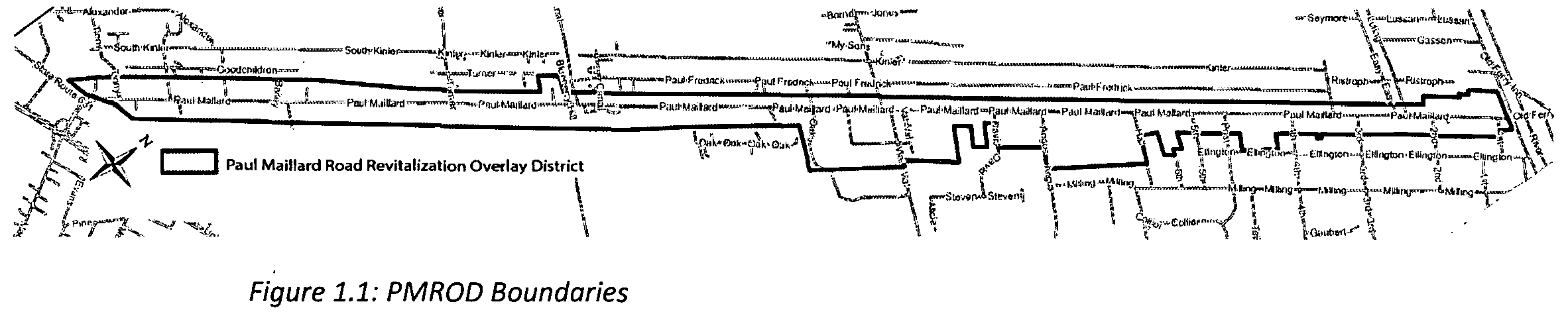
1.3.
Zones.
1.3.1.
Purpose.
A.
The purpose of Zone A is to provide locations for neighborhood scale mixed use development. The regulations support the establishment of residential development as well as both small and medium scale local businesses, and call for a physical environment that encourages walking and biking and invites visitors to linger.
B.
The purpose of Zone B is to provide locations for a vibrant and sustainable town center for Luling and the surrounding area. Mixed use development, including a wide range of commercial and residential development types and scales, will attract businesses, residents, employees, and visitors. The physical environment would be designed to accommodate the needs of all users of this area, including vehicular travelers, pedestrians, and bicyclists.
1.3.2.
Zone limits.
A.
Zone A includes all lots abutting Paul Maillard Road between River Road and 4th Street.
B.
Zone B includes all lots abutting Paul Maillard Road between 4th Street and State Route 631, as shown in Figure 1.2.
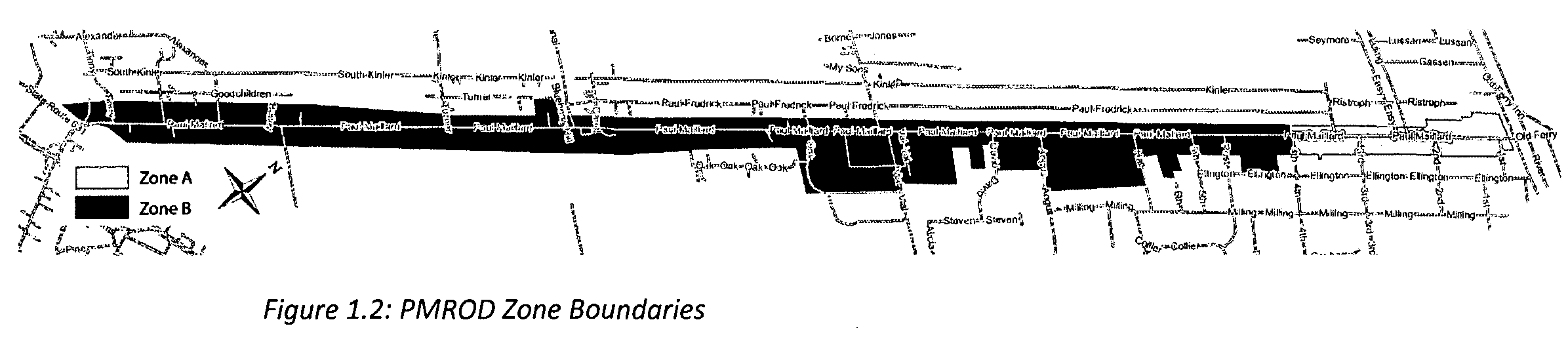
1.4.
Applicability.
1.4.1
Overlay district development standards shall apply when any of the following occurs:
A.
A new principal building is constructed.
B.
A new building, building addition, or accessory building, is constructed on an existing site that expands the gross floor area of the site by thirty (30) percent or more.
C.
A Change of Use from a residential use to a non-residential use is requested.
1.4.2
Exemptions.
A.
The Paul Maillard Overlay District shall not apply to one-family and two-family residential uses.
i.
This exemption shall not be interpreted to permit mobile homes, manufactured homes, trailers, or RVs in the District.(Ord. No. 17-11-4, § III, 11-13-17)
B.
Structures in one-family and two-family residential use within commercial zoning districts are not required to comply with District regulations.
C.
One-family and two-family residential structures are allowed, but not required, to comply with setbacks and building design standards set forth in sections 3.2 and 3.3.
1.4.3
Waivers and exemptions. Should the Director discover that specific aspects of the submitted site plan fail to conform to the regulations of the District, he may choose to forward the proposal for formal consideration by the Planning Commission if the literal enforcement of one or more provisions of the District (i) is impossible, or (ii) will exact undue hardship because of peculiar conditions pertaining to the land or building in question. Financial hardships shall not be considered as the only criteria for any such waiver or modification of existing regulations. Any site plan which contains a request for a waiver or modification of any District regulation shall contain a specific reference to the request and state the reasons that the request be granted. The Planning Commission may grant a waiver or modification of these regulations only when such requests meet the conditions of this subsection (i, ii) and are not detrimental to the public interest.
1.5.
Conflicts. Where this overlay zone conflicts with or exceeds requirements of the Zoning Ordinance of 1981, the overlay zone supersedes.
2.
Use regulations.
2.1.
Permitted uses.
A.
All uses permitted by right in the underlying zoning district, except uses prohibited under section 2.2. Prohibited uses, are permitted.
B.
All commercial uses and residential uses, whether or not permitted in the underlying zoning district, except uses prohibited under section 2.2. Prohibited uses, are permitted.
2.2.
Prohibited uses. The following uses are prohibited within the entire overlay district.
A.
Mobile homes, manufactured homes, and trailers.(Ord. No. 17-11-4, § II, 11-13-17)
B.
Outdoor storage as primary use.
3.
Development standards.
3.1.
General.
3.1.1.
Development plan and design review. Development projects must follow the St. Charles Parish plan review process.
3.1.2.
Development goals. The PMROD is intended to direct development in the district to meet the following goals:
A.
Development shall promote safe, convenient, and attractive pedestrian and bicycle access.
B.
Development shall ensure compatibility between commercial uses and surrounding residential areas.
C.
Design shall be compatible in scale, materials, street level uses, and spatial relationships with existing development.
D.
Compact neighborhood centers shall be created at major intersections to the extent possible in order to support transit, facilitate walkability and improve economic sustainability of neighborhood businesses.
E.
Street façades shall include variations in setbacks, fenestration, textures, colors, and/or materials resulting in no blank walls along the street.
F.
All sides and areas of structures visible to the public shall be treated with materials, finishes, and architectural details appropriate to primary street-facing façades.
_____
Table 3.1: Building Standards
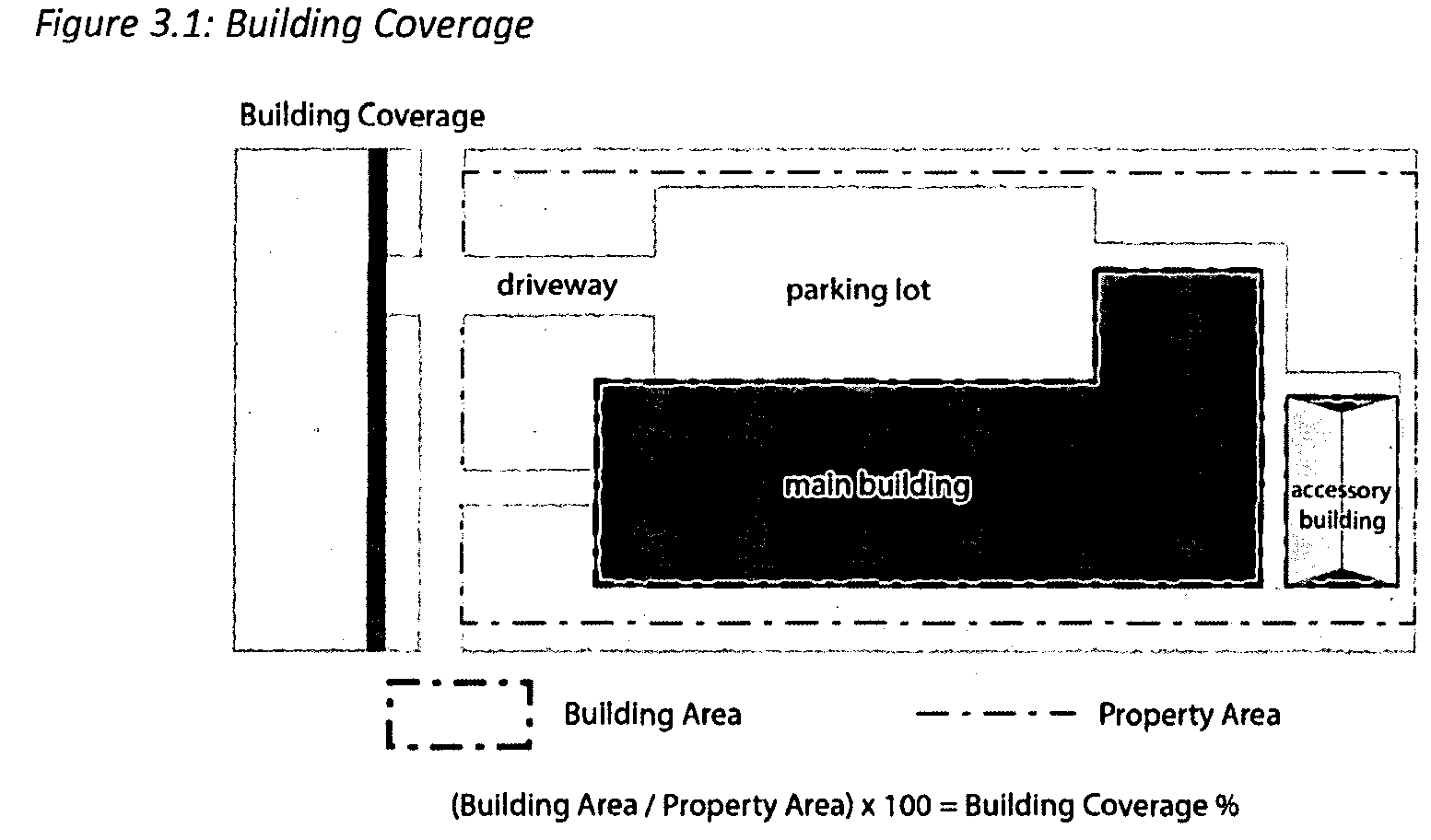
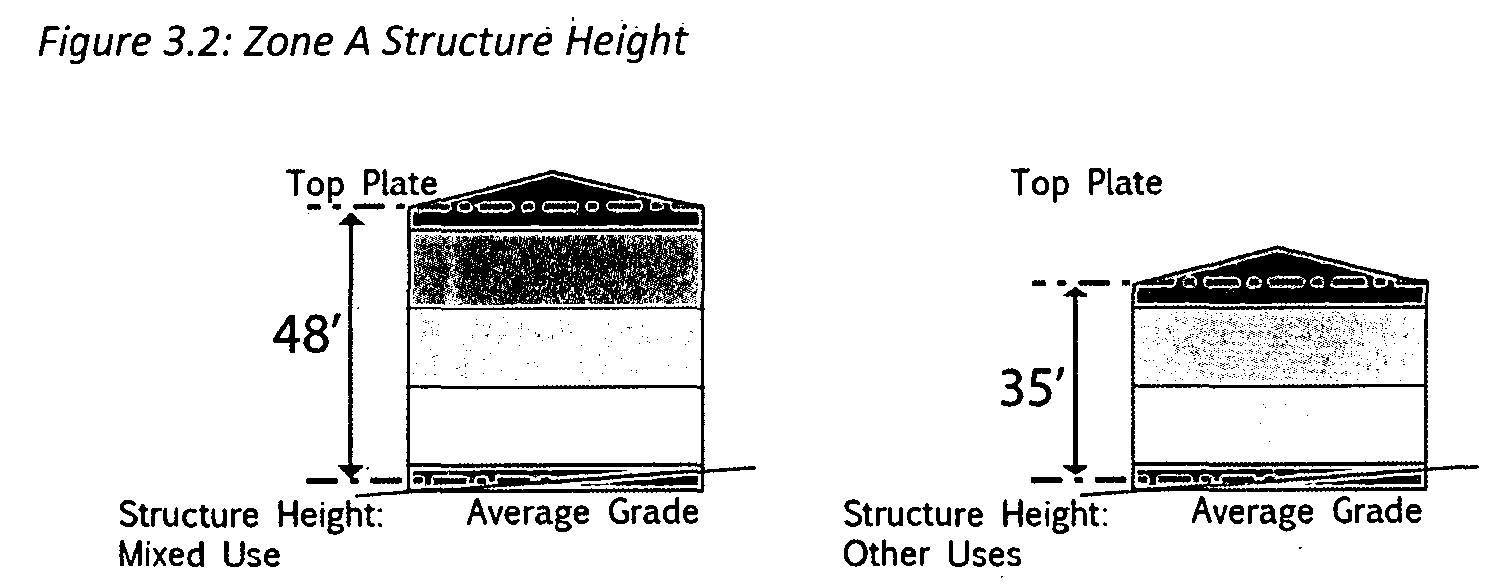
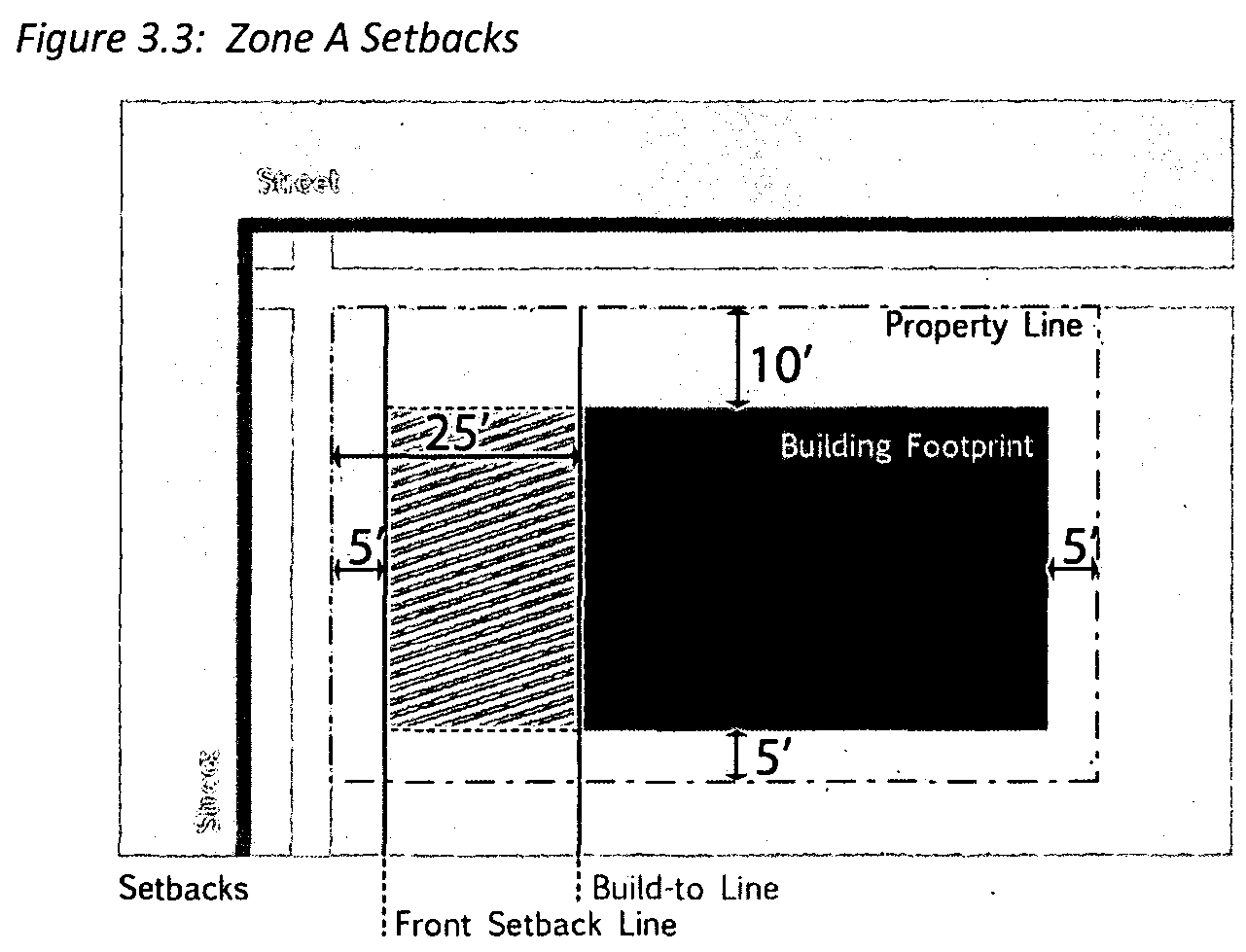
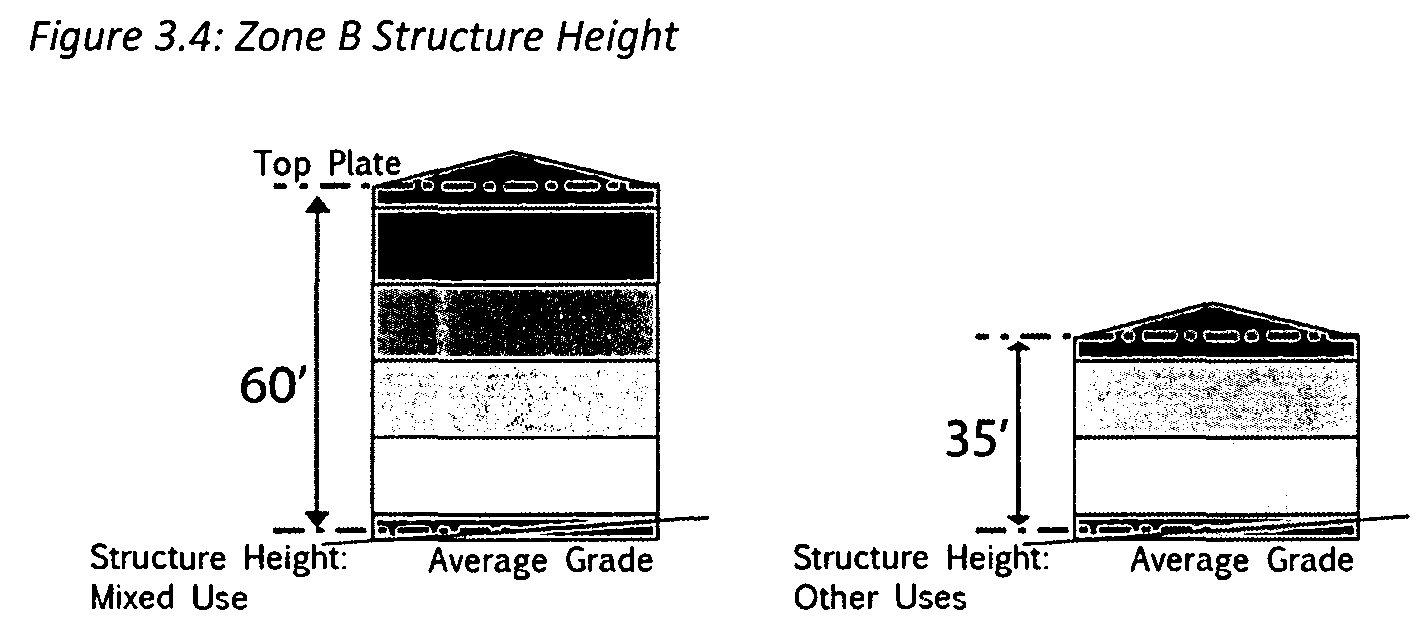
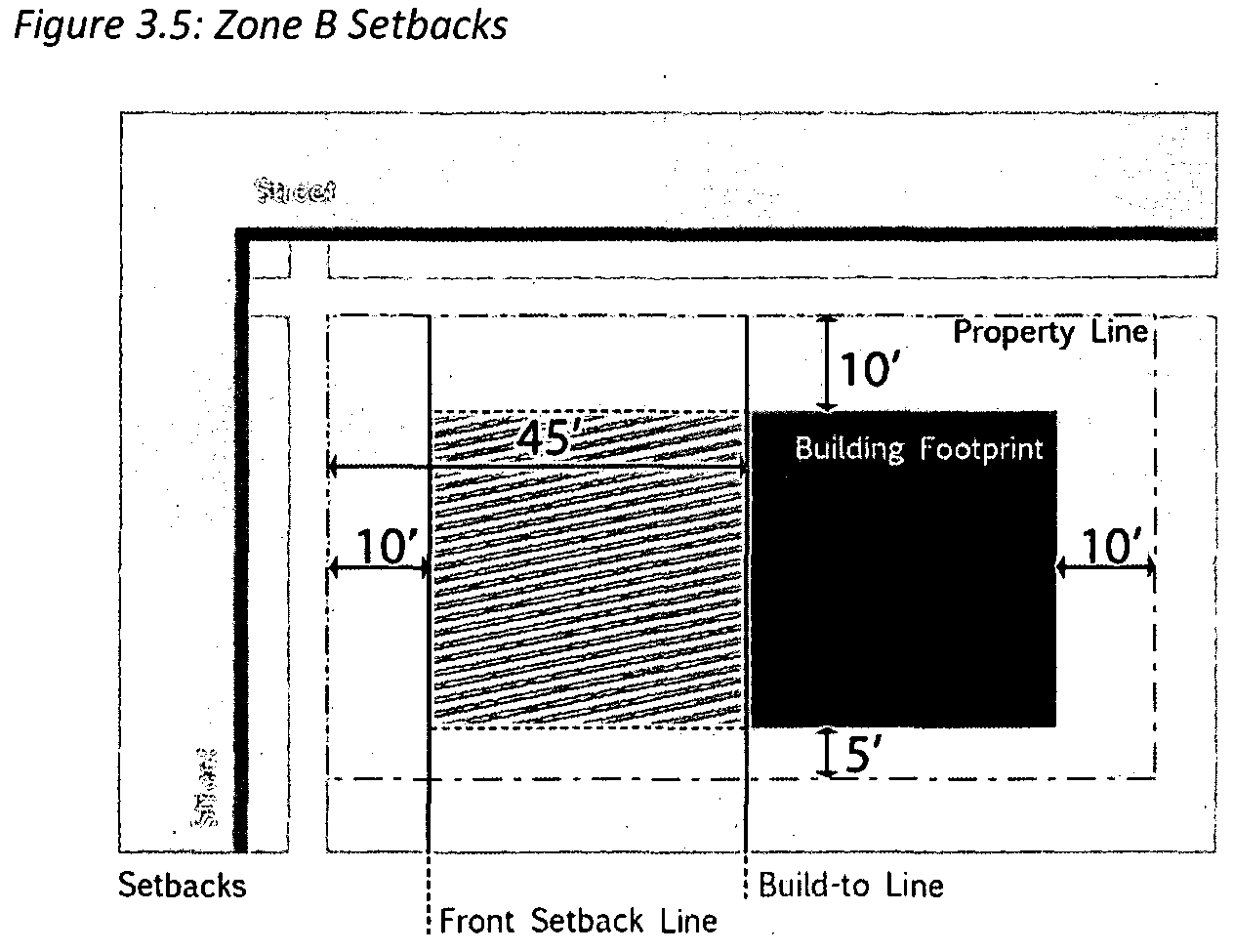
3.2.
Dimensional standards.
3.2.1.
Lot size. Lot sizes as specified in the underlying zoning district regulations apply.
3.2.2.
Setbacks.
A.
All setback requirements are measured from the edge of the corresponding property line.
B.
The following permanent elements are allowed and encouraged to extend into any required setback.
i.
Outdoor dining, benches, trash receptacles, public art, water features, bicycle racks, bollards, planters and other street furniture, pedestrian lighting, landscaping, sidewalk, trees, tree grates and planters may encroach into any required setback.
ii.
Building elements such as porches, stoops, balconies, awnings, galleries, bay windows, unenclosed fire escapes, stairways, patios, decks, and terraces may extend into a required setback if in compliance with the regulations set forth in section 3.3: Building standards.
iii.
Chimneys, flues or smokestacks, building eaves or roof overhangs, cornices, belt courses, sills, buttresses, or other similar architectural features may encroach a maximum of two (2) feet.
iv.
Minor structures accessory to utility lines (such as hydrants, manholes, and transformers and other cabinet structures), mechanical equipment associated with residential uses, such as HVAC units and security lighting and solar and wind energy systems may extend into any required setback.
3.2.3.
Build-to line.
A.
The build-to line is the line measured from the property line up to which most of the building façade must meet. The primary street and side street build-to lines are measured as a maximum setback from the edge of the property line. Building facades can be closer to the street than the build-to-line indicates, but must follow setback requirements.
B.
On corner lots, a building façade must be placed at the build-to line or between the build-to line and setback for at least the first thirty (30) feet along the street(s) extending from the block corner.
3.2.4.
Structure height.
A.
Structure height is measured in both number of stories and feet from the average grade to the top plate.
B.
Average grade is determined by calculating the average of the highest and lowest elevation along natural or improved grade (whichever is more restrictive) along the front of the building parallel to the setback line. (See Fig. 3.2: Zone A Structure Height and Fig. 3.4: Zone B Structure Height))
3.2.5.
Building standards table. Development shall comply with dimensional standards listed in the Building Standards Table 3.1.
3.3.
Building design standards.
3.3.1.
Building elements.
A.
Buildings should be designed with porches, stoops, balconies, galleries, awnings, canopies, and other weather protection devices, all of which are allowed and encouraged.
B.
Stoops, not including steps, may extend a minimum of three (3) feet from the building and are a maximum of six (6) feet wide. (See Figure 3.5: Stoops)
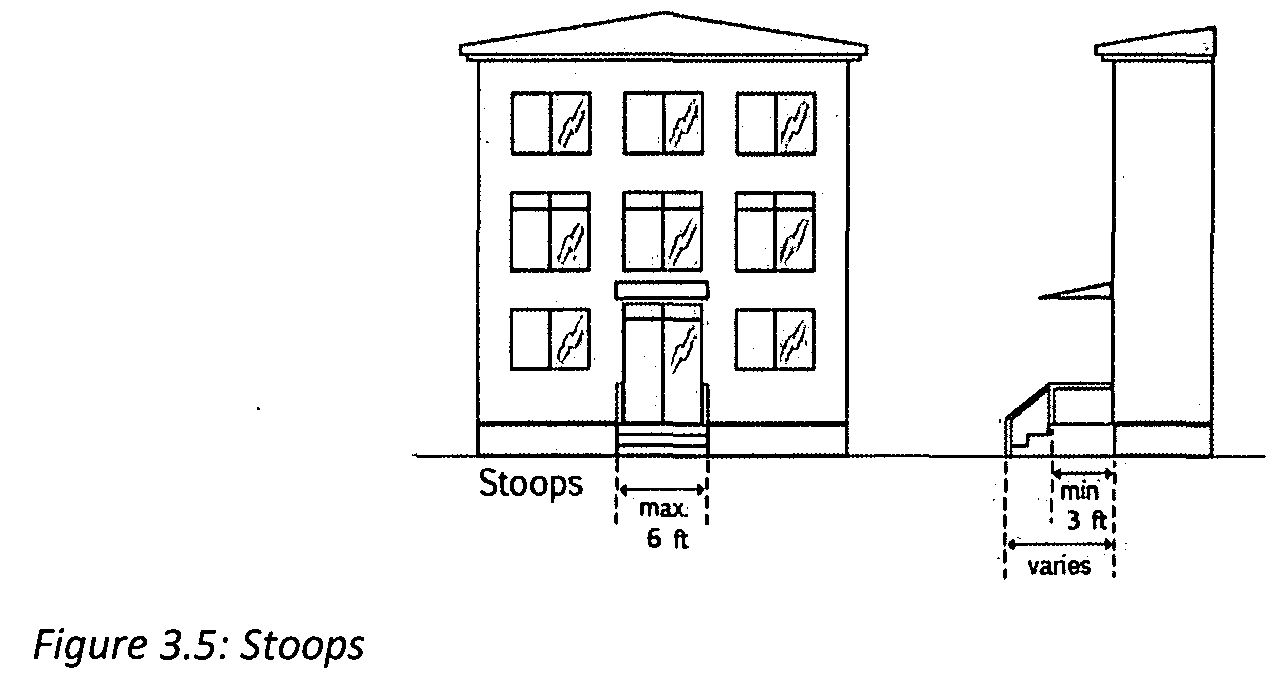
C.
Porches, not including steps, must provide a clear depth of at least six (6) feet from the building's façade, and extend across a minimum of fifty (50) percent of the width of the building façade. (See Figure 3.6: Porches)
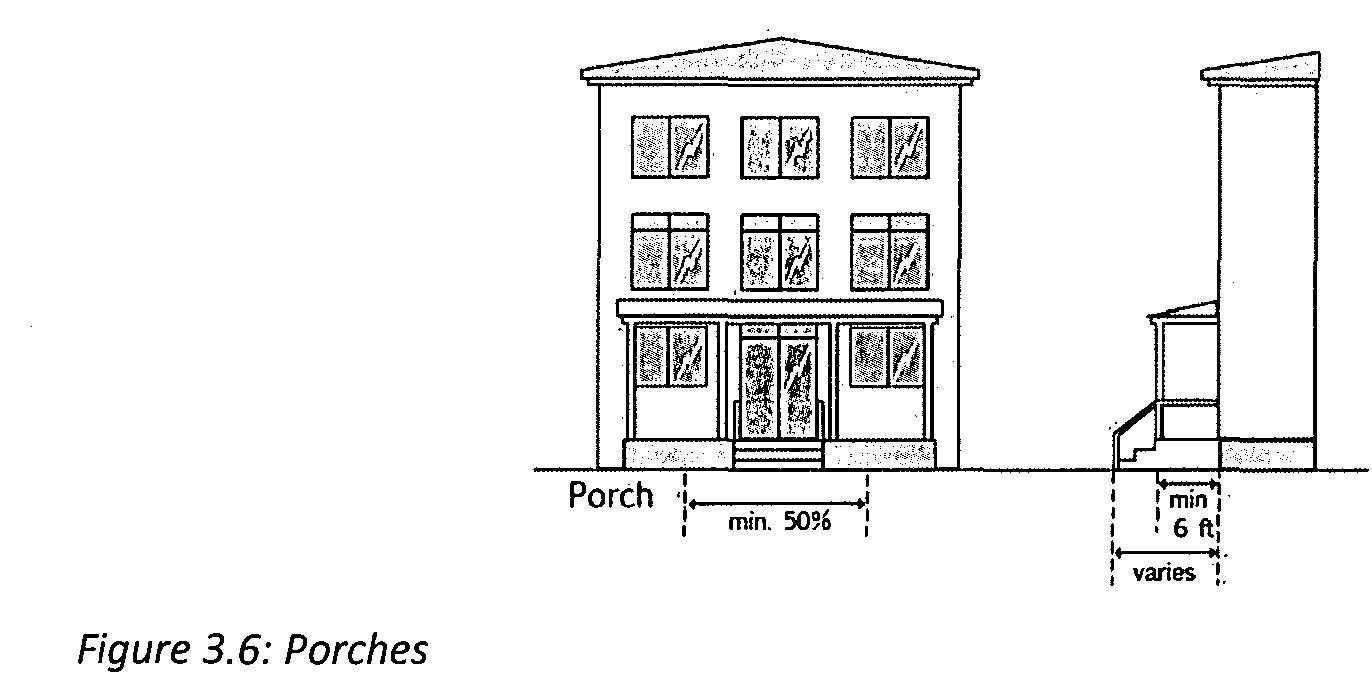
D.
Awnings, light shelves, galleries, balconies, and arcades may extend a maximum six (6) feet from the building front with a ten (10) foot minimum height. (See Figure 3.7: Awnings)
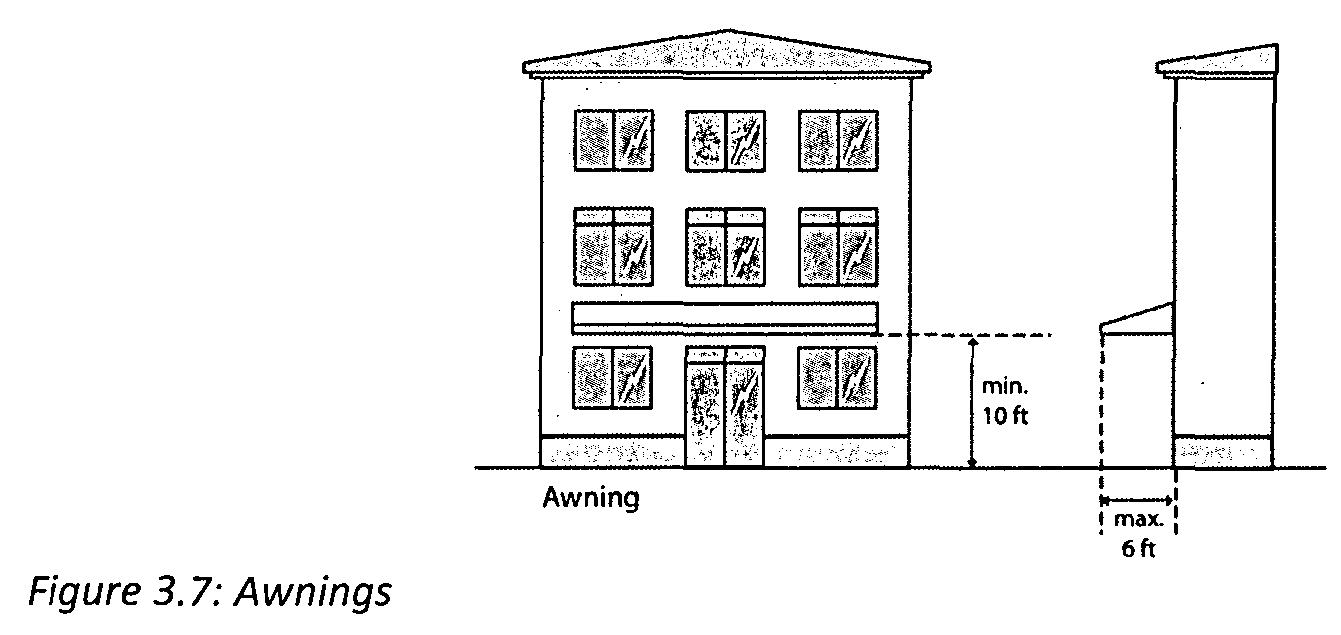
E.
Galleries must provide a clear depth from the support columns to the building's facade of at least eight (8) feet and a clear height above the sidewalk of at least ten (10) feet and must extend across at least fifty (50) percent of the width of the building facade. (See Figure 3.9: Galleries)
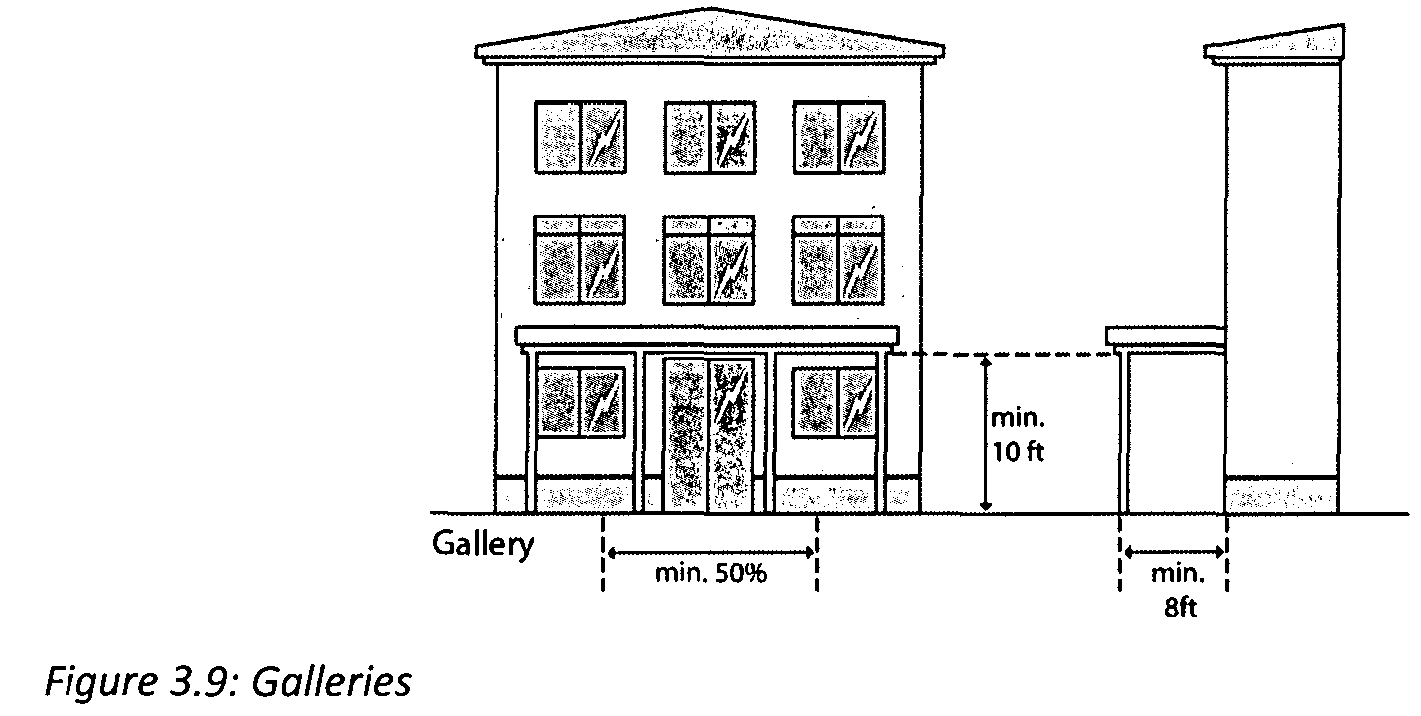
F.
Double galleries must provide a clear depth from the support columns to the building's facade of at least eight (8) feet and a clear height above the sidewalk of at least ten (10) feet and must extend across at least fifty (50) percent of the width of the building facade. (See Figure 3.10: Double Galleries)
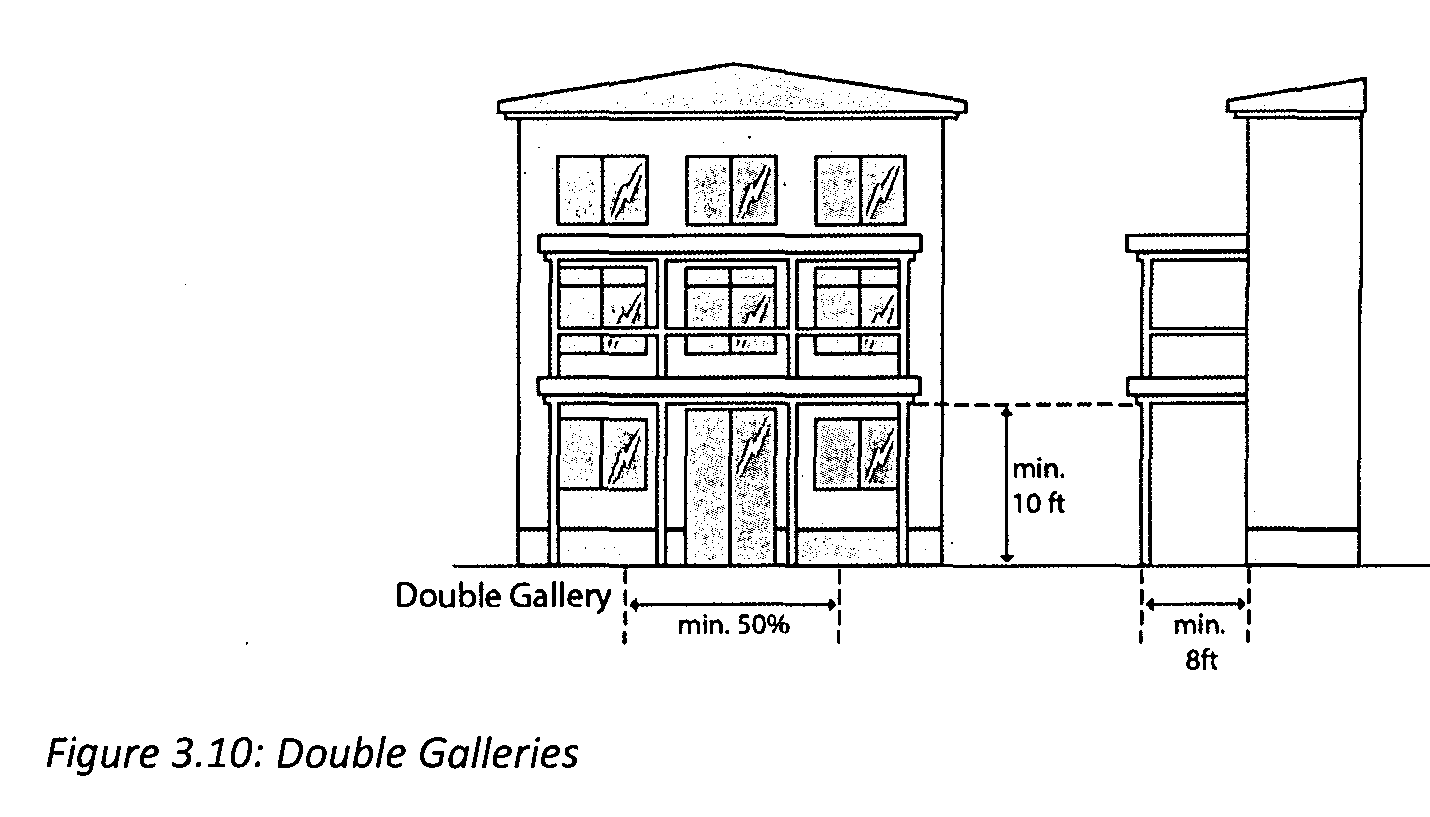
G.
All building elements must remain within the property line, unless special permission is granted by the Planning and Zoning Director for awnings, light shelves, arcades, galleries, and double galleries to encroach upon the public right-of-way.
3.3.2.
Entrance.
A.
Pedestrian and main entrances shall be located on Paul Maillard Road. Additional entrances off another street, pedestrian area or internal parking area are allowed.
B.
An angled entrance may be provided at either corner of a building along the street to meet the street entrance requirements, provided any applicable entrance spacing requirements are met.
C.
A minimum of fifty (50) percent of the main entrance must be transparent.
D.
A required fire exit door with no transparency may front on a primary, side, or service street.
E.
Adjacent commercial properties are encourage to share driveway(s) to minimize curb cuts on Paul Maillard.
3.3.3.
Façade.
A.
The façade along the ground floor fronting Paul Maillard Road at an average of at least every thirty-five (35) feet shall change visually in height, setback, materials, or colors along the axis facing the street.
B.
A minimum of fifty (50) percent of ground floor level of the building façades facing the street shall be comprised of doors or transparent windows that allow views into the ground floor. Non-reflective opaque glass and darkly tinted glass are prohibited, except for development zoned M1 in the St. Charles Parish Zoning Ordinance of 1981. Ground floor transparency (windows and doors) is measured between two (2) and twelve (12) feet above the adjacent sidewalk. (See Figure 3.4: Transparency)
C.
The Planning and Zoning Director may adjust requirements for openings for buildings elevated to meet or exceed base flood elevation (BFE) by the minimum amount needed to accommodate BFE.
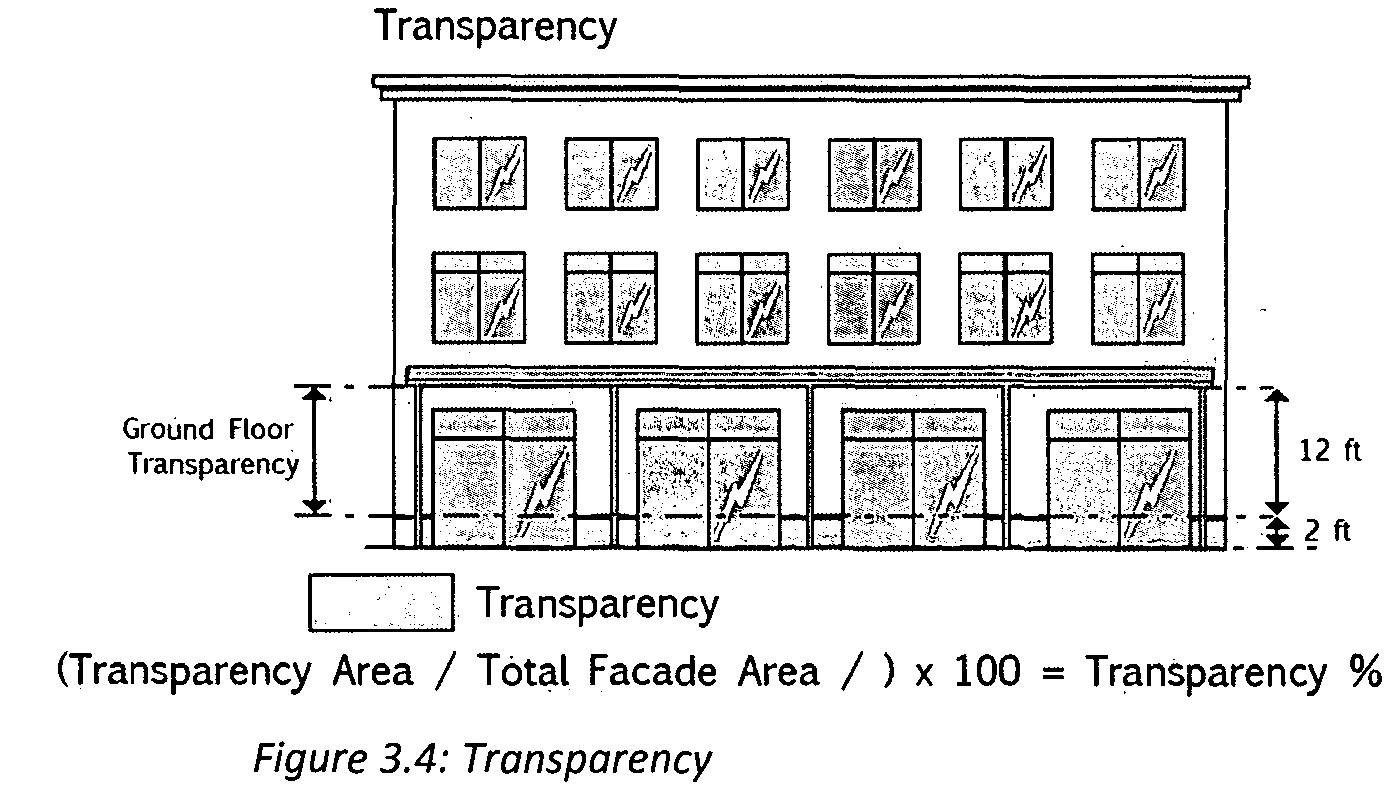
3.3.4.
Façade materials.
A.
Each building façade visible from the street, excluding window and door area, shall be clad in one or a combination of the following materials.
i.
Brick.
ii.
Stone.
iii.
Stucco.
iv.
Textured masonry.
v.
Wood.
vi.
Architectural pre-cast concrete.
vii.
Other materials upon approval of Planning and Zoning Director.
B.
The following building materials are prohibited for building facades:
i.
Plain concrete block.
ii.
Exposed aggregate (rough finish) concrete wall panels.
iii.
Corrugated metal and metal with exposed fasteners.
iv.
Vinyl.
v.
Plastic.
C.
This requirement shall apply to each façade on a building as illustrated in Figure 3.11.
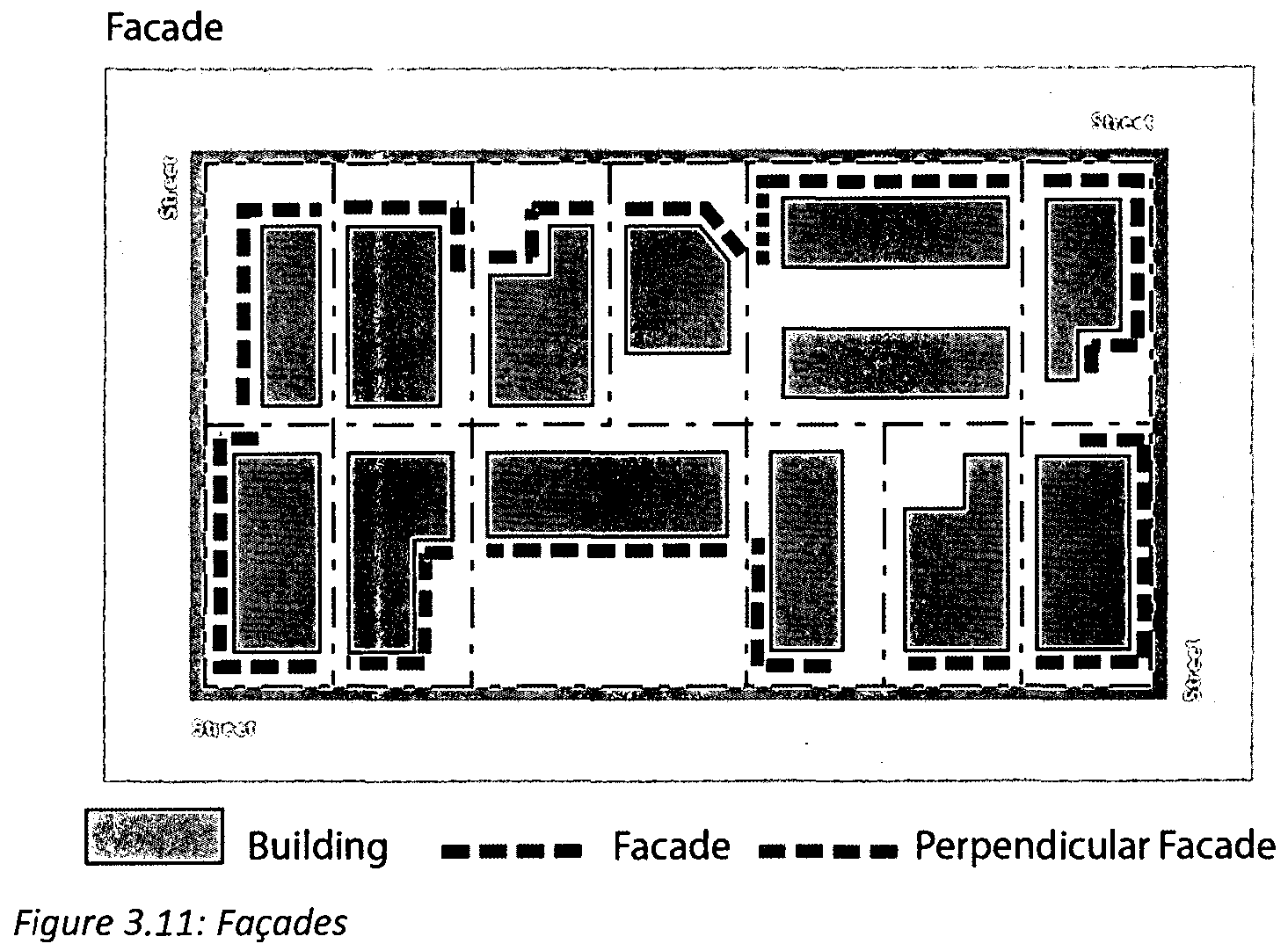
4.
Parking and loading.
4.1.
Off-street parking requirements.
4.1.1.
Minimum parking requirements. The minimum number of off-street parking spaces for any building or use within the overlay district may be reduced to eighty (80) percent of the minimum parking requirements, as specified in the St. Charles Parish Zoning Ordinance, not including accessible spaces.
4.1.2.
Maximum number of parking spaces allowed. The maximum number of off-street parking spaces for any building or use shall not exceed the minimum parking requirements, as specified in the St. Charles Parish Zoning Ordinance.
4.1.3.
Parking credits.
A.
In all areas, on-street parking spaces on the right of way adjacent to the building and between the two (2) side lot lines of the site may be counted to satisfy the minimum off-street parking requirements.
B.
Where parking is available off-site within five hundred (500) feet of the front entry to the building, and that parking is owned or controlled under a permanent and recorded parking encumbrance agreement for use by the occupants or employees on the site, said parking may be counted to satisfy the off-street parking requirements.
4.1.4.
Shared parking. A special exemption to parking requirements may be granted by the Planning and Zoning Director to satisfy minimum parking requirements under the following conditions.
A.
A document shall demonstrate that the demand for parking of the combined uses of two (2) or more buildings can be satisfied with a shared and jointly accessible off-street parking site available to those buildings.
B.
The shared parking site is located within five hundred (500) feet of the front entry to all buildings sharing the parking site.
C.
A written agreement between the owners and lessees is executed for a minimum of twenty (20) years, approved by the parish attorney as provided herein. The agreement shall be recorded and a copy maintained in the project file. Should the lease expire or otherwise terminate, any and all approvals shall be subject to revocation. Continuation or expansion of the use shall be prohibited unless the use is brought into compliance with the parking regulations of this section.
D.
Documents described in 4.1.4. A, B, and C above shall be submitted to the Planning Department for review and consideration by the Planning and Zoning Director.
4.1.5.
Accessible parking. Accessible parking shall be provided in compliance with the latest version of the Americans with Disabilities Act Accessibility Guidelines, as determined by the State Fire Marshal.
4.1.6.
Bicycle Parking.
A.
One (1) bicycle parking space shall be provided per three thousand (3,000) square feet of commercial space.
B.
One (1) bicycle parking space shall be provided per ten (10) parking spaces required for multi-family residential development.
4.1.7.
Residential parking. In mixed-use buildings at least eighty (80) percent of required parking for residential units shall be reserved by signage for residents and located on the same development site as the mixed use building or on an abutting lot in accordance with the shared parking provisions of section 4.1.4. Shared parking.
4.2.
Location of parking.
4.2.1.
The location of parking shall comply with the Table 4.1 Location of Parking below.
4.2.2.
Any requests for parking in addition to what is described in Table 4.1 shall be located only in the rear of the property.
Table 4.1: Location of Parking
4.3.
Parking lot design standards.
4.3.1.
Parking space layout.
A.
Parking space layout shall meet the dimensions showed in Figure 4.1 and 4.2.
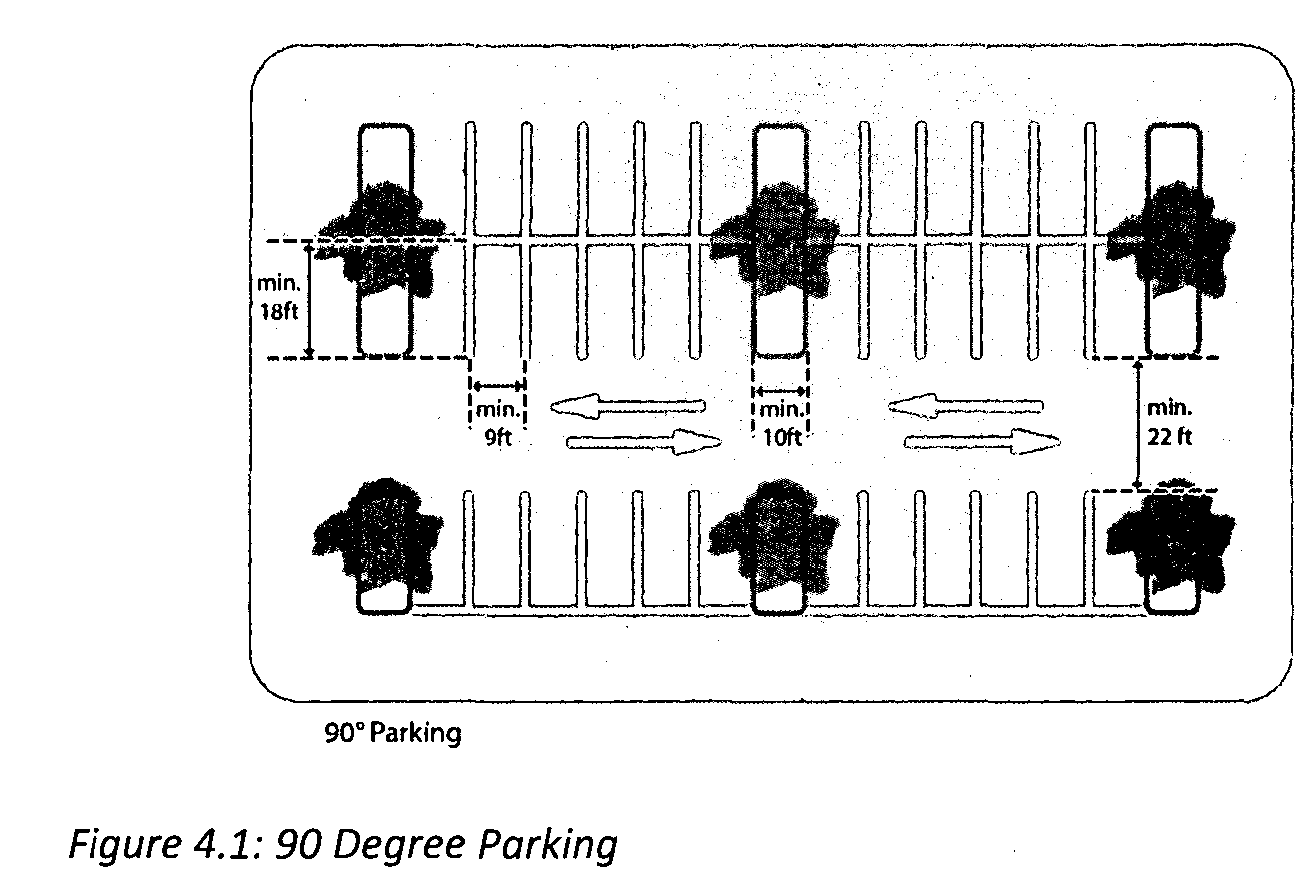
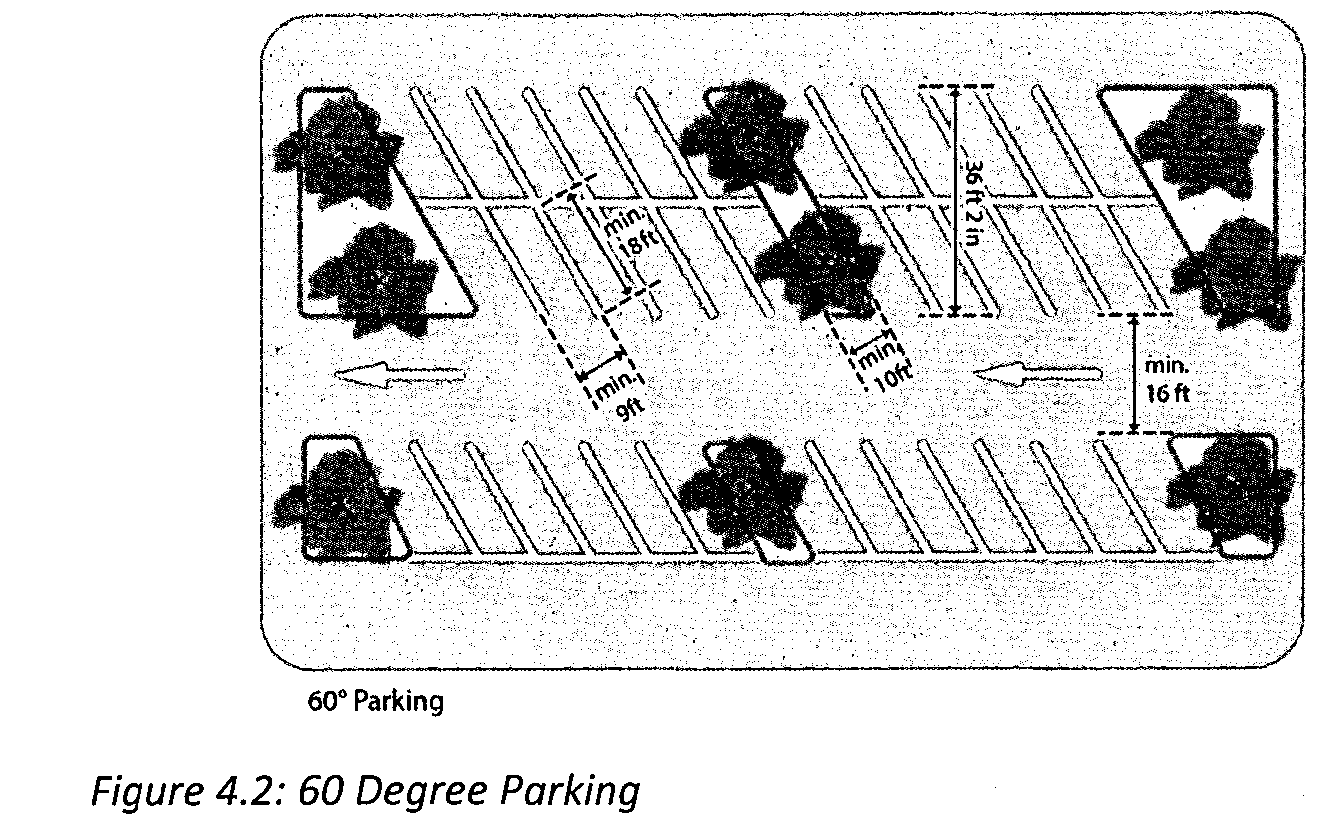
B.
Alternatively parking facilities may reduce the paved length of a parking space to sixteen (16) feet, if wheel stops are provided and a minimum of two (2) feet of planting or turf is installed at the front end of each parking space (see Figures 4.3 and 4.4)
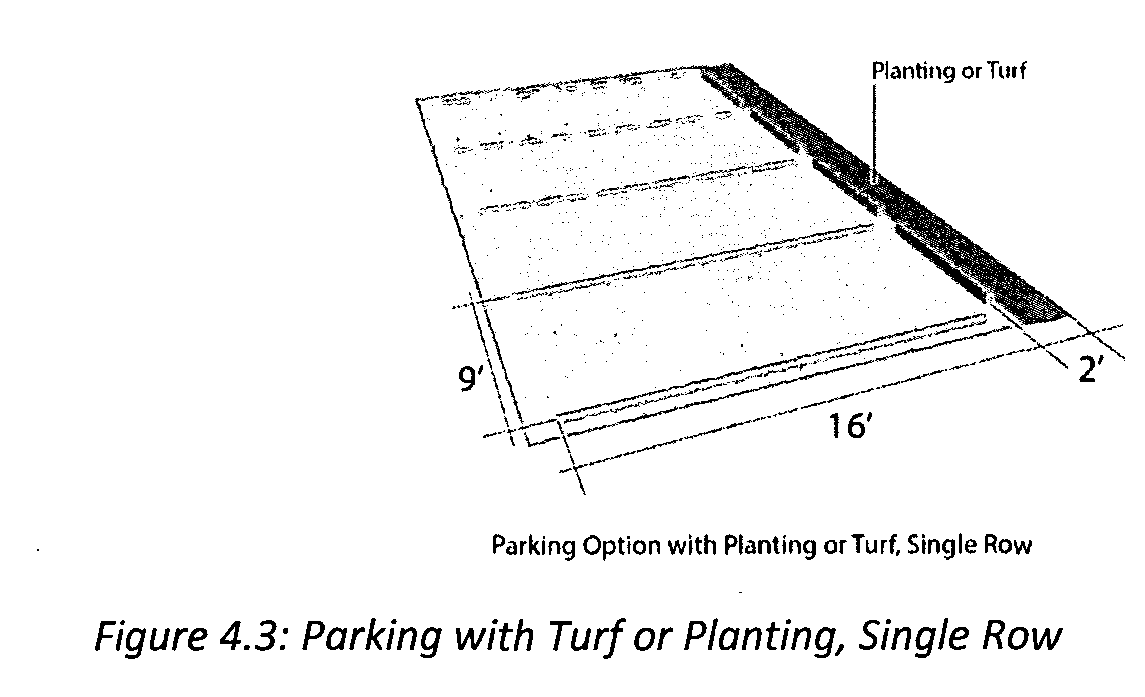
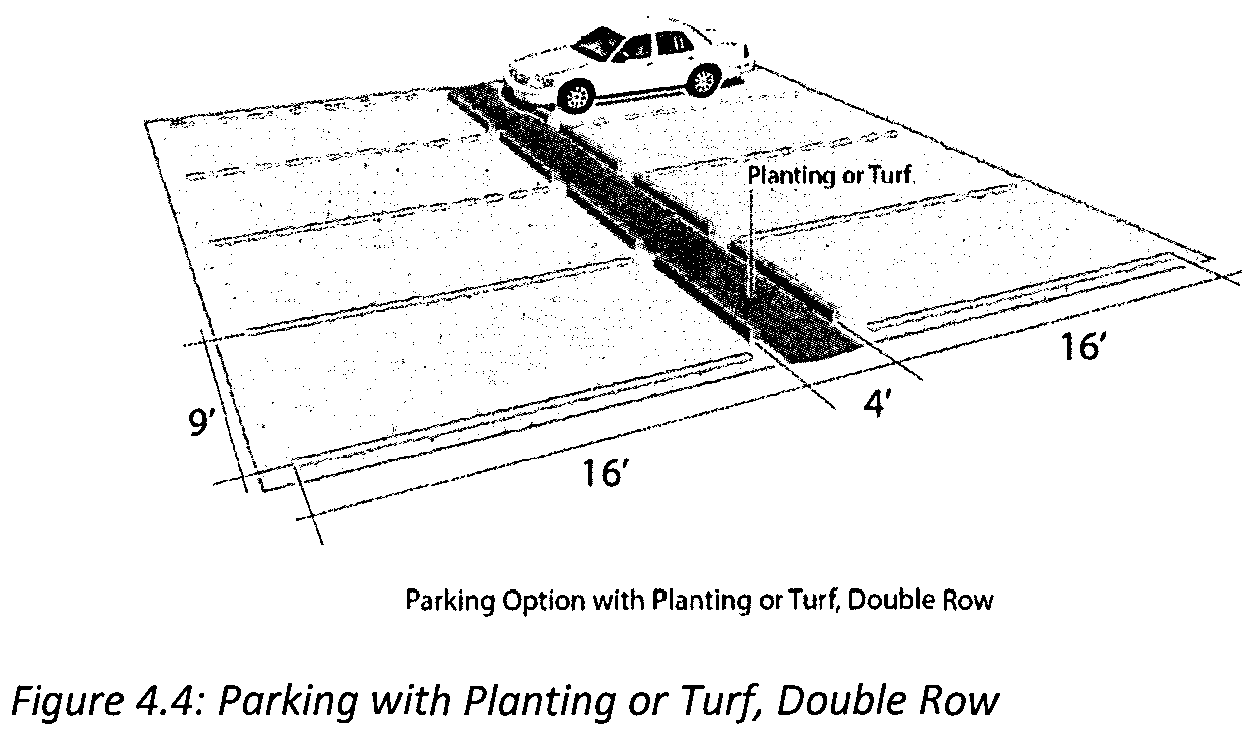
4.3.2.
Surfacing.
A.
Except as provided below, where parking facilities or any other vehicular use area are provided, they shall be surfaced with pervious concrete, pervious asphalt, porous pavers, asphalt bituminous, concrete or other dust free material approved by the Zoning Regulatory Administrator, and shall be maintained in a smooth, well-graded condition.
B.
Driveways, parking areas for heavy equipment and loading zones may be paved with impervious surfacing materials like conventional concrete and asphalt.
C.
Where an existing tree is adjacent to parking paver bricks or other pervious surface shall be used within the dripline of the tree. No parking shall be located closer than five (5) feet from the trunk of an existing tree.
4.3.3.
Setback.
A.
In the event any parking abuts a walkway, sidewalk or street, the parking shall be separated by curbing or other protective device with a minimum distance of two and one-half (2.5) feet between the protective device and the edge of the walkway or sidewalk, and ten (10) feet between the protective device and the street right-of-way.
B.
All parking shall be separated from buildings by a minimum distance of three (3) feet.
4.3.4.
Striping. All parking areas shall be striped to designate parking spaces.
4.3.5.
Non-conforming parking lots. Non-conforming parking lots shall be brought in compliance with the requirements of this section when any one (1) of the following occurs:
A.
A new principal building is constructed.
B.
A building addition is constructed that expands the building footprint by thirty (30) percent or more.
C.
Over fifty (50) percent of the total area of an existing parking lot is reconstructed.
D.
An existing parking lot under ten-thousand (10,000) square feet in area is expanded by fifty (50) percent or more in total surface area.
E.
An existing parking lot over ten-thousand (10,000) square feet in area is expanded by twenty-five (25) percent or more in total surface area.
4.4.
Loading.
A.
On-site loading zones shall be located behind the front building line.
B.
Loading bays shall not face Paul Maillard Road.
4.5.
Generally. The landscaping requirements listed in section VIII.D of The St. Charles Parish Zoning Ordinance of 1981, shall apply for any planting standards that are not provided in this section.
5.
Screening and fencing.
5.1.
Yard fencing.
A.
Along interior side and rear lot lines a fence may be erected in compliance with the following requirements.
i.
The fence shall not exceed eight (8) feet in height.
ii.
Wood fences, ornamental fences, or fences of substantially similar appearance are allowed.
iii.
Chain link security fencing may be established in side and rear yards that do not face a street if located behind the front building line and provided that barbed and razor wire shall not be permitted.
B.
Front yards shall not be fenced, except an ornamental fence not taller than four (4) feet measured from sidewalk elevation may be used to enclose allowed customer areas along street frontages.
C.
Fences facing streets shall be constructed of wrought or cast metal or a similar durable material approved by the Planning and Zoning Director, and may include a masonry wall a maximum height of two and one-half (2.5) feet.
5.2.
Dumpsters and recycling containers.
A.
Dumpsters and Recycling Containers shall be fully enclosed on three (3) sides by a solid fence, a masonry wall, or principal structure wall seven (7) feet in height. The enclosure shall be gated.
B.
The materials used for screening, including the enclosure, shall complement the architecture of the principal building.
C.
Any restaurant shall not store trash, prepare food, or locate service uses in a rear or interior side yard that abuts a residential use.
D.
Dumpsters shall be located behind the front building line, or the side building line on a corner lot.
5.3.
Loading berths. Loading berths shall be screened by a masonry wall or a solid fence at least eight (8) feet in height.
5.4.
Utilities.
A.
Above-ground public utilities with the exception of utility poles shall be screened by a continuous hedge of no less than three (3) feet in height if surrounded by at least three (3) feet of exposed soil or grass. A setback of no less than one and one-half (1.5) feet must be provided around the equipment to allow for proper operation and maintenance of the equipment.
B.
Mechanical equipment. Mechanical equipment, electrical meter and service components, and similar utility devices, whether ground level, wall mounted, or roof mounted, shall be screened from view at the front property line, and side property line on the corner side if a corner lot. Exterior screening materials shall be the same as the predominant exterior materials of the principal building.
6.
Signs.
6.1.
Generally. The general sign regulations of section XXI - Sign regulations of the St. Charles Parish Zoning Ordinance of 1981 shall apply for any standards that are not provided in this section.
6.2.
Sign standards. Signs shall be established in accordance with the standards stated in this section.
Table 6.1: Sign Standards
_____
6.3.
Determination of sign area.
A.
For signs on a background, the entire area of the background is calculated as sign area, including any material or color forming the sign face and the background used to differentiate the sign from the structure against which it is mounted. Sign area does not include any supports or bracing.
B.
For signs consisting of freestanding letters or logos, the sign area is calculated as the total area of each square, circle, rectangle, or triangle, or combination thereof that encompasses each individual letter or logo. Sign area does not include any supports or bracing.
C.
For freestanding signs, height is calculated as the vertical distance measured from the grade of the site where the sign is to be installed or the grade of the roadway, whichever is higher, to the highest point of the sign. Grade is considered the lower of the existing grade prior to construction or the newly established grade after construction.
6.4.
Murals. Upon approval of the Planning and Zoning Director, murals may be allowed on building walls and masonry fences or enclosures subject to the following criteria:
A.
Any portion of a painted or applied sign containing advertising, commercial messages, or logos shall not be considered a mural but a wall sign.
B.
The area of a mural shall not be included in the computation of total sign area.
C.
A mural shall not extend more than six (6) inches from the surface on which it is applied, shall not extend beyond the height of the structure on which it is applied, and shall not include moving or protruding elements.
D.
Murals must be applied in a durable material or paint finish that can withstand five (5) years of regular wear and weathering.
6.5.
Bulletin boards. Bulletin boards limited to twelve (12) square feet in area or less are allowed on public, charitable, or religious institutions.
6.6.
Prohibited signs. All other sign types, including, but not limited to, off-premise advertising signs and projector, animated, or electronic variable message signs are prohibited.
6.7.
Illumination.
A.
A wall, projecting, hanging, or window sign may be illuminated internally.
B.
All signs may be illuminated externally except that a sign shall not be illuminated both internally and externally.
C.
Illumination shall not be aimed, directed or reflected, focused, or mounted to cause direct light from the luminaire to be directed toward residential uses or adjoining uses, or to create up light, spill light, or glare perceptible to persons operating motor vehicles on public ways.
D.
Illumination of the sign face shall not exceed fifty (50) lumens per square foot and flashing, blinking, or scintillating lights are prohibited.
6.8.
Abandoned signs.
A.
An abandoned sign is one in which the business has moved or changed name or type of business such that the sign information is no longer relevant.
B.
The entire structure must be removed within six (6) months of being abandoned.
C.
The face of the sign must be removed or covered within one (1) month after termination of the use.
6.9.
Non-conforming signs.
A.
Where a sign is nonconforming, the sign and its supporting structure shall be removed or otherwise modified to conform to the provisions of this section by December 14, 2018, or within eight (8) years after its initial construction, whichever is later.
B.
Prior to December 14, 2018, or the end of the eight-year period as defined in paragraph "A," the owner of a nonconforming sign other than a freestanding sign may submit a written request to the St. Charles Planning and Zoning Commission for an extension of eight (8) months, August 14, 2019, to come into compliance with the provisions of this section. The written request must explain how the nonconformities will be resolved within the extension period.
7.
Outdoor lighting.
A.
Outdoor illumination of any building, seating area, plaza, courtyard, planting, or similar purpose shall not be aimed, directed or reflected, focused, or mounted to cause direct light from the luminaire to be directed toward residential uses, or to create up light, spill light, or glare perceptible to persons operating motor vehicles on public ways.
B.
The installation of any mercury-vapor fixture or lamp for use as outdoor lighting is prohibited.
8.
Use standards. A residential use is subject to the following limitations: The conversion to residential use of the upper floors or a ground floor portion of a non-residential building meeting the standards of this section shall comply with the minimum unit size standards of eight-hundred fifty (850) square feet per dwelling unit.
9.
Development credits.
9.1
Any development within the PMOD that invests in the following improvements according to the adopted St. Charles Parish Paul Maillard Road Complete Streets Plan are eligible for development credits as described below.
A.
Contributing to a parish fund to reconstruct drainage ditches along Paul Maillard Road into covered drainage pipes.
B.
Planting street trees within the right-of-way on the condition that the species, sizes, and locations are approved by the Planning and Zoning Director with no objection from LaDOTD or St. Charles Parish Public Works Director (whichever applies)
C.
Contributing to a Parish fund to plant street trees within the right-of-way
D.
Constructing sidewalks within the right-of-way according to Parish standards and with no objection from LaDOTD or St. Charles Parish Public Works Director (whichever applies).
E.
Contributing to a parish fund to construct sidewalks within the right-of-way.
9.2
Development credits.
A.
Reduced parking requirements up to fifteen (15) percent.
B.
Increased building square footage up to (15) percent.
C.
Reduced frontage transparency by five (5) percent.
D.
Signage area increased by fifteen (15) percent.
(Ord. No. 15-12-18, § I, 12-14-15)
L.
Corridor Overlay Zone (COZ):
1.
General:
1.1
Purpose. The purpose of the Corridor Overlay Zone (COZ) is to revitalize transportation corridors for the citizens of St. Charles Parish by superimposing an overlay zone with standards for façade, landscaping and buffering, signs and other design elements to improve appearance, function, safety and resilience. These design elements are intended to reduce the amount of paved surface, increase landscaping to beautify the corridor, guide traffic, minimize the impact of development on the parish drainage system, provide buffers to neighboring residences, upgrade the facade of commercial structures, reduce sign clutter, and coordinate signage with green space. The COZ requirements are triggered by new construction and major renovation or additions.
1.2
District Limits. The Highway 90 COZ includes all lots either directly abutting or accessed from U.S. Highway 90 between the I-310 North on-ramp in Boutte and Willowdale Boulevard in Luling.
1.3
Applicability.
1.3.1.
The COZ superimposes design elements and sign standards in addition to requirements set in the underlying zoning district. Development and structures within the overlay zone must conform to the requirements of both the zoning district and the overlay zone, or the more restrictive of the two (2).
1.3.2.
Development activities that involve new construction, major renovation or addition, or change in permitted uses that requires an increase in the number of parking and loading spaces trigger compliance to the COZ, as set under item 5.2, Triggers for Compliance of this ordinance.
1.3.3.
Permitted Uses.
a.
Permitted uses within the COZ shall be those uses allowed in the underlying zoning district.
b.
All permitted uses except single-family and two-family dwellings shall be required to comply with the COZ.
1.3.4.
Height Regulations. Height regulations in the COZ shall be set by the underlying zoning district.
1.3.5.
Area Regulations. Area regulations for front, side and rear yards and lot area shall be set by the underlying zoning district.
2.
Parking Requirements:
2.1.
Off-street parking requirements, including the landscaping thereof, are set in Section 3, Design Standards, of this ordinance and Section VIII, Site plan review and design requirements of the St. Charles Parish Zoning Ordinance.
2.2.
In addition, parking spaces shall be oriented so that no vehicle is required to back directly into the highway or street right-of-way.
3.
Design Standards: Design standards in the COZ are intended to improve the quality and functionality of development as outlined under 1.1 Purpose of this ordinance.
3.1.
Landscaping and Buffering. Landscaping and buffering provisions set in this section of the COZ are in addition to general landscaping standards established in Section VIII, Site plan review and design requirements of the St. Charles Parish Zoning Ordinance.
3.1.1.
General.
a.
All landscaping materials within the COZ shall be in accordance with standards for size, height, diameter at breast height and species set in Section VIII, Site plan review and design Requirements of the St. Charles Parish Zoning Ordinance.
b.
Maintenance Plan.
i.
A maintenance plan for landscaping and buffering shall be required for major development activities within the COZ. The maintenance plan shall contain a schedule of regular waterings, fertilization, removal of dead vegetation, and replacement with similar plantings to the original approved landscaping plan. The maintenance plan should also address repair or replacement of damaged fences or walls required in the COZ. The maintenance plan shall be submitted to the Planning Department for approval prior to the issuance of a building permit.
ii.
Following issuance of the permit and proper installation of the landscaping and buffering, the property owner shall be required to follow the approved maintenance plan. If dead vegetation is not replaced, and/or damaged fences or walls are not repaired or replaced within thirty (30) days of being notified by St. Charles Parish officials, the property owner shall be placed in violation of the zoning ordinance and fined accordingly.
c.
All landscaped areas shall contain a minimum six-inch (6") barrier curb to protect and demarcate vegetation.
d.
The developer shall be credited with preserving existing mature trees on the development site of a significant species as determined by the Planning Director. For every mature tree or group of mature trees preserved and incorporated into the required COZ landscaping plan, the required number of trees that must be planted may be reduced by a one-to-one ratio.
3.1.2.
Perimeter.
a.
All required yards shall be landscaped in the COZ. Landscaped areas shall contain a minimum of one (1) tree for every thirty-five feet (35') of linear lot frontage or portion thereof. Additionally, all landscaped areas shall contain one (1) shrub for every ten feet (10') of linear lot frontage or portion thereof. The required number of shrubs may be grouped.
b.
No building or structure, parking or paving shall be allowed in the required front yard except for sidewalks or approved driveways connecting the development site to the adjacent highway or street.
c.
Side yards may contain access driveways to connect adjacent development sites for the purpose of improving access management.
3.1.3.
Interior.
a.
In order to distribute landscaping throughout the interior of the development, one (1) landscaped island shall be provided for every twenty-four hundred square feet (2,400 SF) or portion thereof, consisting of a minimum size of ten feet (10') by twenty feet (20').
b.
Each required landscaped island shall contain a minimum of one (1) tree, three (3) shrubs and groundcover or mulch.
3.1.4.
Residential Buffering.
a.
A minimum 10-foot buffer shall be required when commercial uses abut residential areas with screening consisting of a wood, brick or masonry fence or wall seven feet (7') in height and trees planted every thirty-five feet (35') or portion thereof.
b.
For large commercial structures of 25,000 (twenty-five thousand) square feet or more, additional landscaping and buffering may be required as determined by the Planning Director.
3.2.
Façade. These façade standards are intended to develop visually interesting architectural features and patterns and a higher quality of design for commercial buildings along the corridor. This includes but is not limited to the use of roofing materials appropriate to the architectural style of the building, transparent features that avoid fortress-like, uninviting front building façades, and clearly defined, highly visible building entrances featuring awnings and other architectural features.
3.2.1.
Exterior Building Materials.
a.
All building façades shall be constructed of one or a combination of brick, concrete aggregate, stucco, glass, wood or decorative/faced concrete and masonry.
b.
No portion of a building shall be constructed of plain, unfaced concrete masonry units, corrugated and/or sheet metal, or mirrored glass.
c.
Large monolithic or solid building façades visible to the corridor or public rights-of-way shall be prohibited. Variations in building façades in materials, color, projecting or recessed forms and/or texture may be employed to break up building forms and wall surfaces at a minimum of every fifty (50) feet.
d.
Moldings, cornices, shutters, metalwork and other decorative features in scale with the development are encouraged.
e.
All commercial buildings shall be architecturally finished on all four sides with the same materials, color, detailing and features, except if the rear face contains two rows of trees planted on the perimeter behind the building. In this case, the architectural finish of the building need only match the remainder of the building in color.
f.
Additions to existing structures may be constructed with the same type of material that is on the primary building, provided it matches the existing building material in color, size and thickness.
3.2.2.
Exterior Colors.
a.
All building elevations shall be finished with complimentary neutral, cream or non-reflective earthtone colors.
b.
No more than twenty percent (20%) of any building elevation may be finished with bright primary or secondary colors. These colors shall be limited to use on accent features including but not limited to window and door frames, moldings, cornices, and awnings.
c.
This percentage may be modified upon approval by the Planning Director in special cases if the building's elevation maintains sufficient visual continuity.
3.2.3.
Roofs.
a.
Slate, synthetic slate, architectural grade fiberglass shingles, cement-like shingles and standing seam metal roofs are permitted.
b.
Earth tone colors such as black, gray, brown, dark green or other earth tone colors are permitted.
c.
Regardless of material, bright or glaring roof colors are not permitted.
3.2.4.
Transparency.
a.
At least thirty-five percent (35%) of the front façade shall be transparent, including doorways.
b.
Windows and doors shall not be obscured by signage or other impediments.
3.2.5.
Building Entrances.
a.
Backlit or plastic awnings are not permitted.
3.2.6.
Canopies.
a.
Building and roof materials for canopies shall match building materials used in the primary building.
b.
The height of canopies shall not exceed the height of the primary building.
c.
Canopy supports shall be proportional to the design and canopy size.
d.
Canopy colors shall blend in with and be consistent with the primary building.
e.
Bright or glaring colors are not permitted.
f.
Canopy lighting must be designed to minimize glare from fixtures and installed to prevent spill over onto the corridor or adjacent properties.
3.3.
Accessory Facilities and Features.
3.3.1.
Light Fixtures.
a.
The maximum height for any light fixture is twenty-five (25) feet.
b.
Lighting shall be oriented inward, toward the development or structures, to minimize intrusion into surrounding property.
c.
Light fixtures shall be incorporated within landscaped areas.
3.3.2.
Service Areas and Waste Containment.
a.
Service bays, loading and unloading areas, dumpsters and waste containment areas shall be located outside of the front yard. When these areas are adjacent to residential development, a minimum 10-foot setback with fencing and landscaping is required as set under item 3.1.4 of this ordinance.
b.
Service bays, loading and unloading areas, dumpsters and waste containment areas shall be screened by a wood, brick, or masonry fence with a minimum height of seven feet (7'). This fence is in addition to perimeter landscape requirements set in this section. Only one (1) fence is required if mechanical equipment and utility cabinets are located adjacent to the service area.
c.
Service bays; loading and unloading areas, dumpsters and waste containment areas shall be oriented in such a way that in the process of loading and unloading, no vehicle will block the passage of other vehicles on the service drive or extend into any other public or private street.
d.
All dumpsters and waste containment areas shall comply with the requirements of Chapter 10, Garbage and Trash, of the St. Charles Parish Code of Ordinances. In situations where the regulations of that chapter and the regulations of this article are in conflict, the more restrictive shall apply.
3.3.3.
Drive-Thru Facilities. Drive-thru facilities shall be located to the side or rear of the structure.
3.3.4.
Outdoor Storage Areas. Outdoor storage and permanent display areas shall be located behind the primary front building line of the principal structure.
3.3.5.
Mechanical Equipment and Utility Cabinets.
a.
Mechanical equipment and utility cabinets shall be located on the roof or at the rear of the building if ground-mounted equipment is used.
b.
Roof parapet or roof forms are encouraged as an effective screen for mechanical equipment mounted on the roof.
c.
If ground mounted, mechanical equipment and utility cabinets shall be screened by a wood, brick, or masonry fence or wall with a minimum height of seven (7) feet. This fence is in addition to perimeter landscape requirements set in this section.
4.
Sign Regulations: The sign regulations are designed to reduce the size, height and number of signs and integrate detached signage within landscaped areas while providing for the identification of businesses within the corridor. The COZ sign regulations are in addition to Section XXI. Sign Regulations of the St. Charles Parish Zoning Ordinance and whichever is more restrictive shall apply. A summary table of COZ sign regulations is included at the end of this section.
4.1.
Detached Signs.
4.1.1.
Primary Detached Sign.
a.
One (1) primary on-premise detached sign shall be allowed per development in the COZ, either as a ground or monument sign. The allowable area for the detached sign shall be calculated at one square foot (1 SF) for each one-foot (1') of linear site frontage or portion thereof up to three hundred square feet (300 SF), whichever is less. The maximum height of the detached sign shall be twenty-five feet (25').
b.
The detached sign must be located within a landscaped area.
c.
Detached signage shall complement the building's architectural style with respect to shape, color and materials.
d.
The primary detached sign may be multi-faced. The allowable sign area for a multi-faced detached sign is divided across each sign face. For a sign allowed the maximum 300 square feet of sign area, each face of a double-faced sign may consist of 150 square feet.
4.1.2.
Monument Sign.
a.
If the primary on premise sign is a monument, the allowable area shall be calculated at one square foot (1 SF) for each one-foot (1') of linear site frontage or portion thereof up to two hundred square feet (200 SF), whichever is less. The maximum height shall be ten feet (10').
b.
The square footage of the support structure of the monument shall be included in the measurements to calculate the maximum allowable sign area.
c.
If a monument sign is employed as the primary detached sign, the development is allowed an additional twenty percent (20%) in attached signage.
d.
No other primary detached sign shall be permitted.
4.1.3.
Accessory Detached Signs. Accessory detached signs including directional, menu boards and electronic message center signs, may be allowed to support the functionality of the development:
a.
Directional Signs. Each development site may have up to two (2) directional signs to demarcate the entrance and exit to and from the site at a maximum height of four feet (4') and no more than four square feet (4 SF) each in area.
b.
Menu Boards. Each development site may have up to two (2) menu boards for drive-through facilities at a maximum height of ten feet (10') and no more than twenty square feet (20 SF) in area. If the menu boards are oriented on the same side of the property as residential development, the additional landscaping requirements specified under item 3.1.4 of this ordinance apply. Additionally, the menu boards must be visibly and audibly buffered so as not to intrude on the residential development.
c.
Electronic Message Center. One (1) electronic message center sign may be permitted in the COZ, provided the electronic message sign is physically integrated into the primary detached sign and contains no more than twenty-five percent (25%) of the allowable detached sign area. Additionally, the electronic message sign shall not contain text that flashes or rotates.
4.2.
Attached Signs.
4.2.1.
Primary Attached Signs.
a.
Attached signage shall be allowed at one square foot (1 SF) for each two feet (2') of linear primary building frontage not to exceed three hundred square feet (300 SF). The attached sign area is calculated by combining the areas of all of the signs that are physically attached to the primary building face.
b.
Additional attached signage is allowed on the primary building frontage on building sites with greater setbacks from rights-of-way as follows:
100 to 199-foot setback: 20% of the linear primary building frontage
200-foot plus setback: 25% of the linear primary building frontage
4.2.2.
Accessory Attached Signs.
a.
Accessory Attached Sign on Corner Lot. In addition to the main attached signage noted above, a smaller attached sign may also be permitted on the secondary building face located on a corner lot. The allowable secondary attached sign may be permitted at one square foot (1 SF) for each two feet (2') of linear secondary building frontage, not to exceed one-hundred square feet (100 SF).
b.
Address Sign. All developments shall provide an address sign to identify the physical address of the building for emergency services. This mandatory address sign shall be prominently located at the primary entrance of the building at a minimum of six inches (6") in height with an area no larger than six square feet (6 SF).
c.
Incidental Signs.
i.
Incidental small attached signs may also be permitted in the COZ. These incidental signs include a small attached sign or signs at the primary door or entrance to the building at a maximum total allowable area of four square feet (4 SF) to identify the name of the business, contact information, hours of operation and/or whether the business is opened or closed. These small incidental signs are not to be included the main attached sign area.
ii.
In order to eliminate clutter within the COZ, window signs will not be considered incidental signs and are prohibited.
d.
Other Accessory Attached Signs. Other accessory attached signs that may be included in the total allowable attached sign area are fascia, marquee, awning and wall signs.
4.3.
Temporary Signs. Temporary signs shall be allowed in the COZ under provisions set in Section XXI. D. Signs To Be Allowed Without a Permit, of the St. Charles Parish Zoning Ordinance.
4.4.
Non-Conforming Signs. Signs permitted legally prior to the implementation of the COZ shall be considered non-conforming for the purposes of this ordinance. Changes to existing legal non-conforming signs that trigger compliance are specified under item 5.2.6 of this ordinance.
4.5.
Prohibited Signs. The following signs shall be prohibited in the COZ:
-
General advertising or off-premise signs
-
Flashing, moving or rotating signs
-
Portable signs
-
Projecting signs
-
Window signs
-
Banner signs, unless allowed as a temporary sign for a limited time frame
-
Signs not supported by a sign structure or not located on an exterior wall of a primary building, such as signs affixed to fences, etc.
-
Signs not specified as permitted detached or attached signs in the COZ
5.
Implementation and Administration:
5.1.
Existing Developments and Structures. Developments and structures existing prior to adoption of the COZ that do not undergo new construction, major renovation or additions shall be deemed legally non-conforming with respect to the COZ.
5.2.
Triggers for Compliance. Any of the following development activities on property located within the COZ shall trigger compliance to the COZ requirements:
5.2.1.
New construction, including support buildings, outparcels and structures.
5.2.2.
Renovation to 50 percent or more of the gross floor area of the existing development.
5.2.3.
Addition that equals 50 percent or more of the gross floor area of the existing development, including the construction of parking lots.
5.2.4.
Change in permitted uses that requires an increase in the number of parking and loading spaces.
5.2.5.
Building or Structures Destroyed by Fire, Storm, or Other Acts of God: Legal non-conforming structures that are destroyed by fire, storm or other Acts of God may be rebuilt within the COZ provided the restoration is accomplished within one year from the date of the destruction and there is no increase in the building footprint immediately prior to the damage. Redevelopment of the subject site must also follow the COZ requirements to the greatest extent practicable with due consideration of provisions for space limitations of existing structures and improvements set under item 5.3 of this ordinance.
5.2.6.
Non-Conforming Signs.
a.
Renovation of 50 percent or more of the existing sign(s).
b.
Damage to 50 percent or more of the existing sign(s) by fire, storm or other Acts of God.
c.
Reconstruction, alteration or any mechanical modifications of existing sign(s) including permitted electrical work.
d.
Routine maintenance of existing signs is permitted including changing the face(s) of the sign(s).
e.
Non-conforming signs left abandoned for more than 12 months must be removed or brought into conformance with the sign requirements of the COZ.
5.3.
Space Limitations of Existing Structures. The COZ shall provide flexibility for major renovation or additions to development existing prior to its implementation. When any of the conditions for compliance listed under item 5.2 paragraphs 5.2.2 to 5.2.4 above are triggered, an existing development or structure shall comply with COZ requirements to the maximum extent practicable subject to space limitations of existing structures and improvements in accordance with the general intent of the COZ. Removal of an existing structure or required legal off-street parking space will not be required in order to comply with the COZ.
5.4.
Changes to Multi-Tenant Centers.
5.4.1.
When a multi-tenant center undergoes any of the development activities triggering compliance to the COZ in accordance with item 5.2 of this ordinance, the owner of the multi-tenant center must submit a master plan to the Planning Director demonstrating how planned improvements to the development site will meet COZ requirements.
5.4.2.
Minor interior improvements to individual tenant spaces within the multi-tenant center that do not impact the exterior appearance or footprint of the multi-tenant center will not be considered a trigger for compliance to the COZ.
5.5.
Site Plan Review. Site plan review is required for developments and structures within the COZ when any of the development activities listed under item 5.2 of this ordinance trigger compliance. Prior to the issuance of a building permit, complete site plans with the information required in Section VIII. Site plan review and design requirements, of the St. Charles Parish Zoning Ordinance shall be submitted to the St. Charles Parish Department of Planning and Zoning for review. Section VIII. of the St. Charles Parish Zoning Ordinance also specifies the required site plan approval process, minor changes or amendment to a site plan, and phased development.
6.
Enforcement: Any deviation from an approved COZ site plan shall be considered a violation of the St. Charles Parish Zoning Ordinance and subject to the penalties imposed in Section XII. Violation and penalty.
7.
Appeal: Appeal of a decision of the Planning Director regarding the COZ shall be directed to the St. Charles Parish Planning Commission.
(Ord. No. 24-8-2, § I, 8-5-24)
ST. CHARLES PARISH ZONING GUIDE
(Ord. No. 83-8-10, § II, 8-15-83)

