
St Joseph City Zoning Code
ARTICLE II
DEFINITIONS
Sec. 2.1.- Purpose.
The purpose of this article is to clarify the meaning of any term used within this ordinance for which the common definition may not serve the purpose of this ordinance, or which is not a commonly used term outside of the context of this ordinance.
Sec. 2.2. - Rules of construction.
The following rules of construction apply to the text, tables and illustrations of this ordinance:
A.
The particular shall control the general.
B.
In the case of any difference of meaning or implication between the text of this ordinance and any caption or illustration, the text shall control.
C.
The word "shall" is always mandatory and not discretionary. The word "may" is permissive.
D.
Words used in the present tense shall include the future; and words used in the singular number shall include the plural, and the plural the singular, unless the context clearly indicates the contrary.
E.
A "building" or "structure" includes any part thereof.
F.
The phrase "used for" or "occupied" includes "arranged for," "designed for," "intended for," "maintained for," or "occupied for."
G.
The word "person" includes an individual, a corporation, a limited liability corporation, a partnership, a trust, a firm, an incorporated association, or any other similar entity.
H.
Unless the context clearly indicates the contrary, where a regulation involves two or more items, conditions, provisions, or events connected by the conjunction "and," "or," or "either...or," the conjunction shall be interpreted as follows:
1.
"And" indicates that all the connected items, conditions, provisions or events shall apply.
2.
"Or" indicates that the connected items, conditions, provisions or events may apply singly or in any combination.
3.
"Either...or" indicates that the connected items, conditions, provisions or events shall apply singly but not in combination.
I.
Words and phrases not otherwise defined in this ordinance shall be construed according to the common and approved usage of the language as found in dictionaries, but technical words and phrases not otherwise defined in this ordinance that may have acquired a particular meaning in law shall be construed and understood according to such meaning.
J.
The word "lot" includes the word "plot," "tract," or "parcel."
K.
The words "this ordinance" means the text of this ordinance as well as all maps, tables, graphics, schedules as included or attached and as enacted or subsequently amended. The "city" is the City of St. Joseph in the County of Berrien, State of Michigan; the "city commission" is the City Commission of the City of St. Joseph; the "planning commission" is the Planning Commission of the City of St. Joseph; the "board of appeals" is the Zoning Board of Appeals, Board of Zoning Appeals or "Board" of the City of St. Joseph.
L.
In computing a period of days, see Section 1.3.1.E.
M.
All statutory citations are to statutes as amended, including codifications and repeals if a new statute is adopted with a similar scope and purpose.
Sec. 2.3. - Definitions.
Accessory structure means a building or structure customarily incidental and subordinate to the principal building and located on the same lot as the principal building. except as otherwise permitted by this ordinance, an accessory building or accessory structure shall not be used for human habitation.
Accessory use means a use which is clearly incidental to, customarily found in connection with, and (except in the case of some accessory off-street parking spaces or loading) located on the same lot as, the principal use to which it is related.
Alley means a dedicated public way, which is not a street, affording a secondary means of vehicular access to abutting property and not intended for general traffic circulation.
Antenna means a device used to transmit and/or receive radio or electromagnetic waves between terrestrially and/or orbitally based structures for the purpose of communication.
Apartment means a suite of rooms or a room in a multiple-family Building, including bath and kitchen facilities, arranged and intended as a place of residence for a single family.
Applicant means a person who submits an application under one of the procedures set forth in this ordinance.
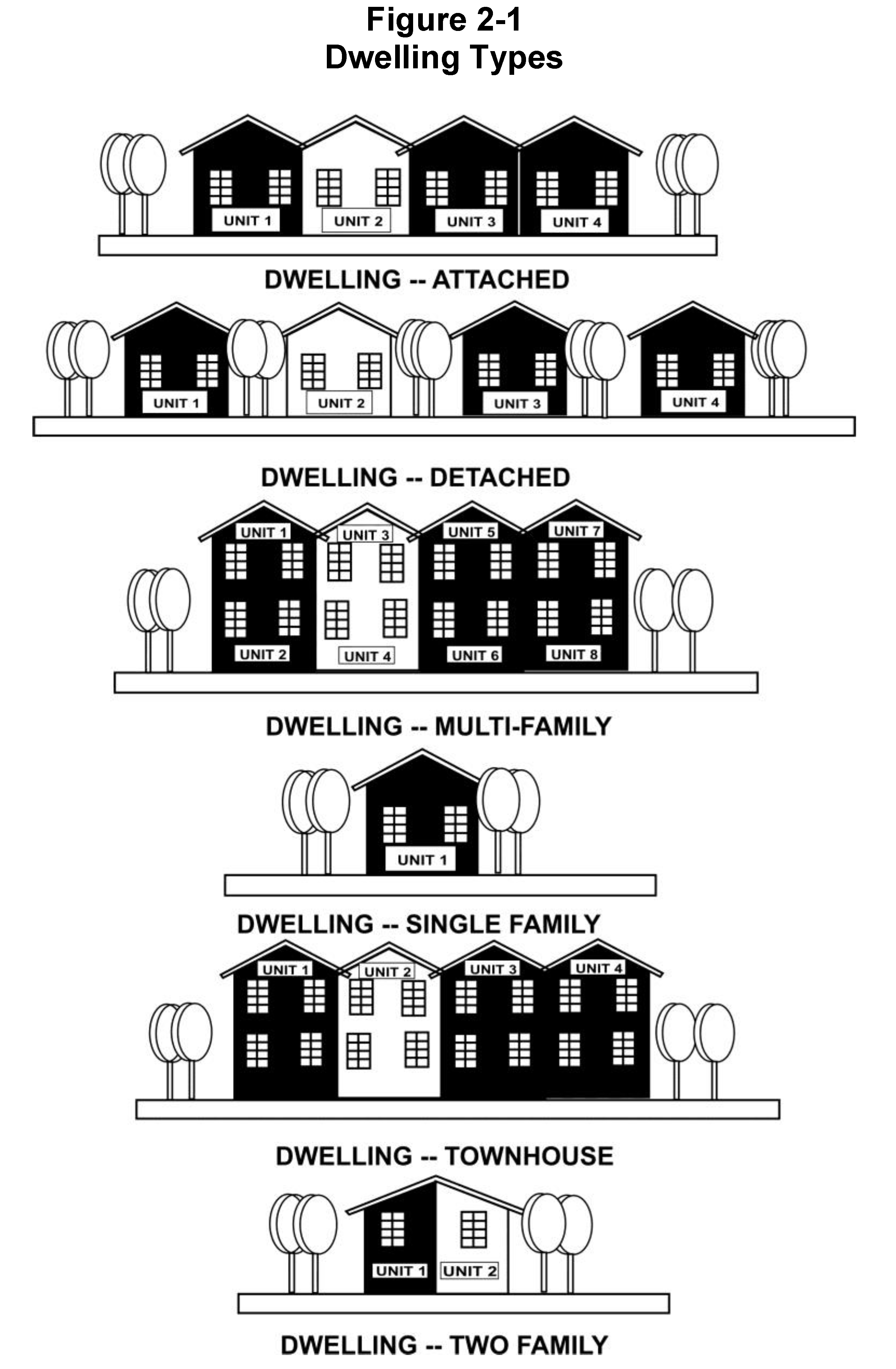
Attached dwelling means a one-family dwelling attached to two (2) or more one-family dwellings by common vertical walls. A townhouse is an attached dwelling. See Figure 2-1.
Attic means that part of a building that is immediately below and wholly or partly within the roof framing.
Authorized use means any use allowed in a zoning district and subject to the regulations applicable to that zoning district; includes conditional uses, permitted uses, and special uses.
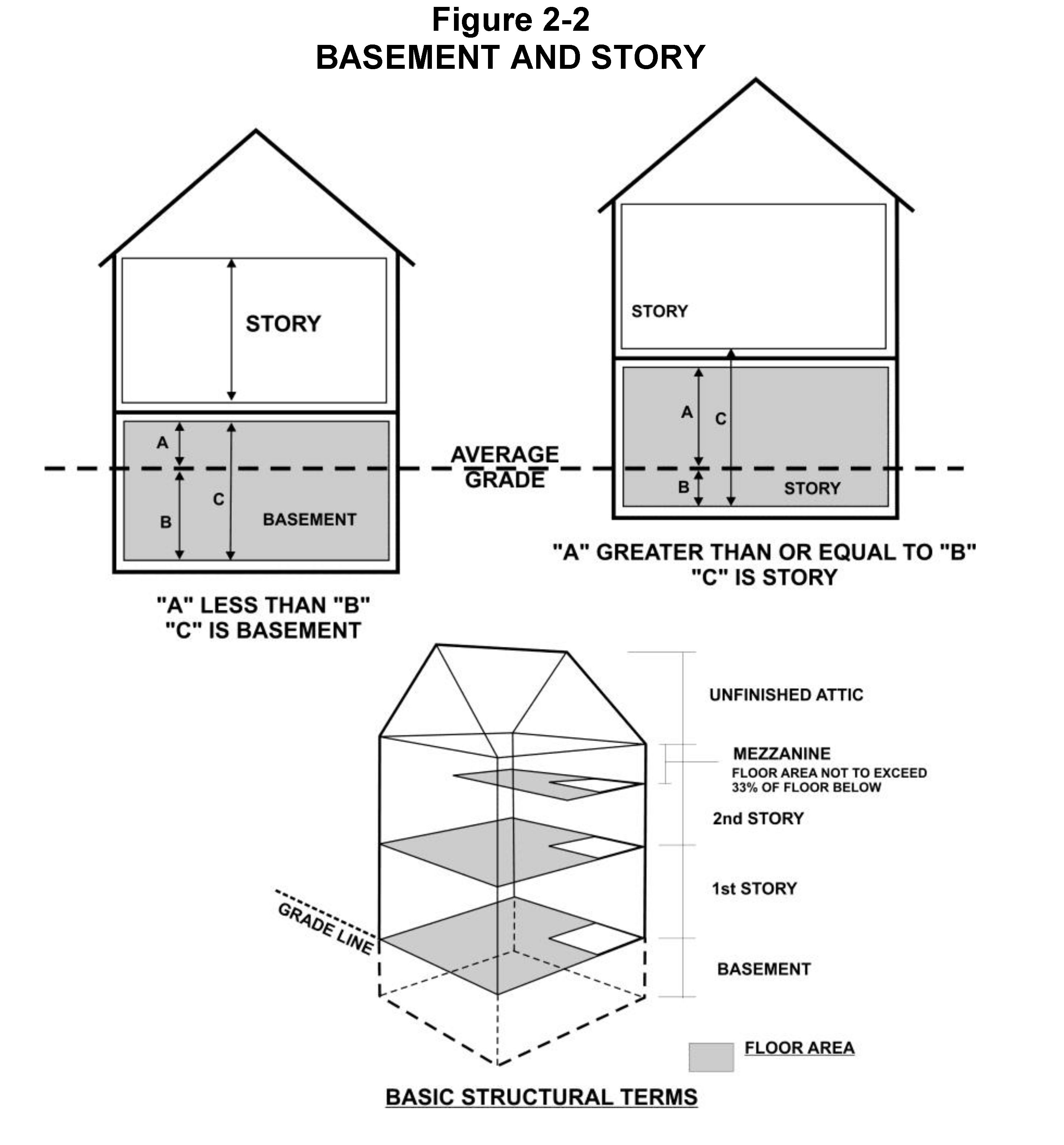
Basement means that portion of a building which is partly or wholly below finished grade, but so located that the vertical distance from the average grade to the floor is greater than the vertical distance from the average grade to the ceiling. A basement shall not be counted as a story (see Figure 2-2). A cellar is a basement. See also definition of "story." However, any walk-out basement, regardless of average grade, shall be considered a story.
Bed and breakfast means a commercial use which is subordinate to the principal use of a building as a single-family dwelling unit, and in which transient guests are provided a sleeping room in return for remuneration. Meals also may be provided.
Berm means a mound of earth graded, shaped and improved with landscaping in such a fashion as to be used for visual and/or audible screening purposes to provide a transition between uses of differing intensity.
Boarding house means a structure in which furnished rooms, or apartments, are let to lodgers on a temporary basis.
Buffer strip means a strip of land reserved for plant material, berms, walls, or fencing to serve as a visual and/or sound barrier between properties, often between abutting properties and properties in different zoning districts.
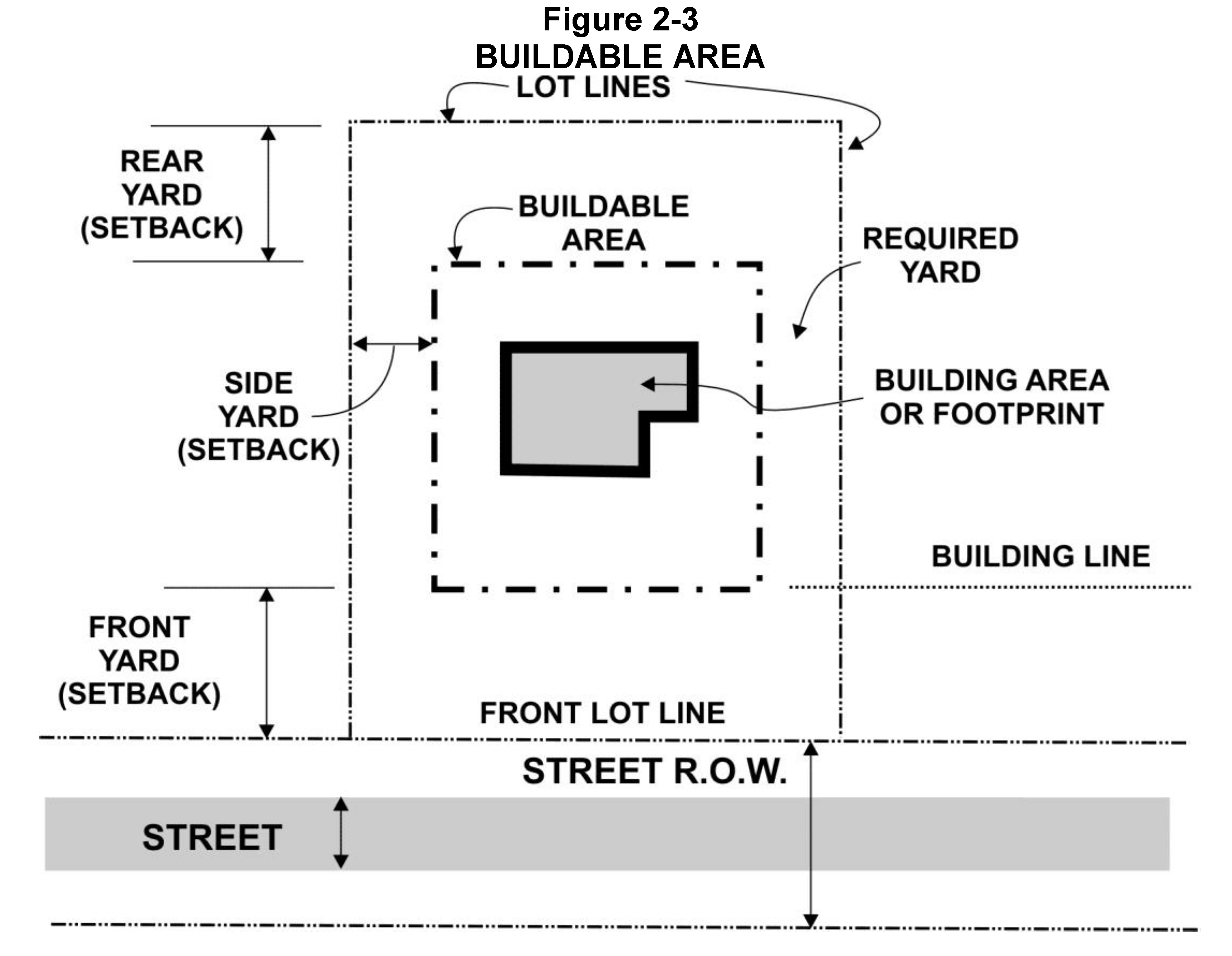
Buildable area means the portion of a lot remaining after the minimum yard and setback requirements of this ordinance have been met. See Figure 2-3.
Building means any structure, either temporary or permanent, having a fixed location and a roof supported by columns, walls or other supports, and used or built for the shelter or enclosure of persons, animals, or property of any kind or for the conduct of business. This shall include, but is not limited to, awnings, mobile homes, inflatable structures, fabric or membrane structures, sheds, garages, greenhouses and other similar structures. It shall also include trucks, vans, recreational vehicles or other vehicles or parts of vehicles situated on private property, and used for the purposes of a building, whether or not mounted on wheels.
Building area or building footprint means the total horizontal area of the largest story of the principal building and all accessory buildings, exclusive of uncovered porches, terraces, patios and steps.
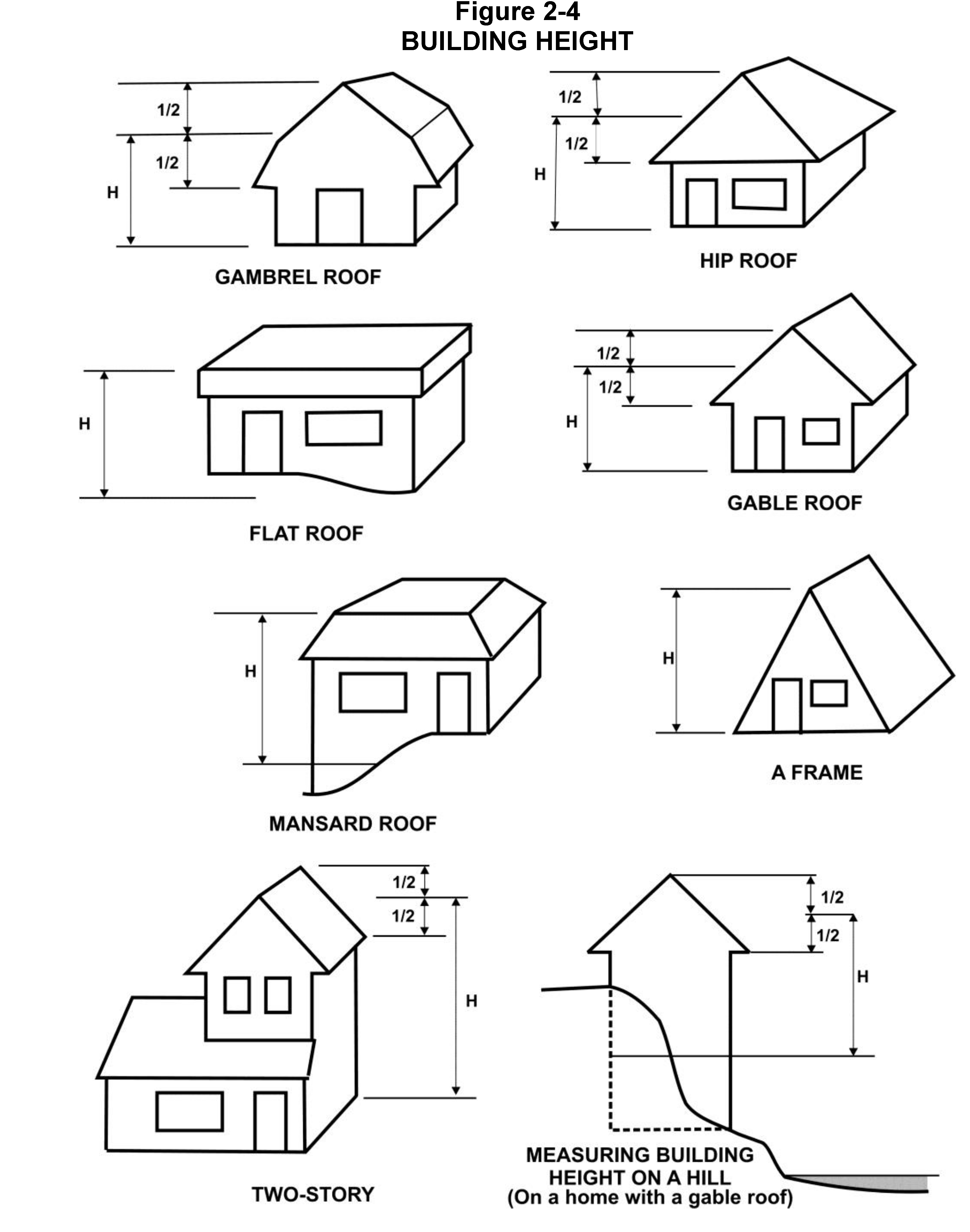
Building height means the vertical distance measured from the average grade to the highest point of the roof surface for flat roofs and A-frames, to the deck line of mansard roofs, and to the average height between the highest eave and the highest ridge for gable, hip and gambrel roofs (see Figure 2-4). A cupola, widow's watch, tower or parapet wall that extends above the roof line shall be considered the highest point of the roof surface on roofs with such features. See also Section 3.25 concerning building grades.
Building line means a line parallel to a front, side or rear lot line, established for the purpose of prohibiting the erection of a structure between such line and the corresponding lot line. See Figure 2-3.
Building, principal means a building in which the principal use of a lot is conducted.
Carport means a structure, open on two or more sides, intended to shelter one or more vehicles. Such structures shall comply with all setback requirements applicable to garages.
Change of use means a use of a building, structure or parcel of land, or portion thereof which differs from the previous use in the way it is classified in this ordinance.
Church means a building wherein persons regularly assemble for religious worship and which is maintained and controlled by a religious body organized to sustain public worship, together with all accessory buildings and uses customarily associated with such primary purpose.
Clear vision area means corner areas at intersecting streets, alleys and driveways in which unobstructed vision of motor vehicle operators is maintained.
Code of ordinances means the Code of Ordinances of the City of St. Joseph.
Communication tower means a structure including, but not limited to, monopole, skeleton framework, or other design which is attached directly to the ground or to another structure which supports one or more antennae, used for the transmission or reception of radio, television, microwave, or any other form of telecommunications signals. Antennae permitted as an accessory use under Article IV of this ordinance are excluded. See "public safety communication tower."
Community care facilities for the elderly means establishments primarily engaged in providing residential and personal care services for (1) the elderly and other persons who are unable to fully care for themselves and/or (2) the elderly and other persons who do not desire to live independently. The care typically includes room, board, supervision, and assistance in daily living, such as housekeeping services. In some instances these establishments provide skilled nursing care for residents in separate on-site facilities.
Comprehensive plan means the municipal plan adopted by the city commission pursuant to Public Act 285 of 1931, including text, maps and graphic proposals indicating the general location for streets, parks, schools, public buildings, and all physical development of the city, the relationship of land uses to one another, and includes any unit or part of such plan, and any amendment to such plan or parts thereof.
Conditional use means a use not essentially incompatible with uses permitted in a zoning district, but which possesses characteristics which require individual review in order to avoid incompatibility with the character of the surrounding area, public services and facilities, and adjacent uses of land. A conditional use is allowed by right in a particular district, provided that the use complies with the nondiscretionary standards of Article XI of this ordinance.
Condominium project means a plan or project including not less than two condominium units established and approved in conformance with the Condominium Act (Act 59 of the Public Acts of 1978).
Condominium subdivision means a division of land on the basis of condominium ownership, pursuant to the Condominium Act and which is not subject to the provisions of the Subdivision Control Act of 1967, Public Act 288 of 1967, as amended.
Condominium subdivision plan means the drawings attached to the master deed for a condominium subdivision which describe the size, location, area, horizontal and vertical boundaries and volume of each condominium unit contained in the condominium subdivision, as well as the nature, location and size of common elements.
Condominium unit means that portion of a condominium project or condominium subdivision which is designed and intended for separate ownership and use, as described in the master deed, regardless of whether it is intended for residential, office, industrial, business, recreational, use as a time-share unit, or any other type of use. The owner of a condominium unit also owns a share of the common elements. The term "condominium unit" shall be equivalent to the term "lot" for purposes of determining compliance of the site condominium subdivision with the provisions of this ordinance pertaining to minimum lot size, minimum lot width, and maximum lot coverage.
Congregate facility means a facility which provides adult foster care for more than 20 adults of which not more than six can be of age 65 or older with the condition that each living unit does not exceed 20 individuals and requires functional grouping of residents.
Day care center (child care center) means a facility, not located in private home, licensed by the State of Michigan, receiving one or more preschool or school age children for care for periods of less than 24 hours a day, and where the parents or guardians are not immediately available to the child. Child care center or day care center includes a facility which provides care for not less than two consecutive weeks, regardless of the number of hours of care per day. The facility is generally described as a child care center, day care center, day nursery, nursery school, parent cooperative preschool, play group, or drop-in center. Child care center or day care center does not include any of the following:
A.
A Sunday school, a vacation bible school, or a religious instructional class that is conducted by a religious organization where children are in attendance for not greater than three hours per day for an indefinite period, or not greater than eight hours per day for a period not to exceed four weeks during a 12-month period.
B.
A facility operated by a religious organization where children are cared for while persons responsible for the children are on the premises.
Day care (family, home) means a licensed day care center as an accessory use in a private home in which at least one but less than seven minor children are received for care and supervision for periods of less than 24 hours a day, unattended by a parent or legal guardian, except children related to an adult member of the family by blood, marriage, or adoption. Family day care home includes a home that gives care to an unrelated minor child for more than four weeks during a calendar year.
Day care (group, home) or day nursery means as defined in PA 116 of 1973, MCL 722.111, a "group day care home" means a licensed day care center in a private home as an accessory use in which more than six but not more than 12 minor children are given care and supervision for periods of less than 24 hours a day unattended by a parent or legal guardian, except children related to an adult member of the family by blood, marriage, or adoption. Group day care home includes a home that gives care to an unrelated minor child for more than four weeks during a calendar year.
Day care (private, home) means a private residence in which a day care center operator licensed by the State of Michigan permanently resides as a member of the household, which residency shall not be contingent upon caring for children or employment by a licensed or approved child placing agency. Private home includes a full-time foster family home, a full-time foster family group home, a group day care home, or a family day care home.
Deck means an unroofed structure used for outdoor living purposes which may or may not be attached to a building and which is more than six inches above the finished grade.
Deed restriction means a restriction on the use of a lot or parcel of land that is set forth in the deed and recorded with the county register of deeds. It is binding on subsequent owners and is sometimes also known as a restrictive covenant. Unless the city has a legal interest in the property or in the deed restriction, the city shall not consider a deed restriction when making zoning decisions under this ordinance.
Demolition means the partial or complete disassembly or removal of a building, structure or other feature, when that disassembly or removal is not dismantlement under this ordinance.
Detached dwelling means a dwelling that is not attached to any other dwelling by any means. See Figure 2-1.
Dismantlement means the partial disassembly or removal of a building, structure or other feature in conjunction with and directly associated with specific remodeling, repair, maintenance or replacement work otherwise allowed under this ordinance and which is being conducted in accordance with all city ordinances. Dismantlement must be conducted in a timeframe reasonably associated with such work, and will be reclassified as demolition if it ceases to be associated with such work. Work classified as "demolition" under other city codes or ordinances may be either dismantlement or demolition under this ordinance.
District (or zone) means a portion of the incorporated area of the city within which certain regulations and requirements, or various combinations thereof, apply under the provisions of this ordinance.
Driveway means a means of access for vehicles from a street or alley to a parking or loading area, garage, dwelling or other structure or area.
Dwelling, single-family means a detached residential building containing only one dwelling unit.
Dwelling, two-family means a detached residential building containing two dwelling units.
Dwelling, multiple-family means a residential building containing three or more dwelling units.
Dwelling unit means a room or rooms connected together, constituting a separate, independent housekeeping establishment for one family occupancy, physically separated from any other dwelling units in the same structure, and containing independent cooking, bathroom, and sleeping facilities.
ECHO housing or ECHO unit means an elder cottage housing opportunity which is a temporary accessory use that permits residents and caregivers to occupy two dwelling units on a single-family residential zoned lot. See Article XI.
Family means an individual or two or more persons related by blood, marriage, or adoption, and/or a group not to exceed six persons, whether or not related by blood or marriage, occupying premises and living as a single nonprofit housekeeping unit with single culinary facilities as distinguished from a group occupying a boarding house, lodging house, club, fraternity, hotel or similar dwelling for group use. Domestic servants residing on the premises shall be considered as part of the family.
Fence means a free-standing unroofed structure erected in such a manner and in such a location as to a enclose, secure, partially enclose or secure, provide privacy for, or mark a boundary for all or any part of a lot, and including any gates appurtenant to that fence. A fence may be of open or solid construction, and includes free-standing walls. A living fence, planter box, or retaining wall is not a fence.
Living fence means a grouping of plants including, but not limited to, hedges, shrubs, bushes, or trees, arranged and/or growing in such a manner as to enclose, secure, partially enclose or secure, provide privacy or mark a boundary for all or any part of a lot.
Protective measures fence means a fence meeting the requirements of a protective measures fence as described in Chapter 12 of the Code of Ordinances.
Floor living area means for the purpose of computing the minimum allowable floor area in a residential dwelling unit, the sum of the horizontal areas of each story of a building shall be measured from the exterior faces of the exterior walls. The floor area measurement is exclusive of areas of basements, unfinished attics, attached garages, or space used for off-street parking, breezeways, and enclosed and unenclosed porches, elevators, or common stair bulkheads, common hall areas, and accessory structures.
Footprint, building. See "building area."
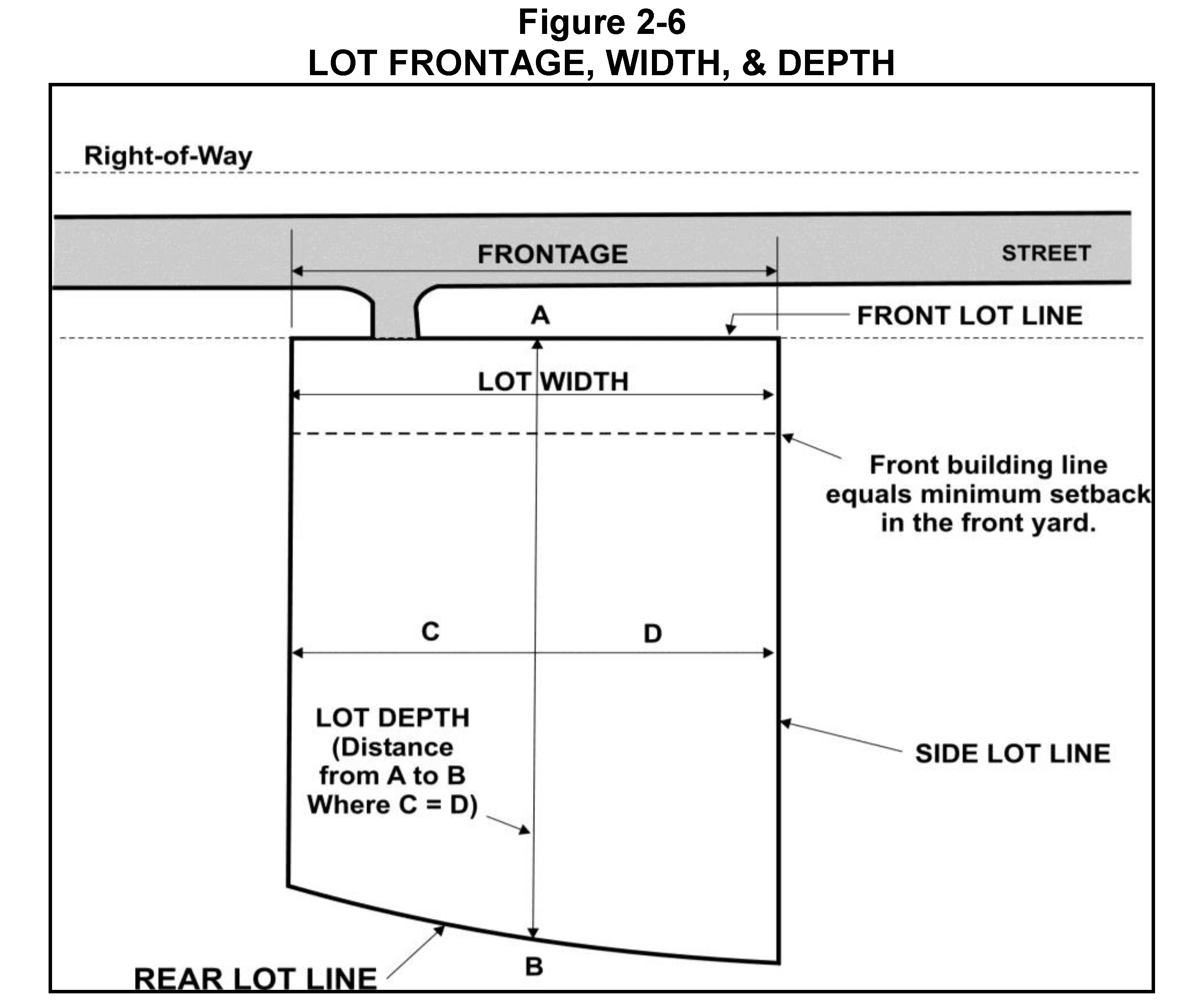
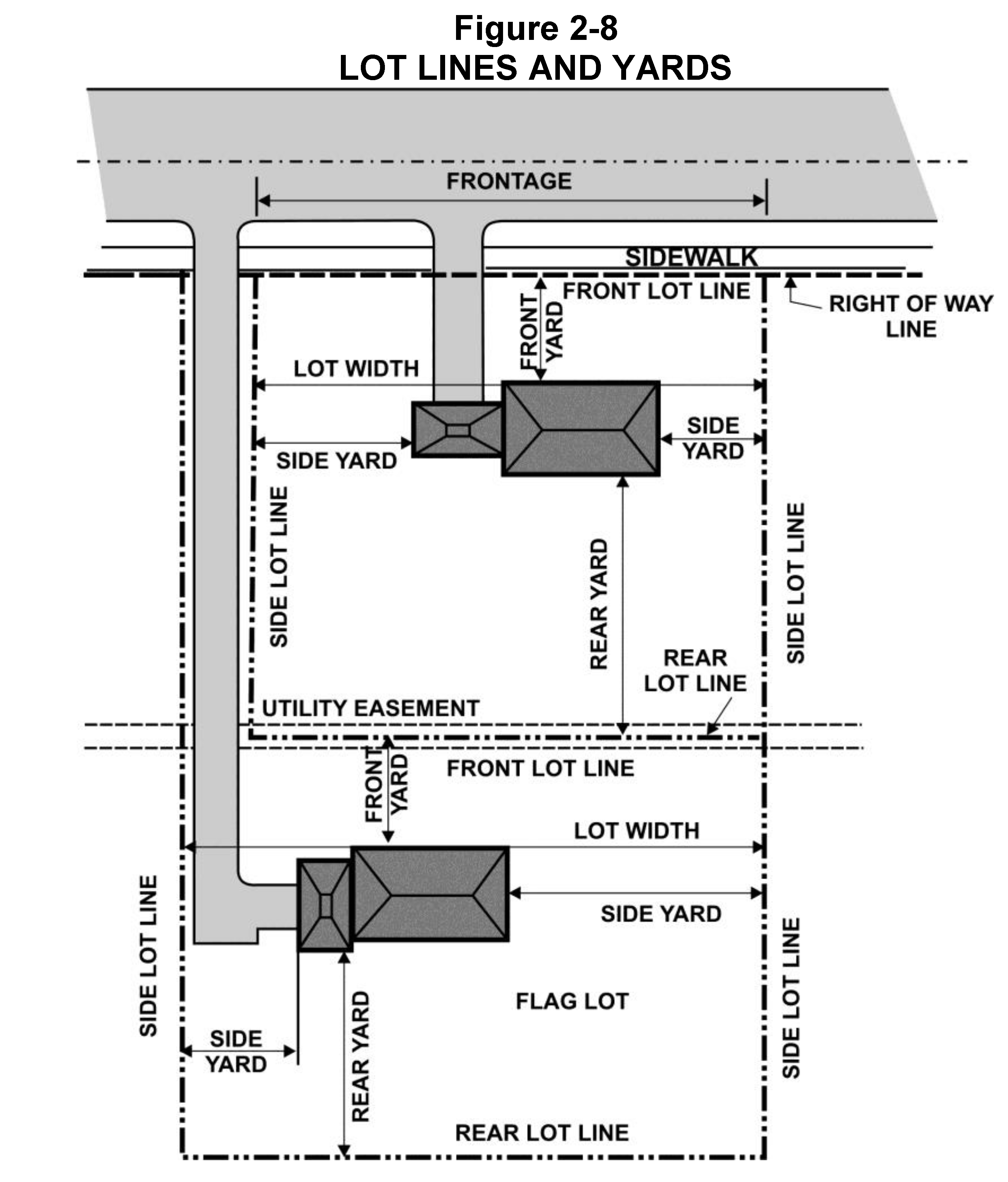
Frontage means the total continuous length of the front lot line. (See Figures 2-6 and 2-8).
Grade, average means the arithmetic average of the lowest and highest grade elevations in an area within six feet of the foundation line of a building or structure not including window wells or required basement egress (see Figure 2-5).
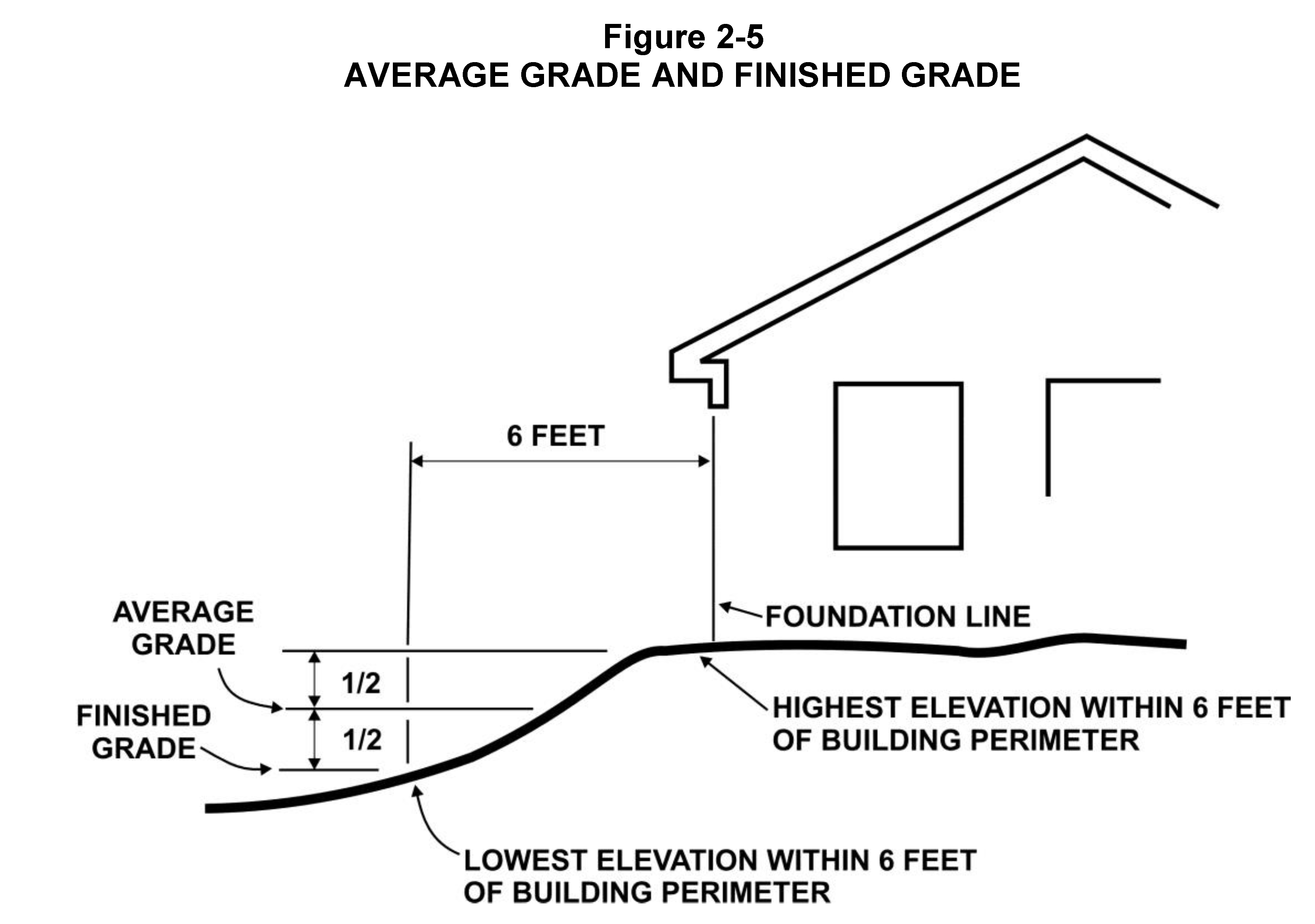
Grade, finished means the lowest point of elevation between the exterior wall of the structure and a line six feet from the exterior wall of the structure, not including window wells or required basement egress. See Figure 2-5.
Grade, natural means the elevation of the ground surface in its natural state, before man-made alterations.
Group home means a facility which provides adult foster care for more than six, but not more than 20 adults.
Hazardous substance:
A.
A chemical or other material which is or may become injurious to the public health, safety, or welfare or to the environment.
B.
"Hazardous substance" as defined in the Comprehensive Environmental Response, Compensation and Liability Act of 1980, as amended, Public Law 96-510, 94 Stat. 2767.
C.
"Hazardous waste" as defined in the Natural Resources and Environmental Protection Act of 1994, as amended, MCL 324.11103.
D.
"Petroleum" as defined in the Natural Resources and Environmental Protection Act of 1994, as amended, MCL 324.21303(d)(ii).
Home occupation means a commercial activity, whether for profit or otherwise, carried on by an occupant of a dwelling unit as a secondary use which is clearly subordinate and incidental to the use of the dwelling unit as a residence and is an accessory use under this ordinance. In the event an occupant telecommutes, "works from home" or otherwise works in or from their dwelling unit but has no visitors or deliveries related to this activity, no non-resident employees, no outward signs that there is commercial activity on the premises, and does not include any use prohibited as a home occupation under this ordinance, this activity is not considered a home occupation but is instead considered part of the residential use.
Improvements means those features and actions associated with a project which are considered necessary by the body or official granting zoning approval, to protect natural resources, or the health, safety, and welfare of the residents of the city and future users or inhabitants of the proposed project area, including, but not limited to, roadways, lighting, utilities, sidewalks, screening, drainage, parking areas, and landscaping.
Kennel, commercial means any lot or premise on which three or more dogs, cats, or other household pets, are confined or kept for sale, breeding, or training purposes for remuneration.
Landscaping means the improvements made to a lot outside of the principal building(s) typically of landscape materials consisting of either hardscape or softscape elements. It does not include a driveway or parking area.
Hardscape elements means the improvements to a lot with landscape materials such as paved patio areas, planter boxes, retaining walls, stairs not required for egress, walkways, and any other landscaping made up of hard wearing materials such as wood, stone, and concrete.
Softscape elements means the improvements to a lot with horticultural elements such as flowering plants, grass, shrubs, trees, and other vegetation. Softscape elements may include earthen berms, and other natural objects.
Lot or parcel means land described in a recorded plat or by metes and bounds description, including a condominium unit in a condominium subdivision, occupied or to be occupied by a building, structure, land use or group of buildings having sufficient size to comply with the frontage, area, width-to-depth ratio, setbacks, yards, coverage and buildable area requirements of this ordinance, and having its principal frontage upon a public street or on an approved private road or approved access easement. Such lot may consist of a) a single lot of record; b) a portion of a lot of record; c) a combination of contiguous lots of record or portions of contiguous lots of record; or d) a parcel of land described by metes and bounds.
Lot area means the area contained within the lot lines or property boundary. In the case of a flag lot, the lot area does not include any portion of the lot located between the main roadway and the front lot line.
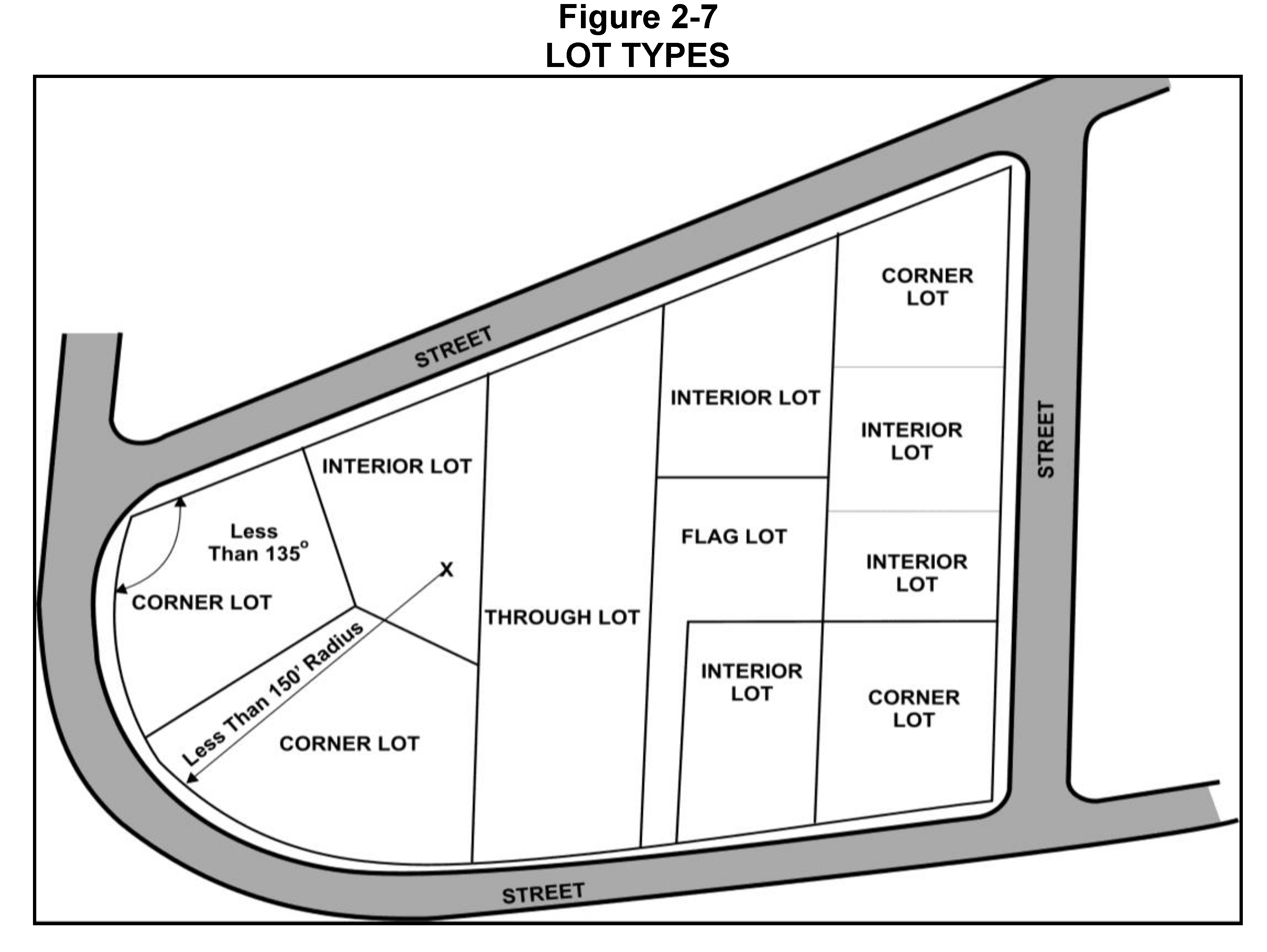
Lot, corner means a lot where the interior angle of two adjacent sides at the intersection of two streets is less than 135 degrees. A lot abutting upon a curved street or streets shall be considered a corner lot for the purposes of this ordinance if the arc is of less radius than 150 feet and the tangents to the curve, at the two points where the lot lines meet the curve or the straight street line extended, form an interior angle of less than 135 degrees (see Figure 2-6).
Lot coverage means the amount of a lot, stated in terms of percentage, that is covered by all buildings and/or structures located thereon. This shall include all buildings and roofed (whether a partial roof, such as a pergola or trellis, or a full roof) structures such as porches, arbors, and breezeways, and open, unenclosed, and uncovered porches or decks six inches or more above finished grade. Lot coverage shall not include fences, walls, planter boxes, retaining walls, or swimming pools, or uncovered parking lots. Lot coverage shall be measured from the drip line of the roof or from the wall or foundation if there is no projecting portion of the roof.
Lot, depth of means the horizontal distance between the front and rear lot lines, measured along the median between the side lot lines. (See Figure 2-6).
Lot, flag means a lot whose access to the main roadway is by an easement across another property or by a portion of the lot that does not meet the requirements of this ordinance to permit building including lot width, setbacks, lot area and buildable area. See Figures 2-7 and 2-8.
Lot, interior means any lot other than a corner lot which has only one lot line fronting on a street. for this purpose, an alley is not considered a street unless the lot has no lot line fronting on a street. See Figure 2-7.
Lot line:
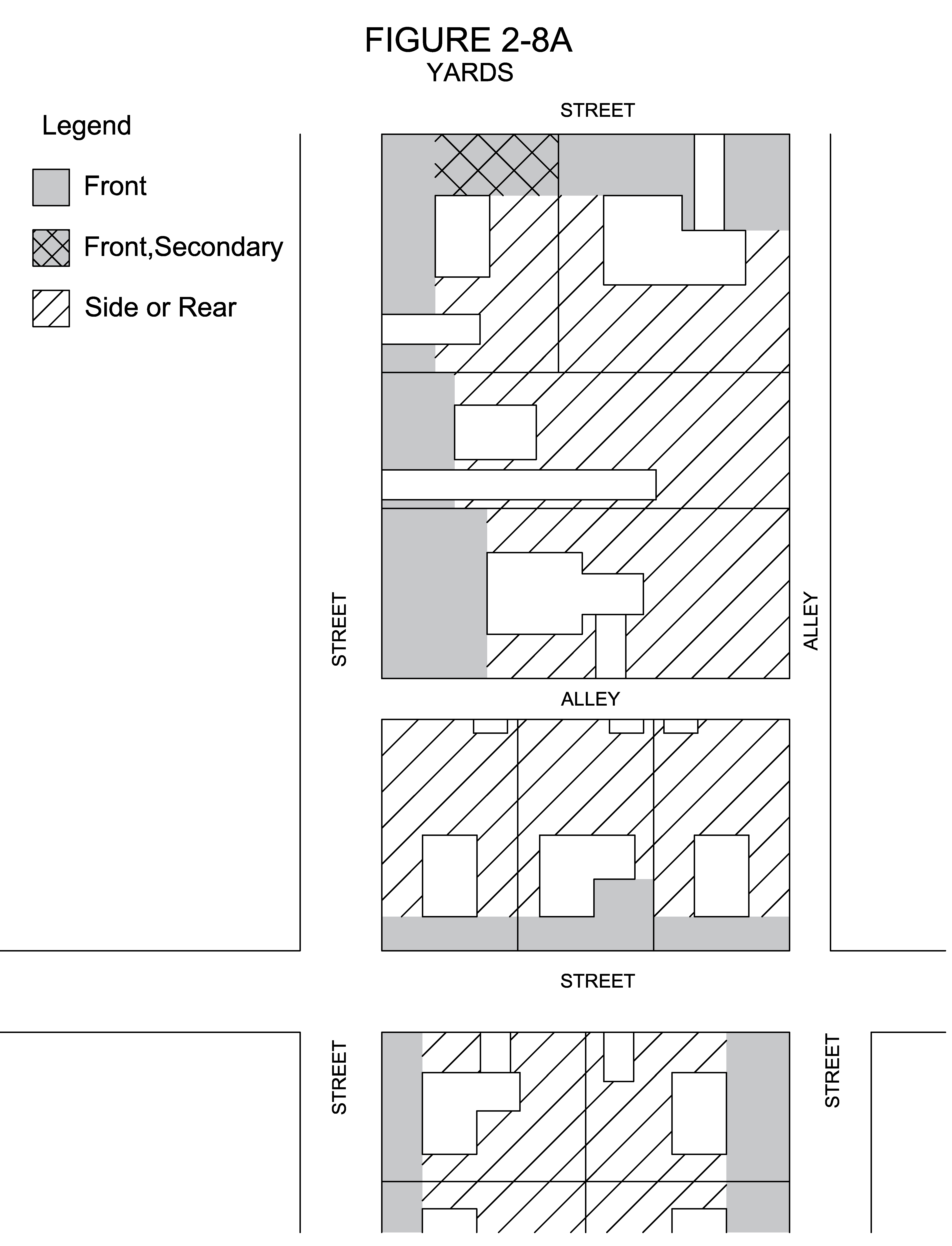
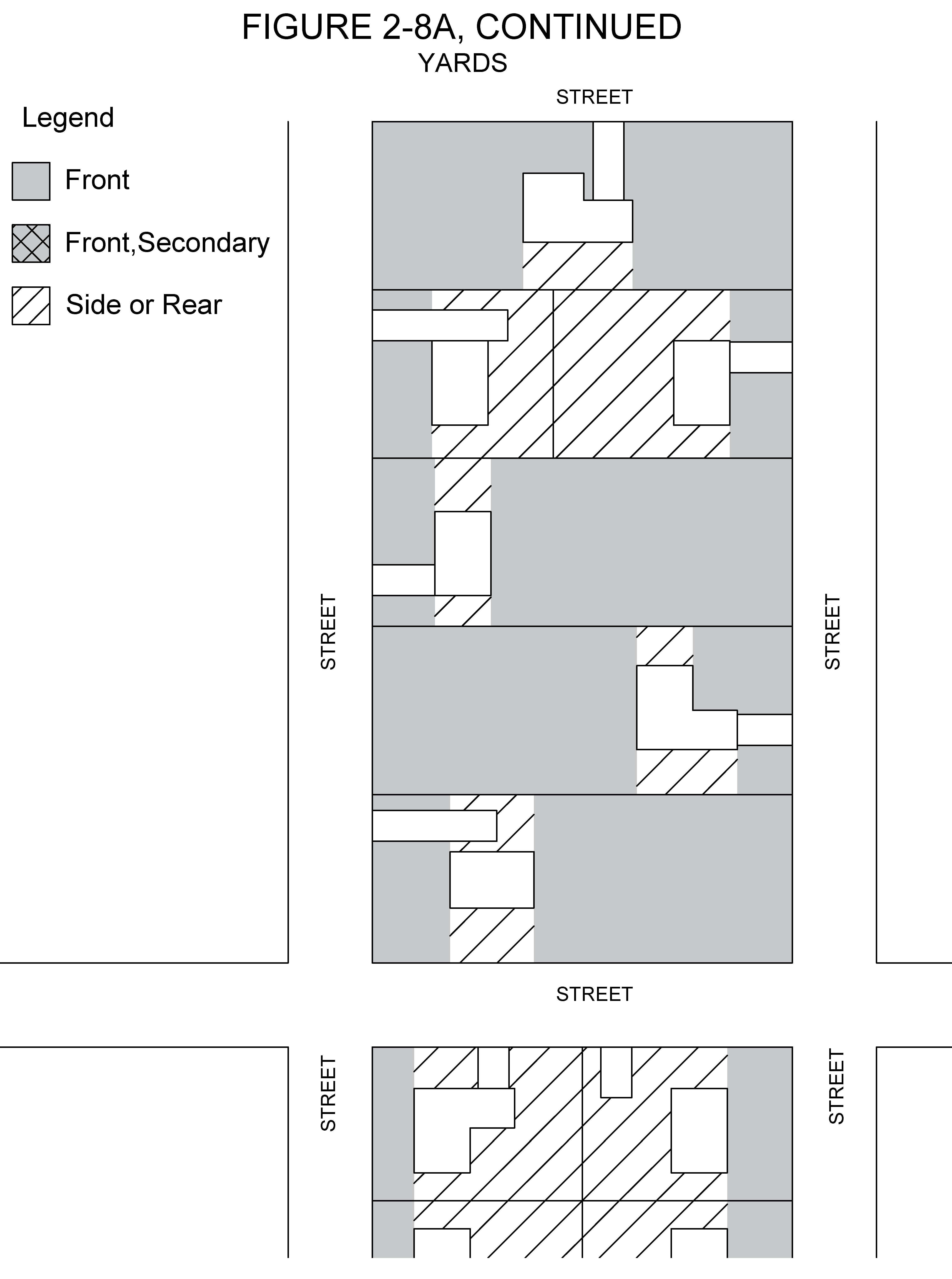
Front means, in the case of an interior lot, the line separating that lot from the street, a private road, or other access easement. In the case of a corner lot or through lot, the line separating that lot from either the street, a private road, or other access easement, and bearing the assigned street address for that lot. See Figures 2-6, 2-8, and 2-8A.
In the case of a flag lot, the line parallel and nearest to the main roadway such that the resulting lot meets the requirements of this ordinance including lot width, setbacks, lot area and buildable area; flag lot's front lot line is often the rear lot line of an adjacent lot located between the flag lot and the main roadway. See Figure 2-8.
Front, secondary means in the case of a corner lot where adjacent property fronts on the corner lot's side street, the line separating the corner lot from the side street upon which an adjacent property fronts. Also referred to as secondary front. See Figure 2-8A.
Rear means the line opposite the front lot line. In the case of a Through Lot, the line which is opposite the street address. In the case of a triangular or otherwise irregularly shaped lot or parcel, or a corner lot which is not bounded entirely by front, side, and side street lot lines, an imaginary line at least ten feet in length entirely within the lot, parallel to and at a maximum distance from the front lot line. (See Figures 2-6 and 2-8). In the case of a corner lot having a secondary front, there is no rear lot line; any remaining yard is a side yard.
Side means any lot line other than the front lot line, secondary front lot line, or rear lot line. (See Figures 2-6, 2-8, and 2-8A). In the case of a corner lot, any lot line which also serves as the side lot line for an adjacent lot shall be considered a side lot line.
Side street means a side lot line separating a lot from a street.
Lot of record means a lot which is part of a subdivision, the map of which was recorded in the Office of the Register of Deeds in Berrien County on or before July 17, 1987; or, a lot described by metes and bounds, the deed, survey or land contract, or land contract memoranda, which had been recorded in the Office of the Register of Deeds in Berrien County on or before July 17, 1987; or, a lot created since July 17, 1987 which at the time of creation met all of the retirements of the then-current city zoning ordinance.
Lot, through means a lot which is not a corner lot, and with frontage on two or more streets. For this purpose, an alley is not considered a street. On a through lot, all street lines shall be deemed front lot lines for setback purposes.
Lot, type:
Lot, corner means a lot where the interior angle of two adjacent sides at the intersection of two streets is less than 135 degrees. A lot abutting upon a curved street or streets shall be considered a corner lot for the purposes of this ordinance if the arc is of less radius than 150 feet and the tangents to the curve, at the two points where the lot lines meet the curve or the straight street line extended, form an interior angle of less than 135 degrees (See Figure 2-6). If such lot abuts three or more streets, it shall be considered a through lot for purposes of this ordinance. See Figure 2-8A.
Lot, flag means a lot whose access to the main roadway is by an easement across another property or by a portion of the lot that does not meet the requirements of this ordinance to permit building including lot width, setbacks, lot area and buildable area. See Figures 2-7 and 2-8.
Lot, interior means any lot other than a corner lot which has only one lot line fronting on a street. For this purpose, an alley is not considered a street unless the lot has no lot line fronting on a street. See Figure 2-7.
Lot, through means a lot which is not a corner lot, and with frontage on two or more streets. For this purpose, an alley is not considered a street. On a through lot, all street lines shall be deemed front lot lines for setback purposes.
Lot, width of means the horizontal straight line distance between the side lot lines, measured between the two points where the line establishing the setback for the front yard (also known as the front building line) intersects the side lot lines. (See Figures 2-6 and 2-8.)
Marina means a boat basin with facilities for berthing and securing recreational craft, which may also provide supplies, provisions, service and fueling facilities, and repair and storage of boats.
Marine terminal means a dock, pier, landing, structure or property which provides access from land to a water-based business.
Master deed means the document recorded as part of a condominium subdivision to which are attached as exhibits and incorporated by reference the approved bylaws for the condominium subdivision and the condominium subdivision plan.
Mechanical equipment means a system or part of a system installed outside of a structure and utilized to provide control of environmental conditions and related process within a structure. Equipment can include air conditioning units, emergency generators, heat pumps, ductless heat pump (mini-splits), water pumps or other similar things.
Mezzanine means an intermediate floor in any story occupying not to exceed one-third of the floor area of such story. See Figure 2-2.
Mobile home means a structure, transportable in one or more sections, which is built on a chassis and designed to be used as a dwelling with or without permanent foundation, when connected to the required utilities, and includes the plumbing, heating, air conditioning, and electrical systems contained in the structure. Mobile home does not include a recreational vehicle.
Nonconforming building means a building lawfully existing on the effective date of this ordinance or subsequent amendment, and which does not conform to the requirements of this ordinance.
Nonconforming lot means any lot of record which at the time it was recorded fully complied with all applicable laws and ordinances, but which does not fully comply with the dimensional or proportional lot requirements of this ordinance or subsequent amendment.
Nonconforming structure means any structure other than a sign, lawfully existing on the effective date of this ordinance or subsequent amendment and which fails to meet the requirements of this ordinance.
Nonconforming use means an activity using land, buildings and/or structures for purposes which were lawfully established prior to the effective date of this ordinance or subsequent amendment and that fails to meet the requirements of this ordinance, or which was established as a limited neighborhood business under the terms of this ordinance and which would fail to meet the requirements of this ordinance if not classified as a limited neighborhood business.
Nonconformity means any nonconforming use, nonconforming building, nonconforming structure or nonconforming lot as defined in this ordinance.
Nuisance means any act, thing, condition, land, building or premises which annoys, injures or endangers the public health, safety, comfort, offends public decency, or in any way renders the public insecure in life or property. A nuisance also includes any of the activities forbidden by Chapter 18 of the Code of Ordinances of the City of St. Joseph, Michigan.
Nursery means a space, building or structure, or combination thereof, for the storage of live trees, shrubs or plants offered for retail sale on the premises, including products used for gardening or landscaping. The definition of nursery within the meaning of this ordinance does not include any space, building or structure used for the sale of fruits, vegetables or Christmas trees.
Nursing care facilities means establishments primarily engaged in providing inpatient nursing and rehabilitative services. The care is generally provided for an extended period of time to individuals requiring nursing care. These establishments have a permanent core staff of registered or licensed practical nurses who, along with other staff, provide nursing and continuous personal care services.
Off-street parking lot means a facility providing vehicular parking spaces, along with adequate drives and aisles for maneuvering, so as to provide access for entrance and exit for the parking of more than three vehicles.
Ordinary high water mark means for shoreland areas adjacent to the St. Joseph River and/or the Paw River, the OHWM is the line between upland and bottomland which persists through successive changes in water levels below which the presence and action of the water is so common or recurrent that the character of the land is marked distinctly from the upland and is apparent in the soil itself, the configuration of the surface of the soil, and the vegetation. For shoreland areas adjacent to Lake Michigan, pursuant to the Natural Resources and Environmental Protection Act, Public Act 451 of 1994, Part 325, formerly the Great Lakes Submerged Lands Act, P.A. 247 of 1955, as amended, the OHWM is 580.5 feet above sea level, International Great Lakes Datum of 1985. The OHWM shall be considered to be the lot line where present on a parcel.
Owner means the owner of the premises or lesser estate in the premises, a mortgagee or vendee in possession, an assignee of rents, receiver, executor, trustee, lessee, or any other person, sole proprietorship, partnership, limited liability company, association, or corporation directly or indirectly in control of a building, structure, or real property, or his or her duly authorized agent.
Parcel. See "lot."
Park means a parcel of land, building or structure used for recreational purposes including, but not limited to, playgrounds, sport fields, game courts, beaches, trails, picnicking areas, and leisure time activities.
Parking spaces mean an area of definite length and width used for the parking of a motor vehicle. Said area shall be exclusive of drives, aisles or entrances giving access thereto, and shall be fully accessible for the parking of permitted vehicles.
Permitted use means a use allowed by right in a zoning district and subject to the regulations applicable to that zoning district.
Person means an individual, corporation, partnership, limited liability company, association, cooperative, trust, or any other legal entity or combination of legal entities.
Planned unit development means a parcel or lot, developed under single ownership or management as a separate neighborhood or community unit. The development shall be based on an approved site plan which allows flexibility of design not available under normal zoning district requirements. The plan may contain a mixture of housing types, common open space and other land uses as provided in this ordinance.
Planter box means a landscaping feature that is a free-standing uncovered structure constructed of hardscape elements rising above existing ground level to form a border or container for softscape elements. A planter box is either a major or a minor planter box. A planter box may also be referred to as a garden wall or garden bed.
Major planter box means a planter box more than two feet in height up to a maximum of four feet in height when measured from existing grade to the highest point.
Minor planter box means a planter box two feet or less in height when measured from existing grade to the highest point.
Plat means a map of a subdivision of land recorded with the county register of deeds pursuant to Public Act 288 of 1967, or a prior statute.
Porch means a roofed open area, which may be screened, usually attached to or part of and with direct access to or from a building. A porch becomes a room when the enclosed space is heated or air conditioned.
Principal use means the primary or predominant use of any lot or parcel of land.
Private road means a private way or means of approach to provide access to two or more abutting lots, and which is constructed and maintained by the owner or owners and is not dedicated for general public use.
Public safety communication tower means a communication tower owned and operated by a governmental entity and used primarily for public safety and governmental communications, such as police, fire, public safety, and public works uses. Commercial antennae may be placed on a public safety communication tower as an accessory use, but at all times more than 50 percent of the number of antennae on the tower must be dedicated to public safety uses.
Public utility means a person, firm or corporation, municipal department, board or commission, duly authorized to furnish and furnishing under federal, state or municipal regulations to the public means gas, steam, electricity, sewage disposal, communication, telephone, telegraph, transportation, or water.
Ramp means a sloping walkway, roadway or passage used to join and provide a smooth transition between two levels of different elevation, including between land and water at a boat launching site.
Recreational vehicle means a vehicle having its own motor power or a vehicle mounted on or towed by another vehicle, and is primarily designed to provide temporary living quarters for recreational, camping, travel, or seasonal use. It includes a motor home, travel trailer, park model trailer that does not require a special highway movement permit under the Motor Vehicle Code, folding tent trailer mounted on wheels, and a pickup camper.
Repair means the reconstruction or renewal of any part of an existing Building for the purpose of maintenance.
Residence hotel means a building, or part of a building, with a common entrance or entrances, in which rooms are rented primarily for long term occupancy, and in which one or more of the following services are offered means maid service, furnishing of linen, telephone, secretarial or desk service, bellboy service and meals in a common eating area. A residence hotel may include a restaurant, or cocktail lounge, public banquet halls, ballrooms or meeting rooms and recreational facilities.
Resort means a place of typically seasonal entertainment, recreation and/or lodging. Resort lodging, if provided, may include hotels, motels, single or multiple-family residential dwelling units, cottages, campgrounds, bed and breakfasts, or some combination, as regulated by appropriate sections of this ordinance.
Restaurant means a building in which food is prepared and sold for consumption within the building as opposed to a drive-in establishment where food may-be taken outside of the building for consumption either on or off the premises.
Restoration means the reconstruction or replication of an existing building's original architectural features.
Retaining wall means a structure designed to restrain the existing natural grade of land or changes to grade associated with the mass grading of a parcel where the soil slope would not naturally keep due to a steep, near-vertical or vertical slope. A retaining wall is either a major or a minor retaining wall.
Major retaining wall means a retaining wall more than four feet in height when measured from existing grade to the highest point and requires a building permit.
Minor retaining wall means a retaining wall four feet or less in height when measured from existing grade to the highest point.
Right-of-way means a street, alley, or other thoroughfare or easement permanently established for passage of persons, vehicles, or the location of utilities. The right-of-way is delineated by legally established lines or boundaries.
Setback means the distance required to obtain minimum front, side or rear yard open space provisions of this ordinance.
Setback line means a line parallel to and equidistant from the relevant lot line (front, rear, and side) between which no buildings or structures may be erected as prescribed in this ordinance. Together the setback lines define the buildable area of the lot. See Figure 2-3.
Shoreland means the land, water and land beneath the water, which is in close proximity to the shoreline of Lake Michigan, the St. Joseph River, or the Paw River.
Shoreline means that area of shorelands where land and water meet.
Short-term rental means a commercial use which is subordinate to the residential principal use of a dwelling unit, in which a tenant is allowed to lease the dwelling unit for periods of less than one calendar month in return for remuneration and which is not a special event rental. If a tenant leases a dwelling unit for a period of at least one calendar month, this is not a short-term rental, but instead is a residential use. A property authorized for a short-term rental use may also be used for such residential uses, but see 11.8.4 for limitations on such residential use.
Signs means any words, lettering, parts of letters, figures, numerals, phrases, sentences, emblems, devices, designs, trade names or marks, or combinations thereof, by which anything is made known such as the designation of an individual, a firm, an association, a profession, a business, a commodity, or product which are visible from any public way and used as an outdoor display.
Site plan means a plan showing all salient features of a proposed development, so that it may be evaluated in order to determine whether it meets the provisions of this ordinance.
Solar energy system means a system that uses the power of the sun to capture, distribute and/or store energy for on-site consumption of utility power relying on a battery system for storage of power and consists of panels or arrays and racking system.
Array means multiple panels combined to create one system.
Ground-mounted means a solar system consisting of panels installed into the ground with a racking system permitted and inspected by the city and any other applicable entity.
Mechanical snow guard means a device typically installed one foot or so above the edge of a sloped roof to retain snow and ice from falling from one surface to a lower one.
Nameplate capacity means the designed full-load sustained generating output of an energy facility or system.
Net metered means a utility billing practice that credits solar energy system owners for excess energy sent to the grid.
Panel means a device that converts sunlight into electricity by using photovoltaic (PV) cells. The PV cells are made of materials that produce excited electrons when exposed to light. The electrons flow through a circuit and produce direct current (DC) electricity, which can be used to power various devices or be stored in batteries.
Racking system means the designed plates and structural elements to anchor and secure solar panels to a fixed surface either a roof, wall or ground.
Roof mounted means a solar system consisting of solar panels installed directly affixed on a roof of the principal or accessory structure with a racking system permitted and inspected by the city and any other applicable entity.
Solar lamp means a solar energy system lighting system composed of an LED lamp, solar panel, battery, charger controller and all components are self-contained and is commonly used for pathway, entrance or outdoor space lighting and does not require any electrical wiring.
Storage means a system which uses on-site batteries for the storage of excess energy produced by the collection solar rays.
Temporary means an energy generating system that is independent of other power sources, that is structurally independent of any other structure and that produce less than 800 watts of power that will be in place for a period of time greater than 24 hours and less than seven days and utilize the manufactures installed supply connections. It does not include factory-built solar systems, typically mounted on a trailer, that are used for another permitted function such as construction or special event.
Wall mounted means a solar system consisting of solar panels installed directly affixed on wall of the principal or accessory structure with a racking system permitted and inspected by the city and any other applicable entity.
Special event rental means a commercial temporary use which is subordinate to the residential principal use of a dwelling unit and means 1) which is not a short-term rental; and 2) in which a tenant is allowed to lease a dwelling unit or portion of a dwelling unit for a designated period of time of less than one month in return for remuneration; and 3) which is authorized as a special event rental under the standards and procedures established in Chapter 8 of the Code of Ordinances.
Special use means a special use is a use that is not essentially incompatible with the uses permitted in a zoning district, but possesses characteristics which require individual review and discretion in order to avoid incompatibility with the character of the surrounding area, public services and facilities, and adjacent uses of land. A special use is permitted in a particular district only after review by the planning commission and issuance of a permit by the city commission, in accordance with the standards set forth in this ordinance. A special use is referred to as a special land use in the zoning enabling act.
Special use permit means a permit issued to a person or persons intending to undertake the operation of an activity upon land or within a structure specifically permitted as a special use pursuant to standards and procedures established in Article III, General Provisions, and Article XI, Special Use and Conditional Use Regulations.
Story means that part of a building, except a mezzanine, included between the surface of one floor and the surface of the next floor, or if there is no floor above, then the ceiling next above. A basement shall not be counted as a story (see Figure 2-2).
Street means a thoroughfare for vehicular traffic, including all area within the right-of-way.
Structure means anything fabricated, constructed or erected, the Use of which requires fixation or placement in, on or attachment to something having location on the ground including, but not limited to, all buildings, independently supported decks, satellite dishes and free-standing signs; excepting anything lawfully in a public right-of-way including, but not limited to, utility poles, sewage pumping stations, utility manholes, fire hydrants, electric transformers, telephone boxes, and related public facilities and utilities defined as essential public services. A paved, uncovered parking lot is not considered a structure.
Structure height means, for all structures other than buildings, the vertical distance measured from the finished grade to the highest point of the structure. For buildings, see "building height."
Subdivision means the division of a lot, tract, or parcel of land into more lots for the purpose of sale or development, and subject to the requirements of Public Act 288 of 1967, as amended, this ordinance and the requirements of Chapter 27 of the Code of Ordinances of the City of St. Joseph.
Swimming pool means any structure intended for swimming or recreational bathing that is capable of holding water, is located in whole or in part outside of a fully enclosed building, and is not a wading pool under this ordinance. This includes in-ground, above-ground and on-ground swimming pools, hot tubs and spas and any other structures defined as a "swimming pool, outdoor" under the Michigan Residential Code. See also Chapter 28 of the Code of Ordinances.
Temporary use or building means a use, building or structure permitted by procedures established in this ordinance, to exist during a specified period of time.
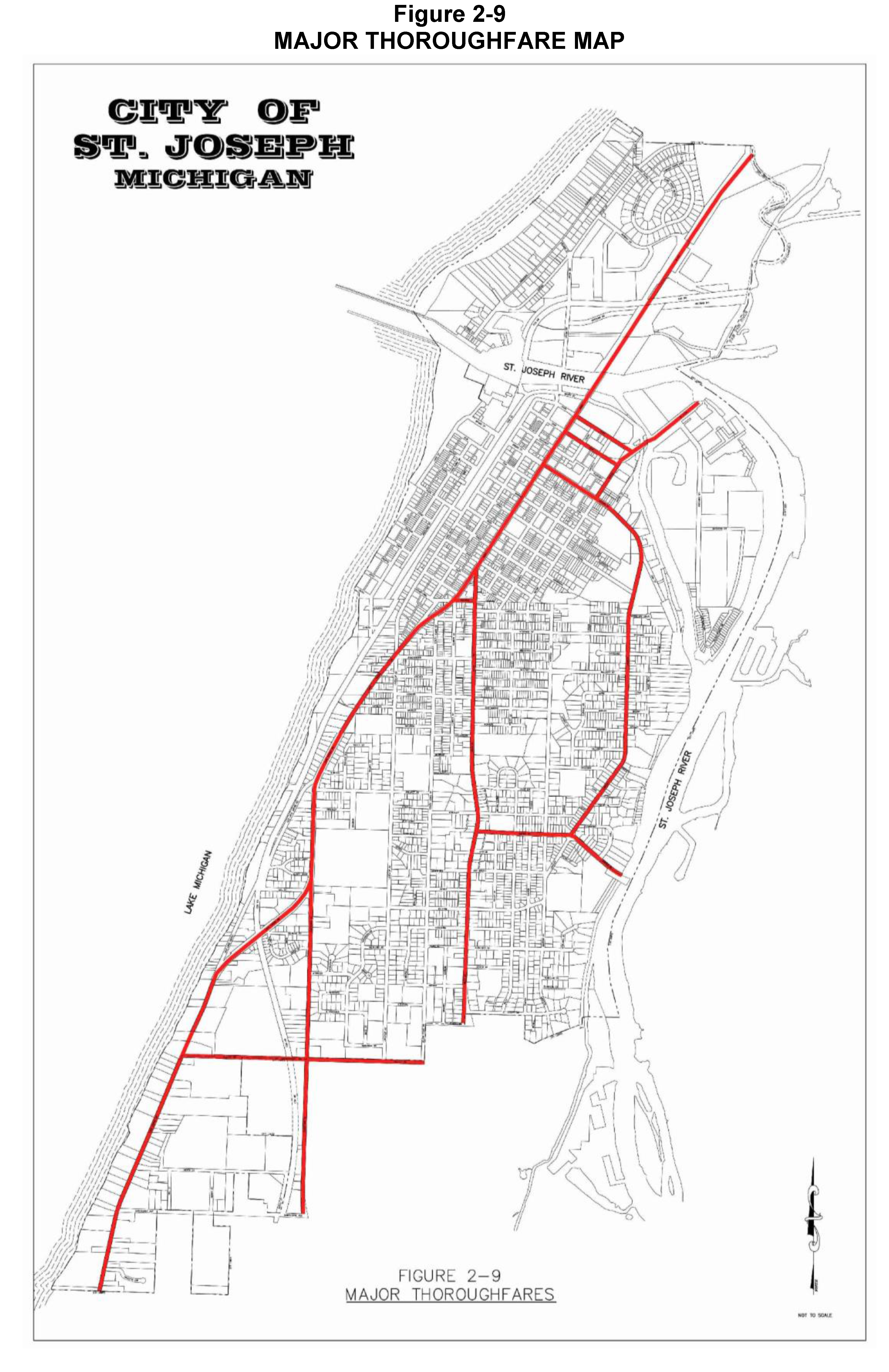
Thoroughfare, major means a public street, the principal use or function of which is to provide an arterial route for through traffic, with its secondary function the provision of access to abutting property, and which is highlighted on the Major Thoroughfare Map, Figure 2-9).
Underground storage tank means a tank or combination of tanks, including underground pipes connected to the tank or tanks, which is, was, or may have been used to contain hazardous substances, and the volume of which, including the volume of the underground pipes connected to the tank or tanks, is ten percent or more beneath the surface of the ground.
Use means the principal purpose for which land or a building is arranged, designed, or intended, or for which land or a building is or may be occupied.
Use, predecessor means, for the purpose of determining whether a proposed use is a limited neighborhood business, the use that is currently on a lot or was the most recent use of the lot.
Use, successor means a limited neighborhood business use which replaced, or is proposed to replace, another limited neighborhood business on a lot under the terms of this ordinance.
Use category. See "use class."
Use class means a grouping of several uses sharing similar characteristics, and treated similarly for the purpose of determining authorized uses for each zoning district.
Use class, ordinary means, for a use that is a limited neighborhood business, the use class to which a use would belong if the use were not a limited neighborhood business.
Variance means a modification of the literal provisions of the zoning ordinance, granted by the zoning board of appeals, when standards established in Article III and Article XV of this ordinance have been met. These standards seek to ensure that no variance is granted unless means (a) strict enforcement of the zoning ordinance would cause practical difficulty or unnecessary hardship, (b) would not be contrary to the public interest, (c) there are circumstances unique to the individual property on which the variance is granted, and (d) the variance request is not due to actions of the applicant.
Wading pool means any self-supporting on-ground prefabricated structure intended for swimming or recreational bathing that is capable of holding water no more than 24 inches deep at any point and is located in whole or in part outside of a fully enclosed building. See also Chapter 28 of the Code of Ordinances.
Water based business means any business in which the proprietor, employee(s) or customer(s) physically board a ship, boat, barge or vessel at a marine terminal, including, but not limited to, dinner boats, charter boats, passenger service, boat tours, watercraft rentals, and commercial fisheries.
Yard means an open space on the same lot with a building, unoccupied and unobstructed by a structure from the ground upward, except as otherwise provided herein. See Figures 2-3, 2-8, and 2-8A.
Front means a yard between any portion of the front exterior wall of a principal building or land use and the front lot line, extending the full width of the lot. The front yard shall not include projections on the side exterior wall of the principal building, including, but not limited to, bay windows, chimneys, or fireplaces.
Front, secondary means, in the case of a corner lot where adjacent property fronts on the corner lot's side street, a yard between the exterior wall of the principal building or land use and the side street upon which the adjacent property fronts, extending to the front lot line and the side lot line of the corner lot. Also referred to as secondary front.
Rear means a yard between any portion of the rear exterior wall of a principal building and the rear lot line, extending the full width of the lot. The rear yard shall not include projections on the side exterior wall of the principal building, including, but not limited to, bay windows, chimneys, or fireplaces.
Side means a yard on the same lot with the building, situated between the exterior wall of the principal building and a side lot line, typically extending from the front yard to the rear yard. Any yard area that is neither a front yard, secondary front yard, or a rear yard.
Zoning administrator means the City of St. Joseph Zoning Administrator hired for the purpose of carrying out certain duties and responsibilities as defined in this ordinance.
Zoning board of appeals means the body appointed by the city commission to hear appeals by any aggrieved party by a decision or order of the zoning administrator, or where it is alleged that the literal enforcement of this ordinance would involve practical difficulties or would cause unnecessary hardship to the property owner.
Zoning permit means a document signed by the zoning administrator according to procedures established in this ordinance, as a condition precedent to the commencement of a use, or the erection, construction, reconstruction, restoration, alteration, conversion, or installation of a structure or building, that indicates that a site plan, and/or other zoning application or request for special zoning approval or variance for a use, structure or building has been reviewed and determined to comply with the requirements of this ordinance or has been granted a variance therefrom, or has been granted a planned unit development approval or a special use permit.
(Ord. No. 2022-5, §§ 1—3, 3-28-22; Ord. of 3-4-24(4); Ord. No. 2024-17, § 1, 8-12-24; Ord. of 2-3-25(1), §§ 1, 2; Ord. of 5-12-25(1))

