
Sunset Hills City Zoning Code
SECTION 4
- DEVELOPMENT STANDARDS AND REVIEW2
These regulations supplement and qualify regulations contained elsewhere in this Ordinance. Unless otherwise stated, the regulations established by the adoption of this Ordinance shall apply to all districts established by this Ordinance.
Editor's note— Ord. No. 2363, § 1, adopted July 9, 2024, amended the title of Sec. 4 to read as herein set out. The former Sec. 4 was entitled "Development Standards."
4.1 - Off-Street Parking, Loading, and Stacking Requirements.
4.1.1
Intent and Purpose. It is the purpose of these off-street parking and loading requirements to provide for sufficient accessory use areas for the temporary parking of motor vehicles and for loading and unloading of transport vehicles associated with large multi-family dwellings, commercial uses, and industrial uses. The requirements for off-street parking and loading spaces are intended to reduce the congestion on the streets due to excessive use of such streets for parking and/or loading and unloading of motor vehicles.
4.1.2
Applicability. For every use, activity, or structure permitted by this Ordinance, and for all buildings or structures erected in accordance with this Ordinance, there shall be provided sufficient space for access and off-street standing; parking; circulation; unloading and loading of motor vehicles that may be expected to transport their occupants, whether as patrons, residents, customers, employees, guests or otherwise, to an establishment, activity, or place of residence at any time under normal conditions for any purpose. Except as otherwise provided for in this Section, when a use is expanded or changed, accessory off-street parking and loading shall be provided in accordance with the regulations established by this Ordinance for the area or capacity of such expansion or change.
4.1.3
Design and Load Requirements.
1)
Surfacing and Drainage of Parking Areas. All open off-street parking areas and driveways shall be graded and paved with a durable dust-free and hard material, such as bituminous hot mix or portland cement concrete, or approved comparable material over a compacted gravel base of not less than four inches (4") thick. Provided, however, gravel parking lots, existing at the time of the adoption of this Ordinance, on properties with PD-LI Planned Development—Light Industrial, LI Light Industrial, NU Non-Urban and POS Parks and Open Space Zoning Designations may continue to be maintained as currently constructed. All parking areas and driveways shall be properly drained to avoid standing water or damage to adjacent property.
2)
Surfacing and Drainage of Loading Areas. All loading spaces shall be improved with a compacted select gravel base, not less than four inches (4") thick and surfaced with portland cement concrete not less than six inches (6") thick.
3)
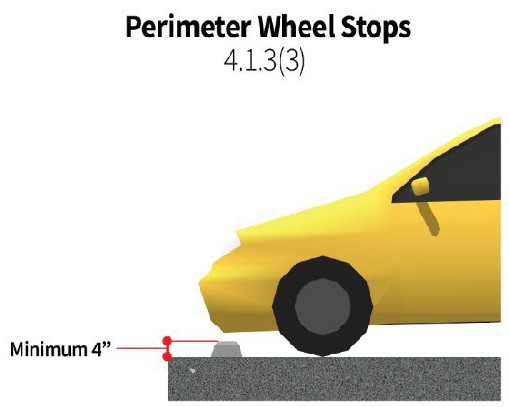
Perimeter Curbing and Wheel Stops. Except for parking areas accessory to single-family dwellings, fixed and permanent wheel stops securely anchored into the ground or curbs of portland cement concrete or approved comparable material at least four inches (4") high shall be installed for each parking stall which is located along the perimeter of any off-street parking area. Such wheel stops, or curbing shall be so placed to prevent damage to landscaping, fences, or walls, and to prevent encroachment of vehicles into public walkways.
4.1.4
Vehicular Access and Circulation.
1)
Access.
Access to parking and loading areas: Off-street parking or loading areas shall be provided with vehicular access via curb-cuts and access drives from an improved street or alley which will least interfere with vehicular and pedestrian traffic flow. Except for off-street parking accessory to single-family dwellings, such parking areas shall be designed to prohibit motor vehicles backing into public streets, alleys, or sidewalks.
Access to parking and loading spaces: Each off-street parking and loading space shall be accessible directly from an aisle or driveway. The only exception to this requirement is off-street parking associated with single family dwellings and parking reserved exclusively for vehicle sales, leasing, or rental.
2)
Parking Area Delineations. All parking lots shall be striped to provide a visible indicator for vehicle circulation and parking maneuvers. Parking spaces and other circulation markings shall be restored, as necessary, to maintain a clear identification of separate parking spaces and other markings at all times.
3)
Traffic Control. Vehicular traffic to, from, and within an off-street parking or loading area shall be controlled by appropriate traffic control signs, surface markings, and curb islands. All parking areas which will, in the opinion of the Public Works Director or his/her designee, generate a significant volume of traffic movement shall have its entrances clearly marked and designated as to direction of traffic flow or other conditions of use of the access driveway by the use of low-profile signs.
4.1.5
Location of Parking Spaces. All required off-street parking shall be provided on the same lot occupied by the use or building to which it is appurtenant unless otherwise provided for in this Section.
4.1.6
Shared and Remote Parking. One (1) parking area may contain required spaces for other adjacent uses, but except as otherwise provided for in this title, the required parking spaces assigned to one (1) use shall not be credited to any other use. To the extent that two (2) or more adjacent uses experience peak parking demand at different times, some parking spaces may be counted as meeting the demand for both uses. In determining the parking requirements where the uses intend to share parking, Public Works Director is his/her designee will establish the peak hourly demand by calculating such need from the appropriate methodology set out in the most recent version of the ITE reference manual or on the basis of a Parking Demand Study. Persons intending to take advantage of this provision shall be required to demonstrate that an enforceable agreement exists between the parties who intend to share the parking.
4.1.7
Parking and Loading Area Setback Requirements.
1)
Nonresidential.
a)
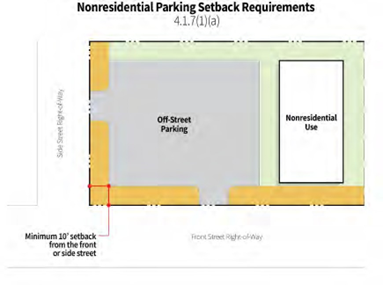
Setback of parking spaces: Parking spaces for nonresidential uses shall not occupy any part of a site between the street right-of-way and ten feet (10') from the front or side street right-of-way. A variance to this may be granted for a lot of record, if the lot depth is one hundred and thirty feet (130') or less or, in the case of a corner lot, the lot width is one hundred and thirty feet (130') or less, but in no case shall parking spaces be closer than six feet six inches (6.5') from the front or side street right-of-way.
b)
Setback of circulation aisles: Parking circulation aisles and parking/loading maneuvering areas may be located in a required front yard, side yard, or rear yard; provided that a minimum of five-foot (5') setback is maintained between the paved area and the property line or right-of-way line. A variance to this may be granted for a lot of record, if the lot depth is one hundred and thirty feet (130') or less or, in the case of a corner lot, the lot width is one hundred and thirty feet (130') or less, but in no case shall the variance allow for the encroachment of vehicles into the street right-of-way except for access drives.
2)
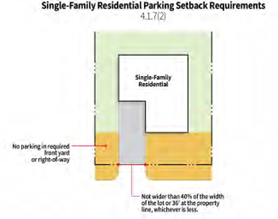
Single-Family Residential. On lots developed with single-family dwellings, no motor vehicle shall be permitted to be parked between the dwelling and any street unless such vehicle is parked upon a driveway. Said driveway shall conform to all of the following standards:
a)
Driveway entrances onto a public or private road shall not comprise more than forty percent (40%) of the width of the lot on which the driveway is located or 36 feet at the property line, whichever is less;
b)
The driveway shall not cover more than forty percent (40%) of the required front yard; and
c)
In all instances, no vehicle shall be parked so as to have any portion of the vehicle located over a public or private sidewalk or pedestrian way.
3)
Loading. No loading space shall be closer than 50 feet (50') to any property in a residential district unless said space is completely enclosed by a building. No loading space shall be located within any area where parking is prohibited by this Ordinance.
4.1.8
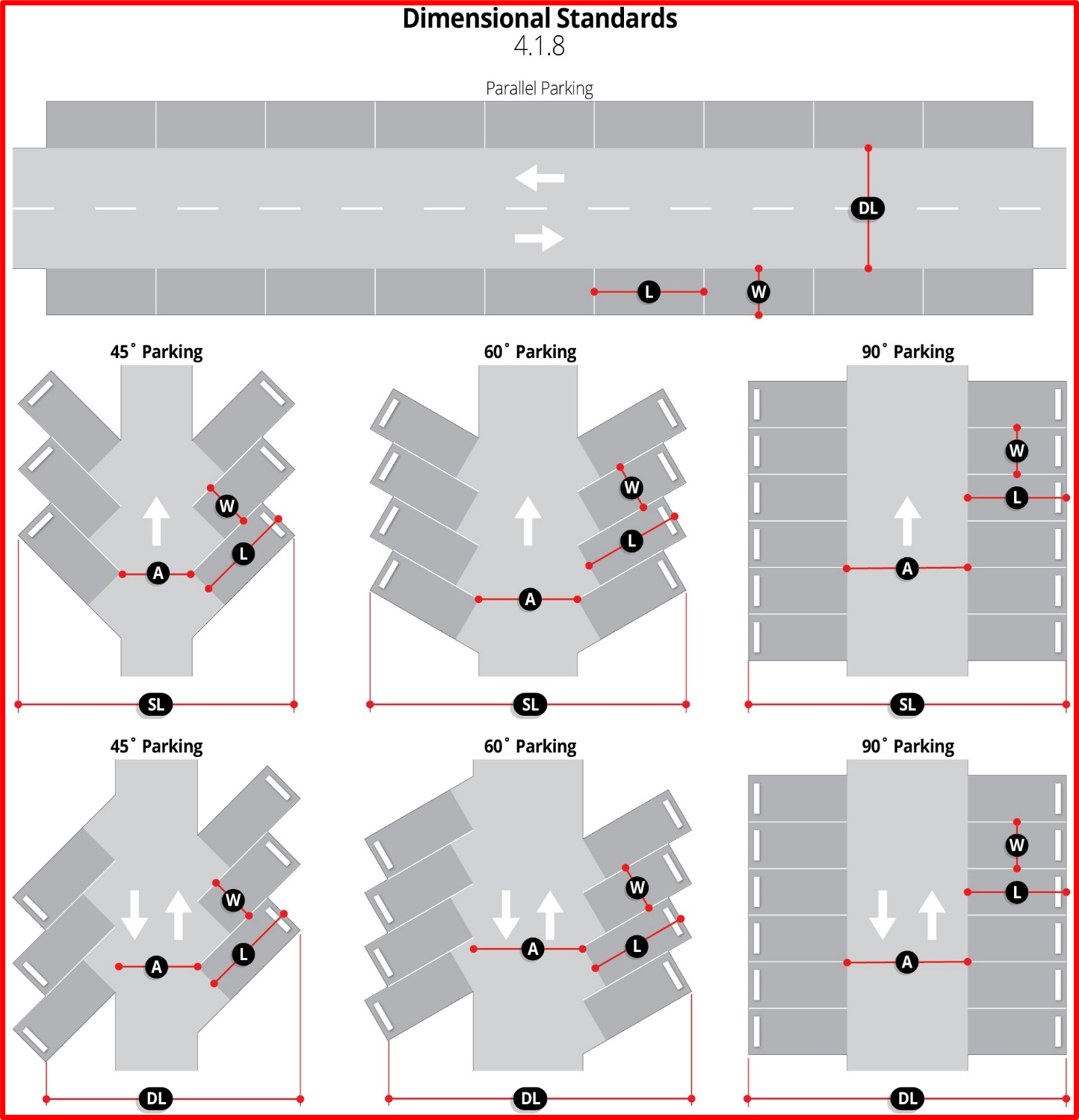
Dimensional Standards. Except for off-street parking associated with single-family dwellings and as otherwise provided in this section, the following minimum dimensional requirements shall apply to all off-street parking areas:
1)
Dimensional Standards of Loading Areas. Loading spaces shall be at least twelve feet (12') in width and twenty-five feet (25') in length (fifty feet (50') in length for tractor/trailer loading spaces), exclusive of vehicle maneuvering areas, and shall have a vertical clearance of at least fifteen feet (15').
2)
Exceptions to Dimensional Standards.
a)
Additional aisle width may be required to accommodate emergency vehicles and equipment, or where the aisle serves as a principal means of access and circulation within the site, including access to loading spaces, drive-through facilities, or trash storage facilities.
b)
If the desired parking angle is not specified in this Section, the Public Works Director or his/her designee may specify other equivalent dimensions associated with the desired parking angle by interpolating from dimensional standards specified in this Section.
c)
Off-street parking spaces for vehicles, other than personal passenger vehicles, shall be of a size (exclusive of aisle, drives and maneuvering space) sufficient to accommodate the length and width of the vehicle as well as the opening of vehicle doors for ingress and egress.
4.1.9
Lighting. All parking areas shall be illuminated in accordance to the City of Sunset Hills Lighting Ordinance as detailed in Appendix B of this UDO, as amended.
4.1.10
Americans with Disabilities Act Compliant Parking. The number of parking spaces for physically disabled persons shall comply with the standards set forth in the Revised Ordinances of St. Louis County as may be amended from time to time.
4.1.11
Parking for Multiple Use Buildings. Unless otherwise specified in this section, the number of parking spaces required for land or buildings used for two (2) or more purposes, shall be the sum of the requirements for the various uses, computed in accordance with this section. Parking facilities for one (1) use shall not be considered as providing the required parking facilities for any other use.
4.1.12
Prohibited Off-Street Parking Uses. Except as expressly permitted by this Ordinance, no off-street parking space or loading space shall be utilized for any other purpose. The following off-street parking uses are expressly prohibited:
1)
Off-street parking or storage of vehicles on surfaces other than properly maintained and properly drained pavements complying with the construction requirements of Section 6.1.3.
2)
Off-street parking of vehicles on any established lawn or landscaped area, except for vehicles required for performing repairs or construction on-site.
3)
Storage of mobile homes or use for dwelling purposes in any zoning district.
4)
The use of recreational equipment or motor homes for living, sleeping or housekeeping purposes when parked or stored in any zoning district.
5)
A motor vehicle, trailer, or other motorized equipment undergoing repairs or remodeling shall be in public view for a period not to exceed one (1) week. Any such motorized equipment shall be covered or kept within a shelter.
6)
Parking of a vehicle, trailer, or boat upon any premises in the City designated by the Missouri Department of Transportation as a "commuter lot" for the principal purpose of displaying such vehicle, trailer, or boat for sale.
4.1.13
Minimum Required Off-Street Parking Spaces.
Except as otherwise expressly provided in this title, off-street parking spaces shall be provided with the parking ratio requirements of Table 4.1.13 below. In no instance shall there be permitted, off-street parking in excess of twenty percent (20%) of the off-street parking required in this title. If the designated use has two (2) or more parking ratio options, the option that requires the greater number of spaces shall be used. When computation of the required number of off-street parking spaces results in a requirement of a fraction space, a fraction of any amount shall be counted as one (1) space. Upon receiving a development application for a use not specifically listed in this title, the Public Works Director or his/her designee is authorized to apply the parking ratio specified for the listed use that he/she deems most similar to the proposed or establish a different minimum parking requirement on the basis of a Parking Demand Study.
Where floor area is the unit of measurement to determine the required number of off-street parking spaces, Gross Floor Area (GFA) shall be used. For the purposes of calculating required off-street parking spaces, designated outdoor dining, seating and sales areas shall be applied toward the floor area. When the number of employees is used as a measurement for determining the number of required parking spaces, it shall be based on the number of employees that can be expected to be on the premises during the largest shift, except as otherwise specified in this Ordinance. The number of employees shall be based on the use activity operating at full capacity.
4.1.14
Minimum Required Loading Spaces. On the same premises with every building erected and occupied for retail business, manufacturing, storage, store, hotel, hospital or other uses similarly involving the receipt or distribution of vehicles, materials or merchandise, there shall be provided and maintained on the lot adequate space for standing, turning, loading, and unloading services in a manner that does not interfere with required parking and with the public use of streets and alleys.
4.1.15
Stacking Spaces for Drive-Through Facilities.
1)
General Requirements. Every use having a drive-through facility shall provide stacking spaces. The following general standards apply to all stacking spaces and drive-through facilities:
a)
Stacking spaces and lanes for drive-through stations are not to impede on- and off-street traffic movement, are not to cross or pass through off-street parking areas and are not to impede pedestrian access to a public entrance of a building.
b)
Drive-through lanes are to be separated from off-street parking areas. Individual lanes are to be striped, marked, or otherwise distinctly delineated.
c)
Approach lanes for drive-through facilities are to have the following minimum dimensions:
i.
Nine feet (9') in width;
ii.
Eighteen feet (18') in length.
d)
All drive-through facilities are to be provided with a bypass lane with a minimum width of ten feet (10').
2)
Requirements by Use.
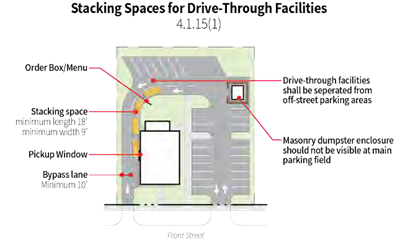
(Ord. No. 2280, § 2, 3-14-2023; Ord. No. 2295, § 1, 5-9-2023; Ord. No. 2363, § 2, 7-9-2024)
4.2 - Landscape Requirements.
4.2.1
Planting Specifications.
1)
General. Landscaping required by this Ordinance shall mean living plants in a combination of trees, shrubs, and/or ground cover. Unless otherwise stated in this Ordinance, all size specifications for plant materials shall be based upon the time of planting. When caliper is specified for tree planting, the caliper of the tree trunk shall be measured at twelve inches (12") above the ground level. Any plant materials used to meet the requirements of this section shall not include any plant material determined by the state of Missouri as an invasive species.
2)
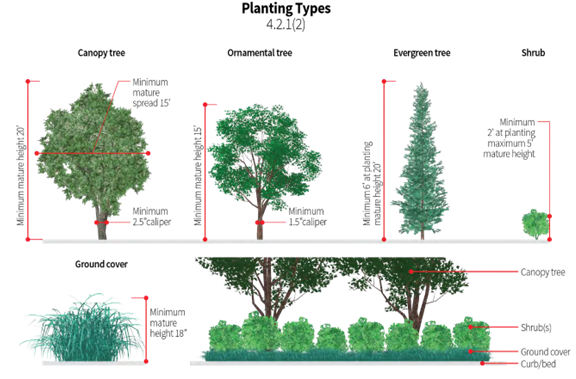
Planting Types.
a)
Canopy trees: A hard wood plant having not less than a two and one-half inches (2.5") caliper and reaches a mature height of not less than twenty feet (20') and a mature spread of not less than fifteen feet (15').
b)
Ornamental trees: A hard wood plant having not less than a one and one-half inches (1.5") caliper and normally attains a mature height of at least fifteen feet (15') and usually has one (1) main stem or trunk and many branches. Several species may appear to have several stems or trunks.
c)
Evergreen trees: A tree having foliage that persists and remains green throughout the year and having a height of not less than six feet (6') at installation and maturing to a height of not less than twenty feet (20').
d)
Shrub: A woody perennial plant (deciduous or evergreen) of low to medium height characterized by multiple stems and branches continuous from its base and having a height of not less than two feet (2') and normally maturing to a height of not more than five feet (5').
e)
Ground cover: Plants, other than turf grass, normally reaching an average maximum height of not more than eighteen inches (18") at maturity.
4.2.2
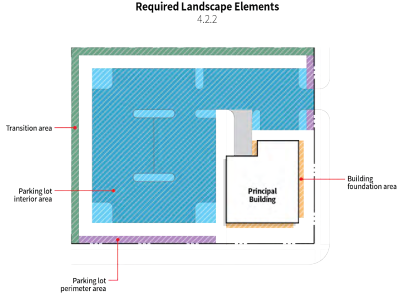
Required Landscape Elements. The graphic below illustrates the location of the landscape and screening requirements detailed in this section.
1)
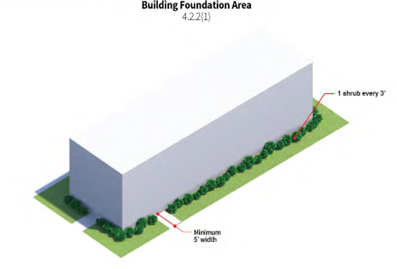
Building Foundation Area.
a)
A multi-family residential, non-residential, or mixed-use development is required to maintain a building foundation area at front and corner side yards of five feet (5') at a minimum.
b)
Foundation plantings shall be designed to supplement buffer yard plantings to frame important views, while visually softening long expanses of walls. Foundation plantings shall respond to the windows and materials of the building.
c)
Foundation plantings shall be installed across sixty percent (60%) of the length of the façade of the building, except where walkways and driveways are located.
d)
A minimum four-foot-wide (4' wide) hedge row shall be planted with one (1) shrub every three feet (3') on center, spaced linearly. Foundation plantings may also include trees, additional shrubs, grasses, perennials, and groundcover.
2)
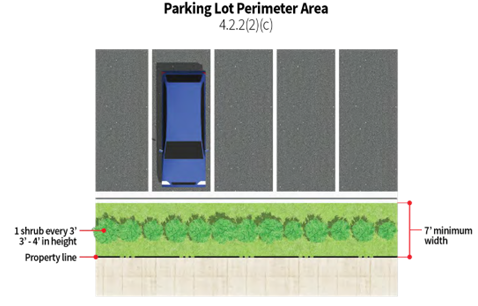
Parking Lot Perimeter Area. All parking lots shall include landscaping and trees located on the perimeter of parking areas as required by this section. Trees and landscaping required by this section shall be in addition to trees and landscaping required under other sections of this Ordinance. It is the objective of this section to provide screening between parking areas and street right-of-way.
a)
Applicability. The parking lot perimeter landscaping regulations of this section apply to all the following:
i.
The construction or installation of any new surface parking lot or vehicular use area that is adjacent to street right-of-way; and
ii.
The expansion of any existing surface parking lot or vehicular use area that is adjacent to street right-of-way, in which case the requirements of this section apply only to the expanded area.
b)
Exemptions. Installation of parking lot perimeter landscaping is not required when the parking lot or vehicular use area is not visible from adjacent street right-of-way.
c)
Requirements. Perimeter landscaping is required for all parking lots and shall be established along the edge of the parking lot with a minimum depth of seven feet (7') as measured from the back of curb, to accommodate vehicle bumper overhang and ensure planting areas that are adequate in size.
i.
The landscape treatment shall run the full length of the parking lot and shall be located between the property line and the edge of the parking lot. Landscaped areas outside of shrub and tree masses shall be planted in live groundcover. The landscaped area shall be improved as follows:
i.
One (1) shrub the height of which shall not be less than three feet (3') nor greater than four feet (4'), shall be planted for every three feet (3') of landscaped area length, spaced linearly to adequately screen vehicle bumpers (ideally creating a solid hedge row).
ii.
Alternatively, a low pedestrian wall or fence the height of which provides effective screening to a maximum height of three feet (3') may be used in conjunction with required landscaping. Plant materials shall be installed between the sidewalk and the fence or wall to provide a softening effect.
3)
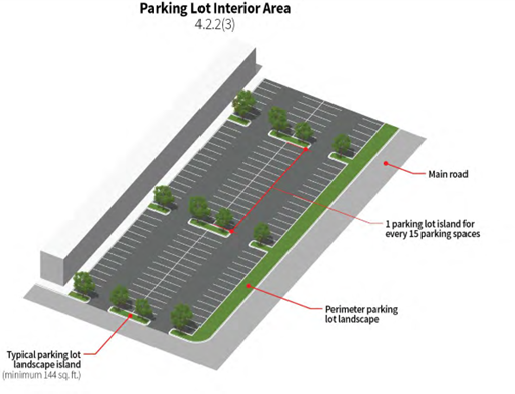
Parking Lot Interior Area. All parking lots shall include landscaping and trees located within the parking area as required by this section. Trees required by this section shall be in addition to trees and landscaping required under other sections of this Ordinance. It is the objective of this section to provide shade within parking areas, break up large expanses of parking lot pavement, and provide a safe pedestrian environment.
a)
Applicability. The parking lot interior landscape regulations of this section apply to all the following:
i.
The construction or installation of any new surface parking lot containing 8 or more parking spaces; and
ii.
The expansion of any existing surface parking lot if the expansion would result in eight or more new parking spaces, in which case the requirements of this section apply only to the expanded area.
b)
Requirements. For parking lots consisting of fifteen (15) or more spaces, interior parking lot landscaping shall be required. For parking lots consisting of fewer than fifteen (15) spaces, all rows of parking shall be terminated by a parking lot island or landscaped area.
c)
Amount. One (1) parking lot island shall be provided between every fifteen (15) parking spaces. Parking lot island locations may be varied based on specific site requirements or design scheme, but the total number of islands shall be no less than the amount required one (1) island for every fifteen (15) spaces. However, all rows of parking spaces shall be terminated by a parking lot island or landscaped area.
d)
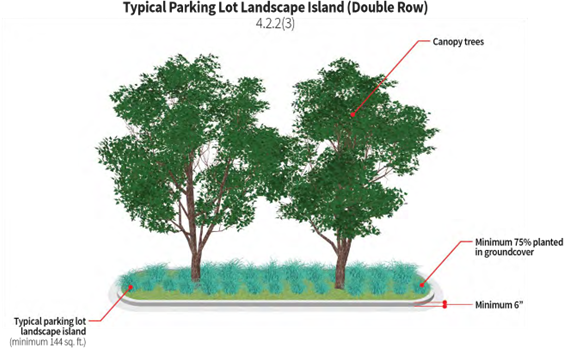
Size and Planting of Parking Lot Islands. Parking lot islands shall be the same dimension as the parking stall. Double rows of parking shall provide parking lot islands that are the same dimension as the double row. A minimum of one (1) canopy tree shall be provided for every parking lot island or landscaped area. If the island extends the width of a double row, then two (2) canopy trees shall be provided.
e)
Design of Planting Areas. Parking lot islands or landscaped areas shall be at least one hundred and forty-four square feet (144 sq. ft.) in area and at least six inches (6") above the surface of the parking lot and protected with concrete curbing, except where designed specifically for the absorption of stormwater. Such islands and landscaped areas shall be properly drained and irrigated as appropriate to the site conditions to ensure survivability.
f)
Type of Landscape Material. Canopy trees shall be the primary plant materials used in parking lot islands and landscaped areas. Ornamental trees, evergreen trees, shrubs, groundcover, and other plant materials may be used to supplement the canopy tree plantings but shall not create visibility concerns for automobiles and pedestrians.
g)
Groundcover. A minimum of seventy-five percent (75%) of every parking lot island shall be planted in groundcover.
4)
Transition Area.
a)
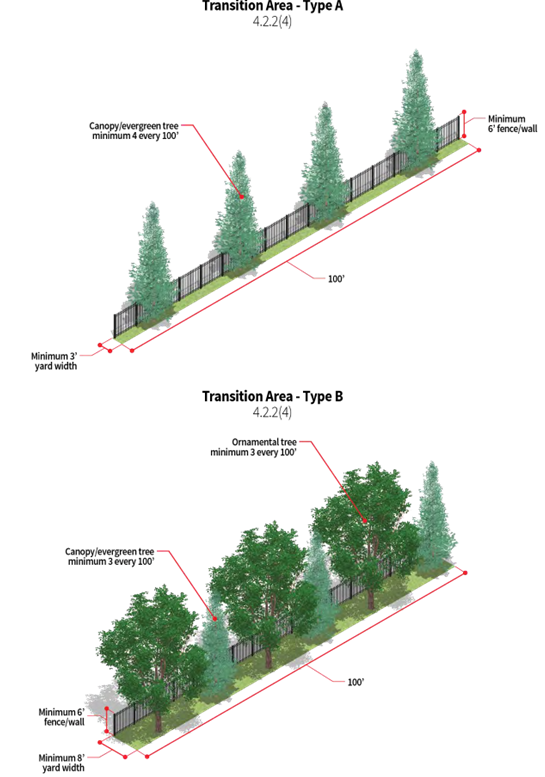
It is the objective of the transition area to minimize the land use conflicts between incompatible uses. It is not expected that the transition area will totally screen such uses. It is expected that the transition area design elements identified below will minimize land use conflicts and will enhance over time as landscaping matures. The transition area landscape regulations of this section apply along interior property lines in those instances expressly identified in this Ordinance and only to the following activities:
i.
The construction or installation of any new principal building or principal use; and
ii.
The expansion of any existing principal building or principal use that results in an increase in gross floor area or site area improvements by more than five percent (5%) or one thousand square feet (1,000 sq. ft.), whichever is greater. In the case of expansions that trigger compliance with transition area requirements, transition area landscaping is required only in proportion to the degree of expansion. The Public Works Director or his/her designee is authorized to allow the transition area to be established adjacent to the area of expansion or to disperse transition area landscaping along the entire site transition area.
b)
Transition Area Types. Four (4) transition yard types are established in recognition of the different contexts that may exist, as shown in the table below. Transition yards may include a combination of elements including setback distances for separation, planting types, solid fencing, groundcover, and turf.
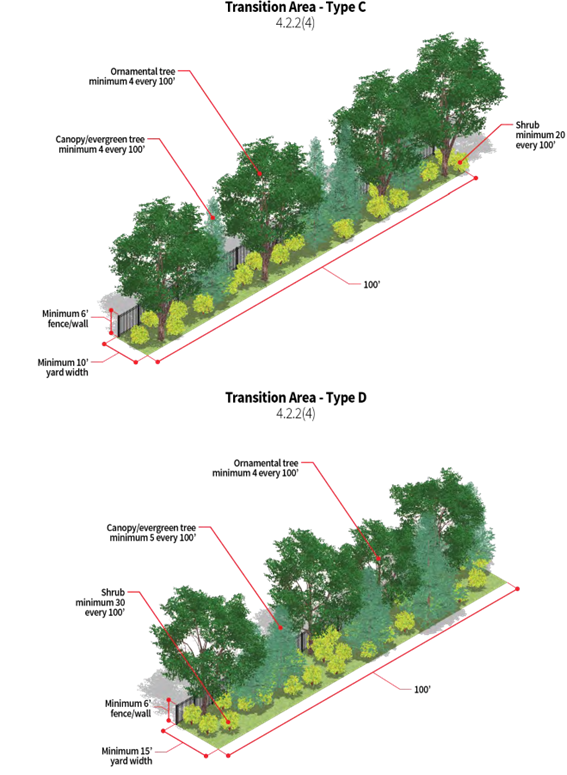
c)
Application of Transition Area Types. Transition areas shall be provided based on the table below, except where adjacent uses are of a similar nature, scale, and intensity. As per the table, the type of required transition yard is dependent upon the land use type of the subject lot and the land use type of the adjacent lot(s). When the approved use of a lot would typically require a transition area of a certain type based on the table below, the Public Works Director or his/her designee may grant an Administrative Departure when a use is deemed not of a similar nature, scale, or intensity, but as a use with nominal impact on the character of uses in the adjacent zoning district. In this instance, the departure may be granted for one less intense type of area.
4.2.3
Installation and Maintenance of Landscape Areas.
1)
Immediately upon planting, all trees shall conform to the American Standard for Nurserymen, published by the American Association of Nurserymen, Inc., as revised from time to time.
2)
All new landscaped areas shall be installed prior to the occupancy or use of the building or premises, or substantial completion of the building so as to allow for occupancy; or if the time of the season or weather conditions is not conducive to planting, the Public Works Director or his/her designee may authorize a delay for such planting up to six (6) months after occupancy or use of the buildings or premises. Dead plant materials shall be replaced within a sixty-day (60-day) taking into consideration the season of the year and shall have at least the same quantity and quality of landscaping as initially approved. If the particular project is constructed in more than one (1) phase, the sixty-day (60-day) timeframe shall apply to each individual phase.
3)
All landscaping and screening shall be maintained in a healthy, neat, trimmed, clean, and weed-free condition. The ground surface of landscaped areas shall be covered with either turf and/or other types of pervious groundcover located beneath and surrounding the trees and shrubs.
4.2.4
Existing Parking Lot Landscape. For existing parking lots that currently do not comply with the required parking lot landscaping, such landscaping shall be provided when:
1)
A new principal building or building addition is constructed, or exterior remodeling of the principal building occurs.
2)
Over fifty percent (50%) of the total area of an existing parking lot is reconstructed. Resealing or re-striping of an existing parking lot, which does not entail paving or resurfacing by replacement of the asphalt or concrete, shall not be subject to this requirement.
3)
When an existing parking lot under ten thousand square feet (10,000 sq. ft.) in area is expanded by fifty percent (50%) or more in total surface area.
4)
When an existing parking lot over ten thousand square feet (10,000 sq. ft.) in area is expanded by twenty-five percent (25%) or more in total surface area.
4.3 - Screening Requirements.
4.3.1
Screening of Trash and Recycling Receptacles. For all uses, except any individual lot occupied by a single-family or two-family dwelling, using a common trash receptacle and all nonresidential uses:
1)
Solid material screening or full screening landscape on three (3) sides to a height that screens the containers, having a minimum height of six feet (6').
2)
Materials used for screening shall complement the architecture of the principal structure, in which three (3) sides are masonry (brick, stone or textured and pigmented concrete) and one (1) side is an opaque gate made of metal, wood, or vinyl. The use of materials that are not solid, such as slats in chain-link, shall not be used to meet this requirement.
3)
Materials and elevations for enclosures that are attached to buildings shall be designed to be integrated into the main structure.
4)
If enclosures are to be attached to buildings, they shall comply with applicable fire and building codes.
5)
Enclosure openings directly visible from a public right-of-way and/or adjoining residential areas shall have a solid material gate. For larger enclosure areas, a separate gate access is encouraged.
6)
Access drives shall be constructed of material and thickness to accommodate truck loading. Year-round accessibility to the enclosure area for service trucks shall be maintained by the property owner or tenant.
7)
Enclosures shall be of an adequate size to accommodate expected containers. It is encouraged to design the enclosure area to be expandable to accommodate future additional containers.
8)
Enclosure structures shall be designed to protect the walls from damage by containers. Such protection may be provided by use of barrier curbing, reinforced masonry walls, or other similar means.
9)
Trash enclosures shall not be located within a required street front or street side setbacks or occupy area used for required parking spaces.
4.3.2
Outdoor Storage Area.
1)
All outdoor storage areas must be completely screened by an opaque masonry wall (stone, stucco, or brick) or a solid wood screen fence no less than five feet (5') and no more than six feet (6') in height. Where feasible, plant materials should be installed along the fence or wall located along the public right-of-way to provide a softening effect.
2)
Growing areas for nursery stock located in the front or corner side yard are considered to meet screening requirements.
4.3.3
Screening of Ground-Mounted Mechanical Units. For all uses, except any individual lot occupied by a single-family, two-family, or three-family dwelling, all ground-mounted mechanical units, including but not limited to air-conditioning condensers, heat pumps, ventilation units, computer cooling equipment, etc., and any related utility structures and equipment, that are visible from any adjacent public thoroughfare shall be visibly screened from public view. The screen shall be designed and established so that the area or element being screened is no more than twenty percent (20%) visible through the screen.
4.3.4
Screening of Roof-Mounted Mechanical Units. All roof-mounted mechanical units shall be screened from adjacent public thoroughfares using an opaque screening material compatible with the architecture of the building or architecturally designed screening such as a parapet wall. The screening of the roof-mounted units shall be designed to blend with the building and roof materials. Additional screening may be required due to topographic differences in the adjoining properties.
4.3.5
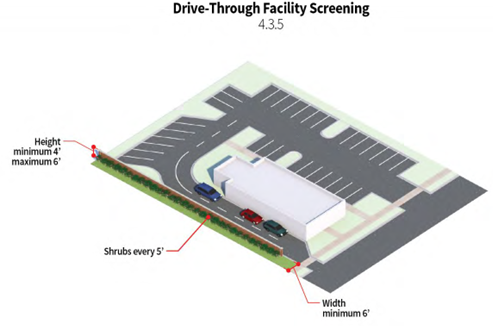
Drive-Through Facility. Drive aisles of drive-through facilities must be effectively screened from view along the public right-of-way and at the edges of sites adjacent to residential properties to minimize the impact of exterior site lighting, headlight glare and any menu intercom displays. Such screening must be approved during the site plan review process, be a minimum of six feet (6') in width, and must consist of an opaque masonry wall (stone, stucco, or brick), a solid wood or simulated wood screen fence with a minimum height of four feet (4') and a maximum height of six feet (6'). Small shrubs must be installed every five feet (5') along the exterior of the fence or wall to provide a softening effect.
(Ord. No. 2364, § 1, 7-9-2024)
4.4 - Fence Regulations.
4.4.1
Permit Required. Except for fences approved under the conditional use permit procedure or planned development procedure, a permit issued by the Public Works Director or his/her designee shall be required for the construction of a fence. Said permit shall be issued upon determination by the Public Works Director or his/her designee that the proposed fence installation complies with the requirements of this section.
4.4.2
Fence Height and Location.
1)
Residential Districts.
a)
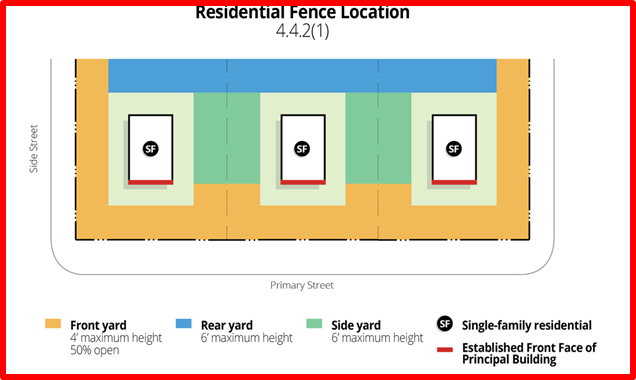
Interior lots: Fences, having a height of not more than six feet (6'), are permitted in the rear yard and side yards, provided that a fence, greater than four feet (4') in height, located in a side yard shall not extend beyond either the established front face of the principal building on the lot or the principal building on an adjoining lot, whichever is closest to the street.
b)
Corner lots: Fences, having a height of not more than six feet (6'), are permitted in the rear and side yards, provided that a fence, greater than four feet (4') in height, shall not extend beyond either the established front face (oriented to either street) of the principal building on the lot or the principal building on the adjoining lot, whichever is closest to the street.
c)
Through lots: Fences, having a height of not more than six feet (6'), are permitted in the yard adjacent to the right-of-way that does not serve as the access to the lot and for all intents and purposes is used as the "rear" yard, provided that fences greater than four feet (4') in height shall not extend beyond the established front building line of a lot fronting onto such right-of-way and located within the same block, or the minimum front building setback line of such lot, if not developed.
d)
Front yards: Fences, having a height of not more than four feet (4'), are permitted in front yards, provided that such fences shall be of non-sight barrier construction (e.g., post and rail fences) a minimum of fifty percent (50%) of which shall be open.
2)
Non-Residential Districts. In any non-residential district, no fence shall exceed six feet (6') in height except as otherwise provided for in this Ordinance. In non-residential districts, fences are permitted in any yard, with the following limitations:
a)
Except for the LI district, fences in the front yard shall be limited to low masonry walls of architectural quality (brick, stone, or textured and pigmented concrete). The height of such fences shall not exceed four feet (4') in height except columns, that are integral to the fence design, may exceed four feet (4').
4.4.3
Exceptions.
1)
Recreational courts may be bounded by an open (no slats) chain link fence up to ten feet (10') in height, provided that such fences be located at least twenty feet (20') from any abutting residential property. Such fences in any residential district shall be located within the rear yard.
2)
Fences (or walls), used as a decorative feature and/or as a backdrop to an identification sign for a subdivision or planned development entrance, may exceed the above stated maximum heights, subject to the requirements and procedures of the city's sign regulations in Appendix B, Sign Ordinance of this UDO.
4.4.4
Fence Materials.
a)
Except as otherwise provided for in subsection b) below, fence material shall be that which is designed and intended for use in fence installations, including decorative masonry (e.g., brick, stone, or textured and pigmented concrete). All wire or makeshift material such as 2" × 4" lumber and plywood shall be prohibited, except for temporary protective barriers on properties undergoing construction or demolition activities. All fences shall be maintained in a structurally sound condition and otherwise in a neat and clean appearance.
b)
All wire, barbed wire, or razor wire shall not constitute any part of a fence in any district, except when used to screen recreational courts or as may be approved by Board of Aldermen in the LI district.
c)
All new chain link fencing shall be coated or painted in a color approved by the City Engineer.
d)
Silver chain link fencing existing at the time of the adoption of this UDO may be repaired with silver chain link fencing.
4.4.5
Fences Surrounding Swimming Pools. Swimming pools shall be surrounded with a protective barrier in accordance with Saint Louis County Building Code as amended from time to time.
4.4.6
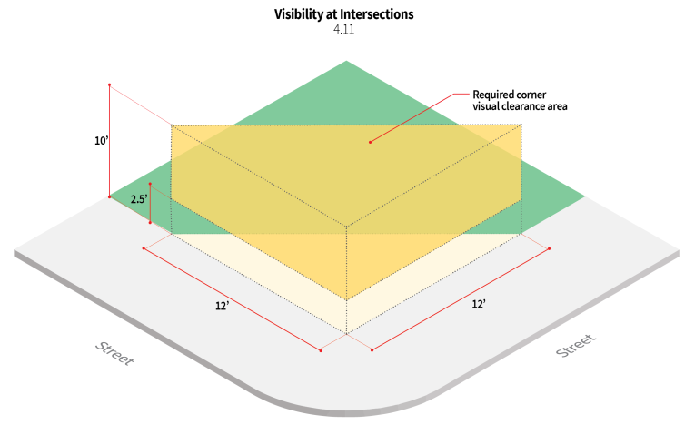
Fences at Street Intersections. Fences, at or near street intersections or access private drives, shall be erected or placed in such a manner as to not materially obstruct or impede vision between a height of two and one-half (2.5) and ten (10) feet above the center line grades of the intersection streets in the area bounded by the street lines of such corner lots and a line joining points along said street lines twelve (12) feet from the point of intersection.
(Ord. No. 2363, § 3, 7-9-2024)
4.5 - Permitted Encroachments.
No obstructions shall be permitted in any yard required by this title. However, the following shall not be considered obstructions when located in the required yards specified, subject to the applicable requirements of Table 4.5 below.
4.6 - Accessory Uses, Buildings, and Structures.
4.6.1
Permitted Accessory Uses, Buildings, and Structures. A permitted accessory use is any use or structure which complies with the definition of "Accessory Use, Building, or Structure, Permanent" or "Accessory Use, Building, or Structure, Temporary" contained in Section 14, "Definitions," including but not limited to, the following typical uses:
(Ord. No. 2280, § 3, 3-14-2023)
4.6.2
Location, Dimensional, and Other Requirements.
1)
Residential and Planned Developments with Residential Uses.
a)
Any accessory structures not located entirely in the required rear yard must comply with the side yard setback requirements of the primary structure, shall not be closer than five feet (5') from the rear property line, and not located between the primary structure and the front lot line or the lot line adjacent to the street for corner lots.
b)
All accessory structures and uses located entirely in the required rear yard setback shall not be closer than five feet (5') from the property line.
c)
No accessory structure or portion thereof shall be located in the required side or front yards.
d)
When an existing principal structure has a substandard side yard setback, then the side or rear setback for the accessory structure or use shall not be less than the side setback of the principal building.
e)
Where an accessory structure is structurally attached to the principal building, it shall comply with the setback requirements that apply to the principal building.
f)
The architectural style of garages shall complement the principal building and shall not exceed the height of the principal building or eighteen feet (18'), whichever is less.
g)
A structure for storage or a greenhouse, that is accessory to a single-family residential building, shall not exceed two hundred and fifty square feet (250 sq. ft.) in gross floor area nor exceed eighteen feet (18') in height.
2)
Non-Residential Districts.
a)
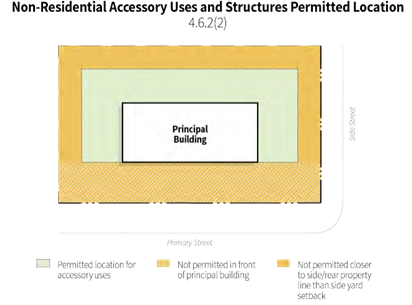
All accessory structures and uses shall be located behind the front of the principal building.
b)
No accessory structure or use shall be located closer to the side or rear property line than the side yard setback dimension established for the particular zoning district.
c)
Parking structures, whether attached to or detached from the principal building, shall comply with the setback requirements for the principal building.
d)
No outdoor display of merchandise is permitted, except for a business in premises of at least one hundred thousand square feet (100,000 sq. ft.) located in a planned commercial development, thirty-five (35) acres or more in area. Further, said display shall be limited to seasonal merchandise only. Outdoor sales and display for such a business may occur on the sidewalk area immediately in front of such business, limited to the free space, not including a six-foot (6') wide pedestrian walkway. Outdoor sales and displays for such a business may occur in a portion of the parking lot proximate to such business, subject to Board of Aldermen approval and provided that no more than twenty percent (20%) of required parking spaces be utilized for such outdoor sales and displays.
3)
Other Use Limitations.
a)
No accessory structure shall be allowed on any lot prior to the time of the completion of the construction of the principal structure to which it is accessory.
b)
Accessory uses customarily incidental to residential uses, such as the use of a lot or portion of a lot for a vegetable or flower garden and the keeping of domesticated animals are permitted, but not on a commercial basis or that creates a nuisance to adjacent or nearby residents.
c)
No garage, attached or detached, shall be used for, or converted to habitable space.
(Ord. No. 2348, § 1, 3-12-2024)
4.7 - Number of Principal Buildings on a Lot.
Except for detached one-family and two-family dwellings, more than one principal building may be located on the same lot provided that density and dimensional requirements of this Ordinance shall be met for each principal building as though they were on individual lots.
4.8 - Conformity with Dimensional and Off-Street Parking Regulations.
1)
The maintenance of yards, other open space and minimum lot area required for a structure shall be a continuing obligation of the owner of such property on which it is located as long as the structure is in existence.
2)
No required yards, other open space, or minimum lot area allocated to any structure, shall be used to satisfy required yards, other open spaces, or minimum lot area requirements for any other structure.
3)
There shall be no obstructions permitted in required yards except as set forth in this Ordinance.
4)
Except as provided for in Section 4.1, "Off-Street Parking and Loading Requirements," no required off-street parking area required for a use on a lot shall be used to satisfy the required off-street parking for a use of another lot.
4.9 - Building Grades.
Any building requiring yard space shall be located at such an elevation that a sloping grade shall be maintained to cause the flow of surface water to run away from the walls of the building but in such a manner as not to cause runoff of surface water to cause damage to adjacent properties.
4.10 - Home Occupations.
1)
Purpose. The following requirements for Home-Based Businesses and Home-Based Work are enacted for the purpose of protecting the public health and safety, including regulations related to fire and building codes, health and sanitation, transportation or traffic control, solid or hazardous waste, pollution, and noise control; ensuring that the business activity is compliant with city, state, and federal law; and confirming that the business is paying applicable taxes.
2)
Definitions. As used in this Section 4.10, the following words shall have the following meanings:
3)
A Home Occupation may operate in any Residential District provided the Home Occupation:
a)
Is: (1) clearly incidental and secondary to the primary residential use of the dwelling unit; and (2) does not occupy more than forty-nine percent (49%) of the floor area of the dwelling; and
b)
Does not change the residential character of the residential building by altering or modifying the exterior of the dwelling so as to indicate the presence of a Home Occupation; and
c)
Is operated such that the total number of employees and clients on-site at one time does not exceed the occupancy limit for the residential dwelling; and
d)
Pays all applicable taxes and otherwise operates in compliance with applicable city, state, and federal law; and
e)
Is operated by a resident or residents of the dwelling unit; and
f)
Does not adversely affect the character of the surrounding neighborhood by allowing or causing, for example: commercial or delivery vehicles used in connection with the home occupation to be parked at or stored on the dwelling or visit the premises with a frequency of more than two (2) visits per day; a steady or concentrated visitation of clients to the dwelling; a substantial increase in traffic or on- street parking through the residential area; storage or the use of equipment that produces negative effects outside the home or accessory structure; or similar adverse impacts.
4)
Within sixty (60) days of establishing a Home Occupation the resident is asked to supply the City with: (1) a copy of their business's Missouri Tax I.D. number and, for Home Occupations selling goods at retail, a Statement of No Tax Due in accordance Missouri Statutes (Section 144.083.2 and 144.083.4 RSMo), and (2) a written description of the Home Occupation, the percentage of the dwelling to be occupied by the Home Occupation, and the number of employees to be working at the Home Occupation who are not residents of the home. At the same time, to help ensure the proposed Home Occupation complies with the requirements of this Subsection, the City shall supply the resident with a copy of this Subsection or a summary of its requirements. Upon receipt of the written description, the City shall verify for the resident that the Home Occupation complies with this Section. Any change in the amount of floor area occupied by the Home Occupation as detailed in the original description, number of employees, or the type of Home Occupation should be followed by a submission of a revised description and review and approval in accordance with this Section to assist the resident in continued compliance.
5)
Nothing in this Subsection pertaining to Home Occupations shall be deemed to:
a)
Prohibit mail order or telephone sales for Home Occupations;
b)
Prohibit service by appointment within the home or accessory structure;
c)
Prohibit or require structural modifications to the home or accessory structure;
d)
Restrict the hours of operation for Home Occupations;
e)
Restrict storage or the use of equipment that does not produce effects outside the home or accessory structure; or
f)
Restrict or prohibit a particular occupation that is legal under the laws of the City, State, and United States.
4.11 - Visibility at Intersections.
On any corner lot nothing shall be erected, placed, planted or allowed to grow in such a manner as to materially obstruct or impede vision between a height of two and one-half (2.5') and ten feet (10') above the centerline grades of the intersecting streets in the area bounded by the street lines of such corner lots and a line joining points along said street lines twelve feet (12') from the point of intersection.
4.12 - Performance Standards.
No building or structure shall be used, erected, structurally altered, enlarged, or maintained, unless it shall be in conformity with the St. Louis County Performance Standard Regulations as those ordinances are amended from time to time.
4.13 - Storage, Dumping of Waste, Junk, Garbage, Etc.
The use of land for the storage or collection or accumulation of used lumber and other used materials, or for the dumping or disposal of scrap iron, junk, garbage, derelict automobiles, rubbish, or other refuse or of ashes, slag or other industrial wastes or by-products is prohibited. The dumping of dirt, sand or rock material excavated from the earth is permitted in any district for fill, provided the surface of such material is graded within a reasonable time as determined by the Public Works Director or his/her designee in a manner preventing the collection of stagnant water, and which leaves the ground surface in a condition suitable for the growing of turf or for other land uses permitted in a district. A temporary certificate from the Public Works Director or his/her designee shall first be obtained, specifying the area and amount of fill, quality of the material to be used for the fill and way fill is to be completed.
4.14 - Removal of Soil, Sand, or Other Material.
The use of land for removal of topsoil, sand, gravel, or other material from the land is permitted in any district, solely under a temporary certificate from the Public Works Director or his/her designee, and on condition that such removal of soil will not be below the normal building grade as established from the nearest existing or proposed street, when such building grade has been established and approved by the Public Works Director or his/her designee. A temporary certificate may be issued in appropriate cases upon filing of an application accompanied by a suitable agreement or bond that such removal will not cause stagnant water to collect or leave the surface of the land at the expiration of such permit in an unstable condition or unfit for the growing of turf or for other land uses permitted in the district in which such removal occurs. This regulation shall not prohibit the normal removal of soil for the construction of an approved building or structure when such plans have been approved by the appropriate City officer and a building permit has been issued and a contract let for said building development.
4.15 - Excavation of Holes.
The construction, maintenance, or existence of any unprotected, unbarricaded open or dangerous excavations, holes, pits, or wells, or of any excavations, holes, or pits which constitute or are reasonably likely to constitute a danger or menace to the public health, safety, or welfare are prohibited; provided, however, this section shall not prevent any excavation under a permit issued under this Ordinance or the building code of the City of Sunset Hills, where such excavations are properly protected and warning signs posted in such manner as may be approved by the Public Works Director or his/her designee.
4.16 - Certain Material Prohibited.
4.16.1
Metal Buildings Prohibited: Metal and steel buildings and structures such as pole barns and other prefabricated metal or steel buildings or structures, including the use or incorporation of metal paneling or metal cladding as a part of or for the exterior wall or face of any building or structure, shall be prohibited in all Zoning Districts with the exception of the PD-LI District, LI District, and LI District with a Planned Development Permit. The Director of Public Works may allow for the use of metal as a part of the roof structure, or for architectural or accent (not primary) elements of a building or structure if its incorporation is well suited with the appearance and design of buildings and structures in the immediate vicinity.
4.16.2
Piers Prohibited: Notwithstanding the provisions of the Unified Development Ordinance or Appendix E to the contrary, piers, posts, pilings, and/or columns may not be utilized as a method of elevating primary structures in residential zoning districts. Additions to primary structures (e.g. sunrooms, decks, etc.) constructed with the approval of City staff, are exempt from this requirement.
(Ord. No. 2363, § 4, 7-9-2024; Ord. No. 2392, § 1, 4-22-2025)
4.17 - Site Plan Review Procedure.
4.17.1
Applicability: The requirements of this Section shall apply to the review of plans where one (1) or more buildings are to be erected on a single lot, updates to the footprint of an existing building, or updates to an approved site plan, excepting the following:
1)
Developments conditioned by a planned district or special procedure approval.
2)
Single-family residential detached dwellings, including associated garages.
3)
Non-residential buildings less than one thousand (1,000) square feet in gross floor area.
4)
Additions to existing non-residential buildings when the addition is less than ten percent (10%) of the existing building's gross floor area, the addition does not exceed five thousand (5,000) square feet, no new curb cuts are required, and where new construction does not reduce existing parking or significantly modify existing on-site circulation as determined by the Department of Public Works.
4.17.2
Procedure: Site plans shall be reviewed by the Department of Public Works for consistency with the Unified Development Ordinance and any relevant policy documents including the City of Sunset Hills Comprehensive Plan. A request involving modifications in conventional zoning and subdivision regulations for commercial, office, and/or industrial development must utilize the procedures of planned development as defined in the Unified Development Ordinance. Upon submission of a site plan for review, Staff shall notify the Ward Aldermen and send public notice postcards to addresses within 300 feet of the tract. Once City Staff has completed a review of the Site Plan it shall be placed on the next available Planning and Zoning Commission agenda for recommendation to the Board of Aldermen. Once recommendation is provided by the Planning and Zoning Commission, the Site Plan will join the next available Board of Aldermen agenda for review and action; two readings of the proposed Bill are required. If approved, within sixty (60) days of approval, the Site Plan shall be recorded with the St. Louis County Recorder of Deeds and thereby authorize development as depicted thereon, with a copy to be filed with the City of Sunset Hills. If not recorded within sixty (60) days, the approval shall expire.
4.17.3
Site Plan Contents:
1)
For a site plan to be accepted for review, the following information shall be either placed on the site plan or on a separate sheet accompanying the plan:
a)
Location map, North arrow, and plan scale.
b)
Zoning district, subdivision name, lot number, dimensions and area, and zoning of adjacent parcels where different than site.
c)
Name, address, and telephone number of the person or firm submitting the plan and the person or firm who desires the review comments forwarded to him/her.
d)
Proposed use of the building and its construction type and distance from adjacent property lines.
e)
Off-street parking spaces, required and proposed, including the number, size, and location of those designated ADA compliant.
f)
Type of sanitary sewage treatment and stormwater drainage facilities, including retention ponds.
g)
Dimensions of existing and proposed roadway pavement and right-of-way width for streets abutting the site.
h)
Existing and proposed contour lines or elevations based on mean sea level datum, unless otherwise waived by the Department.
i)
Location and size of existing and proposed freestanding signs.
j)
Location and identification of all easements (existing and proposed).
k)
Location and height of all light poles.
l)
Overall dimensions of all buildings and the gross floor area of each building.
m)
Approximate location of any stormwater detention facilities, sink holes and springs, silt berms, ponds and other silt control facilities.
n)
Floor area ratio of proposed development, except in single-family attached and detached residential developments.
o)
Open space percentage of proposed development.
p)
Additional information to be placed on the site plan beyond the requirements listed above may be requested based on a joint review of the plans by authorized departmental representatives of the City of Sunset Hills. Updates to the site's landscape and lighting may also require plans sheets that illustrate conformance to the Unified Development Ordinance landscape and lighting requirements.
(Ord. No. 2363, § 4, 7-9-2024)
4.18 - Traffic Impact Study Waiver.
4.18.1
Intent and Purpose: The City of Sunset Hills desires a safe and sustainable transportation system that comfortably supports all modes of connectivity within and through the community while supporting vibrant economic activity.
This Unified Development Ordinance may require a traffic impact study in conjunction with development activity to ensure the desired transportation system. If a petitioner does not believe the impact of a proposed development warrants a traffic study that is required by the City of Sunset Hills Unified Development Ordinance and believes the proposed development maintains or enhances the desired transportation system, a traffic study waiver may be requested to the Board of Aldermen.
4.18.2
Applicability: The City reserves the authority to require traffic impact studies to make informed decisions about the potential impacts of a development and to implement necessary measures to mitigate any negative effects on the transportation system. In the instance a traffic study is required, an applicant may request a traffic study waiver as defined in this Section. The burden of proof shall rest with the applicant to clearly establish that the proposed development maintains or enhances the desired transportation system.
4.18.3
Procedure: The following steps are provided to assure the orderly review of every traffic study waiver application in a timely and equitable manner:
1)
Filing of Application. The applicant shall file an application in accordance with this Section. Upon Submission, the Ward Aldermen shall be notified. City staff will review the application and supporting documents required within the application for completion or outline any deficiencies.
2)
Waiver Request. The applicant shall submit a waiver request as part of the application. A narrative and any supplementary or supporting information is required to illustrate the waiver is warranted. The narrative is intended to include both qualitative and quantitative information incorporating the Standards of Review outlined in Section 4.18.4.
3)
Review by the Board of Aldermen. Once City staff confirms the application is complete, the request may join the next available Board of Aldermen meeting for review of the request. Determination of the request by the Board Aldermen for the traffic study waiver is required to be made in advance of the submission of the project.
4)
Determination by the Board of Aldermen. The applicant must receive a positive determination by the Board of Aldermen by simple majority vote of the waiver request. A positive determination does not infer a future positive determination of the development project but solely provides the ability for a development to move forward through the City's approval process without a traffic impact study.
4.18.4
Standards of Review: The applicant is responsible for providing evidence that a proposed development does not warrant a traffic study because the proposed development maintains or enhances the desired transportation system.
1)
The following pre-determined items may be used to determine the appropriateness of the request:
a)
Business operations (present and future);
b)
Primary users of the development;
c)
Peak business hours;
d)
Site Plan;
e)
Existing and proposed site circulation;
f)
Existing and proposed parking;
g)
Trip generation;
h)
Traffic Volume: Average daily traffic volume of roadway;
i)
Recent impact studies;
j)
Planned improvements;
k)
Crash data;
l)
Access management (type/distance/other development);
m)
Pedestrian accessibility;
n)
Potential for vehicular queuing.
2)
It is understood that an applicant may not have all the information in 4.18.4(1), but these items can be under consideration by the Board of Aldermen with each request. Additional information outside the pre-determined items may be included by the applicant to support the request.
(Ord. No. 2363, § 4, 7-9-2024)
4.19 - Tree Preservation Requirements.
4.19.1
Intent and Purpose. The purpose of this Section is to provide a detailed guide for the preservation of trees within the City of Sunset Hills. Tree preservation in the City of Sunset Hills represents an on-going effort to maintain the character and benefits derived from trees. Whether trees exist as a natural occurrence of native tree species or as planted trees around existing developments, their protection can only be assured when tree protection measures are utilized. By identifying and delineating trees on a site, selecting the trees that will be preserved, and creating tree preservation requirements, the City of Sunset Hills can ensure the protection of required trees through all stages of development.
4.19.2
Applicability. Except where expressly exempted, the terms and provisions of this Section of the UDO shall apply to:
1)
All vacant and undeveloped land; and
2)
All property to be redeveloped, including additions and alterations.
4.19.3
Exceptions.
1)
Single-Family residential lots.
2)
Plants that create a public nuisance are not protected by the provisions of this Section of the UDO.
4.19.4
Preservation Requirements. The following are tree preservation requirements in the City of Sunset Hills.
1)
A minimum fifty percent (50%) of any tree canopy area shall be maintained as protected wooded area without disturbing the roots of trees within the protected wooded area for all lots of two (2) acres or more.
2)
A minimum forty percent (40%) of any tree canopy area shall be maintained for all lots under 2 acres.
3)
Trees depicted on a tree preservation plan located in areas of existing or proposed utility easements or rights-of-way shall not be included to satisfy preservation percentage requirements.
4)
New residential subdivision development shall not include required preserved trees on newly formed individual single-family lots and must be preserved in common areas.
4.19.5
Overview of Submittal Process.
1)
The TSD and TPP are required plan sheets to be included as part of the overall approval process of the proposed development application. Each submittal process begins with the submission of a Tree Stand Delineation (TSD) and a Tree Preservation Plan (TPP) to the city. City staff will review the TSD and TPP in conjunction with all other required plan sheets of the proposed development activity.
The following figure, although does not represent necessarily every development, may be used to assist in the understanding of the TSD and TPP approval process within the City of Sunset Hills development process:
2)
Recommendation: When the Planning and Zoning Commission makes recommendations, recommendations may include but are not limited to the desire for certain existing trees to be preserved, updates to protection measures or other items that would increase the viability of required trees to be preserved and the desire for a specific type of tree to be installed or specific location of a tree to be included in a requested Mitigation Plan.
4.19.6
Tree Stand Delineation (TSD).
1)
Description. A TSD is a plan document that provides a general accounting of existing vegetation on a parcel so a design for development or grading activity can be completed meeting all UDO regulations relating to the preservation of trees.
2)
Applicability. A TSD is required as outlined in the Overview of Submittal Process, of this Section.
3)
Plan Requirements. The following items are required to be included within a TSD.
a)
Detailed description of every tree or groupings of trees on the site including the species, type, diameter (DBH) and condition.
b)
Location of all Landmark Trees.
c)
Identification of existing improvements on the site including roads, building footprints, parking lots, stormwater structures and utilities.
d)
Signed by a tree specialist which includes either a Certified Arborist or Landscape Architect.
4.19.7
Tree Preservation Plan (TPP).
1)
Description. A TPP is a plan based upon information provided by a registered Missouri Landscape Architect that delineates areas where trees are to be saved and details measures to be taken to ensure protection and survivability of trees to be saved, prior to and during construction, and also complies with guidelines which are listed in this Section.
2)
Applicability. A TPP is required as outlined in the Overview of Submittal Process, of this Section.
3)
Plan Requirements. The following are required to be included in the TPP.
a)
Delineated area of trees to be preserved and the proposed protection measures.
b)
A limit of Disturbance Line to indicate the border of areas where no grading is to occur and to delineate the tree preservation areas.
c)
Provide detailed information of every tree on the site including the species, diameter (DBH) and condition.
d)
Plan must be at the same scale as the site or grading plan.
e)
Signed and sealed by a Missouri landscape Architect.
f)
Table listing the following:
i.
The total site area.
ii.
The existing tree canopy coverage, excluding the area in easements and rights-of-way with overhead utility line.
iii.
The tree canopy coverage proposed for removal.
iv.
The tree canopy coverage provided for preservation including percentage.
g)
Existing and proposed contours.
h)
Location of existing tree canopy.
i)
Locations of all improvements with proposed utilities as shown on any plan for development, including building areas, easements, or rights-of-way.
j)
General or conceptual locations of all sediment control devices and structures.
k)
Location of all Landmark Trees.
l)
Tree protection notes shall include the following language:
i.
Clearing limits shall be rough staked or marked by the applicant's surveyor in order to facilitate location for trenching and fencing installation.
ii.
No clearing or grading shall begin in areas where tree treatment, preservation, and protection measures have not yet been completed.
iii.
Protective devices with details (aeration systems, retaining walls, etc.).
iv.
Early maintenance schedule (i.e., pruning, injection fertilizing, etc.).
v.
Name of tree specialist and company.
4.19.8
Requirements On-Site.
1)
Tree Protection Measures and Protection.
a)
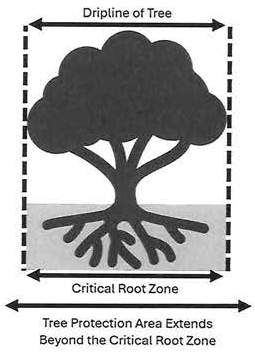
No tree shall be removed in a tree protection area without approval from the City of Sunset Hills. The location of the tree protection areas shall be determined during the establishment of a site-specific ordinance for a planned zoning district or as established on the approved TPP.
b)
The applicant shall not disturb the tree protection area of any tree to be preserved as depicted in the following Figure.
c)
Before construction of any kind the contractor shall place guards, fences, or barriers to prevent injury to the trees to be preserved as depicted on the approved TPP.
d)
Protective fencing shall be installed along the limit of disturbance line that is highly visible to prevent damage to the roots, trunk, and tops of protected trees. This protective fence shall protect the tree and its roots from clearing, grading, soil filling, storage of materials, parking of vehicles, utility installation or other construction activity of any kind.
e)
Should any tree die, or be damaged beyond repair, as a result of grading or construction within a two-year period after cessation of grading or completion of the required improvements, whichever is less, shall constitute default and the City of Sunset Hills shall be entitled to proceed against the tree protection surety.
f)
Sediment and erosion control structures must be used to keep eroded soil from covering roots of protected trees. Siltation screens, etc., are appropriate.
4.19.9
Protection of Private Trees Required to Be Preserved.
1)
Trees that are a required element of an approved plan by the City of Sunset Hills may not be removed unless authorized by the City of Sunset Hills.
2)
The Director of Public Works has the authority to order the removal of trees or shrubs on private property which may endanger life, health, safety, or property of the public.
a)
In the event the owners fail to comply with such provisions, the City shall have the authority to remove such trees and charge the costs of removal as well as any costs for fees to record or release any lien and reasonable administrative costs, as a special assessment represented by a special tax bill against the real property affected, and shall be filed by the City Clerk and deemed a personal debt against the property owner and shall remain a lien on the property until paid.
3)
The Director of Public Works may authorize the removal of street trees for public or private construction projects.
4.19.10
Tree Protection Surety and Escrow Procedures.
1)
Prior to the issuance of any application or permit that authorizes the removal of trees on property in which there are trees that are required to be preserved, a tree protection surety shall be posted to account for trees that die, or are damaged beyond repair, as a result of grading or construction damage. The tree protection surety will remain for two (2) years after the issuance of the cessation of grading or completion of the required improvements, whichever is later.
2)
The amount of the tree protection surety shall be in the amount of ten thousand dollars ($10,000.00) per one hundred (100) linear feet, or portion thereof, of wooded canopy perimeter to be preserved adjacent to any proposed clearing, grading, or other disturbance; or twenty thousand dollars ($20,000.00) per acre to be preserved, whichever is less.
3)
Should any tree die, or be damaged beyond repair, as a result of grading or construction within a two-year period after cessation of grading or completion of the required improvements, whichever is less, the applicant shall be responsible for replacing the tree. Failure to replace shall constitute default and the City of Sunset Hills shall be entitled to proceed against the tree protection surety and monies that account for the total sum of replacement and installation shall be deposited into the City of Sunset Hills Tree Preservation Account.
4)
A tree protection surety is not required for projects or sites that are exempt from the provisions of this Article as described in Exceptions, or for single-family residential lots over two (2) acres in size which are not disturbing any tree mass or as determined by the Director of Public Works.
4.19.11
Request for Modification. In cases where the strict adherence to Preservation Requirements of this Section of the UDO creates practical difficulties or unnecessary hardships in carrying out these provisions due to an irregular shape, topography or other condition of the site requesting the modification, a request for a Modification may be made to the Decision-Making Authority of the appropriate development process as determined in the UDO, provided that the modification will not seriously affect the integrity of this Section.
1)
Special Conditions: To establish that special conditions exist on a site which necessitates a modification to the requirements of this Section of the UDO, information must be submitted which shall include, but not be limited to the following:
a)
Explanation of project qualification which determines a special or unusual site in which the applicant is unable to provide tree preservation in accordance with the UDO requirements due to highly unique and severe circumstance, such as extremely poor quality of trees, extreme topography, unusual lot shape, or other similar condition.
b)
When seeking a modification to the preservation requirement a TSD is required.
c)
An engineering plan and/or drawings which depict and describe that development of the structures, as proposed or authorized, is impracticable because of the unique character or topography of the site which is not generally applicable to other sites.
d)
A statement by a Certified Arborist or a Missouri Landscape Architect stating why in their professional opinion, the development cannot adhere to the requirement based on the explanation provided.
2)
Mitigation Plan: A Request for Modification shall include a Mitigation Plan to off-set the loss of required tree canopy. The Mitigation Plan shall be required to show, at a minimum, the following information and shall be submitted for review and approval by the Decision-Making Authority of the required Tree Preservation Plan.
a)
A landscape plan which displays the name, size, and location of the proposed trees and shrubs to be utilized on the site to mitigate for the required preserved tree canopy.
b)
The number of trees to be installed as part of the mitigation plan shall match the required canopy to be preserved on the site. The number of trees will depend on the species selected and the ultimate tree canopy; based on tree sizes in the City of Sunset Hills Tree List.
i.
Four hundred (400) square feet for large trees.
ii.
Three hundred (300) square feet for medium-sized trees.
iii.
Two hundred (200) square feet for small trees.
c)
A variety of trees from the City of Sunset Hills tree list must be utilized as part of the mitigation plan so that there is a mix of tree species, growth rate and tree size. The mitigation shall include the same proportion of trees with a "large" growth rate as defined in the City of Sunset Hills Tree List that are in the existing overall tree canopy.
d)
All trees at time of installation shall be a minimum 2.5" caliper.
e)
The city encourages the installment of native trees to the State of Missouri.
3)
Modification Approval: The Decision-Making Authority of the development process defined in the City of Sunset Hills UDO will review information provided by the applicant requesting consideration that special conditions exist on the site. The Modification Request will run concurrent with the approval process of the Tree Preservation Plan.
4.19.12
Tree List. The City of Sunset Hills Tree List is a guiding document identifying a common name, variety, mature height and growth rate to be utilized for the many applications of tree installation within the City Limits. Parking Lot information is included as informational only to assist in the correct planting of trees in parking areas.
(Ord. No. 2375, § 2, 12-10-2024)

