
Sunset Hills City Zoning Code
SECTION 5
- USE PROVISIONS
This section is established in recognition that certain uses cannot be treated in the same manner as other uses due to their nature and unique characteristics which may affect public health, safety and welfare; establish a public nuisance; conflict with the character of a neighborhood; impair the social and economic well-being of neighboring properties; impair the general development of an area; or operate in a manner contrary to the intent and purpose of this Ordinance. These uses, when properly placed and regulated, can contribute to the economic vitality of the City. Therefore, it is the purpose of this Section to specify minimum standards that shall be required for certain land uses, in addition to the underlying zoning district regulations, to improve compatibility with neighboring properties and discourage incompatible land uses.
5.1 - Applicability.
The provisions of this Section apply to all Zoning Districts unless indicated otherwise. If there is a conflict between this Section and the individual requirements of the Zoning District, the City Administrator or his/her designee shall determine which standards control.
5.2 - Car Washes.
5.2.1
Location. The facility shall be located on a major or collector street or a frontage road and shall not be located closer than one hundred and twenty feet (120') of a Residential District boundary.
5.2.2
Site Standards.
1)
All car washing facilities shall be within either a completely enclosed building or a canopy structure.
2)
Curb cuts shall not be permitted within ten feet (10') of a side lot line.
3)
The sale of automobile accessories not directly related to the cleaning of automobiles shall be prohibited.
5.2.3
Lighting. All exterior lighting shall comply with Chapter 9 of the Sunset Hills Code of Ordinances and shall not increase the intensity of light within ten feet (10') of a Residential District boundary line by more than 1.5-foot candles.
5.2.4
Building Height. The maximum permitted building height shall be twenty feet (20') or one story whichever is lower.
5.2.5
Site Design Standards. The following minimum site design standards shall be required for the siting and development of any car washes.
5.3 - Cemeteries.
5.3.1
Site Standards.
1)
Water shall be available within four hundred feet (400') of all grave sites.
2)
Trash receptacles shall be located adjacent to internal roadways and not more than two hundred feet (200') apart. No rubbish shall be allowed to accumulate upon the site except within trash receptacles.
3)
Storage of any maintenance machinery or other equipment shall be within completely enclosed buildings.
4)
In addition to compliance with Chapter 9 of the Sunset Hills Code of Ordinances, any security lighting on premises shall be no greater than a residential streetlight (4,000 lumens) and shall have fixtures that direct light away from adjoining residential structures.
5.3.2
Roadways. All roadways shall meet the paving engineering standards established in Section 6.1.3(3).
5.3.3
Building or Structure Height. The maximum permitted height for any building or structure shall be thirty feet (30') or two stories, whichever is lower.
5.3.4
Lot Standards. The following lot standards shall be required for the siting and development of any cemetery.
5.4 - Educational Uses.
5.4.1
Parking. Access to the parking areas shall be located on non-residential streets when possible.
5.4.2
Screening. Playgrounds shall be separated from adjacent residential properties by a Transition Area A as defined in Section 4.2.2. of this Title.
5.4.3
Site Design Standards. The following minimum site design standards shall be required for the siting and development of any educational use.
5.5 - Hospitals.
5.5.1
Parking. Parking areas shall be located no closer than one hundred feet (100') from any residential properties. Access to parking areas shall be located on nonresidential streets, when possible.
5.5.2
Site Design Standards. The following minimum site design standards shall be required for the siting and development of any hospital.
5.6 - Hotels or Motels.
5.6.1
Site Design Standards. The following minimum site design standards shall be required for the siting and development of any hotel or motel.
5.7 - Libraries.
5.7.1
Site Design Standards. The following minimum site design standards shall be required for the siting and development of any library.
5.8 - Motor Vehicle Oriented Businesses.
5.8.1
Site Design Standards. The following minimum site design standards shall be required for the siting and development of any motor vehicle use.
5.8.2
Traffic Study Required. All applicants shall be required to submit a traffic impact study or analysis. Such traffic impact study or analysis shall be performed by the City's contracted traffic engineer. The applicant shall be required to deposit with the City an amount estimated by the Public Works Director or his/her designee to reimburse the City for the cost of such traffic impact study or analysis.
5.8.3
Used Oil Storage. All used oil and other similar materials shall be stored only in underground or indoor areas.
5.8.4
Vehicular Areas.
1)
The entire area used by vehicles for parking, storage, service, etc. shall be paved with asphaltic concrete, concrete, Portland cement, or other material approved by the Public Works Director.
2)
A raised curb shall be placed at the edge of all pavements.
3)
All hydraulic hoists, pits, lubrication, washing, repair, and service, not of an emergency nature shall be conducted entirely within a building.
5.8.5
Ingress and Egress.
1)
The minimum width of driveways at the property line shall be twenty-four feet (24'), and the maximum shall be fifty feet (50').
2)
The minimum distance of any driveway to any side property line shall be twenty-four feet (24'). This distance shall be measured from the side property line to the intersection of the street right-of-way and the edge of the driveway.
3)
Driveway openings shall be limited to one drive per one hundred feet (100') of lot frontage. For parcels with frontage on more than one street the number of driveway openings shall be based on the frontage length on each street individually.
4)
The minimum distance a driveway into the site from a street intersection shall be thirty feet (30') measured from the intersection of the street rights-of-way to the nearest end of the curb radius of the proposed driveway.
5)
The angle of driveway intersection with the street shall be based upon reasonable criteria for safe traffic movements and shall be approved by the Director of Public Works Director.
6)
Motor vehicle uses adjacent to or integrated in a shopping center or cluster of commercial facilities shall use the common access with other business establishments in that center.
5.8.6
Storage of Flammable Materials. Flammable materials used in the conduct of motor vehicle uses when stored above ground, shall be stored within the building setback lines. All storage of flammable materials shall be subject to the approval of the appropriate fire district.
5.8.7
Lighting. All exterior lighting shall comply with Chapter 9 of the Sunset Hills Code of Ordinances and shall not increase the intensity of light within ten feet (10') of a Residential District boundary line by more than 1.5-foot (1.5') candles.
5.9 - Temporary Portable Outdoor Storage Units.
Temporary Portable Outdoor Storage Units are permitted accessory uses in residential districts, subject to the following restrictions.
5.9.1
Permit Required. A permit shall be obtained prior to the setting of the temporary portable outdoor storage unit on the property. A site drawing shall be submitted showing the location on the property where the unit will be placed, size of the unit, and distance to all applicable property lines and all other buildings and structures.
5.9.2
Size. No temporary portable outdoor storage unit shall be greater than twenty feet (20') in length, eight feet (8') in width, or eight feet (8') in height.
5.9.3
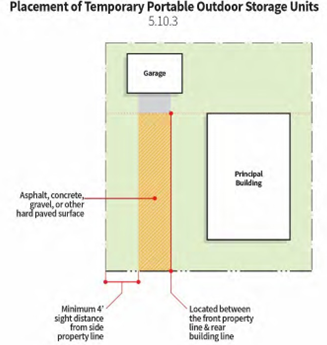
Placement. The temporary portable outdoor storage unit cannot encroach on City property, City right-of-way, neighboring property, sidewalk, or be placed in the street. The unit must be sited on asphalt, concrete, gravel, or hard paved surface between the front property line and the rear building line of the principal structure. The visual distance between the portable temporary storage unit and the side yard property line is four feet (4') or upon the approval by the Public Works Director or his/her designee and as agreed upon by written consent by the neighboring property owner.
5.9.4
Duration. Temporary portable outdoor storage units may be placed in a residential district for no more than 30 days in any consecutive 12-month period. Extensions beyond the 30-day limit may be granted by the Public Works Director or his/her designee.
5.9.5
Number of Units. A maximum of one temporary portable outdoor storage unit is permitted on a lot.
5.9.6
Signage. A temporary portable outdoor storage unit shall have no signage other than the name, address, and telephone number of the person or firm engaged in the business of renting or otherwise placing the temporary portable outdoor storage unit.
5.10 - Drive-Through Facility.
The following provisions shall be applicable to any use with a drive-through facility.
5.10.1
Traffic Study Required. All applicants shall be required to submit a traffic impact study or analysis. Such traffic impact study or analysis shall be performed by the City's contracted traffic engineer. The applicant shall be required to deposit with the City an amount estimated by the Public Works Director or his/her designee to reimburse the City for the cost of such traffic impact study or analysis.
5.11 - Marijuana Businesses.
The purpose of this section is to regulate the placement and licensing of Facilities for the dispensing, selling, cultivating, manufacturing, storing, researching, transporting, and testing of Marijuana and Marijuana-Infused Products, only to the extent permitted by the Missouri Constitution, applicable statutes enacted by the general assembly, and rules and regulations promulgated by the Department, and to protect the health, safety, and welfare of the residents, businesses, and property owners in the City.
5.11.1
Odor and Nuisance Regulations. No Marijuana Business, related use, or activity shall emit an odor or in any way cause a public nuisance per Chapters 7, 24, or 27 of the Code of Ordinances of the City. Every Marijuana Business shall have and maintain an odor control system at least as stringent as that which is required by State regulations and shall at all times operate in compliance with all provisions of Section 4.12, "Performance Standards," of this Unified Development Ordinance and Chapters 7, 24, or 27 of the Code of Ordinances of the City. Additional ventilation systems to prevent any odor of Marijuana or fumes from leaving the Facility or other changes to the Facilities can be required if a public nuisance violation occurs.
5.11.2
Total Number. No more than a total of three (3) of each type of Marijuana Businesses will be allowed within the City limits.
5.11.3
Spacing. Each Marijuana Business shall be located on properties that meet the following distance requirements:
1)
No Medical Marijuana Dispensary Facility shall be operated or maintained within five hundred (500) feet of any then-existing Elementary or Secondary School, Day-Care Center, or Church.
2)
No then-existing Marijuana Business, except not including Medical Dispensary, shall be operated or maintained within one thousand (1,000) feet of any Elementary or Secondary School, Child Day-Care Center, or Church.
3)
No Marijuana Business shall be operated or maintained within one thousand five hundred (1,500) feet of another marijuana related use except when marijuana sales represents less than five (5) percent of the dollar volume of business in a state or federally licensed pharmacy. Marijuana related uses under the same ownership and on the same property are exempt from this requirement.
4)
For the purposes of this Section, "then-existing" shall mean any use with a building permit from the City to be constructed, or under construction, or completed and in use at the time the Marijuana Business applies for zoning authorization.
5)
For purposes of this Section, the above spacing requirement shall be measured as follows:
a.
In the case of a freestanding Facility, the distance between the Facility and the Elementary or Secondary School, Daycare, or Church shall be measured from the external wall of the Facility structure closest in proximity to the Elementary or Secondary School, Daycare, or Church to the closest point of the Property Line of the Elementary or Secondary School, Daycare, or Church. If the Elementary or Secondary School, Daycare, or Church is part of a larger structure, such as an office building or strip mall, the distance shall be measured to the entrance or exit of the Elementary or Secondary School, Daycare, or Church closest in proximity to the Facility.
b.
In the case of a Facility that is part of a larger structure, such as an office building or strip mall, the distance between the Facility and the Elementary or Secondary School, Daycare, or Church shall be measured from the Property Line of the Elementary or Secondary School, Daycare, or Church to the Facility's entrance or exit closest in proximity to the Elementary or Secondary School, Daycare, or Church. If the Elementary or Secondary School, Daycare, or Church is part of a larger structure, such as an office building or strip mall, the distance shall be measured to the entrance or exit of the Elementary or Secondary School, Daycare, or Church closest in proximity to the Facility.
c.
Measurements shall be made along the shortest path between the demarcation points that can be lawfully traveled by foot.
5.11.4
Visibility. No Marijuana or Marijuana Products shall be displayed to be visible through glass, windows, doors, or otherwise by a person of normal visual acuity standing at the outside perimeter of the Facility.
5.11.5
Alcohol Prohibition. The sale or consumption of alcohol within a Marijuana Business is prohibited.
5.11.6
Minors. No person under the age of eighteen (18) shall be allowed in any portion of a Marijuana Business except a Dispensary Facility in which case the minor must remain in the waiting area. The entrance to a Facility shall be clearly and legibly posted with notice indicating that persons under the age of eighteen (18) are precluded from entering the premises.
5.11.7
Marijuana Allowance. A Marijuana Dispensary shall not dispense more than the allowed amount of Marijuana in a thirty-day period to a Caregiver, Qualifying Patient, or Consumer in accordance with Article XIV of the Missouri Constitution and the Department's rules and regulations. Such packaging shall have a label that indicates the quantity and advises the purchaser that any resale or redistribution to any third person is a criminal violation, and otherwise comply with all the rules and regulations for packaging established by the Department.
5.11.8
On-site Usage Prohibited. No Marijuana or Marijuana Products may be smoked, ingested, or otherwise consumed or Administered on the premises of any Marijuana Business, except that a Marijuana Testing Facility or Marijuana Research Facility may consume Marijuana during the testing or research process only as the consumption relates to the testing or research process.
5.11.9
Security Plans. Marijuana Businesses shall provide adequate security on the premises at least as stringent as required by the Department's rules and regulations including, but not limited to, the following:
1)
Surveillance. Security surveillance cameras installed to monitor each entrance to the Facility along with the interior and exterior of the premises to discourage and to facilitate the reporting and investigation of criminal acts and nuisance activities occurring at the premises. Security video shall be preserved for at least ninety (90) days and be made available to law enforcement officers upon demand.
2)
Inventory. All salable inventory of Marijuana must be kept and stored in a secured, locked manner.
3)
Safe. A locking safe or secure vault permanently affixed or built into the premises to store any currency on-site.
4)
Alarm system. Professionally monitored robbery alarm and burglary alarm systems shall be installed and maintained in good working condition within the Facility at all times.
5)
Emergency contact. Each Facility shall provide the chief of police with the name, cellular telephone number, electronic mail address, and facsimile number of an on-site Facility employee to whom the City may provide notice of any operating problems associated with the Facility. It shall be the responsibility of the licensee to keep up to date the contact information of the Facility employee.
5.11.10
Signage.
1)
A sign for a Marijuana Business shall comply with the requirements of this Ordinance, or any Ordinance enacted hereafter regulating signs. Signage shall comply with the rules and regulations of the Department and all outdoor signs or advertising may not display any text other than the Facility's business name or trade name, address, phone number, website, and directional signage, to the extent allowed by law.
2)
A sign for a Marijuana Business shall be located on the same premises as the facility.
5.11.11
Parking and Access. Each Facility shall provide off-street parking and comply with all Parking and access regulations for the use and the zoning district in which the Facility is located.
5.11.12
City Business License. Each Facility shall at all times possess a current City business license. By obtaining a City business license, the Facility licensee irrevocably consents to the immediate closure and cessation of operation of the Facility in addition to all other penalties or remedies available by law for the failure to comply with all applicable ordinances and policies of the City or possess a current City business license.
5.11.13
License. No Marijuana Business shall be operated within the City without a valid license and any other required authorization issued by the Department. No Marijuana or Marijuana Products shall be acquired, certified, cultivated, delivered, manufactured, Administered, processed, sold, stored, tested, researched, or transported within the City, except by persons or entities licensed for such purposes by the Department and in accordance with the Department's rules and regulations. Continued operation in the City shall always require such license to remain valid. The applicable license shall be on display at every Marijuana Business in accordance with the state regulations.
5.11.14
Additional Rules for Marijuana Businesses.
1)
General. No structure or area of land shall be constructed, altered, or used for a Marijuana Business without complying with all appliable rules, regulations, and ordinances of the City, including the requirements of the district for which the Facility is located, Article XIV of the Missouri Constitution requirements and limitations, and the applicable rules and regulations of the Department, including, but not limited to, lighting, parking, amount of Flowering Plants, waste disposal, inventory control systems and procedures, and environmental factors including air supply filtered through high-efficiency particulate air filters.
2)
Cultivation Facility. The following additional rules shall apply to a Medical Marijuana Cultivation Facility or a Comprehensive Marijuana Cultivation Facility:
a.
All operations and all storage of materials, products, or equipment shall be within a fully secured area inside the main building or outside of the main structure in a separate, fully secured, and enclosed structure.
b.
Medical Marijuana Cultivation Facility or a Comprehensive Marijuana Cultivation Facility may be: (1) a completely indoor Facility and growing operation; (2) a completely outdoor Facility and/or growing operation; or (3) a "greenhouse"/hybrid method Facility and growing operation so long as such operation complies with all regulations of the district, all regulations of this Section and applicable ordinances, all applicable regulations of Article XIV of the Missouri Constitution, and any rules or regulations of the Department relating to Marijuana.
3)
Dispensary Facilities. The following additional rules shall apply to Dispensary Facilities:
a.
No outdoor operation or storage shall be allowed.
b.
The waiting area and the area of a Dispensary Facility where Marijuana or Marijuana Products are physically delivered to a Qualifying Patient, Primary Caregiver, or Consumer shall be separated by a solid wall and solid door so that persons in the waiting area are obstructed from observing the delivery of the Marijuana or Marijuana Products to the Qualifying Patient, Primary Caregiver, or Consumer. No loitering will be permitted at any Facility.
c.
Marijuana Accessories may be lawfully sold at a Dispensary Facility but shall not be publicly displayed.
d.
Dispensaries can be on the same property as a Medical Marijuana Cultivation Facility or a Comprehensive Marijuana Cultivation Facility, a Medical Marijuana-Infused Products Manufacturing Facility, Microbusiness Wholesale Facility, or a Marijuana Testing Facility but are not permitted to be within the same building as any other Marijuana related use.
e.
A Comprehensive Marijuana Dispensary Facility and Microbusiness Dispensary Facility may only be allowed after application for and approval of a Conditional Use Permit in accordance with the provisions of Section 8.
f.
As part of the Conditional Use Permit application for a Comprehensive Marijuana Dispensary Facility or Microbusiness Dispensary Facility, the applicant shall submit the estimated number of customers expected per hour or day, estimated peak times, the total number of parking spaces, description of the access to the Facility, and justification statement that the desired location has adequate parking and access to meet the expected foot and vehicle traffic without negatively impacting neighboring properties. The City may require additional conditions to address any traffic or parking concerns based on the justification statement and layout of the Facility and surrounding area and properties.
g.
Dispensary Facilities must follow all requirements found in Section 4.1 and obtain a Conditional Use Permit to utilize a drive-through. As part of the Conditional Use Permit process, the Board of Aldermen or Planning and Zoning Commission may require additional queuing or other conditions related to the drive through Facility to ensure the public safety is protected and the surrounding properties are not negatively affected.
4)
Manufacturing Facilities. For a Medical Marijuana-Infused Products Manufacturing Facility, Microbusiness Wholesale Facility, or Comprehensive Marijuana-Infused Products Manufacturing Facility ("Manufacturing Facility"), the operations and all storage of materials, products, or equipment shall be within a fully secured area inside the main building structure or outside of the main structure in a separate, fully secured, and enclosed structure.
5)
Marijuana Testing and Marijuana Research Facilities. All Marijuana Testing and Marijuana Research Facilities shall at all times maintain in good standing their accreditation as required by State regulations and utilize standards, procedures, and safety requirements for personnel and for the testing and research of Marijuana, which are at least as stringent as those which are required by State regulations.
6)
Transportation Facilities. All Transportation Facilities shall comply with all applicable rules and regulations promulgated by the Department regarding transportation of Marijuana including, but not limited to, security systems and requirements, transportation deadlines and locations, and GPS tracking.
5.11.15
Application review process.
1)
Site review permit. This preliminary permit reviews the proposed Marijuana related use for compliance with the City's zoning and location standards prior to issuance of an occupancy permit. A draft of proposed security and floor plans should also be provided. Site review approval shall expire, and be of no effect, one (1) year after the date of issuance thereof. Site review and approval shall be conducted administratively.
2)
Operating plans. As a condition of processing of a business license application, an applicant shall provide at the time of filing the business license application a detailed operations plan and, upon issuance of a license, shall operate the Facility in accordance with the plan. Such plan shall include:
a.
Floor plan. A plan showing the layout of the Facility and the principal uses of the floor area depicted. A Dispensary Facility shall have a lobby waiting area at the entrance to the center to receive clients, and a separate and secure designated area for dispensing Marijuana to Qualified Patients, Designated Primary Caregivers, or Consumers. The primary entrance of any stand-alone Facility shall be located and maintained clear of barriers, landscaping, and similar obstructions so that it is clearly visible from public streets, sidewalks, or site driveways. All storage areas shall be shown and labeled.
b.
Odor controls. A Facility shall provide a plan for the mitigation and control of odors and other environmental impacts which may emanate from the Facility. Such plan shall describe the ventilation system for the Facility in compliance with the regulations of this Section and the Department.
3)
Business license. Once a state licensing has been received, the business license shall include all relevant state approvals and approved operating plans and security plans.
5.11.16
Home Occupation; Accessory Cultivation Use. It shall be unlawful for any person to distribute, transmit, give, dispense, or otherwise provide medical marijuana as a home occupation. A person holding a current, valid Marijuana Cultivation Identification Card issued by the State of Missouri may have as an Accessory Use Marijuana Cultivation as permitted by Article XIV of the Missouri Constitution so long as all of the following conditions are met:
1)
The Accessory Use must take place only in a Facility that is enclosed, locked, and equipped with security devices (the "Cultivation Area"), and in conformance with all federal and Missouri laws and regulations. Consumer personal Cultivation, Qualifying Patient, and Primary Caregiver Cultivation shall not take place at a place of business.
2)
The State-issued Marijuana Cultivation Identification Card must be clearly displayed within the Cultivation Area and in close proximity to the Marijuana plants.
3)
The Accessory Use must have an odor control system that is at least as stringent as that which is required by State regulations.
4)
A Qualifying Patient may not hold or obtain both a Qualifying Patient Cultivation Identification Card and a Consumer personal Cultivation card at the same time, regardless if the caregiver holds a Cultivation Identification Card on behalf of the Qualified Patient.
5)
All Marijuana cultivation must cease immediately upon the expiration, suspension, or revocation of a State-issued Marijuana Cultivation Identification Card.
6)
Nothing in this Section shall convey or establish a right to cultivate Marijuana in a Facility or site where state or federal law or a private contract would otherwise prohibit doing so.
7)
The following additional rules shall apply to Consumer personal Cultivation:
a.
All Consumer personal Cultivation must take place at a private residence.
b.
One Consumer may not cultivate more than six (6) Flowering Plants, six (6) nonflowering plants fourteen (14) inches tall or more, and six (6) nonflowering plants under fourteen (14) inches tall subject to the limitations herein, Article XIV of the Missouri Constitution, and rules and regulations of the Department.
c.
No more than twelve (12) Flowering Plants, twelve (12) nonflowering plants fourteen (14) inches tall or more, and twelve (12) nonflowering plants under fourteen (14) inches tall may be cultivated by Consumers at a single private residence, regardless of the number of Consumers who live at that private residence subject to the limitations herein, Article XIV of the Missouri Constitution, and rules and regulations of the Department.
d.
Plants and Marijuana produced by the plants in excess of three (3) ounces must be kept at a private residence in an Enclosed, Locked Facility.
e.
All cultivated Flowering Plants in the possession of a Consumer shall be clearly labeled with the Consumer's name.
8)
The following additional rules shall apply to Qualifying Patient Cultivation:
a.
One (1) Qualifying for personal Cultivation, may cultivate up to six (6) Flowering Plants and six (6) non-flowering Marijuana plants fourteen (14) inches tall or more, and six (6) nonflowering plants under fourteen (14) inches tall at any given time in a Cultivation Area, subject to the limitations herein, Article XIV of the Missouri Constitution, and rules and regulations of the Department.
b.
Two (2) Qualifying Patients, who both hold valid Medical Marijuana Cultivation Identification Cards, may share one (1) Cultivation Area but no more than twelve (12) Flowering Plants and twelve (12) non-flowering Marijuana plants fourteen (14) inches tall or more, and twelve (12) non-flowering Marijuana plants under fourteen (14) inches tall may be cultivated in a Cultivation Area, subject to the limitations herein, Article XIV of the Missouri Constitution, and rules and regulations of the Department.
c.
Under no circumstances shall a Qualifying Patient be entitled to cultivate, or have cultivated on his or her behalf, more than six (6) Flowering Plants.
d.
Only one individual in a patient-caregiver relationship may be authorized for Cultivation on behalf of the Qualifying Patient.
e.
All cultivated Flowering Plants in the possession of a Qualifying Patient or Primary Caregiver shall be clearly labeled with the Qualifying Patient's name.
9)
The following additional rules shall apply to Primary Caregiver Cultivation:
a.
One (1) Primary Caregiver may cultivate up to six (6) Flowering Plants and six (6) non-flowering Marijuana plants fourteen (14) inches tall or more, and six (6) nonflowering plants under fourteen (14) inches tall for one (1) Qualifying Patient, subject to the limitations herein, Article XIV of the Missouri Constitution, and rules and regulations of the Department.
b.
A Primary Caregiver may cultivate on behalf of more than one (1) Qualifying Patient and may utilize one or more Cultivation Area(s).
c.
No Primary Caregiver cultivating Marijuana for more than one Qualifying Patient may exceed a total of twenty-four (24) Flowering Plants, twenty-four (24) nonflowering plants fourteen (14) inches tall or more, and twenty-four (24) nonflowering plants under fourteen (14) inches tall, subject to the limitations herein, Article XIV of the Missouri Constitution, and rules and regulations of the Department.
d.
Only one individual in a patient-caregiver relationship may be authorized for Cultivation on behalf of the Qualifying Patient.
e.
All cultivated Flowering Plants in the possession of a Primary Caregiver shall be clearly labeled with the Qualifying Patient's name.
f.
A Primary Caregiver cultivator who is also authorized as a Qualifying Patient cultivator may grow the plants that belong to them as a Qualifying Patient cultivator, and the plants grown on behalf of their Qualifying Patient(s) using the same Cultivation Area.
g.
A Primary Caregiver cultivator who is also authorized as a Consumer personal cultivator may not grow the plants that belong to them as an authorized Consumer personal cultivator and the plants grown on behalf of their Qualifying Patient(s) using the same Cultivation Area.
5.11.17
Definitions. As used in this Section, the following terms shall mean:
ADMINISTER. The direct application of Medical Marijuana to a Qualifying Patient, to the extent allowed by and pursuant to the terms of Article XIV, Section 1 of the Missouri Constitution, by way of any of the following methods:
(1)
Ingestion of capsules, teas, oils, and other Marijuana-Infused Products;
(2)
Vaporization or smoking of dried flowers, buds, plant material, extracts, oils, and other Marijuana-Infused Products;
(3)
Application of ointments or balms;
(4)
Transdermal patches and suppositories;
(5)
Consuming Marijuana-Infused food Products;
(6)
Any other method recommended by a Qualifying Patient's Physician or Nurse Practitioner as authorized by Article XIV, Section 1 of the Missouri Constitution.
CHURCH. A permanent building primarily and regularly used as a place of religious worship.
COMPREHENSIVE MARIJUANA CULTIVATION FACILITY. A Facility licensed by the Department where Cultivation operations for Medical or adult use occur. A Comprehensive Marijuana Cultivation Facility need not segregate or account for its Marijuana Products as either non-Medical Marijuana or Medical Marijuana.
COMPREHENSIVE MARIJUANA DISPENSARY FACILITY. A Facility licensed by the Department where Marijuana Product is dispensed for Medical or adult use. Comprehensive Dispensary Facilities may receive transaction orders at the Dispensary directly from the Consumer in person, by phone, or via the internet, including from a third party. A Comprehensive Marijuana Dispensary Facility need not segregate or account for its Marijuana Products as either non-Medical Marijuana or Medical Marijuana but shall collect all appropriate tangible personal property sales tax for each sale, as set forth in Article XIV and provided for by general or local law.
COMPREHENSIVE MARIJUANA-INFUSED PRODUCTS MANUFACTURING FACILITY. A Facility licensed by the Department where Marijuana-Infused Products and Prerolls are manufactured for Medical or adult use. A Comprehensive Marijuana-Infused Products Manufacturing Facility need not segregate or account for its Marijuana Products as either non-Medical Marijuana or Medical Marijuana.
CONSUMER. Someone at least twenty-one (21) years of age.
CULTIVATION. As related to activity authorized pursuant to Article XIV of the Missouri Constitution and all rules and regulations issued by the Department, the process by which a person, business, or legal Entity promotes the germination and growth of a seed to a mature Marijuana plant.
DAYCARE. A child-care facility, as defined by section 210.201, RSMo. or successor provisions that is licensed by the State of Missouri.
DEPARTMENT. The Missouri Department of Health and Senior Services, or its successor agency.
DISPENSARY FACILITY. A Medical Marijuana Dispensary Facility, a Comprehensive Marijuana Dispensary Facility, or a Microbusiness Dispensary Facility.
ELEMENTARY OR SECONDARY SCHOOL. A public school as defined in section 160.011, RSMo, or any private school giving instruction in a grade or grades not higher than the twelfth grade, including any property owned by the public or private school that is regularly used for extracurricular activities, but does not include any private school in which education is primarily conducted in private homes.
ENCLOSED, LOCKED FACILITY. (A) A stationary, fully enclosed, locked space equipped with functioning security devices that permit access to only the Consumer(s), Qualifying Patient(s), or Primary Caregiver(s) who have informed the Department that this is the space where they will Cultivate Marijuana; and (B) the plants within the Enclosed, Locked Facility must not be visible to the unaided eye from a public space.
ENTITY. A natural person, corporation, professional corporation, nonprofit corporation, cooperative corporation, unincorporated association, business trust, limited liability company, general or limited partnership, limited liability partnership, joint venture, or any other legal entity.
FACILITY. The physical structure(s), including strip malls, and the premises on which the physical structures are located which are used by a licensed or certified Entity to perform its licensed or certified functions, whether the Entity is licensed or certified as a Medical Facility, Research Facility, or a Marijuana Facility.
FLOWERING PLANT. A Marijuana plant from the time it exhibits the first signs of sexual maturity through harvest.
IDENTIFICATION CARD. A document, whether in paper or electronic format, issued by the Department that authorizes a Consumer cultivator, Qualifying Patient, Primary Caregiver, or facility agent to access Marijuana as provided by law.
INFUSED PREROLL. A consumable or smokable Marijuana Product, generally consisting of: (1) a wrap or paper, (2) dried Flower, buds, and/or plant material, and (3) a concentrate, oil, or other type of Marijuana extract, either within or on the surface of the product. Infused Prerolls may or may not include a filter or crutch at the base of the product.
MARIJUANA OR MARIHUANA. means Cannabis indica, Cannabis sativa, and Cannabis ruderalis, hybrids of such species, and any other strains commonly understood within the scientific community to constitute Marijuana, as well as resin extracted from the plant and Marijuana-Infused Products. "Marijuana" or "Marihuana" does not include industrial hemp as defined by Missouri statute, or commodities or products manufactured from industrial hemp.
MARIJUANA ACCESSORIES. Any equipment, product, material, or combination of equipment, products, or materials, which is specifically designed for use in planting, propagating, cultivating, growing, harvesting, manufacturing, compounding, converting, producing, processing, preparing, testing, analyzing, packaging, repackaging, storing, containing, ingesting, inhaling, or otherwise introducing Marijuana into the human body.
MARIJUANA BUSINESS. A Marijuana Facility, a Medical Facility, and a Marijuana Research Facility.
MARIJUANA FACILITY. A Comprehensive Marijuana Cultivation Facility, Comprehensive Marijuana Dispensary Facility, Marijuana Testing Facility, Transportation Facility, Comprehensive Marijuana-Infused Products Manufacturing Facility, Microbusiness Wholesale Facility, Microbusiness Dispensary Facility, or any other type of Marijuana-related facility or business licensed or certified by the Department but shall not include a Medical Facility or Marijuana Research Facility.
MARIJUANA-INFUSED PRODUCTS. Products that are infused, dipped, coated, sprayed, or mixed with Marijuana or an extract thereof, including, but not limited to, products that are able to be vaporized or smoked, edible products, ingestible products, topical products, suppositories, and Infused Prerolls.
MARIJUANA PRODUCT. Marijuana, Marijuana-Infused Products, or other products made using Marijuana, including Prerolls, unless otherwise provided for in the Department's rules.
MARIJUANA RESEARCH FACILITY. A Facility licensed by the Department where activities intended to facilitate scientific research or education related to Marijuana Product occur.
MARIJUANA TESTING FACILITY. A Facility certified by the Department to acquire, test, certify, and transport Marijuana, including those originally licensed as a Medical Marijuana Testing Facility.
MARIJUANA TRANSPORTATION FACILITY. A Facility certified by the Department to house operations involving the transport of Marijuana Product from a Marijuana Facility or Medical Facility; or to a Qualifying Patient, Primary Caregiver, or Consumer.
MEDICAL FACILITY. Any Medical Marijuana Cultivation Facility, Medical Marijuana Dispensary Facility, or Medical Marijuana-Infused Products Manufacturing Facility.
MEDICAL MARIJUANA CULTIVATION FACILITY. A facility licensed by the Department to engage in the process of Cultivating Marijuana that is limited to Medical Use at a Medical Marijuana Cultivation Facility. A Medical Marijuana Cultivation Facility's authority to process Marijuana shall include the production and sale of Prerolls but shall not include the manufacture of Marijuana-Infused Products.
MEDICAL MARIJUANA DISPENSARY FACILITY. A Facility licensed by the Department where Marijuana is dispensed only for Medical Use. Medical Marijuana Dispensary Facilities may receive transaction orders at the dispensary in person, by phone, or via the internet, including from a third party. A Medical Marijuana Dispensary Facility's authority to process Marijuana shall include the production and sale of Prerolls but shall not include the manufacture of Marijuana-Infused Products.
MEDICAL MARIJUANA-INFUSED PRODUCTS MANUFACTURING FACILITY. A Facility licensed by the Department where Marijuana-Infused Products and Prerolls are manufactured only for Medical Use.
MEDICAL USE. The production, possession, delivery, distribution, transportation, or administration of Marijuana or a Marijuana-Infused Product, or Marijuana Accessories used to Administer Marijuana or a Marijuana-Infused Product as provided by Article XIV, Section 1 of the Missouri Constitution, for the benefit of a Qualifying Patient to mitigate the symptoms or effects of the patient's qualifying medical condition as defined in Missouri State law.
MICROBUSINESS DISPENSARY FACILITY. A Facility licensed by the Department to engage in the process of dispensing Marijuana for Medical Use or adult use. Microbusiness Dispensary Facilities may receive transaction orders at the dispensary directly from the Consumer in person, by phone, or via the internet, including from a third party. A Microbusiness Dispensary Facility's authority to process Marijuana shall include the creation of Prerolls.
MICROBUSINESS WHOLESALE FACILITY. A Facility licensed by the Department to where Marijuana Cultivation operations for Medical or adult use occur and/or where Marijuana-Infused Products and Prerolls are manufactured for Medical Use or adult use. A Microbusiness Wholesale Facility may cultivate up to Two Hundred and Fifty (250) Flowering Plants at any given time. A Microbusiness Wholesale Facility's authority to process Marijuana shall include the creation of Prerolls and Infused Prerolls.
NURSE PRACTITIONER. An individual who is licensed and in good standing as an advanced practice registered nurse, or successor designation, under Missouri law.
PHYSICIAN. An individual who is licensed and in good standing to practice medicine or osteopathy under Missouri law.
PREROLL. A consumable or smokable Marijuana Product, generally consisting of: (1) a wrap or paper and (2) dried Flower, buds, and/or plant material. Prerolls may or may not include a filter or crutch at the base of the product.
PRIMARY CAREGIVER. An individual twenty-one (21) years of age or older who has significant responsibility for managing the well-being of a Qualifying Patient and who is designated as such under the rules and regulations of the Department and possesses a Department issued Primary Caregiver or Primary Caregiver Cultivation Identification Card.
QUALIFYING PATIENT. An individual diagnosed with at least one (1) qualifying medical condition as defined in Missouri State law and possessing a Department issued Qualifying Patient or Qualifying Patient Cultivation Identification Card.
TRANSPORTATION FACILITY. A Facility certified by the Department to house operations involving the transport of Marijuana Product from a Marijuana Facility or Medical Facility, or to a Qualifying Patient, Primary Caregiver, or Consumer.
(Ord. No. 2280, § 4, 3-14-2023)
Editor's note— Ord. No. 2280, § 4, adopted Mar. 14, 2023, amended § 5.11 in its entirety to read as herein set out. Former § 5.11 §§ 5.11—5.11.19 was entitled "Medical marijuana," and derived from Ord. No. 2256, adopted Sept. 13, 2022.
5.12 - Wireless Communications Facilities Code.
5.12.0
Purposes: The general purpose of this section is to regulate the placement and construction of Wireless Communications Facilities to protect the health, safety, and welfare of the public, while at the same time not unreasonably interfering with the development of the competitive wireless telecommunications marketplace in the City of Sunset Hills. Specifically, this Section is intended to:
(A)
Provide for the appropriate location and deployment of wireless communications infrastructure to serve citizens and businesses in the City of Sunset Hills and the metropolitan St. Louis area;
(B)
Minimize adverse visual impacts of Wireless Communication Facilities through the careful design, siting, landscape screening, and innovative camouflaging techniques;
(C)
Ensure that any new Support Structure is located in an area compatible with the neighborhood or surrounding community to the extent possible; and
(D)
Comply with applicable laws and enable the City of Sunset Hills to discharge its public trust consistent with the evolving Federal and State regulatory policies, industry competition and technological development.
5.12.1
Applicability; self-preemption: Notwithstanding any ordinance to the contrary, the procedures set forth in this Section shall be applicable to all Wireless Communications Facilities existing or installed, built or modified after the effective date of this Section to the fullest extent permitted by law. No provision of this Section shall apply to any circumstance in which such application shall be unlawful under superseding federal or state law and furthermore, if any section, subsection, sentence, clause, phrase, or portion of this Section is now or in the future superseded or preempted by state or federal law or found by a court of competent jurisdiction to be unauthorized, such provision shall be automatically interpreted and applied as required by law.
5.12.2
Time Limits, fees, and application requirements:
(A)
Time limits: All applications regarding Wireless Communication Facilities shall be processed in accordance with the time limits established by applicable law.
(B)
Fees: Fees for applications regarding Wireless Communication Facilities shall be established by the Director to at least partly cover the City's costs to review and process such applications but shall not exceed the limits established by applicable law.
(C)
Applications and proof of owner consent: Applications pursuant to this Section shall be subject to the supplementary procedures in this Section. Applications shall be submitted to the City as a complete application on forms provided by the City. A "complete application" shall be an application submitted on the forms provided by the City, fully executed by the Applicant, identifying the specific approval sought, and containing all attachments, the established fees, and information as required thereon or by the City, consistent with this Section. Applications shall also require proof of landlord consent, which shall minimally include:
i.
Written consent to pursue the application by all fee simple owners of the underlying real estate (or where located in street Right-of-Way, the Right-of-Way owner thereof), including when the proposed location is also in a utility easement; and
ii.
Written consent to pursue the application, of the owner of the structure on which such facility is to be placed, if different than Applicant.
5.12.3
Definitions: As used in this Section, the following terms shall have the meanings and usages indicated:
AGL: Above ground level. Ground level shall be determined by the average elevation of the natural ground level within a radius of fifty (50) feet from the center location of measurement.
Antenna: Any device that transmits or receives wireless radio waves for voice, data, or video communications purposes including but not limited to, television, AM/FM radio, texts, microwave, cellular telephone and similar forms of communications services. The term shall exclude satellite earth station antenna less than two (2) meters in diameter (mounted within twelve (12) feet of the ground or building-mounted) and any receive-only home television antenna.
Applicant: Any person who submits an application for any approval provided for in this Section.
Building Permit: The City's municipal zoning approval issued to St. Louis County.
Cabinet: A structure for the protection and security of equipment associated with one (1) or more Antenna where direct access to equipment is provided from the exterior and that has horizontal dimensions that do not exceed four feet (4') by six feet (6'), and vertical height that does not exceed six feet (6').
Director: The director of public works of the City or his/her designee.
Disguised Support Structure: Any freestanding, manmade structure designed for the support of Wireless Communication Facilities, the presence of which is camouflaged or concealed as an appropriately-placed architectural or natural feature. Such structures may include but are not limited to clock towers, freestanding bell towers, observation towers, water towers, light standards, flag poles, and artificial trees. For purposes of this definition, a structure "camouflaged or concealed as an appropriately-placed and designed architectural or natural feature" shall mean:
1.
It is consistent with and contributes to and does not detract from the character and property values and use of the area and neighborhood in which it is located;
2.
It does not contain distorted proportions, size, or other features not typically found on the type of structure or feature to which it is designed to replicate;
3.
It cannot be identified as a Support Structure by persons with reasonable sensibilities and knowledge;
4.
Its equipment, accessory buildings, or other aspects or attachments relating to the Disguised Support Structure are wholly concealed using a manner consistent with and typically associated with the architectural or natural structure or feature being replicated; and
5.
It is of a height, design, and type that would ordinarily occur at the location and neighborhood selected.
Electrical Transmission Tower: An Electrical Transmission Structure used to support high voltage overhead power lines. The term shall not include any utility pole.
Existing Structure: Any structure capable of supporting Wireless Communication Facilities (other than a Support Structure) in full conformance with the design and other requirements of this Section and is: (1) existing prior to the date of all applicable applications seeking City authorization for installation of such facilities thereon and (2) not built or installed in anticipation of such specific installation or erected as a means to evade approvals applicable to a non-existing structure.
FAA: The Federal Aviation Administration.
FCC: The Federal Communications Commission.
Height: The vertical distance measured from the average grade of the base of the structure at ground level to its highest point and including the main structure and all attachments thereto.
Shelter: A building for the protection and security of equipment associated with one (1) or more Antenna and where access to equipment is gained from the interior of the building. Human occupancy for office or other uses or the storage of other materials and equipment not in direct support of the connected Antenna is prohibited.
Small Wireless Facility: An Antenna and associated equipment that meets the following:
1.
An Antenna of no more than six cubic feet (6ft 3 ) in volume; and
2.
All other associated equipment, to the extent permitted by applicable law to be calculated, of cumulatively no more than twenty-eight cubic feet (28ft 3 ) in volume; provided that no single piece of equipment on the Utility Pole shall exceed nine cubic feet (9ft 3 ) in volume, and no single piece of ground-mounted equipment shall exceed fifteen cubic feet (15ft 3 ) in volume.
Support Structure: A Tower or Disguised Support Structure.
Tower: A structure designed for the support of one (1) or more Antenna and including guyed towers, self-supporting (lattice) towers, or monopoles, but not Disguised Support Structures, Utility Poles, or buildings. The term shall also not include any Support Structure that includes attachments of sixty-five feet (65') or less in height owned and operated solely for use by an amateur radio operator licensed by the FCC.
Utility Pole: A pole that is or may be used for wireline communications, lighting, traffic control, signage, or a similar function, which may also support a Small Wireless Facility.
Wireless Communications Facility: Any Antenna, Small Wireless Facility, Cabinet, Shelter, and Support Structure, and associated equipment.
5.12.4
General requirements: The requirements set forth in this Subsection shall be applicable to all Wireless Communications Facilities installed, built, or modified after the effective date of this Section to the full extent permitted by law. Such zoning review and approvals required in this Subsection shall be in addition to and separate from any other generally applicable permitting requirement, including applicable building, safety, excavation, or other right-of-way requirements and permits.
(A)
Zoning District: Towers may be located in any non-residential zoning district, subject to the requirements herein and any applicable requirement relating to yard or setback. No other district shall allow Towers unless required by applicable law. All other Wireless Communication Facilities other than Towers, may be located in all districts subject to the requirements herein.
(B)
Building codes and safety standards: All Wireless Communication Facilities shall be constructed and maintained in compliance with all standards contained in applicable state and local building codes, National Electric Safety Codes, and recognized industry standards for structural safety, capacity, reliability, and engineering. A certified engineer's structural report shall be required for all applications to construct a new or modify, or any way alter, a Support Structure, a Utility Pole, or Antenna, including Small Wireless Facility, unless waived upon application to the Director stating why such report is unnecessary to the specific application and a determination in the discretion of the Director approving such statement. In addition to any other approvals required by this section, no Wireless Communication Facility shall be erected prior to the issuance of a Building Permit. For sites within or near pedestrian and vehicle ways: (1) Wireless Communications Facilities shall be installed and maintained as not to obstruct or hinder the usual travel or public safety on the Right-of-Way or obstruct the legal use of such Right-of-Way by authorities or authorized right-of-way users; and (2) shall be required to obtain applicable permits and comply with the City's ROW management rules and regulations set forth in Chapter 24, as applicable.
(C)
Regulatory compliance: All Wireless Communications Facilities shall meet or exceed current standards and regulations of the FAA, FCC, and any other state or federal agency with the authority to regulate such facilities, and the Applicant shall comply with all applicable requirements including all required licenses, permits, and taxes applicable to such structure and/or modification. Should such standards or regulations be amended, then the owner shall bring such Wireless Communication Facilities into compliance with the revised standards or regulations within the time period mandated by the controlling agency.
(D)
Lighting: Small Wireless Facilities, Antenna, and Support Structures shall not be lighted unless required by the FAA or other state or federal agency with authority to regulate, in which case a description of the required lighting scheme will be a part of the application. Lighting may be approved as a consistent component of a Disguised Support Structure. Equipment Cabinets and Shelters may have lighting only as approved by the Director on the approved site development plan or by the Board of Aldermen in the case of a conditional use permit.
(E)
Advertising: Other than a Disguised Support Structure, the placement of advertising on Wireless Communication Facilities is prohibited other than required safety signage that is no bigger than necessary.
(F)
Design:
1.
Color: Wireless Communication Facilities shall, subject to the requirements of the FAA or any other applicable state or federal agency, be painted a neutral color consistent with the natural or built environment of the site or an alternative painting scheme approved by the Director, or the Board of Aldermen in the case of conditional use permits, consistent with the requirements of this Section. Unpainted galvanized steel Support Structures are not permitted.
2.
Ground equipment: When authorized, equipment Shelters or Cabinets shall have an exterior finish compatible with the natural or built environment of the site and shall also comply with any design guidelines as may be applicable to the particular zoning district in which the facility is located. All equipment shall be either placed underground, contained in a single Shelter or Cabinet, or wholly concealed within a building or approved walled compound.
3.
Height: Support Structures and Antenna shall not exceed a Height of one hundred (100) feet AGL unless the Applicant clearly demonstrates that such Height is required for the proper function of the Applicant's system. Support Structures and Antenna shall be no taller than necessary and shall not exceed the Height limitation of any airport overlay zone as may be adopted by the City or other regulatory agency.
4.
Antenna design: Antenna attached to a Disguised Support Structure shall be contained within the Disguised Support Structure or otherwise be part of the disguise. Antenna attached to a Tower shall be within or mounted flush on the surface of the Tower to which they are mounted. Antenna attached to an existing building, Utility Pole, or other structure shall be of a color identical to the surface to which they are mounted. Antenna on the rooftop or attached to a building shall be screened or constructed and/or colored to match the structure to which they are attached. All Antenna shall be designed to be disguised and maximally concealed on or within the Support Structure or other structure. Exposed Antenna or "crow's nest" or other visible platforms or extensions are prohibited except in the light industrial zoning district.
5.
Monopole design: All Towers shall be of a monopole design. Lattice, guyed Towers, or other non-monopole Tower designs shall not be permitted.
6.
Compound walls/landscaping: All Wireless Communication Facilities, except Antenna and Small Wireless Structures, shall be screened by appropriate landscaping and/or fencing. All Towers shall be surrounded by a minimum six-foot high decorative wall constructed of brick, stone or comparable masonry materials and a landscape strip of not less than ten (10) feet in width and planted with materials which will provide a visual barrier to a minimum height of six (6) feet. The landscape strip shall be exterior to any security wall. In lieu of the required wall and landscape strip, an alternative means of screening may be approved by the Board of Aldermen, upon demonstration by the Applicant that an equivalent degree of visual screening will be achieved. In the event the Support Structure is being located on property within a residential district, planned residential district, or any residential portion of a mixed use zoning district, the consent of the property owner shall be achieved as to the type and degree of screening consistent with the purposes of this Subsection. If an agreement with the property owner cannot be achieved as to the type and degree of screening, relief may be sought through the Board of Aldermen to decide the type and degree of screening. Evidence shall be presented that negotiations with the property owner have taken place in good faith with no agreement being able to be achieved.
7.
Setbacks: All Support Structures, including any portions of any Wireless Communications Facilities thereon shall be separated from any public Right-of-Way, sidewalk or street, alley, parking area, playground, or other building, and from the property line of any adjacent property at least a horizontal distance equal to the height of the Support Structure, including any portions of any Wireless Communications Facilities thereon.
8.
Storage: Vehicle or outdoor storage on the site of any Wireless Communications Facilities is prohibited.
9.
Parking: On-site parking for periodic maintenance and service shall be provided at all locations of Support Structures as deemed necessary by the Director or by the Board of Aldermen in the case of a conditional use permit.
10.
Wiring: All wiring to or from Wireless Communication Facilities located more than five (5) feet from the nearest building wall shall be underground.
11.
Decorative Utility Poles: In districts where there are Utility Poles which were specifically designed for their aesthetic nature and compatibility with the built environment of that district, as determined by the City, such Utility Poles shall be deemed to be decorative Utility Poles. Such decorative Utility Poles, when authorized to be replaced by an Applicant for Wireless Communications Facilities pursuant to applicable law and in compliance with this Section, shall only be replaced with a substantially similar decorative Utility Pole which matches the aesthetics and decorative elements of the original decorative Utility Pole being replaced. Such replacement expenses shall be borne wholly by the Applicant seeking to place Wireless Communications Facilities on such decorative Utility Pole.
(G)
Security measures: All Wireless Communications Facilities shall be protected from unauthorized access by appropriate security measures. A description of proposed security measures shall be provided as part of any application to install, build, alter, or modify Wireless Communications Facilities. Additional measures may be required as a condition of the issuance of a conditional use permit.
(H)
Public property: Wireless Communications Facilities located on property owned, leased, or otherwise controlled by the City shall be subject to the requirements of this Section. A license or lease with the City authorizing the location of such Wireless Communications Facilities shall be required for each site.
(I)
As-built plans: Within sixty (60) days of completion of the initial construction and any additional construction, two (2) complete sets of plans drawn to scale and certified as accurately depicting the location of all Wireless Communications Facilities constructed, altered, or modified shall be furnished to the City.
(J)
Historic preservation; 30-day hearing period: For collocation of any certified historic structure as defined in RSMo 253.545, in addition to all other applicable time requirements, there shall be a thirty-day (30) time period before approval of an application during which one or more public hearings on collocation to a certified historic structure are held. The City may require reasonable, technically feasible, and technological neutral design and concealment measures as a condition of approval of a Wireless Communication Facility within a historic district or on a historical structure.
(K)
Administration: The Director shall have the authority to establish forms and procedures consistent with this Section and applicable federal, state, and local law to ensure compliance and to facilitate prompt review and administration of applications.
5.12.5
Permitted use:
(A)
Types of uses: The placement of the following types of Wireless Communication Facilities conforming to the General Requirements are permitted by issuance of a Building Permit only as follows:
(1)
Collocation on Existing Structures: The attachment of additional or replacement complying Antenna or equipment to any existing fully conforming Support Structure or as otherwise authorized by state or federal law where local zoning is preempted, provided that building permit requirements, national safety codes, and other applicable codes including recognized accepted industry standards for structural, safety, capacity, reliability, and engineering are satisfied, including specifically the requirement to submit a certified structural engineering report as provided in Section 5.12.4.
(2)
Antenna on Existing Buildings/structures: In all zoning districts, except not on a single-family residence, the mounting of Antenna on any Existing and conforming building or structure (other than a Support Structure or Utility Pole), provided that the presence of the Antenna and equipment is concealed by architectural elements or satisfactorily camouflaged or concealed by painting a color identical to the surface to which they are attached and further provided that all requirements of this Section and the underlying zoning ordinance are met.
(3)
Antenna on Electrical Transmission Towers: The mounting of Antenna on or within any existing Electrical Transmission Tower, but not exceeding the height of such Tower by more than ten (10) feet provided that all requirements of this Section and the underlying zoning ordinance are met, except minimum setbacks provided in this Section shall not apply.
(4)
Disguised Structure: The construction of a Disguised Support Structure provided that all related equipment shall be placed underground or concealed within the structure. Equipment may be placed in an appropriately concealed Cabinet if the Disguised Support Structure is incidental to an industrial, commercial, or other non-residential use and fits with the natural built environment or the Disguised Support Structure. Any Disguised Support Structure shall record a corresponding covenant on the property that runs with the land to the benefit of the City on behalf of the public, prohibiting modifications to the Disguised Support Structure that eliminate or are materially detrimental to the disguise, unless such proposed modification is approved by a conditional use permit. If the Applicant does not wish to have such a covenant, the application shall not qualify as a permitted use, unless another mechanism is proposed and approved to ensure that the disguise is not subsequently eliminated or materially detrimentally altered. A Disguised Support Structure proposed to be located within a public or private right-of-way or parking lot may be exempted from the General Requirements of this Section relating to parking/access and setbacks, unless determined by the Director as applicable to the specific location for safety reasons.
(5)
Temporary: Wireless Support Structures erected and maintained for a period not to exceed thirty (30) calendar days for the purpose of replacement of an existing Support Structure, testing an existing or proposed network, or special events requiring such temporary facilities.
(6)
New, replacement, and modified Utility Poles: New, replacement, or modified Utility Poles, at Heights below the Height limitations outlined below, and collocation of Small Wireless Facilities on the same shall be a permitted use in all districts except single-family residential districts provided the proposed installation does not:
a.
Materially interfere with the safe operation of traffic and control equipment or City-owned communications equipment;
b.
Materially interfere with compliance with the American Disabilities Act, or similar federal or state standards regarding pedestrian access or movement;
c.
Materially obstruct or hinder the usual travel or public safety on the rights-of-way;
d.
Materially obstruct the legal use of the rights-of-way by the City, utility, or other third-party;
e.
Fail to comply with the spacing requirements within Chapter 24;
f.
Fail to comply with applicable national safety codes, including recognized engineering standards for Utility Poles or Support Structures;
g.
Fail to comply with the decorative pole replacement requirements herein;
h.
Fail to comply with undergrounding requirements within Code Chapter 24; or
i.
Interfere or impair the operation of existing utility facilities or City or third-party attachments.
New, replacement, or modification of Utility Poles under the following circumstances shall not be considered a permitted use under this Section:
a.
Proposals to construct or modify a Utility Pole which exceeds the greater of:
i.
Fifty feet (50') AGL; or
ii.
More than ten feet (10') above the tallest existing Utility Pole as of January 1, 2019 within five hundred feet (500') of the proposed Utility Pole; and
b.
Proposals to collocate on an existing Utility Pole in place on August 28, 2018 which exceeds the Height of the existing Utility Pole by more than ten feet (10').
(B)
Application procedure: Application for a permitted use under this Section shall require submission of an application with proof of owner consent as required by Section 5.12.2 and the established application fee. If the Applicant is not a Wireless Services Provider, then the Applicant must submit evidence of agreements or plans, or otherwise provide attestations to the same, which conclusively demonstrate to the City that the proposed site(s) will become operational and used by a Wireless Services Provider within one year of the permit's issuance date. For any application for a Small Wireless Facility, the Applicant shall provide an attestation that the proposed Small Wireless Facility complies with the volumetric limitations as required to meet the definition of a Small Wireless Facility in accordance with this Section and pursuant to applicable law. Applicants shall also submit a certified structural analysis as required in the General Requirements of this Section. Applicants shall submit a detailed site plan demonstrating compliance with the General Requirements herein and specifications and drawing of the proposed installation. Applications requesting any information that is prohibited by federal or state law under the applicable circumstance shall be deemed inapplicable to the subject application. The Director shall issue a decision on the application for a permitted use within the timeframe permitted by applicable law. A decision to deny an application shall be made in writing and state the specific reasons for the denial.
5.12.6
Conditional use permit:
(A)
Conditional use permit required: All applications to construct or modify Wireless Communication Facilities not permitted by Subsection 5.12.5 (permitted use) or not fully complying with the General Requirements of this Section shall be permitted only upon the approval of a conditional use permit authorized consistent with the procedures and requirements of this Section and Section 8 of the City of Sunset Hills Unified Development Ordinance and issuance of Building Permits, subject to the following additional requirements, procedures, and limitations:
1.
Applications: Applications for conditional use permits shall be filed on such forms required by the Director and processed subject to the requirements of and in the manner established by applicable law, this Section, and conditional use permits and shall be accompanied by payment of the established fee consistent with applicable law. No application for a conditional use permit under this Section shall be deemed complete until the Applicant has paid all established fees, submitted certified engineering plans, and provided proof of owner consent as required by Section 5.12.2. Applications requesting any information that is prohibited by federal or state law under the applicable circumstance shall be deemed inapplicable to the subject application.
2.
Decision and findings required: A decision shall be contemporaneously accompanied by substantial evidence supporting the decision, which shall be made a part of the written record of the meeting at which a final decision on the application is rendered. Evidence shall be under oath and may be submitted with the application or thereafter or presented during the public hearing by the Applicant or others.
3.
Additional minimum requirements: No conditional use permit shall be issued unless the Applicant has clearly demonstrated by substantial evidence that placement of Wireless Communications Facilities pursuant to Section 5.12.4 of this Section is not technologically or economically feasible. The City may consider current or emerging industry standards and practices, among other information, in determining feasibility.
4.
Findings required: In addition to the determinations or limitations specified herein and by the applicable provisions of Section 8 of the City of Sunset Hills Unified Development Ordinance for the consideration of conditional use permits, no conditional use permit shall be approved by the Board of Aldermen unless findings in the affirmative are made that the following conditions exist:
a.
That the design of the Wireless Communications Facilities, including ground layout, maximally reduces visual degradation;
b.
That the design is visually compatible with the area, will not distract from the view of the surrounding area, is maximally concealed or blended in with the environment, and will not adversely affect property values;
c.
That such conditional use shall not be inconsistent or adversely affect the regular permitted uses in the district in which the same is located; and
d.
That the proposal fully complies with applicable law including the General Requirements herein; provided that an exception to the General Requirements may be approved upon evidence that compliance is not feasible or is shown to be unreasonable under the specific circumstances shown.
5.12.7
Removal of Wireless Communications Facilities: Any Wireless Communication Facility or portion thereof that is no longer used for its original communications purpose shall be removed at the owner's expense. Any Support Structure not in use for a period of one (1) year shall be deemed a public nuisance and may be removed by the City at the owner's expense. Removal of facilities shall not be a condition of approval of any application.
5.12.8
Commercial operation of unlawful Wireless Communication Facilities: Notwithstanding any right that may exist for a governmental entity to operate or construct a Wireless Communications Facility, it shall be unlawful for any person to erect or operate for any private commercial purpose any new Wireless Communications Facility in violation of any provision of this ordinance, regardless of whether such facility is located on land owned by a governmental entity.
5.12.9
Penalty: Except as may otherwise be provided by law, any person violating any provision in this Section shall be subject to the penalties set forth in Section 1-8. Each day a violation continues shall be considered a separate violation.
5.12.10
Appeals: The procedures of Section 10 of the City of Sunset Hills Unified Development Ordinance, shall govern appeals by any aggrieved person of a final action of any City officer, employee, board, commission, or the Board of Aldermen that are claimed by an aggrieved person to be unlawful or an unconstitutional taking of property without compensation. To the fullest extent permitted by law, the review procedures of Section 10 shall be exhausted before any action may be filed in any court against the City or its officers, employees, boards, officials or commissions. Nothing herein shall be deemed to unlawfully limit any remedy that is required to be available as a matter of law.
(Ord. No. 2330, § 2, 12-12-2023)

