
Sunset Hills City Zoning Code
SECTION 7
- COMMERCIAL, OFFICE, AND/OR INDUSTRIAL PLANNED DEVELOPMENT
7.0 - Intent and Purpose.
The purpose of the regulations, standards, and criteria contained in this Section is to provide an alternate zoning procedure for commercial, office, and/or industrial development under which land can be developed or redeveloped with innovation, imagination, and creative architectural design when sufficiently justified under the provisions of this Section. This Section does not apply to residential planned developments or any commercial, office, and/or industrial planned development approved before the effective date of this Ordinance, which shall be governed by Appendix A, Sections 4.10 through 4.10 of the Zoning Code superseded by this Ordinance with minor modifications.
The objective of the commercial, office, and/or industrial planned development is to encourage a higher level of design, amenity, and public benefit than is possible to achieve under otherwise applicable zoning regulations. The end result can be a product which fulfills the objectives of City plans, including but not limited to the Comprehensive Plan and all other relevant plans, and planning policies of the City while departing from the strict application of the use and bulk regulations as detailed in Section 3 of this Title. The planned development is intended to permit and encourage such flexibility and to accomplish the following purposes:
1)
To stimulate creative approaches to the commercial, non-residential, industrial, and mixed-use development of land.
2)
To streamline the approval process for development that deviates from zoning standards.
3)
To provide more efficient use of land.
4)
To preserve natural features and provide open space areas and recreation areas in excess of that required under existing zoning regulations.
5)
To develop new approaches to the living environment through variety in type, design and layout of buildings, transportation systems, and public facilities.
6)
To unify building and structures through design.
7)
Promotion of long-term planning pursuant to the City of Sunset Hills Comprehensive Plan and other relevant plans and planning policies of the City, which will allow harmonious and compatible land uses or combination of uses with surrounding areas.
8)
To find creative solutions to stormwater and sustainability related issues.
7.1 - General Provisions.
1)
Any commercial, office and/or industrial development must be approved as a planned development in accordance with the UDO.
2)
Each planned development should be presented and judged on its own merits. It shall not be sufficient to base justification for approval of a planned development upon an already existing planned development except to the extent such planned development has been approved as part of a development master plan.
3)
The burden of providing evidence and persuasion that any planned development is necessary and desirable shall in every case rest with the applicant.
4)
Buildings and uses or combinations of uses within a planned development shall be limited solely to those approved as part of the Ordinance granting a planned development permit provided, however, the Board of Aldermen may permit buildings and uses or combinations of buildings and uses in compliance with an approved development master plan.
7.2 - Standards for Review.
Modifications in conventional zoning and subdivision regulations are privileges and will be considered by the City only in direct response to the accrual of tangible benefits from the planned development to the neighborhood in which it would be located. These benefits shall be in the form of exceptional amenities, outstanding environmental features, landscape, architectural or site design, or the conservation of special man-made or natural features of the site. In reviewing an application for a planned development, the Planning and Zoning Commission and the Board of Aldermen, as the case may be, shall be required to make certain findings based on the following standards:
1)
Required Findings. No application for a planned development shall be approved unless all the following findings are made about the proposal.
2)
City Plans. The planned development shall conform with the general planning policies of the City's official plans, including, but not limited to, the Comprehensive Plan, Design Guidelines, and other relevant plans and planning policies of the City.
3)
Public Welfare. The planned development shall be so designed, located, and proposed to be operated and maintained that it will not impair an adequate supply of light and air to adjacent property and will not substantially increase the danger of fire or otherwise endanger the public health, safety, and welfare.
4)
Impact on Other Property. The planned development shall not be injurious to the use or enjoyment of other property in the neighborhood for the purposes permitted in the district, shall not impede the normal and orderly development and improvement of surrounding properties for uses permitted in the zoning district, shall not be inconsistent with the community character of the neighborhood, shall not alter the essential character of the neighborhood and will be consistent with the goals, objectives, and policies set forth in the Comprehensive Plan, and shall not adversely affect the character of or impair property values within the neighborhood, or be incompatible with other property in the immediate vicinity.
5)
Impact on Public Facilities and Resources. The planned development shall be so designed that adequate utilities, road access, drainage, and other necessary facilities will be provided to serve it.
6)
Archaeological, Historical or Cultural Impact. The planned development shall adequately consider any substantially adverse impact of a known archaeological, historical, or cultural resource located on or off the parcel(s) proposed for development.
7)
Parking and Traffic. The planned development shall have or make adequate provision to provide ingress and egress to the proposed use by motorized and nonmotorized modes of transportation in a manner that minimizes traffic congestion in the public streets and provides adequate access for emergency vehicles.
8)
Adequate Buffering. The planned development shall have adequate landscaping, public open space, and other buffering features to protect uses within the development and surrounding properties.
9)
Performance. The applicant shall demonstrate to the City reasonable assurance that, if authorized, the planned development can be completed according to schedule as designed.
10)
Appearance. The design of all buildings, structures, and facilities on the site of the planned development shall meet the design related recommendations of the relevant City plans, including, but not limited to, the Comprehensive Plan and other relevant plans and planning policies of the City.
11)
Signs. Any sign on the site of the planned development shall be in conformity with or shall satisfy the standards of review for variations as detailed in Section 10.3 of this Title.
7.2.1
Modification Standards. In addition to the findings required above, the following standards shall be utilized in considering applications for modifications of the conventional zoning and subdivision regulations for a planned development. These standards shall not be regarded as inflexible but shall be used as a framework by the City to test the quality of the amenities, benefit to the neighborhood, and design and desirability of the proposal.
1)
Integrated Design. A planned development shall be laid out and developed as a unit in accordance with an integrated overall design. This design shall provide for safe, efficient, convenient, and harmonious grouping of structures, uses and facilities, and for appropriate relation of space inside and outside buildings to intended uses and structural features, utilizing quality building materials and a design consistent with guidelines, policies, and recommendations of relevant City plan.
2)
Beneficial Common Open Space. Any common open space in the planned development shall be integrated into the overall design. Such spaces shall have a direct functional or visual relationship to the main building(s) and not be of isolated or leftover character. The following would not be considered usable common open space:
a)
Areas reserved for the exclusive use or benefit of an individual tenant or owner.
b)
Dedicated streets, alleys, and other public rights-of-way.
c)
Vehicular drives, parking, loading and storage area.
d)
Irregular or unusable narrow strips of land less than 15 feet wide.
3)
Location of Higher Buildings. Higher buildings shall be located within the planned development in such a way as to dissipate any material adverse impact on adjoining lower buildings within the development or on surrounding properties and shall not unreasonably invade the privacy of occupants of such lower buildings.
4)
Functional and Mechanical Features. Exposed storage areas, trash and garbage retainers, exposed machinery installations, service areas, truck loading areas, utility buildings and structures, and similar accessory areas and structures shall be accounted for in the design of the planned development and made as unobtrusive as possible. They shall be subject to such setbacks, special planting or other screening methods as shall reasonably be required to prevent their being incongruous with the existing or contemplated environment and the surrounding properties.
5)
Visual and Acoustical Privacy. The planned development shall provide reasonable visual, and acoustical privacy for each tenant space. Fences, insulations, walks, barriers, and landscaping shall be used as appropriate for the protection and aesthetic enhancement of property and the privacy of its occupants, screening of objectionable view or uses, and reduction of noises.
6)
Sustainable Best Practices. A planned development shall be designed with consideration given to various methods of site design and building location, architectural design of individual structures, landscaping design, and infrastructure reflective of sustainable best practices.
7)
Landscape Conservation and Visual Enhancement. The existing landscape and trees in a planned development shall be conserved and enhanced, as feasible, by minimizing tree and soil removal, and the conservation of special landscape features such as streams, ponds, groves, and land forms. The addition or use of larger trees, shrubs, flowers, fountains, ponds, special paving amenities will be encouraged to the extent of their appropriateness and usefulness to the planned development and the likelihood of their continued maintenance.
8)
Drives, Parking and Circulation. Principal vehicular access shall be from dedicated public streets, and access points shall be designed to encourage smooth traffic flow with controlled turning movements and minimum hazards to vehicular or pedestrian traffic. With respect to vehicular and pedestrian circulation, including walkways, interior drives and parking, special attention shall be given to minimizing the number of vehicular access points to public streets, the location of access points to the public streets, width of interior drives and access points, general interior circulation, separation of pedestrian and vehicular traffic, adequate provision for service by emergency vehicles, and arrangement of parking areas that are safe and convenient, and insofar as feasible, do not detract from the design of proposed buildings and structures and the neighboring properties.
9)
Storm Water. Special attention shall be given to proper site surface drainage so that removal of surface waters will not adversely impact neighboring properties or the public storm drainage system. Surface water in all paved areas shall be collected at intervals so that it will not obstruct the flow of vehicular or pedestrian traffic.
7.3 - Site Development Allowances.
Notwithstanding any limitations on variations which can be approved as contained elsewhere in the Zoning Code, site development allowances, i.e., deviations or relief from the underlying zoning provisions set forth outside this Chapter may be approved provided the applicant specifically identifies each such site development allowance and demonstrates how each such site development allowance would be compatible with surrounding development, is in furtherance of the stated objectives of this section and is necessary for proper development of the site.
7.4 - Procedures.
The following steps are provided to assure the orderly review of every planned development application in a timely and equitable manner:
7.4.1
Pre-filing Review and Transmittal of Application.
1)
Conference.
a)
A prospective applicant, prior to submitting a formal application for a planned development, shall meet for a pre-filing conference(s) with the City Administrator or his/her designee, the alderman from the Ward the Planned Development is to be located and any other City staff or official so designated. The purpose of the conference(s) is to help the applicant understand the City plans, including but not limited to the Comprehensive Plan and other relevant plans and planning policies of the City, the Unified Development Ordinance, the site development allowances, the standards by which the application will be evaluated, and the application requirements.
b)
After the initial prefiling conference, the prospective applicant shall introduce their project to the Board of Aldermen during the public meeting. The Board of Aldermen may provide feedback to the applicant based on materials presented. This feedback from the Board of Aldermen is intended to provide the applicant with an initial impression relative to the character, appropriateness, and intensity of the proposed development, prior to the applicant officially filing for a planned development. Any comments and feedback from the Board of Aldermen at this meeting is non-binding. The applicant is expected to provide a brief narrative and development concept plan sufficient to communicate the character of the proposed development.
c)
The applicant, prior to submitting a formal application for a planned development, will be required to schedule a neighborhood meeting to discuss the proposed planned development and its impact on area residents. The applicant shall send a written notice of the meeting via first class mail to all owners (as determined from current real estate tax records) of property located within 500 feet of any lot line of the subject property included in the proposed planned development and to the Mayor and the two (2) alderman of the ward where the subject property is located. Such notice shall be mailed not less than 15 days prior to the date of the meeting. A copy of the notice and mailing list shall be provided to the City Administrator or his/her designee. A written summary of comments made at the meeting shall be maintained and submitted by the applicant with the application.
d)
Prefiling documents, as well as all staff, commission reports and a copy of the written of the neighborhood meeting notice will be placed on the City website.
2)
Filing of Application. Following the completion of the prefiling conference(s), the applicant shall file an application for a planned development in accordance with this Section. The City Administrator or his/her designee shall deliver copies of the application to other appropriate City departments for review and comment and will also be placed on the City website.
3)
Deficiencies. The City Administrator or his/her designee shall determine whether the application is complete. If the City Administrator or his/her designee determines that the application is not complete, he/she shall notify the applicant in writing of any deficiencies and shall take no further steps to process the application until the deficiencies are remedied.
4)
Report on Compliance. A copy of the complete application and a written report incorporating the comments of City staff and other agencies regarding the compliance of the proposed planned development with the requirements and standards of this Section shall be delivered to the Planning and Zoning Commission prior to the public hearing and will also be placed on the City website.
5)
Determination Not Binding. Neither the City Administrator's or his/her designee's determination that an application is complete nor any comment made by the City Administrator or his/her designee or City staff at a prefiling conference or as part of the review process shall be intended or construed as a formal or informal recommendation for the approval of a planned development permit for the proposed planned development, or component part thereof, nor shall be intended or construed as a binding decision of the City, the Planning and Zoning Commission or any staff member.
7.4.2
Review and Action by the Planning and Zoning Commission.
1)
Upon receiving the report from the City Administrator or his/her designee, the Planning and Zoning Commission shall hold at least one public hearing on the proposed planned development. Notice of the public hearing shall be provided and the public hearing shall be conducted in accordance with the provisions of this Section, State law and rules of procedure adopted by the Planning and Zoning Commission, including Section 13: Public Notices.
2)
The Planning and Zoning Commission shall review the application, the standards and requirements established by this Section, the report of the City Administrator or his/her designee, and any oral and written comments received by the Planning and Zoning Commission before or at the public hearing. Within 45 days following the close of the public hearing and at a regular meeting, the Planning and Zoning Commission shall make specific written findings addressing each of the standards set forth in this Section and transmit such findings, together with a recommendation of approval, approval with conditions, or disapproval to the Board of Aldermen.
7.4.3
Review and Action by the Board of Aldermen.
1)
Within 90 days of receipt of the recommendation of the Planning and Zoning Commission, the Board of Aldermen shall hold at least one public hearing on the proposed planned development. Notice of the public hearing shall be provided and the public hearing shall be conducted in accordance with the provisions of this Section, State law and rules of procedure adopted by the Board of Aldermen, including Section 13: Public Notices.
2)
The Board of Aldermen shall review the application, the standards and requirements established by this Section, the report of the City Administrator or his/her designee, the recommendation of the Planning and Zoning Commission, and any oral and written comments received by the Board of Aldermen before or at the public hearing. The Board of Aldermen shall then either:
a)
deny the application;
b)
refer the application back to the Planning and Zoning Commission for further review;
c)
postpone further consideration pending the submittal of additional information, including any application requirement previously waived; or
d)
adopt an Ordinance approving the planned development permit.
3)
In approving a planned development permit, the Board of Aldermen may attach such conditions to the approval as it deems necessary to have the proposed use or combination of uses meet the standards set forth in this Section and to prevent or minimize adverse impacts on other property in the immediate vicinity. Such conditions may include, but are not limited to: limitations on size, bulk, and location; requirements for landscaping, signage, outdoor lighting, provisions for adequate ingress and egress; hours of operation; and such other conditions as the Board of Aldermen may deem to be in furtherance of the objectives of this Section.
4)
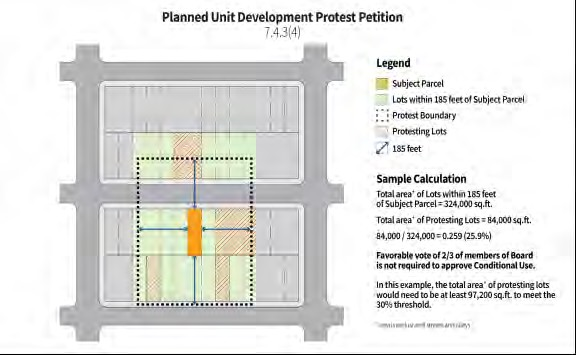
Protest. In case of a protest petition against any proposed planned development signed and acknowledged by the owners of thirty percent or more, either of the areas of the land (exclusive of streets and alleys) included in such proposed planned development or within an area determined by lines drawn parallel to and one hundred eighty-five feet distant from the boundaries of the proposed planned development, such amendment shall not become effective except by the favorable vote of two-thirds of all the members of the Board of Aldermen. The 30% threshold required for a protest under this Section is determined by computing a ratio of the total area contained in the protesting lots divided by the area contained in all lots within the 185-foot radius of the subject parcel.
(Ord. No. 2299, § 1, 6-13-2023)
7.5 - Application Requirements.
1)
An application for a planned development may only be filed by one who has an ownership interest, or the agents thereof; or any contract purchaser or anyone holding an option to purchase the parcel of land on which the use or combination of uses is to be located.
2)
Applications for a planned development shall be filed with the City Administrator or his/her designee in such form and accompanied by such information, with sufficient copies, as shall be established from time to time by the City. Every application shall contain, at a minimum, the following information, and related data:
a)
The names and addresses of the owner of the subject property, the applicant, and all persons having an ownership or beneficial interest in the subject property and proposed planned development.
b)
A statement from the owner of the subject property, if not the applicant, approving of the filing of the application by the particular applicant.
c)
A survey of, and legal description and street address for the subject property.
d)
A narrative describing the proposed planned development's overall character, uses, operations, intent, and impact.
e)
A zoning analysis and narrative identifying conformity with zoning standards, any site development allowances being requested, and the rationale for why each requested site development allowance is necessary and desirable.
f)
A statement indicating compliance of the proposed planned development with relevant City plans, including, but not limited to, the Comprehensive Plan and other relevant plans and planning policies of the City; and evidence of the proposed project's compliance in specific detail with each of the "Standards for Review" for planned developments.
g)
A scaled site plan showing the existing contiguous land uses, natural topographic features, zoning districts, public thoroughfares, transportation, and utilities.
h)
A scaled site plan of the proposed planned development showing lot area, the required yards and setbacks, contour lines, common space, and the location, floor area ratio, lot area coverage and heights of buildings and structures, number of parking spaces and loading areas.
i)
Schematic drawings illustrating the design and character of the building elevations, types of construction, and floor plans of all proposed buildings and structures. The drawings shall also include a schedule showing the number, type, and floor area of all uses or combinations of uses, and the floor area of the entire development.
j)
A landscaping plan showing the location, size, character and composition of vegetation and other material.
k)
The substance of covenants, easements, and other restrictions existing and any to be imposed on the use of land, including common open space, and buildings or structures.
l)
A schedule of development showing the approximate date for beginning and completion of each stage of construction of the planned development.
m)
A professional traffic study performed by a firm chosen by the City showing the proposed traffic circulation pattern within and in the vicinity of the area of the planned development, including the location and description of public improvements to be installed, any streets and access easements, and any impact on current conditions. The traffic study shall be reviewed to determine the effect of the proposed development on traffic, parking, and vehicular and pedestrian safety within and in the vicinity of the planned development. Conditions may be imposed based on the results of the traffic study.
n)
A professional economic analysis acceptable to the City, including the following:
i.
The financial capability of the applicant to complete the proposed planned development;
ii.
Evidence of the project's economic viability; and
iii.
An analysis summarizing the economic impact the proposed planned development will have upon the City.
o)
Copies of all environmental impact studies as required by law.
p)
An analysis setting forth the anticipated demand on all City services.
q)
A plan showing off-site utility improvements required to service the planned development, and a report showing the cost allocations and funding sources for those improvements.
r)
A stormwater management plan, to include stormwater calculations and site drainage plan for the planned developed.
s)
A written summary of residents' comments, pertaining to the proposed application, from any meeting held pursuant to subsection 7.4.3 above.
t)
Where a proposed Planned Development includes a request for subdivision the requirements of Section 6.2.3 (Improvement Plans) must be met and shall be submitted as a part of the Planned Development application.
u)
Where a proposed Planned Development includes a request for subdivision with improvements, the requirements of Section 6.2.5 (Improvements installed or guaranteed) must be met.
3)
Every application must be accompanied by a fee in such amount as established from time to time by the Board of Aldermen to defray the costs of providing notice and contracting with independent professionals to review applications as required. Such professional costs may include, but are not limited to, engineering, legal fees, traffic analyses, environmental impact studies, land use design or other similarly related professional studies. Additional materials may be required during the review of a proposed planned development if determined necessary by the Planning and Zoning Commission or the Board of Aldermen.
(Ord. No. 2310, § 1, 8-8-2023; Ord. No. 2311, § 1, 8-8-2023; Ord. No. 2332, § 1, 12-12-2023)
7.6 - Land subdivision improvements installed or guaranteed.
After the planned development has been approved, but before permits are issued, the applicant shall either:
1)
Post a bond or enter into an escrow agreement in accordance with the provisions hereafter set forth. The bond or escrow agreement shall be prepared and executed on forms satisfactory to the Planning and Zoning Commission and shall be submitted to the Planning and Zoning Commission for approval. Said forms shall be approved by the City Attorney or special counsel prior to being sent to the Planning and Zoning Commission.
2)
A bond shall be issued by a surety company or a title insurance company and shall insure or guarantee, to the extent of the amount specified by the Planning and Zoning Commission in its estimate of the cost of the construction and completion of the improvements shown by the planned development.
3)
An escrow agreement shall provide that there shall be deposited with the escrow agent to be held in a special escrow account by the escrow agent, subject to audit by the City of Sunset Hills. The amount of the escrow shall not be less than the amount specified by the Planning and Zoning Commission in its estimate of the cost of the improvements as reflected by the approved improvement plans and shall be in one of the following forms:
a.
Cash; or
b.
An irrevocable letter of credit or commitment from a lending institution to the escrow agent guaranteeing to such escrow agent the availability of the amount on deposit from time to time upon demand;
c.
Certificates of deposit, treasury bills or other readily negotiable instruments, the type of which has been approved by the Planning and Zoning Commission and endorsed to the escrow agent.
4)
The bond shall remain in effect or the escrowed sum shall be held in the escrow account by the escrow agent, as the case may be, until such time as the Director of Public Works, with oversight by the City Administrator shall, by written authorization to the surety or escrow agent, release the surety from the obligation of the bond or the escrow agent from his obligation to retain the escrowed sum in the escrow account, which release may be partial and may occur from time to time, as improvements are completed, as required by the improvement plans and governing ordinance as applicable, and approved; provided, however:
a.
The Director of Public Works, upon recommendation of the City Administrator and the City Attorney, shall release the surety or escrow agent from all or any part of its obligation only upon receipt of the requisite written notification from the inspecting agency; and
b.
In no case shall the Director of Public Works, authorize the release of more than ninety-five percent (95%) of the amount held as the bond or escrow sum until said improvements have been completed in a satisfactory manner, approved by the Director of Public Works, with oversight by the City Administrator, and accepted or approved by the appropriate authority.
5)
The term of the bond or the escrow agreement shall not exceed two years in duration subject to the following:
a.
If, at the end of the two year period, all the improvements reflected by the approved planned development have not been completed, the Planning and Zoning Commission may extend the term of the land subdivision bond or the escrow agreement for a period not to exceed one additional year at each extension if after review by the Planning and Zoning Commission such longer period is necessary to facilitate planned development requirements. If said improvements have not been completed at the end of the two-year period or as extended by the Planning and Zoning Commission, the Planning and Zoning Commission may:
i.
Require the surety to perform on the bond and pay to the Planning and Zoning Commission such amount as shall be equal to the lesser of the amounts required to complete the improvements or the amount of the bond not theretofore released; or
ii.
Require the escrow agent to remit to the Planning and Zoning Commission in cash or negotiable instruments constituting the escrow sum, as the case may be, the balance in the escrow account required to complete the improvements and the balance, if any, in the escrow account which exceeds such amount shall be returned to the applicant; or
iii.
Require the applicant to submit a bond or escrow agreement which has been recalculated in order to allow for any inflation in the case of constructing improvements.
b.
If the surety fails to perform on the bond or the escrow agent fails to remit the amount required within 30 days after written request, the Planning and Zoning Commission may recommend that the City Attorney or special counsel take immediate action to require performance by the surety under the bond or to secure the payment by the escrow agent of the amount required.
6)
All escrow agents and sureties shall be subject to spot audits by the City of Sunset Hills under the supervision of the Planning and Zoning Commission. If the escrow agent or surety fails to comply with any of the provisions of the escrow agreement or the land subdivision bond, the escrow agent or surety shall not after that time be allowed to act as escrow agent or surety for any planned development improvement in the corporate area of the City of Sunset Hills for a period of two years.
(Ord. No. 2302, § 2, 7-11-2023)
7.7 - Effect of Approval or Denial.
1)
Approval of the planned development permit by the Board of Aldermen authorizes the applicant to proceed with any necessary applications for building permits, certificates of occupancy, and other permits which the City may require for the proposed planned development. The City Administrator or his/her designee shall review applications for these permits for compliance with the terms of the planned development permit granted by the Board of Aldermen. No permit shall be issued for development which does not comply with the terms of the planned development permit.
2)
The Board of Aldermen shall direct the City Administrator or his/her designee to revise the Official Zoning Map to reflect the existence and boundaries of each planned development.
3)
Subject to subsection seven below, an approval of a planned development permit by the Board of Aldermen shall be null and void if the recipient does not file an application for a building permit relative to the proposed planned development within nine (9) months after the date of adoption of the Ordinance approving the planned development permit.
4)
Subject to subsection seven below, an approval of a planned development permit by the Board of Aldermen shall be null and void if construction has not commenced within 15 months and is not completed within 30 months after the date of adoption of the Ordinance approving the planned development permit.
5)
Subject to subsection 8 below, an approval of a planned development permit with a phasing plan shall be null and void if construction has not commenced or is not completed in accordance with the terms of that phasing plan.
6)
An approval of a planned development permit with a master development plan shall be null and void if construction has not commenced or is not completed in accordance with the terms and conditions contained in the development master plan.
7)
An extension of the time requirements stated in subsections 3), 4), 5), and 6) of this Section may be granted by the Board of Aldermen for good cause shown by the applicant, provided a written request is filed with the City at least four weeks prior to the respective deadline.
8)
A planned development permit shall be null and void if the use or combination of uses for which the approval was granted ceases for a consecutive period of one year.
9)
No application for a planned development which was previously denied by the Board of Aldermen shall be considered by the Planning and Zoning Commission or the Board of Aldermen if it is resubmitted in substantially the same form and/or content within one year of the date of such prior denial. In this regard:
a.
City Administrator or his/her designee shall review the application for a planned development and determine if the application is or is not substantially the same. An applicant has the right to request a hearing before the Board of Aldermen to appeal the determination of the City Administrator or his/her designee that the application is substantially the same, provided a petition for appeal is filed in writing with City Administrator or his/her designee within 10 days of the determination. A resident has the right to request a hearing before the Board of Aldermen to appeal the determination of the City Administrator or his/her designee that the application is not substantially the same, provided a petition for appeal is filed in writing with City Administrator or his/her designee within 10 days of the determination.
b.
The Board of Aldermen shall affirm or reverse the determination of the City Administrator or his/her designee, regarding whether the new application is in substantially the same form, within 30 days of receipt of a petition for appeal.
c.
If it is determined that the new application is not substantially in the same form, then the applicant shall be entitled to continue with the application process and have it reviewed in accordance with the provisions of the Zoning Code.
d.
If it is determined that the new application is in substantially the same form, then the applicant shall not be entitled to continue with the application process.
7.8 - Amendments and Alteration to Approved Planned Development Permits.
1)
Except as provided in subsection 2) below, any modifications to an approved planned development permit or any addition to or expansion of an existing planned development permit shall be treated like a new planned development and require separate review and approval under the provisions of the Zoning Code.
2)
As determined by the City Administrator or his/her designee, a minor change is any change in the site plan or design details of an approved planned development permit which is consistent with the standards and conditions applying to the planned development permit and which does not alter the concept or intent of the planned development. A minor change shall not increase the planned development's density or increase the height of buildings, increase parking counts by more than 5%, alter alignment of roads, utilities or drainage. Any change not considered a minor change will be considered a major modification and require a separate public hearing to amend the previously approved planned development.

