
Surfside Beach City Zoning Code
ARTICLE II
ADMINISTRATION
Sec. 17-200. - Code enforcement official to administer and enforce.
The town council shall appoint the code enforcement official to administer and enforce the provisions of this chapter. The duties of the code enforcement official are to:
(1)
Maintain permanent and current records of this chapter including, but not limited to, all zoning maps, amendments, special exceptions, variances, appeals, zoning permits, and applications thereof and records of hearings thereon. Such records shall be open to public inspection during business hours;
(2)
Interpret zoning provisions and district boundaries;
(3)
Provide such clerical, technical, and consultative assistance as may be required by the board of zoning appeals, planning commission, town council, and other boards, commissions, and officials in the exercise of duties relating to this chapter;
(4)
Review, approve, and issue all administrative permits and determinations as authorized by this chapter and to maintain a record of these permits and determinations;
(5)
Review, file, and forward to the board of zoning appeals the records and applications for all appeals, variances, and special exceptions;
(6)
Review, file, and forward to the planning commission the records and applications for all zoning amendments;
(7)
Investigate and resolve zoning violation complaints;
(8)
Conduct inspections of structures, land, and the uses thereof to determine compliance with this chapter; and
(9)
Perform all other duties as assigned by this chapter.
Sec. 17-201. - Exceptions and modifications.
(a)
Nonconforming lot. Where the owner of a lot consisting of one (1) or more adjacent lots of record at the time of adoption of this chapter does not own sufficient land to enable him to conform to the lot size, lot width, or frontage requirements of this chapter, such lot may nonetheless be used as a building site and the code enforcement official is authorized to issue a permit for the use of the property which conforms to the requirements for the district in which the lot is located as set forth in this chapter. In administering this provision, the code enforcement official may authorize the reduction of required yards or setbacks provided that such requirements are not reduced below the minimum specified in this chapter by more than twenty (20) percent. In the event that the code enforcement official fails to authorize such reduction or in cases where a reduction of more than twenty (20) percent is required, the board of zoning appeals may authorize the reduction of required yards or setbacks consistent with variance standards as imposed by this chapter.
(b)
Front yards. The front yard requirements of this chapter for dwellings shall not apply to any lot where the average depth of existing front yards on developed lots, located within one hundred (100) feet on each side of such lot and within the same block and zoning district and fronting on the same street as such lot, is less than the minimum required front yard depth. In such case, the minimum front yard shall be the average of the existing front yard depths on the developed lots.
(c)
Multiple buildings. In the case of a parcel of land consisting of at least one (1) acre, not located in the R-1 low density residential district or the R-2 medium density residential district, not subdivided into the customary streets and lots, and which will not be subdivided, or where the existing or contemplated street and lot layout make it impracticable to apply the requirements of section 17-404, a special exception to the terms of section 17-404 may be approved by the board of zoning appeals to allow more than one (1) principal building to be placed on the parcel or lot of land.
(d)
Exceptions of height limits. Except as provided in this subsection, the height limitations as established by the individual zoning districts shall not apply to church spires, belfries, cupolas, and domes not intended for human occupancy, monuments, water towers, observation towers, transmission towers, windmills, chimneys, smokestacks, derricks, conveyors, flag poles, radio towers, masts, aerials, amusement devices/structures, and elevator shafts. Where a height limitation for a specific structure or use is provided by this chapter, such height limitation shall supersede the height limitations imposed by any district requirement. In cases where a specific use or structure requirement is not provided by this chapter, the structures enumerated by this subsection may be constructed to a height not to exceed one and one-half (1½) times the building height permitted by the zoning district.
(e)
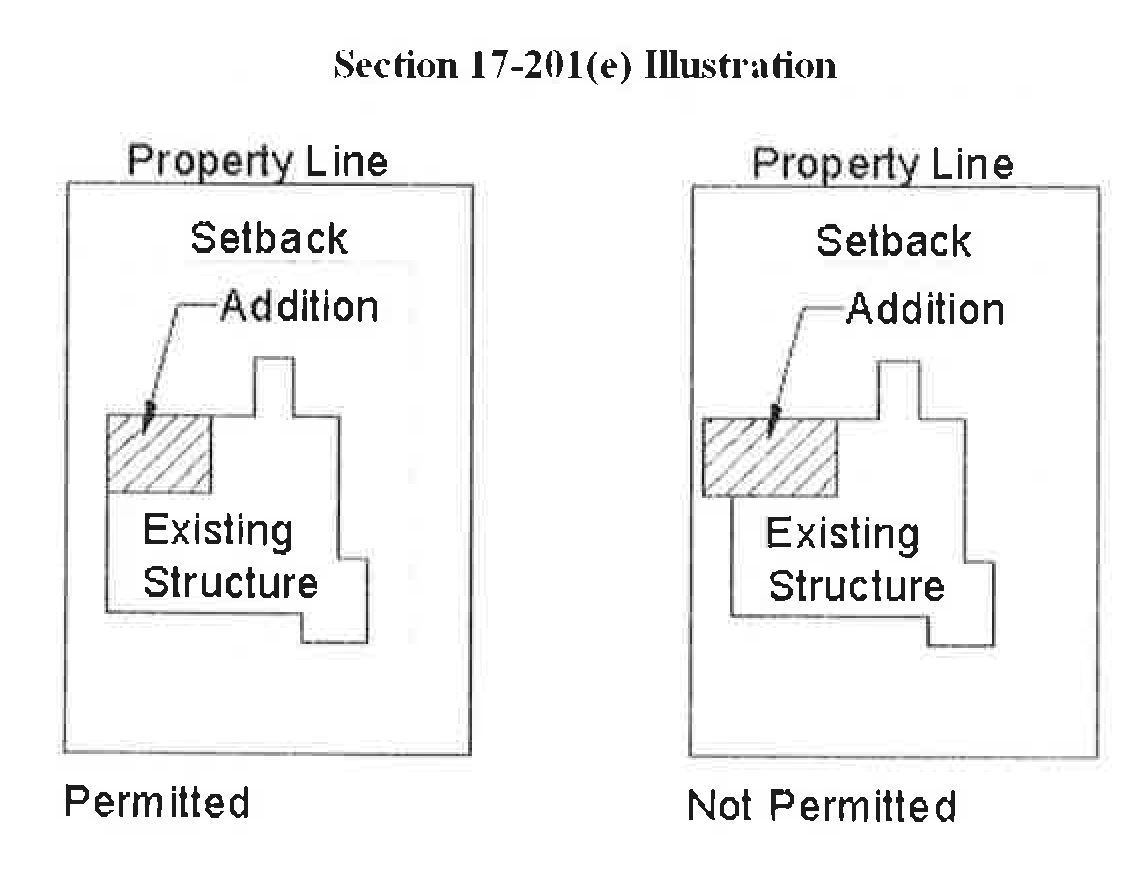
Nonconforming building enlargement. Where the principal building on a lot contains a conforming use and is nonconforming solely as a result of a setback encroachment, additions to the principal building can be allowed provided the new addition does not project into the setback. If a proposed addition would encroach into the same setback that already has been encroached upon, the addition can be allowed, provided that it projects no further into the setback than the existing building and in no way extends past the wall line of the existing building. This provision does not apply to a nonresidential use that adjoins a residential district on the side of the lot having the setback nonconformity. Neither shall this provision be applied to allow a building to be extended closer than five (5) feet from any property line nor allow a building to be extended closer than fifteen (15) feet from any publicly maintained right-of-way.
(f)
Yards and other open spaces. Eaves may protrude into the required yard setback a maximum of eighteen (18) inches.
(g)
Enclosed and unenclosed and uncovered handicapped access ramps, lifts, and landings.
(1)
Residential uses. Unenclosed and uncovered ramps, lifts, and associated landings as well as enclosed elevators necessary to provide handicapped access may extend into the required setback, provided the landings are no larger than ADA (Americans with Disabilities Act) requirements for landings.
(2)
Commercial uses. Unenclosed and uncovered ramps, lifts, and associated landings necessary to provide handicapped access may extend into the required setback, provided the building existed prior to the adoption of the American with Disabilities Act in 1990, and provided the landings are no larger than ADA (Americans with Disabilities Act) requirements for landings.
(Ord. No. 20-0226, 11-10-20)
Sec. 17-202. - Amendments.
(a)
Authority to amend ordinance. When the public necessity, convenience, general welfare, or good zoning practice justify such action, and after the required review and report by the planning commission, the Surfside Beach Town Council may, from time to time, amend, supplement, or change by ordinance, the boundaries of the zoning districts or the regulations herein established.
(b)
Procedure for amendment. Requests to amend this chapter shall be processed in accordance with the following requirements:
(1)
Initiation of amendments. Amendments may be initiated as specified below:
a.
An amendment to the zoning map (rezoning) may be initiated by the town council; the planning commission; the town administrator; the planning director or his or her designee; or by the owner of such property for which an amendment is sought.
b.
An amendment to the zoning ordinance text may be initiated by the town council; planning commission; the town administrator; or, in the case of an application for a planned development, by the owner of such development.
(2)
Application. Application forms for amendment requests shall be obtained from the code enforcement official. When the amendment involves a change in the zoning text, the authority or individual initiating the amendment shall set forth in full, by resolution or application, the proposed text to be considered.
When the amendment involves a change in the zoning district map, the applicant shall submit the following:
a.
A legal description and street address of the subject property, together with a property boundary map if the subject property is not explicitly delineated on the town map;
b.
Name, address, and phone number of the applicant;
c.
Name of property owner(s) and applicant's interest in the property if not the owner in fee simple;
d.
Filing date of application;
e.
Applicant's and owner's signature;
f.
Names and addresses of all owners of property within one hundred fifty (150) feet of the property being requested to be rezoned;
g.
Any additional information as deemed pertinent by the applicant to justify the request for rezoning; and
h.
An application fee, as established by ordinance, to cover administrative costs.
Any communication purporting to be an application for an amendment shall be regarded as mere notice to seek relief until such request is made in the form required and an application fee has been paid. All applications for amendment shall be submitted to the code enforcement official for processing. The code enforcement official shall review the application as to proper form, and then shall submit all papers and other data tendered by the applicant to the planning commission for a public hearing, review, and recommendation to the town council.
(3)
Public hearing scheduling; notice. A public hearing shall be scheduled by the planning commission to be held not more than forty-five (45) days after the filing of the amendment's application with the code enforcement official. For all proposed amendments, notice of the time and place of the hearing shall be published in a newspaper of general circulation in the county at least fifteen (15) days in advance of the scheduled public hearing date. Any person(s) or groups that have expressed in writing, to the planning department, an interest in being informed of zoning proceedings shall be mailed notice of such meeting not less than fifteen (15) days before the public hearing.
In cases of a zoning map amendment, conspicuous notice shall be placed on or adjacent to the property affected, with at least one (1) such notice being visible from each public thoroughfare that abuts the property. The notice shall be posted at least fifteen (15) days prior to the public hearing. A letter of notification to each property owner within one hundred fifty (150) feet of the subject property shall be mailed by the code enforcement official no less than fifteen (15) days prior to the hearing date. The letter shall contain information adequate to notify such owners and residents of the intention to rezone the area for which the application is submitted and when and where the public hearing will be held before the planning commission. In addition, in cases where a zoning map amendment is initiated by the town council or planning commission, written notice shall be provided to the property owner(s), whose parcel is the subject of the rezoning consideration, no less than thirty (30) days in advance of the public hearing.
(4)
Hearing by planning commission. Before enacting an amendment to this chapter, the planning commission shall hold a public hearing thereon. All meetings and hearings of the planning commission shall be open to the public. At the hearing, oral and written comments may be submitted to the planning commission by the applicant or any other interested member of the public, including owners of adjoining property. Any party may appear in person or by agent or by attorney. No member of the planning and zoning commission shall participate in a matter in which he has any pecuniary or special interest.
(5)
Recommendation by the planning commission. The planning commission shall have thirty (30) days following the public hearing within which to submit its recommendation and report to the town council. The report submitted to the town council shall contain a summary of all significant issues or concerns presented at the public hearing. Factors to be considered by the planning commission in making a recommendation include, but shall not be limited to, the following:
a.
Whether or not the requested zoning change is consistent with the comprehensive plan or is justified by an error in the original ordinance;
b.
The precedents and the possible effect of such precedents which might result from approval or denial of the application;
c.
Whether the uses permitted by the proposed change would be appropriate in the area concerned; and
d.
The capacity of the town or other government agencies to provide additional services, facilities, or infrastructure that might be required if the application was approved.
If the planning commission fails to submit a recommendation within the thirty (30) day period, it shall be deemed to have recommended approval of the requested amendment.
(6)
Action by the town council. The planning commission shall promptly transmit its recommendation to the town council. For each amendment request, the town council shall consider the recommendation of the planning commission; however, town council is not bound by the recommendation in making a final decision. All amendments, changes, or supplements to the zoning map or ordinance must be adopted by the town council as an ordinance in accordance with S.C. Code § 5-7-270. If a requested amendment is denied, such action shall be by resolution. If the town council fails to take action on a requested amendment within three hundred sixty-five (365) days of an application's public hearing, the requested amendment shall be deemed to have been rejected and no other action by the town council is required.
(d)
Limitations on reapplication. Except for requests that are continued with the mutual consent of the applicant and the planning commission, a property owner or owners shall not initiate action for a zoning map amendment affecting the same parcel of property, or any part thereof, more often than once every twelve (12) months.
(e)
Reversion. To prevent land speculation at the expense of the general public and to ensure the timing of projects in accord with stated development objectives, construction shall start on all rezoned property within six (6) months after rezoning. If construction is not begun within the specified time or is not completed within two (2) years, the planning commission shall review the zoning of the property and the progress which has taken place, and, if necessary, initiate proceedings to reclassify the zoning of the property in a manner consistent with the comprehensive plan. Any reclassification or reversion of zoning, which may be initiated by the planning commission, shall be considered a zoning map amendment and shall follow the amendment procedures of this section.
(Ord. No. 15-0800, 4-28-215)
Sec. 17-203. - Zoning permit required.
(a)
No building, manufactured home, sign, or other structure shall be erected, located, moved, added to, or structurally altered without a permit issued by the code enforcement official. A zoning permit will not be issued without a legally approved subdivision. No zoning permit shall be issued by the code enforcement official except in conformity with the provisions of this chapter, unless he is so directed by the board of zoning appeals as provided by this chapter. No zoning permit issued under provisions of this chapter for land use or construction in the town shall be considered valid unless signed by the code enforcement official, as duly designated in section 17-200.
(b)
Except as expressly exempted by this chapter, a zoning permit shall be required before any of the following activities:
(1)
The issuance of a building permit under the terms of the building code;
(2)
Excavation preparatory to constructing a structure for which a building permit is required;
(3)
Improving any lot by grading, filling, or surfacing, or by constructing a driveway to include the construction, removal, or alteration of parking lots;
(4)
Prior to the establishment of a use or change in the use classification of any part of a structure or lot, including any increase in the number of families or dwelling units occupying a building or lot;
(5)
Installation of any sign;
(6)
Moving any house, modular unit, manufactured home, or other building;
(7)
Demolition of structures;
(8)
Pruning or removing trees, or
(9)
Prior to obtaining a business license.
Where no new construction, alteration, or site improvement is proposed or in cases involving temporary uses, the certificate of zoning compliance as required by sections 17-206 and 17-208 may, at the discretion of the code enforcement official, be combined with the zoning permit required by this section and may be issued as a single instrument.
Sec. 17-204. - Application for zoning permit.
(a)
Except as provided in article VI (signs) of this chapter, all applications for zoning permits shall be accompanied by plans in duplicate drawn to scale, showing the actual dimensions and shape of the lot to be built upon; the exact sizes and locations on the lot of buildings already existing, if any, and the location and dimensions of the proposed building or alteration. The application shall include such other information as lawfully may be required by the code enforcement official including existing or proposed building or alteration; existing or proposed uses of the building and land; the number of families, housekeeping units, or rental units the building is designed to accommodate; conditions existing on the lot; and such other matters as may be necessary to determine conformance with and provide for the enforcement of this chapter.
(b)
One (1) copy of the plans shall be returned to the applicant by the code enforcement official after he shall have marked such copy either as approved or disapproved and attested to same by his signature of such copy. The original copy of the plans, similarly marked, shall be retained by the code enforcement official.
Sec. 17-205. - Expiration of zoning permit.
If the work described in any zoning permit has not begun six (6) months from the date of issuance thereof, such permit shall expire. It shall be canceled by the code enforcement official and written notice shall be given to the persons affected.
Sec. 17-206. - Certificate of zoning compliance for new, altered, nonconforming uses.
(a)
It shall be unlawful to use, occupy, or permit the use or occupancy of any building, manufactured home, premises, or all or parts thereof hereafter created, erected, changed, converted, or wholly or partly altered or enlarged in its use or structure until a certificate of zoning compliance shall have been issued by the code enforcement official stating that the proposed use of the building or land conforms to the requirements of this chapter.
(b)
No nonconforming structure or use shall be maintained, renewed, changed, or extended until a certificate of zoning compliance shall have been issued by the code enforcement official. The certificate of zoning compliance shall state specifically wherein the nonconforming use differs from the provisions of this chapter, provided that upon enactment of amendment of this chapter owners or occupants of nonconforming uses or structures shall have three (3) months to apply for a certificate of zoning compliance. Failure to make such application within three (3) months shall be presumptive evidence that the property was in conformance at the time of enactment or amendment of this chapter.
(c)
No permit for erection, location, alteration, moving, or repair of any building or manufactured home shall be issued until an application has been made for a certificate of zoning compliance, and the certificate shall be issued in conformity with the provisions of this chapter upon completion of the work. A temporary certificate of occupancy may be issued by the code enforcement official for a period not exceeding six (6) months during alterations or partial occupancy of a building pending its completion, provided that such temporary certificate may include such conditions and safeguards as will protect the safety of the occupants and the public.
(d)
No certificate of zoning compliance issued under the provisions of this chapter shall be considered valid unless signed by the code enforcement official, as duly designated in section 17-200. The issuance of a certificate of zoning compliance shall not be construed as waiving any provision of this chapter or the applicable zoning permit.
(e)
The code enforcement official shall maintain a record of all certificates of zoning compliance and a copy shall be furnished upon request to any person.
(f)
Failure to obtain a certificate of zoning compliance shall be a violation of this chapter and is punishable under section 17-211.
Sec. 17-207. - Effect of permit issuance; integration of zoning and building permit.
(a)
After a zoning permit is issued for construction requiring a building permit, the building official shall issue a building permit when the requirements of the building code have been met.
(b)
After a zoning permit is issued for a use or construction not requiring a building permit, the applicant may proceed to carry out the improvements described in the approved zoning permit application.
(c)
When the code enforcement official created by this chapter is authorized to issue permits under the building code, the zoning permit or certificate of zoning compliance required by this chapter may be combined with or made part of the building permit or certificate of occupancy required by the building code. When combined, the permit and/or certificate shall clearly denote conformance with the requirements of this chapter and the building code.
Sec. 17-208. - Conditional and temporary uses.
(a)
Controls required. Conditional uses, as set forth in Article III of this chapter, and temporary uses, as set forth in this section, are declared to possess characteristics which require certain controls in order to ensure compatibility with other uses in the district within which they are proposed for location.
(b)
Conditional uses. Conditional uses shall be permitted subject to a determination by the code enforcement official that they conform to all regulations set forth in this section and elsewhere in this chapter, with particular reference to those requirements established for those districts in which they are proposed for location. Application for permission to build, erect, or locate a conditional use shall be submitted and processed in accordance with the regulations set forth in this division, prior to the issuance of any permits.
(c)
Temporary uses. The code enforcement official is authorized to issue a temporary certificate of zoning compliance for temporary uses, as follows:
(1)
Carnival, circus, or fair, including the use of a tent in a nonresidential district, for a period not to exceed seven (7) days, subject to the approval of the town council.
(2)
Portable and special event signs in accordance with section 17-654.
(3)
Tents and/or open displays in accordance with section 17-412.
(4)
Open lot sale of Christmas trees for a period not to exceed forty-five (45) days.
(5)
Real estate sales office, in any district, for a period not to exceed one (1) year provided no cooking or sleeping accommodations are maintained in the structure and provided it applies to on-site sales only.
(6)
Contractor's office and equipment sheds, in any district, for a period of one (1) year, provided that such office is placed on the property to which it is appurtenant.
(7)
Manufactured home units may be used for a business establishment on a temporary basis for a period not to exceed one (1) year. Construction of the permanent structure shall begin within thirty (30) days following placement of the temporary manufactured unit. The manufactured unit shall be removed as soon as the permanent structure is occupied for business or within one (1) year, whichever comes first. All temporary certificates of zoning compliance may be renewed provided that it is determined that the use is clearly of a temporary nature, will cause no traffic congestion, and would not create a nuisance to surrounding uses.
Sec. 17-209. - Reserved.
Editor's note— Ord. No. 18-0881, adopted January 8, 2019, repealed § 17-209, which pertained to violations; filing of complaints and derived from the original Code.
Sec. 17-210. - Authority of the code enforcement official to issue orders.
If the code enforcement official shall find that any of the provisions of this chapter are being violated, he shall notify in writing the person responsible for such violation, indicating the nature of the violation and ordering the action necessary to correct it. He shall order discontinuance of illegal use of land, buildings or structures; removal of illegal buildings or structures or of illegal additions, alternations, or structural changes; discontinuance of any illegal work being done; and shall take any other action authorized by this chapter to ensure compliance with or to prevent violation of its provisions.
Sec. 17-211. - Violations declared misdemeanor; remedies.
It shall be unlawful to construct, reconstruct, alter, change the use of or occupy any land, building or other structure without first obtaining written approval of the Surfside Beach building department; and the town building department shall not issue any written approval unless the requirements of this chapter and of any ordinance or resolution adopted pursuant to it are complied with. A violation of this chapter or any ordinance or resolution adopted pursuant to the provisions of this chapter is hereby declared to be a misdemeanor under the laws of the state, and upon conviction thereof, an offender shall be punished in the discretion of the court. Each day such unlawful erection, construction, reconstruction, alteration, conversion, maintenance, or use continues shall be deemed a separate offense.
In case any building or structure is or is proposed to be erected, constructed, reconstructed, altered, converted or maintained, or any building, structure or land is or is proposed to be used in violation of any ordinance or resolution adopted pursuant to this chapter, the code enforcement official or other appropriate administrative officer, municipal attorney, or any adjacent or neighboring property owner who would be specially damaged by such violation, may in addition to other remedies, institute injunction, mandamus, or other appropriate action or proceeding to prevent such unlawful erection, construction, reconstruction, alteration, conversion, maintenance, or use; or to correct or abate the violation, or to prevent the occupancy of the building, structure, or land. Nothing contained in this section shall prevent the town from taking such other lawful action as necessary to prevent or remedy any violation.
Sec. 17-212. - Fees established.
The town council shall establish, by ordinance, a schedule of fees and charges and a collection procedure for all permits, appeals, variances, amendments, and other matters pertaining to this chapter. Such schedule of fees shall be posted in the office of the code enforcement official and may be altered or amended only by the town council. No permit, appeal, or other item for which fees or charges are levied shall be issued or action taken until all applicable fees and charges have been paid in full.
Sec. 17-220. - Established; membership; term of office.
There is hereby created a board of zoning appeals to be composed of seven (7) members appointed by town council for terms of four (4) years pursuant to section 2-61. No member of the board of zoning appeals shall hold a public office or position in the town.
Sec. 17-221. - Officers; bylaws; meetings.
The board of zoning appeals shall elect a chairman and a vice-chairman from its members who shall serve for one (1) year or until reelected or until their successors are elected. The board shall appoint a secretary, who may be a town employee, or a member of the zoning board. The board shall adopt rules and bylaws in accordance with the provisions of this chapter and S.C. Code 1976, § 6-29-790. Meetings of the board shall be held at the call of the chairman and at such other times as the board may determine. A majority of members present shall constitute a quorum (See subsection 2-61(m)). All meetings of the board shall be open to the public.
(Ord. No. 15-0809, 10-13-15)
Sec. 17-222. - Powers of the board.
The board of zoning appeals shall have the following powers:
(1)
To hear and decide appeals where it is alleged there is error in any order, requirement, decision, or determination made by an administrative official in the enforcement of this chapter.
(2)
To hear and decide appeals for variance from the requirements of this chapter when a strict application of the provisions of this chapter would result in unnecessary hardship. A variance may be granted in an individual case of unnecessary hardship if the board makes and explains in writing the following findings:
a.
There are extraordinary and exceptional conditions pertaining to the particular piece of property; and
b.
These conditions do not generally apply to other property in the vicinity; and
c.
Because of these conditions, the application of this chapter to the particular piece of property would effectively prohibit or unreasonable restrict the utilization of the property; and
d.
The authorization of a variance will not be of substantial detriment to adjacent property or the public good, and the character of the district will not be harmed by the granting of the variance.
1.
The board may not grant a variance, the effect of which would be to allow the establishment of a use not otherwise permitted in a zoning district, to extend physically a nonconforming use of land or to change the zoning boundaries shown of the official zoning map. The fact that property may be utilized more profitably, if a variance is granted, may not be considered grounds for a variance.
2.
In granting a variance, the board may attach to it such conditions regarding the location, character, or other features of the proposed building, structure, or use as the board may consider advisable to protect established property values in the surrounding area or to promote the public health, safety, or general welfare.
(3)
To authorize the permitting of special exceptions subject to the terms and conditions for such uses as set forth by this chapter. The board of zoning appeals may approve, approve with conditions, or deny a request for a special exception permit. Special exception permits may be approved only if the board finds that the proposed use:
a.
Is in fact a use specifically listed as a special exception for the zoning district in which the use is intended; and
b.
Is consistent with the recommendations contained in the Surfside Beach Comprehensive Plan and the character of the underlying zoning district as indicated in the zoning district's "intent"; and
c.
Is compatible with existing uses in the vicinity and will not adversely affect the general welfare or character of the immediate community; and
d.
Adequate provision is made for such items as setbacks, buffering, and screening (including fences and/or landscaping) to protect adjacent properties; and
e.
Will not result in nuisances or other adverse disturbances such as noise, odor, dust, vibrations, glare, overcrowding, or excessive traffic, in excess of what is anticipated for the zoning district or area; and
f.
When applicable, will be developed in a way that will preserve and incorporate important natural features; and
g.
Complies with all applicable rules, regulations, laws, and the standards of this chapter; and
h.
Will not hinder or endanger vehicular traffic or pedestrian movements on adjacent streets.
In granting a special exception permit, the board may attach to it such conditions regarding the location, character, or other features of the proposed structure or use as the board may consider advisable to protect established property values in the surrounding area or to promote the public health, safety, or general welfare.
(4)
To remand a matter to the code enforcement official, upon motion by a party or the board's own motion, if the board determines that the record is insufficient for review. A party's motion for remand may be denied if the board determines that the record is sufficient for review. The board must set a rehearing on the remanded matter for a time certain within sixty (60) days unless otherwise agreed by the parties. The board must maintain a list of persons who expressed an interest in being informed when the remanded matter is set for rehearing, and notice of the rehearing must be mailed to these persons prior to the rehearing.
In exercising the above powers, the board of zoning appeals may, in conformity with the provisions of this chapter, reverse or affirm, wholly or in part, or may modify the order, requirements, decision, or determination, and to that end shall have all the powers of the officer from whom the appeal is taken and may issue or direct the issuance of a permit. The board, in the execution of the duties for which appointed, may subpoena witnesses and in case of contempt may certify such fact to the circuit court having jurisdiction.
(5)
To hear and decide appeals to remove a landmark tree within the town. Criteria to be considered in determining whether removal of the landmark tree is warranted shall be as follows:
a.
Size, and health of the tree;
b.
Constraints for reasonable development of the site including location of primary structure and vehicle use areas, proposed grade changes, surface water drainage and utility installations;
c.
Whether a hazard is presented to pedestrians or vehicle traffic;
d.
Overall tree coverage and landscaping of the site (is it probable the tree's roots will cause damage to the primary structure in time;
e.
Whether a hazard is presented to buildings or utility lines;
f.
Whether the tree is damaged, diseased, dying or dead.
(Ord. No. 17-0840, 8-22-17)
Sec. 17-223. - Appeals to board; stay of proceedings.
(a)
Appeals to the board may be taken by any person aggrieved or by any officer, department, board or bureau of the town or county. Such appeal shall be taken within fifteen (15) calendar days of notification of the order, requirement, decision, or determination from which the appeal is sought. An appeal is perfected by filing a written notice of appeal on a form prescribed by the board of zoning appeals. The notice of appeals shall be filed with the code enforcement official from whom the appeal is taken and the secretary of the board, accompanied by the applicable appeal fee in an amount as established by the town council. The notice of appeal shall identify the decision of the code enforcement official that is being appealed and state the grounds for the appeal. The officer from whom the appeal is taken shall forthwith transmit to the board all the papers constituting the record upon which the action appealed from was taken.
(b)
An appeal stays all legal proceedings in furtherance of the action appealed from, unless the officer from whom the appeal is taken certifies to the board, after the notice of appeal has been filed with him, that by reason of facts stated in the certificate a stay would, in his opinion, cause imminent peril to life and property. In such case, proceedings may not be stayed other than by a restraining order which may be granted by the board or by a court of record on application, on notice to the officer from whom the appeal is taken, and on due cause shown.
Sec. 17-224. - Application; hearing; notice; decision.
(a)
The board shall establish the form of all applications to be required by it and shall specify in its rules the procedure for conducting hearings.
(b)
Once the applicant has filed a notice of appeal or other application that may be referred to it, the board of zoning appeals shall hold a duly noticed hearing on the appeal or other matter within a reasonable time, not to exceed sixty (60) calendar days of the filing of the notice or the submission of a complete application. At the hearing any party may appear in person or by agent or by attorney. Public notice of all meetings of the board shall be provided by publication in a newspaper of general circulation in the town at least fifteen (15) days in advance of the meetings. In cases involving variances or special exceptions, conspicuous notice shall be posted on or adjacent to the property affected, with at least one (1) such notice being visible from each public thoroughfare that abuts the property.
(c)
The board of zoning appeals shall issue a decision within a reasonable time, not to exceed thirty (30) calendar days following the duly noticed public hearing or, in the case of remand, the rehearing. Board members must be present to vote. All final decisions and orders of the board must be in writing and be permanently filed in the office of the board as a public record. All findings of fact and conclusions of law must be separately stated in final decisions or orders of the board which must be delivered to parties of interest by certified mail.
(d)
Except in cases where the applicant waives the time limitations of this section, the failure of the board of zoning appeals to act within the time limits imposed by this section or as established in the rules of the board shall not render any application before it approved. Such failure to act shall constitute a denial of the application and shall entitle any aggrieved party to immediately appeal the decision to the circuit court as provided in section 17-226.
Sec. 17-225. - Contempt of board of zoning appeals.
In case of contempt by any party, witness, or other person before the board of zoning appeals, the board may certify such fact to the circuit court of the county wherein such contempt occurs and the judge of the court, in open court or in chambers, after hearing may impose such penalty as authorized by law.
Sec. 17-226. - Appeal of board of zoning appeals decision to court.
(a)
A person who may have a substantial interest in any decision of the board or any officer or agent of the Town of Surfside Beach may appeal from a decision of the board to the Horry County Circuit Court, by filing with the clerk of the court a petition in writing setting forth plainly, fully, and distinctly why the decision is contrary to law. The appeal must be filed within thirty (30) days after the decision of the board is mailed.
(b)
Upon the filing of such an appeal, the clerk of the circuit court shall give immediate notice thereof to the secretary of the board and within thirty (30) days from the time of such notice the board shall cause to be filed with the clerk a duly certified copy of the proceedings held before the board of zoning appeals, including a transcript of the evidence heard before it, if any, and the decision of the board including its findings of fact and conclusions.
(c)
The filing of an appeal in the circuit court from any decision of the board shall not ipso facto act as a supersede as, but the judge of the circuit court may in its discretion grant a supersede as upon such terms and conditions as may seem reasonable and proper.
(d)
Appeals from the decision of the board are to proceed subject to the provision of S.C. Code §§ 6-29-820 through 6-29-850.
Sec. 17-227. - Financing.
The council may appropriate such monies, otherwise unappropriated, as it deems fit to finance the work of the board of zoning appeals and to generally provide for the board of zoning appeals and to generally provide for the enforcement of any regulations and restrictions authorized under this chapter which are adopted and may accept and expend grants of money for those purposes from either private or public sources, local, state, or federal.

