
Surfside Beach City Zoning Code
ARTICLE IV
SUPPLEMENTAL DISTRICT REGULATIONS
Sec. 17-400. - Obstruction of vision at street intersection.
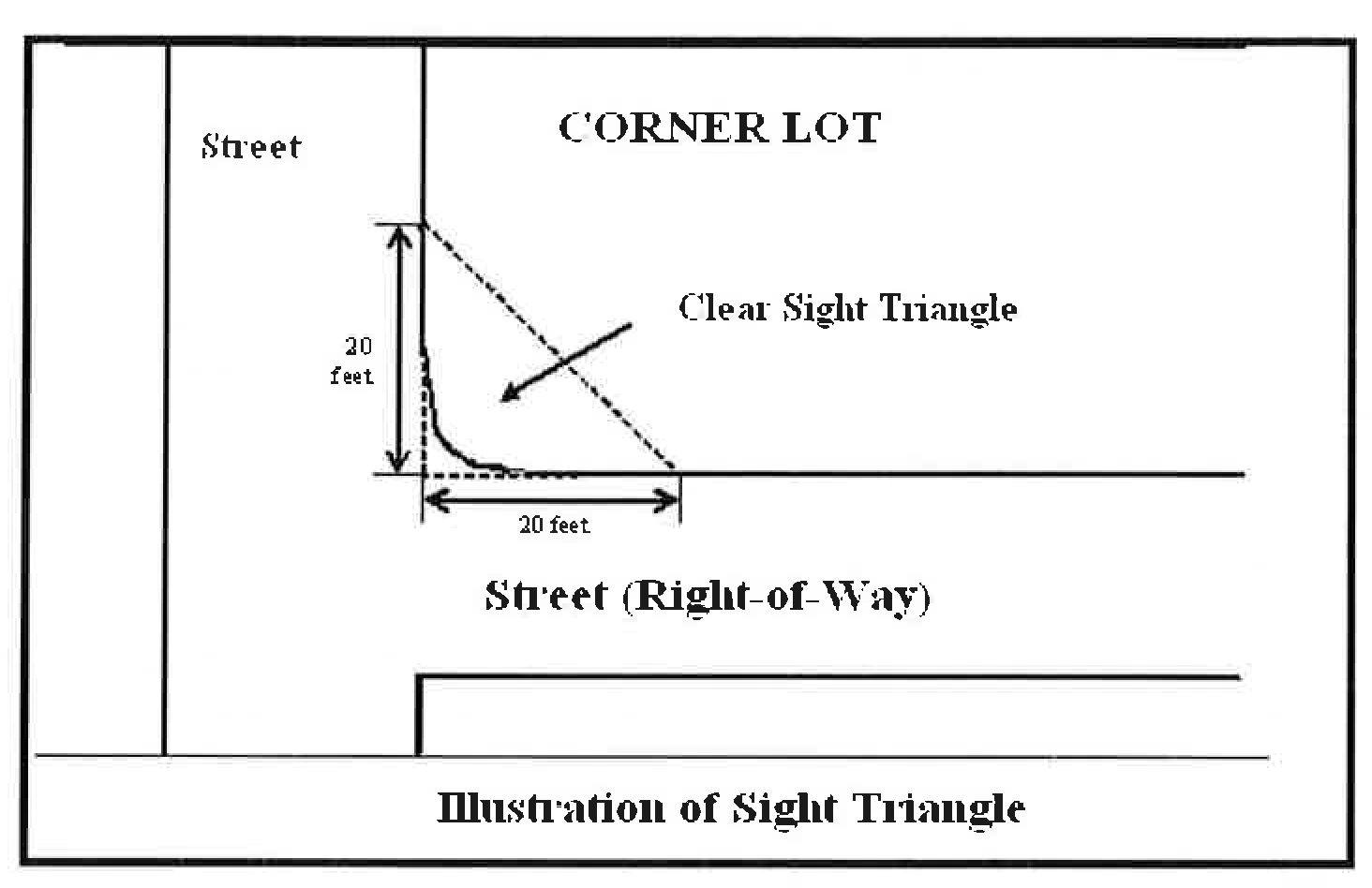
On a corner lot in all districts, except the C-2 central business district, no fence, wall, shrubbery, or other obstruction to vision between the height of three (3) feet and ten (10) feet above the street grade shall be permitted inside the triangle formed by the intersecting streets within twenty (20) feet of the intersections of the right-of-way of streets or of streets and railroads.
Sec. 17-401. - Street frontage.
No dwelling shall be erected on a lot which does not abut a public street for at least fifty (50) feet, except that:
(1)
Lots fronting on cul-de-sacs may have a minimum road frontage of thirty (30) feet if the width at the building line is at least the minimum width required in the district in which the property is located.
(2)
Single-family attached and semi-attached dwellings units, other than semi-attached dwellings in the R-2 district, are excluded from this provision. Single-family attached and semi-attached dwelling units are subject to the requirements imposed by article III of this chapter and the frontage for each lot must be at least thirty (30) feet; and
(3)
Thirty (30) feet of street frontage is allowable in the R-3 high density residential and accommodations district.
Sec. 17-402. - Corner lots.
The minimum width of a side yard along an intersecting street shall be fifty (50) percent greater than the minimum side yard requirements of the district in which the lot is located except in the C-1 highway commercial district where the minimum side yard is five (5) feet for corner lots. For the purposes of this section, the lot line having the shorter dimension along the street line shall be considered the front of the lot.
Sec. 17-403. - Double frontage lots.
On lots having frontage on more than one (1) street but not located on a corner, the minimum front yard requirements for the district within which the lot is located shall be applicable for each street on which the lot fronts. On lots fronting on more than two (2) streets, the minimum front yard shall be provided in at least two (2) streets. The remaining frontage or frontages will be considered side yards and comply with the provisions set forth in section 17-402. For purposes other than yard requirements discussed in this section, the official street address will be considered the front of the lot for each lot that fronts two (2) or more streets.
Sec. 17-404. - One principal building on a lot.
Except in the R-3 district and as is otherwise excluded by section 17-201, only one (1) principal building and its customary accessory buildings may hereafter be erected on any lot.
Sec. 17-405. - Reduction of lot size.
No lot shall be reduced in area so that yards, lot area per dwelling unit, lot width, building area, or other provisions of this chapter shall not be maintained. This section shall not apply when a portion of a lot is acquired for a public purpose.
Sec. 17-406. - Building height, roof pitch limit changes, building height definition.
Any changes made to height restrictions or exceptions to established heights shall require a two-thirds (⅔) vote of the total council; not to include two-thirds (⅔) of a quorum present, in order to be removed or amended. This shall include but not be limited to section 17-311, section 17-321, section 17-331, section 17-341, section 17-349, section 17-357, section 17-359.6, section 17-365, section 17-392.5, approved planned developments and section 17-410.
Building heights as defined in section 17-007 shall require a two-thirds (⅔) vote of total council; not to include two-thirds (⅔) of a quorum present in order to remove or amend.
(Ord. No. 23-0952, 1-24-23)
Sec. 17-407. - Street access to lots.
No building permit shall be issued for and no building shall be erected on any lot within the town unless the street giving access to the lot upon which the building is proposed to be placed shall have been accepted or opened as a public street (or a private street for a planned development) prior to that time, or unless such street corresponds in its location and lines with a street shown on a subdivision plat approved by the planning commission and such approval is entered in writing on the plat by the chairman of the commission.
Sec. 17-408. - General requirements for accessory buildings and uses in residential and non-residential districts.
This section authorizes the establishment of accessory uses and structures that are incidental, customarily associated with, and subordinate to principal uses approved within each zoning district. The town's intent is to allow accessory uses provided such uses are located on the same lot as the principal use and comply with the performance criteria set forth in this section.
(Ord. No. 23-0952, 1-24-23)
Sec. 17-408.1. - General development and operational standards for all accessory uses and structures.
(a)
All accessory uses, structures, and activities shall be subject to the applicable general, dimensional, operational, and use-specified regulations set forth in this section.
(b)
No accessory use or structure shall be permitted in any parcel until after the principal structure is permitted.
(c)
All accessory uses and structures shall:
(1)
Be clearly incidental and customarily associated with the principal use;
(2)
Not involve the conduct of trade on the premises;
(3)
Be located in the same lot as the permitted principal use;
(4)
Be used and maintained under the same ownership as the permitted principal use;
(5)
Not be used as a residence.
(6)
Not be located within any platted or recorded easement or over any utility.
(d)
Shipping containers, tractor-trailer containers, and other structures that have an original intended purpose other than as a residential or commercial storage structure shall be prohibited as an accessory use.
(Ord. No. 23-0952, 1-24-23)
Sec. 17-408.3. - Standards for accessory uses and structures in residential districts.
(a)
Shed or tool room, including prefabricated structures.
(1)
Shall be located in the rear yard only;
(2)
Shall be a minimum of five (5) feet to any property line;
(3)
Shall not exceed fifteen (15) feet in height when located less than ten (10) feet from the property line;
(4)
Shall not exceed twenty-five (25) feet in height when located a minimum of ten feet from the property line.
(5)
Shall not exceed the height of thirty (30) feet or the height of the principal structure, whichever is less.
(6)
Shall cover not more than thirty (30) percent of the rear yard.
(7)
In no case shall accessory structures exceed the square footage of the primary structure.
(8)
Limit the number of accessory structures per lot to two (2).
(Ord. No. 23-0952, 1-24-23)
Sec. 17-408.4. - Non-residential accessory uses and structures permitted in commercially zoned districts provided.
(a)
Storage buildings, including prefabricated structures.
(1)
Shall be located in the rear yard only;
(2)
Shall be a minimum of five (5) feet from all property lines and the principal structure measured from the closest point of the structure;
(3)
Shall not exceed twenty-five (25) feet in height or the height of the principal structure, whichever is less;
(4)
Shall be limited to two (2) per lot;
(5)
Shall not cover more than thirty (30) percent of the rear yard.
(6)
Shall comply with Article IX of this Code if located within the design overlay district.
(b)
Exemption: Commercial gasoline pump canopies shall be permitted in appropriate districts in the front yard when setback and minimum of twenty-five (25) feet from all property lines and the overhang of the canopy shall be setback a minimum of fifteen (15) feet from all property lines. Canopies located within the design overlay district shall comply with Article IX of this Code.
(Ord. No. 23-0952, 1-24-23)
Sec. 17-409. - Fences and hedges.
Fences and hedges are permitted in all districts subject to the following standards:
(1)
General standards applying to all fences within the town limits.
a.
A permit must be obtained for the construction of any fence.
b.
Fence height shall be measured as the vertical distance between the finished grade at the base of the fence and the top edge of the fence material. Where the ground elevation differs from one (1) side of the fence to the other, the height of the fence shall be measured from the side with the lowest natural grade.
c.
All parts of the fence (residential or non-residential), including the footings, shall be constructed on private property. In no instance shall a fence or hedge be located within a right-of-way, easement or town property.
d.
No fence or hedge (residential or non-residential) shall be placed or maintained in a manner as to obstruct vision at the intersection of a street in violation of section 17-400 of this article.
e.
No fence shall obstruct free access to any fire hydrant.
f.
Barbed tape, razor wire, barbed wire or similar materials are prohibited within the town except for use by the police department.
g.
No above ground electrical fence shall be permitted within the town limits.
h.
Solid walls (excluding retaining walls as required for stormwater drainage) shall be prohibited.
i.
Fences required for pools (residential or non-residential) shall meet all requirements set forth in the current edition of the building code.
j.
All fences shall be maintained free from dilapidated or dangerous conditions. No fence shall be allowed to become or remain in a condition of disrepair including but not limited to noticeable leaning, missing slats, broken supports, and overgrowth of weeds or vines.
(2)
Residential fencing.
a.
Fences and hedges are permitted in any required rear or side yard setback, provided that in no case shall a fence be placed in any side or rear yard exceed six (6) feet in height.
b.
In any front yard, no fence shall be permitted above four (4) feet in height.
c.
Solid fences shall not be allowed in the front yard. Fence shall be constructed as "open fence" design.
d.
Open fence shall be defined as a barrier that can be seen through. Visible from public view, on or off-site.
e.
In any front yard, no hedge or vegetation shall be permitted which materially impedes vision across such yard between the heights of four (4) feet and ten (10) feet.
(3)
Non-residential fencing.
a.
Fences and hedges shall be permitted in required side or rear yard setback provided that in no case shall a fence exceed seven (7) feet in height.
b.
Non-residential fencing shall not be placed in the front yard of property. If chain link fencing will be utilized, it shall be black plastic coated galvanized chain link fencing with landscaping on the side and rear of property. In addition to the required building permit, fencing material proposed for the use in the Design Overlay District (Article IX of this Code) must be approved by the planning director in advance of installation. Wood palisade or lattice is preferred fencing materials.
c.
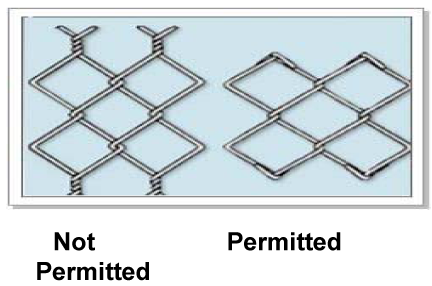
When chain link fencing is utilized the selvage end of the chain link fence shall be smooth, knuckled endings are permitted, twisted ends are not permitted.
(4)
Non-conforming fences. Existing fences that were constructed legally that do not meet the current fencing standards shall be considered a legal non-conforming use. Any alteration, extensions or expansions shall be subject to the limitations of this section.
(Ord. No. 15-0811, 10-27-15)
Editor's note— Ord. No. 15-0811, adopted Oct. 27, 2015, changed the title of § 17-409 from "Fences, walls, and hedges" to read as set out herein.
Sec. 17-410. - Height and density.
No building or structure shall thereafter be erected or altered so as to exceed the height limit, to accommodate or house a greater number of families, to have narrower or smaller front yards or side yards than are required or specified in the regulations in this chapter for the district in which it is located.
Sec. 17-411. - Ocean front setback.
On any lot bordering on the Atlantic Ocean the ocean frontage will be considered the rear yard.
Sec. 17-412. - Open display.
(a)
In all districts, no merchandise for sale, rental, or display shall be located outside of an enclosed building except in conformance with this section.
(b)
Permanent and routine displays.
(1)
C-1 and C-2 districts. The following open displays are permitted in the C-1 and C-2 districts, without restriction on the duration or frequency of display: Newspaper containers, vending machines, automobiles, motorcycles, golf carts, and similar motorized vehicles, bicycles, motor homes, travel trailers, boats, propane bottle exchange cages, nursery and agricultural products, and electrically refrigerated block and bagged ice machines.
(2)
C-3 and C-4 districts. The following open displays are permitted in the C-3 and C-4 districts, without restriction on the duration or frequency of display: Newspaper containers, motorcycles, golf carts, and similar motorized vehicles, bicycles, and small snack food carts.
(3)
The merchandise or rentals permitted in parts (1) and (2) above may be displayed only by the owner of the principal business within the property's boundary in compliance with section 17-400. Merchandise being displayed shall be associated with the business use and products being sold by the business. No permanent or routine display shall extend over any sidewalk, be placed in a manner as to block or impede vehicular or pedestrian ingress or egress to a site, or obstruct any parking space required by this chapter.
(4)
Except in the C-2 district, all open displays permitted in parts (1) and (2) above shall not encroach in the street's right-of-way. Open displays permitted along ocean front lots shall observe a rear yard (ocean front) setback of twenty (20) feet and shall not be placed closer than twenty (20) feet landward on the shore protection line as established in article VIII of this chapter.
(5)
The use of a tent in conjunction with a permanent or temporary display is subject to the limitation imposed by subsection (d).
(c)
Temporary displays.
(1)
Temporary outdoor displays are permitted for the following purposes:
a.
Religious meetings on church property or in nonresidential districts (C-1, C-2, C-3);
b.
Fund-raising events for local nonprofit organizations, only in nonresidential districts (C-1, C-2, C-3 and C4); and
c.
Special sales promotion events for local businesses licensed in the town.
(2)
Outdoor displays, as provided in subsection (c)(1), shall require the issuance of a temporary certificate of zoning compliance as provided in section 17-208 of this chapter. Each temporary certificate of zoning compliance shall permit an outdoor display for no more than ten (10) consecutive days. No more than six (6) certificates authorizing such displays shall be issued per lot within a calendar year (sixty (60) day maximum).
(3)
Notwithstanding the limitations imposed by subsection (c)(2), on lots containing three (3) or more businesses, where each business has a separate principal entrance, two (2) additional certificates of zoning compliance may be issued per business within a calendar year. Each certificate shall authorize no more than ten (10) consecutive days of outdoor display.
(4)
Temporary outdoor displays as authorized by this subsection shall be under a tent and/or within ten (10) feet of the store front. The outdoor displays described above may be displayed only by the owner of the principal business within the property's boundary in compliance with section 17-400. Merchandise being temporarily displayed shall be associated with the business use and products being sold by the business. No outdoor display shall impede vehicular or pedestrian ingress/egress into a site or building, nor shall any outdoor display obstruct a parking space(s) as required by this chapter.
(d)
Tents. Tents used in conjunction with permanent, routine, or temporary displays are authorized by this section subject to the following limitations:
(1)
Except in the C-2 and C-4 district, a tent shall not be placed closer than twenty (20) feet from any right-of-way or ten (10) feet from any side or rear property line. Tents larger than two hundred (200) square feet shall observe the setback requirements applicable to the district in which the tent is located.
(2)
The placement of a tent requires the issuance of a temporary certificate of zoning compliance in accordance with section 17-208. Each temporary certificate of zoning compliance shall permit the placement of a tent for no more than ten (10) consecutive days. No more than six (6) certificates authorizing the placement of a tent shall be issued per lot within a calendar year (sixty (60) day maximum). In the case of a temporary outdoor display, the certificate authorizing the placement of a tent is to be issued concurrently with the certificate required by section 17-412(c)(2).
(3)
Notwithstanding the limitations imposed by subsection (d)(2), on lots containing three (3) or more businesses, where each business has a separate principal entrance, two (2) additional certificates of zoning compliance may be issued per business within a calendar year. Each certificate shall authorize the placement of a tent for no more than ten (10) consecutive days. In the case of a temporary outdoor display, the certificate authorizing the placement of a tent is to be issued concurrently with the certificate required by section 17-412(c)(3).
(Ord. No. 18-0874, 10-23-18; Ord. No. 23-0952, 1-24-23)
Sec. 17-413. - Open air storage.
All open air storage of merchandise, equipment, or machinery in the C-1 highway commercial district or the C-2 central business district shall be in an area separated from adjoining properties and public streets by a planting screen, a fence with staves, or a wall at least six (6) feet in height, but not to exceed eight (8) feet in height, to effectively block the public view.
Sec. 17-414. - Illumination.
Lighting for any site or use, to include the illumination of parking lots, signs, the spotlighting of buildings or structures, or any other exterior lighting, shall be arranged so that the source of light does not shine directly onto adjacent residential properties or into traffic or adjoining streets. Light intensity or brightness shall not exceed one-half (.5) footcandle at a property line adjoining any residential use or at the boundary line of any residential zoning district (as measured no more than six (6) inches above ground level).
Sec. 17-415. - Annexations.
All territory which may hereafter be annexed shall be considered to be in the R-1 low density district until otherwise classified.
Sec. 17-416. - New construction to conform to regulations.
All new construction shall conform to the requirements of this chapter, chapter 13 (buildings and building regulations), chapter 14 (flood damage prevention), and chapter 15 (land development regulations).
Sec. 17-417. - Docks.
(a)
All docks are prohibited on the town stormwater retention ponds, which are commonly referred to and known as the "town lakes."
(b)
Existing docks shall be considered existing nonconforming uses and shall not be allowed to be rebuilt or replaced should the dock be damaged or become unsafe.
(c)
Dock shall be defined as any structure extending over or encroaching upon a town owned body of water.
(Ord. No. 13-0751, 7-12-13)
Sec. 17-418. - Sale of personal property in yard areas of residential zoning areas.
A no charge permit shall be required from the planning, building and zoning department for the sale of personal property in yard areas of residential zoned areas.
Only personal property collected over time by members of the residence, family members or immediate neighbors (meaning nearest, adjacent or contiguous) shall be offered for sale.
The sale of merchandise by a business entity, items purchased for resale or consignment items may not be sold. The sale of bulk items (four (4) or more identical items not in a set) is prohibited.
(1)
Yard sales/sale of personal property in yard areas of residential zoned areas shall be limited to three (3) per calendar year. No more than two (2) consecutive days per yard sale.
(2)
Hours - merchandise and any tables, shelving or racks used to display merchandise must be removed from the yard space by sundown.
(3)
Only one (1) motor vehicle or boat/trailer per residence may display indications that it is "for sale."
Permit applications can be obtained from the planning, building and zoning department and online.
(Ord. No. 17-0847, 6-26-17)
Sec. 17-420. - Spaces required for certain uses.
Off-street vehicular parking space shall be provided on every lot on which any of the following uses are hereafter established or at such time any building or structure is erected, enlarged, or increased in capacity except in the C-2 central business district. The number of vehicular parking spaces provided shall be at least as great as the number specified below in Table 17-420.
(Ord. No. 13-0743, 4-23-13; Ord. No. 18-0874, 10-23-18)
Sec. 17-421. - Dimensional standards for parking.
Each off-street space shall be a minimum of nine (9) feet by eighteen (18) feet. Except for single-family detached, attached or semi-attached residences and duplexes, each space shall be located so that no vehicle is required to back into the street; designed so that no space is blocked, whether temporarily or otherwise by another parking space, and each space has clear vehicular access to a public street; and designed to have a minimum of twenty (20) feet aisles for less than sixty-degree parking and a minimum of twenty-two (22) feet aisles for sixty-degree to ninety-degree parking.
Sec. 17-422. - Driveway and access standards.
All nonresidential drives and site entrances established or re-established hereafter shall observe the following:
(1)
The minimum width of a driveway at the property line shall be twenty-two (22) feet. The width of a driveway at the property line shall not exceed thirty-six (36) feet. Where a driveway is designed for one (1) directional traffic, the minimum driveway width may be reduced to twelve (12) feet.
(2)
The minimum distance between driveways on the site and driveways on adjacent sites shall be seventy-five (75) feet measured from the near edge of the adjacent driveways to the near edge of an onsite driveway. In cases where that distance cannot be met due to conditions such as lot width, existing driveways, or the like, the code enforcement official may reduce the distancing requirement by up to fifty (50) percent based on sound traffic principles.
(3)
A driveway for access into a site is to be placed no closer than thirty (30) feet from a street intersection as measured from the nearest curb radius of the intersecting street's right-of-way to the nearest end of the curb radius of the drive.
(4)
Except in cases where a driveway is provided jointly or serves two (2) or more lots, the minimum distance of any driveway to a property line shall be seven (7) feet.
(5)
In cases where a public street is not maintained by the town, the dimensional and spacing requirements of the maintaining authority, when more restrictive than those of this section, shall govern.
Sec. 17-423. - Common and offsite parking areas.
All parking spaces required herein shall be located on the same lot with the building or use served. However, when an increase in the number of spaces is required by a change of use or enlargement of the building or where the spaces are provided collectively or used jointly by two (2) or more buildings or establishments, the required off-street spaces may be located and maintained on an adjacent property not to exceed four hundred (400) feet from the lot or use served. Such parking spaces shall not be included as part of the area required to satisfy the density requirements of the principal use, shall not thereafter be reduced or encroached upon in any manner, and shall not be extended into the R-1 or R-2 districts.
When a common area is provided to serve two (2) or more uses, the total number of individual spaces available in such common area shall not be less than the sum of the spaces required for the individual uses as separately computed in accordance with the provisions of Table 17-420. The owner of the any lot containing a common parking area relinquishes the right to develop the area devoted to common parking until such time as parking is provided elsewhere.
Sec. 17-424. - Loading and unloading space.
On every lot on which a business, trade, or industry use is hereafter established, space with access to a public street or alley shall be provided as indicated below for the loading and unloading of vehicles off the public street or alley. In the C-1 highway commercial district, a twenty-foot alley is required as the rear yard. The required alley shall be unobstructed and shall provide access for loading and unloading trucks and service vehicles.
(1)
Retail business: One (1) space of at least twelve (12) by twenty-five (25) feet for each three thousand (3,000) square feet of floor area or part thereof.
(2)
Terminals: Sufficient space to accommodate the maximum number of vehicles that will be stored and loaded and unloaded at the terminal at any one (1) time.
(3)
Wholesale and industrial: One (1) space of at least twelve (12) by fifty (50) feet for each ten thousand (10,000) square feet of floor area or part thereof.
Sec. 17-425. - Construction and maintenance.
Except for one- and two-family dwellings, off-street parking and loading facilities shall be constructed, maintained, and operated in accordance with the following specifications:
(1)
Drainage and surfacing. The facility shall be graded for drainage, surfaced with concrete, asphaltic concrete, or asphalt, and maintained in proper condition, free of weeds, dust, trash, and debris. If on the effective date of this chapter there exists lots on which the parking facilities are not required to be surfaced, they shall be maintained in proper condition as noted above.
(2)
Lighting. All lighting fixtures serving parking lots shall be equipped with a cutoff or beveled prism type that directs the casting of light to less than ninety (90) degrees. Light spill-over shall not exceed the standards of illumination as provided in section 17-414.
(3)
Setback and screening. In all districts, parking and loading facilities shall observe a minimum setback of ten (10) feet from a street's right-of-way. Parking or loading areas which abut a residential district or use shall observe a minimum setback of five (5) feet from the residential property or district boundary. Screening shall be provided along any rear or side yard abutting a residential district or use. Screening shall consist of a continuous planting, hedge, fence, wall, or landscaped earthen mound no less than six (6) feet in height.
(4)
Landscaping required: Parking areas containing more than twenty-five (25) spaces are subject to the following standards:
a.
No more than fifteen (15) parking spaces shall be permitted in a continuous row without being interrupted by landscaping. The landscaped area shall not be less than five (5) feet in width.
b.
In addition to the planting and tree retention requirements of article VII, parking lots shall incorporate tree plantings (or retention). One (1) tree is required for each ten (10) parking spaces. In satisfying this requirement, retained trees must conform to the diameter requirements of article VII. New plantings shall conform to the requirements applicable to replacement trees.
(5)
Applicability: Parking lots existing on the effective date of this section shall conform to the standards of subsections (1) and (2) above. All new parking lots and existing lots which are expanded or reconstructed (excluding maintenance and resurfacing) after the effective date of this provision shall conform to the requirements of this section in its entirety.
Sec. 17-426. - Parking and storage of vehicles in residential zones—Commercial vehicles.
Storage of a commercial vehicle in a residentially zoned district is prohibited. Overnight parking of one (1) commercial vehicle in a residentially zoned district is permitted provided that the vehicle is a van or pickup that does not exceed twenty-one (21) feet in length and/or seven feet eleven inches (7'11") in height. All other commercial vehicles are prohibited from overnight parking in residentially zoned districts.
Sec. 17-427. - Noncommercial vehicles, trailers and boats.
(a)
Derelict and unlicensed vehicles. No more than two (2) derelict vehicles, which are visible from a public road, easement, or right-of-way, shall be permitted in any zoning district. Provided however that such vehicles are also substantially covered by an opaque canvas or similar type cover that is maintained free of tears. Unlicensed buses, trucks, vans, recreational vehicles, and trailers, subject to licensure by the State of South Carolina, are not permitted on any property in any residential zone, except in an enclosed garage.
Exception: Automobile service stations complying with section 17-396.3.
(b)
Limitation on large vehicles. Currently licensed vehicles and trailers of any kind or type over twenty-one (21) feet in length shall be limited to a total of one (1) vehicle or trailer per dwelling unit, except when parked in an enclosed garage.
(c)
Boats and boat trailers. Unlicensed boats, except small boats for which a license is not required, are not permitted in any residential zone, except in an enclosed garage or when substantially covered by an opaque canvas or similar type cover. Boats or trailers of any size shall be limited to two (2) per dwelling unit, except when stored in an enclosed garage.
(d)
Occupancy restricted. Vehicles, trailers, boats, campers, tents, recreational vehicles, or any type of nonpermanent structure of any kind shall not be used for living, sleeping, or housekeeping purposes within the town limits of Surfside Beach.
(Ord. No. 25-0975, 3-11-25)
Sec. 17-430. - Purpose and intent.
The purpose of this division is to regulate sexually oriented businesses in order to promote the health, safety, morals, and general welfare of the citizens of Surfside Beach, and to establish reasonable and uniform regulations to prevent or reduce to any extent the secondary effects of sexually oriented businesses in the town. The provisions of this division have neither the purpose nor effect of imposing a limitation or restriction on the content of or reasonable access to any communicative materials or expression. Similarly, it is neither the intent nor effect of these regulations to restrict or deny access by adults to sexually oriented materials or expression protected by the First Amendment of the United States Constitution, or to deny access by the distributors and exhibitors of sexually oriented entertainment to their intended market. Neither is it the intent or effect of this division to condone or legitimize the distribution or exhibition of obscenity.
Due to the direct relationship between the consumption of alcoholic beverages and sexually oriented entertainment and an increase in criminal activities, moral degradation, and disturbances of the peace and good order of the community, and the congruency of these activities as hazardous to the health and safety of the community, the Town of Surfside Beach finds that it is necessary and advisable to regulate and restrict the conduct of owners, operators, agents, employees, entertainers, performers, patrons, and persons on the premises of establishments serving alcoholic beverages. Specifically, it is the intent of the town to prohibit exposure of specified anatomical areas to public view, and any occurrence of specified sexual activity in establishments licensed to serve alcoholic beverages.
Sec. 17-431. - Findings of fact.
Sexually oriented businesses generate secondary effects that are detrimental to the public health, safety, and welfare. Such detriments have been documented in numerous studies including but not limited to: Phoenix, Arizona (1979); Indianapolis, Indiana (1984); Amarillo, Texas (1977); Garden Grove, California (1991); Los Angeles, California (1977); Whittier, California (1978); Austin Texas (1986); Seattle, Washington (1989); Oklahoma City, Oklahoma (1986); El Paso, Texas (1986); New York City, New York (1994); Dallas, Texas (1997); Newport News, Virginia (1996); New York Times Square Study (1994); Phoenix, Arizona (1995-1998); Greensboro, North Carolina (2003); Toledo, Ohio (2002); and, Centralia, Washington (2004).
Sexually oriented businesses, as a category of commercial use, are associated with a wide variety of adverse secondary effects including, but not limited to, personal and property crimes, public safety risks, prostitution, potential spread of disease, lewdness, public indecency, illicit sexual activity, illicit drug use and drug trafficking, negative impacts on surrounding properties, litter, and sexual assault and exploitation.
The location of sexually oriented businesses close to residential areas diminishes property values and leads to conditions that give rise to crime in residential neighborhoods. Studies performed in other communities, including the aforementioned, indicated conclusively that property crimes and sexual crimes increase significantly in neighborhoods where sexually oriented businesses are located.
Each of the foregoing negative secondary effects constitutes a harm which the town has a substantial governmental interest in preventing and/or abating in the future. The regulations contained in this division are designed to ensure that operators of sexually oriented businesses comply with reasonable regulations and to facilitate the enforcement of legitimate location and distance requirements.
Sec. 17-432. - Definitions.
In addition to the definitions set forth in section 17-007, the following words, terms, and phrases, when used in this division, shall have the meanings ascribed to them in this section. All other words, terms, and phrases shall be given their common, ordinary meaning, unless the context clearly requires otherwise.
Adult arcade shall mean any place where the public is permitted or invited wherein coin operated or slug-operated or electronically, electrically, or mechanically controlled still or motion picture machines, projectors, or other image-producing devices are maintained to show images to five (5) or fewer persons per machine at any one (1) time, and where the images so displayed are distinguished or characterized by the depicting or describing of specified sexual activities or specified anatomical areas.
Adult bookstore or adult video store shall mean a commercial establishment which, as one (1) of its principal business purposes, offers for sale or rental (for any form of consideration) adult media. (1) As used in this definition, "principal business purpose or purposes" means the commercial establishment has a substantial portion of its displayed merchandise which consists of said items; or has a substantial portion of the wholesale value of its displayed merchandise which consists of said items; has a substantial portion of the retail value of its displayed merchandise which consists of said items; or derives a substantial portion of its revenues from the sale or rental, for any form of consideration, of said items; or maintains a substantial section of its interior business space for the sale or rental of said items. (2) As used in this definition, "substantial" means twenty-five (25) percent or more.
Adult cabaret shall mean nightclub, bar, restaurant, or similar commercial establishment, regardless of whether alcoholic beverages are served, that features persons who appear in a state of nudity or semi-nudity; or give live performances which are characterized by the exposure of specified sexual activities.
Adult car wash shall mean a car wash where some or all of the employees are semi-nude or nude and/or where "specified sexual activities" occur or "specified anatomical areas" are exhibited.
Adult health club shall mean a health club where some or all of the employees are nude or semi-nude, or in which "specified sexual activities" occur or "specified anatomical activities" are exhibited.
Adult media shall mean books, magazines, periodicals, or other printed matter, or photographs, films, motion pictures, videocassettes or compact discs, digital video discs, video reproductions, slides, or other visual representations, which are characterized by their emphasis upon the display of specified sexual activities or specified anatomical areas.
Adult model studio shall mean any place where a person who appears in a state of nudity or displays "specified anatomical areas" is provided to be observed, sketched, drawn, painted, sculptured, photographed, or similarly depicted by other persons who pay money or any form of consideration. Modeling studios will not be considered a sexually oriented business when meeting the exemption(s) as provided by section 17-440.
Adult motel shall mean a hotel, motel, or similar commercial establishment that: (1) Offers accommodations to the public for any form of consideration; provides patrons with closed-circuit television transmissions, films, motion pictures, videocassettes, slides, compact discs, digital video discs, video reproductions, or similar photographic reproductions that are characterized by the depiction or description of specified sexual activities or specified anatomical areas; and advertises the availability of such material by means of any on or off-premises advertising, including, but not limited to, newspapers, magazines, pamphlets or leaflets, radio, or television; or (2) Offers a sleeping room for rent for a period of time that is less than ten (10) hours; or (3) Allows a tenant or occupant of a sleeping room to sub-rent the room for a period of time that is less than ten (10) hours.
Adult motion picture theater shall mean a commercial establishment that, for any form of consideration, exhibits or shows films, motion pictures, videocassettes, slides, compact discs, digital video discs, video reproductions, or similar photographic reproductions that are characterized by their emphasis upon the display of specified sexual activities or specified anatomical areas. As applied in this chapter, no business shall be classified as a sexually oriented business by virtue of showing, selling or renting materials rated NC-17 or R by the Motion Picture Association of America.
Characterized by shall mean to describe the essential character or quality of an item, activity, or thing.
Establishment of a sexually oriented business shall mean any of the following: (1) The opening or commencement of any sexually oriented business as a new business; (2) The conversion of an existing business, whether or not a sexually oriented business, to any sexually oriented business; (3) The addition of another type(s) of sexually oriented business to any other existing sexually oriented business, such as the addition of an adult video store to an existing sexual device shop; or (4) The relocation of any sexually oriented business.
Nude or a state of nudity shall mean the showing of the human male or female genitals, pubic area, vulva, anus, anal cleft or cleavage, or the showing of bare female breasts. This definition shall not include the act of a female breast-feeding a child in a public place; nor to infants or toddlers in a public place, nor to exposure of the human female breasts above a horizontal line across the top of the areola exhibited by a dress, blouse, shirt, or other similar wearing apparel; nor to exposure of cleavage of the human female breasts exhibited by a dress, blouse, shirt, or similar wearing apparel.
Person shall mean an individual, proprietorship, partnership, corporation, association, or other legal entity.
Premises shall mean the real property upon which the sexually oriented business is located, and all appurtenances thereto and buildings thereon, including, but not limited to, the sexually oriented business structure, the grounds, private walkways, and parking areas under the ownership, control, or supervision of the sexually oriented business.
Regularly shall mean the consistent and repeated doing of the act so described.
Semi-nude shall mean a state of dress in which the human male or female genitals, pubic area, vulva, anus, and anal cleft or cleavage are covered by fully opaque cloth or other material.
Sexual device shop shall mean a commercial establishment that offers for sale:
(1)
Any two (2) of the following categories:
1)
Adult media,
2)
Lingerie; or
3)
Sexual devices; and combination thereof constitutes more than ten (10) percent of its stock in trade or occupies more than ten (10) percent of its interior business space;
(2)
More than five (5) percent of its stock in trade consists of sexual devices; or
(3)
More than five (5) percent of its interior business space is used for the display of sexual devices. Nothing in this definition shall be construed to include any pharmacy, drug store, medical clinic, or any establishment primarily dedicated to providing medical or healthcare products or services.
Sexual device shall mean any three (3) dimensional object designed and marketed for stimulation of the male or female human genital organ or anus, or for sadomasochistic use or abuse of oneself or others, and shall include devices such as dildos, vibrators, penis pumps, and physical representations of the human genital organs. Nothing in this definition shall be construed to include devices primarily intended for protection against sexually transmitted diseases or preventing pregnancy.
Sexual encounter center shall mean a business or commercial enterprise that regularly offers, for any form of consideration, physical contact in the form of wrestling or tumbling between persons when one (1) or more of the persons is semi-nude or nude.
Sexually oriented business shall mean an adult arcade, adult bookstore or adult video store, adult cabaret, adult model studio, adult motel, adult motion picture theater, sexual device shop, sexual encounter center or any other business, such as an adult car wash or adult health club, which offers, for consideration, materials or services characterized as depicting "specified sexual activities" or "specified anatomical areas", or whose employees perform services in a state of nudity or semi-nudity.
Specified anatomical areas shall mean the human genitals, pubic region, buttocks; the female breast below a point immediately above the top of the areola; or human male genitals in a discernibly turgid state, even if completely and opaquely covered.
Specified sexual activities shall mean any of the following: (1) The fondling or other erotic touching of human genitals, pubic region, buttocks, anus, or female breasts; (2) Actual or simulated intercourse, oral copulation, masturbation or sodomy; or (3) Excretory functions as part of or in connection with any of the activities set forth in parts (1) and (2) of this definition.
Viewing room shall mean a room, booth, or other enclosed or partially enclosed area where a patron or patrons of a sexually oriented business would ordinarily be positioned while watching adult media or live entertainment.
Sec. 17-433. - General regulations; prohibited activities.
(a)
Sale and/or consumption of alcohol. The sale and/or consumption of alcoholic beverages in conjunction with any sexually oriented business are prohibited.
(b)
Age requirement. A sexually oriented business shall neither employ nor permit the admittance/patronage of any person who is under eighteen (18) years of age.
(c)
Multiple businesses. The operation, establishment, or maintenance of more than one (1) sexually oriented business is prohibited in the same building, structure, or portion thereof, or the increase of floor area of any sexually oriented business in any building, structure, or portion thereof containing another sexually oriented business.
(d)
Six-foot distance rule. No nude or semi-nude employee or dancer shall perform live entertainment within six (6) feet of any patron, nor shall any patron experience live entertainment within six (6) feet of any nude or semi-nude employee or nude or semi-nude dancer, in a sexually oriented business. Sexually oriented businesses with live entertainment shall conspicuously post a sign that advises patrons that they must be at least six (6) feet away from nude or semi-nude dancers at all times.
(e)
Gratuities. No patron shall personally pay or personally give a gratuity to any nude or semi-nude dancer or nude or semi-nude employee in a sexually oriented business establishment. Gratuities can be placed in a container at a location away from the nude or semi-nude dancer, or handed to a clothed employee. No nude or semi-nude dancer or nude or semi-nude employee of a sexually oriented business shall solicit or accept any pay or gratuity personally from a patron.
Sexually oriented businesses with nude or semi-nude dancers or nude or semi-nude employees shall conspicuously post a sign that advises patrons that gratuities to be paid personally to nude or semi-nude dancers and nude or semi-nude employees are prohibited.
Sec. 17-434. - Location restrictions.
(a)
Use(s) permitted in C-1 district only. Sexually oriented businesses as defined by this division where alcohol is not sold or consumed on the premises are permitted in the C-1 highway commercial district as conditional uses subject to the provisions of this division. A person commits a misdemeanor if he or she operates or causes to be operated a sexually oriented business outside of a designated C-1 district.
(b)
Distance required from certain uses. A person commits a misdemeanor if he or she operates or causes to be operated a sexually oriented business within one thousand (1,000) feet of:
1.
Any residential zone or residential use; or
2.
Any church or place of religious assembly; or
3.
Library; or
4.
Day care center or kindergarten; or
5.
Any primary or secondary school; or
6.
Public park; or
7.
Public playground; or
8.
Public use; or
9.
Any other regulated sexually oriented business.
(c)
Basis of measurement. For the purpose of this section, measurement shall be made in a straight line, without regard to intervening structures or objects, from the nearest property line of the premises where a sexually oriented business is conducted, to the nearest boundary line of a residential zoning district or the nearest property line of the premises containing a residential use, church or place of religious assembly, library, day care center or kindergarten, primary or secondary school, public park, public playground, public use, or other regulated sexually oriented business.
(d)
Impact of distance on existing use(s). A sexually oriented business lawfully operating as a conforming use is not rendered a nonconforming use by the subsequent location of a residential use, church or place of religious assembly, library, day care center of kindergarten, primary or secondary school, public park, public playground, or public use nor the change of a residential district's zoning boundary.
Sec. 17-435. - Supplemental regulations affecting regulated establishments.
(a)
Parking. One (1) on-premise parking space shall be provided for each one hundred (100) square feet of floor area within each sexually oriented business.
(b)
Exterior portions of regulated establishments.
(1)
It shall be unlawful for an owner or operator of a regulated establishment to allow the merchandise or activities of the regulated establishment to be visible from any point outside such regulated establishment.
(2)
It shall be unlawful for the owner or operator of a regulated establishment to allow the exterior portions of the regulated establishment to have flashing lights, or any words, lettering, photographs, silhouettes, drawings, or pictorial representations of any manner except to the extent permitted by the provisions of this Section.
(3)
It shall be unlawful for the owner or operator of a regulated establishment to allow exterior portions of the regulated establishment to be painted any color other than a single achromatic color. This provision shall not apply to any regulated establishment if the following conditions are met:
a.
The regulated establishment is a part of a commercial multi-unit center; and
b.
The exterior portions of each individual unit in the commercial multiunit center, including the exterior portions of the regulated establishment, are painted the same color as one another or are painted in such a way so as to be a component of the overall architectural style or pattern of the commercial multi-unit center.
(4)
Nothing in this article or this section shall be construed to require the painting of an otherwise unpainted exterior portion of a regulated establishment.
(5)
Any sexually oriented business in lawful operation at the time of this section's adoption (on second reading) shall be deemed a nonconforming use, if not in compliance with the provisions of this section, and shall have one hundred eighty (180) calendar days from the date of such adoption to conform to the provisions of this section.
(c)
Signs.
(1)
It shall be unlawful for the owner or operator of any regulated establishment or any other person to erect, construct, or maintain any sign, lighting display or projected image of any type on or for the regulated establishment other than one (1) "primary sign" and one (1) "secondary sign," as provided herein.
(2)
Primary signs shall have no more than two (2) display surfaces. Each such display surface shall:
a.
Not contain any flashing lights;
b.
Be a flat plane, rectangular in shape;
c.
Not exceed seventy-five (75) square feet in area; and
d.
Not exceed ten (10) feet in height or ten (10) feet in length.
(3)
Primary signs shall contain no photographs, silhouettes, drawings or pictorial representations of any manner, and may contain only:
a.
The name of the regulated establishment and/or
b.
One (1) or more of the following phrases:
1.
"Adult Bookstore"
2.
"Adult Movie Theater"
3.
"Adult Cabaret"
4.
"Adult Entertainment"
5.
"Adult Model Studio"
c.
Primary signs for adult movie theaters may contain the additional phrase, "Movie Titles Posted on-Premises."
(4)
Each letter forming a word on a primary sign shall be of a solid color, and each such letter shall be the same print-type, size and color. The background behind such lettering on the display surface of a primary sign shall be of a uniform and solid color.
(5)
Secondary signs shall have only one (1) display surface. Such display surface shall:
a.
Be a flat plane, rectangular in shape;
b.
Not exceed twenty (20) square feet in area;
c.
Not exceed five (5) feet in height and four (4) feet in width; and
d.
Be affixed or attached to any wall or door of the establishment; and
e.
The provisions of subsection (a) parts (2), (3), and (4) shall also apply to secondary signs.
(6)
In addition to the foregoing. It shall be unlawful for the owner or operator of any sexually oriented business or any other person to erect, construct, or maintain any sign or form of external decoration at each business location, except such other sign or signs as specifically permitted herein, including temporary signs, banners, or other device designed to describe the type of business conducted permitted to be carried out thereon.
(7)
Signs and exterior decoration/design of any sexually oriented business shall contain only alphanumeric copy in the English alphabet, and shall not form, outline or contain photographs, silhouettes, drawings, titles, graphic or pictorial representations in any manner of "nudity or state of nudity," "semi-nudity or state of semi-nudity," "specified anatomical areas" or "specified sexual activities."
(8)
Signs and exterior decoration and displays at any sexually oriented business shall not contain neon or flashing lights or animation, or electronically changeable copy. The use of electronic message boards is prohibited.
(9)
Signs or exterior decoration or displays containing the name of the sexually oriented business shall not be placed on top of any building, and the top of any sign or external decoration otherwise permitted on the premises shall not be higher than ten (10) feet, or eight (8) feet lower than the permitted height of the building, or eight (8) feet lower than the actual height of the building where the sexually oriented business is located, whichever is lower.
(10)
In addition to any other sign permitted under this article or the Town Code of Ordinances each sexually oriented business shall display one (1) sign, within twenty-four (24) inches measured laterally from the principal entrance to the establishment, which identifies it as such by using one (1) of the terms defined in section 17-432 such as "Adult Cabaret," consisting of one (1) sign affixed to the exterior of the building with black typeface on a white background, with no border or frame attached to such sign, twenty-four (24) inches tall by eighteen (18) inches wide at a maximum height of between forty-eight (48) and sixty (60) inches above grade.
(11)
The exterior wall and roof coloring of any sexually oriented business shall each be a single monochrome non-reflective and non-luminous tint and shall not incorporate or form (in whole or part) any design, photographs, silhouettes, drawings, titles, graphic or pictorial representations in any manner of "nudity or state of nudity," "semi-nudity or state of semi-nudity," "specified anatomical areas" or "specified sexual activities" or have such design, photographs, silhouettes, drawings, titles, graphic or pictorial representations projected onto them from any illumination or lighting device located on or off the premises.
(12)
The provisions of this article and section shall supplement and not replace or amend any and all other sign requirements established by this chapter from time to time, which shall apply in addition to the provisions set forth above. Nothing herein shall limit the posting of interior signs as required by section 17-433.
(13)
The requirements of subsections (c)(2) and (c)(3) shall apply to all sexually oriented business off-premise signs and/or billboards signs located within the town limits.
(d)
View rooms. A person who operates or causes to be operated a sexually oriented business, other than an adult motel, which exhibits on the premises in a viewing room of less than one hundred fifty (150) square feet of floor space, adult media, or live entertainment characterized by emphasis on exposure or display of specified sexual activities or specified anatomical areas, shall comply with the following requirements:
(1)
A diagram of the premises showing a plan thereof specifying the location of one (1) or more manager's stations and the location of all overhead lighting fixtures and designating any portion of the premises in which patrons will not be permitted must be provided to the code enforcement official. A manager's station shall not exceed thirty-two (32) square feet of floor area. A professionally prepared diagram in the nature of an engineer's or architect's blueprint shall not be required; however, each diagram should be oriented to the north or to some designated street or object and should be drawn to a designated scale or with marked dimensions sufficient to show the dimensions of all areas of the interior to an accuracy of plus or minus six (6) inches.
(2)
The diagram shall be sworn to be true and correct by the applicant.
(3)
No alteration in the configuration or location of a manager's station may be made without the prior approval of the code enforcement official.
(4)
It is the duty of the owners and operators of the premises to ensure that at least one (1) employee is on duty and situated at each manager's station at all times that any patron is present inside the premises.
(5)
The interior of the premises shall be configured in such a manner that there is an unobstructed view from a manager's station of every area of the premises to which any patron is permitted access for any purpose, excluding restrooms. Restrooms may not contain video reproduction equipment. If the premises has two (2) or more manager's stations designated, then the interior of the premises shall be configured in such a manner that there is an unobstructed view of each area of the premises to which any patron is permitted access for any purposes from at least one (1) of the manager's stations. The view required in this subsection must be by direct line of sight from the manager's station. It is further the duty of any agents or employees present in the premises, to ensure that the view area as specified by this section remains unobstructed by doors, walls, merchandise, display racks, or other materials.
(6)
No viewing room shall be occupied by more than one (1) patron or customer at any time.
(7)
The premises shall be equipped with and shall use overhead lighting fixtures of sufficient intensity to illuminate every place to which patrons are permitted access at an illumination of not less than one (1) foot-candle measured at the floor level.
(8)
No owner or agent shall allow opening of any kind to exist between viewing rooms. The operator or owner shall, during each business day, regularly inspect the walls between viewing booths to determine if any openings or holes exist.
Sec. 17-436. - Zoning permit and certificate of zoning compliance required.
(a)
Zoning permit and certificate of zoning compliance. A zoning permit shall be required prior the construction, enlargement, or alteration of any structure, lot, sign, or other site feature intended to be occupied or otherwise used by a sexually oriented business. Prior to the occupancy of any new or existing structure or after the completion of any improvement for which a zoning permit was required, a certificate of occupancy shall be required. Except as is provided in this division, the zoning permit and certificate of zoning compliance are subject to the requirements imposed by article II of this chapter.
(b)
Application. The code enforcement official shall develop application forms for zoning permits and certificates of zoning compliance consistent with requirements of this chapter. In addition to the application requirements for zoning permits and certificates of zoning compliance as provided by article II of this chapter, the application for a sexually oriented business shall include:
(1)
Ownership disclosure. If a person who wishes to operate a sexually oriented business is an individual, he must sign the application for a zoning permit and/or certificate of zoning compliance as applicant. If a person who wishes to operate a sexually oriented business is other than an individual, each individual who has a ten (10) percent or greater current or contingent interest in the ownership, revenues or gross or net profits of the enterprise, and any person (including any lender) having any security interest or any nature or amount whatsoever in any of the income or assets thereof must sign the application for a permit and/or certificate as applicant. If a corporation or limited liability company, or another legal person other than an individual is listed as owner of an a regulated business, or as an entity which wishes to operate such a business, each individual having a ten (10) percent or greater interest in the ownership, revenues or gross or net profits of the enterprise, and any person (including any lender) having any security interest in any of the income or assets thereof of the enterprise must sign the application for a permit and/or certificate as applicant. All corporate officers, managers and directors, including alternate directors shall also sign the application. Any change in ownership or the granting or extinguishment of a security interest at any time that alters the names or identities of the persons having an interest in the permit and/or certificate application as set forth above shall constitute a change in control of the sexually oriented business and require a new application to be submitted within thirty (30) days, failing which the current permit or certificate shall be deemed canceled. The fact that a person possesses other types of state or town permits, certificates, and/or licenses does not exempt him from the requirement of obtaining a zoning permit or certificate of zoning compliance under the terms of this division. The names of all persons signing as applicants for a sexually oriented business permit and/or certificate shall not be subject to any exemption under the South Carolina Freedom of Information Act and shall be published by the town on the request of any person.
(2)
Site plan. The application for a zoning permit or certificate of zoning compliance shall include a plan, drawn to scale, which accurately depicts the use of all structures and lots up to one thousand (1,000) feet from the property lines of the lot intended for the sexually oriented business.
(3)
Diagram. For any sexually oriented business that contains a viewing room, as defined by this division, the application for a zoning permit or certificate of zoning compliance shall contain a diagram as required by section 17-435.
Upon submission of the application and review fee, the code enforcement official shall provide the applicant with a receipt bearing the date on which the application was received. If the code enforcement official finds that an application is incomplete, the applicant shall be notified not more than thirty (30) calendar days after the application is received. The notice, in the form of a certified letter, shall state with specificity the information that is missing or lacking. The applicant may resubmit the application in complete form without repayment of the application/review fee one (1) time within thirty (30) calendar days of when the notice of incompleteness is mailed. If the code enforcement official fails to provide notice of incompleteness within thirty (30) calendar days after the application is received, then the application will be deemed complete.
(c)
Code enforcement official's review. The code enforcement official shall approve all applications which fully comply with the requirements of this article and all other applicable ordinances and laws. For any application which does not comply with this article and all other applicable ordinances and laws, the code enforcement official shall deny the application and provide notice by certified letter of such decision including an explanation of each reason for the denial. The review of an application deemed complete and notification of either approval or denial shall in no case exceed a period of thirty (30) calendar days after the completed application is received. If such notice is not timely given, and the applicant does not waive the time limitations stated herein, the application shall be deemed approved and the applicant shall be allowed to commence with operation.
Sec. 17-437. - Inspections.
The management of any sexually oriented business shall permit representatives of the police department, building and zoning department, or other town, county, or state agency to inspect the premises at any time it is open for business.
Sec. 17-438. - Revocation of permit or certificate.
The code enforcement official shall revoke a zoning permit or certificate of zoning compliance, thereby suspending the operation of any sexually oriented business, for the following:
(1)
The giving of false or misleading information by the permittee at any time in the application process;
(2)
For the illegal sale of any controlled substance on the premises;
(3)
For the arrest and conviction of any owner or employee for any violation of S.C. Code 1976, Title 44, as amended, relating to controlled substances;
(4)
For the arrest and conviction of any owner or employee for any violation of S.C. Code 1976, Title 16, 1976, as amended;
(5)
Failure to permit inspections by authorized town, county, or state agencies; and/or
(6)
Violations of the age restrictions specified in this division.
Sec. 17-439. - Appeals.
(a)
All matters of enforcement, interpretation, and application of this article, including decisions on zoning permits and certificates of zoning compliance, shall be made initially by the code enforcement official as an administrative matter.
(b)
Any person whose application has been denied or who is aggrieved by any decision by the code enforcement official in the administration of this division may appeal that decision to the board of zoning appeals within fifteen (15) calendar days of notification of the denial or other sexually oriented business related decision. Except as provided in this section, appeals to the board are to follow the procedures as provided in article II of this chapter.
(c)
The failure of the board of zoning appeals to take such an act or do such a thing within the time prescribed by article II shall not prevent the exercise of constitutional rights of an applicant. Notwithstanding the provisions of article II or any other provision to the contrary, if the board fails to act within sixty (60) calendar days of receipt of an application for appeal by a sexually oriented business, the application for the operation or continuance of the sexually oriented business shall be deemed approved.
Sec. 17-440. - Exemptions.
The following activities or businesses do not constitute a sexually oriented business as defined by this division:
(1)
A business or organization in which a person serves as a model for a drawing, painting, sketching, sculpture, or other similar art studio class operated:
a.
By a university or college or other institution of higher learning; or
b.
By a nonprofit arts organization, such as a museum, gallery, artist association, or arts cooperative.
(2)
A professional or community theater, or a theater affiliated with an institution of higher education, that produces works of dramatic arts in which actors or actresses occasionally appear onstage in a state of semi-nudity, nudity, or in any state of undress as part of his or her dramatic role.
Sec. 17-450. - Purpose and intent.
The purpose of this division is to regulate the placement of cannabis dispensing businesses, smoke shops, and tobacco stores and is necessary in order to promote the health, safety, morals, and general welfare of the citizens of the Town of Surfside Beach, and to establish reasonable and uniform regulations to prevent or reduce to any extent the secondary effects of cannabis dispensing businesses, smoke shops, and tobacco stores in the town. The provisions of this division have neither the purpose nor effect of imposing a limitation or restriction on the content of or reasonable access to any lawful products being sold, any communicative materials, or expression. Similarly, it is neither the intent nor effect of these regulations to restrict or deny access by adults to the offered products or to deny access by the distributors to their intended market. These retail location restrictions and criteria encourage quality development and economic growth while continuing to provide for a wide range of economic development opportunities throughout the town for those uses which are incompatible with certain parcels in the C-1 highway commercial district.
(Ord. No. 25-0989, 7-8-25)
Sec. 17-451. - Definitions.
The following words, terms and phrases, when used in this article, shall have the meanings ascribed to them in this section, except where the context clearly indicates a different meaning:
Alternative nicotine product shall mean a product or device not consisting of or containing tobacco that provides for the ingestion into the body of nicotine, whether by chewing, smoking, absorbing, dissolving, inhaling, snorting, sniffing, or by any other means. Alternative nicotine product does not include cigarette, smokeless tobacco, other tobacco products, or any other product approved by the United States Food and Drug Administration as a non-tobacco product for sale as a tobacco-cessation product, as a tobacco-dependence product, or for other medical purposes, which is being marketed and sold solely for that approved purpose.
Cannabis product shall mean a product originating from the species Cannabis Sativa L., of the family Cannabaceae, excluding marijuana as defined by S.C. Code of Laws, Title 44 Chapter 54, as amended, and shall include all forms of Cannabis, Cannabidiol, or Low-THC Cannabis products (CBD) to be consumed or applied.
Cannabis dispensing business shall mean any business or premises with more than an incidental or ancillary display, sale, distribution, delivery, offering, furnishing, or marketing of cannabis products. Businesses or premises with an incidental or ancillary level are those that meet the exemption set forth in section 17-459.
Designated zone shall mean the area within C-1 highway commercial district that meets the location restrictions of section 17-453.
E-cigarette shall mean any electronically activated device or inhaler meant to simulate cigarette smoking that uses a heating element to vaporize a liquid solution, popularly referred to as "juice", and that causes the user to exhale any smoke, vapor, or substance other than that produced by unenhanced human exhalation. The juice used in e-cigarettes typically contains nicotine, and for this reason e-cigarettes and their juice can be classified as both tobacco products and tobacco paraphernalia.
Head shop shall mean any business that engages in the retail merchandising of tobacco paraphernalia coupled with the retail offering of synthetic marijuana, cannabis product, or vapor product of alternative consumable matter other than tobacco meant to be smoked, vaped or ingested orally in any fashion.
Material change in business type shall mean that the business becomes a licensed medical marijuana dispensary or is required to obtain a different or additional business license under section 4-4(b).
Medical marijuana dispensary shall mean a legal entity that acquires, possesses, sells, distributes, transmits, gives, dispenses, or otherwise provides medical marijuana to qualifying patients.
Retail square footage shall mean the sales space at a single location as determined by measuring the actual floor area available for retail activities, including selling merchandise and customer movement. It excludes storage rooms, restrooms and offices.
Smoke or smoking shall mean the carrying, smoking, burning, inhaling, or exhaling of any kind of lighted pipe, cigar, cigarette, hookah, weed, herbs, or any other lighted tobacco product in any manner or in any form and shall also include the inhaling, exhaling, burning or carrying any alternative nicotine product or vapor product as defined in this division.
Smoke shop or tobacco store shall mean any business or premises with more than an incidental or ancillary display, sale, distribution, delivery, offering, furnishing, or marketing of alternative nicotine, alternative nicotine delivery product, vapor product, e-cigarette, single cigarette tobacco, tobacco products, or tobacco paraphernalia. Businesses or premises with an incidental or ancillary level are those that meet the exemption set forth in section 17-459.
Tobacco and tobacco related products shall mean items, including but not limited to cigarettes and any product containing, made, or derived from nicotine or tobacco that is intended for human consumption, whether chewed, smoked, absorbed, dissolved, inhaled, snorted, sniffed, ingested or consumed by any other means, including by vaping, or any component, part, or accessory of a tobacco product; cigars; pipe tobacco, cheroots; stogies; peripheral; granulated, plug cut, crimp cut, ready rubbed, and other smoking tobacco; snuff; snuff flour; cavendish; plug and twist tobacco; fine cut and other chewing tobaccos; shorts; refuse scraps; clippings, cuttings and sweepings of tobacco; dipping tobaccos; and other kinds and forms of tobacco. Tobacco excludes any tobacco product that has been approved by the United States Food and Drug Administration for sale as a tobacco-cessation product, as a tobacco-dependence product, or for other medical purposes, and is being marketed and sold solely for such an approved purpose.
Tobacco paraphernalia shall mean any paraphernalia, equipment, device, or instrument that is designed or manufactured for the smoking, chewing, absorbing, dissolving, inhaling, snorting, sniffing, or ingesting by any means into the body of tobacco, tobacco products, or other controlled substances as defined in S.C. Code of Laws, Title 44 Chapter 53, as amended. Items or devices classified as tobacco paraphernalia include but are not limited to the following: pipes, punctured metal bowls, bongs, water bongs, electric pipes, e-cigarettes, e-cigarette juice, buzz bombs, vaporizers, hookahs, and devices for holding burning material. It further includes items designed or manufactured which may be used in ingesting, inhaling, or otherwise introducing marijuana, cocaine, hashish, hashish oil, PCP, methamphetamine, or amphetamines, tobacco or tobacco related products into the human body such as:
•
Metal, wooden, acrylic, glass, stone, plastic, or ceramic pipes with or without screens, permanent screens, hashish heads, or punctured metal bows;
•
Water pipes;
•
Carburetion tubes and devices;
•
Smoking and carburetion masks;
•
Roach clips: meaning objects to hold burning material, such as a marijuana cigarette, that has become too small or too short to be held in the hand;
•
Miniature spoons with level capacities of one-tenth (1/10) centimeter or less.
•
Chamber pipes;
•
Carburetor pipes;
•
Electric pipes;
•
Air-driven pipes;
•
Chillums;
•
Bongs;
•
Ice pipes or chillers;
•
Wired cigarette papers;
•
Cocaine freebase kits; or
•
Rolling papers.
Lighters and matches shall be excluded from the definition of tobacco paraphernalia.
Vapor product shall mean any non-combustible product, which may or may not contain nicotine that employs a heating element, power source, electronic circuit, or other electronic chemical or mechanical means, regardless of shape or size that can be used to produce vapor from a solution or any other form. Vapor product includes any electronic cigarette, hookah, electronic cigar, electronic cigarillo, electronic pipe, hookah pipe or similar product or device, as well as any vapor cartridge or other container that is intended to be used with or in an electronic cigarette, electronic cigar, electronic cigarillo, electronic pipe, or similar product or device. Vapor product does not include any product regulated as a drug or device by the United States Food and Drug Administration under Chapter V of the Food, Drug, and Cosmetic Act, 21 U.S.C. § 301, et seq.
(Ord. No. 25-0989, 7-8-25)
Sec. 17-452. - General regulations; prohibited activities.
(a)
Cannabis dispensing businesses, smoke shops, and tobacco stores as defined in section 17-451 are permitted in the Town of Surfside Beach only in the C-1 highway commercial district as conditional uses subject to the location restrictions of section 17-453 and the other requirements of this division. Except as provided in subsections (d) and (e) [below], a person commits a misdemeanor if he or she operates or causes to be operated a cannabis dispensing business, smoke shop, or tobacco store other than one (1) meeting the requirements of this section and section 17-453 or satisfying the requirements for exemption under section 17-459.
(b)
Any cannabis dispensing business, smoke shop or tobacco store wishing to operate within the designated zone after the effective date of the ordinance codified in this division shall obtain a conditional use permit.
(c)
Standard conditions of approval for any conditional use permit under this division shall, at minimum, include the following:
(1)
A location within C-I highway commercial district determined to satisfy the requirements of section 17-453.
(2)
A zoning permit and certificate of zoning compliance under section 17-455.
(3)
No smoking, inhaling, or ingestion shall be permitted on the premises at any time.
(4)
No sales may be offered, made, solicited, or conducted on the premises by minors.
(5)
No self-service tobacco, tobacco product, or tobacco paraphernalia displays or dispensing machines or devices shall be permitted.
(6)
No distribution of free or low-cost tobacco, tobacco products or tobacco paraphernalia or synthetic substances as defined, as well as coupons for said items, shall be permitted.
(d)
Any cannabis dispensing business, smoke shop, or tobacco store in operation at the time of this division's adoption shall be deemed a nonconforming use. Nonconforming businesses are required to comply with the requirements of this division with the exception of the location restrictions in section 17-453 until such time as there is a change in ownership of the business or a material change in the business type.
(e)
Any business in operation at the time of this division's adoption or thereafter, that exceeds either of the ten (10) percent exemption criterion in section 17-459 shall be deemed a nonconforming use provided that such business applies for a business license for operation of a cannabis dispensing business, smoke shop, or tobacco store within sixty (60) days of the adoption of this division. Submission of a timely application for such business license allows the business to continue as nonconforming use under this division until such time as there is a change in ownership of the business or a material change in the business type. Submission of a timely application for such business license under this subsection shall not constitute a material change in the business type. Failure to submit a timely application shall be deemed a violation under subsection (a) and immediately subjects the business to the requirements of this division.
(f)
It is unlawful for a cannabis dispensing business, smoke shop, or tobacco store to knowingly allow or permit a minor, not accompanied by his or her parent or legal guardian, to enter or remain within any cannabis dispensing business, smoke shop, or tobacco store.
(Ord. No. 25-0989, 7-8-25)
Sec. 17-453. - Location restrictions.
(a)
No portion of the use shall be located on properties contiguous to the town's frontage road or Highway 17.
(b)
Distance required from certain uses. No cannabis dispensing business, smoke shop, or tobacco store shall be operated within one thousand (1,000) feet of:
(1)
Any residential zone or residential use; or
(2)
Any church or place of religious assembly; or
(3)
Library; or
(4)
Day care center or kindergarten; or
(5)
Any primary or secondary school; or
(6)
Public park; or
(7)
Public playground; or
(8)
Public use; or
(9)
Any other regulated cannabis dispensing business, smoke shop, or tobacco store.
(c)
Basis of measurement. For the purpose of this section, measurement shall be made in a straight line, without regard to intervening structure or objects, from the nearest property line of the premises where a cannabis dispensing business, smoke shop, or tobacco store conducts business, to the nearest boundary line of a residential zoning district or the nearest property line of the premises containing a residential use, church or place of religious assembly, library, day care center or kindergarten, primary or secondary school, public park, public playground, public use, or other regulated cannabis dispensing business, smoke shop, or tobacco store.
(d)
Impact of distance on existing use(s). A cannabis dispensing business, smoke shop, or tobacco store lawfully operating as a conforming use is not rendered a nonconforming use by the subsequent location of a residential use, church or place of religious assembly, library, day care center or kindergarten, primary or secondary school, public park, public playground, or public use nor the change of a residential district's existing boundary.
(Ord. No. 25-0989, 7-8-25)
Sec. 17-454. - Supplemental regulations affecting regulated establishments.
(a)
Parking. Each cannabis dispensing business, smoke shop, or tobacco store issued a conditional use permit under section 17-452 shall provide on-premise parking sufficient to meet the requirements for [parking] code N in section 17-420.
(b)
Signs. Cannabis dispensing businesses, smoke shops, and tobacco stores issued a conditional use permit under section 17-452 shall post clear signage stating that minors may not enter the premises unless accompanied by a parent or legal guardian. At least one (1) such sign shall be placed in a conspicuous location near each public entrance to the store. It shall be unlawful for a cannabis dispensing business, smoke shop, or tobacco store to fail to display and maintain or fail to cause to be displayed or maintained, such signage.
(Ord. No. 25-0989, 7-8-25)
Sec. 17-455. - Zoning permit and certificate of zoning compliance required.
(a)
Zoning permit and certificate of zoning compliance. A zoning permit shall be required prior the construction, enlargement, or alteration of any structure, lot, sign, or other site feature intended to be occupied or otherwise used by a cannabis dispensing business, smoke shop, or tobacco store. Prior to the occupancy of any new or existing structure or after the completion of any improvement for which a zoning permit was required, a certificate of occupancy shall be required. Except as is provided in this division, the zoning permit and certificate of zoning compliance are subject to the requirements imposed by article II of this chapter.
(b)
Application. The code enforcement official shall develop application forms for zoning permits and certificates of zoning compliance consistent with requirements of this chapter. In addition to the application requirements for zoning permits and certificates of zoning compliance as provided by article II of this chapter, the application for a cannabis dispensing business, smoke shop, or tobacco store shall include:
(1)
Ownership disclosure. If a person who wishes to operate a cannabis dispensing business, smoke shop, or tobacco store is an individual, he must sign the application for a zoning permit and/or certificate of zoning compliance as the applicant. If a person/entity who wishes to operate a cannabis dispensing business, smoke shop, or tobacco store is other than a single individual, each individual or entity having a ten (10) percent or greater current or contingent interest in the ownership, revenues or gross or net profits of the enterprise, and any person (including any lender) having any security interest or any nature or amount whatsoever in any of the income or assets thereof must sign the application for a permit and/or certificate as applicant. All corporate officers, managers and directors, including alternate directors shall also sign the application. Any change in ownership or the granting or extinguishment of a security interest at any time that alters the names or identities of the persons having an interest in the permit and/or certificate application as set forth above shall constitute a change in control of the cannabis dispensing business, smoke shop, or tobacco store and shall require a new application to be submitted within thirty (30) days, failing which the current permit or certificate shall be deemed canceled. The fact that a person possesses other types of state or town permits, certificates, and/or licenses does not exempt him from the requirement of obtaining a zoning permit or certificate of zoning compliance under the terms of this division. The names of all persons signing as applicants for a cannabis dispensing businesses, smoke shops and tobacco stores permit and/or certificate shall not be subject to any exemption under the South Carolina Freedom of Information Act and shall be published by the town on the request of any person. The names of all persons signing as applicants for a cannabis dispensing business, smoke shop, or tobacco store permit and/or certificate shall not be subject to any exemption under the South Carolina Freedom of Information Act and shall be published by the town on the request of any person.
(2)
Site plan. The application for a zoning permit or certificate of zoning compliance shall include a plan, drawn to scale, which accurately depicts the use of all structures and lots up to one thousand (1,000) feet from the property lines of the lot intended for the cannabis dispensing business, smoke shop, or tobacco store.
Upon submission of the application and review fee, the code enforcement official shall provide the applicant with a receipt bearing the date on which the application was received. If the code enforcement official finds that an application is incomplete, the applicant shall be notified not more than thirty (30) calendar days after the application is received. The notice, in the form of a certified letter, shall state with specificity the information that is missing or lacking. The applicant may resubmit the application in complete form without repayment of the application/review fee one (1) time within thirty (30) calendar days of when the notice of incompleteness is postmarked. If the code enforcement official fails to provide notice of incompleteness within thirty (30) calendar days after the application is received, then the application shall be deemed complete.
(c)
Code enforcement official's review. The code enforcement official shall approve all applications which fully comply with the requirements of this article and all other applicable ordinances and laws. For any application which does not comply with this article and all other applicable ordinances and laws, the code enforcement official shall deny the application and provide notice by certified letter of such decision including an explanation of each reason for the denial. The review of an application deemed complete and notification of either approval or denial shall in no case exceed a period of thirty (30) calendar days after the completed application is received. If such notice is not timely given, and the applicant does not waive the time limitations stated herein, the application shall be deemed approved, and the applicant shall be allowed to commence with operation.
(Ord. No. 25-0989, 7-8-25)
Sec. 17-456. - Inspections.
The management of any cannabis dispensing business, smoke shop, or tobacco store shall permit representatives of the police department, building and zoning department, or other town, county, or state agency to inspect the premises at any time it is open for business.
(Ord. No. 25-0989, 7-8-25)
Sec. 17-457. - Revocation of permit or certificate.
The code enforcement official shall revoke a conditional use permit, a zoning permit or certificate of zoning compliance, thereby suspending the operation of any cannabis dispensing business, smoke shop or tobacco store, for any of the following:
(1)
The giving of false or misleading information by the permittee at any time in the application process;
(2)
For the illegal sale of any controlled substance on the premises;
(3)
For the arrest and conviction of any owner or employee for any violation of Title 44 of the S.C. Code of Law, as amended, relating to controlled substances;
(4)
For the arrest and conviction of any owner or employee for any violation of Title 16 of the S.C. Code of Law, as amended;
(5)
Failure to permit inspections by authorized town, county, or state agencies; or
(6)
Violation of the age restrictions specified in this division.
(Ord. No. 25-0989, 7-8-25)
Sec. 17-458. - Appeals.
(a)
All matters of enforcement, interpretation, and application of this division, including decisions on conditional use permits, zoning permits and certificates of zoning compliance, shall be made initially by the code enforcement official as an administrative matter.
(b)
Any person whose application has been denied or who is aggrieved by any decision by the code enforcement official in the administration of this division may appeal that decision to the board of zoning appeals within fifteen (15) calendar days of notification of the denial or other cannabis dispensing business, smoke shop, or tobacco store-related decision. Except as provided in this section, appeals to the board are to follow the procedures as provided in article II of this chapter.
(c)
The failure of the board of zoning appeals to take such an act or do such a thing within the time prescribed by article II shall not prevent the exercise of constitutional rights of an applicant. Notwithstanding the provisions of article II or any other provision to the contrary, if the board fails to act within sixty (60) calendar days of receipt of an application for appeal by a cannabis dispensing business, smoke shop or tobacco store, the application for the operation or continuance of the cannabis dispensing business, smoke shop or tobacco store shall be deemed approved.
(Ord. No. 25-0989, 7-8-25)
Sec. 17-459. - Exemption.
A business authorized to operate in the Town of Surfside Beach where ten (10) percent or less of its annual gross receipts at that location is derived from the sale of cannabis, smoke and tobacco products or paraphernalia or ten (10) percent or less of its retail square footage at that location is devoted to such products or paraphernalia is exempt from the requirements of this division.
(Ord. No. 25-0989, 7-8-25)
Sec. 17-460. - Severability.
If any section, subsection, sentence, clause, or phrase of this division is, for any reason, held to be invalid or unconstitutional by a court of competent jurisdiction, such decision shall not affect the validity of the remaining portions of the division. The Town of Surfside Beach hereby declares that it would have adopted this division and each section, subsection, sentence, clause, and phrase thereof, irrespective of the fact that any one or more sections, subsections, sentences, clauses, or phrases may be declared invalid or unconstitutional. In the event of such a decision, the remainder of this division shall remain in full force and effect.
(Ord. No. 25-0989, 7-8-25)

