
Surfside Beach City Zoning Code
ARTICLE VII
LANDSCAPING AND TREE PROTECTION5
Editor's note— Ord. No. 17-0838, adopted April 11, 2017, repealed the former Art. VII., §§ 17-700—17-741, and enacted a new Art. VII as set out herein. The former Art. VII pertained to similar subject matter and derived from Ord. No. 15-0799, 4-28-15.
Sec. 17-700.- Intent.
This article is to establish requirements for landscaping and afford protection to all trees, especially those defined as protected, specimen, or landmark trees on developed and undeveloped residential and commercial property. A zoning permit indicating approval by town staff may be required before tree pruning or removal is undertaken.
(Ord. No. 17-0839, 8-22-17)
Sec. 17-701. - Landscaping defined.
Landscaping shall consist of, but not be limited to, any combination of materials such as grass, ground covers, shrubs, flower beds, vines, hedges, and trees.
(Ord. No. 17-0839, 8-22-17)
Sec. 17-702. - Area required to be landscaped per zoning district.
(Ord. No. 17-0839, 8-22-17)
Sec. 17-703. - Installation of landscaping.
The installation of landscaping shall meet all requirements of the Town Code, including article IX for commercial projects in the C1 and C2 districts. New construction, redevelopment or major additions shall have all elements of landscaping installed prior to the issuance of a certificate of zoning compliance in accordance with section 17-206.
(Ord. No. 17-0839, 8-22-17)
Sec. 17-720. - Exemptions from this article.
Electric utilities are exempt from the permitting process for the pruning and/or removal of a tree when necessary to correct a hazardous situation or to eliminate tree or wire conflicts that have the potential to interfere with power reliability upon notification and approval of the town's code enforcement official.
(Ord. No. 17-0839, 8-22-17)
Sec. 17-721. - Contractor/property owner affidavit required.
The removal of trees requiring a zoning permit shall be performed by a licensed, bonded and insured tree removal company. In the event a property owner chooses to remove the tree(s) by himself, a hold harmless agreement shall be executed and filed with the town.
(Ord. No. 17-0839, 8-22-17)
Sec. 17-722. - Regulations and classifications.
The regulations of division 2 tree protection are divided into three (3) classifications:
(1)
Owner of existing residence;
(2)
Owner of existing commercial property (with primary structure);
(3)
Development of vacant property (residential or commercial), redevelopment, major addition, or pool; or,
In all cases, the code enforcement official shall determine if conditions are met.
(Ord. No. 17-0839, 8-22-17; Ord. No. 21-0933, § 1(Exh. A), 11-9-21)
Sec. 17-723. - Owner of existing residence.
(a)
Tree and measurement requirements for residentially zoned properties.
(b)
Applicability. Nonconforming lots that do not contain the number of trees or cumulative measurement requirements may continue pursuant to the provisions of this chapter. Any change shall immediately require compliance with the minimum number of trees listed in Table 17-723.1.
(c)
Reduction authorized. A reduction is limited to one (1) tree or twenty (20) percent of the number of trees required for a lot, whichever is greater. The code enforcement official may, consistent with the requirements of this section, authorize a reduction in the number of required trees from the terms of section 17-723.1 if:
(1)
The lot is nonconforming in area; or
(2)
The lot contains a landmark tree and the placement of the required tree would interfere with its healthy growth; or
(3)
The replacement tree would interfere with a public street, sidewalk, drainage or utility easement.
(d)
Appeals. Appeals regarding code enforcement decisions shall be made to the board of zoning appeals pursuant to section 17-223. The board of zoning appeals may grant a variance to provide additional relief from the terms of this article, subject to the requirements imposed by section 17-222.
(Ord. No. 17-0839, 8-22-17; Ord. No. 21-0933, § 1(Exh. A), 11-9-21)
Sec. 17-723.2. - Zoning permit required for existing residence.
No permit. A zoning permit is not required for the removal of trees under eight (8) inches in diameter or twenty-five (25) inches in circumference measured two (2) feet from the ground, or for the pruning of limbs under eight (8) inches in diameter or twenty-five (25) inches in circumference measured two (2) inches from the tree trunk.
Permit required. Issuance of a no-fee zoning permit is required prior to removal of trees over eight (8) inches in diameter or twenty-five (25) inches in circumference measured two (2) feet from the ground, and for the pruning of limbs over eight (8) inches in diameter or twenty-five (25) inches in circumference measured two (2) inches from the tree trunk.
(Ord. No. 17-0839, 8-22-17; Ord. No. 21-0933, § 1(Exh. A), 11-9-21))
Sec. 17-723.3. - Guidelines for pruning limbs or removal of common trees for an existing residence.
Trees or limbs over eight (8) inches. When trees or limbs exceed eight (8) inches in diameter or twenty-five (25) inches in circumference a no-fee permit is required and will be issued as long as one (1) of the following conditions is met:
(1)
The property owner wishes to thin or remove existing common trees from the property to allow for the proper growth of remaining trees or to enhance the overall appearance of the landscaped area.
(2)
The tree(s) poses a safety hazard to pedestrians or vehicle traffic;
(3)
The tree poses a hazard to building or utilities, including foundations or driveways in the near future; or
(4)
The tree is any variety of pine other than a long leaf; or
(5)
The tree is within ten (10) feet of the primary structure, foundation or driveway; or
(6)
The tree is diseased, dead, or weakened by age, storm, fire, or other injury which is a source of hazard to people, buildings, or other improvements.
Tree replacement. If the removal does not maintain the required number of trees, common trees may be replaced with another common tree.
(Ord. No. 17-0839, 8-22-17; Ord. No. 21-0933, § 1(Exh. A), 11-9-21)
Sec. 17-723.4. - Guidelines for pruning or removal of protected and specimen trees for an existing residence.
Trees or limbs over eight (8) inches. With the issuance of a no-fee permit, protected or specimen trees or limbs exceeding eight (8) inches in diameter or twenty-five (25) inches in circumference may be removed or pruned as long as one (1) of the following conditions is met:
(1)
Tree(s) pose a safety hazard to pedestrians or vehicle traffic;
(2)
Tree(s) can be expected to pose a hazard to building or utilities, including trees within ten (10) feet of the primary structural foundation;
(3)
The tree is diseased, dead, or weakened by age, storm, fire, or other injury, which is a source of hazard to people, buildings, or other improvements on a lot.
Replacement trees. If the removal does not maintain the required number of trees, only trees listed in Table 17-750 shall be authorized for planting to replace protected and specimen trees.
(Ord. No. 17-0839, 8-22-17; Ord. No. 21-0933, § 1(Exh. A), 11-9-21)
Sec. 17-723.5. - Guidelines for pruning or removal of landmark trees for an existing residence.
(a)
Trimming or pruning. Issuance of a no-fee permit shall be required before any trimming or pruning of landmark limbs. Landmark tree limbs over eight (8) inches in diameter or twenty-five (25) inches in circumference measured two (2) inches from the trunk shall not be removed unless one (1) or more of the following conditions is met:
(1)
Limb(s) pose a safety hazard to pedestrians or vehicle traffic;
(2)
Limbs pose or can be expected to pose a hazard to building or utilities,
(3)
The tree limb is diseased, dead, or weakened by age, storm, fire, or other injury, which is a source of hazard to people, buildings, or other improvements on a lot.
(b)
Removal. Prior to the removal of a landmark tree a letter from an ISA certified arborist, South Carolina registered forester, or landscape architect must be submitted to the planning, building and zoning department stating one (1) or more of the reasons listed below that require(s) the tree(s) be removed.
(1)
Tree(s) pose a safety hazard to pedestrians or vehicle traffic;
(2)
Tree poses or can be expected to pose a hazard to primary structure, including foundation or utilities, or
(3)
The tree is diseased, dead, or weakened by age, storm, fire, or other injury which is a source of hazard to people or the primary building.
(4)
Foundation damage caused or likely. When a landmark tree is within ten (10) feet of a primary residence foundation, and can be expected to cause foundation damage the code enforcement official may approve the removal without requiring an arborist letter.
Replacement trees. If the removal does not maintain the required number of trees, only those trees listed in Table 17-750 shall be authorized for planting to replace a landmark tree.
Other requests. Requests for the removal of a landmark tree in order to place a pool, accessory structure, or any other type use other than primary residence shall require approval from the board of zoning appeals. The planning, building and zoning department will expedite the appeal process as much as state law allows.
(Ord. No. 17-0839, 8-22-17; Ord. No. 21-0933, § 1(Exh. A), 11-9-21)
Sec. 17-724. - Commercial property with primary structure.
(a)
Tree and measurement requirements for commercially zoned properties.
(b)
Applicability. Nonconforming lots that do not contain the number of trees or cumulative measurement requirements may continue pursuant to the provisions of this chapter. Any change shall immediately require compliance with the minimum number of trees requirement of Table 17-724.1.
(c)
Reduction authorized. A reduction is limited to one (1) tree or twenty (20) percent of the number of trees required for a lot, whichever is greater. The code enforcement official may, consistent with the requirements of this section, authorize a reduction in the number of required trees from the terms of section 17-723.1 if:
(1)
The lot is nonconforming in area; or
(2)
The lot contains a landmark tree and the placement of the required tree would interfere with its healthy growth; or
(3)
The replacement tree would interfere with a public street, sidewalk, drainage or utility easement.
(d)
Appeals. Appeals regarding code enforcement decisions shall be made to the board of zoning appeals pursuant to section 17-223. The board of zoning appeals may grant a variance to provide additional relief from the terms of this article, subject to the requirements imposed by section 17-222.
(Ord. No. 17-0839, 8-22-17)
Sec. 17-724.2. - Zoning permit required for commercial property with primary structure.
No permit. A zoning permit is not required for the removal of trees under eight (8) inches in diameter or twenty-five (25) inches in circumference measured two (2) feet from the ground, or for the pruning of limbs under eight (8) inches in diameter or twenty-five (25) inches in circumference measured two (2) inches from the tree trunk.
Permit required. Issuance of a no-fee zoning permit is required prior to removal of trees over eight (8) inches in diameter or twenty-five (25) inches in circumference measured two (2) feet from the ground, and for the pruning of limbs over eight (8) inches in diameter or twenty- five (25) inches in circumference measured two (2) inches from the tree trunk.
(Ord. No. 17-0839, 8-22-17)
Sec. 17-724.3. - Guidelines for pruning or removal of common trees for a commercial property with primary structure.
With issuance of a no-fee permit before any trimming or pruning is done common trees limbs over eight (8) inches in diameter or twenty-five (25) inches in circumference measured two (2) inches from the trunk and common trees over eight (8) inches in diameter or twenty-five (25) inches in circumference measured two (2) feet from the ground may be removed from properties when one or more of the following conditions exist:
(1)
The tree(s) or limb pose a safety hazard to pedestrians or vehicle traffic;
(2)
The tree(s) pose or can be expected to pose a hazard to building or utilities, including foundations; or
(3)
The tree is any variety of pine other than a long leaf; or
(4)
The tree is within ten (10) feet of the primary structure, foundation or driveway; or
(5)
The tree or tree limb is diseased, dead or weakened by age, storm, fire or other injury which is a source of hazard to people, buildings or other improvements on a lot.
Replacement trees. If the removal does not maintain the required number of trees, tree replacement shall be required in accordance with article IX of this section or the applicable zoning district. Common trees may be replaced with another common tree.
(Ord. No. 17-0839, 8-22-17; Ord. No. 21-0933, § 1(Exh. A), 11-9-21)
Sec. 17-724.4. - Guidelines for pruning or removal of protected or specimen trees for a commercial property with a primary structure.
Trees or limbs over eight (8) inches. With the issuance of a no-fee permit, protected or specimen trees or limbs that exceed eight (8) inches in diameter or twenty-five (25) inches in circumference may be removed as long as one (1) of the following conditions is met:
(1)
Tree(s) pose a safety hazard to pedestrians or vehicle traffic;
(2)
Tree(s) can be expected to pose a hazard to building or utilities, including trees within ten (10) feet of the primary structural foundation;
(3)
The tree is diseased, dead or weakened by age, storm, fire or other injury, which is a source of hazard to people, buildings or other improvements on a lot.
Replacement trees. If the removal does not maintain the required number of trees, only trees listed in Table 17-750 shall be authorized for planting to replace protected and specimen trees.
(Ord. No. 17-0839, 8-22-17)
Sec. 17-724.5. - Guidelines for pruning or removal of landmark trees for a commercial business with a primary structure.
(a)
Trimming or pruning. Issuance of a no-fee permit shall be required before any trimming or pruning of landmark limbs. Landmark tree limbs over eight (8) inches in diameter or twenty-five (25) inches in circumference measured two (2) inches from the trunk shall not be removed unless one (1) (or more) of the following conditions is met:
(1)
Limb(s) pose a safety hazard to pedestrians or vehicle traffic;
(2)
Limbs pose or can be expected to pose a hazard to building or utilities,
(3)
The tree limb is diseased, dead or weakened by age, storm, fire or other injury, which is a source of hazard to people, buildings or other improvements on a lot.
(b)
Removal. Prior to the removal of a landmark tree a letter from an ISA certified arborist, South Carolina registered forester, landscape architect, must be submitted to the planning, building and zoning department stating one (1) or more of the reasons listed below that require the tree(s) be removed.
(1)
Tree(s) pose a safety hazard to pedestrians or vehicle traffic;
(2)
Tree poses or can be expected to pose a hazard to primary structure, including foundation or utilities;
(3)
The tree is diseased, dead or weakened by age, storm, fire or other injury which is a source of hazard to people or primary building; or,
(4)
Foundation damage caused or likely. When a landmark tree is within ten (10) feet of a primary residence foundation, and can be expected to cause foundation damage the code enforcement official may approve the removal without requiring an arborist letter.
Replacement trees. If the removal does not maintain the required number of trees, only those trees listed in Table 17-750 shall be authorized for planting to replace a landmark tree.
Other request. Requests for the removal of a landmark tree in order to place a pool, accessory structure, or any other type use other than primary residence shall be submitted to the planning, building and zoning department for a permit. When there is a dispute, the applicant may appeal to the board of zoning appeals for a variance. The planning, building and zoning department will expedite the appeal process as much as state law allows.
(Ord. No. 17-0839, 8-22-17; Ord. No. 21-0933, § 1(Exh. A), 11-9-21)
Sec. 17-725. - Development of vacant property, redevelopment, or major addition (residential or commercial.
(a)
Tree and measurement requirements for vacant property, redevelopment or major addition.
(b)
Applicability. Nonconforming lots that do not contain the number of trees or cumulative measurement requirements may continue pursuant to the provisions of this chapter. Any change shall immediately require compliance with the minimum number of trees requirement of Table 17-725.1.
(c)
Reduction authorized. A reduction is limited to one (1) tree or twenty (20) percent of the number of trees required for a lot, whichever is greater. The code enforcement official may, consistent with the requirements of this section, authorize a reduction in the number of required trees from the terms of section 17-723.1 if:
(1)
The lot is nonconforming in area; or
(2)
The lot contains a landmark tree and the placement of the required tree would interfere with its healthy growth; or
(3)
The replacement tree would interfere with a public street, sidewalk, drainage or utility easement.
(d)
Appeals. Appeals regarding code enforcement decisions shall be made to the board of zoning appeals pursuant to section 17-223. The board of zoning appeals may grant a variance to provide additional relief from the terms of this article, subject to the requirements imposed by section 17-222.
(Ord. No. 17-0839, 8-22-17; Ord. No. 21-0933, § 1(Exh. A), 11-9-21)
Sec. 17-725.2. - Zoning permit required for vacant, development, or major addition (residential or commercial.)
No permit. A zoning permit is not required for the removal of trees under eight (8) inches in diameter or twenty-five (25) inches in circumference measured two (2) feet from the ground, or for the pruning of limbs under eight (8) inches in diameter or twenty-five (25) inches in circumference measured two (2) inches from the tree trunk.
Permit required. Issuance of a no-fee zoning permit is required prior to removal of trees over eight (8) inches in diameter or twenty-five (25) inches in circumference measured two (2) feet from the ground, and for the pruning of limbs over eight (8) inches in diameter or twenty-five (25) inches in circumference measured two (2) inches from the tree trunk.
(Ord. No. 17-0839, 8-22-17)
Sec. 17-725.3. - Guidelines for pruning or removal of common trees for vacant, development, redevelopment, or major addition (residential or commercial.)
(a)
Vacant property not for development. With the approval of the code enforcement official common tree limbs over eight (8) inches in diameter or twenty-five (25) inches in circumference measured two (2) inches from the trunk and common trees eight (8) inches in diameter or twenty-five (25) inches in circumference measured two (2) feet from the ground may be removed from properties if one (1) or more of the following conditions exist:
(1)
The tree or limb pose a safety hazard to pedestrians or vehicle traffic;
(2)
Tree or limb poses or can be expected to pose a hazard to utilities;
(3)
The tree is any variety of pine other than a long leaf;
(4)
The tree is within ten (10) feet of the primary structure, foundation or driveway;
(5)
Tree or limb is diseased, dead or weakened by age, storm, fire or other injury, which is a source of hazard to people;
(6)
The property owner wishes to thin or remove existing common trees from the property to allow for the proper growth of remaining trees or to enhance the overall appearance of the landscaped area. Thinning may be authorized provided thinning is limited to forty (40) percent of existing common trees. No protected or landmark tree shall be removed.
(b)
Development, redevelopment, major addition, pool. Removal of trees for development purposes, including redevelopment, major addition, or pool installation requires a tree protection plan. A building permit must be issued prior to the removal of any tree located on a lot to be developed, redeveloped or adding a major addition.
With the approval of the code enforcement official common tree limbs over eight (8) inches in diameter or twenty-five (25) inches in circumference measured two (2) inches from the trunk and common trees eight (8) inches in diameter or twenty-five (25) inches in circumference measured two (2) feet from the ground may be removed from properties if one (1) or more of the following conditions exist:
(1)
The tree or limb poses a safety hazard to pedestrians or vehicle traffic;
(2)
The tree or limb poses or can be expected to pose a hazard to utilities or primary structure, including foundation; or
(3)
The tree or limb is diseased, dead or weakened by age, storm, fire or other injury which is a source of hazard to people; tree is located within ten (10) feet of the proposed foundation of the proposed primary building, major addition or pool.
Replacement trees. If the removal does not maintain the required number of trees, common trees may be replaced with another common tree, except Palmetto trees shall be allowed replacement trees in R2 and R3 districts.
(Ord. No. 17-0839, 8-22-17)
Sec. 17-725.4. - Guidelines for pruning or removal of protected or specimen trees for vacant, redevelopment or major addition (residential or commercial.)
(a)
Vacant property not for development. With the issuance of a no-fee permit, protected or specimen limbs over eight (8) inches in diameter or twenty-five (25) inches in circumference measured two (2) inches from the trunk or protected or specimen trees over eight (8) inches in diameter or twenty-five (25) inches in circumference measured two (2) feet from the ground may be removed if one or more of the following conditions exist:
(1)
Tree or limb poses a safety hazard to pedestrians or vehicle traffic; or
(2)
The tree or limb is diseased, dead or weakened by age, storm, fire or other injury which is a source of hazard to people.
(b)
Development, redevelopment, major addition, pool. Removal of trees for development purposes, including redevelopment, major addition or pool requires a tree protection plan. A building permit must be issued prior to the removal of any tree located on a lot to be developed, redeveloped, adding a major addition or installing a pool.
Contractors: Upon payment set forth in Table 13-61a, and with the issuance of a permit, protected or specimen limbs over eight (8) inches in diameter or twenty-five (25) inches in circumference measured two (2) inches from the trunk or protected or specimen trees over eight (8) inches in diameter or twenty-five (25) inches in circumference measured two (2) feet from the ground may be removed if one (1) or more of the following conditions exist: and
Property owners: With the issuance of a "no fee permit" protected or specimen limbs over eight (8) inches in diameter or twenty-five (25) inches in circumference measured two (2) inches from the trunk or protected or specimen trees over eight (8) inches in diameter or twenty-five (25) inches in circumference measured two (2) feet from the ground may be removed if one (1) or more of the following conditions exist:
(1)
Tree or limb pose a safety hazard to pedestrians or vehicle traffic;
(2)
Tree or limb poses or most likely can be expected to pose a hazard to primary structure, including foundation or utilities;
(3)
The tree is diseased, dead, or weakened by age, storm, fire, or other injury which is a source of hazard to people, or the primary building; or
(4)
If it is determined by a South Carolina licensed surveyor or a South Carolina licensed engineer that the following conditions are present and these conditions are presented to the director of planning, building and zoning as documented:
a.
Tree being protected or landmark tree cannot in anyway escape the building footprint of a residential or commercial building by movement of the building in any direction.
b.
The landmark tree would prevent the land from being used either residentially or commercially by the owner, builder, or contractor then the following would take place:
i.
The director of planning, building and zoning and the building official shall verify that the survey data by the South Carolina licensed surveyor or the South Carolina licensed engineer is factual.
ii.
The owner, builder or contractor shall not be required to appear before the board of zoning appeals and the director of planning, building and zoning and code enforcement shall issue a release excusing the owner, builder or contractor from the board of zoning appeals hearing.
iii.
The owner, builder or contractor shall plant a minimum of four (4) trees with at least two (2) being of the same species as the landmark tree removed. The trees planted as replacement trees shall meet the guidelines set forth in section 17-750. Tree replacement for permitted tree removal shall be planted prior to final inspection and certificate of occupancy.
Replacement trees. If the removal does not maintain the required number of trees, only those trees listed in Table 17-750 shall be authorized for planting to replace protected, or specimen trees, except Palmetto trees shall be allowed replacement trees in R2 and R3 districts.
(Ord. No. 17-0839, 8-22-17; Ord. No. 21-0933, § 1(Exh. A), 11-9-21)
Sec. 17-725.5. - Guidelines for pruning or removal of landmark trees for vacant, redevelopment, or major addition (residential or commercial.)
(a)
Vacant property not for development. Trimming or pruning. With the approval of the code enforcement official landmark tree limbs over eight (8) inches in diameter or twenty-five (25) inches in circumference measured two (2) inches from the trunk may be removed if one (1) or more of the following conditions exist:
(1)
Limb(s) poses a safety hazard to pedestrians or vehicle traffic;
(2)
Limb(s) poses or can be expected to pose a hazard to utilities; or
(3)
The limb is diseased, dead or weakened by age, storm, fire or other injury which is a source of hazard to people.
Removal. Prior to the removal of a landmark tree a letter from an ISA certified arborist, South Carolina registered forester, landscape architect must be submitted to the planning, building and zoning department stating one or more of the reasons listed below that require the tree(s) be removed.
(1)
Tree(s) poses a safety hazard to pedestrians or vehicle traffic;
(2)
Tree(s) poses or can be expected to pose a hazard to utilities, or
(3)
The tree is diseased, dead or weakened by age, storm, fire or other injury which is a source of hazard to people.
(b)
Development, redevelopment, major addition, pool. Trimming or pruning. With the approval of the code enforcement official and issuance of a no-fee permit, landmark tree limbs over eight (8) inches in diameter or twenty-five (25) inches in circumference measured two (2) inches from the trunk may be removed if one (1) or more of the following conditions exist:
(1)
Limb(s) poses a safety hazard to pedestrians or vehicle traffic;
(2)
Limb(s) poses or can be expected to pose a hazard to utilities; or
(3)
The limb is diseased, dead or weakened by age, storm, fire or other injury, which is a source of hazard to people, buildings or other improvements on a lot.
Removal. Removal of trees for development purposes, including redevelopment, major addition or pool requires a tree protection plan. A building permit must be issued prior to the removal of any tree located on a lot to be developed, redeveloped, adding a major addition or installation of a pool.
Prior to the removal of a landmark tree a letter from an ISA certified arborist, South Carolina registered forester, landscape architect must be submitted to the planning, building and zoning department stating one (1) or more of the reasons listed below that require the tree(s) be removed:
(1)
Tree(s) poses a safety hazard to pedestrians or vehicle traffic;
(2)
Tree(s) poses or can be expected to pose a hazard to utilities, or
(3)
The tree is diseased, dead or weakened by age, storm, fire or other injury which is a source of hazard to people, buildings or other improvements on a lot.
(4)
If it is determined by a South Carolina licensed surveyor or a South Carolina licensed engineer that the following condition are present and these conditions are presented to the director of planning, building and zoning as documented:
a.
Tree being protected or landmark tree cannot in anyway escape the building footprint of a residential or commercial building by movement of the building in any direction.
b.
The landmark tree would prevent the land from being used either residentially or commercially by the owner, builder or contractor then the following would take place:
i.
The director of planning, building and zoning and the building official shall verify that the survey data by the South Carolina licensed surveyor or the South Carolina licensed engineer is factual.
ii.
The owner, builder or contractor shall not be required to appear before the board of zoning appeals and the director of planning, building and zoning and code enforcement shall issue a release excusing the owner, builder or contractor from the board of zoning appeals hearing.
iii.
The owner, builder or contractor shall plant a minimum of four (4) trees with at least two (2) being of the same species as the landmark tree removed. The trees planted as replacement trees shall meet the guidelines set forth in section 17-750. Tree replacement for permitted tree removal shall be planted prior to final inspection and certificate of occupancy.
Replacement trees. If the removal does not maintain the required number of trees only those trees listed in Table 17-750 shall be authorized for planting to replace landmark trees.
Other requests. Requests for the removal of a landmark tree in order to place a pool, accessory structure, or any use other than the primary structure shall be required to obtain approval from the board of zoning appeals. The planning, building and zoning department will expedite the appeal process as much as state law allows.
(Ord. No. 17-0839, 8-22-17; Ord. No. 21-0933, § 1(Exh. A), 11-9-21)
Sec. 17-726. - Tree protection during clearing, grubbing, and development.
During development there shall be erected and maintained suitable protective barriers around all trees to be retained to prevent damage thereto. The code enforcement official shall be consulted regarding the specific type(s) of barrier(s) to be used. Protective measures may not be removed until construction is complete. No other types of disturbance or construction shall be allowed under the drip line.
(Ord. No. 17-0839, 8-22-17)
Sec. 17-727. - Public tree care.
The Town of Surfside Beach shall have the right to plant, prune, maintain, and remove trees, plants, and shrubs within the lines of all streets, alleys, avenues, lanes, squares, boulevards, drives, public rights-of-way, and public grounds as may be necessary to ensure public safety or to preserve or enhance the symmetry and beauty of such public grounds.
The code enforcement official or the public works director may remove or cause or order to be removed any tree or part thereof which is in an unsafe condition or which by reason of its nature is injurious to sewers, electric power lines, gas lines, water lines, or other public improvements, or which is infected with any injurious fungus, insect, or other pest. The installation of trees and/or landscaping shall meet all requirements of other applicable ordinances of the town.
(Ord. No. 17-0839, 8-22-17)
Sec. 17-728. - Tree topping.
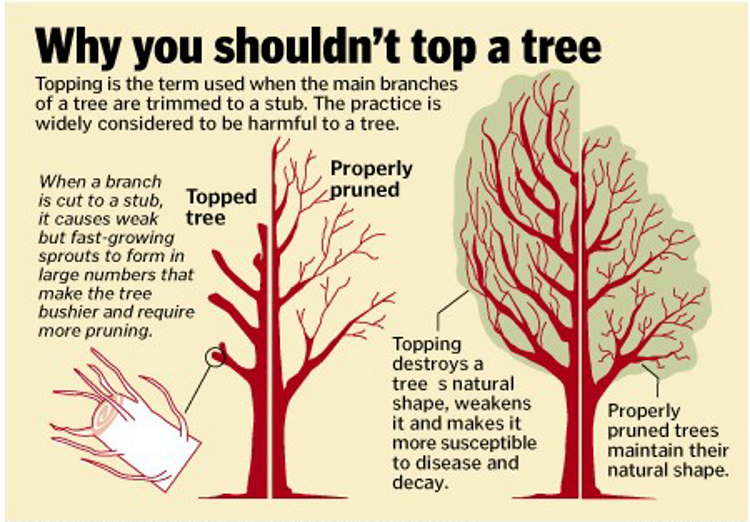
It shall be unlawful for any person, firm, or town department to top any tree on public or private property. "Topping" is defined as the severe cutting back of limbs to the stubs larger than eight (8) inches in diameter within the trees crown to such a degree so as to remove the normal canopy and disfigure the tree. Trees severely damaged by storms or other causes, or certain trees under utility wires or other obstructions where other pruning practices are impractical may be exempted from this article at the determination of the code enforcement official or the public works director. Crape Myrtles shall be exempt from this section of the article.
(Ord. No. 17-0839, 8-22-17; Ord. No. 21-0933, § 1(Exh. A), 11-9-21)
Sec. 17-729. - Tree protection plan.
All applications for building permits for development, redevelopment, major additions or pools shall be accompanied by a tree protection plan. All plans must be approved by the code enforcement official prior to the issuance of a permit. The plan(s) shall be drawn to include all pertinent dimensions and indicate clearly proposed parking, driveways and other vehicular use areas, all proposed buildings and structures, all existing trees eight (8) inches and over in diameter measured two (2) feet from ground and locations of proposed landscaped areas and materials to be used in landscaping. Where more than six (6) inches of soil fill is to be used to bring up lot elevations, the tree protection plan must indicate how existing required trees will be protected.
(Ord. No. 17-0839, 8-22-17)
Sec. 17-740. - Penalties.
The code enforcement officer shall institute appropriate legal action including, but not limited to immediately issuing a stop work order. The stop work shall remain in effect for a minimum of thirty (30) days not to exceed one hundred twenty (120) days. The code enforcement official shall also institute appropriate legal action including imposition of the fines set forth herein.
Fines.
Removing limbs over eight (8) inches in diameter and twenty-five (25) inches in circumference measured two (2) inches from trunk without approval and permit shall be five hundred dollars ($500.00) per limb.
Removing unprotected trees over eight (8) inches in diameter and twenty-five (25) inches in circumference measured two (2) feet from ground without approval and permit shall be five hundred dollars ($500.00) per tree.
Removing protected or specimen trees over eight (8) inches in diameter or twenty-five (25) inches in circumference measured two (2) feet from ground without approval and permit two thousand five hundred dollars ($2,500.00) per tree.
Removing landmark trees without approval and permit shall be ten thousand dollars ($10,000.00) per tree.
In addition to the fines, violators shall be subject to all of the provisions established in section 1-16, General penalty; continuing violations, of the Town's Code of Ordinances. Issuance of a fine or penalty does not relieve any party of complying with the mitigation requirements set forth in section 17-741.
All fines collected as a result of the enforcement of this article shall be placed in the proposed tree mitigation fund.
(Ord. No. 17-0839, 8-22-17; Ord. No. 21-0933, § 1(Exh. A), 11-9-21)
Sec. 17-741. - Mitigation required for removal of trees without a permit.
Any tree removed without a permit must be replaced with equal the inches removed, and shall be replaced with species listed in Table 17-750 of this article.
Penalty. When trees cannot be replaced as stated above, a penalty shall be paid that equals the average amount for purchase and planting of replacement trees based on the market rates from three (3) local nurseries. All penalties shall be deposited in the general fund.
(Ord. No. 17-0839, 8-22-17)
[Sec. 17-750. - Definitions.]
In addition to the definitions set forth in section 17-007, the following words, terms, and phrases when used in this article shall have the meanings ascribed to them in this section. All other words, terms, and phrases shall be given their common, ordinary meaning, unless the context clearly requires otherwise.
Circumference shall mean the distance around the tree two (2) feet from ground or limb two (2) inches from trunk.
Common tree shall mean any tree not listed in Table 17-750 herein as a protected, specimen or landmark tree.
Drip line shall mean that area at the base of the tree where the rain falls from the canopy.
Major addition shall mean any addition, the cost of which equals or exceeds forty-eight (48) percent of the tax or certified appraised value of the structure before the start of construction of the improvement.
Replacement tree shall mean any tree planted in order to satisfy the requirements of division 2: tree protection. A minimum circumference or diameter must be met. A required replacement tree shall not be removed due to its size without prior approval by the board of zoning appeals.
Tree mitigation fund shall mean an account for any fines associated with the application of article VII to be deposited into to be used by the town to plant additional trees and landscaping in the public realm.
Tree protection plan shall mean a plan that identifies the location, size, and species of existing trees and trees targeted for removal including the identification of any tree protection areas and the means of such protection. When new plantings are proposed or required by this article, the tree protection plan shall state the location, size, and species of all trees to be planted on the site.
Trees: protected, specimen and landmark. The following trees are designated by the Town of Surfside Beach as either protected, specimen or landmark trees when the diameter and circumference is attained as indicated in Table 17-750 below:
(Ord. No. 17-0839, 8-22-17; Ord. No. 21-0933, § 1(Exh. A), 11-9-21)

