
Surfside Beach City Zoning Code
ARTICLE IX
DESIGN OVERLAY DISTRICT
Sec. 17-900.- Purpose and intent.
(a)
The purpose of article IX is to create a design overlay district containing standards that supplement the basic zoning requirements of the town's commercial districts.
(b)
Design overlay standards are intended to benefit the entire community by promoting attractive, harmonious, well-designed commercial areas. These standards govern landscaping, signage, color schemes and architectural details within the overlay area. Application of these standards to future development or redevelopment is expected to result in multiple benefits:
(1)
Protection of property values by positive impact on the town's appearance.
(2)
Encouragement of economic development by providing a more visually inviting atmosphere to attract commerce for existing and potential businesses.
(3)
Establishment of unique character to the town's commercial areas while respecting surrounding uses.
(Ord. No. 12-0729, 1-8-13)
Sec. 17-901. - Design overlay district established.
This district shall include:
(1)
All parcels either partially or completely within the C1and C2 zoned area of the town, excluding parcels that front on Sandy Lane.
(2)
Parcels located on Sandy Lane but combined with parcels fronting on Hwy 17 or Frontage Road must comply.
(3)
Properties that are rezoned to C1 or C2 after adoption of this ordinance.
(Ord. No. 12-0729, 1-8-13)
Sec. 17-902. - Design overlay district standards are minimum standards.
(a)
Everything within the design overlay district shall also meet all underlying zoning district requirements set forth in chapter 17.
(b)
Provisions of this ordinance shall be held to be the minimum requirements adopted.
(c)
If requirements set forth herein are in conflict with the requirements of any other lawfully adopted rule, regulation or ordinance, the most restrictive, or that imposing the higher standard shall govern.
(Ord. No. 12-0729, 1-8-13)
Sec. 17-903. - Applicability.
The requirements of this ordinance shall apply in any of the following circumstances:
(a)
New construction.
(b)
Addition or enlargement of an existing building, including combining existing units when removing load bearing walls.
(c)
Change of use or change of ownership.
(d)
Redevelopment of parking lots, including resurfacing shall cause landscaping and parking areas to be brought into compliance.
(e)
When dwellings are converting into a commercial business property.
(f)
When renovations to an existing building exceed twenty (20) percent of the appraised value of the building as indicated in the Horry County tax records or a current certified appraisal of the structure before the start of renovations the entire property shall be brought into compliance.
(g)
When a single building or fifty (50) percent of the total square footage of a strip center has been vacant (not open to public) for over one hundred eighty (180) days, or for one (1) year in the case of seasonal uses.
(h)
The requirements of section 17-908 shall not apply to existing metal buildings (as built). Existing metal buildings shall be maintained in good condition and free of damage and/or visible defects. Existing facades shall be maintained or improved.
(i)
The requirements of section 17-911 shall not apply to areas within the C2 zoning on the North side of 3rd Avenue South from Poplar Drive to Floral Drive to the South side of 1st Avenue North from Poplar Drive to Floral Drive.
(j)
Accessory structures used in conjunction with businesses shall also meet these requirements.
(Ord. No. 12-0729, 1-8-13)
Sec. 17-904. - Definitions.
Unless otherwise stated, the following words shall, for the purpose of this chapter, have the meanings indicated in this section. Words used in the present tense include the future. The singular number includes the plural and the plural the singular. The word "shall" is mandatory and the word "may" is permissive. Words or phrases not specifically defined herein shall have their customary dictionary meanings.
Change of ownership means a transfer from one person or entity to another at a point of sale. This definition is not intended for ownership that has been inherited or handed down from generation to generation within the same family.
Change of use means structures are classified with respect to occupancy in one (1) or more of the groups listed below (based on the International Building Code). Changing from one classification to another classification constitutes a change in use.
Development director means the Director of the Town of Surfside Beach planning, building and zoning Department, and/or his designee, shall serve as development administrator.
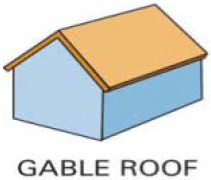
Gable roof means a two-sided sloped roof.
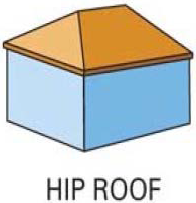
Hipped roof means a type of roof where all sides slope downwards to the walls, usually with a fairly gentle slope.
Mansard roof means a four-sided roof having a double slope on all sides, with the lower slope much steeper than the upper.

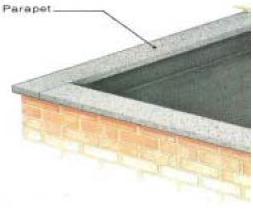
Parapet means a low protective wall along the roof edge of a structure.
Resurfacing of parking lot means grinding or milling off selected areas of old asphalt; patching or resealing; repairing any pot holes or badly deteriorated areas.
Unadorned means not painted or covered by some acceptable material to increase its beauty or distinction.
(Ord. No. 12-0729, 1-8-13)
Sec. 17-905. - Issuance of permits/certificate of occupancy.
(a)
Development director shall review each application for a zoning or building permit to determine if it adheres to these criteria.
(b)
No zoning or building permit will be issued unless these requirements have been addressed to the satisfaction of the development director.
(c)
No certificate of occupancy will be issued until the requirements of this article have been met.
(d)
The requirements of article IX are not intended to prevent a business from being open before it is in full compliance with the design overlay. Therefore, existing buildings having a change of use, change of ownership and/or parking areas requiring improvements shall have sixty (60) days from the date of approval from the development director to comply with the requirements of this article that were triggered by change of use, change of ownership and/or parking area requiring improvements. A certificate of compliance shall not be issued until the requirements of this article have been met.
(Ord. No. 12-0729, 1-8-13; Ord. No. 13-0742, 4-23-13)
Sec. 17-906. - Design standards.
In addition to meeting the underlying zoning district requirements, any projects in the design overlay district which are approved by the development director shall meet the following design standards:
(a)
Site design standards.
(b)
Architectural design standards.
(c)
Sign design standards.
(d)
Color scheme standards.
(e)
Landscaping design standards.
1.
Landscaping requirements for perimeter parking areas.
2.
Perimeters adjacent to public rights-of-way.
3.
Perimeters not adjacent to public rights-of-way.
4.
Interior parking area requirements.
5.
Landscape requirements for signs.
6.
Landscape buffer requirements.
(f)
Parking area.
(Ord. No. 12-0729, 1-8-13)
Sec. 17-907. - Site design standards.
(a)
Plant materials for required landscaping shall be selected and placed with regards to the estimated mature height and width of such materials.
(b)
Site lighting shall be from a concealed light source fixture and shall not interfere with the vision of vehicle traffic. All exterior lighting shall be arranged and installed so that the direct or reflected illumination does not impede on surrounding properties.
(c)
Lighting shall enhance the overall aesthetics of the site.
(d)
Lighting source (light bulbs) shall not be visible. They shall be shielded to reflect down onto the ground and not onto the street or neighboring property.
(e)
Lighting fixtures shall be limited to twenty-one (21) feet in height.
(f)
All lighting sources shall be white or off-white in color.
(g)
New construction of utility or service lines must be underground. Exposed wires, pipes or conduits are not acceptable.
(h)
Chain link fencing shall not be placed in the front yard of property. If chain link fencing will be utilized, it shall be black plastic coated galvanized chain link fencing with landscaping on the side and rear of property. Fencing of any kind proposed within the design overlay district must be approved prior to installation. Wood palisade or lattice is preferred fencing materials.
(Ord. No. 12-0729, 1-8-13)
Sec. 17-908. - Architectural design standards.
The intent of the architectural design standards is to assure respect for the character, integrity, and quality of the built and natural environments of the town; it is not intended to stifle innovative architecture.
(1)
All buildings shall be oriented towards the street, and each building shall have a clearly defined primary entrance that shall front the street.
(2)
The architectural detail, design and finishes (signage, canopies, railings etc.) shall be architecturally appropriate and compatible with one another.
(3)
The scale of buildings and accessory structures (including canopies) shall be small in scale and utilize traditional building forms of wood siding and contrasting trim; canopies designed as domineering or overpowering architectural features shall not be permitted.
(4)
Porticos with vertical post or columns of traditional design shall be incorporated into designs where practical.
(5)
All structures within a commercial proposed development in the district shall utilize a uniform traditional architectural theme (including gasoline canopies and accessory buildings).
(6)
Building designs shall not utilize long monotonous façade design, including but not limited to those characterized by unrelieved repetition of shape or form, or by unbroken extension of line. All sides of any newly constructed building or addition shall have the same attention to detail and appearance. Windows, shutters and other details should be added to siding to break up façade.
(7)
The side and rear elevations of a newly constructed building or addition shall be visibly attractive if the sides and/or rear elevations are visible from a street or right-of-way. Rooflines and architectural details shall present a consistency in quality design.
(8)
Siding materials for newly constructed buildings and additions shall be wood clapboard, concrete fiberglass composition (hardi-plank) or other synthetic products which show a wood grain closely resembling wood siding, or board and batten, wood shingles or shakes, brick, stucco, tabby, or synthetic stucco with light texture. Only materials listed shall be specified in design submissions. No other materials will be accepted.
(9)
No portion of any newly constructed building or addition shall be constructed of unadorned concrete masonry units or corrugated metal, corrugated fiberglass, sheet metal, exposed metal, and/or manufactured panelized metal wall systems shall be visible in any manner from adjoining developed properties, from existing right-of-way, or from adjoining properties which are eligible for future development.
(10)
All roofs on newly constructed buildings not exceeding five thousand (5,000) square feet shall be hipped or gabled and have a minimum of 6/12 pitch.
(11)
All roofs on newly constructed buildings exceeding five thousand one (5,001) square feet shall be allowed to utilize a parapet roof.
(12)
Mansard roofs shall not be permitted.
(13)
The use of a parapet or a flat roof is acceptable for existing buildings only.
(14)
Roofing material shall be wood shingles or shakes, slate shingles, copper, architectural grade asphalt or fiberglass shingles, galvanized standing seam or v-crimp metal, painted corrugated metal, concrete composition shingles, other standard roofing material applications like built up tar and gravel if not exposed to view from Hwy. 17 or adjoining streets. Only materials listed shall be specified in design submissions. No other materials will be accepted.
(15)
Decorative wall-mounted lighting along the sides and front of a building is encouraged to provide a sense of security for pedestrians. This lighting shall compliment the architectural style of the building.
(16)
Mechanical equipment whether ground level, raised or on roof-top if visible from any street or right-of-way shall be shielded and screened from public view through the use of a parapet wall or other decorative feature. The public view includes front facades, and side and rear facades visible from public right(s)-of-way and adjacent properties.
(17)
Awnings, when utilized, may project a maximum of six (6) feet out from the main façade into the public right-of-way or private property, with a minimum clearance height of seven and one-half (7½) to eight (8) feet.
(18)
Shutters, when utilized, shall be either louvered, paneled, or board and batten. They shall be hung or hinged from window sides or jambs, or from window top or heads (Bermuda shutters).
(19)
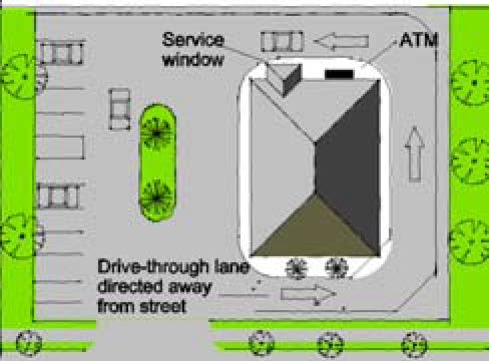
All order boxes, menu stands, pick-up windows, service/teller windows, and required vehicle queuing associated with drive-thru services shall be located to the side or rear of the buildings. For the purpose of this section, the side or rear shall mean the area behind a projected line running parallel from the front (street facing) side(s) of the structure to the side property line. This concept is depicted in the graphic below:
(20)
Highly tinted or mirrored glass shall not be permitted.
(21)
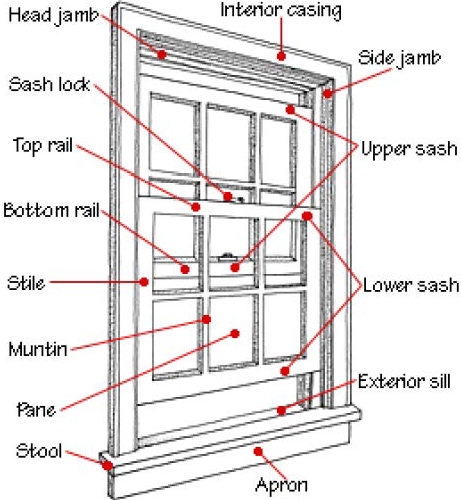
Large expanses of glass shall be avoided, or divided into smaller lights through the use of mullions or muntins. Undivided glass panes shall not exceed nine (9) square feet in size. This size format may be used in multiple, tandem panes to create larger glass proportions for storefront systems. The larger the glass pane, the larger the mullions or muntins used shall be.
(22)
True divided light or simulated divided light windows of wood, vinyl clad wood, metal, or metal-clad, painted to contrast with building color shall be used.
(23)
Service, loading and solid waste receptacles or dumpster locations shall be designed to minimize the impacts on the pedestrian areas and customer parking areas and shall be located in the rear or side yard. No such facility shall be located in the front yard. Dumpsters shall be surrounded on at least three (3) sides by a wall or solid fence. Such enclosures shall be designed compatible with the primary structure onsite by using compatible materials with the primary structure. This requirement does not apply to moby roll carts.
(Ord. No. 12-0729, 1-8-13)
Sec. 17-909. - Sign design standards.
The intent of the sign design standards is to assure each is compatible with materials and the architectural style of the business which it advertises. The following applies to any new signage, additional signage or any sign changes within the design overlay district:
(1)
Signage shall be designed, constructed and installed by a licensed sign company.
(2)
All proposed signage shall be indicated on the architectural elevation plan and include location and dimensions to scale.
(3)
Freestanding signs and wall signs shall compliment the architectural style of the building and shall be designed as an architectural element of the building.
(4)
Materials, colors, and lighting of signs shall be compatible with the materials used in the construction of the building.
(5)
Wall signs shall be proportionately sized with other architectural features of the building and fit within the confines of the architectural details of the building as to not obscure or detract from those details. Business signs erected upon or above a roof or parapet of a building shall not be permitted within the design overlay district.
(Ord. No. 12-0729, 1-8-13)
Sec. 17-910. - Color scheme standards.
The intent of the color scheme design standards is to assure respect for the character, integrity, quality of design and unite designs within the town.
(1)
Required color palette: Paint colors for exterior finishes shall be selected from the color range chart as approved by the town council and maintained at the planning, building and zoning department. These are the only colors allowed.
(2)
Color palette: The color palette is typical of coastal environment colors which generally include earth tones. Colors such as black, dark blue, grays and other dark colors can be used to accent only.
(3)
Windows and doors shall be finished in white or earth tone colors. Trim, shutters and awnings shall be white, or a contrasting value of the cladding color as shown on the approved color chart.
(4)
Color combinations of paints and stains shall be complimentary. In general no more than three (3) different colors per building shall be permitted. One (1) for base color, one (1) trim color, and one (1) accent color. Primary colors, fluorescent, psychedelic, and phosphorescent are not permitted in the design overlay district. Color combinations shall apply not only to new construction, additions and/or renovations, but also when repainting the building at any time.
(5)
Roofing colors shall be black, dark blue, grays or other dark value colors.
(Ord. No. 12-0729, 1-8-13)
Sec. 17-911. - Landscaping design standards.
The purpose of the landscape design standards is to reduce the visibility of paved areas from adjacent properties and streets, moderate climatic effects, minimize noise and glare, and enhance public safety by defining spaces to influence traffic movement. Landscaping will reduce the amount of stormwater runoff and provide transition between properties.
Each newly developed commercial property shall allocate a minimum of twenty (20) percent of its total area to landscaping which may include existing or transplanted trees, shrubs, and groundcover. Paved areas, gravel areas and landscaping rocks shall not be calculated as part of the minimum twenty (20) percent. Retention/detention ponds may be included up to five (5) percent of the total area. Retention/detention ponds shall be maintained to be aesthetically pleasing and promote the overall landscaping design.
Landscape requirements shall supersede parking requirements for the commercial districts.
New projects: All new buildings, structures and parking areas shall comply with the minimum landscape requirements set forth herein.
Existing properties: Under the following circumstances, existing properties will be required to meet the landscaping requirements of the design overlay district as closely as possible:
(a)
Addition or enlargement of an existing building, including combining existing units when removing load bearing walls.
(b)
Change of use or change of ownership.
(c)
Redevelopment of parking lots, including resurfacing shall cause landscaping and parking areas to be brought into compliance.
(d)
When dwellings are converting into a commercial business property.
(e)
When renovations to an existing building exceed twenty (20) percent of the appraised value of the building as indicated in the Horry County tax records or a current certified appraisal of the structure before the start of renovations the entire property shall be brought into compliance.
(f)
When a single building or fifty (50) percent of the total square footage of a strip center has been vacant (not open to public) for over one hundred eighty (180) days, or for one (1) year in the case of seasonal uses.
Accessory structures used in conjunction with businesses shall also meet these requirements.
Existing properties having pavement and/or concrete where landscape buffers are required shall be required to remove the existing pavement/concrete in order to meet the buffer requirements herein.
Landscaping buffer requirements for perimeter parking areas: Arrangement of trees and shrubs in groupings is encouraged to ensure visibility and to allow for creativity. Equal spacing of plant materials shall not be required.
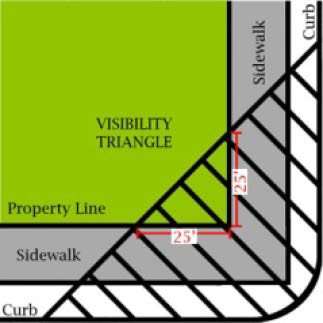
Perimeters adjacent to public right-of-way: A visual clearance area between the height of two and one-half (2½) feet and ten (10) feet shall be maintained on the corners of all property adjacent to the intersection of two (2) streets or a driveway providing access to a public or private street within twenty-five (25) feet of the intersections of the right-of-way of streets or of streets and driveways. (See diagram below.)
Perimeters adjacent to public right-of-way: Parking areas that do not exceed five thousand (5,000) square feet in area shall be required to have a minimum landscape buffer of five (5) feet in width and shall contain a minimum of one (1) shade or ornamental tree and ten (10) shrubs with appropriate ground cover for every thirty (30) linear feet or fraction thereof of street frontage.

Parking areas that exceed five thousand (5,000) square feet but do not exceed twenty thousand (20,000) square feet in area shall be required to have a minimum landscape buffer of ten (10) feet in width and shall contain a minimum of one (1) shade or ornamental tree and ten (10) shrubs with appropriate ground cover for every thirty (30) linear feet or fraction thereof of street frontage.
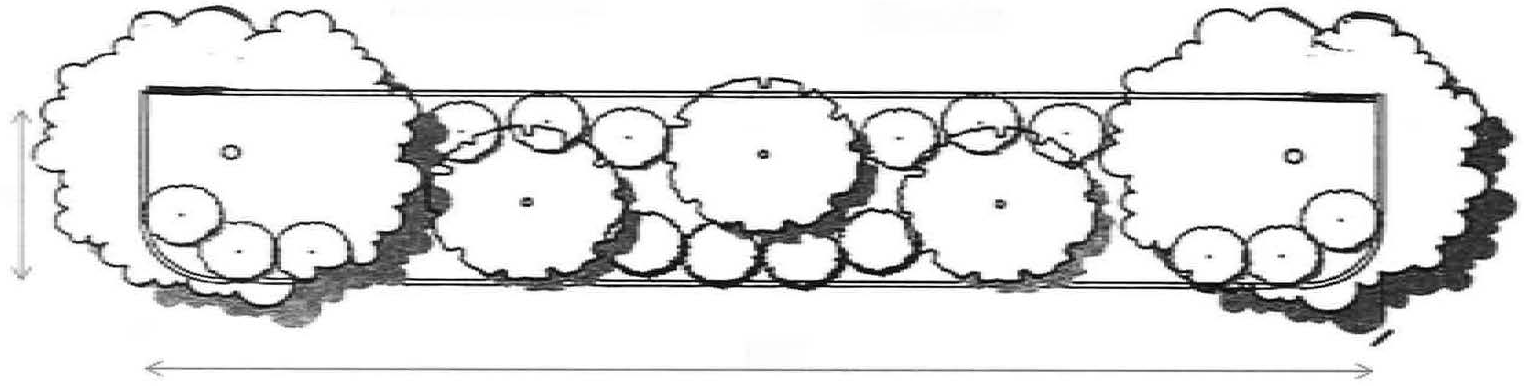
Parking areas that exceed twenty thousand (20,000) square feet in area shall be required to have a minimum landscape buffer of fifteen (15) feet in width and shall contain a minimum of two (2) shade or ornamental trees and fifteen (15) shrubs with appropriate ground cover for every thirty (30) linear feet or fraction thereof of street frontage.
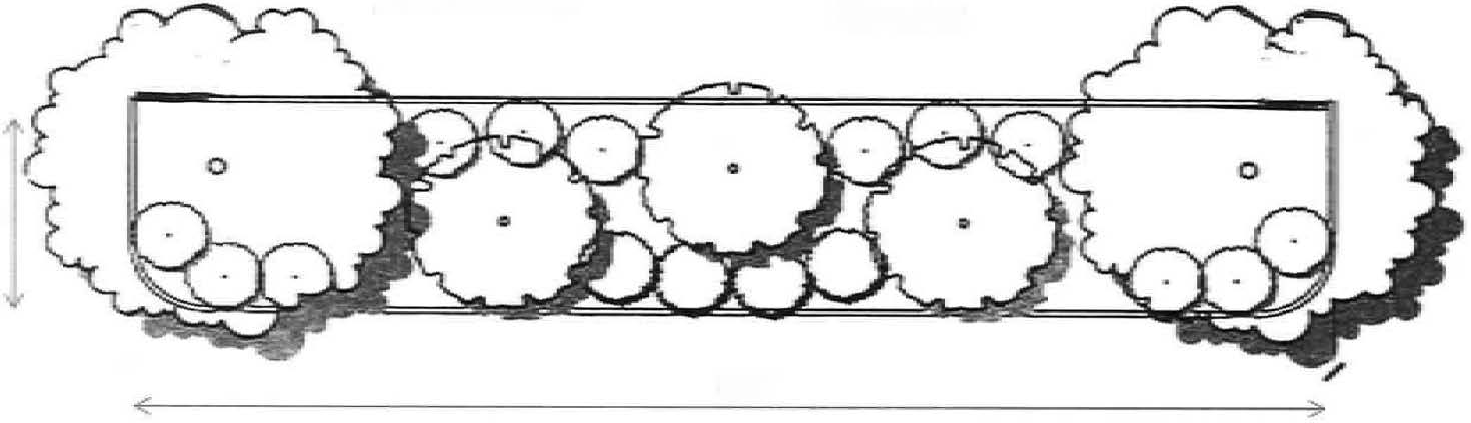
Perimeters buffers not adjacent to public right-of-way shall be required to have a minimum landscape buffer of five (5) feet in width and shall contain a minimum of one (1) shade or ornamental tree and ten (10) shrubs with appropriate ground cover for every thirty (30) linear feet or fraction thereof of perimeter.
Interior parking buffer area requirements: Landscaping provided around the perimeter of the building and interior parking areas enhance the appearance and customer attraction of commercial businesses.
A three-foot landscaping buffer with six (6) shrubs for every thirty (30) linear feet of building or fraction thereof shall be required between buildings and parking lots as well as end caps and landscape islands. Trees and shrubs located within the interior areas of the parking lot provide shade and heat abatement, and help break up the visual impact of the large areas of pavement.
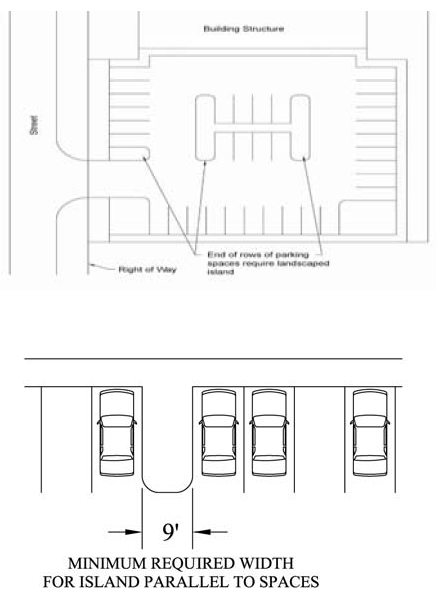
End caps and landscape islands shall not be less than nine (9) by eighteen (18) feet and shall include at least one (1) shade or ornamental tree and five (5) shrubs.
•
End caps—Parking aisle end caps shall be required and utilized as landscape islands.
•
A maximum of twelve (12) consecutive parking spaces in a row shall be permitted without a landscape island.
Landscape requirements for signs: A landscape border a minimum of five (5) feet in depth and a minimum width equal to the greatest width of the sign shall be required for all freestanding signs. The landscape border shall contain five (5) shrubs for every ten (10) linear feet with appropriate ground cover. No portion of the sign shall project beyond the landscape border.
Landscape buffer requirements: Existing trees, regardless of size may be counted towards requirements for shade trees or ornamental trees provided such trees are in good health, and located in the approximate area as required.
Shade trees: Must be indigenous to the area and reach a mature height in excess of forty (40) feet and shall be a minimum of three (3) inches in caliper dbh and ten (10) to twelve (12) feet in height at the time of installation.
Ornamental trees: trees that have a particular ornamental characteristic and tend to have a mature height of less than that of a shade tree. Ornamental trees shall be a minimum of one and five-tenths (1.5) inches in caliper dbh and six (6) to eight (8) feet in height at the time of installation.
Shrubs: Shall be a minimum of three (3) gallons in size and one and five-tenths (1.5) feet in height at the time of installation.
Groundcover: Shall consist of grass, sod, ivy, bedding plants, wood chips, bark, mulch, straw and similar materials. In no case shall stone, pebbles, sand or rocks be used for groundcover.
No structures (except public utilities) shall be permitted within the required landscape buffer. Ingress and egress shall be permitted.
The owner, occupant, tenant or agent shall be jointly and severally responsible for the maintenance of all landscaping. Landscaping shall be maintained in good condition as to present a healthy, neat, and orderly appearance. Proper maintenance shall include watering, weeding, mowing, mulching, fertilizing, and pruning. Any dead, dying or damaged landscaping material shall be promptly replaced with materials of an approved size and type.
(Ord. No. 12-0729, 1-8-13)
Sec. 17-912. - Parking area design standards.
Parking areas shall be paved with materials which are appropriate to the comprehensive design scheme of the project and to the intensity of use to which parking areas will be subject (asphalt or concrete). Pervious concrete is encouraged to allow water from precipitation and other sources to pass directly through, thereby reducing the runoff from a site and allowing groundwater recharge.
(Ord. No. 12-0729, 1-8-13)
Sec. 17-913. - Appeals/variances.
Any person aggrieved by the development director's action or decision, or seeking relief from a requirement of the design overlay district shall make a formal request to the board of zoning appeals.
(Ord. No. 12-0729, 1-8-13)
Sec. 17-914. - Violations declared misdemeanor; remedies.
A violation of this ordinance is hereby declared to be a misdemeanor under the laws of the state, and upon conviction thereof, an offender shall be punished by a fine not exceeding five hundred dollars ($500.00), plus fees and assessments, or by imprisonment for a period not exceeding thirty (30) days. Each day any violation of this Code or any such ordinance, rule or regulation shall continue shall constitute a separate offense.
(Ord. No. 13-0742, 4-23-13)

