
Sutter County Unincorporated
City Zoning Code
City Zoning Code
PART 1
Enactment, Rules and Use Classification
1500-01-010 - Title and Authority
A.
Title. Chapter 1500 of the Sutter County Ordinance Code shall be known and cited as the "Sutter County Zoning Code".
B.
Authority. This Zoning Code is enacted based upon the authority vested in Sutter County by the State of California including, but not limited to, Article XI, Section 7 of the Constitution of the State of California and the State Planning and Zoning Law (Government Code 65000 et seq.).
(Ord. of 6-28-2022)
1500-01-020 - Purpose
The purpose of this Zoning Code is to implement the Sutter County General Plan, and to protect and promote the health, safety, peace, comfort, convenience, prosperity and general welfare of those living, working and visiting the County. The Zoning Code is intended to:
A.
Classify, designate, and regulate the use of buildings, structures and the land within the County pursuant to the vision, goals, policies and programs of the General Plan;
B.
Preserve and enhance the appearance, character, and rural lifestyle of the County and ensure compatible, orderly, efficient, high quality and beneficial growth;
C.
Protect valuable agricultural lands and maintain a viable agricultural industry;
D.
Support appropriate and vibrant economic development and diversification;
E.
Conserve the County's environmental and non-renewable resources;
F.
Protect and enhance the social and economic stability and value of land uses in the County that conform with the General Plan;
G.
Provide an appropriate balance of regulatory certainty and flexibility; and
H.
Facilitate efficient review of development proposals and other requests that are consistent with the General Plan and this Zoning Code.
(Ord. of 6-28-2022)
1500-01-030 - Applicability
This Zoning Code applies to all property, uses, structures and regulated activities within unincorporated areas under Sutter County's jurisdiction. Any governmental agency may be exempt from the provisions of this Zoning Code only to the extent such agency, property or activity may not be lawfully regulated by the County.
A.
Compliance with Zoning Code. No land shall be used and no structure constructed, altered, reconstructed, occupied, demolished or moved other than as allowed by this Zoning Code.
B.
Minimum Requirements. Unless otherwise stated, the provisions of this Zoning Code shall be the minimum requirements for the promotion and protection of the public health, safety, peace, comfort, convenience, prosperity and general welfare.
C.
Discretionary Approval. Where the Zoning Code provides for discretion on the part of the County review authority, the discretion may be exercised to impose additional or more flexible requirements than required by this Zoning Code in order to promote orderly land use and development, environmental resource protection, or other purposes of this Zoning Code.
D.
Relationship to Other Regulations.
1.
General Plan. If a conflict occurs between the requirements of this Zoning Code and the Sutter County General Plan, the requirements of the General Plan shall prevail.
2.
Other County Regulations. In the event of an inconsistency between this Zoning Code and any other duly adopted County regulation, the more restrictive of such provisions shall prevail.
3.
Development Agreements and Specific Plans: If a conflict occurs between the requirements of this Zoning Code and standards adopted as part of a development agreement or specific plan, the requirements of the development agreement or specific plan shall prevail.
4.
Private Agreements. This Zoning Code shall not interfere with, abrogate, annul, or repeal any easement, covenant (e.g., CC&Rs), deed restriction or other agreements in effect between private parties. However, where this Zoning Code imposes greater restrictions than are imposed or required by a private covenant or agreement, the provisions of this Zoning Code shall prevail. Sutter County shall not be responsible for enforcing or monitoring any private covenant or agreement, unless it is party to the covenant or agreement.
E.
Other Permits and Requirements. Nothing in this Zoning Code eliminates the need to obtain any other permit, license, approval or entitlement required by the County; regulations of a special district or agency; or regulation of a state or federal agency.
F.
Prior Rights and Violations. The enactment of this Zoning Code shall not terminate or otherwise effect vested land use development permits, approvals or agreements authorized under the provisions of any ordinance, nor shall violation of a prior ordinance be excused by the adoption of this Zoning Code
G.
Pending and Approved Applications.
1.
Pending Applications. Applications submitted to the County that have been deemed complete pursuant to Government Code Section 65943 before the effective date of this Zoning Code, or any amendment hereto, shall comply with the provision of the Zoning Code in effect on the date that the application was deemed complete.
2.
Approved Applications. Applications approved prior to the effective date of this Zoning Code, or any amendment hereto, may be constructed or used in accordance with the adopted plans and conditions of approval.
3.
Time Extensions. An approval of an extension of time for an application approved prior to the effective date of this Zoning Code, or any amendment hereto, may be conditioned to comply with the provisions of the Zoning Code in effect on the date when the application for time extension was deemed complete pursuant to Government Code Section 65943.
H.
Severability. If any portion of this Zoning Code is for any reason held by a court of competent jurisdiction to be invalid, unconstitutional, or unenforceable, such decision shall not affect the validity of the remaining portions of this Zoning Code. The Sutter County Board of Supervisors hereby declares that this Zoning Code and each article, chapter, section, paragraph, subparagraph, sentence, clause, phrase and portion thereof, is adopted irrespective of the fact that one or more portions of this Zoning Code may be declared invalid, unconstitutional, or unenforceable.
(Ord. of 6-28-2022)
1500-02-010 - Purpose
This Chapter specifies the authority, procedures and rules for clarification of any ambiguity of this Zoning Code to ensure consistent interpretation and application.
(Ord. of 6-28-2022)
1500-02-020 - Authority for Interpretations
The Director shall have the authority to make formal interpretations of the meaning and applicability of all provisions of this Zoning Code when, in the opinion of the Director, an interpretation would substantially clarify an ambiguity which interferes with the effective administration of the Zoning Code.
(Ord. of 6-28-2022)
1500-02-030 - Procedures for Interpretation
A.
Request for Interpretation. A request for an interpretation of the Zoning Code shall be filed with the Planning Division on an official County application form. The application shall be filed with all required fees, materials, and other information deemed necessary by the Director to assist in the review.
B.
Response: The Director shall respond to a request for an interpretation within 30 days of receiving the request and any associated information deemed necessary.
C.
Record of Interpretation. Official interpretations prepared by the Director shall be in writing, shall cite the provision being interpreted, and shall describe the meaning or applicability of the provision as well as the circumstances that caused the need for the interpretation. The issuance of an interpretation shall also include a finding of consistency with the General Plan. The Planning Division shall maintain a complete record of all official interpretations available for public review.
D.
Referral to the Planning Commission. The Director may refer any interpretation of the Zoning Code to the Planning Commission for review and determination.
E.
Appeal. All actions of the Director and Planning Commission may be appealed pursuant to Section 1500-23-080.
(Ord. of 6-28-2022)
1500-02-040 - Construction of Language
The following rules shall apply to the construction of language except where the context indicates a different meaning:
A.
Shall, Should and May. The words "shall", "will", "must", "are to" and "is to" are always mandatory. "Should" and "encouraged" are highly recommended and discretionary. "May" is advisory.
B.
Includes. The word "includes" shall not limit connected words or provisions to the specified example, but is intended to extend the meaning to all other instances or circumstances of like kind or character.
C.
And, Or and Either. The conjunction "and" indicates that all connected words or provisions shall apply. "and/or" and "or" indicate that the connected words or provisions may apply singularly or in any combination. "Either...or" indicates that the connected words or provisions shall apply singularly but not in combination.
D.
Tense. Words used in the present tense include the past and future tenses, and words used in the future tense include the past.
E.
Singular and Plural. Words used in the singular include the plural, and words used in the plural include the singular.
F.
Officials and Agencies. All references to public officials, departments, committees, commissions, boards or other public agencies are those of Sutter County, unless otherwise indicated.
G.
Headings. Article, chapter and section headings do not govern, limit, modify, or in any manner affect the scope, meaning, or intent of any provision.
H.
Illustrations. In the case of any conflict of meaning or implication between text and an illustration or caption, the text shall prevail.
I.
Calendar Days. All references to days are to calendar days, unless otherwise indicated. If a deadline falls on a weekend or holiday, or a day when County offices are closed, it shall extend to the next working day. The end of a time period shall be the close of business on the last day of the period.
(Ord. of 6-28-2022)
1500-02-050 - Common Measurements and Lot Lines
The following rules shall apply to the calculation of common measurements unless otherwise specified:
A.
General Rules
1.
Rounding of Fractions. Whenever the Zoning Code specifies distances, parking spaces, dwelling units, square feet, or other requirements in numerical quantities, the results of calculations containing a fraction of 0.5 or greater shall be rounded up to the nearest whole number, and fractions less than 0.5 shall be rounded down to the nearest whole number. Rounding provisions do not apply to minimum lot sizes, setbacks, building heights and other prescriptive development standards.
2.
Minimum Distance. When measuring a minimum distance, the measurement is made at the closest or shortest distance between the two specified locations (see Figure 1500-02-1).
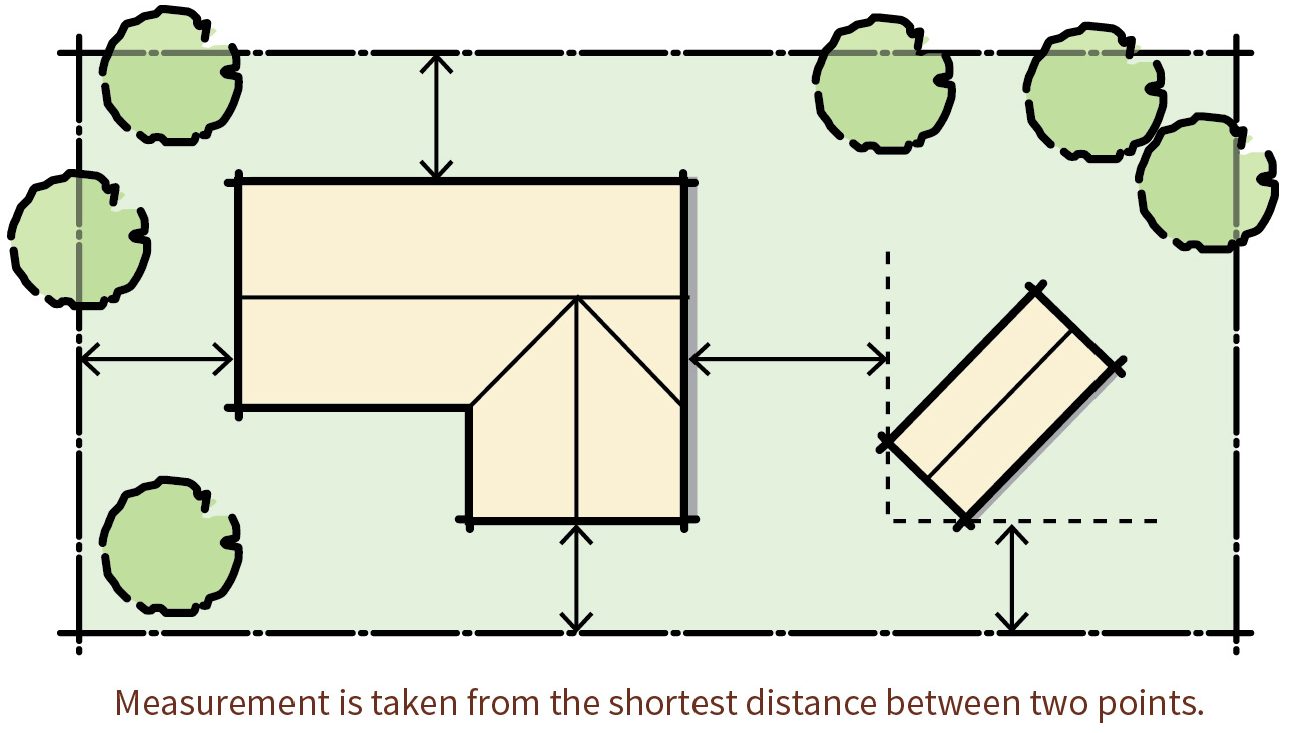
Figure 1500-02-1: Minimum Distance
3.
Horizontal Measurements. All horizontal distances are measured along a horizontal plane, and not measured following the topography of the land or other grade differentials (See Figure 1500-02-2).
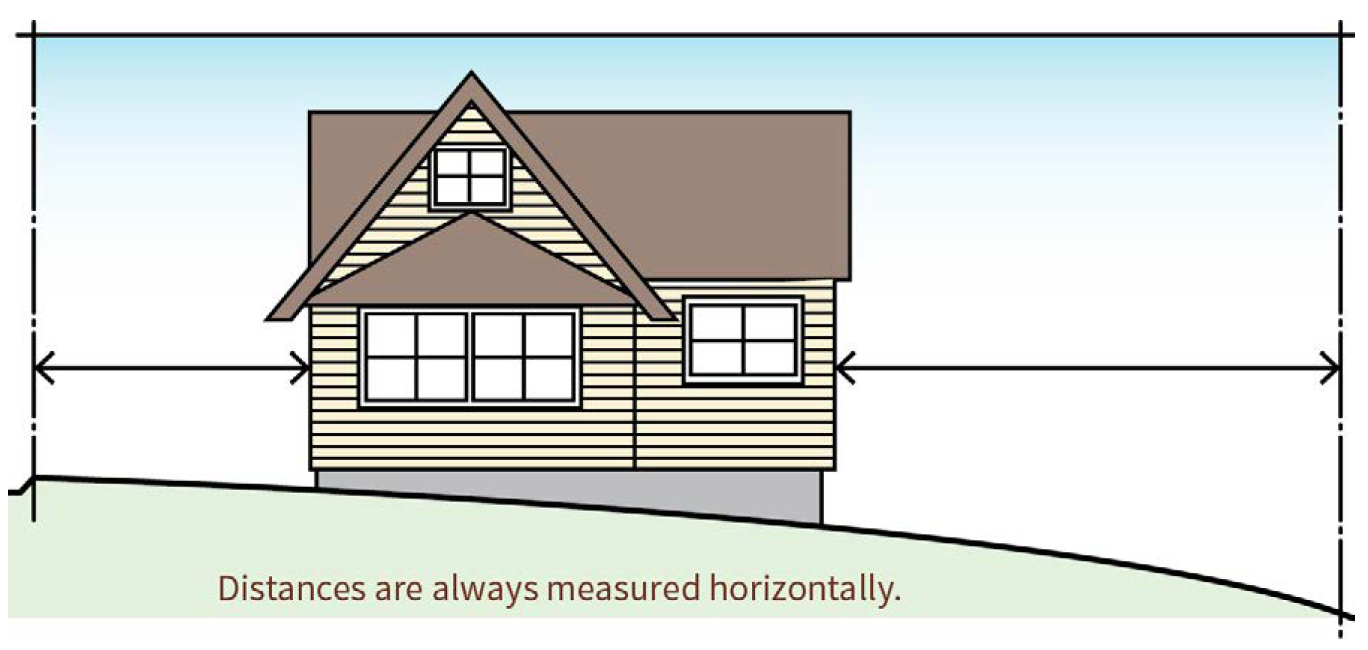
Figure 1500-02-2: Horizontal Distance
4.
Measurements Involving a Structure. Measurements involving a structure are made to the closest support element of the structure (See Figure 1500-02-3).
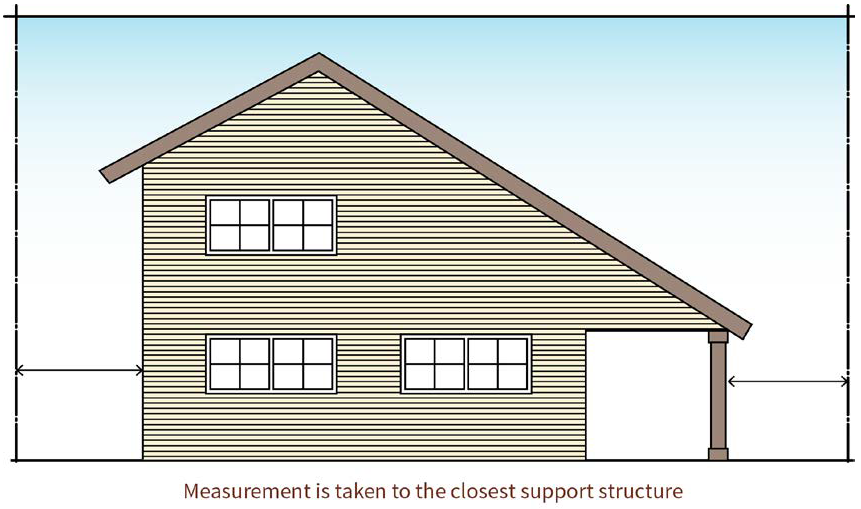
Figure 1500-02-3: Measurements Involving a Structure
5.
Vehicle Stacking and Travel Areas. Measurements for vehicle travel distances, such as stacking lanes, are measured at the centerline of the vehicle travel area (See Figure 1500-02-4).
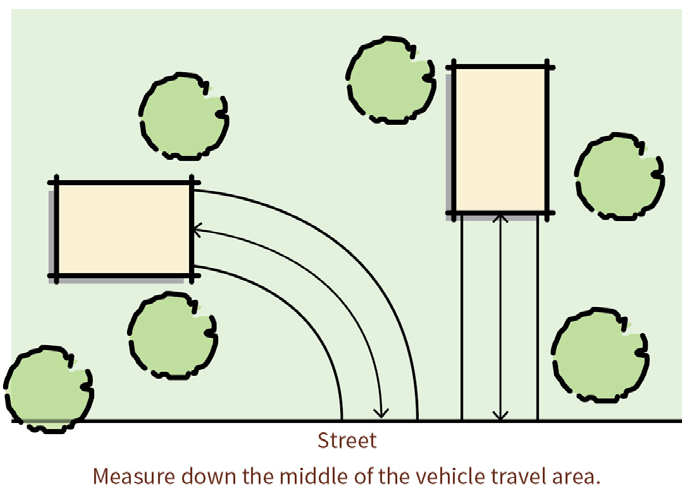
Figure 1500-02-4: Vehicle Stacking Distance
B.
Determining Specific Measurements
1.
Density. Is the number of dwelling units per gross acre. Allowed densities are assigned by the General Plan.
2.
Lot Area, Gross. Is the area contained within the property lines of a lot, including up to the centerline of the street (See Figure 1500-02-5).
3.
Lot Area, Net. Is the area contained within the property lines of a lot, exclusive of public rights-of-way, canals, levees or other easements (See Figure 1500-02-5).
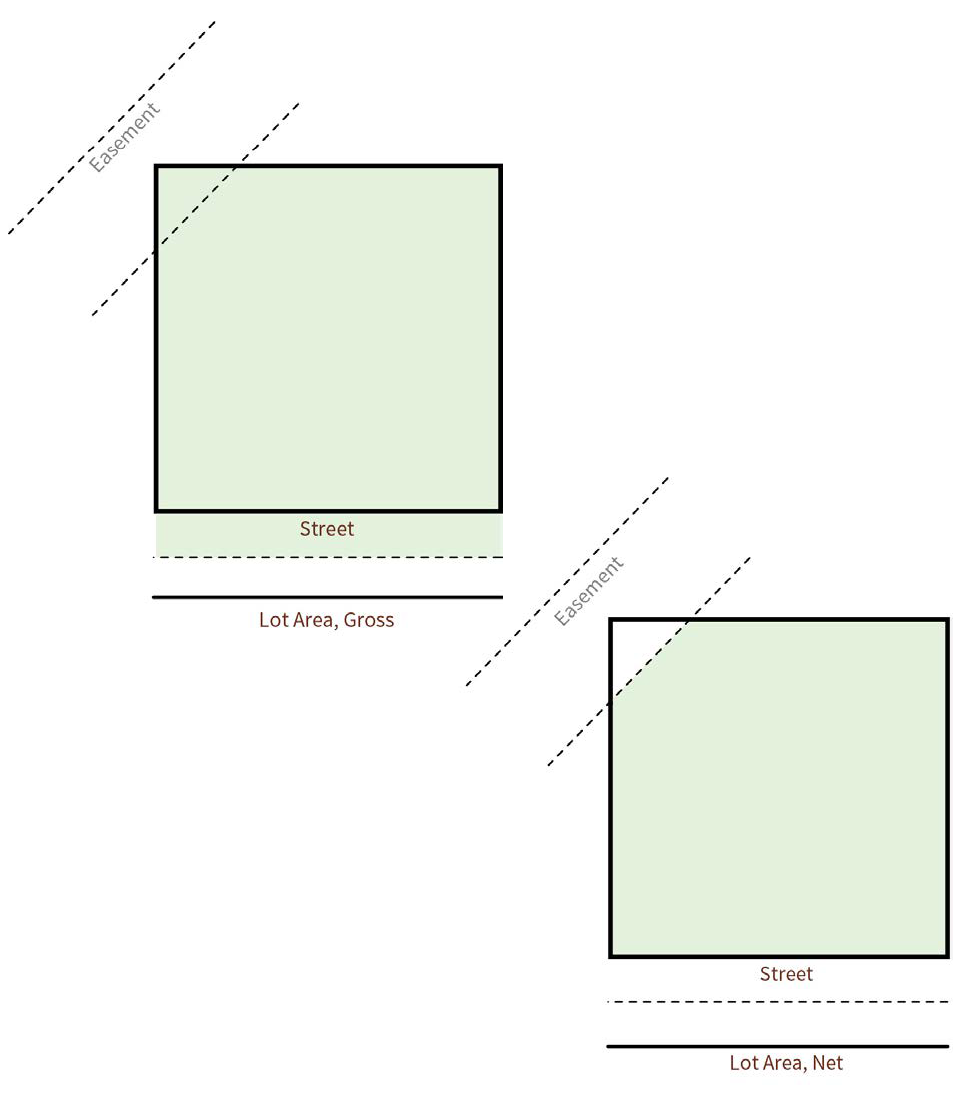
Figure 1500-02-5: Lot Area
4.
Lot Width. Is the horizontal distance between side property lines, measured at the front setback line (See Figure 1500-02-6).
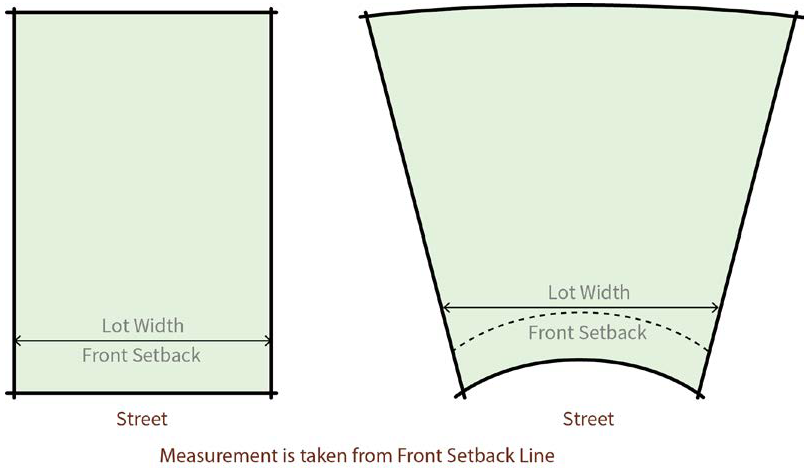
Figure 1500-02-6: Lot Width
5.
Lot Coverage. Is the ratio of the total footprint area of all structures on a lot to the lot area, typically expressed as a percentage (See Figure 1500-02-7).
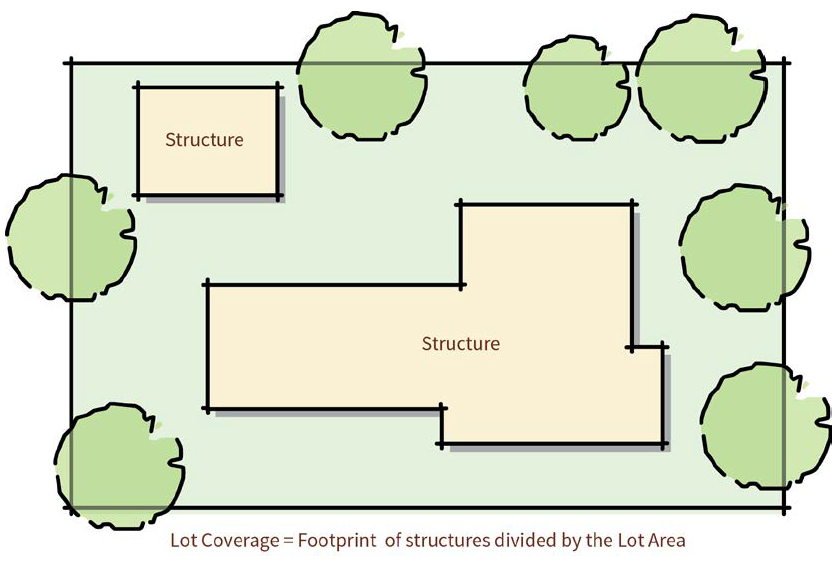
Figure 1500-02-7: Lot Coverage
6.
Lot Frontage. Is the horizontal distance of a parcel contiguous with a street or street right-of-way, measured between side property lines. If a parcel has frontage on more than one street, the distance along one of the streets only may be used to calculate lot frontage. For lots located on the turnaround of a cul-de-sac, frontage is measured at the front setback line (See Figure 1500-02-8).
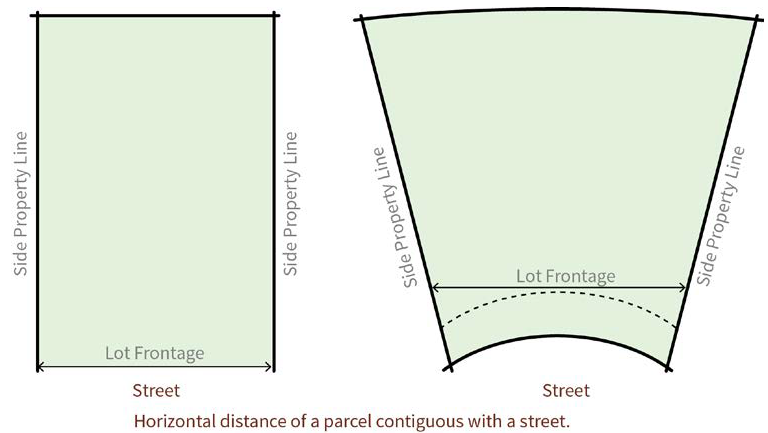
Figure 1500-02-8: Lot Frontage
7.
Setback. Is the required distance that a building, structure, parking lot, or other designated feature must be located from the lot lines. Setbacks are measured as the horizontal distance between the nearest lot line and the closest point of the building, structure, parking lot or feature. Setback areas are also commonly referred to as 'yards" (See Figure 1500-02-9).
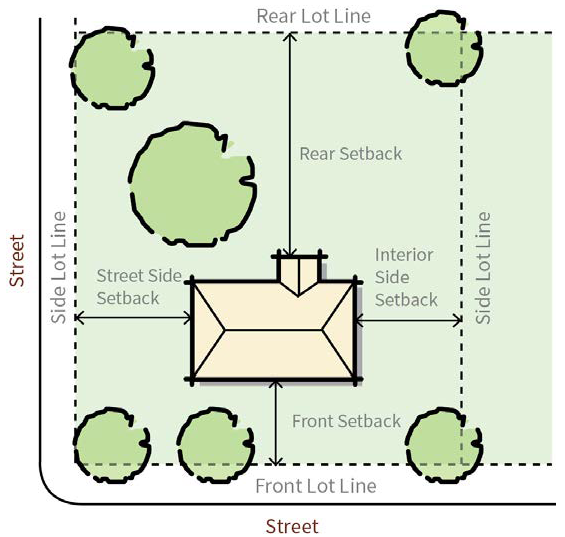
Figure 1500-02-9: Setback
8.
Building Height. Is the vertical distance from the average level of the highest and lowest point of that portion of the lot covered by the building, to the highest point of the building roof, ridge, or parapet wall (See Figure 1500-02-10).
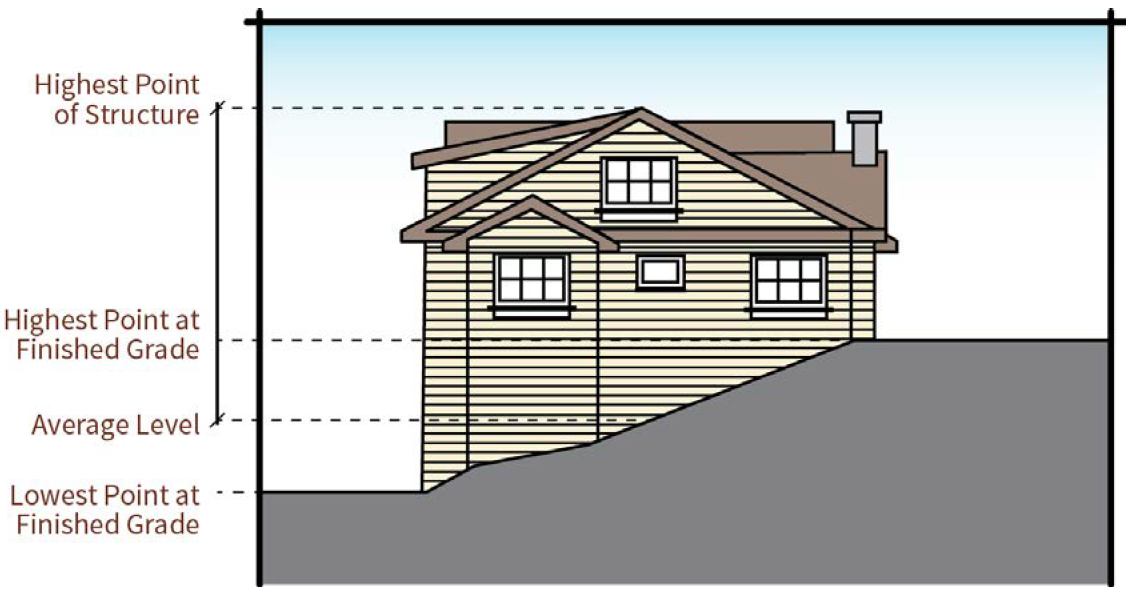
Figure 1500-02-10: Building Height
C.
Determining Lot Lines
1.
Front Lot Line. Is the lot line separating a lot from a street right-of-way. The front lot line of a corner lot may face either street frontage, provided that the required rear yard setback is obtainable opposite from the designated front lot line (See Figure 1500-02-9). In cases where a lot does not have direct frontage on a street, the front lot line shall generally be the lot line that the primary facade of the building faces on, as determined by the Director.
2.
Rear Lot Line. Is that lot line, not intersecting a front lot line, which is most distant from and most closely parallel to the front lot line. If a rear lot line is less than ten (10) feet in length, or if the lot comes to a point at the rear, the rear lot line shall be deemed to be a ten (10) foot line parallel to the front lot line, lying wholly within the lot for the purposes of establishing the required minimum rear yard setback (See Figure 1500-02-9).
3.
Side Lot Line. Is any lot line that is not a front or rear lot line (See Figure 1500-02-9).
(Ord. of 6-28-2022)
1500-02-060 - Zoning District Boundaries
The following rules shall apply to the determination of zoning district boundaries unless otherwise specified:
A.
Uncertainty in Boundaries. Where there is uncertainty about the location of any zoning district boundary shown on the Zoning Map, the following shall apply:
1.
Zone boundaries shown approximately following the property line of a parcel shall be construed to follow the property line.
2.
Zone boundaries shown as following a street, alley or other right-of-way shall be construed to follow the centerline of the road or right-of-way.
3.
Where a public street or alley, or portion thereof, is officially abandoned, the property that was formally in the street or alley shall be included within the zoning district of the adjoining property on either side of the centerline of the abandoned street or alley.
4.
Zone boundaries that divide a parcel shall be determined by use of the scale appearing on the Zoning Map or adopted ordinance.
B.
Parcels with Multiple Zoning Districts. Where a parcel is covered by two or more zoning districts, the regulations of the parcel shall be consistent with the zoning district as shown on the subject portion of the parcel. If both zoning districts permit a single family residence, only one residence shall be permitted per legal parcel.
(Ord. of 6-28-2022)
1500-03-010 - Purpose
This Chapter establishes use types applied in this Zoning Code, providing a basis for the orderly regulation of uses in accordance with the public health, safety, and general welfare.
(Ord. of 6-28-2022)
1500-03-020 - Classification of Uses
A.
Use Types. Use types describe groups of uses that have common functional, product, compatibility, or other characteristics, and therefore can be regulated in a similar manner. The use type descriptions often contain typical uses and activities appropriate within the use types, but do not attempt to list every individual use that may be appropriate.
B.
Primary Uses. All new and continuing primary uses shall be classified under one of the use types set forth in this Chapter. If a primary use resembles two or more individual use types, it shall be classified in the use type whose description most closely portrays the nature of the use. Accessory uses are regulated by Article 10.
C.
Multiple Primary Uses. If an individual establishment or business conducts more than one primary use which fits under more than one use type, each primary use shall be considered separate and distinct. Similarly, if two or more individual establishments or businesses conduct separate primary uses on a single parcel, each use shall be considered separate and distinct.
D.
New Use Types. The creation of new use types shall require amendment to this Zoning Code pursuant to Section 1500-25-070.
(Ord. of 6-28-2022)
1500-03-030 - Authority
The Director shall have the authority to:
A.
Classify Unlisted Uses: Classify an unlisted use as permitted if such use is substantially similar in nature and intensity to other uses identified for a use type and is consistent with the General Plan. If an unlisted use is determined to be permitted, such use shall be subject to the same regulations as the assigned use type;
B.
Establish Accessory Uses: Establish whether a use is primary, accessory or incidental, and determine that an accessory or incidental use is permitted if such use is accessory to and generally compatible with the primary use; and,
C.
Determine Prohibited Uses. Determine whether a use does not fit under any use type and is therefore not permitted.
The Director may refer any of the above determinations to the Planning Commission for interpretation pursuant to Section 1500-02-030. All actions of the Director and Planning Commission may be appealed pursuant to Section 1500-23-080.
(Ord. of 6-28-2022)
1500-03-040 - Agricultural Use Types
A.
Agricultural Education and Entertainment. Includes agricultural themed exhibitions, art shows, craft fairs, educational seminars, farm tours, hay rides, interpretive trails, livestock shows, on-site fruit and vegetable picking, outdoor mazes, petting farms, picnic areas, seasonal festivals, and similar uses that are conducted in conjunction with on-site agricultural uses. Does not include uses defined under "Temporary Uses" (Article 16). Shall be classified into one of the following categories:
1.
Small. Includes Agricultural Education and Entertainment occurring on a temporary or intermittent basis that can accommodate less than 100 guests on-site at a given time.
2.
Large. Includes Agricultural Education and Entertainment occurring on a temporary, intermittent or permanent basis that can accommodate 100 or more guests on-site at a given time.
B.
Agricultural Homestays. Includes bedrooms made available for rent on a working farm in a farm house or detached structure which meets all of the following requirements: (a) has no more than 6 guestrooms or can accommodate no more than 15 guests (Health and Safety Code Section 113870); (b) provides overnight transient accommodations; (c) serves food only to its registered guests and serves meals at any time, and includes the price of the food in the price of the lodging; (d) lodging and meals are incidental and not the primary function of the facility; and, (e) the facility is located on, and is part of, a farm, as defined in the Food and Agricultural Code (Section 52262), that produces agricultural products as its primary source of income.
C.
Agricultural Manufacturing. Includes the commercial manufacturing, assembly, salvage or storage of agricultural related goods from finished products or raw materials. Typical uses include agricultural chemical storage and repacking; agricultural pesticide and herbicide blending and distribution; agricultural services laboratories; animal waste processing; biomass energy conversion; composting, processing and recycling of crop wastes; farm machinery equipment assembly; food and beverage packaging and services; food storage; indoor bulk product storage; meat and fish cutting and packing provided no slaughtering; soil blending and distribution; and similar uses. Does not include uses defined under "Agricultural Processing" (1500-03-040(D) or "Animal Processing" (1500-03-040(I)).
D.
Agricultural Processing. Includes facilities for the canning, drying and dehydrating, handling, packaging, packing, sorting, processing, shipping and storing of agricultural commodities. Does not include uses defined under "Animal Processing" (1500-03-040(I)).
E.
Agricultural Product Sales. Includes facilities for the retail sales of agricultural commodities. Shall be classified into one of the following categories:
1.
Wayside Stand. A stand or similar structure of up to 600 square feet of floor area. May include up to 50 square feet of floor area for the sale of prepackaged food and/or drinks.
2.
Agricultural Store. A stand, enclosed building or similar sales structure of up to 1,500 square feet. May include food preparation, bakery and up to 150 square feet of floor area for limited retail sales.
F.
Agricultural Supplies and Services. Includes uses primarily supportive of nearby agricultural operations. Shall be classified into one of the following categories:
1.
Light. Includes agricultural organizations and services; agricultural research and development; agricultural management, and maintenance services; animal or equipment auctions; farm supplies; feed, grain and fertilizer sales; and similar uses.
2.
Heavy. Includes composting, processing and recycling of crop wastes; farm machinery and equipment sales, rental, repair and storage; fertilizer processing; land leveling and contract harvesting services; propane storage and distribution for the agricultural community; and similar uses.
G.
Agricultural Truck Yards. Includes yards and terminals exclusively for the transportation of bulk raw agricultural products directly from the harvest location to a processing or storage location by appropriate commodity transporters such as grain trailers with tarps and flat bed/portable bin trailers. Allows for maintenance, storage, repair and servicing of transport vehicles. Does not include uses defined under "General Truck Yards" (1500-03-100(B)). Shall be classified into one of the following categories:
1.
Small. Includes Agricultural Truck Yards accommodating five or fewer trucks.
2.
Large. Includes Agricultural Truck Yards accommodating more than five trucks.
H.
Agriculture. Includes the raising of crops and animals, as well as uses and structures accessory to and supporting agricultural operations, including non-commercial agricultural equipment repair, barns, composting, corrals, greenhouses, offices and farming headquarters, stables, storage, and similar uses. Shall also include equipment and materials storage in support of forestry operations. Shall be classified into one of the following categories:
1.
Agriculture, Animal Husbandry. Includes aviaries, bee keeping, fish farms, grazing, livestock pasturing, and similar uses, does not include uses defined under "Intensive Animal Operations" (1500-03-040(J)).
2.
Agriculture, Crops and Tree Farms. Includes field crops, floriculture, horticulture, greenhouse growing, row crops, seeds, tree crops, viticulture, and other similar uses.
3.
Agriculture, Forestry Support. Includes facilities limited to equipment and materials storage in support of forestry operations.
I.
Animal Processing. Includes the slaughtering, processing, and packaging of animals, poultry and fish for commercial purposes, such as rendering plants, slaughterhouses, and similar uses.
J.
Intensive Animal Operations. Includes the raising of animals or poultry in a manner that produces potentially adverse environmental impacts or impacts to neighboring properties. Typical uses include dairies, feed lots, hog farms, poultry and egg farms, and similar uses.
K.
Commercial Stables. Includes facilities for the boarding, care, riding and exercising of horses. Shall be classified into one of the following categories:
1.
Small. Boarding and training services for ten or less horses, including those owned by the property owner, on a parcel with a minimum size of three acres. Typical uses include boarding stables, horse arenas to serve boarded horses, and similar uses.
2.
Large. Boarding, exercise, and training services for more than ten horses, including those owned by the property owner, on a parcel with a minimum size of three acres. Typical uses include commercial stables, horse arenas, riding academies and clubs, specialized training, and similar uses.
L.
Wineries, Breweries, Distilleries and Mills. Includes facilities for the production, storage, bottling and distribution of wine, beer, spirits, olive oil and other products with related administrative offices and functions such as on-site tasting, sales, accessory food service and retail sales, picnic areas, and special event facilities. Facilities that do not include tasting and other public activities are defined under "Agricultural Processing" (1500-03-040(D)). Shall be classified into one of the following categories:
1.
Small. Includes Wineries, Breweries, Distilleries and Mills that can accommodate less than 100 guests on-site at a given time.
2.
Large. Includes Wineries, Breweries, Distilleries and Mills that can accommodate 100 or more guests on-site at a given time.
(Ord. of 6-28-2022; Ord. No. 1696, § 1, 6-28-2022)
1500-03-050 - Open Space and Recreational Use Types
A.
Community Garden. Includes a plot of land cultivated by a public or non-profit organization or a group of individuals to grow and harvest plants for personal consumption or donation. Does not include growth and harvesting of plants in compliance with the County's Marijuana Cultivation Ordinance.
B.
Campgrounds and Recreational Vehicle Parks. Includes facilities that provide for the use of recreational vehicles, tents or trailers as temporary living quarters for recreational use. Allows for accessory services such as bathrooms, caretakers unit and office, cooking areas, limited retail sales, recreation facilities, water and sanitary hookups, and similar services. Does not include uses defined under "Recreational Vehicle Storage" (1500-03-090(T)).
C.
Camps and Retreats. Includes outdoor-oriented recreational facilities, meeting, lodging, and associated facilities. Typical uses include educational and group retreats, guest ranches, hostels, lodges, and similar uses. Does not include uses defined under "Lodging, Hotels and Motels" (1500-03-090(J)).
D.
Conversion of Agricultural Land to Habitat. Includes the conversion of land designated for agricultural use to permanent wildlife or other habitat. An Open Space Easement Agreement shall be approved by the Board of Supervisors prior to the conversion of agricultural land to habitat.
E.
Golf Courses and Country Clubs. Includes land used for playing golf, consisting of at least nine holes, and improved with tees, fairways and hazards. Allows for accessory uses such as driving ranges, locker rooms, pro shops, restaurants, bars and similar uses.
F.
Marinas and Boat Launching. Includes facilities to accommodate recreational boats and watercraft. Shall be classified into one of the following categories:
1.
Boat Launching. Includes recreational boat launching ramps, with auto and trailer parking, picnic, restroom, and other limited facilities.
2.
Marinas. Includes recreational boat docking, launching, storage, rental, repair, accessory retail and food services, and similar uses.
G.
Parks and Recreation. Includes publicly and privately owned and operated parks, playgrounds, and open space accommodating both passive and active recreational activities. Typical uses include athletic fields and courts, picnic areas, specialized recreation facilities, swimming pools, trails, and similar uses. Allows for accessory services such as food carts, snack booths, and similar vendor facilities.
H.
Residential Recreation Facilities. Includes private recreational uses provided by and integrated as part of a residential or mixed use community such as a community center, health and fitness facility, swimming pool, racquet club/tennis courts, and similar uses. Typically operated by a homeowner's association.
I.
Resource Protection and Restoration. Includes activities commonly undertaken to preserve, restore, recreate, enhance, and manage natural, cultural and scenic resource values such as fish and wildlife habitat, rare and endangered plants, wetlands, archeological sites, and viewing areas.
J.
Resource Related Recreation. Includes facilities related to passive recreational use of open space areas such as bike and pedestrian trails, interpretive centers, picnic areas, and similar uses.
K.
Shooting Ranges, Indoor. Includes fully enclosed and soundproof buildings where firearms are discharged at targets.
L.
Shooting Ranges, Outdoor. Includes outdoor designated areas where firearms are discharged at targets.
M.
Sports Clubs. Includes sports clubs using open space or agricultural land for hunting, shooting, or fishing purposes. Typical uses include archery clubs, duck clubs, hunting clubs, skeet clubs, and similar uses. Lodge and other accessory structures may be permitted outside of a designated floodway.
(Ord. of 6-28-2022)
1500-03-060 - Assembly and Educational Use Types
A.
Community Assembly and Cultural Facilities. Includes group gatherings and events conducted primarily indoors. Typical uses include banquet facilities, bingo halls, community centers, convention and conference centers, fraternal organizations, lodges, museums, non-profit community service groups, philanthropic and charitable organizations, private clubs, private libraries, and similar uses. May include accessory food and beverage services, multi-purpose rooms, sports and other similar accessory facilities.
B.
Religious Institutions. Includes sites or buildings used by a religious group for services and activities. Typical uses include churches, mosques, synagogues, temples and other similar places of worship. Also, includes accessory uses on the same site including living quarters for staff, schools, food preparation, temporary resident shelters to provide humanitarian assistance, and day care.
C.
Schools and Educational Services. Includes public, private or parochial facilities for primary, secondary, or higher education and professional training. Shall be classified into one of the following categories:
1.
Elementary and Secondary Schools, Public. Includes preschools, elementary schools, middle schools, high schools, special education, and similar uses operated by a public-school district.
2.
Elementary and Secondary Schools, Private. Includes preschools, elementary schools, middle schools, high schools, special education, and similar uses operated by a private or non-profit institution other than a public-school district.
3.
Colleges and Universities. Includes community colleges, colleges, universities and similar uses.
4.
Specialized Education and Training. Includes business schools, hair styling schools, music schools, occupational safety training, technical and trade schools, vocational schools, and similar uses.
D.
Special Event Facilities. Includes indoor or outdoor facilities to accommodate special events such as birthday parties, group picnics, weddings, and other similar uses. Shall be classified into one of the following categories:
1.
Small. Includes Special Event Facilities that can accommodate less than 100 guests on-site at a given time.
2.
Large. Includes Special Event Facilities that can accommodate 100 or more guests on-site at a given time.
(Ord. of 6-28-2022)
1500-03-070 - Residential Use Types
A.
Agricultural Employee Housing. Includes living accommodations for agricultural and farm employees and their families. Shall be classified into one of the following categories:
1.
Dwelling Unit. Includes a dwelling unit accommodating up to six agricultural employees which complies with Health and Safety Code Section 17021.5. An agricultural employee dwelling unit shall be considered a residential use and only subject to those restrictions that apply to other residential uses of the same type in the same zone.
2.
Complex. Includes a housing complex for agricultural employees of up to 36 beds in group quarters or 12 dwelling units designated for use by a single family or household which complies with Health and Safety Code Section 17021.6. Agricultural employee housing complexes shall be treated as an agricultural use, and are not required to be located on the same property where the agricultural employee is employed.
3.
Labor Camp. Includes seasonal, temporary or permanent housing projects of between 50 and 200 units consisting of two-, three-, and four-bedrooms on agricultural land as defined by Section 610 of Title 25, California Code of regulations.
B.
Caretaker Housing. Includes a residence that is provided as an accessory use occupied by a caretaker on the same lot as the primary use that requires the caretaker. Shall be classified into one of the following categories:
1.
Agricultural. A dwelling unit used to house a caretaker of agricultural property, improvements, or equipment.
2.
Residential. A dwelling unit used to house caregiver and/or family member in need of living assistance.
3.
Commercial/Industrial. A dwelling unit used to house an owner, operator, guard or caretaker, and his or her family, to provide 24-hour service, security or monitoring of the commercial or industrial use and/or site.
4.
Marina/Boat Launch Facilities. A recreational vehicle used to house an owner, operator, guard or caretaker on a seasonal basis, to provide 24-hour service, security or monitoring of a marina or boat launch facility.
C.
Dwelling Units. Includes a building or portion of a building containing one or more dwelling units used or designed for occupancy by one family for living and sleeping purposes. Each unit shall be independent, containing bathroom facilities and a single kitchen. Also, includes residential accessory structures and facilities such as detached storage buildings, game/pool rooms, and swimming pools. Shall be classified into one of the following categories:
1.
Single Family. Includes a detached independent dwelling unit on a single lot occupied by a household. Includes individual manufactured housing units installed on a foundation system pursuant to Section 18551 of the California Health and Safety Code.
2.
Accessory Dwelling Unit (ADU). An attached or detached residential dwelling unit that provides complete independent facilities for one or more persons and is proposed on a lot with a proposed or existing primary residence. An ADU shall include permanent provisions for living, sleeping, eating, cooking, and sanitation on the same lot as the single-family or multifamily dwelling is or will be situated. An ADU may be an efficiency unit, as defined at Government Code Section 65852.2; or a manufactured home, as defined at Government Code Section 65852.2.
3.
Junior Accessory Dwelling Unit (JADU). A dwelling unit that is not more than 500 square feet in size and contained entirely within a single-family unit. A JADU may include separate sanitation facilities or may share sanitation facilities with the existing structure.
4.
Two Family. Includes two detached units on a single lot, or an attached building occupied by two independent dwelling units located on either a single lot (duplex) or separate lots (halfplex).
5.
Multi Family. Includes a building or complex occupied by three or more independent dwelling units, owned individually or by a single landlord. Includes apartments, townhomes, row houses, condominiums, triplexes, fourplexes, and similar uses.
D.
Group Quarters. Includes shared living quarters for ten or more unrelated persons without separate kitchen or bathroom facilities for each room. May include renting of individual bedrooms. Typical uses include boarding houses, efficiency units, retirement homes, single-room occupancy (SRO) units, and similar types of organized housing. Does not include uses defined under "Community Care and Assistance Use Types" (1500-03-080).
E.
Guest Cottage. Includes a detached habitable structure without kitchen facilities and of no more than 500 square feet of floor area, accessory to the primary dwelling.
F.
Live-Work Residential. Includes an integrated housing unit and work space designed to accommodate joint residential occupancy and work/business activity. The "live" component must be a permitted dwelling unit, and the "work" component conducted by a person or persons making the dwelling unit their principal residence.
G.
Manufactured Home Park. Includes a development occupied by two or more manufactured homes, including facilities and amenities used by common occupants who rent, lease, or own spaces for manufactured homes through a subdivision, cooperative, condominium, or other form of resident ownership.
(Ord. of 6-28-2022)
1500-03-080 - Community Care and Assistance Use Types
A.
Cold Weather Shelter. Includes facilities and centers such as armories, recreation centers, and religious institutions that are opened for brief intervals during cold and inclement weather to shelter homeless persons from the elements. May provide overnight accommodations.
B.
Day Care. Includes state licensed facilities supplying care and supervision of children or adults for periods of less than 24 hours. Shall be classified into one of the following categories:
1.
Day Care Center. Commercial or non-profit day care located in a building other than the providers own home.
2.
Family Day Care, Small: Day care located in the providers own home accommodating eight or fewer children under the age of 10, or six or fewer adults.
3.
Family Day Care, Large: Day care located in the provider's own home accommodating nine to 14 children under the age of 10, or up to 14 adults.
C.
Emergency Shelter. Housing with minimal supportive services for homeless persons that is limited to occupancy of six months or less by a homeless person. No individual or household may be denied emergency shelter because of an inability to pay. (California Health and Safety Code Section 50801). Does not include temporary residential shelters as may be provided following a natural disaster or during a state emergency.
D.
Extended Care Facility. Includes a state licensed facility providing nursing and health care as a primary use for 24 or more consecutive hours with inpatient beds. Typical uses include assisted living facilities, convalescent and rest homes, hospices, intermediate care facilities, skilled nursing facilities, and similar uses.
E.
Residential Care Facility. Includes a state licensed facility providing 24 hour residential, social and personal care for children, the elderly and/or people with limited ability for self-care, but where medical care is not a major element. Typical uses include children's homes, orphanages, rehabilitation centers, self-help group homes, and similar uses. Shall be classified into one of the following categories:
1.
Small: Accommodating six or fewer persons.
2.
Large: Accommodating seven or more persons.
F.
Social Services Facility. Includes a facility providing training, counseling, and other services which help people become more self-sufficient, prevent dependency, strengthen family relationships, and promote successful social functioning and may include housing with no limit on length of stay. Typical uses include food and clothing distribution, life skills training, recovery centers, substance abuse counseling, housing for those served, and similar uses.
G.
Supportive Housing. Housing with no limit on length of stay, that is occupied by the target population, and that is linked to onsite or offsite services that assist the supportive housing resident in retaining the housing, improving his or her health status, and maximizing his or her ability to live and, when possible, work in the community. (California Health and Safety Code Section 50675.14)
H.
Transitional Housing. Buildings configured as rental housing developments, but operated under program requirements that call for the termination of assistance and recirculation of the assisted unit to another eligible program recipient at some predetermined future point in time, which shall be no less than six months. (California Health and Safety Code Section 50675.2).
(Ord. of 6-28-2022)
1500-03-090 - Commercial Use Types
A.
Adult Oriented Businesses. Includes any adult bookstore, motion picture theater, hotel or motel, arcade, cabaret, modeling studio or other use as defined and regulated by Chapter 465 of the Sutter County Ordinance Code.
B.
Animal Sales and Services. Includes establishments primarily engaged in animal-related services. Does not include grooming and pet stores (Retail Sales General 1500-03-090(V)). Shall be classified into one of the following categories:
1.
Kennels. Includes any establishment in which five or more dogs, cats, or similar small animals of at least 4 months of age are kept. Typical uses include boarding kennels, dog training centers, pet day care facilities, pet rescue facilities, shelters, and similar uses. Shall be classified into one of the following categories:
a.
Indoor. A kennel fully enclosed within a building or structure.
b.
Outdoor. A kennel that includes outside pens, runs or yard areas.
2.
Veterinary Clinic or Hospital, Small Animal. Includes a fully enclosed veterinary facility containing only enough cage arrangements as necessary to provide services for small animals requiring medical or surgical care, boarding, and grooming.
3.
Veterinary Clinic or Hospital, Large Animal. Includes a veterinary facility conducted in and/or outside of an enclosed building, which provides medical and surgical care, boarding and grooming for large animals and livestock.
C.
Banks and Credit Unions. Includes financial institutions providing retail banking services and similar uses. Does not include stand-alone ATM's defined under "Personal Services" (1500-03-090(Q)).
D.
Business Support Services. Includes establishments providing goods and services to other businesses. Typical uses include advertising services, blueprint services, commercial art and design production, custodial services, equipment rental and repair, mailbox services, office security, printing and copying, window cleaning, and similar uses.
E.
Commercial Entertainment and Recreation. Includes participant or spectator entertainment. May include accessory food and beverage services. Does not include uses defined under "Open Space and Recreational Use Types" (1500-03-050). Shall be classified into one of the following categories:
1.
Indoor. Includes establishments primarily engaged in the provision of indoor entertainment, sports and recreation. Typical uses include amusement centers, arcades, athletic clubs, bowling alleys, gyms, indoor paintball, health and fitness clubs, sports courts and fields, movie theaters, performing arts theaters, skating rinks, swimming pools, and similar uses.
2.
Outdoor. Includes establishments primarily engaged in the provision of outdoor sports and recreation. Typical uses include amphitheaters, amusement centers, BMX tracks, drive-in theaters, driving ranges, miniature golf courses, paintball, radio-controlled model aircraft facilities, recreational and water ski lakes, rodeo grounds, skateboard parks, sports arenas, swimming and wave pools, tennis courts, water slides, and similar uses.
F.
Communication Services. Includes commercial and public communications uses including radio, telephone, and television broadcasting stations and studios; television production and sound recording studios; and similar uses with facilities entirely within buildings. Antenna, dishes and towers are included under the definition of "Wireless Telecommunication Facilities" (1500-03-110(H)).
G.
Eating and Drinking Establishments. Includes establishments primarily engaged in the sale of food prepared on-premises for on-site or off-site consumption. Shall be classified into one of the following categories:
1.
Bars and Drinking Places. Includes establishments where alcoholic beverages are sold for on-premises consumption as a primary use. Typical uses include bars and pubs, brew pubs, taverns, wine bars, and similar establishments where any food service is subordinate to the sale of alcoholic beverages. Does not include uses defined under "Nightclubs" (1500-03-090(O)).
2.
Restaurant, Fast Food. Includes establishments primarily engaged in the preparation and retail sale of food and beverages at a walk up counter and/or at a drive-through window. May or may not include seating. Typical uses include drive-through restaurants, take-out only food services, and similar uses.
3.
Restaurant, Full Service. Includes establishments primarily engaged in the preparation and retail sale of food and beverages, where food is ordered and served at a table, and which may include sales of alcoholic beverages, to-go food, and live entertainment as an accessory use. Typical uses include full or partial service restaurants with indoor and/or outdoor seating.
4.
Mobile Food Truck. Includes licensed, motorized vehicles where food or beverages are sold on a temporary basis to walk up customers, with at least some of the food preparation done in the vehicle.
H.
Funeral and Internment Services. Includes establishments primarily engaged in the care, preparation, or disposition of human or pet remains and conducting memorial services. Typical uses include crematories, mausoleums, mortuaries, or similar uses. Does not include "Cemeteries" (Community Facilities and Services, Major 1500-03-110(B)).
I.
Hospitals. Includes state licensed facilities providing medical, surgical, psychiatric, or emergency services primarily on an in-patient basis. May include accessory facilities for administration, diagnostic and out-patient services, research, training, and similar uses.
J.
Lodging. Includes establishments primarily engaged in the provision of temporary commercial lodging on a less than monthly basis to transient patrons. Does not include uses defined under "Group Quarters" (1500-03-070(D)). Shall be classified into one of the following categories:
1.
Bed and Breakfast Inn. A residential structure with one or more owner or manager in permanent residence, that provides five or less guest rooms for overnight lodging without individual cooking facilities. Meals may be provided.
2.
Hotels and Motels. Includes a building or series of buildings under common ownership which provide interrelated overnight lodging services, with or without individual cooking facilities. May include accessory convention and banquet facilities, meeting rooms, recreation, restaurant, retail, spa and personal service, and similar uses.
K.
Maintenance, Repair and Rental Services. Includes uses that provide maintenance, repair, and rental of light equipment (i.e., bicycles, furniture, garden equipment, home electronics, home repair equipment, household appliances, light construction equipment, and similar uses). Does not include the sales, rental and service of heavy equipment as defined under "Vehicle Rentals, Sales and Leasing, Heavy" and "Vehicle Repairs, Heavy" (1500-03-090(W)).
L.
Manufactured Home Sales and Rentals. Includes establishments for the sale or rental of prefabricated manufactured housing.
M.
Medical Marijuana Dispensary. Includes any facility or location where medical marijuana is made available to and/or distributed by or to three or more of the following: a primary caregiver, a qualified patient, or a person with an identification card, in strict accordance with California Health and Safety Code Section 11362.5 et seq. A "Medical Marijuana Dispensary" shall not include the following uses, as long as the location of such uses are otherwise regulated by this Code or applicable law: a clinic licensed pursuant to Chapter 1 of Division 2 of the Health and Safety Code, a health care facility licensed pursuant to Chapter 2 of Division 2 of the Health and Safety Code, a residential care facility for persons with chronic life-threatening illness licensed pursuant to Chapter 3.01 of Division 2 of the Health and Safety Code, a residential care facility for the elderly licensed pursuant to Chapter 3.2 of Division 2 of the Health and Safety Code, a residential hospice, or a home health agency licensed pursuant to Chapter 8 of Division 2 of the Health and Safety Code, as long as any such use complies strictly with applicable law including, but not limited to, Health and Safety Code Section 11362.5 et seq.
N.
Medical Offices and Clinics. Includes medical, dental, psychiatric, surgical, diagnostic, treatment, therapeutic or other health related services that see patients. Typical uses include blood banks, dental clinics, immediate care facilities, medical and dental laboratories, medical offices, medical clinics, mental health clinics, substance abuse clinics, and offices for acupuncturists, chiropractors, physical therapists, and similar uses. Does not include uses defined under "Hospitals" (1500-03-909(I)).
O.
Nightclubs. Includes establishments within a building, offering entertainment (e.g., live or recorded music, comedy) open primarily at night, and providing a stage or floor show with space for spectators either standing, sitting, and/or dancing. May serve alcohol, meals or snacks. Does not includes uses defined under "Eating or Drinking Establishments" (1500-03-090(G), "Commercial Entertainment and Recreation" (1500-03-090(E)), or "Adult Entertainment Businesses" (1500-03-090(A)).
P.
Nursery. Includes businesses that grow, propagate, and sell plants and plant materials grown on-or off site, as well as garden supplies and related equipment. Shall be classified into one of the following categories:
1.
Wholesale. Includes nurseries where plants are sold in bulk form for the purposes of retail resale, for purchase by landscape contractors or to agricultural operations.
2.
Retail. Includes nurseries where a majority of the plants are grown off-site and sold to the public for personal or household consumption.
Q.
Personal Services. Includes establishments providing services to individuals as a primary use, and may provide accessory retail sales of products related to the services provided. Typical uses include ATM's, barber and beauty shops, day spas, dry cleaning, massage therapists, pedicurists and manicurists, photocopying and photo finishing, self-service laundries, shoe repair, tailors and seamstresses, tanning salons, tattoo studios, travel agencies, taxidermy, and similar uses. Includes massage establishments as defined and regulated by Chapter 467 of the Sutter County Ordinance Code.
R.
Personal Storage. A structure or group of structures containing individual stalls or lockers rented as individual storage spaces. No activities other than rental of storage units, pick-up and deposit of storage, sale of packing supplies or rental of moving equipment shall be allowed on the premises. Does not include uses defined under "Recreational Vehicle Storage" (1500-03-090(T)).
S.
Professional Offices. Includes offices for business and professional uses which may or may not provide direct services to consumers. Typical uses include offices for accountants, architects, attorneys, brokers, call centers, computer programming, consulting, engineers, financial services and investments, graphic design, insurance, interior design, public relations, real estate, word processing, and similar uses. Does not include uses defined under "Medical Offices and Clinics" (1500-03-090(N)).
T.
Recreational Vehicle Storage. Includes indoor and outdoor facilities for the storage of recreational vehicles including boats, boat trailers, recreational vehicles, travel trailers, and similar vehicles.
U.
Recycling Collection Facilities. Includes centers for the acceptance, donation, redemption or purchase of recyclable materials from the public. Does not include recycling processing as defined under "Manufacturing, General" and "Manufacturing, Heavy" (1500-03-100(C)). Shall be classified into one of the following categories:
1.
Small. Includes collection facilities occupying 500 square feet of area or less. May include mobile units, kiosks, containers, reverse vending machines, and similar uses.
2.
Large. Includes collection centers which occupy over 500 square feet and may include permanent structures.
V.
Retail Sales. Includes establishments primarily engaged in the sales of a wide variety of goods and merchandise to the public, and not defined under other use types. Shall be classified into one of the following categories:
1.
General. Includes retail sales where a majority of the display and sales occur indoors. Typical uses include antiques shops, auto parts stores, bakeries, bicycle shops, clothing and accessories stores, cameras and photography supplies, convenience stores, department stores, drug stores, electronic equipment stores, firearms sales, floor covering stores, florists, galleries, grocery stores, grooming and pet stores, home furnishing & appliance stores, home improvement stores, hardware stores, jewelry stores, liquor stores, medical supplies, office supplies, paint and wallpaper stores, pawn shops, pet supplies, pharmacies, specialty shops, sporting goods, thrift stores, toy and hobby stores, and similar uses.
2.
Outdoor. Includes retail sales where the use is conducted primarily outdoors. Typical uses include the sale of landscaping materials, building materials, sand and rock, lumberyards, and similar uses. Does not include uses defined under "Nursery" (1500-03-090(P)).
3.
Superstore. A single large format retail sales establishment whose total sales floor area exceeds 90,000 square feet. Also, commonly referred to as "big-box retail" or "large-scale retail".
W.
Vehicle and Equipment Sales and Service. Includes establishments primarily engaged in automotive, truck or heavy equipment sales or services. Shall be classified into one of the following categories:
1.
Fuel Stations. Includes establishments primarily engaged in the retail sale of vehicle fuels. May include accessory car washes, minor repair services, as well as the sale of replacement items, limited retail goods, and similar uses. Typical uses include automobile service stations, co-branded fuel sales and fast food restaurants, mini-marts with gas sales, and similar uses.
2.
Vehicle Rentals, Sales and Leasing, Light. Includes the retail or wholesale sales, rental, or leasing of new or used automobiles, light trucks, boats, recreational vehicles and, motorcycles together with associated enclosed repair services and parts sales. Typical uses include automobile dealers, car rental agencies, recreational vehicle sales agencies, and similar uses.
3.
Vehicle Rentals, Sales and Leasing, Heavy. Includes the retail or wholesale sales, rental, or leasing of new or used tractor-trailer, semi-trucks and heavy construction equipment with associated repair services and parts sales. Typical uses include heavy equipment rental agencies, semi-truck dealers, and similar uses.
4.
Vehicle Repairs, Light. Includes repair, servicing, alteration or restoration of automobiles, light trucks, boats, recreational vehicles and motorcycles and the sale, installation, and servicing of associated equipment and parts completely within an enclosed building. Does not include body repair and painting (Vehicle Repairs, Heavy). Typical uses include automobile glass shops, automobile repair garages, oil change, muffler shops, stereo and car accessory installation, tire installation, tune-up/lube shops, upholstery shops, and similar uses.
5.
Vehicle Repairs, Heavy. Includes body repair and painting shops, as well as repair, servicing, alteration or restoration of tractor-trailer, semi-trucks and heavy equipment. Typical uses include collision centers, semi-truck or trailer repair, and similar uses.
6.
Vehicle Washing. Includes washing, polishing and detailing of vehicles as the principal use of a site. Typical uses include full and self-service automobile car washes, detailing services, truck washing facilities, and similar services.
(Ord. of 6-28-2022)
1500-03-100 - Industrial Use Types
A.
Equipment and Materials Storage Yards. Includes the outdoor storage of construction equipment or machinery, company vehicles and fleets, or large quantities of other materials for use off-site. May include office and limited facilities for maintenance of equipment owned and operated by the business owner. Typical uses include contractor's storage yards, as well as yards and facilities for appliance service, building maintenance, janitorial, heating and air conditioning, landscaping, moving and storage, painting, pest control, plumbing, roofing, septic tank service, tree removal, and similar uses.
B.
General Truck Yards. Includes freight terminals and yards for goods transported by truck or truck/trailer storage yards. Allows for maintenance, storage, repair and servicing of transport vehicles when maintenance occurs within a building. Does not include "Agricultural Truck Yards" (1500-03-040(G)). General truck yards shall be classified into one of the following categories:
1.
Small. Includes General Truck Yards accommodating five (5) or fewer trucks and/or trailer combinations.
2.
Large. Includes General Truck Yards accommodating six (6) or more trucks and/or trailer combinations.
C.
Impound and Towing Yards. Includes the storage of inoperable vehicles for limited periods of time, within a secured enclosure. Does not include "Wrecking, Junk, Dismantling, Recycling, Pick-and-Pull, and Salvage" (Manufacturing, Heavy 1500-03-100(D)(3)).
D.
Manufacturing. Includes manufacturing, assembly, processing, or salvage of goods from finished products or raw materials. Shall be classified into one of the following categories:
1.
Light. Includes the manufacturing and assembly of finished products or parts, primarily taking place indoors using previously prepared materials, where such uses produce minimal impacts to surrounding land uses. Typical uses include clothing and fabric product manufacturing; commercial kitchens and bakeries; commercial laundry, dry-cleaning plants, and carpet cleaning plants; electronics, software, equipment, and appliance manufacturing; food and beverage packaging and services; ice making and food storage; indoor bulk product storage; manufacturing and assembling of small products primarily by hand, including jewelry, pottery and other ceramics; manufacturing and repair of small mechanical components and hardware; meat and fish cutting and packing provided no slaughtering; printing, publishing and lithography; photo processing labs; and similar uses. Accessory retail sales areas of products produced on-site are allowed. Does not include businesses primarily engaged in the sale of consumer products produced off-site.
2.
General. Includes indoor or outdoor manufacturing, assembly or processing where the intensity or scale of operations is greater than those classified under "Manufacturing, Light", but where impacts on surrounding land uses can typically be mitigated to acceptable levels. Typical uses include cutting, shaping, and finishing of marble, granite, slate, and other stone; indoor recycling collection, sorting, storage and processing; metal products fabrication, including machine, sheet metal and welding shops; production of clay and pottery products; production of glass products from manufactured glass; tire recapping; woodworking, cabinet making and furniture manufacturing; and similar uses.
3.
Heavy. Includes indoor or outdoor manufacturing, assembly or processing operations that necessitates the handling or storage of large volumes of hazardous, explosive or unsightly materials, or which produce dust, smoke, fumes, odors, light, noise, or vibrations at levels that would affect surrounding uses. Typical uses include automotive and heavy equipment manufacturing; cement or asphalt batch plants; composting and bio-mass facilities; gravel crushing and processing; hazardous material processing and disposal; manufacturing of chemical products and fertilizers; medical waste processing/incineration; paint removal and sandblasting; paving and roofing materials manufacturing; petroleum, natural gas, propane and other fuel refining and bulk storage or distribution; plastics, other synthetics, and rubber product manufacturing; primary metal industries including the smelting and refining of ferrous and nonferrous metals from ore, pig, or scrap; pulp and pulp product manufacturing, including paper mills; sawmills and planing mills; wrecking, junk, dismantling, recycling, pick-and-pull, and salvage yards; and similar uses.
E.
Research and Development. Includes facilities for scientific research, design, development, and testing of chemical, biotechnology, electrical, electronic, magnetic, medical, optical, and pharmaceutical components in advance of product manufacturing. May include assembly of related products from parts produced off-site where the manufacturing activity is secondary to the research and development. Typical uses include electronics research firms, pharmaceutical research laboratories, soils and materials testing laboratories, and similar uses.
F.
Warehousing, Wholesaling, and Distribution. Includes establishments used primarily for the storage, selling or distribution of goods to retailers, contractors, commercial purchasers, or to retail outlets of the same firm. Wholesalers are primarily engaged in business-to-business sales, but may sell to individual consumers through mail or internet orders.
(Ord. of 6-28-2022)
1500-03-110 - Transportation, Communication, and Utilities Use Types
A.
Aerial Services. Includes aerial services provided to agricultural operations or other businesses. Shall be classified into one of the following categories:
1.
Airports and Landing Strips. Includes facilities for the takeoff, landing and storage of small planes including those providing services to agricultural uses, such as aerial spraying and crop dusting.
2.
Heliports. Includes facilities providing for the takeoff and landing of helicopters serving agricultural, business, and commercial uses, or for life safety. Typical uses include business specific helipads, hospital helipads, and helicopter charter heliports.
B.
Community Facilities and Services. Includes public services, utilities and other facilities involving major structures or land areas required to support the community. Does not include uses defined under "Wireless Telecommunication Facilities" (1500-03-110(F)). Shall be classified into one of the following categories:
1.
Major. Includes public facilities generally determined to be compatible with surrounding uses. Typical uses include ambulance services, court houses, electric substations, governmental office centers, human or pet cemeteries, sheriff and fire stations, post offices, public libraries, regional power transmission lines, roads, sewer pump stations, water storage tanks/towers and reservoirs, transformers, and similar uses.
2.
Intensive. Includes public facilities that may have an objectionable effect on the surrounding uses due to dust, smoke, fumes, odors, light, noise, vibrations, storage of hazardous materials, or aesthetics. Typical uses include correctional institutions, corporation yards, electric receiving stations, fairgrounds, major flood control improvements, natural gas storage and pumping stations, power generating facilities, refuse transfer facilities, regional detention/retention basins, sanitary landfills, training facilities, water and wastewater treatment plants, and similar uses.
C.
Intermodal Transportation Services. Includes facilities primarily engaged in the transportation of persons. Typical uses include depots, dispatch centers, stations, yards, and other facilities for bus, train, taxi and/or other transportation modes.
D.
Parking Facilities. Includes publicly or privately owned and operated parking lots, garages, park-and-ride facilities, and similar uses.
E.
Solar Energy Facilities, Commercial. Includes photovoltaic panels and other facilities used for the conversion of solar energy for the commercial sale of electricity. Does not include accessory systems that are primarily to supply energy to an on-site residential, agricultural, industrial or other permitted use.
F.
Wireless Telecommunications Facilities. Includes electromagnetic and photoelectric transmission, broadcast, repeater, and receiving stations for radio, television, telephone, cellular telephones, microwave communications, data network communications, and satellite based communications, such as antennas, dishes, towers, and monopoles. Does not include accessory home television and radio receiving equipment, satellite dishes, HAM radio antennas, or any wireless communication facility operated exclusively as part of a public safety network or specifically exempt from local regulation by state or federal law. Shall be classified into one of the following categories:
1.
Co-located. Includes the placement or installation of any wireless telecommunications facility on, or immediately adjacent to, an existing legally established wireless telecommunication facility.
2.
Integrated. Includes any wireless telecommunications facility directly affixed to a primary building, provided that all components of the facility are designed in a manner to be architecturally consistent with the building and meet all other Zoning Code requirements.
3.
Freestanding. Includes any freestanding wireless telecommunication facility including associated equipment buildings.
(Ord. of 6-28-2022)
1500-03-120 - Resource Extraction Use Types
A.
Mining Operations. Includes the extraction of rock, sand, gravel and other materials from the earth. Typical uses include quarrying, storing, and preparing of materials for shipment from the producing site.
B.
Oil and Gas Extraction and Injection Wells. Includes the extraction of oil and natural gas from the ground or the injection of saline water that is a natural by-product of well drilling operations. Typical uses include oil, gas and injection wells, on-site storage, and activities to prepare raw materials for shipment from the producing property or storage and activities to return saline water into the ground.
(Ord. of 6-28-2022)

