
Sutter County Unincorporated
City Zoning Code
City Zoning Code
PART 4
General Regulations
1500-19-010 - Purpose
The purpose of agricultural buffers and setbacks is to provide for the long-term viability of agricultural operations and to minimize potential conflicts between adjacent agricultural and new, non-agricultural development and uses.
(Ord. of 6-28-2022)
1500-19-020 - Applicability
Permanent agricultural buffers are required for any new or expanded non-agricultural use or development such as the subdivision of Estate Residential properties or other residential subdivisions, or development of commercial or industrial projects that are:
A.
Located on land that is not zoned AG;
B.
Located outside established City sphere of influence boundaries or rural communities boundaries. Projects located within but adjacent to these boundaries shall buffer from adjacent properties located outside the boundaries; and
C.
Require discretionary approval from the County.
(Ord. of 6-28-2022)
1500-19-030 - Buffer Design
A.
Where agricultural buffers are required they shall be located on the non-agricultural property.
B.
Agricultural buffers should be designed to ensure that the buffer does not provide a host environment for pests or carriers of disease which could potentially impact adjacent agricultural operations.
C.
Agricultural buffers should be designed to accommodate drainage, trails, roads, parks, greenbelts, infrastructure, community gardens, native landscaping, and other uses that are compatible with ongoing agricultural operations and provide multiple use opportunities.
D.
Hedgerows, berms, walls, or other types of barriers may be incorporated into the buffer design to reduce impacts between adjacent agricultural operations and non-agricultural uses.
(Ord. of 6-28-2022)
1500-19-040 - Buffer Setbacks
Table 1500-19-1 identifies recommended minimum agricultural buffer setbacks which are required to be provided on the property on which the new or expanded non-agricultural use or development (i.e. new residential subdivision, commercial or industrial use) is proposed. The minimum agricultural buffer setback shall be measured from the proposed non-agricultural project site to the property line of the adjacent agricultural property and may include the width of adjacent road rights-of-way, canals, or other similar features. These buffers shall not apply to accessory uses and structures such as shops, barns, ground mounted solar facilities, and other similar uses and structures.
(Ord. of 6-28-2022)
1500-19-050 - Reductions in Buffer Widths
Agricultural buffers may be reduced with approval of a Use Permit where the approving authority determines that:
A.
Specific site characteristics exist such as topography, prevailing winds, vegetation, and other site features that provide adequate buffering such that the required setback is not necessary to promote and protect agriculture and protect public health and safety; or
B.
Site constraints such as parcel size and configuration are such that the required setback is infeasible and the reduced setback provides the maximum feasible buffer from the Agricultural District or use.
(Ord. of 6-28-2022)
1500-19-060 - Maintenance
All buffers shall provide an ongoing maintenance program for the buffer area.
(Ord. of 6-28-2022)
1500-19-070 - Waiver and Termination
Buffer requirements may be waived or subsequently terminated if determined by the Director, in consultation with the Agricultural Commissioner, that all adjacent parcels zoned AG have been irreversibly converted to non-agricultural uses.
(Ord. of 6-28-2022)
1500-20-010 - Purpose
The purpose of this Chapter is to:
A.
Ensure sufficient off-street parking and loading facilities for all use types;
B.
Provide safe, accessible, attractive, secure, and well-designed off-street parking and loading facilities;
C.
Encourage the use of alternative modes of transportation where feasible; and
D.
Ensure access and maneuverability for emergency and service vehicles.
(Ord. of 6-28-2022)
1500-20-020 - Applicability
Off-street parking and loading provisions of this Chapter shall apply as follows:
A.
New Development. For all buildings or structures erected and all uses of land established after the effective date of this Chapter, parking and loading facilities shall be provided as required herein. Except as otherwise specifically conditioned, projects with unexpired land use and development approvals on the effective date of this Chapter have the option of meeting the parking requirements the Sutter County Zoning Code in effect on the project approval date or being subject to the provisions required herein.
B.
Change in Use or Structure. Whenever an existing structure is modified, or whenever the use of any structure changed, whereby the modification or change creates an increase of more than 10% in the number of required off-street parking spaces, additional off-street parking spaces shall be provided to meet the additional demand.
(Ord. of 6-28-2022)
1500-20-030 - Location and Use of Parking
A.
Use and Availability. All required off-street parking spaces shall be designed, located, constructed and maintained so as to be fully usable and accessible at all times:
1.
Required off-street parking spaces shall not be used for any purpose that would prevent vehicles from parking in required spaces, except as permitted by Article 16 (Temporary Uses).
2.
Required parking spaces shall not be used for the parking of fleet vehicles or equipment, or for the sale, lease, display, storage or repair of vehicles, trailers, boats, campers, mobile homes, merchandise or equipment.
3.
Driveways and aisle ways shall not be used for any purpose that would prevent vehicle access to parking spaces, or inhibit circulation or emergency service response.
B.
Location Requirements for Parking Spaces.
1.
Except as otherwise permitted herein, all required off-street parking spaces shall be accessible to and located on the same lot as the use and/or development requiring such spaces.
2.
Parking spaces may be located as needed on a single-family residential parcel, provided that no required parking space shall be located within a front or street side setback, unless otherwise allowed in this Chapter. A driveway providing access to a street may be located within a front or street side setback.
C.
Parking on Multiple Parcels. Where parking is provided in a building complex or other project on multiple contiguous parcels, reciprocal parking and access agreements shall be recorded to provide equal use and access to parking for all users within the complex or project.
D.
Off-site Parking. The County may grant an Administrative Permit for off-site parking provided the following conditions are met:
1.
The site on which the parking is located is within a reasonable distance of the use it is serving and is not separated from the use by any feature which would make pedestrian access inconvenient or hazardous.
2.
The site on which the parking is located is owned, leased, or otherwise controlled by the party controlling the use it is serving, and a covenant or other binding instrument for the maintenance and continued use of such parking for the duration of the use is recorded.
3.
The site is designed and improved as required by this Chapter.
4.
The parking requirements for existing use(s) at the off-site location are not compromised.
E.
Tandem Parking. Tandem parking shall not be permitted to satisfy off-street parking requirements, except within mobile home parks and for single-family residential use when located outside required front and street side yard setback areas with spaces and access surfaced in accordance with requirements of this Chapter.
(Ord. of 6-28-2022)
1500-20-040 - Calculation of Parking Requirements
A.
Minimum Parking Requirements. Unless off-street parking reductions are permitted pursuant to Section 1500-20-070, the number of off-street parking spaces required in Table 1500-20-1 shall be considered the minimum necessary for each use.
B.
Rounding of Quantities. When the calculation of the required number of off-street parking spaces results in a fraction of a space, the total number of spaces shall be rounded to the nearest whole number (0.49 and below round down, 0.50 and above round up).
C.
Mixed-use/Multiple Tenant Building Complex. When more than one use type is conducted on a parcel or within a building complex, the required number of parking spaces shall be the sum of the number of parking spaces required for each individual use type.
D.
Developments with Unknown Tenants. When the type of tenants that will occupy a project are not known at the time of the development entitlement, the amount of parking provided shall be the minimum number of spaces required by Table 1500-20-1 for the most intense use type allowed within the underlying zoning district that can reasonably be accommodated within the entire structure/project, as determined by the Director. The Director may grant exceptions to this rule where the use or other restrictions ensure adequate parking is provided, or where a parking reduction is approved pursuant to Section 1500-20-070.
E.
Tenants/Uses with Multiple Functions. When an individual tenant has several functions, the amount of parking for the tenant shall be calculated for the primary use type.
F.
Tenants/Uses with Accessory Storage. When a tenant has enclosed accessory storage in excess of 2,000 square feet, the required parking for that portion of the tenant space dedicated to storage shall be calculated as specified in Table 1500-20-1 for the Warehousing, Wholesaling and Distribution use type (in addition to the parking requirements for the primary use of the building).
G.
Use Types Not Listed. When a use type is not listed in Table 1500-20-1, the parking requirement shall be determined based on the parking requirements for use types with similar functional characteristics.
H.
Parking Study. The Director may require preparation of a parking demand study to determine appropriate parking requirements in any of the above or other circumstances where the standards in Table 1500-20-1 do not readily apply to a proposed project or use type(s).
(Ord. of 6-28-2022)
1500-20-050 - Number of Spaces Required by Use Type
Where used to determine required parking in Table 1500-20-1, the following terms shall be defined as:
A.
Square Feet. The gross square feet of building floor area unless otherwise specified.
B.
Employee. The total number of employees on the largest working shift.
C.
Guest. The maximum number of guests permitted at one time.
D.
Bedroom. Any designated bedroom as well as dens, studies, or other similar rooms that may be used as a bedroom.
E.
Number of Seats. The total number of fixed seats. Where fixed seats provided are either benches or bleachers, such seats shall be construed to be not more than 20 linear inches wide (24 inches wide for dining), but in no case, shall seating be less than determined as required by the International Building Code.
(Ord. of 6-28-2022)
1500-20-060 - Special Parking Provisions and Substitutions
A.
Disabled Accessible Parking. For multi-family, residential, commercial, industrial, institutional, and public uses, California law establishes the required number of disabled accessible parking spaces. Accessible parking spaces shall be provided, located, labeled, striped and signed as required by the California Building Code, Federal Accessibility Guidelines, and the California Code of Regulations (Title 24, Part 2, Chapter 2-71). Such parking spaces shall count toward compliance with the number of parking spaces required on Table 1500-20-1.
B.
Compact Parking Substitution.
1.
Parking lots with a minimum of 20 parking spaces may substitute standard spaces with compact spaces for up to 25 percent of the total parking spaces required.
2.
Each compact space shall be clearly labeled as "Compact" or "C".
3.
Compact parking spaces shall be reasonably distributed throughout the parking lot and shall be designed consistent with Table 1500-20-2.
C.
Motorcycle Parking Substitution.
1.
Parking lots with a minimum of 50 parking spaces may substitute standard spaces with Motorcycle spaces for up to two percent of the total parking spaces required.
2.
Each motorcycle space shall be clearly labeled as "Motorcycle".
3.
Motorcycle parking spaces shall be reasonably distributed throughout the parking lot and shall be designed consistent with Table 1500-20-2.
D.
Alternative Fuel Vehicle Parking Substitution.
1.
Parking lots may substitute standard parking spaces with spaces designated exclusively for alternative fuel vehicle parking and/or charging. The amount and location of alternative fuel vehicle parking shall be as approved by the Director, but shall typically not exceed five percent of the total parking spaces required.
2.
Each alternative vehicle parking space shall be clearly identified.
3.
Alternative fuel vehicle parking spaces shall be designed as standard parking spaces consistent with Table 1500-20-2.
E.
Company vehicles. Non-residential uses shall provide one parking space for each company vehicle which is parked on the site during normal business hours, in addition to the regular parking requirement. Such space may be located within a building.
F.
Vehicles, Trailers, and Boats within Residential Districts.
1.
Inoperable/unregistered Vehicles, Trailers, and Boats. Any vehicle, trailer, or boat which is inoperable and/or without current registration shall be stored behind a six-foot-high fence or entirely within an enclosed structure and shall not be parked or stored in any required front or street side yard within a residential zoning district.
2.
Commercial Vehicle Parking. Commercial truck tractors or trailers weighing five tons or more are prohibited on any street or parcel within a residential zoning district. Exceptions may be made for Truck-Tractor Parking in ER, RAN and R-1 districts subject to approval of a Use Permit in accordance with Section 1500-06-030.
3.
Recreational Vehicle or Boat Parking/Storage. Recreational vehicle or boat parking/storage shall occur consistent with the following standards:
a.
Within a city sphere of influence, Rural Community or Rural Planned Community as designated by the General Plan, recreational vehicle or boat parking/storage is prohibited in required front and street side yards. However, recreational vehicle or boat parking/storage is permitted outside of required front and street side yard setback areas and within interior side and rear yards when screened by a solid six-foot minimum tall fence, wall, and/or landscape barrier.
b.
On any parcel zoned AG, RAN, ER, R-1 and located outside a city sphere of influence, Rural Community or Rural Planned Community as designated by the General Plan, the parking/storage of one licensed recreational vehicle or boat may occur in an unscreened and unfenced front or street side yard setback in a designated parking area surfaced consistent with Section 1500-20-080 B and located outside of a public right-of-way or public utility easement.
(Ord. of 6-28-2022)
1500-20-070 - Parking Reductions
The County may grant an Administrative Permit for a reduction in the required minimum number of parking spaces specified on Table 1500-20-1 when one or more of the following conditions exist:
A.
Mixed-use/Joint Use Projects. Where mixed-use and/or joint use projects utilize shared parking facilities, a reduction in the required number of parking spaces may be granted subject to approval of a parking demand study that demonstrates:
1.
The application of the parking requirements in Table 1500-20-1, which is the sum of all the users within the project, will generate more parking stalls than are needed;
2.
The principal hours of operation and peak parking demands of the different tenants/uses within the project do not conflict and will effectively allow for dual use of parking spaces;
3.
The shared parking facility is within 500 feet from the uses which it serves; and
4.
That covenants, deed restrictions, or other agreements will be recorded to assure that the required parking spaces are maintained for shared use for the life of the project.
B.
Individual Use. For any use type where the required number of parking spaces seems unreasonable given the characteristics of the specific use, a reduction in the required number of parking spaces may be granted subject to approval of a parking demand study that, based upon field data of the same use elsewhere, demonstrates;
1.
The proposed use functions differently than the standard use type and associated parking standards established in this Chapter; and
2.
The appropriate number of required parking spaces for the use accounting for peak parking usage.
C.
Facilities and Programs. For any non-residential use type or project where facilities or programs are implemented which serve to reduce parking demand, a reduction in the required number of parking spaces may be granted subject to approval of a parking demand study that demonstrates:
1.
The proposed facilities and programs will result in a reduction in parking demand. Such facilities and programs may include, but are not limited to: shower/locker facilities for bicycle commuting employees; secure bicycle parking facilities over and above the minimum requirement; preferred parking spaces for employees who participate regularly in a carpool or vanpool; and/or proximity to an active transit facility.
2.
The appropriate reduction in required parking spaces based upon field data of the same use, facilities and programs elsewhere; and
3.
That covenants, deed restrictions, or other agreements will be recorded to assure that the facilities and programs resulting in the reduction in required parking demand are maintained for the life of the project.
(Ord. of 6-28-2022)
1500-20-080 - Design of Parking Lots and Spaces
A.
Parking Space and Drive Aisle Dimensions.
1.
All parking areas shall be designed so that the parking spaces are permanently maintained and have suitable maneuvering space and access to and from a public street or alley. The dimensions of parking spaces and drive aisles shall be consistent with the design standards in Table 1500-20-2, as illustrated on Figure 1500-20-1.
2.
Truck aisles. Access aisles for multiple-axle trucks in commercial and industrial use types shall be a minimum of 40 feet. Truck movement templates shall be included with any discretionary approval to indicate turning conditions.
3.
Enclosed parking spaces. Enclosed parking spaces (i.e. residential garages) shall be at least ten feet in width and 20 feet in length for a single vehicle. The width shall increase by ten feet for each additional vehicle.
B.
Surfacing and Striping.
1.
Within a City Sphere of Influence, Rural Community, and all Industrial and Commercial Districts including the Employment Corridor and Non-agricultural Uses within FPARC.
a.
Surfacing of Residential Use Types. Required parking and circulation areas for residential use types shall be surfaced with either four inches of Class 2 aggregate base or seven inches of Butte Rock base with a ¾-inch maximum grading requirement and such areas shall be paved with two inches of asphalt concrete with ½-inch grade requirement. Equivalent base rock and paving materials may be approved by the Director and may require evaluation of soil capabilities (R value) and anticipated traffic loading (traffic index).
b.
Surfacing of Commercial and Industrial Use Types. Required parking and circulation areas for commercial and industrial use types shall have paved surfacing based upon the recommendations of a geotechnical analysis for pavement thickness. At a minimum, these use types shall have 3½ inches of asphalt concrete over eight inches of class 2 aggregate base over six inches of aggregate subbase.
Outdoor storage areas shall be graveled with a minimum of four inches of Class 2 aggregate base or as determined necessary by the Director based on the operational impacts of the use type proposed.
c.
Striping. All parking spaces shall be delineated and separated by a painted divider.
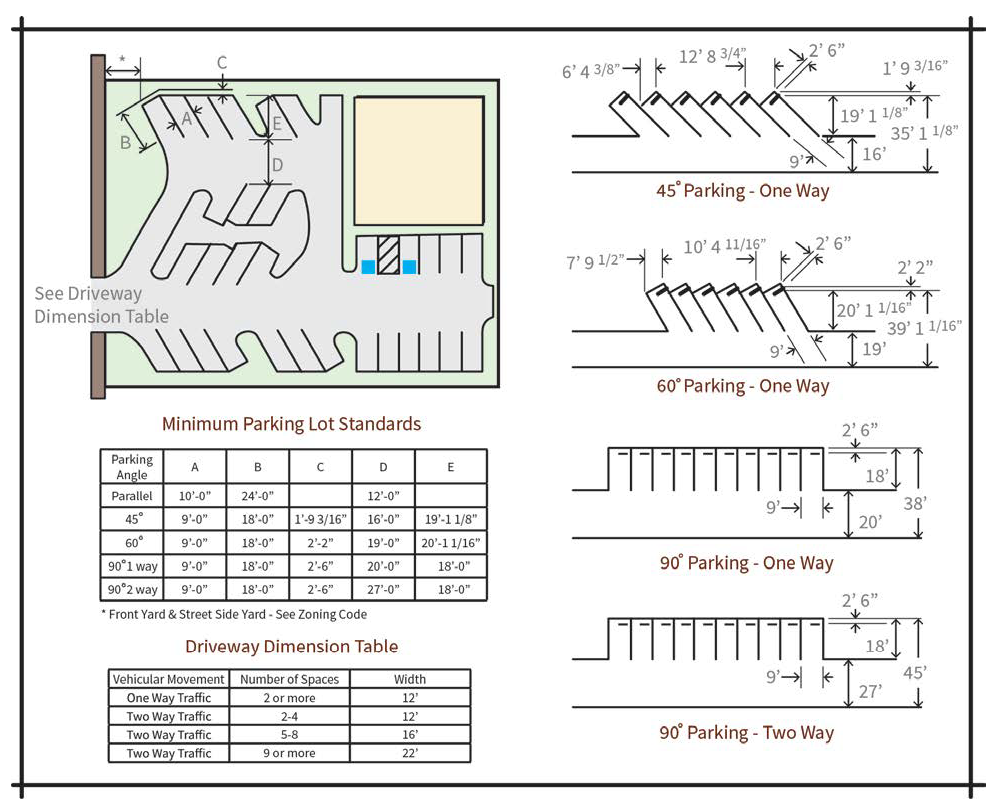
Figure 1500-20-1: Parking Dimension Standards
2.
Agricultural, Open Space and Recreation, Special Event, and Resource Extraction or Residential use types located outside a City sphere of influence or Rural Community.
a.
Surfacing. Required parking and circulation areas shall be all-weather and usable for the purpose for which they are provided, but are not required to be paved, unless as conditioned as part of a discretionary approval. Non-paved surfacing materials and improvement requirements shall, at a minimum, be four inches of either Class 2 aggregate base or Butte Rock. All such parking spaces and accessways shall have a ½ inch grading requirement.
3.
All Other Use Types and Areas within the County.
a.
Surfacing. Required parking and circulation areas shall generally be paved with asphalt, concrete or another approved all-weather, hard, non-eroding surface. Non-paved surfacing materials may be used when approved by the Director or as part of a discretionary approval, based upon the nature of the use, frequency of parking and vehicle traffic, level of heavy vehicle use, and fire access requirements. Non-paved surfacing materials and improvement requirements must be durable and dustless, as approved by the Director.
b.
Striping. All parking spaces shall be delineated and separated by a painted divider. The striping requirement for non-paved surfaces may be waived by the Director or as part of a discretionary approval.
C.
Drainage. Required parking and circulation areas shall be graded and drained so as to dispose of all surface water accumulated within the area in accordance with County standards as determined by the Director. Best management practices to reduce runoff pollutants shall be incorporated.
D.
Access and Traffic Flow. Access to parking areas and curb cuts for driveways shall be approved by the Director to ensure an efficient and safe traffic flow into the parking areas and along public streets. Parking areas for commercial, industrial, and multiple family residential uses, not including duplexes and single family residences, shall be designed so that vehicles are not permitted to back out of the parking area onto a public street.
E.
Dead-end Aisles. Parking lot design should avoid use of dead-end aisles unless warranted in special circumstances where other design alternatives cannot be reasonably accommodated. When used, 90-degree angle stalls are required and the aisle shall have a minimum five-foot backing area at its terminus.
F.
Curb Stops. A permanent curb, bumper, wheel stop or similar device at least six inches in height shall be installed in all paved parking areas adjacent to sidewalks, planters and other landscaping areas, parking lot fixtures and buildings and walls to protect these improvements from vehicular damage. The stopping edge of such protected bumper shall be placed no closer than two feet from the above noted improvement.
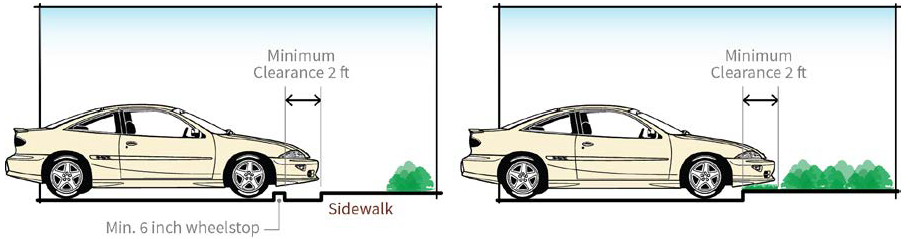
Figure 1500-20-2: Curb Stops and Clearance
G.
Vehicle Overhang. Vehicular overhang is permitted, provided no vehicle shall overhang into a sidewalk which would reduce the unencumbered width of a sidewalk to less than four feet. A vehicle is permitted to overhang into a landscaped area by two feet, provided that the required landscaped area is extended by the amount of the overhang.
H.
Lighting, Landscaping and Screening. All parking areas and associated landscaping, lighting and screening shall comply with the design criteria for the applicable zoning district.
I.
Maintenance. All parking areas shall be permanently maintained free of weeds, litter and debris.
(Ord. of 6-28-2022)
1500-20-090 - Bicycle Parking
Within a City Sphere of Influence or a Rural Community the following bicycle parking requirements shall apply:
A.
Bicycle Parking. Bicycle Parking shall be provided in addition to vehicle parking as follows:
1.
Multi-family residential use types. One bicycle parking space per every three units.
2.
Schools and educational services use types. One bicycle parking space per every vehicle parking space required.
3.
All other use types. One bicycle parking space per every 20 vehicle parking spaces required.
4.
Required bicycle parking shall be provided in the form of racks or lockers.
B.
Bicycle Parking Requirements:
1.
Bicycle parking areas shall be accessible to and located on the same lot as the use and/or development requiring such spaces, or on an adjacent, contiguous lot.
2.
Bicycle parking shall be located near building entries in highly visible and well lighted locations.
3.
Bicycle and vehicle parking areas shall be separated from one another by a physical barrier or sufficient distance to protect bicycles and riders.
4.
All bicycle parking shall be paved with asphalt, concrete, or other all-weather surface.
5.
Bicycle racks and lockers shall be anchored so that they cannot be easily removed.
6.
All required bicycle parking shall be maintained for the duration of the use requiring such spaces.
(Ord. of 6-28-2022)
1500-20-100 - Loading Requirements
A.
Loading Spaces Required. A minimum of one loading space (dock or parking space) shall be provided for all commercial and industrial use types in excess of 10,000 square feet that require a loading space, plus one additional space for every additional 20,000 square feet of floor area, up to a maximum of four loading spaces required.
B.
Dimensions. Each required loading space shall be not less than 12 feet wide, 40 feet long and with 14 feet of vertical clearance.
C.
Location.
1.
Loading spaces shall be separate from other required parking and maneuvering areas.
2.
Where feasible, loading spaces and docks shall be located to the rear of properties.
3.
No loading space or dock shall be permitted to face a residential use within 500 feet of such facility.
D.
Screening. All loading spaces, docks and truck parking areas shall be screened from view from adjacent roadways and residential uses by a minimum of a six-foot-high hedge, six-foot-high chain link fence with privacy slats and landscaping, or a solid six-foot-high wall and landscaping.
E.
Striping. All loading areas shall be striped and clearly identified for loading purposes only.
F.
Passenger Loading Areas.
1.
Passenger loading areas shall be provided for any commercial and industrial use types or complexes with greater than 50,000 square feet gross floor area.
2.
Passenger loading areas shall be located at the point(s) of primary pedestrian access from the parking area to the adjacent building, or buildings, and shall be designed in such a manner that vehicles waiting in the loading area do not impede vehicular circulation in the parking area.
(Ord. of 6-28-2022)
1500-20-110 - Improvements
A.
Public Right-of-Way Dedication and Improvements. Within all Commercial and Employment Districts and all proposed development in the Sutter Pointe Specific Plan Area, no building permit shall be issued for new construction, construction resulting in an increase in occupancy load by 10% or more, or an increase in parking demand by 10% or more unless the owner of the property has dedicated necessary rights-of-way and easements required for street and utility purposes and provisions have been made for their improvement. The public improvements shall be made for that portion of streets which such lot fronts and adjoins. Such dedications and public improvements shall be at no cost to the county.
For land zoned other than Commercial and Employment Districts within the Rural and Rural Planned Communities identified in the General Plan, no building permit shall be issued for new construction, construction resulting in an increase in occupancy load of 10% or more, or an increase in parking demand of 10% or more unless the owner of the property offers for dedication, only, necessary rights-of-way and easements required for street and utility purposes.
Single-family residences shall be exempt for any additions or alterations. All Agricultural Districts shall be exempt from the requirements of this section. Reconstruction after a fire or natural disaster, including flood or earthquake shall also be exempt.
For the purposes of this section, the words "provisions have been made for their improvement" shall mean all the required public improvements are in place in conformity with the requirements of the County's adopted improvement standards.
For the purposes of this section, the word "public improvement" shall mean the installation of curbs, gutters, sidewalks, and street paving in the public right-of-way as are required by the Development Services Department on that side of the centerline of the street which adjoins such lot. Public improvement shall also mean the installation of, and/or the extension of, water and sewer lines as provided for in the General Plan. Such public improvement shall be constructed under permits issued by and to standards established by the Development Services Department. The existence of scenic, historic, or cultural resources on site may require the approval of an alternative improvement plan on a case by case basis. If public improvements are required as a condition of a building permit, the work to complete the public improvement shall be subject to the plan check and inspection fees as established by the Board of Supervisors. Also, the term "new construction" shall not include replacement of, additions to or alterations to existing structures. Further, the term "occupancy load" shall be as defined within the Uniform Building Code.
Road widths and utility easements are established in the General Plan to adequately protect the traveling public and property owners entering and exiting public thoroughfares as well as providing sufficient paving width to appropriately accommodate emergency vehicles which may be called upon to respond to calls for service to properties that are improved with structures of sufficient value to make likely the owner's desire to protect their worth. Utility easements are required and sized in order to facilitate appropriate service to those same properties consistent with having sufficient and appropriate services available to the land and public improvements situated thereon. Additional right-of-way appropriate to maintain the paved portions and afford adequate parking are also established in the General Plan. Installation of curbs, gutters, sidewalks, and water and sewer services similarly implement related General Plan policies and enhance various protections available to the land and structures subject of the referenced building permit as well as those persons who will use them by affording safe pedestrian access, drainage, protection from errant vehicles, fire safety, and appropriate sanitary and public health provisions.
B.
Privately-owned improvements. For any proposed private road, drainage facility, hydrant, or other facility as may be proposed in an industrial zone (M-1 or M-2) or the Employment Corridor (EC) zone only, the applicant shall submit and obtain County approval of plans and specifications for the construction of private road improvements. Private roads shall be designed to meet the Sutter County Design/ Improvement Standards for industrial/commercial roads, in effect at the time of improvement plan approval, or such standards included as a condition of approval for the parcel or subdivision map. The privately-owned road shall be located in accordance with the approved plans. Intersections with the public right-of-way shall be improved as required by the Director of Public Works to provide safe and efficient access to and egress from the private road. Private roads shall include signage as required by County standards identifying the road as not publicly owned or publicly maintained.
New private roads shall provide access to the frontage of all parcels and structures in the development and shall meet the requirements of California Fire Code. Any restrictions, posts, gates, or other physical barriers or constrictions shall be approved by the County prior to installation.
The applicant shall be responsible for constructing private improvements in accordance with the plans and specifications approved by the County.
If any proposed private improvements will be shared among more than one parcel, a maintenance agreement for such improvements shall be recorded and shall be binding upon all heirs, assigns or successors in interest.
(Ord. of 6-28-2022)
1500-21-010 - Purpose
The purpose of this Chapter is to establish sign regulations that:
A.
Support economically viable businesses;
B.
Provide fair and equitable treatment of sign users;
C.
Preserve and enhance the visual quality of Sutter County;
D.
Prevent excessive and confusing sign displays;
E.
Control signs in a constitutional manner;
F.
Minimize hazards to pedestrians and motorists; and
G.
Safeguard life, health, property, and the public welfare.
(Ord. of 6-28-2022)
1500-21-020 - Applicability
The standards in this Chapter apply to signs within all zones and are intended to be maximum standards.
(Ord. of 6-28-2022)
1500-21-030 - Sign Measurements
A.
Sign Area.
1.
Freestanding Signs. The area of the display face and other communicative elements of the sign. Does not include embellishments such as the monument base, framing or decorative roofing, provided there is not advertising copy on such embellishments.
2.
Wall Signs. The entire face of the sign, including all structures framing the sign. Where individual letters or logos are used, the sign area shall consist of the area within a rectangle or square drawn completely around the letters or logo.
3.
Double Faced Signs. If a sign is double faced, only one face (the bigger if applicable) shall be used to calculate area as long as there is less than 24 inches between faces. Otherwise, each face shall be used to calculate area.
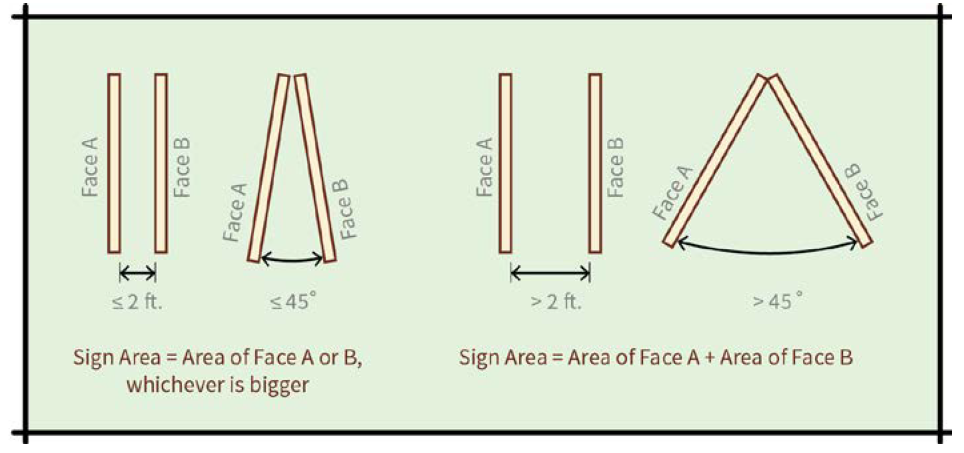
Figure 1500-21-1: Sign Area—Double Faced Signs
B.
Freestanding Sign Height.
1.
Height Measurement. The distance from the grade adjacent to the sign to the highest point of the sign, or any structural or architectural components of the sign.
2.
Grade Differential. When the grade at the edge of the adjacent right-of-way is higher than the site on which the sign is placed, that portion of the sign below the grade at the edge of right-of-way shall not be included in determining the sign's overall height.
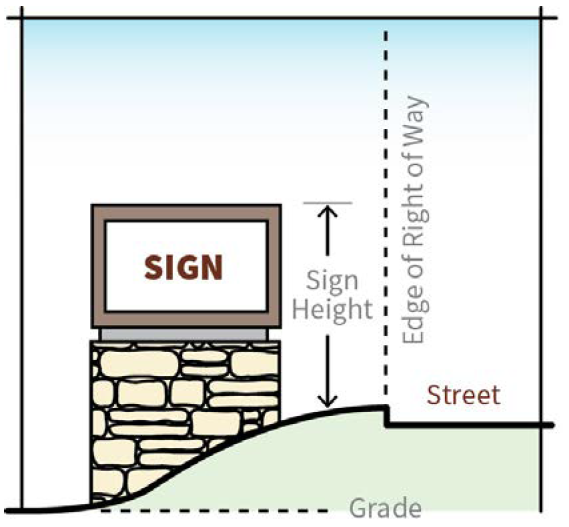
Figure 1500-21-2: Sign Height
(Ord. of 6-28-2022)
1500-21-040 - General Sign Standards
The following criteria shall be utilized for permanent advertising displays and signs:
A.
Architectural Style. Each sign shall be designed to be compatible with and relate to the architectural style of the main building or buildings upon the site where such sign is located.
B.
Relationship to Other Signs. Where there is more than one sign on a site or building, all permanent signs displaying a commercial message shall have designs that are similar and compatible in type, design and treatment.
C.
Sign Illumination. All signs may be illuminated from an internal or external light source. The illumination of signs shall be designed to minimize negative impacts on surrounding rights-of-way and properties. The following standards shall apply to all illuminated signs:
1.
External light sources shall be directed and shielded to limit direct illumination to the sign area only;
2.
The light from an illuminated sign shall not be of an intensity or brightness that will create glare or other negative impacts on residential properties in direct line of sight to the sign.
D.
Wall Sign Design. All wall signs shall be attached flat against or pinned away (peg mounted or similar) from a building wall, but shall not extend or protrude more than one foot from the wall, except for allowed projecting signs. Exposed raceways are permitted only when the raceway is an integral design component of the sign.
E.
Freestanding Sign Design. All freestanding signs shall be monument style and incorporate a base (masonry, stone, brick, stucco, decorative metal or other similar material).
F.
Freestanding Sign Setbacks. Freestanding signs shall maintain a setback, measured from that part of the sign that is closest to the nearest property line of the parcel or lot on which it is placed, equal to at least one-half the height of the sign. No freestanding sign shall be located closer than six feet from any property line, closer than three feet from any building, within any right-of-way or public utility easement, or within the corner lot clear vision triangle pursuant to Section 1500-02-050.
G.
Awning, Canopy and Under Canopy Signs. Awning, canopy and under canopy signs shall provide a minimum of eight feet of clearance above the ground.
H.
Projecting Signs. Projecting signs shall provide a minimum of eight feet of clearance above the ground, and shall not extend more than four feet from the wall upon which they are attached.
I.
Changeable Copy Signs. The text on changeable copy signs shall be limited to activities and events offered by the use associated with the sign.
(Ord. of 6-28-2022)
1500-21-050 - Signs Allowed Without a Permit
The following signs are allowed without a permit and do not count towards the allowable area or number of signs on a site:
A.
Standard Signs.
1.
Address Signs. Address, building, unit and suite numbers.
2.
Civic Signs. Memorial signs and plaques installed by a civic organization recognized by resolution of the County Board of Supervisors.
3.
County/City Entrance Signs. Signs erected in or near the County or a city boundary, the contents of which are limited to the name of the County or city and the name of or other information regarding civic, fraternal, or religious organizations located within the County or city. Such signs shall not exceed 200 square feet in area, and 15 feet in height.
4.
Directional and Informational Signs. On-site directional or informational signs of no more than four square feet in area each, and three feet in height. Such signs shall provide information for the convenience or safety of the public, and may include directional signs in parking lots and building complexes, signs listing hours of business, and signs identifying the locations of restrooms or other facilities. Such signs may be increased to 12 square feet in area, and six feet in height when their primary purpose is to direct truck traffic.
5.
Directory Signs—Project Entry. On-site freestanding directory signs of no more than 12 square in area each, and six feet in height. One such sign may be located at each project entry along a street frontage, and may include a map and directory of buildings or users. Such signs shall not be oriented to or readable from the public right-of-way.
6.
Directory Signs - Building. One wall mounted or freestanding directory sign for each building with two or more tenants. Signs shall be no more than 12 square feet in area, and freestanding signs no more than six feet in height.
7.
Entry Portal Signs. One freestanding entry portal sign not exceeding 32 square feet in area and 20 feet in height may be placed across a property's entry accessway within the AG District only. The entry portal sign may list only the name of the property owner or business located thereon and the property address.
8.
Flags. Official flags, emblems and historical markers. This exemption does not apply to flags or pennants bearing corporate emblems, logos or commercial copy.
9.
Floor Treatments. Exterior floor treatments, such as paint or decorative tile, indicating the name of the business and/or a business logo, provided such floor treatments are flush with the surrounding surface and is completely horizontal.
10.
Gasoline Price Signs. That portion of the area of a gasoline price sign necessary to comply with the minimum sign requirements of the California Business and Professions Code Section 13531, as it may be amended.
11.
Governmental Signs. Signs that are posted or required by a government agency or a public utility or service, including official signs for traffic control and warnings of potential hazards.
12.
Lottery Signs. Signs and advertising for the California State Lottery as authorized by California Government Code, Section 8880 et seq.
13.
Menu/Order Boards. No more than two menu/order board signs per each establishment with a drive through facility. Signs shall not exceed 32 square feet in area, and six feet in height.
14.
Murals. Murals on the exterior of a building that do not advertise a product, business, or service.
15.
Notices. Signs that are required by local, State, or federal law or by court order.
16.
Non-viewable signs. Signs within a building, or on the premises of a building, that are not visible from a public street.
17.
Wayside Stand Signs. On-site signs for wayside stands subject to the following:
a.
A combination of two freestanding or wall signs within the AG district not exceeding 32 square feet each in area, with freestanding signs not over six feet in height.
b.
A combination of two freestanding or wall signs within the RAN, ER or R1 districts not exceeding nine square feet each in area, with freestanding signs not over six feet in height.
18.
Informational Window Signs. Signs hanging on the interior of the window or stenciled on the inside or outside of the window not exceeding three square feet in area and limited to business identification, hours of operation, "open/closed", address, and emergency information.
B.
Temporary Signs.
1.
Business Identification. Temporary business identification signs subject to the following:
a.
Either one freestanding or one building mounted sign no more than 24 square feet in area per each street frontage. Freestanding signs shall be no more than eight feet in height.
b.
Signs may be displayed for a maximum duration of 90 consecutive days, and shall be removed upon installation of permanent signage.
2.
Development/Contractor Signs. On-site development, construction and contractor's sign(s) subject to the following:
a.
One sign no more than 32 square feet in area and eight feet in height may be erected for every 1,000 lineal feet of property street frontage, or portion thereof.
b.
All signs shall be removed no later than seven days after issuance of the last occupancy permit for the project.
3.
Garage/Yard Sale and Short Term Agricultural Sale/Auction Signs, Offsite. A maximum of one on-site and two off-site signs no more than five square feet in area and six feet in height each. All signs shall be removed no later than 24 hours after the conclusion of the sale. Such signs shall not be affixed to any utility pole or street sign pole.
4.
Political Signs. Signs shall be installed no earlier than 90 days prior to the election and removed no later than 15 days following the election.
5.
Real Estate Signs, On-Site.
a.
Residential properties. One sign no more than six square feet in area and six feet in height shall be permitted for each street frontage. Two signs no more than 32 square feet in area and eight feet in height shall be permitted for residential subdivisions with four or more parcels.
b.
Non-residential properties. One sign no more than 32 square feet in area and eight feet in height shall be permitted for each street frontage.
c.
Duration. All temporary on-site real estate signs shall be removed no later than seven days after the property is no longer offered for lease, rent or sale.
6.
Real Estate Signs, Off-Site.
a.
Portable. Portable directional signs within the scope of Civil Code 713 (Real estate for sale, etc.) no more than four feet in height and six square feet in area. Signs shall remain in place for a maximum duration of 48 hours.
b.
Non-Portable. Non-portable real estate, subdivision, or development signs no more than 32 square feet in area and six feet in height. Signs may be displayed for the duration of development activity. No more than two off-site signs may be displayed for a single property, subdivision, or development project. Signs shall be removed no later than seven days after the property is no longer offered for lease, rent or sale.
7.
Seasonal Displays. Temporary exterior decorations and banners that are associated with a seasonal, cultural, religious, or national holidays, and that are not used to advertise a product, business, or service.
8.
Special Event Signs. On-site, special event signs, including but not limited to banners, pennants, streamers, bunting, wind signs, balloons or flags shall be permitted up to 30 days in any calendar year. The use of special event signs is limited to properties located in Commercial, Employment, Agricultural, Recreational and Public districts.
9.
Subdivision Flags. Flags and pennants bearing the name of the developer or development and only when utilized in association with an approved model home sales office for a new residential subdivision. Subdivision flags shall be limited to two flags per model home and four flags at the subdivision entrance not to exceed a maximum area of 20 square feet each and a pole height of 25 feet. If there are no model homes, then up to four flags may be utilized in addition to those at the subdivision entrance. Flags and pennants shall be removed no later than seven days after property is no longer offered for lease, rent or sale.
C.
Changes to Sign Face. Changes or maintenance to a sign face that do not structurally alter the sign, its size or illumination.
(Ord. of 6-28-2022)
1500-21-060 - Permit Requirements
A.
Zoning Clearance for On-site Signs.
1.
Zoning Clearance Required. All on-site signs identified in Section 1500-21-070 (Signs Requiring a Permit) require approval of a Zoning Clearance (Section 1500-25-030) to ensure compliance with the provisions of this Chapter.
2.
Submittal Requirements. A Zoning Clearance application for an on-site sign shall provide all applicable information and materials required by Article 22. Applications shall also include:
a.
One reproducible copy of a site plan for the property upon which the sign(s) is to be located depicting the location of existing building(s), and existing and proposed sign(s);
b.
One reproducible copy of a sign plan depicting the sign(s) including dimensions, colors, materials and type of illumination; and
c.
One reproducible copy of a scaled building elevation plan indicating the sign location (wall signs only).
B.
Use Permit for Off-site Signs within Commercial and Employment Districts.
1.
Use Permit. All off-site signs within Commercial and Employment Districts identified in Section 1500-21-070 (Signs Requiring a Permit) require approval of a Use Permit (Section 1500-25-050) to ensure compliance with the provisions of this Chapter.
2.
Submittal Requirements. A Use Permit for an off-site sign shall provide all applicable information and materials required by Article 22. Applications shall also include:
A.
One reproducible copy of a site plan for the property upon which the sign(s) is to be located depicting the location of existing building(s), and existing and proposed sign(s);
B.
One reproducible copy of a sign plan depicting the sign(s) including dimensions, colors, materials and type of illumination.
C.
Planned Sign Program for Building Complexes.
1.
Planned Sign Program Required. A Planned Sign Program shall be processed as a component of the Design Review application for any projects within Commercial and Employment districts that propose five or more buildings, tenants, or uses, intended to function as a building complex. Characteristics of a building complex may include, but are not limited to, shared parking facilities, reciprocal access, and common building design. Such projects may include multiple tenants or owners, and may be situated on one or more lots or parcels.
The purpose of a Planned Sign Program is to establish criteria to ensure coordinated and consistent signage within building complexes. Upon approval of a Planned Sign Program, all signs erected in the area governed by the Program shall conform to the Program, and no Zoning Clearance shall be issued for a sign not in conformance with the criteria of the Program. Relief from the criteria of a Planned Sign Program may be granted only through Design Review approval to modify or replace the Program.
2.
Submittal Requirements. A Design Review application including a Planned Sign Program shall provide all applicable information and materials required by Article 22. Applications shall also include:
a.
One reproducible copy of a site plan for the property upon which the sign(s) is/are to be located, depicting the location of existing and proposed building(s), and existing and proposed freestanding sign(s);
b.
One reproducible copy of a sign plan depicting the format for all signs subject to the Planned Sign Program, including the location, dimensions, colors, materials, and type of illumination;
c.
One reproducible copy of a scaled building elevation plan indicating the sign location (wall signs only); and
d.
A detailed statement of criteria for the proposed signs including, but not limited to: number, type, location, size, height, materials, letter style, colors, mounting details and illumination.
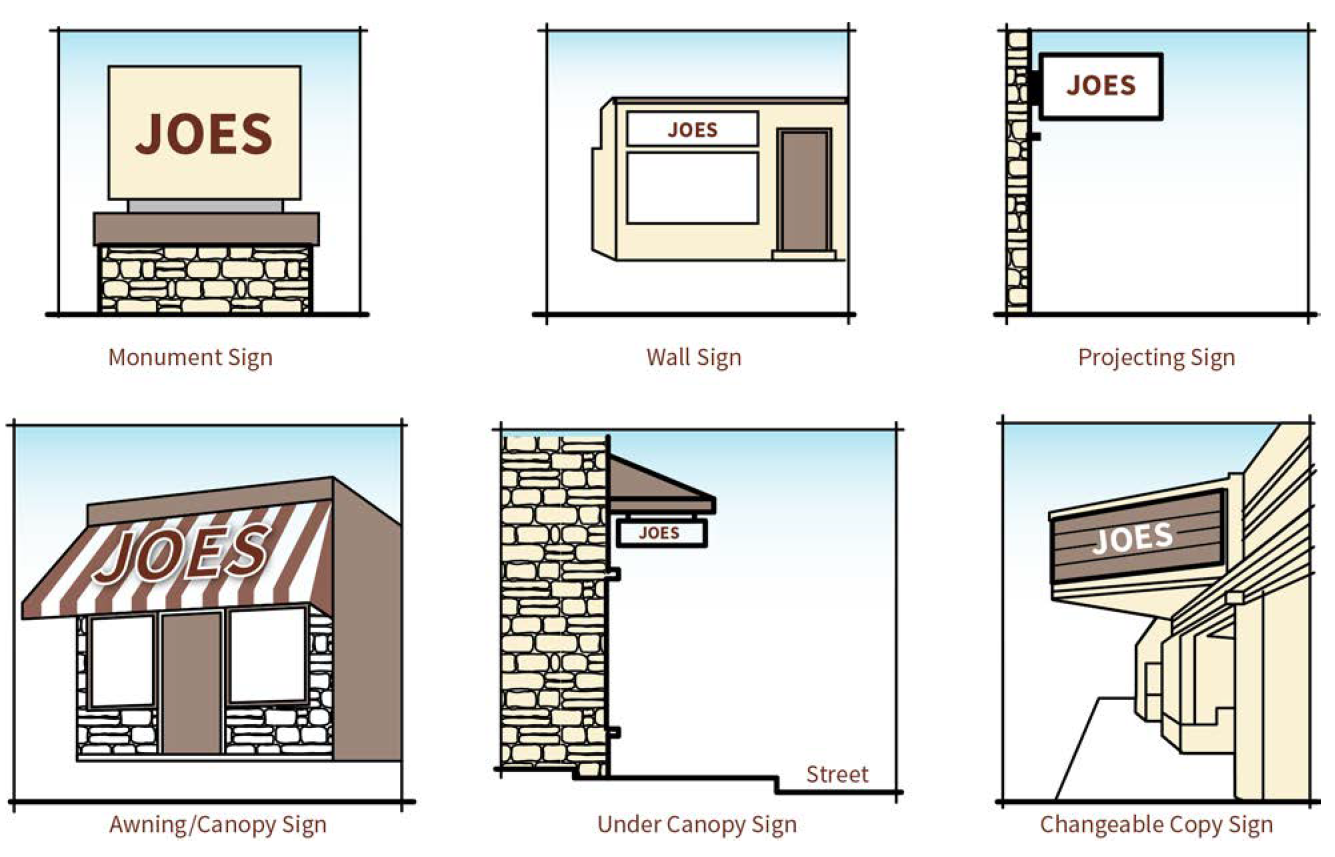
Figure 1500-21-3: Common Sign Types
(Ord. of 6-28-2022)
1500-21-070 - Signs Requiring a Permit
The following signs are allowed pursuant to the permit requirements specified in Section 1500-21-060:
(Ord. of 6-28-2022)
1500-21-080 - Prohibited Signs
The following signs shall be prohibited:
A.
Portable, A-frame, banners, inflatable displays, flying signs, searchlights and similar except as provided for under Section 1500-21-050(B) (Temporary Signs).
B.
Signs that include any part that appears to flash, blink, move, change color, or change intensity, excluding flags and pennants, standard barber poles, and date, time and temperature signs.
C.
Signs that emit noise, odor or any visible matter other than light.
D.
Roof signs and any signs that projects above the building wall or parapet to which they are affixed.
E.
Signs that obstruct a door, window, fire escape, or other required building access way.
F.
Pole signs.
G.
Signs that encroach into any public right-of-way or easement, means of ingress or egress, or path of travel.
H.
Signs that interfere with visibility and/or restrict safe sight distances for drivers at any intersection, public or private road, or driveway.
I.
Freestanding signs within the corner lot clear vision triangle pursuant to Section 1500-02-050.
J.
Signs adversely affecting traffic control or safety.
K.
Signs located on public property, excluding official signs that are posted or required by a government agency, public utility, or public service.
L.
Off-site advertising signs, including Billboards, except as otherwise provided by this Chapter.
M.
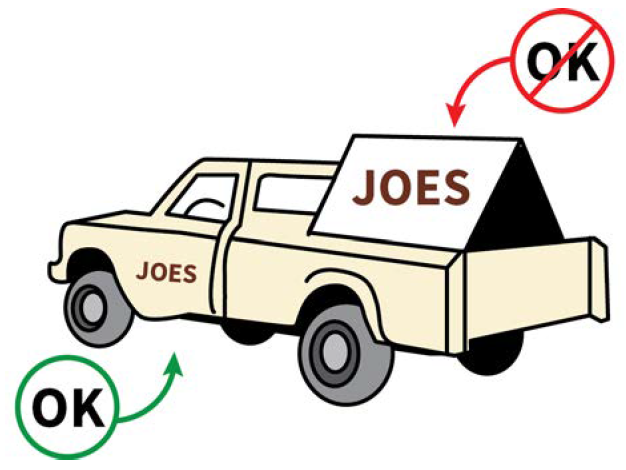
Signs on vehicles, trailers, boats, storage boxes or other similar objects where such signs are not incidental to the primary use of the vehicle or other similar object, and where the primary purpose of the sign and vehicle or other similar object upon which the sign is attached is for advertising purposes.
N.
Signs that have become a public nuisance due to inadequate maintenance, dilapidation, or abandonment.
O.
Signs that were unlawfully installed, erected, or maintained.
P.
Signs that have less clearance from overhead lines and other utilities than required by the applicable service providers.
(Ord. of 6-28-2022)
1500-26-090 - Nonconforming and Abandoned Signs
A.
Nonconforming Signs.
1.
Legal Nonconforming Signs. Any sign that does not comply with the requirements of this Chapter, but which was constructed, operated, and maintained in compliance with all previous regulations, shall be regarded as a legal nonconforming sign.
2.
Modification. No legal nonconforming sign shall be structurally altered, remodeled or moved without being made to comply in all respects with the provisions of this Chapter; provided, however, that nothing herein shall prohibit the normal maintenance or repair of any legal nonconforming sign nor the painting or repainting or otherwise changing of its face.
B.
Abandoned Signs. Any sign whose advertised use has ceased to function for a period of six months or more shall be deemed abandoned. Any re-use of such sign shall require compliance with the appropriate permitting requirements of this Chapter.
(Ord. of 6-28-2022)
1500-21-100 - Sign Maintenance
A.
Maintenance. Signs, including supports, monuments, and architectural embellishments, shall be maintained in a state of good repair at all times. Damage to signs shall be repaired in a timely manner.
B.
Remedy. If after 90 days of written notice from the Director a sign owner has failed to maintain a sign, the sign may be declared abandoned by the Director. Any re-use of such sign shall require compliance with the appropriate permitting requirements of this Chapter.
(Ord. of 6-28-2022)
1500-21-110 - Sign Removal
Prohibited, abandoned and other illegal signs shall be removed, at no cost to the County, within 30 days upon written notice from the Director or shall be repaired and/or modified and lawfully permitted in accordance with the provisions of this Chapter.
(Ord. of 6-28-2022)
1500-21.5-010 - Purpose
This Article establishes standards and procedures to protect the health and safety of County residents from the harmful effects of exposure to excessive, unnecessary or offensive noise.
(Ord. of 6-28-2022)
1500-21.5-020 - Definitions
The words, phrases and terms as used in this Article shall have the following meanings:
A.
Ambient Noise Level. All-encompassing noise level associated with a given environment, being a composite of sounds from all sources, excluding the alleged offensive noise, at the location and approximate time at which a comparison with the alleged offensive noise is to be made.
B.
Decibel (dB). A unit used to express the relative intensity of sound as it is heard by the human ear. The lowest volume a normal ear can detect under laboratory conditions is zero dB, the threshold of human hearing. Since the decibel is logarithmic, ten decibels are ten times more intense and 20 decibels are a 100 times more intense than 1 dB.
C.
Equivalent Sound Level (Leq). The average of sound energy occurring over a specified period. The L eq is equivalent to the same average acoustical energy as the time-varying sound that actually occurs during a specified period.
D.
Impulsive Noise. A noise characterized by sound pressures whose peak levels are very much greater than the ambient noise level resulting in instantaneous sharp sounds, such as might be produced by the impact of a pile driver, hammering, back-up alarm, or gunfire, typically with 1 second or less duration.
E.
Noise Level. A-weighted sound pressure level in decibels obtained by using a sound level meter at slow response (1,000 milliseconds up and down) with a reference pressure of 20 micropascals. A fast meter response (125 milliseconds up and down) shall be used for impulsive noise. The unit of measurement shall be designated as "dBA."
F.
Noise Sensitive Uses. Land uses considered more sensitive to noise than others due to the amount of noise exposure and types of activities typically involved at the land use location such as residences, schools, motels and hotels, libraries, religious institutions, hospitals and nursing homes.
G.
Simple Tone Noise or Pure Tone Noise. A noise characterized by the presence of a predominant frequency or frequencies such as might be produced by whistle, squeal, screech, or hum.
H.
Sound Level Meter. An instrument meeting American National Standard Institute (ANSI) Standard S1.4-1971 for Type 2 sound level meters that is calibrated utilizing an acoustical calibrator meeting ANSI Type 2 standard, performed immediately prior to recording any sound data. Calibration equipment shall be certified annually.
I.
Sound Pressure Level. A sound pressure level of a sound, in decibels, as defined in ANSI Standards 51.2-1962 and 51.13-1920. It is computed as ten times the logarithm of the source sound pressure divided by a reference sound pressure.
(Ord. of 6-28-2022)
1500-21.5-030 - General Noise Regulations
Notwithstanding any other provisions of this Article, it is unlawful for any person to willfully make or continue or cause to be made or continued any excessive, unnecessary or offensive noise levels, which disturbs the peace and quiet of any noise sensitive use, or which causes discomfort or annoyance to any reasonable person of normal sensitivity.
The standards which shall be considered in determining whether a violation of the provisions of this section exists shall include, but not be limited to the following:
A.
The sound level of the objectionable noise;
B.
The proximity of the noise to residential or other noise sensitive uses;
C.
The time of day or night the noise occurs;
D.
The duration of the noise and its tonal informational or musical content;
E.
Whether the noise is continuous, recurrent or intermittent; and
F.
The level and intensity of ambient background noise, if any.
(Ord. of 6-28-2022)
1500-21.5-040 - Noise Level Measurement
A.
Noise Level Measurement. Any noise level measurements made pursuant to the provisions of this Article shall be performed using a sound level meter as defined in Section 1500-21.5-020.
B.
Designated Exterior Noise Measurement Location. The location selected for measuring exterior noise levels shall be within one foot or as close as is practicable inside the property line of the receiving property closest to the noise source or where the noise level is greatest. Where feasible, the microphone shall be at a height of five feet above ground level and shall be at least four feet from walls or similar reflecting surfaces.
(Ord. of 6-28-2022)
1500-21.5-050 - Exterior Noise Standards
The noise standards shown in Table 1500-21.5-1, unless otherwise specified in this Article, shall apply to all noise sensitive exterior areas within Sutter County.
A.
Exterior Noise Violation. It is unlawful for any person at any location within the County to create any noise which causes the noise levels on a noise sensitive receiving property, when measured in the designated exterior noise measurement location, to exceed the noise standards specified in Table 1500-21.5-1.
B.
Impulsive, Simple and Pure Tone Noise. Each of the noise limits specified in Table 1500-21.5-1 shall be reduced by 5 dBA for recurring impulsive noise, simple or pure tone noise, or for noises consisting of speech or music.
C.
Ambient Noise Level. Noise level standards, which are up to five 5 dBA less than those specified in Table 1500-21.5-1 may be imposed, based upon determination of existing low ambient noise levels in the vicinity of the receiving property.
D.
Application. The exterior noise level standard shall be applied to the property line of the receiving property (as measured no more than one foot or as close as practicable inside the property line).
(Ord. of 6-28-2022)
1500-21.5-060 - Unique Noise Standards
A.
Animals and Birds. It is unlawful for any person to possess or harbor any animal or bird that howls, barks, meows, squawks, or makes other noises continuously and/or incessantly for an unreasonable period of time so as to create a noise disturbance across a real property line.
B.
Audio Equipment. It is unlawful for any person to use or operate audio equipment on private property where said equipment is unreasonably audible beyond the property line. In addition, no person shall operate audio equipment in a vehicle on or within any public street, public park, public parking lot or other public place which is audible to a person of normal hearing sensitivity more than 50 feet from such vehicle.
C.
Schools, Hospitals and Churches. It is unlawful for any person to create any noise on any public street, public sidewalk, public park, public parking lot or other public place adjacent to any school, institution of learning, hospital or church while the same is in use, which noise unreasonably interferes with the workings of such institution or which disturbs or unduly annoys the users of such institution.
(Ord. of 6-28-2022)
1500-21.50-070 - Exceptions to Noise Standards
The following activities shall be exempted from the provisions of this Article:
A.
Agricultural Activities. Noise sources associated with agricultural activities in zones permitting agricultural uses, which are carried out in any manner consistent with the practice and within the standards of the agricultural industry. This includes without limitation all mechanical devices, apparatus or equipment utilized for the protection or salvage of agricultural crops during periods of adverse weather conditions or when the use of mobile sources is necessary for pest control.
B.
Construction. Noise sources associated with construction, repair, remodeling, demolition, paving or grading of any real property or public works project located within 1,000 feet of noise-sensitive uses (i.e., residential uses, daycares, schools, convalescent homes, and medical care facilities), provided such activities take place between:
1.
7:00 a.m. to 6:00 p.m. on weekdays
2.
8:00 a.m. to 5:00 p.m. on Saturdays
Construction is prohibited on Sundays and legal holidays unless permission has been applied for and granted by the County.
C.
Emergency Activities. Any machinery, equipment, vehicle, manpower or other activity related to or connected with emergency activities or emergency work to protect, maintain, provide or restore safe conditions in the community or for citizenry, or work by private or public utilities when restoring utility service.
D.
Temporary Activities and Events. Authorized outdoor or indoor events, gatherings, shows, bands, fairs, festivals, weddings, sporting events entertainment and similar events provided such activities take place between 7:00 a.m. to 10:00 p.m. and do not exceed an L eq of 65 dBA when measured at any point on the property line over any 30 minute period.
E.
Maintenance of Residential Property. Noise sources associated with maintenance of residential property, provided such activities take place between 7:00 a.m. to sunset.
F.
Parks and Schools. Activities conducted in public parks, public playgrounds and public or private school grounds provided such activities take place between:
1.
7:00 a.m. to sunset for unlighted facilities.
2.
7:00 a.m. to 10:00 p.m. for lighted facilities.
Such activities include, but are not limited to athletic and entertainment events.
G.
Private Recreation. Private recreational activities provided such activities take place between 7:00 am to sunset and do not exceed an L eq of 65 dBA when measured at any point on the property line over any 30 minute period. Such activities include, but are not limited to off-road vehicles, pleasure motor boats, and gunfire from target practice consistent with all State laws on private property.
H.
State and Federal Preemption. Any activity to the extent regulation thereof has been preempted by state or federal law.
I.
Waste Disposal Activities. Waste disposal collection activities provided such activities do not take place within 500 feet of any area zoned for residential use earlier than 5:30 a.m. or later than 8:00 p.m., except in an emergency or with the approval of the County.
J.
Legally Established Uses.
1.
Allowed activities generated by a legally established use (e.g. a commercial or employment use) impacting non-conforming uses (e.g. a residential use) that, if legally established, would be considered a noise sensitive use.
2.
Any land use for which a valid land use approval, entitlement, or permit has been issued by the county prior to the effective date of the ordinance codified in this chapter.
(Ord. of 6-28-2022)
1500-21.5-080 - Noise Exception Requests
A.
If the owner or operator of a noise source demonstrates to the satisfaction of the Director that immediate compliance with the requirements of this Article would be impractical or unreasonable, the Director may issue Zoning Clearance to allow an exception from the provisions thereof. Such Zoning Clearance shall be processed in accordance with Article 1500-25-030 of this Zoning Code.
1.
A Zoning Clearance application for a noise exception shall set forth all actions taken to comply with this Article, the reasons why immediate compliance cannot be achieved, a proposed method for achieving compliance, and a proposed time schedule for its accomplishment.
2.
Any Zoning Clearance for an exception shall be for an initial term as specified by the Director, not to exceed 30 days. Longer terms up to 120 days may be granted by the Planning Commission.
3.
In reviewing a Zoning Clearance for a noise exception the approving authority shall consider:
a.
The level, intensity and duration of the noise;
b.
The magnitude of nuisance caused by the noise;
c.
The uses of property within the area affected by the noise;
d.
The time of day that the noise occurs;
e.
The design and cost of remedial work; and,
f.
The general public interest and welfare.
4.
A Zoning Clearance for a noise exception may be subject to any terms, conditions and requirements that the approving authority may deem necessary to achieve maximum compliance with the provisions of this Article. Such terms, conditions and requirements may include, but shall not be limited to, limitations on noise levels and operating hours.
5.
Prior to the Director issuing a Zoning Clearance for a noise exception, a Notice of Intent to Approve shall be issued pursuant to Section 1500-23-060B.
(Ord. of 6-28-2022)
1500-21.5-090 - Violations
A.
The violation of any provision contained in this Article shall constitute an infraction and a public nuisance.
B.
It shall be the duty of the Director, County Sheriff and/or other assigned County officials to enforce the provisions of this Article.
C.
To determine whether there is a violation of this Article, the assigned County enforcement official will review a complaint in accordance with Sutter County Ordinance Code and may investigate and assess whether the alleged noise levels exceed the noise standards set forth in this Article.
D.
If the assigned County enforcement official has reason to believe that any provision(s) of this Article has been violated, he/she shall cause written notice to be served upon the alleged violator. Such notice shall specify the provision(s) of this Article alleged to have been violated and the facts alleged to constitute a violation, including dBA readings noted and the time and place of their detection, and shall include an order that corrective action be taken within a specified time. If corrective action is not taken within such specified time or any extension thereof approved by the County enforcement official, he/she shall commence the enforcement process specified in Article 26.
E.
In addition to the penalties for infraction offenses and the procedures for nuisance abatement as set forth in the Sutter County Ordinance Code, any noise level and its source in violation of any of the provisions of this Article may be summarily abated, which may include, but is not limited to, removal, dismantlement and taking into custody the source of such noise, and in this regard, the confiscation of any machine or device used to violate any of the provisions of this Article is hereby authorized to be held for use as evidence in any proceeding that may be brought for such violation.
F.
It is unlawful for any person to refuse to cooperate with or to obstruct any governmental agent, officer or employee in determining the noise level or the ambient noise level. Such cooperation shall include, but is not limited to, the shutting off or quieting of any noise source so that an ambient noise level can be measured or alternatively the turning on or starting of any noise source that is alleged to exceed standards.
(Ord. of 6-28-2022)

