
Sutter County Unincorporated
City Zoning Code
City Zoning Code
PART 5
Process and Enforcement
1500-22-010 - Purpose
This chapter establishes common requirements for the preparation, filing, and completeness of permit applications required by the Zoning Code.
(Ord. of 6-28-2022)
1500-22-020 - Pre-Application Consultation
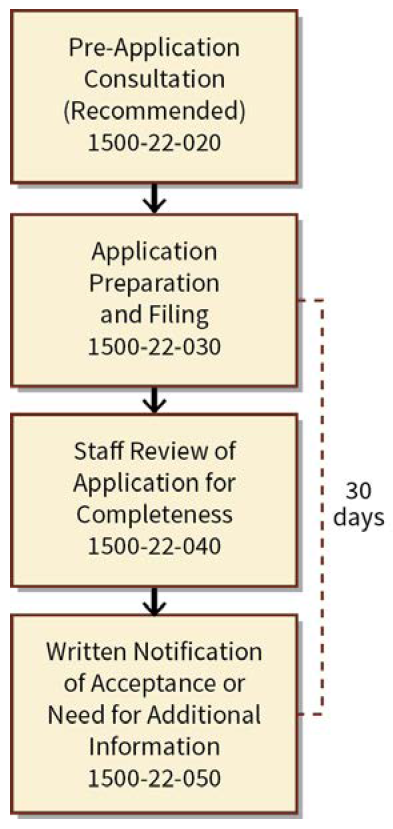
While optional, the County encourages prospective applicants to consult with the individual divisions of the Development Services Department (i.e., Planning, Environmental Health, Public Works, Fire, and Building) before completing and filing a permit application.
(Ord. of 6-28-2022)
1500-22-030 - Application Preparation and Filing
A.
Application Form. All applications for a permit or approval required by the Zoning Code shall be filed with the Development Services Department on an official County application form.
B.
Supporting Information. The application shall be filed with all required fees, deposits, plans, maps, drawings, renderings, models, studies, and other information and materials as specified by the Development Services Department. Such information and materials shall be adequate to describe existing conditions and the proposed project, and to determine the level of environmental review required pursuant to the California Environmental Quality Act (CEQA).
C.
Eligibility for Filing. An application may only be filed by the owner of the subject property or a duly authorized agent of the property owner with the written consent of the owner.
D.
Concurrent Filing. An application may be filed and processed concurrently with any other discretionary permit for the subject property. Such permits or approvals shall be reviewed and acted on in a unified process.
E.
Application Fees. Fees required for any application shall be paid as required by the fee schedule adopted by the Board of Supervisors. Failure to pay the appropriate fee or subsequent deposit(s) upon request shall be deemed to be a withdrawal of the application and shall result in the file being closed and no further action being taken on the application.
F.
Rejection of Application. If the Development Services Department determines that an application requests permission for an action not allowed in the applicable zoning district or that cannot lawfully be approved by the County, the Department shall not accept the application for processing.
G.
Zoning Code Violations. An application shall not be accepted if conditions exist on the subject property in violation of this Zoning Code, or other section of the Sutter County Ordinance Code including but not limited to the provisions of Chapter 410, or any permit or other approval granted in compliance with this Code, unless the proposed project includes the correction of the violation(s).
H.
Availability of Information. All applications and supporting information shall be made available for public inspection. Upon reasonable request, and during normal business hours, any person may examine an application and supporting information submitted to the Development Services Department. Unless prohibited by law, copies of such materials shall be made available at a reasonable cost.
(Ord. of 6-28-2022)
1500-22-040 - Application Completeness
A.
Review. The Development Services Department shall review each application for completeness and accuracy before it is accepted.
B.
Acceptance. Acceptance of the application by the Development Services Department shall be based on the County's list of required application contents and any additional instructions provided to the applicant in a pre-application consultation or during the initial application review period.
C.
Applicant Notification. Unless otherwise specified by this Zoning Code, within 30 calendar days of application acceptance, the applicant shall be informed in writing that either the application is complete and has been accepted for processing, or that the application is incomplete and that additional information is required. If determined to be incomplete, the written correspondence shall itemize any information which is necessary to complete the application. The written correspondence shall also address any areas in which the submitted plans are not in compliance with County standards and requirements.
D.
Time Limit to Make Application Complete. When the Development Services Department determines that additional information is required and the application is not made complete within six months of application submittal, the application shall be deemed withdrawn, the file closed, and no action will be taken on the application.
E.
Additional Information. After the County has accepted an application as complete, the Development Services Department may require the applicant to submit additional information for the environmental review of the project in compliance with the CEQA.
(Ord. of 6-28-2022)
1500-22-050 - Referral of Application
At the discretion of the Development Services Department, or where otherwise required by this Zoning Code or State or federal law, an application may be referred to any County department, state or federal agency, or other agency, group or individual that may have relevant authority, expertise or interest in the proposed project.
(Ord. of 6-28-2022)
1500-23-010 - Purpose
This chapter establishes the approving authorities and common requirements for the review, noticing, action on and appeal of permits required by the Zoning Code.
(Ord. of 6-28-2022)
1500-23-020 - Environmental Review
A.
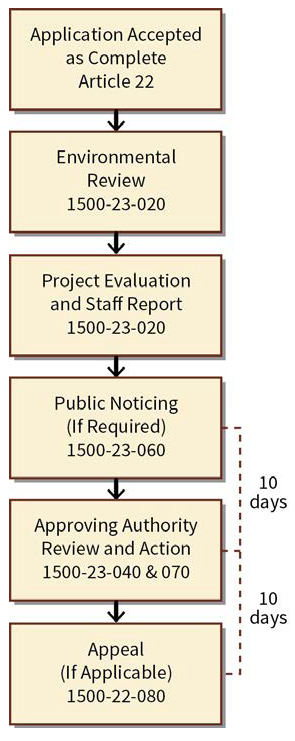
CEQA Review. After acceptance of a complete application, the Development Services Department shall review the project in compliance with California Environmental Quality Act (CEQA) to determine whether:
1.
The proposed project is not a project as defined by CEQA;
2.
The proposed project is exempt from the requirements of CEQA;
3.
A Negative Declaration may be issued;
4.
A Mitigated Negative Declaration may be issued;
5.
A Subsequent EIR, Supplemental EIR or Addendum may be issued; or
6.
An Environmental Impact Report (EIR) is required.
B.
Compliance with CEQA. The above determinations and, where required, the preparation and circulation of appropriate environmental documents, shall be in compliance with CEQA and any environmental guidelines and thresholds that the County has adopted in accordance with CEQA.
C.
Special Studies. Special studies, paid for by the applicant, may be required to supplement the County's CEQA compliance review.
(Ord. of 6-28-2022)
1500-23-030 - Project Evaluation and Staff Reports
A.
Staff Evaluation. The Development Services Department shall review all applications to determine if they comply with all applicable requirements, including the Zoning Code, other applicable provisions of the Sutter County Ordinance Code, the General Plan, applicable specific plan or community plan, and the Sutter County Design Standards as noted in the specified zone district.
B.
Staff Report. The Development Services Department shall provide a staff report including a written recommendation to the approving authority as to whether the application should be approved, approved with conditions, or denied.
C.
Report Distribution. Each staff report shall be furnished to the applicant at the same time it is provided to the approving authority before action on the application.
(Ord. of 6-28-2022)
1500-23-040 - Approving Authority and Public Hearing Requirements
Table 1500-23-1 identifies the Approving authority and public hearing requirements for each type of permit and approval provided for by the Zoning Code:
1. A Notice of Intent to approve shall be provided in accordance with Section 1500-23-060(B) prior to action on any Zoning Clearance associated with applications for gas and oil wells (Sections1500-05-030(S) and 1500-07-030(H)), the Sutter Buttes Overlay (Section 1500-08-020(E)), and small wind energy systems (Section 1500-17-040(B)).
2. Within the Historic Preservation (HP) Combining District, the Historic Preservation Review Committee shall approve Administrative Permits.
3. For projects located within the R-3 and R-4 Zoning Districts:
a. Multi-Family uses of less than 20 units require Minor Design Review.
b. Multi-Family uses of 20 units or more units require Design Review.
4. For projects located within the Employment Corridor Zoning District:
a. Additions to existing residences, new permitted caretaker housing, new or additions to existing agricultural buildings, accessory buildings, solar arrays and similar use types do not require Design Review.
b. Additions to existing commercial and industrial buildings and/or use types require Minor Design Review.
c. New commercial and industrial buildings and/or use types require Design Review approval by the Planning Commission and Board of Supervisors.
5. For projects located within the GC, CM, M-1 and M-2 Zoning Districts:
a. Additions to existing residences, new permitted caretaker housing, new or additions to existing agricultural buildings, accessory buildings, solar arrays and similar use types do not require Design Review.
b. Additions to existing commercial and industrial buildings and/or use types require Minor Design Review.
c. New commercial and industrial buildings and/or use types require Design Review in accordance with the following:
i. Building permit applications for projects over 65,000 square feet of area, or a warehouse/outdoor storage use type over 100,000 square feet of area, require Design Review approval by the Board of Supervisors.
ii. Building permit applications for projects under 65,000 square feet of area, or a warehouse/outdoor storage use type under 100,000 square feet of gross floor area, require Minor Design Review approval. If the Director denies the Minor Design Review application, the project may be appealed to the Planning Commission for review in accordance with Section 1500-23-080.
6. The approving authority for a major electrical transmission and distribution project application shall be the Board of Supervisors. The Planning Commission shall review the application and any other relevant documents, hold at least one noticed public hearing, and make a recommendation to the Board of Supervisors thereon. Upon receiving this recommendation, the Board of Supervisors shall consider the application at a noticed public hearing.
7. Within the Historic Preservation (HP) Combining District, the Historic Preservation Review Committee shall assume the Planning Commission's Role.
8. Also refer to Chapter 2 of the Sutter County Housing Element.
9. See the Sutter County Subdivision Ordinance for requirements relating to the processing of parcel maps and tentative subdivision maps.
(Ord. of 6-28-2022)
1500-23-050 - Decisions and Multiple Applications
In the case of multiple applications in which one or more project requires the Board of Supervisors action, the Planning Commission shall forward their recommendation only. The Board of Supervisors shall consider and decide all of the applications.
(Ord. of 6-28-2022)
1500-23-060 - Public Noticing
Where identified on Table 1500-23-1, noticing for permits and approvals shall be in compliance with the following:
A.
No Public Hearing Required. No public notice is required.
B.
Notice of Intent to Approve.
1.
Noticing. A Notice of an Intent to Approve shall be mailed via first class US Mail or delivered at least ten calendar days prior to an action to the applicant, the property owner, the owners as shown on the most recent secured assessor's roll of property within 400 feet of the property involved in the application, and all persons who have requested notice. In addition, for Zoning Clearances associated with small wind energy systems, notice shall also be provided to all established agricultural aerial spraying operators of record.
2.
Content. A Notice of an Intent to Approve shall include the following information:
a.
The name of the applicant;
b.
The file number assigned to the application;
c.
A general description of the nature of the request;
d.
A general description, in text or diagram, of the location of property that is subject to the notice;
e.
The identity of the Approving Authority as the Director and the scheduled date for action;
f.
A statement that the Director may approve the application without holding a public hearing, unless a public hearing is requested in writing prior to the scheduled approval date;
g.
Notice that if a decision is challenged in court, the challenge may be limited to raising only those issues which were raised at a public hearing, if a public hearing is requested, or in written correspondence delivered to the Director at, or prior to, the public hearing; and
h.
A description of the procedure for requesting the scheduling of a public hearing or for filing an appeal.
C.
Public Hearing Required.
1.
Noticing. Notice of the hearing shall be mailed or delivered at least ten days prior to the public hearing to the applicant, the property owner, the owners as shown on the most recent secured assessor's roll of property within 500 feet of the property involved in the application, each local agency expected to provide essential facilities or services to the site, and other agencies the application was circulated to for comments as part of the review process. Notice shall also be provided to all persons who have requested notice. In addition:
a.
If the number of owners to whom notice would be mailed or delivered pursuant to this section is greater than 1,000, the County, in lieu of a mailed or delivered notice, may provide notice by placing a display advertisement at least one-eighth page in at least one newspaper of general circulation within the County at least ten days prior to the hearing.
b.
If the notice is mailed or delivered to the owners of property within 500 feet, the notice shall also be published pursuant to in at least one newspaper of general circulation within the County at least ten days prior to the hearing.
Beyond the noticing required by this section, the County may also give notice of the hearing in any other manner it deems necessary or desirable.
2.
Content. A notice of a public hearing shall include the following information:
a.
The name of the applicant;
b.
The file number assigned to the application;
c.
A general description of the nature of the request;
d.
A general description, in text or diagram, of the location of property that is subject to the hearing;
e.
The date, time, and place of the public hearing;
f.
The identity of the Approving Authority and a brief description of the process and procedure for submitting public comment; and
g.
Notice that if a decision is challenged in court, the challenge may be limited to raising only those issues which were raised at the public hearing described in the notice, or in written correspondence delivered to the Director at, or prior to, the public hearing.
D.
Public Notification Signs for New Development Proposals. In addition to other noticing requirements, applications having the Planning Commission or Board of Supervisors as the Approving Authority, shall establish public notification sign(s) as required by this section. Sign(s) shall be established within 30 days after submitting an application to the Development Services Department. An application shall not be deemed complete, pursuant to Section 1500-22-040, unless the required sign(s) have been established in compliance with the following standards:
1.
Signs shall be sized a minimum of four feet tall by four feet wide and shall not exceed four feet tall by eight feet wide and shall be mounted on four inch by four inch posts and shall not be illuminated.
2.
A sign shall be established adjacent to each public right-of-way street frontage the project abuts in a manner that does not create sight distance obstructions within the public right-of-way.
3.
All sign text shall be approved by the Development Services Department. Each sign shall include the wording "Sutter County Development Services Department - Planning Division" and "Development Proposal Pending" and shall include contact phone number(s), website information, a brief description of the approvals being sought, and a sleeve that will be used to hold public notices describing project details, public hearing dates, and information to contact the project planner and applicant.
4.
Applicants shall be responsible for all costs associated with constructing and maintaining the sign(s) in a satisfactory condition and shall remove all sign(s) within 30 days after a final determination by the approving authority has been made.
5.
Public notification signs shall be considered Governmental signs not requiring a permit consistent with Article 21: Signs, Section 1500-21-050A.11.
6.
These requirements shall not apply to use permits for secondary manufactured homes for caretaker housing (Agricultural and Residential) - 1500-05-030M.
(Ord. of 6-28-2022)
1500-23-070 - Approving Authority Action
A.
Action. The Approving Authority, as identified in Section 1500-23-040, shall approve, conditionally approve, or deny the proposed permit in accordance with the requirements of this Zoning Code. In acting on a permit, the Approving Authority shall make the applicable findings set forth in Article 25. An action of the Approving Authority may be appealed in accordance with the appeal procedures set forth in Section 1500-23-080.
B.
Security. The County may require an applicant to provide adequate security to guarantee the proper completion of any conditions of approval for an approved permit.
C.
Notice of Action. Within five working days of the action by the Approving Authority, a notice of action shall be mailed to the applicant at the address appearing on the application or to such other address designated in writing by the applicant. The notice shall contain the following information:
1.
The action taken by the Approving Authority;
2.
Any conditions of approval;
3.
The permit expiration date and extension or renewal requirements; and
4.
Notice of the time for appeal.
(Ord. of 6-28-2022)
1500-23-080 - Appeals
A.
Eligibility for Filing. Decisions of the Director and/or the Planning Commission may be appealed by an applicant, property owner or any other aggrieved person.
B.
Filing for Appeal of the Director. Appeal from any finding or action by the Director shall be made in writing to the Planning Commission and filed with the Development Services Department within ten days of the date of the action by the Director. If the tenth day falls upon a weekend or holiday the appeal period shall be extended to the end of the next available business day.
C.
Filing for Appeal of the Planning Commission. Appeal from any finding or action by the Planning Commission or Historic Preservation Review Committee shall be made in writing to the Board of Supervisors and filed with the County Board Clerk within ten days of the date of the action by the Planning Commission or Historic Preservation Review Committee. If the tenth day falls upon a weekend or holiday the appeal period shall be extended to the end of the next available business day.
D.
Reason for Appeal. The appeal shall identify the decision being appealed and shall clearly and concisely state the reasons for the appeal. If only certain conditions of an approval are being appealed, the specific conditions shall be identified and the specific grounds for appeal of the conditions shall be specified.
E.
Appeals Fees. Fees for an appeal shall be paid as required by the Sutter County Planning Fees Schedule.
F.
Proceedings Stayed by Appeal. A timely appeal of an action shall stay the effective date of the action, for that portion of the permit being appealed, until the appeal has been acted upon or withdrawn.
G.
Appeal Hearing. The appellate body shall hold a public hearing within 60 days after the filing of an appeal unless circumstances beyond the control of the County do not allow such hearing. Each appeal shall be considered to be a de novo hearing on the matter being appealed.
H.
Public Noticing. The appellate body's public hearing shall be noticed in accordance with the requirements of Section 1500-23-060(C).
Action. At the public hearing, the appellate body may consider the entire action and not just the specific issue appealed. The appellate body may confirm, modify, or reverse the action appealed and any other action or issue involved in the application or proceeding as it deems appropriate, including but not limited to the issuance of a permit. In taking its action on an appeal, the appellate body shall state the basis for the action being taken on the appeal, and may refer the matter back to the original Approving Authority for further action. If the appellate body is the Board of Supervisors, such action shall be final.
(Ord. of 6-28-2022)
1500-24-010 - Purpose
This chapter establishes procedures and requirements that apply following County action on permits required by the Zoning Code.
(Ord. of 6-28-2022)
1500-24-020 - Effective Date, Expirations and Extensions
A.
Effective Date.
1.
Zoning Clearances shall become effective immediately upon issuance.
2.
All other permits required by the Zoning Code shall become effective after the expiration of the ten-day appeal period following the date of final action, unless an appeal is filed in compliance with Section 1500-23-080.
3.
Permits processed concurrent with a legislative action (i.e., general plan amendment, zoning text or map amendment, specific plan approval or amendment) shall not become effective until the legislative action becomes effective.
B.
Expiration. Any permit granted under this Zoning Code is valid for 24 months from its issuance. The approving authority, in the granting of any permit, may specify a different amount of time within which the proposed use must be effectuated, consistent with the purposes of the use and necessary to safeguard the public safety, health and welfare.
C.
Effectuation. A permit shall be considered effectuated when:
1.
A certificate of occupancy is issued;
2.
A building permit is issued and active, and construction has commenced;
3.
If a building permit is not required, the use is formally established and can be documented through business records, tax records or other evidence as determined by the Director; or
4.
The applicant has satisfied all applicable development conditions prior to the use of the property.
D.
Extension of a Permit.
1.
Extension. Any person holding a permit granted under this Zoning Code may request an extension of that permit. The Director may grant a 12 month extension of a permit and its terms, or may choose to refer a permit extension request to the Planning Commission for review and final decision at a duly noticed public hearing.
2.
Findings. The Approving Authority shall make all of the following findings to approve an extension of a permit:
a.
The proposed development complies with all applicable provisions of the Zoning Code in effect as of the date of application for the extension; all project conditions of approval; the General Plan; and any applicable specific plan; and
b.
No change has occurred in the circumstances or in the factual basis on which the approval was made since the date of original approval, which results in the inability to make findings of approval for the extension consistent with those originally made.
The inability to make one or more of the above findings is grounds for denial of an application.
3.
Application Form. All applications for an extension of a permit shall be filed with the Development Services Department on an official County application form.
4.
Application Fees. Fees required for an extension of a permit shall be paid as required by the Sutter County Planning Fees Schedule.
5.
Current Standards. The permit as extended may be conditioned to comply with any development standards or fees which may have been enacted since the permit was initially approved.
6.
Appeal. A determination on an extension of a permit may be appealed in compliance with Section 1500-23-080.
(Ord. of 6-28-2022)
1500-24-030 - Resubmittals
No application for a permit required by the Zoning Code shall be accepted or acted upon, if within the preceding 12 months, an application has been denied or revoked by the Approving Authority which involves substantially the same parcel and permits, unless the Director determines that either of the following applies:
A.
New evidence has become available which was unavailable or unknown at the time of the previous action and which could not have been discovered in the exercise of reasonable diligence by the applicant or County; or
B.
There has been a substantial and permanent change of relevant circumstances since the previous decision, which materially affects the parcel involved in the application.
(Ord. of 6-28-2022)
1500-24-040 - Permit Revocation
A.
Grounds for Revocation. A permit required by the Zoning Code may be revoked by the Board of Supervisors at a duly noticed public hearing upon a finding of any of the following grounds:
1.
The applicant or property owner has altered the circumstances under which the permit was granted to a degree that one or more of the findings required to grant the original permit can no longer be made.
2.
Permit issuance was based on misrepresentation by the applicant, either through omission or the making of a false material statement in the application, or in public hearing testimony.
3.
One or more conditions of approval have been violated, or have not been complied with or fulfilled.
4.
The applicant or property owner has failed or refused to allow inspections for compliance.
5.
Improvements authorized by the permit are in violation of the Zoning Code or any applicable law or regulation.
6.
The use has been conducted in a manner detrimental to the public safety, health and welfare, or so as to be a nuisance.
B.
Noticing. The Board of Supervisors shall give notice to the permittee of intention to revoke a permit at least ten days prior to a hearing thereon.
(Ord. of 6-28-2022)
1500-24-050 - Certificate of Occupancy
A final Certificate of Occupancy shall not be issued until the Development Services Department has determined that all applicable standards and conditions of approval have been met.
(Ord. of 6-28-2022)
1500-24-060 - Permit to Run with the Land
Unless otherwise conditioned, a permit granted pursuant to the provisions of this chapter shall be transferable upon a change of ownership of the site, business, service, use or structure, provided that the use and conditions of the original permit are fully complied with and not modified or enlarged.
(Ord. of 6-28-2022)
1500-25-010 - Purpose
This chapter establishes the general requirements and findings for obtaining various permits and approvals as provided for by the Zoning Code.
(Ord. of 6-28-2022)
1500-25-020 - Process and Procedures
All permit applications, public noticing, reviews, appeals, effective dates and other requirements shall be consistent with this chapter; Article 22 Permit Application and Completeness; Article 23, Review, Actions and Appeals; and Article 24 Post Action Procedures.
(Ord. of 6-28-2022)
1500-25-025 - Development in Flood Hazard Areas
All actions involving Zoning Clearances, Administrative Permits, Design Reviews and Minor Design Reviews, Use Permits and Use Permit Amendments, Zoning Code Amendments, General Plan Amendments, Specific Plans, and Development Agreements shall be required to make a flood protection finding in either subsection A or B, depending on location. The inability to make one of the findings is grounds for denial of an application:
A.
Urban Level of Flood Protection Finding.
1.
A ULOP finding is required when all of the following four location conditions are met:
a.
It is located within an urban area with 10,000 residents or more, or an urbanizing area that is planned or anticipated to have 10,000 residents or more within the next ten years (as defined in California Government Code section 65007);
b.
It is located within a flood hazard zone that is mapped as either a special hazard area or an area of moderate hazard on FEMA's official Flood Insurance Rate Map (FIRM) for the National Flood Insurance Program (NFIP);
c.
It is located within an area of potential flooding depth above 3.0 feet from sources of flooding other than local conditions that may occur anywhere in a community; and
d.
It is located within a watershed with a contributing area of ten or fewer square miles, as determined by the County.
2.
If all four of the conditions in subsection (1) are met, the Approving Authority shall make one of the following findings related to an urban level of flood protection:
a.
The facilities of the State Plan of Flood Control or other flood management facilities provide the required urban level of flood protection to the property, development project or subdivision.
b.
The County has imposed conditions on the property, development project or subdivision that are sufficient to provide the required urban level of flood protection.
c.
The local flood management agency has made adequate progress (as defined in California Government Code section 65007) on the construction of a flood protection system that will result in flood protection equal to or greater than the urban level of flood protection in urban or urbanizing areas, to be achieved by 2025.
d.
The property in an undetermined risk area has met the urban level of flood protection.
B.
National FEMA Standard of Flood Protection Finding. A national FEMA standard of flood protection finding is required when both of the following location conditions, in subsection (1) below, are met and the Approving Authority makes one of the three findings in subsection (2) below.
1.
A FEMA finding is required when both of the following location conditions are met:
a.
It is located outside of an urban area or urbanizing area; and
b.
It is located within a flood hazard zone that is mapped as either a special hazard area or an area of moderate hazard on FEMA's official FIRM for the NFIP.
2.
If both of the conditions are met, the Approving Authority shall make one of the following findings related to the national FEMA standard of flood protection:
a.
The facilities of the State Plan of Flood Control or other flood management facilities provide the national FEMA standard of flood protection to the property, development project or subdivision.
b.
The County has imposed conditions on the property, development project or subdivision that are sufficient to provide the national FEMA standard of flood protection.
c.
The local flood management agency has made adequate progress (as defined in California Government Code section 65007) on the construction of a flood protection system that will result in flood protection equal to or greater than the national FEMA standard of flood protection.
(Ord. of 6-28-2022; Ord. No. 1720, § 1, 5-14-2024)
1500-25-030 - Zoning Clearance
A.
Purpose. A Zoning Clearance is a ministerial action that enables the County to ensure that a proposed use or development complies with the Zoning Code, list of development standards applicable to the use or structure, and the General Plan. Approval does not requires a public hearing.
B.
Applicability. Approval of a Zoning Clearance is required for uses or developments specifically identified in Part 2, District Specific Regulations, and/or any other section of this Zoning Code that requires a Zoning Clearance.
C.
Approving Authority. The Director, or their designee, shall approve or deny an application for a Zoning Clearance consistent with the requirements of Table 1500-23-1. When a Zoning Clearance is submitted in conjunction with an application for another approval, permit, or entitlement under this Zoning Code, it shall be heard and acted upon at the same time as that application.
D.
Appeal. Any appeal of a Zoning Clearance, in whole or in part, shall be consistent with the requirements of Table 1500-23-1.
E.
Required Findings. The Approving Authority shall make all of the following findings to approve a Zoning Clearance. The inability to make one or more of the findings is grounds for denial of an application:
1.
The proposed use and/or development is consistent with the General Plan, any applicable specific plan, the development standards, this Zoning Code, and all County Codes; and
2.
The proposed use and/or development provided for by the Zoning Clearance adheres to the development standards applicable to the use or development, is allowed within the applicable zoning district, and complies with all other relevant provisions of the Zoning Code; and
3.
Approval of the Zoning Clearance will not be detrimental to the health, safety, and general welfare of persons residing or working in the area, nor be detrimental or injurious to property and improvements in the area or to the general welfare of the County.
(Ord. of 6-28-2022; Ord. No. 1720, § 2, 5-14-2024)
1500-25-035 - Administrative Permit
A.
Purpose. An Administrative Permit is a discretionary action that enables the County to ensure that a proposed use or development complies with the Zoning Code and General Plan, and it provides for the public's health, safety and general welfare. Approval does not require a public hearing.
B.
Applicability. Approval of an Administrative Permit is required for uses or developments specifically identified in Part 2, District Specific Regulations, and/or any other section of this Zoning Code that requires an Administrative Permit.
C.
Approving Authority. The Director, their designee, or staff shall approve, conditionally approve using existing adopted standards, or deny an application for an Administrative Permit consistent with the requirements of Table 1500-23-1. When an Administrative Permit is submitted in conjunction with an application for another approval, permit, or entitlement under this Zoning Code, it shall be heard and acted upon at the same time as that application.
D.
Appeal. Any appeal of a denial of an administrative permit, in whole or in part, shall be consistent with the requirements of Table 1500-23-1.
E.
Required Findings. The Approving Authority shall make all of the following findings to approve an Administrative Permit. The inability to make one or more of the findings is grounds for denial of an application:
1.
The proposed use is consistent with the General Plan, any applicable specific plan, and this Zoning Code:
2.
The proposed use is allowed within the subject zoning district and complies with all other applicable provisions of the Zoning Code and the County Code;
3.
The design, location, size, and operating characteristics of the proposed use are compatible with the allowed uses in the vicinity;
4.
The proposed use or development provided for adheres to the development standards applicable to the use or development;
5.
Operation of the use at the location proposed would not be detrimental to the harmonious and orderly growth of the County, or endanger, jeopardize, or other wise constitute a hazard to the public convenience, health, interest, safety, or general welfare of persons residing or working in proximity to the proposed use; and
6.
The project site is:
a.
Physically suitable in terms of design, location, operating characteristics, shape, size, topography, and the provision of public and emergency vehicle (e.g., fire and medical) access, and public services and utilities or private water/septic public services if not required by zone;
b.
Served by highways and streets adequate in width and improvement to carry the type and quantity of traffic the proposed use would likely generate; and
c.
Served adequately by public water and sewer and/or private septic and wells.
F.
Conditions of Approval. In making the above findings, the Approving Authority may attach conditions of approval to ensure the approval will comply with the findings required by section 1500-25-035.
(Ord. No. 1720, § 3, 5-14-2024)
1500-25-040 - Design Review and Minor Design Review
A.
Purpose. Both a Design Review and Minor Design Review enable the County to ensure the proposed development is in compliance with the goals, objectives, and policies of the General Plan, any applicable specific plan, the applicable standards specified in the Zoning Code, and any applicable design guidelines. The County may consider site design, architecture, parking, circulation, lighting, landscaping, resource conservation and other design-related issues. This review is intended to promote attractive, compatible and coordinated development projects in the interest of public health, safety and general welfare.
1.
A Design Review is a discretionary action.
2.
A Minor Design Review is a streamlined and ministerial action implementing existing adopted standards. It involves no personal or subjective judgment by a public official and is uniformly verifiable by reference to an available criterion.
B.
Applicability. All development projects including those requiring other land use applications that are located within a Commercial or Employment zoning district (GC, CM, EC, M-1 and M-2), and all multi-family development within a Residential District (R-3 and R-4), shall be subject to Design Review as follows:
1.
For projects located within the R-3 and R-4 Zoning Districts:
a.
Multi-Family uses of less than 20 units require Minor Design Review.
b.
Multi-Family uses of 20 or more units require Design Review.
2.
For projects located within the Employment Corridor Zoning District:
a.
Additions to existing residences, new permitted caretaker housing, new or additions to existing agricultural buildings, accessory buildings, solar arrays and similar use types do not require Design Review.
b.
Additions to existing commercial and industrial buildings and/or use types require Minor Design Review.
c.
New commercial and industrial buildings and/or use types require Design Review approval by the Planning Commission and Board of Supervisors.
3.
For projects located within the GC, CM, M-1 and M-2 Zoning Districts:
a.
Additions to existing residences, new permitted caretaker housing, new or additions to existing agricultural buildings, accessory buildings, solar arrays and similar use types do not require Design Review.
b.
Additions to existing commercial and industrial buildings and/or use types require Minor Design Review.
c.
New commercial and industrial buildings and/or use types require Design Review in accordance with the following:
i.
Building permit applications for projects over 65,000 square feet of area, or a warehouse/outdoor storage use type over 100,000 square feet of area, require Design Review approval by the Board of Supervisors.
ii.
Building permit applications for projects under 65,000 square feet of area, or a warehouse/outdoor storage use type under 100,000 square feet of gross floor area, require Minor Design Review approval. If the Director denies the Minor Design Review application, the project may be appealed in accordance with Section 1500-23-080.
C.
Amendments or Changes to Existing Plans. The Director shall determine whether a proposed amendment or change to a previously approved project is significant enough to require formal review. In cases where such amendment or change is determined to be minor in nature, a Minor Design Review shall be used. In cases where such amendment or change is determined to be major in nature, shall require a Design Review.
D.
Approving Authority.
1.
Design Review. The Planning Commission shall approve, conditionally approve, or deny an application for Design Review except when:
a.
The project is located in the EC zoning district; or
b.
The project also requires another discretionary approval in addition to Design Review.
In the above cases the Planning Commission shall recommend, and the Board of Supervisors shall approve, conditionally approve, or deny an application for a Design Review consistent with the requirements of Table 1500-23-1.
2.
Minor Design Review. The Director or their designee, shall approve, conditionally approve using existing adopted standards, or deny an application for Minor Design Review consistent with the requirements of Table 1500-23-1.
3.
Multiple Entitlements. When a Design Review or a Minor Design Review is submitted in conjunction with an application for another approval, permit, or entitlement under this Zoning Code, it shall be heard and acted upon at the same time as that application.
E.
Required Findings. The Approving Authority shall make all of the following findings to grant approval. The inability to make one or more of the findings is grounds for denial of an application:
1.
Required Findings for Design Review:
a.
The Design Review is consistent with the General Plan, any applicable specific plan, and all County Codes;
b.
The proposed use or development provided for by the Design Review adheres to the development standards applicable to the use or development;
c.
The proposed use or development provided for by the Design Review is allowed within the applicable zoning district and complies with all other relevant provisions of the Zoning Code;
d.
The proposed use or development provided for by the Design Review adheres to the development standards applicable to the use or development;
e.
The overall design of the proposed project provided for by the Design Review, including where applicable its site design, vehicle circulation and parking, loading areas, architecture, colors, materials, scale, massing, height, landscaping, shading, hardscapes, screening, walls and fences, trash enclosure, lighting and other design features are attractive, internally integrated, and will enhance the appearance and features of the project site; and
f.
Approval of the Design Review will not be detrimental to the health, safety, and general welfare of persons residing or working in the area, or be detrimental or injurious to property and improvements in the area or to the general welfare of the County.
2.
Required Findings for Minor Design Review.
a.
The Minor Design Review is consistent with the General Plan, any applicable specific plan, and all County Codes;
b.
The proposed use or development provided for by the Minor Design Review adheres to the development standards applicable to the use or development.
c.
The proposed use or development provided for by the Minor Design Review is allowed within the applicable zoning district and complies with all other relevant provisions of the Zoning Code; and
F.
Conditions of Approval. In making the above findings, the Approving Authority may attach conditions of approval will comply with the General Plan, any applicable specific plan, development standards, zoning code and any other findings required in this section.
(Ord. of 6-28-2022; Ord. No. 1720, § 4, 5-14-2024)
1500-25-050 - Use Permit and Use Permit Amendment
A.
Purpose. A Use Permit or Use Permit Amendment enables the County to ensure that a proposed use or development, that may have the potential to negatively impact adjoining properties and uses, can be designed, located, and operated in a manner that will not have an effect on the use and enjoyment of surrounding properties.
B.
Applicability. Approval of a Use Permit or Use Permit Amendment is required for uses or developments specifically identified in Part 2, District Specific Regulations, and/or any other section of this Zoning Code that requires a Use Permit or Use Permit Amendment. A Use Permit Amendment may be processed if it is determined to be minor in nature, consistent with the character of the existing Use Permit, and will not result in a significant increase in intensity of the use of the site (e.g. expansion of the approved Use Permit with a less than 20 percent increase in floor area or parking demand).
C.
Approving Authority.
1.
Use Permit. The Planning Commission shall approve, conditionally approve, or deny an application for a Use Permit consistent with the requirements of Table 1500-23-1.
2.
Use Permit Amendment. The Director or their designee, shall approve, conditionally approve using existing adopted standards, or deny an application for a Use Permit amendment consistent with the requirements of Table 1500-23-1.
3.
Multiple Entitlements. When a Use Permit or a Use Permit Amendment is submitted in conjunction with an application for another approval, permit, or entitlement under this Zoning Code, it shall be heard and acted upon at the same time as that application.
D.
Required Findings. The Approving Authority shall make all of the following findings to approve a Use Permit or Use Permit Amendment. The inability to make one or more of the findings is grounds for denial of an application:
1.
The proposed use is consistent with the General Plan, any applicable specific plan, the development standards, and this Zoning Code;
2.
The proposed use is allowed within the subject zone and district, and the use complies with all other applicable provisions of the Zoning Code and Conty Codes;
3.
The design, location, size, and operating characteristics of the proposed use are compatible with the allowed uses in the vicinity;
4.
The site for the proposed use is adequate in size and shape to accommodate said use, public access, parking and loading, yards, landscaping and other features required by this chapter;
5.
The streets serving the site are adequate to carry the quantity of traffic generated by the proposed use;
6.
The site design and the size and design of the buildings will compliment neighboring facilities; and
7.
Approval of the Use Permit or Use Permit Amendment, subject to the recommended conditions of approval, will not be detrimental to the health, safety, and general welfare of persons residing or working in the area, or be detrimental or injurious to property and improvements in the area or to the general welfare of the County.
E.
Conditions of Approval. In making the above findings, the Approving Authority may attach conditions of approval to ensure compliance with the Zoning Code, other County ordinances and requirements, the General Plan, and any applicable specific plan.
F.
Required Findings for Regional Power Transmission Line Projects. A use permit for regional power transmission line projects may only be approved if all of the following findings are made based on substantial evidence in the record:
i.
The proposed project is consistent with any applicable policies in the General Plan and any applicable specific plan(s);
ii.
There is a demonstrated need for the proposed project;
iii.
To the greatest feasible (as that term is defined in Public Utilities Code § 12808.5) extent, the project utilizes existing infrastructure and rights-of-way or, alternatively, expands existing rights-of-way, in that order of preference;
iv.
There are no feasible alternatives that are superior to the proposed project, particularly with respect to individuals present in residential areas, schools, licensed day-care facilities, playgrounds, and other developed areas in reasonable proximity to the project;
v.
To the greatest feasible extent, the proposed project does not have a significant adverse effect on the environment, agriculture, existing land uses and activities, areas with significant scenic qualities, or other relevant considerations of public health, safety, or welfare;
vi.
To the greatest feasible extent, the proposed project avoids lands preserved by the County for public park purposes;
vii.
To the greatest feasible extent, the proposed project avoids lands preserved by a conservation easement or similar deed restriction for agricultural, habitat, or other purposes. The Board of Supervisors may waive this requirement if the applicant provides documentation that the project does not conflict with the conservation easement or deed restriction, or that the conservation easement or deed restriction will be amended or extinguished prior to implementation of the project. If the conservation easement or deed restriction was provided as mitigation for the impacts of a prior development project, however, it shall only be amended or extinguished if adequate substitute mitigation is provided by the applicant;
viii.
The proposed project complies with all laws, regulations, and rules regarding airport safety conditions and similar matters, and would not require a significant change in the operations of a public or private airport in the County, create an undue hazard for aircraft, or substantially hinder aerial spraying operations;
ix.
To the greatest feasible extent, operation of the proposed project would not create conditions that unduly reduce or interfere with public or private television, radio, telemetry, or other electromagnetic communication signals; and
x.
The applicant has agreed to conduct all roadwork and other site development work in compliance with all laws, regulations, and rules relating to dust control, air quality, erosion, and sediment control, as well as any permits issued pursuant thereto.
G.
Expiration. If the use or structure for which the Use Permit or Use Permit Amendment was granted no longer exists or has been discontinued for a continuous period of at least 24 months, said use shall be considered abandoned and is null and void.
(Ord. of 6-28-2022; Ord. No. 1720, § 5, 5-14-2024)
1500-25-060 - Variance and Minor Variance
A.
Purpose. A Variance and a Minor Variance enables the County to grant relief from certain standards of this Zoning Code where, because of unique circumstances applicable to the property, the strict application of such standards will deprive the property owner of privileges enjoyed by similar properties in the vicinity and in the same zoning district. A Variance or Minor Variance may be granted to waive or modify any requirement of this Zoning Code except as to: allowed uses; residential density; specific prohibitions (for example, prohibited signs); or procedural requirements.
1.
A Variance is a discretionary action.
2.
A Minor Variance is a ministerial action.
B.
Applicability.
1.
Minor Variance. Approval of a Minor Variance is required to approve deviations of this Code which do not exceed the Maximum Adjustment in accordance with the below table 15-25-060 (Allowable Minor Variance Deviations).
2.
Variance. Approval of a Variance is required for any deviations of this Code which cannot otherwise be granted under a Minor Variance except as to: allowed uses; residential density; specific prohibitions (for example, prohibited signs); or procedural requirements.
a.
Variances. The planning commission may grant an adjustment from the requirements of this development code governing only the following development standards:
i.
Development Standards. Any development standard identified in table 15-25-070 (Allowable Minor Variance Deviations), where the requested adjustment exceeds the maximum limits;
ii.
Dimensional Standards. Dimensional standards including distance-separation requirements, fence and wall requirements, landscape and paving requirements, lighting, loading spaces, parcel area, parcel dimensions, parking areas, open space, setbacks, structure heights, etc.;
iii.
Numerical Standards. Number of off-street parking spaces, loading spaces, landscaping, etc.;
iv.
Signs. Sign regulations (other than prohibited signs);
v.
Alteration, Enlargement, or Reconstruction of Nonconformities. To allow the alteration or enlargement of a nonconforming use, or the alteration, enlargement, or reconstruction of a structure in which a nonconforming use is conducted, when the changes (e.g., alteration, enlargement, or reconstruction) would be of distinct benefit to the zoning district in which the use or structure is located; and
vi.
Other. Other standards including operational/performance standards relating to dust, glare, hours of operation, landscaping, light, noise, number of employees, etc.
C.
Table 1500-25-060. Allowable Minor Variance Deviations.
D.
Approving Authority.
1.
Variance. The Planning Commission shall recommend, and the Board of Supervisors shall approve, conditionally approve using existing adopted standards, or deny an application for a Variance consistent with the requirements of Table 1500-23-1.
2.
Minor Variance. The Director or their designee, shall approve, conditionally approve, or deny an application for a Minor Variance consistent with the requirements of Table 1500-23-1.
3.
Multiple Entitlements. When a Variance or a Minor Variance is submitted in conjunction with an application for another approval, permit, or entitlement under this Zoning Code, it shall be heard and acted upon at the same time as that application.
E.
Required Findings. The Approving Authority shall make all of the following findings to approve either a Variance or Minor Variance, as listed below. The inability to make one or more of the findings is grounds for denial of an application:
1.
Required Findings for a Variance.
a.
Because of special circumstances applicable to the subject property (e.g., location, shape, size, surroundings, topography, or other physical features), the strict application of the Zoning Code requirements would deprive the subject property of privileges enjoyed by other properties in the vicinity and under an identical zoning classification;
b.
The Variance or Minor Variance will not constitute a grant of special privilege inconsistent with the limitations on other properties in the vicinity and in the same zoning district in which the property is located;
c.
The Variance or Minor Variance will not authorize a use or activity which is not otherwise expressly authorized by the zoning district governing the property;
d.
The Variance or Minor Variance complies with the General Plan and any applicable specific plan; and
e.
Approval of the Variance or Minor Variance, subject to the recommended conditions of approval, will not be detrimental to the health, safety, and general welfare of persons residing or working in the area, or be detrimental or injurious to property and improvements in the area or to the general welfare of the County.
2.
Required Findings for a Minor Variance.
a.
Because of special circumstances applicable to the subject property (e.g., location, shape, size, surroundings, topography, or other physical features), the strict application of the Zoning Code requirements would deprive the subject property of privileges enjoyed by other properties in the vicinity and under an identical zoning classification;
b.
The Minor Variance will not constitute a grant of special privilege inconsistent with the limitations on other properties in the vicinity and in the same zoing [zoning] district in which the property is located;
c.
The Minor Variance will not authorize a use or activity which is not otherwise expressly authorized by the zoning district governing the property; and
d.
The Minor Variance complies with the General Plan and any applicable specific plan.
F.
Conditions of Approval. In approving a variance, the approving authority may imposed conditions (e.g. buffers, landscaping and maintenance, lighting, off-site improvements, parking, performance guarantees, property maintenance, signs, surfacing, traffic circulation, etc.) deemed reasonable and necessary to:
1.
Compliance with Code. Ensure compliance with this Zoning Code, and the actions, goals, objectives, and policies of the general plan and any applicable specific plan, and any County Ordinances and Regulations;
2.
Special Privileges Prohibited. Ensure that the variance does not grant special privileges inconsistent with the limitations on other properties in the vicinity and zoning district in which the property is located;
3.
Compliance with Findings. Ensure that the approval would be in compliance with the findings required by subsection (E) (Findings and Decision), above; and
4.
Protect Interests. Protect the best interests of the surrounding property or neighborhood.
G.
Burden of Proof. The burden of proof to establish the evidence in support of the findings, required by section 1500-25-060(E) (Required Findings) above, is the responsibility of the applicant.
H.
Expiration. If the use or structure for which the Variance or Minor Variance was granted no longer exists or has been discontinued for a continuous period of at least 24 months, said variance shall be considered abandoned, expired, and is null and void.
(Ord. of 6-28-2022; Ord. No. 1720, § 6, 5-14-2024)
1500-25-070 - Zoning Code Amendment
A.
Purpose. A Zoning Code Amendment is a discretionary action that enables the County to change the text of this Code and/or the zoning map where required for the public necessity, convenience, and/or general welfare.
B.
Applicability. The procedures in this chapter shall apply to all proposed Zoning Code Amendments. A request for Zoning Code Amendment may be made by:
1.
A property owner or owners of a parcel proposed to be rezoned or upon which an amendment to the Zoning Code text would apply;
2.
Motion of the Board of Supervisors; or
3.
Recommendation by the Director.
C.
Approving Authority. The Planning Commission shall recommend, and the Board of Supervisors shall approve or deny an application for a Zoning Code Amendment consistent with the requirements of Table 1500-23-1. When a Zoning Code Amendment is submitted in conjunction with an application for another approval, permit, or entitlement under this Zoning Code, it shall be heard and acted upon at the same time as that application. Entitlements approved in conjunction with a Zoning Code Amendment that cannot be approved without the amendment shall not be effective until the amendment is effective.
D.
Zoning Map. Amendments to the zoning map may be accomplished by an ordinance for a parcel or parcels of land adopting a map the Board of Supervisors deems appropriate.
E.
Required Findings. The Approving Authority shall make all of the following findings to approve a Zoning Code Amendment. The inability to make one or more of the findings is grounds for denial of an application:
1.
The Zoning Code Amendment is consistent with the General Plan and any applicable specific plan;
2.
The Zoning Code Amendment promotes the growth of the County in an orderly manner; and
3.
Approval of the Zoning Code Amendment will not be detrimental to the health, safety, and general welfare of persons residing or working in the area, or be detrimental or injurious to property and improvements in the area or to the general welfare of the County.
(Ord. of 6-28-2022)
1500-25-080 - General Plan Amendment
A.
Purpose. A General Plan Amendment is a discretionary action that enables the County to change the text of the General Plan and/or the Land Use Diagram as provided for by state law and where required for the public necessity, convenience, and/or general welfare.
B.
Applicability. The procedures in this chapter shall apply to all proposed General Plan Amendments. A request for General Plan Amendment may be made by:
1.
A property owner or owners of a parcel proposed to change land use or upon which an amendment to the General Plan text would apply;
2.
Motion of the Board of Supervisors; or
3.
Recommendation by the Director.
C.
Approving Authority. The Planning Commission shall recommend, and the Board of Supervisors shall approve, or deny an application for a General Plan Amendment consistent with the requirements of Table 1500-23-1. When a General Plan Amendment is submitted in conjunction with an application for another approval, permit, or entitlement under this Zoning Code, it shall be heard and acted upon at the same time as that application. Entitlements approved in conjunction with a General Plan Amendment that cannot be approved without the amendment shall not be effective until the amendment is effective.
D.
Annual Limit on Number of General Plan Amendments. Pursuant to California Government Code Section 65358b, General Plan Amendments are, with specified exceptions, limited to four times per calendar year.
E.
Required Findings. The Approving Authority shall make all of the following findings to approve a General Plan Amendment. The inability to make one or more of the findings is grounds for denial of an application:
1.
The General Plan Amendment is consistent with the remainder of the General Plan;
2.
The General Plan Amendment promotes the growth of the County in an orderly manner; and
3.
Approval of the General Plan Amendment will not be detrimental to the health, safety, and general welfare of persons residing or working in the area, or be detrimental or injurious to property and improvements in the area or to the general welfare of the County.
(Ord. of 6-28-2022)
1500-25-090 - Specific Plan
A.
Purpose. A Specific Plan is a tool for the systematic and orderly implementation of the General Plan that provides a development framework for land uses, circulation and utility infrastructure, public services, affordable housing, design, and implementation for a defined area of the County. Sutter County is authorized to prepare and adopt Specific Plans pursuant to Sections 65450 through 65457 of the California Government Code.
B.
Applicability. The procedures in this chapter shall apply to adoption and amendment of all proposed Specific Plans. A request for Specific Plan or a Specific Plan Amendment may be made by:
1.
A property owner or owners of a parcel proposed to be included with a Specific Plan area or where an amendment to a Specific Plan land use diagram or text would apply;
2.
Upon Motion of the Board of Supervisors; or
3.
Upon recommendation by the Director.
C.
Approving Authority. The Planning Commission shall recommend, and the Board of Supervisors shall approve, conditionally approve, or deny an application for a Specific Plan or Specific Plan Amendment consistent with the requirements of Table 1500-23-1. When a Specific Plan or Specific Plan Amendment is submitted in conjunction with an application for another approval, permit, or entitlement under this Zoning Code, it shall be heard and acted upon at the same time as that application. Entitlements approved in conjunction with a Specific Plan or Specific Plan Amendment that cannot be approved without the plan or amendment shall not be effective until the plan or amendment is effective.
D.
Specific Plan Content. A Specific Plan shall include text and diagrams that specify, at a minimum, all of the following in detail:
1.
The distribution, location, and extent of the land uses, including open space, within the area covered by the Specific Plan;
2.
The proposed distribution, location, and extent and intensity of public and private transportation, sewage, water, drainage, solid waste disposal, energy, and other essential facilities proposed to be located within the area covered by the Specific Plan and needed to support the land uses described in the plan;.
3.
Standards and criteria by which development will proceed, and standards for the conservation, development, and utilization of natural resources, where applicable;
4.
A program of implementation measures including regulations, programs, public works projects, and financing measures necessary to carry out the above;
5.
A statement of the relationship of the Specific Plan to the general plan; and.
6.
Any other subjects which, in the judgment of the County, are necessary or desirable for implementation of the General Plan.
E.
Required Findings. The Approving Authority shall make all of the following findings to approve a Specific Plan or Specific Plan Amendment. The inability to make one or more of the findings is grounds for denial of an application:
1.
The Specific Plan or Specific Plan Amendment is consistent with the General Plan;
2.
The Specific Plan or Specific Plan Amendment promotes the growth of the County in an orderly manner; and
3.
Approval of the Specific Plan or Specific Plan Amendment will not be detrimental to the health, safety, and general welfare of persons residing or working in the area, or be detrimental or injurious to property and improvements in the area or to the general welfare of the County.
(Ord. of 6-28-2022; Ord. No. 1720, § 7, 5-14-2024)
1500-25-100 - Development Agreement
A.
Purpose. A Development Agreement vests the property owners' rights to develop the property subject to mutually agreeable terms and conditions and sets forth the general obligations of the property owner and County related to the construction and financing of infrastructure for the project. Sutter County is authorized to enter into Development Agreements pursuant to Sections 65864 through 65869.5 of the California Government Code.
B.
Applicability. The procedures in this chapter shall apply to adoption and amendment of all proposed Development Agreements. The County may enter into or amend a Development Agreement with any person having controlling, legal, or equitable interest in real property for the development of the property,
C.
Approving Authority. The Planning Commission shall recommend, and the Board of Supervisors shall approve, conditionally approve, or deny an application for a Development Agreement or Development Agreement Amendment consistent with the requirements of Table 1500-23-1. When a Development Agreement or Development Agreement Amendment is submitted in conjunction with an application for another approval, permit, or entitlement under this Zoning Code, it shall be heard and acted upon at the same time as that application. Entitlements approved in conjunction with a Development Agreement or Development Agreement Amendment shall not be effective until the agreement or amendment is effective.
D.
Development Agreement Content. A Development Agreement shall, at a minimum, specify all of the following as applicable:
1.
The specified duration of the Development Agreement;
2.
The permitted uses of the subject property;
3.
The permitted density or intensity of development of the subject project;
4.
The maximum permitted height and size of proposed structures;
5.
Provisions for the dedication or preservation of land for public purposes;
6.
Affordable housing obligations;
7.
A specific sunset date for the Development Agreement.
8.
The conditions, terms, restrictions, and requirements for subsequent discretionary actions;
9.
Terms and conditions related to applicant construction and financing of necessary on-site and off-site public infrastructure and facilities;
10.
Credits and reimbursements;
11.
Development phasing and sub-phasing; and
12.
Any other topics which, in the judgment of the County, are necessary or desirable for implementation of the subject project, the General Plan or applicable specific plan.
E.
Required Findings. The Approving Authority shall make all of the following findings to approve a Development Agreement or Development Agreement Amendment. The inability to make one or more of the findings is grounds for denial of an application:
1.
The Development Agreement or Development Agreement Amendment is consistent with the Zoning Code, General Plan and any applicable specific plan;
2.
The Development Agreement or Development Agreement Amendment will not cause adverse effects to the orderly development of property or the preservation of property values in the County;
3.
Approval of the Development Agreement or Development Agreement Amendment will promote the health, safety, and general welfare of persons residing or working in the area, and will not be detrimental or injurious to property and improvements in the area or to the general welfare of the County; and
4.
The Development Agreement or Development Agreement Amendment will provide the County with important, tangible benefits beyond those that may be required by the County through project conditions of approval.
In making the above findings, the Approving Authority may attach conditions of approval to ensure compliance with the Zoning Code, other County ordinances and requirements and the General Plan and any applicable specific plan.
F.
Periodic Review.
1.
The County shall perform a periodic review of a Development Agreement at least every 12 months, or at any other time that the County considers to be appropriate, at which time the applicant (or successor in interest) shall demonstrate good faith compliance with the terms and conditions of the Development Agreement. The review shall be limited in scope to compliance with the terms and conditions of the Development Agreement.
2.
The costs of notice and related costs incurred by the County for review shall be borne by the applicant (or successor in interest).
3.
Failure of the County to conduct a periodic review shall not constitute a waiver by the County of its rights to enforce the provisions of the Development Agreement. The developer shall not assert any defense to the enforcement of the Development Agreement by reason of the failure of the County to conduct a periodic review.
(Ord. of 6-28-2022; Ord. No. 1720, § 8, 5-14-2024)
1500-25-110 - Reasonable Accommodation
A.
Purpose. A Reasonable Accommodation is a discretionary action that enables the County to grant relief from the County's zoning, building code and other land use regulations, policies, practices and/or procedures when necessary to ensure equal access to housing in compliance with the federal Fair Housing Amendments Act of 1988, the Americans with Disabilities Act (ADA) and State Fair Employment and Housing Act (FEHA).
B.
Applicability. A request for reasonable accommodation may be made by any person with a disability, their representative, or a developer or provider of housing for individuals with a disability. A reasonable accommodation may be approved only for the benefit of one or more persons with a disability. A "person with a disability" as defined by the ADA is a person who has a physical or mental impairment that limits or substantially limits one or more major life activities, anyone who is regarded as having this type of impairment, or anyone who has a record of this type of impairment. A reasonable accommodation request shall be made in writing and submitted to the Director.
C.
Approving Authority. The Director or their designee, shall approve, conditionally approve, or deny an application for Reasonable Accommodation consistent with the requirements of Table 1500-23-1.
D.
Required Findings. The Approving Authority shall make all of the following findings to approve a Reasonable Accommodation. The inability to make one or more of the findings is grounds for denial of an application:
1.
The Reasonable Accommodation is requested by or on the behalf of one or more individuals with a disability protected under the Federal and State fair housing laws;
2.
The Reasonable Accommodation is necessary to provide one or more individuals with a disability an equal opportunity to use and enjoy a dwelling;
3.
The Reasonable Accommodation does not impose an undue financial or administrative burden on the County; and
4.
The Reasonable Accommodation does not fundamentally alter the nature of the County zoning, development standards, policies or procedures.
In making the above findings, the Approving Authority may approve alternative reasonable accommodations that provide an equivalent level of benefit to the applicant.
(Ord. of 6-28-2022)
1500-26-010 - Purpose
This chapter establishes uniform enforcement procedures for the requirements of the Zoning Code.
(Ord. of 6-28-2022)
1500-26-020 - Enforcement
It shall be the duty of the Director or their designee to enforce the provisions of this Zoning Code. All departments, officials and public employees vested with the duty or authority to issue permits or licenses shall not issue a permit or license for uses, buildings or purposes in conflict with the provisions of this Zoning Code and any such permit or license issued in conflict with the provisions of this Code shall be null and void.
(Ord. of 6-28-2022)
1500-26-030 - Violation
Except for a lawfully existing non-conforming use, it shall be unlawful to use any land or to erect, construct, enlarge, alter, convert, move, use or maintain any structure, except in accordance with the provisions and requirements of this Zoning Code. Any use type not specified as permitted in a particular zoning district is not permitted within that zoning district.
(Ord. of 6-28-2022)
1500-26-040 - Public Nuisance
Any of the following activities in violation of this Code shall be declared a public nuisance and may be abated in the manner prescribed by law:
A.
Activity Inconsistent with the Zoning Code. Any development, use or other activity of any building, structure, sign or use of any land in contravention of any provision or any regulation of this Code.
B.
Activity Inconsistent with Permit or Approval. Any development, use, or other activity in any way inconsistent with the terms or conditions of any permit or approval required to engage in such activity, whether issued under or required by this Zoning Code.
(Ord. of 6-28-2022)
1500-26-050 - Remedies
The remedies provided for herein shall be cumulative and not exclusive. Upon a finding of violation or nuisance pursuant to this chapter, and after giving the property owner an opportunity to cure the violation or nuisance or apply for and receive approval of the appropriate entitlement for the use as provided by the Zoning Code, and determining that the violation or nuisance still exists; the Director may assess administrative penalties under the provisions of Chapter 87 of the Sutter County Ordinance Code or may forward the matter to the District Attorney's office, who may impose any remedy available at law or in equity, which shall include, but is not limited to, any of the following or combination thereof:
A.
Ordering the cessation of the use in whole or in part;
B.
Imposing reasonable conditions upon any continued operation of the use, including those uses that constitute existing non-conforming uses;
C.
Requiring continuous compliance with any conditions so imposed;
D.
Requiring the user to guarantee that such conditions shall in all respects be complied with;
E.
Imposing additional conditions or ordering the cessation of the use in whole or in part upon a failure of the user to comply with any conditions so imposed;
F.
Impose fees to cover staff time involved in investigating the violation; and/or
G.
Imposing fines and penalties as permitted by law.
(Ord. of 6-28-2022)
1500-26-060 - Penalties
Any person, firm, corporation, or partnership which willfully violates any of the provisions or fails to comply with any of the mandatory requirements of this Zoning Code is guilty of a misdemeanor or infraction, except that nothing herein shall be deemed to bar any legal, equitable, or summary remedy to which the County of Sutter or other political subdivision or any person, corporation, or partnership may have including, but not limited to, the assessment of administrative penalties under the provisions of Chapter 87 of the Sutter County Ordinance Code.
(Ord. of 6-28-2022)

