
Swartz Creek City Zoning Code
ARTICLE 13
- GENERAL PROVISIONS10
Editor's note— Ord. No. 440, §§ 1, and 10, adopted June 10, 2019, repealed the former Art. 13, §§ 13.00—13.04, and renumbered Art. 20 §§ 20.00—20.12 as Art. 13 §§ 13.00—13.12, as set out herein. The former Art. 13 pertained to the CBD, Central Business District and derived from Ord. No. 395, adopted August 15, 2006; and Ord. No. 434, §§ 3—5, adopted Oct. 8, 2018.
Section 13.00.- Accessory buildings or structures.
Accessory buildings, except as otherwise permitted in this ordinance, shall be subject to the following regulations:
A.
Attached buildings or structures: Where the accessory building is structurally attached to a main building, it shall be subject to, and must conform to, all yard regulations of this ordinance applicable to main buildings. To be considered attached, the accessory building must share a wall with the main building or be connected in such a way that the structures are integrally connected. An accessory building that is attached to the main building by an unenclosed structure, breezeway, trellis, fence or other uninhabitable space shall be considered detached for the purpose of the yard regulations of this ordinance.
B.
Maximum area: Accessory buildings may occupy not more than 30 percent of the rear yard.
C.
Maximum number: The number of detached accessory buildings is limited to a maximum of two for any lot in Zoning Districts R-2 & R-3. Lots in Zoning District R-1 may have a maximum of three such structures.
D.
Building or structure appearance: Building appearance for all new accessory structures shall be aesthetically compatible in design and appearance with residences or similarly situated accessory structures in the surrounding area. The roof shall have a minimum 4:12 pitch and with a drainage system that will collect and concentrate the discharge of storm water or snow away from the sides of the dwelling. The roof shall have wood shake, asphalt, or other acceptable shingles. A roof overhang of not less than six inches on all sides shall be provided.
E.
Accessory buildings or structures in Nonresidential Districts: Accessory buildings in Nonresidential Districts shall comply with the maximum building height of the district in which it is located.
F.
Additional standards applicable to accessory buildings and structures in Residential Districts:
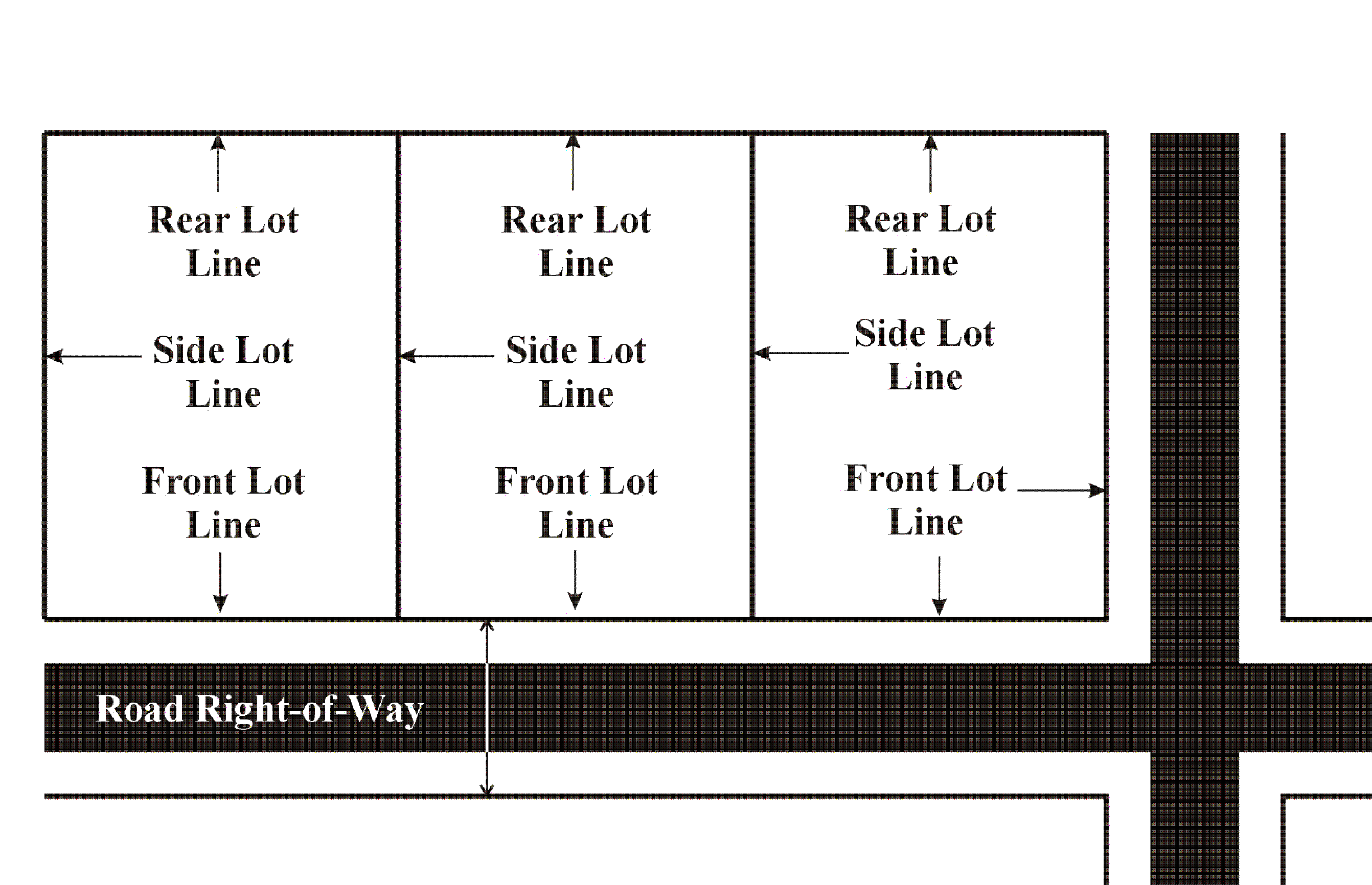
An accessory building must be at least 30 feet from each front lot line on corner
lots
1.
A detached building or structure accessory to a residential building shall be located no closer than ten feet to any main building nor shall it be located closer than four feet to any side or rear lot line. In those instances where the rear lot line is co-terminus with an alley right-of-way, the accessory building shall be no closer than one foot to such rear lot line. In no instance shall an accessory structure be located within a dedicated easement right-of-way.
2.
A building accessory to a residential building shall not exceed one story or 14 feet in height.
3.
When a building accessory to a residential building is located on a corner lot, the side lot line of which is substantially a continuation of the front lot line of the lot to its rear, said building shall not project beyond the front yard line required on the lot to the rear of such corner lot. An accessory building shall in no case be located nearer than 30 feet to a street right-of-way line.
G.
Outdoor dining as accessory to otherwise allowed restaurants, subject to the following requirements:
A.
Within public right-of-way or on easements for public use. Outdoor dining is allowed by permit, between April 1 and October 31 subject to approval by the zoning administrator, when located outside of public rights-of-way or easements for public use and comply with the following:
1.
Outdoor dining areas in the public right-of-way or on an easement for public use, must apply and receive an outdoor dining permit. Outdoor dining permits must be re-applied for annually.
2.
Pedestrian circulation and access to the building entrance shall not be impaired. A minimum sidewalk width of five feet along the curb and leading to the entrance to the establishment must be maintained free of tables, chairs, and other encumbrances. The seating in an outdoor dining area must be accessible to people with disabilities. Americans with Disabilities Act (ADA) accessibility requirements must be met within the outdoor dining area. Five percent, or at least one, of the seating spaces in the outdoor café area must be accessible to people with disabilities. An accessible route connecting the outdoor dining area, the business entrance, and the restrooms must be provided.
3.
The seating area on the public sidewalk shall only be limited to the area directly in front of the permitted restaurant use to which the seating area is accessory and shall not extend into adjoining sites. Seating may also be permitted within the front, side and rear yard area of the lot.
4.
The seating area shall be kept free of debris and litter. Written procedures for cleaning and trash containment and removal must be submitted.
5.
Tables, chairs, umbrellas, canopies, planters, waste receptacles, and other street furniture shall be compatible with the architectural character of the principal building.
6.
Outdoor dining, including any canopies or covers associated with such dining, shall be permitted within the required setback. Said canopies or covers may be affixed to the ground.
7.
Except as provided above, all fixtures and furnishings in the outdoor dining area including, but not limited to, tables, chairs, bar, server stations, and sources of heat shall be portable and not affixed to the ground, building, or other permanent structures. Permanent railings or fences may be permitted only where and to the extent that the building code requires an affixed fence for safety purposes. Permanent attachment of railings must be approved by the building department and permit emergency egress.
8.
The hours of operation of outdoor dining shall not extend past the normal operating hours of the main use, the restaurant.
9.
No sound or audio or video entertainment, including but not limited to television or radio playing of music and/or sports events, may be piped into, or played so as to be visible or audible from the outdoor dining area before 9:00 a.m. or after 11:00 p.m. on Fridays and Saturdays and before 9:00 a.m. or after 10:00 p.m. on Sundays through Thursdays.
10.
Outdoor amplification is not permitted.
11.
Outdoor dining areas shall not have permanent fixtures, tables or seating.
12.
Tables, seating, barriers, and other furniture may be required to be removed at the end of every business day, if identified as a condition of the outdoor dining permit.
13.
Heating is permitted in outdoor dining areas. Heaters must be portable and be removed at the end of every business day.
14.
Outdoor grills are not permitted in outdoor dining areas.
15.
Outdoor dining areas shall follow any other applicable zoning regulations, such as signs, etc.
16.
Outdoor cafes provide an alternative to sitting inside but are not intended to be permanent expansions of a restaurant's capacity.
17.
Additional signage may not be permitted.
18.
Lighting in the outdoor dining area must meet lighting standards as specified in Article 19.
19.
Requests for outdoor dining shall include submission of a sketch plan to determine compliance with the above requirements. The request may be administratively approved by the zoning administrator and building department. At the time of approval, a performance guarantee is required that provides liability coverage in an amount determined by the city.
B.
Outdoor dining on private property.
1.
Outdoor dining is allowed by permit subject to approval by the zoning administrator.
2.
Permanent fences or barriers may be installed where safety is a concern or where such permanence is required by building code. They shall be shown on all applications and permits.
3.
The hours of operation of outdoor dining shall not extend past the normal operating hours of the main use, the restaurant.
4.
Outdoor dining located in side or rear yards, abutting or across from a residential district, shall not operate before 9:00 a.m. or after 11:00 p.m.
5.
No sound or audio or video entertainment, including but not limited to television or radio playing of music and/or sports events, may be piped into, or played so as to be visible or audible from the outdoor dining area before 9:00 a.m. or after 11:00 p.m. on Fridays and Saturdays and before 9:00 a.m. or after 10:00 p.m. on Sundays through Thursdays.
6.
The seating in an outdoor dining area must be accessible to people with disabilities. Americans with Disabilities Act (ADA) accessibility requirements must be met within the outdoor dining area. Five percent, or at least one, of the seating spaces in the outdoor dining area must be accessible to people with disabilities. An accessible route connecting the outdoor dining area, the business entrance, and the restrooms must be provided.
Lighting in the outdoor dining area must meet lighting standards as specified in Article 27.
(Ord. No. 401, § 3, 5-11-09, eff. 6-15-09; Ord. No. 434, § 10, 10-8-18; Ord. No. 440, §§ 1, 10, 6-10-19)
Section 13.01. - Temporary structures and uses.
A.
Temporary structures used for residential purposes: A building or structure may be approved for temporary residential use only while damage to the principal dwelling due to fire, flood, ice, wind, or other natural disaster is being repaired. Any such temporary building shall not be used as a residence without prior review and approval by the zoning administrator.
Also, a manufactured dwelling unit or other approved living quarters may be occupied as a residence on a temporary basis on sites for which a building permit has been issued for construction, major repair, or remodeling of a new dwelling unit, subject to the following:
1.
An occupancy permit is issued by the zoning administrator for the temporary residence.
2.
Such permits may be issued by the zoning administrator for up to six months in duration and may be renewed for periods of up to six months, provided that work is proceeding in an expeditious manner.
3.
Temporary structures shall comply with the setback standards for the district in which they are located.
4.
The zoning administrator shall approve electrical and utility connections to any temporary structure.
5.
An approved temporary structure may be moved onto a site 14 days prior to commencement of construction and shall be removed within 14 days following issuance of a certificate of occupancy for the permanent dwelling.
B.
Performance guarantee: The applicant shall furnish the city with a performance guarantee to assure removal of the temporary structure.
C.
Temporary structures used for non-residential purposes: Temporary buildings for non-residential use, including semi-trucks/trailers and concrete batch plants, shall be permitted only when the intended use is by a contractor or builder in conjunction with a construction project, and only after review and approval by the zoning administrator. Such temporary structures shall be removed immediately upon completion of the construction project and prior to a request for a certificate of occupancy for the project.
D.
Permits: Permits for the utilization of temporary structures shall be issued by the zoning administrator. The permit shall specify a date for the removal of the temporary structure, and the zoning administrator may require posting of a bond to ensure removal. A certificate of occupancy shall be required for such structures.
E.
Use as an accessory structure: A temporary building or structure shall not be used as an accessory building or structure, except as permitted herein.
F.
Special events and other temporary uses: The zoning administrator may grant temporary use of land and structures for special events and other temporary uses, subject to the following general conditions:
1.
Adequate off-street parking shall be provided.
2.
The applicant shall specify the exact duration of the temporary use.
3.
Electrical and utility connections shall be approved by the zoning administrator.
4.
A performance bond may be required to assure proper clean-up.
5.
Review by police and fire administrators.
6.
Approval of other applicable government agencies to ensure compliance with applicable health and safety regulations and standards.
G.
Specific temporary use conditions: The following conditions apply to specific temporary uses:
1.
Carnival, circus, or festival:
a)
Maximum duration: Ten days.
b)
Operator, sponsor or beneficiary: Charitable entity.
c)
City council approval required.
2.
Sidewalk display and sales:
a)
Maximum duration: 90 days.
b)
Location: In commercial districts only.
c)
Sidewalk coverage: Shall not cover more than 50 percent of the width of the sidewalk.
d)
Zoning administrator approval required.
3.
Christmas tree sales:
a)
Maximum duration: 45 days.
b)
Clean-up: Stumps, branches, and other debris shall be completely removed from site.
c)
Zoning administrator approval required.
4.
Roadside stands: See section 22.09(A)(40).
(Ord. No. 440, §§ 1, 10, 6-10-19)
Section 13.02. - Regulations applicable to manufactured dwellings outside of manufactured home communities.
Any manufactured home, constructed and erected on a lot outside a manufactured home community, shall be permitted only if it complies with all of the following requirements:
A.
Manufactured homes: If the dwelling unit is a manufactured home, it must either be:
1.
New and certified by the manufacturer and/or appropriate inspection agency as meeting the Manufactured Home Construction and Safety Standards of the U.S. Department of Housing and Urban Development, as amended, the International Building Code, and any similar successor or replacement standards which may be promulgated.
2.
Used and certified by the manufacturer and/or appropriate inspection agency as meeting the standards referenced in subsection (1) above, and found, on inspection by the zoning administrator or his designee, to be in excellent condition and safe and fit for residential occupancy.
B.
Manufactured home installation: If the dwelling unit is a manufactured home, it shall be installed pursuant to the manufacturer's setup instructions and shall be secured to the building site by an anchoring system or device complying with the rules and regulations, as amended, of the Michigan Manufactured Home Commission, or any similar or successor agency having regulatory responsibility for manufactured home parks or manufactured housing communities. The wheels and tongue shall be removed.
C.
Garage. A manufactured home must be provided with a detached or attached garage.
D.
Compliance with other codes: The dwelling unit shall comply with all applicable building, electrical, plumbing, fire, energy, and other similar codes adopted by the city, provided, that where a dwelling unit is required by law to comply with any federal or state standards or regulations for construction, and where such standards or regulations for construction are more strict than those imposed by city codes, then and such federal or state standards or regulations shall apply. Appropriate evidence of compliance with such standards or regulations shall be provided to the zoning administrator.
E.
Compliance with bulk and area requirements: The dwelling unit and lot on which it is located shall comply with all restrictions and requirements of this ordinance, including, without limitation, the minimum lot area, minimum lot width, minimum residential floor area, yard requirements, and maximum building height requirements of the zoning district in which it is located.
F.
Dwelling size and design: The dwelling unit shall meet the following standards:
(1)
Minimum width of 24 feet.
(2)
A shingled pitched roof with a minimum slope of 3:1.
(3)
Exterior materials and overhangs to eaves relationship similar to other homes in the vicinity.
G.
Anchoring: The dwelling unit shall be firmly attached to a permanent continuous foundation constructed on the building site. Such foundation must have a wall of the same perimeter dimensions as the dwelling unit and be constructed of such materials and type as required by the building code for on-site constructed one-family dwellings. The dwelling unit foundation and skirting shall fully enclose the chassis, and undercarriage.
H.
Storage: A storage area not less than 120 square feet in area shall be provided within a building. This storage area may consist of a basement, attic, or attached garage in a principal building, or in a detached accessory building which is in compliance with all other applicable provisions of this ordinance pertaining to accessory buildings.
I.
Steps and porches: Permanently attached steps or porch areas at least three feet in width shall be provided where there is an elevation difference greater than eight inches between the first floor entry of the dwelling unit and the adjacent grade. Railings shall be provided in accordance with the city building code.
J.
Exterior finish: The exterior finish of the dwelling unit shall not cause glare or reflection that is greater than that from siding coated with clean, white, gloss exterior enamel.
K.
Additions: The dwelling unit shall not contain any additions of rooms or other areas which are not constructed with similar quality workmanship and materials as the original structure, including permanent attachment to the principal structure and construction of a foundation as required herein.
L.
Modification: The above standards may be modified by the zoning administrator upon determination that the proposed design is consistent with the predominant standard in the surrounding area.
(Ord. No. 440, §§ 1, 10, 6-10-19)
Section 13.03. - Regulations for infill housing for existing neighborhoods.
A.
Intent: The development regulations contained herein are intended to regulate the character of new infill housing development in certain areas of the city which contain traditional and historic exterior design elements. The purpose of these regulations is to promote harmony in neighborhoods between new housing units and the existing buildings by assuring that new construction is of suitable character in terms of site layout, building dimensions, architectural design, and building materials.
B.
Procedure:
1.
All building permit applications for new one-family and two-family housing development must be submitted to the zoning administrator for approval.
2.
The zoning administrator shall have final approval on any applicable infill housing development. However, the zoning administrator may refer applications to the planning commission for final approval.
C.
Site design and architectural standards for single- and two-family dwellings:
1.
Lot coverage: The lot coverage of any proposed dwelling unit shall be no less than 90 percent and no more than 135 percent of the lot coverage of other one-family or two-family dwelling units within 300 feet of the subject lot, including dwelling units on both sides of the street of the same block. To avoid a skewed average, the zoning administrator has the discretion to eliminate from the average calculation a lot coverage figure that is more than 200 percent of the lot coverage requirement for the district.
2.
Front yard setbacks: The front and side yard setbacks of any proposed one-family or two-family dwelling unit shall be no less than 90 percent and no more than 135 percent of the average established front setback of other one-family or two-family dwelling units on the same side of the street, within 300 feet of the side lot lines of the subject lot, but in no case shall the setback be less than the minimum setback by the district. To avoid a skewed average, the zoning administrator has the discretion to eliminate from the average calculation a front yard setback figure that is more than 200 percent of the lot coverage requirement for the district.
3.
Building appearance: Building appearance for new one-family and two-family dwelling units shall reflect a continuity of design with surrounding buildings by maintaining the architectural styles, details, building materials, and design themes of dwelling units on both sides of the street within 300 feet of the subject lot. Similarity and compatibility with surrounding dwelling units in terms of the following features may be necessary in order to meet this requirement:
a)
Roof and overhang style (e.g., gable, mansard, hip, A-frame, flat).
b)
Façade appearance (door and window openings).
c)
Building massing and height.
d)
Exterior building materials.
e)
Porches.
f)
Detached garage style and design.
4.
Basements. That the structure shall be firmly attached to a permanent basement foundation constructed on the site in accordance with the City Building Code and shall have a wall of the same perimeter dimensions of the dwelling and constructed of such material and type as required in the applicable building code for single-family and two-family dwellings. In the event that the dwelling is a mobile home, modular home, or pre- constructed home, then such dwelling shall be installed pursuant to the manufacturer's setup instructions and shall be secured to the premises by an anchoring system or device complying with the rules and regulations of the Michigan Mobile Home Commission and shall have a perimeter wall as required above.
(Ord. No. 440, §§ 1, 10, 6-10-19; Ord. No. 454, §§ 1, 2, 9-13-21)
Section 13.04. - Performance standards.
No use or activity in a non-residential zoning district shall be permitted to create noxious odors, noises, particulates, radiation or vibrations in such quantities or intensities so as to constitute a nuisance, unreasonable annoyance or hazard outside of the subject property.
A.
Smoke: It shall be unlawful for any person, firm or corporation, to permit the emission of any smoke from any source whatever that constitutes a nuisance.
B.
Dust, dirt and fly ash: No person, firm or corporation shall operate or cause to be operated, maintained or cause to be maintained, any process for any purpose, or furnace or combustion device for the burning of coal or other natural or synthetic fuels, which creates a nuisance, unreasonable annoyance or hazard.
C.
Open storage: Open storage shall be screened from public view, from a public street and from adjoining properties by an enclosure consisting of a wall not less than the height of the materials or equipment to be stored. Whenever such open storage is adjacent to, or across the street from, a residential zone, there shall be provided an obscuring masonry wall or wood fence as provided by Article 20. Such masonry wall or wood fence shall be repaired, maintained and kept in good condition by the owners.
D.
Glare and radioactive materials:
1.
Glare: Glare, whether direct or reflected, such as from floodlights or high temperature processes, and as differentiated from general illumination, shall not be visible at any property line.
2.
Nuclear radiation: Research operations shall cause no dangerous radiation at any property line as specified by the regulations of the United States Atomic Energy Commission.
3.
Electrical emissions: Any electrical emissions shall not adversely affect at any point any operations or any equipment, including not only professional research equipment but also equipment reserved for personal uses such as reception or public radio transmissions, use of cellular phones, etc., except equipment belonging to the creator of the radiation.
4.
Lighting: Exterior lighting, except for overhead street lighting and warning, emergency or traffic signals, shall be installed in such a manner that the light source will be sufficiently obscured to prevent glare on public streets and walkways or into any residential area.
E.
Fire and explosive hazards: The storage and handling of flammable liquids, liquefied petroleum, gases, and explosives shall comply with the state rules and regulations as established by the Michigan Zoning Enabling Act (Public Act 110 of 2006).
F.
Noise: The emission of noises in such intensities that constitute a nuisance shall be prohibited.
G.
Odors: Creation of nuisance odors shall be prohibited.
(Ord. No. 440, §§ 1, 10, 6-10-19)
Section 13.05. - Use restrictions.
No portion of a lot or parcel once used in complying with the provisions of this ordinance for yards, lot area per family, density as for a development in the Multiple-Family District, or percentage of lot occupancy, in connection with an existing or proposed building or structure, shall again be used as part of the lot or parcel required in connection with any other building or structure existing or intended to exist at the same time.
(Ord. No. 440, §§ 1, 10, 6-10-19)
Section 13.06. - Similar use determination.
This ordinance acknowledges that all potential uses of land cannot be specifically identified in the zoning districts. A land use which is not cited by name in a zoning district may be permitted upon determination by the planning commission that the use is clearly similar in nature and compatible with the principal uses permitted, special land use, or as a permitted accessory use listed in that district. This determination shall be made at a public hearing, with required notice given. The public hearing shall not replace the requirement for a separate public hearing to consider special land use approval, following the procedures and requirements of Article 22, if the use is determined to be a special land use. The applicant shall be required to submit pertinent information on the physical and operational characteristics of the proposed use and any additional information that may be requested by the planning commission. In making a determination of similarity and compatibility with the listed uses in that district, the planning commission shall consider the following:
A.
Determination of compatibility: In making the determination of compatibility, the planning commission shall consider specific characteristics of the use in question and compare such characteristics with those of the uses which are expressly permitted by right or special land use in the district. Such characteristics shall include, but are not limited to, traffic generation, generation of nuisances, parking, types of service offered, types of goods produced, methods of operation, and building characteristics.
B.
Method by which use may be permitted: If the planning commission determines that the proposed use is compatible with permitted uses in the district, the planning commission shall decide whether the proposed use is most similar to those permitted by right, as a special land use, or as a permitted accessory use. The proposed use shall be subject to the review and approval requirements for the district in which it is located. The planning commission shall have the authority to establish additional standards and conditions under which a use may be permitted in a district.
C.
Use provided for in other district: No use shall be permitted in a district under the terms of this section if that use is specifically listed as a use permitted by right or as a special land use in any other district.
D.
Prohibited uses: Certain uses may not be appropriate within the city given the existing development pattern, environmental conditions, and overall character in the community. All uses not permitted are prohibited. In finding that there is no appropriate location for the use within the city, the planning commission shall consider the following:
1.
The land area required by the proposed use.
2.
Existing environmental conditions and potential environmental hazards.
3.
The potential impact on surrounding properties in terms of traffic, noise, lighting, property valuation, and views.
4.
Demand and capacity of utilities and municipal services to support the proposed use.
5.
The applicant cannot demonstrate to the satisfaction of the planning commission that there is not an alternative land use that will provide the property owner with a reasonable rate of return on investment.
E.
In the event that an applicant for a similar use determination is not satisfied with the ruling of the planning commission, he/she may appeal the planning commission's ruling to the zoning board of appeals.
(Ord. No. 440, §§ 1, 10, 6-10-19)
Section 13.07. - Home occupations.
A.
Intent: It is the intent of this section to allow for and regulate the establishment of home occupations that are compatible with the neighborhood in which they are located and which will preserve the peace, quiet, and domestic tranquility within all residential districts in the city.
B.
Conditions: Home occupations may be permitted subject to the following conditions:
1.
The use of the dwelling unit for the home occupation shall be clearly incidental and subordinate to its use for residential purposes, and not more than 20 percent of the habitable floor area of the dwelling unit may be used for the purposes of the home occupation.
A home occupation, including storage of materials and goods, shall be entirely conducted within the confines of the dwelling unit.
2.
There shall be no change in the outside appearance of the structure or premises, or other visible evidence of conduct of the home occupation, and there shall be no external or internal alterations that are not customary in residential areas.
3.
Unless specifically otherwise provided herein, no article shall be sold or offered for sale on the premises except as prepared within the dwelling or accessory building or is provided as incidental to the service or profession conducted therein. A retail showroom, sales area, outlet, or similar facility is prohibited.
4.
Traffic generated by such operation shall not be greater than that for normal residential purposes.
5.
No equipment or process shall be used in the home occupation that creates noise, vibration, glare, fumes, odor, or electrical interference that are nuisances to persons off the lot. Any electrical equipment or process which creates visual or audible interference with any radio or television receivers off the premises or which cause fluctuations in line voltages off the premises shall be prohibited.
6.
No outdoor display and/or storage of materials, goods, supplies, or equipment used in the home occupation shall be permitted on the premises with the exception of one commercial vehicle or trailer and/or trailer combination.
7.
Any necessary parking spaces for vehicles generated by the conduct of the home occupation shall be provided off the road.
8.
A permit and fee is required once every two years.
9.
No employees other than occupants of the premises shall be engaged in such occupation. The operator of a home occupation shall reside within the same dwelling unit in which the activity is conducted.
10.
In no way shall the appearance of the structure be altered or the occupation within the residence be conducted in a manner which would cause the premises to differ from its residential character either by the use of colors, materials, construction, lighting, or the emission of sounds, noises, or vibrations.
11.
The home occupation shall not exceed 20 percent of the habitable floor area of the dwelling unit. Habitable floor area of a dwelling unit shall include the floor area of all heated and ventilated (habitable) rooms and areas within the dwelling unit including basements and habitable attic space. Further, the use shall not exceed 400 square feet and at least 850 square feet of the dwelling unit must remain in residential use.
12.
There shall be no outside or visible storage of any kind related to the home occupation.
13.
No equipment or process shall be used in a home occupation which creates noise, vibration, glare, fumes, heat, dust, odors, or electrical interference detectable to the normal senses off the lot. The production, storage or dumping of combustible, hazardous materials, or toxic substances on the property is prohibited.
14.
No use shall require internal or external alterations or involve construction features or the use of electrical or mechanical equipment that would change the fire rating of the structure or the fire district in which the structure is located.
15.
In order to preserve the residential appearance and character of a neighborhood, signs and window or yard displays of merchandise for sale or trade shall not be permitted.
16.
The home occupation may increase vehicular traffic and parking only such that no more than two additional vehicles other than those owned and operated by the resident family, are parked on the subject parcel at any time. The use shall not necessitate, or result in, on-street parking of vehicles. Parking shall not be permitted in the front yard.
17.
The pickup and delivery of goods in connection with the home occupation shall not exceed one pickup and one delivery each day (between the hours of 6:00 a.m. and 8:00 p.m.) and shall be restricted to the use of a vehicle having a gross vehicle weight of 14,000 pounds or less.
18.
No home occupation shall cause an increase in the use of any one or more utilities (water, sewer, electricity, trash removal, etc.) such that the combined total use for the dwelling unit and home occupation exceeds by more than ten percent the average for the residence itself, measured over the previous 12-month period.
C.
Procedure: A person may request a home occupation permit by:
1.
Submitting to the zoning administrator an application for a home occupation permit on forms to be provided by the zoning administrator.
2.
If the zoning administrator finds the application to be complete, and all conditions are met, a home occupation permit shall be issued by the zoning administrator.
3.
The home occupation permit shall be renewed every two years, subject to review and approval by the zoning administrator.
D.
Prohibited home occupations: The following uses are not permitted as home occupations:
1.
Stables or kennels.
2.
Automobile body repair, machine shop or any similar business.
3.
Animal hospitals.
4.
Welding service.
5.
Funeral parlors or undertaking establishments.
6.
Antique shops.
7.
Rooming houses and tourist homes.
8.
Dancing schools.
9.
Contractors, such as building construction, electrical, plumbing landscaping, lawn mowing, masonry, snow plowing, excavating, and similar businesses.
10.
Trailer rental.
11.
Private clubs.
12.
Restaurants and tea rooms.
13.
Repair shops of any kind that may create nuisance factors.
14.
Repair, maintenance, painting service, and storage of automobiles, machinery, tools, trucks, boats, recreational vehicles and similar items.
15.
Utility and public service buildings.
16.
Any proposed home occupation neither specifically permitted above, nor specifically prohibited above, shall be reviewed as a special land use. The city council may establish appropriate standards for the operation of such special land use to meet the standards of the ordinance. The council may determine, after public hearing, that a use not specifically mentioned above that has similar negative impacts as one or more of the uses above is also not permitted.
E.
Required application information: A site plan and a home occupation information sheet shall accompany a permit application for a home occupation. Issuance of home occupation permit shall be based on the site plan. For purposes of this section, the site plan shall illustrate at a minimum, the following:
1.
Dimensions of a subject parcel.
2.
Dimensions of the building in which the home occupation is proposed.
3.
Dimensions of the exact area which is to be utilized for the home occupation.
4.
Location of exterior doors.
5.
The proposed location and dimensions of the parking area.
F.
Voiding of permit: Home occupations may be monitored and reviewed to ensure that they are operated in compliance with the requirements herein or any conditions stipulated in their approval. Non-compliance with the requirements herein and/or the conditions of approval relating to the permit for a home occupation shall constitute grounds for the zoning administrator to terminate said permit.
(Ord. No. 440, §§ 1, 10, 6-10-19)
Section 13.08. - Adult and child care facilities.
A.
Adult and child care facilities, as defined in Article 2, are allowed only as provided for in the following table. Applicable conditions are listed as notes to the table.
Notes:
1.
The use shall be registered with the city clerk's office and shall continually have on file with the city documentation of a valid license as required by the state.
2.
Since the state law preempts in this area, the facility shall be brought into compliance with all state building and fire codes pursuant to State Licensing Rules R400.1831—R400.1835. Documentation of such compliance with State requirements shall be provided.
3.
The site shall comply with the sign provisions of the city's sign ordinance.
4.
Off-street parking shall be provided for the maximum number of employees on-site at any one time.
5.
The building shall have an appearance which is non-intrusive and consistent in color, materials, roof-line, and architecture with the one-family or Multiple-Family Residential District in which it is located, as determined by the planning commission.
6.
Documentation of sufficient indoor classroom, crib, or play area meeting state requirements shall be provided. Documentation of approved areas, as licensed by the state, shall be provided.
7.
There shall be sufficient outdoor play area to meet state regulations. All required outdoor play areas shall be fenced with a four-foot tall fence, provided that no fenced outdoor play area shall be located in a front yard.
8.
There shall be sufficient drop-off parking spaces to allow maneuvers without creating a hazard to traffic flow.
9.
The lot shall be at least 1,500 feet from another group day care home or similar facility. This may be reduced by the planning commission upon a finding by the planning commission that the proposed facility will not contribute to an excessive concentration of state licensed residential care facilities in the area.
10.
The facility shall operate not more than 16 hours per day.
B.
A state-licensed residential adult or child care facility existing prior to the effective date of this ordinance that has been operating under a valid state license and is registered with the city no later than 60 days following the effective date of this ordinance, shall be considered an approved special land use, provided such use conforms with the conditions of this section. Any change in class of the use to a larger care facility shall require approval in accordance with the requirements of this ordinance.
(Ord. No. 440, §§ 1, 10, 6-10-19)
Section 13.09. - Swimming pools.
A
Requirement for fence: Every person owning land on which there is located a pool shall erect and maintain thereon a fence or enclosure approved by the building official in conformance with the City Building Code.
B.
Restriction from front yard: Swimming pools, spas, hot tubs and similar devices shall not be located in any front yard.
C.
Spacing: There shall be a minimum distance of not less than ten feet between the adjoining property line and the outside of the pool wall. The required side yard setbacks of the zoning district shall apply to side yards if greater than ten feet. There shall be a minimum distance of not less than four feet between the outside edge of the pool wall and any building located on the same lot.
D.
Surrounding walk: All public swimming pools shall be surrounded by a slip resistant walk at least four feet wide.
E.
Permits: Construction shall be in accordance with the city building code. Permits shall be applied for and issued from the zoning administrator prior to excavation or construction of any swimming pool, spa, hot tub or similar device requiring a fence as noted above. The application shall be accompanied by a complete set of plans and specifications. A final inspection and approval from the zoning administrator must be obtained prior to use of the swimming pool.
(Ord. No. 440, §§ 1, 10, 6-10-19)
Section 13.10. - Fences and hedges.
(A)
A fence is defined as any partition, structure or gate that is erected as a dividing marker, barrier or enclosure (excluding hedges as defined below).
(B)
A hedge is defined as any bush, shrub or any living green screen of any nature that serves as a dividing marker, barrier or enclosure.
(C)
Regulations applicable to R-1, R-2, R-3, R-4, RM-1, PMSHDD, PUD, O-1, CBD, NBD, and GBD.
1.
A fence shall not exceed six feet in height in the rear or side lot of any parcel.
2.
Front yard fences or hedges must be less than 50 percent solid, impervious, or of an obscuring nature above a height of 30 inches above the curb or centerline of the street, and not exceed four feet in total height. Front yard fences may not be constructed of chain link fence unless such fence is coated or sealed to prevent rusting, such as vinyl coated fencing.
3.
Fences and hedges in front yards that function as exterior side yards must follow front yard height restrictions unless the fence or hedge is installed or planted in the following manner:
(a)
The fence is at least 25 feet back from the intersection of the front yard and side yard right-of-way lines, and
(b)
The fence is at least 20 feet back from the intersection of any driveway or alley with that of a street, and
(c)
The fence is at least ten feet back from the intersection of any driveway or alley with that of a sidewalk.
4.
No fence or hedge shall extend across property lines.
5.
The finished side of any fence shall face away from the property on which the fence is located.
6.
No portion of any fence shall be constructed with or contain barbed wire, electric current or charge of electricity, glass, spikes or other sharp protruding objects.
7.
Fences must be maintained so as not to endanger life or property. Any fence which, through lack of maintenance or type of construction which will obstruct vision so to create a hazard to vehicular traffic or pedestrians upon the public streets and/or sidewalks shall be deemed a nuisance.
8.
Fences shall not be constructed, in whole or in part, with any of the following materials:
(a)
Junk or other debris;
(b)
Scrap building materials or metals;
(c)
Organic materials known to be poisonous or hazardous to human or animal life;
(d)
Materials which may be deemed unsafe to person or property by the zoning administrator or building official.
9.
No hedge shall be constructed with noxious weeds or grasses, as defined by PA 359 of 1941, being MCL 247.62.
(D)
Regulations applicable to industrial districts.
1.
Fences, walls and screens are permitted in the required front, side and rear lots provided they do not exceed six feet in the front yard and eight feet in the side and rear lots. To preserve open space and aesthetic character in the front yard, fences higher than four feet must be setback two feet for each additional foot above four feet and all front yard fences must be black vinyl chain link or decorative in nature.
2.
In the I-2 zoning district, barbed wire strands are permitted on fences six feet or higher on industrial parcels with the barbed wire tilted in toward the fenced parcel.
3.
On any corner lot, no fence, wall or screen, whether structural or botanical, shall be more than 30 inches above the curb or the centerline of the street pavement within 25 feet of the intersection of the two right-of-way lines, so as to interfere with motorists' vision across the corner.
(E)
The zoning administrator or building official may require removal, reconstruction, or repair of any fence or wall which, in their judgment is dilapidated, unsafe, or a threat to the health, safety and welfare of the residents of the City of Swartz Creek.
(F)
A permit shall be required for new fence construction, with a fee to be prescribed by resolution of the council.
(Ord. No. 401, § 4, 5-11-09, eff. 6-15-09; Ord. No. 422, § 1, 10-12-15; Ord. No. 440, §§ 1, 10, 6-10-19)
Section 13.11. - Flagpoles.
(A)
The maximum height of flagpoles shall not exceed 40 feet measured from the average surrounding grade.
(B)
A maximum of three flagpoles per site shall be permitted.
(C)
Flagpoles shall be set back a minimum of ten feet from any public right-of-way, private road, access easement, access drive, or property line.
(D)
A maximum of two flags per flagpole shall be permitted provided that only one non-governmental or institutional flag per flagpole is allowed.
(Ord. No. 401, § 5, 5-11-09, eff. 6-15-09; Ord. No. 440, §§ 1, 10, 6-10-19)
Section 13.12. - Mechanical equipment and utilities.
(A)
Ground mounted mechanical equipment, such as blowers, ventilating fans, and air conditioning units, are permitted only in non-required side yards and in any rear yard, as determined by the building official/zoning administrator.
(B)
Mechanical equipment shall be placed no closer than three feet to any lot line in the CBD.
(C)
Any ground, building, or roof mounted mechanical equipment or utilities, including water and gas meters or related devices, utility boxes, transformers, elevator housings, stairways, tanks, heating, ventilation and air condition equipment (HVAC), and other similar equipment, shall comply with the following standards.
1.
All such equipment shall be screened by a solid wall, fence, landscaping, and/or architectural features that are compatible in appearances with the principal building.
2.
Roof mounted equipment shall not exceed a height of ten feet above the surrounding roof surface, and shall occupy no more than 15 percent of the total roof area. All roof mounted mechanical units must be screened so they are not visible from ground level.
(Ord. No. 401, § 5, 5-11-09, eff. 6-15-09; Ord. No. 440, §§ 1, 10, 6-10-19)
Section 13.13. - Ponds.
(A)
Definition.
Pond, Accessory Use: A facility (natural or excavated) capable of holding 24 inches or more of water, with an area larger than 100 square feet. Such basins are intended to be an accessory use to improved property and have aesthetic or intrinsic value as a water resource. Such basins are not intended for storm water management and may or may not have an outlet.
(B)
Application and review procedures.
1.
Application shall be made to the city zoning administrator. Applications shall contain the following information:
a.
Name and address of the applicant.
b.
Legal description of the property upon which the pond will be established.
c.
Site plan submitted in accordance with article XXI, Site Plan Review.
2.
Evidence shall also be presented at the time of application that the Genesee County Drain Commission and Michigan Department of Environmental Quality have granted the necessary permits and/or approvals to the applicant for the construction of the pond or have released the applicant from any obligation thereto.
3.
The applicant shall also, at the discretion of the building official or zoning administrator at the time of application, provide evidence from a licensed excavator, civil engineer, or similar allied professional that water can be continuously maintained in the pond once it is constructed, that the drainage pattern of the site will preclude drainage of water onto adjacent property or toward buildings, and that the natural or manmade drainage pattern of the area will remain unaffected.
4.
The zoning administrator may require full site plan review by the planning commission at his or her discretion.
(C)
Requirements.
1.
Ponds shall be an accessory use.
2.
The minimum lot size for any pond shall be 1.5 acres.
3.
The minimum setback distance for the pond shall be a minimum of 50 feet from any property line or right-of-way line. A pond may cross a property line only when all properties are owned by the applicant or upon submittal of an easement allowing such occupation.
4.
There shall be a horizontal distance of not less than 25 feet from any overhead transmission lines.
5.
The pond shall not have a slope steeper than one to three (1:3) for the first ten feet around the perimeter of the pond.
6.
All areas disturbed during construction shall be seeded with grasses and maintained in good condition to prevent erosion.
7.
The zoning administrator or planning commission may, at its discretion, require the installation of a fence not less than four feet in height to protect the health, safety, and welfare of the property owners and/or tenants, neighboring uses, and residents.
8.
No pond is to be located closer than 25 feet to a building, septic fields, or property easements.
9.
All materials removed as a result of the pond excavation must be retained on-site and distributed about the property so as to not disturb or redirect the natural flow of water and drainage of the property. The Building Official may require a plan submitted for a pond include drawings showing adequate methods to prevent overflow of water onto adjacent properties or rights-of-way.
(D)
Fees required.
1.
Fees shall correspond to the standard Zoning Permit fee for administrative reviews and the applicable Site Plan Review fee for full site plan review by the planning commission, as set by the City Council.
2.
The zoning administrator, building official, or planning commission may require posting of a performance bond or other surety to cover the estimated cost of completion or removal of the pond facility.
(Ord. No. 456, § 1, 11-8-21)
Section 13.14. - Renewable energy standards.
A.
Definitions. The following definitions apply to provisions of section 13.14 through section 13.18 only.
1.
Accessory battery energy storage system means a battery energy storage system intended primarily to serve the electricity needs of the applicant property but may, at times, discharge into the electric grid.
2.
Accessory solar energy system means a small-scale solar energy system with the primary purpose of generating electricity for the principal use on the site.
3.
Accessory ground-mounted solar energy system means a ground-mounted solar energy system with the purpose primarily of generating electricity for the principal use on the site.
4.
ANSI means American National Standards Institute.
5.
A-Weighted sound level means the sound pressure level in decibels as measured on a sound level meter using the A-weighting network, as expressed as dB(A) or dBA.
6.
Building-mounted solar energy system means a solar energy system attached to the roof or wall of a building, or which serves as the roof, wall or window or other element, in whole or in part, of a building.
7.
Building-integrated solar energy system means a solar energy system that is an integral part of a primary or accessory building or structure (rather than a separate mechanical device), replacing or substituting for an architectural or structural component of the building or structure. Building-integrated systems include, but are not limited to, photovoltaic or hot water solar energy systems that are contained within roofing materials, windows, skylights, and awnings.
8.
Construction means any substantial action taken constituting the placement, erection, expansion, or repowering of an energy facility.
9.
Dark sky-friendly lighting technology means a light fixture that is designed to minimize the amount of light that escapes upward into the sky.
10.
dBA means the sound pressure level in decibels using the "A" weighted scale defined by the American National Standards Institute (ANSI).
11.
Decibel means a unit used to measure the intensity of a sound or the power level of an electric signal by comparing it with a given level on a logarithmic scale.
12.
Dual use means a solar energy system that employs one or more of the following land management and conservation practices throughout the project site:
a)
Pollinator habitat means a site designed to have vegetation that will enhance pollinator populations, including a diversity of flowering plants and wildflowers, and meets a score of 76 or more on the Michigan Pollinator Habitat Planning Scorecard for Solar Sites.
b)
Conservation cover means a site designed with practices to restore native plants, grasses, and prairie with the aim of protecting specific species or providing specific ecosystem services, such as carbon sequestration or soil health. The site must be designed in partnership with a conservation organization or approved by the Genesee County Conservation District.
c)
Forage/Grazing means sites that incorporate rotational livestock grazing and forage production as part of a vegetative maintenance plan.
d)
Agrivoltaics means sites that combine raising crops for food, fiber, or fuel, and generating electricity within the project area to maximize land use.
13.
Energy storage system (ESS) means a system that absorbs, stores, and discharges electricity. Energy storage facility does not include fossil fuel storage or power-to-gas storage that directly uses fossil fuel inputs.
14.
Ground-mounted solar energy system means a solar energy system mounted on support posts, like a rack or pole, that is attached to or rests on the ground. The system is not attached to and is separate from any building on the property.
15.
Independent power producer (IPP) means a person that is not an electric provider but owns or operates facilities to generate electric power for sale to electric providers, the state, or local units of government.
16.
Leq means the equivalent average sound level for the measurement period.
17.
Maximum tilt means the maximum angle of a solar array (i.e., most vertical position) for capturing solar radiation as compared to the horizon line.
18.
Minimum tilt means the minimal angle of a solar array (i.e., most horizontal position) for capturing solar radiation as compared to the horizon line.
19.
Nameplate capacity means the designed full-load sustained generating output of an energy facility. Nameplate capacity shall be determined by reference to the sustained output of an energy facility even if components of the energy facility are located on different parcels, whether contiguous or noncontiguous.
20.
NFPA means National Fire Protection Association.
21.
Non-participating property means a property that is adjacent to an energy facility and that is not a participating property.
22.
Occupied community building means a school, place of worship, day-care facility, public library, community center, or other similar building that the applicant knows or reasonably should know is used on a regular basis as a gathering place for community members.
23.
Participating property means real property that either is owned by an applicant or that is the subject of an agreement that provides for the payment by an applicant to a landowner of monetary compensation related to an energy facility regardless of whether any part of that energy facility is constructed on the property.
24.
Person means an individual, governmental entity authorized by this state, political subdivision of this state, business, proprietorship, firm, partnership, limited partnership, limited liability partnership, co-partnership, joint venture, syndicate, business trust, labor organization, company, corporation, association, subchapter S corporation, limited liability company, committee, receiver, estate, trust, or any other legal entity or combination or group of persons acting jointly as a unit.
25.
Principal-use (large) energy facility means a large, principal-use energy system. An energy facility may be located on more than 1 parcel of property, including noncontiguous parcels, but shares a single point of interconnection to the grid.
26.
Principal-use (large) energy storage system means an energy storage system (ESS) that is a principal use (or co-located with a second principal use), is designed and built to connect into the transmission grid and has a nameplate capacity of 50 MW or more and an energy discharge capacity of 200 MWh or more.
27.
Principal-use (large) solar energy system means a principal-use SES with a nameplate capacity of 50 MW or more for the primary purpose of off-site use through the electrical grid or export to the wholesale market.
28.
Principal-use (small) solar energy system means a principal-use SES with a nameplate capacity of less than 50 MW for the primary purpose of off-site use through the electrical grid or export to the wholesale market.
29.
Repowering means the replacement of all or substantially all of the energy facility for the purpose of extending its life. Repowering does not include repairs related to the ongoing operations that do not increase the capacity or energy output of the energy facility.
30.
Roof-mounted solar energy system means a solar energy system mounted on a racking that is attached to or ballasted on the roof of a building or structure.
31.
Sound pressure means the difference at a given point between the pressure produced by sound energy and the atmospheric pressure, expressed as pascals (Pa).
32.
Sound pressure level means 20 times the logarithm to the base ten, of the ratio of the root-mean-square sound pressure to the reference pressure of micro pascals, expressed as decibels (dB). Unless expressed with reference to a specific weighing network (such as dBA), the unit dB shall refer to an unweighted measurement.
33.
Solar energy system (SES) means a system that captures and converts solar energy into electricity, for the purpose of sale or for use in locations other than solely the solar energy system property. A solar energy system includes, but is not limited to, the following equipment and facilities to be constructed by an electric provider or independent power producer: photovoltaic solar panels; solar inverters; access roads; distribution, collection, and feeder lines; wires and cables; conduit; footings; foundations; towers; poles; crossarms; guy lines and anchors; substations; interconnection or switching facilities; circuit breakers and transformers; energy storage systems; overhead and underground control; communications and radio relay systems and telecommunications equipment; utility lines and installations; generation tie lines; solar monitoring stations; and accessory equipment and structures.
34.
Solar thermal system means a system of equipment that converts sunlight into heat.
B.
Accessory solar energy systems, as defined in section 13.14 Renewable Energy Standards Definitions, include building-mounted, building-integrated, and ground-mounted systems with the primary purpose of generating electricity for the principal use on the site. Accessory solar energy systems are subject to the following standards:
1.
Permitted use. accessory solar energy systems are permitted accessory uses in all zoning districts, subject to administrative review and approval.
2.
Application criteria. An application seeking installation of an accessory solar energy system shall be made to the zoning administrator in line with Section 21.03 Sketch plan review process and shall also include the following information:
a)
Sketch plan showing the proposed location of the accessory solar energy system, the primary structure, any accessory structures, and setbacks from lot lines.
b)
For building-mounted or building-integrated systems, horizontal and vertical elevation drawings showing the location and height of the SES on the building and dimensions of the SES.
c)
For ground-mounted systems, elevation drawings showing height, dimensions of the SES, and tilt features if applicable.
3.
Exemptions from permitting. The following are exempt from review and permitting:
a)
The installation of one solar panel with a total area of less than eight square feet.
b)
The installation of device-specific solar panels, which exclusively power the device it is attached to and is less than one square foot in area.
c)
Repair and replacement of existing solar energy equipment, provided that there is no expansion of the size or coverage area of the system.
4.
Standards for accessory solar energy systems. All accessory SES shall be subject to the following requirements, as well as applicable standards listed below for building-mounted or ground-mounted systems:
a)
The exterior surfaces of solar energy systems shall be generally neutral in color and substantially non-reflective of light.
b)
Solar energy systems shall be installed, maintained, and used only in accordance with the manufacturer's directions. Upon request, a copy of such directions shall be submitted to the zoning administrator prior to installation. The zoning administrator may inspect the completed installation to verify compliance with the manufacturer's directions.
c)
Accessory SES shall conform with all county, state, and federal regulations and safety requirements as well as applicable industry standards.
5.
Building-mounted solar energy systems. Building-mounted solar energy systems, including roof-mounted systems and building integrated systems, are subject to the following requirements:
a)
Solar energy systems that are mounted on the roof of a building shall not project more than five feet above the highest point of the roof but, in any event, shall not exceed the maximum building height for the zoning district in which it is located, and shall not project beyond the eaves of the roof.
b)
Solar energy systems that are roof-mounted, wall-mounted or otherwise attached to a building or structure shall be permanently and safely attached to the building or structure. Proof of the safety and reliability of the means of such attachment shall be submitted to the zoning administrator prior to installation; such proof shall be subject to the zoning administrator's approval.
c)
Solar energy systems that are wall-mounted shall not exceed the height of the building wall to which they are attached.
d)
Solar energy systems shall not be mounted on a building wall that is facing an adjacent public right-of-way.
e)
A building-mounted SES installed on a non-conforming building, structure, or use shall not be considered an expansion of the nonconformity, but shall be required to meet all height and placement requirements.
6.
Ground-mounted solar energy systems. Ground-mounted solar energy systems are subject to the following requirements:
a)
Accessory ground-mounted solar energy systems shall be located as follows:
1)
Shall be located in the rear yard or non-required side yard.
2)
Should extenuating circumstances exist that prevent the system from being located in the rear or non-required side yard, the planning commission may have the authority to approve a location in the front yard, but in no event shall the energy system be located within the front yard setback. The applicant shall demonstrate to the commission that the rear or side yard is not feasible.
b)
Accessory ground-mounted SES shall have a minimum height as detailed in the manufacturer's specifications, but shall in no case exceed 14 feet in height, measured from the ground at the base of such equipment, when oriented at maximum tilt.
c)
Ground-mounted SES shall be permanently and safely attached to the ground. Proof of the safety and reliability of the means of such attachment shall be submitted with the application and be subject to the zoning administrator's approval.
d)
The total area of accessory ground-mounted SES shall not exceed 50 percent of the square footage of the principal building.
e)
An accessory ground-mounted SES installed on a non-conforming use or lot shall not be considered and expansion of the nonconformity, but shall be required to meet all placement and height requirements.
7.
Building-integrated solar energy systems. Building-integrated SES are subject to zoning regulations applicable to the building or structure and not subject to accessory ground or building-mounted SES permits.
8.
Accessory energy storage systems, as defined in section 13.14 Renewable Energy Standards Definitions, with the primary purpose of serving the electricity needs of the applicant property are a permitted accessory use in all zoning districts. Accessory energy storage systems shall follow the regulations associated with accessory uses.
C.
A small principal-use SES, as defined in section 13.14 Renewable Energy Standards Definitions, is a special land use in the I-1, Light Industrial, and I-2, Heavy Industrial, zoning districts subject to site plan and special land use review requirements, and shall meet the following requirements:
1.
Height. Total height for a small principal-use SES shall not exceed a maximum of 16 feet in height, measured from the ground at the base of such equipment, when oriented at maximum tilt. The planning commission may permit up to 20 feet in height for small principal-use systems as part of the special land use approval, to allow for grazing or other operations.
2.
Lot coverage. The total area of a small principal-use SES shall not be included in the calculation of the maximum permitted lot coverage requirement for the parcel of land.
3.
Installation and safety. Small principal-use SES shall be properly installed to ensure safety, and meet the following requirements:
a)
Solar energy systems shall be safely attached to the ground. Proof of the safety and reliability of the means of such attachment shall be submitted with the special land use application and shall be subject to the planning commission's approval.
b)
Solar energy systems shall be installed, maintained and used only in accordance with the manufacturer's directions. A copy of such directions shall be submitted with the special land use application. The special land use, if granted, may be subject to the zoning administrator's inspection to determine compliance with the manufacturer's directions.
4.
Appearance. The exterior surfaces of solar energy systems shall be generally neutral in color and substantially non-reflective of light.
5.
Compliance with construction and electrical codes. A small principal-use SES, and the installation and use thereof, shall comply with all applicable construction codes and electric codes, including state construction codes and the National Electric Safety Code.
6.
Fencing. A small principal-use SES shall be secured with perimeter fencing to restrict unauthorized access. Perimeter fencing shall comply with the latest version of the National Electric Code as of November 2023. Barbed wire is prohibited. Fencing is not subject to setback requirements.
7.
Transmission and communication lines. All power transmission and communication lines between banks of solar panels and to nearby electric substations or interconnections with any buildings or other structures shall be located underground. Exemptions may be granted in instances when soil conditions, shape, topography, or other elements of the natural landscape interfere with the ability to bury lines, or distance makes undergrounding infeasible, at the discretion of the planning commission.
8.
Setbacks. Setback distance shall be measured from the stated location below to the nearest edge of the perimeter fencing of the small principal-use SES as follows:
a)
300 feet from the nearest point on the outer wall of any occupied community buildings and residences on non-participating properties.
b)
50 feet from the nearest edge of a public road right-of-way.
c)
50 feet from the nearest shared property line of non-participating properties.
9.
Setback from wetlands. A small principal-use SES shall be at least 50 feet from the edge of any wetland, or any shoreline or drain easement.
10.
Sound. The sound pressure level of a small principal-use SES and all ancillary solar equipment shall not exceed 55 dBA at the property line of adjacent non-participating properties or the exterior of any non-participating habitable structure, whichever is closer. The site plan shall include modeled sound isolines extending from the sound source to the property lines to demonstrate compliance with this standard.
11.
Lighting. Lighting for a small principal-use SES shall be limited to inverter and/or substation locations only. A small principal-use SES shall implement dark sky friendly lighting solutions and any lighting shall be directed downward and be placed to keep light on-site and glare away from adjacent properties, bodies of water, and adjacent roadways. Flashing or intermittent lights are prohibited.
12.
Groundcover. A small principal-use SES shall include the installation of ground cover vegetation maintained for the duration of operation until the site is decommissioned. A ground cover vegetation establishment and management plan shall be submitted as part of the site plan. Ground cover shall meet one or more of the following types of dual use, as defined in this section, to promote ecological benefits:
a)
Pollinator habitat.
b)
Conservation cover.
c)
Forage/Grazing.
d)
Agrivoltaics.
13.
Drainage. Drainage on the site shall be maintained in a manner consistent with, or improved upon, existing natural drainage patterns. Any disturbance to drainage or water management practices must be managed within the property and on-site, in order to not negatively impact surrounding properties as a result of the development. This shall be maintained for the duration of the operation and shall be able to be returned to pre-existing conditions following decommissioning. Any existing drainage tiles that are identified on the property shall be shown on the as-built drawings submitted following construction.
14.
Landscaping/screening. Landscaping shall be provided in accordance with the standards required in Article 20, Landscaping.
15.
Signage. Signage shall be permitted in accordance with Article 14, Sign Regulations. Signage shall be required to identify the owner and provide a 24-hour emergency contact phone number.
16.
Agricultural protection. A small principal-use SES shall be sited to minimize impacts to agricultural production, including the following:
a)
Systems shall be sited to minimize land disturbance or clearing except for minimally necessary. Topsoil shall be retained on-site.
b)
Any access drives shall be designed to minimize the extent of soil disturbance, water runoff, and soil compaction.
17.
Battery storage. On-site battery storage accessory to a small principal-use solar energy system is prohibited.
18.
Decommissioning. A decommissioning plan that is consistent with agreements reached between the applicant and other landowners of participating properties and that ensures the return of all participating properties to a useful condition similar to that which existed before construction, including removal of above-surface facilities and infrastructure that have no ongoing purpose. The decommissioning plan shall include, but is not limited to, financial assurance in the form of a bond, a parent company guarantee, or an irrevocable letter of credit, but excluding cash. The amount of the financial assurance shall not be less than the estimated cost of decommissioning the energy facility, after deducting salvage value, as calculated by a third party with expertise in decommissioning, hired by the applicant. However, the financial assurance shall be posted in increments as follows:
a)
At least 25 percent by the start of full commercial operation.
b)
At least 50 percent by the start of the fifth year of commercial operation.
c)
100 percent by the start of the tenth year of commercial operation.
19.
Abandonment. In the event that a small principal-use SES has not been in operation for a period of one year without a waiver from the planning commission, the system shall be considered abandoned and shall prompt an abandonment hearing conducted by the city council. If deemed abandoned after a hearing, the system shall be removed by the applicant or the property owner and the site shall be stabilized and re-vegetated, in compliance with the approved decommissioning plan. If the abandoned system is not removed or repaired, amongst other available remedies, the city may pursue legal action against the applicant and property owner to have the system removed and assess its cost to the tax roll of the subject parcel. The applicant and property owner shall be responsible for the payment of any costs and attorney's fees incurred by the city in securing removal of the structure. The city may utilize the benefit of any performance guarantee being held to offset its cost. As a condition of approval, the applicant and property owner shall give permission to the city to enter the parcel of land for this purpose.
20.
Annual reports. For a small principal-use SES, a written annual report shall be submitted to the planning commission by a date determined at the time of special land use approval. The annual report shall include an update on electricity generation by the project, as well as document all complaints received regarding the small principal-scale solar energy system along with the status of complaint resolutions and the actions taken to mitigate the complaints.
21.
Additional approvals and agency reviews. The following approval and agency reviews shall be required, as applicable:
a)
Local fire chief;
b)
Department of Environment, Great Lakes, and Energy (EGLE);
c)
Genesee County Drain commissioner;
d)
Genesee County road commission;
e)
Genesee County Health Department;
f)
Federal Aviation Administration (FAA);
g)
Local airport zoning (if applicable);
h)
Building department;
i)
Tax assessor.
22.
Operations agreement. The applicant shall provide the planning commission with an operations agreement, which sets forth the operations parameters, the name and contact information of the certified operator, inspection protocol, emergency procedures and general safety documentation. It shall be a condition of approval that the zoning administrator shall be notified and provided copies of any changes.
23.
Indemnity/insurance. The city shall be indemnified from all third-party claims for personal or property damage arising from the developer's negligent and/or intentional acts and/or omissions during construction, maintenance, and decommissioning of the small principal-scale solar energy system and shall be listed as an additional insured on applicable insurance policies during the life of the project.
24.
Maintenance and repair. Repair, replacement, and maintenance of components is permitted without the need for a new special land use permit. Proposals to change the project footprint of an existing system shall be considered a new application.
25.
Site plan requirements. Small principal-Use SES are subject to submittal and approval of a site plan meeting all requirements in Article 21, Site Plan Review, as well as the following requirements:
a)
Small principal-use SES shall be submitted at a scale of 1" = 200 feet;
b)
Location of all arrays, including dimensions and layout of arrays, ancillary structures and equipment, utility connections, dwellings on the property and within 300 feet of the property lines, any existing and proposed structures, wiring locations, temporary and permanent access drives, fencing details, screening and landscaping detail, and any signage;
c)
Plan for land clearing and/or grading required for the installation and operation of the system;
d)
Plan for ground cover establishment and management;
e)
Anticipated construction schedule;
f)
Sound modeling study including sound isolines extending from the sound source(s) to the property lines;
g)
A decommissioning plan in accordance with section 13.17.R Decommissioning;
h)
Additional studies may be required by the planning commission if reasonably related to the standards of this section as applied to the application, including but not limited to:
1)
Visual impact assessment: A technical analysis by a third party qualified professional of the visual impacts of the proposed project, including a description of the project, the existing visual landscape, and important scenic resources, plus visual simulations that show what the project will look like (including proposed landscaping and other screening measures), a description of potential project impacts, and mitigation measures that would help to reduce the visual impacts created by the project.
2)
Environmental analysis: An analysis by a third-party qualified professional to identify and assess any potential impacts on the natural environment including, but not limited to, wetlands and other fragile ecosystems, wildlife, endangered and threated species. If required, the analysis shall identify all appropriate measures to minimize, eliminate or mitigate adverse impacts identified and show those measures on the site plan, where applicable.
3)
Stormwater study: An analysis by a third-party qualified professional that takes into account the proposed layout of the principal-use scale solar energy system and how the spacing, row separation, and slope affects stormwater infiltration, including calculations for a 100-year rain event. Percolation tests or site-specific soil information shall be provided to demonstrate infiltration on-site without the use of engineered solutions.
4)
Glare study: An analysis by a third-party qualified professional to determine if glare from the principal-use solar energy system will be visible from nearby residents and roadways. If required, the analysis shall consider the changing position of the sun throughout the day and year, and its influences on the principal-use solar energy system.
26.
As-built drawings. A set of as-built drawings shall be submitted to the city following project completion and prior to energy generation within the project.
D.
The following standards are intended to regulate Principal-Use (Large) Energy Facilities, as defined in Section 13.14 Renewable Energy Standards Definitions, as a Compatible Renewable Energy Ordinance in accordance with Part 8 of P.A. 233 of 2023.
1.
Application process. An electric provider or IPP that proposes to obtain a certificate from the Michigan Public Service Commission to construct an energy facility within the city shall follow the following application process, unless exempt as noted in Section 222 (4) of PA 233:
a)
At least 60 days before the public meeting provided for in MCL 460.1223, an electric provider or IPP shall offer in writing to meet with the city manager, or the manager's designee, to discuss the site plan. The offer to meet must be delivered by email and certified mail and must also be sent to the city council in care of the city clerk in the same manner. The manager or manager's designee must respond within 30 days from the offer to meet.
b)
Within 30 days following the meeting described in paragraph 1, the city manager shall notify the electric provider or IPP planning to construct the energy facility that the city has a compatible renewable energy ordinance. If all affected local units with zoning jurisdiction provide similar timely notice to the electric provider or IPP, then the electric provider or IPP shall file for approval of a permit with the city.
c)
To file for approval of a permit the electric provider or IPP must submit a complete application to the city clerk. The application form to be used shall be adopted by resolution of the city council. The application shall contain the items set forth in MCL 460.1225(1), except for (l)(j) and (s). The application may also require other information to determine compliance with this Compatible Renewable Energy Ordinance. By resolution, the city may establish an application fee and escrow policy to cover the city's reasonable costs of review and processing of the application, including but not limited to staff, attorney, engineer, planning, environmental, or other professional costs.
2.
Application requirements. Any application for a principal-use (large) energy facility shall contain all of the following:
a)
The complete name, address, and telephone number of the applicant.
b)
The planned date for the start of construction and the expected duration of construction.
c)
A description of the energy facility, including a site plan as described in Section 224 of the Clean and Renewable Energy Waste Reduction Act, 2008 PA 295, MCL 460.1224. The following items must be shown on the site plan:
1)
A map of all properties upon which any component of a facility or ancillary feature would be located, and for solar energy or energy storage systems, all properties within 1,000 feet. This should indicate the location of all existing structures and shall identify such structures as occupied or vacant.
2)
Lot lines and required setbacks shown and dimensioned.
3)
Size and location of existing and proposed water utilities, including any proposed connections to public, or private community sewer or water supply systems.
4)
A map of any existing overhead and underground major facilities for electric, gas, telecommunications transmission within the facility and surrounding area.
5)
The location and size of all surface water drainage facilities, including source, volume expected, route, and course to final destination.
6)
A map depicting the proposed facilities, adjacent properties, all structures within participating and adjacent properties, property lines, and the projected sound isolines along with the modeled sound isolines including the statutory limit.
d)
A description of the expected use of the energy facility.
e)
Expected public benefits of the proposed energy facility.
f)
The expected direct impacts of the proposed energy facility on the environment and natural resources and how the applicant intends to address and mitigate these impacts.
g)
Information on the effects of the proposed energy facility on public health and safety.
h)
A description of the portion of the community where the energy facility will be located.
i)
A statement and reasonable evidence that the proposed energy facility will not commence commercial operation until it complies with applicable state and federal environmental laws, including, but not limited to, the Natural Resources and Environmental Protection Act, 1994 PA 451, MCL 324.101 to 324.90106.
j)
Evidence of consultation, before submission of the application, with the Department of Environment, Great Lakes, and Energy and other relevant state and federal agencies before submitting the application, including, but not limited to, the Department of Natural Resources and the Department of Agriculture and Rural Development.
k)
The Soil and Economic Survey Report under Section 60303 of the Natural Resources and Environmental Protection Act, 1994 PA 451, MCL 324.60303, for the county where the proposed energy facility will be located.
l)
Interconnection queue information for the applicable regional transmission organization.
m)
If the proposed site of the energy facility is undeveloped land, a description of feasible alternative developed locations, including, but not limited to, vacant industrial property and brownfields, and an explanation of why they were not chosen.
n)
If the energy facility is reasonably expected to have an impact on television signals, microwave signals, agricultural global position systems, military defense radar, radio reception, or weather and doppler radio, a plan to minimize and mitigate that impact. Information in the plan concerning military defense radar is exempt from disclosure under the Freedom of Information Act, 1976 PA 442, MCL 15.231 to 15.246, and shall not be disclosed by the commission or the electric provider or independent power producer except pursuant to court order.
o)
A stormwater assessment and a plan to minimize, mitigate, and repair any drainage impacts at the expense of the electric provider or IPP. The applicant shall make reasonable efforts to consult with the county drain commissioner before submitting the application and shall include evidence of those efforts in its application.
p)
A fire response plan and an emergency response plan.
1)
The fire response plan (FRP) shall include:
i.
Evidence of consultation or a good faith effort to consult with local fire department representatives to ensure that the FRP is in alignment with acceptable operating procedures, capabilities, resources, etc. If consultation with local fire department representatives is not possible, provide evidence of consultation or a good faith effort to consult with the State Fire Marshal or other local emergency manager.
ii.
A description of all on-site equipment and systems to be provided to prevent or handle fire emergencies.
iii.
A description of all contingency plans to be implemented in response to the occurrence of a fire emergency.
iv.
For energy storage systems, a commitment to conduct, or provide funding to conduct, site-specific training drills with emergency responders before commencing operation, and upon request while the facility is in operation. Training should familiarize local fire departments with the project, hazards, procedures, and current best practices.
v.
A commitment to review and update the FRP with fire departments, first responders, and county emergency managers at least once every three years.
vi.
An analysis of whether plans to be implemented in response to a fire emergency can be fulfilled by existing local emergency response capacity. The analysis should include identification of any specific equipment or training deficiencies in local emergency response capacity and recommendations for measures to mitigate deficiencies.
vii.
Other information the applicant finds relevant.
2)
The emergency response plan (ERP) shall include:
i.
Evidence of consultation or a good faith effort to consult with local first responders and county emergency managers to ensure that the ERP is in alignment with acceptable operating procedures, capabilities, resources, etc.
ii.
An identification of contingencies that would constitute a safety or security emergency (fire emergencies are to be addressed in a separate fire response plan);
iii.
Emergency response measures by contingency;
iv.
Evacuation control measures by contingency;
v.
Community notification procedures by contingency;
vi.
An identification of potential approach and departure routes to and from the facility site for police, fire, ambulance, and other emergency vehicles;
vii.
A commitment to review and update the ERP with fire departments, first responders, and county emergency managers at least once every three years;
viii.
An analysis of whether plans to be implemented in response to an emergency can be fulfilled by existing local emergency response capacity, and identification of any specific equipment or training deficiencies in local emergency response capacity; and
ix.
Other information the applicants finds relevant.
q)
A decommissioning plan that is consistent with agreements reached between the applicant and other landowners of participating properties and that ensures the return of all participating properties to a useful condition similar to that which existed before construction, including removal of above-surface facilities and infrastructure that have no ongoing purpose. The decommissioning plan shall include, but is not limited to, financial assurance in the form of a bond, a parent company guarantee, or an irrevocable letter of credit, but excluding cash. The amount of the financial assurance shall not be less than the estimated cost of decommissioning the energy facility, after deducting salvage value, as calculated by a third party with expertise in decommissioning, hired by the applicant. However, the financial assurance shall be posted in increments as follows:
1)
At least 25 percent by the start of full commercial operation.
2)
At least 50 percent by the start of the fifth year of commercial operation.
3)
100 percent by the start of the tenth year of commercial operation.
r)
A report detailing the sound modeling results along with mitigation plans to ensure that sound emitted from the facilities will remain below the statutory limit throughout the operational life of the facilities.
s)
A photometric plan to demonstrate compliance with dark sky-friendly lighting solutions.
t)
For energy storage systems, evidence of compliance with NPFA 855 including, but not limited to:
1)
Commissioning Plan (NFPA 855 Chapters 4.2.4 & 6.1.3.2)
2)
Emergency Operation Plan (NFPA 855 Chapter 4.3.2.1.4)
3)
Hazard Mitigation Analysis (NFPA 855 Chapter 4.4)
3.
Application review. The application shall be processed subject to the provisions of this article. The planning commission shall approve or deny the application within 120 days after receiving a complete application. This deadline may be extended by up to 120 days if jointly agreed upon by the city council and the applicant. In consideration of the application, the planning commission must approve the application and issue a permit for the requested construction if it complies with the standards as detailed in section 13.18.D for a large principal-use solar energy system or section 13.18.E for a large principal-use energy storage system.
4.
Principal-use (large) solar energy system (SES): A large principal-use SES is a permitted use in all zoning districts subject to site plan review by the planning commission, and shall meet the following requirements:
a)
Height: Total height for a large principal-use SES shall not exceed a maximum of 25 feet above ground when the arrays are at maximum tilt.
b)
Setbacks: Setback distance shall be measured from the stated location below to the nearest edge of the perimeter fencing of the large principal-use SES as follows:
1)
Three hundred feet from the nearest point on the outer wall of any occupied community buildings and residences on non-participating properties.
2)
Fifty feet from the nearest edge of a public road right-of way.
3)
Fifty feet from the nearest shared property line of non-participating parties.
c)
Fencing: A large principal-use SES shall be secured with perimeter fencing to restrict unauthorized access. Perimeter fencing shall comply with the latest version of the National Electric Code as of November 2023 or any applicable successor standard approved by the Michigan Public Service Commission (MPSC) as reasonable and consistent with the purposes of Subsection 226(8) of the Clean and Renewable Energy Waste Reduction Act, 2008 PA 295, MCL 460.1226.
d)
Lighting: A large principal-use SES shall implement dark sky-friendly lighting solutions.
e)
Sound: The sound pressure level of a large principal-use SES and all ancillary solar equipment shall not exceed 55 dBA (Leq (1-hour)) at the nearest outer wall of the nearest dwelling of an adjacent non-participating lot. Decibel modeling shall use the A-weighted sound level meter as designed by the American National Standards Institute.
f)
Michigan Public Service Commission requirements: Principal-use large SES shall comply with any more stringent requirements adopted by the MPSC as provided in MCL 460.1226(8)(a)(vi).
5.
Principal-use (large) energy storage system (ESS): A large principal-use energy storage system is a permitted use in all zoning districts subject to site plan review by the planning commission, and shall meet the following requirements:
a)
NFPA compliance and other applicable codes: Large principal-use energy storage systems (ESS) shall comply with the version of NFPA 855 "Standard for the Installation of Stationary Energy Storage Systems" in effect on November 29, 2024, or any applicable successor standard adopted by the MPSC as reasonable and consistent with the purposes of this subsection.
b)
Setbacks: Setback distance shall be measured from the stated location below to the nearest edge of the perimeter fencing of the large principal-use ESS as follows:
1)
Occupied community buildings and residences on non-participating properties: 300 feet from the nearest point on the outer wall of the building or residence.
2)
Public road right of way: 50 feet from the nearest edge of a public road right-of-way.
3)
Non-participating parties: 50 feet from the nearest shared property line.
c)
Sound: The sound pressure level of a large principal use ESS shall not exceed a noise level of 55 dBA (Leq (1-hour)) as modeled at the nearest outer wall of the nearest dwelling located on an adjacent non-participating lot. Decibel modeling shall use the A-weighted scale as designed by the American National Standards Institute.
d)
Lighting: The large principal-use ESS will implement dark sky friendly lighting solutions.
e)
Michigan Public Service Commission requirements: Large principal-use energy storage systems shall comply with any more stringent requirements adopted by the MPSC as provided in MCL 460.1226(8)(c)(v).
6.
Issuance and compliance with permit.
a)
Upon approval of an application, the city shall issue the permit to the electric provider or IPP. Construction of the proposed energy facility must begin within five years after the date the permit is issued and any challenges to the grant of the permit are concluded. The city council may extend this timeline at the request of the electric provider or IPP without requiring a new application.
b)
The permit shall require the electric provider or IPP to remain in compliance at all times with the standards identified for approval of the permit and all documentation submitted with and affirmations made in the application, including, but not limited to, the site plan, decommissioning plan, fire response plan, and emergency plan. No changes may be made to the permit by the electric provider or IPP without the written agreement of the city. The energy facility must further comply with all local ordinances, state and federal laws and regulations except as otherwise provided in Section MCL 460.1231. The city shall not revoke a permit except for material noncompliance with the permit by the electric provider or IPP.
c)
A permit may be transferred to another electric provider or IPP upon the filing with the city of an attestation by the transferee that it accepts the terms of the permit and acknowledges that it is subject to this section.
7.
Section host community agreement. The permit holder shall enter into a host community agreement with the city within 90 days after issuance of the permit. The host community agreement shall require that, upon commencement of any operation, the energy facility owner must pay the city $2,000.00 per megawatt of nameplate capacity located within the city. The payment shall be used as determined by the city for police, fire, public safety, or other infrastructure, or for other projects as agreed to by the city and the permit holder within said 90 days.
8.
Section interpretation. The provisions contained in this article are intended to meet the definition of a Compatible Renewable Energy Ordinance pursuant to 2023 PA 233, as may be amended, MCL 460.1221 et. seq. and shall only be interpreted in a manner consistent with such intent.
(Ord. No. 468, § 1, 11-21-24)

