
Swartz Creek City Zoning Code
ARTICLE 19
- LIGHTING STANDARDS16
Editor's note—Ord. No. 467, § 1, adopted July 22, 2024, repealed the former Art. 19., §§ 19.00—19.06, and enacted a new Art. 19 as set out herein. The former Art. 19 pertained to similar subject matter and derived from Ord. No. 440, adopted June 10, 2019.
Section 19.00.- Purpose.
The purpose of this article is to protect the health, safety and welfare of the public by recognizing that buildings and sites need to be illuminated for safety, security and visibility for pedestrians and motorists. To do so, this article provides standards for various forms of lighting that will: minimize light pollution; maintain safe nighttime driver performance on public roadways; preserve the restful quality of nighttime by eliminating intrusive artificial light and lighting that unnecessarily contributes to "sky glow"; prevent glare from light fixtures onto adjacent properties; conserve electrical energy; and curtail the degradation of the nighttime visual environment.
(Ord. No. 467, § 1, 7-22-24)
Section 19.01. - Applicability.
The standards in this article shall apply to any light source that is visible from any property line, or beyond, for the site from which the light is emanating. The building official/zoning administrator may review any building or site to determine compliance with the requirements under this article. Whenever a person is required to obtain a building permit, electrical permit for outdoor lighting or signage, a special land use approval, subdivision approval or site plan approval from the city, the applicant shall submit sufficient information to enable the building official/zoning administrator and/or planning commission to determine whether the proposed lighting complies with this article.
(Ord. No. 467, § 1, 7-22-24)
Section 19.02. - Lighting definitions.
The following words, terms and phrases, when used in this article, shall have the meanings ascribed to them in this section, except where the context clearly indicates a different meaning:
A.
Canopy structure means any overhead protective structure which is constructed in such a manner as to allow pedestrians/vehicles to pass under.
B.
Flood or spot light means any light fixture or lamp that incorporates a reflector or refractor to concentrate the light output into a directed beam in a particular direction.
C.
Glare means a direct light emitted by a light fixture, lamp, luminous tube lighting or other light source.
D.
Lamp means the component of the luminaire that produces the actual light including luminous tube lighting.
E.
Light fixture means the assembly that holds a lamp and may include an assembly housing, a mounting bracket or pole socket, a lamp holder, a ballast, a reflector or mirror, and a refractor or lens. A light fixture also includes the assembly for luminous tube and fluorescent lighting.
F.
Light pollution means an artificial light which causes a detrimental effect on the environment, enjoyment of the night sky or causes undesirable glare or unnecessary illumination of adjacent properties.
G.
Light trespass means the shining of light produced by a luminaire beyond the boundaries of the property on which it is located.
H.
Luminaire means the complete lighting system including the lamp and light fixture.
I.
Luminous tube lighting means gas filled tubing which, when subjected to high voltage, becomes luminescent in a color characteristic of the particular gas used, e.g., neon, argon, etc.
J.
Outdoor light fixtures means outdoor artificial illuminating devices, outdoor fixtures, lamps and other similar devices, permanently installed or portable, used for flood lighting, general illumination or advertisement.
K.
Shielded fixture means outdoor light fixtures shielded or constructed so that light rays emitted by the fixture are projected below the horizontal plane passing through the lowest point on the fixture from which light is emitted, e.g., "shoebox-type" fixtures. A luminaire mounted in a recessed fashion under a canopy or other structure such that the surrounding structure effectively shields the light in the same manner is also considered fully shielded for the purposes of this article.
L.
Light fixture, fixed means either a pole- or building-mounted fixture that is permanently directed downward, shielded, and cannot be adjusted at an angle.
M.
Accessory string lighting means clear "Edison Style" string lighting in commercial or residential districts used for roof-top, porch, patio or deck for ambiance enhancement lighting that meet all other lighting and locational requirements of the ordinance.
(Ord. No. 467, § 1, 7-22-24)
Section 19.03. - Submittal requirements.
The following information must be included for all site plan submissions and where site plan approval is not required, some or all of the items may be required by the zoning administrator prior to lighting installation:
A.
Location of all freestanding, building-mounted and canopy light fixtures on the site plan and building elevations.
B.
Photometric grid overlaid on the proposed site plan indicating the overall light intensity throughout the site (in footcandles).
C.
Specifications and details for the type of fixture being proposed including the total lumen output, type of lamp and method of shielding.
D.
Purpose of the fixture proposed.
E.
Any other information deemed necessary by the zoning administrator to determine compliance with provisions of this article.
(Ord. No. 467, § 1, 7-22-24)
Section 19.04. - Lighting standards.
Unless exempted under section 19.05, Exemptions, all lighting must comply with the following standards:
A.
Freestanding pole lighting:
1.
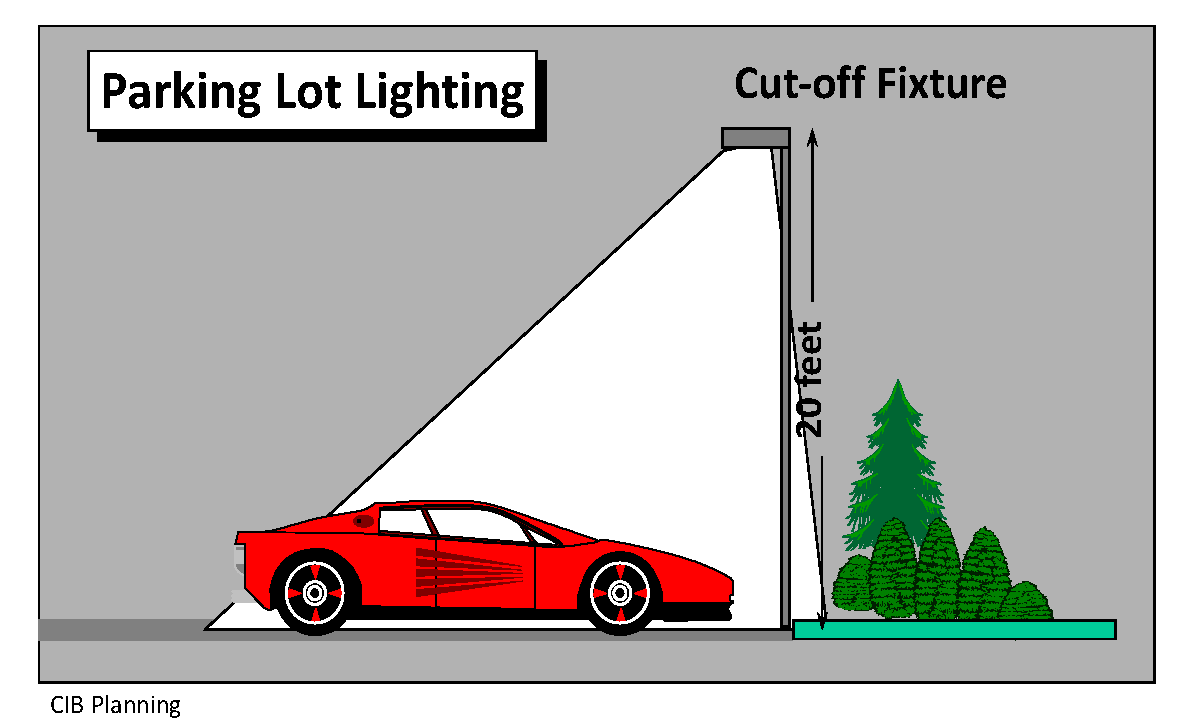
Exterior lighting shall be cut-off, fully shielded, and directed downward to prevent off-site glare. The intensity of light within a site shall not exceed ten footcandles within any site or one footcandle at any property line, except where it abuts a residential district or use whereby a maximum of 0.5 footcandles is permitted. The only exception is with gas station canopy and automobile dealership lighting, where a maximum of 20 footcandles is permitted within the site but the above standards shall apply to intensity at the property line. In addition, lighting of parking lots should provide illumination adequate for security, typically at an overall intensity ratio of ten to one throughout the site.
2.
Metal halide or LED fixtures shall be used in an effort to maintain a unified lighting standard throughout the city and minimize "sky glow."
3.
The planning commission may approve decorative light fixtures as an alternative to shielded fixtures when it can be proven that there will be no off-site glare and the proposed fixtures are necessary to preserve the intended character of the site.
4.
Lighting fixtures shall not exceed a height of 20 feet measured from the ground level to the centerline of the light source, except that fixtures as high as 30 feet shall be permitted in industrial districts. These light fixture height standards shall not apply to public lighting in a road right-of-way.
a)
The planning commission may modify these height standards in commercial and industrial districts, based on consideration of the following: the position and height of buildings, other structures, and trees on the site; the potential off-site impact of the lighting; the character of the proposed use; and, the character of surrounding land use.
b)
In no case shall the lighting exceed the maximum building height in the district in which it is located.
5.
Except where used for security purposes, all outdoor lighting fixtures, existing or hereafter installed and maintained upon private property within commercial, industrial and office zoning districts shall be turned off between 11:00 p.m. and sunrise, except when used for commercial and industrial uses, such as in sales, assembly and repair areas, where such use continues after 11:00 p.m. but only for so long as such use continues.
B.
Building-mounted lighting:
1.
Building-mounted lighting shall be cut-off, fully shielded, and directed downward to prevent off-site glare. The intensity of light shall not exceed ten footcandles within any site or one footcandle at any property line, except where it abuts a residential district or use whereby a maximum of 0.5 footcandles is permitted at the property line.
2.
Metal halide or LED fixtures shall be used in an effort to maintain a unified lighting standard throughout the city and prevent "sky glow."
3.
Luminous tube, exposed bulb fluorescent, and LED lighting is prohibited as an architectural detail on all buildings, e.g., along the roof line and eaves, around windows, inside windows, etc. The planning commission may approve internally illuminated architectural bands when it can be shown that the treatment will enhance the appearance of the building or is necessary for security purposes.
4.
The planning commission may approve decorative light fixtures as an alternative to shielded fixtures when it can be proven that there will be no off-site glare and the proposed fixtures will improve the appearance of the site.
C.
Window lighting:
1.
Any light fixtures visible through a window must be shielded to prevent glare at the property line.
2.
Luminous tube and exposed bulb fluorescent lighting (visible from the property line) is prohibited unless it is part of a sign that meets the requirements of the city's sign ordinance.
D.
Other lighting:
1.
The internal illumination of canopies is prohibited.
2.
Indirect or non-primary illumination of signs, canopies and buildings is permitted provided a maximum 100-watt incandescent bulb, or LED lumen equivalent bulb of no more than 14 watts, is utilized and there is no glare.
3.
The use of laser light source, search lights or any similar high intensity light for outdoor advertisement or entertainment is prohibited.
4.
Lighting shall not be of a flashing, moving or intermittent type.
(Ord. No. 467, § 1, 7-22-24)
Section 19.05. - Exemptions.
The following are exempt from the lighting requirements of this article, except that the building official/zoning administrator may take steps to eliminate the impact of the below exempted items when deemed necessary to protect the health, safety and welfare of the public:
A.
Sports fields.
B.
Swimming pools.
C.
Holiday decorations.
D.
Window displays without glare.
E.
Shielded pedestrian walkway lighting, including bollard fixtures.
F.
Street lights.
G.
Decorative street lights with internal shields to prevent glare onto adjacent residential properties.
H.
Decorative exterior string lights including clear "Edison Style" string lighting in commercial or residential districts used for roof-top, porch, patio, deck specifically as ambiance enhancement lighting that meet all other lighting requirements of the ordinance.
(Ord. No. 467, § 1, 7-22-24)
Section 19.06. - Lamp or fixture substitution.
Should any light fixture regulated under this article, or the type of light source therein, be changed after the permit has been issued, a change request must be submitted to the zoning administrator for his approval, together with adequate information to assure compliance with this ordinance, which must be received prior to substitution.
(Ord. No. 467, § 1, 7-22-24)
Section 19.07. - Residential lighting.
Permits are not required for lighting on single-family detached housing, but fixtures cannot create off-site glare on either the roadway or adjacent properties. For security lighting, residents are encouraged to utilize fixtures with motion detectors that only go on when caused by movement in the yard. The building official can require existing residential light fixtures to be re-directed or removed altogether if creating off-site glare on adjacent properties.
(Ord. No. 467, § 1, 7-22-24)

