
Swartz Creek City Zoning Code
ARTICLE 14
- SIGN REGULATIONS11
Editor's note— Ord. No. 440, §§ 1, and 10, adopted June 10, 2019, repealed the former Art. 14, §§ 14.00—14.04, and renumbered Art. 21 §§ 21.00—21.14 as Art. 14 §§ 14.00—14.14, as set out herein. The former Art. 14 pertained to the GBD, General Business District and derived from Ord. No. 395, adopted August 15, 2006; Ord. No. 407, § 2, adopted May 24, 2011; Ord. No. 431, § 2, adopted Dec. 12, 2016; and Ord. No. 434, § 6, adopted Oct. 8, 2018.
Section 14.00.- Signs intent and applicability.
The intent of this article is to regulate signs and to minimize outdoor advertising within the city so as to protect public safety, health, and welfare; minimize abundance, intensity (as it relates to the use of light, movement, reflection, and color), and size of signs to reduce visual clutter, motorist distraction, and loss of sight distances; promote public convenience; preserve property values; support and complement land use objectives as set forth in the City of Swartz Creek Master Plan and this ordinance; and enhance the aesthetic appearance and quality of life within the city. The standards contained herein are intended to be content neutral.
These objectives are accomplished by establishing the minimum amount of regulations necessary concerning the size, placement, construction, illumination, and other aspects of signs in the city so as to:
A.
Recognize that the proliferation of signs is unduly distracting to motorists and nonmotorized travelers, reduces the effectiveness of signs directing and informing the public, creates confusion, reduces optimum uniform traffic flow, and creates potential for traffic incidents.
B.
Prevent signs that are potentially dangerous to the public due to structural deficiencies or disrepair.
C.
Reduce physical and visual obstructions due to a proliferation of signs which would diminish the city's character, property values, and quality of life.
D.
Serve the public interest of and satisfy the principal intent of commercial signs which is to identify establishments on the premises, and not advertise special events, branding, or off-premises activity.
E.
Enable the public to locate goods, services, and facilities without excessive difficulty and confusion by regulating the number and placement of signs.
F.
Regulate placement of signs so as not to obstruct or conceal signs of adjacent uses or important visual objects, such as public safety signals or hazards.
G.
Protect the public right to receive messages, especially non-commercial messages such as religious, political, economic, social, and other types of information protected by the First Amendment of the U.S. Constitution.
H.
Maintain and improve the character or image of the city and its neighborhoods by encouraging signs of consistent size and composition which are compatible with and complementary to related structures and uses, and harmonious with their surroundings.
I.
Prohibit portable commercial signs in recognition of their significant negative impact on traffic safety and aesthetics.
J.
Enhance the character of the City's Downtown Commercial and Residential Districts (CBD & R-3)
K.
Recognize the collective public benefit of individuals' need to erect temporary on-premises signs to sell real estate, hold garage sales, and express political or other speech while balancing this need with the public good by regulating the number, manner, and duration of such placement to promote less collective clutter and visual obstruction.
L.
Recognize that the City of Swartz Creek and or its affiliates are in the unique position to hold, sponsor, or sanction educational, public, or community events that require identification, notice, or posting of temporary signs. Such events include but are not limited to public hearings, public notices, workshops, or promotional community events.
(Ord. No. 401, § 6, 5-11-09, eff. 6-15-09; Ord. No. 440, §§ 1, 10, 6-10-19)
Section 14.01. - Definitions.
For the purpose of this article, the following definitions shall apply in addition to the definitions set forth in Article 2 of this ordinance:
A.
Abandoned sign: See "obsolete sign."
B.
Awning or canopy: A retractable, foldable, collapsible or fixed shelter constructed of non-rigid or rigid materials on a supporting framework that projects from the exterior wall of a building.
C.
Awning or canopy sign: A sign attached directly to, or painted or otherwise inscribed upon an awning or canopy.
D.
Banner sign: A fabric, plastic, or other temporary sign made of non-rigid material without an enclosing structural framework.
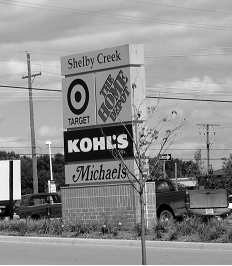
Business Center Sign
E.
Billboard: See off-premises sign. A structure for the permanent display of off-premises advertising. Off-premises advertising is any commercial message referring or relating to an enterprise or business that is not conducted on the premises where the sign is located.
F.
Business center: Any group of three or more commercial establishments which: a) are under one common ownership or management; or b) have a common arrangement for the maintenance of the grounds and are connected by party walls, partitions, covered canopies or other structural members to form one continuous structure; or c) share a common parking area; or d) otherwise present the appearance of one continuous commercial area.
G.
Community special event sign: Signs and banners, including decorations and displays celebrating a traditionally-accepted patriotic or religious holiday, or informing the public of community events, municipal, or school activities.
H.
Construction sign: A temporary sign which identifies the owners, financiers, contractors, architects, and engineers of a project under construction.
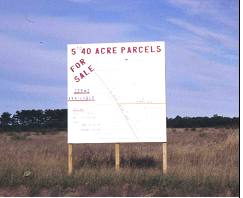
Construction Sign
I.
Corner parcel: See "lot, corner" in Article 2, Definitions.
J.
Day: For the purpose of this ordinance, a calendar day rather than a business day.
K.
Directional sign: A sign which gives directions, instructions, or facility information for the use on the lot on which the sign is located, such as parking or exit and entrance signs.
L.
Flashing sign: Any illuminated sign on which the artificial light is not maintained stationary or constant in intensity and color at all times when such is in use. Any moving, illuminated sign shall be considered a "flashing sign."
M.
Freestanding/pole/pylon sign: A sign which is erected upon or supported by the ground on one or more poles, uprights or braces which do not have the appearance of a solid base.
N.
Ground or monument sign: A three-dimensional, self-supporting, base-mounted freestanding sign, consisting of two or more sides extending up from the base, and upon which a message, business, group of businesses or center name is affixed.
O.
Incidental sign: A small sign, emblem, or decal informing the public of goods, facilities, or services available on the premises. Examples of incidental signs include credit card signs, signs indicating the hours of business, no smoking signs, signs used to designate bathrooms, and signs providing information on business affiliations.
P.
Institutional sign: A sign, which by symbol or name identifies an institutional use permitted within a Residential Zoning District and may also provide the announcement of services or activities to be held therein.
Q.
Major thoroughfare: An arterial street which is intended to serve as a large volume traffic way for both the immediate municipal area and the region beyond.
R.
Marquee: A permanent structure constructed of rigid materials that project from the exterior wall of a building.
S.
Marquee sign: A sign attached directly to, or painted or otherwise inscribed upon a marquee.
T.
Mural: A design or representation painted or drawn on a wall which does not advertise an establishment, product, service, or activity.
U.
Nameplate: A non-electric on-premises identification sign giving only the name, address, and/or occupation of an occupant or group of occupants.
V.
Obsolete sign: A sign that advertises a product that is no longer made or that advertises a business that has closed.
W.
Off-premises sign: A sign which identifies a use or advertises products and services not available on the site or parcel on which the sign is located (e.g., billboards, garage sale signs, residential open house signs, business or institutional signs that are not located on the premises of the identified function).
X.
Political sign: A temporary sign used in connection with an expression of a political opinion or message or an official Swartz Creek, school district, county, state, or federal election or referendum sign.
Y.
Portable sign: A sign designed to be moved easily and not permanently attached to the ground, a structure, or a building, including signs with wheels, A-frame signs, signs mounted on vehicles for advertising purposes, hot-air and gas filled balloons, pennants, streamers, ribbons, pinwheels, non-governmental flags and searchlights.
Z.
Poster panel signs: A portable advertising or business ground sign constructed in such a manner as to form an "A" or a tent-like shape, hinged or not hinged at the top; each angular face held at an appropriate distance by a supporting member.
AA.
Reader board, message board or changeable message sign: The portion of a sign on which copy is changed manually or electronically. Electronic reader boards (ERB) are defined as a changeable message sign and further include dynamic message signs (DMS), electronic billboards (EBB), light emitting diode (LED) displays, and other similar signs.
BB.
Real estate sign: A temporary sign advertising the real estate upon which the sign is located as being for sale, rent, or lease.
CC.
Roof line: The top edge of a roof or parapet wall, whichever is higher, but excluding any cupolas, chimneys, or other minor projections.
DD.
Roof sign: A sign erected above the roof line of a building.
EE.
Sign: A device, structure, fixture, display or placard using graphics, symbols, and/or written copy designed specifically for the purpose of advertising or identifying an establishment, product, service, or activity.
FF.
Special event sign: Temporary and portable signs containing public messages concerning special events sponsored by governmental agencies or nonprofit organizations.
GG.
Temporary sign: A non-commercial sign constructed of cloth, canvas, fabric, wood, plastic or other light temporary material, with or without a structural frame that is intended for short-term use; not including decorative display for holidays or public demonstration. Such signs include but are not limited to on-site real estate signs used for the purpose of advertising the premises for sale, rent or lease; on-site garage sale signs; political signs; seasonal signs; non-commercial signs which contain non-commercial information or directional messages; and construction signs.
HH.
Wall sign: A sign painted or attached directly to and parallel to the exterior wall of a building
II.
Window sign: A temporary sign installed on or inside a window and intended to be viewed from the outside.
(Ord. No. 401, § 6, 5-11-09, eff. 6-15-09; Ord. No. 440, §§ 1, 10, 6-10-19)
Section 14.02. - Exempt signs.
Subject to the conditions and requirements set forth in this section, the following signs shall be exempt from approval and permit requirements:
A.
Address numbers with a numeral height no greater than six inches for residences and 18 inches for businesses. A limit of one address sign per lot shall be permitted per residence or business. In the case of a corner lot, a maximum of two address signs may be permitted per residence or business. Address numbers on mailboxes are excluded from these requirements.
B.
Nameplates identifying the occupants of the building, not to exceed two square feet. A limit of one nameplate sign per lot shall be permitted per residence or business. In the case of a corner lot, a maximum of two nameplate signs may be permitted per residence or business.
C.
Memorial signs or tablets, names of buildings and date of erection, monumental citations, commemorative tablets carved into stone, concrete or similar material or made of bronze, aluminum or other non-combustible material and made an integral part of the structure and not exceeding 25 square feet.
D.
Signs on a bus, truck, trailer, or other vehicle while operated and used for transport in the normal course of a business.
E.
Regulatory, directional and street signs erected by a public agency in compliance with Michigan Manual of Uniform Traffic Control Devices, and the Uniform Federal Accessibility Standards and Michigan Barrier-Free Manual.
F.
Flags bearing the official design of a nation, state, municipality, educational institution, or non-profit organization.
G.
Plaques or signs designating a building as a historic structure.
H.
Incidental signs, provided that total of all such signs shall not exceed two square feet per business.
I.
Private traffic control signs which conform to the requirements of the Michigan Manual of Uniform Traffic Control Devices.
J.
Permanent signs on vending machines, gas pumps, or ice containers indicating only the contents of such devices, provided that the sign area shall not exceed six square feet per device.
K.
Menu and order boards for drive-through facilities provided such signs shall be located on the interior of the lot and not legible from adjacent properties. The placement, size, content, manner of illumination and sound level of such signs shall not constitute a traffic or pedestrian hazard and shall not be located in a front yard.
L.
Stadium signs and athletic scoreboards up to 200 square feet in total.
M.
Portable real estate "open house" signs with an area no greater than four square feet.
N.
"Help wanted" signs soliciting employees for the place of business, where posted, provided that the maximum area for all such signs shall be six square feet.
O.
Any sign which is located completely within an enclosed building and not visible from outside the building.
P.
Placards, not to exceed two square feet in area, located on top of gas station pumps.
Q.
Placards, not to exceed two square feet in area which provide notices of a public nature such as "No Trespassing," "No Hunting," "Beware of Dog" and "No Dumping" signs. Such signs shall be posted a minimum of 30 feet apart, as measured across the property line, and not include any additional further identification, advertisement, or unrelated content.
R.
Any sign that the city erects in the public right-of-way or on public property for a public purpose.
(Ord. No. 401, § 6, 5-11-09, eff. 6-15-09; Ord. No. 440, §§ 1, 10, 6-10-19)
Section 14.03. - Prohibited signs.
The following signs are prohibited in all districts:
A.
Any sign not expressly permitted.
B.
Abandoned or obsolete signs.
C.
Signs which incorporate flashing or moving lights.
D.
Banners, balloons, pennants, festoons, inflatable figures, spinners, and streamers, unless specifically permitted in this article.
E.
String lights used for commercial purposes, other than holiday decorations. Such holiday decorations are admissible only 45 days per calendar year per holiday.
F.
Moving signs, including any sign which has visible moving parts, visible revolving parts, visible mechanical movement, or other visible movement achieved by electrical, electronic, or mechanical means, including intermittent electric pulsations or movement caused by normal wind current.
G.
Any sign or sign structure which:
1)
Is structurally unsafe;
2)
Constitutes a hazard to safety or health by reason of inadequate maintenance, dilapidation, or abandonment;
3)
Constitutes a hazard to safety or health by reason of blocking views;
4)
Is capable of causing electric shock to a person making contact with it;
5)
Is unlawfully installed, erected, or maintained;
6)
Is located in public street or utility right-of-way, except where expressly permitted herein; or
7)
Is not kept in good repair, such that it has broken parts, missing letters, or non-operational lights.
H.
Any sign erected on a tree or utility pole, except government or utility signs of a government or utility.
I.
Any sign erected within ten feet of a fire hydrant.
J.
Portable signs, except where expressly permitted in this article.
K.
Signs affixed to a parked vehicle or truck trailer which is being used principally for advertising purposes, rather than for transportation purposes, and parked in a location that is selected for that purpose (e.g., a vehicle parked close to a street in a large commercial parking lot).
L.
Any sign which obstructs vision or free access to or egress from a required door, window, fire escape, or other required exit from a building or structure.
M.
Any sign which makes use of the words "Stop," "Look," or "Danger," or any other words, phrases, symbols, or characters, in such a manner as to interfere with, mislead, or confuse traffic.
N.
Any sign which contains obscene, indecent, or immoral matter.
O.
Roof signs.
P.
Signs on canopies at gas stations, banks or other drive-through establishments except for "enter" and "exit" signs.
Q.
Signs on street furniture, such as benches and trash receptacles, except for plaques of recognition.
R.
Temporary signs no longer valid due to the sale, rental, or lease of the property; termination of identified event; or disrepair.
S.
Business logos on directional signs.
T.
Billboards.
U.
Off-premises signs.
V.
Signs placed or erected without the permission of the property owner.
(Ord. No. 401, § 6, 5-11-09, eff. 6-15-09; Ord. No. 440, §§ 1, 10, 6-10-19)
Section 14.04. - General regulations.
A.
Sign location. No sign, except those established by the City of Swartz Creek, Genesee County, or state or federal governments shall be located in, project or overhang into any public right-of-way or dedicated easement unless explicitly permitted herein.
B.
Sign area.
1.
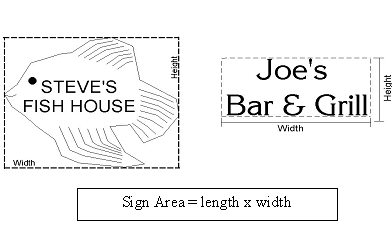
Sign area shall be measured as the square footage of the sign face and any frame or other material or color forming an integral part of the display or used to differentiate it from the background against which it is placed.
2.
When a sign consists solely of lettering or other sign elements printed, painted or mounted on a wall of a building without any distinguishing border, panel or background, the calculation for sign area shall be measured by enclosing the most protruding edges of the sign elements within a parallelogram or rectangle.
3.
The area of a double-faced freestanding sign shall be computed using only one face of the sign provided that: 1) the outline and dimensions of both faces are identical, and 2) the faces are back to back so that only one face is visible at any given time.
C.
Design and construction.
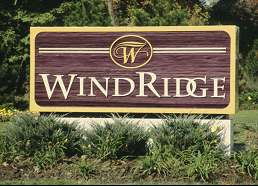
Landscaped Ground Sign
1.
Signs shall be designed to be compatible with the building materials and landscaping used on the property to promote an overall unified and aesthetic effect in accordance with the standards set forth herein.
2.
Signs shall not be constructed from materials that are remnants or manufactured for a different purpose.
3.
Signs shall not have light reflecting backgrounds but may use light reflecting lettering.
4.
All ground signs must be planted with a combination of low shrubbery and perennial/annual plantings.
5.
The maximum distance between parallel sign faces on a double-faced sign shall be 20 inches.
6.
The background of a multiple-tenant commercial or shopping center signs, including individual sign panels within the sign, shall be one color. However, individual businesses may have different colored lettering or advertising.
7.
Every sign shall be constructed and maintained in a manner consistent with the applicable building code provisions and maintained in good structural condition at all times. All signs shall be kept neatly painted, stained, sealed or preserved including all metal, wood, plastic, and other parts and supports.
8.
All signs erected, constructed, reconstructed, altered or moved shall be constructed in such a manner and of such materials so that they meet applicable building code provisions.
9.
All portable signs shall be constructed and maintained by the owner in such a manner and of such materials so that they withstand environmental conditions.
D.
Sign height.
1.
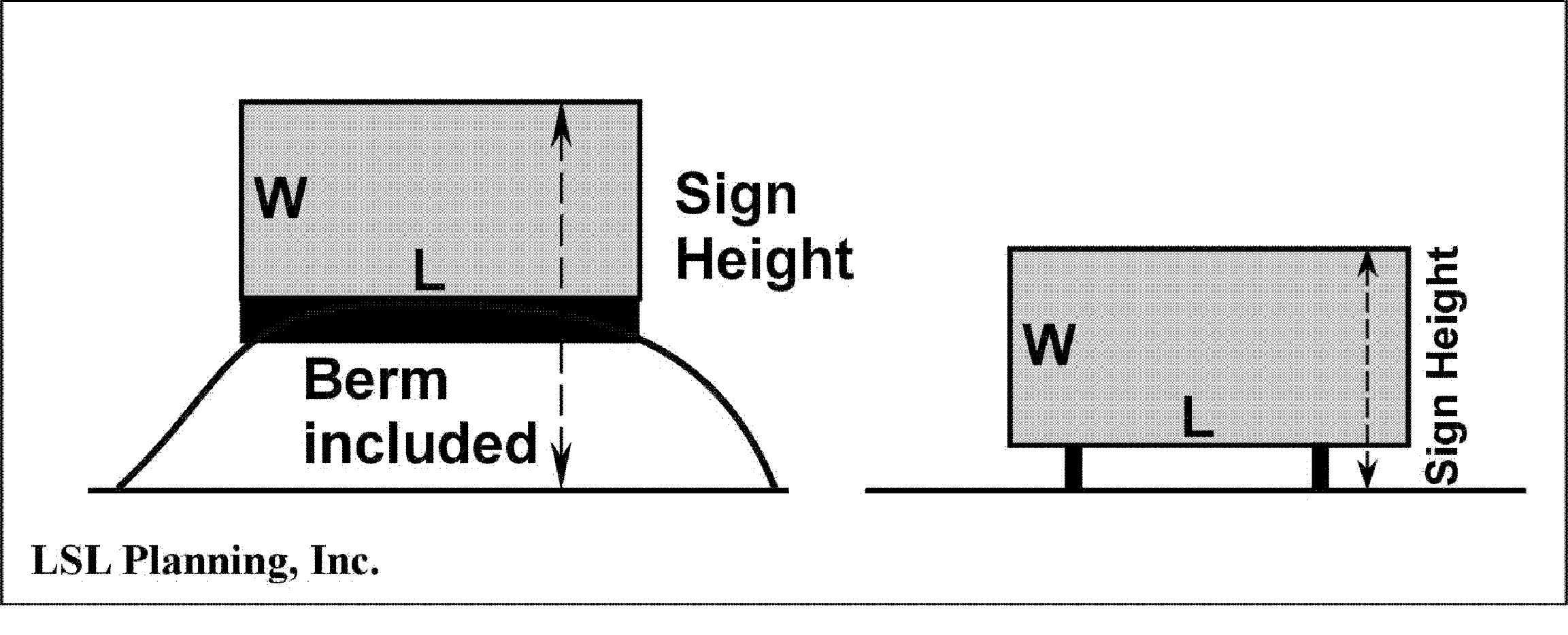
The permitted height of all signs supported by the ground shall be measured from the level of the ground adjacent to the sign if the finished grade is level.
2.
If the ground adjacent to the sign is not level, the height of the sign shall be measured from the average elevation of the ground in the general area surrounding the sign.
3.
The permitted height of signs shall not be measured from an area of the ground that has been built-up or constructed in a manner that would have the effect of allowing a higher sign height than permitted by this article (e.g., The height of signs erected on a berm shall be measured from the finished grade adjacent to the berm).
E.
Illumination.
Front Lit Sign - Gooseneck
1.
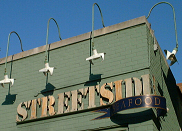
Signs shall be illuminated only by steady, stationary, shielded light sources directed solely at the sign or internal to it.
2.
Use of glaring undiffused lights or bulbs shall be prohibited.
3.
Lights shall be shaded so as not to project onto adjoining properties or thoroughfares.
4.
Underground wiring shall be required for all illuminated signs not attached to a building.
(Ord. No. 401, § 6, 5-11-09, eff. 6-15-09; Ord. No. 440, §§ 1, 10, 6-10-19)
Section 14.05. - Specific sign type requirements.
Many of the following regulations are summarized in Table 2.
A.
Wall signs.
1.
Number of signs. One wall sign shall be permitted per street or highway frontage on each parcel. Buildings adjacent to I-69 shall be permitted one wall sign facing I-69. In the case of a multi-tenant building or shopping center, one wall sign shall be permitted for each tenant having an individual means of public access into the building. Tenants occupying a corner space in a multi-tenant structure shall be permitted to have one sign on each side of the building. Where several tenants share a common entrance in a multi-tenant structure, only one wall sign shall be permitted, but the total sign area should be allocated among the tenants.
2.
Wall signs shall extend no greater than 12 inches from the exterior face of the wall to which it is attached.
3.
Wall signs must be a minimum of eight feet above the ground level or the sidewalk, whichever is greater.
4.
The height of wall signs shall not exceed the maximum building height specified for the district it is located in.
5.
The height of wall signs shall not be higher than the building on which the sign is located.
B.
Window signs.
1.
Window signs are not to cover more than 25 percent of a window.
2.
One window sign is permitted per window.
3.
The area of the window sign counts towards permitted wall sign area.
4.
Window signs are not to be illuminated by a direct light source.
C.
Awning and canopy signs.
1.
Awnings or canopies may project a maximum of six feet into the public right-of-way or up to three feet from any street curb line on properties zoned CBD, Central Business District. In other districts, the awning or canopy may project a maximum of four feet from the wall of the building.
2.
A minimum clearance of eight feet shall be maintained from ground level.
3.
Any lettering or logos on the awning or canopy shall be included within the calculation of total permitted wall sign area.
4.
Awnings and canopies may be front lit only on the sides of the building which contain a public entryway or those having a pedestrian sidewalk immediately adjacent to the building.
D.
Directional signs. Directional signs used to direct vehicular or pedestrian traffic to driveways, parking areas, loading areas, or to certain buildings or locations on the site, shall not exceed four square feet in area, and four feet in height. Directional signs may be located in the front setback area, provided they are setback at least 15 feet from the existing or planned right-of-way line and do not include a logo.
E.
Reader boards and changeable message signs.
1.
Reader boards and changeable message signs are permitted only on ground signs in nonresidential zoned areas.
2.
Reader boards and changeable message signs shall not exceed more than 50 percent of the total sign area.
3.
No message occurrence shall be less than ten seconds in duration.
4.
Such signs shall not be programmed with any animated, scrolling, or flashing messages, symbols, logos, or other graphics. Only static text and static logos are permissible.
5.
Gasoline price signs may be permitted as part of a ground sign, but the price signs shall not exceed 20 square feet in area.
6.
Changeable marquee signs may be permitted for theaters but are not to exceed 100 square feet in area.
7.
Colors of reader boards and changeable message signs shall be limited to a single background color and a single text color.
8.
Reader boards and changeable message signs shall be maintained in good repair at all times. If any part of the message display is not functioning properly, the use of the reader board sign will be discontinued until sufficient repairs are made.
9.
Electronic reader boards shall have a minimum separation distance of 200 feet from any other reader board.
10.
Electronic reader boards must comply within the following thresholds for luminance: Day 600—1,000 cd/m 2 ; Night 100—350/m 2 . The day/night transition shall occur within one-half hour of the official sunrise/sunset.
11.
Electronic reader boards may only operate during normal business hours or from 6 a.m. to 11 p.m., whichever is greater.
F.
Poster panel signs (i.e., sandwich signs). Poster panel signs including sandwich signs and "A" frame signs shall be permitted in CBD, Central Business District, subject to the following:
1.
The area of the sign shall not exceed 12 square feet per side.
2.
One such sign shall be permitted per customer entrance.
3.
The sign shall be no greater than four feet in height and three feet in width.
4.
The sign shall not be illuminated in any manner.
5.
The sign shall be located a minimum of four feet from the edge of the sidewalk and not be located in a manner as to interfere with vehicular or pedestrian traffic flow or visibility.
6.
The sign is permitted only during operating business hours and must be stored inside when the establishment is not open to the general public.
7.
The sign must be constructed of weather-proof, durable material and kept in good repair.
G.
Temporary signs.
1.
Temporary signs shall be in accordance with Table 1.
2.
Each temporary sign shall be removed within 45 days of placement. No sign may be erected on a single parcel for more than 45 calendar days out of every 90 calendar days.
3.
Temporary signs shall not be placed within a public right-of-way or easement or within 20 feet of the edge of any traveled portion of a roadway.
4.
Temporary signs shall not be erected, situated, or constructed so as to create a hazard of any kind or so as to interfere with, obstruct, confuse, or mislead traffic.
H.
Institutional signs (public services, churches, schools, etc.).
Institutional signs in a Nonresidential District are subject to the same standards as other signs in the district in which the institution is located.
Institutions in Residential Districts may erect signs for the purpose of identifying a church, school, public building, church affiliated school, parsonage, or other facility; advertising the time or subject of programming; or presenting other related information. Such signs shall be subject to the following standards:
1.
There shall be no more than one sign per parcel, except on a corner parcel, where two signs shall be permitted, with one facing each street. One additional sign shall be permitted for each school, parsonage, or other related facility.
2.
The maximum size of each sign shall be 32 square feet.
3.
Signs shall comply with the setback requirements for the district in which they are located.
4.
The maximum height of church signs shall be six feet.
I.
Entranceway signs.
1.
One permanent entranceway sign, identifying the name of the subdivision or development, may be located at each entrance to the subdivision or development.
2.
The maximum size of the sign shall be 12 square feet.
3.
The sign shall cover no more than 50 percent of the entranceway structure it is attached to.
4.
The sign shall only be illuminated by stationary, shielded light sources directed solely at the sign, or internal to it.
J.
Pole or pylon signs.
1.
Pole or Pylon signs are to be permitted only on properties that abut I-69 and are zoned and used for commercial purposes.
2.
The sign must be located on the same lot as the commercial use that it advertises. Additional businesses on properties within 2,500 feet of the I-69 right-of-way may also be included on the sign.
3.
The sign must not include any changeable messaging.
4.
The height of the sign shall not be more than 35 feet higher than the elevation of I-69 directly opposite the lot on which the sign is located.
5.
The sign shall not be less than 500 feet from any existing pole or pylon sign.
6.
Except for the sign cabinet and sign face, the sign shall be constructed of brick or other masonry materials that match or are compatible with the building on the lot.
7.
The sign shall have a maximum area of 100 square feet. In the case of a two-sided sign, each side may have an area of 100 square feet.
(Ord. No. 401, § 6, 5-11-09, eff. 6-15-09; Ord. No. 440, §§ 1, 10, 6-10-19)
Section 14.06. - Legal non-conforming signs.
A.
Any sign existing at the time of adoption of this article which does not comply with all provisions shall be considered a legal non-conforming sign and may be permitted to continue, subject to the limitations of section 14.08 of this article, if the sign is properly maintained and not detrimental to the health, safety and welfare of the community.
B.
If a non-conforming sign structure and frame are in good condition and can be reused by a new occupant in a leased or rented building, the building owner shall not be required to remove the sign structure and frame in the interim periods when the building is not occupied. If the building is unoccupied for less than 30 days the previous business' sign information may be retained. If the building is unoccupied for more than 30 days, the previous business' sign information must be removed. In such cases, the sign must be maintained in good condition and any openings must be covered with appropriate panels.
C.
Legal non-conforming signs which are removed, blown down, destroyed, relocated, damaged or altered such that 50 percent of their value is lost, shall be required to be replaced with signs that conform to this article.
D.
All portable signs, except those specifically permitted by this article, that exist on the effective date of this article, shall be removed immediately upon the enactment of this article.
E.
All illegal non-conforming signs that exist on the effective date of this article shall be removed immediately upon the enactment of this article and should be replaced by signs that conform to this ordinance.
(Ord. No. 401, § 6, 5-11-09, eff. 6-15-09; Ord. No. 440, §§ 1, 10, 6-10-19)
Section 14.07. - Reserved.
Editor's note— Ord. No. 410, § 1, adopted March 25, 2013, effective May 10, 2013, repealed § 21.07, which pertained to amortization of legal non-conforming signs. See also the Code Comparative Table.
Section 14.08. - Administration.
A.
Review and approval. No sign, permanent or temporary, shall be erected, structurally altered, or relocated, except as otherwise provided in this ordinance, without review and approval from the City of Swartz Creek Building Official.
B.
Application. The application, on a form provided by the City of Swartz Creek Building Department, shall contain the proposed location of the sign, the name and address of the sign owner and of the sign erector, the name and address of the owner of the business and of the property if different from that of the sign owner, drawings and/or sketches showing the design and location of the sign, the estimated cost of construction and any other information as the building official may require to ensure compliance with this ordinance and with other ordinances of the city.
C.
Staking of sign's proposed location. The location of a proposed sign shall be staked by the property owner. The building department will use the staked location to determine compliance with required setbacks set out in this article before issuing a sign permit.
D.
Permit required. Upon approval, a sign permit will be issued by the City of Swartz Creek Building Official. The building official shall issue a numbered permit for all approved signs. Such number shall be permanently displayed at a conspicuous place on the sign.
E.
Fees. All permit fees for signs shall be as established by resolution of the City of Swartz Creek City Council.
F.
Nullification. A sign permit shall become null and void if the work for which the permit was issued has not been completed within six months after the date of the permit.
G.
Exceptions. The following shall not require a sign permit:
1.
Replacing copy. The changing of the advertising copy or message on an approved painted or printed sign, on a theater marquee and on similar approved signs which are specifically designed for the use of replaceable copy; and
2.
Maintenance. Painting, repainting, cleaning or other normal maintenance or repair of a sign or a sign structure, unless a structural change is made.
H.
Certificate of compliance. All signs shall require a final inspection and the issuance of a certificate of compliance from the building department. The property owner shall notify the building department immediately upon erecting the sign to request the final inspection.
(Ord. No. 401, § 6, 5-11-09, eff. 6-15-09; Ord. No. 440, §§ 1, 10, 6-10-19)
Section 14.09. - Compliance with other laws.
All signs shall comply with the pertinent requirements of the city's adopted Building Code, as amended from time to time, except as modified in this article.
(Ord. No. 401, § 6, 5-11-09, eff. 6-15-09; Ord. No. 440, §§ 1, 10, 6-10-19)
Section 14.10. - Inspections, maintenance and removal.
A.
Inspections. Signs for which a permit is required may be inspected periodically by the building official, or his or her designee, for compliance with this ordinance and with other ordinances of the city.
B.
Maintenance. All signs and components thereof shall be kept in good repair and in a safe, neat, clean and attractive condition.
C.
Removal.
1.
The building official may order the removal of any permanent sign and its supporting structure erected or maintained in violation of this ordinance. The building official shall give 30 days' notice in writing, to the owner of such sign and its supporting structure to bring it into compliance. Any sign erected of a temporary nature shall require written notice of only three days.
2.
Upon failure to comply with this notice, the building department representative may remove the sign and its supporting structure. The building department representative may remove a sign and its supporting structure immediately and without notice if, in his or her opinion, the condition of the sign and its supporting structure presents an immediate threat to the safety of the public. The cost of such removal by the city shall be assessed against the owner of such sign or the owner of the building, structure or premises.
3.
Any portable sign, except those expressly permitted in this article, shall be removed within six months from the effective date of this article. The building department may extend the date for removal of such portable signs up to an additional 12 months upon proving hardship.
D.
Obsolete signs. An obsolete sign and its supporting structure shall be removed by the property owner or lessee of the premises upon which the sign is located when the business which it advertises is no longer conducted on the premises. If the property owner or lessee fails to remove it within 60 days of the date that the business becomes inactive, the building official may remove the sign and its supporting structure and the cost of this work will be placed on the tax roll.
E.
Where a successor to an inactive business agrees, within 30 days of the date of written notice by the building official, to maintain the sign as provided for in this article, this removal requirement shall not apply, provided that the existing sign and structure conforms to all current sign requirements.
(Ord. No. 401, § 6, 5-11-09, eff. 6-15-09; Ord. No. 440, §§ 1, 10, 6-10-19)
Section 14.11. - Criteria for variance from the sign regulations.
The zoning board of appeals may hear requests for variances from the regulations set forth in this article. The building official and zoning administrator may require the applicant to present photographs of similar signs, color renderings or to erect a temporary mock-up of the sign on the site prior to rendering a decision on a variance request. A non-use variance may be granted by the zoning board of appeals in cases involving practical difficulties and a use variance may be granted in cases involving undue hardship. Requests for variance shall be reviewed for compliance with the following:
A.
Variances may be granted for any one of the following conditions:
1.
The applicant has demonstrated a variance is needed due to a practical difficulty on the site, such as varied topography, horizontal or vertical road curvature, or presence of structures or desired trees that limit visibility of a sign on the premises compared to similar sites with conforming signs in the same zoning district; or
2.
A variance is warranted due to the relatively large size of the site, frontage or building in comparison to other establishments in the same zoning district; or
3.
A variance would significantly improve the conformity of an existing sign.
B.
To grant a variance for one of the conditions specified above, all of the following standards must also be met:
1.
The inability to conform with the requirements of this article is due to a hardship or practical difficulty that includes more than mere inconvenience or mere inability to attain a supposed higher financial return; and
2.
That the alleged hardships or practical difficulties, or both, are exceptional and peculiar to the property of the person who requested the variance, and result from conditions which do not exist generally throughout the city; and
3.
That allowing the variance will result in substantial justice being done, considering the public benefits intended to be secured by this ordinance, the individual hardships that will be suffered by a failure of the zoning board of appeals to grant a variance, and the rights of others whose property would be affected by the allowance of the variance, and will not be contrary to the public purpose and general intent of this article; and
4.
The variance granted is the minimum necessary to allow the applicant to enjoy the same rights as other establishments in the same zoning district, have a reasonable outlet for free speech and meet the intent of this article; and
5.
The variance will not adversely affect the health, safety and welfare of the public.
(Ord. No. 401, § 6, 5-11-09, eff. 6-15-09; Ord. No. 440, §§ 1, 10, 6-10-19)
Section 14.12. - Costs of enforcement.
Any costs or expenses incurred by the city in enforcing this article shall be paid by the owner of the sign found to be in violation of this article; or upon default thereof, by the owner of the sign or the owner of the property to reimburse the city for costs and expenses incurred in such enforcement. The owner of the property shall be billed for such cost and expenses in the same manner as other taxes.
(Ord. No. 401, § 6, 5-11-09, eff. 6-15-09; Ord. No. 440, §§ 1, 10, 6-10-19)
Section 14.13. - Penalties.
Any violation of this article shall be a municipal civil infraction punishable as provided in section 1-21 et seq. of Article II of Chapter 1 of the Code of Ordinances of the City of Swartz Creek.
(Ord. No. 401, § 6, 5-11-09, eff. 6-15-09; Ord. No. 440, §§ 1, 10, 6-10-19)
Section 14.14. - Conflict with other laws.
In any case where a provision of this article is found to be in conflict with another provision of this ordinance, or any building, housing, fire, safety, or health ordinance of the City of Swartz Creek existing on the effective date of this article, the provisions which establish the higher standard for the promotion and protection of the health and safety of the people shall prevail. In any case where a provision of any other ordinance or Code of the City of Swartz Creek establishes a lower standard for the promotion of health and safety of the people, the provisions of this article shall prevail, and such other ordinances or Codes are hereby declared to be repealed.
Table 14.1: SCHEDULE OF SIGN REGULATIONS
Notes to Sign Schedule of Regulations:
(a)
A maximum of one wall or canopy sign per principal building is permitted. One sign per tenant for shopping centers and office buildings shall be allowed. In the case of a multi-tenant building or shopping center, one wall sign shall be permitted for each tenant having an individual means of public access into the building. Tenants occupying a corner space in a multi-tenant structure shall be permitted to have one sign on each side of the building. Where several tenants share a common entrance in a multi-tenant structure, only one wall sign shall be permitted, and the total sign area should be allocated among the tenants.
(b)
Maximum allowable sign areas may be increased as indicated in the table below up to a maximum of 250 square feet.
(c)
One ground sign shall be permitted per parcel except as follows:
(1)
On corner lots, two ground signs, one on each street, shall be permitted. Signs shall be permitted along major public thoroughfares only.
(2)
One ground sign per each 300 lineal feet of frontage along a major public thoroughfare shall be permitted.
(d)
For multiple-tenant commercial or shopping center signs, a main identification sign with the name of the center only may be permitted not to exceed 40 square feet per sign face (80 square feet total area) and ten feet in height.
(e)
Individual businesses within a business center, including multiple-tenant commercial or shopping centers and multiple-tenant office buildings, are not allowed to have individual freestanding signs, but individual businesses may have other signs permitted by this article.
(f)
For multiple-tenant office signs, the sign area shall not exceed 40 square feet per sign face.
(g)
Ground signs are not permitted in the Central Business District.
(h)
All nonresidential signs shall be set back at least 50 feet from any residential district.
(i)
The temporary sign shall be setback at least 15 feet from any public right-of-way line and 100 feet from any residential district property line.
(j)
The temporary sign may be located in the required setback area, but must be set back at least ten feet from the public right-of-way.
(k)
Community special event signs may include ground or wall signs, banners, pennants, or similar displays; the number, size and height of such signs shall be subject to building official or zoning administrator approval.
(l)
The total of all window signs, temporary and permanent, shall not exceed 25 percent of the total window area of each window. The area of permanent window signs shall also be counted in determining compliance with standards for total area of wall signs.
(m)
Temporary window signs that are faded, yellowed, ripped or otherwise damaged shall be removed immediately.
(Ord. No. 401, § 6, 5-11-09, eff. 6-15-09; Ord. No. 440, §§ 1, 10, 6-10-19)

