
Swartz Creek City Zoning Code
ARTICLE 2
- DEFINITIONS
Section 2.00.- Construction of language.
The following rules of construction apply to the text of this ordinance:
A.
The particular shall control the general.
B.
In case of any difference of meaning or implication between the text of this ordinance and any caption or illustration, the text shall control.
C.
The word "shall" is always mandatory and not discretionary. The word "may" is permissive, with the decision made by the planning commission, city council, or zoning board of appeals, as indicated.
D.
The masculine gender includes the feminine and neuter.
E.
Words used in the present tense shall include the future; and words used in the singular number shall include the plural, and the plural the singular, unless the context clearly indicates the contrary.
F.
A "building" or "structure" includes any part thereof. The word "dwelling" includes "residence." The word "lot" includes the words "plot" or "parcel".
G.
The phrase "used for" includes "arranged for," "designed for," "intended for," "maintained for," or "occupied for."
H.
The word "person" includes an individual, a corporation, a co-partnership, a limited liability company, an incorporated or unincorporated association, or any other entity recognizable as a "person" under the laws of Michigan.
I.
Unless the context clearly indicates the contrary, where a regulation involves two or more items, conditions, provisions, or events connected by the conjunction "and," "or," "either..." "or," the conjunction shall be interpreted as follows:
1.
"And" indicates that all the connected items, conditions, provisions, or events shall apply.
2.
"Or" indicates that the connected items, conditions, provisions, or events may apply singly or in any combination (i.e., "or" also means "and/or").
3.
"Either...or" indicates that the connected items, conditions, provisions or events shall apply singly but not in combination.
J.
The terms "abutting" or "adjacent to" include property "across from", such as across a street, alley, or an easement. This term shall also apply to adjacent zoning districts in an adjacent community.
K.
Terms not herein defined shall have the meaning customarily assigned to them.
Section 2.01. - Definitions A—B.
Abandonment: The relinquishment of land or cessation of the use of the land by the owner or lessee without any intention of transferring rights to the land to another owner or of resuming use of the land or building (i.e. a discontinuance and an indication of an intent to abandon).
Accessory buildings or structures: A building or structure on the same lot with the main building or use, but the use of which is clearly incidental to that of the main building or use.
Accessory use: A use which is clearly incidental to, customarily found in connection with, and (except in the case of accessory off-street parking spaces or loading) located on the same zoning lot as, the principal use to which it is related. An accessory use includes, but is not limited to, the following:
A.
Accessory apartment in a one-family dwelling.
B.
Swimming pools for the use of the occupants of a residence or their guests.
C.
Domestic or agricultural storage in a barn, shed, tool room, or similar accessory building or other structure.
D.
Storage of merchandise normally carried in stock in connection with a business or industrial use, unless such storage is excluded in the applicable district regulations.
E.
Storage of goods used in or produced by industrial uses or related activities, unless such storage is excluded in the applicable district regulations.
F.
Accessory off-street parking spaces, open or enclosed, subject to the accessory off-street parking regulations for the district in which the zoning lot is located.
G.
Uses clearly incidental to a main use such as, but not limited to, offices of an industrial or commercial complex located on the site of the commercial or industrial complex.
H.
Accessory off-street loading, subject to the off-street loading regulations for the district in which the zoning lot is located.
I.
Accessory signs, subject to the sign regulations for the district in which the zoning lot is located.
J.
Boat houses used for the accessory storage of boats of any principal use on a zoning lot or parcel.
K.
A use or structure shall only be considered an accessory use where it is built, located, or otherwise placed on a zoning lot with a principal use to which it is accessory thereto and which is permitted in the zoning district in which it is located.
Activity: Any use, operation, development, or action involving a change in, on or to uplands or bottomlands caused by any person, including, but not limited to, constructing, operating, or maintaining any use or development; erecting buildings or other structures; depositing or removing material; dredging; ditching; land balancing; draining or diverting water; pumping or discharge of surface water; grading; paving; vegetative clearing or excavation, mining or drilling operations.
Adult care facility: A facility for the care of adults, over 18 years of age, as licensed and regulated by the state under Michigan Public Act 218 of 1979, and rules promulgated by the State Department of Consumer and Industry Services. Such organizations shall be defined as follows:
A.
Adult foster care facility: A governmental or nongovernmental establishment subject to state licensing procedures as may be required having as its principal function the receiving of adults for foster care. It includes facilities and foster care family homes for adults who are aged, emotionally disturbed, developmentally disabled, or physically handicapped who require supervision on an on-going basis but who do not require continuous nursing care. An adult foster care facility does not include a nursing home, a home for the aged, an alcohol or substance abuse rehabilitation center, a hospital for the mentally ill, or similar facilities.
Adult foster care large group home: Facility with the approved capacity to receive at least 13, but not more than 20 adults who shall be provided supervision, personal care, and protection in addition to room and board, for 24 hours a day, five or more days a week, and for two or more consecutive weeks for compensation.
Adult foster care small group home: Facility with the approved capacity of not more than 12 adults who shall be provided supervision, personal care, and protection in addition to room and board, for 24 hours a day, five or more days a week, and for two or more consecutive weeks for compensation.
Adult foster care family home: A private residence with the approved capacity to receive not more than six adults who shall be provided foster care for five or more days a week and for two or more consecutive weeks. The adult foster care family home licensee shall be a member of the household and an occupant of the residence.
Adult foster care congregate facility: A foster care facility with the approved capacity to receive more than 20 adults to be provided with foster care.
B.
Adult day care facility: An unlicensed facility which provides care for elderly and/or functionally impaired adults in a protective setting for a portion of a 24-hour day.
Adult regulated uses or sexually-oriented businesses: Any business which primarily features sexually stimulating material and/or performances, including the following uses:
A.
Adult personal service establishment: Any establishment, club, or business by whatever name designated, which offers or advertises, or is equipped or arranged to provide as part of its services, massages, body rubs, body painting, alcohol rubs, physical stimulation, baths, or other similar treatment by any person. An adult personal service establishment may include, but is not limited to, establishments commonly known as massage parlors, health spas, sauna baths, Turkish bathhouses, and steam baths. The following uses shall not be included within the definition of an adult personal service establishment:
1.
Establishments which routinely provide such services by a licensed physician, a licensed chiropractor, a licensed physical therapist, a licensed practical nurse practitioner, or any other similarly licensed medical professional.
2.
Fitness center, as defined herein.
3.
Electrolysis treatment by a licensed operator of electrolysis equipment.
4.
Continuing instruction in martial or performing arts, or in organized athletic activities.
5.
Hospitals, nursing homes, medical clinics, or medical offices.
6.
Barber shops or beauty parlors and salons which offer massages to the scalp, the face, the neck or shoulders only.
7.
Adult photography studios whose principal business does not include the taking of photographs of "specified anatomical areas" as defined herein.
B.
Adult book store: An establishment having a substantial portion of its stock-in-trade devoted to the distribution, display, or storage of books, magazines, and other periodicals, photographs, drawings, and other print material which is distinguished or characterized by its emphasis on matters depicting, describing, or relating to "specified sexual activities" or "specified anatomical areas" (as defined herein).
C.
Adult cabaret: An establishment where live entertainment is provided, presented, permitted or performed, where a substantial portion of performances are distinguished or characterized by an emphasis on or relationship to "specified sexual activities" or "specified anatomical areas" (as defined herein) for observation by or participation of patrons therein. Also, an establishment which features any of the following: topless dancers and/or bottomless dancers, go-go dancers, strippers, male and/or female impersonators or similar entertainers, topless and/or bottomless waiters, waitresses and/or employees.
D.
Adult motion picture theater or adult live stage performing theater: An enclosed building wherein still or motion pictures, video tapes or similar material is presented or viewed where a substantial portion is distinguished or characterized by an emphasis on matter depicting, describing or relating to "specified sexual activities" or "specified anatomical areas" (as defined herein) for observation by patrons therein. Such an establishment is customarily not open to the public generally, but only to one or more classes of the public, excluding any minor by reason of age.
E.
Adult model studio: Any place where models who display "specified anatomical areas" (as defined herein) are present to be observed, sketched, drawn, painted, sculptured, photographed, or similarly depicted by persons who pay some form of compensation or gratuity. This definition shall not apply to any accredited art school or similar educational institution.
F.
Adult motion picture arcade or mini-motion picture theater: Any place where motion picture machines, projectors, or other image producing devices are maintained to show images to five or fewer persons per machine at any one time, and where the images displayed depict, describe, or relate to "specified sexual activities" or "specified anatomical areas" (as defined herein).
G.
Adult video store: An establishment having a substantial portion of its stock-in-trade devoted to the distribution, display, storage, or on-premises viewing of films, movies, motion pictures, video cassettes, slides, or other visual representations which are distinguished or characterized by their emphasis on matters depicting, describing, or relating to "specified sexual activities" or "specified anatomical areas" (as defined herein), or an establishment with a segment or section devoted to the sale or display of such material.
H.
Adult outdoor motion picture theater: A drive-in theater where a substantial portion of the material presented is distinguished or characterized by an emphasis on matter depicting, describing or relating to "specified sexual activities" or "specified anatomical areas" (as defined herein) for observation by patrons of the theater. Such establishment is customarily not open to the public generally, but only to one or more classes of the public, excluding any minor by reason of age.
I.
Sexual paraphernalia store: An establishment having a substantial portion of its stock-in-trade devoted to the distribution, display, or storage, of instruments, devices, or paraphernalia designed for use related to "specified anatomical areas" or as part of, in connection with, or related to "specified sexual activities" (as defined herein), or an establishment with a segment or section devoted to the sale or display of such material.
Special definitions: With respect to adult regulated uses or sexually oriented businesses, the following terms and phrases shall have the following meanings:
A.
Substantial portion: A use of activity accounting for more than 20 percent of any one or more of the following: stock-in-trade, sales revenue, display space, floor space, viewing time, movie display time, or entertainment time measured per month.
B.
Specified anatomical areas: Portions of the human body defined as follows:
1.
Less than completely and opaquely covered human genitals, pubic region, buttocks, anus, or female breast below the point immediately above the top of the areola.
2.
Human male genitals in a discernible turgid state, even if completely and opaquely covered.
C.
Specified sexual activities: The explicit display of one or more of the following:
1.
Human genitals in a state of sexual stimulation or arousal.
2.
Fondling or other erotic touching of human genitals, pubic region, buttocks, anus, or female breast.
3.
Human sex acts, normal or perverted, actual or simulated including, but not limited to human masturbation, oral copulation, sexual intercourse, or sodomy.
4.
Human excretory functions as part of, or as related to, any of the activities described above.
5.
Physical violence, bondage, mutilation, or rape, actual or simulated, as part of or related to, any of the activities described above.
Alley: Any dedicated public way or private road affording a secondary means of access to abutting property, and not intended for general traffic circulation.
Alterations: Any change, addition, or modification in construction or type of occupancy, or in the structural members of a building, such as walls or partitions, columns, beams or girders, the consummated act of which may be referred to herein as "altered" or "reconstructed."
Apartment: A suite of rooms or a room in a multiple-family building arranged and intended for a place of residence of a single-family or a group of individuals living together as a single housekeeping unit.
Apartment, accessory: (i.e. "mother-in-law" apartment) A single apartment unit contained within a single-family home meeting the regulations of this ordinance.
Automobile service (gasoline) station: An establishment which includes buildings and premises for the primary purpose of retail sales of gasoline. An automobile gasoline service station may also include an area devoted to sales of automotive items and convenience goods (mini-mart) primarily sold to patrons purchasing gasoline. An establishment which provides vehicle maintenance or repair is not included within this definition.
Automobile service center, major repairs: A place where the following services may be carried out: General repair, engine rebuilding, rebuilding or reconditioning of motor vehicles, collision service, such as body, frame, or fender straightening and repair, overall painting and undercoating of automobiles.
Automobile service center, minor repairs: A place for the sale of minor accessories for motor vehicles and minor automobile repairs, but not including the dispensing, sale, or offering for sale of motor fuels directly to users of motor vehicles or major automobile repairs such as, but not limited to, vehicle body repair, painting, engine rebuilding, auto dismantling, upholstering, glass work, undercoating, steam cleaning, and other such activities.
Automobile wash: Any building or structure or portion thereof containing facilities for washing motor vehicles using production line methods with a conveyor, blower, steam cleaning device or other mechanical washing devices; and shall also include coin- and attendant-operated drive-through, automatic self-serve, track mounted units and similar high volume washing establishments, but shall not include hand washing operations.
Basement: That portion of a building which is partly or wholly below grade but so located that the vertical distance from the average grade to the floor is greater than the vertical distance from the average grade to the ceiling. A basement shall not be counted as a story. Should the vertical distance between the floor and midpoint, and ceiling and midpoint, be equal the area shall be counted as a basement.
Bed and breakfast inn: Any dwelling in which overnight accommodations are provided or offered for transient guests for compensation, including provision for a morning meal only for the overnight guest. A bed and breakfast is distinguished from a motel in that a bed and breakfast establishment shall have only one set of kitchen facilities and employ only those living in the house or up to one additional employee.
Berm: A mound of soil graded, shaped and improved with landscaping in such a fashion so as to be utilized for screening purposes or as a transition between uses or along major roadways.
Block: The property abutting one side of a street and lying between the two nearest intersecting streets, (crossing or terminating) or between the nearest such street and railroad right-of-way, unsubdivided acreage, lake, river, or live stream; or between any of the foregoing and any other barrier to the continuity of development, or corporate boundary lines of the municipality.
Boarding house: A dwelling where meals, or lodging and meals, are provided for compensation for three or more persons by pre-arrangement for definite periods. A boarding house shall be distinguished from a hotel.
Building: Any structure, either temporary of permanent having a roof supported by columns or walls, and intended for the shelter or enclosure of persons, animals, chattels or property of any kind.
Building, accessory: A building on the same lot with the main building or use, but the use of which is clearly incidental to that of the main building or use.
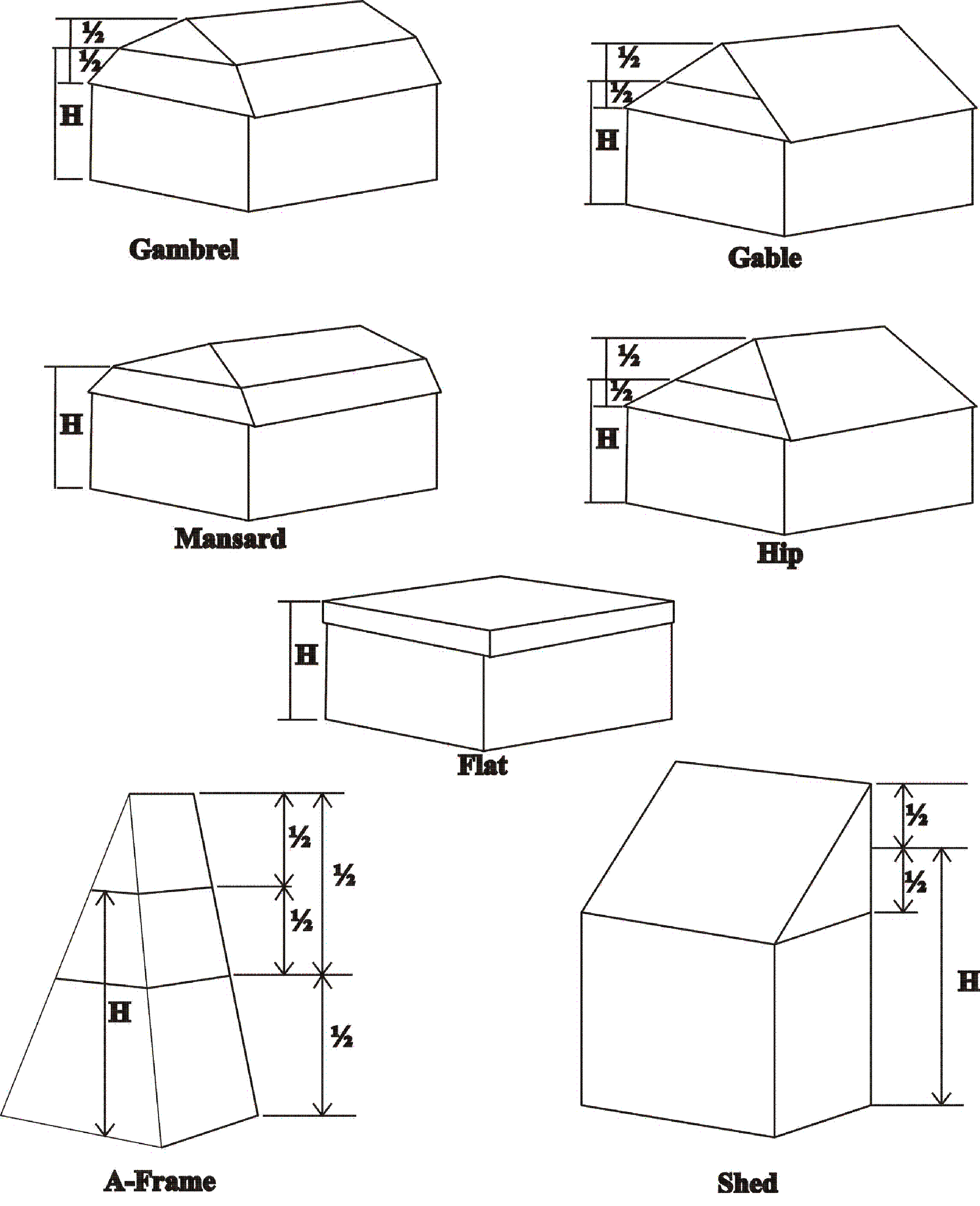
Building Height
Building height: The vertical distance measured from the established grade to the highest point of the roof surface for flat roof; to the deck line of mansard roofs; and to the average height between eaves and ridge for gable, hip, and gambrel roofs. Where a building is located on sloping terrain, the height may be measured from the average ground level of the grade at the building wall.
Building line: A line formed by the face of the building, and for the purpose of this ordinance, a minimum building line is the same as a front setback line.
Building official: The building official (or similar title) designated by the Swartz Creek City Council responsible for duties as established herein.
Section 2.02. - Definitions C—D.
Canopy: Any overhead protective structure which is constructed in such a manner as to allow pedestrians/vehicles to pass under.
Cemetery: Land used for the burial of the dead, including crematoriums, mausoleums, and mortuaries.
Child care facilities: A facility for the care of children under 18 years of age, as licensed and regulated by the state under Act No. 116 of the Public Acts of 1973 and the associated rules promulgated by the State Department of Social Services. Such care facilities are classified below:
A.
Child day care center: A facility other than a private residence, receiving more than six preschool or school age children for group day care for periods of less than 24 hours a day, and where the parents or guardians are not immediately available to the child. It includes a facility which provides care for not less than two consecutive weeks, regardless of the number of hours of care per day.
B.
Foster family home: A private home in which at least one but not more than four minor children, who are not related to an adult member of the household by blood, marriage, or adoption, are given care and supervision for 24 hours a day, for four or more days a week, for two or more consecutive weeks, unattended by a parent or legal guardian.
C.
Foster family group home: A private home in which more than four but less than seven children, who are not related to an adult member of the household by blood, marriage, or adoption, are provided care for 24 hours a day, for four or more days a week, for two or more consecutive weeks, unattended by a parent or legal guardian.
D.
Family day care home: A private home in which one but less than seven minor children are received for care and supervision for periods of less than 24 hours a day, unattended by a parent or legal guardian, except children related to an adult member of the family by blood, marriage, or adoption. It includes a home that gives care to an unrelated child for more than four weeks during a calendar year.
E.
Group day care home: A private home in which more than six but not more than 12 children are given care and supervision for periods of less than 24 hours a day unattended by a parent or legal guardian except children related to an adult member of the family by blood, marriage, or adoption. It includes a home that gives care to an unrelated child for more than four weeks during a calendar year.
City council: The duly elected or appointed City Council of the City of Swartz Creek.
Club: An organization of persons for special purposes or for the promulgation of sports, arts, sciences, literature, politics, or the like, but not operated for profit.
Cluster housing: A group of buildings and especially houses built close together to form relatively compact units on a sizable tract in order to preserve open spaces and environmentally sensitive areas larger than the individual yards for common recreation.
Commercial vehicle: Any vehicle bearing or required to bear commercial license plates and which falls into one or more of the categories listed below:
A.
Truck tractor.
B.
Semi-trailer, which shall include flat beds, stake beds, roll-off containers, tanker bodies, dump bodies, and full or partial box-type enclosures.
C.
Vehicles of a type that are commonly used for the delivery of ice cream, milk, bread, fruit, or similar vending supply or delivery trucks. This category shall include vehicles of a similar nature which are also of a type commonly used by electrical, plumbing, heating and cooling, and other construction oriented contractors.
D.
Commercial hauling, vehicle repair service, snow plowing, or tow trucks.
E.
Any other vehicle with a commercial license plate having a gross vehicle weight in excess of 10,000 pounds or a total length in excess of 22 feet.
Commercial use: "Commercial use" relates to the use of property in connection with the purchase, sale, barter, display or exchange of goods, wares, merchandise or personal services and the maintenance or operation thereof of offices, or recreational or amusement enterprises.
Condominium: A condominium is a system of separate ownership of individual units and/or multi-unit projects according to Public Act 59 of 1978, as amended. In addition to the interest acquired in a particular unit, each unit owner is also a tenant in common in the underlying fee and in the spaces and building parts used in common by all the unit owners.
Condominium Act: Michigan Act 59 of 1978, as amended.
Condominium, contractible: A condominium project from which any portion of the submitted land or building may be withdrawn in pursuant to express provisions in the condominium documents and in accordance with the Swartz Creek Code of Ordinances and the Condominium Act.
Condominium, conversion: A condominium project containing condominium units some or all of which were occupied before the establishment of the condominium project.
Condominium—Convertible area: A unit or a portion of the common elements of the condominium project referred to in the condominium documents within which additional condominium units or general or limited common elements may be created pursuant to provisions in the condominium documents and in accordance with these zoning regulations and the Condominium Act.
Condominium, expandable: A condominium project to which additional land may be added pursuant to express provision in the condominium documents and in accordance with these zoning regulations and the Condominium Act.
Condominium—General common element: The common elements other than the limited common elements intended for the common use of all co-owners.
Condominium—Limited common element: A portion of the common elements reserved in the master deed for the exclusive use of less than all of the co-owners.
Condominium master deed: The condominium document recording the condominium project as approved by the city including attached exhibits and incorporated by reference the approved bylaws for the project and the approved condominium subdivision plan for the project.
Condominium—Site condominium project: A condominium project designed to function in a similar manner, or as an alternative to a platted subdivision. A residential site condominium project shall be considered as equivalent to a platted subdivision for purposes of regulation in these zoning regulations.
Condominium subdivision plan: Drawings and information which show the size, location, area, and boundaries of each condominium unit, building locations, the nature, location, and approximate size of common elements, and other information required by Section 66 of Michigan Public Act 59 of 1978, as amended.
Condominium unit site (i.e., site condominium lot): The area designating the perimeter within which the condominium unit must be built. After construction of the condominium unit, the balance of the condominium unit site shall become a limited common element. A site condominium lot is considered the same as a zoning lot for purposes of determine compliance with the provisions of this ordinance pertaining to minimum lot size, minimum lot width, minimum lot coverage and maximum floor area ratio.
Condominium unit: The portion of the condominium project designed and intended for separate ownership as described in the master deed, regardless of whether it is intended for residential, office, industrial, business, recreational, use as a time-share unit, or any other type of use.
Convenience store: A small-scale retail establishment offering for sale a limited line of groceries and household items intended for the convenience of the neighborhood. Density: The number of dwelling units situated on or to be developed per net acre of land. The following calculation shall be utilized in determining maximum density:
A.
The acreage exclusive of paragraphs (B) and (C) below shall be calculated at 100 percent toward the total site acreage.
B.
The acreage comprised of land within the 100-year floodplain elevation, or wetlands protected by the Goemaere-Anderson Wetland Protection Act, PA 203 of 1979, shall be calculated at 25 percent toward the total site acreage.
C.
All open bodies of water and public rights-of-way are excluded from the density calculation.
Development: The construction of a new building or other structures on a zoning lot, the relocation of an existing building on another zoning lot, or the use of open land for a new use.
Discontinuance: Vacating of a lot, building or structure; or a ceasing of the activities related to the non-conforming situation.
District: A portion of the incorporated area of the city within which certain regulations and requirements or various combinations thereof apply under the provisions of this ordinance.
Drive-through establishment: A business establishment whose method of operation involves the delivery of a product or service directly to customer inside a vehicle, typically through a window or other appurtenance to a building, where vehicles are queued within a stacking area or approach to the service window or facility.
Drive-through stacking lane: A paved surface designed to accommodate a motor vehicle waiting for entry to any drive-in facility or auto-oriented use, which is located in such a way that a parking space or access to a parking space is not obstructed.
Dwelling, two-family (duplex): A building designed exclusively for occupancy by two families living independently of each other.
Dwelling, single-family: A building designed exclusively for and occupied exclusively by one family.
Dwelling, multiple-family: A residential building or a portion thereof, designed exclusively for occupancy by three or more families living independently of each other, with separate housekeeping, cooking, and bathroom facilities for each. Examples of multiple-family dwellings include dwellings commonly known as apartments and townhouses, which are defined as follows:
A.
Townhouse: An attached dwelling unit with common walls, its own front door which opens to the outdoors, and typically, with its own utility connections and front and rear yards. Townhouses are also commonly known as terrace dwellings or row houses.
B.
Apartment: An apartment is an attached dwelling unit with common walls, contained in a building with other apartment units which are commonly reached off of a common stair landing or walkway.
Dwelling unit: A building, or portion thereof, designed exclusively and occupied exclusively by one family for residential purposes and having single cooking and bath facilities. In no case shall a travel trailer, motor home, automobile, tent or other portable building defined as a recreational vehicle be considered a dwelling. In the case of mixed occupancy, where a building is occupied in part as a dwelling unit, the part so occupied shall be deemed a dwelling unit for the purposes of these zoning regulations:
A.
Efficiency apartment: A dwelling unit containing not over 500 square feet of floor area, and consisting of not more than one room in addition to kitchen, dining, and necessary sanitary facilities.
B.
One-bedroom unit: A dwelling unit containing a minimum floor area of at least 600 square feet per unit, consisting of not more than two rooms in addition to kitchen, dining, and necessary sanitary facilities.
C.
Two-bedroom unit: A dwelling unit containing a minimum floor area of at least 750 square feet per unit, consisting of not more than three rooms in addition to kitchen, dinning, and necessary sanitary facilities.
D.
Three or more bedroom unit: A dwelling unit wherein for each room in addition to the three rooms permitted in a two-bedroom unit, there shall be provided an additional area of 150 square feet to the minimum floor area of 750 square feet.
Dwelling unit, attached: A dwelling unit attached to one or more dwelling units by common major structural elements.
Dwelling unit, detached: A dwelling unit which is not attached to any other dwelling unit by any means.
Dwelling unit, manufactured: A building or portion of a building designed for long-term residential use and characterized by all of the following:
A.
The structure is produced in a factory in accordance with the National Manufactured Housing Construction and Safety Standards Act, as amended.
B.
The structure is designed to be transported to the site in a nearly complete form, where it is placed on a foundation and connected to utilities.
C.
The structure is designed to be used as either an independent building or as a module to be combined with other elements to form a complete building on the site.
Dwelling unit, mobile home: A mobile home dwelling is a type of manufactured housing that is a structure, transportable in one or more sections, which is built upon a chassis and designed to be used as a dwelling with or without permanent foundation, when connected to the required utilities, and includes the plumbing, heating, air-conditioning, and electrical systems contained in the structure. Recreational vehicles as described and regulated herein shall not be considered "mobile homes" for the purposes of this ordinance.
Section 2.03. - Definitions E—F.
Easement: A right-of-way granted, but not dedicated, for the limited use of private land for private, public or quasi-public purposes, such as for franchised utilities
Erected: Built, constructed, altered, reconstructed, moved upon, or any physical operations on the premises which are required for construction, excavation, fill, drainage, and the like, shall be considered a part of erection.
Essential public services: The erection, construction, alteration, or maintenance by public utilities or municipal departments of underground, surface, or overhead gas, electrical, steam, fuel, or water transmission or distribution system, collection, communication, supply or disposal systems, including towers, poles, wires, mains, drains, sewers, pipes, conduits, cables, fire alarm and police call boxes, traffic signals, hydrants, and similar equipment in connection herewith, but not including buildings, which are necessary for the furnishing of adequate service by such utilities or municipal departments for the general health, safety, or welfare. This definition includes sewer sub-stations and water towers but does not include wireless communication towers or antennas.
Essential public service/utility buildings: The erection, construction, alteration, or maintenance by public utilities or municipal departments of buildings or structures which are necessary for the furnishing of adequate service by such utilities or municipal departments for the general health, safety, or welfare including water supply and sewage plants, electrical transformer stations, and telephone exchange buildings.
Excavation: Any breaking of ground, except common household gardening and ground care.
Family: Either of the following:
A.
A domestic family which is one or more persons related by blood, marriage or adoption occupying a dwelling unit and living as a single housekeeping unit in a dwelling.
B.
The functional equivalent of the domestic family which is persons living together in a dwelling unit whose relationship is of a permanent and distinct domestic character, and is the functional equivalent of a domestic family with a demonstrable and recognizable bond which constitutes the functional equivalent of the bonds which render the domestic family a cohesive unit. All persons of the functional equivalent of the domestic family must be operating as a single housekeeping unit. This definition shall not include any society, club, fraternity, sorority, association, lodge, combine, federation, or group, coterie, or organization, which is not a recognized religious order, nor include a group of individuals whose association is temporary in character.
Farm operation: A condition or activity which occurs on a farm in connection with the commercial production of farm products, and includes, but is not limited to, marketed produce at roadside stands or farm markets; noise; odors; dust; fumes; operation of machinery and irrigation pumps; ground and aerial seeding and spraying; the application of chemical fertilizers, conditioners, insecticides, pesticides, and herbicides, and the employment and use of labor.
Farm product: Those plants and animals useful to human beings and includes, but is not limited to, forages and sod crops, grains and feed crops, dairy and dairy products, poultry and poultry products, livestock, including breeding and grazing, fruits, vegetables, flowers, seeds, grasses, trees, fish, apiaries, equine and other similar products, or any other product which incorporates the use of food, feed, fiber, or fur.
Fence: A structure of definite height and location to serve as an enclosure in carrying out the requirements of this ordinance.
Fence, obscuring: A structure of definite height and location to serve as an obscuring screen in carrying out the requirements of this ordinance.
Filling: Filling shall mean the depositing or dumping of any matter onto, or into the ground, except common household gardening and general farm care.
Firearm: An instrument which is capable of hurling a missile by means of exploding or burning powder.
Floodplain: That area which would be inundated by storm runoff or flood water equivalent to that which would occur with a rainfall or flood of 100-year recurrence frequency after total development of the watershed.
Floodway: The channel of a river or other watercourse and the adjacent land areas that must be reserved in order to discharge the base flood without cumulatively increasing the water surface elevation more than one foot.
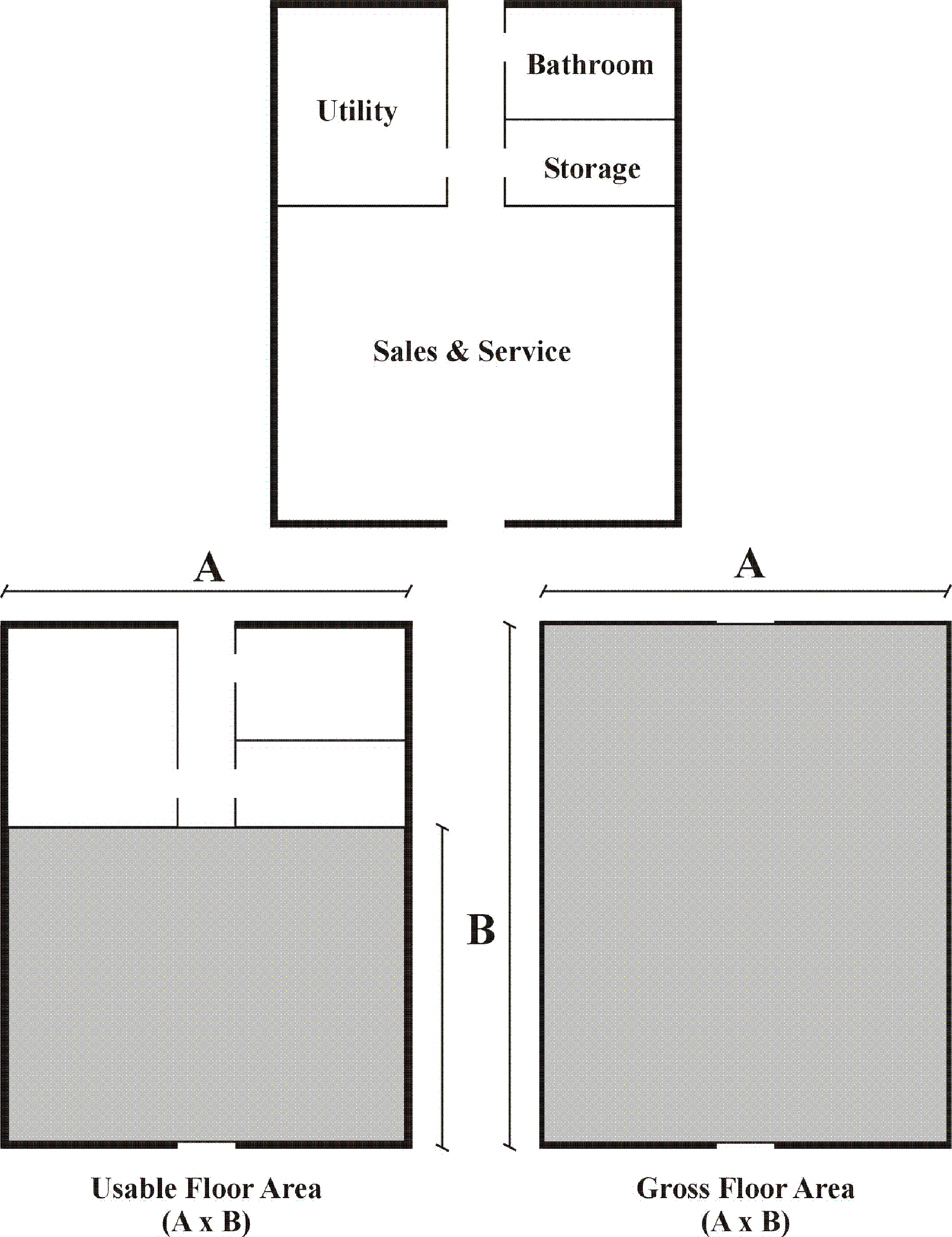
Floor Area, Gross and Usable
Floor area, gross: The sum of all gross horizontal areas of all floors of a building or buildings, measured from the outside dimensions of the outside face of the outside wall. Unenclosed courtyards or patios shall not be considered as part of the gross floor area except where they are utilized for commercial purposes, such as the outdoor sale of merchandise.
Floor area, residential: For the purpose of computing the minimum allowable floor area in a residential dwelling unit, the sum of the horizontal areas of each story of the building shall be measured from the exterior faces of the exterior walls or from the centerline of walls separating two buildings. The floor area measurement is exclusive of areas of basements, unfinished attics, attached garages, breezeways, and enclosed and unenclosed porches.
Floor area, usable (for the purpose of computing parking): That area used for or intended to be used for the sale of merchandise or services, or for use to serve patrons, clients, or customers. Such floor area which is used or intended to be used principally for the storage or processing of merchandise, hallways, or for utilities or sanitary facilities, shall be excluded from this computation of "usable floor area." Measurement of usable floor area shall be the sum of horizontal areas of the several floors of the building, measured from the interior faces of the exterior walls.
Floor area ratio: The floor area ratio shall be calculated as the ratio of the building floor area as a percentage of the lot area. Principal building floor area shall not include uninhabited attic space, basement, garage, accessory buildings or enclosed/unenclosed porches.
Frontage: The linear dimension of a lot measured along the public road right-of-way line, private road access easement, or shared driveway.
Section 2.04. - Definitions G—H.
Garbage: The word "garbage" shall be made to include every refuse, accumulation of all waste, animal, fish, fowl, fruit or vegetable matter incidental to the preparation, use, cooking, dealing in or storage of meat, fish, fowl, fruit and vegetables, including spoiled food, dead animals, animal manure and fowl manure.
Garage, private: An accessory building or portion of a main building designed or used solely for the storage of motor driven vehicles, boats, and similar vehicles owned and used by the occupants of the building to which it is accessory.
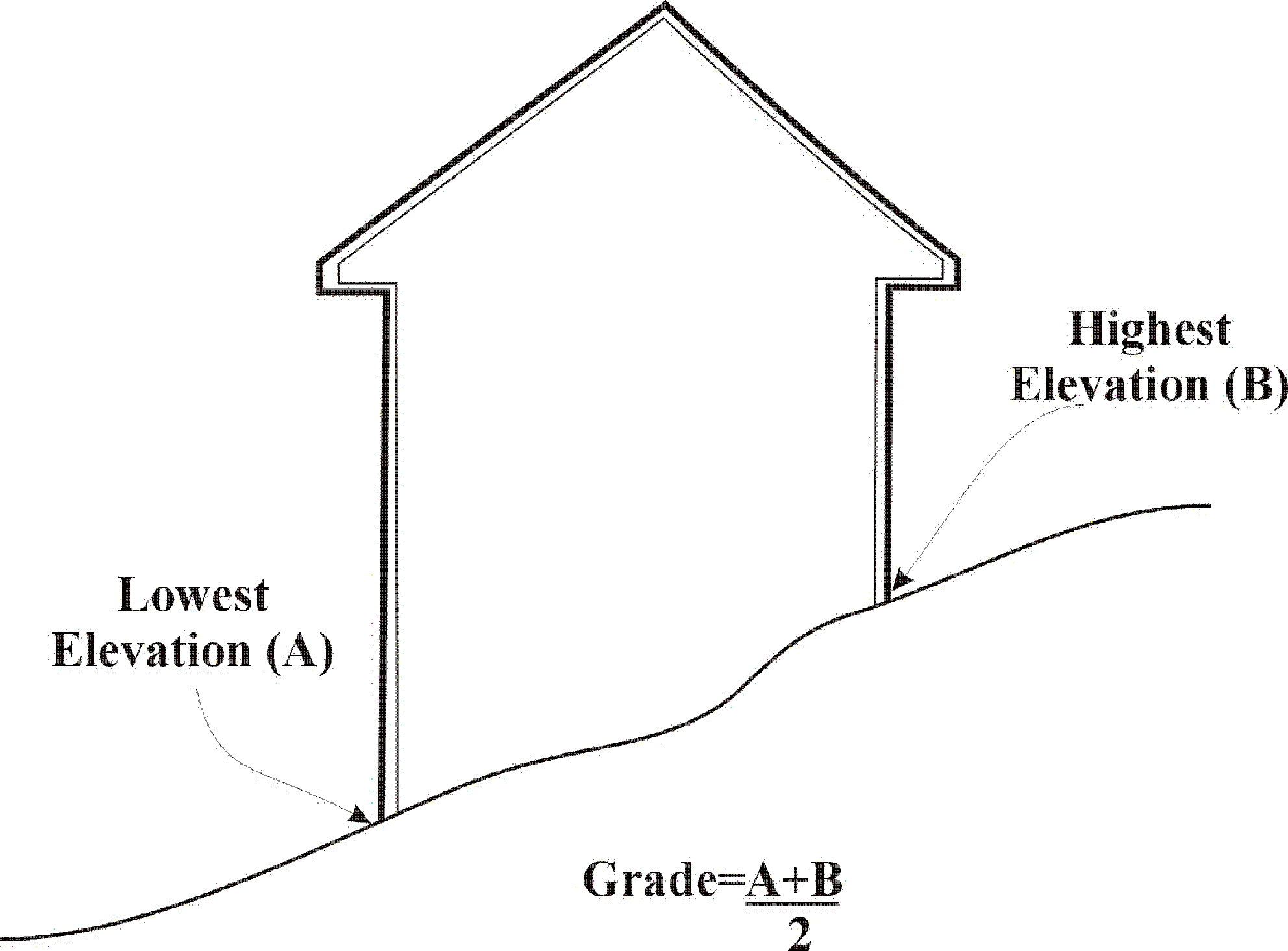
Grade
Grade: The ground elevation established for the purpose of regulating the number of stories and the height of buildings. The building grade shall be the level of the ground adjacent to the walls of the building if the finished grade is level. If the ground is not entirely level, the grade shall be determined by averaging the elevation of the ground for each face of the building.
Greenbelt: A strip of land of definite width and location reserved for the planting of shrubs and/or trees to serve as an obscuring screen or buffer strip in carrying out the requirements of this ordinance.
Gun club: Any club, organization, individual, group of individuals, or use (indoor or outdoor) whether operated for profit or not, which caters or allows the use of firearms.
Home occupation: An accessory use conducted within a permitted dwelling unit and customarily carried on by the inhabitants thereof, for gainful employment involving the manufacture, provision, or sale of goods and/or services.
Hospital: A building, structure, or institution in which sick or injured persons are given medical or surgical treatment and operating under license by the health department and the State of Michigan.
Hotel: A building or part of a building, with a common entrance or entrances, in which the dwelling units or rooming units are used primarily for transient occupancy. A hotel may include a restaurant or cocktail lounge, public banquet halls, ballrooms, or meeting rooms. One or more of the following services are offered:
A.
Maid service;
B.
Furnishing of linen;
C.
Telephone, secretarial, or desk service;
D.
Bellboy service.
Housing for the elderly: An institution other than a hospital or hotel, which provides room and board to non-transient persons primarily 60 years of age or older. Housing for the elderly may include:
A.
Senior apartments: Multiple-family dwelling units occupied by persons 55 years of age or older.
B.
Elderly housing complex: A building or group of buildings containing dwellings where the occupancy is restricted to persons 60 years of age or older or couples where either the husband or wife is 60 years of age or older.
C.
Congregate or interim care housing: A semi-independent housing facility containing congregate kitchen, dining, and living areas, but with separate sleeping rooms. Such facilities typically provide special support services, such as transportation and limited medical care.
D.
Convalescent home, nursing home, or rest home: A home for the care of the aged, infirm, or those suffering from bodily disorders, wherein two or more persons are housed or lodged and furnished with nursing care. Such facilities are licensed in accordance with Michigan Public Act 139 of 1956, as amended.
Section 2.05. - Definitions I—J.
Industrial use: Any land or building occupied or used for manufacturing or processing purposes.
Junk yard: An open area where waste, used or secondhand material are bought and sold, exchanged or secondhand material are bought and sold, exchanged, stored, baled, packed, disassembled, or handled including but not limited to scrap iron and other metals, paper rags, rubber tires, and bottles. A "junk yard" includes automobile wrecking yards and includes any area of more than 200 square feet for storage, keeping or abandonment of junk but does not include uses established entirely within enclosed buildings.
Section 2.06. - Definitions K—L.
Kennel, commercial: Any lot or premises on which three or more dogs, cats or other household pets, six months old or older, are either permanently or temporarily boarded for sale, breeding, boarding, or training purposes. Kennel shall also include any lot or premises where household pets are bred or sold.
Laboratory: A place devoted to experimental study such as testing and analyzing, but not devoted to the manufacturing of a product or products.
Loading space: An off-street space on the same lot with a building, or group of buildings for the temporary parking of a commercial vehicle while loading and unloading merchandise or materials.
Lot: A parcel of land, including a site condominium lot, occupied or intended to be occupied by a main building or a group of such buildings and accessory buildings, or utilized for the principal use and uses accessory thereto, together with such yards and open spaces as are required under the provisions of this ordinance. A lot may or may not be specifically designated as such on public records.
Lot, corner: A lot where the interior angle of two adjacent sides at the intersection of two streets is less than 135 degrees. A lot abutting upon a curved street or streets shall be considered a corner lot for the purposes of this ordinance if the arc is of less radius than 150 feet and the tangents to the curve, at the two points, where the lot lines meet the curve or the straight street line extended, form an interior angle of less than 135 degrees.
Lot, interior: Any lot other than a corner lot.
Lot of record: A parcel of land, the dimensions of which are shown on a document or map on file with the county register of deeds or in common use by city or county officials, and which actually exists as so shown, or any part of such parcel held in a record ownership separate from that of the remainder thereof.
Lot, through: Any interior lot having frontage on two more or less parallel streets as distinguished from a corner lot. In the case of a row of double frontage lots, all sides of said lots adjacent to streets shall be considered frontage, and front yards shall be provided as required.
Lot, zoning: A single tract of land, located within a single block, which, at the time of filing for a building permit, is designated by its owner or developer as a tract to be used, developed, or built upon as a unit, under single ownership or control.
A zoning lot shall satisfy this ordinance with respect to area, size, dimensions, and frontage as required in the district in which the zoning lot is located. A zoning lot therefore, may not coincide with a lot of record as filed with the County Register of Deeds, but may include one or more lots of record.
Lot area: The total horizontal area within the lot lines of the lot.
Lot coverage: The part or percent of the lot occupied by buildings including accessory buildings and other impervious areas such as paved areas.
Lot depth: The horizontal distance between the front and rear lot lines, measured along the median between the side lot lines.
Lot lines: The lines bounding a lot as defined herein:
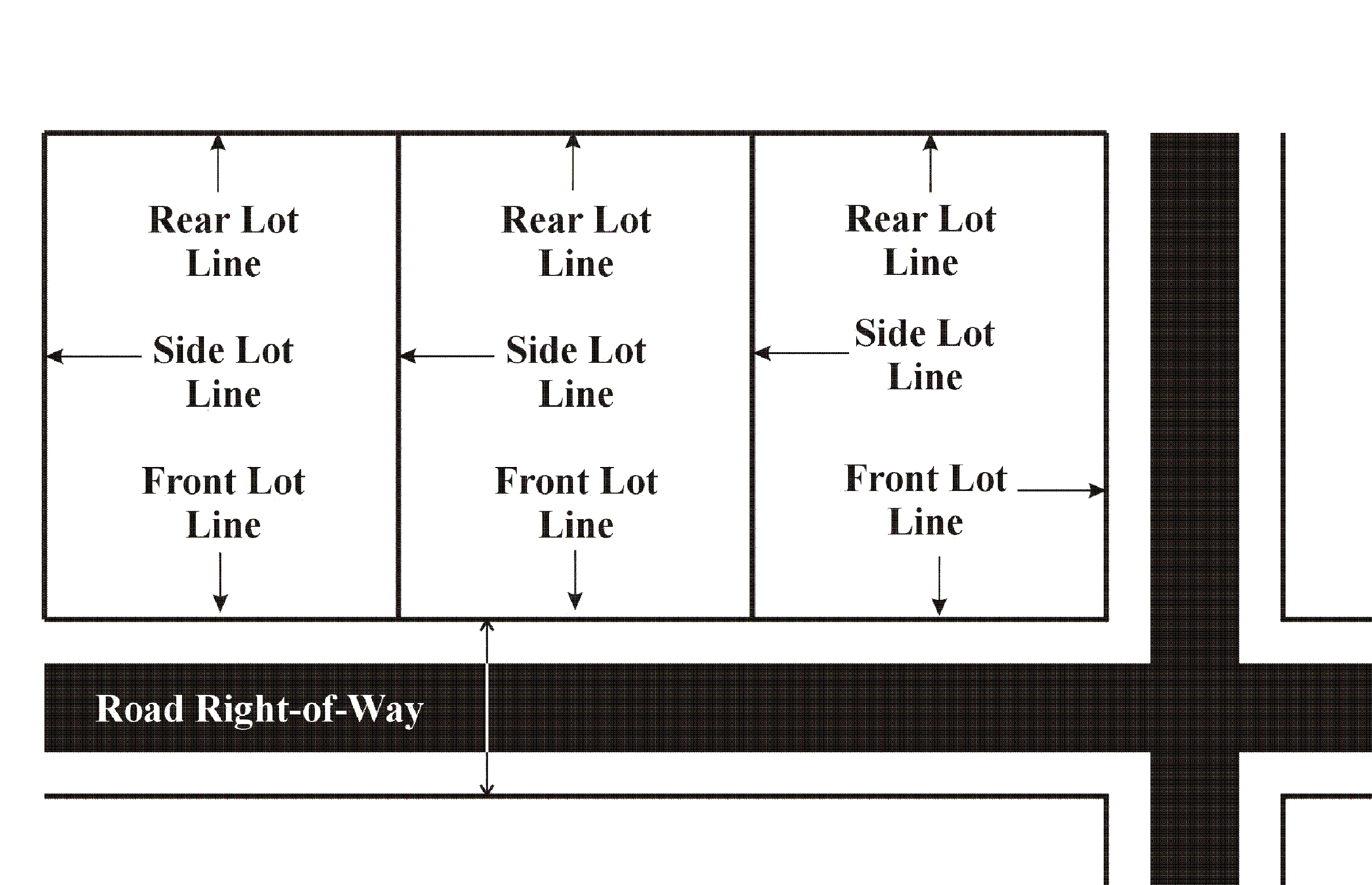
Lot Lines
A.
Front lot line: In the case of an interior lot, it is that line separating said lot from the street. In the case of a corner lot, or through lot, it is that line separating said lot from any street.
B.
Rear lot line: That lot line opposite the front lot line. In the case of a lot pointed at the rear, the rear lot line shall be an imaginary line parallel to the front lot line, not less than ten feet long lying farthest from the front lot line and wholly within the lot. In the case of a corner lot, the rear lot line if the lot line furthest from one of the front lot lines. In the case of a through lot, there shall be three front lot lines and one side lot line and no rear lot line.
C.
Side lot line: Any lot line other than the front lot line or rear lot line.
Lot width: The horizontal distance between the side lot lines, measured at the two points where the building line, or setback line intersects the side lot lines.
Section 2.07. - Definitions M—N.
Main building: A building in which is conducted the principal use of the lot upon which it is situated.
Manufactured home: A factory-built, single-family structure, which is manufactured or constructed under authority of 42 U.S.C. Sec. 5403, Federal Manufactured Home Construction and Safety Standards, and is to be used as a place for human habitation, but which is not constructed with a permanent hitch or other device allowing it to be moved other than for the purpose of moving to a permanent site and which does not have permanently attached to its body or frame any wheels or axles. A modular home is a manufactured home but a mobile home is not. For the purpose of this ordinance, a manufactured home shall be considered the same as any site-built, single-family detached dwelling.
Manufactured home community: A parcel or tract of land under the control of a person upon which three or more manufactured homes are located on a continual non-recreational basis and which is offered to the public for that purpose regardless of whether a charge is made therefore, together with any building, structure, enclosure, street, equipment, or facility used or intended for use incident to the occupancy of a manufactured home, subject to conditions set forth in the Mobile Home Commission Rules and Michigan Public Act 419 of 1976, as amended.
Manufactured home lot: An area within a manufactured home community which is designated for the exclusive use of a specific manufactured home.
Manufactured housing development, planned: A planned unit development which includes manufactured dwelling units in which a concept plan is included with a rezoning to achieve integration with the characteristics of the project area.
Master plan: The adopted comprehensive plan including graphic and written proposals indicating the general location for streets, parks, schools, public buildings, and all physical development of the municipality, and includes any unit or part of such plan, and any amendment to such plan or parts thereof.
Medical clinic: An establishment where human patients who are not lodged overnight are admitted for examination and treatment by one or more physicians, dentists, or similar professions working in cooperation.
Mezzanine: An intermediate floor in any story occupying not to exceed one-third of the floor area of such story.
Migratory labor camp: Temporary facilities provided for the housing of workers who for seasonal purposes are employed in the planting, harvesting, or processing of crops, or for other essential, but temporary employment.
Modular home: A factory-built home which meets all of the following requirements: is designed only for erection or installation on a site-built permanent foundation; is not designed to be moved once so erected or installed; is designed and manufactured to comply with a nationally recognized model building code or an equivalent local code, and recognized as generally equivalent to site-built housing and is not intended to be used other than on a site built permanent foundation.
Motel: A series of attached, semi-detached rental units containing a bedroom, bathroom and closet space. Units shall provide for overnight lodging and are offered to the public for compensation, and shall cater primarily to the public traveling by motor vehicle.
Municipality: The City of Swartz Creek.
Natural features: Any one or more of the following: soils, topography, geology, vegetation, woodlands, hedgerow, historic/landmark tree, animal-life, endangered species habitat, floodplain, watercourse, lakes, rivers, streams, creeks, ponds, wetland, groundwater, watersheds, aesthetic resources, such as views, and microclimate, which is influenced by site topography and vegetation.
Non-conforming buildings or structures: A building or structure or portion thereof lawfully existing at the effective date of this ordinance, or amendments thereto and that do not conform to the provisions of the ordinance in the district in which it is located.
Non-conforming lot: A lot that was lawfully in existence at the effective date of this ordinance, or amendments thereto, which lot does not meet the minimum area or lot dimensional requirements of the zoning district in which the lot is located.
Non-conforming use: A use which lawfully occupied a building or land at the effective date of this ordinance, or amendments thereto and that does not conform to the use regulations of the district in which it is located.
Nursery: A space, building or structure, or combination thereof, for the storage of live trees, shrubs or plants offered for retail sale on the premises including products used for gardening or landscaping. The definition of nursery within the meaning of this ordinance does not include any space, building or structure used for the sale of fruits, vegetables or Christmas trees.
Nuisance factors: An offensive, annoying, unpleasant, or obnoxious thing or practice, a cause or source of annoyance, especially a continuing or repeating invasion of any physical characteristics of an activity or use across a property line which can be perceived by or affect a human being, or the generation of an excessive or concentrated movement of people or things such as: (a) noise, (b) dust, (c) smoke, (d) odor, (e) glare, (f) fumes, (g) flashes, (h) vibration, (i) shock waves, (j) heat, (k) electronic or atomic radiation, (l) objectionable effluent, (m) noise of congregation of people, particularly at night, (n) passenger traffic, (o) invasion of non-abutting street frontage by traffic.
(Ord. No. 407, § 1, 5-24-11; Ord. No. 431, § 1, 12-12-16)
Section 2.08. - Definitions O—P.
Occupied: Includes the meaning of intent, design or arranged for occupancy.
Occupancy load: The number of individuals normally occupying a building or part thereof, or for which the existing facilities have been designed.
Off-street parking lot: A facility providing vehicular parking spaces along with adequate drives and aisles, for maneuvering, so as to provide access for entrance and exit for the parking of more than three vehicles.
Open front store: A business establishment so developed that service to the patron may be extended beyond the walls of the structure not requiring the patron to enter the structure. The term "open front store" shall not include automobile repair stations or automobile service stations.
Open space: For the purposes of this ordinance, open space shall apply to the improved dedicated or reserved area to be used for leisure or active recreation purposes. That part of a lot, which is open and unobstructed by any built features from its lowest level to the sky, and is accessible to all residents upon the lot. This area is intended to provide light and air, and is designed for environmentally, scenic, or recreational purposes. Open space may include, but is not limited to lawns, decorative plantings, walkways, active and passive recreation areas, playgrounds, fountains, swimming pools, living plant materials, wetlands and water courses. Open space shall not be deemed to include driveways, parking lots or other surfaces designed or intended for vehicular travel. Areas qualifying as open space within a PUD shall be more narrowly defined and shall exclude submerged lands and golf courses.
Outdoor dining: Outdoor dining is permitted in Swartz Creek only as accessory uses to the main use of a property as a restaurant. As such, the outdoor dining area must be adjacent to the main use, either on private property or on a public sidewalk. Outdoor cafes consist of tables and chairs, placed for the consumption of food by customers. Service may be self-service or by a waiter.
Parking space: An area of definite length and width. Said area shall be exclusive of drives, aisles or entrances giving access thereto, and shall be fully accessible for the storage or parking of permitted vehicles.
Pond, detention: A designed (although may be a natural area) facility which stores and detains runoff and releases water at a controlled rate. Size will depend on the design storm event (ten-, 25-, 100-year storm). These basins may be dry between runoff events or may be "wet bottom," where a base water level occurs below the elevation of the outlet structure.
Pond, retention: A storm water management facility, either natural or manmade, which does not have an outlet, which captures and holds runoff directed into it.
Principal use: The principal use to which the premises are devoted and the principal purpose for which the premises exist.
Public service: Public service facilities within the context of this ordinance shall include such uses and services as voting booths, pumping stations, fire halls, police stations, temporary quarters for welfare agencies, public health activities and similar uses including essential services.
Public utility: A person, firm, or corporation, municipal department, board or commission duly authorized to furnish and furnishing under federal, state or municipal regulations to the public: gas, steam, electricity, sewage disposal, communication, telegraph, transportation, or water.
(Ord. No. 434, § 1, 10-8-18)
Section 2.09. - Definitions Q—R.
Recreational vehicle: "Recreational vehicles" shall include the following:
A.
Travel trailer: A portable vehicle on a chassis, which is designed to be used as a temporary dwelling during travel, recreational, and vacation uses, and which may be identified as a "travel trailer" by the manufacturer. Travel trailers generally contain sanitary, water, and electrical facilities.
B.
Pickup camper: A structure designed to be mounted on a pickup or truck chassis with sufficient equipment to render it suitable for use as a temporary dwelling during the process of travel, recreational, and vacation uses.
C.
Motor home: A recreational vehicle intended for temporary human habitation, sleeping, and/or eating, mounted upon a chassis with wheels and capable of being moved from place to place under its own power. Motor homes generally contain sanitary, water, and electrical facilities.
D.
Folding tent trailer: A folding structure mounted on wheels and designed for travel and vacation use.
E.
Boats and boat trailers: "Boats" and "boat trailers" shall include boats, floats, rafts, canoes, plus the normal equipment to transport them on the highway.
F.
Other recreational equipment: Other recreational equipment includes snowmobiles, all terrain or special terrain vehicles, utility trailers, plus normal equipment to transport them on the highway.
Restaurant: Any establishment whose principal business is the sale of food and beverages to the customer in a ready-to-consume state, and whose method of operation is characteristic of a carry-out, drive-in, drive-through, fast food, standard restaurant, or bar/lounge, or combination thereof, as defined below:
A.
Restaurant, carry out: A business establishment whose method of operation involves sale of food, beverages, and/or frozen desserts in disposable or edible containers or wrappers in a ready-to-consume state for consumption primarily off the premises.
B.
Delicatessen: A restaurant typically offering sandwiches and other foods and beverages for both carry-out and consumption on the premises. A delicatessen also typically offers meats, cheese and prepared foods on a retail basis.
C.
Restaurant, drive-in: A business establishment whose method of operation involves delivery of prepared food so as to allow its consumption in a motor vehicle or elsewhere on the premises, but outside of an enclosed building. A drive-in restaurant may also have interior seating.
D.
Restaurant, drive-through: A business establishment whose method of operation involves the delivery of the prepared food to the customer in a motor vehicle, typically through a drive-through window, for consumption off the premises.
E.
Restaurant, fast-food: A business establishment whose method of operation involves minimum waiting for delivery of ready-to-consume food to the customer at a counter or cafeteria line for consumption at the counter where it is served, or at tables, booths, or stands inside the structure or out, or for consumption off the premises, but not in a motor vehicle at the site.
F.
Restaurant, open front window: See "open front store or restaurant."
G.
Restaurant, standard: A business establishment whose method of operation involves either the delivery of prepared food by waiters and waitresses to customers seated at tables within a completely enclosed building or the prepared food is acquired by customers at a cafeteria line and is subsequently consumed by the customers at tables within a completely enclosed building.
H.
Bar/lounge/tavern: A type of restaurant which is operated primarily for the dispensing of alcoholic beverages, although the sale of prepared food or snacks may also be permitted. If a bar or lounge is part of a larger dining facility, it shall be defined as that part of the structure so designated or operated. The hours of operation may extend beyond 11:00 p.m.; thereby differentiating it from a standard restaurant. A brewpub or microbrewery that operates beyond 11:00 p.m. is considered a bar, tavern or lounge.
Restaurant, pick-up window: A standard restaurant with an additional method of operation involving the delivery of prepared food to the customer in a motor vehicle, through a pick-up window, for consumption off premises. Outdoor menu boards, ordering capabilities, speakers, and/or electronic or remote communication with restaurant staff from outside the building are not permitted. All orders shall be placed by phone or ordered on-line in advance of window pick-up.
Roadside stands or markets: A roadside stand or market is the temporary use of property or facilities for the selling of produce.
Room: For the purpose of determining lot area requirements and density in a Multiple-Family District, a living room, dining room and bedroom, equal to at least 80 square feet in area. A room shall not include the area in kitchen, sanitary facilities, utility provisions, corridors, hallways, and storage. Plans showing one-, two-, or three-bedroom units and including a "den," "library" or other extra room shall count such extra room as a bedroom for the purpose of computing density.
Row house: A row of houses having at least one sidewall in common with a neighboring dwelling, and usually uniform or nearly uniform plans, fenestration, and architectural treatment.
Rubbish: Rubbish means the miscellaneous waste materials resulting from housekeeping, mercantile enterprises, trades, manufacturing and offices, including other waste matter such as slag, stone, broken concrete, fly ash, ashes, tin cans, glass, etc.
Recyclable items: Recyclable items are items such as newspapers, magazines, books, and other paper products; glass, metals cans; and other products, that can be recycled, reprocessed, and treated to return such products to a condition in which they may again be used in new products.
(Ord. No. 434, § 2, 10-8-18)
Section 2.10. - Definitions S—T.
School, charter (public school academy): A charter school or public school academy is a public school and a school district, and is subject to the leadership and general supervision of the state board over all public education. A public school academy is authorized by the executive action of an authorizing body which may be the board of a school district, an intermediate school board, or the board of a community college or a state public university. A charter school shall not be organized by a church or other religious organization.
School, home: Home school enables a child to be educated at the child's home by his or her parent or legal guardian in an organized educational program in the subject areas of reading, spelling, mathematics, science history, civics, literature, writing and English grammar. The home school family may choose whether to operate as a nonpublic school. If a home school family chooses to operate as a nonpublic school, it must register with the Michigan Department of Education.
School, non-public: A non-public school is any school other than a public school giving instruction to children below the age of 16 years and not under the exclusive supervision and control of the officials having charge of the public schools of the state. Non-public schools include private, denominational, and parochial schools.
School, public: A public school is a public elementary or secondary educational entity or agency that has as its primary mission the teaching and learning of academic and vocational-technical skills and knowledge, and is operated by a school district, local act school district, special act school district, intermediate school district, public school academy corporation, public state university, or by the department or state board.
Setback: The distance between a front, side, or rear lot line and the nearest supporting member of a structure on the lot. Setbacks shall be measured from the public or private road right-of-way line or shared driveway easement.
Setback, required: The minimum distance established by this ordinance to conform to the required setback provisions of the district in which the lot is located.
Storm water management plan: A plan that includes calculations on the increased storm water run-off to be created by the development or redevelopment of a property and the facilities that will be used to contain the pre- and post-development or redevelopment run-off.
Storm water detention basin/storm water control structure: A structure designed and constructed for the detention and/or treatment of storm water.
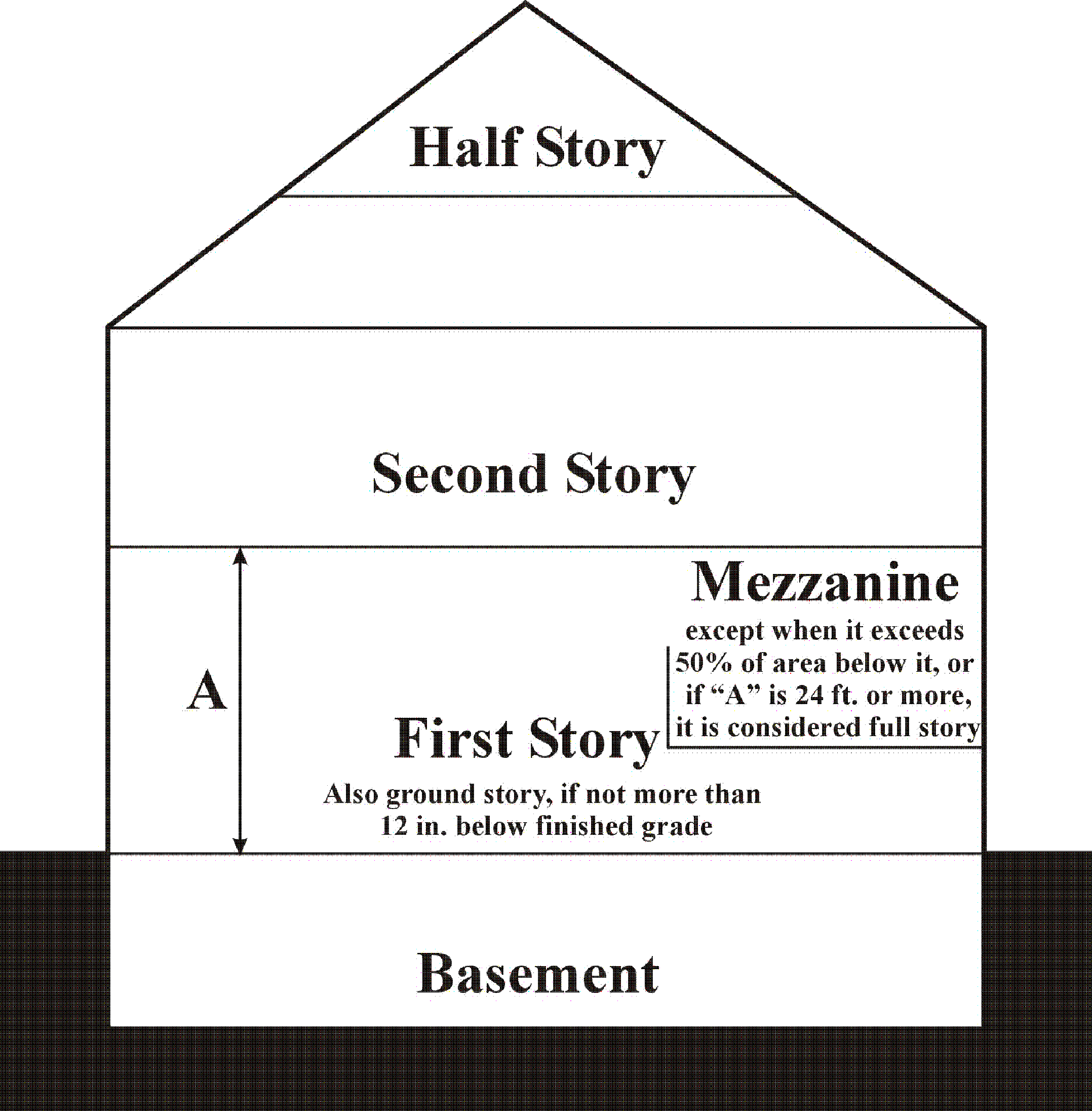
Illustration of Stories
Story: That part of a building, except a mezzanine as defined herein, included between the surface of one floor and the surface of the next floor, or if there is no floor above, then the ceiling next as above. A story thus defined shall not be counted as a story when more than 50 percent, by cubic content, is below the height level of the adjoining ground.
Story, half: An uppermost story lying under a sloping roof having an area of at least 200 square feet with a clear height of seven feet six inches. For the purpose of the ordinance the usable floor area is only that area having at least four feet clear height between floor and ceiling.
Street: A public dedicated right-of-way, other than alley, which affords the principal means of access to abutting property. Various types of streets are defined as follows:
A.
Alley. Any dedicated public way affording a secondary means of access to abutting property, and not intended for general traffic circulations.
B.
Arterial street. A street which carries high volumes of traffic at relatively high speeds, and serves as an avenue for circulation of traffic onto, off of, or around the city. An arterial street may also be defined as a major thoroughfare, major arterial, minor arterial or county primary road. Since the primary function of the arterial is to provide mobility, access to adjacent land uses may be controlled to optimize capacity along the roadway.
C.
Collector road. A street whose principal function is to carry traffic between minor and local roads and arterial roads but may also provide direct access to abutting properties.
D.
Cul-de-sac. A street that terminates in a vehicular turnaround.
E.
Local or minor street. A street whose principal function is to provide access to abutting properties and is designed to be used or is used to connect minor and local streets with collector or arterial streets. Local streets are designed for low volumes and speeds of 25 mph or less, with numerous curb cuts and on-street parking permitted.
F.
Public street. Any street or portion of a street which has been dedicated to and accepted for maintenance by Swartz Creek, Genesee County, State of Michigan or the federal government.
G.
Service drive. An access street which parallels the public right-of-way in front of or behind a building or buildings or may be aligned perpendicular to the street between buildings, which provides shared access between two or more lots or uses.
Structure: Anything constructed or erected, the use of which requires location on the ground or attachment to something having location on the ground.
Structurally attached: A structural member or support integrally connecting two separate detached buildings or structures exists, which may be a breezeway, roof, or partition wall, other than an abutting fence or wall not exceeding six feet in height. A motor vehicle or a semi-trailer or other type of truck conveyance may not be so attached to a building or structure.
Swimming pool: For the purposes of this ordinance a swimming pool shall be any receptacle utilized for holding water which has a water depth greater than two feet.
Temporary use or building: A use or building to exist during an established and limited period of time.
Tents: Tents as used in this ordinance shall not include those used solely for children's recreational purposes.
Terrace home: One of a row of houses situated on or near the top of a slope.
Trailer coach (motor home): Any vehicle designed, used, or so constructed as to permit its being used as a conveyance upon the public streets or highways and duly licensable as such, and constructed in such a manner as will permit occupancy thereof as a dwelling or sleeping place for one or more persons.
Trailer court (motor home park): Any plot of ground upon which two or more trailer coaches, occupied for dwelling or sleeping purposes are located.
Travel trailer: A vehicle designed as a travel unit for occupancy as a temporary or seasonal living unit and not exceeding 200 square feet in area.
Thoroughfares, major: A street identified as a "principal arterial" or "minor arterial" in the city's master plan. These streets are intended to serve as large volume traffic ways for both the immediate city area and the region beyond.
Thoroughfares, secondary: A street identified as a "collector" in the city's master plan. These streets are intended as traffic ways serving primarily the immediate city area and serving to connect with major thoroughfares.
Tourist home: Any dwelling used or designed in such a manner that certain rooms other than those used by the family, and occupied as a dwelling unit are related to the public for compensation and shall cater primarily to the public traveling by motor vehicle.
Townhouses: A residential structure, or group of structures, each of which contains three or more attached single-family dwelling units with individual rear yards and or front yards designed as an integral part of each single-family dwelling unit.
Section 2.11. - Definitions U—W.
Use: The principal purpose for which land or a building is arranged, designed or intended, or for which land or a building is or may be occupied.
Use, accessory: A use subordinate to the main use of a lot and used for purposes clearly incidental to those of the main use.
Utility room: A utility room is a room used primarily for storage, for housing a heating unit, or for laundry purposes.
Variance, dimensional: Permission to depart from the literal requirements relating to setbacks, building height, lot width, and/or lot area as regulated by this ordinance.
Variance, use: Permission to establish a use of land that is otherwise not provided for in the zoning district as regulated by this ordinance.
Section 2.12. - Definitions W—X.
Wading pool: For the purposes of the ordinance a wading pool shall be any receptacle utilized for holding water which has a water depth not exceeding two feet.
Walls, obscuring: An obscuring structure of definite height and location constructed of wood, masonry, concrete or similar material.
Waterway: Any natural or open artificial watercourse, diversion, lake, pond, stream, river, creek, ditch, channel, canal conduit, culvert, drain, gully, ravine or wash in which waters may flow in a definite direction or course, either continuously or intermittently, and which has a definite channel, bed and banks and shall include the floodplain.
Wetland: Any land characterized by the presence of water at a frequency and duration sufficient to support (and that under normal circumstances does support) wetland vegetation or aquatic life and is commonly referred to as a bog, swamp, or marsh.
Wireless communication facilities: All structures and accessory facilities relating to the use of the radio frequency spectrum for the purpose of transmitting or receiving radio signals. This may include, but shall not be limited to, radio towers, television towers, telephone devices, personal communication transmission equipment and exchanges, microwave relay towers, telephone transmission equipment building and commercial mobile radio service facilities. This definition does not include "reception antenna" for an individual lot as otherwise defined and regulated in this ordinance.
A.
Attached wireless communication facilities: Wireless communication facilities affixed to existing structures, including but not limited to existing buildings, towers, water tanks, or utility poles.
B.
Wireless communication support structures: Structures erected or modified to support wireless communication antennas. Support structures within this definition include, but shall not be limited to, monopoles, lattice towers, light poles, wood poles and guyed towers, or other structures which appear to be something other than a mere support structure.
C.
Co-location: Location by two or more wireless communication providers of wireless communication facilities on a common structure, tower, or building, to reduce the overall number of structures required to support wireless communication antennas in the city.
Section 2.13. - Definitions Y—Z.
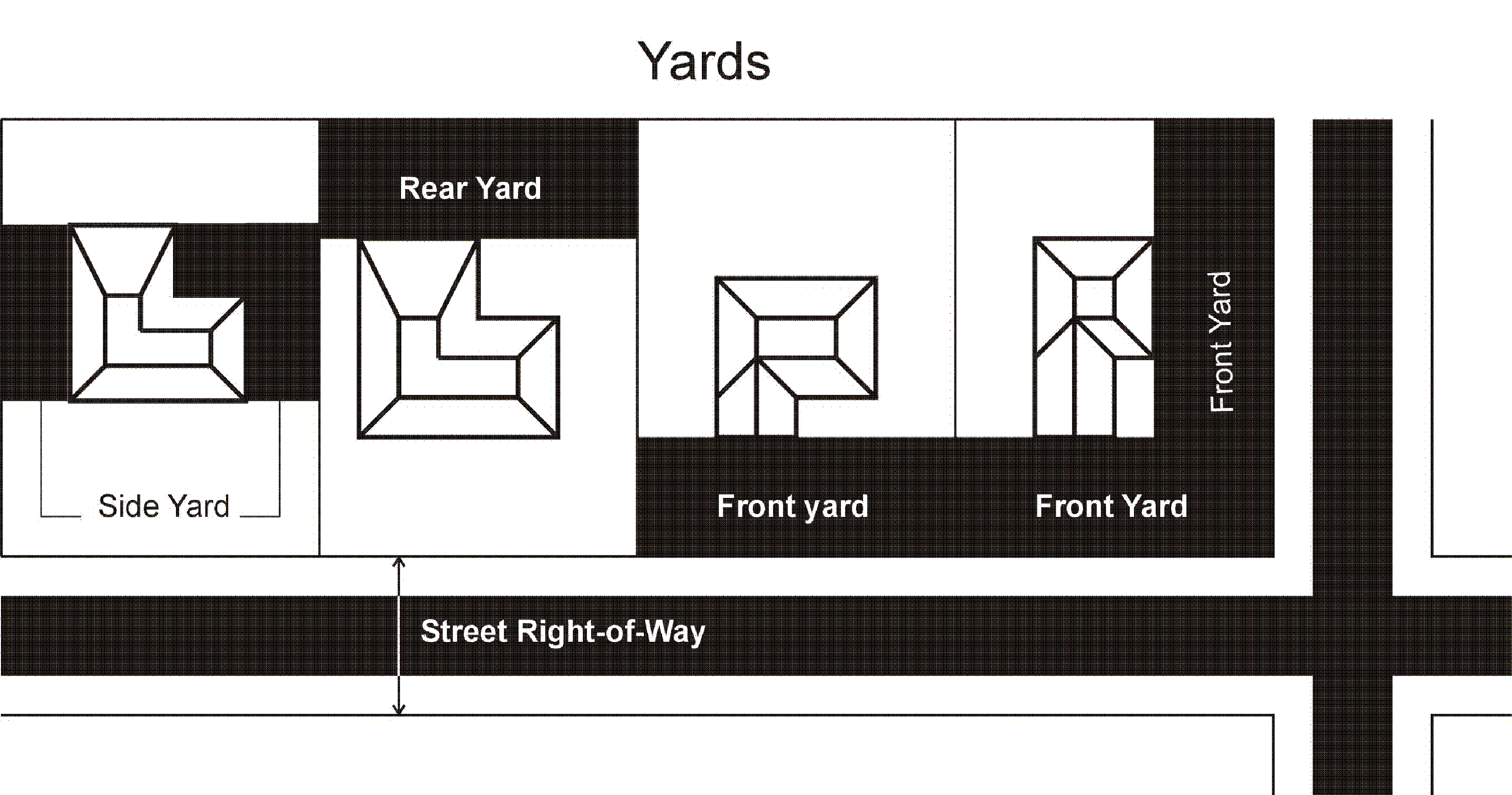
Yards: The open spaces on the same lot with a main building, unoccupied and unobstructed from the ground upward except as otherwise provided in this ordinance, and as defined herein:
Yards
A.
Front yard: An open space extending the full width of the lot, the depth of which is the minimum horizontal distance between the front lot line and the nearest point of the main building. Unless otherwise stipulated in this ordinance, in the case of a corner lot, there shall be two front yards.
B.
Rear yard: An open space extending the full width of the lot the depth of which is the minimum horizontal distance between the rear lot line and the nearest point of the main building. In the case of a corner lot, the rear yard is the yard opposite the shorter of the street frontages.
C.
Side yard: An open space between a main building and the side lot line, extending from the front yard to the rear yard the width of which is the horizontal distance from the nearest point on the side lot line to the nearest point of the main building.
Zoning Act: The Michigan Zoning Enabling Act (Public Act 110 of 2006).
Zoning administrator: The zoning administrator (or similar title) designated by the Swartz Creek City Council responsible for duties as established herein.
Zoning board of appeals (ZBA): The Swartz Creek Board of Appeals, created pursuant to the provisions of The Michigan Zoning Enabling Act (Public Act 110 of 2006).

