
Tempe City Zoning Code
PART 3
- LAND USE
Section 3-101 - Purpose and Applicability.
A.
Purpose. The residential districts are designed to provide neighborhoods with a range of housing densities. The differences in these housing densities and regulations are intended to support the varying lifestyles of the City's residents. The districts provide for a range of residential habitation including rural-agricultural, single-family, multi-family, mobile home, and combinations thereof, together with home occupations, schools, parks, and public services necessary for neighborhood living.
B.
Applicability. Residential zoning districts fall under three (3) categories:
1.
Single-Family Residential (AG, R1-15, R1-10, R1-8, R1-7, R1-6, R1-5, R1-4 and R1-PAD);
2.
Multi-Family Residential (R-2, R-3R, R-3, R-4, R-5); and
3.
Mobile Home (RMH, MHS and TP).
C.
Applicability of Other Code Chapters. Uses permitted under this chapter shall conform to the development standards in Part 4 and the application procedures in Part 6, as applicable. Uses shall also conform to any overlay district requirements that are applicable. Uses permitted with special standards or limitations ("S" type uses) shall comply with the standards in Part 3, Chapter 4, Special Use Standards. See also, Zoning Administrator Opinions in Appendix H.
City Code reference—See TCC § 14A, Historic Preservation Ordinance.
Section 3-102 - Permitted Uses in Residential Districts.
Table 3-102 identifies land uses according to permit status. See key below the table:
Key:
P = Permitted
S = Permitted with special standards or limitations
U = Use permit required
N = Not permitted
AG = Agriculture districts
SFR = Single-family districts
MF = Multi-family districts
MH = Mobile home district
RMH = Mobile Home Residence
TP = Trailer Park
(Ord. No. 2009.15, 10-22-2009; Ord. No. 2010.17, 7-1-2010; Ord. No. 2011.20, 8-18-2011; Ord. No. 2014.69, 12-4-2014; Ord. No. O2019.08, 4-11-2019; Ord. No. O2019.53, 12-12-2019; Ord. No. O2021.09, 2-11-2021; Ord. No. O2021.22, 6-10-2021; Ord. No. O2121.44, 10-14-2021; Ord. No. O2022.27, 9-8-2022; Ord. No. O2024.51, 11-21-2024; Ord. No. O2024.51, 11-21-2024; Ord. No. O2024.57, 12-19-2024; Ord. No. O2024.60, 12-19-2024; Ord. No. O2025.23, 7-1-2025)
Section 3-201 - Purpose and Applicability.
A.
Purpose. The commercial and mixed-use districts are established to provide a mixture of complimentary land uses including retail, offices, commercial services, Public Universities, Public University related uses, civic uses, and housing. These districts are intended to create economic and social vitality and to encourage trip reduction; and encourage pedestrian circulation as an alternative to driving and provide employment and housing options.
B.
Applicability. Commercial and mixed-use districts fall under the following categories:
1.
Residential/Office (R/O). The R/O district allows professional and administrative services, live-work, and limited retail uses on small parcels located between higher intensity commercial and multi-use zones and residential zones;
2.
Commercial Shopping and Services (CSS) (previously designated as CCR, C-1 and C-2 districts). The CSS district is intended to meet the daily shopping and service needs of Tempe's neighborhoods;
3.
City Center (CC) (previously designated as CCD). The CC district fosters employment and livability in Tempe's City Center (generally bounded by Rio Salado Parkway to the North, the railroad tracks to the West, University Drive to the South and College Avenue to the East). This area constitutes Tempe's Defined Central Business District, as described in A.R.S. § 9-462.13,by providing retail, offices, moderate- and high- density residential uses, entertainment, civic uses, and cultural exchange in a mixed-use environment that supports the public investment in transit and other public facilities and services. This district may also be considered mixed-use when the design provides a mix of uses for the purposes of implementing the General Plan Land Use;
4.
Planned Commercial Center (PCC-1, PCC-2). The PCC districts are for neighborhood (PCC-1) or general (PCC-2) retailing, services and entertainment uses oriented to serve the needs of the neighborhood, community or the metropolitan region. Residential uses may be allowed subject to a use permit for the purpose of revitalizing an existing commercial center;
5.
Regional Commercial Center (RCC). The RCC district provides regional shopping facilities in locations deemed appropriate to serve large demographic areas; and
6.
Mixed-Use Commercial and Residential [MU-1, MU-2, MU-3, MU-4 (MU-4 previously designated as MG)]. All MU zone districts require the integration of commercial and residential uses to support pedestrian circulation and transit as alternates to driving, and to provide employment and housing options. MU districts allow a range of development intensities and uses including, but not limited to: personal and professional services, institutional and civic uses, retail, multi-family dwellings, attached single-family dwellings, and mixed-usebuildings and building sites. All mixed-use districts require a PAD Overlay for processing.
a.
The MU-1 district allows low to medium density housing to be combined with commercial, office and public uses that serve the neighborhood. Residential uses are allowed up to ten (10) units per acre. Permitted commercial uses are limited to those that are compatible with low to medium density housing.
b.
The MU-2 district allows medium density housing to be combined with commercial, office and public uses that serve the neighborhood. Residential uses are allowed up to fifteen (15) units per acre. Permitted commercial uses include those that are allowed in the MU-1 district, and some hotels, motels and lodging when approved with a use permit.
c.
The MU-3 district allows medium to high density housing to be combined with commercial, office and public uses that serve the neighborhood and/or community. Residential uses are allowed up to twenty-five (25) units per acre. Permitted commercial uses include those that are allowed in the MU-1 and MU-2 districts, and hotels and motels (permitted); and hospitals, commercial parking, and retail, and restaurant uses with drive through facilities when approved with a use permit.
d.
The MU-4 district (previously designated as MG district) allows unlimited housing density in a mixed-use setting with commercial, office, and public uses. Developmentintensity in the MU-4 district isestablished through the PAD Overlay process and must be consistent with the General Plan and the City's ability to provide public facilities.
7.
Mixed Use Educational (MU-Ed). Only properties owned by a public university may utilize the MU-Ed zoning district and the Joint Review Committee processing. In the event MU-Ed zoned land ownership is transferred by the public university to another entity that is not a public university, either the public university or the new entity shall apply to the City for the appropriate zoning classification. In no event shall the MU-Ed criteria, standards, or process be available to an entity other than a public university. However, if MU-Ed zoned land is leased to an entity that is not a Public University, Improvements on such land shall be subject to the MU-Ed Zoning District regulations and process.
C.
Applicability of Other Code Chapters. Uses permitted under this chapter shall conform to the development standards in Part 4 and the application procedures in Part 6, as applicable. Uses shall also conform to any overlay district requirements that are applicable. Uses permitted with special standards or limitations ("S" type uses) shall comply with the standards in Part 3, Chapter 4, Special Use Standards. Zoning Administrator opinions may also apply. See Appendix H. Commercial Use, Residential Use and Mixed-Use development within the MU-Ed district shall conform to the design review criteria as adopted by ASU and applicable Development Standards in Part 4. The Joint Review Committee will determine the criteria to be applied. Uses permitted under this chapter shall utilize the applications and review procedures in Part 6.
(Ord. No. 2005.47, 8-18-2005; Ord. No. O2121.44, 10-14-2021; Ord. No. O2025.45, 11-6-2025, effective 1-1-2026)
City Code reference — See TCC § 14A, Historic Preservation Ordinance.
Section 3-202 - Permitted Uses in Commercial and Mixed-Use Districts
Table 3-202A identifies land uses according to permit status. See key below the table:
Key:
P = Permitted
S = Permitted with special standards or limitations
U = Use permit required
N = Not permitted
R/O = Residential/Office
(a) Security plan required. See Section 6-313.
CSS = Commercial Shopping and Services (previously designated as CCR, C-1, C-2 districts)
CC = City Center (previously designated as CCD)
PCC-1 = Planned Commercial Center Neighborhood
PCC-2 = Planned Commercial Center General
RCC = Regional Commercial Center
(Ord. No. O2022.27, 9-8-2022; Ord. No. O2025.23, 7-1-2025)
Key:
P = Permitted
S = Permitted with special standards or limitations
U = Use permit required
N = Not permitted
R/O = Residential/Office
(a) Security plan required. See Section 6-313.
CSS = Commercial Shopping and Services (previously designated as CCR, C-1, C-2 districts)
CC = City Center (previously designated as CCD)
PCC-1 = Planned Commercial Center Neighborhood
PCC-2 = Planned Commercial Center General
RCC = Regional Commercial Center
(Ord. No. 2005.47, 8-18-2005; Ord. No. 2005.90, 12-1-2005; Ord. No. 2005.91, 2005.94, 12-1-2005; Ord. No. 2006.82, 1-4-2007; Ord. No. 2007.36, 6-28-2007; Ord. No. 2007.74, 12-13-2007; Ord. No. 2009.15, 10-22-2009; Ord. No. 2010.17, 7-1-2010; Ord. No. 2011.01, 1-27-2011; Ord. No. 2011.20, 8-18-2011; Ord. No. 2005.47, 8-18-2005; Ord. No. 2009.15, 10-22-2009; Ord. No. 2010.17, 7-1-2010; Ord. No. 2011.01, 1-27-2011; Ord. No. O2016.63, 12-8-2016; Ord. No. O2019.53, 12-12-2019; Ord. No. O2021.09, 2-11-2021; Ord. No. O2021.22, 6-10-2021; Ord. No. O2121.44, 10-14-2021; Ord. No. O2022.21, 6-23-2022; Ord. No. O2022.27, 9-8-2022; Ord. No. O2025.23, 7-1-2025)
Section 3-301 - Purpose and Applicability.
A.
Purpose. The office/industrial districts are designed to provide for office/industrial business involved in research, warehousing, wholesaling, and manufacturing. The facilities range from administrative and research institutions to assembly and production. The office/industrial districts allow a range of industrial uses, as expressed below.
B.
Applicability. Industrial uses are accommodated in three (3) districts:
1.
Light Industrial District (LID) (previously designated as IBD district). Administrative and research industries, offices, and limited manufacturing to provide opportunities for employment and for protection to neighborhood residential areas;
2.
General Industrial District (GID) (previously designated as I-1 and 1-2 districts). Office uses, warehousing, wholesaling, assembling and manufacturing of building materials, machinery and other commodities to provide employment centers and production; and
3.
Heavy Industrial District (HID) (previously designated as I-3 district). Intensive manufacturing, fabricating, and storage to provide for concentrated industrial uses.
C.
Applicability of Other Code Chapters. Uses permitted under this chapter shall conform to the development standards in Part 4 and the application procedures in Part 6, as applicable. Uses shall also conform to any overlay district requirements that are applicable. Uses permitted with special standards or limitations ("S" type uses) shall comply with the standards in Part 3, Chapter 4, Special Use Standards. Zoning Administrator opinions may also apply. See Appendix H.
City Code reference — See TCC § 14A, Historic Preservation Ordinance.
Section 3-302 - Permitted Uses in Office/Industrial Districts.
Table 3-302A identifies land uses according to permit status. See key below the table:
Key:
P = Permitted
S = Permitted with special standards or limitations
U = Use permit required
N = Not permitted
LID = Light Industrial District (previously IBD district)
GID = General Industrial District (previously I-1 and I-2 districts)
HID = Heavy Industrial District (previously I-3 district)
(Ord. No. O2021.09, 2-11-2021; Ord. No. O2121.44, 10-14-2021; Ord. No. O2022.21, 6-23-2022; Ord. No. O2022.27, 9-8-2022; Ord. No. O2025.23, 7-1-2025)
Section 3-401 - Accessory Buildings, Uses and Structures.
A.
Applicability.Accessory buildings, uses and structures shall be incidental to the principal use. They must occupy less floor area, cover less lot area, and have a use that is secondary to the primary structure(s) and use(s) on the property. Buildings, structures (e.g., fence, carport, deck, etc.), and uses may all function as "accessory," subject to the provisions below.
B.
Accessory Uses.Accessory buildings may be used for home occupations in reference to Section 3-412.
C.
Accessory Building. Buildings that exceed two hundred (200) square feet in area or eight (8) feet in height are accessory buildings (e.g., freestanding garages, large sheds, workshops, etc.). Such buildings are permitted on properties in single-family residential districts or with a single-family use, subject to the following:
1.
Use. Accessory buildings shall not be used as a dwelling, except where permitted as guest quarters or as accessory dwelling units.
2.
Setback.
a.
Accessory buildings shall not be located in the required front yard and street sideyard building setbacks, except per subsection c. below for the purposes of providing one (1) permanent engineered shade detached structure located over the required driveway;
b.
Accessory buildings shall be setback at least three (3) feet from all side and rear property lines. An additional one (1) foot setback is required for every additional foot in height above nine (9) feet, up to fifteen (15) feet in height. This requirement may be reduced to the minimum setback standards required in the district, subject to approval of a Use Permit Standard, pursuant to Section 6-308;
c.
Detached engineered shadestructures are allowed in the front yard, subject to a use permit, and shall be limited to the area over the required driveway and shall be setback a minimum of five (5) feet from side, street side and front lot lines.
d.
Accessory buildings in the AG district shall comply with the setback standards required in the district;
e.
When adjacent to a dedicated public alley, the side and rear yard setbacks for an accessory building shall be measured from the midpoint of the alley; and
f.
Accessory buildings shall comply with required separation for applicable building codes.
Figure 3-401 C1
Accessory Building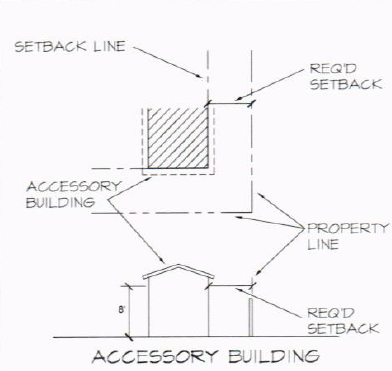
3.
Height.
a.
The maximum allowed building height shall be fifteen (15) feet. Additional height may be permitted up to the maximum height allowed in the district, subject to approval of a Use Permit, pursuant to Section 6-308; and
b.
In the AG district, accessory buildings may be erected to the maximum allowed height in the district.
Figure 3-401 C2.
Accessory Building Height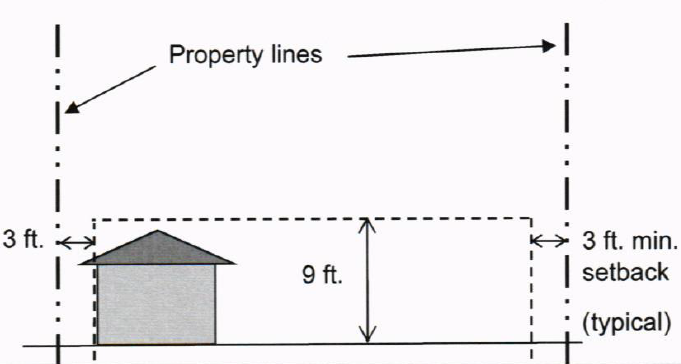
Figure 3-401 C3.
Accessory Building Envelope Example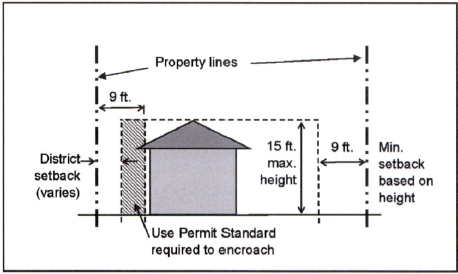
4.
Area. Lot coverage, as defined in this Code, for accessory buildings shall be included in the overall maximum allowed in the district.
D.
Accessory Structure.Accessorystructures (e.g., ramadas, small sheds) are structures that are a maximum of two hundred (200) square feet in area and equal to or less than eight (8) feet in height. A structure that exceeds this building area or height shall be considered an accessory building. Such structures are subject to the following standards:
Figure 3-401 D1.
Accessory Structure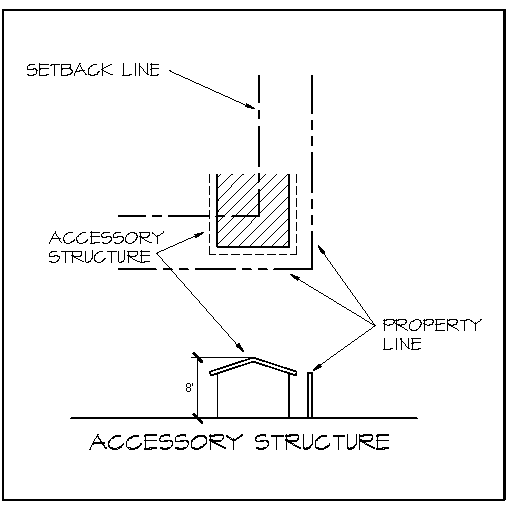
1.
Accessory structures shall not be located in the required front yard building setback except per subsection a, below. An accessory structure may be located in the required rear, side, and street side yard setbacks provided that required separation for applicable building codes is provided.
a.
Accessory structures for the purposes of providing one (1) permanent detached engineered shadestructure are allowed in the front yard, subject to a use permit. The structure shall be located over the required driveway and shall be setback a minimum of five (5) feet from the side, street side and front lot lines.
2.
On a through lot, an accessory structure shall not be located closer to the rear property line than the distance required for the front yard buildingsetback; and
Figure 3-401 D2.
Through Lot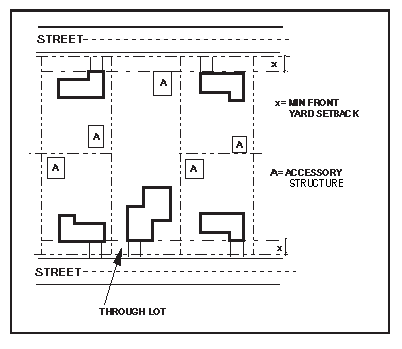
3.
Lot coverage, as defined in this Code, for accessory structures shall be included in the overall maximum allowed in the district.
E.
Neighborhood Libraries.
1.
Neighborhood libraries. Neighborhood libraries, which are gathering places where neighbors share their favorite literature and stories, are considered an accessory structure.
2.
Neighborhood libraries are permitted to be placed, with the landowner's permission, on single-family residential lots, multi-family residential lots, church properties, public or private school properties, and on City properties with the authorization of the Community Development Director or designee. Neighborhood libraries are not permitted in public right-of-way.
3.
Neighborhood libraries are accessory use to the property and shall conform to all of the following:
a.
The neighborhood library shall not be located between the street and the public sidewalk.
b.
The neighborhood library shall not obstruct vehicular, bicycle or pedestrian traffic, either physically or by a person utilizing the neighborhood library.
c.
The neighborhood library shall not obstruct access isles or paths utilized by persons in wheelchairs or for ADA accessibility.
d.
On residential property, the neighborhood library must be placed in the front yard between the face of the building and the right-of-way.
e.
The neighborhood library shall be designed to hold books. The overall structure shall be limited to a height not to exceed sixty-six (66) inches; a width not to exceed thirty (30) inches; a depth not to exceed eighteen (18) inches; and the box height shall not exceed thirty (30) inches.
f.
The neighborhood library shall be anchored to the ground or securely attached to something having a permanent location on the ground.
g.
There shall be a limit of one (1) neighborhood library per residential property.
h.
A neighborhood library meeting the above conditions will not be subject to any permits or special licensing requirements.
(Ord. No. 2005.47, 8-18-2005; Ord. No. 2007.36, 6-28-2007; Ord. No. 2009.15, 10-22-2009; Ord. No. 2016.40, 8-4-2016; Ord. No. O2019.08, 4-11-2019; Ord. No. O2121.44, 10-14-2021; Ord. No. O2024.57, 12-19-2024)
Section 3-402 - Accessory Dwelling Units.
A.
Purpose.
1.
This section furthers the goals of the City of Tempe's housing element within the general plan by increasing access to housing stock, promoting affordable housing and ensuring that accessory dwelling units (ADUs) are consistent with the character of the City and do not create significant impacts to traffic flow or public safety. These regulations are in addition to other applicable codes. To the extent any provision in this section conflicts with A.R.S. 9-461.18, the state law shall control.
2.
Accessory dwelling units (ADUs) are designed to allow a subordinate dwelling, that may be rented or leased independent from the main residence. Guest quarters, used to house guests of the main residence, are also allowed within the provisions of the ADU regulations. These dwellings augment the diversity of housing while ensuring that the property remains compatible with the scale of single-family residential development.
B.
Applicability. ADUs are a permissible use, subject to the terms of this section and the City of Tempe building codes, fire codes, and public health and safety regulations, ADUs are permitted in all residential districts, as identified in Section 2-102, when a property contains a single-family dwelling. A property shall retain its single-family use status to the extent applicable. ADUs permitted under this section are excluded from multi-family use regulations found in Part 4, Chapter 4, building design; Chapter 6, parking; Chapter 7, landscape and walls; Chapter 8, lighting; and Section 6-306, development plan review.
C.
Standards and restrictions. ADUs are allowed subject to the following requirements:
1.
Density.
A.
One (1) attached and one (1) detached ADU are allowed on any lot that is less than one (1) acre.
B.
One (1) additional ADU is allowed on a lot that is one (1) acre or more in size if at least one (1) ADU on the lot is a restricted-affordable dwelling unit, pursuant to Section 3-402(g).
2.
Size.
A.
The gross floor area of an ADU shall not exceed one thousand (1,000) square feet of interior habitable area, or no more than seventy-five percent (75%) of the gross floor area of the main residence on the same lot, whichever square feet is less.
B.
For lots that are one (1) acre or more in size, the gross floor area of an ADU shall not exceed two thousand (2,000) square feet of interior habitable area, or no more than seventy-five percent (75%) of the gross floor area of the main residence on the same lot, whichever square feet is less.
C.
For the purpose of this section "gross floor area" means the interior habitable area of the residence. This excludes parking garages/carports or exterior storage space.
3.
Parking. No additional vehicle parking is required for an ADU. The property owner may provide additional vehicle parking on site. An ADU that removes or modifies an existing required vehicle parking space(s) for the main residence shall replace the required parking space(s) in a location authorized by the Community Development Director, or designee.
4.
Bedrooms. No more than three (3) bedrooms are allowed within an ADU that is limited to no more one thousand (1,000) square feet of interior habitable area. There is no restriction on the number of bedrooms within an ADU on lots one (1) acre or more in size.
5.
Setbacks.
A.
The rear, side, and street side yard setback for an attached ADU shall be a minimum of five (5) feet in all districts, unless a lesser setback is established by the district or overlay, pursuant to Section 4-202.
B.
The rear, side, and street side yard setback for a detached ADU shall be a minimum of five (5) feet in all districts, unless a lesser setback is allowed for accessory buildings, pursuant to Section 3-401.
C.
When adjacent to a dedicated public alley, the side and rear yard setbacks for an ADU shall be measured from the Midpoint of the alley. In no instance shall any portion of a structure extend into the public alley.
D.
The front yard setback shall be consistent with the front yard setback required for buildings and open structures, as identified within the district setback tables, pursuant to Section 4-202 , development standards for residential districts.
6.
Building height. ADUs are subject to the same height regulations that apply to the zoning district with a single-family dwelling on the same lot. Refer to Section 4-202 for the maximum height for the district, Section 3-401 for detached accessory building height, and Section 3-420 - Single-family residential second story addition, rebuild.
7.
Lot coverage. The area of a lot covered by an ADU shall be included in the overall maximum lot coverage allowed in the district, pursuant to Section 4-202 , development standards for residential districts.
8.
Addressing. A unique address shall be provided for each ADU and shall be placed near the primary entrance of the ADU, using numbers/letters with contrasting color.
D.
Conversion regulations.
1.
When located in a multi-family residential district, if an existing ADU is increased to exceed the maximum allowable interior habitable area for an ADU, the dwelling shall no longer be considered an ADU. The property containing the expanded dwelling and all remaining dwelling units shall be subject to the multi-family use and development standards.
2.
An ADU shall count against the maximum allowable density of the zoning district in which it is located when the following occurs:
A.
Another dwelling unit is proposed, which exceeds the maximum number of ADUs on the lot; or
B.
The ADU exceeds the maximum allowable interior habitable area described in Section 3-402(c)(2).
3.
Guest quarters.
A.
An existing permitted guest quarters may remain on a lot, pursuant to Part 4, Chapter 5, Non-conforming use or development.
B.
Guest quarters may be converted to an ADU for the purpose of rental use, and shall apply for appropriate building permits, subject to the regulations of this section, except that the interior habitable area may exceed the maximum area described in Section 3-402(c)(2). Conversion to an ADU shall terminate the rental restriction covenant that may exist for the guest quarters.
C.
An existing guest quarters shall count toward either the allowed one (1) attached or one (1) detached ADU. In other words, a lot shall not provide an additional detached Adu if there is an existing detached guest quarters, unless the proposed ADU complies with the maximum allowed.
E.
Restrictions.
1.
Short-term rental or vacation rentals are permitted, subject to Tempe City Code, Chapter 16a, Article X, and owner occupancy requirements.
2.
An ADU shall not be subdivided or split on its own lot, or be sold separately from the lot.
3.
Public access. Property owners shall provide unencumbered public access to accessory dwellings. No owner may deny or restrict in any way, access to an ADU. Owner(s) of property with an ADU waive any and all rights to deny and restrict access in any way to emergency providers responding to calls for service to an ADU.
F.
Infrastructure and construction.
1.
Residential connections to sewer, water and/or utility services shall be provided to the ADU in conformance with City standards.
2.
The ADU shall include its own sleeping and sanitation facilities (shower/tub, toilet and sink) and kitchen facilities within the unit.
3.
ADUs constructed on trailers are allowed when the suspension/axle components have been removed and the chassis is permanently attached to a foundation and compliant with the adopted building codes.
4.
Tiny home construction is permissible for an ADU, when built on a permanent foundation, and compliant with tempe's adopted building code for tiny homes.
5.
ADUs may use an alternate building construction type for prefabricated/modular home permitted through the building safety division, and compliant with the adopted building codes.
G.
Restricted-affordable dwelling unit.
1.
A lot one (1) acre or more in size may have one (1) additional ADU (3rd ADU), as long as one of the three ADUs is identified as a restricted-affordable dwelling unit through a deed restriction, in a form reviewed and authorized by the City.
2.
The restricted-affordable dwelling unit shall only be rented to households earning up to eighty percent (80%) of area median income. Rent shall be established based on the household size and income in accordance with the rent and income limits published by the Arizona Department of Housing.
3.
Deed restriction shall be signed and recorded through the Community Development Department, prior to the issuance of building permits to construct the third ADU.
4.
Reporting requirement. The property owner shall provide an annual time frame report and proof to the City of Tempe that demonstrates compliance with the rental requirements set forth in this section. The annual report shall be submitted to the [Housing Department Director] from the date of the recorded deed restriction and each year thereafter and shall cover the entire twelve (12) month period of the preceding the deed restriction. At minimum, the annual report shall contain: 1. The period the restricted-affordable dwelling unit was rented and the status by which its occupants qualified under the deed restriction. 2. The monthly rent paid/received. 3. The taxes, special assessments, hoa and management fees and any other fees or charges included.
5.
Failure to report; penalties. Failure to submit the annual report within the time requested or failure to comply with the deed restrictions set forth, shall be subject to a civil sanction, pursuant to Section 1-201, and/or subject to the forfeiture of the restricted-affordable dwelling.
(Ord. No. O2019.08, 4-11-2019; Ord. No. O2024.51, 11-21-2024)
Section 3-403 - Adult-Oriented Businesses.
A.
Purpose. It is recognized that there are some uses, which because of their very nature, are recognized as having serious objectionable operational characteristics, particularly when several such uses are concentrated under circumstances having a deleterious effect upon the use and enjoyment of adjacent areas. Special regulation of these uses is necessary to insure that these adverse secondary effects will not contribute to the blighting or downgrading of the existing surrounding neighborhood. These special regulations are itemized in this section. The purpose of the regulation is to promote the health, safety, and general welfare of the citizens of the City by preventing a concentration of these uses in any one (1) area. It is not the intent of this Code to restrict or deny access by adults to sexually oriented materials protected by the First Amendment, or to deny access by the distributors and exhibitors of sexually oriented entertainment to their intended market. Further, it is not the intent of this Code to permit any use or act, which is otherwise prohibited or made punishable by law.
Cross reference— See also the following definitions in Part 7 of this Code: adult-oriented business, adult arcade, adult retail store,adult cabaret, adult motel, adult motion picture theater, adult service, adult service business, adult theater, adult video facility, escort, escort agency, nude model studio, nudity/state of nudity, sexual encounter center, specified anatomical areas and specified sexual activities.
City Code reference — See TCC § 16A-56, escort definitions and rules; TCC § 16A-112 et seq., adult-oriented businesses.
State Law reference— A.R.S. § 13-1422, Adult oriented businesses, location, hours of operation, injunction, classification, definitions.
B.
Location Requirements.Adult-oriented businesses are allowed in the GID and HID zoning districts, subject to the following:
1.
No adult-oriented business shall be operated or maintained within one thousand three hundred twenty (1,320) feet from the defined provisions located in Section 3-403(B)(1)(a—g) below. Measurements shall be made in a straight line in all directions, without regard to intervening structures or objects, from the nearest point on the property line of a parcel containing an adult-oriented business to the nearest point on the property line of a parcel containing the following:
a.
Another adult-oriented business;
b.
Child care facility;
c.
Public, private or charter school;
d.
A church, synagogue, temple or similar religious worship building;
e.
A library, a public playground, a public community building, a public recreational facility, or a private recreational facility where minors are permitted;
f.
An establishment having an Arizona spirituous liquor license with any of the following classifications: Bar (Series 06); Beer and Wine Bar (Series 07) or the equivalent of such licenses; or
g.
A residential district or the property line of a lot devoted to a residential use in any zoning district.
2.
Any adult-oriented business that fails to comply with this section but which was lawfully operating before City Code Chapter 16A Article VI, took effect shall not be deemed to be in violation of this Code. However, such business will not be permitted to be increased, enlarged, extended or altered except the business may be changed so as to fully comply with this Code. An adult-oriented business lawfully operating is not rendered in violation of this Code by the location, subsequent to the grant or renewal of the license herein, of any of the premises identified in subsection 1 above. (Ord. No. 95.49, 12-14-95)
C.
Operation Requirements. Any adult-oriented business shall comply with the following requirements, as well as those contained in Tempe City Code, Chapter 16A 112 through 135:
1.
Security plan required;
2.
For the prevention of the spread of sexually transmitted disease, no partitions between subdivisions of a room, portion or part of a building, structure or premises may have an aperture which is designed or otherwise constructed to permit sexual activity between persons on either side of the partition; and
3.
No booths, stalls, or partitioned portions of a room, or individual rooms, used for the viewing of motion pictures or other forms of entertainment, shall have doors, curtains or portal partitions, but all such booths, stalls, partitioned portions of a room, or individual rooms so used shall have at least one (1) side open to an adjacent public room so that the area inside is visible to persons in the adjacent public room. All such described areas shall be lighted in such a manner that the persons in the areas used for viewing motion pictures or other forms of entertainment are visible from the adjacent public rooms, but such lighting shall not be of such intensity as to prevent the viewing of the motion pictures or other offered entertainment:
a.
The words "booth, stalls, partitioned portions of a room or individual rooms" mean such enclosures as are specifically offered to the public or members of that establishment for hire or for a fee as part of a business operated on the premises which offers as part of its business the entertainment to be viewed within the enclosure; which shall include, without limitation, such enclosures wherein the entertainment is dispensed for a fee, but a fee is not charged for mere access to the enclosure;
b.
The words "booths, stalls, partitioned portions of a room or individual rooms" do not mean such enclosures that are private offices used by the owners, managers or persons employed on the premises for attending to the tasks of their employment, which enclosures are not held out to the public or members of the establishment for hire or for a fee or for the purpose of viewing entertainment for a fee, and are not open to any persons other than employees;
c.
The words "doors, curtains or portal partitions" mean full, complete, nontransparent closure devices through which one cannot see or view the activity taking place within the enclosure; and
d.
The words "open to adjacent public room so that the area inside is visible to persons in the adjacent public room" shall mean either the absence of any "door, curtain or portal partition" or a door or other device which is made of clear, transparent material such as glass, plexiglass or other such material meeting building code and safety standards, extending from the floor to the top of the door frame, exclusive of the door or device framing itself, so that the activity inside the enclosure may be viewed or seen by persons outside the enclosure.
C.
Prohibited Uses.Sexual encounter centers, as defined in this Code, are prohibited from all zoning districts within the boundaries of the City of Tempe.
(Ord. No. 2007.01, 2-2-2007)
Section 3-404 - Agricultural Uses.
Agricultural uses, as provided in subsections below, are permitted in the AG district and shall conform to the following standards:
A.
Farming. Farming, including all types of agriculture and horticulture, such as flower, vegetable and field crops, berry and bush crops, tree crops, and orchards, and their storage.
B.
Livestock. The keeping of livestock, including cattle, horses, sheep, goats or similar animals except the keeping of swine. The number of such livestock permitted shall be calculated on the basis of one (1) horse, cow or similar animal, or two (2) sheep, goats or similar animal for each six thousand (6,000) square feet of net lot area after deducting at least thirty (30) percent of the lot area and no more than one-half (½) acre for the home site. The total aggregate of all such animals permitted shall be twenty-four (24). Animals of six (6) months or younger shall not be counted.
C.
Apiaries. Apiaries, upon the following conditions:
1.
Occupied bee hives shall be at least two hundred (200) feet from any existing dwelling on another property;
2.
Occupied bee hives shall have a minimum separation of fifty (50) feet to any property line;
3.
Occupied bee hives shall have a minimum separation of one hundred fifty (150) feet to any street or bridle path; and
4.
Apiaries shall require a use permit.
D.
Grazing. The grazing and keeping of cattle, sheep or horses, except swine on a site of five (5) or more acres; including the supplementary feeding of such cattle, sheep, or horses, provided such grazing is not a part of, nor conducted in conjunction with any dairy or livestock sales yard located on the same premises.
E.
Processing of Farm Products. Farming and processing of farm products, customarily conducted on farms, is permitted subject to a use permit, on a site five (5) acres or more.
F.
Horse Stables. A commercial horse stable may be permitted with a minimum net site of ten (10) acres or more.
G.
Keeping of Horses. The keeping of horses for residential use is permitted in the AG district subject to Section 3-404(B). Keeping of horses in the R1-15 and R1-10 district are permitted subject to a use permit provided the following conditions are met:
1.
The zoning for such property was in effect prior to 1/20/85;
2.
The rear yard of site with R1-15 and R1-10 districts abuts property in the agricultural district and the conditions, covenants and restrictions of such agriculturally zoned property permits the keeping of horses;
3.
The lots in the R1-15 and R1-10 districts are not less than thirty thousand five hundred (30,500) square feet in area;
4.
The minimum distance from the rear of the dwelling unit to the rear property line is not less than two hundred (200) feet;
5.
The lots in the R1-15 and R1-10 districts are located south of Elliot Road; and
6.
The number of horses permitted shall be determined by following the criteria set forth in Section 3-404(B).
H.
Dairy Farm. A dairy farm may be permitted with a net site area of forty (40) acres or more.
I.
Small Animals.Small animals, as defined herein, and pot-bellied pigs are permitted in all residential districts which have a single-family dwelling, subject to the following:
1.
No more than five (5) small animals collectively are allowed on an individual lot;
2.
No more than two (2) pot-bellied pigs are allowed on an individual lot and shall be counted in the total allotment for small animals;
3.
No more than six (6) domestic chickens are allowed on an individual lot. Domestic chickens do not count in the total allotment for small animals.
4.
The keeping of roosters or peafowl is prohibited, except in the AG district;
5.
The keeping of household pets, and all dogs and cats pursuant to the Tempe City Code, Chapter 6, are allowed in all residential districts and do not count towards the number of small animals;
6.
The keeping of small animals, pot-bellied pigs, and domestic chickens, that exceed the maximum allowed quantity in subsection (1) through (3) above, and the keeping of livestock, as defined in Section 3-404(B), may be allowed subject to review and approval through a Use Permit application, pursuant to Section 6-308. In addition to the approval criteria, the request must demonstrate adequate area for the animal(s) and control of living quarters;
7.
It shall be unlawful to keep small animals and livestock in a manner that constitutes a nuisance.
8.
Lots less than one (1) acre, chicken enclosures shall be no taller than the height of the fence/wall line located on the property.
J.
Agritainment. Such use is allowed within the AG district, subject to the following:
1.
Agritainment uses include, but are not limited to, fitness, education, special events, festivals and markets, art exhibits, agricultural food processing, petting zoo, camping, short term rentals and similar entertainment attractions.
2.
Uses shall have a minimum separation of twenty (20) feet to any residential property line. Additional separation requirements may be required to address uses and compatibility; and
3.
An agritainment use is subject to an approval of a use permit, pursuant to section 6-308.
(Ord. No. 2009.15, 10-22-2009; Ord. No. 2014.69, 12-4-2014; Ord. No. O2024.60, 12-19-2024; Ord. No. O2025.23, 7-1-2025)
Section 3-405 - Bed and Breakfast.
Bed and breakfast use, where allowed with a use permit, shall conform to all of the following standards:
A.
Accessory Use. A bed and breakfast facility must be accessory to a residential use on the subject site. This means that the individual or family who operates the facility must occupy the dwelling as their primary residence.
B.
Maximum Size.Bed and breakfast facilities are limited to a maximum of five (5) bedrooms for guests and the maximum occupancy per night shall be established by use permit.
C.
Employees.Bed and breakfast facilities may have nonresident employees for the lodging activity such as booking rooms and food preparation, if approved as part of the use permit. Hired service for normal maintenance, repair and care of the residences or site such as yardmaintenance may also be approved. The number of employees and the frequency of employee auto trips to the facility may be limited or monitored as part of the use permit approval.
D.
Service to Guests. Food services may only be provided to overnight guests of a bed and breakfast in residential districts. Food service may be provided to overnight guests and other guests in all mixed-use (MU) districts. Any other service is subject to the use requirements of the zoning district.
E.
Meetings and Social Gatherings.
1.
Commercial meetings. Activities including luncheons, banquets, parties, weddings, meetings, charitable fund raising, commercial or advertising activities, or other gatherings for direct or indirect compensation are prohibited at a bed and breakfast facility.
2.
Private social gatherings. The residents/guests of bed and breakfast facilities may be allowed to have social gatherings, parties, or meetings if authorized in the use permit.
Section 3-406 - Boutique.
Home, religious organization, or not-for-profit service organization boutiques, where permitted, shall conform to the following conditions:
A.
Location. The boutique shall be allowed at a dwelling unit, school, or a place of worship.
B.
Products Sold. The boutique shall primarily sell locally handcrafted items.
C.
Operation. The boutique shall operate for not more than any five (5) consecutive days in each one-half (½) calendar year at any one (1) location. The activity shall be limited to the hours between 9:00 a.m. and 8:00 p.m.
D.
Impacts. There shall be no offensive noise, vibration, smoke, dust, odors, heat or glare produced by the boutique. The activity shall not generate such additional traffic and parking in the area of the boutique which would create a traffic or safety hazard.
E.
Signs. All signs used by the boutique shall comply with Section 4-903.
F.
Sales Tax. The boutique shall comply with the applicable transaction privilege (sales) tax provisions of the Tempe City Code (TCC) § 16-1 et seq.
G.
License. The operator or sponsor of the boutique must apply for a City transaction privilege (sales) tax license a minimum of ten (10) days prior to the start of the boutique and obtain the license prior to conducting business.
H.
Violation. Any violation of the above conditions shall cause the immediate revocation of the boutique's privilege to transact business within the City.
(Ord. No. O2016.64, 1-12-2017)
Section 3-407 - Child Care, In Home.
A.
License and Certified. Licensed, certified or approved by the State of Arizona;
B.
Administrative Review. Such home must be reviewed and approved and have a certificate of occupancy issued for the use by the Community Development Director, or designee, for building codes (including pool fence requirements) and land use code compliance prior to use commencing; See Arizona Revised Statutes, Division 43; and
C.
Use Permit. In home day care for seven (7) to ten (10) children shall require a use permit and comply with Section 3-407(A) and (B) above.
Section 3-408 - Drive-Through Facilities.
Drive-through facilities shall be designed to minimize conflicts with the pedestrian pathway from the public street and to all building entrances. Minimum width of drive-through lanes at straight-away is nine (9) feet. Drive-through pick-up windows located on the south or west building elevation shall provide shade by means of a building canopy or additional trees alongside the drive lane. When new drive-through facilities are oriented towards the street the following standards shall be provided:
A.
All maneuvering drive lanes shall provide for a minimum twenty (20) feet of landscape buffer from the street sidewalk;
B.
A screen wall, three (3) feet in height, shall be located along the drive-through lane where building facades face the street and at the menu board, in compliance with Section 4-706(E);
C.
A delineated pedestrian pathway with a traffic calming device shall be provided where drive lane intersects the pathway, in compliance with Section 4-503; and
D.
Screen walls shall be separated a minimum of six (6) feet from pathway crossing to allow visibility of pedestrians and vehicles.
Figure 3-408.
Drive-Through Facilities Diagram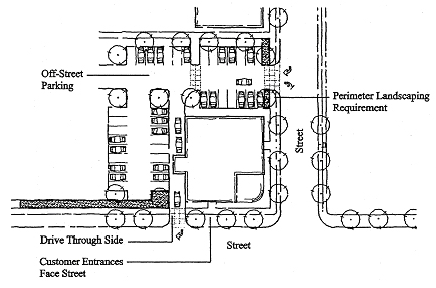
(Ord. No. 2010.17, 7-1-2010)
Section 3-409 - Group Homes for Adult Care, Persons with Disabilities, and Child Shelter.
A.
Purpose. The purpose of these regulations is to permit child shelters, and a group of unrelated persons with disabilities, to reside together in residential neighborhoods in compliance with the federal Fair Housing Act (Section 3601 of Title 42 of the United States Code), while preserving and maintaining the residential character of the neighborhood. The Federal Fair Housing Act prohibits discrimination in housing on the basis of race, color, religion, sex, national origin, familial status, and disability.
B.
Applicability and Registration. Group homes are permitted in an individual dwelling unit on a lot within any district that allows residential uses, subject to the requirements provided herein. Group homes shall submit a completed verification application and required supplemental materials to the Community Development Department on a form established by the Zoning Administrator. A group home zoning clearance letter may be issued upon verifying the application complies with the standards listed in subsection C.
1.
Group homes that are licensed by the state, county or other governmental authority, shall be considered to be registered with the City at the time they receive tentative group home zoning clearance and shall submit a copy of the license issued by the state, county or other governmental authority to the City within ninety (90) days, or said registration shall be automatically withdrawn.
2.
For group homes that are not licensed by the state, county or other governmental authority, group home zoning clearance may be provided in place of a tentative zoning clearance at which time the group home shall be considered to be registered with the City.
3.
In all cases, registration for group homes shall expire when the group home use ceases. The operator shall notify the Community Development Department within thirty (30) calendar days of the group home ceasing operation. Any new group home seeking registration of a prior group home site shall require a new application in compliance with the regulations set forth.
C.
Standards. Group homes shall comply with the following standards:
1.
Capacity. The number of residents within a group home, excluding staff, shall not exceed five (5).
2.
Location. Group homes shall not be located on a lot that is within one thousand two hundred (1,200) feet, measured by a straight line in any direction, from the lot line of another registered group home.
3.
Signs. A group home shall have no identification from a public street by signage, graphics, display, or other visual means, except for signage permitted under Table 4-903B. Sign Type B of this Code.
4.
Code compliance. A group home shall be in compliance with all applicable City codes, including building codes, fire safety regulations, zoning and subdivision codes.
5.
Parking. Any parking for the group home shall be maintained on site and comply with requirements set forth in Part 4, Chapter 6 - Parking of this Code, and Section 21-3(b)(4), of the Tempe City Code.
6.
Maintenance. The exterior of the dwelling and yards shall be kept in a condition that is consistent with requirements set forth in Section 21-3 of the Tempe City Code.
7.
Exclusive use. All administrative activities, including staffing, counseling, and other visitations, shall serve only the residents of the group home.
D.
Reasonable Accommodation Waiver. The purpose of this Section is to establish a procedure for persons with a disability to make a request for reasonable accommodation in the application of Tempe's zoning rules, policies, practices and procedures pursuant to Section 3604(f)(3)(b) of Title 42 of the Fair Housing Act which prohibits local government from refusing to make reasonable accommodations when these accommodations are necessary to afford persons with disabilities equal opportunity to use and enjoy a dwelling. A reasonable accommodation for a group home will be granted or denied, In accordance with the requirements stated herein. A request for such a reasonable accommodation waiver must be in writing and filed with the Zoning Administrator (exceptions for the waiver request to be in writing may be made on a case-by-case basis). In all cases, the Zoning Administrator, or designee, shall make findings of fact in support of their determination and shall render a decision in writing. The Zoning Administrator may meet with the person making the request for additional information or discuss an alternative accommodation, in order to ascertain or clarify information sufficiently to make the required findings. To grant a reasonable accommodation waiver, the Zoning Administrator shall find affirmatively all of the following:
1.
The requesting party or future occupants of the housing for which the reasonable accommodation has been made are protected under the Fair Housing Act and/or the Americans with Disabilities Act;
2.
The request is reasonable and necessary to afford an individual with a disability an equal opportunity to use and enjoy a dwelling;
3.
The request will be in compliance with all applicable building and fire codes;
4.
The request will allow for the maintenance and preservation of the residential characteristics of the neighborhood and will not create a substantial detriment to neighboring properties by creating traffic impacts, parking impacts, impacts on water or sewer system, or other similar adverse impacts; and
5.
Profitability or financial hardship of the owner/service provider of a facility shall not be considered by the Zoning Administrator in determining to grant a reasonable accommodation waiver.
E.
Appeal. An appeal of the decision by the Zoning Administrator may be made regarding reasonable accommodation to the Board of Adjustment pursuant to Part 6, Chapter 8, Appeals.
(Ord. No. O2021.22, 6-10-2021)
Section 3-410 - Room Addition.
A room, sleeping room or boarding room in a single-family residence shall provide occupancy for not more than two (2) persons. Access to such room shall be provided internally through the main residence of which such room is an integral part; this excludes doors opening to patios or balconies that are part of the main residence.
(Ord. No. 2009.15, 10-22-2009)
Section 3-411 - Reserved.
Editor's note— Ord. No. O2024.51, § 3, adopted November 21, 2024, repealed § 3-411, which pertained to guest quarters and derived from Ord. No. 2009.15, 10-22-2009; Ord. No. O2019.08, 4-11-2019. Additionally, guest quarters may be used within the provisions allowed for accessory dwelling units, pursuant to Section 3-402.
Section 3-412 - Home Occupation.
A.
Purpose.Home occupation allows small commercial ventures for which the leasing of commercial quarters is not cost effective and which, by the nature of the venture, are appropriate in scale and impact to be operated within a residence.
B.
Applicability.Home occupations are permitted in all residential dwellings as an accessory use (see Section 7-102 for definition), subject to any of the following standards indicated to protect the residential character of Tempe's neighborhoods. Deviation from any provision noted below shall be considered a violation of this Code.
1.
Appearance of Residence.
a.
The home occupation shall be restricted to lawfully-built enclosed buildings and be conducted in such a manner as not to give an outward appearance of a business.
b.
The home occupation shall not result in any structural alterations or additions to a building that will change its primary use or building code occupancy classification.
c.
The home occupation shall not violate any conditions of development approval (i.e., prior development permit approval).
d.
Products and or equipment produced or used by the home occupation shall not be displayed or visible from outside any building.
e.
No offensive noise, vibrations, smoke, dust, odors, heat or glare shall be produced.
2.
Storage.
a.
On-site storage and use of hazardous materials (including toxic, explosive, noxious, combustible or flammable) beyond those normally incidental to residential use is prohibited.
b.
Inventory, products, equipment, fixtures, and activities associated with the home occupation shall be allowed in any building, provided that the building conforms to the provisions under Section 3-412(B)(1).
3.
Employees.
a.
A home occupation shall have no more than three (3) individuals working within a residence for the purpose of the business.
b.
No more than one (1) person, who is not a family member residing within the dwelling located on the home occupation site, may be permitted to work for the benefit of the home occupation.
c.
Additional individuals may be employed by or associated with the home occupation, so long as they do not report to work or pick up/deliver at the home.
d.
The home occupation site shall not be used as a headquarters for the assembly of employees for instruction or other purposes, including dispatch to other locations.
4.
Signs. Home occupations shall comply with Section 4-903 and are limited to Sign Type B.
5.
Vehicles, Parking and Traffic.
a.
Vehicles associated with the home occupation must comply with TCC Section 21-4.
b.
There shall be no more than three (3) commercial vehicle deliveries to or from the home occupation site daily. There shall be no commercial vehicle deliveries during the hours of 8:00 p.m. to 7:00 a.m.
c.
There shall be no more than one (1) client or customer vehicle on the premises at any one (1) time and the activity shall not generate traffic beyond that normal in its district.
d.
Barbershops and beauty salons are allowed up to two (2) client stations within the dwelling.
6.
Business Hours. Clients or customers are permitted at the home occupation from 7:00 a.m. to 8:00 p.m. only. Additional hours of operation for such use shall require the approval of a use permit.
7.
Prohibited Uses. A home occupation shall not include the sale of commodities on premises nor the following: clubs, commercial stables, veterinary offices, hospitals, hotels, motels, kennels, restaurants, motor vehicle repairing, massage parlors, and any use that does not conform to the provisions in Section 3-412.
(Ord. No. 2006.82, 1-4-2007; Ord. No. 2005.47, 8-18-2005; Ord. No. O2016.64, 1-12-2017; Ord. No. O2022.18, 6-9-2022)
Section 3-413 - Hospitals, Sanitariums, and Nursing Homes.
Any building used for any of the following uses shall be not less than fifty (50) feet from the lot line of any adjoining property: Hospitals or sanitariums for the treatment of human ailments, nursing or convalescent homes, orphanages, and institutions for the mentally disabled, epileptic, drug or alcoholic patients; homes for the aged and shelters, without cooking facilities in individual dwelling units; and related institutions of an educational, religious, or philanthropic nature. Memory care units, when accessory to an assisted living facility or other allowed residential uses, shall not require a use permit and compliance with this section's building use setback.
(Ord. No. O2025.23, 7-1-2025)
Section 3-414 - Live-Work.
Live-work is permitted in all Mixed-Use (MU) districts and in the CC and R/O districts, and is permitted with a use permit in the PCC-1, PCC-2, and all multi-family districts. Live-work is permitted to provide a housing and employment option that is transportation efficient and low-impact on adjacent neighborhoods. Live-work uses are subject to the standards for home occupations in Section 3-412, with the following exceptions:
A.
Employees. Two (2) employees, in addition to the family members residing in the dwelling, may work on premises. Additional employees may be authorized subject to the provisions of a use permit;
B.
Signs. Live-work shall comply with Section 4-903.
C.
Vehicles, Parking and Traffic. All live-work units in the Mixed-Use districts, CC, PCC-1, and PCC-2 districts are exempt from the standards in Section 3-412(B)(5). All live-work units in the R/O and Multi-Family districts shall comply with Section 3-412(B)(5).
(Ord. No. 2005.47, 8-18-2005; Ord. No. O2016.64, 1-12-2017)
Section 3-415 - Mini-Warehouse/Rental Storage Facilities.
Mini-warehouse/rental storage facilities are for storage purposes only. No retailing is permitted from a rented storage unit.
Section 3-416 - Mobile Homes.
A.
Dwelling. A mobile home, recreational vehicle, or similar vehicle shall not be considered a dwelling unit, nor occupied as such, unless located in a trailer or mobile home park, except as noted herein.
B.
Access. A minimum of two (2) vehicular entrances shall be provided for each mobile home park, mobile home subdivision, and trailer parkdevelopment. One (1) entrance may be kept closed to the general public if provision is made for emergency access and if this entrance is not necessary to accommodate the volume of traffic generated by uses on the site.
C.
Perimeter Walls. Perimeter boundaries of all mobile home parks, mobile home subdivisions and trailer parks shall have a perimeter wall with a minimum height of eight (8) feet, measured from the highest adjacent grade within twenty (20) feet. The wall shall be of masonry or concrete construction, with architectural texture, finish, and color to be compatible with other buildings in the vicinity. The perimeter wall shall be designed to create an attractive appearance, incorporating elements such as recesses, piers, pilasters, contrasting courses and texture. The area between the wall and the public street shall be landscaped, and the wall may contain pedestrian access gate(s), as approved through development plan review. Street frontage landscape areas of mobile home and trailer parkdevelopments shall be maintained by the mobile home or trailer park operators.
(Ord. No. 2005.47, 8-18-2005)
Section 3-417 - Outdoor Retailing.
A.
Purpose. To allow sales or display of merchandise on the exterior of a building.
B.
Permanent Outdoor Retail Display.
1.
Applicability. Permanent Outdoor retail display is a permanent outdoor sales component which is an integral part of a business, including but not limited to, Garden Centers and Auto, Boat, and RV Dealership display lots.
2.
General Regulations.
a.
Must be shown as part of a Development Plan Review with all applicable site improvements.
b.
If added to an existing site. The use shall obtain Development Plan Review approval with all applicable site improvements.
c.
Shall comply with parking ratios per Table 4-603E.
C.
Temporary Outdoor Retail Display.
1.
Applicability. Temporary outdoor retail display allows a business or tenant to display an incidental amount of merchandise sold within the business, in proximity to the exterior of a building. Outdoor display is subject to the following:
2.
General Regulations.
a.
Permitted subject to a Use Permit in the Commercial (except R/O), Mixed-Use, and Industrial Districts. Such display is permitted in the CC District without a Use Permit;
b.
Merchandise must be associated with an established business and shall be the same as that sold inside the store;
c.
Displays shall not occupy the minimum required parking areas, landscape areas, or vehicular driveways (including fire lanes);
d.
In the CC District, displays shall be located within three (3) feet of the business space;
e.
Any display must allow for a minimum four (4) foot wide pedestrian pathway across the buildingfrontage and to all building entrances and exits. On public sidewalks a minimum six (6) foot wide pathway clearance shall be provided. An encroachment permit shall be required when placed in the public right-of-way, as determined by the Public Works Director or designee;
f.
Displays are limited to the normal hours of operation of the business, unless otherwise authorized by condition;
g.
Sound amplification shall not be used for sales demonstrations; and
h.
Outdoor display signage shall not exceed a total of three (3) square feet.
D.
Temporary Outdoor Vending.
1.
Applicability. Temporary outdoor vending refers to sale of merchandise or service not within a building or a permanent structure on a site. Temporary outdoor vending includes food carts, grills and general merchandise offered for purchase in any retail establishment, on a daily basis, throughout the calendar year and limited personal services such as a shoe polishing and re-occurring outdoor events such as farmers markets.
2.
General Regulations.
a.
Permitted subject to a Use Permit;
b.
Must be located on the specified lot identified by the Use Permit and not in the public right-of-way, unless authorized with an encroachment permit, subject to approval by Public Works Director or designee;
c.
Shall not occupy the minimum required parking areas, landscape areas, or vehicular driveways (including fire lanes);
d.
Must allow for a minimum four (4) foot wide pedestrian path across any building frontage and to and from all building entrances and exits. On public sidewalks a minimum six (6) foot wide pathway clearance shall be provided;
e.
Sound amplification may not be used for sales demonstrations;
f.
The allowable signage, size and location of the business, and storage of equipment/materials, shall be established through the Use Permit; and
g.
Shall not include the sale of the following commodities or provide the following services on the premises; vehicle sales which have more than three (3) vehicles on display, vehicle washing or detailing, or motor vehicle repair.
E.
Outdoor Retail of Seasonal Merchandise.
1.
Applicability. The outdoor retail allowed under the provision of seasonal merchandise includes items that are not typically offered for purchase in any retail establishment, on a daily basis, throughout the calendar year. These items include pumpkin patches, tree lots and paraphernalia associated with a sport's championship or exclusive event.
2.
General Regulations.
a.
Requires an administrative review process prior to commencement of use;
b.
Must be located on the site specified by a site plan and not in the public right-of-way, unless authorized with an encroachment permit, subject to approval by the Public Works Director or designee;
c.
Shall not occupy minimum required parking areas, pedestrian pathways, landscape areas, or vehicular driveways (including fire lanes), except as granted with an administrative approval;
d.
Sound amplification shall not be used for sales demonstrations; and
e.
The allowable signage, size and location of the business and storage of equipment/materials, shall established by the administrative review.
F.
Vending Machines.
1.
Applicability. Vending machines refer to automated or self service dispensers of merchandise located on the exterior of a building, including but not limited to soda, candy, other retail dispensed items and reverse vending machines.
2.
General Regulations.
a.
Requires Development Plan Review prior to installation;
b.
Propane gas cages that have an existing fire permit issued prior to October 8, 2009, do not require a separate Development Plan Review;
c.
Shall provide a minimum four (4) foot wide pedestrian pathway across any building frontage and to all building entrances and exits; and
d.
Shall be screened from street view or provide an architecturally compatible design. Water, ice, and propane gas vending are not required to be screened.
(Ord. No. 2009.15, 10-22-2009)
Section 3-419 - Residential Sales Office, Temporary.
Temporary residential sales offices are permitted for the sale of homes being constructed on the premises and for a period not exceeding twenty-four (24) months. Extension of this time requires approval by the Hearing Officer or Board of Adjustment who shall find that the office meets the standards of this section and a hardship exists warranting the extension that is beyond the applicant's control. The residential sales office is subject to the following conditions:
A.
Location. Temporary residential sales offices may be located in a building designed as a dwelling unit or in a modular officebuilding located on the site.
B.
Temporary Certificate of Occupancy. Prior to use of the premises as a temporary residential sales office, the sales office must meet all applicable building codes, and a temporary certificate of occupancy shall be obtained from the Community Development Director, or designee.
C.
Conversion and Final Approval of Dwelling. Prior to the sale of any dwelling that has been used as a temporary residential sales office, the dwelling shall be restored to comply with all applicable codes and ordinances, and final approval obtained from the Community Development Department, pursuant to Section 1-207.
Section 3-420 - Single-Family Residential Second Story Addition, Rebuild.
A.
A use permit is required for any single story, single-family residence to add, expand, or rebuild for a second story. This provision is applicable to viewing decks, play structures and detached accessory buildings and structures that have a second story.
B.
Exceptions:
1.
This section shall not apply to replacement dwellings where the dwelling occupying a lot was demolished prior to Ordinance No. 808.8718 effective December 19, 1987.
2.
This section shall not apply to existing vacant lots/parcels of land without a prior residence, or to newly subdivided lots.
3.
This section shall not apply to conversions of attics into occupiable space, where no changes or additions are made to the roofline of the existing residence.
C.
Additional criteria for determining approval of a use permit:
1.
The proposed second story is designed to be compatible with the architecture of the residence and compatible with the surrounding neighborhood;
2.
There are design considerations for privacy to adjacent properties and protection of existing solar appurtenances on adjacent lots; and
3.
There is sufficient parking on site or on the street frontage to accommodate guests. Addition shall be required to meet current single family parking standards pursuant to Section 4-603, parking ratios.
(Ord. No. O2022.27, 9-8-2022)
Section 3-421 - Wireless Telecommunication Facilities.
A.
Towers. Wireless telecommunications towers and related equipment facilities shall be allowed upon approval with a use permit. Subject to the provisions of subsection C below, co-location on existing towers is subject only to an administrative review.
B.
Building-Mounted. Building-mounted telecommunications shall be integrated into the design of the building or be fully screened, and in either case must receive development plan approval as a building modification. Satellite dishes not exceeding two (2) feet in diameter shall be permitted in any zoning district. Building-mounted dishes shall require administrative review, except for residential uses. Building-mounted dishes greater than two (2) feet in diameter are permitted only in commercial, mixed-use, and office/industrial districts and shall require a use permit.
C.
Co-location.Wireless Telecommunication Facilities may be co-located, subject to administrative review only. Any addition to the existing height or change in appearance of the tower, as determined by the Community Development Director, or designee, to facilitate co-location may require a use permit. Wireless Telecommunication Facilities to be attached to existing light, power or telephone poles shall require a use permit.
D.
Application Requirements. An applicant for a new Wireless Telecommunication Facilitiesuse permit shall submit the following information:
1.
Use permit application, including a development plan when applicable.
2.
For towers, monopoles, and similar proposals, a visual study containing, at a minimum, a vicinity map depicting where, within a one-half (½) mile radius, any portion of the proposed Wireless Telecommunication Facilities could be visible, and a scaled graphic simulation showing the appearance of the proposed tower and accessory structures from two (2) separate points within the impacted vicinity, accompanied by an assessment of potential mitigation measures. Such points are to be mutually agreed upon by the Community Development Director, or designee, and the applicant.
3.
Documentation of the steps that will be taken to minimize the visual impact of the proposed Wireless Telecommunication Facilities.
4.
A landscape plan drawn to scale that is consistent with the need for screening at the site. Any existing vegetation that is to be removed must be clearly indicated and provisions for mitigation included where appropriate.
5.
A feasibility study for the co-location of telecommunication facilities as an alternative to new structures. The feasibility study shall include:
a.
An inventory, including the location, ownership, height, and design of existing Wireless Telecommunication Facilities within one-half (½) mile of the proposed location of a new Wireless Telecommunication Facilities. The City may share such information with other applicants seeking permits for WTFs, but shall not, by sharing such information, in any way represent or warrant that such sites are available or suitable.
b.
Applicant shall document efforts made to co-locate on existing towers. Each applicant shall make a good faith effort to contact the owner(s) of existing or approved towers and shall provide a list of all owners contacted in the area, including the date, form and content of such contact. Co-location shall not be precluded simply because a fee for shared use is charged, or because of reasonable costs necessary to adapt the existing and proposed uses to a shared tower. Co-location costs exceeding new tower development are presumed to be unreasonable.
6.
The Community Development Director, or designee, may request any other information deemed necessary to fully evaluate and review the application and the potential impact of a proposed tower and/or antenna.
E.
Abandoned Tower/Antenna.
1.
The wireless telecommunication tower/antenna shall be removed within thirty (30) days of discontinuance of the tower/antenna's use.
Section 3-422 - Amateur Radio Antennas.
Amateur radio antennas for non-commercial use.
A.
Antennas Permitted. Amateur radio antennas are permitted in all zoning districts subject to the following standards:
1.
Antenna structures are allowed up to thirty-five (35) feet in height;
2.
Antenna structures shall comply with setback standards for the zoning district in which it is located and in all residential zoning districts, shall be located in the rear half of the lot;
3.
Antennas, including support structures, shall not extend beyond the property line; and
4.
When a Federally Licensed Radio Amateur no longer occupies the subject property, the antenna structure shall be removed.
B.
Antennas with a Use Permit. All amateur radio antennas that exceed thirty-five (35) feet in height shall require approval of a use permit. Such antennas shall be of telescoping design and lowered to a height of no more than thirty-five (35) feet when not in use. In no event shall an amateur radio antenna exceed the height of seventy-five (75) feet.
Section 3-423 - Use Separation Requirements.
A.
Limited Financial Service Businesses.
1.
Limited financial service businesses shall be defined herein as deferred presentment companies (pay day loan), auto title loan, pawn shop, or gold-buying stores.
2.
A limited financial service business shall not be located on a lot within one thousand three hundred twenty (1,320) feet, measured by a straight line in any direction, from the lot line of another limited financial service business.
3.
Limited financial service businesses shall not be located on a lot within five hundred (500) feet, measured by a straight line in any direction, from the lot line of a residential district, child care center, or the lot line of a charter school, private school, or public school, which provides elementary or secondary education. Instructional or vocational schools are excluded from the separation requirement.
4.
The requirements pursuant to Section 3-423(A) shall also apply to deferred presentment companies (pay day loan) or auto title loan businesses which are ancillary to another existing or permitted use.
B.
Tobacco Retailer, Smoking Establishment. Such use shall not be located on a lot within one thousand three hundred twenty (1,320) feet, measured by a straight line in any direction, from the lot line of a charter school, private school, or public school, which provides elementary or secondary education. Instructional or vocational schools are excluded from the separation requirement.
(Ord. No. 2005.90, 12-1-2005; Ord. No. 2005.91, 2005.94, 12-1-2005; Ord. No. 2007.36, 6-28-2007; Ord. No. O2016-63, 12-8-2016; Ord. No. O2025.23, 7-1-2025)
Section 3-424 - Tattoo, Body Piercing Establishment.
A.
Separation Requirements.
1.
Tattoo, body piercing establishments shall not be located on a lot within one thousand three hundred twenty (1,320) feet, measured by a straight line in any direction, from the lot line of another tattoo shop or body piercing establishment.
2.
Tattoo, body piercing establishments shall not be located on a lot within five hundred (500) feet, measured by a straight line in any direction, from the lot line of a residential district.
3.
Tattoo, Body Piercing Establishments shall not be located on a lot within five hundred (500) feet, measured by a straight line in any direction, from the lot line of a charter school, private school, or public school, which provides elementary or secondary education. Instructional or vocational schools are excluded from the separation requirement.
4.
Existing tattoo, body piercing establishments that are considered a legalnon-conforming use, not meeting the separation requirements of this Code, may relocate to another tenant space that is located on the same lot of the current tenant space. Such change shall require compliance with the procedures for Use Permits, pursuant to Section 6-308 and 6-903.
B.
General Regulations. A use permit is required for such use, pursuant to the approval criteria within Section 6-308. Additional use requirements include the following, which shall be verified prior to occupying location:
1.
The establishment must have and thereafter maintain written procedures on the premises, the proper handling and sterilization of equipment and demonstrate that all personnel are trained in the procedures;
2.
All practitioners must have training in blood-borne pathogens and cross-contamination. Current Verification of such shall be maintained on the premises at all times;
3.
The establishment must post and thereafter maintain and provide to customers, upon request, written instructions on tattoo and body piercing care; and
4.
All hypodermic needles shall be immediately disposed within a proper container of single-use contaminated needles that is then shipped back to the appropriate company for further disposal. Needles and other similar equipment shall not be placed within the facility's refuse container outside of the business.
(Ord. No. 2007.74, 12-13-2007)
Section 3-425 - Outdoor Seating.
A.
Purpose and Applicability. This section is applicable to all outdoor seating areas designated on site or within the public right of way for use by a restaurant, bar or other related establishments providing outdoor seating.
B.
Procedure. All outdoor seating shall first require review through a minor Development Plan Review application, pursuant to Section 6-306. Furniture, materials, and other related exterior modifications are included in the review process.
1.
Use of outdoor seating within the public right of way shall require an encroachment permit and a right of way permit for construction performed, authorized by the City Engineer or designee;
2.
Businesses utilizing the outdoor seating area for liquor consumption shall require a liquor license and a security plan, pursuant to Tempe City Code, Chapter 4, Alcoholic Beverages and Chapter 26, Article V, Security Plans; and
3.
If liquor consumption is granted within the outdoor seating, the request shall comply with all Arizona revised Statutes and their related regulations, as amended, including liquor licensing and designated non-smoking areas.
C.
Standards. Outdoor seating areas are subject to the following requirements:
1.
Advertising or signs of any sort in the right-of-way or on site shall conform to the requirements pursuant to Part 4, Chapter 9, Signs, as applicable;
2.
The outdoor seating area shall be a clearly defined area, which creates a clear and continuous division between the use area and the public portion of the sidewalk; and
3.
Shall not obstruct sidewalk pedestrian traffic or create public health and safety hazards and shall leave a minimum clear distance of six (6) feet of sidewalk pedestrian area in all places. All walkways within the confines of the seating shall be level with the public sidewalk and accessible for the physically disabled.
(Ord. No. 2007.74, 12-13-2007)
Section 3-426 - Marijuana.
A.
Purpose. The purpose of this section is to implement Arizona Revised Statutes, Title 36, Chapter 28.1; entitled "Arizona Medical Marijuana Act" and Chapter 28.2; entitled "Responsible Adult Use of Marijuana".
Cross reference— See also the following definitions in Part 7 of this Code: medical marijuana, medical marijuana cultivation facility, and medical marijuana dispensary.
B.
Location Requirements. A medical marijuana dispensary or marijuana establishment, without cultivation, is allowed in the CSS, CC, PCC-1, PCC-2, RCC, and LID districts. A medical marijuana dispensary, marijuana establishment, marijuana cultivation facility or marijuana infusion facility is allowed in the GID and HID zoning districts. The locations are limited to the following:
1.
A medical marijuana dispensary or marijuana establishment shall not be operated or maintained on a parcel, measured by a straight line in all directions, without regard to intervening structures or objects, from the nearest point of the property line of a parcel containing the following:
a.
Within one thousand five hundred (1,500) feet from a childcare facility;
b.
Within one thousand five hundred (1,500) feet from a charter school, private school, or public school, which provides elementary or secondary education;
c.
Within one thousand three hundred twenty (1,320) feet from a place of worship;
d.
Within one thousand three hundred twenty (1,320) feet from a public park, library, or public community building;
e.
Within one thousand three hundred twenty (1,320) feet from a residential zoning district or the property line of a parcel solely devoted to a residential use in any zoning district; or
f.
Within five thousand two hundred eighty (5,280) feet (1 mile) from another medical marijuana dispensary or marijuana establishment.
2.
A marijuana cultivation facility for medical marijuana or a marijuana establishment shall not be operated or maintained on a parcel, measured by a straight line in all directions, without regard to intervening structures or objects, from the nearest point on the property line of a parcel containing the following:
a.
Within one thousand three hundred twenty (1,320) feet from a childcare facility;
b.
Within one thousand three hundred twenty (1,320) feet from a charter school, private school, or public school, which provides elementary or secondary education;
c.
Within one thousand three hundred twenty (1,320) feet from a place of worship;
d.
Within one thousand three hundred twenty (1,320) feet from a public park, library, or public community building: or
e.
Within five hundred (500) feet from a residential zoning district or the property line of a parcel solely devoted to a residential use in any zoning district.
3.
A marijuana infusion facility shall not be operated or maintained on a parcel, measured by a straight line in all directions, without regard to intervening structures or objects, from the nearest point on the property line of a parcel containing the following:
a.
Within five hundred (500) feet from a childcare facility;
b.
Within five hundred (500) feet from a charter school, private school, or public school, which provides elementary or secondary education;
c.
Within five hundred (500) feet from a place of worship;
d.
Within five hundred (500) feet from a public park, library, or public community building; or
e.
Within five hundred (500) feet from a residential zoning district or the property line of a parcel solely devoted to a residential use in any zoning district.
4.
Medical marijuana cultivation for a caregiver or patient's residence in a residential district is not permitted, unless sufficient evidence exists that the location is greater than twenty-five (25) miles from a medical marijuana dispensary within the State of Arizona.
C.
Operation Requirements. Any medical marijuana dispensary, marijuana establishment, marijuana cultivation facility, or marijuana infusion facility except within a residential home, shall comply with the following requirements, as well as those contained within Arizona Revised Statutes, Title 36, Chapter 28.1 and 28.2:
1.
The business shall be located in a permanent building, with an engineered foundation that meets Tempe Building Code, and not located in a mobile home, trailer, cargo container, motor vehicle, or similar personal property.
2.
The maximum size for a medical marijuana dispensary or marijuana establishment shall be no more than five thousand (5,000) square feet. A dual licensee for both a medical marijuana dispensary and a marijuana establishment within a shared location shall have a combined maximum size of no more than ten thousand (10,000) square feet.
3.
The business and tenant space must comply with Tempe's applicable Building Code and Fire Code requirements.
4.
Drive-through facilities are prohibited.
5.
The medical marijuana dispensary or marijuana establishment is limited to the hours of operation not earlier than 8:00 a.m. and not later than 10:00 p.m.
6.
Marijuana remnants or bi-products shall be disposed of according to an approved plan and not placed within the facilities exterior refuse containers.
7.
There shall be no emission of dust, fumes, vapors, or odors into the environment from the premise.
8.
A security plan is required, which shall include, but is not limited to, the following:
a.
All exterior doorways for the facility shall provide a security vision panel pursuant to Section 4-406, Employee Service Entrances and Exits, or a one hundred eighty (180) degree rotatable viewer. If doorway is transparent, the door shall be designed with a material that is either impact resistant or restricts entry by means of a wrought iron gate;
b.
Closed circuit television cameras, operating twenty-four (24) hours a day, shall be provided at the building's exterior entrances and inside the building at a designated service area;
c.
All lighting for the site shall be brought into conformance with the current lighting standards identified in Part 4, Chapter 8, Lighting. The building entrance of the business shall be illuminated from dusk till dawn activated by photocell relay to the lighting controller;
d.
No one under the age of eighteen (18) shall enter the medical marijuana dispensary; and
e.
Any person, prior to entering the establishment, shall remove all hats, sunglasses or other similar objects, to avoid obstruction of physical identification.
D.
Dual Licensee. A lawfully existing medical marijuana dispensary shall be authorized to obtain a dual license to operate both a nonprofit medical marijuana dispensary and marijuana establishment cooperatively in a shared location that has not forfeited or terminated the nonprofit medical marijuana dispensary registration from the Arizona Department of Health Services.
E.
Marijuana Testing Facility; Permitted. It shall be unlawful for a person to operate a marijuana testing facility at any location within the City of Tempe without obtaining a use acceptance letter from the Community Development Department in accordance with the provisions set forth herein, including any application and review procedures required by the City's Building Safety Division and Tempe Fire Medical Rescue.
1.
A marijuana testing facility is permitted in the City of Tempe subject to the following:
a.
A marijuana testing facility is allowed in the GID and HID zoning districts as a laboratory.
b.
Independently operated marijuana testing facilities do not require location separation requirements. A marijuana testing facility that is accessory to a medical marijuana dispensary, cultivation facility, or marijuana establishment, is allowed in any commercial or industrial zoning district in compliance with the primary use regulations set forth.
c.
Shall ensure that access to the area of the facility where marijuana or marijuana products are being tested or stored for testing is limited to a facility's owners or authorized agents.
d.
Shall ensure that transportation of marijuana or marijuana products is in compliance with applicable law.
F.
Use Acceptance. A zoning administrative application shall be processed, certifying that all City of Tempe regulations for the medical marijuana dispensary, marijuana establishment, marijuana cultivation facility, marijuana infusion facility or marijuana testing facilities, are in compliance with the provisions set forth in Section 3-426 of this Code. The business use shall not commence without the zoning administrator, or designee, acceptance letter. A use acceptance letter is not transferable.
The application shall include, but is not limited to, the following items:
1.
A project submittal form with applicable fee;
2.
The property owner's letter of authorization for the use;
3.
The name and location of the dispensary's off-site medical marijuana cultivation facility and/or marijuana infusion facility, if applicable;
4.
A map showing the location in compliance with the separation requirements listed in Section 3-426(B), as applicable;
5.
A copy of operating procedures adopted in compliance with A.R.S. 36-2804(B)(1)(c) and A.R.S. Title 36, Chapter 28.2;
6.
A site plan;
7.
A floor plan of the building or tenant space;
8.
If applicable, Building permits (Separate submittal) in compliance with Tempe's Building Code and Fire Code; and
9.
A Security Plan, in compliance with Section 3-426(C) and Tempe City Code, section 26-70, Security Plans.
G.
Marijuana Permitted; Residential. To the extent allowable by law, marijuana possession, consumption, processing, manufacturing, transportation and cultivation is permitted in any residential zoning district or a district that allows residential in the City of Tempe, subject to the following:
1.
Any individual who is at least twenty-one (21) years of age may possess, transport, cultivate or process no more than six (6) marijuana plants at the individual's primary residence.
2.
Two or more individuals who are at least twenty-one (21) years of age and reside together at one time may possess, transport, cultivate or process no more than twelve (12) marijuana plants at the individuals' primary residence.
3.
Except as provided by A.R.S. § 36-2801 et al. and this section, it shall be unlawful for an individual to otherwise cultivate marijuana in any residential zoning district, or in a district within any residential dwelling, that is for a commercial purpose or remuneration within the City of Tempe limits.
4.
Shall take place in an area where the marijuana plants are not visible from public view without using binoculars, aircraft or other optical aids.
5.
Shall be limited to a closet, room, greenhouse or other enclosed area on the grounds of the residence equipped with a lock or other security device that prevents access by minors. "Enclosed area" shall be further defined as a complete roof enclosure supported by connecting walls that are constructed of solid material extending from the ground to the roof and has either a foundation, slab or equivalent base to which the floor is securely attached;
6.
Shall maintain kitchen, bathrooms, and primary bedroom(s) for their intended use and shall not be used primarily for residential marijuana cultivation.
7.
Residential cultivation shall prohibit use of chemical extraction or chemical synthesis. "Chemical extraction" means the process of removing a particular component of a mixture from others present, including removing resinous tetrahydrocannabinol from marijuana. "Chemical synthesis" means production of a new particular molecule by adding to, subtracting from, or changing the structure of a precursor molecule.
H.
Industrial Hemp Program. Industrial hemp is an agricultural product licensed by the State of Arizona as part of an agricultural pilot program for the purpose of research into the growth, cultivation and marketing of industrial hemp as authorized by the Agricultural Act of 2014 (p.l. 113-79; 128 Stat. 649; 7 United States Code section 5940). Industrial hemp is allowed for the commercial growth, cultivation and marketing of industrial hemp if the commercial growth, cultivation and marketing of industrial hemp is authorized by federal law, while maintaining strict control of marijuana.
1.
Industrial hemp when used for commercial growth, cultivation, or research, is allowed in the AG, Agricultural District and the GID and HID zoning districts. when provided to consumers industrial hemp shall be considered a retail product for the purposes of this Code.
2.
Industrial hemp shall be compliant with the state's licensing including any application and review procedures required by the City's Building Safety Division and Tempe Fire Medical Rescue.
State Law reference— A.R.S. § Title 3, Chapter 2, Article 4.1, Industrial Hemp
(Ord. No. 2011.01, 1-27-2011; Ord. No. 2015.48, 11-12-2015; Ord. No. 2015.49, 12-3-2015; Ord. No. O2017.25, 5-25-2017; Ord. No. O2020.02, 2-13-2020; Ord. No. O2020.10, 6-11-2020; Ord. No. O2021.09, 2-11-2021; Ord. No. O2022.21, 6-23-2022)
Section 3-427 - Community Gardens.
A.
Purpose. The purpose of this section is to foster and support sustainable practices through interim use and/or the adaptive re-use of open space and vacant lands with community gardens.
B.
Applicability. A community garden is permitted in the AG, Agricultural District. A community garden is also permitted, subject to approval of a use permit, in all other Residential Districts and in all Commercial, Mixed-use and Industrial Districts. See procedures identified in Section 6-308, Use Permit.
C.
Approval Criteria. In addition to the use permit approval criteria found in Section 6-308, the following factors shall be considered by the decision-making body, but not be limited to:
1.
Compatibility with existing surroundings as it relates to the size of the community garden;
2.
Adequate accessibility to the site and for public parking within the vicinity, which does not create a nuisance to the surrounding area or general public;
3.
Evaluation of acceptable hours/days of operation, including outdoor retailing of produce; and
4.
Evaluation of acceptable products sold on-site.
D.
Operation Requirements. A community garden may be located on a vacant lot, within an enclosed building, or on a lot with other buildings and uses.
1.
Buildings or structures, a maximum of two hundred (200) square feet in area and equal to or less than eight (8) feet in height, may be located in the required side or rear yard setbacks, subject to applicable building codes. Development plan review is not required.
2.
Any building or structure, in excess of two hundred (200) square feet in building area or over eight (8) feet in height must comply with building setbacks and receive approval of a development plan review, pursuant to Section 6-306, including sites in all Residential Districts.
3.
Any existing on-site retention shall be maintained or reconfigured in accordance with City Code requirements.
4.
All equipment or materials, not in use, shall be stored within an enclosed structure or screened from street view.
5.
Use of vehicular operated equipment, such as garden tillers or tractors, for initial establishment of the community garden is permissible and may only be used for on-going maintenance if approved through the use permit process. The use of motorized hand-operated equipment is permitted.
6.
The community garden may display a maximum of one (1) sign, subject to review, as a part of the use permit. The sign shall be a maximum of eight (8) feet in height and a maximum of thirty-two (32) square feet in area. A sign permit is not required.
7.
Chain link fence and other fencing materials, without barbed or razor wire, are permissible for the community garden. No lighting is required for the gate entrance. Outdoor retailing of products produced on the site is permitted as a part of the use permit.
8.
Outdoor retailing of products produced on the site is permitted as a part of the use permit.
9.
Proposed improvements on the site relating to other land use development including adding buildings, parking, lighting and driveways, shall conform to the standards of this Code, unless otherwise permitted by this section.
E.
Discontinuance of use. If a community garden is no longer in operation or left fallow, the site shall be returned to its original form. If previously vacant, the site shall provide proper dust control mitigation. Any re-establishment of a community garden shall require processing and approval of a new use permit.
(Ord. No. 2011.20, 8-18-2011; Ord. No. O2016.64, 1-12-2017)
Section 3-428 - Vacation and Short-Term Rentals.
A.
Applicability. As authorized by state statute, vacation and short-term rentals are permitted in land use categories within an existing dwelling. For City of Tempe regulations refer to Tempe City Code, Chapter 16a, Article X, Short-Term Rentals and Vacation Rentals.
(Ord. No. O2019.53, 12-12-2019; Ord. No. O2023.57, 11-30-2023)
City Code reference — See TCC § 8, Article II, Section 310.4. Building permits required for change of occupancy. Contact the Community Development, Building Safety Division for processing.
Section 3-429 - Data Centers.
A.
Purpose and Applicability. the purpose of this section is to allow data centers in areas that limit the impact of identified innovation hubs and rail corridors where job employment growth and commerce are desired. sustainability measures are addressed through appropriate land planning, energy and water consumption are mitigated through infrastructure evaluation, and design standards adopted to mitigate noise levels. data centers are allowed in the mu-ed. gid and hid zoning districts only, subject to approval of a use permit, pursuant to section 6-308.
B.
Location Requirements.
1.
Data center buildings shall not be located within 500 feet of the property line of a site containing a residential use or a residential district.
2.
Generators for data centers shall be located within an enclosed building with necessary ventilation to reduce impacts on noise to surrounding area.
C.
Approval Criteria. in addition to such use complying with use permit approval criteria, section 6-308 (e), an economic impact study shall be submitted, for review by the economic development director, or designee, to evaluate any potential impacts that limit locating a data center in either an innovation hub or rail corridor intended to attract a high concentration of permanent employment jobs and public consumers. data centers that are defined as an "extreme-water use" shall also submit for review with the public works department, a water use plan, pursuant to the tempe city code, section 33-142.
(Ord. No. O2025.23, 7-1-2025)
Section 3-501 - Purpose.
The purpose of this section is to allow non-conforming uses and developments to continue, but not to encourage their perpetuation; and ultimately bring development and uses into conformance with this Code.
Section 3-502 - General Provisions.
A.
Legal Non-Conforming Uses and Non-Conforming Developments. Nothing in this Code shall affect existing property or the right to its continued use for the purpose used at the time the Code takes effect, nor to make any reasonable repairs or alterations in buildings or property used for such legal existing purpose.
B.
Approved Projects. Nothing in this Code shall be deemed to require a change in the plans, construction, or designated use of any building for which a building permit has been lawfully issued prior to the effective date of adoption or amendment of this Code.
Section 3-503 - Legal Non-Conforming Development.
All developments may be maintained but shall not be re-erected, relocated, or replaced unless brought into compliance with this Code. Signs which are legally non-conforming may be maintained in in accordance with Part 4, Chapter 9, Signs.
(Ord. No. 2009.15, 10-22-2009; Ord. No. 2009.40, 11-5-2009; Ord. No. 2013.39, 8-22-2013; Ord. No. O2016.64, 1-12-2017)
Section 3-504 - Legal Non-Conforming Use.
A non-conforming use may be expanded or enlarged to an extent not exceeding twenty-five percent (25%) of the land area or building floor area devoted to the use at the time it became non-conforming. Such expansion shall require a use permit.
Section 3-505 - Discontinuance of a Legal Non-Conforming Use.
Whenever a non-conforming use has been abandoned or ceases to exist for a period in excess of one (1) year, such use shall not thereafter be re-established, as long as the period of non-use is attributable at least in part to the property owner, tenant or other person or entity in control of the use. For purposes of this Code, rental payments or lease payments and taxes shall not be considered as a continued use. Legal non-conforming development rights, including but not limited to buildings, structures, parking, signs and landscape as defined in Section 3-503, shall not be granted the non-conforming use time limitations to re-establish such development.
(Ord. No. 2013.39, 8-22-2013)
Section 3-506 - Damage to a Legal Non-Conforming Development.
If a non-conforming development is damaged by any means to an extent exceeding fifty percent (50%) of its most recent, pre-damage valuation, as determined by a qualified appraiser, and as approved by the Community Development Director, or designee. Any repair, replacement, or reconstruction of that development on the site shall conform to the requirements of the district in which it is located, unless the Community Development Director, or designee, deems a deviation from the requirements of this section is appropriate for Historic Preservation purposes.
City Code reference — See TCC § 14A, Historic Preservation Ordinance.
Section 3-507 - Legal Non-Conforming Lots of Record.
A legal, non-conforming lot, existing at the time of adoption of this Code, may be developed with a use permitted in the district for which the lot is zoned, subject to complying with the current standards of that district except for, lot size, width and depth.

