
Tempe City Zoning Code
PART 6
- APPLICATIONS AND REVIEW PROCEDURES
Section 6-101 - Summary Decision Matrix.
The following table describes the decision-making authority and the appeal authority for the approvals that may be granted under this Code. Where more than one (1) body may be the decision or appeal body for a specific type of approval, the Community Development Director, or designee, is responsible for determining the applicable decision or appeal body.
_________________
1. Where this Code identifies more than one possible decision or appeal body, the Community Development Director shall determine which body is applicable to a particular project.
2. The JRC jurisdiction and process only applies to the MU-Ed zoning district. Appeals of a JRC decision shall first be heard by the President or designee of Arizona State University. That decision can be appealed to the City Council.
Key:
CD DIR. = Community Development Director or designee
ZA = Zoning Administrator
ORIGINAL = Decision body that made the original decision (modifications)
HO = Hearing Officer
BA = Board of Adjustment
DRC = Development Review Commission
JRC = Joint Review Committee
CC = City Council
Rev = Reviews and recommends action to decision-making body
D = Decision-making authority
A = Appeal authority
Nghd. Meeting = Neighborhood Meeting requirement
Ord. No. 2005.83, 1-5-2006; Ord. No. O2014.72, 12-4-2014; Ord. No. O2022.28, 9-8-2022; Ord. No. O2025.46, 11-6-2025, effective 1-1-2026)
Section 6-201 - Initiation and Withdrawal of Application.
A.
Initiation of Application. An application may be initiated under this Code by the City Council or by the owner of the subject parcel. The property owner's written authorization shall be required for all applications. The City Council may initiate an application without the owner's authorization for a zoning map (re-zoning) amendment.
B.
Withdrawal. An applicant may withdraw an application at any time or the Community Development Director, or designee, may withdraw an application at the written request of the applicant.
Section 6-202 - Application Submittal.
A.
Preliminary Review Process.
1.
Purpose. The purpose of the preliminary review is intended to acquaint the prospective applicant or applicant's representative(s) with the requirements of this Code, the General Plan and other relevant City policies and regulations. Preliminary review is intended to be informative and identify potential issues.
2.
Applicability. The preliminary review is required for annexations, General Plan amendments, major development plans, PAD overlays, and zoning map amendments, but is not required for individual single-familydwelling applications or applications regarding individual structures that are accessory to a single-familydwelling. Minor development plans and exterior modifications to existing development may require preliminary review upon determination of the Community Development Director, or designee. A preliminary review may also be held as requested by the prospective applicant or applicant's representative for any proposal.
3.
Requirements. Applications for preliminary review under this Code shall be submitted to the Community Development Department, in accordance with the format and upon such forms as established by the Community Development Director, or designee.
4.
Review. Preliminary site plan review submittals are reviewed for conformance with all City and code requirements. A report and markup of the plans are compiled by the Community Development Department and made available to the applicant.
5.
Preliminary Review Meeting. The applicant or applicant's representative may request a meeting to review comments which may be held virtually or at the Community Development Department by appointment. Staff will review the comments with the applicant or applicant's representative at the preliminary review meeting and provide information on City code requirements, procedures, and other relevant City policies and regulations.
B.
Application Forms and Submittal Requirements. Applications under this Code shall be submitted to the Community Development Department, in accordance with the format and upon such forms as established by the Community Development Director, or designee. Applications must be signed by the property owner or the property owner's authorized representative, except that applications initiated by the City Council must be signed by the Community Development Director, or designee.
C.
Concurrent Review of Applications for Same Project. The applicant or Community Development Director, or designee, may elect to combine multiple applications for concurrent review when the applications are for the same project and the same decision-making body is responsible for reviewing all of the applications related to the project. For example, the Zoning Administrator may review an application for a code interpretation concurrently with an application for a non-conforming use determination; and a decision-making body may review an application for Planned Area Development Overlay and a subdivision plat concurrently. For zoning applications, an applicant may choose to file applications for each entitlement individually, in sequence of the entitlement process, or submit concurrent applications for all requested entitlements. The City is able to provide a coordinated process for applications submitted concurrently.
(Ord. No. 2005.83, 1-5-2006; Ord. No. 2010.17, 7-1-2010; Ord. No. 2014.70, 12-4-2014; Ord. No. O2024.59, 12-19-2024; Ord. No. O2025.46, 11-6-2025, effective 1-1-2026)
Section 6-203 - Application Acceptance.
A.
Review for Administrative Completeness.
1.
The administrative completeness review will certify that the applicant has submitted a complete application containing all required documents. The Community Development Director, or designee shall review an application for administrative completeness and issue a notice of deficiency identifying the items required to make the application complete or accept the plans as administratively complete. The notice of deficiency may incorporate review and approvals from multiple City departments.
2.
A complete application is required for the City to process an application. The City will not begin substantive content review or schedule a meeting or hearing date until the application is complete.
3.
If the applicant fails to submit the items required to make the application complete within sixty (60) calendar days of the date of the notice of deficiency, the Community Development Director, or designee, may notify the applicant that the application cannot be accepted, and a new application will be required for the proposed project and shall not be construed as denial of the application. For zoning map amendments refer to Section 6-304(c) below.
B.
Complete Application. A complete application is one which fulfills the following general requirements, more specifically described on official application forms available from the Community Development Department:
1.
A completed original application form that is signed by the property owner or authorized representative agent, or the Community Development Director, or designee, for applications initiated by the City Council. In lieu of signature by property owner, a letter of authorization shall substitute;
2.
Application fee, payable to the City of Tempe in accordance with the fee schedule in effect at the time of application pursuant to Appendix H;
3.
An application requiring a public hearing pursuant to Section 6-206 shall provide the current Maricopa County tax map(s) showing the subject property(ies) and all properties within six-hundred (600) feet of the subject property(ies), and a list of the names and addresses of the owners of record within that six-hundred (600) foot area, in the form and manner as required by the Community Development Director, or designee. For applications regarding existing developments, the names and mailing addresses of all tenants within the subject property(ies) shall also be included. For projects containing more than one (1) parcel, or phases of a larger project, the six-hundred (600) foot measurement shall be taken from the perimeter of the entire project including all future phases of that project. The Community Development Department will provide the applicant with a list of recognized neighborhood and homeowner associations within the vicinity of the project for notification pursuant to Part 6, Chapter 4;
4.
A letter explaining the nature and intent of the proposed development and reasons justifying the request addressing the criteria of the specific request(s) as outlined in Part 6, Chapter 3, Applications. References to the effects produced by the request upon surrounding neighborhoods, and the City at large, should be included;
5.
Schematic level construction documentation pursuant to the application form, i.e. site plan, elevations, landscape plan, and preliminary grading and drainage plans. In addition, the applicant may submit additional information not specifically requested by the application form but which will aid in the understanding and review of the application; and
6.
The Community Development Director, or designee, may require any other supportive information to aid in clarifying an application.
C.
Processing Application. Processing of an application indicates only that the application is ready for substantive content review. The Community Development Director, or designee, may accept additional information from the applicant at the discretion of the Director during the review process.
(Ord. No. O2121.44, 10-14-2021; Ord. No. O2024.59, 12-19-2024)
Section 6-204 - Administrative Application Review Procedures.
An Administrative application review includes the staff interpretation of the administration related to this Code without public meeting or public hearing. The steps in reviewing administrative applications include the following:
A.
Preliminary Review Process. With the exception of a Major Development Plan Review application, no preliminary review process is required for administrative review applications; however, an applicant may request such preliminary review pursuant to Section 6-202(A).
B.
Application Submittal and Review for Completeness. The applicant shall submit an application to the Community Development Department, in accordance with the format and upon such forms as established by the Community Development Director, or designee. The application shall be reviewed for completeness pursuant to Sections 6-202 and 6-203.
C.
Review. The Community Development Director, or designee, shall review the application pursuant to Part 6, Chapters 1 and 2 and may act upon the application to approve, approve with conditions, or deny the request.
D.
Notice of Decision. The Community Development Director, or designee, shall provide notice of the administrative decision in writing to the applicant or the applicant's representative and owner(s) of the subject property within fourteen (14) calendar days after the date of filing the administrative application.
E.
Appeal. Any appeals of an administrative decision shall be filed in accordance with Part 6, Chapter 8, Appeals. Such appeal shall be forwarded to the appropriate decision-making body pursuant to Part 6 Chapter 8 and placed on the next regularly scheduled hearing or meeting agenda or heard administratively within fourteen (14) calendar days from the date of filing the appeal.
(Ord. No. O2025.46, 11-6-2025, effective 1-1-2026)
Section 6-205 - Public Meeting Application Review Procedures.
A Public Meeting is held to gather input from the community but does not require advertising or posting of the specific property. The steps in reviewing public meeting applications include the following:
A.
Preliminary Review Process. Pursuant to Section 6-202 regarding the preliminary review process, preliminary review may be requested by the applicant for any matter. See Section 6-202 for further requirements.
B.
Application Submittal and Review for Completeness. The applicant shall submit an application to the Community Development Department, in accordance with the format and upon such forms as established by the Community Development Director, or designee. The application shall be reviewed for completeness pursuant to Sections 6-202 and 6-203.
C.
Schedule Public Meeting. The Community Development Director, or designee, shall schedule the public meeting with the appropriate decision-making body according to the publicly available public meeting schedules. (See Section 6-101, Summary Decision Matrix and Section 6-403, Notice for Public Meetings.) The Community Development Director, or designee, shall also notify the applicant in writing of the public meeting date(s) within five (5) calendar days of the scheduling of such public meeting.
D.
Review. Planning Staff shall review the application and provide comments to the Community Development Director or designee, who will then prepare a staff report in accordance with Section 6-406. Planning Staff shall provide the staff report to the applicant and to the decision-making body prior to the public meeting.
E.
Public Meeting. A public meeting(s) shall be held before the appropriate decision-making body pursuant to Table 6-101A. The decision-making body shall render a decision on the application pursuant to Part 1, Chapter 3, Applications, following a public meeting.
F.
Notice of Decision. The Community Development Director, or designee, shall provide notice of the decision in writing to the applicant or the applicant's representative and owner(s) of the subject property within five (5) calendar days after the decision is rendered.
G.
Appeal. Any appeal of a public meeting decision shall be filed pursuant to Part 6, Chapter 8, Appeals, no later than fourteen (14) calendar days after the date on which the decision was rendered.
Section 6-206 - Public Hearing Application Review Procedures.
A Public Hearing shall be preceded by public notice and is held to gather input from the community. The steps in reviewing public hearing applications include the following:
A.
Preliminary Review Process. Preliminary review may be requested by the applicant for any matter, but is required in those circumstances set forth in Section 6-202.
B.
Application Submittal and Review for Completeness. The applicant shall submit an application to the Community Development Department, in accordance with the format and content of current forms as established by the Community Development Director, or designee. The application shall be reviewed for completeness pursuant to Sections 6-202 and 6-203.
C.
Neighborhood Meeting. The applicant shall comply with Section 6-402 regarding conducting an informational neighborhood meeting.
D.
Schedule Public Hearing. The Community Development Director, or designee, shall schedule a public hearing with the appropriate decision-making body according to the publicly available public hearing schedules. (See Section 6-101, Summary Decision Matrix and Section 6-404, Notice for Public Hearings.) The Community Development Director, or designee, shall also notify the applicant in writing of the public hearing date(s) within five (5) calendar days of the scheduling of such public hearing.
E.
Public Notification. Staff shall issue public notice pursuant to Section 6-404. Such public notification shall include, but not be limited to, posting a sign(s) on the property and sending notices by mail to property owners within six hundred (600) feet of the property at least fifteen (15) calendar days prior to the public hearing date.
F.
Review. Staff shall review the application and provide comments to the Community Development Director, or designee, who will then prepare a staff report in accordance with Section 6-406. Staff shall provide the staff report to the applicant and to the decision-making body prior to the public hearing.
G.
Public Hearing. A public hearing(s) shall be held before the appropriate decision-making body pursuant to Table 6-101A. The decision-making body shall render a decision on the application pursuant to Part 1, Chapter 3, Applications, following a public hearing.
H.
Notice of Decision. The Community Development Director, or designee, shall provide notice of the decision in writing to the applicant or the applicant's representative and owner(s) of the subject property within ten (10) calendar days after the decision is rendered.
I.
Appeal. Any appeal of a public hearing decision shall be filed pursuant to Part 6, Chapter 8, Appeals. When the City of Tempe is the appellate body, appeals shall be filed within fourteen (14) calendar days from the date of the decision which is being appealed. When the Superior Court is the appellate body, appeals shall be filed within thirty (30) calendar days from the date of the decision which is being appealed.
(Ord. No. O2025.46, 11-6-2025, effective 1-1-2026)
Section 6-207 - Legislative Review.
For requirements related to City Council review, please refer to City Charter, Section 2.11, Action Requiring Ordinances in General, and Arizona Revised Statute 9-461.06.
Section 6-301 - Code Interpretations and Similar Use Rulings.
A.
Purpose. Any use not appearing in this code which is similar to, and not more detrimental than the uses permitted herein, as determined by the Zoning Administrator, may be permitted based on a code interpretation and similar use ruling.
B.
Procedure. Code interpretations and similar use rulings are processed as administrative review decisions by the Zoning Administrator pursuant to Part 6, Chapter 1 and 2. Decisions by the Zoning Administrator may be appealed to the Board of Adjustment pursuant to Part 6, Chapter 8. (Please refer to the Community Development Department for application requirements.)
C.
Approval Criteria. The decision-making body shall base its decision regarding a code interpretation and similar use ruling on the definitions and other provisions contained in this Code, relevant City policy, and/or any applicable State or Federal law or case law.
D.
Record. Code interpretations and similar use rulings shall be catalogued and kept in the Zoning and Development Code Appendix.
Section 6-302 - General Plan Amendment.
A.
Purpose. The General Plan is an evolving document that is designed to change based on community needs. The purpose of a General Plan amendment is to facilitate reasonable changes in effort to maintain a livable and sustainable urban environment that is sensitive to issues that impact where people live, learn, work and play.
B.
Applicability. There are two (2) types of amendments to the General Plan, amendments and major amendments. Any change to the maps or text of the General Plan, is an amendment to the General Plan. Community Plans and Specific Plans are amendments to the General Plan. Any change determined by the Community Development Director, or designee, to be a major amendment pursuant to the criteria below has additional processing requirements. A proposed plan or project is a major amendment to the General Plan if any one (1) of the following apply:
1.
A Specific Plan which decreases any land use category within the specified area by one percent (1%);
2.
The plan or project results in significant alteration to or deviation from the Water Master Plan;
3.
The plan or project results in significant alteration to or deviation from the Comprehensive Transportation Plan; and
4.
The plan or project decreases the acreage of any projected land use ratios City-wide at the time of application by the following criteria:
a.
Residential land use by one percent (1%);
b.
Open space land use by one percent (1%); or
c.
Any other land use category by two percent (2%).
(For the acreage resulting in a major amendment, see the land use element chart of projected land uses within the City's adopted general plan. The projected land uses are subject to update by amendment to the general plan. Calculation will be made with the most updated data at the time of application.)
C.
Procedure.
1.
Commission Action:
a.
Amendments. The applicable recommending body shall hear and forward its recommendation to the City Council after at least one (1) public hearing in accordance with the public hearing procedures in Part 6, Chapter 5, Public Meetings and Public Hearings; and
b.
Major amendments. The applicable recommending body shall hold at least two (2) public hearings, in accordance with the public hearing procedure. Hearings shall be in different locations to encourage community participation. The first hearing shall be held for the purpose of gathering public information only. A recommendation shall be forwarded to the City Council only at the second public hearing.
2.
City Council Action:
a.
Amendments. Applications for a general plan amendment shall be heard by the City Council during at least one (1) public hearing;
b.
Major Amendments. Applications for a general plan major amendment shall be heard by the City Council during at least two (2) public hearings;
c.
The initial public hearing(s) shall be held for the purpose of gathering public information only. The final hearing on an application for a major amendment must be held at one (1) annual public hearing in the calendar year that the proposed major amendment was filed. This annual hearing shall be held in October, at a date to be determined by the City Council; and
d.
All general plan amendments, including map amendments, shall be approved by an affirmative vote of two-thirds (⅔) of all members of the City Council. If any members of the City Council are unable to vote on such a question because of a conflict of interest, then the required number of votes for passage of the question shall be two-thirds (⅔) of the remaining City Council members, provided that such required number of votes shall in no event be less than a majority of the full membership of the Tempe City Council.
3.
Final Hearing Notification Requirements. At least sixty (60) days before either an amendment or major amendment, staff shall transmit the proposal to the applicable decision-making body and submit a copy for review and comment to:
a.
The planning agency of Maricopa County;
b.
Each municipality that is contiguous to the corporate limits of the City;
c.
The regional planning agency within which the City is located;
d.
The Department of Commerce or any other state agency that is subsequently designated as the general planning agency for the state; and
e.
Any person or entity that requests in writing to receive a review copy of the proposal.
4.
Notice of time and place of hearings and availability of relevant materials shall be:
a.
Advertised by publication at least once, in a newspaper of general circulation in the City, at least fifteen (15) and not more than thirty (30) calendar days before the first hearing;
b.
Posted on the website at least fifteen (15) and not more than thirty (30) calendar days before the first hearing;
c.
Posted at City Hall at least twenty-four (24) hours prior to such meetings, in accordance with Arizona open meeting law;
d.
If modifying a map, then post property with dates, times and locations of the public hearings, and a summary of the amendment. Such notice shall be clearly legible and wherever possible, placed adjacent to the right-of-way or a public street or road for maximum visibility. Posting shall be done not less than fifteen (15) calendar days before the first hearing. It shall be the responsibility of the applicant to maintain the notice once it has been placed on the subject property; and
e.
If modifying a map, then mailed notification of public hearings shall be sent not less than fifteen (15) and not more than thirty (30) calendar days before the first hearing to:
1.
The applicant or representative and the owners of the subject property;
2.
All property owners of record within six-hundred (600) feet of the subject property which are included on the mailing list submitted by the applicant; and
3.
The chairperson of the registered neighborhood association(s) and home owners association(s) in which subject property is located.
D.
Approval Criteria. No General Plan amendment shall be approved unless it has substantial conformance with the criteria below, and any other criteria determined by the City Council.
1.
Appropriate short and long-term public benefits;
2.
Mitigate impacts on land use, water infrastructure or transportation;
3.
Helps the City attain applicable objectives of the General Plan;
4.
Provides rights-of-way, transit facilities, open space, recreational amenities or public art;
5.
Potentially negative influences are mitigated and deemed acceptable by the City Council; and
6.
Judgment of the appropriateness of the amendment with regard to market demands, and impacts on surrounding area, service, fiscal, traffic, historic properties, utilities and public facilities.
(Ord. No. 2005.49, 8-18-2005; Ord. No. 2005.83, 1-5-2006; Ord. No. 2010.17, 7-1-2010; Ord. No. O2121.44, 10-14-2021)
State Law reference— A.R.S. § 9-461.06, Adoption and amendment of General Plan.
Section 6-304 - Zoning Map Amendments (including Overlay Districts) and Code Text Amendments.
A.
Purpose. The regulations and boundaries of zoning districts set forth in this Code may be amended whenever deemed necessary to best serve the public interest, and the health, comfort, convenience, safety, and general welfare of the City.
B.
Applicability. Amendments to the text or zoning map of this Code shall not be made except through the adoption of an amending ordinance by the City Council and following the procedure prescribed in this Code.
C.
Procedure. An application for zoning map or code text amendment shall be made as a written request submitted to the Community Development Director, or designee. The written request shall specify the nature of the amendment with pertinent details to explain or support the request. Requests for zoning map or code text amendments shall be taken to the applicable decision-making body, by the owner or owners of real property situated in the City or by any officer, department, board or commission of the City, or by the City Council, under its own motion. In addition the following are required:
1.
Code text amendments must receive authorization from the Community Development Director prior to being processed by any board, commission or the City Council.
2.
Zoning map amendments administrative completeness review will certify that the applicant has submitted a complete application containing all documents required to complete the entitlement process.
A.
Within thirty (30) days of receipt, the Community Development Director, or designee, shall review an application for administrative completeness and shall accept the application as administratively complete or shall issue a comprehensive notice of deficiency identifying the items required to make the application complete. The notice of deficiency may subsequently incorporate an additional notice or notices of deficiency if the application requires other City department or official approval.
B.
Suspension of time and resubmitted application. The administrative completeness review time frame and the overall time frame are suspended from the date of the notice or notices of deficiency until receipt from the applicant of information identified as deficient.
C.
Within fifteen (15) days of receipt of the resubmitted application, the Community Development Director, or designee, shall determine if the resubmitted application is or is not administratively complete.
D.
Approval, Denial and Extensions of Time. Upon the determination that an application is administratively complete, the decision-making authority shall approve or deny the application within one hundred eighty (180) days. The Community Development Director, or designee, may extend the approve or deny time frame as follows:
I.
An extension of not more than thirty (30) calendar days for extenuating circumstances; or
II.
An extension of thirty (30) calendar days upon applicant request for an extension.
E.
Land that is or will be designated as a district of historical significance, or an area that is designated as historic on the National Register of Historic Places, and planned area development overlays are excluded from section 6-304(c)(2).
3.
A development plan review application may be processed concurrently with a zoning map amendment, pursuant to Section 6-306.
4.
The applicable recommending body shall review the request and make a recommendation to City Council in a public hearing. The recommendation of approval of any amendment by the recommending body shall be based on a finding of consistency and conformance with the General Plan and may include conditions of approval.
5.
City Council Review and Approval Criteria. The City Council shall conduct at least one (1) public hearing for zoning map and code text amendments. Approval by the City Council of an amendment shall be based on a finding that the zoning amendment is in the public interest and is consistent and conforms with the General Plan. Any approval may be subject to such conditions as the council deems applicable in order to fully carry out the provisions and intent of this Code. Zoning map amendments are subject to legal protest, pursuant to procedures in Section 6-502.
D.
Approval Criteria.
1.
The proposed zoning map amendment is in the public interest.
2.
The proposed zoning map amendment conforms with the general plan land use and residential density map, and implements certain goals and objectives of the general plan.
3.
The proposed zoning map amendment is compatible with the surrounding land uses, zoning designations and development standards.
4.
The proposed zoning map amendment mitigates impacts on land use, water infrastructure, utilities or transportation.
E.
Reversion. A complete building permit application shall be made on or before two (2) years from the date of City Council approval, or within a time stipulated as a condition of approval. If this condition is not met, the applicant shall be required to appear at a hearing before the City Council to determine by Council vote whether the zoning should revert to that in place at the time of application, or whether to extend, remove or determine compliance with the schedule.
1.
A reversion, if directed by City Council at the administrative hearing, is subject to the same public hearing process as a zoning map amendment.
2.
The Community Development Director, or designee, may grant a one (1) year extension of a Zoning Map Amendment or Overlay District decision through the following process:
a.
For sites with an existing building that is seventy-five percent (75%) or more occupied, the Owner/Developer may file an extension application with the Community Development Director, or designee, that attaches documentation identifying existing tenants and vacancies. The Community Development Director, or designee, reserves the right to conduct a site inspection to verify occupancy. If the building has seventy-five percent (75%) or more of the tenant spaces occupied with residents (for residential properties) or active businesses (for commercial properties) then the Community Development Director, or designee, shall grant a one (1) year extension to a Zoning Map Amendment or Overlay District. This process may be repeated for additional one (1) year extension requests.
b.
For vacant sites or for sites with an existing building that is less than seventy-five percent (75%) occupied, the Owner/Developer may file an extension application with the Community Development
Director, or designee, that identifies which site improvement(s) from the Community Development Department's list of acceptable site plan improvements the Owner/Developer agrees to place on the property to enhance its aesthetic value for community benefit. The Community Development Director, or designee, shall determine whether the site improvements the Owner/Developer selected are reasonable. In determining reasonableness, the Community Development Director, or designee, will consider the location and size of the parcel. If the Community Development Director, or designee, determines that the selected site improvements are reasonable, then the Community Development Director, or designee, shall grant a one (1) year extension to a Zoning Map Amendment; otherwise, the Community Development Director, or designee, shall deny the application. This process may be repeated for additional one (1) year extension requests. If the Owner/Developer continues to maintain the originally-approved temporary improvements upon receiving an extension, then such improvements shall serve to meet the requirements for an additional time extension so long as the Community Development Director, or designee, determines that such site improvements are reasonable.
3.
The Owner/Developer may forego an extension to the Community Development Director, or designee, for any property and insteadrequest an extension directly from the City Council at the next reasonably scheduled hearing date, pursuant to Section 6-305(F) above.
(Ord. No. 2005.83, 1-5-2006; Ord. No. 2006.82, 1-4-2007; Ord. No. O2014.72, 12-4-2014; Ord. No. O2018.33, 4-26-2018; Ord. No. O2024.59, 12-19-2024)
State Law reference— A.R.S. § 9-462.01, § 9-462.03, § 9-462.04, Zoning amendments, procedures.
Section 6-305 - Planned Area Development Overlay Districts.
A.
Purpose. The purpose of Planned Area Development Overlay Districts is to accommodate, encourage and promote innovatively designed developments involving residential and/or non-residential land uses, which form an attractive and harmonious unit of the community. Such a planned development may be designed as a large-scale separate entity, able to function as an individual community, neighborhood, or mixed-use development; as a small-scale project which requires flexibility because of unique circumstances or design characteristics; or as a transitional area between dissimilar land uses.
This zoning designation recognizes that adherence to a traditional pattern of development standards, (i.e. height, setback, lot coverage) space, bulk and use specifications contained elsewhere in this Code would preclude the application of the PAD concept. Therefore, where PAD zoning is deemed appropriate or necessary, traditional zoning regulations are replaced by performance considerations to fulfill the objectives of the General Plan. The PAD overlay district may be tailored to meet the specific development representations of an application. Hence one (1) PAD overlay may vary considerably from another overlay.
B.
Applicability. PAD Overlays may be applied to any zoning district in the City of Tempe and shall be processed as a zoning map amendment. A PAD Overlay District may not be used for an individual detached single-family dwelling.
C.
Procedure.
1.
Applications for a zoning map amendment for any district requiring a planned areadevelopmentoverlay may be processed separately or concurrently to establish development standards.
2.
PAD Overlay Districts shall be processed to the Development Review Commission or Joint Review Committee, as applicable, using the public hearing procedure. PAD Overlay Districts shall also be processed to the City Council, using the public hearing procedure, after review and recommendation by the recommending body;
3.
Modifications. Once a PAD Overlay District request has been approved, it can be modified or amended per Section 6-312. Questions as to procedure for modifications to existing PADs shall be determined by the Zoning Administrator; and
4.
Development Plan Review. A Development Plan Review application may be processed concurrently with a PAD Overlay District, pursuant to Section 6-306.
D.
Approval Criteria. PAD Overlay District approval shall be based on consideration of the following criteria:
1.
The development fulfills certain goals and objectives in the General Plan, and the principles and guidelines of other area policy plans. Performance considerations are established to fulfill those objectives;
2.
Standards requested through the PAD Overlay District shall take into consideration the location and context for the site for which the project is proposed;
3.
The development appropriately mitigates transitional impacts on the immediate surroundings.
E.
Property Owners Associations. If a property owners association(s) is required, the covenants, conditions and restrictions shall include all applicable requirements under the Tempe City Code, and shall be reviewed by the City Attorney and Community Development Director, or designee, to determine if the association will remain responsible for maintaining common areas within the development. Such covenants, conditions and restrictions shall be recorded with the Maricopa County Recorder.
F.
Reversion. A complete building permit application shall be made on or before two (2) years from the date of City Council approval, or within a time stipulated as a condition of approval. If this condition is not met, the applicant shall be required to appear at a hearing before the City Council to determine by Council vote whether the zoning should revert to that in place at the time of application, or whether to extend, remove or determine compliance with the schedule.
1.
A reversion, if directed by City Council at the administrative hearing, is subject to the same public hearing process as a zoning map amendment.
2.
The Community Development Director, or designee, may grant a one (1) year extension of a PAD Overlay District decision through the following process:
A.
For sites with an existing building that is seventy-five percent (75%) or more occupied, the Owner/Developer may file an extension application with the Community Development Director, or designee, that attaches documentation identifying existing tenants and vacancies. The Community Development Director, or designee, reserves the right to conduct a site inspection to verify occupancy. If the building has seventy-five percent (75%) or more of the tenant spaces occupied with residents (for residential properties) or active businesses (for commercial properties) then the Community Development Director, or designee, shall grant a one (1) year extension to a PAD Overlay District. This process may be repeated for additional one (1) year extension requests.
B.
For vacant sites or for sites with an existing building that is less than seventy-five percent (75%) occupied, the Owner/Developer may file an extension application with the Community Development Director, or designee, that identifies which site improvement(s) from the Community Development Department's list of acceptable site plan improvements the Owner/Developer agrees to place on the property to enhance its aesthetic value for community benefit. The Community Development Director, or designee, shall determine whether the site improvements the Owner/Developer selected are reasonable. In determining reasonableness, the Community Development Director, or designee, will consider the location and size of the parcel. If the Community Development Director, or designee, determines that the selected site improvements are reasonable, then the Community Development Director or designee shall grant a one (1) year extension to a PAD Overlay District; otherwise, the Community Development Director, or designee, shall deny the application. This process may be repeated for additional one (1) year extension requests. If the Owner/Developer continues to maintain the originally-approved temporary improvements upon receiving an extension, then such improvements shall serve to meet the requirements for an additional time extension so long as the Community Development Director or designee determines that such site improvements are reasonable.
3.
The Owner/Developer may forego an extension to the Community Development Director, or designee, for any property and instead request an extension directly from the City Council at the next reasonably scheduled hearing date, pursuant to Section 6-305(F) above.
(Ord. No. 2005.83, 1-5-2006; Ord. No. 2007.74, 12-13-2007; Ord. No. O2014.72, 12-4-2014; Ord. No. O2018.33, 4-26-2018; Ord. No. O2024.59, 12-19-2024)
Section 6-306 - Development Plan Review.
A.
Purpose. The purpose of a Development Plan Review is to provide review of architectural drawings, including but not limited to a site plan, building elevations, landscape plan, preliminary grading and drainage plan, materials and color samples, structures, and signs. A development plan provides a plan of development supported by technical construction documents as necessary to encourage, protect, and enhance the functional and attractive appearance of the City of Tempe.
B.
Applicability. Development plan review shall include the following, except individual single-family dwellings:
1.
Major Development Plan Review. Applies to all new development and building expansions over five thousand (5,000) square feet net floor area; major changes in elevations; and residential development consisting of six (6) or more dwelling units.
2.
Minor Development Plan Review. Applies to all new development and building modifications or expansions up to five thousand (5,000) square feet of net floor area; minor changes in site plans, landscape plans or building elevations; comprehensive sign packages and residential development consisting of two (2) to five (5) dwelling units.
C.
Procedure. Major and Minor Development Plan Reviews are processed as administrative review decisions through the Community Development Director, or designee.
D.
Approval Criteria.Development plan approval shall be based on consideration of the following criteria:
1.
Placement, form, and articulation of buildings and structures provide variety in the streetscape;
2.
Building design and orientation, together with landscape, combine to mitigate heat gain/retention while providing shade for energy conservation and human comfort;
3.
Materials are of a superior quality, providing detail appropriate with their location and function while complementing the surroundings;
4.
Buildings, structures, and landscape elements are appropriately scaled, relative to the site and surroundings;
5.
Large building masses are sufficiently articulated so as to relieve monotony and create a sense of movement, resulting in a well-defined base and top, featuring an enhanced pedestrian experience at and near street level;
6.
Building facades provide architectural detail and interest overall with visibility at street level (in particular, special treatment of windows, entries and walkways with particular attention to proportionality, scale, materials, rhythm, etc.) while responding to varying climatic and contextual conditions;
7.
Plans take into account pleasant and convenient access to multi-modal transportation options and support the potential for transit patronage;
8.
Vehicular circulation is designed to minimize conflicts with pedestrian access and circulation, and with surrounding residential uses;
9.
Plans appropriately integrate Crime Prevention Through Environmental Design principles such as territoriality, natural surveillance, access control, activity support, and maintenance;
10.
Landscape accents and provides delineation from parking, buildings, driveways and pathways;
11.
Signs have design, scale, proportion, location and color compatible with the design, colors, orientation and materials of the building or site on which they are located; and
12.
Lighting is compatible with the proposed building(s) and adjoining buildings and uses, and does not create negative effects.
E.
Time Limitations.Development plan approval shall be void if the development is not commenced or if an application for a building permit has not been submitted, whichever is applicable, within twelve (12) months after the approval is granted or within the time stipulated by the decision-making body. The period of approval is extended upon the time review limitations set forth for building permit applications, pursuant to Chapter 8, Article I. Tempe Administrative Code, of the Tempe City Code. An expiration of the building permit application will result in expiration of the development plan.
(Ord. No. 2005.83, 1-5-2006; Ord. No. 2009.15, 10-22-2009; Ord. No. O2016.64, 1-12-2017; Ord. No. O2121.44, 10-14-2021; Ord. No. O2022.27, 9-8-2022; Ord. No. O2025.46, 11-6-2025, effective 1-1-2026)
Section 6-307 - Subdivisions, Lot Splits, Lot Combinations and Adjustments.
A.
Purpose. The purpose of this section is to provide for the orderly growth and harmonious development of the City; to ensure adequate traffic circulation through coordinated street, transit, bicycle and pedestrian systems with relation to major thoroughfares, adjoining subdivisions, and public facilities; to achieve individual property lots of reasonable utility and livability; to secure adequate provisions for water supply, drainage, sanitary sewerage, and other health requirements; to ensure consideration for adequate sites for schools, recreation areas, and other public facilities; and to promote the conveyance of land by accurate legal description and plat.
B.
Applicability.
1.
Subdivision. Subdivision applies to improved or unimproved land or lands divided for the purpose of financing, sale or lease, whether immediate or future, into four (4) or more lots, tracts or parcels of land. Also, if a new street is involved, any such property which is divided into two (2) or more lots, tracts or parcels of land, or, any such property, the boundaries of which have been fixed by a recorded plat, which is divided into more than two (2) parts. Subdivision also includes any condominium, cooperative, community apartment, townhouse or similar project containing four (4) or more parcels, in which an undivided interest in the land is coupled with the right of exclusive occupancy of any unit located thereon, but plats of such projects need not show the buildings or the manner in which the buildings or airspace above the property shown on the plat are to be divided or as defined in A.R.S. § 9-463.02, as it may be amended.
a.
Preliminary Subdivision. A preliminary subdivision is required when a proposed subdivision of four (4) or more lots, tracts, or parcels of land, or a new street is involved in the division of two (2) or more lots, contains any portion of land not previously part of a recorded subdivision plat.
2.
Lot Combination. Lot combinations apply to no more than three (3) contiguous lots or tracts are being consolidated into larger lots within an existing recorded subdivision for ownership, development or redevelopment.
3.
Lot Split. Lot splits apply to the division of improved or unimproved land whose area is two and one-half (2 1/2) acres or less, into two (2) or three (3) tracts or parcels of land for the purpose of sale or lease or as defined in A.R.S. § 9-463, within an existing recorded subdivision that complies with existing subdivision laws.
4.
Land splits apply to the division of improved or unimproved land whose area is two and one-half (2 1/2) acres or less, into two (2) or three (3) tracts or parcels of land for the purpose of sale or lease, as defined in A.R.S. § 9-463. Previous land splits shall be counted toward the maximum land splits allowed.
5.
Lot Line Adjustment. Lot line adjustments apply to property line modifications within a recorded subdivision plat. The lot line adjustment process will yield the same number of lots. The lot line adjustment process is not used to create additional lots.
6.
Map of Dedication. When a dedication of rights-of-way or easements are required by the City but does not allow the creation of new lots. New lots or tracts require a subdivision plat.
C.
Procedure. All subdivisions, lot/land splits, lot combinations and lot line adjustments shall require an administrative approval by the Community Development Director, or designee, and the City Engineer. Appeals of the Community Development Director decision may be appealed to the city council, pursuant to Part 4, Chapter 8, Appeals, within fourteen (14) calendar days of a decision.
(Ord. No. 2005.83, 1-5-2006; Ord. No. O2022.28, 9-8-2022; Ord. No. O2025.46, 11-6-2025, effective 1-1-2026)
Section 6-308 - Use Permit.
A.
Purpose. The purpose of Section 6-308 is to ensure the orderly use of land in conformance with the General Plan and applicable City standards where uses are proposed that may require special limitations or conditions to provide compatibility with other uses.
B.
Applicability Based on Square Feet of Use. For use permits that are based on the square footage devoted to a particular use, the square footage will be taken as the net floor area for the use requiring the use permit.
C.
Procedure. All requests for use permits shall be taken to the the appropriate decision-making body for a public hearing, to review and approve, continue, deny, or approve with conditions. Appeals of decisions made shall be processed through the appropriate decision-making body, pursuant to Part 6, Chapter 8, Appeals.
1.
The Zoning Administrator may direct that a request be heard by the appropriate decision-making body, based on a review which includes but is not limited to the following factors:
a.
Previous decisions by the City regarding the site on which the proposed use is located;
b.
The probable impact of the requested use on its immediate surroundings; or
c.
The consistency of the requested use with the projected land uses, policies and principles of the General Plan.
D.
First Amendment. A use permit request for any activity that is protected by the First Amendment shall be heard by the decision-making body at the next regularly-scheduled public hearing complying with legal notice requirements following submittal of a complete application for such a permit. No continuances or other delays in such processing may occur without the concurrence of the applicant for such permit, provided that there is sufficient time to complete any public notification requirement. If approved, the use shall be commenced within one (1) year after the approval is granted.
E.
Approval Criteria.
1.
A use permit shall be granted only upon a finding by the decision-making body, that the use covered by the permit, the manner of its conduct, and any building which is involved, will not be detrimental to persons residing or working in the vicinity, to adjacent property, to the neighborhood, or to the public welfare in general, and that the use will be in full conformity to any conditions, requirements, or standards prescribed therefore by this Code.
2.
In arriving at the above determination, the following factors shall be considered, but not be limited to:
a.
Any significant increase in vehicular or pedestrian traffic;
b.
Nuisance arising from the emission of odor, dust, gas, noise, vibration, smoke, heat, or glare at a level exceeding that of ambient conditions;
c.
Contribution to the deterioration of the neighborhood or to the downgrading of property values which, is in conflict with the goals, objectives or policies for rehabilitation, redevelopment or conservation as set forth in the City's adopted plans or General Plan;
d.
Compatibility with existing surrounding structures and uses; and
e.
Adequate control of disruptive behavior both inside and outside the premises, which may create a nuisance to the surrounding area or general public.
F.
Burden of Proof. The burden of proof for satisfying the aforementioned requirements shall rest with the applicant. A refusal of a use permit shall not be interpreted as the denial of a right, conditional or otherwise.
G.
Conditions. Any use permit granted may be subject to conditions the decision-making body deems applicable in order to fully carry out the provisions and intent of the Code, including, but not limited to:
1.
Limit the hours, days, place and/or manner of operation;
2.
Require site or architectural design features that minimize impacts due to removal of vegetation, noise, vibration, exhaust/emissions, light, glare, erosion, water quality impacts, odor and/or dust;
3.
Require landscaping, screening, drainage, water quality facilities, and/or improvement of parking and loading areas;
4.
Designate the size, number, location and/or design of vehicle access points or parking areas;
5.
Require additional setbacks and planting if deemed necessary; and
6.
Limit the building height, size or lot coverage, and/or location on the site.
I.
Effect of Use Permit.
1.
The use permit is valid and operable only for the specific use as granted and subject to any specified time limit. No use may be modified, changed, altered or increased in intensity, in a manner that conflicts with the use permit and/or required conditions of approval, without approval of a new use permit.
J.
Use Modifications. See Section 6-312.
K.
Use Permit Time Limitation.Use permit approvals shall be void if the use is not commenced or if an application for a building permit has not been submitted, whichever is applicable, within twelve (12) months after the use permit is granted or within the time stipulated by the decision-making body. The period of approval is extended upon the time review limitations set forth for building permit applications, pursuant to Tempe Building Safety Administrative Code, Section 8-104.15. An expiration of the building permit application will result in expiration of theuse permit.
(Ord. No. 2005.83, 1-5-2006; Ord. No. 2009.15, 10-22-2009; Ord. No. O2121.44, 10-14-2021)
Section 6-309 - Variances.
A.
Purpose. This section provides for relief from the standards of this Code.
B.
Applicability.Variances are applicable to quantified standards (e.g., setbacks, height, lot areas, dimensions, etc.) and non-quantified standards. Variances are not applicable to guidelines as specifically identified in this Code. A variance shall not:
1.
Make any changes in the uses and densities permitted in any zoning classification or zoning district; or
2.
Allow relief from any item expressly prohibited by this Code.
C.
Procedure. Requests for variances from the terms of this Code shall be processed as a public hearing procedure to the decision-making body as provided in Section 6-101.
State Law reference— A.R.S. § 9-462.06, Variances, power to grant.
D.
Approval Criteria. A variance from the terms of the Zoning and Development Code shall not be authorized unless the decision-making body finds upon sufficient evidence of the following:
1.
That special circumstances are applicable to the property, including its size, shape, topography, location, or surroundings; and
2.
The strict application of this Code will deprive such property of privileges enjoyed by other property of the same classification in the same zoning district; and
3.
The adjustment authorized shall not constitute a grant of special privileges inconsistent with the limitations upon other properties in the vicinity and zone in which such property is located; and
4.
A variance may not be granted if the special circumstances applicable to the property are self-imposed by the property owner.
E.
Conditions of Approval. Any variance granted may be subject to such conditions deemed applicable by the decision-making body. Variances shall become void if the subject property does not conform to all conditions, requirements, and standards prescribed by the decision-making body as a condition for approval of the variance. See also, Section 6-902, Revocation of a Permit/Approval.
F.
Variance Time Limitations.Variance approvals shall be void if the use is not commenced or if an application for a building permit has not been submitted, whichever is applicable, within twelve (12) months of such granting or within the time stipulated by the decision-making body. The period of approval is extended upon the time review limitations set forth for building permit applications, pursuant to Tempe Building Safety Administrative Code, Section 8-104.15. An expiration of the building permit application will result in expiration of thevariance.
(Ord. No. 2006.82, 1-4-2007; Ord. No. 2009.15, 10-22-2009)
Section 6-310 - Abatement.
A.
Purpose. Abatements shall remove code violations from property.
B.
Applicability. Refer to Tempe City Code, Chapter 21, Article III.
C.
Procedure. Abatements are processed through the Hearing Officer during a public meeting. Appeals from the Hearing Officer shall be heard by the Board of Adjustment, and then appealed to the Superior Court.
(Ord. No. 2009.15, 10-22-2009)
Section 6-311 - Shared Parking.
A.
Purpose.Shared parking allows for different uses on one (1) site to share parking, there by increasing flexibility, use, building design and other development plan criteria.
B.
Applicability. Any commercial, industrial, civic, or mixed-use project may request approval of alternative parking space requirements using a parking demand study. The application procedures, methodology, specifications, and approval criteria for parking demand studies are provided in the Appendix F. See also, Section 4-604.
C.
Procedure.Shared parking applications shall be processed using the administrative review procedure through the Community Development Director, or designee.
D.
Approval Criteria. A shared parking model shall be reviewed for compliance with the standards of Section 4-604 (See Appendix F, Shared Parking Model).
Section 6-312 - Modify Approved Development Plan, Use Permit, or Condition of Approval.
A.
Purpose. This section allows an applicant to modify an approved plan or condition of approval when a project needs change.
B.
Applicability. This section applies to all types of applications approved under this Code.
C.
Procedure. There are four (4) types of modification procedures as follows:
1.
Minor Modifications to Approved Plans. Minor modifications are processed through an administrative review by the Community Development Director, or designee. Minor modifications include:
a.
An increase in the floor area proposed for residential or non-residential use by less than ten percent (10%) where previously specified, unless such increase fails to meet the development standards or the Planned Area Development Overlay;
b.
A reduction of less than ten percent (10%) of the area reserved for landscape, open space, or outdoor living area, unless such reduction fails to meet the development standards or the Planned Area Development Overlay; or
c.
Changes similar to those listed in subsection (a) and (b) that are not likely to have an adverse impact on adjoining properties, as determined by the Community Development Director, or designee.
2.
Major Modifications to Approved Plans. A major modification is a significant change that exceeds the threshold(s) provided for a minor modification under 6-312(C)(1) or changes the basic intent of the original plans, as determined by the Community Development Director, or designee. Major modifications shall be processed through the original or appropriate decision-making body. Major modifications include:
a.
An increase in the amount of approved residential units or a ten percent (10%) or more increase in bedrooms where previously specified on the approved plans;
b.
The site plan is not in substantial conformance with the original plans;
c.
For a Planned Area Development Overlay, any modification to the established maximum or minimum development standards for that overlay; or
d.
For a Planned Area Development Overlay, any increase or decrease in the approved plans for height by ten percent (10%) or more, whether such change modifies the standards.
3.
Minor Modifications to Conditions of Approval. A minor modification, processed through an administrative review, is one that does not change the basic intent of the condition as determined by the Community Development Director, or designee.
4.
Major Modifications or Elimination of Conditions of Approval. A major modification changes the basic intent of the original condition as determined by the Community Development Director, or designee, or eliminates the condition. Major modifications shall be processed through the original or appropriate decision-making body.
D.
Approval Criteria.
1.
Minor Modifications. Minor modifications are administrative decisions and may be approved by staff when they meet the basic thresholds defined in this section, and when approval does not cause a violation of any provision of this Code.
2.
Major Modifications. The approval criteria for major modifications are the same as for the original decision.
3.
Elimination of Conditions of Approval. A request to remove condition(s) of approval shall only be granted if the decision-making body determines that:
a.
The applicant or owner has demonstrated that a mistake of law or fact occurred, and that the mistake was substantial enough to warrant modification or removal of conditions; or
b.
The condition could not be implemented because it is beyond the reasonable control of the applicant and the modification will not require a significant modification of the original decision; or
c.
The circumstances have changed to the extent that the condition(s) is no longer needed or warranted; or
d.
A different condition(s) would better accomplish the purpose of the original condition.
(Ord. No. 2006.82, 1-4-2007; Ord. No. O2014.72, 12-4-2014)
Section 6-313 - Security Plan.
A.
Purpose. The purpose of approving a security plan is to protect the public health, safety, and welfare through crime prevention measures that are tailored to proposed land uses.
B.
Applicability and Procedure. Security plans are required for the following uses subject to the standards contained in Chapter 26, Article V, Security Plans, of the Tempe City Code:
1.
Bars, cocktail lounges, taverns, discotheques, nightclubs and similar businesses;
2.
Adult-oriented businesses;
3.
Recreational or amusement businesses, including both indoor and outdoor activities, including pool halls and video arcades with a liquor license;
4.
Entertainment as a primary use of the business, or as an accessory use to a business with a liquor license and a planned primary use for the sale or service of spirituous liquor;
5.
Hotels and motels;
6.
Tobacco retail or smoking establishments with onsite consumption;
7.
Medical marijuana dispensary, marijuana establishment, marijuana testing facility, or cultivation facility; and
8.
Upon determination by the Chief of Police, based on documented calls for service, reported crimes, complaints, or any other factual information that demonstrates a disregard for public safety. Upon a determination made pursuant to this subsection, the property owner or designee of the use subject to the determination shall submit a complete security plan application within ten (10) days of the receipt of the determination in accordance with subsection (e) of Tempe City Code Section 26-70. Failure to submit a security plan application within ten (10) days shall be a violation of this Article and punishable as set forth in Section 1-7 of the Tempe City Code;
9.
Multi-unit dwellings as defined in Tempe City Code, Section 26-70(a) and shelters; or
10.
Any structure or development with five (5) or more dwelling units where documented calls for service, reported crimes, complaints, or other factual information, has occurred demonstrating a disregard for public safety. This determination shall be made by the Police Department.
C.
Exemptions. Businesses with a Series 6 or 7 liquor license and having a primary use other than entertainment or the sale, service, or consumption of spirituous liquor, are exempt from this requirement, unless deemed necessary per subsection (b)(8) of this Code.
Security plans for uses within the MU-Ed District shall be formulated in coordination with the Public University.
(Ord. No. 2011.01, 1-27-2011; Ord. No. O2021.09, 2-11-2021; Ord. No. O2023.57, 11-30-2023; Ord. No. O2025.23, 7-1-2025)
Section 6-314 - Adaptive Reuse Program.
A.
Purpose. The purpose of the adaptive reuse program is to facilitate the reuse of underutilized buildings while providing needed services and amenities to the community. These projects often incur increased costs related to use of new innovations and technologies. Many sites are constrained by the existing size and layout, making code improvements more difficult.
B.
Applicability. Projects eligible for the adaptive reuse program include the following:
1.
The project involves a building constructed at least twenty (20) years from the current date;
2.
The subject lot is located within one hundred (100) feet of the right-of-way of an arterial street;
3.
The new use results in a change of occupancy classification for the existing building; and
4.
The building, including any proposed additions, shall not exceed 5,000 square feet.
5.
The Community Development Director has the ability to authorize projects that comply with two (2) of the four (4) above criteria and that otherwise meet the intent of the adaptive reuse program.
(Ord. No. 2014.59, 10-2-2014)
Section 6-315 - Adaptive Reuse or Redevelopment for Multi-Family Residential.
A.
Purpose. This section describes application requirements, review procedures, and approval criteria utilized by the Community Development Director, or designee, when reviewing an application for multi-family residential development or adaptive reuse of qualified obsolete commercial parcels pursuant to A.R.S. Section 9-462.10. The regulations in this Section are in addition to other codes and requirements of the City of Tempe unless such codes and requirements are inconsistent with Section 9-462.10.
B.
Applicability. Adaptive reuse or redevelopment for multi-family residential development may be requested in all commercial, office, or mixed-use parcels in any zoning district. The adaptive reuse process allows a multi-family residential project entitlement without requiring a use permit, a planned area development overlay, rezoning application, or any other application that would require a public hearing, subject to the provisions of this Section. As a result, General Plan land use conformity, pursuant to Section 6-302, and Zoning Map Amendments, pursuant to Section 6-304, are not applicable to this Section.
C.
Definitions. Terms used in this Section have the following definitions:
1.
"Adaptive reuse" means converting an existing building from the use for which it was constructed to a multi-family use by maintaining some or all of the elements of the building.
2.
"Economically or functionally obsolete" means the commercial, office or mixed-use buildings is in a state of disrepair or has a fifty percent (50%) or more vacancy in the total leasable square footage. Vacancy shall mean the leasable floor area of the building is vacant for a period of one (1) year or more. Rental payments or lease payments and taxes shall not be considered as a continued use.
3.
"Low-income housing" means housing:
a.
For a person or persons whose household income does not exceed eighty percent (80%) of the area median income;
b.
To determine or implement subsection A above, the City shall consider whether the occupant pays not more than thirty percent (30%) of the occupant's gross income for the occupant's rent or mortgage, as determined by the Arizona Department of Housing and adjusted for household size based on the United States Department of Housing and Urban Development.
4.
"Moderate-income housing" means housing:
a.
For a person or persons whose household income does not exceed one hundred twenty (120%) of the area median income; and
b.
To determine or implement subsection A above, the City shall consider whether the occupant pays not more than thirty percent (30%) of the occupant's gross income for the occupant's rent or mortgage, as determined by the Arizona Department of Housing and adjusted for household size based on the United States Department of Housing and Urban Development.
5.
"Multi-family residential development" means a building or buildings that are designed and used for residential purposes and that contain more than one (1) apartment or dwelling unit for sale or for rent but that are not adaptive reuse.
D.
Obsolete Commercial, Office and Mixed-Use Buildings.
1.
Verification. A property seeking adaptive reuse or multi-family residential development shall demonstrate the following qualifications. Applications shall be reviewed as an Administrative Application pursuant to Section 6-204.
a.
Justification satisfactory to the Economic Development Director, or designee, that the existing building that is the subject of the application is economically or functionally obsolete.
b.
The existing building is located on a parcel or parcels of at least one (1) acre but not more than twenty (20) acres.
c.
The existing building is not located in one of the designated statutory exempted areas or exclusion areas as set forth in Section 6-315(D)(2).
d.
Documentation satisfactory to the Community Development Department and the City Attorney's Office such as a restrictive covenant, that the redevelopment will include a set aside of at least ten percent (10%) of the total dwelling units for either moderate-income housing or low-income housing or any combination of the two (2) for at least twenty (20) years after the initial occupation of the proposed development.
2.
Qualified Obsolete Building. A property that has been verified as a qualified obsolete commercial, office or mixed-use building by the Community Development Director, or designee, shall submit the remaining application steps that include the following:
a.
A site plan in conformance with City of Tempe site plan review and approval process, and in compliance with all applicable building and fire codes, pursuant to the application requirements of Section 6-306, Development Plan Review.
b.
Proof of site plan review and approval by any utility provider impacted by the proposed development.
c.
Verification from the Public Works Department of adequate existing public sewer and water service for the entire proposed development.
3.
Development Standards and Requirements.Multi-family residential development or adaptive reuse of a qualified obsolete commercial, office and/or mixed-use parcels shall comply with the following standards and requirements:
a.
Parking. The development shall comply with parking space requirements applicable to multi-family residential buildings pursuant to Part 4, Chapter 6 - Parking or Part 5, Chapter 6 - Transportation Overlay District, if applicable.
b.
Mixed-use development. If the development or adaptive reuse is a mixed-use development, parking consisting of the sum of the required parking for each individual proposed use shall be provided, determined in accordance with the provisions of Part 4, Chapter 6 - Parking or Transportation Overlay District Part 5, Chapter 6, if applicable.
c.
Setbacks. Setback requirements for the redevelopment shall be the existing setbacks for multi-family residential buildings based on the density of the proposed development, pursuant to Section 4-202, Table 4-202B or the setback requirements that apply to the existing commercial, office, or mixed-use building for an adaptive reuse development, whichever is less.
d.
Height and Density. Multi-family residential height and density shall not exceed:
1.
Two (2) stories in the portions of a site directly adjacent to and within one hundred (100) feet of a single-family residential district. The remainder of the site can have increased heights pursuant to subsection 2 below.
2.
In all other areas, the lesser of:
i.
Five (5) stories; or
ii.
The highest allowable multi-family height and density for a multi-family zoning district, or a zoning district that allows for residential use, including mixed-use and commercial districts, in the City of Tempe located within one-mile of the lot line of the site to be redeveloped; or
iii.
If there is no multi-family zoning district or any zoning district that allows for residential use, including mixed-use and commercial districts, in the City of Tempe within one-mile of the lot line of the site to be redeveloped, the maximum height and density of the multi-family shall be equivalent to what is allowed in the next closest multi-family zoning district or zoning district that allows for residential use located in the City of Tempe.
3.
For densities within an adaptive reuse, the existing building(s) may be expanded to the maximum allowable density within the building(s). Additions are limited density defined in subsection (d)(3)(d)(2)(ii) above.
e.
Height Exemption. If the maximum allowable height applicable to the existing commercial, office, or mixed-use building exceeds the maximum allowable height for the proposed use, the existing height may remain and shall be considered legal nonconforming for height purposes and the existing building may be expanded to the maximum allowable density for the proposed use.
E.
Multi-Family Residential Development or Adaptive Reuse Limit and Area Exclusion.
1.
Limit. Not more than sixty-six (66) of the existing commercial, office, or mixed-use parcels may be redeveloped for multifamily residential development or adaptive reuse under this section. This limit is established to confine the adaptive reuse on no more than ten percent (10%) of the total number of qualified parcels in the City of Tempe.
2.
Area Exclusion. The following commercial/employment hubs and essential commercial/employment use areas, including areas exempted pursuant to A.R.S. Section 9-462.10 and other areas as excluded by the City of Tempe, as shown on Figure 6-315, are not eligible for multi-family residential development or adaptive reuse under this Section:
a.
Land in an area designated as a district of historical significance;
b.
Land in an area designated as historic on the Tempe Historic Property Register;
c.
Land in an area designated as historic on the National Register of Historic Places;
d.
Land in the territory in the vicinity of a military airport or ancillary military facility as defined in A.R.S. Section 28-8461, where the average sound level at the parcel is at or above sixty-five (65) decibels;
e.
Land in the territory in the vicinity of a federal aviation administration commercially licensed airport or a general aviation or public airport as defined A.R.S. Section 28-8486, where the average sound level at the parcel is at or above sixty-five (65) decibels; or
f.
Land located in the City that is located on tribal land.
Figure 6-315. Exclusion Areas for Adaptive Reuse or Multi-Family Residential Redevelopment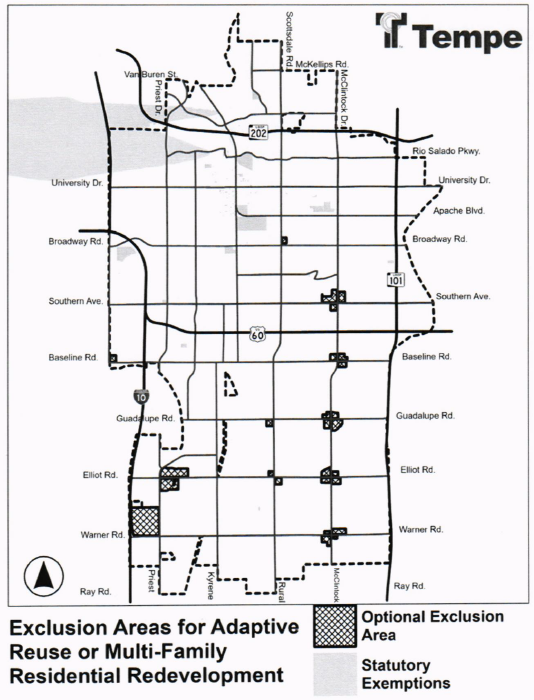
(Ord. No. O2024.58, 12-19-2024; Ord. No. O2025.31, 9-19-2025)
Section 6-401 - General Provisions.
A.
Mailed Notices. Notices mailed under provisions of this Code shall be mailed to property owners and neighborhood/homeowner associations, and tenants (if required) within the notification area as defined in Section 6-401(B). The applicant is responsible for mailing neighborhood meeting notices in accordance with Section 6-402, and the City is responsible for mailing all other public notices under this Code in accordance with Section 6-404 and 6-405. The City is not responsible for receipt of mailed notices.
B.
Notification Area. The boundary of the subject property shall be used in determining the geographic area to be notified. For projects containing more than one (1) parcel, phases of a larger project, or when part of a larger commercial center with shared access, the measurement shall be taken from the perimeter of the entire project (all phases). The Community Development Department will provide a list of recognized neighborhood and homeowner associations, within the vicinity of the project, for notification.
C.
Computation of Time. All time required actions shall be consistent with "computation of time" as defined in the Tempe City Code, Section 1-2, Definitions and rules of construction.
(Ord. No. 2008.28, 10-2-2008; Ord. No. O2014.72, 12-4-2014)
Section 6-402 - Neighborhood Meetings.
A.
Purpose. The purpose of the neighborhood meeting is to provide a means for the applicant, surrounding residential neighbors, and all affected registered neighborhood and homeowner's association representatives to review a preliminary development proposal and solicit input and exchange information about the proposed development. This preliminary meeting is intended to result in an application that is responsive to neighborhood concerns and to expedite and lessen the expense of the review process by avoiding needless delays, appeals, remands or denials. The applicant is responsible for all costs associated with the neighborhood meeting.
B.
Applicability. Neighborhood meeting steps and procedures shall be conducted in a manner that is consistent with the creation of a public involvement plan. A neighborhood meeting is required for all Zoning Map Amendments and Planned Area Development Overlays, and the following types of applications when located within six hundred (600) feet from the lot line of a residential use:
1.
Variances;
2.
Planned Area Development Overlay Districts (all locations);
3.
Major modification to an approved plan or condition of approval (when original approval requires neighborhood meeting);
4.
Zoning map amendments (all locations); and
5.
General Plan map amendments.
C.
Meeting Schedule. The applicant is required to hold one (1) meeting, prior to the first public hearing on an application for a specific site, but may hold more if desired. The required meeting shall be held at least thirty (30) calendar days and not more than one (1) year (365 days) before the first public hearing on the application. Meetings held more than one (1) year (365 days) before the first public hearing shall be required to hold an additional neighborhood meeting.
D.
Meeting Location. Neighborhood meetings shall be held at a location near the proposed development site. The meeting shall be held on a weekday evening, or weekends at any reasonable time and in a publicly accessible location.
E.
Notification Requirements. Notice of the meeting shall be provided by the applicant as follows:
1.
The development site shall be posted with public notice about the meeting not less than fifteen (15) calendar days prior to the date of neighborhood meeting, a notice of the date, time and place and a summary of the request. Such notice shall be clearly legible and wherever possible, placed adjacent to the right-of-way of a public street or road. It shall be the responsibility of the applicant to use reasonable efforts to maintain the notice once it has been placed on the subject property. It is the responsibility of the applicant to post the notice affiliated with items identified in Section 6-402(B)(2—5), with a sign having a minimum sign area of sixteen (16) square feet, which shall include information on future public hearings, pursuant to Section 6-404(C)(2). For variance applications the neighborhood meeting sign(s) shall be no smaller than six (6) square feet in area.
2.
Mailing a notice not less than fifteen (15) calendar days prior to the date of the neighborhood meeting to:
a.
All property owners of record within six hundred (600) feet of the subject property which are included on the mailing list submitted by the applicant;
b.
Provide notice by electronic communication or other standard means of noticing to the chairperson of the registered neighborhood association(s) and home owners association(s) within one thousand three hundred twenty (1,320) feet (¼ mile) of the subject property; and
c.
All tenants, within the boundary of the subject property(ies).
F.
Meeting Summary. The applicant shall submit to the Community Development Department not less than fifteen (15) calendar days before the first public hearing on the matter a written summary of the issues and discussions from the meeting and the meeting notes.
(Ord. No. 2005.83, 1-5-2006; Ord. No. 2007.74, 12-13-2007; Ord. No. 2008.28, 10-2-2008; Ord. No. O2014.72, 12-4-2014)
Section 6-403 - Notice for Public Meetings.
A.
Purpose and Applicability. The purpose of a public meeting is to provide a means for the decision-making body to receive input from the public.
B.
Agenda as Notice of Meeting. Agendas for all public meetings shall be posted at City Hall at least twenty-four (24) hours prior to such meetings, in accordance with Arizona open meeting law.
C.
Notice of Decision. Written notice of the decision made by the decision-making body in a public meeting shall be provided to the applicant and property owner (if different) and made available for public inspection at the Community Development Department.
(Ord. No. 2005.83, 1-5-2006)
Section 6-404 - Notice for Public Hearings.
A.
Public Notice. Public hearings shall be preceded by public notice in accordance with this section and Arizona open meeting law. Public hearings for General Plan amendments have additional notification requirements; see Section 6-302. When multiple applications are under review for the same project, the City may simultaneously issue notice for multiple applications. Such notice may be given in the initial posting and of the initial hearing and any subsequent hearing.
B.
Agenda. Upon receiving a complete application for action requiring a public hearing under this Code, the Community Development Director, or designee, shall place the request upon the next available agenda for a regular meeting of the decision-making body.
C.
Notification Requirements. The Community Development Department or the City Clerk shall issue public notices for all types of hearings under this Code as follows:
1.
Posting the agenda at City Hall at least twenty-four (24) hours prior to such meetings, in accordance with Arizona open meeting law;
2.
The development site shall be posted with public notice about the hearing not less than fifteen (15) calendar days prior to the dates of public hearings, a notice of the date, time and place of each public hearing and a summary of the request. Such notice shall be clearly legible and wherever possible, placed adjacent to the right-of-way of a public street or road. It shall be the responsibility of the applicant to use reasonable efforts to maintain the notice once it has been placed on the subject property. Signs shall be no smaller than sixteen (16) square feet, except applications for single-family dwellings and inline commercial sites without landscape frontage, when not part of a zoning map amendment or PAD overlay. Such sign shall be no smaller than six (6) square feet. Hearing signs are not required for Zoning and Development Code text amendments;
3.
Submitting for publication in the official newspaper the hearing notice, at least once, fifteen (15) days prior to the public hearing; and
4.
Mailing a hearing notice not less than fifteen (15) calendar days prior to the date of the initial hearing to:
a.
The applicant or representative and owners of the subject property;
b.
All property owners of record within six hundred (600) feet of the subject property which are included on the mailing list submitted by the applicant;
c.
Provide notice by electronic communication, or if not applicable, by other standard means of noticing to the chairperson of the registered neighborhood association(s) and home owners association(s) within one thousand three hundred twenty (1,320) feet (¼ mile) of the subject property(ies);
d.
All tenants, within the boundary of the subject property(ies); and
e.
Mailing of hearing notices does not apply to Zoning and Development Code text amendments.
5.
If notification is required for a public hearing with City Council, the City Clerk shall submit for publication in the official newspaper the request, at least once, fifteen (15) days prior to the action hearing. If a Tempe City Code amendment is involved, the City Clerk shall comply with the requirements of the City Charter.
D.
Content of Public Hearing Notice. Public hearing notices pursuant to Section 6-404(C) shall contain:
1.
The name of the applicant or owner;
2.
A description of the subject property reasonably sufficient to inform the public of its location;
3.
A concise description of the proposed development or use;
4.
The designation of the hearing body; and
5.
The time, date and place of the hearing.
E.
Decision Notice. Written notice of the decision of the hearing body shall be provided to the applicant and property owner (if different). The notice of decision shall contain a brief summary of the decision and conditions of approval, if any.
(Ord. No. 2005.59, 12-1-2005; Ord. No. 2007.74, 12-13-2007; Ord. No. O2014.72, 12-4-2014)
Section 6-405 - Notice of Appeals.
Notice of an appeal of a decision made at the public meeting or public hearing shall be provided in the same manner as the original meeting or hearing.
Section 6-406 - Staff Reports.
A.
Staff Reports for Boards and Commissions. After any application has been submitted for a public hearing/meeting as provided for in this Code and has been placed on an agenda, the Community Development Department shall prepare a written report for the decision-making body that includes the following information:
1.
The name of the applicant or initiating party;
2.
A description of the subject property or amendment, including any maps, drawings etc.;
3.
A statement of the proposed request and any history pertinent to such request or property;
4.
A statement of the observations of the personal inspection of the subject property and surrounding area; and
5.
A recommendation for disposition of the request.
B.
Staff Reports for City Council. Any request forwarded to the City Council shall be transmitted to the City Clerk for inclusion on the agenda of a regular meeting of the City Council. A report shall accompany the request and include items in Section 6-406(A)(1-5) and the following information:
1.
A concise statement of history and facts on the processing of the request by the Community Development Department and the public meeting(s)/hearing(s) held by the relevant decision-making body(s), found in Part 1, Chapter 3, Officers, Boards, Committees and Commissions;
2.
The findings made by the decision-making body(s) and the action taken; and
3.
Any other pertinent documents and maps, as well as other information deemed necessary by the City Clerk or Community Development Director, or designee.
(Ord. No. 2005.83, 1-5-2006)
Section 6-501 - Purpose.
This chapter provides procedures for public meetings and public hearings. It is intended to provide an efficient and effective means of public review on land use and development decisions made by the City. The provisions set forth in this chapter also are intended to encourage public dialogue and comment that is relevant to the applicable approval. All public meetings and hearings shall be open to the public and held in an accessible location and shall provide special accommodation when requested.
Section 6-502 - Rules of Procedure.
Public meetings and hearings shall be conducted in accordance with this Section and any rules of procedure adopted by the decision-making body, so long as these procedures do not conflict.
A.
Procedure. The following procedures apply to all public meetings and public hearings, except as provided for zoning map amendment protests under Section 6-502(C):
1.
Call for the request as stated on the agenda and announce that any person believed to be affected by the request may appear and will be heard, in person or by their representative;
2.
Hear the report and recommendation submitted by the Community Development Department;
3.
Time Limits. The decision-making body may set reasonable time limits for oral presentations. The decision-making body may also determine not to receive cumulative, repetitious, immaterial, derogatory or abusive testimony. Persons may be required to submit written testimony in lieu of oral if the decision-making body determines that a reasonable opportunity for oral presentations has been provided;
4.
Hear a presentation by the applicant(s) describing the manner in which the proposal is consistent with City plans, policies, and codes;
5.
Hear the relevant comments from the public regarding the application;
6.
Hear the response to the public comments and a summary statement by the applicant;
7.
The presiding officer may allow further comment, exhibits, and other evidence to be filed as part of the record of the meeting/hearing; and
8.
Hold any pertinent discussion necessary for clarification or additional information.
B.
Decision. Following discussion related to the application or comments received during the public meeting/hearing, the decision-making body may approve, approve with conditions, continue, or deny the application. In making the decision, consideration shall be given to the facts presented. The findings of fact justifying the decision shall be noted for the record. Decisions made under the provisions of this Code are effective on the date of approval (unless conditioned otherwise), except for those decisions subject to referendum.
C.
Zoning Map Amendment (rezoning) Protest. The following procedure shall apply when a zoning map amendment or overlay is protested:
1.
If the owners of twenty-percent (20%) or more of the property by area and number of lots, tracts and condominium units within the zoning area of the affected property, excluding government owned property, file a protest in writing against a proposed amendment, the change shall not become effective except by the favorable vote of three-fourths (3/4) of all members of the governing body of the municipality. If any member of the governing body are unable to vote on such a question because of a conflict of interest, then the required number of votes for passage of the question shall be three-fourths of the remaining membership of the governing body, provided that such required number of votes shall in no event be less than a majority of the full membership of the legally established governing body. For the purposes of this subsection, the vote shall be rounded to the nearest whole number. A protest filed pursuant to this subsection shall be signed by the property owners, excluding government owned property, opposing the proposed amendment and filed in the office of the Clerk of the municipality not later than 12:00 noon one (1) business day before the date on which the governing body will vote on the proposed amendment.
2.
For the purposes of this section, "zoning area" means both the following:
a.
The area within one hundred-fifty (150) feet, including all rights-of-way, of the affected property subject to the proposed amendment or change,
b.
The area of the proposed amendment or change.
(Ord. No. O2121.44, 10-14-2021; Ord. No. O2024.59, 12-19-2024)
State Law reference— A.R.S. § 9-462.04(H).
Section 6-503 - Record.
A.
Summary Minutes. Summary minutes giving a reflection of the matters discussed and decisions made during a public hearing or meeting shall be written and shall be retained as part of the public record.
B.
Additional Information. Other materials and correspondence submitted prior to or at the public hearing or meeting shall be retained as part of the record.
Section 6-601 - Conditions of Approval.
The decision-making body may impose conditions on any approval. Such conditions shall be designed to implement the requirements of this Code, protect the public from potential adverse impacts from the proposed use or development, or to fulfill an identified need for public services. In addition to those conditions imposed by the decision-making body, the City may consider as a requirement or condition any plan, exhibit, statement, or other material provided by the applicant and on record with the decision.
Section 6-602 - Contract for Conditions.
When the approval requires a contract, conditions shall be set forth in a contract executed by the City and the applicant and approved as to form by legal counsel for the City. If a contract is required, no approval shall be effective until the conditions are recorded. As a condition of approval, the City may require that the contract or a memorandum thereof be filed in the County Deed Records and shall appear in the chain of the title of the subject property, if recording is required. In addition to any personal remedy, the condition shall constitute a burden running with the land in favor of the City of Tempe and, unless otherwise provided, shall be removed only with the written authorization of the Tempe City Council. The contract shall be enforceable by and against the parties, their heirs, successors and assigns. The contract, however, shall not restrict the authority of the City of Tempe from taking actions affecting the property.
Section 6-603 - Time Limits on Conditions.
Conditions shall be fulfilled within the time limitations set forth or a reasonable time if no time limitations are specified. Failure to fulfill a condition within said time may result in initiation of revocation of the approval, citation or such other enforcement action as the City deems appropriate.
Section 6-604 - Failure to Fulfill Previous Conditions.
The decision-making body may withhold a requested approval if it determines that the current applicant has not fulfilled a previous condition or requirement from a previous approval, granted to the applicant, on the subject property, and withholding the permit would encourage compliance or is necessary to protect the public from future noncompliance.
Section 6-605 - Modification or Removal of Conditions.
Modification or removal of conditions of approval may be sought on appeal or as a new application, in accordance with Section 6-312. Such proposals shall be processed through the same procedure that was used to impose the conditions.
Section 6-701 - Re-Application.
In the event that an application is denied, an application that is substantially the same project or request will not be considered for a period of one (1) year from the date the initial application was denied, except as follows;
Section 6-702 - Reconsideration as Extraordinary Remedy.
Reconsideration of a decision is available only as an extraordinary remedy upon a determination by the decision-making body that the criteria in subsections A and B are met:
A.
Mistake. The party requesting reconsideration has sufficiently alleged in writing that a mistake of law or fact occurred; and the alleged mistake, if found to have occurred, was a substantial factor in the decision; and
B.
Hardship or Delay. Reconsideration is appropriate to avoid delay or hardship that may be caused by an appeal.
Section 6-703 - Motion for Reconsideration.
A motion for reconsideration must be filed with the Community Development Director, or designee, within fourteen (14) calendar days of the original decision. The motion shall address the factors set forth in Section 6-702 above. The applicable fee shall be submitted with the request. A motion for reconsideration may be filed by the applicant, the Community Development Director, or designee, or a party of record.
Section 6-704 - Motion for Reconsideration and Appeal Period.
Filing a motion for reconsideration is not a precondition to appealing the decision and does not stay the deadline for filing an appeal. To preserve the right to appeal, a party must file a petition for review as provided in Part 6, Chapter 8, Appeals. If the decision-making body grants reconsideration, and ultimately rules in favor of the party filing for reconsideration, the party may terminate its appeal.
Section 6-705 - Process for Reconsideration.
The decision-making body shall schedule and notify the parties of a new public hearing or meeting on the merits of the issues raised. Such hearing or meeting shall be held at the next reasonably available opportunity. The decision-making body shall limit their discussion to the issues raised in the motion for reconsideration and the merits of those issues. New evidence or testimony provided by the applicant or staff, shall be limited to grounds upon which the motion or petition for reconsideration was granted.
Section 6-706 - Reconsideration and Appeals.
If the motion for reconsideration is denied or the decision is not altered upon reconsideration, any appeal of the original decision, timely filed, shall be processed in accordance with Part 6, Chapter 8, Appeals. If the motion is granted and the decision-making body modifies the previous decision, the parties to the initial decision shall be notified within ten (10) calendar days of the decision and may appeal the decision as modified pursuant to Part 6, Chapter 8, Appeals.
Section 6-707 - Reconsideration Limit.
No decision shall be reconsidered more than once.
Section 6-801 - Purpose.
This chapter provides criteria and procedures to be used whenever an applicant or person is aggrieved by a decision by a decision-making body.
Section 6-802 - Parties to an Appeal.
Any person, entity, or group aggrieved by a decision under this Code may be a party to an appeal hearing as provided in this Section.
A.
Public Notice/Hearing. Such appeals shall be noticed and heard using the same procedures as the original public meeting/hearing, pursuant to Part 6, Chapter 4, Public Notice and Staff Reports and Part 6, Chapter 5, Public Meetings and Public Hearings.
B.
Appeal Stays Proceedings. An appeal shall stay all proceedings in the matter appealed from, unless the Zoning Administrator certifies in writing to the decision-making body that, by reason of the fact stated in the certificate, the stay would, in his opinion, cause imminent peril to life or property. In such case, proceedings shall not be stayed, except by a restraining order granted by a court of record on application and notice to the Zoning Administrator.
C.
In the event that a decision made under this Code is appealed, the appeal does not invalidate the approval. The holder of the approval may proceed with a use or development at their own risk.
D.
Conditions When Granting Appeal. Any appeal granted may be subject to such conditions as the decision-making body deems applicable.
(Ord. No. 2009.15, 10-22-2009)
Section 6-803 - Appeal Criteria.
A.
Appeal Criteria. To effect an appeal, the petitioner must file an appeal petition with the Community Development Department, City Clerk or Superior Court not later than 5:00 p.m. on the appeal due date, as provided on the notice of decision.
1.
The petition for appeals to the City of Tempe shall contain:
a.
The name of the applicant and the City case file number;
b.
The name, address and signature of each petitioner; and
c.
The specific grounds for appeal. The appeal shall be limited to the issue(s) raised in the petition.
2.
Appeals to Superior Court shall be filed per the standards of Superior Court.
B.
Time Limitations. Appeals may be processed in accordance with the time limitations established, after the decision has been rendered.
C.
Failure to File an Appeal. Failure to file an appeal with the Community Development Department or City Clerk as applicable, by 5:00 p.m. on the due date, shall render such appeal invalid.
(Ord. No. 2005.49, 8-18-2005; Ord. No. 2005.83, 1-5-2006)
Section 6-901 - Time Extension.
A.
Request for Extension. If an extension is desired, the holder of the approval or permit must file an application for an extension prior to expiration of the approval or permit.
B.
Procedure and Approval Criteria. Extension requests shall be processed by the Community Development Director, or designee, as an administrative review decision. The Community Development Director, or designee, may refer the request to the original decision-making body that issued the original approval if different than the Community Development Director, or designee. An extension may be granted for a maximum of one (1) year from the original date of expiration, and may be less than one (1) year if the Community Development Director, or designee, or the original decision-making body deems that a shorter timeframe is warranted. Extensions shall be granted only upon findings that:
1.
The use or development could not reasonably commence for reasons beyond the control of the permit holder;
2.
The request for extension is not sought for purposes of avoiding the requirements or standards of this Code or the permit;
3.
There has been no change in City standards or other circumstances likely to necessitate significant modification of the development approval or conditions of approval; and
4.
The use of property, if any, conforms to applicable City codes. The City may deny an extension request if there is an existing Code violation, or impose conditions to facilitate compliance.
C.
Exception. For time extensions pertaining to Zoning Map Amendments and Overlays, refer to procedures pursuant to Section 6-304(D) and Section 6-305(F).
(Ord. No. 2009.15, 10-22-2009; Ord. No. 2009.40, 11-5-2009; Ord. No. O2018.33, 4-26-2018)
Section 6-902 - Revocation of a Permit/Approval.
The City may revoke an approval or permit granted under this Code. In revoking an approval or permit, the following procedures apply:
A.
Procedure and Criteria. Following reasonable notice to the permit/approval holder an administrative hearing shall be held to consider all relevant information, conditions, and concerns related to the permit. The permit/approval holder will be given a reasonable opportunity to resolve all related issues. If the permit/approval holder cannot comply with conditions of the permit/approval or otherwise remains in violation of this Code after thirty (30) days, or sooner when the violations constitute an immediate public health, safety and general welfare concern, the Zoning Administrator shall schedule the item on the next regularly scheduled agenda of the original decision-making body, as may be appropriate, at which time revocation of the permit/approval may be considered. Notice of a revocation shall be provided in the same manner as the original meeting or hearing, as amended within Sections 6-403 and 6-404, Notices for Public Meetings and Hearings. A permit/approval may be revoked if it is determined that:
1.
Development which has occurred does not comply with the standards set forth in this Code or any special conditions imposed upon the permit/approval;
2.
The permit/approval was approved based on materially incorrect or incomplete information; or
3.
A change has occurred to City regulations, the General Plan or applicable law, prior to the development obtaining a vested right or status as a legal nonconforming use that makes the approved development unlawful or not permitted.
B.
Revoke Permit/Approval. The decision-making body, upon finding that the applicant has not taken corrective actions to resolve issues related to the permit/approval and that a continuation of the permit/approval is not in the interest of the public health, safety and general welfare, can revoke the permit/approval after providing written notice of its intentions to the holder of the permit.
C.
Option to Reapply for Permit/Approval. The holder of the revoked permit/approval may reapply for a new permit/approval at any time as an entirely new application.
(Ord. No. 2009.15, 10-22-2009; Ord. No. 2009.40, 11-5-2009)
Section 6-903 - Transfer of Permits/Approvals.
A.
Use permits and approvals are transferable to successors in interest. Transfer of a use permit is reviewed as an administrative application, pursuant to Section 6-204.
(Ord. No. 2005.49, 8-18-2005)

