
Tiburon City Zoning Code
16-30
Standards for All Development and Land Uses
16-30.010 - Purpose.
The provisions of division 16-30 are intended to ensure that the construction of new development and the establishment of new and modified uses contribute to the maintenance of a stable and healthy environment, that new development is harmonious in character with existing and future development, and that the use and enjoyment of neighboring properties are protected, as established in the general plan.
(Ord. No. 519 N.S., § 3(Exh. A), 3-17-2010)
16-30.020 - Applicability.
A.
The regulations of division 16-30 apply to any zone wherever the specified circumstances exist.
B.
Uses referred to in this zoning ordinance include the structures ordinarily devoted to such use.
C.
No buildings or structures shall be erected, reconstructed, moved, converted, or structurally altered in any manner, nor shall any buildings, other structures, or land be used for any purpose or in any manner other than as permitted by and in conformance with the general plan and this zoning ordinance.
(Ord. No. 519 N.S., § 3(Exh. A), 3-17-2010)
16-30.030 - Setback requirements and exemptions.
A.
Purpose. This section provides standards for the use and minimum size of setbacks. Setbacks provide open areas around structures for: visibility and traffic safety; access to and around structures; access to natural light, ventilation and direct sunlight; separation between incompatible activities; and space for privacy, landscaping, and recreation. Setbacks can also provide a sense of low density, spaciousness, and aesthetic pleasure.
B.
Setback requirements. Unless exempted in compliance with subsection E. below, all structures shall conform with the setback requirements established for each zone by article II (zones and allowable land uses), and with any special setbacks established for specific uses by this zoning ordinance, except as otherwise provided by this section.
C.
Measurement of setbacks. Required setbacks shall be measured horizontally from the front, side or rear property line as appropriate to the measurement, to a line parallel thereto at the minimum distance specified in article II for the zone in which the property is located. On a site that is not rectangular or approximately rectangular in shape, required setbacks shall be determined by the director, and a record of such determination kept in the town building file.
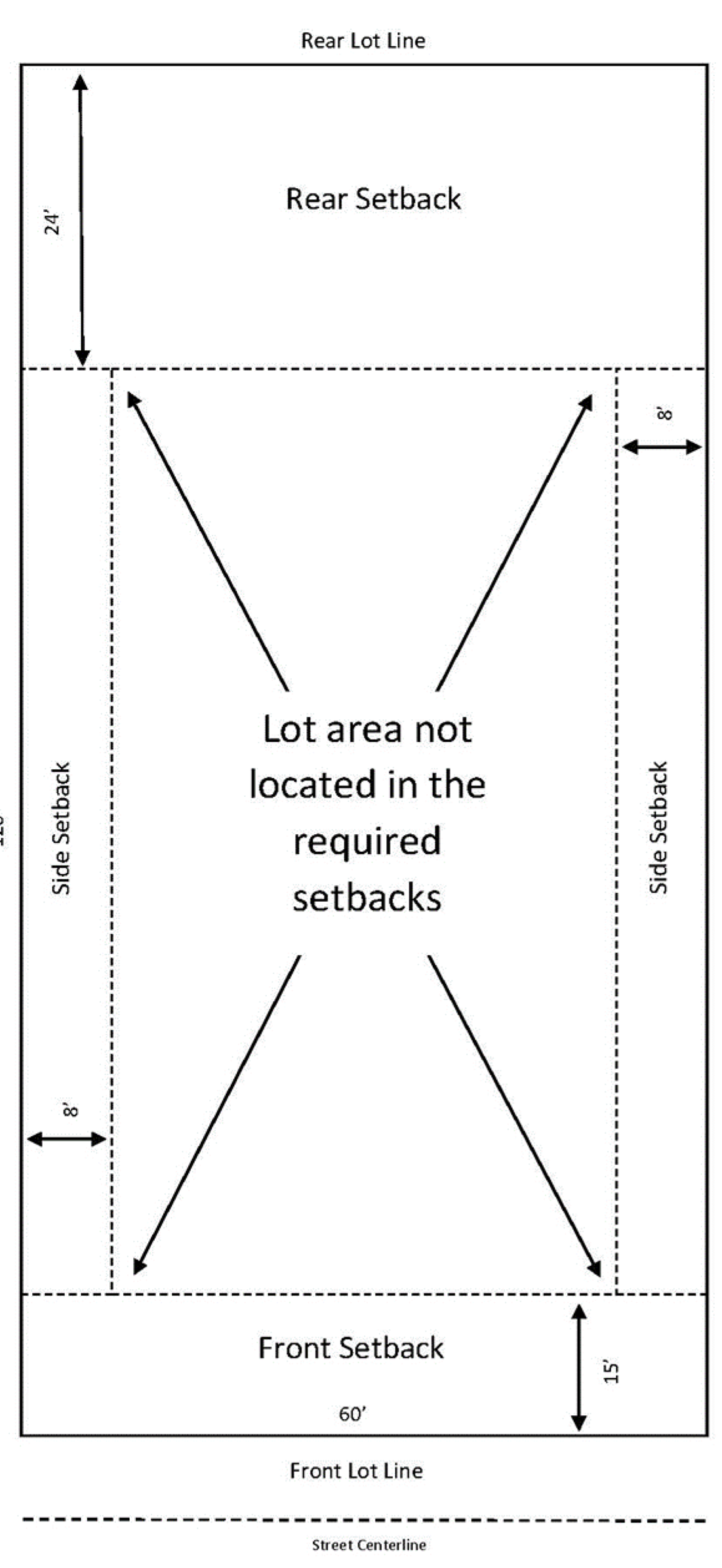
Figure 3.1.Setbacks (Examples using R-1 zone setbacks)
D.
Front setback reduction. Where more than half the lots on one block in the same zone have been improved with buildings, the required front setback on that block is the average of the front setbacks on improved lots, but need not exceed the minimum required front setback in that zone.
E.
Limitations on the use of setbacks.
1.
Accessory structures. Required front and side setbacks shall not be used for the placement or erection of any accessory building in any zone. Detached accessory buildings not exceeding twelve feet in height may be located on a rear setback, provided that such buildings do not occupy more than twenty-five percent of the area of the rear setback. Swimming pools and spas may also be located on a rear setback, but not within a front setback or side setback.
2.
Fences. See section 16-30.040 (fences and walls).
3.
Landscaping. Landscape features such as patios, open grills, water features (other than swimming pools and spas), trellises, entry pergolas, and similar features may occupy any required setback. But in no case shall any obstruction be located in a public right-of-way without issuance of an encroachment permit.
4.
Parking. The parking or storage of operable or inoperable vehicles in areas other than on an improved parking surface, as defined in article X (definitions), is prohibited.
5.
Additional requirements.
a.
Required setbacks shall not be encroached upon by movement or alteration of an existing main building.
b.
Required accessory structure setbacks shall not be less than the minimum for any new main building, except as noted in subsection 1. above.
F.
Allowed projections into setbacks. Attached architectural features and certain detached structures may project into or be placed within a required setback in compliance with the following requirements:
1.
The ordinary projection of sills, bay windows, cornices, architectural features and eaves may extend beyond the wall of the structure and into the front, side and rear setbacks; provided, however, that none shall project into a minimum setback more than three feet. In no case shall such projection encroach to within three feet of any property line.
2.
The extension of structures such as chimneys, fire escapes, landing places, outside stairways and uncovered balconies, decks and porches may extend beyond the wall of the structure and into the front, side and rear setbacks; provided, however, that none shall extend into a required side setback more than three feet, nor into a required front or rear setback more than six feet. In no case shall such structures extend to within three feet of any property line.
G.
Restrictions on the use of front setbacks in residential zones. In any residential zone, a front setback shall not be used for the storage of junk materials as described in article X (Definitions) under the definition of "junkyard."
H.
Vehicle entry gates. Vehicle entry gates shall be set back a minimum of fifteen feet from a private or public roadway, shared driveway, curb, gutter or sidewalk so as not to impede vehicular or pedestrian traffic. The review authority shall have reasonable discretion to require a larger setback distance, if circumstances warrant.
(Ord. No. 519 N.S., § 3(Exh. A), 3-17-2010; Ord. No. 541 N.S., § 2(M), 8-15-2012; Ord. No. 564 N.S., §§ (D)—(G), 4-6-2016)
16-30.040 - Fences and walls.
A.
Applicability. The requirements of this section apply to all fences and walls, including fence/wall combinations, unless otherwise stated.
B.
Height limits. Fences and walls may occupy any required setback, provided that:
1.
A fence, wall, or retaining wall greater than three and one-half feet in height shall not be erected without site plan and architectural review approval as provided in section 16-52.020 (site plan and architectural review).
2.
A fence, wall, or retaining wall shall not exceed six feet in height in any setback, with the following exceptions:
a.
A fence, wall or retaining wall may exceed six feet in height if all of the following conditions are met:
i.
The fence and/or wall is located along a private residential property line shared with another private residential property;
ii.
There is a difference in surface elevation between the two adjoining properties along the property line upon which the proposed fence and/or wall is to be located;
iii.
The fence and/or wall would have a maximum height of six feet on the upper side of the structure; and a maximum height on the lower side of the structure of six feet plus the difference in surface elevation between the adjoining property at the property line, but in no instance more than nine feet;
iv.
The review authority determines that a fence and/or wall with a height of six feet on the lower side of the structure would not provide an effective privacy screen for the adjoining properties; and
v.
The review authority determines that the proposed fence would not result in significant view obstruction or visual impacts on properties in the vicinity.
b.
A safety railing on top of a retaining wall as required by the town's building code shall not count toward the measured height of the retaining wall if the building official determines that the location of the railing is necessary for safety purposes. Site plan and architectural review approval shall be required for such railings and walls as provided in section 16-52.020 (site plan and architectural review). Such railings are encouraged to be constructed either of transparent materials or be otherwise visually open in design.
3.
Fences (including walls used as fences) shall not be located, designed, or constructed so as to impair safe vision from vehicles or of pedestrians.
4.
If two or more fences and/or walls are constructed on the same property with a separation of three feet or less between the faces of the structures, the height of the respective structures shall be combined to determine the total wall or fence height. If the fences and/or walls are separated by a horizontal distance greater than three feet, the heights of the fences and/or walls shall be calculated separately and shall not be combined to determine total height.
(Ord. No. 519 N.S., § 3(Exh. A), 3-17-2010; Ord. No. 561 N.S., § 2(B), 9-2-2015; Ord. No. 564 N.S., § (H), 4-6-2016)
16-30.050 - Height limits and exceptions.
A.
Purpose. Height limits are important measures to protect privacy and views; to promote the adequate provision of sunlight, air, and visual safety; and to prevent the vertical overbuilding of properties.
B.
Maximum height. No building or structure shall be erected or altered to exceed the height limit established for the zone in which the structure is located. The height limit is a maximum, and is subject to reduction through the site plan and architectural review process, through precise development plan approvals, or through other permit approvals issued by the town.
C.
Height measurement. Height is the plumb vertical distance, measured using a plane, established by the lower of the natural or finished grade at the perimeter of the exposed exterior surface of the building, structure, fence, or wall. No point of the roof edge, fence, wall, parapet, mansard, structure, or other building feature shall extend above the plane established by the maximum height line from grade, except as specifically excluded below. Refer to Figure 3-2 below.
On lots in subdivisions where there is an approved grading plan that has been implemented and accepted as complete by the town, the elevation established by the subdivision grading shall be considered the natural ground elevation.
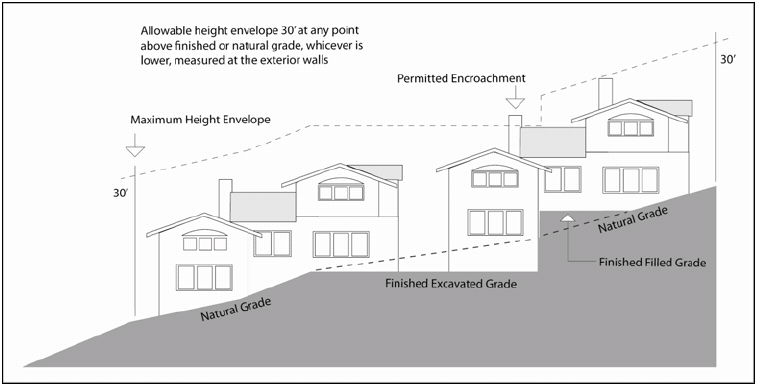
Figure 3-2. Height Measurement
D.
Exceptions to height limits.
1.
Elevator and stairwell roof enclosures, roof equipment enclosures, skylights, chimneys, flues, vents, and similar features may exceed the maximum height to provide for the normal function of a facility, provided that they are of minimum height and bulk.
2.
Spires, radio and television towers or antennas, and similar features, of minimal area and bulk, may exceed maximum height limits by up to three feet or as required by the California Building Code. The height restrictions shall not apply to antennas for wireless communication facilities licensed by the Federal Communications Commission when a conditional use permit has been obtained for that use in compliance with section 16-52.040 (conditional use permit) and section 16-42 (wireless communications facilities).
3.
The footing portion of a retaining wall (below grade) shall not be included in the measurement of height.
4.
Height limitations specified in this section shall not apply to public utility distribution and transmission lines that are under the jurisdiction of the State Public Utilities Commission.
5.
Flag poles shall have a maximum height of twenty-four feet.
E.
Height limit at street intersections. For visual safety reasons at all street intersections, it is unlawful to install or maintain any sign, fence, hedge, vegetation, or any other view obstructions that extend more than thirty inches above the street level of any adjacent intersection, within that area between the property line and a diagonal line joining points on the property lines that are thirty-five feet from their intersection, as extended. Refer to Figure 3-3 below.
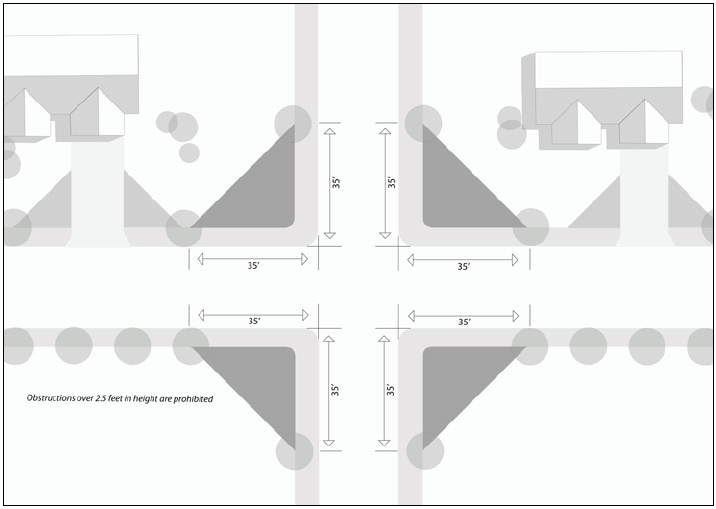
Figure 3-3. Sight Distance at Intersections
The above provision shall also apply to lots on sharp curves of streets, where, in the opinion of the police chief, town engineer or superintendent of public works, sight distances are impaired. In such cases, the thirty-five-foot distance shall be measured from the outermost point on the curve.
(Ord. No. 519 N.S., § 3(Exh. A), 3-17-2010; Ord. No. 548 N.S, § 2(D), (E), 3-5-2014)
16-30.060 - Child play structures/sports courts.
A.
Purpose. This section provides regulations for play structure and sports courts improvements that require permits from the town.
B.
Pre-application recommendations. Prior to the installation of sports courts, play equipment or structures, or similar improvements, applicants should consult town staff regarding the design of such facilities. Applicants are advised to provide informal noticing to neighbors about proposed plans before an application is submitted to the town and prior to construction, to prevent potential problems during public review.
C.
General. Sports courts, play structures and similar improvements shall not be located on or over public utilities or easements of record without express written permission from the easement holder(s).
D.
Review and permitting. The following items require site plan and architectural review in compliance with section 16-52.020 and building permits.
1.
A sports court, only when accompanied with the items listed below:
a.
Fences or walls over forty-two inches in height.
b.
Exterior lighting poles or mounts over forty-two inches in height.
c.
Nonportable (fixed in place) basketball standards or other similar structures.
2.
Nonportable playhouses, play structures, or secure playground equipment (such as swings and seesaws) on residential property, on public property subject to regulation by the town, on private school property, or at a commercial child day-care center.
E.
Site plan and architectural review exceptions. The following items do not require site plan and architectural review but do require building permits:
1.
Fences or walls forty-two inches or less in height; and
2.
Flat-surface work, including tennis and basketball court surfaces, if constructed on top of a deck that is more than thirty inches above grade.
(Ord. No. 519 N.S., § 3(Exh. A), 3-17-2010)
16-30.070 - Lighting.
General lighting design and development shall comply with the following standards:
A.
Exterior lighting shall not invade the privacy of other properties, or produce glare or light pollution; yet shall provide adequate illumination for safety and security purposes.
B.
All proposed exterior lighting shall be shielded downlighting.
C.
All skylights shall be bronzed or tinted and shall not utilize frosted glass, and no lights shall be placed in or directed up into the wells.
D.
Baffles, shields or other structural elements may be required to limit light pollution from exterior lights and skylights.
(Ord. No. 519 N.S., § 3(Exh. A), 3-17-2010)
16-30.080 - Recyclable materials collection and loading.
The design and location of all collection and loading areas for recyclable materials shall comply with the requirements of Municipal Code chapter 16C, also known as the recyclables collection area ordinance.
(Ord. No. 519 N.S., § 3(Exh. A), 3-17-2010)
16-30.090 - Storage and debris boxes.
A.
Purpose. The purpose of this section is to regulate the placement of storage and debris boxes on public and private property.
B.
General. Site plan and architectural review (section 16-52.020) approval shall be obtained for any storage or debris box not associated with an active building permit. In addition, an encroachment permit shall be obtained if the storage or debris box is not associated with an active building permit and is located on public property.
C.
Site plan and architectural review exceptions. Storage or debris boxes are exempt from the site plan and architectural review (section 16-52.020) and encroachment permit process as long as the following criteria are met:
1.
The storage or debris box is associated with construction on a property for which there is an active building permit.
2.
Debris boxes shall be on private property and off the street, unless there is no practical location for the debris box off-street as determined by the director.
3.
Storage boxes in all cases shall be located on private property and off the street.
(Ord. No. 519 N.S., § 3(Exh. A), 3-17-2010)
16-30.100 - Submerged and partially submerged land.
A.
Wholly submerged lands, and underwater portions of lands that are partially submerged, shall be considered conservation areas subject to the regulations of the M (marine) zone (divison 16-25), and of the San Francisco Bay Conservation and Development Commission (BCDC).
B.
The area of such lots that is below the mean high tide line shall not be used in the determination of lot coverage, floor area ratio, or any other land and structure regulation of the zone in which it is located, but submerged land under the same ownership may be applied toward the minimum lot area requirements and the required rear setback of a lot.
C.
Land use changes in submerged and partially submerged land as allowed by subsection 16-25.030.B. (uses permitted with a tidelands permit in the M zone) shall require tidelands permit review in compliance with section 16-52-080 (tidelands permit).
(Ord. No. 519 N.S., § 3(Exh. A), 3-17-2010; Ord. No. 541 N.S., § 2(N), 8-15-2012; Ord. No. 564 N.S., § (I), 4-6-2016)
16-30.110 - Public utility lines.
A.
Public utility lines requirements. Public utility distribution lines, both overhead and underground, are permitted in all zones, subject to obtaining normal permits (see section 16-52.020 [site plan and architectural review]), except where routine maintenance and repairs on existing lines are required, in which case no zoning permit is required.
B.
Undergrounding of utilities. The town requires undergrounding of utility connections for new construction and for remodel of existing structures, in compliance with Municipal Code chapter 12A (underground utility districts—extensions). The locations of new power transmission lines are to be approved by the town through site plan and architectural review (section 16-52.020).
(Ord. No. 519 N.S., § 3(Exh. A), 3-17-2010)
16-30.120 - Lot legality and coverage.
A.
Legality of lots and lot area requirements.
1.
Legality of lots required for improvement. No building or structure shall be constructed on a lot that is not legally recognized. The purpose of this provision is to prevent the construction of improvements on lots that have been illegally subdivided or otherwise illegally created. This provision does not apply to improvements on any of the following:
a.
A lot created by a valid recorded subdivision map;
b.
A legal lot of record, provided that the lot is not subject to merger provisions of the State Subdivision Map Act;
c.
A lot divided and conveyed by valid deed, written contract of sale, or similar means, executed prior to June 24, 1964 (when the town's subdivision ordinance was adopted), provided that the lot is not subject to merger provisions of the State Subdivision Map Act; or
d.
A lot recognized by a recorded certificate of compliance wherein all conditions (if any) of said certificate of compliance are satisfied.
2.
Lot area requirements.
a.
Newly created lots shall have not less than the minimum area required by the land and structure regulations for the zone in which they are located. Any lot on which dwelling units are proposed shall also comply with any minimum lot area per unit requirement of its zone.
b.
No existing lot shall be reduced in area so as to be smaller than required by this zoning ordinance, nor shall it be divided to create lots smaller than required by this zoning ordinance; if already smaller in dimension or area, it shall not be further reduced or divided.
3.
Water and sewer requirements. Newly-created lots and unimproved lots shall be served for domestic purposes by the public water system, or in accordance with Municipal Code chapter 13F (water well construction and use); and by the public sewer system unless specifically exempted by the council.
B.
Lot coverage.
1.
Lot coverage measures the proportion of a lot that is covered by structures. Lot coverage limits help to promote the aesthetic qualities of spaciousness and privacy. Lot coverage limits can also help reduce excessive run-off and help provide usable outdoor spaces by restricting the horizontal overbuilding of properties. In traditional zones (R-1, R-1-B, R-2, R-3, RO), the percentage of any lot that may be covered by structures is specified in the land and structure regulations for that zone (see article II [zones and allowable uses]). Lot coverage in planned developments is usually established by the precise development plan or associated document.
2.
Lot coverage is calculated by dividing the area occupied by the exterior limits of all structures exceeding three feet in height above the natural or finished ground surface, whichever is lower, by the total lot area, and multiplying by one hundred.
3.
Lot coverage shall include buildings, accessory buildings, and carports; one-half the area of all decks higher than three feet above grade; cantilevered elements, porches, canopies, chimneys, fire escapes, balconies, and similar features that are higher than three feet above grade; and eaves that project more than four feet.
4.
Lot coverage shall not include the area of uncovered and unenclosed off-street parking spaces, walks, patios, in-ground swimming pools or pools that do not extend more than three feet above grade, uncovered decks three feet or less above grade, landscape features, and eaves projecting four feet or less.
(Ord. No. 519 N.S., § 3(Exh. A), 3-17-2010; Ord. No. 564 N.S., § (J), 4-6-2016)

