
Tiburon City Zoning Code
16-32
Parking and Loading Standards
16-32.010 - Purpose.
The purpose of this section 16-32 is to establish off-street vehicle and bicycle parking requirements that balance the town's goal to encourage walking, bicycling, and transit use with the goal to provide adequate off-street parking to meet the needs of residents, shoppers, and visitors. The town discourages providing parking in excess of that required by the standards herein except where good cause can be demonstrated. It is also the purpose of this chapter to provide flexibility and allow alternative means of addressing parking demand in the commercial zones. Off-street parking requirements and provisions set forth herein consider various factors, including the context of downtown's transit availability, generous overall supply of parking in the downtown commercial area, demonstrated on-street and off-street parking availability, density and mix of uses, extensive shared parking, walkability, and the use of alternative modes of transportation.
(Ord. No. 519 N.S., § 3(Exh. A), 3-17-2010; Ord. No. 577 N.S., § 2(B), 5-16-2018)
16-32.020 - Applicability.
Each land use and structure, including a change or expansion of a land use or structure, shall provide continuously maintained off-street parking and loading areas in compliance with section 16-32. A land use shall not be commenced and a structure shall not be occupied until the improvements required by section 16-32 are satisfactorily completed.
(Ord. No. 519 N.S., § 3(Exh. A), 3-17-2010; Ord. No. 577 N.S., § 2(B), 5-16-2018)
16-32.030 - General parking regulations.
A.
Location.
1.
Parking. The required parking shall be provided on site, except that required parking may be provided on another lot providing that the lot is in a commercial zone within the town and is reasonably convenient to the subject lot, as determined and approved by the review authority.
If the building, structure, use, or improvement requiring parking space is located on one lot and the required parking is on another lot, partially or wholly, then one of the following shall apply:
a.
There shall be recorded with the county recorder of Marin County a covenant by the owner or owners of such lots for the benefit of the town, in a form approved by the town, that the owner or owners will continue to maintain the required number of parking spaces so long as the building, structure, use or improvement is maintained within the town. The covenant shall stipulate that the title to and right to use the lot or lots upon which the parking spaces are to be provided shall be subservient to the title to the premises upon which the building has been or is to be erected and that it is warranted that such lot or lots are not and will not be made subject to any other covenant or contract for use without prior written consent of the town.
b.
The town may permit required parking spaces to be secured by a lease agreement. The terms of any such lease agreement shall be reviewed and approved by the town prior to establishment of the use to determine whether the provisions of section 16-32 are satisfied. A copy of any such lease shall be maintained in the files of the town. It shall be understood that the loss of required parking spaces secured by such method shall be valid cause for revocation of a conditional use permit, or other zoning permit, allowing such use.
c.
Other equivalent methods satisfactory to the review authority.
2.
Loading. The required loading shall be permanently available, marked, and maintained for loading purposes for the use it is intended to serve. Loading spaces shall be located as required in section 16-32.090 (Loading berths).
B.
Recreation vehicle, trailer and truck parking.
1.
It is unlawful for any person to place, keep or maintain, for dwelling purposes on any property, any travel trailer, automobile, truck, recreation vehicle, camper, boat or other temporary or movable facility (excluding mobile homes).
2.
Parking or storage of trucks having gross weights of less than five thousand pounds (two and one-half tons), trailers, boats and campers for periods in excess of seventy-two hours is permitted without a conditional use permit in accordance with section 16-52.040 (Conditional use permit) in completely enclosed structures or when not plainly visible from any public right-of-way.
3.
Public agency or utility company vehicles for emergency responders on official business or when assigned by the agency or company to an employee as a "company car" may be kept or placed in residential zones.
C.
Parking log and map. The town may maintain a log and/or map of all parking lots in commercial zones, noting the buildings and/or uses assigned to each. However, it shall be the responsibility of the property owner and/or applicant to demonstrate the availability and adequacy of parking for a use or building to the satisfaction of the review authority.
(Ord. No. 519 N.S., § 3(Exh. A), 3-17-2010; Ord. No. 577 N.S., § 2(B), 5-16-2018)
16-32.040 - Number of parking spaces required.
A.
Parking requirements. The minimum number of parking spaces (stalls) established in subsection B, below, unless otherwise superseded by provisions of state law, shall be required to serve the uses or buildings listed. The ratios listed shall apply to normal occupancy densities and uses. Higher or lower ratios may be used for other than normal occupancy densities and uses, availability of public transportation and other special conditions, as determined by the review authority.
B.
Minimum number of parking spaces. It is the intent of the town that parking areas be adequate but not excessive. When units of measurement determining the number of required parking spaces result in the requirement of a fractional space, any fraction of over one-half shall be rounded up to the next parking space. In the case of any use that is not specifically mentioned in table 3-1 below, the provisions for a use that is so mentioned and is similar, or as determined by the director if no similar uses are mentioned in table 3-1, shall apply, with the review authority having final approval authority.
C.
Required parking reduction in commercial zones. The review authority may reduce the required parking spaces for proposed non-residential uses or structures located in a VC, NC or O zone if it makes the following findings prior to approval of the non-residential use, structure or expansion:
1.
An adequate parking supply exists in the surrounding commercial area and the proposed structure, use or expansion will not result, either individually or cumulatively, in an inadequate parking supply. The town may require an independent parking study for the purpose of determining whether it can make this finding.
2.
The proposed structure, use or expansion will promote the general welfare of the surrounding commercial area.
3.
The reduction of required parking spaces will not result in a substantive detrimental effect on the surrounding area due to identified factors including but not limited to those set forth in section 16-32.010.
D.
The California Building Code. The required number of spaces in off-street parking facilities that are restriped or redesigned to meet accessibility requirements may be reduced as necessary to comply with Title 24 of the California Building Code.
E.
Elimination of parking spaces. Existing off-street parking spaces may not be eliminated without first obtaining site plan and architectural review approval pursuant to this chapter, except as allowed in subsection D above.
TABLE 3-1
MINIMUM NUMBER OF PARKING SPACES
(Ord. No. 519 N.S., § 3(Exh. A), 3-17-2010; Ord. No. 577 N.S., § 2(B), 5-16-2018; Ord. No. 605 N.S, § 8, 6-21-2023)
16-32.050 - Disabled/handicapped parking requirements.
Parking spaces for the disabled shall be provided in compliance with the Federal Accessibility Guidelines, and/or California Code of Regulations Title 24, as applicable. Parking spaces required for the disabled shall count toward compliance with the number of off-street parking spaces required by section 16-32.040 (Number of parking spaces required).
(Ord. No. 519 N.S., § 3(Exh. A), 3-17-2010; Ord. No. 577 N.S., § 2(B), 5-16-2018)
16-32.060 - Bicycle parking.
For all uses except single-family and two-family dwellings, bicycle racks or stands shall be provided at the rate of one bicycle per fifteen required parking spaces. Bicycle racks or stands shall be located off-street so as to avoid undue interference with pedestrians and vehicular traffic, and shall have adequate provision for secure locking of bicycles.
(Ord. No. 519 N.S., § 3(Exh. A), 3-17-2010; Ord. No. 577 N.S., § 2(B), 5-16-2018)
16-32.070 - Motorcycle parking and electric vehicle charging stations.
Motorcycle parking shall be provided for all commercial uses at a rate of one space per forty required parking spaces, with a minimum of one motorcycle space for any lot with more than twenty parking spaces. Electric vehicle charging stations for all uses shall be required at a rate of one charging station for each forty required parking spaces, with a minimum of one charging station for any lot with more than twenty parking spaces.
(Ord. No. 519 N.S., § 3(Exh. A), 3-17-2010; Ord. No. 577 N.S., § 2(B), 5-16-2018)
16-32.080 - Parking design and development standards.
A.
The layout of parking spaces, loading berths, parking aisles, landscaping, lighting and other required information shall be submitted with the application for the applicable land use permits and shall comply with all the requirements specified below, which shall be completed prior to occupancy.
1.
The required parking spaces, loading berths and parking aisles may not be located on any street right-of-way;
2.
The required parking spaces, loading berths and parking aisles, if outdoors, may be located on the required side and rear setbacks, and within the required front setbacks up to three feet from the street right-of-way;
3.
Each parking stall and loading berth shall have vehicular access to the street, accessway, or alley, without passing over other parking spaces;
4.
Each parking stall shall have vehicular access to the street without backing into it or another stall, except where conditions of terrain or siting in the case of single- and two-family dwellings makes this infeasible, as determined by the review authority. Access driveways shall not be arranged so as to unduly increase hazards to traffic or pedestrians;
5.
Each parking stall, aisle and driveway shall be graded, drained and surfaced so as to prevent dust, mud or standing water, to the satisfaction of the town engineer. For non-residential lots and uses, all parking spaces, aisles, circulation directions, motorcycle spaces, pedestrian spaces, no-parking spaces and the like shall be clearly marked with durable traffic paint. Raised wheel stops or similar devices acceptable to the town engineer, shall be provided to protect adjacent walks, fences, walls, landscaping and the like but shall not be installed in locations that may unduly increase hazards to pedestrians, such as between parking spaces;
6.
Landscaping, including trees and shrubs for shading and visual buffering, shall be required and shown as part of the parking layout. Large paved areas shall be given some measure of visual relief by the interspersion of landscaping within the paved area where reasonably feasible, as well as around the perimeter. Potentially unsightly areas such as trash storage shall be screened from public view and other properties by opaque fences or walls. Landscaping shall be water-conserving types and shall be properly irrigated and maintained. Defective or dead landscaping shall be promptly replaced;
7.
Sufficient lighting shall be provided to protect the public in a parking area during the time it is accessible to the public after daylight; glare shall be shielded from other properties.
B.
Each parking lot stall and aisle shall comply with the minimum dimension requirements in Figure 3-4, Figure 3-5, and Table 3-2.
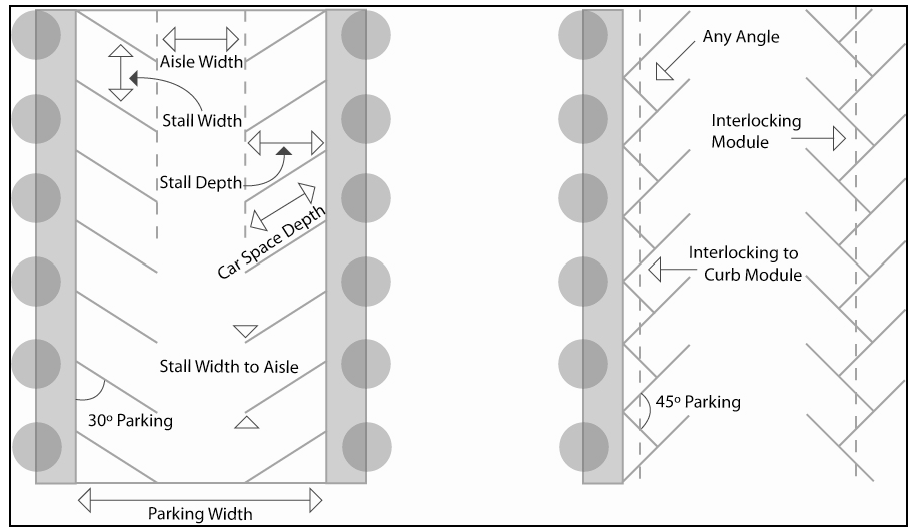
Figure 3-4. Parking Dimensions Diagram, 30 and 45 degrees
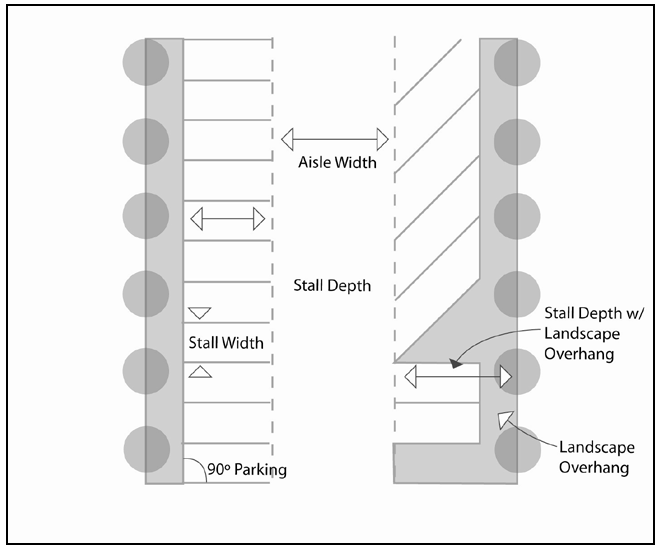
Figure 3-5. Parking Dimensions Diagram, 90 degrees
TABLE 3-2: PARKING DIMENSIONS
For parking spaces constrained by walls or other physical barriers on one side, one foot shall be added to the width required in Table 3-2, and for parking spaces constrained on both sides two feet shall be added to the width required in Table 3-2.
(Ord. No. 519 N.S., § 3(Exh. A), 3-17-2010; Ord. No. 577 N.S., § 2(B), 5-16-2018)
16-32.090 - Loading berths.
Off-street loading spaces shall be provided as required by this section. The director may modify these requirements if the director first determines that the operating, shipping, and delivery characteristics of the use do not require the number or size of loading berths as required by this section, or determines that existing loading berths (public or private) are adequate to serve the needs of the use.
A.
A minimum of one loading berth shall be required for each building or related group of buildings on a property containing more than five thousand square feet of floor area used for the storage, receipt, distribution, processing, or display of goods, materials or merchandise.
B.
Loading berths shall be no less than twelve feet by thirty-five feet wide with fourteen feet minimum height clearance.
C.
Loading berths shall be located off-street and arranged to avoid undue interference with parking, pedestrians, street traffic, and other properties. Berths may be open or covered.
(Ord. No. 519 N.S., § 3(Exh. A), 3-17-2010; Ord. No. 577 N.S., § 2(B), 5-16-2018)
16-32.100 - Multiple uses.
Parking required for multiple uses shall be the sum of the requirements for each individual use; provided that parking spaces required for one use or time may utilize the same spaces required for another use or time upon commission approval, by means of appropriate conditions, of such dual parking. The commission shall not grant such approval unless it is able to, and does, make the following findings:
A.
That the uses or times for which overlapping parking is being requested do not have overlapping hours of operations sufficient to result in a deficiency of parking spaces;
B.
That the parking lot in question is within a reasonable distance from the uses for which parking requirements are to be overlapped.
Failure to abide by the conditions of the approval shall be cause for revocation of such approval for all uses involved, regardless of previous approvals.
(Ord. No. 519 N.S., § 3(Exh. A), 3-17-2010; Ord. No. 577 N.S., § 2(B), 5-16-2018)
16-32.110 - Change in use—Additions and enlargement.
A.
Whenever on any lot or site there is a substantial change in use, addition or enlargement, or substantial increase in the number of employees or other unit of measurement used to calculate the number of required off-street parking spaces, then additional off-street parking spaces shall be provided corresponding to the increase in floor area, number of employees, or such other applicable unit of measurement in accordance with section 16-32.040. The effects of additions, enlargements and changes in use shall be cumulative in regard to off-street parking requirements.
B.
For non-residential uses located in an NC, VC, or O zone, the provisions of subsection A above shall not apply if the change in use, addition or enlargement, or increase in the number of employees is not substantial as measured by increased parking demand, as determined by the director or the review authority, and does not have the potential to result, either individually or cumulatively, in an inadequate parking supply for the surrounding commercial area. The director may establish minimum thresholds for determining whether a proposal would constitute a substantial change in use, addition or enlargement.
(Ord. No. 519 N.S., § 3(Exh. A), 3-17-2010; Ord. No. 577 N.S., § 2(B), 5-16-2018)
16-32.120 - In lieu payments.
In lieu of furnishing the parking spaces required by the provisions herein, the town may permit the requirements to be satisfied by the payment to the town, prior to the issuance of the building or occupancy permit, of a sum equivalent to the estimated normal current cost to the town of providing required parking spaces to serve the contemplated uses. The amount of payment for each required parking space shall be fixed by the council by resolution. An application for permission to make such in lieu payments shall be filed with the town and set for public hearing before the council within forty-five days of filing. The council may waive all or part of the parking normally required, and require payment in lieu thereof and impose conditions when the facts demonstrate that granting the application:
A.
Will not result in an unreasonable burden on parking facilities serving the area in which the subject use is to be located;
B.
Will not materially adversely affect the use and enjoyment of property in the vicinity; and
C.
Will be consistent with the general purpose and intent of this zoning ordinance and the general plan.
(Ord. No. 519 N.S., § 3(Exh. A), 3-17-2010; Ord. No. 577 N.S., § 2(B), 5-16-2018)

