
Tiburon City Zoning Code
16-23
Downtown Zones
16-23.010 - Purpose.
The purpose of division 16-23 is to establish standards for land uses, site layout, and building form and design in the downtown zones including the MS (Main Street), VC (Village Commercial), and MU (Mixed Use) zones. These requirements constitute "objective standards" under current state housing law, including but not limited to Government Code sections 65913.4, 655589.5 and 756852.21, to provide clear development standards that allow for streamlined review processes.
A.
The MS (Main Street) zone intends to support the downtown area by providing a wide range of resident and tourist-serving commercial uses. Mixed commercial and residential uses are allowed. The MS zone conforms with the general plan land use designation Main Street (MS).
B.
The MU (mixed use) zone intends to encourage development of multifamily dwellings in a pedestrian-oriented setting. The MU zone conforms with the general plan land use designation mixed use (MU).
C.
The VC (village commercial) zone intends to support the Ark Row portion of the downtown area by providing a wide range of resident and tourist-serving commercial use. Mixed commercial and residential uses are allowed. The VC zone conforms with the general plan land use designation Village Commercial (VC).
Further, the purposes of this Division are to:
1.
reinforce downtown as a cultural and commercial destination;
2.
accommodate infill housing of appropriate scale and character;
3.
maintain and enhance downtown's design character;
4.
facilitate transitions from lower scale residential areas to mixed-use downtown zoning districts that are compatible with adjacent residential neighborhoods;
5.
remove barriers to revitalization and reinvestment through clear, objective, and context-sensitive standards;
6.
promote a walkable compact development pattern that supports safe and convenient pedestrian mobility and other multi-modal transportation options; and
7.
implement the downtown and housing elements of the Tiburon General Plan.
(Ord. No. 519 N.S., § 3(Exh. A), 3-17-2010; Ord. No. 605 N.S, § 5, 6-21-2023)
16-23.020 - Allowable land uses and permit requirements.
A.
General permit requirements. Table 2-A (allowed land uses and permit requirements) identifies the uses allowed in each downtown zone and the zoning permit required to establish each use. Permitted uses are shown as "P" in table 2-A (allowed land uses and permit requirements).
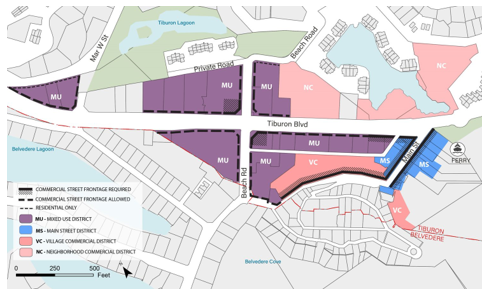
Figure 2-1: Zoning Districts and Street Frontages
Notes:
(1) Parcels with Required Commercial Frontage are shown on the Town of Tiburon Zoning Map and regulated by section 16-23.050.B (commercial street frontages).
(2) Also subject to the standards adopted by separate resolution of the town council.
B.
Change of use and additional uses. Changes made to the existing land use that are not qualified as use-for-use changes, and additional specific uses which are, in the determination of the director of community development, similar or accessory to those uses listed in table 2-A (allowed land uses and permit requirements), shall be permitted only when a conditional use permit is granted as provided in section 16-52.040 (conditional use permit) and when the use is identified as "U" in table 2-A (allowed land uses and permit requirements).
C.
Use-for-use changes and minor structural alterations. Use-for-use changes (e.g., restaurant to restaurant) or minor structural alterations when there is no substantive intensification of use, as determined by the Director, are allowed except that land uses precluded on the ground floor of required commercial frontages as set forth in table 2-4 (allowed land uses and permit requirements) and as indicated in Figure 2-1 (zoning districts and street frontages) may not expand their floor area on the ground floor. Substantive intensification of use shall be measured in terms of parking requirements, number of employees at maximum shift, total floor area occupied, vehicular trip generation, or other factors within the reasonable discretion of the Director. The term "use-for-use changes" is limited to situations where the replacement use is substantially similar to the prior use in the reasonable discretion of the Director.
D.
Pre-existing uses. Lawfully existing uses established prior to December 26, 1990, shall be permitted to operate under the authority and limitations of applicable zoning permits.
(Ord. No. 605 N.S, § 6, 6-21-2023)
16-23.030 - Site planning.
A.
Site standards. New subdivisions, land uses, and structures, and alterations to existing land uses and structures shall conform to the requirements in table 2-B (site standards).
TABLE 2-B
SITE STANDARDS
Notes:
(1) Housing Element Sites. Residential use must occupy 50% of the total floor area of any mixed use development project on Sites 1-7 and 9 as identified in the 6 th Cycle Housing Element
(2) Separation of block widths may be accomplished with a paseo, lanes, or courtyard that extends at least 30 feet behind the facade plane.
(3) For block width illustrated, see Figure 2-15 (block width and massing increments).
(Ord. No. 605 N.S, § 6, 6-21-2023)
16-23.040 - Building envelope and placement.
A.
Heights, setbacks, and stepbacks. Building heights, setbacks, and stepbacks. New structures and alterations to existing structures shall conform to the requirements in table 2-C (building heights, setbacks, and stepbacks), with height exceptions consistent with section 16-30.050.D, and as illustrated in Figure 2-2 (setback requirements for Mixed Use and Main Street zones). Construction in flood hazard zones shall conform to the requirements in chapter 13D (flood damage prevention).
Table 2-C
BUILDING HEIGHTS, SETBACKS, AND STEPBACKS
Notes:
(1) When adjacent to street intersections, line-of-sight setback standards in section 16-30.050.E also apply.
(2) Maximum setback requirements only apply to street-facing buildings used to conform with subsection 16-23.050.A.1 (street frontage continuity).
(3) Allowable height shall include up to half of the vertical height of sloped roofs (i.e., half of the distance between lowest eave and the highest point within principal roof volume)
(4) Not applicable to accessory buildings or detached accessory dwelling units.
(5) Standards illustrated in Figure 2-2 (setback requirements for Mixed Use and Main Street zones).
(6) Measured from the front property line.
(7) Stepback requirements do not apply to building facades that: face the corner of Tiburon Boulevard & Beach Road in conformance with subsection 16-30.050.E (height limit at street intersections), or to one facade increment within each massing unit, in conformance with subsection 16-23.060.A (scale of development).
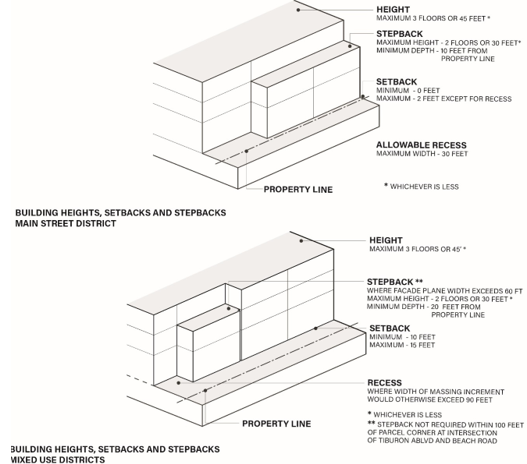
Figure 2-2: Setback requirements for Mixed Use and Main Street zones
B.
Allowable projections into setbacks. Specified building elements may project beyond the Facade Plane into Setbacks in accordance with table 2-D (allowable projections into setbacks). These requirements shall supersede section 16-30.030.F (allowed projections into setbacks). When located within the public right-of-way, building projections are subject to issuance of an encroachment permit per division 19-2. No building projection shall be less than 8 feet in height above a pedestrian path of travel.
TABLE 2-D
ALLOWABLE PROJECTIONS INTO SETBACKS
Notes:
(1) Not allowed within the public right-of-way.
(2) When located within the public right-of-way, subject to issuance of an Encroachment Permit per division 19-2.
(3) Neighboring balconies and bay windows may not be closer than 4 feet in separation.
(Ord. No. 605 N.S, § 6, 6-21-2023)
16-23.050 - Street frontages.
A.
Relationship of building to street.
1.
Street frontage continuity. At least 75 percent of a parcel's total available street frontage adjacent to a public right-of-way shall be occupied by commercial street frontage, residential street frontage, community open space, or some combination of these, as defined in section 16-23.050.B (commercial street frontage) and section 16-23.050.C (residential street frontage), and as illustrated in Figure 2-3 (street frontage continuity). Areas devoted to parking and service areas may not be used to meet this requirement.
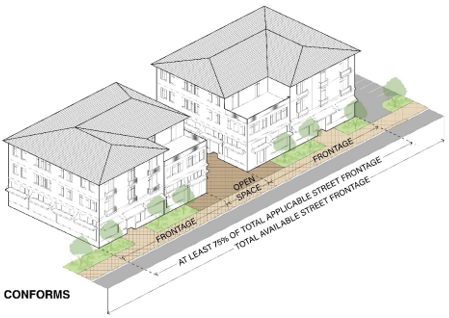
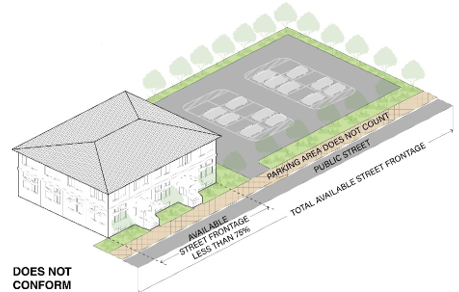
Figure 2-3: Street Frontage Continuity
2.
Extent of street frontage. Street frontages include features adjacent to property lines along a public street, including:
a.
the facade plane between finished grade and the floor of the second level;
b.
the building use accessible at the ground level;
c.
the building setback, if any;
d.
that part of the public right-of-way between the curb and front property line; and
e.
that part of the property that is within the front setback or twenty feet, whichever is greater, but where there is no building.
These features are further described in Figure 2-4 (commercial street frontage illustrated), Figure 2-5 (residential street frontage illustrated), and Figure 2-6 (mixed-use street frontage illustrated).
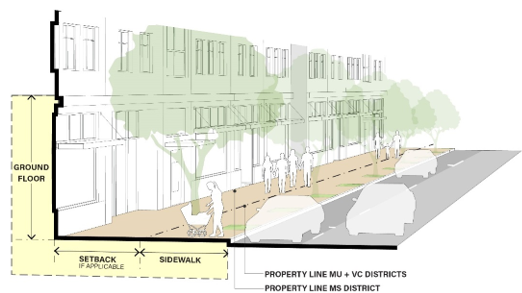
Figure 2-4: Commercial Street Frontage Illustrated
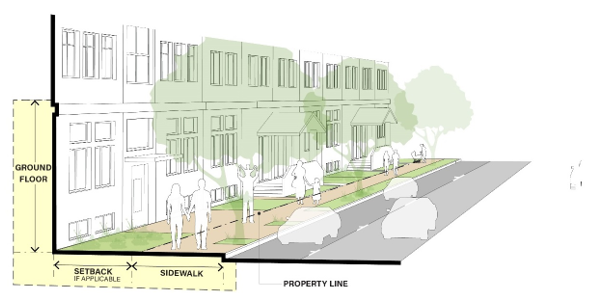
Figure 2-5: Residential Street Frontage Illustrated
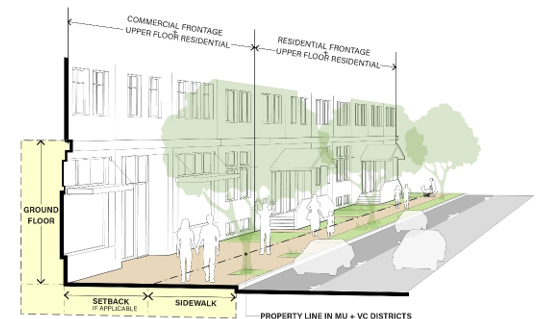
Figure 2-6. Mixed-Use Street Frontage Illustrated
3.
Building entrance location and pedestrian access. Sidewalks that lead to principal building entrances shall connect directly to a public sidewalk, or connect indirectly to a public sidewalk via a private sidewalk that passes within a paseo, courtyard, corner plaza, or lane, as defined by section 16-23.070.C (community open space).
4.
Frontage on Juanita Lane. A project adjacent to Juanita Lane shall front onto and orient principal building entrance(s) to Tiburon Boulevard, Main Street, or Beach Road. Such a project shall orient vehicle site access from Juanita Lane and not from other streets. Projects on Juanita Lane shall be exempt from street frontage requirements, except that setback areas along Juanita Lane shall be landscaped, except to allow for access (including vehicular, bicycle, or pedestrian) and utilities. Projects shall make sidewalk improvements along Juanita Lane as described in subsection 16-23.070.C.5 (Juanita Lane improvements).
B.
Commercial street frontage.
1.
Required commercial street frontages. The Town of Tiburon Zoning Map indicates where commercial street frontages are required, and where they are allowed but not required.
2.
Required commercial frontage allowable uses. Storefronts shall be accompanied by a first-floor space that is at least twenty-five feet deep and contain an allowable use consistent with commercial zone requirements in table 2-A (allowed land uses and permit requirements).
Commercial uses not otherwise allowed on the ground floor as part of commercial frontages may be located on upper stories and/or behind a Storefront with at least 25-foot depth, commercial lobby, or residential vestibule.
3.
Commercial street frontage design. Where commercial street frontage is applied, ground-floor improvements shall be comprised of the street frontage types and consistent with standards provided with each figure listed:
a.
storefronts (Figure 2-8);
b.
arcades (Figure 2-9);
c.
commercial lobbies (Figure 2-10); and
d.
residential vestibules (Figure 2-13).
4.
Commercial street frontage transparency. Along commercial street frontages, at least 60 percent of the ground-floor area of a facade plane, as measured from 2.5 to 8 feet above finished grade, shall be comprised of windows and/or doorlites with clear unobscured glass, as shown in Figure 2-7 (commercial street frontage transparency).
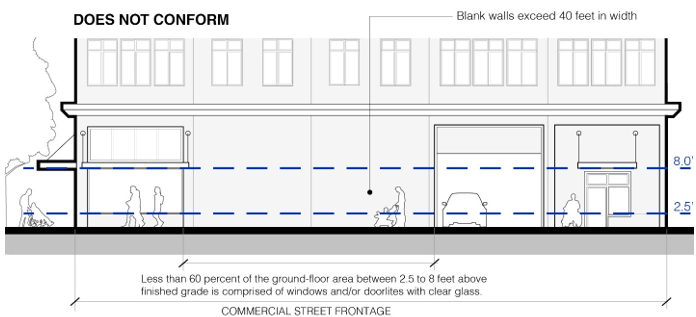
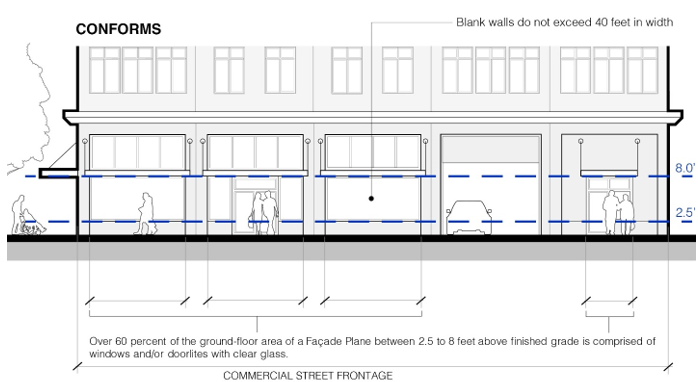
Figure 2-7: Commercial Street Frontage Transparency
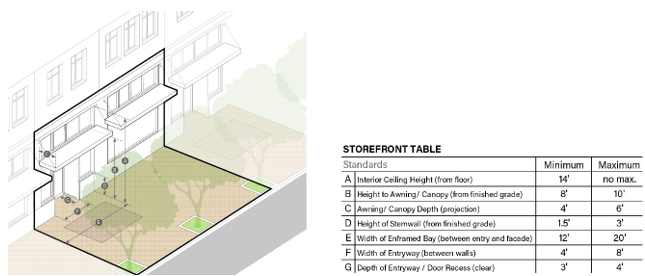
Figure 2-8: Storefronts
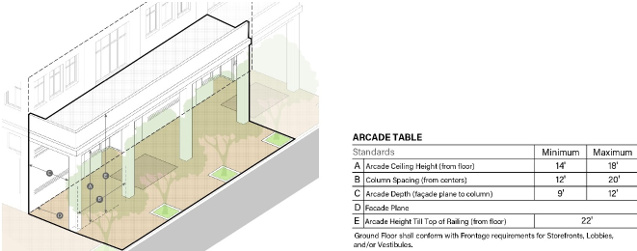
Figure 2-9: Arcades
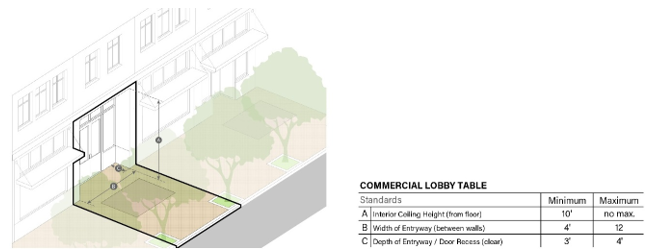
Figure 2-10: Commercial Lobbies
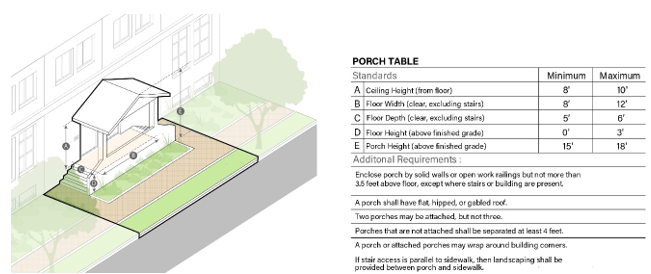
Figure 2-11: Porches
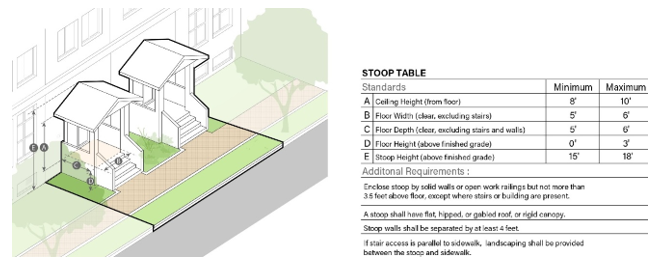
Figure 2-12: Stoops
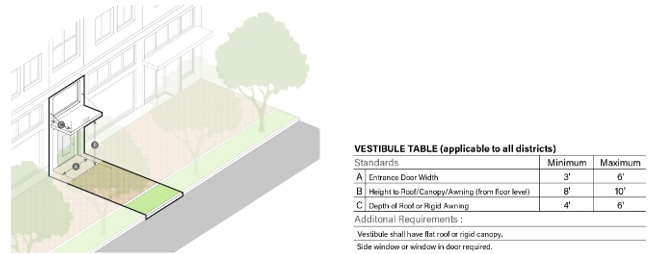
Figure 2-13: Residential Vestibules
C.
Residential street frontage.
1.
Required residential street frontage. The Town of Tiburon Zoning Map indicates where residential street frontages are required. Residential street frontages are allowed along street edges, except where commercial street frontages are required.
2.
Residential street frontage design. Where residential street frontage is applied, ground-floor improvements shall be comprised of the following street frontage types and consistent with standards provided with each figure listed:
a.
porches (Figure 2-11);
b.
stoops (Figure 2-12); and
c.
residential vestibules (Figure 2-13).
3.
Residential street frontage transparency. Window openings and/or door openings, inclusive of inset frames, shall comprise at least twenty-five percent of the width of a facade plane along the ground floor of a residential street frontage.
D.
Community open space street frontage. Street frontage may be comprised of community open space subject to the requirements of section 16-23.070.C (community open space).
E.
Site access and service areas.
1.
Site access location and design. Off-street lanes, alleys, and parking areas shall connect to a public right-of-way by access driveways and comply with the following design standards:
a.
The paved width of driveways in a front building setback shall not exceed twenty feet.
b.
A stop sign or other stop marking that is in clear view of exiting motorists shall be placed where exiting cars cross public sidewalks or other pedestrian paths or travel.
c.
From a point that is five feet or more from a sidewalk, motorist egress shall have an uninterrupted line of sight to the sidewalk at a 45-degree angle from straight ahead and in both directions.
d.
Driveways that cross public sidewalks shall be at the same level as the sidewalk.
2.
Loading. Off-street loading spaces shall be subject to section 16-32.090 (loading berths).
3.
Vehicle entry gates. Vehicle entry gates shall conform with subsection 16-30.030.H. (vehicle entry gates), except to require that vehicle entry gates be setback behind the Facade Plane or at least twenty feet from any public sidewalk, whichever is greater.
4.
Service area location and screening. Service entrances, waste disposal areas, and other similar service areas shall not be located within the front setback or between a building and the street right-of-way or public open space. For project sites greater than one acre, service areas shall be located:
a.
behind street-facing buildings;
b.
enclosed within a building envelope;
c.
screened from view of public sidewalk(s) with a solid wall or fence at least four (4) feet in height, and/or
d.
screened from view of public sidewalk(s) by shrubs that are or can be expected to grow to four feet in height.
5.
Ground-level utility boxes and equipment. Ground-level utility boxes and equipment, including but not limited to back-flow preventers, air conditioner units, transformer boxes, gas and electric meters, generators and other utilities, shall not be located within the front setback of a project or between a street-facing building and a public street right-of-way. If this is determined to be technically infeasible by a qualified engineer, ground-level utility boxes and equipment may be located in the front setback but shall be screened from all direct sight lines from public sidewalks by shrubs that can be expected to grow to the same height as the box or equipment.
(Ord. No. 605 N.S, § 6, 6-21-2023)
16-23.060 - Building scale and design.
A.
Scale of development. Massing increment and facade increment standards regulate the horizontal scale of building architecture parallel with streets. These horizontal increments complement limitations on vertical height and stepback requirements.
1.
Massing increments. The width of any portion of a facade plane facing a street and within twenty feet of the street right-of-way shall not exceed ninety feet, as illustrated in Figure 2-14 (massing increments and facade increments).
On parcels that are greater than one acre, adjacent massing increments shall be separated by a recess in the facade plane that is at least twelve feet wide and 10 feet deep, as illustrated in Figure 2-15 (block width and massing increments).
The height of the street-facing building facade closest to a public street shall be limited vertically by required stepbacks above the second floor, as illustrated in Figure 2-2 (setback requirements for mixed use and main street zones).
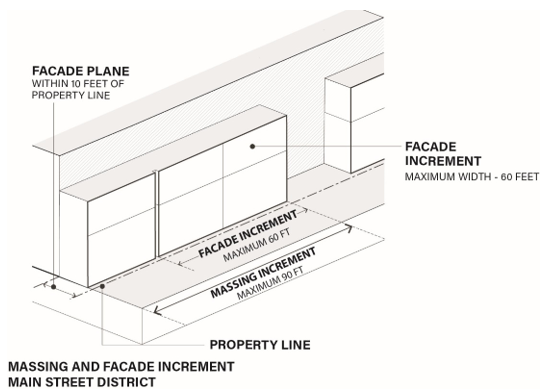
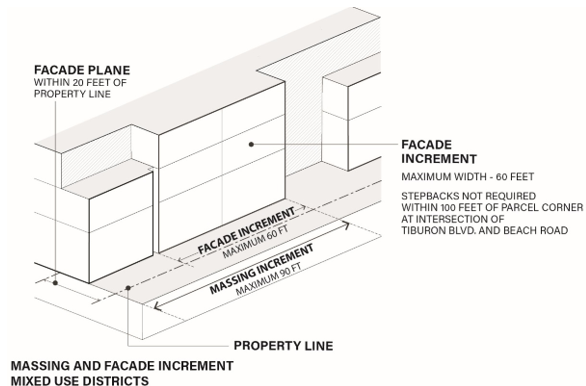
Figure 2-14. Massing Increments and Facade Increments
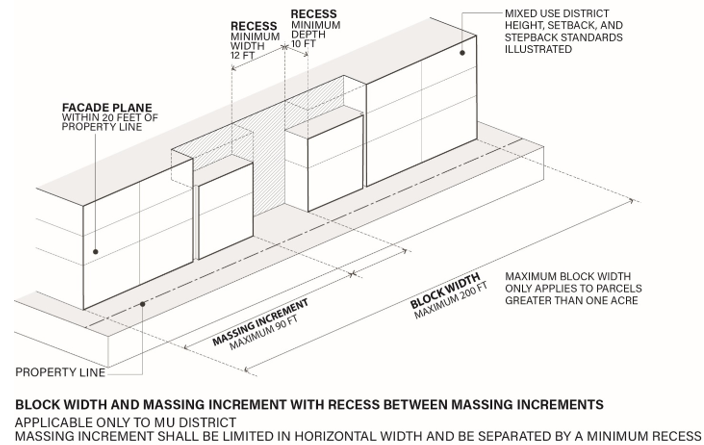
Figure 2-15. Block Width and Massing Increments
2.
Facade increments.
a.
Facade increments shall not exceed 60 feet in width. In addition, adjacent facade increments shall differentiate architectural expression with at least three of the following:
i.
vary exterior finish material of the facade plane from among wood, stucco, metal, and cementitious materials;
ii.
vary exterior finish texture from among shingles, board-and-batten, shiplap, panels, and uninterrupted planes;
iii.
vary at least two types of projections, including bay windows, balconies, awnings, ridged canopies, porch, stoop, cornice, and eaves.
iv.
vary at least two types of openings, including window grouping pattern, window muntin pattern, door type, lintels, and arcades.
v.
vary hue of the color of the building facade by at least thirty degrees within a 360-degree color wheel; and/or
vi.
vary grey value of the color of the building facade by at least twenty percent within a one hundred percent grey scale.
b.
Adjacent facade increments shall also be separated by at least one of the following vertical features:
i.
a vertical metal reinforced control joint or expansion joint creating a gap that is at least one-inch in width;
ii.
a metal downspout (not thinner than 28 gauge) that extends from roof to ground, except to avoid cornices, eaves, or other horizontal projections; and/or
iii.
a vertical recess between facade increments with a minimum width and depth of at least sixty inches, and with a rear surface of the recess having a dark grey value of least fifty percent.
c.
In the mixed use zone, adjacent facade increments shall vary the height of the facade plane by at least ten feet. The lower facade increment height shall be accompanied by a stepback depth consistent with table 2-C (building heights, setbacks, and stepbacks).
3.
Facade plane. At least two-thirds of the area of a facade increment that faces a street or public open space shall be in the same street-facing plane, which shall comprise a facade plane. Each facade plane shall be comprised of a single exterior finish when the ground-floor land use and upper-story land use are the same. When the ground-floor land use and upper-story land use are different, then one or two exterior finishes may be applied. When two exterior finishes are applied, the finishes shall be separated along the upper interior edge of a cornice that extends at least six inches in front of the facade plane and with a cornice height of at least one foot.
4.
Block width. Block width requirements further limit the horizontal scale of buildings facing streets, as described in table 2-B (site standards) and Figure 2-15 (block width and massing increments).
B.
Exterior finish materials.
1.
Exterior materials. Allowable exterior building materials are set forth in table 2-E (allowable materials). Materials not allowed include vinyl and aluminum products, including those intended to simulate wood, and rough sawn wood. Concrete block is not allowed, unless concealed by allowable materials listed below.
TABLE 2-E
ALLOWABLE MATERIALS
2.
Materials at corners. Veneers and other surface applications shall not be discernable. Materials shall be continued horizontally around the entirety of allowable projections and at visible exterior building corners, unless the material would be concealed by an immediately abutting structure. The same materials shall extend around an outer corner until: 1) it meets an interior corner, or 2) for at least eight feet. The edge of wood finishes shall be concealed at exterior corners by corner boards or miter joint.
3.
Wood. Exterior application of wood shall be comprised of one of the following:
a.
wood modules comprised of lap siding, vertical plank siding, horizontal plank siding, or shingles; or
b.
exterior plywood with battens to cover joints and horizontally spaced not less than two feet on center.
4.
Stucco and concrete. For exterior application of stucco and concrete, a horizontal expansion joint or control joint shall be placed at the level of each floor and roof, and a vertical expansion joint shall occur at least every fourteen feet. For stucco, expansion and control joints shall be reinforced with metal.
5.
Metal. Metal panels and metalwork may be used but shall be non-reflective and shall not produce glare. Metal pieces, panels, fasteners, and detailing shall be resistant to corrosion.
6.
Brick and stone. If brick and stone are used around a building opening, a soldier course or lintel shall be incorporated, which is above the opening and at least 8 inches tall.
7.
Facade color. For building facades that can be seen from a street or public open space, pastel color finishes are not allowed, such that if not white, the color hue shall contain at least ten percent grey.
C.
Windows.
1.
Window type. Operable windows shall be limited to double-hung, awning, or casement type windows. Horizontal sliding and hopper windows are prohibited.
2.
Operable windows. Rooms with exterior windows shall include one or more operable windows, except where exclusive use of fixed windows are needed to mitigate excessive noise or air quality impacts.
3.
Window materials. Solid wood or steel sash windows are required. Hollow window sections are not allowed.
4.
Mullions. Mullions may not be behind glass, such as within double glazed windows, but must project beyond the exterior of the glass surface.
5.
Clear glass. Except for bathroom windows, exterior glass shall be clear in appearance having at least ninety percent light transmission within the visible spectrum, and shall not be mirrored, frosted, or opaque.
6.
Recessed glass. Window glass shall be recessed at least two inches behind facade plane.
7.
Wood trim. Where a facade plane is surfaced with wood, windows shall be framed by wood.
8.
Privacy. Within the same development project, facing windows shall at least include one of the following:
a.
separated horizontally by at least twenty feet,
b.
offset horizontally by at least ten degrees perpendicular to window plane,
c.
have an interior sill height that is at least forty-eight inches above floor; or
d.
use obscured glass.
(Ord. No. 605 N.S, § 6, 6-21-2023)
16-23.070 - Open space.
A.
Private and semi-private open space.
1.
Open space for residents' use. Residential development projects shall provide usable open space for the private and shared use of its residents and their guests in accordance with table 2-F (usable open space required per dwelling unit). Required useable open space may be met using a combination of privately accessible open space consistent with subsection 16-23.070.A.2 and shared semi-private open space consistent with subsection 16-23.070.A.3.
TABLE 2-F
USABLE OPEN SPACE REQUIRED PER DWELLING UNIT
2.
Private open space. Each dwelling unit shall include at least forty square feet of private open space. Usable private open space includes: balconies at least two feet deep; or covered porches, covered stoops, fenced decks, or fenced yards, which are at least six feet clear in all directions.
3.
Semi-private open space. Residential development projects shall include shared semi-private open space for the use of building residents and their guests, except for townhouse dwelling units which may use private open space to meet all or part of subsection 16-23.070.A.1 (open space for residents' use) requirements. Semi-private open space(s) shall have an area that is not less than one hundred square feet per dwelling unit.
Semi-private open space may include shared community gardens, lawns, roof terraces, play areas, community rooms, reading rooms, and recreation centers. Community rooms, reading rooms, and recreation centers may be enclosed. These spaces shall have a clear dimension of at least twenty-five feet in each direction.
Semi-private open space may be provided adjacent to Paseos but only the usable portions, exclusive of the areas devoted to pedestrian circulation and landscape buffers next to dwelling units, may count towards the minimum square footage standards. Semi-private open space requirements may also constitute portions of courtyards that are accessible to the public, consistent with section 16-23.070.C (community open space).
B.
Public and publicly-accessible open space.
1.
Improvements to public sidewalks. Development projects shall make improvements to adjacent public sidewalks. Street frontage improvements shall include all of the following:
a.
a continuous path for pedestrian travel shall be provided along sidewalks and shall have an unobstructed width of at least six feet;
b.
street trees shall be planted along sidewalks between two and four feet from the curb, and shall be spaced not less than thirty feet on center, but not within forty feet of a public street intersection;
c.
street trees shall be selected from a list of acceptable species provided by the town;
d.
where adjacent to a commercial street frontage, each street tree shall be accompanied by a tree well that is between four and eight feet wide, and the sidewalk shall extend to the curb where tree wells are not present;
e.
where adjacent to a residential street frontage, street trees shall be accompanied by a landscape strip behind the curb that is between four and eight feet wide. The landscape strip shall be continuous except to allow sidewalk access to parked vehicles or curbside drop off;
f.
street lighting shall be installed in line with street trees, shall not exceed a height of eighteen feet, and shall have light fixtures (luminaires) and light pole base plates consistent with specifications provided by the town;
g.
along commercial street frontages, bicycle parking shall be installed consistent with section 16-23.090.C (bicycle parking), and shall be consistent with specifications provided by the town.
The town engineer may waive requirements that are in this section if they are deemed unnecessary or infeasible. A determination of feasibility may be received prior to submitting an application for development by submitting utility and/or circulation information prepared by qualified professional(s) to the town engineer.
2.
Privately-owned public open space. For development projects with forty or more dwelling units, at least one privately-owned public open space shall be provided, which shall be maintained by the property owner and shall remain accessible to the public. Each privately-owned public open space shall have a minimum clear dimension in each direction of at least thirty feet and a minimum site area that is not less than the sum of thirty square feet per dwelling unit, plus one square foot per twenty square feet of commercial floor area, but not less than a total of one thousand two hundred square feet.
A privately-owned public open space shall be designed as either a courtyard or corner plaza, consistent with section 16-23.070.C (community open space).
C.
Community open space.
1.
Courtyards. Courtyards shall be used to separate blocks required by table 2-B (site standards) and shall meet all of the following design requirements:
a.
have a minimum site area on private property of at least one thousand two hundred square feet;
b.
have a minimum width of at least thirty feet;
c.
have one side of the courtyard's frontage open to a public street;
d.
be accessible to the public directly from the adjacent street right-of-way;
e.
include fixed seating in the form of benches and/or seat walls, with at least one seat (eighteen inches in width) per one hundred square feet of courtyard site area;
f.
have not less than fifty percent of the perimeter enclosed by building(s);
g.
the ground-floor of buildings adjacent to a Lane shall conform to transparency requirements in subsection 16-23.050.B.4 (commercial street frontage transparency) and subsection 16-23.050.C.3 (residential street frontage transparency); and
h.
have landscaped areas comprising not less than twenty-five percent of the courtyard site area.
2.
Corner plazas. Corner plazas are allowed at street intersections, and shall meet all the following design requirements:
a.
be open and accessible on two sides to public streets, and in conformance with section 16-30.050.E (height limit at street intersections);
b.
have a minimum of one thousand two hundred square feet of site area on private property;
c.
have a minimum width of at least thirty feet;
d.
include fixed seating in the form of benches and/or seat walls, with at least one seat per one hundred square feet of plaza site area;
e.
have not less than fifty percent of perimeter of plaza enclosed by building(s);
f.
the ground-floor of buildings adjacent to a corner plaza shall conform to section 16-23.050.B (commercial street frontages) and section 16-23.050.C (residential street frontage); and
g.
have landscaped areas comprising not less than twenty-five percent of the plaza's site area.
3.
Paseos. Paseos are linear landscape passages for pedestrian movement that extend in from streets and may link to other paseos. Paseos may be enclosed on buildings on one or both sides. Paseos may be used to provide a required connection from building entrances to a street to conform with subsection 16-23.050.A.3 (building entrance locations). Paseos shall meet all of the following design requirements:
a.
access to the Paseo may occur directly at a street or may be via a courtyard or corner plaza;
b.
shall be accessible to the public within forty feet of a street right-of-way, after which a gate may restrict public access;
c.
shall be not less than twenty-five feet in width;
d.
the paseo shall have a shared sidewalk with a width of at least five feet that connects end points
e.
have landscaped areas comprising not less than 50 percent of the area of the paseo;
f.
the ground-floor of buildings adjacent to a Paseo shall conform to transparency requirements in subsection 16-23.050.B.4 (commercial street frontage transparency) and subsection 16-23.050.C.3 (residential street frontage transparency); and
g.
may include shared semi-private open space, consistent with subsection 16-23.070.A.3 (shared semi-private open space).
Building projections are allowed to project into paseos, consistent with subsection 16-23.040.B.1 (allowable building projections into setbacks).
4.
Lanes. Lanes are private roadways with space dedicated to both vehicles and pedestrians. Lanes shall meet all of the following design requirements:
a.
access to a lane shall be directly from a public street;
b.
Lanes shall be accessible to the public within forty feet of a front property line, after which a gate may restrict public access;
c.
a shared sidewalk shall be provided where there are principal building entrances and shall connect to a public sidewalk or internal sidewalk network;
d.
sidewalks shall be placed adjacent to the curb or separated from the curb with a planting strip that is at least three feet wide;
e.
Lanes shall have a drive aisle plus parking on one, both, or no sides;
f.
the combined paved width of a lane, including the drive aisle and parking, shall be at least twenty feet and not exceed forty-two feet;
g.
where parking is present along the Lane, parking and aisle dimensions shall conform to section 16-32.080 (parking design and development standards), except that aisle dimension shall be interpreted to include driveways that provide additional room for maneuvering vehicles;
h.
pavement along Lanes shall be comprised of asphalt, concrete, and/or permeable pavers;
i.
space for vehicles shall be delineated by curbs and/or bollards; and
j.
the ground-floor of buildings adjacent to a Lane shall conform to transparency requirements in subsection 16-23.050.B.4 (commercial street frontage transparency) and subsection 16-23.050.C.3 (residential street frontage transparency).
5.
Juanita Lane Improvements. Development projects adjacent to the Juanita Lane public right-of-way shall provide a mountable curb and adjacent sidewalk not less than five feet in width. If new development fronts onto Juanita Lane, then residential street frontage standards shall apply.
6.
Alleys. Alleys may be used to provide vehicular access on-site without pedestrian circulation. Alleys shall meet all of the following design requirements:
a.
Alleys shall have a drive aisle that is at least twenty-four feet wide;
b.
where parking is present along the alley, parking and aisle dimensions shall conform to section 16-32.080 (parking design and development standards), except that aisle dimension shall be interpreted to include driveways that provide additional room for maneuvering vehicles;
c.
pavement along lanes shall be comprised of asphalt, concrete, and/or permeable pavers; and
d.
space for vehicles shall be delineated by curbs and/or bollards.
(Ord. No. 605 N.S, § 6, 6-21-2023)
16-23.080 - Landscape design.
A.
Landscaped setbacks. Setback areas shall be landscaped except for areas necessary for pedestrian access and vehicular access consistent with section 16-23.050.E (site access and service areas) and subsection 16-23.070.C.4 (lanes), and where utilities preclude landscaping. Landscaping shall be comprised of trees, shrubs, and groundcover shall be selected from lists provided by the town.
B.
Hardscape - Brick pavers. Along Tiburon Boulevard and along Main Street in the Main Street zone (but not Ark Row), sidewalks shall match the use and pattern of brick pavers used. In courtyards and corner plazas the same use and pattern of brick pavers shall be used as hard scape except for concrete edges two feet or less in width.
C.
Fences and walls.
1.
Fence and wall requirements. Subsection 16-30.040.B (height limits) shall apply.
2.
Fence and wall height. Within the setback between a building and street (or public open space), no fence or wall shall exceed a height of forty-two inches above finished grade.
3.
Fence and wall materials. The following fence materials are allowed:
a.
wood picket,
b.
wood board,
c.
metal bar,
d.
open wood or metal frame with coated or uncoated metal wire,
e.
stone and brick, or
f.
cast in place concrete.
Fence materials which are not allowed include:
a.
chain link,
b.
corrugated metal,
c.
plastic and other synthetic materials, and*
d.
Concrete block, unless faced with stucco or other approved materials in table 2-E (allowable materials).
D.
Lighting for parking and open space areas. Lighting shall conform with section 16-30.070 (lighting). The following standards also apply:
1.
pole-mounted lighting fixtures shall not exceed a height of sixteen feet;
2.
within four feet of a building entryway, at least one wall-mounted exterior light fixture shall be provided; and
3.
exterior lighting shall not cast direct light beyond the side and rear property lines, based on lighting location, height, and fixture light-angle specifications.
(Ord. No. 605 N.S, § 6, 6-21-2023)
16-23.090 - Parking.
A.
Number of parking spaces required. On-site parking for vehicles shall conform with section 16-32.040 (number of parking spaces required).
B.
Parking design standards. On-site parking for vehicles shall conform with section 16-32.080 (parking design and development standards), except that:
1.
parking shall be located in conformance with subsection 16-23.050.A.1 (street frontage continuity);
2.
no surface parking shall be allowed within twenty feet of a street-facing property line;
3.
a wall or fence shall screen parking stalls where they would otherwise be in direct view of a public sidewalk, with a wall or fence height of between thirty-six and forty-two inches above finished grade;
4.
within surface parking lots, plant at least one tree for every six parking stalls;
5.
parking lots shall be separated from property line by a landscape strip that is no less than five feet wide;
6.
mechanical parking lifts shall be allowed within an enclosed garage when designated for use by residents, except for parking designated for use by persons with disabilities;
7.
mechanical lifts shall be accompanied by an on-site battery or electrical generator to provide sufficient power to clear the lift of all vehicles, or shall be capable of manually clearing the lift without power; and
8.
a pair of tandem parking spaces shall be allowed when designated for use by members of the same household/dwelling unit.
C.
Bicycle parking. Bicycle parking shall be provided in conformance with section 16-32.040 (number of parking spaces required). Additionally, at least one-half of the bicycle parking for commercial uses shall be provided in publicly-accessible locations, such as along public sidewalks, street-facing setbacks, and publicly-accessible open space. The remainder of bicycle parking that is required shall be provided on-site in covered and secure locations.
(Ord. No. 605 N.S, § 6, 6-21-2023)

