
Upper Arlington City Zoning Code
ARTICLE 2
- DEFINITIONS
§ 2.01 - INTERPRETATION.
For the purposes of this Unified Development Ordinance (UDO), certain terms or words used herein shall be interpreted as follows:
(1)
The word person includes a firm, association, organization, partnership, trust, company, or corporation as well as an individual.
(2)
The present tense includes the future tense, the singular number includes the plural, and the plural number includes the singular.
(3)
The word shall or will is a mandatory requirement, the word may is a permissive requirement, and the word should is a preferred requirement.
(4)
The words used or occupied include the words intended, designed or arranged to be used or occupied.
(5)
The word lot includes the words plot or parcel.
(6)
Any reference to days shall mean, unless expressly provided otherwise, calendar days.
(7)
Any reference to an article or section shall mean an article or section of this Ordinance, unless otherwise specified.
(8)
The words Director of Community Development shall also mean his/her designated representative.
(9)
TRC shall mean technical review committee.
(10)
BZAP shall mean Board of Zoning and Planning.
§ 2.02 - DEFINITIONS (A—B).
The following words and phrases when used in the UDO or any zoning ordinance of the City shall have the meanings respectively ascribed to them unless otherwise stated.
Above ground level: means the height measured by the distance from the average grade level to the highest point on the structure, including any antenna and additional height required for co-location.
Accessory structure: means a subordinate structure detached from, but located on the same lot as the principal structure, and is incidental to the use of the principal structure. Accessory structures include but are not limited to sheds, play sets, outdoor kitchens or fireplaces, pet shelters, and mechanical units.
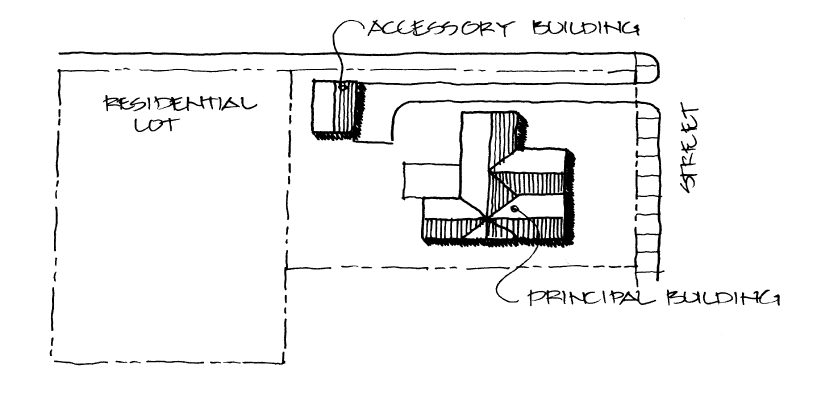
Accessory and Principle Structure
Accessory use: means a subordinate use detached from, but located on the same lot as the principal use of the property.
Accessory use, major: means an accessory use that, because of its size, location, or intensity of activity, may have impact on adjacent property and is listed in Table 5-A. Accessory uses and buildings may be erected upon a lot on which a principal structure already exists. The use of the accessory building must be secondary and incidental to the principal use. The Director of Community Development shall determine if the accessory use is a major or minor accessory use. Major accessory uses and buildings are considered for approval by BZAP. See Section 6.09 for standards.
Accessory use, minor: means an accessory use that will not have significant impact on adjacent property and is listed as a minor accessory use in Table 5-A. Accessory uses and buildings may be erected upon a lot on which a principal structure already exists. The use of the accessory building must be secondary and incidental to the principal use. Minor accessory uses and buildings are considered for approval by the Director of Community Development. See Subsection 6.09 for standards.
Adult book store: means a commercial establishment which, as one of its principal business purposes, offers for sale or rental for any form of consideration any one (1) or more of the following:
(1)
Books, magazines, periodicals or other printed matter, or photographs, films, motion pictures, video cassettes or video reproductions, slides, or other visual representations which are characterized by the depiction or description of specified sexual activities or specified anatomical areas; or
(2)
Instruments, devices, or paraphernalia which are designed for use in connection with specified sexual activities.
A commercial establishment may have other principal business purposes that do not involve the offering for sale or rental of material depicting or describing specified sexual activities or specified anatomical areas and still be categorized as an adult book store. Such other business purposes will not serve to exempt such commercial establishments from being categorized as an adult book store so long as one of its principal business purposes is the offering for sale or rental for consideration the specified materials, which are characterized by the depiction or description of specified sexual activities or specified anatomical areas.
Adult booth: means any area of a sexually oriented business establishment set off from the remainder of such establishment by one (1) or more walls or other dividers or partitions and used to show, play or otherwise demonstrate any adult materials or to view any live performance that is distinguished or characterized by an emphasis on the exposure, depiction, or description of specified anatomical areas or the conduct or simulation of specified sexual activities.
Adult cabaret: means a nightclub, bar, restaurant or similar establishment that features live performances that are characterized by the exposure of specified anatomical areas or by specified sexual activities, or adult materials, films, motion pictures, video cassettes, slides, computer displays, or other photographic reproductions in which a substantial portion of the total presentation time is devoted to the showing of material that is characterized by an emphasis upon the depiction or description of specified sexual activities or specified anatomical areas.
Adult care facility: means an adult family home or an adult group home, as defined in the ORC § 3722 and licensed by the Ohio Department of Health which provides accommodations and supervision for three (3) to sixteen (16) unrelated adults, at least three (3) of whom are provided personal care services.
Adult day care facility: means a facility providing care for the elderly and/or functionally impaired adults in a protected setting for a portion of a twenty-four-hour day.
Adult family home: means an adult care facility licensed by the Ohio Department of Health, which provides accommodations for three (3) to five (5) unrelated adults, with supervision, and provides personal care services to at least three (3) individuals. Adult family homes are permitted by law in any residentially zoned district.
Adult foster home: means a residence certified by the Ohio Department of Aging, which will provide accommodations, supervision, personal care services to one (1) or two (2) unrelated adults. Adult foster homes will be certified by the area agency on aging in those counties under its jurisdiction, in accordance with rules for certification established by the Ohio Department of Aging.
Adult group home: means an adult care facility licensed by the Ohio Department of Health, which provides accommodations for six (6) to sixteen (16) unrelated adults, supervision, and personal care services to at least three (3) individuals. Adult group homes are permitted by law in any multi-family zoned district. An adult care facility does not include the following specific facilities, nor any which are similar in nature to these facilities: a nursing home, rest home, or home for the aging as defined in ORC § 3721.01; An alcohol and drug addiction program as defined in ORC § 3793.01; A habitation center as defined in ORC § 5111.041.
Adult material: means magazines, books, photographic reproductions, videotapes, movies, slides, compact discs in any format (e.g., CD-ROM, CD-R, CD-RW), digital video discs in any format (e.g., DVD), other devices used to reproduce or record computer images, or other print, video, film, electronic, computer-based, analog, or digital media characterized by an emphasis on matter depicting, describing or related to specified sexual activities or specified anatomical areas.
Adult theater: means a theater, concert hall, auditorium, or similar commercial establishment, which regularly features persons who appear in a state of nudity or semi-nudity, or live performances which are characterized by the exposure of specified anatomical areas or by specified sexual activities.
Aggrieved: means any person who demonstrates an interest that is directly affected by the order, requirement, decision, or determination. A person's interest is directly affected where it is subject to an immediate, unique harm distinct from the harm suffered by the community at large. A future, contingent, or speculative interest will not suffice. For the purposes of this definition, any person owning property contiguous or adjacent to a proposed land use site shall be considered directly affected with respect to any administrative hearing or appeal regarding that site.
Agricultural uses: means a use typically considered to be agricultural in nature, which includes, but is not limited to: farming, dairying, pasturage, beekeeping, horticulture, floriculture, viticulture, and animal and poultry husbandry.
Aisle: means that portion of the off-street parking and loading area that provides access to parking, stacking or loading spaces, exclusive of driveways and parking and loading spaces.
Alley/Lane: means a public way not more than twenty-two (22) feet wide affording only secondary means of access to abutting property.
Amusement arcade: means any place of business at which three (3) or more amusement devices are located for the use of entertaining or amusement of persons patronizing the place of business. Billiards/pool tables/rooms are excluded from this definition and are specifically referenced in the zones in which they are permitted. Any amusement device operated exclusively by an employee of the place of business for the entertainment or amusement of patrons shall not be considered in calculating the number of amusement devices, but shall instead be a prima facie indicator of the provision of entertainment.
Antenna: means any exterior apparatus used for transmitting and receiving, mounted on a tower, alternative tower structure, building or structure and used in communications that radiate or capture electromagnetic waves, digital signals, analog signals, radio frequencies (excluding radar signals), wireless telecommunications signals or other communications signals in the provision of wireless service.
Antenna support structure: means any building, poles (utility poles, light poles, or traffic signal poles) currently in place having been previously constructed for a primary purpose other than supporting wireless communication facilities, or other structure other than an antenna tower which can be used for the location of wireless communication facilities.
Antenna tower: means any structure that is designed and constructed primarily for the purpose of supporting one (1) or more antennas for telephone, radio and similar communication purposes. The term includes radio and television transmission towers, microwave towers, common-carrier towers, cellular telephone towers, antenna tower alternative structures, and the like.
Antenna tower alternative structures: means man made trees, clock towers, flagpoles, bell steeples, and similar alternative-design mounting structures that substantially camouflage or conceal the presence of antennas or towers such that one would not identify the structure as an antenna tower.
Antenna tower height: means the above ground level height measured by the distance from the average grade level of the base of the antenna tower or antenna support structure to the highest point on the tower or other structure, including any antenna and additional height required for co-location. Lightning rods up to six (6) feet in length and 1.25 inches in diameter may extend above the maximum height measured. When roof-mounted, antenna tower height shall be measured from the average grade level of the building to the highest point on the tower or other structure, including any antenna and additional height required for co-location.
Apartment: means a suite of rooms or a room in a multi-family building arranged and intended for a place of residence of a single family or a group of individuals living together as a single housekeeping unit.
Apartment, efficiency: means a dwelling unit in a multi-family building consisting of not more than one (1) habitable room, together with kitchen or kitchenette and sanitary facilities.
Apartment hotel: means an apartment house, which furnishes services for the use of its tenants, which are ordinarily furnished by hotels.
Appeal: means a request for a review of the Director of Community Development and BZAP interpretation of any provision of this Ordinance or a request for a variance.
Area of shallow flooding: means a designated AO or AH zone on the flood insurance rate map (FIRM) with a one percent (1%) or greater annual chance of flooding to an average depth of one (1) foot to three (3) feet where a clearly defined channel does not exist, where the path of flooding is unpredictable and where velocity flow may be evident. Such flooding is characterized by ponding or sheet flow.
Area of special flood hazard: means the land in the floodplain subject to a one percent (1%) or greater chance of flooding in any given year. Areas of special flood hazard are designated by the Federal Emergency Management Agency as zone A, AE, AH, AO, A1-30, and A99.
Assisted living: See "rest homes".
Attached: means (1) a use, room or space that has at least one (1) wall (or part of one (1) wall) in common with the remainder of a building; (2) a use, room or space that can be entered from and/or through other rooms and spaces within a building. An unenclosed roof connection shall not be considered attached.
Automobile repair, major: means general repair, rebuilding or reconditioning of engines, motor vehicles or trailers; collision services including body, frame, or fender straightening or repair; overall painting or paint shop; vehicle steam cleaning.
Automobile repair, minor: means incidental body or fender work, or other minor repairs, painting and upholstering, replacement of parts and motor service to passenger cars and trucks not exceeding one and one-half (1½) tons capacity, but not including any operation named under automobile repair, major, or any other similar thereto.
Automobile service: means any building, structure, or land used primarily for the dispersal, sale, or offering for the cleaning and washing of automobiles or the sale of automotive fuels, oils, or accessories, including lubrication of automobiles and replacement or installation of minor parts and accessories, but not including repair work, such as motor replacement, rebuilding, body and fender repair, or painting. Automobile storage shall not be considered an automobile service.
Automobile/Trailer sales area: means an open area, other than a street, used for the display, sale or rental of new or used motor vehicles or trailers in operable condition and where no repair work is done. The parking on such area of one (1) or more motor vehicles that do not bear current registration plates issued for such vehicles, shall be prima facie evidence of the use of such premises as an automobile sales area.
Average grade level: means a reference plane representing the average of finished ground level adjoining the structure or building at all exterior surfaces.
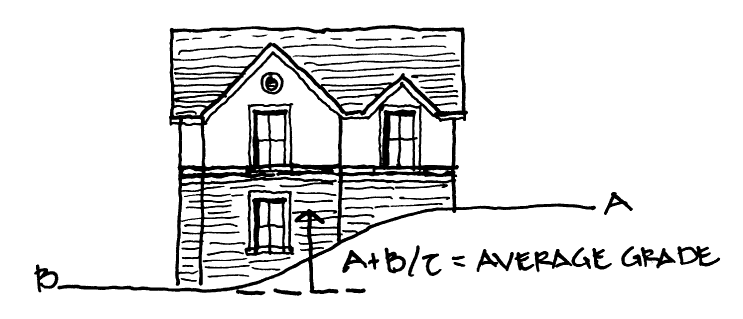
Average Grade
Balcony: means a projecting platform on a building, sometimes supported from below, sometimes cantilevered; enclosed with a railing or balustrade. A balcony is distinguished from a deck when it projects from the building at a second story level or higher and is accessible from within the building.
Bank, finance and loan offices: Banking, financial or loan facilities that house the offices of professional banking, financial or loan personnel that do not include tellers, ATMs or drive-throughs, and are not open to the general public. They are often located on the upper floors of a multi-story building.
Bank, retail: A banking operation that includes personal and/or business banking services, such as deposits, withdrawals and loans, and that is open to the public. A retail bank generally has tellers, ATMs and/or drive-throughs, and are located on the first floor of a building, typically by itself.
Banner: means a sign that contains a message, which is attached or imprinted on a flexible surface that deforms under light pressure, that is typically constructed of nondurable materials including paper, cardboard, cloth and/or plastic.
Banquet hall: means an establishment that is rented by individuals or groups to accommodate private functions such as weddings, anniversaries, business promotional events, and similar celebrations.
Bar: (see also "tavern") means an area primarily devoted to the serving of alcoholic beverages and in which the service of food is only incidental to the consumption of such beverages.
Base flood: means the flood having a one percent (1%) chance of being equaled or exceeded in any given year. The base flood may also be referred to as the 100-year flood.
Basement: means a story whose floor line is below grade at any entrance or exit and whose ceiling is not more than five (5) feet above grade at any such entrance or exit.
Bed and breakfast: means a transient lodging establishment generally in a single-family dwelling providing overnight or otherwise temporary lodging for the general public and may provide meals for compensation.
Big box retail: means any single retail establishment having a gross floor area that exceeds sixty thousand (60,000) square feet, drawing customers from a distance greater than five (5) miles and is typically surrounded by parking lots.
Big box retail, multi-story: means any single retail establishment having a gross floor area that exceeds sixty thousand (60,000) square feet, draws customers from a distance greater than five (5) miles and has a minimum of two (2) similar-sized floors.
Board: means the Board of Zoning and Planning of the City of Upper Arlington, Ohio. The Board of Zoning and Planning (BZAP) is responsible for reviewing and recommending to City Council a master plan for the physical development of the City, official zoning map and UDO amendments, preliminary and final plats, and other administrative development approvals.
Boarding/Lodging house: means a dwelling or part thereof occupied by a single housekeeping unit where meals and lodging are provided for three (3) or more persons for compensation by previous arrangement but not transients.
Bottomless: means less than full opaque covering of male or female genitals, pubic area or buttocks.
Build-to line: An alignment established at a certain distance from and parallel to the curb line along which the building shall be built.
Buildable area: means the internal area of a lot bounded by front, side, and rear yard setback lines.
Building: means any structure having a roof supported by columns or walls, used or intended to be used for the shelter or enclosure of persons, animals or property, including detached garages.
Building addition: means a part added to a building, either by being built so as to form one (1) architectural whole with it, or by being joined with it in some way, as by a passage, and so that one is a necessary adjunct or appurtenance of the other or so that both constitute the same building.
Building cover: means the lot area occupied by any structure used for the purpose of providing temporary or permanent forms of shelter. The calculation of building cover area shall include all areas covered by a building's roof and other forms of protection from the elements.
Building directory signs: A building directory sign is defined as an exterior building mounted commercial sign intended to provide the identity or name, whether through logo, type, graphics or other symbols, for two (2) or more uses within one (1) building.
Building footprint: means the outline of the total area covered by a buildings' perimeter at the ground level.
Building, height of: means the vertical distance from the average existing grade around the foundation to the highest point of the coping of a flat roof, or mansard roof, or to the top of the highest ridge line of gable, hip or gambrel roofs. For commercial buildings and structures, maximum height shall be measured to the top of parapet wall, top of cornice or soffit, or top of eave fascia for sloped or mansard-style roofs, whichever is higher.
Building setback line: means the line beyond which no building or parts thereof shall project, except as otherwise provided by this Ordinance.
Bus: means a rubber-tired vehicle that is designed for roadway operation for public transportation service.
(Ord. No. 58-2011; Ord. No. 8-2012; Ord. No. 36-2014Ord. No. 87-2015, § 5, 12-14-2015; Ord. No. 21-2016, § 2, 5-9-2016; Ord. No. 44-2017, § 1, 7-5-2017; Ord. No. 53-2017, §§ 1, 2, 12-11-2017; Ord. No. 54-2017, §§ 2, 3, 12-11-2017Ord. No. 32-2018, § 2, 4-23-2018 ; Ord. No. 47-2018, § 2—5, 6-25-2018; Ord. No. 16-2019, § 2, 6-10-2019; Ord. No. 40-2023, § 1(Exh. A), 8-28-2023)
§ 2.03 - DEFINITIONS (C—E).
The following words and phrases when used in the UDO or any zoning ordinance of the City shall have the meanings respectively ascribed to them unless otherwise stated:
Camper trailer: means a folding or collapsible vehicular structure, mounted on wheels but without its own power, designed as a temporary living quarters for travel, camping, recreation and vacation uses, which is not covered by the definition of travel trailer.
Canopy: means a permanently roofed shelter projecting over a sidewalk, driveway, entry, window, or similar area, which may be wholly supported by a building or may be wholly or partially supported by columns, poles, or braces extending from the ground. Any roof overhang extending more than two (2) feet from the face of a building shall be considered a canopy.
Carport: means a permanent roofed structure permanently open on at least two (2) sides, designed for or occupied by private passenger vehicles.
Cast Limestone: means mixture of highly refined crushed natural limestone mixed with cement as a binder that has a look of natural limestone.
Cemetery: means land used or intended to be used for the burial of the human dead and dedicated for cemetery purposes, including columbarium, crematories, mausoleums and mortuaries if operated in connection with and within the boundaries of such cemetery.
Certificate of economic hardship: means a certificate issued by the Board authorizing the timely demolition of a contributing structure that meets the applicable criteria set forth in this Ordinance, based on a finding by the Board that delaying the demolition by one hundred eighty (180) days would cause unusual economic hardship for the property owner seeking a demolition permit.
Certificate of zoning compliance: means a document issued by the Community Development Department indicating compliance with the Unified Development Ordinance.
Child day-care: means administering to the needs of infants, toddlers, preschool children and school children outside of school hours by persons other than their parents or guardians, custodians or relatives by blood, marriage, or adoption, for any part of the twenty-four-hour day in a place or residence other than the child's own home.
Child day-care center and type A home: means any place in which child day-care is provided, with or without compensation, for thirteen (13) or more children at one time, or any place that is not the permanent residence of the licensee or administrator in which child day-care is provided, with or without compensation, for seven (7) to twelve (12) children at one time. In counting children for the purpose of this Ordinance, any children under 6 years of age who are related to a licensee, administrator, or employee and who are on the premises of the center shall be counted.
Child day-care home and type B home: means a permanent residence of the provider in which child day-care services are provided for one (1) to six (6) children at one time and in which no more than three (3) children may be under two (2) years of age at one time. In counting children for the purpose of this Ordinance, any children under six (6) years of age who are related to the provider and who are on the premises of the type B home shall be counted. A type B family day-care home does not include a residence in which the needs of children are administered to, if all of the children are siblings of the same immediate family and the residence is the home of the siblings.
City: means the City of Upper Arlington, Ohio.
City property: means land and other property in which the City holds a present right of possession and control such as, but not limited to, rights-of-way, easements, streets, parks, building parcels, and other grounds, regardless of the type of ownership interest in the property.
Club: means a non-profit association of persons who are bona fide members, paying regular dues and are organized for some common purpose, but not including a group organized solely or primarily to render a service customarily carried on as a commercial enterprise.
Co-location: means the use of wireless communications facilities by more than one (1) wireless communications provider.
Collection box: means any portable or permanent container of any type, construction or material designed for the collection and storage of articles donated to a recognized charitable, educational or similar organization.
Community Development Department: means the Community Development Department established pursuant to C.O. § 175.01.
Community scale A: means a commercial development consisting of a single user whose gross floor area ranges from five thousand (5,000) to twenty thousand (20,000) square feet in size.
Community scale B: means a commercial development consisting of a single user whose gross floor area ranges from twenty thousand one (20,001) to forty thousand (40,000) square feet in size.
Community scale C: means a commercial development consisting of a single user whose gross floor area ranges from forty thousand one (40,001) to sixty thousand (60,000) square feet in size.
Conditional uses: Conditional uses are those uses that, because of special requirements or characteristics, may be allowed in a particular zoning district only after review by BZAP and granting of conditional use approval imposing such conditions as necessary to make the use compatible with other uses permitted in the same zone or vicinity.
Congregate housing: means an independent rental housing facility in which hotel services are included in the monthly rental fee and lease agreement. For a building to qualify under this definition, services provided shall include a meal program available to all residents, a dining room with seating capacity for all residents as defined by the Ohio Basic Building Code, a full-service kitchen with staff and capacity to support the meal program and dining room service, and available housekeeping, laundry, and transportation services for its residents. No supervision or personal care need be provided.
Connectivity: The ability to establish vehicular and pedestrian connections between neighborhoods. These connections can take the form of paths or passages. Paths are pedestrian and bicycle connections traversing an open area and connecting with the sidewalk network. Passages provide shortcuts through long blocks or connect rear-parking areas with street frontage.
Construction (beginning of): means any act or process that requires a building permit and that adds an addition onto an existing building or erects a new principal or accessory structure on a lot, which is subject to the design standards for the district in which the property is located.
Continuing care retirement community: means a retirement community licensed by the Ohio Department of Health which contains a number of different living arrangements from independent living to skilled care. Continuing care retirement communities often require the payment of an entrance fee or endowment in exchange for a promise of continuing care to the resident for a prescribed period, usually the life of the resident. Continuing care retirement communities will arrange for nursing care or provide it on the same site.
Contributing structures: means those buildings or structures that do not exist principally to serve a religious function, that stand within the "Upper Arlington Historic District," as defined by the National Register of Historic Places, that feature characteristics for which the National Register designation was made such as construction between 1915 and 1940, representation of early 20th century architecture, or local significance in the area of community planning or landscape design, and that were contained in the original nomination form and map for purposes of receiving the historic district designation.
Coping: means the protective top member of any vertical construction, such as a wall or chimney. A coping may be masonry, metal, or wood and is usually sloping or beveled to shed water in such a way that it does not run down the vertical face of the wall. Copings often project out from a wall with a drip groove on the under side.
Cornice: A horizontal molded projection that crowns or completes a building or wall to which it is affixed.
Council: means the City Council of the City of Upper Arlington, Ohio.
Country club, private: A private organization with facilities set on a minimum of five acres available only to its members and their guests. Is formed primarily for recreational purposes, and may include a club house and golf course, and may also include swimming pools, tennis courts and a fitness center. Dining facilities, meeting rooms, organizational offices, lounges, snack bars, retail sales, maintenance facilities, and housing accommodations for not more than fifteen (15) seasonal/temporary employees may also be permitted as accessory uses.
Court: means an open, unoccupied and unobstructed space, other than a yard, on the same lot with a building or group of buildings, which is enclosed on three (3) or more sides.
Deck: Means a horizontal platform supported by any combination of posts, beams, foundations, and/or joists with or without handrails, steps or terraces. Terrace in this definition means a portion of the deck stepping up or down with the grade and used in lieu of, or in combination with, more traditional steps.
Decorative pole: means a pole, arch, or structure other than a street light pole placed in the public way specifically designed and placed for aesthetic purposes and on which no appurtenances or attachments have been placed except for any of the following (1) electric lighting; (2) specifically designed informational or directional signage; (3) temporary holiday or special event attachments.
Detached: means (1) a use, room, space, building or assembly of buildings that is completely surrounded by open space; (2) a use, room, space, building or assembly of accessory buildings that is not attached or connected to a principally permitted use or building.
Development: means any man-made change to improved or unimproved real estate, including but not limited to buildings or other structures, mining, dredging, filling, grading, paving, excavation or drilling operations or storage of equipment or materials.
Development cover (also Impervious Cover): means the amount of the lot area occupied by all principal and accessory structures, driveways, parking lots, decks, sidewalks, patios, swimming pools, athletic courts, permeable surface areas and any other permanent impervious development on the lot. Gravel and grass pavers do not count toward development cover. For the purposes of development cover in the front yard, any portion of the principal structure that is located in the front yard shall not be counted.
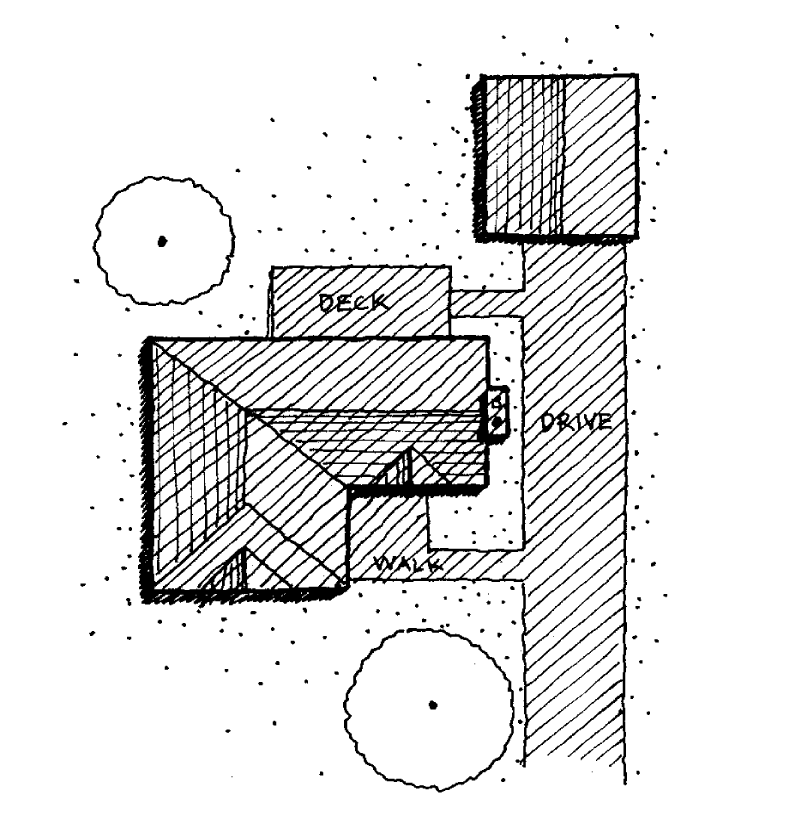
Development Cover
Development plan: means a dimensioned presentation of the proposed development of a specified parcel of land that reflects thereon the location of buildings, easements, parking arrangement, public access, street pattern, and other similar features.
Director of Community Development: means the person appointed by the City Manager as the Director of Community Development pursuant to C.O. § 175.02.
Display area: means the entire area within a continuous perimeter, which encloses the message or display and any other material, color or feature which forms an integral part of the sign and is used to differentiate such a sign from the masonry wall upon which it is placed.
District: means a portion of the territory of the City of Upper Arlington, within which certain uniform regulations and requirements or various combinations thereof apply under the provisions of this Ordinance.
Donation bin/receptacle: means a large container placed in outdoor public locations for people to drop-off or donate used clothing or items, typically for charitable purposes.
Dormer, shed: means a structure projecting from a sloped roof which contains more than one (1) window unit or louver or which exceeds an overall exterior width of five (5) feet. Window dormers shall be considered a shed dormer when the sum of their exterior widths along any building elevation exceeds thirty percent (30%) of the overall projected elevation length of the building face on which they appear.
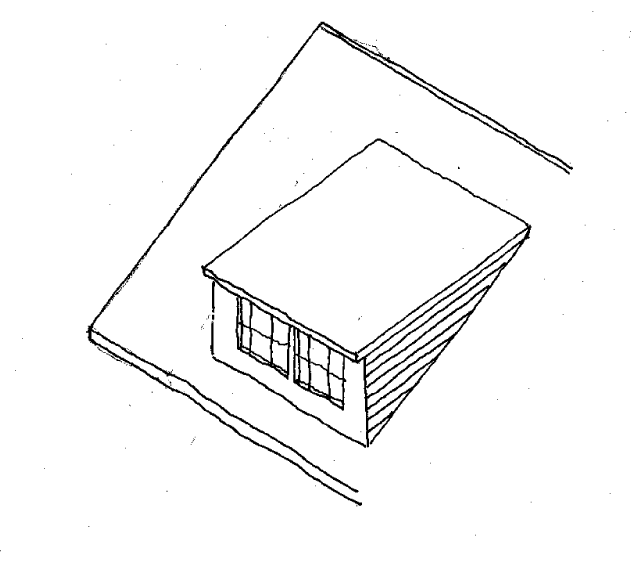
Shed Dormer
Dormer, window: means a structure projecting from a sloped roof containing one (1) window unit.
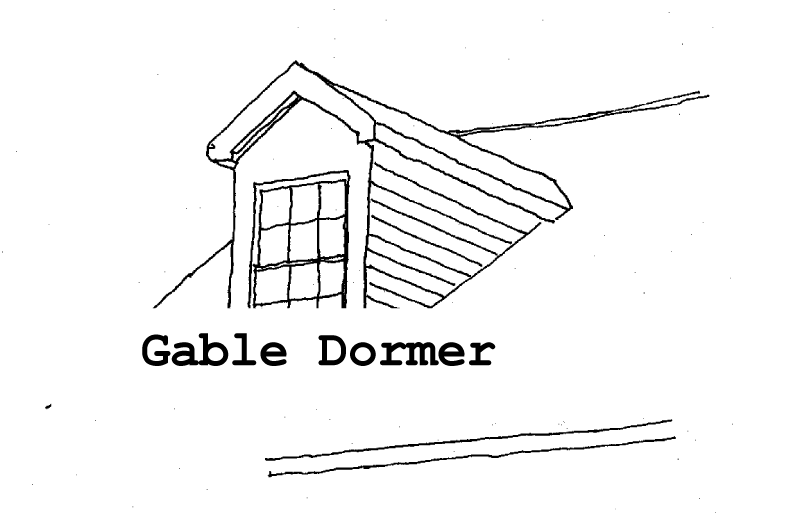
Dwelling: means any building or portion thereof designed or used exclusively as the residence or sleeping place of one (1) or more persons, but not including a tent, cabin, trailer, or trailer coach, boarding or rooming house, hotel or motel.
Dwelling group: means a group of two (2) or more detached dwellings located on a parcel of land in one ownership and having any yard or court in common.
Dwelling, multi-family: means a building or portion thereof designed for or used by three (3) or more families or housekeeping units.
Dwelling, single-family: means a building designed for or used exclusively for residence purposes by one (1) family or housekeeping unit.
Dwelling, two-family: means a building designed for or used exclusively by two (2) families or housekeeping units.
Dwelling unit: means a single housekeeping unit providing complete, independent living facilities for one (1) or more persons, including permanent provisions for living, sleeping, eating, cooking, and sanitation.
Dwelling unit - No bedroom: means a dwelling unit which contains no bedroom and no other room or space which may be readily converted to a bedroom whether such room or space be designated as a library, study, or otherwise. Generally, a no bedroom unit will contain only a living room, kitchen or kitchenette, breakfast space, bath, dressing room and customary closets or storage areas.
Dwelling unit - One-bedroom: means a dwelling unit which has only one (1) bedroom and which does not contain another room or space which may be readily converted to an additional bedroom whether such room or space be designated as a library, study, or otherwise. Generally, a one-bedroom unit will contain only a living room, kitchen or kitchenette, dining or breakfast space, bath, one (1) bedroom and customary closets or storage areas.
Elderly housing: means housing in a community that is specifically designed and operated for the elderly under state or Federal programs; or housing intended for and occupied solely by persons who are at least 62 years of age; or housing that meets the following criteria: (1) at least eighty percent (80%) of the occupied units in the housing facility or community must be occupied by at least one (1) person 55 years of age or older, (2) the facility or community must publish and must adhere to policies and procedures that demonstrate intent to comply with the requirements of the federal Fair Housing Act, and (3) the community or facility must meet the rules for verification of occupancy promulgated by the Federal Department of Housing and Urban Development.
Electric supplier: means any electric light company as defined in section 4905.03 of the Ohio Revised Code, including electric light companies organized as nonprofit corporations, but not including municipal corporations or other units of local government that provide electric service.
Elevation: means the orthographically projected length of one (1) side of a building without compensation for indentations and projections included in the perimeter length.
Eligible facilities request: means any request for modification of an existing wireless tower or base station that involves (A) collocation of new transmission equipment; (B) removal of transmission equipment; or (C) replacement of transmission equipment as such terms are defined in 47 C.F.R. 1.40001.
Employees (for determining parking requirements): means the maximum number of employees on duty on the premises at one (1) time or on any two (2) successive shifts, whichever is greater.
Essential services: means the erection, construction, alteration or maintenance, by public utilities of municipal or other governmental agencies, of underground or overhead gas, electrical, steam, or water transmission or distribution systems, collection, communication, supply or disposal systems, including poles, wires, mains, drains, sewers, pipes, conduits, cables, fire alarm boxes, police call boxes, in connection therewith; reasonably necessary for the furnishing of adequate service by such public utilities or municipal or other governmental agencies or for the public health or safety or general welfare, but not including buildings and utility stations.
(Ord. No. 58-2011; Ord. No. 6-2012; Ord. No. 8-2012; Ord. No. 36-2014; Ord. No. 87-2015, § 5, 12-14-2015; Ord. No. 16-2017, § 2, 4-10-2017; Ord. No. 42-2017, § 1, 6-26-2017; Ord. No. 44-2017, § 2, 7-5-2017; Ord. No. 47-2018, § 6—10, 6-25-2018; Ord. No. 7-2020, § 2, 9-14-2020; Ord. No. 75-2021, § 1(Exh. A), 12-13-2021; Ord. No. 40-2023, § 1(Exh. A), 8-28-2023; Ord. No. 11-2024, § 1(Exh. A), 3-4-2024)
§ 2.04 - DEFINITIONS (F—H).
The following words and phrases when used in the UDO or any zoning ordinance of the city shall have the meanings respectively ascribed to them unless otherwise stated:
FAA: means the Federal Aviation Administration.
FCC: means the Federal Communications Commission.
Family: means two (2) or more persons occupying a dwelling unit as an individual housekeeping unit.
Federal Emergency Management Agency (FEMA): means the agency with the overall responsibility for administering the National Flood Insurance Program.
Fence/Wall: means an enclosure or barrier, such as wooden posts, wire, iron, etc., used as a boundary, means of protection, privacy screening or confinement, but not including hedges, shrubs, trees, or other natural growth.
Fenestration: means the arrangement of windows and doors on the elevations of a building.
Fill: A deposit of earth material placed by artificial means.
Finished grade level: means the final elevation of the ground surface after man-made alterations, such as grading, grubbing, filling, or excavating, have been made on the ground surface.
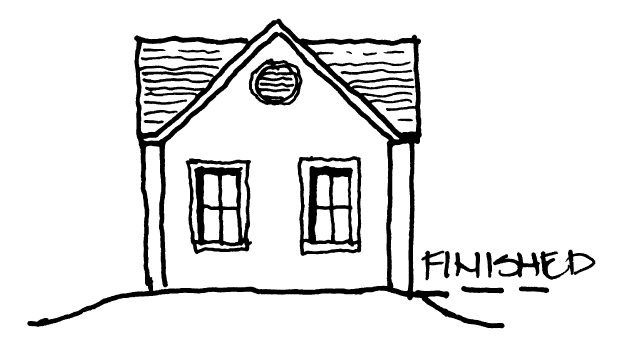
Finished Grade
Flood or flooding: means a general and temporary condition of partial or complete inundation of normally dry land areas from the overflow of inland or tidal waters; and the unusual and rapid accumulation or runoff of surface waters from any source.
Flood insurance rate map (FIRM): means an official map on which FEMA has delineated the areas of special flood hazard.
Flood insurance study: means the official report in which FEMA has provided flood profiles and the water surface elevations of the base flood.
Floodway: means the channel of a river or other watercourse and the adjacent land areas that must be reserved in order to discharge the base flood without cumulatively increasing the water surface elevation more than one (1) foot.
Floor area ratio (FAR): Means the gross floor area of a building, buildings, or structures on a lot divided by the total lot area. For the purposes of this definition, parking garages and/or unfinished basement space shall not be counted toward FAR.
Footcandle: means a measure of illumination on a surface that is one (1) foot from a uniform point source of light of one (1) candle and equal to one (1) lumen per square foot.
Frontage: means that boundary of a lot which is along an existing or dedicated public street, or where no public street exists, is along a public way. Where a lot abuts more than one (1) street, the Director of Community Development shall determine the frontage for purposes of this Ordinance.
Frontage Zone: means the portion of the Streetscape that is adjacent to the front of the building that allows space for outdoor seating, stoops, porches, awnings, planters, etc. and serves as a transition from the Pedestrian Zone.
Furniture Zone: means the portion of the Streetscape that lies between the Pedestrian Zone and on street parking or the travelway that includes tree planting, seating, lighting, bio-retention, etc.
Garage, private: means a totally enclosed building which may be attached to, or detached from, the principal structure, and is used or intended for use by the occupants of the premises for the storage of self-propelled vehicles or trailers.
Garage, public: means a structure or portion thereof, other than a private garage, used for the storage, sale, hire, care, repair, or refinishing of self-propelled vehicles or trailers.
Gateway Area: means an area of the site incorporating portions of the Streetscape and adjacent building façades that is significant because of its location and/or use. Gateways provide identifiable entrances and exits to and from the site, aid in wayfinding through the use of unique architectural and landscape treatments, and can work together to reinforce the identity of a district.
Gazebo: means an accessory building consisting of a detached, covered, freestanding, open-air structure.
Governmental directional sign: means a multi-sided sign structure with a unified design theme accommodating individual directional sign panels.
Gross floor area: means the total floor area of all main and accessory buildings, whether closed or unenclosed, measured from the exterior building face, including storage areas but excluding interior areas used for parking and loading and access thereto.
Ground floor area: means the gross area of the first floor of a building excluding exterior porches and balconies.
Hedge: means a row of shrubs or trees used as an enclosure for, or to mark the boundary of, or to screen a yard or lot or enclosure for, or any part thereof.
Historic demolition: means any act of process of destruction or removal of a substantial amount of the square footage of a contributing structure so that its historical significance is materially compromised.
Historic demolition permit: means a permit approved by the Board of Zoning and Planning that indicates an applicant whose proposal meets the definition of historic demolition of a contributing structure has complied with the requirements of Subsection 4.06(I).
Home for the aging: means a home licensed by the Ohio Department of Health which provides both the following:
(1)
Accommodations, supervision, personal care services, administration of medication, and supervision of special diets for three (3) or more unrelated individuals who are dependent on the services of others by reason of age and physical or mental impairment.
(2)
Personal care services and skilled nursing care for three (3) or more other unrelated individuals. The part of the unit of the home for the aging that provides personal care services, that may administer medication, and that may supervise special diets is licensed as a rest home. The part of the unit that provides other skilled nursing care is licensed as a nursing home.
Home occupation: means any occupation which is customarily incident to the principal use of the premises and is conducted by a resident occupant.
Home office: means an office, studio, workshop or area located in a residence or occupying a structure or accessory structure from which a resident occupant conducts professional or business activity incidental to the residential use of the premises.
Home sale: means a sale of personal property to the general public conducted in or on any property within a residential zoning district, to include, without limitation, garage sales, patio sales, yard sales, porch sales, driveway sales, motor vehicle sales, and the sale of boats, trailers, motorcycles, motor homes, and the like.
Hotel: means any building or portion thereof used as a temporary aboding place for remuneration, with or without meals, containing fifteen (15) or more guest rooms or suites where no provision for cooking is made in any individual guest room or suite, and does not include hospitals and jails.
Hot tub: means an artificial container of water with a liquid capacity greater than one hundred (100) gallons and designed with a mechanical air injection system and/or re-circulating device.
Housekeeping unit: means an individual or group of persons occupying a dwelling unit that has a single kitchen; provided, however, that an In-law Suite and the primary single-family residence to which it is an accessory use shall also be considered a single housekeeping unit even if the in-law suite has its own kitchen.
(Ord. No. 58-2011; Ord. No. 62-2015, § 1, 11-23-2015; Ord. No. 87-2015, § 5, 12-14-2015; Ord. No. 42-2017, § 2, 6-26-2017; Ord. No. 75-2021, § 1(Exh. A), 12-13-2021)
§ 2.05 - DEFINITIONS (I—M).
The following words and phrases when used in the UDO or any zoning ordinance of the City shall have the meanings respectively ascribed to them unless otherwise stated:
Identification: means the act of specifying the name, address, and number of a building, institution, or person or the activity carried on in the building or institution.
In between places: A location which fulfills a necessary role between the public and private realms. In between places usually occur in cafes, pubs, exercise clubs, corner stores, and the like.
Information service: means the offering of a capability for generating, acquiring, storing, transforming, processing, retrieving, utilizing, or making available information via telecommunications, and includes electronic publishing, but does not include any use of any such capability for the management, control, or operation of a telecommunications system or the management of a telecommunications service.
In-law suite: means an independent dwelling unit contained within a single-family residence, typically with its own entrance, kitchen, bedroom, and bathroom, and used exclusively for family members of the property owner, who must also live within the single-family residence. The structure must maintain a single-family residential appearance which blends with the principal structure and the neighborhood, and the in-law suite may not exceed more than eight hundred sixteen (816) square feet. The in-law suite shall be located within the buildable area of the lot, and shall not be detached from the home, be located in a detached garage or within another accessory structure. The in-law suite shall only be permitted on properties which meet minimum lot frontage and minimum lot size requirements in that zoning district. The in-law suite shall be occupied in a manner consistent with a single-family use in conjunction with the primary residence. An in-law suite is being occupied in a manner consistent with a single-family use in conjunction with the primary residence if all of the following factors are present: unrestricted access to the entire structure is provided to all occupants; interior passages connect the in-law suite to the primary residence; household expenses and responsibilities are shared; the entire structure has no more than one meter and one connection for water, electricity, gas, and other household utilities, respectively; the in-law suite does not have a separate mailbox or mailing address; the in-law suite will not be used for transient accommodations; and no leasehold interest has been or will be granted in the in-law suite.
Intersection clearance zone: means on a corner lot, an area between the curb line or edge of pavement of the two (2) intersecting streets and a diagonal line connecting the curb or edge of pavement of intersecting streets at a point thirty (30) feet from the their point of intersection. In an intersection clearance zone, no fence, snow fence, wall, ornamental landscaping or feature, mound, or hedge shall exceed thirty-two (32) inches in height above the grade of the pavement of street gutter.
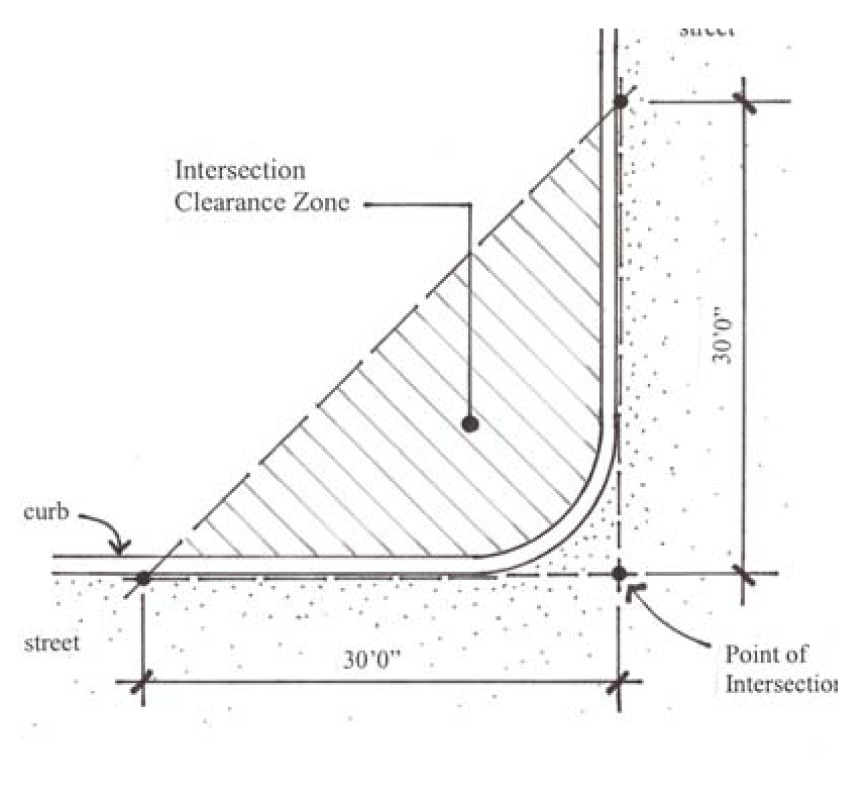
Corner Lot
Intersection Clearance Zone
Kennel: means any place where four (4) or more dogs, cats, or other animals over three (3) months of age are kept, raised, sold, boarded, bred, shown, treated, or groomed for purposes other than serving as individual or family pets.
Kitchen: means any room in a building or dwelling unit which is used for cooking or the preparation of food.
List(s), (notice): means the County auditor's current tax listing and/or any other listing that might be reasonably used to identify a current property owner of record or tenant.
Live-work quarters: means buildings or spaces within buildings that are used jointly for commercial and residential purposes where the residential use of the space is secondary or accessory to the primary use as a place of work.
Livestock: means a generally accepted outdoor farm animal or grazing animal and shall include, but not be limited to: chickens, roosters, cocks, hens, pullets, chicks, capons or other barnyard fowl; ducks, geese or other waterfowl/wildfowl; cattle or other animals of the bovine species; horses, mules, burros, asses or other animals of the equine species; goats or other animals of the caprine species; swine or other animals of the porcine species; sheep or other animals of the ovine species. The term livestock shall not include cats, dogs or other house pets.
Longwall: See "side yard increased".
Lot: means a parcel of land whose boundaries have been established by some legal instrument such as a recorded deed or a recorded plat and which is recognized as a separate legal entity for purposes of transfer of title.
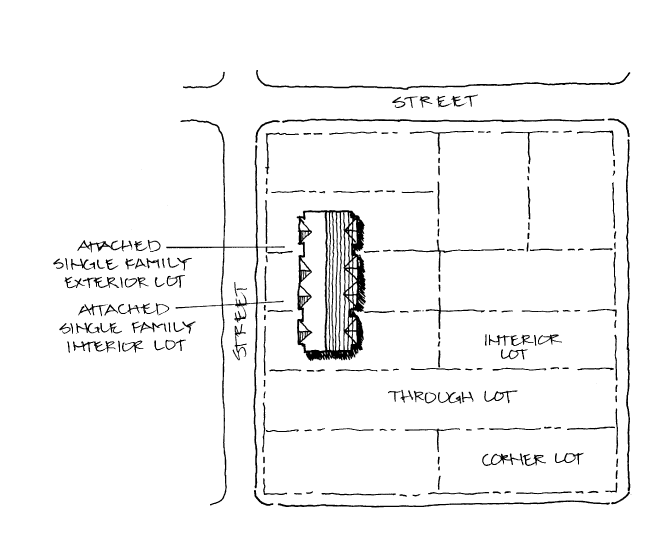
Lot Types
Lot area: means the computed area contained within the lot lines. In cases where the lot lines incorporate public rights-of-way, only the area outside the public rights-of-way shall be considered for purposes of this Ordinance.
Lot, corner: means a lot abutting upon two (2) or more streets at their intersection or upon two (2) parts of the same street, such streets or parts of the same street forming an interior angle of less than one hundred thirty-five (135) degrees. The point of intersection of the street lines is the corner.
Lot, depth: means the mean distance between the front and the rear lot lines.
Lot, double frontage: means a lot having frontage on two (2) nonintersecting streets, as distinguished from a corner lot (see "lot, through").
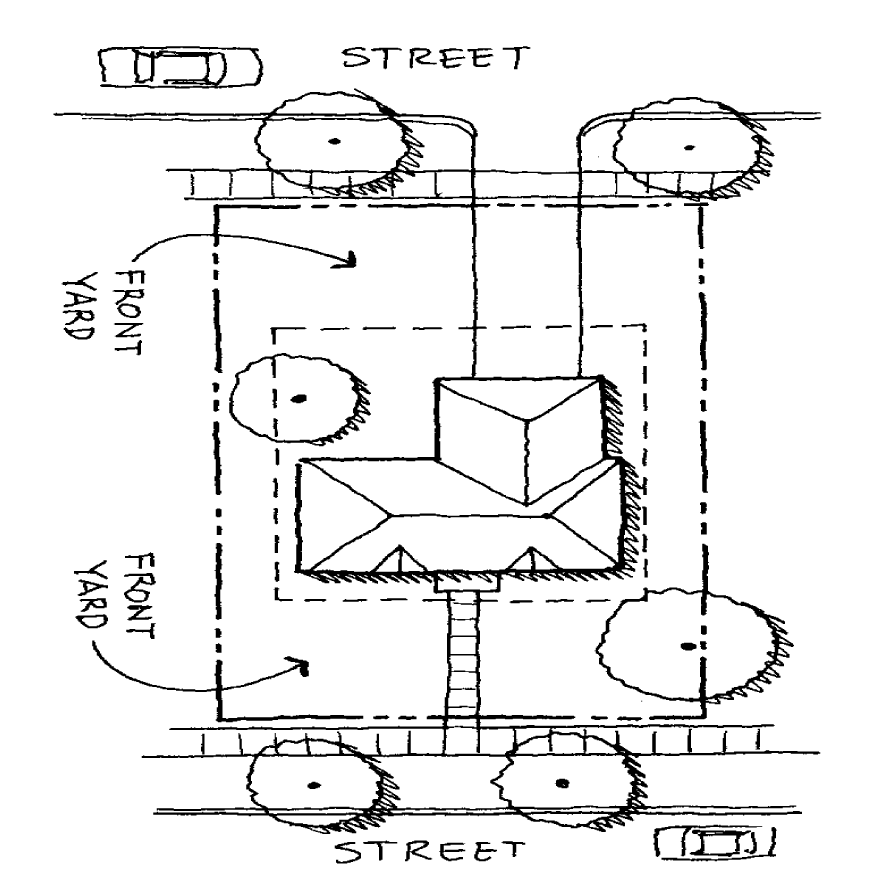
Defining the Front Yard for a Double Frontage Lot
Lot, flag: means a lot fronting or abutting a public roadway and where access to the public roadway is limited to a narrow private right-of-way.
Lot, interior: means a lot other than a corner lot.
Lot line: means the property lines bounding the lot.
Lot line, front: means the line separating the lot from a street on which it fronts (see "frontage").
Lot line, rear: means the lot line opposite and most distant from the front lot line.
Lot line, side: means any lot line other than a front or rear lot line. A side lot line separating a lot from a street is called a side street lot line. A side lot line separating a lot from another lot or lots is called an interior side lot line.
Lot line, street or alley: means a lot line separating the lot from a street or alley.
Lot, through: means a lot having frontage on two (2) parallel or approximately parallel streets.
Lot width: means the mean width of the lot measured at right angles to its depth.
Lowest floor: means the lowest floor of the lowest enclosed area (including basement). An unfinished or flood resistant enclosure, usable solely for parking of vehicles, building access or storage, in an area other than a basement area, is not considered a building's lowest floor; provided that such enclosure is built in accordance with the applicable design requirements specified in this Ordinance for enclosures below the lowest floor.
Massing: means three-dimensional building form. Appearance and style are applied to massing, but do not appreciably affect the volume established, except for the roof form selected.
Microbrewery: means a limited production brewery, producing less than fifteen thousand (15,000 barrels per year), where beer is brewed for consumption primarily on-site.
Micro-distillery: A small, often boutique-style distillery established to produce beverage grade spirit alcohol in relatively small quantities, usually done in single batches.
Microwinery: means a small wine producer that sources its grape product from an outside supplier or an off-site vineyard.
Mobile Billboard: means any motorized or non-motorized vehicle that carries a sign or signs for the primary purpose of displaying such sign, where such sign is not permanently affixed to the vehicle or extends beyond the overall length, width, or height of the vehicle. "Permanently affixed" means that the sign is painted or applied as a decal directly on the body of the vehicle.
Monopole: means a single pole with no above ground lateral support from secondary structural members in either tension or compression.
Motor home: means a self-propelled vehicle constructed with permanently installed facilities for cold storage, cooking and consuming of food and for sleeping.
Motor vehicle: means any self-propelled vehicle designed primarily for transportation of persons or goods along public streets or alleys, or other public ways.
Motor vehicle wash facility: means a building or structure where chain conveyors, blowers, steam cleaners or similar mechanical devices are employed for the purpose of washing motor vehicles, or which provides coin-operated facilities for the washing of motor vehicles or which provides for the so-called do-it-yourself motor vehicles wash.
Mound: means an artificial rise or elevation above the natural grade of the surrounding ground created with earth, rock or other material.
Movie theater: means a specialized theater for showing movies or motion pictures.
(Ord. No. 106-2009; Ord. No. 62-2015, § 2, 11-23-2015; Ord. No. 21-2016, § 3, 5-9-2016; Ord. No. 53-2017, § 3, 12-11-2017; Ord. No. 54-2017, §§ 4—7, 12-11-2017; Ord. No. 32-2018, § 3, 4-23-2018; Ord. No. 47-2018, § 11, 6-25-2018)
§ 2.06 - DEFINITIONS (N—Q).
The following words and phrases when used in the UDO or any zoning ordinance of the City shall have the meanings respectively ascribed to them unless otherwise stated.
National Register of Historic Places: means the official listing of properties (including districts, buildings, structures, sites, and objects) managed by the National Park Service to recognize the value of preserving certain structures that are important to local, state, or National American History.
Neighborhood scale: means a commercial development consisting of a single user whose gross floor area is less than five thousand (5,000) square feet in size.
Nonconforming uses: means a building, structure or premises legally existing and/or used at the time of adoption of this Ordinance, or any amendment thereto, and which does not conform with the use regulations of the district in which it is located. Any such building, structure or premises conforming in respect to use but not in respect to height, area, yards or courts, floor area or distance requirements from more restricted districts or uses, shall not be considered a nonconforming use.
No-impact wireless communication facility: means a facility which is either:
(1)
Virtually invisible to the casual observer, such as an antenna behind louvers on a building, or inside a steeple or similar structure, or
(2)
Camouflaged with stealth design so as to blend in with its surroundings to such an extent that it is indistinguishable by the casual observer from the structure on which it is placed or the surroundings in which it is located, such as a flagpole serving as an antenna.
Nude: means exposing to view the genitals, pubic area, vulva, perineum, anus, anal cleft or cleavage, or pubic hair with less than a fully opaque covering; exposing to view any portion of the areola of the female breast with less than a fully opaque covering; exposing to view male genitals in a discernibly turgid state, even if entirely covered by an opaque covering; or exposing to view any device, costume, or covering that gives the appearance of or simulates any of these anatomical areas.
Nursing home: means a home licensed by the Ohio Department of Health which is used for the reception and care of individuals who by reason of illness or physical or mental impairment require skilled nursing care and of individuals who require personal care services but not skilled nursing care.
Off-street loading space: means a space for parking one (1) commercial vehicle for pickups and deliveries, which space has minimum dimensions of twelve (12) feet in width, fifty (50) feet in length and fifteen (15) feet in vertical height, which is located in a building or in the open on the same lot as the use such space is intended to serve, which has access to a public street, and which is exclusive of the right-of-way of any public or private street or any driveway, aisle, circulation drive or off-street parking space.
Off-street parking space: means an area for parking one (1) or more motor vehicles, which is located in a building or in the open, which has access to a public street, and which is exclusive of the right-of-way of any public or private street or any driveway, aisle, circulation drive or off-street loading space. Off-street parking spaces shall have minimum rectangular dimensions as shown in Section 6.03.
Open-sided structure: means a free-standing, unheated structure unenclosed except for a structural system supporting a roof, and screen panels which may be used to enclose the open spaces between structural elements.
Open space: means the land remaining after all development cover has been constructed on a given lot or in a given area. Open space for public use, such as parks, should not be confused with open space provided to separate buildings, parking, roads and miscellaneous pavement as part of an overall project design.
Ornamental feature: means a structure or any part of a structure of wood, metal, masonry or other material used to ornament any part of a yard area.
Overlay district: means a district established by ordinance to prescribe special regulations to be applied to a site in combination with the underlying or base district.
Package shipment services: A commercial enterprise having as its primary function the pick-up, transport, shipping and delivery of parcels or packages.
Parking area, private: means an open area for the same uses as private garage.
Parking area, public: means an open area, excluding a street or other public way, used for the parking of automobiles and available to the public, whether for free or for compensation.
Parking lot, structured - Aboveground: means a structure designed to accommodate motor and other vehicle parking spaces that are fully or partially enclosed or located on the deck surface of a building where some of the parking spaces are located aboveground.
Parking lot, structured - Underground: means a below grade structure designed to accommodate motor and other vehicle parking spaces where all of the parking spaces are located underground.
Parking lot, surface: means a parking area for motor and other vehicles where there is no gross building area above or below the parking area.
Parking space: means a permanently surfaced area of not less than one hundred sixty-two (162) square feet, either within a structure or in the open, exclusive of driveways or access drives, for the parking of a motor vehicle.
Pavilion: means a freestanding structure that is used primarily for entertainment, relaxation, and/or leisure activities.
Pedestrian Active Uses: means uses which generate significant pedestrian traffic and interest at street level including consumer and service-oriented retail and retail displays, commercial and restaurants, hotel uses, and in some cases residential and residential-oriented services. Entrances and lobbies to groups of uses on higher floors are also considered pedestrian active uses.
Pedestrian Zone: means the area of the Streetscape adjacent to the Furniture Zone that is reserved for pedestrian traffic. The Pedestrian Zone is to remain clear and unobstructed for ease of travel and maintenance.
Performance, standard: means a criterion established in the interest of protecting the public health and safety for the control of vibration, noise, odor, smoke, noxious gases and other objectionable or dangerous elements generated by and inherent in or incidental to land uses.
Person: means any natural person, corporation, or partnership and also includes any governmental entity.
Personal services: means an establishment or place of business primarily engaged in the provision of frequent or recurrent needed services of a personal nature. Typical uses include, but are not limited to, beauty and barber shops, massage parlors or spas where the massage is given by a State of Ohio (Ohio State Cosmetology and Barber Board or Board of State of Ohio Nursing or State Medical Board of Ohio or Ohio State Chiropractic Board) licensed massage therapist, non-overnight pet grooming, shoe repair shops, and tailor shops. A tattoo parlor or body-piercing studio shall not be considered a personal service.
Pervious concrete: means a special type of concrete with a high porosity used for concrete flatwork applications that allows water from precipitation and other sources to pass through it, thereby reducing the runoff from a site and recharging ground water levels. The high porosity is attained by a highly interconnected void content, with little to no fine aggregate and enough cementitious paste to coast the aggregate particles.
Pharmacy (or drug store): An establishment engaged in the retail sale of prescription drugs, nonprescription medicines, cosmetics, and related supplies. Marijuana and marijuana-related products shall not be sold in a pharmacy or drug store.
Porch: means a covered but unenclosed projection from the main wall of a building that may or may not use columns or other ground supports for structural purposes.
Portable storage unit: means any portable enclosed unit of any type construction or material, designed for permanent or temporary storage, which can be transported by vehicle and left on-site.
Preservationists: means those entities or individuals that are considered experts by specialized knowledge, skill, experience, training, or education the field of historic preservation.
Primary Street: means a thru vehicular and pedestrian access way that connects to existing public streets of adjacent neighborhoods and is dedicated public right-of-way. A Primary Street may include those designated by the Traffic Code as an arterial, collector, or highway or laned street and is the street that the lot takes its address from, has the highest street classification or highest traffic counts, and orients mostly toward pedestrians.
Principal structure: means a structure, or group of structures, in which is conducted the primary use of the lot on which the structure is located. As regulated in zoning districts, the principal structure contains the principally permitted use.
Principal use: means the primary use and chief purpose of the lot or structure. As regulated in zoning districts, the use of a lot which is permitted within the district. This is often referred to as the principally permitted use, or uses, within the district.
Profile coefficient: means a number which defines the angle of the rear yard profile limit. The definition of rear yard profile limit identifies where this angle is to be constructed. Defining the increase in height permitted in a twelve-foot run is another way of defining the profile limit slope created by this angle. If the number 12 is divided by the profile coefficient, or cotangent, the result will indicate the feet or rise permitted in a twelve-foot run.
Protected Zone: means the residentially-zoned properties surrounding the Lane Avenue PMUD.
Public property: means real estate owned, leased, or otherwise controlled by the City of Upper Arlington, the Upper Arlington School District, or other local, state or federal public agency as determined by the Community Development Department.
(Ord. No. 106-2009; Ord. No. 8-2012; Ord. No. 87-2015, § 5, 12-14-2015; Ord. No. 21-2016, § 4, 5-9-2016; Ord. No. 54-2017, §§ 8, 9, 12-11-2017; Ord. No. 32-2018, § 4, 4-23-2016; Ord. No. 47-2018, § 12, 6-25-2018; Ord. No. 75-2021, § 1(Exh. A), 12-13-2021; Ord. No. 11-2024, § 1(Exh. A), 3-4-2024)
§ 2.07 - DEFINITIONS (R—S).
The following words and phrases when used in the UDO or any zoning ordinance of the City shall have the meanings respectively ascribed to them unless otherwise stated.
Recreational vehicle: means a vehicle which is (1) built on a single chassis; (2) four hundred (400) square feet or less when measured at the largest horizontal projection; (3) designed to be self-propelled or permanently towable by a light duty truck; and (4) designed primarily not for use as a permanent dwelling but as temporary living quarters for recreational, camping, travel or seasonal use. The term also means an all-terrain vehicle (ATV), golf cart, personal watercraft and similar vehicle.
Rest home: also called assisted living, both of which mean a home licensed by the Ohio Department of Health which provide either of the following:
(1)
Accommodations for seventeen (17) or more unrelated individuals and supervision and personal care services for three (3) or more of those individuals who are dependent on the services of others by reason of age or physical or mental impairment or, in the case of a rest home component of a home for the aging, accommodation to three (3) or more individuals and supervision and personal care services for at least three (3) of those individuals;
(2)
Accommodations for three (3) or more unrelated individuals, supervision and personal care services for at least three (3) or more of those individuals, who are dependent on the services of others by reason of age or physical or mental impairment, and supervision of special diets or the administration of medication to at least one (1) of those individuals.
Restaurant: means an establishment where food and drink are prepared, served and consumed primarily or exclusively within the principal building. A restaurant is distinguished by at least the following features:
(1)
At least thirty percent (30%) of the gross floor area of the facility is devoted to a dining room or area designed for customer seating and food consumption with at least twenty (20) seats provided at all times.
(2)
No company-owned or sanctioned vehicles are used to deliver ready to consume food to off-site customers.
(3)
Payment for food consumed is received after consumption by the patron, except for cafeterias.
(4)
Food orders are taken at the table by employees of the company, except for cafeterias.
Restaurant, cafeteria: means a restaurant where ordering of a meal is not required and pre-prepared entrees are selected and assembled by the patron into a complete meal before payment.
Restaurant, carry-out: means establishments where food is usually ordered by telephone and prepared on the premises for consumption off the premises, with no seating or other area provided on the premises for consumption. The establishment may deliver food to the customer, or the customer may pick food up.
Restaurant, drive-in: means an establishment where food and/or beverages are sold in a form ready for consumption, where all or a significant portion of the consumption takes place or is designed to take place outside the confines of the restaurant, and where ordering and pick-up of food may take place from an automobile.
Restaurant, fast-food: means restaurants where most customers order and are served their food at a counter or in a motor vehicle in packages prepared to leave the premises or able to be taken to a table or counter to be consumed.
Restaurant, with entertaining or dancing: means a restaurant which also contains a dance floor, stage or bar selling alcoholic beverages to the customer without a meal order.
Retail, convenience: A commercial enterprise having as its primary function the sale of goods and/or services directly to the consumer, where the goods for sale are available for immediate purchase and removal from the premises by the purchaser. A marijuana dispensary shall not be considered convenience retail.
Retail, luxury: A commercial enterprise having as its primary function the sale of goods directly to the consumer where the minimum price for the majority of individual items offered for sale exceeds one hundred fifty dollars ($150.00), such as jewelry, men's or women's fashion clothing or accessories, or electronics such as computers. This shall not include big box retail or retail related to automobiles, automotive products, motorcycles, motorcycle products, boats or boating products, furniture, hot tubs/spas or appliances, and marijuana and marijuana-related products.
Retaining wall: A wall or similar structure device used at grade changes to hold the soil on the up-hillside from slumping, sliding or falling.
Review, administrative: means the act or process for which any city official(s) will study, examine and/or deliberate on a development proposal.
Review, board: means the act or process for which any legally established city board or commission will study, examine and/or deliberate on a development proposal.
Right-of-way fee or public way fee: means a fee levied to recover the costs incurred by the city and associated with the occupancy or use of a public way.
Right(s)-of-way: means the surface of, and the space within, through, on, across, above, or below, any public street, public road, public highway, public freeway, public lane, public path, public alley, public court, public sidewalk, public boulevard, public parkway, public drive, public easement, and any other land dedicated or otherwise designated for a compatible public use, which, on or after July 2, 2002, is owned or controlled by a municipal corporation. "Rights-of-way" excludes a private easement.
River Ridge Addition: means the subdivision platted in 1926 that is generally bound by Fishinger Road, Mountview Road, Swansea Road and Sunset Drive.
River Ridge Addition (extended): means the area generally bound by the south side of Fishinger Road, the east side of Sunset Drive, the north side of Zollinger Road and the west side of Somerford Road, and consisting of the following subdivisions within that area: River Ridge Addition, East Cleft on the Scioto, North Mountview Addition, Sciotangy Heights, and Millwood Addition.
Rooming house: means a residential building with three (3) or more sleeping rooms for lodgers, and wherein no dining facilities are maintained for the lodger, as distinguished from a boarding house.
Runoff coefficient: means an empirical coefficient representing a relationship between rainfall and runoff.
Satellite signal receiving antennas or dish-type satellite signal receiving antennas (also referred to as satellite earth stations, or satellite dish antenna or ground station: means any antenna designed to receive or transmit microwave signals or other communication, either directly or indirectly, to or from satellites in earth orbit.
School, elementary and high: means an institution of learning which offers instructions in the several branches of learning and study required to be taught in accredited schools by the applicable statutes of the State of Ohio. High schools include junior and senior grades.
Seats: means the number of seating units installed or indicated on plans, or each twenty (20) lineal inches of stands, benches or pews. It is assumed that a seating unit occupies seven (7) square feet of floor area for fixed seating and fifteen (15) square feet of floor area for uses without fixed seating, exclusive of aisles and assembly areas.
Secondary Street: means a road with a dedicated right-of-way or a private road with vehicular and/or pedestrian access to uses fronting Lane Avenue and the adjacent neighborhood. A Secondary Street may include those designated by the Traffic Code as collector or local streets. With the exception of aboveground walkways and building connections, secondary streets shall be open to the sky.
Sexually oriented business establishment: means any of the following commercial establishments, as defined herein:
(1)
Adult cabaret.
(2)
Adult book store.
(3)
Adult theater.
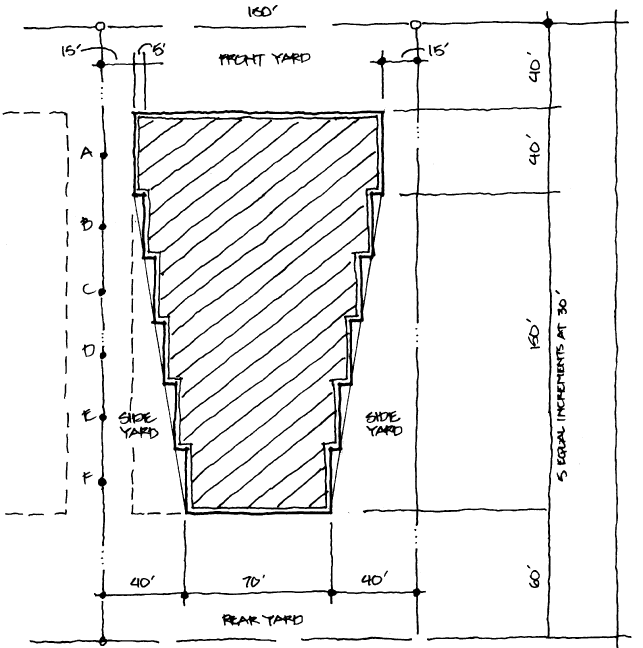
Side yard increased (longwall): means the situation where, beginning at the front façade of the structure, each side yard, where required, shall be increased in width by two (2) inches for each foot by which the elevation length of the building, adjacent to the side yard, exceeds forty (40) feet. Adjacent in this context means any portion of the side wall that is closer to the side property line than twenty-five percent (25%) of the lot width at the place of measurement.
Longwall Plan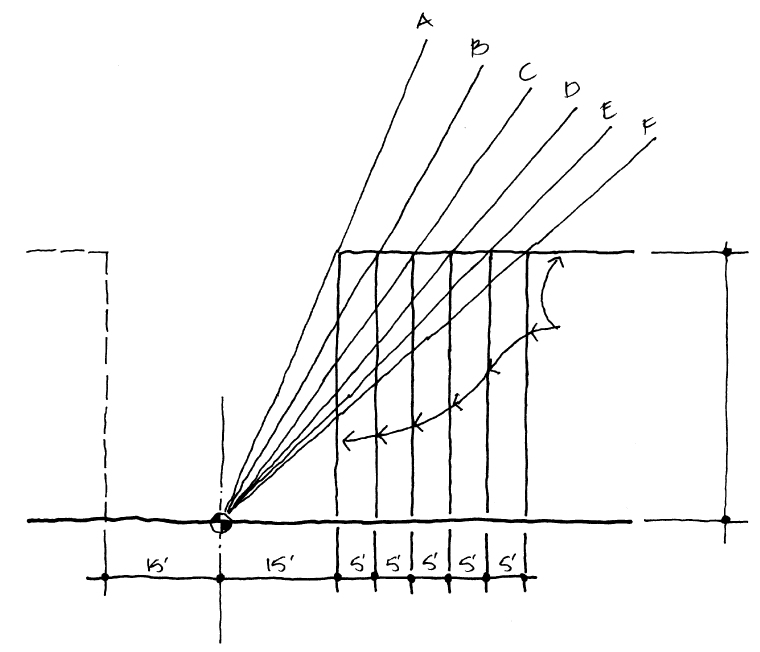
Sight triangle: See definition of "intersection clearance zone".
Sign: means any text or illustration that is affixed to, portrayed, or depicted directly or indirectly upon any surface for outdoor public view. This definition includes all signs visible from any public right-of-way or adjacent property.
Sign, area of: means the total exterior surface computed in square feet of a sign having but one exposed exterior surface; one-half (½) the total of the exposed exterior surface computed in square feet of a sign having more than one (1) such surface.

Sign, Area of
Sign, building-mounted: means an exterior building mounted sign. Building-mounted signs include murals, messages, graphics, and painted designs, and any letters or numerals mounted directly on buildings.
Sign, commercial: means any sign or banner that contains text and/or graphics designed to propose or promote a commercial transaction or directing attention to a business, commodity, or service for non-residential beneficiaries of the message. This includes business identification signs, free standing site identifiers, and free-standing single user identifiers.
Sign, deteriorated: means showing signs of weathering, rust, corrosion, exposed wiring, chipped paint or faces, cracked, broken, or missing faces, or loose materials, missing or broken lettering (for changeable copy signs), or other evidence of disrepair.
Sign, free-standing: means a sign supported by or suspended from posts, pillars, columns, or other structures which are not a building or portion thereof.
Sign, free-standing, main site identifier: means a free-standing commercial sign for the identification of a site where multiple users are grouped together for mutual benefits. For the purposes of this Ordinance, all such arrangements, combinations, and groupings shall be referred to as centers.
Sign, free-standing, single user identifier: means a free-standing commercial sign for the identification of a single, individual, profit or non-profit enterprise, excluding single enterprises representing a collection of member users, representing multiple tenants. A free-standing scoreboard is considered a free-standing, single user sign.
Sign, message area: means the area within a continuous perimeter that surrounds, but is not limited to, each word, graphic, symbol, number and illustration.

Sign, Message Area
Sign, noncommercial: means any sign that does not contain text and/or graphics designed to propose or promote a commercial transaction or directing attention to a business, commodity, or service for any occupant of the property or for non-resident beneficiaries of the message.
Sign, off-premise: means any commercial sign where the commercial beneficiary of the sign is not located on the premises on which the sign is located.
Sign, on-premise: means any commercial sign where the commercial beneficiary is located on the premises where the sign is located. All noncommercial signs are treated as on-premises signs.
Sign, permanent: means a building mounted or a free-standing sign that is constructed of materials that are weather-resistant for multiple years without significant deterioration from exposure to the elements or wear and tear; or any sign left in one (1) location for more than three (3) months.
Sign, temporary: means a sign, which by virtue of its materials, design, or the manner in which it is affixed to the ground or a structure, is intended to be erected and used, or in fact is used, for a limited period of time. A sign left in one location for more than three (3) months is not a temporary sign regardless of its physical characteristics. Removing and replacing a sign within a fifty (50) feet radius of its original location, where the sign has not been removed for at least a two (2) week period, does not interrupt the calculation of the three (3) month limitation on temporary signs.
Sign, window: means a sign visible from the exterior of a building that is attached to, painted on, etched in, or within three (3) feet of the inside of a building's transparent surfaces.
Site plan, major: means a site plan where changes involve twenty-five percent (25%) or less of the original floor area not to exceed ten thousand (10,000) square feet and reviewed by the Director of Community Development. Amendments to major site plans exceeding twenty-five percent (25%) of the original floor area, or ten thousand (10,000) square feet, shall be reviewed by BZAP.
Site plan, minor: means a site plan for single-family residences; accessory uses and structures; multi-family dwellings of three (3) units or less; signs; and non-residential additions up to twenty-five percent (25%) or less of the original floor area, not to exceed ten thousand (10,000) square-feet.
Slogan area: means the maximum area permitted for business descriptions, explanations and representations including, but not limited to, slogans, price lists, testimonials and guarantees. The remainder of the message area shall be limited to identification of the name of the business, the business address and the type of business maintained or operated on the premises.
Small cell facility: means a wireless facility that meets both of the following requirements:
(1)
Each antenna is located inside of an enclosure of not more than six cubic feet in volume or, in the case of an antenna that has exposed elements, the antenna and all of its exposed elements could fit within an enclosure of not more than six cubic feet in volume.
(2)
All other wireless equipment associated with the facility is cumulatively not more than twenty-eight cubic feet in volume. The calculation of equipment volume shall not include electric meters, concealment elements, telecommunications demarcation boxes, grounding equipment, power transfer switches, cut-off switches, and vertical cable runs for the connection of power and other services.
Snout house: means a single family or townhome with an attached garage extended forward from the principal structure.
Snow fence: means any temporary fence used to control the drifting of snow.
Special event: means a special occasion or activity that is open to the general public and supported by the City. A special event is educational, cultural or recreational in function.
Specified anatomical areas: means and includes any of the following: (1) less than completely and opaquely covered human genitals, pubic region, buttocks, anus, or female breasts below a point immediately above the areolas, but not including any portion of the cleavage of the female breast exhibited by a dress, blouse, shirt, leotard, bathing suit or other wearing apparel, provided the areola is not exposed; or (2) human male genitals in a discernibly turgid state, even if completely and opaquely covered.
Specified sexual activities: means and includes any of the following:
(1)
The fondling or other erotic touching of human genitals, pubic region, buttocks, anus, or female breasts;
(2)
Sex acts, normal or perverted, actual or simulated, including intercourse, oral copulation or sodomy;
(3)
Masturbation, actual or simulated; or
(4)
Excretory functions as part of or in connection with any of the activities set forth in this definition.
Stable: means a building which horses, ponies, mules or donkeys are sheltered; may be accessory to a residential or other use, or a freestanding principle use.
Stealth design: means any communications facility, which is designed to blend into the surrounding environment. Examples of stealth facilities may include, but are not limited to, antenna tower alternative structures, architecturally screened roof-mounted antennas, building-mounted antennas painted to match the existing structure, antennas integrated into architectural elements, antennas and monopoles surrounded or obscured by existing and/or proposed trees and landscaping and antenna structures designed to look like light poles, or other camouflaging techniques available on the market.
Story: means that portion of a building included between the surface of any floor and the surface of the floor next above it, or, if no floor above it, then the space between the floor and the ceiling next above it.
Story, first: means the lowest story or the ground story of any building the floor of which is not more than twelve (12) inches below the average contact ground level at the exterior walls of the building; except that any basement or cellar used for residence purposes shall be deemed the first story, provided, however, that a basement or cellar used purely for recreational purposes shall not be deemed the first story.
Story, half: means a partial story under a gable, hip or gambrel roof, whose rafters bear on the floor plate of such story, or the wall plate of the story below. If this partial story exceeds one-third (⅓) of the area of the next floor below, or if this story uses a shed dormer on one (1) or more sides, it shall be deemed a full story.
Story, mezzanine: means a story which covers one-third (⅓) or less of the area of the story directly underneath it. A mezzanine story shall be deemed a full story in the event it covers more than one-third (⅓) of the area of the story directly underneath said mezzanine story.
Streamer: means any lightweight plastic, fabric or other material, whether or not containing a message of any kind, suspended from or attached to rope, wire, string or cord, usually in series, designed to move in the wind.
Street: means a public right-of-way fifty (50) feet or more in width which provides a public means of access to abutting property, or any such right-of-way more than thirty (30) feet and less than fifty (50) feet in width provided it existed prior to the enactment of this Ordinance. The term street shall include avenue, drive, circle, road, parkway, boulevard, highway, thoroughfare or any other similar term.
Street frontage: means the total width of the side of the building that faces a street, excluding any extension of an exterior wall beyond the building envelope.
Street segment: means both sides of the street within two (2) intersecting streets.
Structure: means anything constructed, the use of which requires permanent location on the ground, or attachment to something having a permanent location on the ground, except that air supported structures shall be defined separately.
Structure, air supported: means a structure constructed of any single diaphragm light weight flexible fabric or film, or any combination thereof, which derives its primary support and stability from inflation pressure together with anchorage attached to the base of the structure, which shall be considered a structure and regulated as set forth in the various districts of UDO.
Structural alteration: means any change in the structural members of a building, such as walls, columns, beams or girders.
Subdivision: means the division of any parcel of land shown as a unit or contiguous units as filed on a plat of record with the Franklin County Auditor.
Subdivision, major: means a platting of land for the purposes of development and transfer of ownership. A major subdivision is any subdivision that does not meet the requirements of a minor subdivision. It requires approval of a preliminary plan by BZAP, approval of a final plat by BZAP, acceptance by Council, and recording of the final plat prior to the transfer of land.
Subdivision, minor: means a division of a parcel of land (also known as a lot split) that is approved by BZAP and does not require a plat to be approved by City Council. A minor subdivision includes a division of a parcel of land along an existing public street or road, and not involving the opening, widening, or extension of any street or road, and involving not more than five (5) lots, any one of which is less than five (5) acres, after the original tract has been completely subdivided.
Substantial damage: means damage of any origin sustained by a structure whereby the cost of restoring the structure to its before damaged condition would equal or exceed fifty percent (50%) of the market value of the structure before the damage occurred.
Substantial improvement: means any reconstruction, rehabilitation, addition, or other improvement of a structure, the cost of which equals or exceeds fifty percent (50%) of the market value of the structure before the start of construction of the improvement. This term includes structures which have incurred substantial damage, regardless of the actual repair work performed. The term does not, however, include:
(1)
Any project for improvement of a structure to correct existing violations of State or local health, sanitary or safety code specifications which have been identified by the local code enforcement official and which are the minimum necessary to assure safe living conditions.
(2)
Any alteration of a historic structure, provided that the alteration will not preclude the structure's continued designation as a historic structure.
(3)
Any improvement to a structure which is considered new construction.
Substantial modification: means a change that significantly alters the impacts and/or character of development or activity.
Swimming pool: means a structure intended for swimming or recreational bathing that is capable of containing water over twenty-four (24) inches deep.
(Ord. No. 106-2009; Ord. No. 36-2014; Ord. No. 87-2015, § 5, 12-14-2015; Ord. No. 21-2016, § 5, 5-9-2016; Ord. No. 53-2017, § 4, 12-11-2017; Ord. No. 54-2017, §§ 10, 11, 12-11-2017; Ord. No. 35-2018, § 2, 5-29-2018; Ord. No. 47-2018, §§ 13—15, 6-25-2018; Ord. No. 50-2018, § 2, 7-9-2018; Ord. No. 75-2021, § 1(Exh. A), 12-13-2021; Ord. No. 28-2023, § 1(Exh. A), 8-28-2023)
§ 2.08 - DEFINITIONS (T—Z).
The following words and phrases when used in the UDO or any zoning ordinance of the City shall have the meanings respectively ascribed to them unless otherwise stated:
Tattoo parlor or body-piercing studio: means an establishment whose principle business activity is in the practice of inserting ink into the layers of skin to change the pigment for decorative or other reasons, or is to create an opening in the body of a person for the purpose of inserting jewelry or other decoration.
Tavern: (see also "bar") means an area primarily devoted to the serving of alcoholic beverages and in which the service of food is only incidental to the consumption of such beverages.
Technical review committee (TRC): means an administrative committee made up of city staff responsible for the initial review of applications forwarded to it by the Director of Community Development.
Thoroughfare: means an officially designated federal or state numbered highway or county or other road or street designated as a thoroughfare on the official Thoroughfare Plan of the City of Upper Arlington.
Throat width: means the edge-to-edge linear width of any residential or non-residential driveway measured at the right-of-way line.
Tower: see "antenna Tower".
Traditional public forum: means City-owned parks, the surfaces of City-owned streets to the extent that such use does not constitute a hazard to public safety as reasonably as determined by the Chief of Police; and, subject to the limitations set forth herein and as otherwise necessary to protect, the public health, safety, moral or welfare, sidewalks forming the City's vehicular and pedestrian circulation system. Sidewalks located along the outside perimeter of the Municipal Services Center are included within this definition. Specifically excluded, however, from this definition, and in no way to be construed as a Traditional Public Forum, are the interiors of the Municipal Services Center, the Public Service Center, or other buildings on City Property.
Trailer: means a vehicle, standing on wheels or rigid supports, which is used for living, sleeping or business purposes.
Transportation/Thoroughfare plan: means the official Transportation/Thoroughfare Plan of Upper Arlington, as recommended by the Board of Zoning and Planning and adopted by City Council on the date noted on the official record. This plan, establishing the location and official right-of-way width of principal highways and streets in the City, shall be kept on file in the office of the City Clerk, together with all amendments thereto subsequently adopted.
Travel trailer: means a non-self-propelled recreational vehicle, including a tent type fold out camping trailer as defined in ORC § 4517.01(S).
Truck camper: means a non-self-propelled recreational vehicle, without wheels for road use but with sufficient equipment to render it suitable for use as a temporary dwelling for travel, recreation and vacation use; and designed to be placed upon and attached to a motor vehicle. Truck camper does not include truck covers, which consist of walls and roof, but do not have floors and facilities for using same as a dwelling.
Truck: means a motor vehicle of three (3) different types: heavy truck, medium truck and light truck. A heavy truck includes tractor trailers and truck tractors and similar vehicles with two (2) or more rear axles. A medium truck includes vehicles other than truck tractors, with single rear axles and dual rear wheels. Light trucks include vehicles with single rear axles and single rear wheels.
Unified Development Ordinance (UDO): The combining of development regulations and procedures, including zoning and subdivision regulations, sign and floodplain regulations, administrative and hearing procedures, etc. into one unified code as in the City of Upper Arlington Unified Development Ordinance.
Unusual and compelling circumstances: means those uncommon and rare instances in which the preservation of a contributing structure may not be justified due to conditions unique to the property including that the structure is unsafe or constitutes a threat to the public health, safety, or welfare, that the contributing structure has been previously modified to such an extent that it has lost its historic architectural integrity, or that the proposed demolition involves only an accessory structure and will not diminish the historical significance of the principal structure; and where the proposed replacement plan is found to be compatible with the surrounding neighborhood in terms of architectural style, scale, massing, height and materials, consistent with the character of the historic district.
Use: means the purpose for which land or a building or structure is arranged, designed or intended, or for which either land or a building or structure is, or may be, occupied or maintained.
Use - Conditional: means a use which is permitted in a district only if a zoning certificate therefore is expressly authorized by the Board of Zoning and Planning in accordance with Subsection 4.05(F).
Use - Principal permitted: means a use which is pe\rmitted outright in a district for which a zoning certificate may be issued by the Director of Community Development in accordance with Subsection 4.05(D).
Utility pole: means a structure that is designed for or used for the purpose of, carrying lines, cables, or wires for electric or telecommunications service. "Utility pole" excludes street signs and decorative poles.
Utility station: means any grouping of above- and below-ground utility facilities or equipment which exceed 100 square feet in area and are not typically located in City rights-of-way. These include but are not limited to: boosters, compressors, data storage, pumps, separators, processing and/or transferring facilities, and valves, that are associated with a utility providing services to its customers. Such services shall include, but are not limited to: electricity, natural gas, telecommunications (except small cell facilities), cable, video and internet services, and water.
Utility structure: means any above ground structure, facility, or equipment, including but not limited to, pedestals, poles, boxes, cabinets, meters, storage facilities, or utility stations, that are associated with a utility providing services to its customers. Such services shall include, but are not limited to: electricity, natural gas, telecommunications, cable, video and internet service, and water. Utility structures shall not include fire hydrants, traffic control devices, or other city equipment.
Variance: means a grant of relief from the standards of this Ordinance consistent with the variance conditions herein.
Video service provider: means a person granted a video service authorization under sections 1332.21 to 1332.34 of the Ohio Revised Code in accordance with section 777.16 of the Codified Ordinances.
Vision clearance: means the intersection clearance zone defined as an area in which no fence/wall, ornamental feature, snow fence, mound or hedge may be located so as to obstruct vision from the driver's position in a vehicle or a pedestrian approaching on a street.
Window/Window area: means the area within and surrounded by a combination of structural elements designed to contain a pane of glass or other transparent panel. Window panes within a window sash that are separated by muntins are not considered separate windows. Decorative separations with materials such as, but not limited to, lead and plastic also do not create separate windows with a sash or single glass area.
Wireless communication facility: includes, but shall not be limited to, towers, poles, cables, wires, lines, wave guides, antennas, microwave dishes, and/or any other equipment or facilities associated with the transmission or reception of communications as regulated by the FCC (or other unregulated wireless communication facility). The term shall not include:
(a)
Any satellite earth station antenna two (2) meters or less in diameter or diagonal measurement located in a non-residential district.
(b)
Any satellite earth station antenna one (1) meter or less in diameter that is designed to receive direct broadband satellite service, including direct-to-home satellite services, or to receive or transmit fixed wireless signals via satellite.
(c)
Any antenna that is one (1) meter or less in diameter or diagonal measurement and is designed to receive video programming service via broadband video services (wireless cable) or to receive or transmit fixed wireless signals other than via satellite.
(d)
Antennas used by amateur radio operators.
(e)
Towers, structures, antennas, or other equipment used for the purposes of operating a public safety voice or data radio network or an outdoor early warning system within the city limits. This includes directional and omnidirectional antenna equipment, as well as microwave and point-to-point equipment.
Wireless service: means any services using licensed or unlicensed wireless spectrum, whether at a fixed location or mobile, provided to the public using wireless facilities.
Wireless service provider: means a person who provides wireless service as defined in division (A)(19) of section 4927.01 of the Ohio Revised Code.
Wireline backhaul facility: means a facility used for the transport of communications service or any other electronic communications by coaxial, fiber-optic cable, or any other wire.
Yard, front: means a yard extending across the full width of the lot, the depth of which is the minimum distance between the front lot line and line parallel thereto on the lot as required in the district where located. In the case of a corner lot, the front yard shall be consistently defined as that yard having the shorter street frontage dimension. In the case of lots where the property line curves at the street intersection, the radius of the curve shall be excluded from the comparison of frontage. In the case of equal frontages, the yard adjacent to the street on which the property is addressed shall be considered the front yard. In the case of a corner lot abutting more than two (2) streets, the front yard shall be defined by the Director of Community Development.
Yard, front - How measured: means such depth shall be measured from the right-of-way line of the existing street on which the lot fronts (the front lot line); provided, however, that if the proposed location of the right-of-way line of such street as established on the thoroughfare plan or on the Official Zoning Map of the City of Upper Arlington differs from that of the existing street, then the required front yard least depth shall be measured from the right-of-way line of such street as designated on said Thoroughfare Plan or Official Zoning Map.
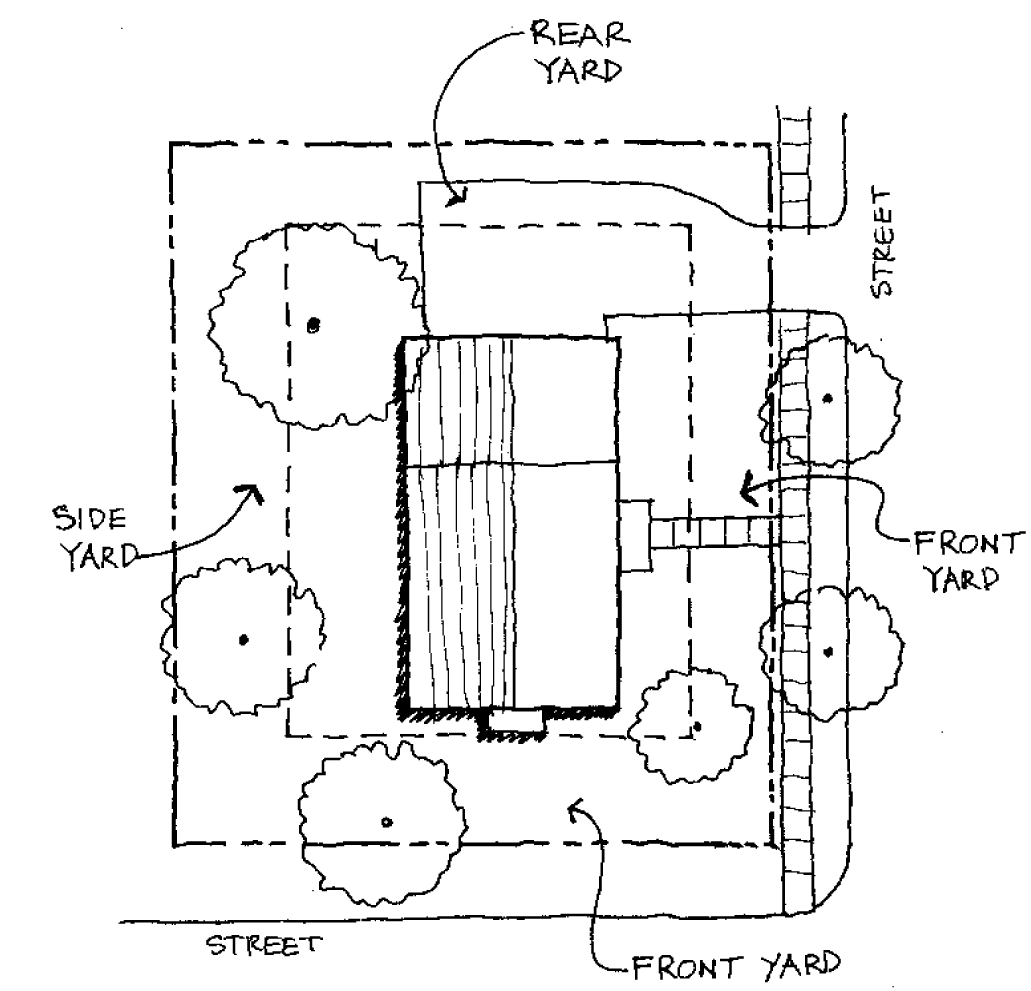
Defining the Front Yard for a Corner Lot
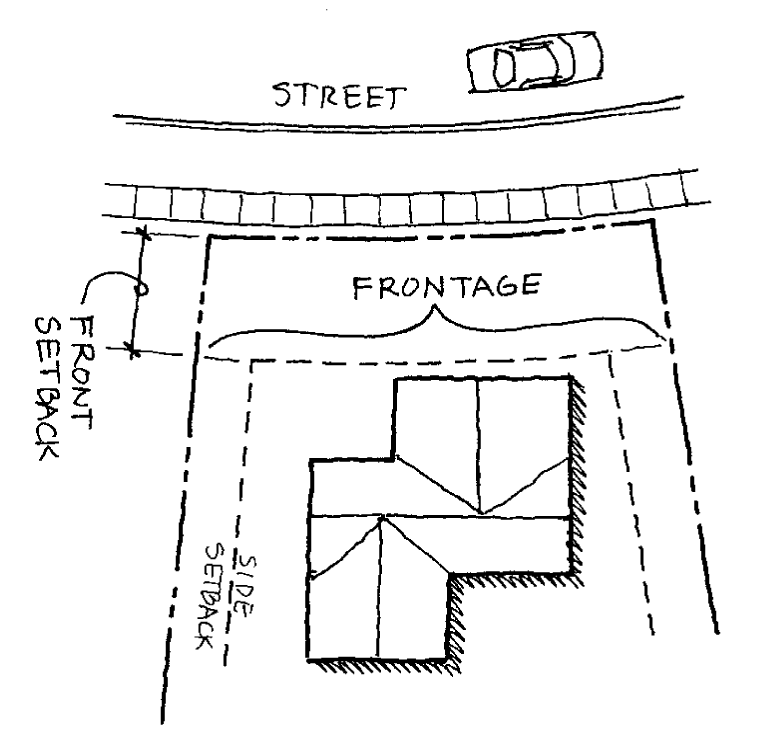
Frontage on a Cul-de-sac
Yard, rear: means a yard extending across the full width of the lot, the depth of which is the minimum distance between the rear lot line and a line parallel thereto on the lot as required in the District where located. In the case of an R-1c corner lot, the rear yard shall be considered the minimum side yard required. In the case of a corner lot abutting more than two (2) streets, the rear yard, subject to the provision above, shall be determined by the Director of Community Development. In all corner lot cases, the rear yard shall be defined as being the opposite from the narrower street frontage.
Yard, rear (profile limit): means a sloping plane which may not be penetrated by the height and bulk of any principal structure. This imaginary plane slopes up from each rear property line segment to its intersection with the maximum building height permitted in Table 5-E. This slope begins at the intersection formed by the vertical projection of each rear property line segment and the horizontal projection of the first-floor elevation of the principal structure at its lowest point. The maximum slope permitted is defined by the profile coefficients, or cotangents, listed for each zone in Table 5-E. No principal structure shall exceed the height and number of stories specified in Table 5-E, nor shall its outermost roof membrane project above the rear yard profile limit specified in Table 5-E. Window dormers may project above the rear yard profile limit when the top of the dormer does not exceed the ridge height of the roof to which it is attached, and when the face of the dormer does not project beyond the face of the wall below. Shed dormers may not project above the rear yard profile limit.
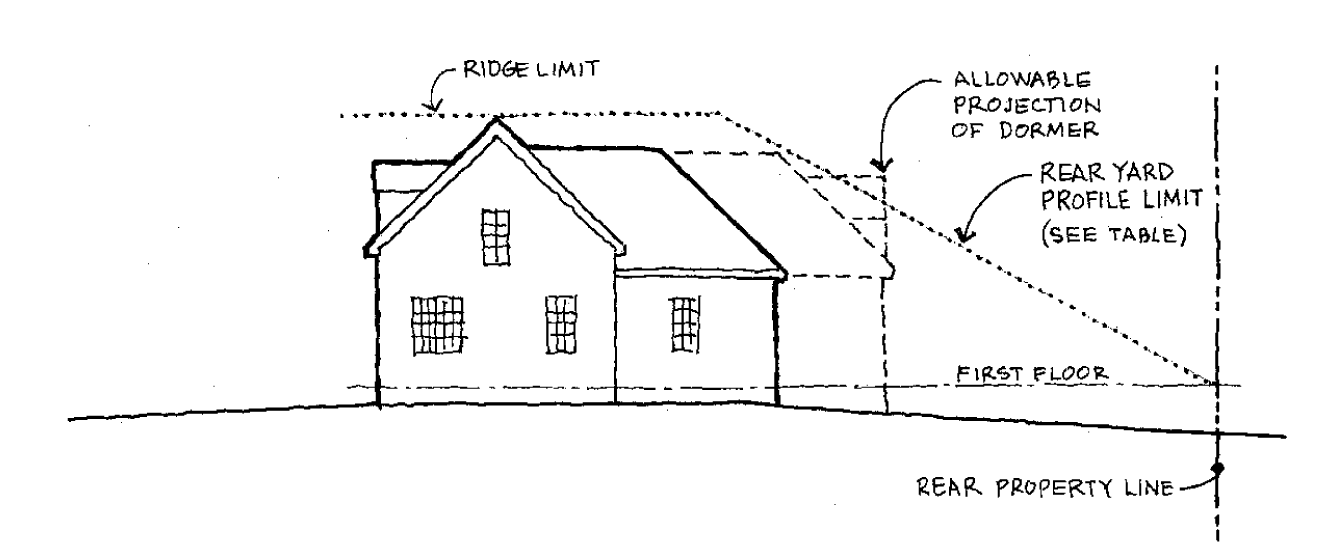
Yard, required: means a required amount of open space on a lot, unoccupied by building cover, whose area is defined by the yard requirements of the district (zone) in which it is located.
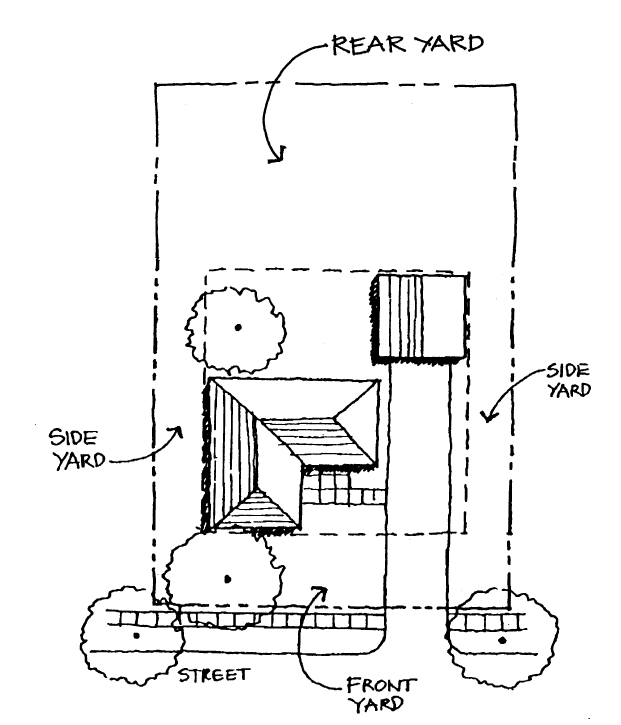
Yard, side: means a yard extending from the front yard to the rear yard, the width of which is the minimum horizontal distance between the side lot line and a line parallel thereto on the lot as required in the district where located.
Yard, side - Least width, how measured: such width shall be measured from the nearest side lot line and, in case the nearest side lot line is a side street lot line, from the right-of-way line of the existing street; provided, however, that if the proposed location of the right-of-way line of such street as established on the thoroughfare plan or on the Official Zoning Map of the City of Upper Arlington differs from that of the existing street, then the required side yard least width shall be measured from the right-of-way of such street as designated on the thoroughfare plan or official zoning map.
Zoning map: means the official City of Upper Arlington map(s), as adopted and amended by City Council, which includes zoning, overlay, and historic district boundaries and classifications within the community.
(Ord. No. 106-2009; Ord. No. 8-2012; Ord. No. 87-2015, § 5, 12-14-2015; Ord. No. 42-2017, § 3, 6-26-2017; Ord. No. 44-2017, § 3, 7-5-2017; Ord. No. 47-2018, § 16—20, 6-25-2018; Ord. No. 7-2020, § 3, 9-14-2020; Ord. No. 11-2024, § 1(Exh. A), 3-4-2024)

