
Upper Arlington City Zoning Code
ARTICLE 7
- DESIGN GUIDELINES
§ 7.01 - PURPOSE AND INTENT.
(A)
The purpose of the design guidelines is to encourage the best design of improvements to the built environment that are consistent and compatible with the historic character and outstanding residential environment of Upper Arlington, especially its historic district.
(B)
The design guidelines provide guidance to the development design process regarding site layout; architecture; building materials, treatment and color; landscaping, screening and buffering; signage, and other site improvements. The design guidelines are intended to be flexible in guiding the design process.
(C)
The design guidelines implement the land use, development, and urban design policies of the master plan.
(D)
The design guidelines are to be used as a guide in the private development process to represent the City's expectations relative to changes in the built environment.
(E)
The design guidelines are to be used by city staff, BZAP, City Council, and other boards and commissions in the review, evaluation, and approval of development and improvements to properties.
§ 7.02 - GENERAL PROVISIONS.
(A)
The design guidelines are to be addressed in all requests for a site plan, development plan, landscape plan, conditional use, accessory use, or sign permit.
(B)
The applicant shall specifically address relevant design guidelines in the material submitted for development approval, showing evidence that demonstrates consistency with these guidelines.
(C)
The approving authority shall use these guidelines as a means of evaluating the development proposal and shall have the authority to recommend changes to ensure consistency with these guidelines.
(D)
The approval of a building permit and subsequent inspection by the City, and the issuance of an occupancy permit, shall ensure that the constructed development fulfills the intent of the approval as related to these guidelines.
§ 7.03 - INTERPRETATION.
In situations where the guidelines conflict with a standard or requirement, the standard or requirement shall govern. However, the guideline should be used to identify ways of interpreting compliance with the standard or requirement.
§ 7.04 - DESIGN PRINCIPLES.
(A)
To create outstanding business areas in the City that reflect the heritage, design sensitivity, and qualities of the City's historic area.
(B)
To promote the use of quality and long lasting building materials, as well as building design, landscaping, and site designs.
(C)
To facilitate the redevelopment of the City's business areas into mixed-use centers that reflect the vision and public consensus of the City's Master Plan.
(D)
To create a walkable community supported by a safe, pedestrian-friendly, built environment and with alternatives to the automobile.
(E)
To expand the City's tax base by facilitating quality reinvestment and redevelopment in the City's major business areas.
(F)
To create areas for community gathering and celebration that reinforce the civic nature of the City's business areas.
(G)
To integrate business areas into the fabric of the City through connections with the street and sidewalk network, compatibility in design and architecture, and well designed and effective screening and buffering.
§ 7.05 - SITE PLANNING.
(A)
Purpose and intent: The placement of structures on a site is critical to meeting the purpose and intent of this article. Placement shall consider the built context of the area, but where that context is suburban in character (low density, large setbacks, extensive surface parking) a new context should be developed that is urban in character and consistent with the master plan. The following standards should apply. See also Section 7.07 and Section 7.08, pedestrian orientation and connectivity.
(1)
Urban context: Structures shall be sited in a manner that will create an urban physical context, including defining public and pedestrian spaces. Sites should be developed in a coordinated manner to provide order and diversity and avoid a jumbled, confused development. Sites shall provide for connectivity and pedestrian orientation.
(2)
Setbacks and visual connections: New structures should be built to the right-of-way or street (unless the district standard is different) and clustered to create plazas and pedestrian spaces. When clustering is impractical, a visual link between separate structures shall be established using an arcade system, trellis or other open structure.
(3)
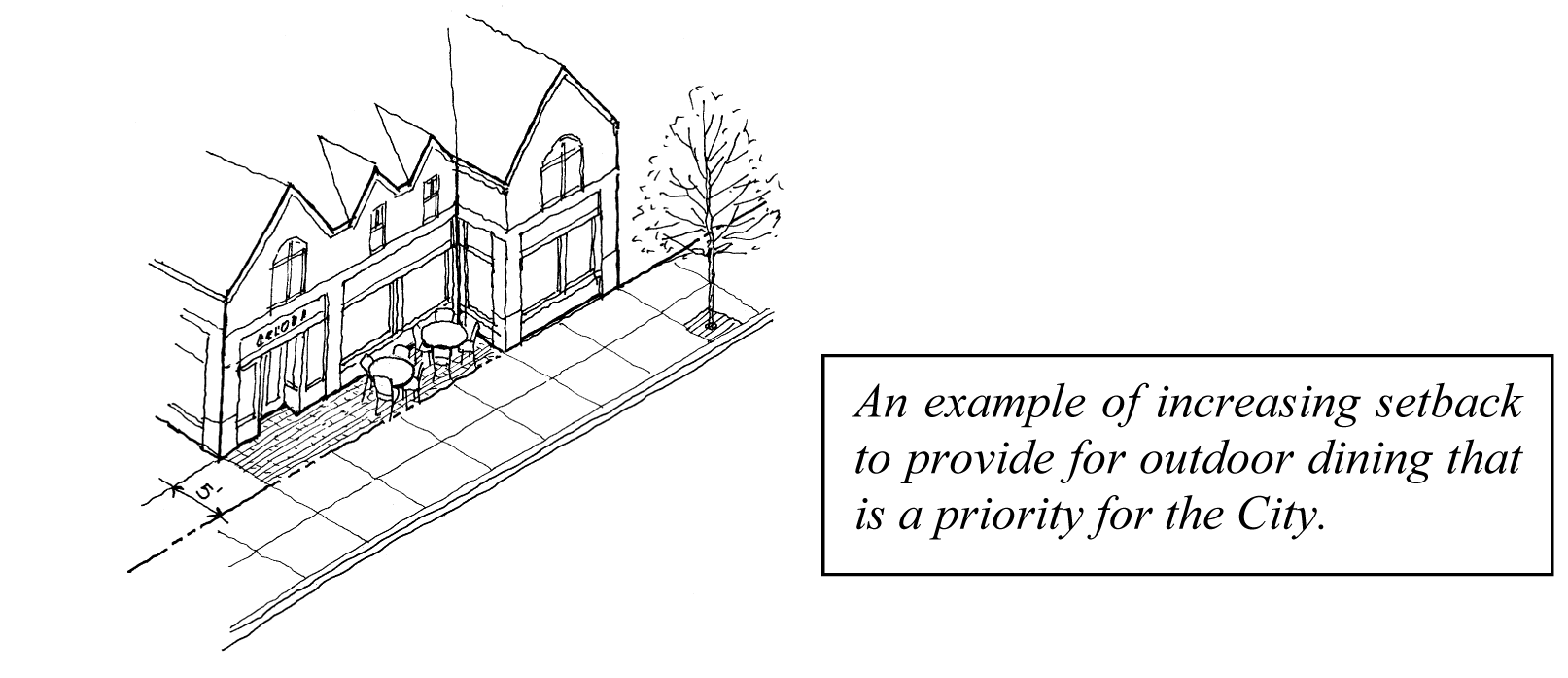
Building setbacks: A portion of a building setback can be increased an additional five (5) to ten (10) feet from the right-of-way if the setback area is surfaced with brick or similar material and contains outdoor amenities (i.e. seating, dining).
(4)
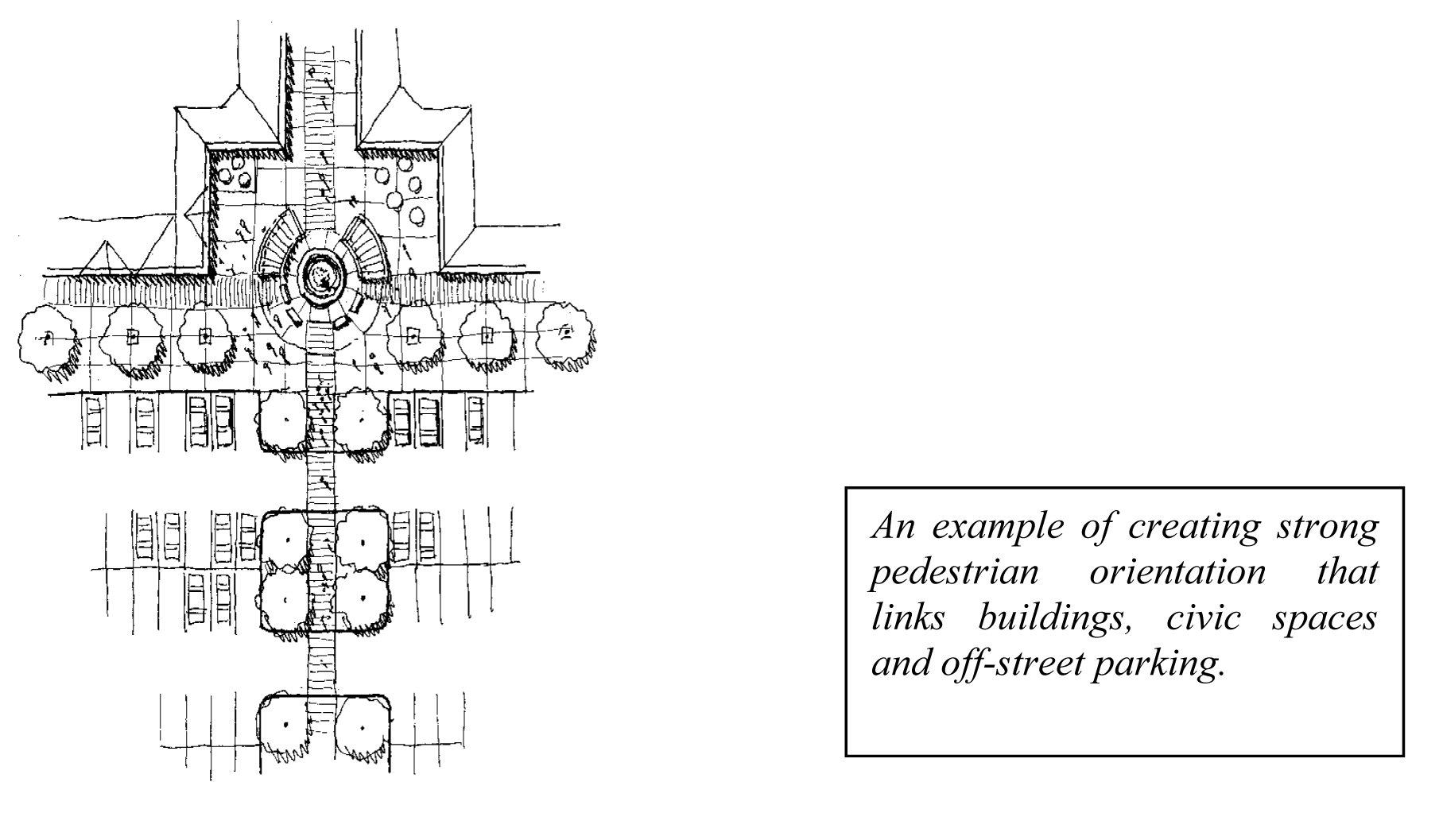
Pedestrian orientation: Structures and on-site circulation systems shall be located to minimize pedestrian/vehicle conflicts - while emphasizing a pedestrian orientation. Structures shall be linked to the pedestrian system with such features as concrete sidewalks, textured paving, landscaping or trellises.
(5)
Outdoor rooms: Spaces between buildings shall be recognized as "outdoor rooms". They shall be defined by recognizable, form giving shapes and details that reflect careful planning and are not simply "left over" spaces. Pedestrian amenities such as shade, benches, fountains, etc. shall be provided.
(6)
Civic spaces: Civic spaces, such as plazas and squares, shall be provided in centralized locations that create inviting places for social interaction. They should be a minimum of one-half (½) acre in size. About fifty percent (50%) of the space of a plaza should open along streets. About seventy-five percent (75%) of the space of a square should open along streets. A minimum of fifteen percent (15%) and a maximum of forty percent (40%) of the area of a plaza or square shall be composed of planting materials. Permanent seating shall be incorporated into the design.
(7)
Open spaces: Open spaces shall be designed for the use of building tenants, residents, and visitors and shall be architecturally defined by the buildings that surround them. Open spaces shall have direct access from a pedestrian walk on at least one side and for at least fifty percent (50%) of the length of that side. Open spaces shall be easily accessible and viewed from the street and be of a size, proportion, and orientation that optimizes sunlight exposure over the course of the year. Open spaces should include durable furnishings including seating, wayfinding information, charging stations for electronic devices, and trash and recycling receptacles. Open space should be provided at a minimum based on the following standard:
(8)
Freestanding structures: Freestanding, singular commercial structures shall be oriented with their major entry toward the street and sidewalk where access is to be provided, as well as having their major façade parallel to the street.
(9)
Loading: Loading facilities shall be located to the rear of structures and should be screened, per code. Their placement shall also consider proximity to residential areas to minimize noise impacts.
(10)
Stormwater: Sites shall be designed to effectively utilize the City's stormwater system to appropriately handle storm runoff.
(11)
Utilities: Electrical and other wiring to support on-site utilities, such as electricity, telephone, satellite dishes, cable television, internet service, etc. shall be placed underground. All other utility structures shall be located and screened to minimize visual impact.
(Ord. No. 75-2021, § 1(Exh. A), 12-13-2021)
§ 7.06 - BUILDING DESIGN.
(A)
Purpose and intent: Development shall provide a high quality, interesting and long lasting style and should incorporate materials that are appropriate to Upper Arlington's built environment - especially its historic areas.
(1)
The following describes desirable elements:
(a)
Richness of surface and texture;
(b)
Limestone, architectural cast limestone, architectural metal panel system, and brick as exterior wall materials; dimensional shingled roofs;
(c)
Significant wall articulation (such as insets, canopies, wing walls, reveals, pilasters, trellises);
(d)
Multi-planed, pitched roofs;
(e)
Roof overhangs and arcades;
(f)
Regular or traditional window rhythm;
(g)
Articulated mass and bulk;
(h)
Pedestrian orientation;
(i)
Significant landscape and hardscape elements of brick and/or stone;
(j)
Landscaped and screened parking;
(k)
Comprehensive sign program with strong pedestrian-scale orientation; and
(l)
Traditional building design with base, middle and cap.
(2)
The following describes undesirable elements:
(a)
Large blank, unarticulated wall surfaces;
(b)
Unpainted concrete precision block walls;
(c)
Highly reflective surfaces;
(d)
Metal, vinyl or plastic siding; stucco, exterior insulated foam systems (e.g., Dryvit) and similar materials except when used as trim; metal roofs (except for standing seam roofs);
(e)
Exterior insulation and finishing systems (EIFS) shall not be used on ground floor façades up to thirty-five (35) feet in height;
(f)
Square "boxlike" structures;
(g)
Mix of unrelated styles (e.g., rustic wood shingles and polished chrome);
(h)
Visible outdoor storage, loading, and equipment areas;
(i)
Disjointed parking areas and confusing circulation patterns;
(j)
Lack of pedestrian circulation and connectivity; and
(k)
Large asphalt and/or concrete paved surfaces.
(B)
Guidelines:
(1)
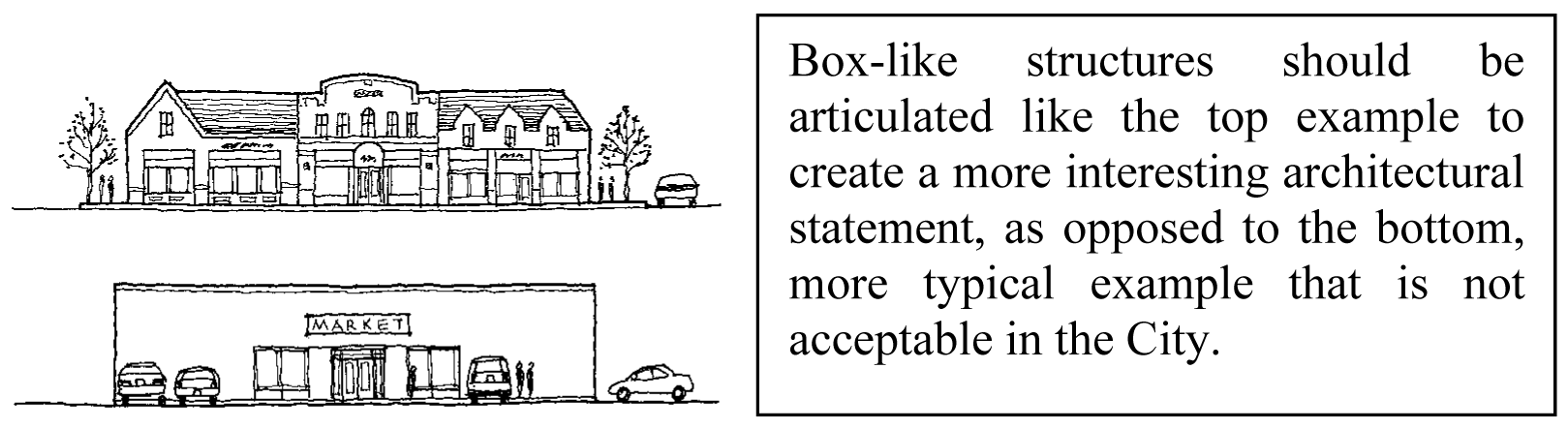
Avoiding box-like structures: Large buildings that give the appearance of "box-like" structures shall be avoided. In general, planes of the exterior walls shall be varied in depth and/or direction. Building height shall be varied so that it appears to be divided into distinct massing elements. For buildings that are one hundred and fifty (150) feet in length or greater, roof height should vary by at least five (5) feet for fifteen (15) percent of the street-facing roof line. For buildings one hundred (100) feet or more in length, at least two portions of the street-facing building facade must have a variation in setback of at least two (2) feet. The different parts of a building's façade and mass shall be articulated by the use of color, arrangement of façade elements, or a change in materials. Landscaping and architectural detailing can be used at ground level to lessen the impact of a bulky building. Building scale shall be carefully related to the adjacent pedestrian areas. The use of standardized "corporate" architectural styles associated with chain-type businesses shall be strongly discouraged.
(2)
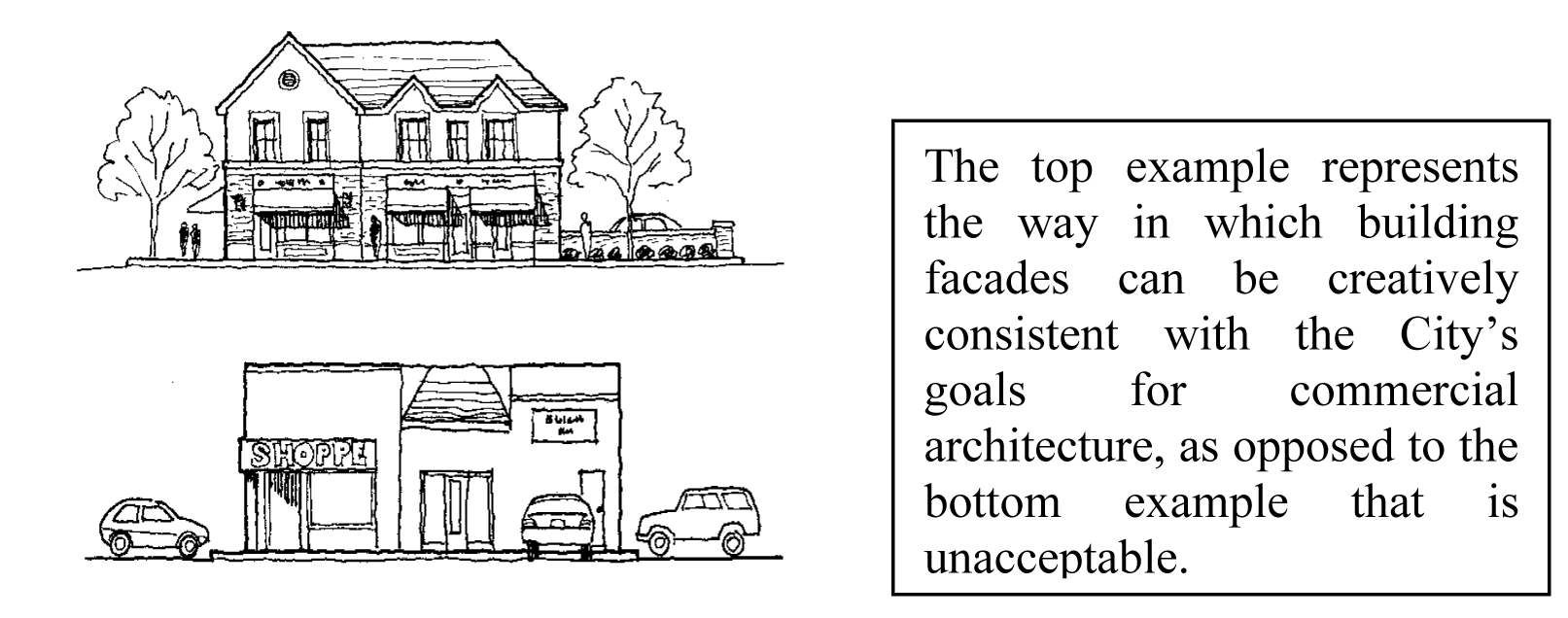
Building façades: Building façades must provide a visually interesting environment and shall avoid uniform design styles. Upper floors should be distinguished by decreased solid-to-void ratios. The ratio of fenestration to wall of the building façade should be less than thirty-five percent (35%) (sixty-five percent (65%) for retail storefronts). Vertical piers, pilasters or other vertical visual elements shall be creatively used when appropriate to break the plane of long façades.
(3)
Roof lines: The shape of a building's roof shall be simple and compatible with the buildings to which it is visually linked. In general, flat roofs are discouraged for buildings less than three stories. If a residential style is appropriate, roof pitch shall be a minimum of 5/12. This may be especially true where smaller commercial developments are located in predominantly residential areas.
(4)
Architectural style and materials: Architectural style and materials shall be compatible throughout an area. Each building façade should have no more than two (2) similar wall materials, textures or colors (the trim is excluded). Materials should be composed within the building facade in a way that adheres to a visual and structural logic. For example, materials that clad or express a structural element should be more prominent than those that clad or express an infill element. Materials shall be long lasting. Brick and limestone are materials characteristic of Upper Arlington and shall comprise at least fifty percent (50%) of exterior walls. Materials such as cementitious or metal panels, siding, stucco or exterior insulated foam systems (EIFS) shall be used on no more than twenty-five percent (25%) of exterior walls. The same proportion of materials should be used on each side of the building. In general, aluminum and vinyl siding and other less durable materials should not be used. Matte finishes are appropriate and not gloss finishes.
(5)
Drive-thru facilities: Businesses that require the use of drive-thru facilities as accessory uses shall attach those facilities to the principal building. These facilities shall be located to the rear or side of the principal building or heavily screened and shall not be visible to a residential use.
(6)
Residential buildings along sidewalks: When residential buildings are proposed along sidewalks, the finished floor elevation shall be placed about three-foot above the grade of the sidewalk to provide for the privacy of the occupants. To ensure ADA requirements are met within the development, internal units shall be located at the grade level of sidewalks.
(7)
Shadow studies: A shadow study shall be required for all proposed buildings exceeding four (4) stories or sixty (60) feet in height. Based upon the findings of the shadow study, the fourth or higher story of the building may be required to be set back to minimize shade impacts on adjacent properties or the public right-of-way.
(8)
Sustainable design: All new commercial buildings of more than fifty thousand (50,000) square feet of Habitable Rooms or Habitable Space shall, at a minimum, meet certification standards by the United States Green Building Council (USGBC) Leadership in Energy and Environmental Design (LEED) or equivalent standards adopted or approved by the City. At the time of Building Permit application, the applicant shall submit a LEED Scorecard, or equivalent document, identifying anticipated credits that could be achieved using the most recent standard.
(Ord. No. 16-2017, § 9, 4-10-2017; Ord. No. 75-2021, § 1(Exh. A), 12-13-2021)
§ 7.07 - PEDESTRIAN ORIENTATION.
(A)
Purpose and intent: Development shall emphasize and support a pedestrian-oriented environment. Buildings shall facilitate walking and ease of access by respecting the street. See also Section 7.07 and Section 7.08, pedestrian orientation and connectivity.
(1)
Entrances: Buildings shall be oriented toward the predominant pedestrian movement route by providing a direct link between the building and the pedestrian walking system. The main entrance to a building shall be located on the primary abutting street or plaza space and articulated by architectural treatments (canopies, awnings, light fixtures, planters) to give dimension and prominence to the opening. Additional primary entrances should be provided on all of the façades of the building that abut a street or sidewalk. Groups of uses on higher floors with no direct street connection shall be accessed by at least one primary building entrance at the ground floor. This could be provided through a common lobby facing the street. Secondary entrances should be provided to parking areas located to the rear or side of buildings. A vehicular entrance should not be combined with a pedestrian entrance.
(2)
Ground floor opacity: The ground floor of a building facing a public street should contain a minimum of sixty-five percent (65%) unobstructed windows, doors or display areas. Where the required window to wall ratio is not feasible or is in conflict with internal functions, elements such as public art, retail displays, or enhanced signage and building detail should be integrated to maintain the visual interest at street level.
(3)
On-street parking: On-street parking shall be required to provide separation between pedestrians and street traffic to ensure safety. Textured pavement, landscaping, low walls, light standards, or other treatments may articulate such separation.
(4)
Off-street parking: Safe pedestrian walks shall be provided that are separated from parking and circulation areas. Parking lots should not lead into buildings, but lead to a sidewalk or the sidewalk system of the development. The pedestrian transition from the parking area to the street should include storefronts and display windows.
(5)
Street trees: Street trees shall be installed along all pedestrian walkways. Decorative tree grates shall be provided to protect the tree roots and increase the width of the pedestrian walkway. Diversity of street tree species shall be encouraged in order to protect the health and longevity of the City's urban forest. Species selection shall be coordinated through the City Forester.
(6)
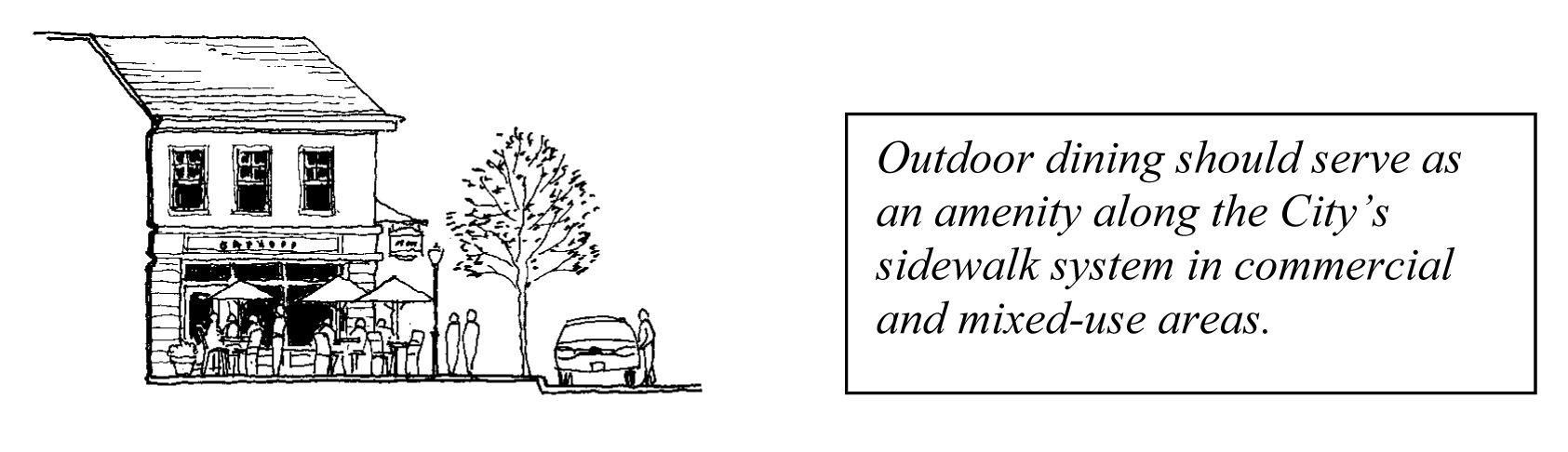
Outdoor dining: General areas appropriate for outdoor dining along public and private streets is encouraged, which will create a stronger pedestrian environment.
(7)
Outdoor seating: Outdoor seating shall be arranged in a conversational grouping with shade.
(8)
Storefront design: The design of storefronts along a sidewalk shall encourage pedestrian activity. Variations in individual storefronts should be designed to change at least every fifty (50) feet. Pedestrian entrances should be provided at an average of every fifty (50) feet.
(Ord. No. 75-2021, § 1(Exh. A), 12-13-2021)
§ 7.08 - CONNECTIVITY.
(A)
Purpose and intent: All development shall provide for connectivity between the subject site and adjacent parcels. The internal street and sidewalk system of an area shall interconnect in multiple locations with the community-wide street and sidewalk system to knit the area together with the greater community. See also Section 7.07 pedestrian orientation and Section 7.10 parking and access.
(1)
Street pattern: In redevelopment areas, a traditional grid street pattern should be used that connects with adjacent streets. A curvilinear street pattern is strongly discouraged. Culs-de-sac and other dead end streets or access points that discourage connectivity are strongly discouraged.
(2)
Blocks: Large blocks are strongly discouraged. Numerous pedestrian linkages shall be provided throughout a development. Within the Kingsdale Study Area per the Master Plan, blocks should not exceed four hundred (400) feet in length and should provide pedestrian linkages at least every two hundred (200) feet. Within all other study areas, blocks should not exceed two hundred (200) feet in length and should provide pedestrian linkages at least every one hundred (100) feet.
(3)
Signalized intersections: Potentially signalized, full-movement intersections of collector or local streets with arterials streets shall be provided every one thousand three hundred twenty (1,320) feet (¼-mile) along arterial streets, unless rendered infeasible due to existing street pattern or existing development.
(4)
Non-signalized intersections: Non-signalized, potentially limited movement, collector or local street intersections with arterial streets shall be spaced at intervals not to exceed six hundred sixty (660) feet between full movement collector or local street intersections, unless rendered infeasible due to existing street pattern or existing development. Access controls may be required to the satisfaction of the City Engineer.
(5)
Future connections: All developments shall provide for future public street connections to adjacent developable parcels by providing a local street connection spaced at intervals not to exceed six hundred sixty (660) feet along each abutting development boundary.
(6)
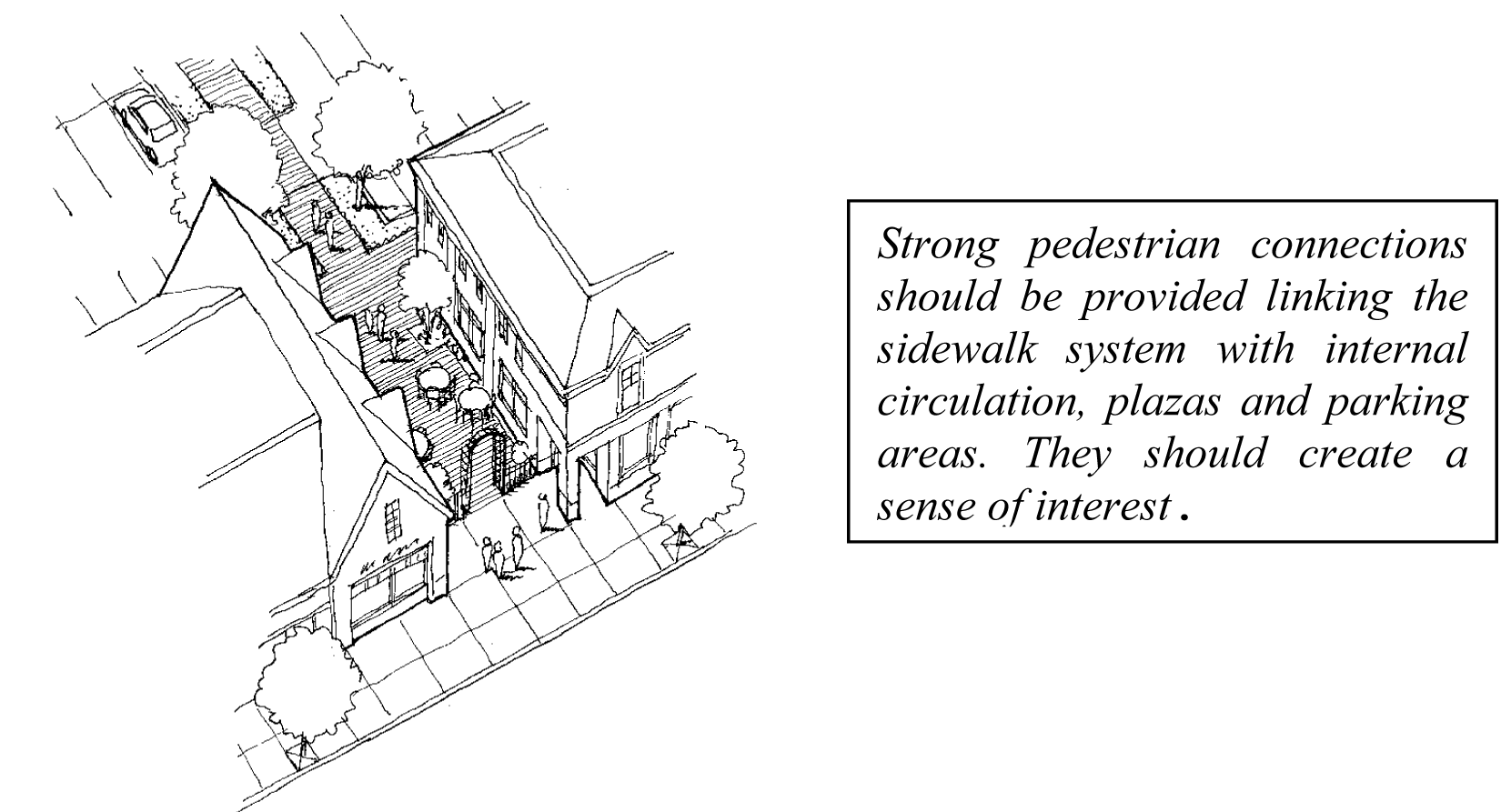
Sidewalk connections: Sidewalk connections shall be provided between areas, developments within areas and adjacent residential neighborhoods.
(7)
Through-block connections: Where appropriate, pedestrian paths shall be provided through mid-block locations. These shall be landscaped and lighted for safety. Such paths should regularly abut public streets.
(8)
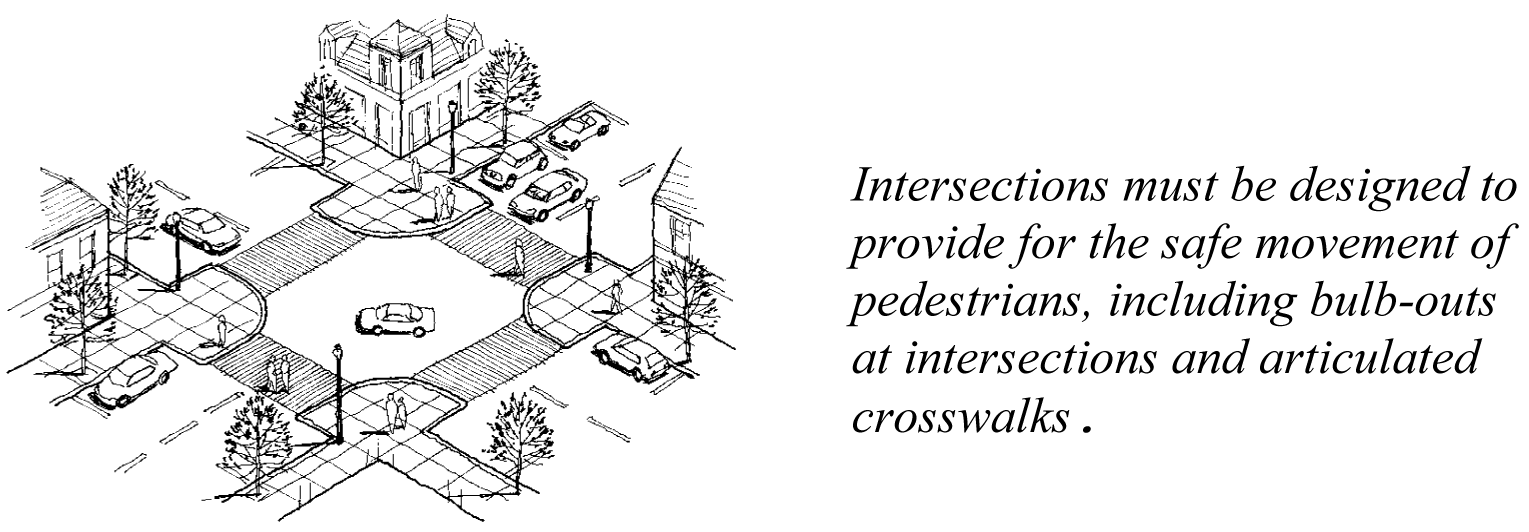
Corner radii: Corner radii shall be tight to shorten the distance necessary for walkers to cross at an intersection.
(9)
Crosswalks: Crosswalks shall be provided at all intersections with minor and major arterials and at mid-block locations with signalization where necessary. Crosswalks shall be a minimum of ten (10) feet in width. Pavement treatment shall ensure that crosswalks are fully demarcated, such as by the use of pavers. Crosswalks and adjacent sidewalks shall fully meet ADA requirements. Bulb outs shall be used to reduce the distance of the pedestrian crossing and to slow traffic.
§ 7.09 - GATEWAYS AND ENTRY FEATURES.
(A)
Purpose and intent: Gateway areas and entry features are encouraged to emphasize and differentiate special corners and intersections from the surrounding building architecture and to aid in wayfinding and articulate important changes in character and use. Gateways may announce physical entry to a redevelopment area, provided they are complementary to the overall physical context. See also signage, Section 6.06 for signature signage elements.
(1)
Treatment: Gateways shall be articulated by a change in density, building height, or building setback, an enhanced building character, the provision of a plaza or expanded streetscape, and/or the incorporation of unique building signage or art. Gateway areas may include landscaping, textured pavement, and/or decorative walls and fences that complement the scale and character of the primary building. Within a designated gateway area, there shall be at least one (1) pedestrian entrance. Exposed parking garage frontage shall not occur at the ground floor within a gateway area. The site visibility triangle shall be maintained between three (3) and seven (7) feet in height.
(2)
Gated entries: Gated street entryways into developments shall be prohibited.
(Ord. No. 75-2021, § 1(Exh. A), 12-13-2021)
§ 7.10 - PARKING AND ACCESS.
(A)
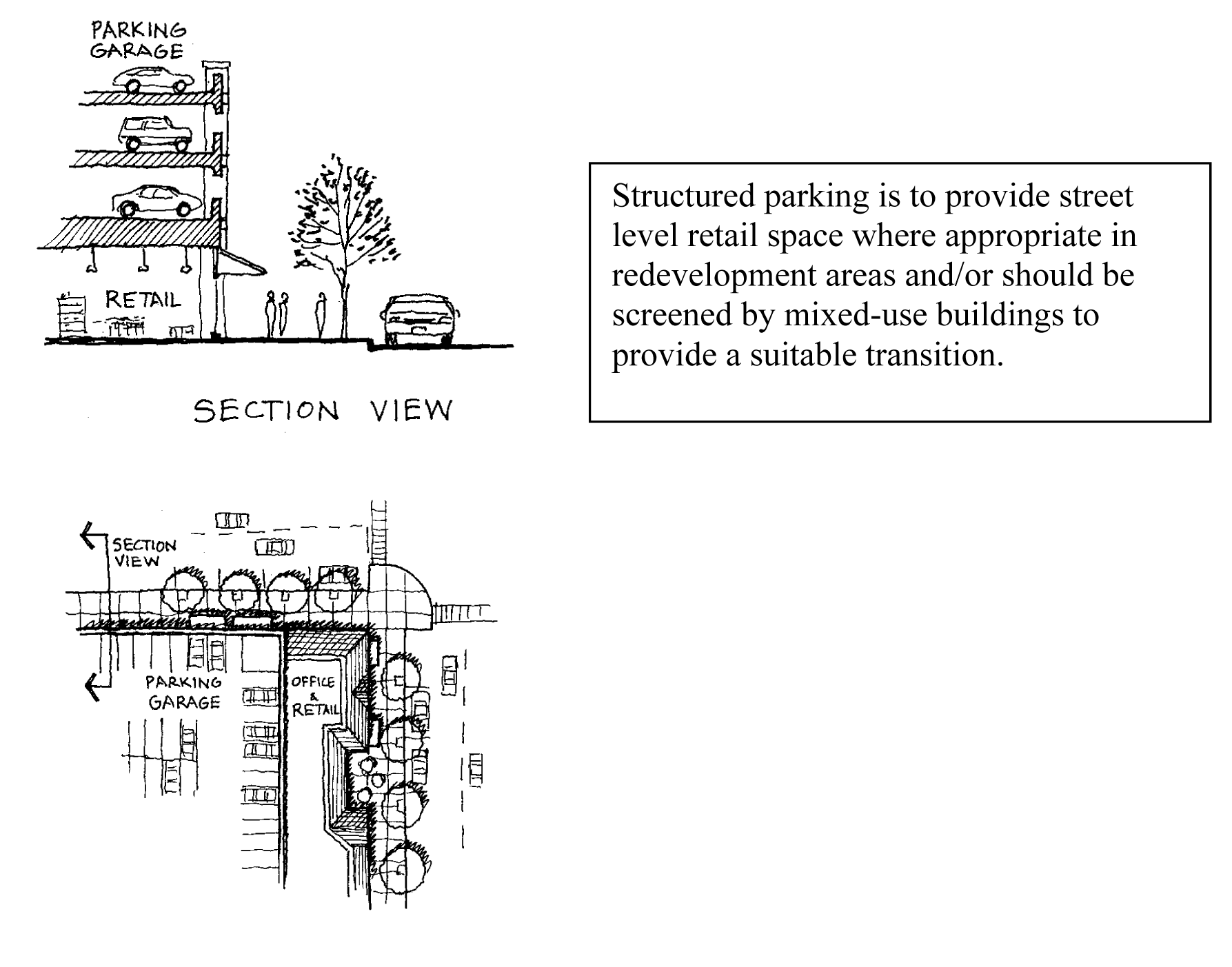
Purpose and intent: Parking must be provided to support development, however, its quantity and location shall ensure that parking doesn't dominate a site but compliments the principal uses. Excessive amounts of parking are strongly discouraged. Parking structures are encouraged in redevelopment areas.
(1)
Parking structures: Parking structures should be placed in the middle of blocks and surrounded by buildings or designed to conceal their appearance. Exposed, above-grade parking structures shall not exceed thirty percent (30%) of block frontage on Primary Streets at the ground floor. The facades of parking garages exposed to view shall be orthogonal in composition and shall not express ramping systems. Spandrel panels or opaque architectural wall systems, a minimum of forty-two (42) inches high, shall be required to screen the view of parked cars and car headlights from the opposite side of the street and from streets within adjacent neighborhoods. Parking structure lighting shall be screened from all streets and not protrude from the garage. Below grade structured parking is encouraged. Pedestrian access points, including stairs and elevators, shall be clearly demarcated, but designed to be architecturally compatible with adjacent structures. They shall be landscaped, well lit, and supported with directional signage. See Subsection 6.07(K)(4).
(2)
Surface parking: Surface parking should be located and oriented to reduce its visual and environmental impact. New surface parking shall not exceed twenty-five percent (25%) of block frontage along any Primary Street or fifty percent (50%) of block frontage along any Secondary Street). Surface parking is discouraged between the front of a building and the street and screening with a fence or seat wall barrier is encouraged. New surface parking shall provide safe pedestrian passage by incorporating an efficient system of pedestrian paths.
(3)
On-street parking: On-street parking shall be required in redevelopment areas and encouraged in other locations, with the approval of the City Engineer. On-street parking should be metered to encourage turnover. On-street parking within two hundred (200) feet of a use shall be counted towards meeting the code-parking requirement when the parking is not located in single-family district or has already been attributed to another use.
(4)
Shared parking: The City will encourage shared parking arrangements among compatible land uses (i.e. movie theatre adjacent to office uses). This may apply within the same development or across developments through shared parking agreements.
(5)
Access drives: For individual, adjacent lots, access drives shall be shared and cross-access easements provided. Driveways are to be consolidated and located as far as possible from traffic signals when practical. The spacing of access drives shall meet the requirements of the City Engineer.
(Ord. No. 75-2021, § 1(Exh. A), 12-13-2021)
§ 7.11 - STREETSCAPE.
(A)
Purpose and intent: Within redevelopment areas, an inviting streetscape shall be established on public and private streets, and pedestrian walkways adjacent to parking surface lots and structures. See Section 7.12, traffic calming.
(1)
Lighting: Lighting levels and fixture heights shall be of a scale and character appropriate to the pedestrian, while providing adequate intensity and dimensions to meet the needs of auto traffic. Vehicular and pedestrian lighting shall be combined to prevent street clutter. A standard style shall be used, district-wide. Lighting shall be designed to limit glare onto adjacent properties and avoid extreme contrast between light and shadow.
(2)
Signage: Signs shall be unified in character with the lighting and other ornamentation along the streetscape, and shall be a scale and height that is appropriate for pedestrians, cyclists, and motorists.
(3)
Tree plantings: Tree plantings unify the streetscape and provide an edge to the roadway. Plantings help provide a comfortable vertical scale, create a cooler microclimate, and can be a visually distinguishing feature. Trees shall be planted in a uniform manner pattern, centered on the width of the Furniture Zone, and space equally to create a relatively continuous canopy upon maturity. Structural soil or vaults may be required for street trees in tree wells. Street trees should have a minimum two (2) inch caliper. Species shall be selected to match the scale of the right-of-way and adjacent buildings, to the satisfaction of the Urban Forester.
(4)
Pavement materials: Pavement materials for sidewalks should be a mixture of concrete, decorative pavers, and other appropriate materials in a unifying pattern within a single development. The pattern should clearly distinguish the active pedestrian zone from the less active street furnishings zone. These patterns should be designed at a scale appropriate to each right-of-way. Where brick pavers are planned, an asphalt base should be applied to increase longevity.
(5)
Furniture zone: The furniture zone shall be about five (5) feet in width and shall contain street trees. High quality street furnishings shall be provided with a unifying style, color and materials per specifications approved by the City. Furnishings may include benches, trash receptacles, bicycle racks, newspaper boxes, directional signage, kiosks, drinking fountains, and lighting. Placement shall be regular and adequate to serve the needs of the streetscape users.
(6)
Pedestrian zone: The pedestrian zone shall be a minimum six (6) feet in width and provide for unobstructed travel by pedestrians (free of street trees and street furnishings). It is located adjacent to the building. Cast-in-place concrete may be an appropriate material for this zone.
(7)
Street furnishings zone: The street furnishings zone is located adjacent to the back of the street curb. The width shall be a function of the building setback, width of right-of-way, and related site characteristics. This zone contains all street furniture, street trees and grates, lighting, signage, parking meters, bicycle parking, trash receptacles, newspaper boxes, kiosks, etc.
(Ord. No. 75-2021, § 1(Exh. A), 12-13-2021)
§ 7.12 - TRAFFIC CALMING.
(A)
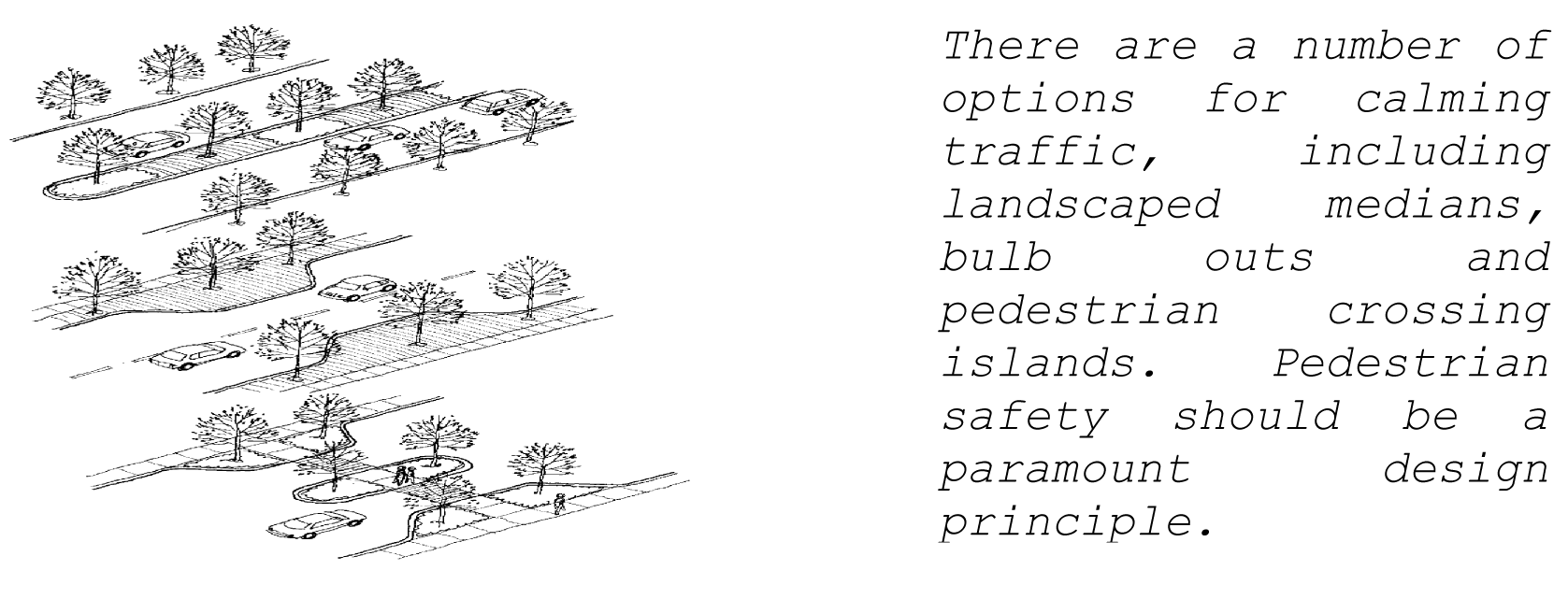
Purpose and intent: The safety of streets for pedestrians can be improved with the construction of simple improvements to encourage safe walking. Traffic calming slows traffic, thereby creating a safer driving and walking environment. These measures can also have the dual benefit of increasing traffic flow at safe speeds.
(1)
Landscaped medians: Where appropriate, landscaped medians provide a pedestrian respite in the center of busy two-way arterials. Pedestrian crossings are more pleasant and more predictable, with less disruption to auto traffic.
(2)
Bulb outs/curb extensions: Extended curbs (bulb outs) shall be used at intersections and mid-block crossings to shorten the time required by pedestrians to cross the vehicular travel lanes, which also reduces delays for motorists.
(3)
Neck-downs: When the space between curbs is reduced, drivers slow down. Neck-downs can also increase the size of existing park strips and allow for more plantings.
(4)
Pedestrian crossing islands: At wide intersections or mid-block crossings, islands create a protected area between travel lanes, allowing the pedestrian to cross one half of the traffic flow at a time.
(5)
Painted or contrasting pavement: The use of painted, stamped, or colored concrete, or contrasting paving material for cross walks provides a strong visual cue for drivers.
(6)
Mid-block crosswalks: Crosswalks shall be designed with bulb-outs and marked by a different paving material. Signalization may be necessary.
(7)
Neighborhood thresholds: Where districts change from commercial to residential uses, neighborhood thresholds can help signal this change in use. Neighborhood thresholds can include traffic calming elements like medians, gateway signage, and landscaping, among other elements.
(Ord. No. 75-2021, § 1(Exh. A), 12-13-2021)
§ 7.13 - SIGNAGE.
(A)
Purpose and intent: Signage shall be oriented to the pedestrian and located to slow moving traffic. It shall compliment the character and architecture of the primary building(s). It shall be muted in color, style, materials, and the use of light.
(1)
Comprehensive signage packages: Comprehensive signage packages shall create an integrated communication system.
(2)
Signature signage: Signature signage elements for redevelopment areas and major development components shall be permitted. This element may consist of free-standing signage, mural signs, banner signs, skyline signs, or other architectural elements, such as clock towers. Such elements shall not exceed fifteen (15) feet in height and five (5) feet in width.
(3)
On-site signage: On-site signage shall be oriented to the pedestrian. Perpendicular hanging wall signs designed of high quality crafted materials are preferred. Wall, window, and arcade signs should not overlap or conceal major architectural elements. Tenant identification signage should not directly orient to existing residential areas.
(4)
Banners: Banner systems attached to light standards in parking lots and along public and private streets are encouraged, provided they meet all code requirements.
(Ord. No. 75-2021, § 1(Exh. A), 12-13-2021)
§ 7.14 - LANDSCAPING.
(A)
Purpose and intent: Landscaping shall be used to complement structures, buildings and spaces. Softening hard surfaces is important in areas adjacent to residential neighborhoods. See also Section 7.15, buffering and screening.
(1)
Mixture of material: The design of planted areas shall provide for a mixture of material based on height, colors, textures, and other factors to create inviting and aesthetically pleasing views. The style of the plantings shall compliment the architectural style of adjacent and nearby buildings.
(2)
Scale: Landscaping shall be in scale with adjacent structures and be of appropriate size at maturity to accomplish its intended purpose. Street trees shall not block storefronts and therefore could be located between awnings or at fire/common walls.
(3)
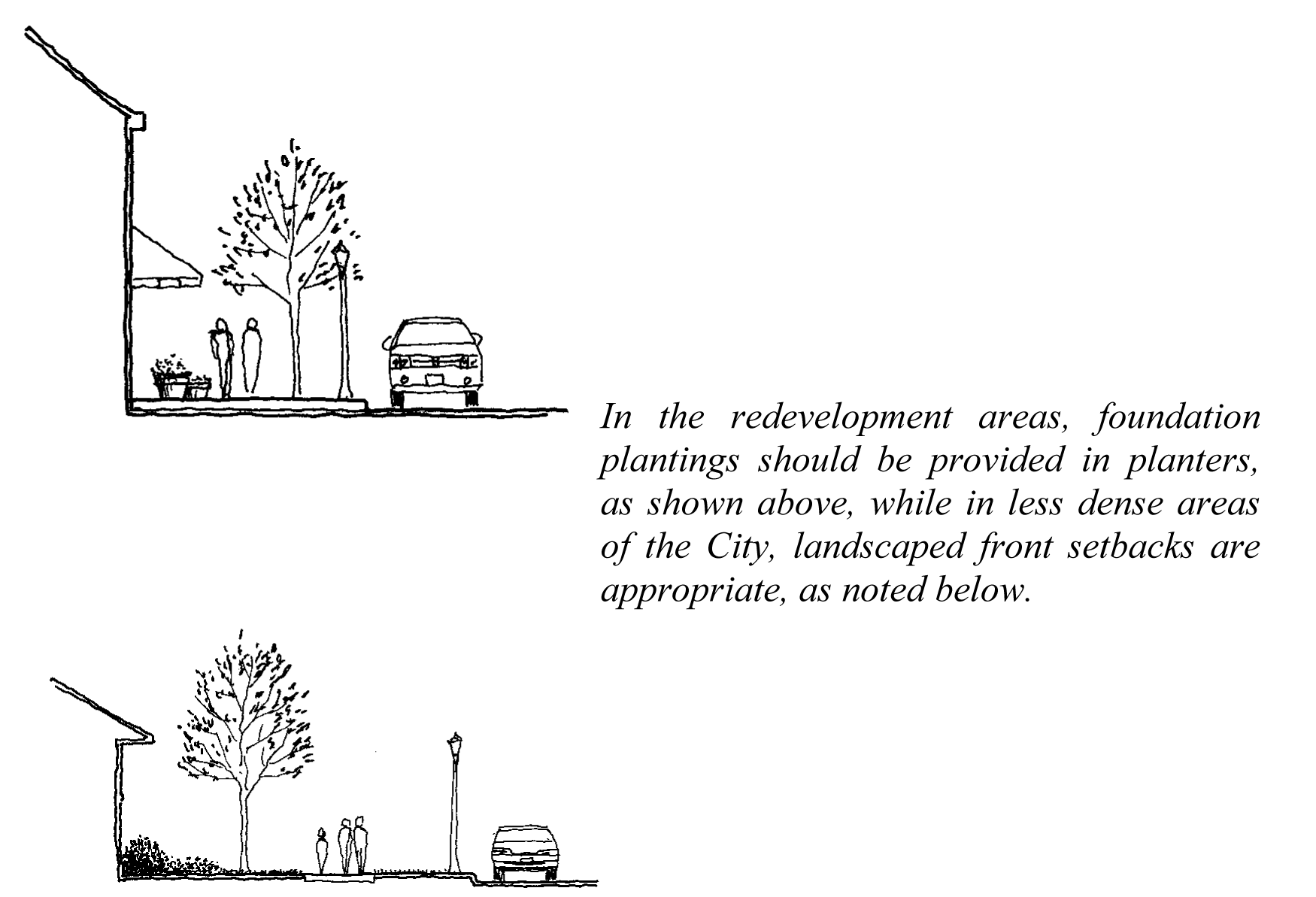
Structure bases: Landscaping around the base of structures shall soften the edge of buildings where appropriate. Landscaping shall be accented at entrances to provide focus for the pedestrian. Where the foundation abuts a sidewalk or outdoor dining area, clusters of complimentary planters shall be used.
(4)
Setbacks: The building and parking setback along a public street shall be landscaped per code.
(5)
Off-street parking lots: Trees shall be located throughout off-street parking lots, in between parking rows, and not simply at the end of parking rows. Such trees shall be located in planters and bounded on at least three (3) sides by parking area paving.
(6)
Native plant material: Wherever feasible, native plant material shall be used to reduce long-term maintenance demands and to ensure survivability.
(7)
Irrigation: In locations that are stressful to plant material, drip irrigation shall be considered to ensure survivability.
(8)
Site detention areas: Site detention areas shall use landforms and live native plant material in a way that satisfies detention and water-quality requirements while allowing for passive and active recreational uses. The use of pea gravel, rip-rap, rock, cobble stones, or other non-organic landscape materials should be minimized. Site detention strategies may include planted roofs, below-grade vaults, bioretention facilities or rain gardens, water features, and pervious paving systems. Dispersing site detention to reduce size of individual detention areas is encouraged.
(Ord. No. 75-2021, § 1(Exh. A), 12-13-2021)
§ 7.15 - BUFFERING AND SCREENING.
(A)
Purpose and intent: Incompatible uses shall be sufficiently buffered and screened to ensure that adverse land use impacts should be mitigated. In the design of a screen or buffer, setbacks shall be taken into account to ensure an appropriate design solution. Where fences or walls are used as screening, they shall be designed to blend with the parcel's architecture and use similar materials, modules, and details as those on nearby or adjacent buildings. Railings located at the ground floor between buildings and Pedestrian Active Uses and the street shall be at least fifty percent (50%) transparent. See also Section 7.14, landscaping.
(1)
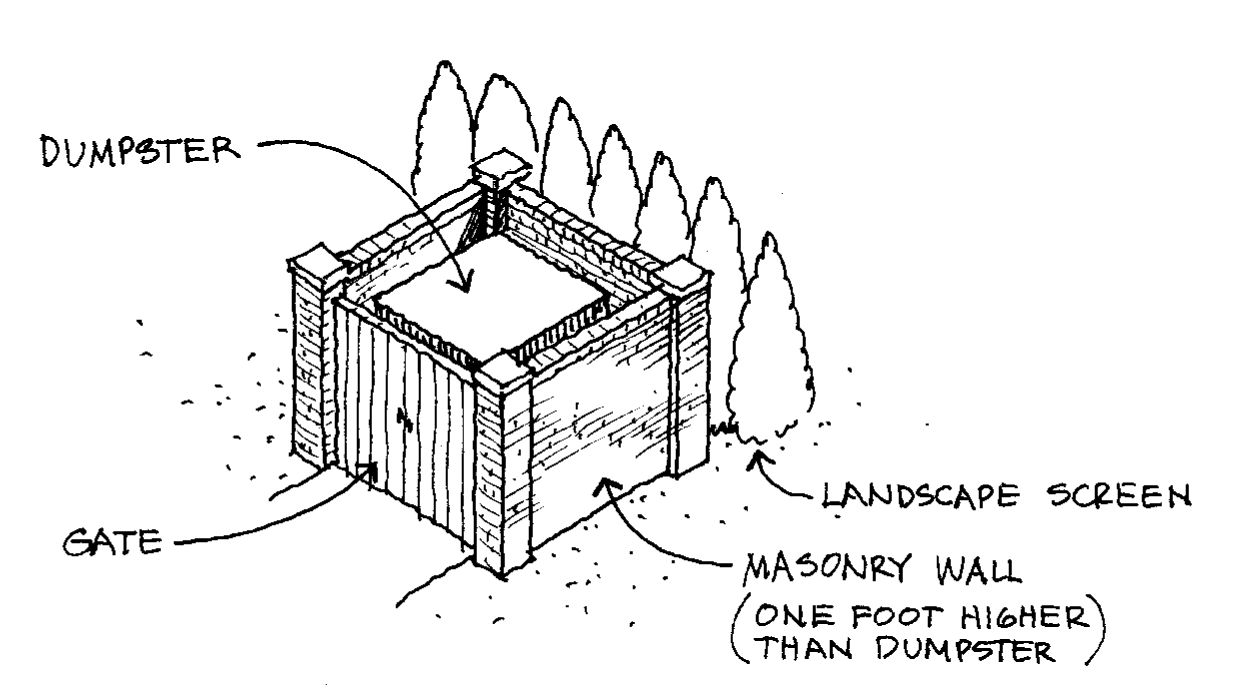
Trash dumpsters and donation bins/receptacles: When located adjacent to buildings, but no further away than fifteen (15) feet, trash dumpsters and donation bins/receptacles shall be screened with masonry walls that match the building. When located away from buildings further than fifteen (15) feet, trash dumpsters and donation bins/receptacles shall be screened in accordance with Section 6.07(H), with consideration given for masonry walls or other treatment that compliments the principal structure and with an entrance gate, but also screened with evergreen plant material on any side that faces a public right-of-way or residential use or zoning district. Screening shall exceed the height of the dumpster or donation bin/receptacle by one (1) foot and be no higher than six (6) feet.
(2)
Loading docks: Loading docks shall be located adjacent to a building and screened with a masonry wing wall that matches the building.
(3)
Roof-, side- and ground-mounted mechanicals: All outdoor equipment and mechanicals shall be screened from view from adjacent streets. Screening of roof-mounted mechanicals shall be architecturally integrated with the adjacent structure in terms of materials, color, shape, and size. This may include locating the unit within a mechanical penthouse, locating it behind an architectural screen, or locating it far enough into the building to effectively be invisible from view. Ground-mounted mechanicals shall be screened with evergreen plant material.
(4)
Residential refuse containers: All solid waste, recycling and yard waste containers shall either be stored inside a garage or accessory structure or be stored outside. Containers stored outside shall be located to the side or rear of the residence and be reasonably screened so as to not be visible from the street. The containers shall be screened by either a natural landscape barrier with a minimum fifty percent (50%) opacity or a fence with a minimum height of forty-two (42) inches.
(Ord. No. 16-2017, § 10, 4-10-2017; Ord. No. 54-2017, § 23, 12-11-2017; Ord. No. 75-2021, § 1(Exh. A), 12-13-2021)
§ 7.16 - MIXING USES.
(A)
Purpose and intent: Uses shall be mixed within developments and/or within individual buildings to provide for a mixed-use environment. Typical uses include retail and personal services, offices, and residences. The goal is to create exciting, active and vital areas of the community where people can live, work, and shop within a quality, walkable environment.
(1)
Horizontal integration: Uses shall be mixed horizontally through a development. This occurs by providing for buildings that have individual focuses (i.e. retail or housing), but that are adjacent within the same development.
(2)
Vertical integration: Uses should be mixed vertically in a single building. This can occur by providing for retail uses on the first level, office or residential uses on the second level, and residential uses on third and higher levels.
§ 7.17 - RESIDENTIAL DESIGN STANDARDS.
(A)
Purpose and intent: The purpose of these standards is to encourage residential investment and infill redevelopment to maintain and expand the property values in Upper Arlington, while also protecting the character of the residential neighborhoods by ensuring that new development blends in and is compatible with existing and prominent neighborhood characteristics. These standards are in addition to all other standards and requirements of the Unified Development Ordinance.
(B)
Applicability: The following standards apply to the design of new single-family homes, additions, detached garages, and any proposed modification of a Contributing Structure whereby its historical significance is materially compromised. The standards also apply to minor subdivisions.
(1)
Neighborhood compatibility: The proposal shall be consistent and compatible with the noticeable and recognizable characteristics of the homes and lots on the street segment. Such characteristics include: lot width and size, architectural style and materials, heights and massing, front yard setbacks, roof pitch and shape, garage location, amount of impervious surface, and other defining features of the street segment. If two (2) or more lots or a combination of lots and portions of lots with continuous frontage in the same ownership exist on the street segment, then such lots shall be considered one (1) lot for purposes of this subsection (1).
Secondary areas of focus may be considered when noticeable and recognizable characteristics are not readily present on the street segment. This secondary area of focus includes the entire subdivision, or, if the subject lot is unplatted, an additional street segment in each direction from the subject street segment. Adjacent lots sharing a common property line that are in a different subdivision plat, but in the same zoning district, will be considered in the secondary area of focus for compatibility. Review for compatibility shall be based on all characteristics above specified.

(2)
Elevations and floor plans: Houses with identical or similar building elevations and/or floor plans shall not be located on adjacent lots or directly across the street from each other. Hip roof forms, or similar roof forms or designs, and/or varied upper floor setbacks should be used to break-up overall massing, where appropriate. Where existing adjacent homes have lower massing profiles, roof forms and designs with lower profiles should be employed, and should be set back from existing wall planes. The height of new homes and proposed additions shall be compatible with the other homes in the neighborhood, with particular consideration and focus on homes on the same street segment and with the totality of the other applicable design standards required under the Unified Development Ordinance. Number of stories, size of the lot, and proposed distance from neighboring homes shall be considered in determining compatibility.
(3)
Façade articulation: Building façades shall be articulated through the use of color, arrangement, or change in materials to emphasize the façade elements. The planes of the exterior walls may be varied in height, depth or direction. Design elements and detailing shall be continued completely around the structure; blank elevations are prohibited. Such design elements shall include window treatments, trim detailing, and exterior wall materials.
(4)
Privacy: The location of the house on the lot, windows, orientation, building height, and location of on-site open spaces must be designed in such a manner as to preserve the privacy of existing adjacent homes and development. Second floor balconies proposed adjacent to an existing one-story single-family home shall be set back at least double the minimum side yard setback.
(5)
Snout houses: The front elevation of new homes shall not be dominated by attached garages. Where possible the garages of new homes shall be side- or rear-loaded.
(6)
Notification: The property owner shall provide written notice of a Building Permit application submitted for a proposed new single-family residence to all property owners within two hundred (200) feet of the subject property. Such notice shall be hand-delivered or sent by postal mail prior to zoning review of a Building Permit application. Signage will be conspicuously placed at the site by the City.
(7)
The Director of Community Development (or designee) may request additional information in order to determine compliance with these standards, including but not limited to: Streetscape renderings with adjacent homes, field specific measurements or material samples.
(8)
Third-party Architectural Review: Upon the submission of a Building Permit application, the Director of Community Development (or designee) may forward a copy of the proposed site plan and elevations to a third-party architectural design firm, to be assigned by the City Manager, for review. The third-party architectural design firm shall review the proposed plans and provide the Director of Community Development a recommendation as to compliance with these standards, which may include recommended changes to the plans so that compliance can be achieved. Such recommendations are not binding, but may be considered by the Director of Community Development in determining compliance with these standards.
Any individual entitled to notice pursuant to subsection (B)(6), and any individual who submits a Building Permit application, may request that the Director of Community Development refer such proposal to the third-party architectural design firm for review and recommendations as to compliance with these standards. The Director of Community Development shall determine if such third-party architectural review is necessary.
(9)
Director of Community Development Determination: Upon review of all materials submitted, including any additional information provided pursuant to subsection (B)(7), and including any recommendations (if any) from the third-party architectural design firm, as described in subsection (B)(8), the Director of Community Development shall determine compliance with these standards. The Policy for Neighborhood Compatibility shall be used to determine compliance.
(10)
Appeal to BZAP: If the Director of Community Development (or designee) determines that these standards are not met by the Building Permit application (or by preliminary review), the applicant may appeal such determination to the Board of Zoning and Planning (BZAP). If an appeal is filed, the applicant shall notify all property owners within one hundred (100) feet of the subject property boundaries of the time and place of the hearing at least ten (10) days prior to the hearing. The notice provided under this section is for informational purposes only. Receipt of the required notice under this section does not make the recipient an Aggrieved party and does not confer any right to participate in the appeal to BZAP or to appeal any decision of BZAP on such appeal. Only persons meeting the definition of "Aggrieved" in UDO Section 2.02 shall be considered Aggrieved.
(11)
Street Trees: For all new homes, street trees shall be installed per Article 6.07, which requires one street tree to be planted (or retained) for each 25 feet of lot frontage. All existing on-site healthy trees shall be preserved to the fullest extent reasonable, unless directed otherwise by the City Forester.
(Ord. No. 8-2012; Ord. No. 57-2013; Ord. No. 54-2017, § 24, 12-11-2017; Ord. No. 10-2019, § 2, 4-22-2019; Ord. No. 28-2023, § 1(Exh. A), 8-28-2023)
Editor's note— Ord. No. 54-2017, § 24, adopted Dec. 11, 2017, amended the title of § 7.17 to read as set out herein. The former § 7-17 title pertained to residential conservation.
§ 7.18 - HISTORIC BUILDINGS AND DISTRICTS.
(A)
Design requirements: Alterations to contributing structures that require a building permit and new construction that replaces such structures or any other new construction in the Upper Arlington Historic District should be consistent with the design criteria as described below as well as the adopted guidelines approved by the Board and City Council:
(1)
Maintain distinctive original features and styles: Alterations to Contributing structures that require a building permit and new construction that replaces such structures or any other new construction in the Upper Arlington Historic District should maintain the original features and styles, allowing the distinctive character of the house to serve as an example of or be compatible with early twentieth century revival architecture in the historic district. These features include: details, columns, arched openings, windows, brick designs, porches, roof types, materials and design. These Revival styles include but are not limited to: American Colonial, English Country, English Tudor, Spanish, Italian, and French.
(2)
Recognize historical architecture: Insensitive alterations and changes to the architecture and to the environment can destroy the special characteristics of the historic district. The window proportions and materials such as siding, doors and shutters help to establish the identity of the revival-style architecture. Replacement of these details with more contemporary features should be avoided.
(3)
Recognize change: National Register designation does not mean a building or district should be frozen in time, but rather that any change should harmonize with the old and should respect the historic fabric of the district. When attempting to restore a house to a particular style, no attempt should be made to create a building that never existed and the arbitrary removal of later features should be avoided.
(4)
Materials used: Materials used should be consistent with the historic fabric of the area and compatible with the neighborhood.
(5)
Compatible contemporary alterations: Alterations should not destroy the architectural or historic fabric of the building and should be compatible with the neighborhood. Landscape materials should reflect the character of the neighborhood and front yard fencing should be avoided to maintain continual visual character along the streetscape.
(6)
Avoid impairing the underlying structure: Additions should be built so that the original character and feeling of the building would survive if the additions were removed at any time in the future. Freestanding structures should be designed to observe height proportions of the building façade and openings including solid rhythms, spacing rhythms, setbacks and directionality of adjacent buildings, porches, and other projections. Additions should be similar in character to others in the neighborhood. Saving of mature trees is encouraged.
(B)
These guidelines shall not be required for the following activities in the historic district, but the guidelines under Section 7.17 may still apply:
(1)
Maintenance and/or repair activities.
(2)
Alterations to contributing structures that do not require a building permit.
(3)
Interior work on any building or structure that does not require a building permit.
(4)
General landscape maintenance and/or planting of new organic material.
(5)
Work required for temporary stabilization of a building or structure due to damage from natural events or an act of God.

