
Valley City City Zoning Code
CHAPTER 11
02.- CONSTRUCTION AND DEFINITIONS
Section 11-02-01.- Construction of language.
For the purpose of this Zoning Ordinance certain terms and works are herein defined as set forth in the definitions section.
Section 11-02-02. - Meanings and intent.
1.
All words and phrases contained in the Zoning Ordinance are construed and understood according to the common preferred usage of the language; but technical words and phrases and such as may have acquired a peculiar and appropriate meaning in the law are construed and understood according to such peculiar and appropriate meaning. Terms not defined have the meaning customarily assigned to them.
2.
Unless otherwise specifically indicated, lists of items or examples that use terms such as "including" and "such as," or similar language, are intended to provide examples, not to be exhaustive lists of all possibilities.
Section 11-02-03. - Headings, illustrations and text.
In case of any difference of meaning or implication between the Zoning Ordinance's text and any heading, drawing, table or figure, the text will control.
Section 11-02-04. - Computation of time.
The time within which an act is to be completed will be computed by including the first day and excluding the last day. If the last day is a Saturday, Sunday or legal holiday, that day will be excluded. In the computation of time for public hearing notice, the day of the advertisement will be counted and the day of the hearing will be excluded.
Section 11-02-05. - Mandatory and discretionary terms.
1.
The words "shall," "will," and "must" are always mandatory and not discretionary.
2.
The words "may" and "should" are discretionary terms.
Section 11-02-06. - Conjunctions.
Unless the context clearly suggests the contrary, conjunctions will be interpreted as follows:
1.
The term "and" indicates that all connected items, conditions, provisions or events apply; and
2.
The term "either … or" indicates that one or more of the connected items, conditions, provisions or events shall apply singularly but not in combination.
Section 11-02-07. - Tenses and usage.
1.
Words used in one tense (past, present or future) include all other tenses, unless the context clearly indicates the contrary.
2.
The singular number includes the plural number, and the plural number includes the singular number.
3.
The word "person" includes an individual, a corporation, a partnership, an incorporated association, or any other similar entity. The word "lot" includes the work "plot" or "parcel."
4.
A "building" or "structure" includes any part thereof. A building is considered a structure.
Section 11-02-08. - Definitions.
Abutting property: Properties having a boundary line, or point or portion thereof, in common, with no intervening street right-of-way or easement, or any other easement over 25 feet in width.
Accessory use: A use customarily incidental and subordinate to the principal use or building and located on the same lot with such principal use or buildings.
Adjacent: Lying near or close to; sometimes, contiguous; neighboring. Adjacent implies that the two objects are not widely separated, though they may not actually touch.
Adjoining: Adjoining imports that they are so joined contiguous to, in contact with each other that no third object intervenes. Lots separated by a street shall be considered adjoining; except those lots separated by an arterial or collector street shall be adjacent.
Adult bookstore: An enclosed building having a substantial or significant portion of its stock in trade, books, magazines, or other periodicals which are distinguished or characterized by their emphasis on matter depicting or describing specified sexual activities or specified anatomical areas and which excludes minors by virtue of age.
Adult cabaret: A cabaret which features go-go dancers, exotic dancers, strippers, male or female impersonators, or similar entertainers.
Adult cinema: An enclosed building used on a regular basis for presenting pictorial materials or other visual images by way of direct or indirect projection, which materials are distinguished or characterized by an emphasis on the depiction of specified sexual activities or specified anatomical areas for observation by patrons therein in return for the payment of a consideration, irrespective of the number of patrons who may be able to view the presentation at one time.
Adult entertainment center: An adult bookstore, adult cabaret, adult cinema, or any combination thereof.
Agency foster home for adults: A residential home in which foster care for adults is regularly provided by professional staff trained to provide services to older adults or adults with a disability, to four or fewer adults who are not related by blood or marriage to the owner or lessee, for hire or compensation.
Alley: A right-of-way or easement which provides secondary access to abutting property or primary access if street access is prohibited.
Alterations: Any change to a building or structure, means a change or rearrangement in the structural parts or existing facilities, or an enlargement, whether by extending on a side or by increasing in height, or the moving from one location or position to another location or position.
Alterations, structural: Any change, addition or modification in construction in the supporting members of a building, such as exterior walls, bearing walls, beams, columns, foundations, girders, floor joists, roof joists, rafters or trusses.
Automobile wrecking: See "recycling facility."
Banks and financial establishments: This group of uses includes commercial and stock savings banks, mutual savings banks, savings and loan associations, agricultural credit institutions, mortgage bankers and brokers and ATMs (automatic teller machines) and other establishments performing functions closely related to banking.
Bed and breakfast: A facility of residential character in which the proprietor resides, which is licensed by the city, that provides sleeping accommodations and breakfast for a charge to the public on a day-to-day basis.
Boarding house: A single-family house, duplex or two-family home wherein rooms are rented for valuable consideration, with or without meals, to three or more persons unrelated to the property owner for periods of one week or more and which is licensed by the city.
Buffer: A landscaped area intended to separate and eliminate or minimize conflicts between two adjacent land uses or properties.
Building: Any structure for the shelter, support, or enclosure of persons, animals, chattel, or property of any kind, and when separated by party walls without openings, each portion of such building so separated shall be deemed a separate building.
Building, accessory: A building or portion of a building supplementary and/or subordinate to a main building on the same lot occupied by or devoted exclusively to an accessory use. When an accessory building is attached to a principal building in a substantial manner, such as a wall or roof, the accessory building shall be considered a part of the principal building.
Building coverage: The area of a site covered by buildings or roofed areas, excluding allowed projecting eves, balconies and similar features.
Building height: See section 11-04-04 for measuring building height.
Building inspector: The City Building Inspector or any other such official or officials as may be designated by the City Commission to act in place of the Building Inspector, including the City Engineer or City Planner.
Building line: A line between which and any street line of a lot, no structure may be erected, altered or maintained except as otherwise permitted in this Zoning Ordinance.
Building lot: A lot or two or more abutting lots of a recorded plat or subdivision or a tract occupied and used or intended to be occupied and used as a building site and improved or intended to be improved by the erection thereon of a building or buildings and accessory buildings and having a frontage upon a public street or upon a thoroughfare or upon a highway or upon a traveled road and including as a minimum such open spaces as required in this Zoning Ordinance.
Building permit: The permit to allow for structural construction as required by the building code and Zoning Ordinance of the city.
Building, principal: A building occupied by the principal use of the lot on which it is situated.
Building setback: The required minimum distance between the building and the property line.
Car wash: Establishments primarily engaged in washing cars or in furnishing facilities for the self-service washing of cars.
Churches and other places of worship: Large-scale recreational facilities operated by a church or other place of worship are considered as accessory uses and have different regulations than the church or place of worship.
City: The City of Valley City, North Dakota.
City Commission: The Board of City Commissioners of Valley City, North Dakota.
Commercial vehicle: Any motor vehicle, trailer, or semi-trailer designed or used to carry freight, passengers for a fee, or merchandise in the furtherance of any commercial enterprise and having a gross weight of more than 10,000 pounds.
Community garden: A private or public facility for cultivation of fruits, flowers, vegetables, or ornamental plants by more than one person or family.
Compatible: In describing the relation between two land uses, buildings or structures, or zoning districts, the term "compatible" means the state wherein those two things exhibit either a positive relationship based on fit, similarity or reciprocity of characteristics, or a neutral relationship based on a relative lack of conflict (actual or potential) or on a failure to communicate negative or harmful influences one to another.
Conditional use: A use which is permitted only through the issuance of a conditional use permit as provided by section 11-07-02.
Crew camp housing:
a.
Crew camp: A conglomerate of portable modular quarters (PMQ) and their appurtenances, erected, co-located and/or assembled by an owner or operator offered to others for purchase or at a fee as temporary sleeping rooms, regardless of whether meals are provided on site. A crew camp's PMQ's are not constructed on nor permanently affixed to either a concrete block or cement foundation with a footing extending below the frost line.
b.
Crew camp permit: A revocable conditional authorization issued by the city to the holder allowing construction and/or operation of a crew camp.
c.
Occupied structure (as related to crew camp housing): A structure in which people live on a permanent basis. It includes but is not limited to a residence, dwelling, apartment house, condominium, residential subdivision platted and recorded under N.D.C.C. Ch. 11-33.2 its predecessor or successor law, a town site, addition or subdivision platted and recorded under N.D.C.C. Ch. 40-50.1 its predecessor or successor law. It includes a lot that is being developed for use as a structure in which people will live on a permanent basis that is under construction (e.g. surface has been improved in preparation for construction) at the time the application for the crew camp permit is submitted to the city.
d.
Portable modular quarters: A structure or container that is used as a sleeping room or dwelling, that can stand alone or be integrated into a series, which when prefabricated is towed to or carried to the site, or when not prefabricated is assembled on site, but regardless of where it is manufactured or assembled it is not designed as a permanent single-family dwelling or a permanent multiple family dwelling and when in use it is not placed on nor permanently affixed to a foundation with a footing that extends below the frost line.
e.
Utility service: Supply of water, sewage, electric or other power that is located externally to the structure and is capable of serving more than one structure or group of structures.
Day care, adult: A facility or establishment that provides basic services such as, but not limited to, a protective setting, social or leisure time activities, self-care training or nutritional services to three or more adults not related by blood or marriage to the owner or operator, who require services. This definition will not be interpreted to include overnight care.
Day care, child: Substitute parental child care facility provided pursuant to N.D.C.C. Ch. 50-11 for eight or more children present, including sons, daughters, related children, and others. This definition includes:
a.
Child care provided in a kindergarten which has been established pursuant to N.D.C.C. Ch 15-45 or a non-public elementary school program established pursuant to N.D.C.C. Ch. 15-34.1.
b.
Child care provided to preschool age handicapped children in any educational facility through a program approved by the superintendent of public instruction.
c.
Child care provided in facilities operated in connection with a church, shopping center, business, or other establishment where children are cared for during periods of time not exceeding four continuous hours while the child's parent, guardian or custodian is attending church services, shopping or engaged in other activities, other than employment, on or near the premises.
Day care, family: Occupied private residence, which serves fewer than eight children.
Deck: A platform, either freestanding or attached to a building, which is supported by pillars or posts.
Density: The number of dwelling units for each acre of land. Density may also be expressed as the amount of land area per dwelling unit.
Department store: A departmentalized retail store, generally offering in one establishment, within each department, several lines and price and quality ranges of goods and services. Such an establishment is usually part of a chain store system, and may occupy a freestanding structure or occupy a space in a shopping center within which it usually functions as an attractor or anchor store.
Drive-through facility: An establishment that by design, physical facilities, service, or packaging procedures encourages or permits customers to receive services, obtain goods, or be entertained while remaining in their motor vehicles.
Dwelling unit: A building or portion of it designed and used for residential occupancy by a single household and that includes exclusive sleeping, cooking, eating and sanitation facilities. Residential structure types include:
a.
Duplex: A single structure that contains two primary dwelling units on one lot. The units may share common walls or common floor/ceilings.
b.
Multiple dwelling structure: A structure that contains three or more dwelling units that share common walls or floor/ceilings with one or more units. The land underneath the structure is not divided into separate lots. Multi-dwelling includes structures commonly called garden apartments, apartments and condominiums.
c.
Manufactured housing unit: A dwelling unit constructed in accordance with Federal Manufactured Housing Construction and Safety Standards (HUD code) in effect after June 15, 1976.
d.
Mobile home: A transportable, factory-built structure that was manufactured prior to enactment of or otherwise does not comply with the federal Manufactured Housing Construction and Safety Standards Act of 1974 (42 U.S.C. Sec. 5401) and that is designed to be used as a single dwelling unit.
e.
Single-family attached: A single-family dwelling unit occupying its own lot but attached to one or more other units by a common wall or walls. An attached house is also called a twin home (two units) or a townhouse (more than two units).
f.
Single-family detached: A detached residence designed for or occupied by one family only. A dwelling unit located on its own lot that is not attached to any other dwelling unit.
Entertainment facilities: Indoor continuous entertainment activities such as bowling alleys, ice rinks and game arcades; pool halls; dance halls; casinos, indoor firing ranges; theaters, health clubs and gyms.
Essential services: The erection, construction, alteration, maintenance by public utilities or by governmental departments of such underground or overhead gas, electrical, water, wastewater transmission or distribution systems, collection, communication, supply or disposal systems, including towers, poles, wires, mains, drains, pipes, conduits, cables, fire alarm boxes, police call boxes, street lights, traffic signals, hydrants, and other similar equipment, and accessories, but not including buildings, as are reasonably necessary for the furnishing of adequate service by such public utilities or governmental departments or as are required for protection of the public health, safety, or general welfare.
Extraterritorial jurisdiction area: An area extending up to one mile beyond the city limits.
Facade: The exterior wall of a building exposed to public view.
Family: One or more persons occupying a dwelling unit and living as a single, nonprofit housekeeping unit, provided that a group of three or more adults who are not related by blood, marriage or adoption will not be deemed to constitute a family. The term "family" does not include a fraternity, sorority, club, monastery, convent or institutional group.
Farm: The use of land for agricultural purposes, including farming, dairying, pasturage, agriculture, horticulture, floriculture, viticulture, animal and poultry husbandry and the necessary accessory uses for packing, treating or storing the produce; provided, however, that the operation of any such accessory uses shall be secondary to that of the normal agricultural activities. Agriculture shall not include the commercial feeding of garbage or offal to swine or other animals. The term "farm" does not include intensive livestock operations.
Floodplain: The land adjacent to a body of water which has a statistical probability of being inundated on the average of one percent per year; this is the area which would be inundated by a regional flood of a 100-year magnitude.
Flood, regional: A flood which is representative of a large flood known to have occurred in the surrounding region and reasonably characteristic of a flood which can be expected to occur on an average probability of one percent per year or on an average frequency of a 100-year recurrence interval.
Floodway: The area shall be as shown on the current flood insurance rate map as adopted by the Federal Emergency Management Agency or its successor.
Foster care for adults: The provision of food, shelter, security and safety, guidance, and comfort on a 24-hour per day basis, in the residential home of a caregiver or agency, to an individual age eighteen or older, who is unable, neglects, or refuses to provide for the individual's own care.
Garage: An accessory building or portion of a principal building used for the storage of motor vehicles.
Garage, residential: A residential accessory building or portion of a dwelling used for the storage of motor vehicles.
Grocery store: A retail market for general food items, often, but not necessarily, self-service, smaller than a supermarket and with a far smaller range of nonfood items.
Group home: Any community residential facility, family care facility, or other similar home for individuals with a developmental disability, as defined by N.D.C.C. § 25-16-04(1).
Guest inn: Any building or portion thereof where lodging is offered to ten or less transient persons for compensation.
Home occupation: A business, profession, occupation or trade conducted for gain, conducted within a dwelling unit for gain or support by a resident of the dwelling unit.
Hotel/motel: Any building or portion thereof where lodging is offered to more than ten transient persons for compensation.
Impervious coverage: The total horizontal area of all buildings, roofed or covered spaces, paved surface areas, walkways and driveways, and any other site improvements that decrease the ability of the surface of the site to absorb water, expressed as a percentage of the site area. The surface water area of pools is excluded from this definition.
Increase nonconformity: Any one of an infinite number of differing combinations of change which, in effect, would make a use of land or structures already not in conformance with this chapter, less in compliance with this chapter after the change than the use or structure was prior to the change.
Intensity: A measurement of the degree of customarily nonresidential uses considering such factors as density, land coverage by buildings and parking areas, the number of stories, the floor area ratio, the bulk of the buildings and traffic generation.
Intensive livestock operations: Feed lots and similar operations.
Loading space, off-street: A space logically and conveniently located for pickups or deliveries or for loading or unloading, scaled to delivery vehicles expected to be used and accessible to such vehicles when required off-street parking spaces are filled.
Lot: Land occupied or to be occupied by a building and its accessory buildings, or by a dwelling group and its; accessory buildings, together with open spaces as are required under the provisions of this Zoning Ordinance, having not less than the minimum area required by this Zoning Ordinance for a building site in the zoning district in which such lot is situated, and having its principle frontage on a street.
Lot area: The total horizontal area within the lot lines.
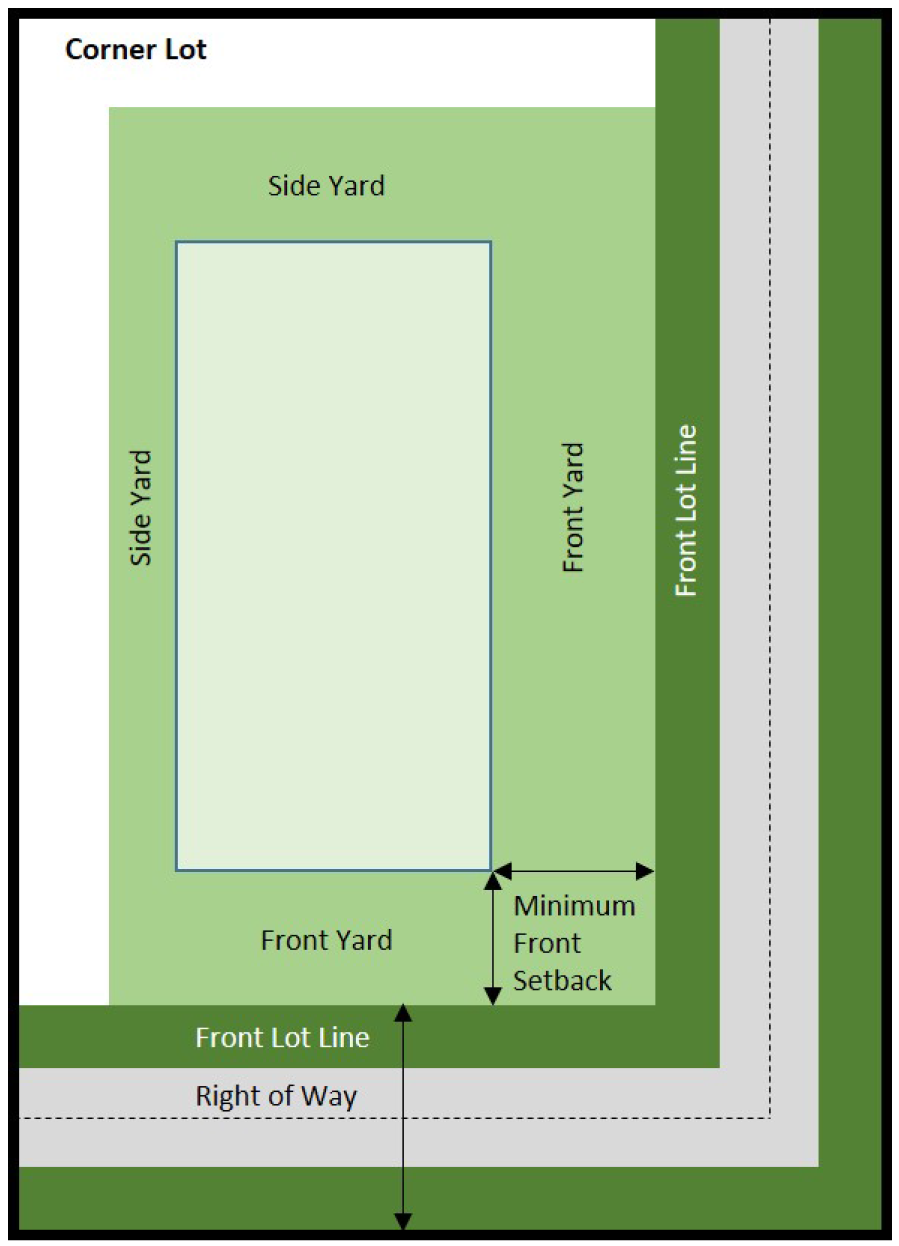
Lot, corner: A lot abutting two or more streets at their intersection.
Lot line: A line which delineates the boundary of a lot.
a.
Front lot line: A lot line that abuts a street right-of-way or easement. A through lot has two front lot lines. On a corner lot, there is one front lot line which is the lot line abutting the street used for addressing the lot. On a corner lot there is one (or more) secondary front lot lines.
b.
Secondary front lot line: A lot line that abuts a street right-of-way or easement on a corner lot that is not the front lot line.
c.
Side lot line: Any lot line except a front or rear lot line.
d.
Rear lot line: A lot line that is opposite a front lot line. A triangular lot has two side lot lines but no rear lot line. For other irregularly shaped lots, the rear lot line is all lot lines that are most nearly opposite the front lot line. In the case of an irregular or triangular lot, a line 20 feet in length, entirely within the lot, parallel to or concentric with and at the maximum possible distance from the front lot line, shall be considered to be the rear lot line. In the case of a through lot, there shall be no rear lot line. In the case of corner lots, the rear lot line shall be the line most nearly parallel to or concentric with and most distant from the front lot line most prevalent along the block.
Lot measurement, depth: See section 11-04-06.
Lot measurement, width: See section 11-04-07.
Lot, through: A lot, other than a corner lot, having its front and rear lot lines on different streets.
Mobile home: See "dwelling unit."
Mobile home space: That part of a mobile home park that has been reserved for the placement of the mobile home, appurtenant structures, or additions.
Mobile home park: A parcel of land under single ownership that has been planned and improved for the placement of mobile homes for non-transient use.
Motor vehicle: Any motor vehicle as defined in section 14-01-01.
Nonconforming lot: Lots that were legally created in accordance with zoning district minimum lot size and dimensional standards in effect at the time of their creation, but which, because of amendments to the zoning regulations, no longer comply with the minimum lot size or other dimensional standards of the zoning district.
Nonconforming structure: Buildings or structures that were established in accordance with all zoning regulations in effect at the time of their establishment, but which, because of amendments to the zoning regulations, no longer comply with the dimensional standards of the underlying zoning district.
Nonconforming use: Uses that were established in accordance with zoning regulations in effect at the time of their establishment, but which, because of amendments to the zoning regulations, no longer comply with the use regulations of the underlying zoning district.
Off-site recyclable collection facility: See "recyclable collection facility, off-site".
Open space: An outdoor area within a lot that is other than an impervious surface area.
Open space, common: Open space within a development, not in individually owned lots or dedicated for public use, but which is designed and intended for the common use or enjoyment of the residents or occupants of the development.
Overlay zoning district: A zoning district that is applied to a parcel of land to add special or additional development requirements in addition to or in place of the requirements of the base zoning district(s) requirements.
Personal service establishments: Small establishments designed and intended to serve the daily or frequent trade or service needs of immediately surrounding population. Typical uses include: ATM (automatic teller machine), barbershop or beauty shop, clothing alterations and repair, coin-operated laundries, photo drop-off and pick up services, shoe repair services, gyms, health clubs or spas.
Planning and Zoning Commission: The Planning and Zoning Commission of Valley City, North Dakota. The Planning and Zoning Commission consists of seven members: two members must reside within city limits, two members must reside outside of city limits but within one mile, two city commissioners and one county commissioner. (N.D.C.C. § 40-47-06)
Recycling center: A facility designed and operated solely for receiving, storing, or transferring source separated recyclable materials including but not limited to the storage of wastepaper, rags, scrap metal, and discarded materials and the collection, dismantlement, storage, and salvage of two or more vehicles which have remained unlicensed for two consecutive years.
Recyclable collection facility, off-site: Bins, boxes or containers used for the collection of recyclable materials.
Recycling center: A facility designed and operated solely for receiving, storing, or transferring source separated recyclable materials.
Religious institutions: Parish homes, monasteries and convents accessory to a church or similar place of worship.
Retail sales: Stores selling, leasing, or renting consumer, home and business goods including art, art supplies, bicycles, clothing, dry goods, electronic equipment, fabric, furniture, garden supplies, gifts, groceries, hardware, home improvements, household products, jewelry, pets, pet food and supplies, pharmaceuticals, plants, printed material, stationary and videos but excluding the sales or leasing of consumer vehicles including passenger vehicles, motorcycles, light and medium trucks and recreational vehicles, building material sales and lumber yards.
Senior housing: A multiple residential structure or structures designed exclusively for use by elderly or retired persons. To fulfill this requirement at least one occupant of each unit must be retired or at least 55 years of age.
Sign: Any device designed to inform or attract the attention of persons not on the premises on which the sign is located, provided however that the following shall not be included in the application of the regulations herein:
a.
Signs not exceeding one square foot in area and bearing only property numbers, post box numbers, names of occupants of premises or other identification on premises not having commercial connotations.
b.
Flags and insignias of any government except when displayed in connection with commercial promotion.
c.
Legal notices, identification, information or directional signs erected or required by governmental bodies.
d.
Integral decorative or architectural features of buildings, except letters, trademarks, moving parts or moving lights.
e.
Signs directing and guiding traffic and parking on private property, but bearing no advertising matter.
Story: That portion of a building between the surface of any floor and the surface of the floor above it, or if there be no floor above it, then the space between the floor and the ceiling next above it. Any portion of a story exceeding 14 feet in height shall be considered as an additional story for each 14 feet or fraction thereof.
Structure: Anything constructed or erected having location on or under the ground or attached to something having location on or under the ground.
Surfaces:
a.
Improved, Improved surface, or Improved parking surface: An all-weather surface that is durable and reasonably free of dust or mud, such as concrete, asphalt, paver system, brick, and other similar materials intended for outdoor vehicle use. Such surface shall exclude dirt, grass, gravel, crushed concrete, asphalt millings and other similar materials. Paver systems may be used where appropriate soil and site conditions exist. The City may require an owner to provide sufficient information to the City Engineer to prove that the paver system will function as intended. Any applicable surface constructed, reconstructed, or substantially improved after June 1, 2023, must comply with this section. A nonconforming surface may be maintained but the area of nonconformity must not increase.
Telecommunication facility, attached: An antenna array that is attached to an existing building or structure, including utility poles, signs, water towers, and similar structures with any associated connection cables, and an equipment facility which may be located either inside or outside of the attachment structure.
Telecommunications support structure: A structure designed and constructed specifically to support an antenna array, and may include a monopole, self-supporting (lattice) tower, guy-wire support tower and other similar structures. Any device used solely to attach a telecommunications facility to an existing building or structure shall be excluded from this definition. A monopole, self-supporting (lattice) tower, Guy-wire support tower and other similar structures which are erected or constructed on a building, water tower, or other structure for the purpose of elevating an attached telecommunications facility shall be included in this definition.
Temporary use: The use of land for a fixed period of time with the intent to discontinue such use upon the expiration of permitted time period. See section 11-05-18.
Temporary structure: A structure without any foundation or footings and does not require a building permit. Such building is constructed with the understanding that it will be taken down/removed when the permitted time period has expired.
Townhouse: See "single-family attached."
Variety store: A retail store offering a broad mix of generally nondurable goods, notions and sundries, also generally of moderate price. Durable goods, such as furniture, large appliances and the like, are seldom offered in a variety store.
Vehicle: Any vehicle as defined in section 14-01-01; and any motorcycle not qualified for registration, off-highway vehicle, snowmobile, vessel, or personal watercraft.
Vehicle repair: Includes repair of automobiles and trucks, farm equipment and similar vehicles.
Vehicle service stations: Includes service stations for automobiles and trucks.
Vehicle wash: Establishments primarily engaged in washing vehicles including trucks and automobiles or in furnishing facilities for the self-service washing of trucks and automobiles.
Yard: The actual unobstructed open space that exists or that is proposed between a structure and the lot lines of the lot on which the structure is located. See "measurement, yard" (section 11-04-08).
Yard, front: A yard extending across the full width of the lot at the street line in accordance with the setback requirements of this Zoning Ordinance.
Yard, rear: A yard extending across the full width of the lot between the rear line of the building and the rear line of the lot. Through (double frontage) lots have no rear yard.
Yard, side: A yard extending along the side lot line between the front and rear yards.
(Ord. No. 1092, § 8, 3-15-2022; Ord. No. 1112, § 2, 9-20-2022; Ord. No. 1128, § 2, 5-2-2023; Ord. No. 1129, § 1, 5-2-2023; Ord. No. 1130, § 1, 5-2-2023; Ord. No. 1137, § 1, 8-1-2023; Ord. No. 1172, § 2, 7-17-2025)

