
Victorville City Zoning Code
ARTICLE 10
- Commercial Districts
Sec. 16-3.10.010: - General purpose and intent
(a)
The commercial districts are established:
(1)
To provide opportunities for professional and administrative office buildings of a semi-commercial character to locate outside of commercial districts;
(2)
To promote the construction of well-designed professional office buildings in locations which can serve as harmonious buffers between commercial and industrial uses and residential uses;
(3)
To reserve certain areas of the City, consistent with the General Plan, allowing the establishment of a full range of retail stores, business and professional offices, personal and business service establishments, transportation related service establishments and certain wholesale establishments, scaled to meet the needs of City neighborhood dwellers, residents of the City as a whole, residents of the nearby region and visitors;
(4)
To establish appropriate standards for the siting of neighborhood convenience retail stores, helping foster neighborhood cohesion and reducing the need for vehicular traffic to obtain such convenience goods;
(5)
To encourage construction of attractive and functional community shopping centers at strategic locations throughout the City consistent with the General Plan;
(6)
To ensure adequate space on commercial lots to meet the needs of commercial development, including onsite parking, loading and landscaping;
(7)
To provide a strong economic and financial base and to increase employment opportunities for City residents and those of the surrounding area;
(8)
To ensure a high quality of exterior appearance for commercial uses and structures is maintained, in harmony with the visual character of the area in which they are located and, at the same time, minimize the impact of uses and structures on surrounding residential neighborhoods;
(9)
To provide specific design guidelines which result in a well designed and high quality commercial development project.
(b)
The purpose of each commercial zoning district is as follows:
(1)
The C-1 (Neighborhood Service) zoning district is intended to be for small, limited shopping centers and services designed to meet more localized neighborhood needs. This district may be located on any street designation, however, it is generally not located at the intersections of larger streets. The neighborhood service district is consistent with the commercial land use designation of the General Plan.
(2)
The C-2/C-4 (General Commercial) zoning district is intended to provide suitable locations and lands for various commercial activities, primarily of a retail nature, and for various types of service, office, and commercial activities. The general commercial district is consistent with the commercial land use designation of the General Plan. This district accommodates most commercial activities that are neighborhood, community, and regional in scale.
(3)
The C-A (Administrative Professional Offices) zoning district is intended to provide for the location of offices for professional services and for business activities which involve a relatively low volume of direct consumer contact and to regulate such development.
(4)
The C-M (Commercial Manufacturing) zoning district is intended to provide a location for service industries which combine a mixture of commercial and light industrial users. These uses may have a larger number of retail customers than the I.P.D. zone district, yet also have the need for warehouse storage space.
Sec. 16-3.10.020: - Development standards
Development standards for commercial districts are found on Table 10-1.
Table 10-1: Commercial Development Standards
Notes:
(1)
FAR of certain multi-floor hospitality uses (e.g. hotels & convention centers) may be increased on a case-by-case basis.
(2)
Parking, landscaping and walks may project into the required setbacks.
(3)
The setback shall be provided along any rear or side lot line that abuts a residential district not separated by a public right-of-way. The area within the required setback shall consist of a minimum fifteen-foot wide landscape strip planted with evergreen trees adjacent to the masonry wall required by this Title, unless in the opinion of the Zoning Administrator it is deemed unnecessary due to building and site design and/or site constraints. The required setback shall be increased by 30-feet for every story above the ground floor.
(4)
Unless otherwise approved by the Planning Commission, in accordance with Section 16-3.01.030 of this code.
(Ord. No. 2448, § 5(Exh. B), 2-6-24)
Sec. 16-3.10.030: - Wall and fence standards
(a)
Residential Buffer. A solid masonry wall at least six feet in height, not to exceed the maximum height limitations of this Title; provided, such wall shall not exceed four feet in height where it is located within the required front yard, shall be erected and maintained along any rear or side lot line of a Commercial District lot that abuts a residential district, unless in the opinion of the Zoning Administrator it is deemed unnecessary due to building and site design and/or site constraints.
(b)
Open Storage. If open storage of materials, products and equipment is allowed in the C-M District by the Planning Commission or Zoning Administrator, the open storage shall be screened from public view by a wall, building or other means, not less than six feet in height, adequate to conceal such storage.
(c)
Prohibited fences and walls include:
(1)
Razor wire and/or barb wire;
(2)
Chain link fence on any new commercial development; and
(3)
Fences or walls along interior parcel lines within a commercial complex.
Sec. 16-3.10.040: - Other development requirements
The following requirements also apply to uses and structures in Commercial Districts:
(a)
Asphalt roof shingles are prohibited on all new construction.
(b)
Rooftop mechanical equipment shall be screened from public view to the greatest extent possible with the design of the building.
(c)
Signs are limited as set forth in Article 22.
(d)
Removable commercial buildings having a floor area of less than one hundred square feet shall be permitted in any commercial zone district if a Conditional Use Permit is approved pursuant to Article 2 of this Chapter.
Sec. 16-3.10.050: - Site plan review
Site plan review is required, pursuant to Article 1 of this Chapter, for all development and/or physical expansion of a use and/or building within a Commercial District.
Sec. 16-3.10.060: - Design guidelines
(a)
Introduction. This policy provides general guidelines for the design of commercial development in all areas of the City. Any commercial addition, remodeling, relocation or construction within any land use district shall adhere to these guidelines where applicable.
(1)
Design Goals. Commercial developments are located in many prominent locations throughout the City of Victorville and convey a strong visual image. The attention paid to their design reflects a City's pride in itself and its economic vitality. For this reason, the commercial design guidelines are intended to promote high quality development that will:
(i)
Lead to quality architecture and design;
(ii)
Contribute to a positive physical image and identity of the City; and
(iii)
Complement and preserve the surrounding natural resources.
(2)
Design Objectives. The design of each commercial project in the City of Victorville should:
(i)
Reinforce or establish a distinct architectural image;
(ii)
Establish attractive, inviting, imaginative and functional site design;
(iii)
Facilitate and encourage pedestrian activity and mitigate adverse automotive patterns;
(iv)
Enhance surrounding neighborhoods, existing commercial developments and the City as a whole;
(v)
Preserve and incorporate natural amenities unique to the site such as mature trees and scenic views; and
(vi)
Minimize excessive or incompatible impacts of noise, light, traffic, and visual character.
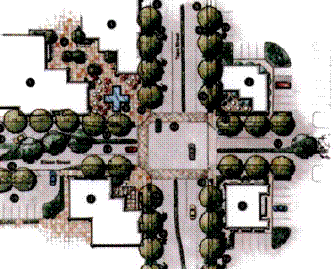
Spaces around buildings are equally as important as the buildings themselves
(b)
Site Planning and Design. Site planning refers to the arrangement of buildings and parking areas, the size and location of pedestrian spaces and landscaping, and how these features relate to one another. Site design addresses the scale and size of outdoor spaces, spaces between buildings and parking areas and the relationship of site elements that create a comfortable pedestrian environment.
(1)
Site Grading. Grading should be minimized, where possible, to preserve the natural character of the City. Where grading is unavoidable, consider the following guidelines:
i.
Follow the natural contours as much as possible.
ii.
Round and contour slopes to blend with the existing terrain.
iii.
Emphasize and accentuate scenic vistas.
iv.
Avoid large manufactured slopes in favor of several smaller slopes.
v.
Retain and incorporate significant natural vegetation into the project.
vi.
Grading should be performed in such manner as to optimize water retention.
(2)
Buffers. Most land uses can be compatible when adjacent uses are taken into consideration in the process of design. The use of visual buffers in the form of setbacks, landscaping, walls, berms or a combination of some or all will assist in transitioning between land uses. Where commercial and industrial uses are adjacent to residential development, the placement of the buffers, buildings, and parking areas should be considered to minimize any negative impact to the surrounding residential development. Buffers shall be used to transition between commercial development and natural features.
(3)
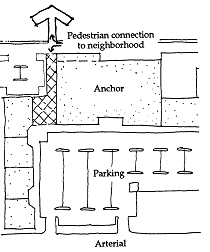
Off-Site Connections. Each project is encouraged to have its own identity, yet any site development should be integrated with adjacent compatible uses to provide functional and aesthetically designed vehicular and pedestrian circulation. Where complementary land uses are close (e.g. residential & employment) and conditions make it feasible, vehicular connections and pedestrian paths to neighborhood-serving retail are encouraged. Pedestrian paths should be well lighted and have entries or windows facing them. For additional security, they may be gated at certain hours and designed to accommodate emergency vehicles (while discouraging other vehicles).
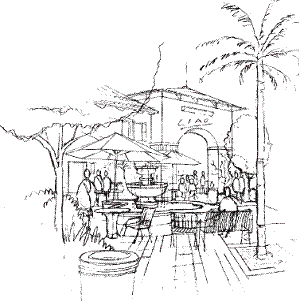
Outdoor plazas such as this help to enhance the quality of a project
(4)
Plazas, Courtyards, Outdoor Patios and Arcades. Outdoor spaces should have clear, recognizable shapes that reflect careful planning and are not simply "left over" areas between structures. Such spaces shall provide pedestrian amenities such as:
i.
Shade;
ii.
Benches;
iii.
Water features;
iv.
Landscaping;
v.
Enhanced paving;
vi.
Public art, etc.
Features used within a plaza shall be consistent with the architectural style of the project. Plazas are encouraged where high-levels of pedestrian-activity are expected, such as adjacent to major entrances and food services like delis, restaurants and bakeries. Building entries and windows should look onto plazas to enhance activity and security.
(5)
Public art is encouraged as an on-site amenity for large-scale commercial and mixed-use projects.
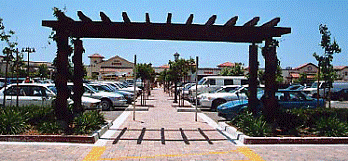
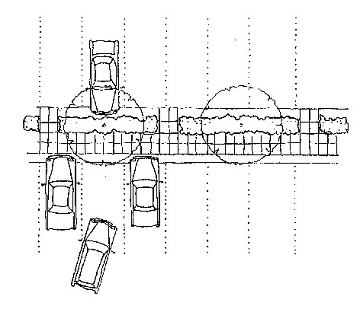
Landscape islands and pedestrian walkways should be used to connect parking areas
to buildings
(6)
Pedestrian Access. The following pedestrian guidelines shall be adhered to:
i.
Parking areas should be designed so that cars and pedestrians are separated. The need for pedestrians to cross parking aisles should be minimized. Landscape islands and pedestrian walkways should be used to connect parking and building entries.
ii.
Where connecting walkways pass through parking lots, they should be at least five (5) feet wide (excluding car overhangs) and should be accompanied by a landscape buffer.
iii.
Pedestrian access should be provided and clearly defined between transit/bus stops and building entrances.
iv.
Where possible, connecting walkways should follow an alignment that connects building entries and should be at least eight (8) feet wide in these locations.
v.
Walkways should consist of special pavers or scored concrete with modules that should not exceed three (3) feet in width.
vi.
The on-site pedestrian circulation system should be directly connected to off-site public sidewalks.
(7)
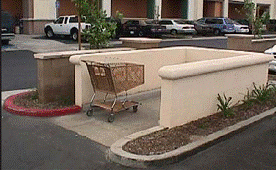
Cart Return. Cart returns shall be incorporated into projects wherever shopping carts will be provided on-site. The following guidelines shall be adhered to:
i.
Cart return facilities shall be consistent with the design of the project and building architecture. Similar or the same materials shall be used on the return as the buildings.
ii.
Cart return areas adjacent to the building shall be integrally designed as a part of the building.
iii.
Cart returns shall be distributed evenly throughout the parking area to encourage usage by the customer.
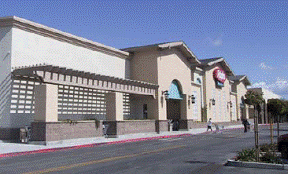

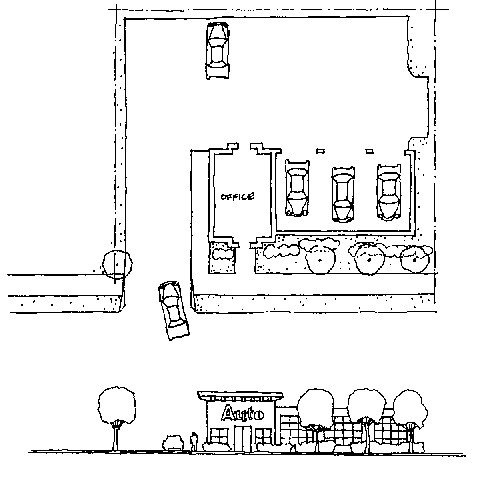
Preferred auto-serving retail building orientation
(8)
Loading and Delivery
i.
Loading and delivery areas shall be located in the rear of a site as opposed to the front where it shall be difficult to adequately screen them from view.
ii.
Loading docks, overhead doors and storage areas should not face streets and freeways, and preferably be located behind or to the side of buildings. Where oblique views of these features are possible from streets, freeways, connecting walkways or residences, the features should be screened through the use of walls, trellises, tall landscaping, or equivalent features. Loading docks and storage areas should not conflict with connecting walkways.
iii.
Loading and delivery areas shall not be located in required setbacks.
iv.
When residential properties are located directly adjacent to commercial properties, loading and delivery facilities should be located at the side of the building away from the residences or screened with mature vegetation and decorative block walls.
v.
Overhead doors for auto-service uses need not front onto streets. Avoid facing auto-service bays, loading areas, and blank walls toward the street; orient these features to the side or rear while presenting windows, entries and landscaping to the street. Trees or other landscaping should be used to further screen these features when viewed from the street.
(9)
Landscaping. Landscaping within commercial developments shall create a sense of place by establishing a unique and inviting frontage design that incorporates landscape design elements, varying rock sizes and dense plantings that are unique to the project frontage and conform to Section 13.60 of the Victorville Municipal Code while incorporating the following design standards:
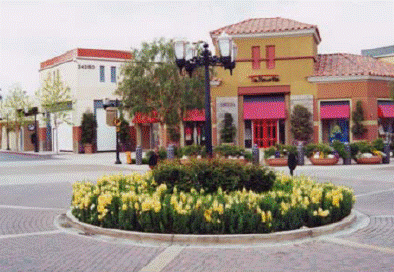
This formal planting area helps to create a visually stimulating landscape.
i.
Native and low water use plants shall be used in developing the landscaping palette for a project.
ii.
Landscaping should consist of 24-inch, 36-inch and 48-inch box trees (15-gallon size in slopes), 5- and 15-gallon shrubs, and ground cover.
iii.
Exposed dirt is prohibited.
iv.
Bark or wood mulch is prohibited as a permanent and primary form of ground cover.
v.
Decorative rock, with a minimum variety of three sizes/types, shall be used to cover areas that are not completely covered by plant material. Decorative rock shall not cover more than 25% of a planter area and shall have 3" base with weed barrier.
vi.
A six-inch wide planter curbing is required along the perimeter of all landscaped areas.
vii.
All planter strips abutting a public right-of-way shall be a minimum of five feet in width and include six inch wide curbing abutting the required planter strip.
viii.
Where possible, infill projects should connect with adjacent landscaping by using similar plant types, sizes and arrangements.
ix.
Landscaping should occur around the entire base of the building to soften the edge between the parking lot and the structure. This should be accented at entrances to provide focus.
x.
Provide special landscaping treatments such as intensifying density (size and/or number) of trees and accent trees at all project entries.
xi.
Trees and shrubs should be located and spaced to allow for mature and long-term growth. Trees and shrubs should provide minimal root problems.
xii.
Formal planting designs and color-spots are encouraged in courtyards, plazas and in tree wells along the street frontages.
xiii.
Planting should be used to screen less desirable areas from public view, i.e., trash enclosures, parking areas, storage areas, loading areas and public utilities. Use evergreen trees to screen unsightly features on-site or off-site.
(10)
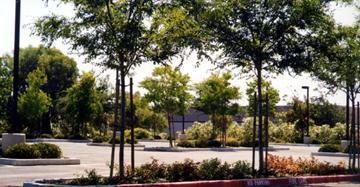
Parking Lot Area Planting. Landscaping within parking lots should be given special consideration. These guidelines should provide a parking lot designer with the direction needed to create a functional and attractive parking environment.
i.
Appropriate lighting and landscaping should be provided, including shade trees and lampposts style (Refer to lighting Section of these Guidelines).
ii.
Areas not used for vehicle parking or maneuvering, or for the movement of pedestrians to and from vehicles should be used for landscaping.
iii.
Trees should be distributed throughout the parking lot so as to maximize the aesthetic effect and compatibility with adjoining uses.
iv.
Trees should be located throughout a parking lot and not merely at the ends of parking rows. Trees should be sized at 24-inch box or larger at the time of installation so as to provide shade to parked cars and add aesthetic appeal to the project.
v.
Planter islands and landscape fingers should have a minimum interior dimension of five (5) feet and should be located throughout the parking lot and at the end of all parking rows.
vi.
Where parking spaces or drive aisles abut an interior lot line, a landscaped planter strip should be installed.
vii.
Trash enclosures and loading areas provided in the parking areas shall be screened with landscaping and wall materials.
viii.
Trash enclosures should be separated from adjacent parking stalls by minimum 3-foot wide planters with low-growing plant materials to ensure that adequate space is available for passengers to access a vehicle in an adjacent parking space.
(11)
Paving Treatment.
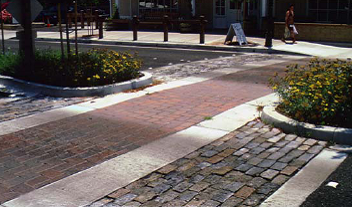
Textured paving creates visual interest, which slows drivers and makes pedestrians
feel more comfortable when crossing.
i.
Paved areas between privately owned properties and the street right-of-way should be paved with a different material than the sidewalk to accentuate entryways or other pedestrian ways.
ii.
Plazas, courtyards, outdoor patios and arcades should have detailed and well-defined paving design. Materials should include brick pavers, tile, and scored, colored, and textured concrete. These spaces should be provided adjacent to building entries or facades, in plaza or seating areas, at intersections, mid-block between buildings, and adjacent to parks. Use permeable paving systems whenever possible.
iii.
Durable, smooth and even surfaces should be used in well-traveled areas while other materials which are appropriate for minimal use should be used in less traveled areas.
iv.
Patterns and colors should be installed in paving treatments using tile, brick or textured concrete in order to provide clear identification of pedestrian access points into buildings, parking features (i.e., handicap spaces, pedestrian loading, bus stops, etc.), entry drives, and at pedestrian crossings within the site.
v.
Colors shall not be painted on the surface of the enhanced paving. Colors shall permeate through the entire material used.
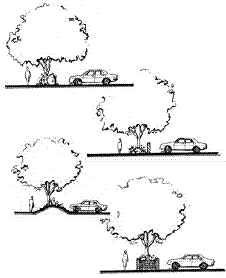
Parking lots can be screened with berms, walls, and landscaping.
(12)
Parking and Circulation. This Section is intended to ensure that parking lot designs are attractive and functional, while at the same time meet parking regulations.
i.
Site plans should balance the need to provide adequate vehicular access, with the need to eliminate unnecessary driveway entrances and provide reciprocal access points which are coordinated with other properties.
ii.
Parking access points from public streets should be located as far as possible from street intersections so that adequate stacking room is provided.
iii.
Dead end drive aisles and intersections should be minimized.
iv.
The site area adjacent to the street should not be dominated with parking. Parking should be concentrated in areas behind buildings at the front of the property and away from the street when possible.
v.
Reciprocal access should be provided so that vehicles are not required to enter the street in order to move from one area to another on the same site.
vi.
Parking lots on corner sites should not be placed adjacent to the street edge.
vii.
Screening at the periphery of all parking lots should be provided.
viii.
Structures and on-site circulation systems should be located to minimize pedestrian/vehicle conflicts where possible.
ix.
Drive-through restaurants should have a drive-through lane that measures a minimum of 144 feet in length from entry to pick-up window, accommodating 6 vehicles. The lane should not enter from the street or be located adjacent to an entry drive. The lane should have a minimum width of 11 feet on straight Section and 12 feet on curved Section. Drive-through lanes should be screened through building orientation, landscaping, low screen walls, trellis feature and located away from the street.
x.
Large parking areas on sites with five (5) acres or more should be designed with a clear hierarchy of circulation: major access drives with no parking, and parking aisles for direct access to parking spaces.
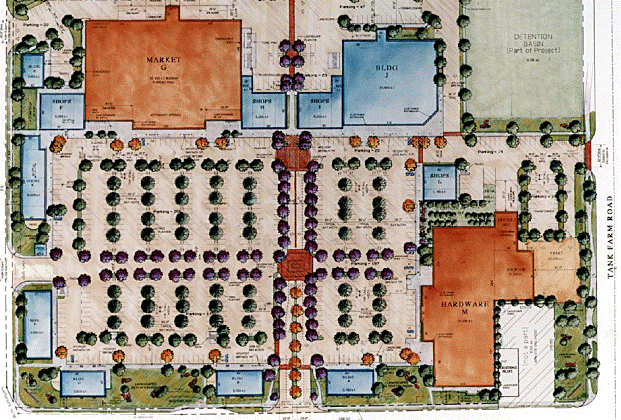
Developments abutting major streets should be designed so that parking areas are buffered
by either landscaping or buildings. Large parking areas shall have strategically placed
main drive aisles with no parking.
xi.
Provide connectivity for bicycle lines and bicycle racks for sites 40 acres or larger.
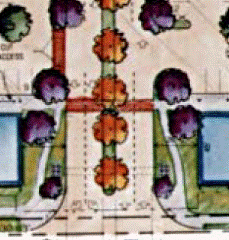
Landscaped center median creates an entry focal point.
(13)
Project Entry Design. Walls, signage, enhanced paving, and planting should be incorporated into a well-designed entry into the project site to visually link the site entry to the buildings. Parking lots with more than 100 stalls should incorporate the following entry elements:
i.
A minimum of 7-foot wide landscaped center median from the public street to the first bisecting parking aisle.
ii.
A minimum of a 5-foot wide sidewalk on at least one side of the drive aisle should be provided to connect the street to the front cross aisle.
iii.
Two 10-foot landscaped parkways flanking both sides of the entry drive.
iv.
Enhanced paving treatments.
v.
The entry drive aisle should have a sufficient depth exclusive of parking spaces and bisecting parking aisles to allow for stacking as vehicles leave the site and to eliminate interferences as vehicles enter the site.
vi.
One way drive aisles shall measure a minimum of 20 feet.
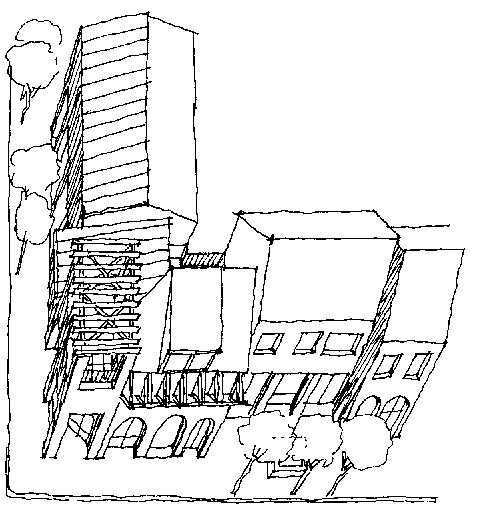
Stepped buildings create visual interest and relate to the pedestrian environment.
(c)
Building Design. Building forms and facades influence cohesiveness, comfort, and aesthetic pride and at the same time can encourage shopping, increase a sense of security, and generate pedestrian activity. Where commercial buildings are neighbors to residential buildings or where infill buildings are being constructed, consideration of scale, detail and materials is very important. The following guidelines are intended to provide a general framework for design, and do not mandate specific architectural styles, themes or details.
(1)
Continuity. Continuity among individual buildings in the area contributes to community identity, levels of pedestrian activity, and economic vitality.
(i)
Subdivision of vacant commercial land and the development of 5 acres or more will require a development plan for the entire site, to ensure continuity in site layout, landscaping, and building design.
(ii)
Infill buildings that are much wider than the existing facades should be broken down into a series of appropriate proportioned structural bays or components.
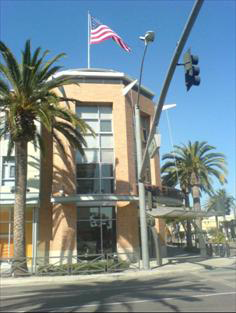
This tower element creates a focal point for the entrance of the building.
(iii)
New development height should "transition" from the height of adjacent development to the maximum height of the proposed structure.
(iv)
Selection of materials should complement adjacent buildings and their surroundings.
(v)
Designs should take into account the physical scale of the area and adjacent buildings.
(2)
Massing. Mass is defined as a three-dimensional form such as a cube, box, cylinder, pyramid, and cone. The way the forms are sized directly relates to the way building elements are emphasized or de-emphasized. Voids, projections or open spaces in the forms can change their appearance and make the building more interesting and less imposing. The following massing guidelines should be followed:
(i)
Variation in the wall planes (project and recess). Wall planes should not run in one continuous direction without a significant offset.
(ii)
Variation in wall height. The height of the building should appear to be divided into distinct massing elements.
(iii)
Roofs located at different levels. Multi-form roofs, gabled, and shed roof combinations should be used to create an interesting and varying roof form that will lessen the mass of the buiding and add visual appeal.
(iv)
Higher tower elements or similar features are encouraged at focal points, such as plazas, major entrances, and/or street intersections.
(v)
Recessed or projecting entries and articulation in the store-front mass is encouraged.
(vi)
New development should express its own uniqueness of location, tenant, or structure, designed especially for the particular building site and not as a copy of a generic building type which might be used anywhere.
(vii)
The use of corporate prototype "chain" architecture that detracts from the unique character of the community is strongly discouraged. Corporate tenants should design their buildings to fit the scale and character of the community.
(viii)
Outdoor or covered play areas associated with fast-food restaurants shall be architecturally integrated with, and subordinate in size and height to, the principal structure.
(3)
Scale. Scale is the proportion of one object to another. "Human" or "intimate" scale incorporates building and landscape elements that are modest in size. "Monumental" scale incorporates large or grand building elements. The individual components of a building relate with each other and create the overall scale of a building.
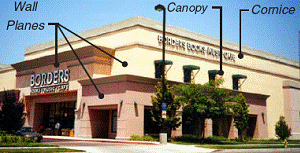
Building scale can be reduced with varying planes and colors.
(i)
Buildings scale should be reduced through the proper use of window patterns, structural bays, roof overhangs, siding, awnings, molding, fixtures and other details.
(ii)
The scale and proportions that have historically been related to the selected architectural style should be utilized.
(iii)
Architectural storefronts with carefully arranged doors, windows, arches, trellises or awnings, rather than blank walls, should face onto pedestrian spaces and streets.
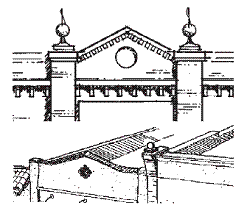
Parapets are attractive and can be used to hide rooftop
(iv)
Projections and recesses should be added to create texture and differentiation between buildings.
(4)
Roof Forms and Parapets
(i)
Roof materials and colors should be consistent with the desired architecture.
(ii)
Long, unbroken, horizontal roof lines are discouraged.
(iii)
Deep roof overhangs are encouraged to create pedestrian arches, verandas, and passive solar benefits.
(iv)
Parapets should be used to screen roof mounted equipment and provide a contrast to other roof forms.
(v)
Rooftop equipment on flat roofs should be screened and not visible from ground level. Buildings with flat or low-pitched roofs should incorporate parapets, pitched facades, or architectural elements designed to screen roof mounted mechanical equipment and to be architecturally compatible with the design of the building façade.
(vi)
Parapets should not appear "tacked on" and should convey a sense of permanence. Parapets should have sufficient depth, receive appropriate detail, and proper application of materials should be utilized when the side or rear of the parapet is visible from streets and/or pedestrian areas.
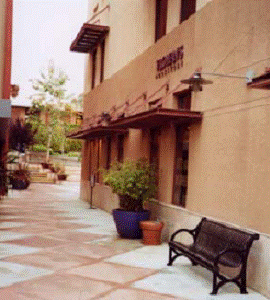
Textured paving, benches, and marquee display windows enhance this facade
(5)
Roof Drains
(i)
Roof drains (i.e. scuppers and down spouts) should not be visually exposed on a building.
(ii)
Roof drains should be internally located or covered in a manner that is architecturally integrated into the design of the building.
(6)
Sides and Backs of Buildings
(i)
Architectural treatments indicated on the front of a building should be included on the sides and back of the building when these areas are visible from streets and/or pedestrian areas.
(ii)
Architecturally compatible wall mounted lighting should be provided between buildings to ensure security.
(iii)
Marquee display cases should be provided between buildings in pedestrian linkage areas. Such display cases should include theater movie posters, upcoming civic events, retail displays, art displays or shows.
(7)
Windows and Doors
(i)
Window type, material, shape, and proportion should complement the architectural style of the building.
(ii)
Windows should be located to maximize daylighting and views.
(iii)
Doors, windows, and openings should be used to add extra texture to the wall plane.
(iv)
Recessed windows and doors provide depth and should be used to break up the mass of a large wall.
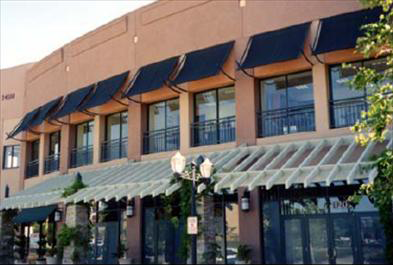
Windows and doors should be in scale with the building.
(v)
Windows and doors should be in scale with the building elevation on which they appear.
(vi)
Awnings, landscaping, tinted glass, and controllable blinds should be provided to reduce heat gain through windows. South facing windows should be shaded with a roof overhang, deciduous trees, or awnings to reduce summer exposure.
(vii)
Retail storefronts with display windows are encouraged within a creatively designed façade. Large expanses of glass, glass curtain walls, or glass buildings are discouraged.
(8)
Awnings and Umbrellas
(i)
Awnings add color, forms, relief, and pedestrian protection from the elements.
(ii)
Awnings and umbrellas should be made of metal and should match the architectural style of the building.
(iii)
Awnings and umbrellas shall be regularly maintained and kept free from tears, fading, and stains. The life of an awning is generally not expected to exceed eight to ten years. Property owners should not propose installing awnings unless they are prepared to replace the awning.
(iv)
Awnings shall not contain printed text or signage.
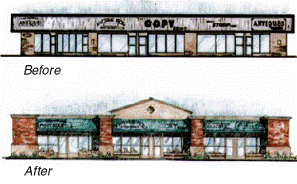
Natural materials, parapets, and columns improve the appearance of a building.
(v)
Awnings should not be wrapped around buildings in continuous bands. Awnings should only be placed on top of doors, windows, and other openings where arcades are not utilized.
(9)
Arches, Porches and Covered Walkways
(i)
Buildings that contain multiple tenants should utilize pedestrian connection elements, i.e. arcades and internal courtyards.
(ii)
Covered walkways should occur at building street frontages, between buildings, from building to parking lots, and within a parking lot.
(iii)
Covered walkways associated with buildings should utilize the material and style of that building.
(10)
Building Materials and Texture
(i)
The selection and placement of building materials should provide visual interest at the pedestrian level.
(ii)
Different parts of a building's façade should be articulated by the use of color, arrangement of façade elements, or change in materials.
(iii)
Blank walls should be avoided. Consider utilizing windows, trellises, wall articulation, arcades, changes in materials or other features to break up the massing of the building.
(iv)
Details such as wall surfaces constructed with patterns, changes in materials, building pop-outs, columns, and recessed areas should be used to create shadow patterns and depth on the wall surfaces.
(v)
High quality building materials are encouraged. Veneers that are visibly prefabricated are prohibited. Materials and detailing should look natural and have a long lasting appearance.
(vi)
To avoid the false appearance of lightweight veneers, material changes should not occur at the external corners. Material changes may occur at "reverse" or interior corners.
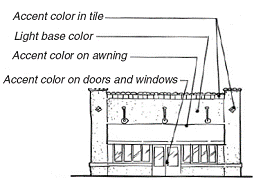
(11)
Colors. The following guidelines are intended to promote well-coordinated color palettes that integrate with the other exterior features of a building.
(i)
For large building surfaces (excluding trim), colors should be muted and lighter in value. Subdued colors usually work best for overall building color, bright or accent colors are typically appropriate for trim, windows, doors, and key architectural elements.
(ii)
Buildings should keep a balanced color palette between base colors and "brighter" or "darker" accent colors on each building.
(iii)
Flat muted colors should be used to reduce sun glare on wall planes. Avoid using bright whites.
(iv)
Door and window trims, awnings, and wall tiles should be used to provide an opportunity for color that adds interest and texture to storefronts or building bases. Color of trim should be coordinated with the wall colors.
(v)
Colors should coordinate with natural/unpainted materials used on the facades such as tile, brick and stone.
(d)
Utility & Mechanical Equipment
(1)
Equipment Screening
(i)
All utility equipment including, but not limited to, electric and gas meters, electrical panels, cable boxes, and junction boxes should be located in a utility room within the building or placed within an enclosure that is architecturally integrated into the building design.
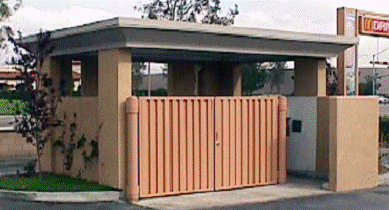
A separate pedesrian entry provides convenient access to trash and recycling receptacles.
(ii)
Any outdoor equipment, whether on a roof, side or a structure, or on the ground shall be appropriately screened from view and should not be placed adjacent to paths of travel.
(iii)
Roof access should be provided from the interior of the building. Exterior roof access ladders are inappropriate.
(iv)
Where walls are used at property frontages to conceal storage and equipment areas, they should be designed to blend with the site's architecture.
(2)
Trash and Recycling Enclosures
(i)
The trash/recycle enclosure should be consistent with the design of the project and building architecture. Similar or the same materials should be used on the enclosure as the building.
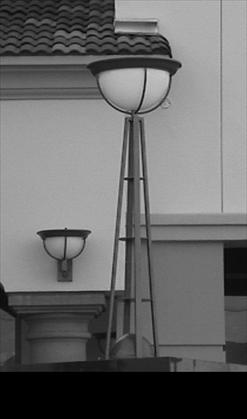
Complementary light fixtures
(ii)
Every property should provide a trash enclosure that is capable of handling the refuse generated by that site.
(iii)
A pedestrian entrance to the trash enclosure should be provided so that the large access gates do not have to be opened as often (Section 16-3.24.110 of the Victorville Municipal Code).
(iv)
Trash/recycle enclosures should be easily accessed by service vehicles.
(v)
Trash enclosures should be located away from residential uses to minimize nuisance to adjacent properties.
(vi)
Landscaping or trelliswork should screen enclosures visible from a street or connecting walkway and shall be permanently maintained.
(e)
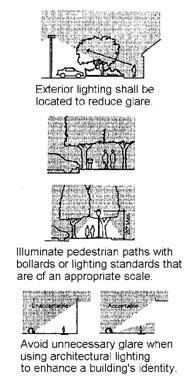
Lighting. Effective lighting provides safety and direction for vehicles and pedestrians, visibility and security for businesses, while enhancing architectural building and landscape details. These guidelines apply to on-site lighting of parking areas and lights associated with the exterior of the building. Lighting types could include pole lights, spotlighting, wall-mounted sconces, parking and landscape lighting.
(1)
Light Design.
(i)
Light fixtures should be designed or selected to be architecturally compatible with the main structure or theme of the building (typical shoe-box light fixtures are prohibited).
(ii)
Height of a light pole should be appropriate in scale for the building or complex and the surrounding area.
(iii)
Landscape lighting should be used to accent walkways and entries and/or seating areas and focal plants/trees
(2)
Glare
(i)
The quality of light, level of lights as measured in footcandles, and the type of bulb or source should be carefully addressed. Lighting levels should not be so intense as to draw attention to the glow or glare of the project.
(ii)
Spotlighting or glare from any site lighting should be shielded from adjacent properties and directed at a specific object or target area.
(iii)
Exposed bulbs should not be used. Cut-off lighting is preferred.
(iv)
Uplighting of building elements and trees should use the lowest wattage possible to minimize impacts to the night sky.
(v)
Timers and sensors should be incorporated to avoid unnecessary lighting.
(f)
Signage. Signs play an important role in the success of any business by providing identification and necessary advertising. When signs are integrated into the building design, they provide a personal quality that contributes to the ambiance of the commercial complex or streetscape. On the other hand, signs that are applied as an afterthought can diminish the aesthetic appeal of a building or commercial complex. These guidelines are intended to balance the advertising needs of businesses with the need to prevent visual clutter.
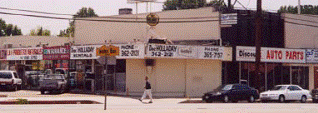
Cluttered signage diminishes the overall aesthetics of the project.
(1)
Building Signage
(i)
The City's sign regulations and guidelines as stated in the Municipal Code shall be adhered to at all times.
(ii)
A single development with more than 5 users should provide a unifying sign theme through a sign program.
(iii)
Signs should coordinate with the building design, materials, color, size, and placement.
(iv)
Signs should not cover up windows or important architectural features.
(v)
Damaged wall surfaces should be resurfaced and/or painted when removing an existing sign or prior to installing a new replacement sign.
(vi)
Sign cabinets (i.e. can signs) are strongly discouraged.
(vii)
Signs that reflect the type of business through design, shape, or graphic form are encouraged.
(viii)
Hanging signs attached to buildings that project perpendicular to the building should be a minimum of 8 feet from ground level to the bottom of the sign. Signs that project should be small and reflect the use of the business by incorporating symbols or logos of the business.
(ix)
Wall mounted signs should align with the others in the commercial complex so as to maintain the existing pattern.
(x)
Wall mounted signs should be appropriately positioned within architectural features, such as a wall surface or parapet above the storefront. The size of a sign should not exceed 70% of the wall surface within an architectural feature.

Landscaping enhances this freestanding sign.
(xi)
Lighting of all exterior signs should illuminate the sign without producing glare on pedestrians, automobiles, or adjacent residential units.
(xii)
Electrical connections should not be visible on signage.
(xiii)
Signs that rotate and flash should not be used.
(2)
Freestanding Signs (Monument, Pylon and Pole Signs)
(i)
Pole signs are prohibited, unless architecturally integral to the overall development of the site.
(ii)
Freestanding signs shall match the architectural style and materials of the project.
(iii)
Freestanding signs should be accented with landscaping. The signs should be in scale with the adjacent buildings and landscape areas.
(iv)
Freestanding signs shall incorporate complementary colors, materials, and lettering fonts used on the buildings. More than one material is recommended on the sign structure.
(v)
Freestanding signs should match the scale and proportion of the building(s).
(vi)
Internally illuminated sign cabinets should have matching opaque backgrounds that allow the illumination of graphics and lettering only.
(g)
Special Design Considerations. In addition to the design standards listed in this document, a few particular circumstances exist that require additional recommendations and direction. This Section addresses corporate architecture, mixed-use projects, educational/religious facilities and parking structures.
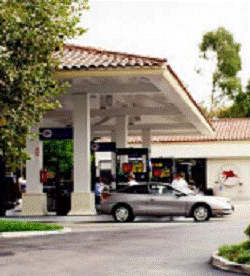
Service canopies shall match the design of the building.
(1)
Corporate Architecture
(i)
Corporate tenants should design their building to fit the scale and character of the community.
(ii)
Typical "chain" prototypes are discouraged.
(iii)
Gas station canopies shall be consistent with the design of the project and building architecture. The roof structure should be designed to be architecturally compatible.
(iv)
Play ground structures and enclosures, typically associated with fast food restaurants, shall be consistent with the design of the main building.
(v)
Corporate signage shall not dominate the building façade.
(2)
Mixed-Use Projects. Mixed-use projects join commercial/office and residential uses into one single development.
(i)
Where possible, provide clearly marked and separated driveways and parking areas for each proposed use.
(ii)
Mixed-use projects should only use a minimal amount of commercial signage, and only place signs where they are most appropriate.
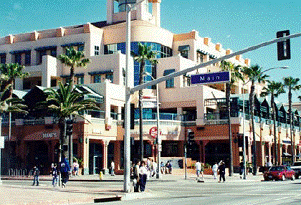
A vertical mixed-use project with setbacks on each floor adds visual appeal and provides
outdoor open space.
(iii)
The entire mixed-use development should have a consistent architectural style and use of materials.
(iv)
Commercial uses should attempt to shield parking lot and security lighting from impacting the surrounding residential uses.
(v)
A residential development in a mixed-use project can be benefited by the addition of a private open space, which is only accessed by the residents.
(vi)
Security gates and fencing should be used for the residential access into a mixed-use development.
(vii)
When multiple uses are both proposed in the same building, they should have separate and convenient entrances for each use.
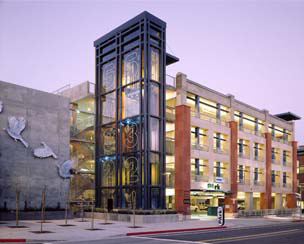
A tower element adds character to the parking structure similar to a commercial building.
(3)
Parking Structures
(i)
The deck and railing should not dominate the elevation of the structure.
(ii)
Substantial massing should occur at the corner of the structure to anchor the building, and give the structure proportions similar to a regular commercial building.
(iii)
Awnings should be added at vehicular and pedestrian entrances to create more pedestrian scale.
(iv)
Horizontal openings should be broken up with vertical columns to create a rhythm of openings, again reflecting the proportions of the building.
(v)
Framing should be added to openings that mimic windows. The framing should have vertical members to de-emphasize the horizontal lines of the building.
(vi)
Landscaping along the perimeter of the building is encouraged.
(vii)
Retail uses are encouraged on the ground floor of the structure.
(Ord. No. 2454, § 5(Exh. B), 3-4-25)

