
Victorville City Zoning Code
ARTICLE 24
- General Development Requirements and Exceptions
Sec. 16-3.24.010: - General application
The provisions of this Chapter shall be subject to the general regulations, special requirements and exceptions contained in this Article.
Sec. 16-3.24.020: - Voting place
Nothing in this Title shall limit or interfere with the temporary use of any property as a public voting place.
Sec. 16-3.24.030: - Landscape standards
The purpose of the landscaping requirements in this Section shall be to protect the general welfare by enhancing, conserving and encouraging pleasant and attractive surroundings in all zones of the City.
(a)
General provisions applicable to all new development and existing lots:
(1)
All landscaping shall be in accord with Section 13.60 of this Code and installed with a permanent irrigation system.
(2)
All landscaped areas shall be maintained in a neat, clean, orderly and healthful condition. This includes proper pruning, mowing of lawns, removal of weeds, removal of litter, fertilizing, and replacement of plants where necessary, the regular watering of all plants and the repair of landscape edging/curbing. Property owners shall provide a means to keep decorative rock in-place (i.e. landscape edging, mow curbing, etc.).
(3)
All areas landscaped with decorative rock, pea gravel or decomposed granite (DG) shall include an unexposed permanent weed barrier. The weed barrier shall be opaque, breathable and permeable as well as durable (does not stretch or tear using bare hands). Excluding single-family homes, weed barrier installation may be waived by the Planning Commission or Zoning Administrator if the soil is treated with a pre-emergent weed application prior to rock installation and the landscaping is regularly maintained by a licensed commercial landscaping business. Decorative rock shall be contained in place with the use of landscape edging/curbing to prevent scattering onto the sidewalk or driveways. All areas landscaped with decorative rock shall be treated and/or maintained regularly to control weeds.
(4)
All front yard areas installed with drought tolerant landscaping or those converted from water intensive landscaping to drought tolerant landscaping, must permanently remain drought tolerant in accord with Section 13.60.
(b)
Single-family landscape standards.
(1)
Front yard landscape standards;
(i)
This section applies to all landscaping installed in small tract lots in conjunction with a building permit for a primary dwelling unit issued after January 20, 2015, the effective date of Ordinance No. 2322, and includes those installed as a part of a tract development or individual single-family homes.
(ii)
All front and street side yards visible from the street shall be covered with landscaping, excluding paved driveways and walkways, which shall be well-maintained and free of weeds.
(iii)
All required front and street side yard areas, shall have a minimum of fifty (50) percent landscaping free of paved parking and driveway areas. Any areas used for pedestrian access or other landscape features utilizing paved areas shall be permitted administratively at the discretion of the Zoning Administrator or his designee.
(iv)
Decorative rock, with a minimum variety of three sizes/types and minimum depth of 3", shall be used as a permanent and primary form of groundcover within the front yard. Bark or wood mulch within the front and street side yard shall not be used as a permanent or primary form of ground cover within landscape areas, unless located within a flowerbed that is regularly maintained.
(v)
Front and street side yard landscaping shall at a minimum include an arrangement or combination of trees (fifteen gallon minimum), shrubs, and live ground cover that is irrigated by an automatic drip or sprinkler watering system. In no case shall decorative rock exceed fifty (50) percent of landscaped area, which shall be calculated by excluding the spread of plants at maturity.
(vi)
Front and street side yard landscaping shall be maintained with the requisite minimum amount and size of trees, shrubs, and live ground cover that was installed and approved in conjunction with the building permit that authorized its original installation.
(2)
Non-conforming front yard landscape standards:
(i)
This section applies to all existing landscaping within small tract lot subdivisions that was installed before the effective date of Ordinance No. 2322, January 20, 2015.
(ii)
All front and street side yards visible from the street shall include landscaping, excluding paved driveways and walkways, which shall be well-maintained and free of weeds.
(iii)
All required front and street side yard areas shall have a minimum of fifty (50) percent free of paved parking and driveway areas. Any areas used for pedestrian access or other landscape features utilizing paved areas shall be permitted administratively at the discretion of the Zoning Administrator or his designee.
(iv)
Decorative rock with a minimum depth of 3" shall be used as a permanent and primary form of groundcover. Bark or wood mulch within the front and street side yard shall not be used as a permanent or primary form of ground cover within landscape areas, unless located within a flowerbed that is regularly maintained. Exposed dirt is prohibited.
(v)
Front and street side yard landscaping shall at a minimum include an arrangement or combination of trees (fifteen gallon minimum), shrubs, and live ground cover that is irrigated by a drip or sprinkler watering system. Plant material should produce a minimum twenty-five (25) percent yard coverage calculated at plant maturity. In no case shall exposed decorative rock exceed seventy-five (75) percent of the landscaped area at maturity.
(vi)
Should applicable city records be available for confirmation, front and street side yard landscaping shall be maintained with a matching amount and size of trees, shrubs, and live ground cover that was installed and approved in conjunction with the building permit that authorized its original installation, if in compliance with Water Efficient Landscaping standards outlined in Chapter 13.60 of Title 13 of this Code.
(3)
Exceptions to single-family landscape standards:
(i)
Existing non-small tract lots shall not be subject to subsections (1) and (2); however, any lot with previous or currently existing landscaping shall be maintained and free of weeds, as required by this Title or any associated entitlement.
(c)
Multi-family landscape standards. All areas of the site not occupied by buildings, improvements for the storage of vehicles and access thereto, or improved recreational facility shall be landscaped. Submission of a landscape plan shall be required for all multi-family residential housing. All existing multi-family residential housing that fails to comply with this regulation shall submit and gain approval of a landscape plan and install said landscaping. Landscape plans shall be submitted for administrative approval in accordance with the following standards:
(1)
The type of plants used for landscaping shall be able to survive in the local climate.
(2)
Decorative rock, with a minimum variety of three sizes/types, shall be used as a permanent form of groundcover. Bark or wood mulch shall not be used as a permanent and primary form of ground cover within landscape areas, unless located within a flowerbed that is regularly maintained. Exposed dirt within landscaped areas is prohibited.
(3)
Plans shall include a variety of plant types such as ground covers, shrubs, trees and turf. The use of decorative rock shall not exceed 25% of the landscape area. Further, the landscape plan shall include the maximum spacing of all plants as follows:
(i)
Ground cover - eighteen inches on center.
(ii)
One gallon plants - three feet on center.
(iii)
Five gallon plants - five feet on center.
(4)
Plants used for required screening purposes (trash enclosures, storage areas, utility equipment) shall be a minimum of five gallon size and spaced at a maximum of four feet on center.
(5)
Every site shall contain at least two 24-inch box trees for each half acre of lot size.
(6)
Parking lots within multi-family developments shall meet the development standards listed within subsection (d).
(d)
Landscaping requirements for nonresidential lots and parking areas are as follows:
(1)
All non-residential lots which abut a dedicated street shall have a planter strip along the entire property abutting the dedicated street, excluding all driveway approaches. The planter strip shall have a minimum interior width of five feet. Properties along Highways 18 (Palmdale Road) and 395 shall have a planter strip with a minimum interior width of ten feet to accommodate any applicable development standards for landscape palettes for thoroughfares.
(2)
All nonresidential parking areas requiring four or more parking stalls shall provide the following interior and peripheral landscaping:
(i)
All landscaping areas shall be surrounded by a concrete curb or other approved curbing having a minimum height and width of not less than six inches, including planters that abut the public right-of-way sidewalk. Landscaped areas without curbing may be substituted upon review and approval of the Zoning Administrator.
(ii)
A minimum five-foot interior width landscape planter strip where any parking spaces and/or drive aisles abut an interior lot line or building.
(iii)
One twenty-four-inch box tree with approved ground cover for every eight parking spaces evenly dispersed throughout the parking area within landscape fingers or tree wells:
(A)
Landscape fingers and tree wells shall have a minimum interior width of five feet as measured perpendicularly from side curb;
(B)
Tree wells are only permitted when parking spaces are in double stacked rows, unless otherwise approved by the Planning Commission when utilized to increase compliance with the Commercial Design Guidelines; and
(C)
Double stacked landscape fingers shall have a minimum of two twenty-four-inch box trees.
(iv)
A minimum five-foot interior width planter island shall be located at the end of every parking aisle/row.
(v)
All parking spaces abutting landscape areas shall include access and maintenance measures as follows:
(A)
Landscape areas used as front parking space overhang area shall include two feet additional interior width and be paved in accordance with Figure 21-3 entitled "Concrete Curb/Wheel Stop" or be landscaped with durable ground cover that will not damage vehicles and be designed exclusive of the minimum required planter widths; and
(B)
Landscape areas abutting the side of parking spaces, excluding individual tree wells, shall include one foot additional interior width and be paved to allow for vehicle doors to open freely and not impede passenger access to or from vehicles.
(vi)
All landscaped areas shall be provided with a suitable permanent water system.
(vii)
Required planters shall not exceed a three foot horizontal to one foot vertical slope ratio.
(viii)
Rock ground cover shall not exceed twenty-five percent of the total for any landscaped area and such structural features as fountains, pools or art works, but such objects alone shall not meet the requirements of this Section.
(ix)
The maximum spacing of all plants within the parking area is as follows:
(A)
Ground cover—eighteen inches on center.
(B)
One gallon plants—three feet on center.
(C)
Five gallon plants—five feet on center.
(e)
Landscaping Maintenance. All landscaped areas and approved curbing shall be maintained in a neat, clean, orderly and healthful condition. This includes proper pruning, mowing of lawns, weeding, removal of litter, fertilizing, replacement of plants where necessary, the regular watering of all planting and the repair of landscaped curbing.
(Ord. No. 2299, 6-18-13, eff. 7-18-13; Ord. No. 2322, § 1, 1-20-15; Ord. No. 2326, § 1, 1-20-15; Ord. No. 2360, § 2, 12-20-16; Ord. No. 2415, § 3, 3-2-21; Ord. No. 2454, § 5(Exh. B), 3-4-25)
Sec. 16-3.24.040: - Landscape Maintenance Assessment Districts (LMADs)
Construction documents (i.e. landscaping, irrigation, walls) for areas within a Landscape Maintenance Assessment District shall be submitted to the Development Department for approval in accordance with City standards.
Sec. 16-3.24.050: - Building height limitations and exceptions
(a)
The height limitations of this Title shall not apply to such features as chimneys or church spires. The height of attached church spires and other architectural features shall not exceed the height of the building plus an additional fifty (50) percent of the height of the building.
(b)
Antennas may project up to ten (10) feet above any building on-site. Antennas in excess of ten (10) feet above any building height shall be subject to a Conditional Use Permit pursuant to Article 2 of this Chapter.
(c)
Flag poles are permitted in any zone district as an accessory use. Flag poles on any property zoned for single-family use shall be limited to one (1) in number and shall be limited to a height of twenty (20) feet. The maximum flag size in any single-family residential district shall be 3 ft. × 5 ft. Flag poles within any zone other than single-family residential zones shall be limited to a height of fifty (50) feet and flags on said poles shall not exceed the following size limitations:
Sec. 16-3.24.060: - Historic monuments
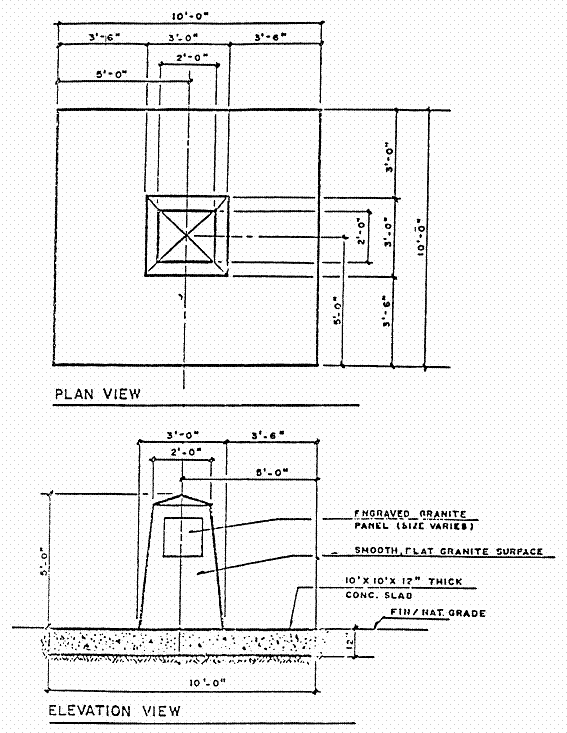
The following regulations shall control the location, placement and design of historical monuments:
(a)
Each historical monument shall be allowed in any zone district subject to the review and approval, with or without conditions, of the Planning Commission. As part of the review, the Development Department shall notify owners of adjacent property of the proposed monument placement and provide said owners with ten days in which to comment. The decision of the Planning Commission shall be subject to appeal to the City Council pursuant to Article 2 of Chapter 2.
(b)
The design of each historical monument shall be in full compliance with Figure 24-1, or in a form as approved by the Planning Commission which best suits the location in which it is proposed.
(c)
Historical monuments may be placed on private property with written consent of the property owner or City right-of-way with an approved encroachment permit which shall be acquired from the engineering department and filed with the planning department prior to installation of the monument.
(d)
It is the responsibility of the organization and/or property owner requesting and erecting an historical monument to maintain said monument in a neat and orderly manner.
Figure 24-1 - Historical Monuments
Sec. 16-3.24.070: - Projections into yards
The following features of a building may project into a required yard to the extent specified:
(a)
Cornices, eaves, fireplaces, or other architectural features which do not increase the livable volume enclosed by the building may project up to two feet. The projection of eaves beyond two feet shall be subject to review and approval of the Zoning Administrator.
(b)
An uncovered stair, landing or porch which does not extend above the level of the ground floor, except for a protective railing, may project not more than six feet into a front or rear yard and not more than two feet into a required side yard.
(c)
Permitted Projections Into Yards. An unenclosed patio attached to a building may project into the required rear yard setback a maximum of ten feet, excluding eaves; provided, a minimum of ten feet is maintained between the rear property line(s) and the patio.
(d)
Additions to existing single-family residences with non-conforming side yard setbacks may be permitted in the subject side yard providing they do not project in excess of the existing non-conforming setback. This provision shall not be applicable where the projections into the side yard would impede an easement, cross property lines, or are deemed contrary to maintaining the public health, safety and welfare.
(Ord. No. 2360, § 2, 12-20-16)
Sec. 16-3.24.080: - Measurement of height for walls and fences
(a)
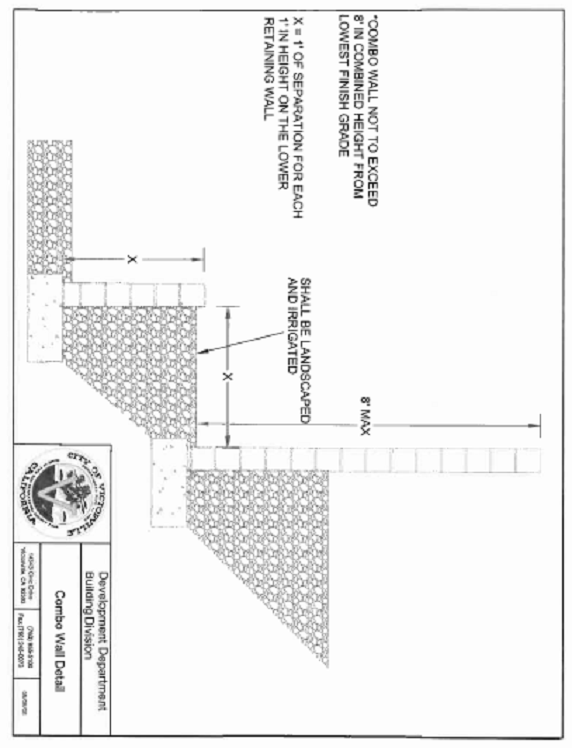
Yard areas abutting the public right-of-way. The height of a fence, wall or hedge shall be measured from the lowest finished level of the ground abutting it. No wall or fence type shall exceed a height of eight feet, as measured from the lowest finished level of ground abutting the wall, unless a step design is utilized per Figure 24-2 or as otherwise approved by the Planning Commission.
(b)
Yard areas not abutting a public right-of-way. The height of a fence, wall or hedge shall be measured from the highest finished level of the ground abutting it. No wall or fence type shall exceed a height of eight feet, as measured from the lowest finished level of ground abutting the wall, unless a step design is utilized per Figure 24-2 or as otherwise approved by the Planning Commission.
(Ord. No. 2326, § 1, 1-20-15; Ord. No. 2360, § 2, 12-20-16)
Figure 24-2
Sec. 16-3.24.090: - Exception to fence and wall standards
Each land use district has limitations on fence and wall height standards, the limitations of each land use district shall not apply where:
(1)
Greater fence height is required by any other ordinance;
(2)
A protective fence, if constructed of materials which are capable of transmitting at least ninety percent light, encloses any public property or an open public area for games or a public swimming pool;
(3)
A fence or wall is required by any law or regulation of the State and/or Federal Government;
(4)
On vacant property, a fence is needed to fulfill environmental mitigation or security requirements imposed by the City, State and/or Federal Government;
(5)
It can be demonstrated that a continued security problem exists which exceeds those same problems incurred by similar properties in the vicinity. In such cases, the fence height, location and materials shall be subject to review and approval of the Zoning Administrator.
(6)
A fence in excess of four feet in height, which does not interfere in terms of sight distance from a public right-of-way or driveway, may be built in the front yard area of lots if approved in conformance with Article 3 of this Chapter, Minor Deviations.
Sec. 16-3.24.100: - Manufactured home installation criteria
(a)
The purpose of this Section is to establish regulations for the placement of manufactured housing in residential zone districts that allow single-family dwellings and to insure a compatible integration with surrounding conventional-built single-family homes. For purposes of this Section, a "manufactured house" is defined as a housing unit built with a vehicular chassis, designed and equipped for human habitation, and for being drawn by a motor vehicle, conforming to the National Mobilehome Construction and Safety Standards Act of 1974.
(b)
The installation of a manufactured home on an individual residential lot not located within a mobile home subdivision shall be subject to the following:
(1)
Certification shall be provided showing that the mobile home complies with the National Mobilehome Construction and Safety Standards Act of 1974 and bears a California insignia of approval from the Department of Housing and Community Development. Any mobile home built in the United States on June 15, 1976, or after does meet the 1974 National Mobilehome Construction and Safety Standards Act requirements. Any mobile home built before June 15, 1976, may or may not meet the 1974 standards. For mobile homes built prior to June 15, 1976, the following certification process will be required:
(i)
Structural—certified by a licensed civil engineer;
(ii)
Plumbing, heating, and electrical—certified by a written request to the California Department of Housing or bear a California insignia of approval from the Department of Housing and Community Development.
(2)
No more than ten years shall have elapsed between the date of manufacture of the manufactured home and the date of application for the issuance of a building permit to install the manufactured home.
(3)
All manufactured homes shall be placed on a permanent foundation, engineered to meet local soil conditions and the requirements of Chapter 5 of this Title. A permanent foundation system can be either:
(i)
A continuous decorative exterior perimeter wall;
(ii)
An interior foundation system with a nonstructural decorative wall completely enclosing and encircling the base and/or undercarriage of the mobile home;
(iii)
Any other type of foundation system as approved by the City; and
(iv)
The exterior face of the perimeter wall must, in any case, be flush with the exterior face of the mobile home coach wall.
(4)
Exterior walls should be finished with materials and trim customarily associated with conventional single-family dwellings. This would include horizontal wood siding, stucco or stucco-like finishes, masonry and board and batten siding. Corrugated metal walls, vertical rib siding or other such materials are not generally acceptable under this guideline. The exterior wall material should extend to the ground where units are mounted at grade level or into the top of the foundation where an above grade foundation is used. Foundation plantings should be specified to screen exposed above grade foundations from adjoining streets.
(5)
The roof pitch should be consistent with that of surrounding structures. Roof covering should be asphalt or tile shingles or other material characteristic of conventional dwellings and compatible with the area in question. The roof should overhang the exterior wall by at least sixteen inches unless a lesser overhang can be shown to be characteristic of the area in question. Fascia boards should be used on all sides of the structure to screen exposed rafters, vents, etc., to enhance the residential quality of the unit.
(6)
All manufactured housing shall have a minimum living area equal to the required minimum single-family dwelling size as outlined in Table 8-1 of the Municipal Code entitled "Minimum Dwelling Unit Areas".
(7)
A two-car garage in accordance with Section 16-3.21.050 of this Title entitled "Standards for off-street parking facilities" shall be provided and shall be consistent and compatible with garages constructed in the neighborhood in which the manufactured home is to be located. Further, all detached garages shall be located no closer than ten feet from the manufactured home. Manufactured homes located within an R-MPD Zone District shall be permitted to fulfill off-street parking requirements with a carport or awning in lieu if a garage pursuant to Table 21-1 of this Title entitled "Off-street parking and loading requirements".
(8)
A plot plan drawn to scale providing the following information shall be submitted to and approved by the planning department:
(i)
Name, address and telephone number of applicant and/or land owner;
(ii)
Legal description of property;
(iii)
North arrow (top of map being north);
(iv)
Overall dimensions of property and location of adjoining lot lines;
(v)
Name of all streets;
(vi)
All off-site improvements (curb, gutters and sidewalk);
(vii)
Setback dimensions;
(viii)
Location and dimensions of existing structures, proposed structures and easements;
(ix)
Location of all walls and fences—give height and type of materials;
(x)
Show all proposed walkways and driveways and their dimensions.
(9)
Photographs that show the mobile home in sufficient detail with regard to siding material, roof overhang and roofing material.
(10)
All manufactured homes shall be used only as a single-family residence and shall comply with all applicable development standards of the zone district in which it is located.
(Ord. No. 2360, § 2, 12-20-16)
16-3.24.110: - Waste/recycling material enclosures.
(a)
Applicability. The requirements of this section shall apply to all buildings or development permits for:
(1)
New commercial development projects.
(2)
New multi-family residential development projects that will utilize shared waste and recycling enclosures.
(3)
Existing commercial development projects, including but not limited to tenant improvements, that require a planning entitlement (such as a site plan review or conditional use permit) or as otherwise noted within this section.
(b)
Definitions. The terms used in this Chapter have the meanings set forth below:
"Collection" means the removal and transportation of solid waste, recycling and organics by the collector from the place of delivery to a disposal facility approved under the collector's agreement with the city or by a nonexclusive franchise agreement.
"Collector" means that person or business having an exclusive franchise agreement with the city granting to him/her or it the exclusive privilege of collecting or causing to be collected or transported for a fee any solid waste within the city or any portion thereof.
"Commercial development" means the construction of or existing sites and buildings consisting of retail, professional, wholesale, or industrial facilities.
"Compactor" means any roll-off container or bin which has a compaction mechanism, whether stationary or mobile.
"Discharge" means any addition of any pollutant that has potential to enter navigable waters from any point source.
"Food service establishments" include restaurants, markets, bakeries, grocery stores and all other establishments that prepare and/or serve fresh food on the premises.
"Multi-family residential development" includes the construction of or existing sites and buildings consisting of multiple dwelling units such as apartments, condominiums, duplexes, triplexes, mobile home parks, etc., and excluding single-family dwellings that include an accessory dwelling unit.
"National Pollutant Discharge Elimination System (NPDES)" means a national program under Section 402 of the Clean Water Act for regulation of discharges of pollutants from point sources to waters of the United States. Discharges are illegal unless authorized by an NPDES permit.
"Organics" means all types of plant debris including grass and weed clippings, shrub and tree pruning, branches (less than four (4) feet in length and four (4) inches in diameter), leaves, plants, flowers, food scraps and food-soiled paper products.
"Owner" means the owner or owners of real property having fee title to the property as identified in the most recent equalized assessment roll of the San Bernardino County Assessor.
"Park" means and includes all grounds, trails, buildings, improvements and areas dedicated for use by property residents and their quests for park, recreation or open space purposes, and any part, portion or area thereof, whether developed or undeveloped or over which the property owner has acquired right of use for such purposes.
"Pollutant" means dredged soil, solid waste, incinerator residue, sewage, sewage sludge, munitions, chemical wastes, biological materials, radioactive materials, heat, wrecked or discarded equipment, rock, sand, dirt and industrial, municipal and agricultural waste discharge into water.
"Public Litter Container" means a permanent or semi-permanent (e.g. secured in placed and not easily removed) solid waste, recycling, and/or organics waste collection container(s) utilized for intermediary refuse collection prior to transport to the waste enclosure by the property owner or their designee.
"Recycling" consists of any clean, dry paper, cardboard, plastic and glass (bottles, jars and jugs only), and metal cans (tin and aluminum) placed in a single container. Cardboard is accepted in recycling bins and carts; however, cardboard-only dumpsters are also available.
"Roll-off container" means a metal container that is normally loaded onto a motor vehicle and transported to an appropriate facility.
"Solid waste" means all putrescible and nonputrescible solid waste (garbage), including paper, ashes, industrial or commercial wastes, demolition and construction wastes, discarded home and industrial appliances, animal solid and semi-solid wastes other than fecal matter, vegetable wastes, and other discarded solid and semi-solid wastes, but does not include hazardous waste, as herein defined, sewage, or abandoned automobiles.
"Stormwater" means rainwater runoff, snow melt runoff, surface runoff and drainage.
"Tenant" means any person or persons other than the owner occupying or in possession of the residence or commercial space.
"Waste enclosure" means a structure intended to serve collection and storage needs for solid waste, recycling, and organics waste.
(c)
General construction, design, and maintenance standards.
(1)
General waste enclosure requirements. The location, design and construction of waste enclosures for the set out and collection of garbage, recycling, organics or other discarded materials shall conform to all applicable regulations set out in this section and to all other provisions of the Victorville Municipal Code. A commercial or multi-family residential development may be required to have multiple waste enclosures to meet the required amount of capacity. The Zoning Administrator shall review the design of all waste enclosures. All new waste enclosures are subject to a building permit and shall be shown on the respective site plan.
(2)
Commercial development waste enclosure standards. All commercial uses within the city shall at a minimum provide adequate space for separate garbage bins, recycling bins, and organics bins within a waste enclosure. If a food service establishment will generate fat, oil, grease, or associated by-products (e.g. lard and tallow), adequate space for those containers is required within the waste enclosure if the fat, oil, grease, or associated by-product containers are not collected and stored inside the commercial building within a designated and established area. The types and sizes of bins shall be based on the volume of tonnage generated by the planned commercial activity, and with the aim of reducing, as much as possible, the number of service trips per week by the collector.
(3)
Waste enclosure design standards:
(4)
Waste enclosure maintenance. Enclosures and ground surface areas must remain functional as designed and free of debris, accumulated grime, fat, oil or grease and must be pressure washed and cleaned periodically with wash water collected and discharged to the sanitary sewer only.
(d)
Multi-family residential development requirements.
(1)
Multi-family residential development waste enclosures in the City of Victorville are required to contain space for separate collection of garbage, recycling and organics.
(2)
Shared service within a multi-family residential development shall include a minimum of 50 gallons of service for every 3 residents. Required service shall provide space for 40% as trash, 40% as recycling, and 20% as organics (excluding any plant debris from facility maintenance). Adequate enclosure space shall be provided to store estimated solid waste generation. Estimated occupancy shall be based on the number of bedrooms with an assumed 2 people per bedroom.
(3)
Waste enclosures for collection of garbage, recycling and organics provided for multi-family residential development shall observe the requirements of the California Building Code and the requirements of California Code of Regulations Title 24, regarding accessibility to solid waste and recycling collection containers for persons with disabilities.
(e)
Compactors.
(1)
Outdoor compactors are generally not permitted unless preapproved by the Planning Commission as part of a Site Plan application review. Inclusion of a compactor shall not supplant the requirements that a site provide adequate enclosure space for recycling and organics collection.
(2)
Compactors may require additional space and electrical connections, as well as separate building permits.
(3)
Compactors are required to be screened from public view, covered, and shall include plumbing directed to the sanitary sewer system to capture possible leaks and spills.
(4)
Adequate room for service access, including back up and turning area, shall be provided on-site and shall not require use of the public right-of-way.
(f)
Roll-off boxes. Unless reviewed and approved in conjunction with a Site Plan entitlement that includes access in accordance with the California Building Code, screening via masonry wall and landscaping, solid metal access gates, and stormwater pollution prevention measures, roll-off boxes are permitted only as a temporary use. The temporary use of roll-off boxes is allowable during construction in conjunction with an active building permit or as approved by a Temporary Use Permit for a period not to exceed three months per calendar year, in connection with a principal use on the property, pursuant to Section 16-3.07.050 of the Municipal Code.
(g)
Permits. All necessary entitlements and/or building permits, as determined by the Zoning Administrator and City Building Official, shall be obtained prior to the construction of any enclosures within the City of Victorville.
(h)
Exceptions. The Planning Commission shall have the authority to grant exceptions to the requirements of this section. The Planning Commission shall review any exception request as part of a Site Plan application review and shall only approve exceptions in accordance with Section 16-3.01.030 of the Victorville Municipal Code.
(i)
Stormwater pollution prevention.
(1)
All properties shall comply with the Federal Clean Water Act.
(2)
Waste enclosures within the city that are subject to the standards in this Chapter shall have a roof to comply with the City of Victorville's National Pollution Discharge Elimination System (NPDES) stormwater permit.
(3)
Ongoing Waste Enclosure Use and Maintenance. At a minimum, the following best management practices shall be adhered to:
i.
The enclosure shall only be used for storage of garbage, recycling, cardboard, organics and used cooking oil/grease containers. Storage of hazardous waste or any other items inside the enclosure is strictly prohibited.
ii.
Storage of garbage, recycling, cardboard only, or organics containers outside of the enclosure is strictly prohibited. All containers shall be stored inside of the enclosure. Exceptions to this requirement may be approved by the Zoning Administrator due to lack of enclosure or lack of enclosure space.
iii.
All solid waste and used cooking oil/grease shall always be contained within appropriate water-tight, covered containers including secondary containment. A supply of spill response materials designed to absorb leaking fluids and/or cooking oil/grease spills shall be kept near the enclosure.
iv.
Overfilling garbage, recycling and/or organics containers is prohibited. Solid waste shall not protrude above the top rim of the container and shall allow for the lid(s) to close fully. Establishments that have more than three (3) instances of overflowing containers within six (6) months will be required to increase their service level(s).
v.
Solid waste enclosures shall be maintained in good working condition and in the condition that they were approved. Maintenance and cleaning of the solid waste enclosure is the day-to-day responsibility of the occupant or owner of the premises.
vi.
Washing out the solid waste enclosure to the storm drain system is prohibited. Wash water shall be collected and discharged to the sanitary sewer only.
(j)
Non-conforming sites with substandard or no on-site waste enclosure.
(1)
Existing development. If an existing development lacks a waste enclosure or includes a substandard waste enclosure, the development may be required to install a waste enclosure that meets the requirements of this Chapter. The Zoning Administrator shall determine the requirement for a waste enclosure based upon any of the following:
i.
Section 16-3.05.060 of the Victorville Municipal Code, titled "Nonconforming sites";
ii.
Compliance with California Green Building Code standards; or
iii.
Recommendation by the City Manager or their designee, the City Code Enforcement Official, or the City Director of Public Works with evidence of the development's missing waste enclosure causing a public nuisance or being injurious to the public health, safety and welfare.
(2)
Code compliance. Where waste is not being fully contained and secured within a dumpster where no or substandard on-site waste enclosure exists, the Code Enforcement Official shall:
i.
Issue a Notice of Violation to the property owner and the business owner.
ii.
Upon the issuance of the third Notice of Violation within a 12-month period, the Code Enforcement Official may require the replacement of the dumpster with a tamper proof dumpster.
iii.
After four documented instances of waste not being fully contained and secured within a dumpster where no on-site waste enclosure exists, and after utilizing a tamper proof dumpster, the Code Enforcement Official shall require the installation of a fully conforming waste enclosure that complies with this Section for any multifamily or commercial property. Such instances may include but are not limited to overflowing containers, scattered waste located near a container or other litter-related or theft incidences causing a disturbance to the health, comfort or welfare of the community.
(3)
New dumpsters. Additional dumpsters shall not be added to non-conforming sites, unless located within a waste enclosure that meets the requirements of this section. New or modified waste enclosures shall require a building permit and a site plan entitlement based upon the scope of the proposal, as determined by the Zoning Administrator and City Building Official.
(k)
Public litter containers for commercial and multifamily properties. It shall be the responsibility of the property owner to install, maintain, and empty the public litter containers for all new developments.
(1)
Location of Public Litter Containers.
i.
Install public litter containers within ten (10) feet of any food-generating or food-selling store planned for the property.
ii.
Include containers along internal, on-site walkways at intervals of three hundred (300) to three hundred fifty (350) feet.
iii.
Locate containers at pedestrian entrance(s) and exit(s) of property.
iv.
The final location of public litter containers are subject to Zoning Administrator review and shall be placed based on existing or anticipated pedestrian traffic specific to the site.
(2)
Properties that Involve Outdoor Eating Area.
i.
Include three (3) compartment discard waste cans that are central and visible to the eating area.
ii.
Label the three (3) compartment discard waste cans with clear signage describing organics. recycling and garbage.
(3)
Design of Public Litter Containers.
i.
When selecting public litter containers, they should be considered as a design element and the design should reflect aesthetic as well as functional concerns.
ii.
Public litter containers should be selected from the same or a similar design family as other site furnishings (such as benches, bollards, bike racks, etc.) and should be finished or painted to complement other site furnishings.
iii.
Public litter container construction should use durable, high quality materials, such as galvanized or stainless steel.
iv.
Materials should be painted to reflect colors similar to nearby elements. Material and paint selection should be graffiti resistant.
v.
Public litter containers should include recycling containers and should be able to open from the side to allow easy access for removal of waste.
(4)
Maintenance of Public Litter Containers.
i.
It is the responsibility of the property manager or owner to empty the contents of the public litter containers at least once a week or more frequently as use dictates to prevent overflow of any litter containers.
ii.
Public litter containers should be kept clean and free of graffiti.
(5)
The Code Enforcement Official, at his or her discretion, may also require installation of public litter containers that comply with this section for any multi-family or commercial property having repeated litter issues. Such issues may include but are not limited to overflowing garbage, recycling and organics containers, litter on the ground in common areas, or other litter-related incidences causing a disturbance to the health, comfort or welfare of the community.
(Ord. No. 2415, § 3, 3-2-21)
Sec. 16-3.24.120: - Reserved
Editor's note— Ord. No. 2339, § 2, adopted August 18, 2015, repealed § 16-3.24.120, which pertained to finding of public convenience or necessity.
Sec. 16-3.24.130: - Single-room occupancy developments
The following regulations shall control the development of single-room occupancy facilities:
(a)
Each single-room occupancy development shall have a management plan which is approved by the Planning Commission. The plan shall include a twenty-four hour resident manager and security monitoring system.
(b)
Common areas shall be provided and evaluated as part of the Conditional Use Permit application. A common area shall be defined as any interior area or exterior area or combination thereof, to be used primarily for enjoyment, leisure or recreational purposes by the residents of the SRO development. Such areas may include but are not limited to television viewing rooms, game rooms, weight training rooms, patios, balconies, decks, barbecue areas or other similar areas.
(c)
Parking benchmark: one space for every two living units. This benchmark will be reviewed and adjusted as part of the Conditional Use Permit review process based upon the proximity of the development to commercial support services and public transportation facilities. Parking spaces may be further adjusted based upon the inclusion of bicycle parking.
(d)
SRO living units that do not provide individual cooking or bathroom facilities shall provide common facilities that serve the residents of the SRO development.
(e)
Mixed land uses comprising commercial and single-room occupancy developments may be allowed only in the C-2 (general commercial) zone district provided the commercial uses are compatible with and complementary to the single-room occupancy development. Such commercial activities should be located on the ground floor.
(f)
Each development shall accommodate the storage space needs for tenants in an area or areas separate from the single-room occupancy living units.
Sec. 16-3.24.140: - Private, non-commercial, amateur antennas
(a)
The installation of private, non-commercial or amateur antennas are permitted in single-family residential zoning districts subject to the following:
(1)
One mast shall be permitted per lot or parcel. No more than three (3) antennas may be mounted per mast and provided, further, that no antennas or antenna wires shall be attached to balloons.
(2)
The maximum height of a mast or an antenna shall be forty-five (45) feet. However, the maximum height of an antenna mounted upon a self-supporting telescoping tower may exceed the limit by twenty (20) feet, provided that the highest portion of the antenna does not exceed forty-five (45) foot in height when the antenna is not in use. Any greater size or height necessary for reception shall be subject to Planning Commission approval of a Conditional Use Permit pursuant to Article 2 of this Chapter.
(b)
The following requirements shall apply to all amateur radio facilities described in this Section:
(1)
The antenna is accessory to the primary use of the property and that the use of the property is not a telecommunications facility.
(2)
An antenna mast not roof-mounted shall be located behind the main structure and no closer than ten (10) feet to the rear and side property lines. A roof-mounted antenna shall be kept to the rear portion of the main structure to minimize antenna visibility from the street.
(3)
Sufficient anti-climbing measures must be incorporated in the structure, as needed, to reduce potential for trespass and injury.
(4)
The amateur radio operator must retain and provide proof upon request of an official certification from the Federal Communication Commission.
(5)
A building permit shall be obtained for all amateur radio antennas.
Sec. 16-3.24.150: - Wireless communication facilities
(a)
Purpose and Intent.
(1)
The purpose of this Section is to establish a uniform and comprehensive set of regulations for the development of Wireless Communications Facilities (WCFs).
(2)
The regulations contained herein are designed to protect and promote the public health, safety and welfare by encouraging aesthetic quality consistent with the goals and policies of the Victorville General Plan, while not prohibiting, or having the effect of prohibiting, the development of communications facilities necessary to serve the community.
(3)
All WCFs shall be developed in a way that minimizes their potential adverse effects upon the public through careful design, siting, landscaping, screening and camouflage techniques so that the aesthetic and architectural compatibility with the existing natural or developed setting is maximized.
(4)
This section shall be interpreted and applied so as to be consistent with the Telecommunications Act of 1996; Section 1455 of Title 47 of the United States Code; applicable state laws, including the California Government Code and the California Public Utilities Code; as well as applicable modifications and administrative, court decisions or determinations relating to the same.
(b)
Exempt Wireless Communication Facilities. WCFs located within the public right-of-way are exempt from the provisions of this Section, provided such facilities conform with all of the following:
(1)
Are located on an existing or replacement street light pole. A replacement street light pole shall match the existing pole in color, finish, materials, height, general location and shall not exceed a diameter of 12 inches;
(2)
Transmission equipment mounted on the exterior of an existing or replacement street light pole shall not exceed the height of the street light pole by more than three feet, shall not project horizontally by more than 1.5 feet and shall not exceed 4 cubic feet in aggregate size;
(3)
Transmission equipment not mounted to a street light pole shall be located below finished grade in a manner that does not: cause a physical or visual obstruction to pedestrian or vehicular traffic, inconvenience the public's use of the right-of-way, or present safety hazards to pedestrians or motorists;
(4)
When located within a Residential Zone District, shall only be located within master planned roadways identified in the Circulation Element of the General Plan;
(5)
The developer and/or operator have provided to City satisfactory documentation that he/she/it is a telephone corporation and includes certification that the WCF is for the use of a telephone corporation or otherwise states the basis for its claimed right to use right-of-way. If the developer and/or operator has a certificate of public convenience and necessity (CPCN) issued by the California Public Utilities Commission, it shall provide a copy of its CPCN to the City; and
(6)
Prior to commencing any work within the public right-of-way, the developer and/or operator shall obtain an encroachment permit from the City's Engineering Department, subject to the ministerial review and approval of the City Engineer or his designee.
(7)
The provisions set forth in Subsections (h)(1)(A) through (h)(1)(I) of this Section;
(8)
The developer and/or operator agree to maintain and keep in good repair all transmission equipment and support structures installed specifically to support the WCF.
(c)
Prohibited Wireless Communication Facilities. The following WCFs shall be prohibited:
(1)
The use of a WCF within a residential zone on a stand-alone Wireless Tower, unless a written explanation setting forth clear and convincing evidence that the location and the design of the WCF is necessary to close a demonstrated significant gap in service coverage, that there is no feasible alternate location or design, and that the facility is the least intrusive means to close the demonstrated significant gap in service. If such evidence is provided, approval of the WCF shall be subject to Article 2 of this Chapter, entitled "Conditional Use Permit." The burden is on the applicant to prove significant gaps and least intrusive means as required;
(2)
WCFs that would be located within required off-street parking areas or front and street side yards;
(3)
Other WCFs which do not meet the criteria identified in Subsection (b), (d), or (e) of this Section.
(d)
Administrative Review. The following WCFs located on private or public property (excluding the public right-of-way) shall be subject to review and approval by the Zoning Administrator upon the filing of a proper application with the development department. Administrative review shall be conducted within sixty (60) to ninety (90) days of application submission, depending on the applicable Federal or State regulations identified by the applicant. WCF entitlements shall lapse and be void one year after the date of final approval, unless the WCF is constructed, under construction, or maintains an active building permit.
(1)
Collocations and WCF Modifications.
(A)
Support structures or transmission equipment up to a maximum of fifteen feet in height above an existing building or rooftop and that are screened from view from all adjacent public rights-of-way;
(B)
Transmission equipment that is architecturally integrated with an existing building or structure so as not to be recognized as transmission equipment;
(C)
Transmission equipment that is mounted onto other existing structures such as water tanks, pump stations, utility poles, ball field lighting, and similar structures where the transmission equipment is designed to be camouflaged by the existing structure and does not exceed the structure height by more than fifteen feet;
(D)
Support structures or transmission equipment up to seventy-five feet in height within the M-2 (Heavy Industrial) zone district on a minimum parcel of five acres, subordinate to an existing use, and when located as far away as possible from the public right-of-way;
(E)
New or modified Base Stations up to a maximum of three hundred square feet;
(F)
Addition or modification of transmission equipment within a previously-approved base station, provided that equipment is not visible from the exterior of the base station;
(G)
Addition or modification of transmission equipment on a previously-approved support structure or wireless tower, provided that the additional or modified transmission equipment does not constitute a substantial change;
(2)
WCF Modifications Regulated by Federal or State Law.
(A)
Eligible facilities requests that do not constitute a substantial change to the eligible support structure as specified in 47 USC section 1455 and 47 CFR section 1.40001;
(B)
Modification to existing WCFs in accordance with all requirements and provisions of California Government Code Section 65860.6, including the specific definitions contained therein as they relate to the allowances provided.
(e)
Planning Commission Review. The following WCFs located on private or public property (excluding the public right-of-way) shall be subject to review and approval by the Planning Commission pursuant to Article 2 of this Chapter, entitled "Conditional Use Permits," unless otherwise exempt pursuant to other applicable Federal and State laws;
(1)
Collocations.
(A)
Support structures or transmission equipment which exceed fifteen feet in height above an existing building or rooftop;
(B)
Transmission equipment that is not architecturally integrated with an existing building or structure;
(C)
Transmission equipment that is mounted onto other existing structures such as water tanks, pump stations, utility poles, ball field lighting, and similar structures where the antenna height exceeds the structure height by more than fifteen feet; and
(D)
Addition of new transmission equipment to allow for collocation on an existing city approved structure exceeding an additional height beyond fifteen feet.
(2)
New WCFs, Support Structures, and Base Stations.
(A)
Support structures or transmission equipment greater than seventy-five feet in height within the M-2 (Heavy Industrial) zone district when subordinate to an existing use and when located to the rear or side (excluding street side) of the principal building or structure;
(B)
Wireless communication facilities that are not subordinate to any existing development, including a utility pole or light standard constructed for use as a WCF;
(C)
The use of a WCF with a stand-alone wireless tower, including a utility pole or light standard specifically constructed for use as a WCF, unless otherwise regulated by this section; and
(D)
Base stations greater than three hundred square feet in area.
(f)
Application Filing Requirements. All applications for WCFs reviewed administratively or by the Planning Commission shall include the following, unless otherwise deemed inapplicable due to relevant Federal Regulations such as those specified 47 CFR section 1.40001:
(1)
A declaration of the relevant Federal or State codes or sections under which the applicant seeks coverage, and/or deems applicable to its proposal;
(2)
A photographic simulation of the proposed facility. The photographic simulation shall include a photograph of existing conditions and a photographic simulation of any and all proposed transmission equipment, support structures, base stations, equipment cabinets, and other related equipment;
(3)
A propagation map of all existing facilities operated by the subject carrier located within the City as well as those facilities located outside of the City whose coverage provides service within the City limits;
(4)
Any other items or information reasonably deemed necessary by Zoning Administrator and outlined in the applicable provisions of the City's Application for Planning Commission Action or the Application for Zoning Administrator Action forms.
(g)
Required Findings. Any entitlement approval for a new WCF or a modification to an existing WCF shall include the following findings made by the Zoning Administrator, Planning Commission, or other hearing body, as applicable:
(1)
The WCF is sited to assure maximum compatibility with surrounding development and does not adversely impact the neighborhood;
(2)
The WCF is sited to minimize views from the public right-of-way where applicable, including landscaping and/or fencing sufficient to screen the transmission equipment or support structures from public view;
(3)
Transmission equipment is painted to match the color and design of the support structures, covered with similar materials, or painted a single non-glossy color that matches the surrounding development and/or environment as applicable when visible to the public;
(4)
Base stations comply with required setbacks of the zone district in which they are located, are not located within required off-street parking areas, do not exceed fifteen feet in height and match the architectural style of the principal structure and surrounding environment;
(5)
WCFs that use stand-alone wireless towers are located at least one thousand linear feet from any other such wireless tower, as measured from the centerline of the base of the proposed wireless tower and any other approved or existing wireless tower, and no collocation on an existing wireless tower or other support structure in the vicinity was feasible. The approving authority may allow deviation from these distance standards provided clear and convincing evidence is submitted showing that there was no feasible alternate location or locations, or design, that would close a significant gap in coverage and that the WCF is the least intrusive means to close a demonstrated significant gap in coverage.
(h)
General Provisions. The following provisions are applicable to all WCFs located on private or public property, unless exempted by other provisions of this Section.
(1)
Conditions of Approval. Any entitlement approval for a new WCF or a modification to an existing facility, shall at a minimum, include the following conditions of approval:
(A)
All necessary building and/or encroachment permits must be obtained prior to WCF installation;
(B)
All WCFs shall comply with all applicable rules and regulations of the Federal Communications Commission and Public Utilities Commission;
(C)
WCFs shall not be artificially illuminated except to assure human safety or as required by the Federal Aviation Administration;
(D)
Antennas shall conform to any applicable Federal Aviation Administration regulation;
(E)
WCFs shall be operated in conformance with all applicable Federal Communications Commission regulations regarding interference with other equipment;
(F)
The use of any portion of a WCF for signs or advertising purposes is prohibited. The use of a small name plat (two square feet maximum) on the facility to identify the facility operator, address, and emergency contact telephone number shall be allowed;
(G)
All wireless communication providers shall immediately notify the City in writing upon the cessation of use of the facility and shall ensure that all equipment, buildings and structures used as part of the WCF shall be removed within ninety days following the termination of its operation, unless deemed unnecessary by the Zoning Administrator or Planning Commission;
(H)
All WCFs shall be in conformance with and not cause non-compliance with the Americans with Disabilities Act;
(I)
All WCFs shall at all times comply with all applicable Federal, State, and local building codes, electrical codes, fire codes; all applicable General Orders of the California Public Utilities Commission; and any other code or regulation related to public health and safety;
(J)
All wireless communication providers utilizing a stand-alone wireless tower shall post a surety bond with the City in an amount determined appropriate by City staff prior to installing such tower. The bond is to ensure the removal of the wireless tower upon cessation of its use and the amount of the bond shall be reasonably related to such removal requirements. Said bond, or approved replacement bond, shall remain valid for the operational duration of the facility. Further, the bond shall identify the City of Victorville as being authorized to redeem it.
(2)
Design Guidelines. Any new or modified WCF, as well as a collocation onto an existing support structure shall be designed in conformance with the following standards, unless the approving authority determines, in its reasonable discretion, that sufficient justification exists to the contrary:
(A)
New WCFs or modifications to existing WCFs which constitute a substantial change, including increases to height, size, scope, etc.
i.
All new WCFs and modifications to existing WCFs which constitute a substantial change shall include appropriate stealth and concealment techniques based upon the proposed location, design, visual environment, and surrounding uses and/or structures. Appropriate stealth design/concealment shall include, without limitation: architectural features, faux plant designs, landscaping, screening and placement, or a combination thereof that are compatible with the built or natural environments, and which minimize views from the public right-of-way and/or adequately camouflage the WCF;
ii.
All new WCFs shall be designed to accommodate collocation where feasible;
iii.
Base stations shall be architecturally integrated with the surrounding environment, including matching colors, materials, design features, or location within existing structures sufficient to conceal such equipment from public view. In those cases where the surrounding environment is void of structures with relevant architectural features, base stations shall at a minimum be constructed of split face block not to exceed the fence height limitations of the underlying zone district, unless deemed unnecessary by the approving authority due to visibility, location, maintenance concerns, and/or an approved alternative design. Alternately, transmission equipment may also be placed underground providing any protrusions from the ground (i.e., vents, exhaust, etc.) can be adequately screened from public view and do not cause a physical or visual obstruction to pedestrian or vehicular traffic, present safety hazards to pedestrians or motorists.
(B)
Collocations and minor modifications at existing WCFs, including transmission equipment additions, modifications, upgrades, etc., excluding any modifications allowed by 47 USC section 1455 and 47 CFR section 1.40001.
i.
Any collocation and/or modification to an existing WCF shall not substantially change the physical dimension of the wireless tower, including changes such as installation of new transmission equipment, removal of transmission equipment, and/or replacement of transmission equipment;
ii.
Changes to base stations shall be limited to interior equipment and shall not extend above or beyond the limits of the existing structure unless the base station is concurrently modified to screen such equipment from public view. Exceptions for typical electrical and data conveyances associated with WCFs can be permitted by the providing authority providing they are located underground or otherwise screened from public view.
(Ord. No. 2368, § 6, 6-20-17)

