
Victorville City Zoning Code
ARTICLE 21
- Off-street Parking
Sec. 16-3.21.010: - Purpose and authorization
The purpose of this Article is to alleviate or prevent congestion of the public streets, and to promote the safety and welfare of the public establishing minimum requirements for the off-street parking and loading of motor vehicles, in accordance with the use of the property.
Sec. 16-3.21.020: - General provisions for off-street parking and loading
The following regulations apply:
(a)
Any building or structure constructed or located on any use of land established after the effective date of the ordinances codified in this Article or any subsequent amendment thereto shall be required to provide and continuously maintain off-street parking facilities in accordance with the provisions of this Article. These regulations are intended to provide off-street parking facilities for the use of automobiles of the tenants of the premises and for visitors, clients, customers and employees and shall be kept accessible for these purposes.
(b)
Any use of property which is nonconforming only as to the regulations relating to off-street parking, may continue in the same manner as if the parking facilities were conforming. Any nonresidential nonconforming site made so by virtue of noncompliance with parking standards, shall not be enlarged and/or structurally altered in any manner which creates a further nonconformance with parking requirements without the approval of a Conditional Use Permit. A dwelling in an R district which is nonconforming with respect to off-street parking may be structurally altered, enlarged or extended; provided, that any addition or enlargement shall itself be fully conforming and that the number of dwelling units in the structure shall not be increased.
(c)
Excluding single-family dwellings and duplexes, nothing in this Article shall be deemed to prevent the voluntary establishment of off-street parking, loading facilities or landscaped planter areas in excess of those required by this Article provided, that all regulations and/or development standards pertaining to said facilities and planter areas are adhered to.
(d)
The provision for off-street parking facilities shall be a continuing obligation of the property owner so long as the use requiring vehicle parking facilities continues. It is unlawful or any owner of any building or use to discontinue or dispense with the required vehicle parking facilities without providing other vehicle parking facilities which meet the requirements of this Article.
(e)
Nothing in this Article shall be deemed to limit the power of the Planning Commission or of the City Council on appeal to require adequate provisions of parking spaces as a condition of a Conditional Use Permit, or of a site plan, when under the circumstances of a particular case a greater number than specified in this Article is found to be necessary.
(f)
Whenever existing parking areas serving nonresidential uses are to be restriped, a plot plan showing existing and proposed striping shall be submitted to the Zoning Administrator for review and approval.
Sec. 16-3.21.030 - Required number of off-street parking and loading spaces
The number of parking spaces required shall be as specified in Table 21-1, when the calculation results in a fractional number, any fraction up to and including one-half shall be disregarded and any fraction over one-half shall be adjusted to the next higher number. The required number of parking spaces for any use to specifically mentioned or similar to any use enumerated in this Article shall be determined by the Planning Commission after it has ascertained all of the pertinent facts and then by minute action of record sets forth its findings and interpretation. In the event that two or more uses occupy the same building, lot, or parcel of land, the total requirements for off-street parking and off-street loading shall be the sum of the requirements of the uses computed separately.
Table 21-1. Off-street parking and loading requirements
Notes for Table 21-1:
(1)
No parking space is required if the parcel is located within one-half mile walking distance of a high-quality transit corridor (as defined in subdivision (b) of Section 21155 of the Public Resources Code) or a major transit stop (as defined in Section 21064.3 of the Public Resources Code), or if a car share vehicle is located within one block of the parcel.
(Ord. No. 2326, § 1, 1-20-15; Ord. No. 2360, § 3, 12-20-16; Ord. No. 2448, § 5(Exh. B), 2-6-24; Ord. No. 2461, § 3, 11-18-25)
Sec. 16-3.21.040: - Provisions for the physically handicapped
Whenever any off-street parking is required, spaces shall be provided in accordance with the latest adopted State of California Building Code (Title 24).
Sec. 16-3.21.050: - Standards for off-street parking facilities
(a)
Size of parking facilities shall be as follows:
(1)
The minimum dimension of clear area for a garage or carport for single-family residential dwellings shall be eighteen feet in width and twenty feet in length, and the minimum size for a parking space associated with an urban dwelling unit project shall be nine feet in width and twenty feet in length. Each required garage or carport shall be served by a driveway from the property line which abuts a road or accessway to said structures. The minimum driveway width to a two-car garage or carport providing side-by-side parking shall be sixteen feet and nine feet for tandem parking within a garage or carport. However, when determined by the Zoning Administrator, a nine-foot driveway may be permitted (excepting within twenty feet of the garage or carport) and/or no improved driveway shall be required if it is deemed by the Zoning Administrator impractical and unreasonable because of special circumstances applicable to the subject property. The special circumstances shall include but not be limited to the size and shape of the subject property. Where the required off-street parking spaces are provided within an accessory building, a driveway to serve the off-street parking shall be a minimum of twenty feet in length from the garage structure to the property line. The minimum driveway width to a two-car garage shall be sixteen feet. However, when determined by the Zoning Administrator, a nine-foot driveway may be permitted (excepting within twenty feet of the garage or carport) and/or no improved driveway shall be required if it is deemed by the Zoning Administrator impractical and unreasonable because of special circumstances applicable to the subject property. The special circumstances shall include, but not be limited to, the size and shape of the subject property.
(2)
The size of parking space, aisle widths and driveway widths for multiple-family residential dwellings shall conform to the minimum dimensions and access requirements as outlined for nonresidential parking lots.
(3)
The size of parking spaces and aisle width for all nonresidential uses shall conform to the minimum dimension and access requirements as outlined in Figures 21-1, 21-2 and 21-3. All two-way drive aisles shall be a minimum of twenty-six feet in width and one-way drive aisles shall be a minimum of twelve feet in width unless otherwise noted in the noted figures. Parking spaces abutting walls and planters along the length of the space shall provide an additional one foot of width. Parking spaces abutting support posts for carport structures shall also provide for an additional one foot of width, unless the support post is located at the perimeter of the parking stall(s) within the first 2.5-feet at the nose of the parking stall. Compact car parking spaces shall not be included when calculating required off-street parking. Compact car parking spaces are permitted only in excess of required off-street parking. Compact car parking shall be located at the peripheral of the site and shall meet the compact car standards shown in Figure 21-2. In those instances where a compact car stall is immediately adjacent to a standard car stall, the compact car stall shall be nine feet in width. All compact car spaces shall be designed, located and clearly labeled on the required parking spaces plan. Each compact car stall shall have a stencil reading "COMPACT CAR ONLY," with a required height of eight inches, placed at its entrance.
(4)
Parking may be provided for motorcycles provided the proposed facility remains in compliance with all applicable development standards for parking facilities. A motorcycle parking area consists of one or more individual stalls. The stall dimensions shall have a length of six feet and a width of three feet. Each motorcycle stall shall have a stencil reading "MOTORCYCLE ONLY" with a required height of three inches placed at the stall entrance.
(5)
Ten percent of the required number of off-street parking spaces shall be provided for recreational vehicles and buses for highway and general commercial uses (such as motels, hotels, eating establishments, etc.) when determined by the Zoning Administrator that the need for the parking spaces exists. A parking space intended for recreational vehicles shall be designed with a minimum ten-foot width and a thirty-foot length. A minimum thirty-foot aisle width shall be required for angled parking and a thirty-five-foot aisle width shall be required for perpendicular parking.
Figure 21-1 Required Standards for Large Car Aisles and Angled Parking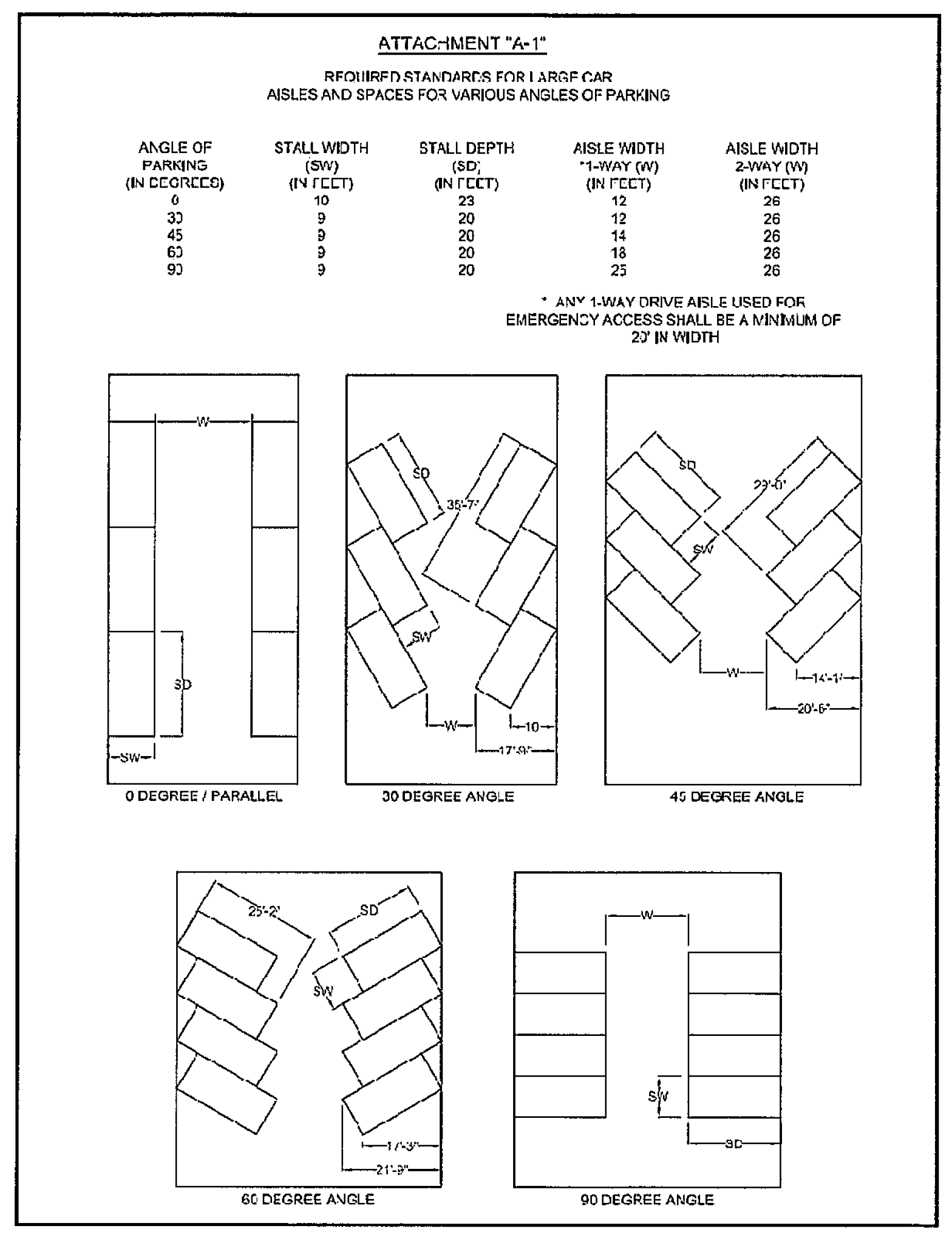
Figure 21-2 Required Standards for Compact Car Aisles and Angled Parking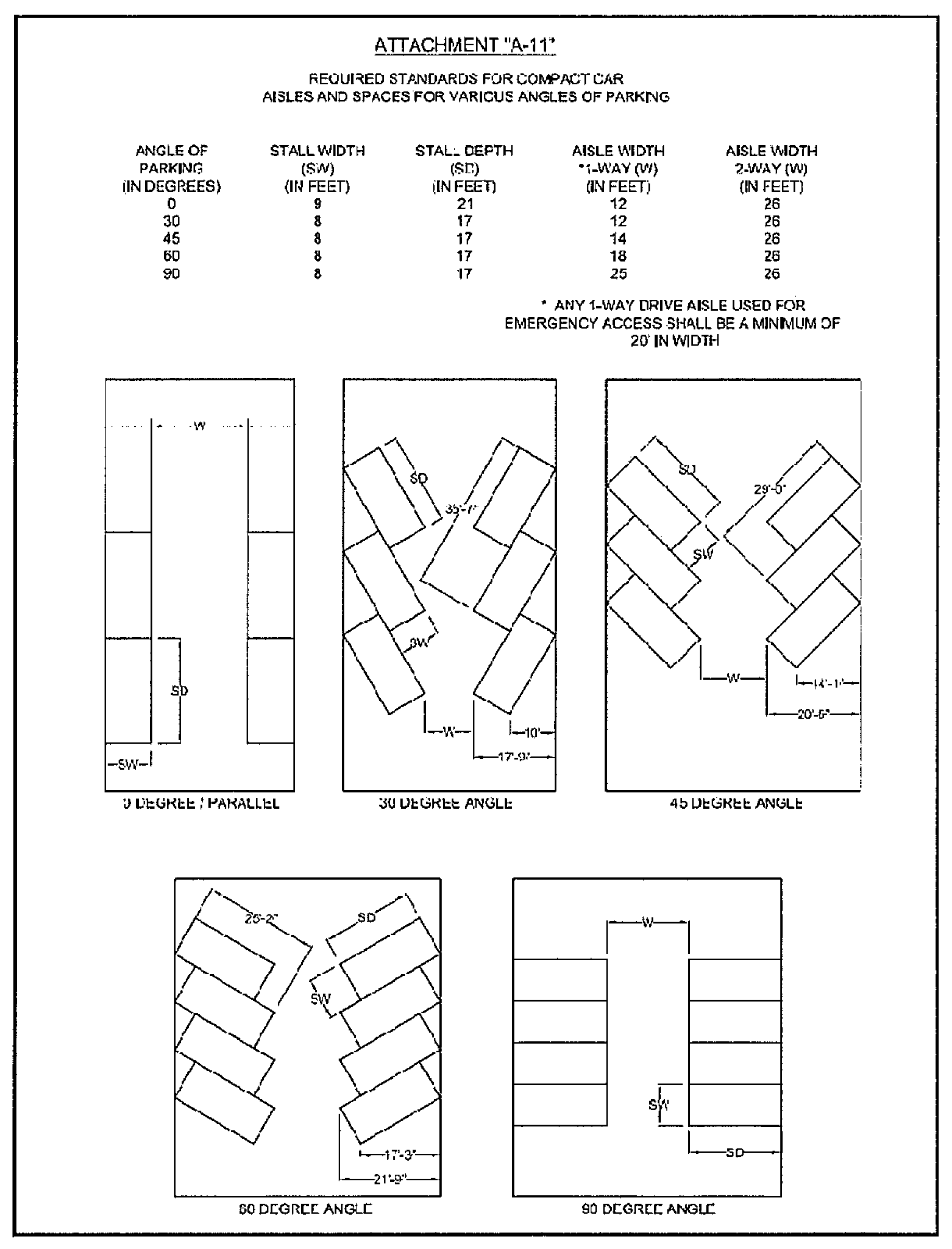
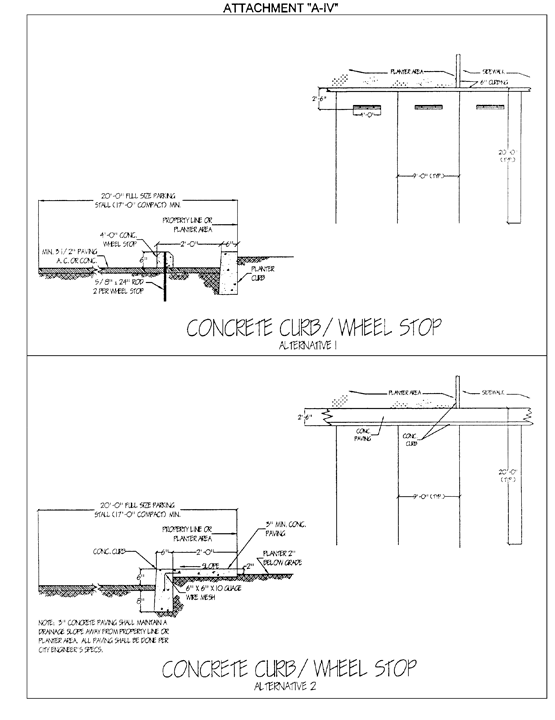
Figure 21-3
Concrete Curb/Wheel Stop
(b)
Location of parking facilities shall be as follows:
(1)
No parking space for a residential use shall occupy any part of a required front yard or shall occupy any part of a required street side yard of a corner lot.
(2)
Where an accessory garage or carport is accessible to vehicles from an alley, it shall be located not less than ten feet from the edge of the property line. Where the required off-street parking spaces are provided within an accessory building, a driveway to serve the off-street parking shall be a minimum of twenty feet in length from the garage structure to the property line.
(3)
Recreational vehicles are allowed to be stored on any developed residential lot provided said recreational vehicles comply with the following standards:
(i)
Recreational vehicles shall not be located within front yard area extending across the full width of the lot between a main building and the front lot line;
(ii)
Recreational vehicles must be under the same ownership as either the owner of the residential lot or the tenant;
(iii)
Recreational vehicles shall be located behind a view obstructing fence, wall or gate. The fence, wall or gate shall be a minimum height of five feet and shall be located between the stored recreation vehicle and street;
(iv)
Recreational vehicles shall not be utilized as living quarters; and
(v)
Recreational vehicle storage locations permitted by this section shall be accessed by an approved driveway approach and paved access that complies with Section 16-3.08.090(d)(2) and Section 16-3.24.030(b)(2) of this code.
Recreational vehicles not in compliance with subsections (3)(i) and (3)(iii) are permitted on a temporary basis not to exceed seventy-two hours, provided the vehicle is parked on a paved concrete surface and does not overhang into the public right-of-way. Additional time may be granted not to exceed a seven consecutive day period, provided a permit is obtained from the Victorville Development Department with application fee paid in accordance with the adopted fee schedule to cover administrative costs. Said recreational vehicle shall not be stored more than twenty-one days per quarter annually. Recreational vehicle parking in front of a third car garage that was legally parked prior to the adoption of this code are permitted to remain in a legal non-conforming status until such a time that a change in ownership of property or recreational vehicle takes place at which point compliance with the standards herein shall be required.
(4)
The off-street parking facilities required by this article shall be located on the same lot of land as the use they are intended to serve; except, in the cases of practical difficulties, the Planning Commission may approve a substitute location which meets the following conditions:
(i)
For Residential Uses. The substitute location abuts the property for which the use being served is located.
(ii)
For Nonresidential Uses. The owner participates in a community lot or parking district, or all or part of the substitute location lies immediately adjacent to or directly across a public alleyway from the principal use for which the parking is being provided.
(c)
Required Improvements. All required parking areas shall have the following improvements:
(1)
All off-street parking areas, vehicle sales, display and storage areas, and any driveway used for access thereto shall be surfaced with portland cement concrete with a minimum of four inches thickness asphalt concrete over an approved base, as approved by the City Engineer.
(2)
All parking areas, excluding single-family dwellings and duplexes, shall be clearly striped to show all parking spaces. Directional surface arrows shall be provided to differentiate between one-way and two-way traffic and between entrance and exit access points to the street or alley.
(3)
Where such parking areas, excluding single-family dwellings and duplexes, adjoin residential districts, they shall be separated therefrom by a solid masonry wall at least six feet in height, not to exceed the maximum height limitations of this Title; provided, such wall shall not exceed four feet in height where it is in the required front yard. The wall height requirement may be reduced or the wall may be eliminated by the Zoning Administrator when determined that the reduction in wall height or its elimination will not have an adverse impact on the adjacent residential property(ies). Where no wall is required by this article along the boundary of parking area, concrete curbs or wheelstops shall be provided along a parking space abutting adjacent properties, public rights-of-way or planter areas. Such curbs or wheelstops shall conform to the minimum dimensions as outlined in Figure 21-3. If an alternate placement of wheelstops is proposed, such placement shall be subject to review and approval by the Zoning Administrator.
(4)
All nonresidential parking areas shall provide landscaping and the maintenance thereof shall be provided in accordance with the provisions of Section 16-3.24.030.
(5)
Lighting, where provided to illuminate any parking area, sales and/or display area, shall be so arranged so as to reflect downward and away from any residential area and shall be designed not to cause a nuisance either to highway traffic or to the living environment.
(d)
Development and maintenance of parking areas: All private streets, public or private parking areas, excluding single-family dwellings and duplexes, including commercial parking lots, vehicle sales area and service stations shall be developed and maintained in good condition in accordance with the provisions of this article. The maintenance thereof may include, but shall not be limited to, the repaving, oiling, striping, and sweeping of a parking area and the repair, restoration and/or replacement of any parking area design features outlined in this article when deemed necessary by the Zoning Administrator to insure the health, safety and welfare of the general public.
(e)
No off-street parking stall shall be located within twenty feet of the intersection of a public right-of-way and a drive approach when said drive approach is used as direct access to said off-street parking stall, as measured from the property line.
(f)
All required parking shall be located in close proximity to the buildings main entrance.
(Ord. No. 2360, § 3, 12-20-16; Ord. No. 2443, § 3, 9-5-23)
Sec. 16-3.21.060: - Landscaping of parking facilities
All off-street parking areas shall comply with the provisions of Section 16-3.24.030.
Sec. 16-3.21.070: - Prohibited on-site parking
(a)
There shall be no parking and/or storage of large vehicles and/or heavy equipment in residential zone districts or on property used for residential purposes. Large vehicles refer to tractor-trailers, 18-wheelers, or the cab portion and shall exclude all recreational vehicles.
(b)
Parking of recreational vehicles shall comply with Section 16-3.21.050 of this code.
(c)
Parking of any vehicle, not otherwise regulated by this code, on a single-family residential lot shall be prohibited unless in a designated driveway that leads to a garage or side yard, or is located behind a legally permitted view obstructing wall or fence at least five-feet in height.
(Ord. No. 2360, § 3, 12-20-16; Ord. No. 2443, § 3, 9-5-23)

