
Walterboro City Zoning Code
CHAPTER 3
- CONDITIONAL USES
Section 3.1 - Purpose
The City of Walterboro finds that there are certain uses that exist which may be constructed, continued, and/or expanded provided they meet certain mitigating requirements specific to their design and/or operation. Such conditions ensure compatibility among other uses. This Chapter specifies those conditions that must be met by all the uses listed as Conditional Uses for each district in Chapter 2.
Each use shall be permitted in compliance with all conditions listed for the use in this Chapter. Certain uses are also classified as Special Exceptions and require Board of Zoning Appeals approval.
Section 3.8 - Agricultural Uses
Reserved for future use.
3.2.1 - Accessory Apartment
A.
In the SFR, MDR, HDR, NCD, GCD zoning districts, either the principal dwelling or the accessory apartment must be occupied by the property owner.
B.
In the HCD, IICD, & ID zoning districts accessory apartments shall only be for the resident caretaker or manager of a permitted use.
C.
Evidence of the accessory apartment should not be readily apparent from the street.
D.
Except for in the CBD zoning district, the maximum size for an accessory apartment, whether attached or detached, cannot exceed 35 percent of the gross floor area of the principal dwelling.
E.
In the CBD Zoning District, if a building is just one story tall, a maximum of 50% of the gross floor area may be used for an accessory apartment and must be situated at the rear of the building, thus preserving the commercial storefront and a minimum of 50% of the gross floor area for commercial use.
In a two-story building only the top floor may be used for an accessory apartment, preserving the ground floor for commercial use.
F.
Lot size shall be at least 50 percent greater in area than the minimum lot requirements for the district in which the apartment is located.
G.
If there is an existing accessory building, a second accessory building may not be erected to allow an accessory apartment unless the lot is at least one-half acre in area.
H.
No more than one accessory apartment shall be allowed per lot.
I.
The accessory apartment must be a complete living space, with kitchen and bathroom facilities separated from the principal unit.
J.
The accessory apartment shall not contain more than two (2) bedrooms.
K.
Detached accessory apartments shall be set back not less than 20 feet from the principal dwelling and shall be located to the side or rear of the principal building as per Section 3.2.2 (E).
L.
The footprint of a principal or accessory building may not be enlarged to allow an accessory apartment without first receiving a Special Exception approved from the Board of Zoning Appeals.
M.
A second floor may not be added to an existing accessory building for an accessory apartment without first receiving a Special Exception.
N.
In no case shall the height of an accessory building containing an accessory apartment exceed the height of the principal building, and in each case it must meet setback requirements in the Dimensional Table in Section 2.5.2.
(Ord. No. 2017-15 , 1-2-18)
3.2.2 - Accessory Structure (Residential)
A.
Accessory structures customarily incidental to residential principal uses are permitted.
B.
All accessory structures shall comply with the standards of the district in which they are located.
C.
No accessory structure shall be established or erected prior to the establishment or erected to the establishment or erection of the principal use to which it is accessory.
D.
No existing accessory use may be expanded or extended except in compliance with the regulations of this Ordinance.
E.
Accessory structures shall only be permitted in the side and rear portions of a lot unless otherwise permitted by Variance.
F.
The following are permitted accessory uses:
1.
Private attached and detached garages and carports
2.
Storage sheds or tool rooms
3.
Detached greenhouses
4.
Children's playhouse and play equipment, including basketball apparatus, volleyball nets, swing sets, jungle gyms
5.
Private dish antennas/satellite earth stations under two (2) feet in diameter
6.
Private above-grade or below-grade swimming pools and pool houses.
G.
The total combined area of accessory structures shall not exceed the size of the principal structure, and no single accessory structure shall exceed 40 percent of the size of the principal structure in square footage.
FIG. 3.1 ACCESSORY STRUCTURE SIZE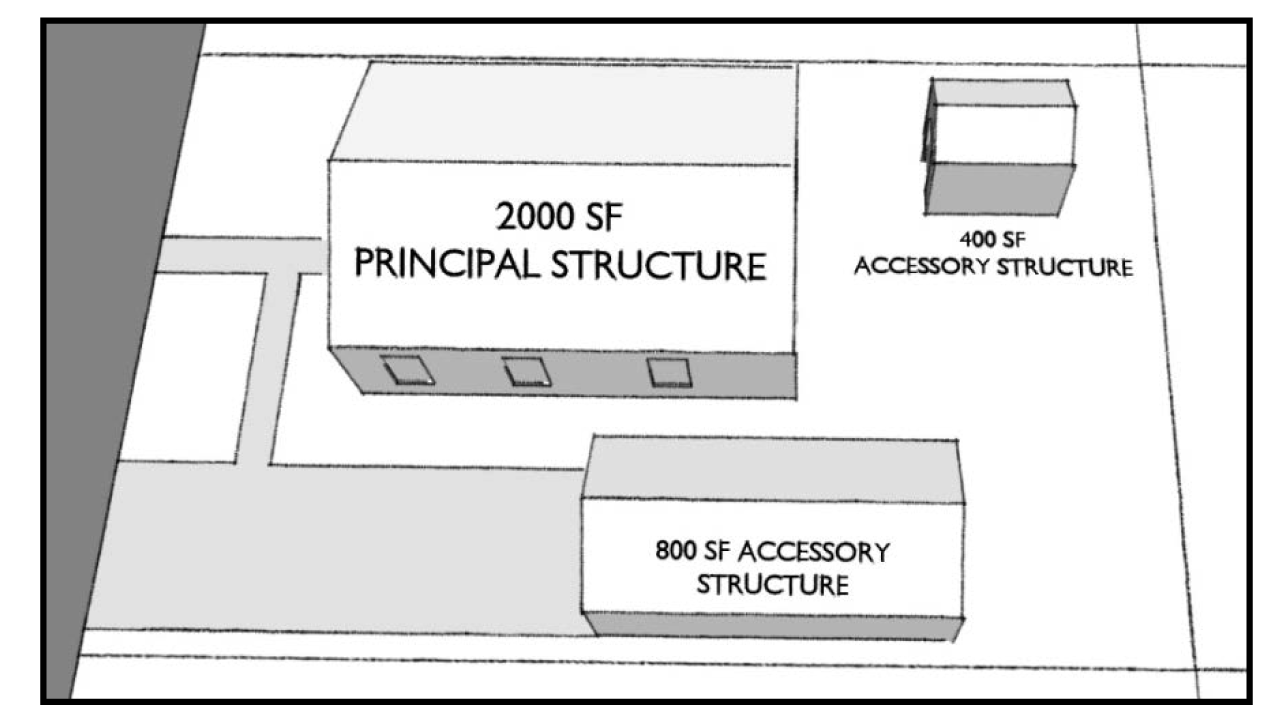
H.
The maximum height for accessory structures shall be the height of the principal structure. Accessory structures that are greater than 15 feet tall shall meet the district setbacks set forth Table 2.5.2 on page 2-13. Accessory structures that are less than 15 feet tall shall meet the following setbacks:
1 No accessory structure shall be located in front of the front building wall of the principal structure.
2 Detached garages shall be set back a minimum of 20 feet from any front or corner side setback.
I.
No manufactured home, mobile home, shipping container, recreational vehicle or similar structure or non-structure shall be used as an accessory building or used as a sign in any manner.
3.2.3 - Bed & Breakfast Inn
A.
The bed and breakfast inns shall only be permitted in the Single-Family Residential zoning district east of Jefferies Boulevard.
B.
The primary use of the structure must remain as a single family residence.
C.
The duration of a guest stay may not exceed thirty (30) consecutive days.
D.
The residence must be owner-occupied.
E.
No more than five (5) guest rooms may be established.
F.
The resident owner shall maintain a current guest register listing the names, addresses and dates of occupancy of all guests.
G.
The property owner shall provide a minimum of two (2) family parking spaces and one (1) additional space per guest room. All parking must be on site and may not fall within the required setbacks.
H.
The bed and breakfast shall be subject to all business licenses, revenue collection ordinance and other codes of the City of Walterboro and State of South Carolina.
I.
Meals may be served only to resident guests.
J.
No special events or functions, for which the owner receives compensation, may be held at the bed and breakfast.
K.
All parking shall be located to the side or rear of the home.
L.
Approval of a property for use as a bed and breakfast establishment shall be transferable with the sale of the property, provided the new property owner certifies compliance with the above stated provisions as part of the issuance or transfer of a business license for the new bed and breakfast establishment.
3.2.4 - Boarding or Rooming House
A.
The maximum number of guest bedrooms shall be five (5).
B.
The boarding house shall be operated by a resident manager.
C.
The use shall be located in a structure which was originally constructed as a dwelling.
D.
The use shall contain only one (1) kitchen facility. Meals served on the premises shall be only for overnight residents and guests of the facility.
E.
The parking area shall be located to the side or rear of the building and shall be screened with landscaping from adjacent properties.
3.2.5 - Conservation Development
The purpose of Conservation Development design is to preserve agricultural and forestry lands, natural and cultural features, and environmentally sensitive areas that would be likely lost through conventional development approaches. Lot widths and setbacks in residential districts may be reduced subject to the following requirements:
A.
The development density shall not exceed the overall density permitted in the zoning district in which the development is located.
B.
The district setbacks set forth in Section 2.5 shall apply along the boundaries of the development. Setbacks within the development shall be set forth as part of the design process as outlined in Subsection (D) below.
C.
A minimum of 50 percent of the total area of the development shall be set aside in Common Open Space and shall meet the requirements of Section 6.6.
D.
Each Master Plan for a Conservation Development shall follow a four-step design process as described below. When the conceptual Master Plan is submitted, applicants shall be prepared to demonstrate to the City that these four design steps were followed by their site designers in determining the layout of their proposed streets, house lots and greenway lands.
1.
During the first step all potential Conservation Areas (both Primary and Secondary) shall be identified, using the Existing Features Plan described in Section 6.2. Primary Conservation Areas shall consist of wetlands, floodplains, steep slopes (greater than 25%), and other environmentally protected areas. Secondary Conservation Areas shall include the most sensitive and noteworthy natural, scenic and cultural resources including viewsheds, rock outcroppings, specimen trees, significant tree stands, and historic sites.
2.
During the second step, potential building sites are tentatively located. Because the proposed location of the buildings within each lot represents a significant decision with potential impacts on the ability of the development to meet the requirements of the Ordinance, applicants shall identify tentative house sites on the conceptual Sketch Plan. House sites should be located not closer than 50 feet to Primary Conservation Areas.
3.
The third step consists of aligning proposed streets to provide vehicular access to each house in the most reasonable and economical way. When lots and access streets are laid out, they shall be located in a way that avoids, or at least minimizes, adverse impacts on both the Primary and Secondary Conservation Areas. Wetland crossings shall be avoided. Street connections shall be provided to minimize the number of cul-de-sacs and to facilitate easy access to and from homes in different parts of the property (and on adjoining parcels).
4.
The fourth step is simply to draw in the lot lines where applicable.
FIG. 3.2 CONSERVATION DEVELOPMENT EXAMPLE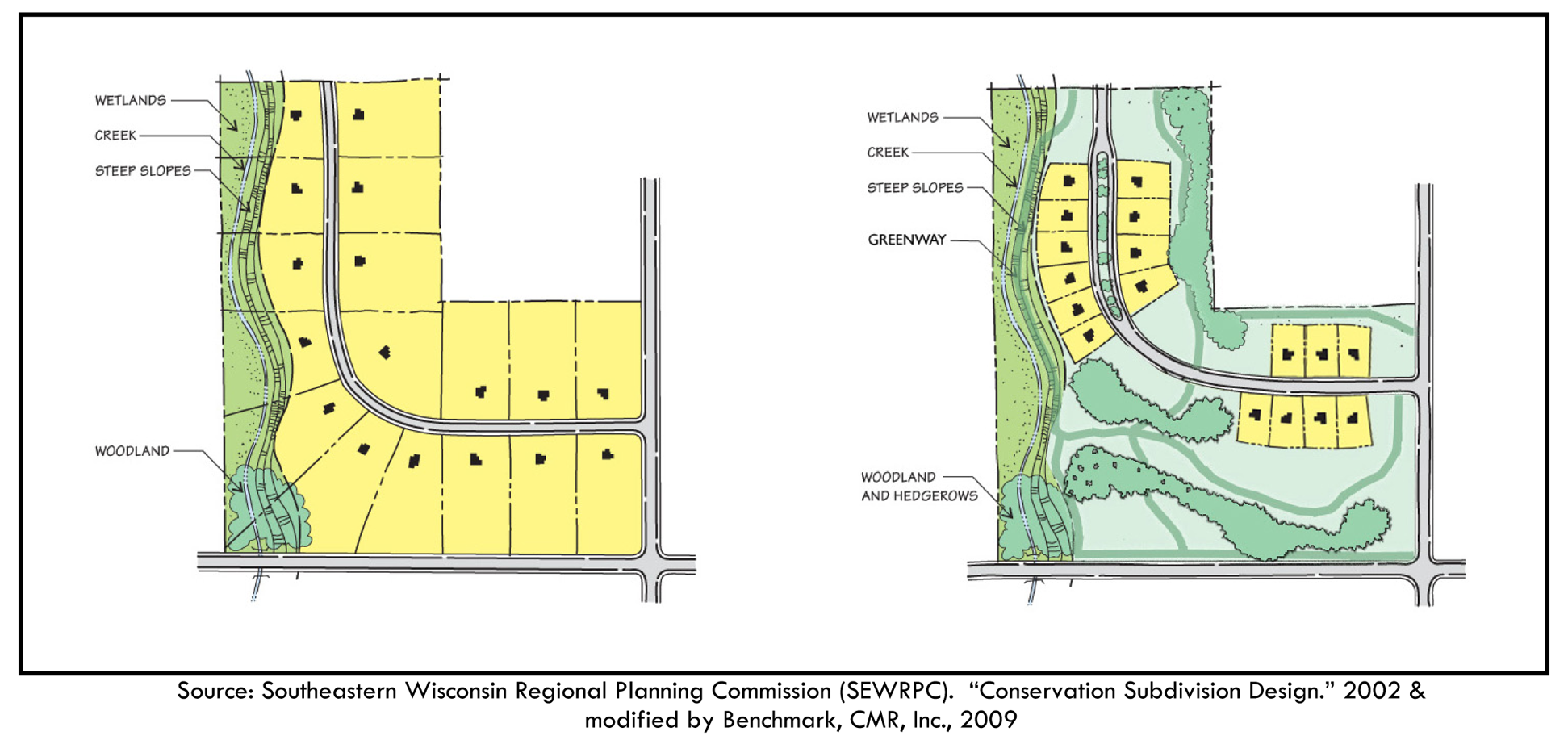
3.2.6 - Family Care Homes for the Handicapped
In accordance with SC Code 6-29-770(E) Family Care Homes for the Handicapped are deemed residential uses and are permitted in all districts where single-family residential homes are permitted subject to the following conditions:
A.
No more than nine (9) mentally or physically handicapped residents other than the homeowner and the homeowner's immediate family are permitted to live in a Family Care Home.
B.
The operator of the home shall give prior notice to the local governing body advising of the exact site of the proposed home. The notice must identify the individual responsible for site selection.
C.
If the City objects to the selected site, it must notify the individual responsible for site selection within 15 days of receiving notice and must appoint a representative to assist in selecting a comparable alternate site. This triggers the following:
1.
The site selection representative of the entity proposing the project and the City representative select a third mutually agreeable person.
2.
The three (3) people have 45 days to make a final site selection by majority vote.
3.
This final site selection is binding for both the proposing entity and the governing body.
4.
In the event that no selection has been made at the end of the 45 day period, the entity selecting the site may select the site without further proceedings.
D.
A home shall be licensed with the State of South Carolina before operating.
E.
Prospective residents of these homes must be screened by the licensing agency to ensure that the placement is appropriate.
F.
The licensing agency shall conduct reviews of these homes no less frequently than every six (6) months for the purpose of promoting the rehabilitative purposes of the homes and their confirmed compatibility with their neighborhoods.
G.
No exterior signage is permitted.
H.
No lockdown, violent, or dangerous residents.
I.
Only incidental and occasional medical care may be provided.
3.2.7 - Home Occupation
3.2.7.1 Customary Home Occupation
A.
A home occupation, or home-based business, is that accessory use of a dwelling that shall constitute either entirely or partly the livelihood of a person living in the dwelling.
B.
The primary use of the structure must remain as a residential dwelling. No more than 25 percent, to a maximum of 750 square feet, whichever is less, shall be used for the purposes of a home occupation.
C.
A home occupation shall be conducted solely by resident occupants plus no more than one (1) additional full-time equivalent employee.
D.
There shall be no outside storage or processing. All activity must be conducted within a pre-existing structure.
E.
The activity shall produce no alteration or change in the residential character or outside appearance of the primary structure.
F.
No goods are located on site except for samples or designs produced on site.
G.
The activity shall be subject to all business licenses, revenue collection ordinance and other codes of the City of Walterboro and the State of South Carolina.
H.
Activities specifically prohibited include repair or service of motor vehicles and other large equipment; service or manufacturing processes which would normally require industrial zoning; any activity which may become a nuisance due to noise, unsightly appearance, heat, glare, vibration, smoke, dust, electrical interference, unhealthy conditions or odor; and any activity which may affect surrounding property.
I.
There shall be no exterior display or signage allowed except for one (1), unlighted sign less than two (2) square feet in size mounted on a wall of the principal building.
J.
No traffic or parking activity, sewerage or water use shall be generated by the activity in greater volumes than would normally be expected in a residential neighborhood; any need for parking generated by such home occupation shall be met off the street and other than in a required front yard.
3.2.7.2 Child Care Home Occupation
In addition to the requirements for a Customary Home Occupation, the following requirements shall apply to a Child Care Home Occupation:
A.
Child Care Home Occupations shall be limited to a maximum of six (6) children in addition to any children of the operator.
B.
A minimum of 100 square feet of outdoor play area per child shall be provided in the rear yard. This area shall be fenced to a minimum height of four (4) feet.
C.
A minimum of one (1) off-street parking space shall be required for each two children in addition to the minimum number of parking spaces required for a residence as set forth in Section 8.3.
3.2.8 - Mobile Home Park
The intent of these Mobile Home Park (MHP) conditions is to ensure the provision of a high quality residential environment, to meet the needs of inhabitants of mobile home parks, to protect mobile home parks from encroachment by incompatible uses, and to encourage the consolidation of mobile homes into mobile home parks. In order to qualify for a Certificate of Zoning Compliance, a proposed park must meet the requirements listed below.
A.
Mobile homes at a density not to exceed four (4) units per acre are permitted.
B.
Accessory structures shall meet the requirements of Section 3.2.2.
C.
The following dimensional standards shall apply:
D.
Two on-site parking spaces shall be provided for each mobile home space.
E.
Mobile Home Parks shall meet the buffer requirements of Section 7.3.1. The streetyard requirements of Section 7.3.4 shall also be met where the MHP abuts a public street.
3.2.9 - Multi-Family Dwelling
A.
No building shall exceed a length of 150 feet.
B.
A distance of at least 20 feet shall be maintained between all buildings within the development.
C.
All sanitary containers shall be completely screened from view of the street and adjacent properties with fencing and/or landscaping.
D.
Multi-family dwellings shall not occupy the first floor or ground level in the CBD.
3.2.10 - Temporary Emergency Residences
Mobile homes may be allowed on a temporary basis in a zoning district in which such use is not listed as a permitted use, if a disaster occurs which results in an occupied dwelling being destroyed (i.e., it receives damage greater than 60 percent of its tax value as indicated on the most current tax listings). In this instance, a mobile home may be placed on the lot containing the dwelling unit which was destroyed. The purpose of allowing such mobile home on said lot is to give the occupants of the destroyed dwelling unit a place to live while a new dwelling unit is being constructed or damage to the original dwelling unit is being repaired. If a mobile home is used for such an occurrence, it is subject to the following conditions:
A.
Temporary emergency residences shall not be placed in the front yard and shall be located no closer than 15 feet to another principal residential structure on another lot and no closer than 10 feet to any lot line.
B.
The Administrator shall be given the authority to issue a Certificate of Zoning Compliance for such temporary residence on a one-time basis only for a period of up to one (1) year. Such permit may be renewed on a one-time only basis (for a period of no greater than six (6) months) by the Administrator.
3.3.1 - Assembly Hall, Community Center
Assembly halls and community centers in the SFR, MDR, HDR, or NCD districts shall have maximum hours of operation from 10AM until midnight.
3.3.2 - Daycare Center
A.
Hours of operation shall be limited from 7:00am to 7:00pm
B.
The lot on which the daycare center is located shall have access onto an arterial or collector street in residential zoning districts.
C.
Evidence that the facility will meet the minimum requirements to qualify for a State of South Carolina License is satisfied shall be submitted with the application.
D.
Evidence shall be submitted indicating that adequate access to and from the site, as well as adequate space off the road right-of-way, is provided for the safe pick-up and discharge of clients and is provided in such a manner that traffic generated by the facility is not disruptive to adjacent residentially developed properties.
E.
Fencing and/or screening shall be provided that assures the protection of clients receiving care, protects adjacent residentially developed properties from trespass, effectively screens the view of any outdoor recreational areas, and reduces noise associated with the operation of the use.
3.3.3 - School & Associated Facilities (public & private, elementary & secondary)
A.
Schools in the CBD shall be limited to maximum hours of operation of 7:00am until midnight.
B.
Site plans submitted for review shall include the following information in addition to the standard site plan requirements of Chapter 12:
1.
Total student capacity of the school as designed;
2.
Total number of employees on the largest shift;
3.
Number and dimensions of designated parking spaces for school buses;
4.
Number of designated parking spaces for employees, visitors, and students;
5.
Location of student drop-off points with stacking spaces identified;
6.
Location of all proposed and future athletic fields and structures, including the total number of seats for spectators and the location of concession stands, if any are anticipated;
7.
Proposed public roadway improvements; and
8.
Existing and proposed infrastructure improvements.
C.
A lighting plan shall be submitted indicating the locations of outdoor lighting fixtures and ensuring that outdoor lighting from athletic field and security lighting will not spill over onto adjacent properties.
D.
A report indicating estimated water usage for structures, landscaping, and athletic fields shall be submitted with the application.
E.
The project shall meet all applicable requirements of this Ordinance.
F.
The project shall meet all service provision criteria as set forth below:
1.
Water Supply - identification of public or private utility source and capacity of water supply or identification of water source through a water resource study.
2.
Wastewater Treatment Method - provider and capacity of wastewater treatment source.
G.
The minimum lot size shall be, with respect to non-charter public schools, as required by the Colleton County School Board. The lot size shall be adequate to accommodate all activities. The proposed manner to handle the maximum number of participants and patrons for any single event shall be provided while also adhering to safe vehicular and pedestrian circulation.
H.
There shall be a minimum of two (2) access points to the site. Access points shall separate student drop-off areas and visitor parking from bus traffic. If school buses are used, then at least one access shall be limited to school employee and bus use during normal school hours. All access points shall be located to provide maximum visibility and safety. No driveway shall be permitted in a location that will hinder or congest traffic movement on a public street.
I.
The site shall be designed so as to take advantage of shared use opportunities, such as use for parks and recreation activities as needed by the City of Walterboro and/or Colleton County.
J.
All State permits and licenses that are required for the facility or evidence that the facility can meet all requirements shall be submitted with the application.
3.4.1 - Alternative Financial Service Institution
A.
The business shall be located no closer than 3,000 feet, measured lot line to lot line, from the nearest alternative financial services institution
B.
The business institution must be located either:
1.
within a group nonresidential development, shopping center, or the like with all structures constituting a minimum of 30,000 heated square feet; or
2.
wholly within the confines of a grocery store or general merchandise retail establishment having a minimum of 30,000 heated square feet with no separate access to the exterior of the building.
C.
An alternative financial services institution that does not comply with the standards set forth in this Section shall not be reestablished after vacancy, abandonment, or discontinuance for any consecutive 30-day period. An alternative financial services institution shall not be relocated without compliance with the standards set forth in this Section.
3.4.2 - Animal Services (with kennels)
A.
No outdoor containment of animals shall be located less than 100 feet from any residentially zoned property.
B.
Kennel areas must be surrounded by an opaque fence of not less than six (6) feet in height and enclosed as to prevent escape.
C.
Kennels shall be designed to effectively buffer noise audible to surrounding properties.
D.
All animals shall be kept indoors overnight.
3.4.3 - Artist, Craftsmen
A.
All activities associated with the business shall take place in a fully enclosed building.
B.
No noise, odor, or light trespass on adjacent properties shall be created.
3.4.4 - Automotive & Boat Service, Car Wash
A.
The lot shall front on a collector or arterial street and have direct access thereto. Proposals for lots with double frontage that desire multiple driveways shall be limited to one curb cut on the higher classified street. Additional cuts shall be on streets of lower classification.
B.
Adequate provision shall be made for ventilation and the dispersion and removal of fumes, and for the removal of hazardous chemicals and fluids. Hazardous materials and byproducts such as fuel, lubricants, antifreeze (ethylene glycol), asbestos, freon, carbon monoxide, automobile batteries, and solvents must be registered, stored, handled, and disposed of in accordance with all State and Federal regulations.
C.
Air compressors, hydraulic hoists, pits, repair equipment, greasing and lubrication equipment, and similar equipment shall be entirely enclosed within a building.
D.
All outdoor storage must be screened in accordance with Section 7.6.
E.
The number of vehicles temporarily stored outdoors shall not exceed the number of service bays at the establishment. No vehicles may be parked outside of a screened storage area overnight.
F.
Canopy overhangs shall be at least five (5) feet from property lines and street rights-of-way.
G.
Certification by a registered, licensed engineer shall be required to ensure the prevention of petroleum and petroleum related product runoffs into the existing storm drainage system.
H.
All garbage and refuse shall be stored in mechanical loading containers located at the rear of the lot or building, but not less than 20 feet from any adjacent property lines.
I.
A photometric lighting plan shall be submitted with the site plan that includes fixture details, light intensity contours and overlap, and a statement regarding light trespass on adjacent properties. Lighting shall not exceed six (6) footcandles anywhere on the site and shall not exceed one (1) footcandle at the property line.
J.
No outdoor servicing, repair or disassembly of vehicles shall be permitted.
K.
All carwashes shall comply with SCDHEC regulations concerning runoff and obtain a National Pollutant Discharge Elimination System (NPDES) "General Permit for Vehicle Wash Water Discharges."
( Ord. No. 2014-02 , 5-13-14)
3.4.5 - Body Piercing & Tattoo Studios
A.
All body piercing and tattooing shall take place in an area of the establishment that cannot be viewed by other customers or by the general public from any public or private street right-of-way or any area commonly accessed by the public (i.e. parking lots, mall corridors, promenades, sidewalks), whether on the same or a nearby property.
B.
Window signs and displays shall be limited to business identification, open and closed signs, and hours of operation.
3.5.1 - Automotive or Boat Sales, Rental
A.
A permanent structure with permanent restroom facilities built in accordance with SC Building Code shall be located on the premises.
B.
The lot shall front on a collector or arterial street and have direct access thereto.
C.
No outdoor sound system shall be permitted which can be heard beyond the boundaries of the property.
D.
No vehicle or boat shall be stored or displayed within the right-of-way of any public street.
3.5.2 - Mobile Home and Portable Building Sales
A.
No mobile home or portable building shall be located within 50 feet of a street right-of-way.
B.
Display homes along the street shall be parallel to the street and be set up to look like residences, including skirting.
C.
Unassembled structures shall not be visible from the street.
D.
Access drives shall be paved at least 50 feet from the street.
3.5.3 - Open Air Market (including farmers' markets, produce markets)
A.
All sales shall take place under cover of an approved structure or tent.
B.
Adequate restroom facilities shall be provided. These facilities shall not be located between the market and the street right-of-way and shall be screened from view.
C.
Trailers for delivery or pick-up may be stored temporarily on-site for not more than three (3) days at a time and shall be to the rear of the permanent structure.
D.
When the open air market is not open for business, all items shall be removed or screened from view.
3.5.4 - Retail Use (outside fully enclosed building)
A.
A permanent structure with permanent restroom facilities built in accordance with SC Building Code shall be located on the premises.
B.
Items for sale shall not be displayed within any right-of-way.
C.
No outdoor sound system shall be permitted which can be heard beyond the boundaries of the property.
3.5.5 - Food Trucks/Trailers
1.
A valid food truck/trailer vending permit issued by the Planning Department is required prior to setting up or selling merchandise. Permit certificates shall be attached to the mobile vending unit where they are readily visible, and shall include the current name, mailing address and valid phone number of the food truck vending unit owner;
2.
Permitted merchandise shall be limited to edibles, hot and cold beverages containing no alcohol, and items related to such merchandise;
3.
Sales must take place on private property within permitted zoning districts, unless taking place as part of a City approved special event.
4.
Permission to operate must be obtained, in writing, from the property representative; and must be filed with the Planning and Development Department of the City prior to commencing sales. Additionally, a copy of permission document must be on site during sales;
5.
Required parking for the primary business(es) shall be minimally affected;
6.
Signage shall be permitted on the vehicle only to identify the name of the product or the name of the vendor, and the posting of prices. A separate menu board is allowed, not exceeding 12 square feet in area and 40 inches height. This sign must be located on the same property as and within close proximity to the food truck/trailer, and should not be placed on the sidewalk or in the public right-of-way;
7.
The food truck/trailer shall only use single-service plates and utensils. Garbage and recycling receptacles must be made available for patron use and removed from the site daily by the vendor;
8.
The food truck/trailer must comply with all requirements and regulations as established by SCDHEC in the Retail Food Establishments Regulation 61-25, including but not limited to:
A.
The food truck/trailer shall have a potable water system under pressure. The system shall furnish hot and cold water for all food preparation, utensil cleaning, and handwashing. The water inlet shall be located so that it will not be contaminated by waste discharge, road dust, oil, or grease, and it shall be kept capped unless being filled;
B.
Grease must be contained and disposed of in an approved grease receptacle located at the associated commissary;
C.
Grey water must be contained and disposed of in a sanitary sewer at the associated commissary;
9.
The food truck/trailer shall prominently display the SCDHEC letter grade;
10.
Any food truck/trailer that has been issued a notice of health violation by any department of the State of South Carolina, which remains uncorrected upon a subsequent inspection, shall have its food truck/trailer permit revoked;
11.
All food truck/trailers must obtain from the City an appropriate, current business license;
12.
No food truck/trailer operator shall:
A.
Leave the food truck/trailer unattended on sales site;
B.
Store, park or leave any vehicle overnight on any street or sidewalk;
C.
Leave from any location without first picking up, removing and disposing of all trash or refuse remaining from sales made by the operator;
D.
Solicit or conduct business with persons in motor vehicles;
E.
Sell anything other than that for which a license to vend has been issued;
F.
Sound or permit the sounding of any device that produces a loud and raucous noise, or use or operate any loudspeaker, public address system, radio, sound amplifier or similar device to attract the attention of the public;
G.
Allow any item relating to the operation of the vending business to lean against or hang from any building or other structure lawfully placed on public property;
H.
Change vending locations without first notifying the Planning Department and submitting the required permissions and site plan; and
13.
Food truck/trailer operators must provide hand sanitation for customers;
14.
Food trucks/trailers shall operate in conjunction with a permitted retail food establishment authorized to operate as a commissary and shall report at least daily to the designated commissary for supplies, storage of foodstuffs, cleaning, and servicing;
15.
Exemptions. Catered events, special events, and mobile food vendors that fall under a peddler's permit.
(Ord. No. 2018-14 , 10-2-18)
3.6.1 - Campground
A.
All spaces for camping and recreational vehicles shall be located at least 100 feet from any adjoining lot line.
B.
Each recreational vehicle parking area shall be connected to an approved water supply system which provides an accessible, adequate, safe and potable supply of water.
C.
An adequate and safe sewer system shall be provided in all recreational vehicle parking areas.
D.
A buffer installed in accordance with Section 7.3.1 shall be provided where the use adjoins residentially-zoned or residentially-developed property.
E.
A central service building containing all necessary toilets, bathhouses and other plumbing fixtures specified in the most current edition of the Plumbing Code, as amended, shall be provided. The service building shall be conveniently located within a radius of 300 feet to spaces which it serves.
F.
The storage, collection and disposal of trash and refuse shall comply with all applicable city, county and state regulations.
G.
No person, recreational vehicle, or tent may occupy the campground for a period in excess of 30 days. A register of all occupants, the space occupied, and the time of arrival and departure shall be maintained.
3.6.2 - Recreation or Entertainment Use (in CBD)
Maximum hours of operation are 8:00am to midnight if located in the CBD or within 100 feet of residentially-zoned or used property.
3.6.3 - Sexually Oriented Business
3.6.3.1 Purpose
It is the purpose of this Section to regulate sexually oriented businesses to promote the health, safety, morals, and general welfare of the citizens of the City, and to establish reasonable and uniform regulations to prevent the deleterious location and concentration of sexually oriented businesses within the City. The provisions of this Section have neither the purpose nor effect of imposing a limitation or restriction on the content of any communicative materials, including sexually oriented materials. Similarly, it is not the intent or effect of this article to restrict or deny access by adults to sexually oriented materials protected by the first amendment nor to deny access by the distributors and exhibitors of sexually oriented entertainment to their intended market. Neither is it the intent or effect of this article to condone or legitimize the distribution of obscene material. All other regulations and standards covering the ID shall also apply to sexually oriented businesses.
3.6.3.2 Permit Required
A.
A sexually oriented business is prohibited from operating within the city limits without a valid Certificate of Zoning Compliance issued by the City. The permit, if granted, shall state on its face the name of the person or persons to whom it is granted, the expiration date, and the address of the sexually oriented business. The permit shall be posted in a conspicuous place at or near the entrance to the sexually oriented business so that it may be easily read at any time. The fact that a person possesses other types of state or county permits and/or licenses does not exempt him from the requirement of obtaining a Certificate of Zoning Compliance from the City.
B.
The application for a Certificate of Zoning Compliance must be accompanied by a sketch plan, drawn to scale, showing the property and the configuration of the premises, including a statement of total floor space occupied by the business. The sketch or diagram must be drawn with marked dimensions of the interior of the premises to an accuracy of plus or minus six (6) inches.
C.
If a person who wishes to operate a sexually oriented business is an individual, he or she must sign the application for a permit as applicant. If the business owner or operator is other than an individual, each person who has a 10 percent or greater interest in the business must sign the application for a permit. If a corporation is listed as owner of the business or as the entity that wishes to operate such a business, each individual having a ten (10) percent or greater interest in the corporation must sign the application for a permit.
D.
Before a Certificate of Zoning Compliance can be issued, the premises must be inspected and found to be in compliance with all applicable statutes and regulations by DHEC, the Public Safety Department, and the Planning and Codes Department. Inspections shall be completed within 21 days of receipt of a complete application for a Certificate of Zoning Compliance. At the conclusion of its inspection, each department or agency shall indicate in writing the results of the inspection, date it, sign it, and forward a copy of the inspection to the Administrator.
E.
Within 30 days after receipt of a complete application, the Administrator shall either approve or deny the Certificate of Zoning Compliance.
F.
The permit application shall be denied by the Administrator if he finds that the proposed sexually oriented business will be in violation of any provision of any statute, code, ordinance, regulation or other law in effect in the City.
G.
If the application is denied, the Administrator shall notify the applicant of the denial in writing and shall state the reason(s) for the denial.
H.
If a person applies for a permit for a particular location within a period of twelve (12) months from the date of denial of a previous application for a permit at the location, and there has not been an intervening change in the circumstances that could reasonably be expected to lead to a different decision regarding the former reasons for denial, the application shall be denied.
I.
The annual fee for a sexually oriented business permit is set forth in the City of Walterboro Comprehensive Fee Schedule. Said fee is in addition to the City of Walterboro Business License and other applicable fees or permits.
3.6.3.3 Permit Expiration
A.
Each permit shall expire one (1) year from the date of issuance and may be renewed only by making application as provided herein.
B.
Application for renewal should be made at least 30 days before the expiration date, and when made less than 30 days before the expiration date, the expiration of the permit will not be affected.
C.
If a permit expires, or an application for permit renewal is denied, the applicant shall not be issued a permit for one (1) year from the date of denial. If, subsequent to denial, the Administrator finds that the basis for denial of a renewal permit has been corrected or abated, the applicant may be granted a permit if at least 90 days have elapsed since the date of denial.
3.6.3.4 Suspension of Permit
A.
The Administrator may suspend a permit at any time if he or she determines that a permittee is not in compliance with any portion of this sub-section or if the sexually oriented business is in violation of a building, fire, health, or zoning statute, code or regulation. Such determination shall be based on investigation by the department or agency charged with enforcing said rules or laws.
B.
In the event of a violation, the Administrator shall promptly notify the permittee of the violation in writing. The permittee shall have seven (7) days from being notified to correct the violation. If the permittee fails to correct the violation before the expiration of the seven-day period, the Codes Enforcement Officer shall suspend the permit and shall notify the permittee in writing of the suspension.
C.
The suspension shall remain in effect until the violation has been corrected.
3.6.3.5 Revocation of Permit
A.
The Administrator shall revoke a permit if a cause for suspension in Section 3.6.3.4 (above) occurs and the permit has been suspended within the preceding 12 months.
B.
When the Administrator revokes a permit, the revocation shall continue for one (1) year from the date the revocation becomes effective. If, subsequent to revocation the zoning administrator finds that the basis for the revocation has been corrected or abated, the applicant may be granted a permit if at least 90 days have elapsed since the date the revocation became effective.
3.6.3.6 Transfer of Permit
A permittee shall not transfer his permit to another, nor shall a permittee operate a sexually oriented business under the authority of a permit at any place other than the address designated in the permit application.
3.6.3.7 Location of Sexually Oriented Business
A.
A sexually oriented business may be located only within a designated Industrial District (ID).
B.
No sexually oriented business shall be permitted within 750 feet of:
1.
Any religious institution
2.
Any public or private daycare center, kindergarten, elementary or secondary school
3.
The boundary of any designated residential zoning district
4.
A public park, landscaped area designed for public use or recreation area
5.
The property line of a lot devoted to residential use
C.
For purposes of this Section, measurement shall be made in a straight line, without regard to intervening structures or objects, from the nearest portion of the building or structure used as a part of the premises where a sexually oriented business is conducted, to the nearest property line of the premises of a church or public or private daycare center, kindergarten, elementary or secondary school, or to the nearest boundary of an affected public park, residential district, or residential lot.
D.
A sexually oriented business shall not be operated within 500 feet of another sexually oriented business.
E.
A sexually oriented business lawfully operating as a conforming use is not rendered a nonconforming use by the location, subsequent to the grant or renewal of the sexually oriented business permit, of a church, public or private day care center, kindergarten, elementary or secondary school, public park, residential district or residential lot within 750 feet of the sexually oriented business. This provision applies only to the renewal of a valid permit and does not apply when an application for a permit has expired or been revoked.
3.6.3.8 Advertising, Parking and Lighting
A.
Any activity prohibited by any applicable state statute or local ordinance shall not be advertised at any sexually oriented business.
B.
Displays or exhibitions of materials and/or performances at any sexually oriented business shall not be visible outside the premises. This prohibition shall not extend to advertising of the existence or location of such sexually oriented business provided that the name of the business is not expressed in sexually explicit or offensive nomenclature.
C.
No portion of the interior premises of any sexually oriented business shall be visible from outside the premises.
D.
All off-street parking areas shall be located in front of the building for safety reasons. All off-street parking and premise entries of the sexually oriented business shall be illuminated from dusk to closing hours of operation with a lighting system which provides an average maintained horizontal illumination of one (1.0) foot candle of light on the parking surface and/or walkways. This required lighting level is established in order to provide sufficient illumination of the parking areas and walkways serving the sexually oriented business for the personal safety of patrons and employees and to reduce the incidence of vandalism and criminal conduct. The lighting shall be shown on the required sketch or diagram of the premise.
3.6.3.9 Hours of Operation
No sexually oriented business shall remain open for business, nor shall any employee of such business engage in a performance, solicit a performance, make a sale, solicit a sale, provide a service, or solicit a service, between the hours of 1:00 AM and 9:00 AM on any particular day and between 12:01AM Sunday and 9:00 AM Monday.
3.7.1 - Junkyards, Salvage Yards, Recycling Operations, & Similar Uses
A.
A junkyard may not be placed within 50 feet of a public street right-of-way.
B.
Junkyards shall be screened so as not to be visible from any public street right-of-way using a minimum six (6) foot privacy fence. No items may be stacked in a manner so that they protrude above the top of the fence.
C.
Burning shall not be permitted.
D.
Disposal of garbage shall be in an approved container and regularly maintained. Open dumping of garbage shall be prohibited.
E.
Disposal of toxic/hazardous matter is prohibited anywhere without a state permit.
F.
Stock piling of tires and batteries is prohibited.
G.
Storage of items shall be so arranged as to permit easy access for fire fighting purposes.
3.7.2 - Storage, Mini-warehouse
A.
This use shall not be located within 500 feet of another storage/mini warehouse facility.
B.
All outdoor storage shall be located in the rear yard only.
C.
All outdoor storage shall be screened from view of the street with an opaque screen meeting the requirements of Section 7.6.
3.9.1 - Accessory Structure (non-residential)
A.
All accessory structures shall comply with the district setbacks.
B.
Accessory structures shall only be permitted in the side or rear yard, unless otherwise stated in this Ordinance.
C.
No accessory use shall be established or erected prior to the establishment or erection of the principal use to which it is accessory.
D.
No existing accessory use may be expanded or extended except in compliance with the regulations of this Ordinance.
3.9.2 - Drive-through Use
A.
Stand alone drive through ATMs may be permitted as accessory uses (i.e. in a shopping center parking lot).
B.
Drive-through lanes shall not be located to the front of a building or facing the primary street.
C.
Vehicle storage for drive-throughs shall be located outside of and physically separated from the right-of-way of any street. This area shall not interfere with the efficient internal circulation of traffic on the site, adjacent property, or adjacent street right-of-way. There shall be adequate vehicular stacking area so that vehicles waiting for the drive-through do not back up into the street.
3.9.3 - Outdoor Storage (non-residential)
A.
All outdoor storage shall be located in the side or rear yard only.
B.
All outdoor storage shall be screened from view of the street with an opaque screen meeting the requirements of Section 7.6.
3.9.4 - Telecommunications Tower
3.9.4.1 Purpose
This Section applies to any structure designed to receive telecommunication and data communications signals from orbiting satellites including, but not limited to, antennae, satellite receiving dishes, and telecommunications towers.
3.9.4.2 Special Exception Process for Telecommunications Towers
Telecommunications towers are permitted only as a Special Exception. Special exceptions are reviewed by the Board of Zoning Appeals in accordance with Section 11.3. Additional factors or those which should be given special consideration by the Board of Zoning Appeals concerning telecommunication towers include the following factors:
A.
The design, location, and height of the proposed tower must not detract from the aesthetic and neighborhood character or impair the use of neighboring properties. Additional consideration must be given to properties located within the Historic Preservation Overlay or in close proximity to the Historic Preservation Overlay.
B.
The applicant must demonstrate that additional height is necessary for providing service to occupants of an area within the City.
C.
The applicant must demonstrate that the tower is designed to fall in such a way that provide for public safety, specifically that the tower's fall zone does not include residential property or residentially-zoned land.
D.
Whether all other provisions of this Ordinance have been met.
3.9.4.3 Development Standards for Telecommunications Towers
The following development standards shall apply to all telecommunication towers:
A.
Setbacks.
1.
Telecommunication towers shall be set back a distance equal to the height of the tower plus 50 feet from any residential structure. This setback may be waived or reduced by the owner of the affected residential structure through a notarized affidavit.
2.
Telecommunication tower setbacks from all lot lines shall be a minimum of 20 feet plus the linear measurement of the tower's fall zone as certified by a Registered Professional Engineer.
3.
Guy wire anchors, equipment buildings, and other facilities supporting telecommunication towers shall satisfy the minimum setback requirements in the underlying zoning district.
4.
All setback distances for towers shall be measured from the outermost edge of the base of the tower.
B.
Lighting. Telecommunication towers shall only be illuminated as required by FCC, Federal Aviation Administration, or other applicable regulatory agency. Night-time strobe lighting shall not be incorporated unless required by state or federal regulations.
C.
Appearance. Telecommunication towers shall have either a galvanized steel or neutral color finish unless otherwise required by the Federal Aviation Administration.
D.
Signage. No commercial signs or advertising shall be placed on communication towers. Signs pertaining to trespassing, emergency, or other information required by state or federal regulations are allowed.
E.
Security Fencing. Telecommunication towers shall be enclosed by security fencing not less than six (6) feet in height. Razor wire shall not be permitted on fences. Access to communication towers shall be through a lockable gate.
F.
Landscaping. The visual impacts of telecommunication towers shall be mitigated to the extent reasonably possible. At a minimum, the following landscaping requirements shall be met in order to screen the tower and support facilities from adjacent properties and roadways:
1.
A continuous hedge of evergreen shrubs, at least 24 inches high at planting, shall be planted a maximum of five (5) feet apart around the outside perimeter of the security fence around the tower site, except for access driveways. These shrubs shall have an expected height of at least six (6) feet within two (2) years and twelve (12) feet at maturity.
2.
Existing native vegetation shall be preserved where possible to meet these screening requirements.
3.
These requirements may be waived or reduced in those instances where the applicant provides written, notarized statements from adjacent property owners agreeing to a waiver or reduction in landscaping requirements. In no instance shall these landscaping requirements be waived or reduced along any public roadway, nor along portions of the tower site that can be seen from any public roadway.
3.9.4.4 Roof-Mounted Telecommunications Towers
Roof-mounted telecommunication towers may not be located in any residential district and shall not extend more than 20 feet above the highest part of the structure on which it is located.
3.9.4.5 Location Requirements
An applicant for a new telecommunication tower shall have made a reasonable attempt to co-locate proposed antenna(s) on existing towers, buildings, or other structures. A telecommunication tower shall not be approved unless the applicant provides written documentation that no existing structure is available or sufficient to accommodate the proposed antenna(s) by providing evidence of any of the following:
A.
Existing structures located within the geographic area in which the applicant's antenna must be located are of insufficient height to meet the applicant's technical design requirements.
B.
Existing structures do not have sufficient structural strength to support the applicant's proposed antenna.
C.
The applicant's proposed antenna would cause electromagnetic interference with antennae on existing structures, or antennae on existing structures would cause interference with the applicant's proposed antenna.
D.
The fees, costs or other contractual provisions required by the owner of the existing structure for co-location or the engineering costs to adapt an existing structure for co-location are unreasonable given current market rates in the region.
E.
The applicant shall be required to allow other users to co-locate on the proposed communication tower when constructed. Telecommunications towers:
1.
Less than 180 feet in height shall provide space for at least one (1) co-location.
2.
Over 180 feet in height shall provide space for at least two (2) co-locations.
3.
Over 220 feet in height shall provide space for at least four (4) co- locations.
4.
All communication towers shall be structurally engineered to support the appropriate number of co-locations.
3.9.4.6 Telecommunication Tower Application Submittals
All applications for new telecommunication towers shall include the following items:
A.
A site plan drawn to scale (no more than 1 inch = 50 feet), signed and sealed by a South Carolina Registered Professional Engineer, showing:
1.
Boundaries of the property involved. Location of the proposed tower, existing and proposed buildings, parking, driveways, guy anchors (if any), and other improvements.
2.
Location of adjacent structures, roads, driveways, and other improvements.
3.
Proposed landscaping and fences.
4.
Proposed setbacks of existing and proposed structures from adjacent properties, residential structures, and road rights-of-way.
B.
A map of the geographic area in which the applicant's antenna must be located to reasonably serve the applicant's coverage area, showing all existing and approved tower sites and all other structures equal to or greater than 75 percent of the height of the proposed tower within this area.
C.
Written documentation that co-location on existing towers or structures in the vicinity of the proposed tower was attempted by the applicant but found unfeasible with reasons explained. This documentation should include, at the least, verification by Registered Professional Engineer that no alternative to the construction of a new tower exists.
D.
Copies of all applicable submissions made by the applicant to any state or federal regulatory agency relative to the proposed project, including written statement from the Walterboro-Colleton County Airport Commission indicating conformance with airport approach patterns.
E.
Elevation drawings showing the height and design of the tower, materials to be used, color and lighting. For applications requiring special exception review, the applicant shall also submit visual renderings of the proposed tower as it will look from public roadways and adjacent non-commercially zoned areas.
F.
A report, signed and sealed by a South Carolina Registered Professional Engineer, that describes the tower height and design and demonstrates the tower's compliance with the structural requirements of the Standard Building Code and the co-location requirements of this Ordinance. The engineering report shall further certify that the tower will satisfy minimum wind load standards imposed by the American Society of Consulting Engineers and shall certify the tower's fall zone.
G.
A notarized affidavit that states the applicant's willingness to allow co-location on the proposed tower at a fair market rate and in a timely manner to any other service provider licensed by the federal communications commission for the City of Walterboro market area.
H.
Identification of the owners of all antennae and equipment to be located on the site.
I.
Written authorization from the owner of the site, if different from the tower owner, to apply for approval of the proposed tower
3.9.4.7 Abandoned Telecommunication Towers.
A.
A telecommunication tower not used for communication purposes for a period of 120 consecutive days shall be presumed to be abandoned.
B.
The owner of such tower shall notify the city and remove the tower and all associated structures, equipment, foundations and other improvements within 60 days.
C.
Removal costs shall be the responsibility of the tower owner. The tower owner may apply to the city for a one-time extension of an additional 120 days upon proof that a licensed antenna will be in use on the structure prior to the end of the 120-day extension period.
3.9.5 - Temporary Uses
The Administrator is authorized to issue a temporary certificate of zoning compliance for temporary uses, as follows. Temporary retail sales shall be subject to the "soliciting peddlers, soliciting and transient merchants" requirements in Section 8, Article 3 of the City Code.
A.
Religious meeting in a tent or other temporary structure for a period not to exceed 30 days.
B.
Contractor's offices, equipment sheds, and construction trailers in any district may be located at a building site where there is a valid building permit for the construction project, or, in the case of a residential subdivision, a valid building permit for at least one (1) of the residential units being constructed. All construction trailers shall be located at least 10 feet from any street right-of-way and not be placed in any required rear or side yard setback.
C.
Carnival, circus, or fair, for a period not to exceed 21 days, subject to the approval of the City Council.
D.
Real estate sales office, in any district, for a period not to exceed one (1) year, provided no cooking or sleeping accommodations are maintained in the structure.
E.
A manufactured home for business purposes, in GC, HC, and IIC districts, for a period not to exceed one (1) year. A temporary certificate of zoning compliance issued under this subsection shall be void and such use declared illegal if the foundation of the permanent structure to replace the manufactured home has not been poured or constructed within ninety (90) days of the issuance of the temporary certificate.
F.
Yard sales shall be limited to three (3) consecutive days and shall be limited to three (3) permits per calendar year for any person and/or address.
G.
Public or private schools may install temporary manufactured classroom units with the issuance of a Certificate of Zoning Compliance.
3.9.6 - Correctional Facility
A.
Minimum lot size two and one half acres.
B.
Maximum lot size three acres.
C.
Cannot be located on any Major Arterial Street.
D.
Cannot front on more than one street.
( Ord. No. 2014-02 , 5-13-14)

