
Walterboro City Zoning Code
CHAPTER 4
- BUILDING AND HISTORIC DESIGN REQUIREMENTS
Section 4.1 - Purpose and Applicability
The purpose of this Chapter is to ensure architectural compatibility and the establishment and preservation of architectural character throughout the City. Enumerated in the sections below are general requirements for all buildings as well as requirements specific to building use, typology, and location.
Section 4.2 - General Guidelines for All Buildings
A.
Adjacent buildings should be compatible in regards to spacing, setbacks, proportions, materials, massing, and scale.
B.
The primary entrance shall be architecturally and functionally designed on the front façade facing the primary public street.
C.
The front façade of the principal structure shall be parallel to the front lot line and street.
D.
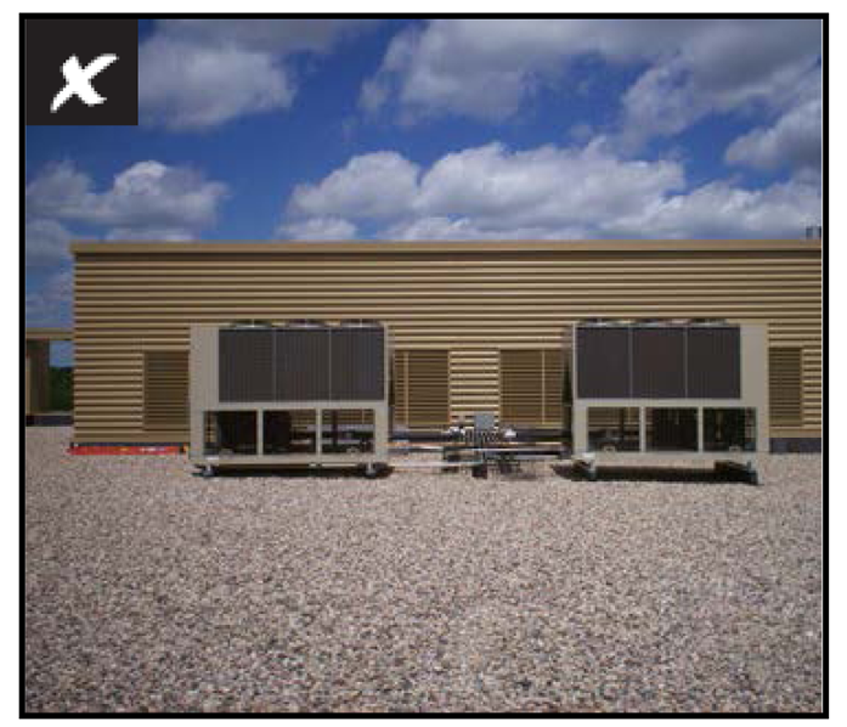
Prominently visible roof-mounted mechanical or utility equipment should be screened. The method of screening or painting should be architecturally integrated with the structure in terms of materials, color, shape and size. Roof-mounted equipment should be located out of the line of sight, where feasible.
Screened Roof-top Equipment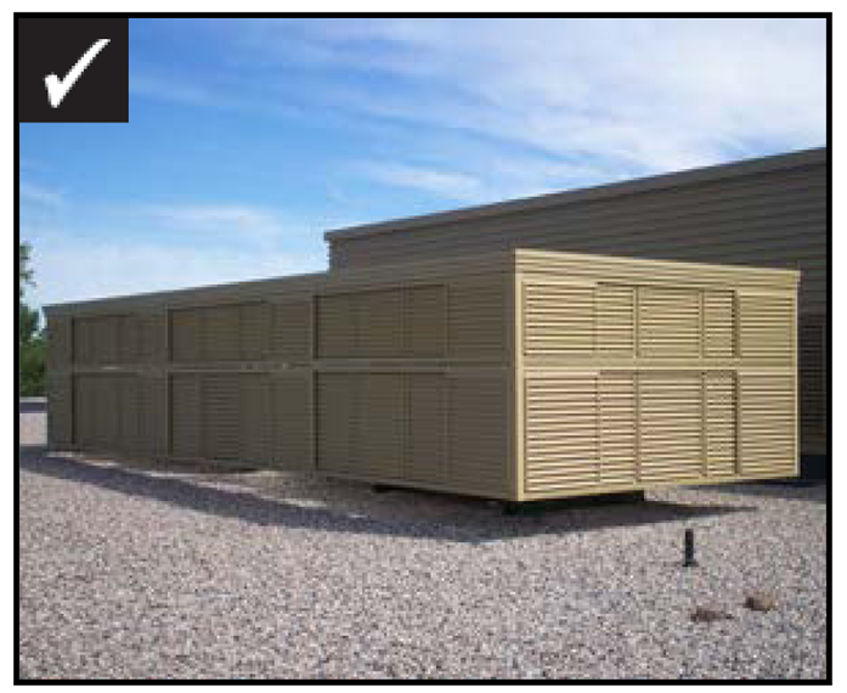
Section 4.3 - Residential Buildings
These requirements shall apply to all new residential construction that is not located within a Historic Preservation Overlay.
A.
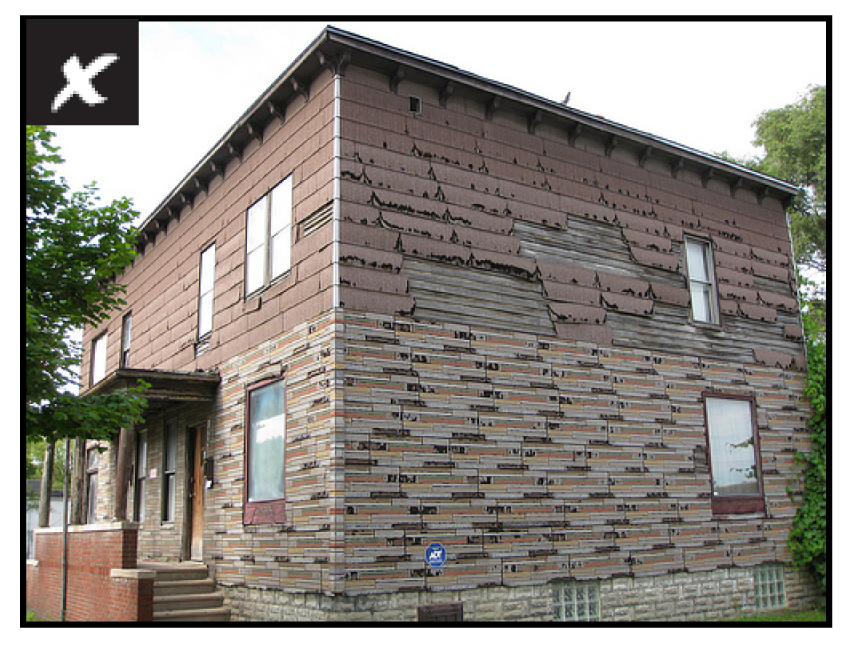
Exterior materials shall be durable and residential in character. Exterior wall materials shall be wood, brick, stone, stucco, vinyl, or similar materials. Roof materials shall be asphalt shingles, standing seam metal, slate, or similar materials.
Wood Shingles and
Clapboard Siding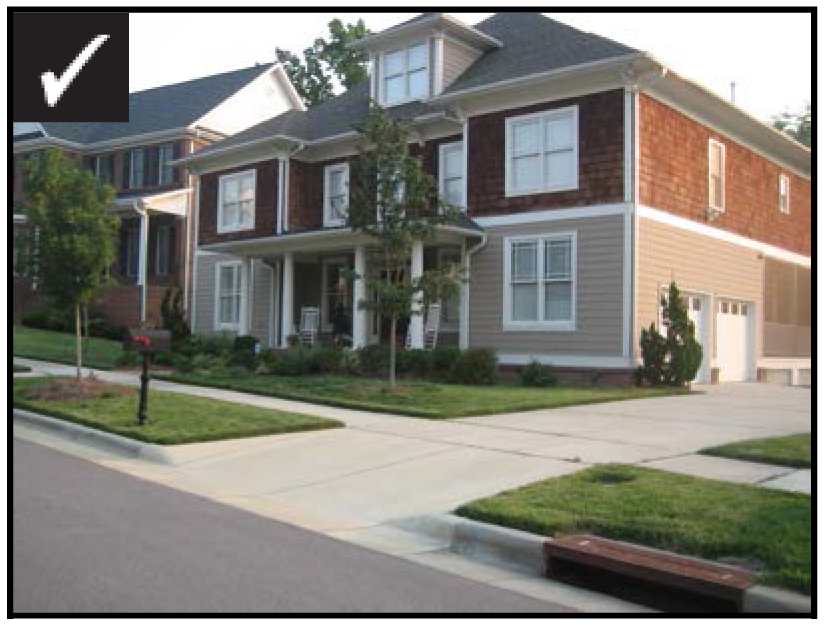
B.
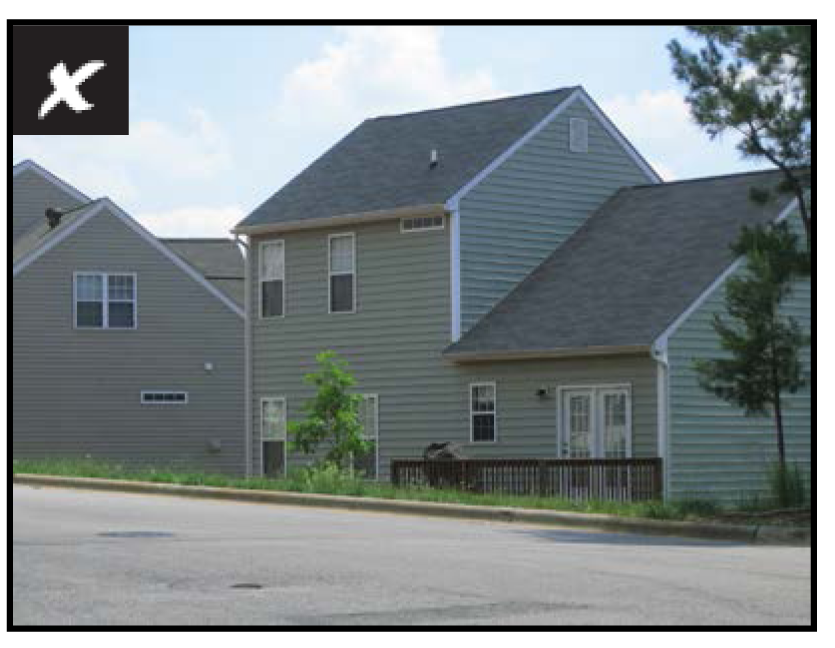
Roofs shall be in scale with the house and shall have an overhang of nine (9) inches or more to facilitate proper water run-off.
Approximately 12-inch Overhang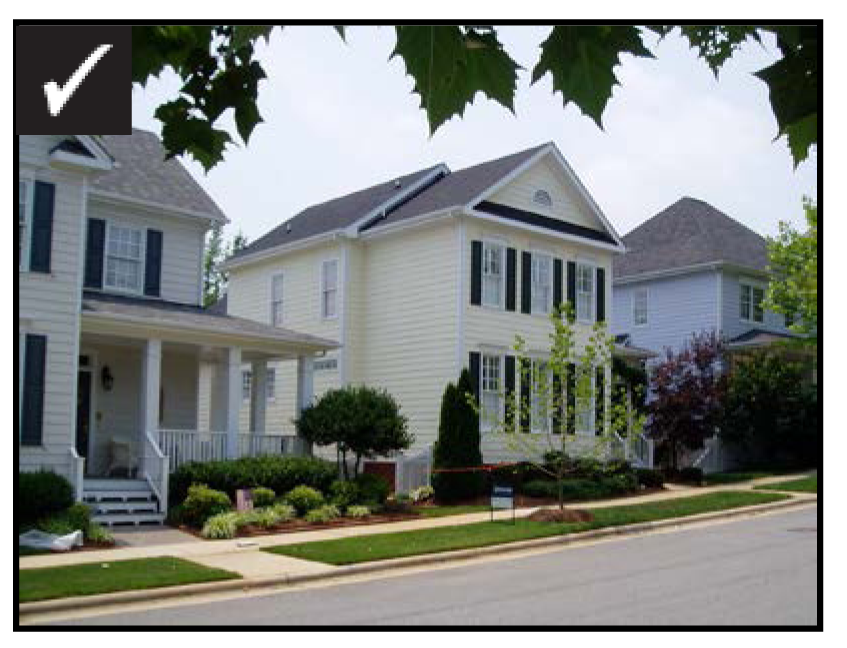
C.
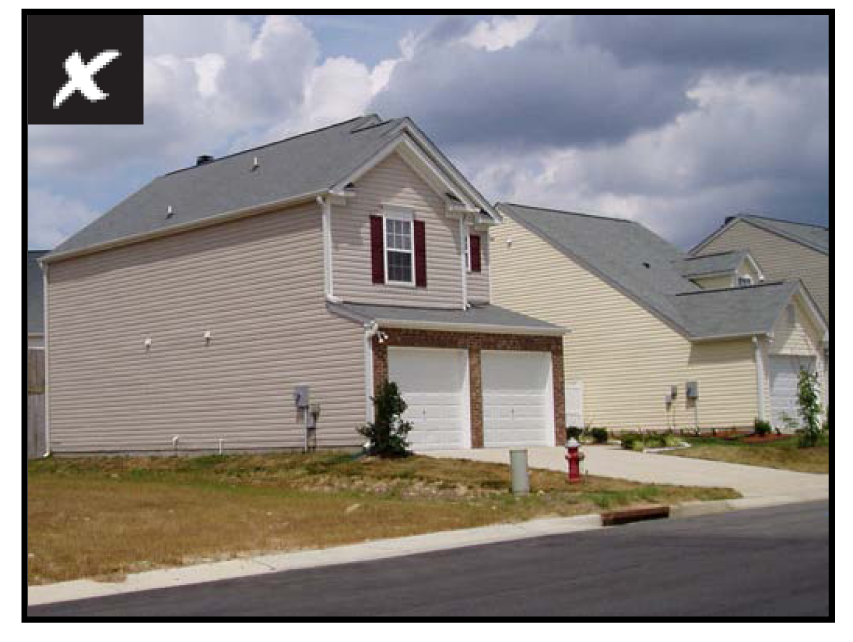
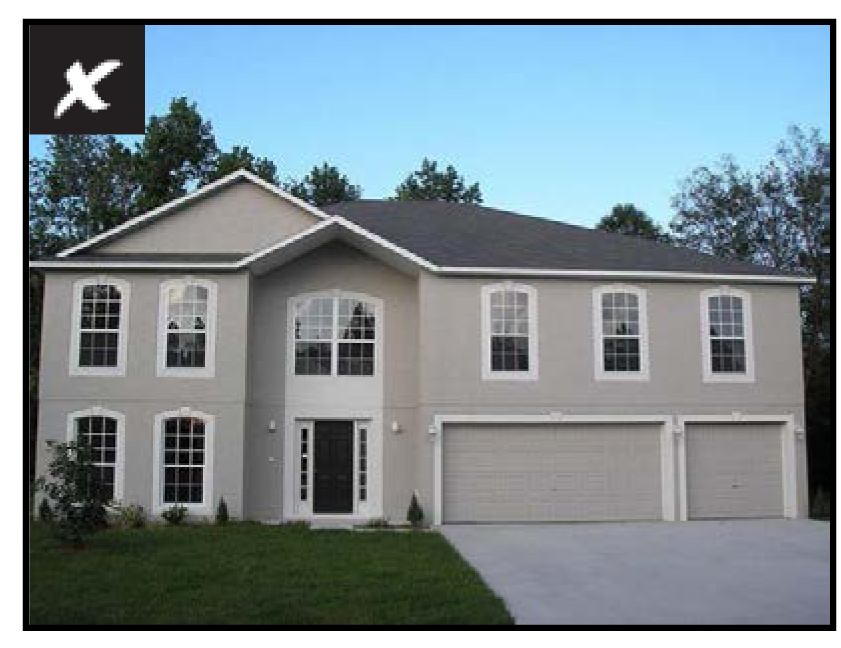
Front loaded garages shall not have visual prominence on the front façade and shall not compose more than 50 percent of the total length of the front elevation.
Recessed Garage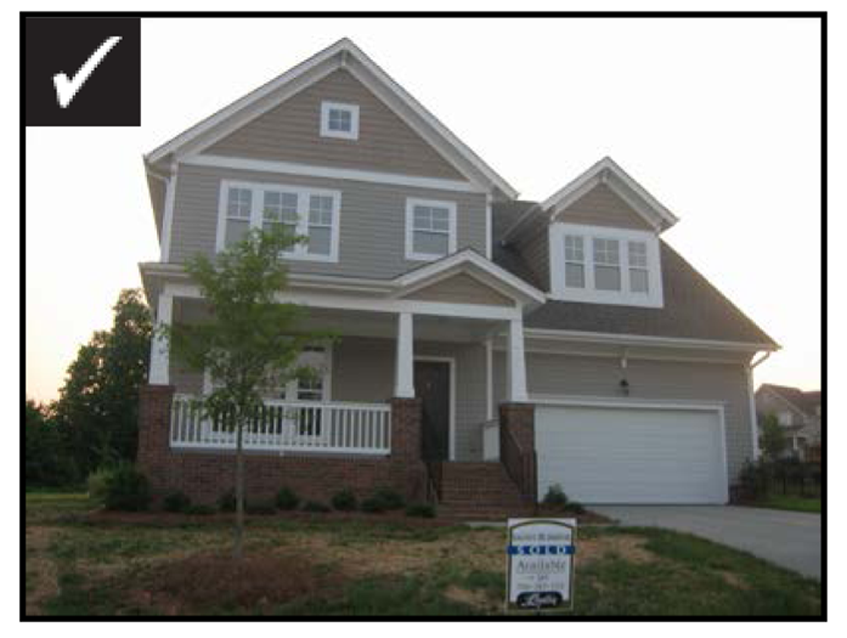
D.
Attached garages for more than two (2) cars should not, wherever possible, face the primary street. Such garages on corner lots may face the non-fronting street.
Side-loaded Three-Car Garage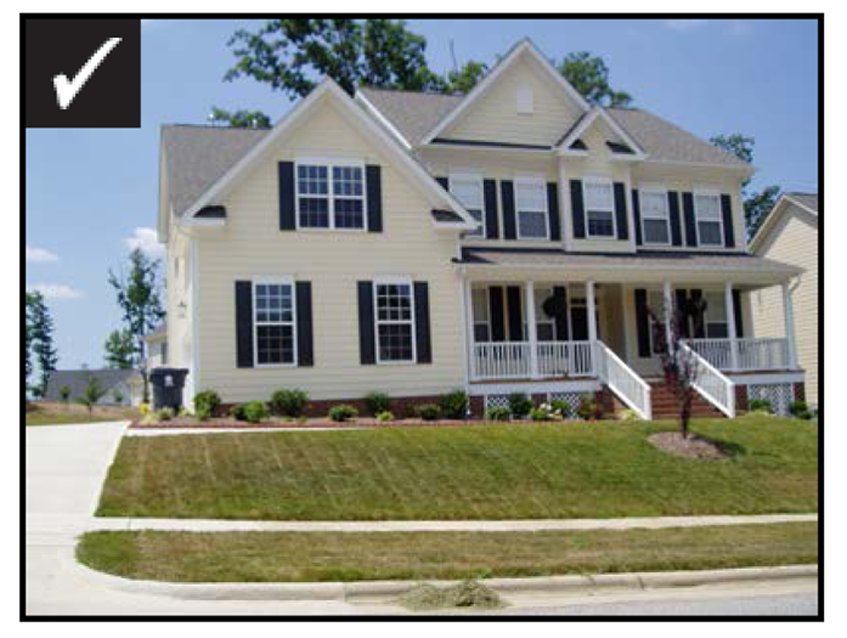
E.
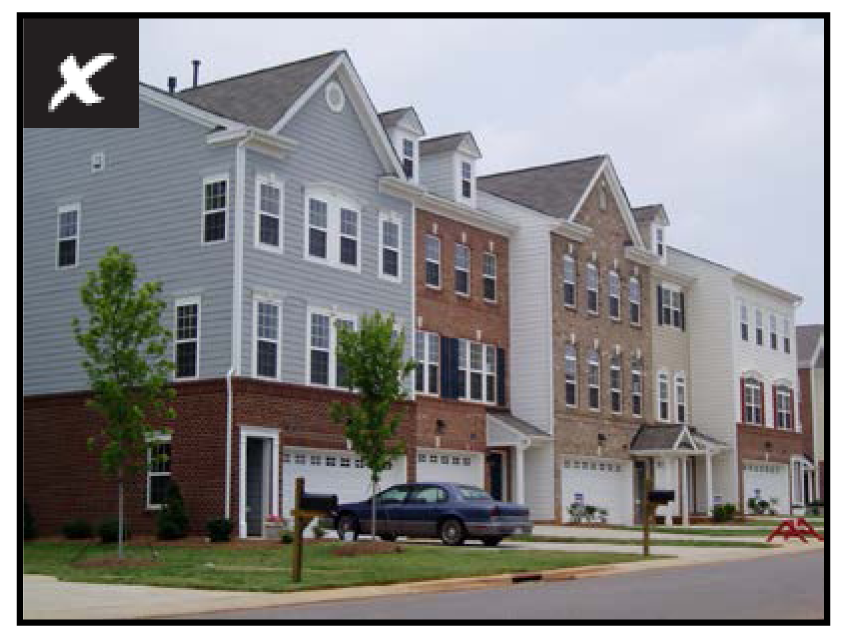
Multiple-car garages on the front façade of any single-family attached or multi-family dwelling unit should utilize separated individual doors.
Single-Car Garage on
Front Facade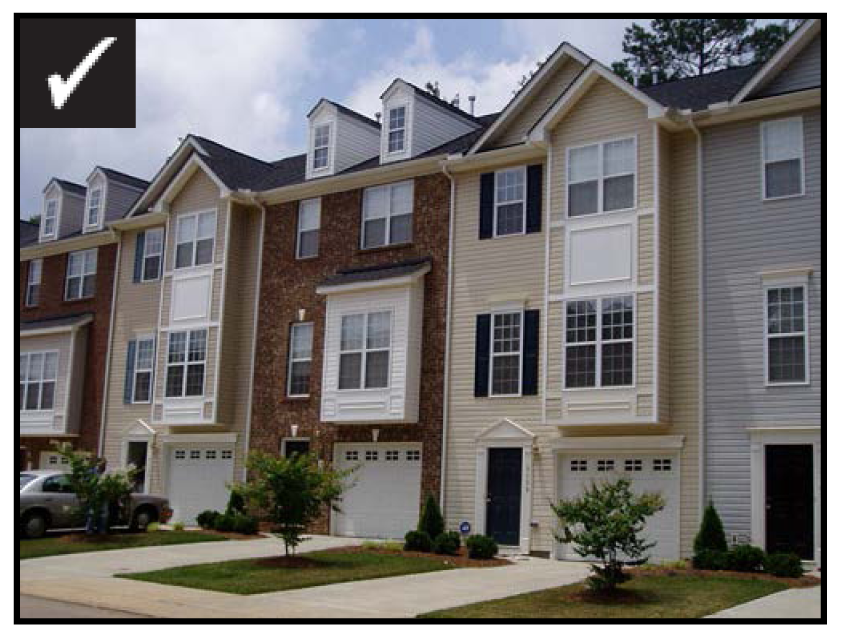
F.
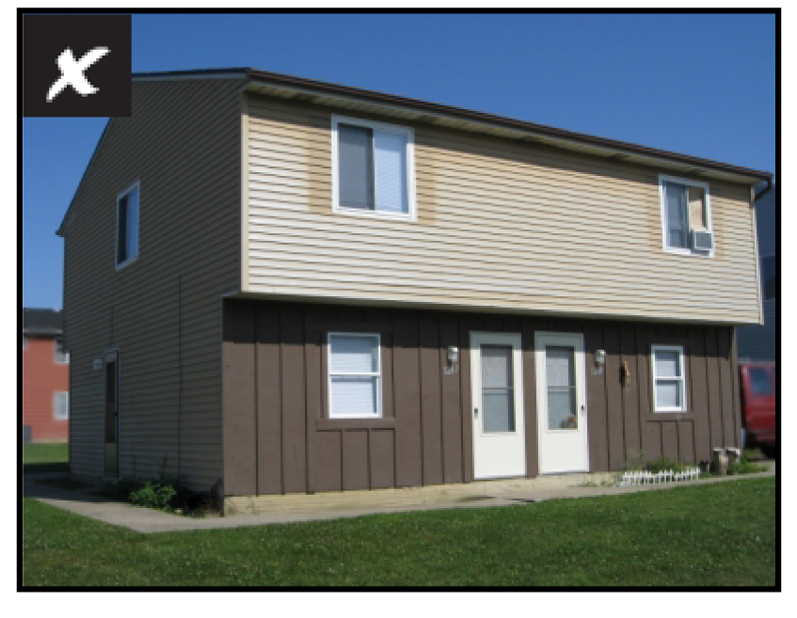
Two-family (duplex) residences shall be designed in such a way that the primary entrances are not both on the same plane of the front façade. Two-family residences are preferred on corner lots with one unit's primary entrance facing one fronting street and the other units facing the other fronting street.
Entrance on Different Plane of Facade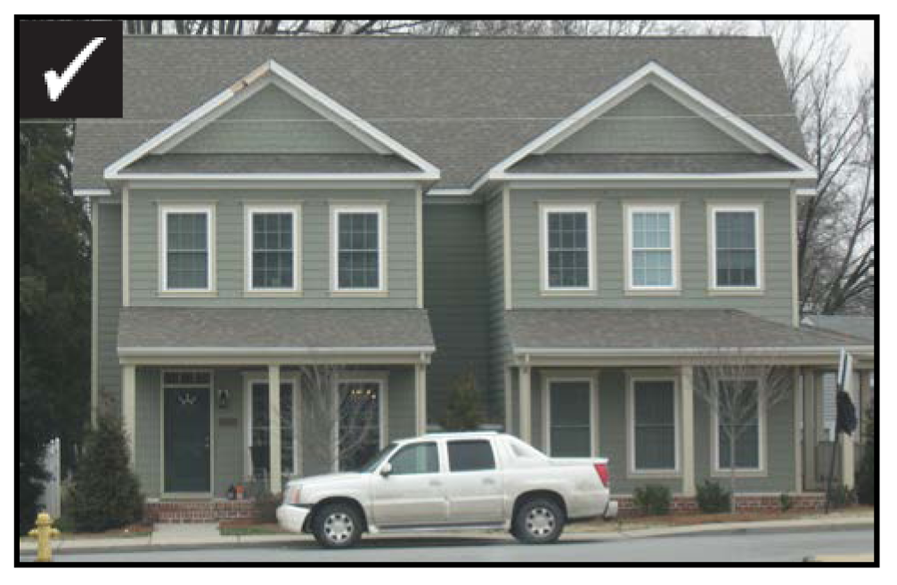
Section 4.4 - Non-residential Buildings
These requirements shall apply to all new non-residential construction that is not located within a Historic Preservation Overlay.
4.4.1 - Materials & Color
A.
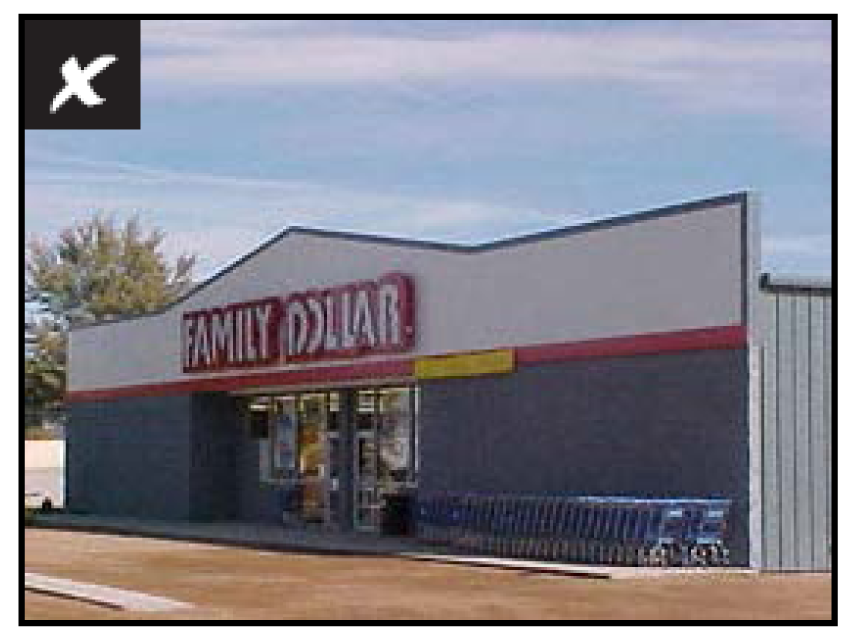
Front facades and exterior walls visible from the public right(s)-of-way shall be at least 75 percent brick, decorative concrete block, stucco, stone, or other materials similar in appearance and durability. Vinyl siding, standard concrete block, cast concrete, metal, and wood may be used on building walls not visible from a public street or as minority elements or accent materials on walls that are visible from the public street provided that they do not compose greater than 25 percent of the façade. Two (2) wall materials may be combined horizontally on one façade. The heavier material should be below. Pitched roofs should be clad in standing seam metal, slate, asphalt shingles, or similar material. All accessory buildings shall be complementary in appearance and architecture to the principal structure.
Brick Facade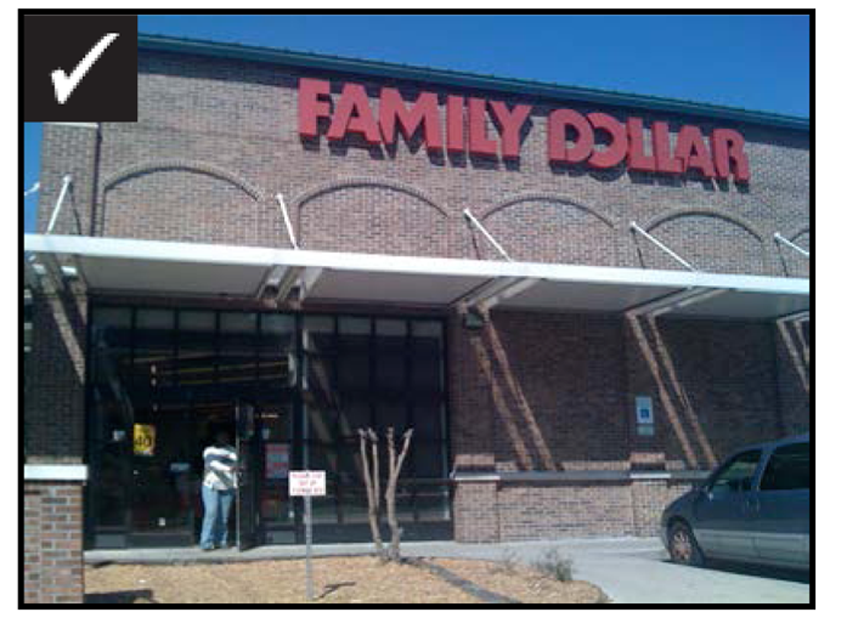
B.
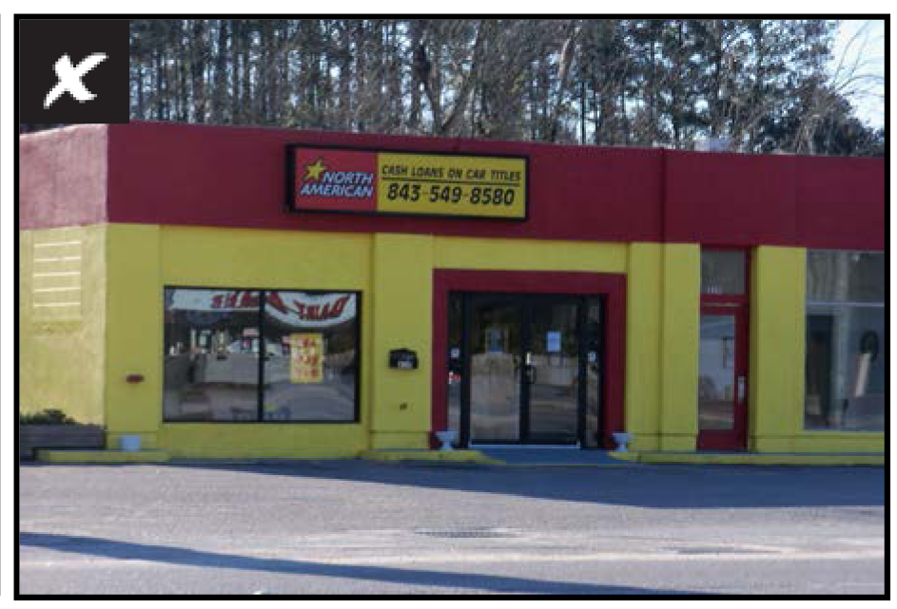
Facade colors shall be of low reflectance earth tone, muted, subtle, or neutral colors. The use of high-intensity, metallic, fluorescent, or neon colors is not permitted. Variations in color schemes are encouraged in order to articulate entryways, architectural features and public amenities so as to give greater recognition to these features.
Muted Neutral Colors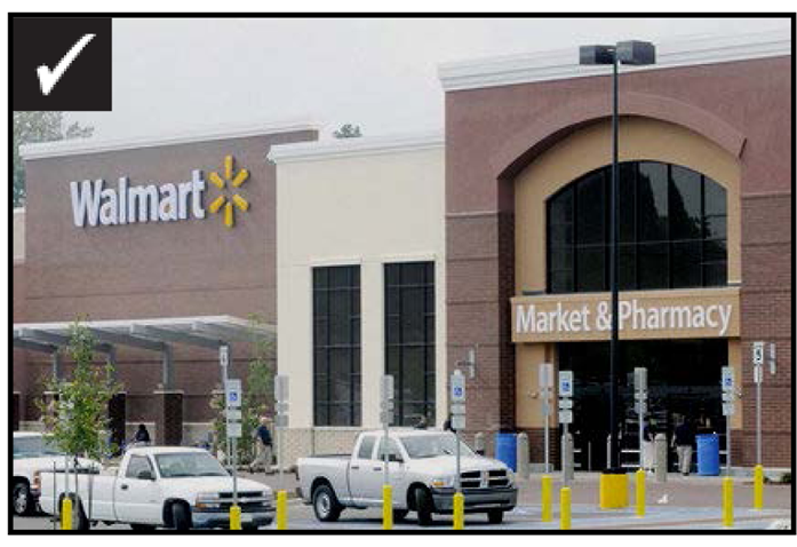
4.4.2 - Building Design
A.
Roof pitches less than 3:12 and flat roofs should incorporate a parapet wall on all sides visible from the adjacent street. Parapet walls should have decorative cornices or caps. Roof lines should be varied to reduce the scale of structures and visual interest.
Parapet with Decorative Cap &
Varied Roof Line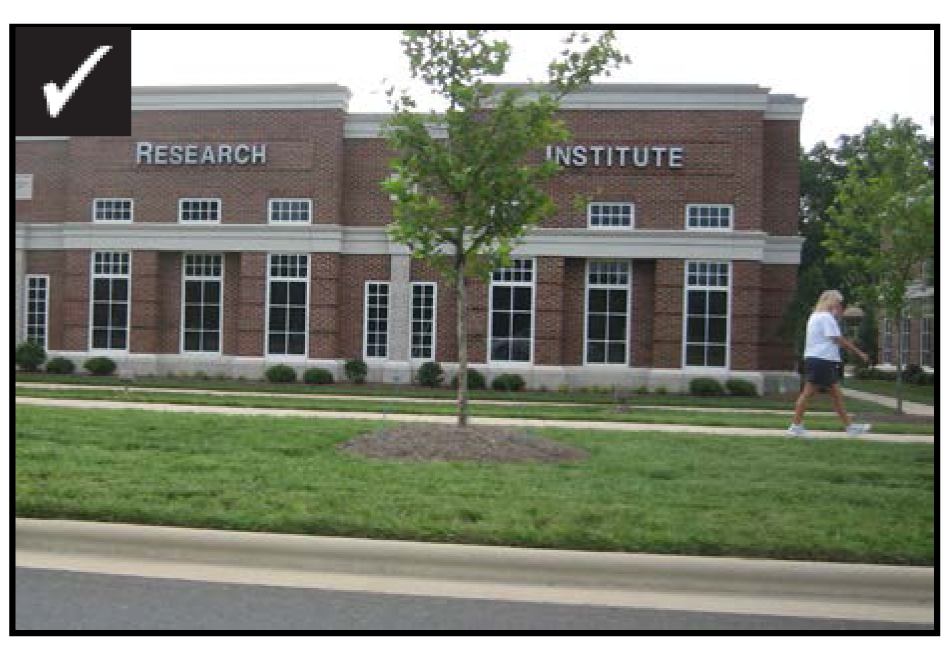
B.
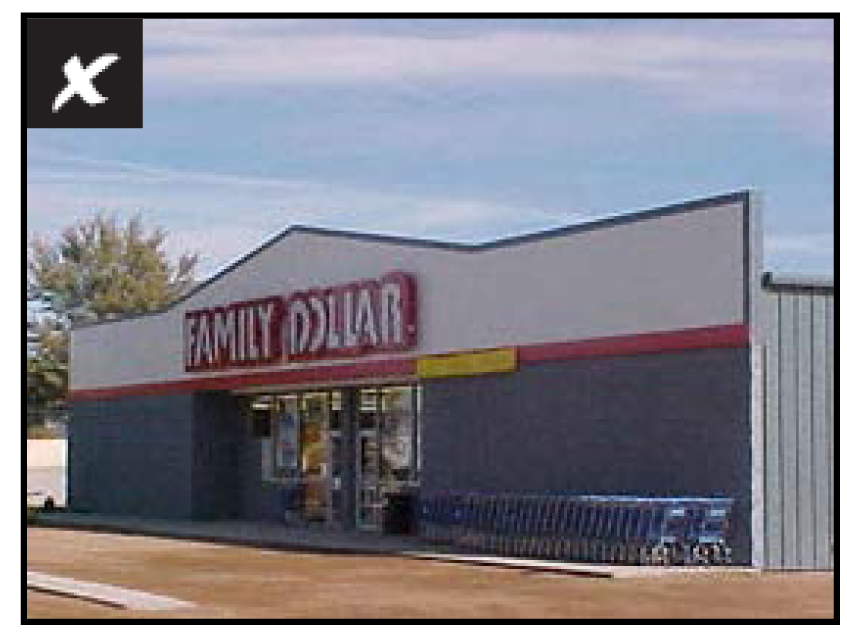
Facades greater than 50 feet in length should incorporate recesses, fenestrations, and projections along at least 20 percent of the length of the façade.
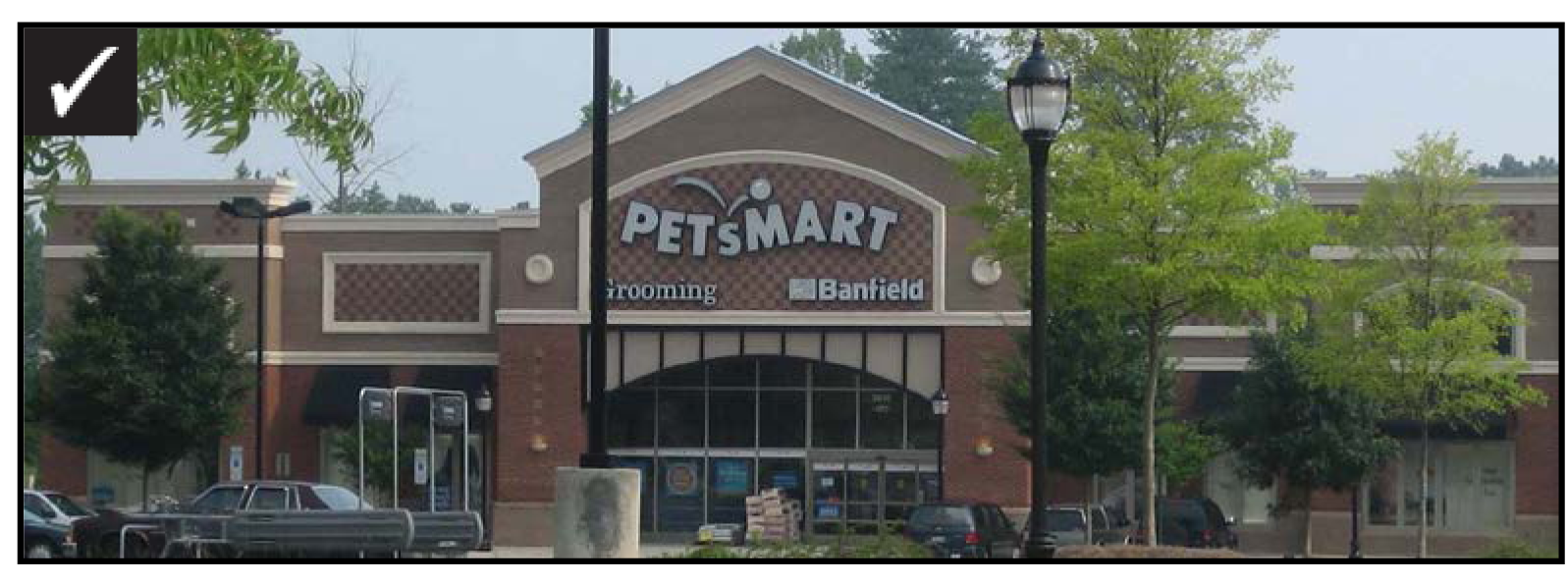
Facade with Recesses & Projections
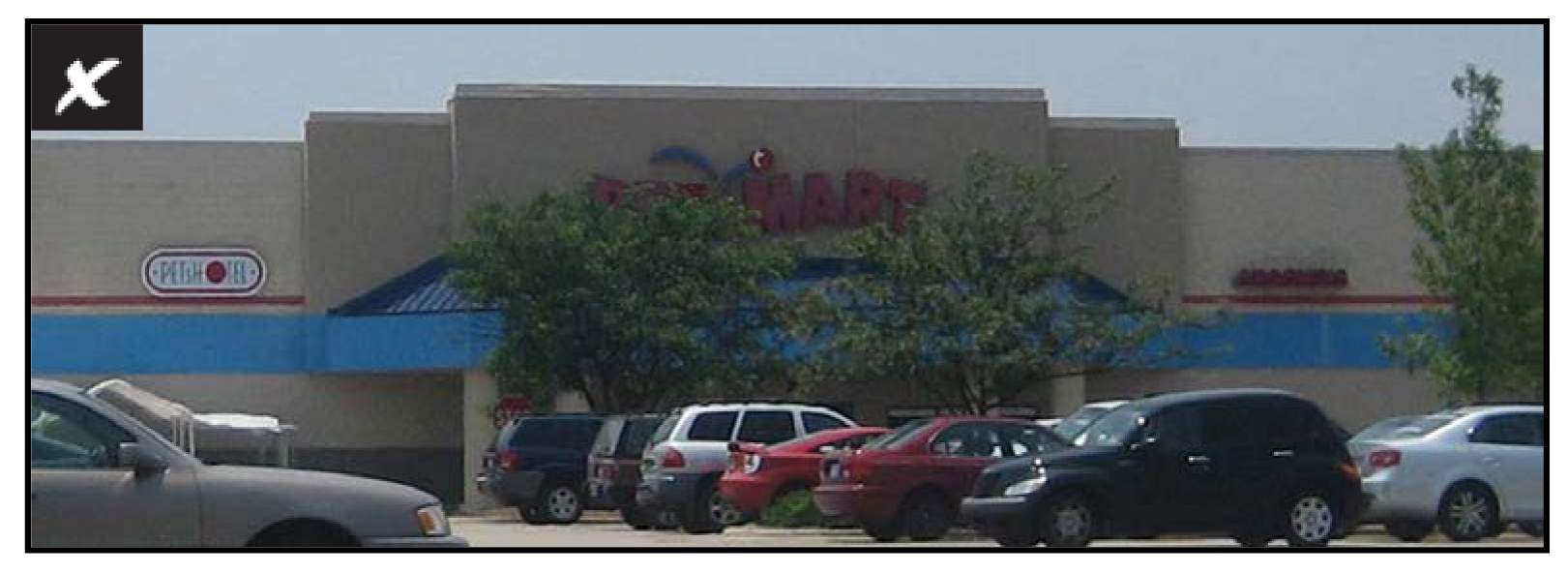
Facade without Recesses & Projections
C.
When used, awnings should be placed at the top of window or doorway openings, and should not extend beyond such openings. No awning shall extend more than the width of the sidewalk or 10 feet, whichever is less. Awnings shall be self-supporting from the wall. No supports should rest on or interfere with the use of pedestrian walkways or streets. In no case, shall any awning extend beyond the street curb or interfere with street trees or public utilities.

4.5.1 - Administrative Design Evaluation
All building design requirements for properties not located in the Historic Preservation Overlay shall be evaluated by the Administrator during the Certificate of Zoning Compliance approval process outlined in Section 11.2.
4.5.2 - Planning Commission Design Evaluation
The Administrator may request that the Planning Commission evaluate alternate design plans, building materials or construction techniques when unreasonable or impractical situations would result from the application of the building design standards of this Chapter for properties not located in a Historic Preservation Overlay. Such situations may result from unique site conditions, innovative design applications, and/or unified development design. The Planning Commission may issue a Design Waiver in accordance with Section 11.4.
4.5.3 - Historic Preservation Commission Design Evaluation
The design guidelines for properties in the Historic Preservation Overlay shall be evaluated by the Historic Preservation Commission during the Certificates of Appropriateness approval process outlined in Section 11.5.
( Ord. No. 2014-08 , 7-22-14)
4.6.1 - Applicability
A.
The policy statements of this Section were developed in 2000 with the adoption of the Design Guidelines for Historic Districts in Walterboro, South Carolina prepared by Winter and Company of Boulder, Colorado. For more detail about design guidelines for residential properties in the Historic Preservation Overlay, refer to this document. This Section shall be used by the Administrator and the Historic Preservation Commission for the evaluation of all Certificate of Appropriateness requests for properties located in the Historic Preservation Overlay as set forth in Section 11.5.
( Ord. No. 2014-08 , 7-22-14)
4.7.1 - Applicability
A.
This Section shall be used by the Administrator and the Historic Preservation Commission for the evaluation of all Certificate of Appropriateness requests for commercial properties located in the Historic Preservation Overlay as set forth in Section 11.5.
( Ord. No. 2014-08 , 7-22-14)
4.7.2 - Purpose of Guidelines
A.
The main intent of these guidelines is to ensure that new construction and proposed alteration of existing properties will not adversely affect the architectural character of Historic Preservation Overlay. These guidelines provide information to property owners about the maintenance, repair, rehabilitation, and historic or distinctive characteristics of the buildings in and around Historic Downtown Walterboro.
B.
The goals of these guidelines are:
1.
To preserve and enhance the aesthetic beauty of the Historic Preservation Overlay.
2.
To protect and celebrate the heritage of Walterboro as exemplified in the architectural characteristics of the buildings and environment.
3.
To preserve and protect older architectural features.
4.
To foster appropriate development within Historic Preservation Overlay.
5.
To maintain a pedestrian friendly environment.
6.
To promote heritage tourism.
7.
To use historic assets for economic development and community revitalization.
( Ord. No. 2014-08 , 7-22-14)
4.7.3 - Existing Structures
4.7.3.1 General Provisions
A.
While it is acknowledged that changes to structures in the Historic Preservation Overlay will occur over time, it is also important to bear in mind that these changes should not do damage to the historic building fabric and character of the district. This character is exactly what gives Walterboro that distinct ambiance that relates to the historic fiber of a small southern town that has survived for over 200 years. Inconsistent improvements will decrease the value of all downtown properties. Preservation of the exteriors and storefronts of these buildings will continue their contribution to the unique architectural character of the area.
B.
Any building renovations or alterations, no matter the planned use for the building, must retain the overall design integrity of the historic building by protecting the original features and materials and respecting the traditional design elements.
C.
The renovation or restoration of older structures provides an excellent means of maintaining and reinforcing the architectural character of Walterboro's traditional downtown and should be encouraged. When an existing structure is to be renovated, restored or expanded, care should be taken to complete the work in a manner that respects the original design character of the structure.
D.
Preservation of traditional façade elements found in the existing buildings creates patterns along the face of the block that contribute to the overall historic character of the area, whether it is on the main streets or a side street. These elements are:
1.
Bulkhead or 'kick plate' as the base in building fronts
2.
Clear first floor storefront windows
3.
Recessed or covered central entrance areas or angled entrances on corners
4.
Transoms above entrance doors
5.
Masonry pier or building frame pilasters
6.
Storefront cornice
7.
Sign panel area
8.
Parapet walls with caps or decorative cornices
9.
Vertical window patterns, shapes, and window sills on second floor
10.
Occasional window hoods
11.
Masonry wall
12.
Corbelling
13.
Upper Cornice
FIG. 4.1: FACADE ELEMENTS
E.
Do not apply theme designs that alter the original character or architectural style such as coach lanterns to make the building look more Colonial, mansard designs to make the building more Victorian, the use of wood shakes to make it look more 'arts and crafts', or anything that cannot be documented historically.
F.
Adding more elaborate ornamentation than was originally found on the building façade is typically inappropriate as it renders a false history to the building.
G.
It is not the intention to recreate the past if the original building façade does not exist. However, if the original façade had been modified over time, and documentary evidence such as photographs of the original features exists, then our recommended alternative is to restore the façade.
H.
Where exact reconstruction is not practical, new, contemporary interpretations of the original details are appropriate as long as the scale and character of the original detail is retained.
I.
Brick was the predominant building material used in the Historic Downtown Walterboro area.
(Ord. No. 2017-14 , 4-3-18)
4.7.3.2 Storefront Renovation and Replacement
A.
Storefront renovation and replacement should retain the original materials wherever possible through repair and restoration.
B.
If the original material has been covered, uncover if feasible.
C.
If portions of the original material must be replaced, use a material similar to the original.
D.
Avoid the use of materials that are not visually compatible with the original façade such as shiny metals, mirror glass, plastic panels, and vinyl windows or doors.
E.
Preserve the original façade materials whenever possible.
F.
Remove metal slip covers when they conceal the original architecture beneath and prevent the horizontal alignment of building elements with adjacent buildings.
G.
Whenever possible, remove any material that conceals traditional façade elements.
H.
Repair, restore, or replace in a manner sympathetic to the style and history of the building.
I.
For most traditional buildings, large panes of glass at the display window level with solid kick plates or bulkhead below are appropriate.
J.
Multi-pane designs that divide the storefront window into small components should only be used if they restore proven historic elements and original openings.
K.
Maintain the original size, shape and proportion of storefronts and openings to retain the historic scale and character of the structure.
L.
Preserve the transom and sign board area features whenever possible.
FIG. 4.2: STOREFRONT REPLACEMENT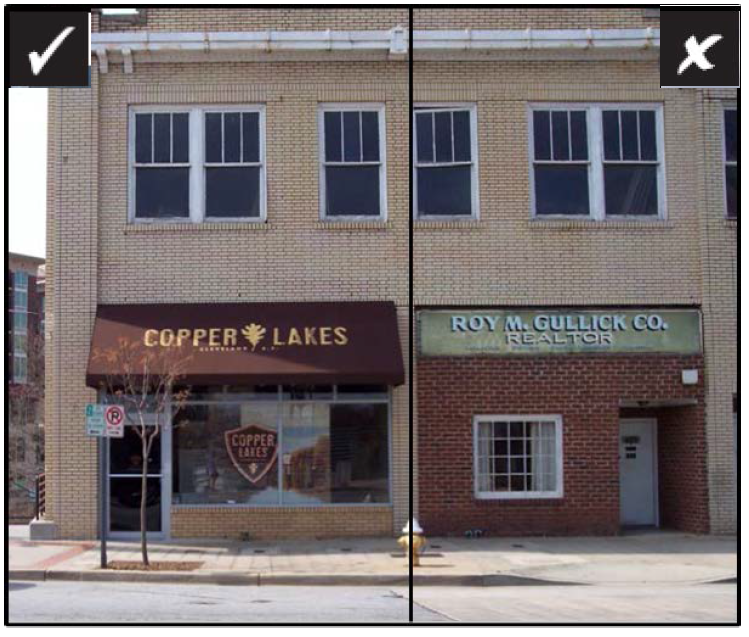
4.7.3.3 Window Renovation & Replacement
A.
Whenever possible, repair, rather than replace existing windows.
B.
If repair is not feasible, and the window must be replaced, match the existing window in terms of size, materials, method of operation and detailing.
C.
The window opening itself should be carefully preserved. It should not be made larger or smaller to accommodate a differently sized window.
D.
Window materials other than wood may be considered provided they replicate the original shapes, detailing and form of the original windows as closely as possible.
E.
If original to the building, shutters may be considered to define the original window proportions.
F.
If lowered ceilings are necessary, pull the dropped ceiling back from the window.
G.
Wood was the traditional material for windows in Historic Downtown Walterboro. However, other materials such as metal or vinyl-clad windows may be utilized provided they replicate the shape, detailing and form of the original windows as closely as possible.
4.7.3.4 Door Renovation and Replacement
A.
Maintain original doors and door hardware whenever possible.
B.
Repair damaged original doors and door assemblies whenever possible following recognized preservation methods.
C.
Retain and preserve the functional, proportional and decorative features of a primary entrance. These features include the door and its frame, sill, head, jamb, moldings, and any flanking windows.
D.
If an original door must be replaced, the replacement door should match the original as closely as possible.
E.
Doors in additions to existing structures should reflect the proportions, both height and width, of doors in the existing structure and similar structures in the Historic Preservation Overlay.
F.
Wood and glass were the traditional materials used for entrance doors in the Historic Preservation Overlay.
G.
Original size and proportion of a front door, the details of the door, the door surround, and the placement of the door all contribute to the character of the entrance.
H.
While it is appropriate to retain, repair and refinish doors, they shall comply with the requirements of the Americans with Disabilities Act (ADA).
4.7.3.5 Awnings or Canopy Renovation and Replacement
A.
Original awing hardware should be used if it is in working order or is repairable.
B.
Replacement awnings should be designed to fit the storefront opening to emphasize the building's proportions.
C.
Awnings should not obscure or damage important architectural details.
D.
Align awnings with others on the block, particularly to the bottom line of the awning.
E.
Metal awnings or canopies that are similar in form to fabric awnings may be appropriate when designed as an integral part of the building façade and not appearing as tacked-on additions.
F.
Awning color should be coordinated with the color scheme of the building. Solid color awnings should be used on building with intricate and abundant architectural detailing, while striped awnings may be utilized on simpler buildings to introduce color and vitality to an otherwise 'plain' building.
G.
Backlit awnings are not appropriate.
H.
The traditional canvas, slanted awnings were traditionally used in Historic Overlay commercial areas and are most appropriate for older storefronts.
4.7.3.6 Replacement of Unavailable Components
A.
Sometimes traditional construction materials cannot be replaced or matched.
B.
Care should be taken to match the original pattern, thickness, color, and texture as closely as possible with available materials.
C.
Repair deteriorated primary building materials by patching, piecing-in, consolidating or otherwise reinforcing the material.
D.
Avoid removing damaged materials when they can be repaired.
4.7.3.7 Removal of Inconsistent Elements
A.
Preserve the original façade materials whenever possible and avoid concealing original façade materials.
B.
Avoid the use of materials that are not visually compatible with the original façade, such as shiny metals, mirror glass, plastic panels, and vinyl windows or doors.
C.
Remove metal slip covers when they conceal the original architecture beneath and prevent the horizontal alignment of building elements with adjacent buildings.
D.
Whenever possible, remove any material that conceals traditional façade elements and repair, restore, or replace in a manner that is sympathetic to the style and history of the building.
E.
As brick was the predominant material used in the façade structure of the downtown buildings, avoid covering or replacing the brick with more modern materials.
F.
Vinyl clad windows and doors may be allowed provided they are detailed in a manner that causes them to appear similar to the original.
4.7.3.8 Painting, Repair, and Cleaning of Existing Structures
A.
Whenever possible, keep historically unpainted buildings unpainted.
B.
If it becomes necessary to paint a building, the color selected should be coordinated with the color of the buildings to the property's right and left.
C.
It is appropriate to paint the cornices, window trim, window hoods, and bulkhead of the façade in a different color from the wall of the building.
D.
Utilize historic and compatible paint colors when painting a storefront façade.
E.
Address maintenance issues to the wall materials prior to painting.
F.
Abrasive methods such as sandblasting are inappropriate, as they permanently erode building materials and finishes and accelerate deterioration.
G.
If cleaning is to be considered, use a low-pressure water wash and mild detergent. Chemical cleaning may also be considered if a test patch is first reviewed and negative effects are not found.
H.
Repair deteriorated primary building materials by patching, piecing-in, consolidating or otherwise reinforcing the material.
I.
Avoid removing damaged material when they can be repaired.
J.
If masonry has been painted; it may be preferable to continue to repaint it, because paint removal methods may cause damage to the building materials and finishes.
K.
Waterproofing and graffiti proofing sealers should be used after cleaning and repair.
4.7.3.9 Additions to Existing Structures
A.
New additions should be interpretations of the existing buildings whereby the architectural characteristics of the existing structure are incorporated using modern construction materials and methods. Examples: the extension of architectural lines from the existing structure to the addition; repetition of window patterns and entrance spacing; use of harmonizing colors and materials; and the inclusion of similar, yet distinct, architectural details.
B.
New additions should be designed so that if the addition were to be removed in the future, the essential form and integrity of the original structure would be unimpaired.
C.
Minor additions, such as decks and stairs should use similar materials, design, and colors to the original building and should occur in areas not visible from the street.
D.
Additions to existing structures within the overlay district are appropriate as long as they do not destroy traditional features, materials, and spatial relationships that are significant to the original building and site.
E.
New additions must be distinguishable from, yet compatible with, the overall architectural character of the Historic Preservation Overlay commercial area.
F.
It is normal for buildings to evolve over a period of time as additional space is needed or new uses are accommodated. Architectural details to be considered include window/door trim, lighting fixtures, tile/brick decoration, decorative cornices, storefront cornices, display windows, the bulkhead and transom over the door and windows.
G.
In other words, all aspects of new construction that are visible from public streets will be reviewed.
4.7.3.10 Demolition & Relocation
A.
If an existing building's condition is deteriorated such that rehabilitation is technically infeasible, a request for demolition may be considered.
B.
If public safety is threatened interim steps may be taken to close and stabilize the structure.
C.
Any application for a demolition shall include plans for the redevelopment of the site after demolition.
D.
It is the responsibility of the property owner to demonstrate that rehabilitation is not appropriate and demonstrate a clear plan for the reuse of the site and any related new construction after demolition.
( Ord. No. 2014-08 , 7-22-14)
4.7.4 - New Structures
A.
New buildings should be designed so that they are similar in mass, scale, rhythm, design, materials, and orientation to surrounding buildings.
B.
New buildings should be oriented close to the street and in line with adjacent buildings.
C.
Window and door patterns that are symmetrical and reflect the historic patterns found in existing buildings should be used.
D.
Infill buildings should not be constructed closer than five (5) feet from a wall with an existing functional window or doorway on the side of an adjacent existing building.
E.
Whenever an infill building is proposed that is much wider than the typical facades on the street, the new building façade should be broken down into a series of appropriately proportioned 'bays.'
F.
Historic styles should not be copied. Each building should be a product of its own time. Contemporary design that is in context with surrounding buildings and is complementary in mass, scale, design, and materials is more appropriate.
G.
Wherever possible, architectural elements on new structures should align with architectural elements on adjacent existing structures. Some façade elements that typically align with adjoining buildings include:
1.
Building kick plates or bulkheads
2.
The top and bottom heights of first floor display windows
3.
Transoms above entrance doors
4.
Clear first floor storefront windows
5.
Awnings & canopies
6.
Upper-story window openings and styles
7.
Sign band above the street level
8.
Parapet and cornice line
9.
Window sills on upper floors
10.
Roof lines
FIG. 4.3: SCALE, MASSING, PROPORTIONS, RHYTHM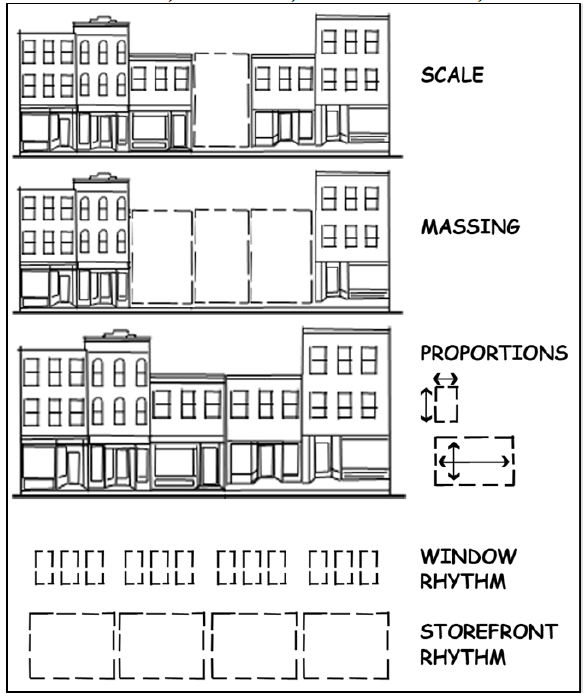
H.
The wall materials of new structures should be selected to coordinate with neighboring structures and the overall context of the commercial area. The following wall materials are generally inappropriate:
1.
Coarsely finished, 'rustic' materials, such as wood shakes, shingles, or plywood
2.
Corrugated metal
3.
Stucco surfaces, especially synthetic stucco applications
4.
Metal slipcovers
5.
Residential-type sliding glass doors
6.
Imitation wood or stone siding
7.
Plastic molded imitations of any conventional building material
8.
Mirror or metalized reflective glass
I.
Accent materials should be similar in texture and scale to others in the district. These include, but are not limited to:
1.
Brick and stone masonry
2.
Wood details such as windows
3.
Clear glass
4.
Ceramic accent tiles
5.
Concrete and stone as lintels and wood or concrete columns
J.
Windows and doors in new structures should be compatible in proportion, shape, location, pattern, size, and material with windows and doors of the characteristic structures in the commercial area.
K.
Colors that are used on new commercial buildings should be coordinated with adjacent structures.
L.
The preferred base colors used on new buildings should be the natural color of the material in the case of brick or stone, of a neutral muted palette or pastels and whites. Deep saturated hues may be used as accents or trim. Brighter, more vivid colors including but not limited to primary colors should be reserved for limited use (no more than 10% of a façade area) as trim or accents. No fluorescent, day-glow, neon, or reflective colors should be used in the construction of a new building.
M.
Awnings should be designed to fit the storefront opening and emphasize the building's proportions and should not obscure or damage important traditional architectural details. Awnings should be aligned with other buildings on the block if at all possible, especially the bottom edge. The top edge should be aligned with the top of the transom. In general, solid color awnings should be used on building with intricate and abundant architectural detailing, while striped awnings might be utilized on simpler buildings to introduce color and vitality. Metal canopies that are similar in form to fabric awnings may be appropriate when designed as an integral part of the building façade and not appearing as tacked-on additions.
( Ord. No. 2014-08 , 7-22-14; Ord. No. 2017-14 , 4-3-18)
4.7.5 - Site Design
A.
New construction and infill buildings should maintain the alignment of facades along the sidewalk edge. Exceptions may be granted if the setback is pedestrian-oriented and contributes to the quality and character of the streetscape such as a park or outdoor dining space.
B.
In instances where a building has been removed, consider utilizing other devices such as landscaping, sculpture, wrought iron fences, arches, etc. to maintain the continuity of the building line.
C.
Buildings should be oriented so as to engage and maintain pedestrian interest. Storefronts should be designed to orient to the major street frontage. While side or rear entries are also encouraged, a predominant building entry should be oriented toward the dominant pedestrian route.
D.
In cases where the functional entry might be to the side or rear of the building such as a hotel with a drop-off area, a physical gesture of entry should still be considered along the major street frontage. Buildings on corners should include entry design features that address both street frontages.
E.
Maintain the established pattern of medians, street trees, and street furnishings in the commercial areas. When a tree must be removed, or where there is a gap in the rhythm of street trees, install new street trees in locations that continue to express the established rhythm.
F.
Maintain alley access for pedestrians and automobiles yet retain the character of alleys as clearly secondary access to properties. Retain and preserve the variety and character found in the existing rear access to buildings along the alleys.
G.
Incorporate pedestrian-scaled street lighting and accent lighting to highlight the building and alleyway entrances.
H.
Service equipment, trash receptacles, or any similar element should be screened from view.
I.
Fence railing designs should reflect an open, transparent feeling while visually closed-in fences and railings prohibit views into the public space and are generally not appropriate. Materials such as metal rails and posts, stone or brick piers, and wood may be used. Decorative elements incorporated into the railing design are encouraged. Generally, metal surfaces should have a black finish although colors that are incorporated as part of a coordinated color plan for the building, or that are used characteristically throughout commercial areas, may be considered. Chain link, ropes, chains, and unsupported railings are unacceptable materials.
( Ord. No. 2014-08 , 7-22-14)

